The Evolution of M-Learning Andrea Howard IT 780 April 21, 2008
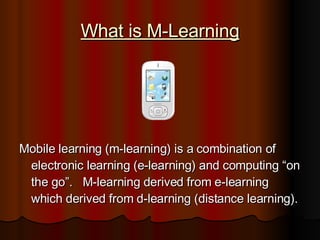
What is M-Learning Mobile learning (m-learning) is a combination of electronic learning (e-learning) and computing “on the go”.  M-learning derived from e-learning which derived from d-learning (distance learning).
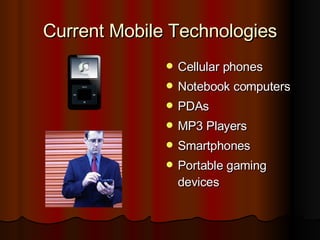
Current Mobile Technologies Cellular phones Notebook computers PDAs  MP3 Players Smartphones Portable gaming devices
Pros  and  Cons  of M-Learning Pros Provides anytime, anywhere access Mobile computing Inexpensive Interactive Paperless Allows for immediate feedback Cons Small screen size Unpredictable connectivity reliability Less personal contact Technology literacy required for students Instructors must continuously monitor and update sites and materials.
M-Learning “Must Have’s” Interactivity- Can users interact with content easily? Reliability- Can users depend on consistency among the content? Ubiquity- Can the user access all content needed at anytime? Access- Is the wireless network available relatively anywhere? Security- How protected is the mobile device and the content? Flexibility- Can the content be viewed on different types of devices and operating systems? Efficiency- What is the required memory for the applications and how quickly will they load? Richness- What is the visual quality of the content? Source: Wagner, Ellen D. (2005). Enabling Mobile Learning.  EDUCAUSE Review,  40(3) 40-53.
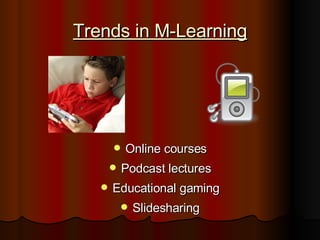
Trends in M-Learning Online courses Podcast lectures Educational gaming Slidesharing
Future of M-Learning Ability to transport both voice data and non-voice data through mobile telephones High speed mobile Internet and data transmission “ Effective mobile learning programs will require new digital communication skills, new pedagogies, and new practices” (Wagner, 2005). Source: Wagner, Ellen D. (2005). Enabling Mobile Learning.  EDUCAUSE Review,  40(3) 40-53.

The Evolution Of M Learning Slideshare

  • 1.
    The Evolution ofM-Learning Andrea Howard IT 780 April 21, 2008
  • 2.
    What is M-LearningMobile learning (m-learning) is a combination of electronic learning (e-learning) and computing “on the go”. M-learning derived from e-learning which derived from d-learning (distance learning).
  • 3.
    Current Mobile TechnologiesCellular phones Notebook computers PDAs MP3 Players Smartphones Portable gaming devices
  • 4.
    Pros and Cons of M-Learning Pros Provides anytime, anywhere access Mobile computing Inexpensive Interactive Paperless Allows for immediate feedback Cons Small screen size Unpredictable connectivity reliability Less personal contact Technology literacy required for students Instructors must continuously monitor and update sites and materials.
  • 5.
    M-Learning “Must Have’s”Interactivity- Can users interact with content easily? Reliability- Can users depend on consistency among the content? Ubiquity- Can the user access all content needed at anytime? Access- Is the wireless network available relatively anywhere? Security- How protected is the mobile device and the content? Flexibility- Can the content be viewed on different types of devices and operating systems? Efficiency- What is the required memory for the applications and how quickly will they load? Richness- What is the visual quality of the content? Source: Wagner, Ellen D. (2005). Enabling Mobile Learning. EDUCAUSE Review, 40(3) 40-53.
  • 6.
    Trends in M-LearningOnline courses Podcast lectures Educational gaming Slidesharing
  • 7.
    Future of M-LearningAbility to transport both voice data and non-voice data through mobile telephones High speed mobile Internet and data transmission “ Effective mobile learning programs will require new digital communication skills, new pedagogies, and new practices” (Wagner, 2005). Source: Wagner, Ellen D. (2005). Enabling Mobile Learning. EDUCAUSE Review, 40(3) 40-53.