USABLE	PRIVACY	
VIVIAN	GENARO	MOTTI	
ASSISTANT	PROFESSOR	
INFORMATION	SCIENCES	AND	TECHNOLOGY	
VOLGENAU	SCHOOL	OF	ENGINEERING	
GEORGE	MASON	UNIVERSITY	
Washington	DC,	March	14th,	2019
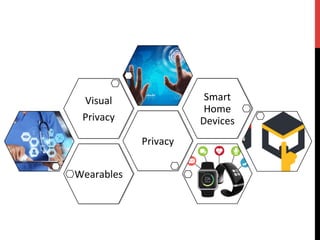
Wearables	
Privacy	
Visual	
Privacy	
Smart	
Home	
Devices
OUTLINE	
•  Contextualization	
•  Theoretical	definitions	vs.	privacy	in	practice	
•  Privacy	studies	
•  Online	reviews	
•  Wearables	and	Smart	Home	Technologies	
•  Imagery	Analysis	
•  Visual	Privacy	
•  Open	questions
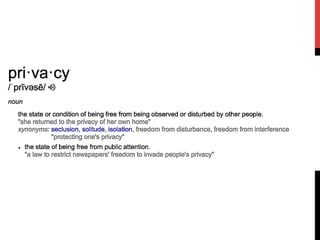
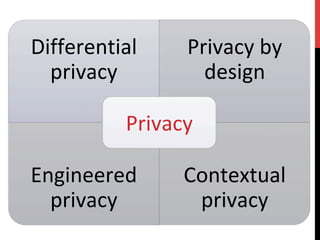
WHAT	IS	PRIVACY?
Differential	
privacy	
Privacy	by	
design	
Engineered	
privacy	
Contextual	
privacy	
Privacy
PRIVACY	IN	PRACTICE
PRIVACY	IN	PRACTICE
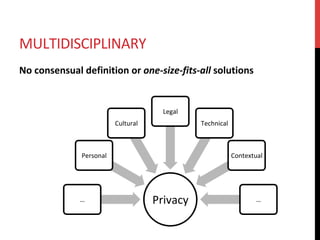
MULTIDISCIPLINARY	
No	consensual	definition	or	one-size-fits-all	solutions	
	
Privacy	…	
Personal	
Cultural	
Legal	
Technical	
Contextual	
…
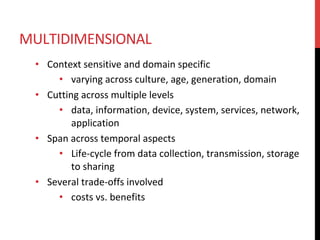
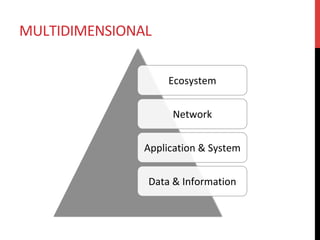
MULTIDIMENSIONAL	
•  Context	sensitive	and	domain	specific	
•  varying	across	culture,	age,	generation,	domain	
•  Cutting	across	multiple	levels	
•  data,	information,	device,	system,	services,	network,	
application	
•  Span	across	temporal	aspects	
•  Life-cycle	from	data	collection,	transmission,	storage	
to	sharing	
•  Several	trade-offs	involved	
•  costs	vs.	benefits
MULTIDIMENSIONAL	
Ecosystem	
Network	
Application	&	System	
Data	&	Information
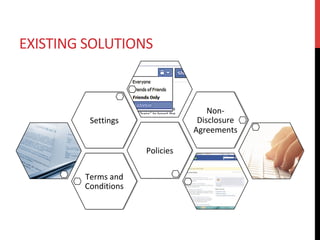
EXISTING	SOLUTIONS	
Terms	and	
Conditions	
Policies	
Settings	
Non-
Disclosure	
Agreements
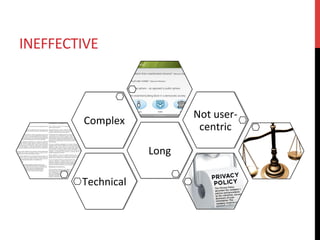
INEFFECTIVE	
Technical	
Long	
Complex	
Not	user-
centric
OPEN	QUESTIONS	
What	are	actual	users’	concerns?	
How	aware	are	users	about	privacy?	
How	users’	consider	privacy	in	practice?	
What	measures	do	they	take?	
What	actions	should	they	take?	
What	are	the	mismatches	among	stakeholders?	
How	can	we	facilitate	adoption?
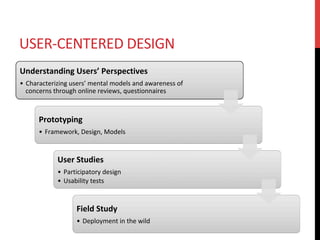
USER-CENTERED	DESIGN	
Understanding	Users’	Perspectives	
•  Characterizing	users’	mental	models	and	awareness	of	
concerns	through	online	reviews,	questionnaires	
Prototyping	
•  Framework,	Design,	Models	
User	Studies	
•  Participatory	design	
•  Usability	tests	
Field	Study	
•  Deployment	in	the	wild
1.	ONLINE	REVIEWS	
•  Wearables	and	Smart	Home	Devices	
•  Major	Findings	
•  ‘I	have	never	thought	about	it…’	
•  Oblivious	users	
•  ‘Pick	your	poison’	
•  Deliberate	choices	
•  ‘I	am	[my	data	is]	not	important’	
•  Unconcerned	users
WEARABLES	
Right	to	forget	
•  ‘it	gives	a	record	of	everything	you’ve	done,	day	in	and	
day	out,	possibly	even	some	things	you	don’t	want	to	be	
reminded	of’	
Location	disclosure	
•  ‘...	stalkers	know	where	you	are	at	all	times	of	the	day,	
know	when	you	go	to	sleep,	riding	a	car,	or	climbing	a	
mountain’
WEARABLES	
Discreet	Display	
•  ‘the	second	screen	will	act	as	sort	of	a	privacy	screen,	
keeping	folks	from	reading	your	texts	by	glancing	at	your	
wrist’	
Surreptitious	Audio	and	Video	Recording	
•  ‘Social	norms	already	frown	on	making	surreptitious	
audio	recordings	(though	it	isn't	illegal,	it	is	done	only	
infrequently	and	with	an	air	of	"secret	agency"	about	it);	
video	is	much	more	of	an	intrusion.’
WEARABLES	
Fear	of	Surveillance	
•  ‘[wearable	devices	are]	the	NSA's	new	best	friend’	
Fear	of	Sousveillence	
•  ‘There's	also	another	challenge	that	affects	not	only	
those	who	wear	Glass,	but	everyone	else	around	privacy’
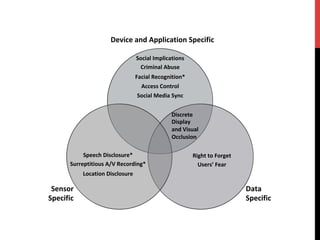
Social	Implications	
Criminal	Abuse	
Facial	Recognition*	
Access	Control	
Social	Media	Sync	
	
Right	to	Forget	
Users’	Fear	
Speech	Disclosure*	
Surreptitious	A/V	Recording*	
Location	Disclosure	
Device	and	Application	Specific	
Sensor	
Specific	
Data	
Specific	
Discrete		
Display		
and	Visual		
Occlusion
2.	VISUAL	PRIVACY	
•  Imagery	analysis
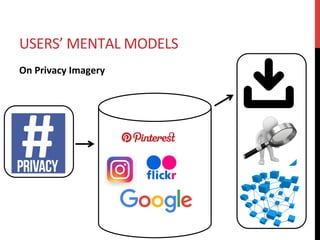
USERS’	MENTAL	MODELS	
On	Privacy	Imagery
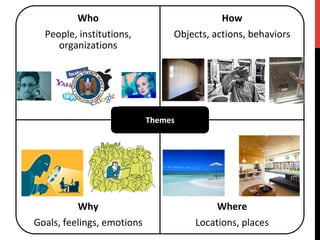
Who	
People,	institutions,	
organizations	
How	
Objects,	actions,	behaviors	
Why	
Goals,	feelings,	emotions	
Where	
Locations,	places	
Themes
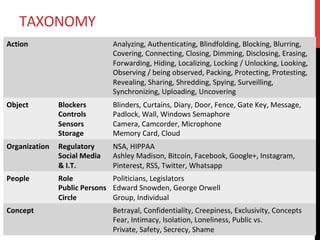
TAXONOMY	
Action	 Analyzing,	Authenticating,	Blindfolding,	Blocking,	Blurring,	
Covering,	Connecting,	Closing,	Dimming,	Disclosing,	Erasing,	
Forwarding,	Hiding,	Localizing,	Locking	/	Unlocking,	Looking,	
Observing	/	being	observed,	Packing,	Protecting,	Protesting,	
Revealing,	Sharing,	Shredding,	Spying,	Surveilling,	
Synchronizing,	Uploading,	Uncovering	
Object	 Blockers	
Controls	
Sensors	
Storage	
Blinders,	Curtains,	Diary,	Door,	Fence,	Gate	Key,	Message,	
Padlock,	Wall,	Windows	Semaphore	
Camera,	Camcorder,	Microphone	
Memory	Card,	Cloud	
Organization	 Regulatory	
Social	Media	
&	I.T.	
NSA,	HIPPAA	
Ashley	Madison,	Bitcoin,	Facebook,	Google+,	Instagram,	
Pinterest,	RSS,	Twitter,	Whatsapp	
People	 Role	
Public	Persons	
Circle	
Politicians,	Legislators	
Edward	Snowden,	George	Orwell	
Group,	Individual	
Concept	 Betrayal,	Confidentiality,	Creepiness,	Exclusivity,	Concepts	
Fear,	Intimacy,	Isolation,	Loneliness,	Public	vs.	
Private,	Safety,	Secrecy,	Shame
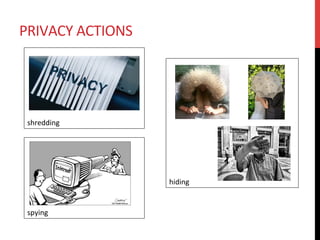
PRIVACY	ACTIONS	


shredding	


hiding	


spying
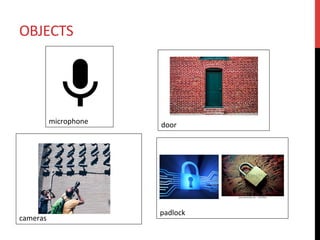
microphone	
OBJECTS	


cameras	


door	


padlock
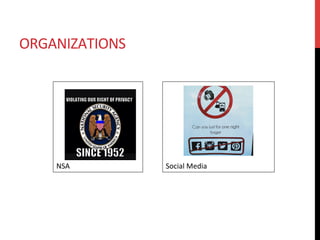
ORGANIZATIONS	


NSA	


Social	Media
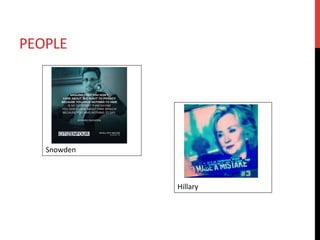
PEOPLE	


Snowden	


Hillary
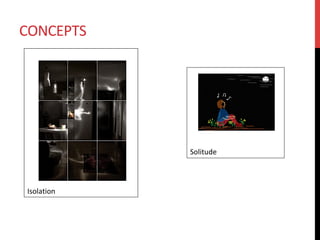
CONCEPTS	


Solitude	


Isolation
FREQUENCY	OF	CODES	
Actions	and	objects	were	the	most	frequent	
•  n=73	and	n=39	
UI	designers	focus	mainly	on	actions	
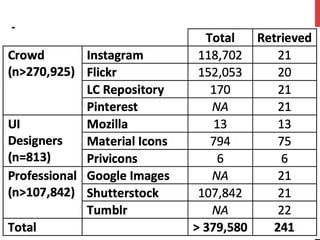
•  Privicons,	Material	icons,	Mozilla	icons	
Variability	
•  Instagram	was	the	most	diverse	source	in	terms	of	codes	
All	codes	were	used		
•  Real	world	actions	
•  Physical	objects	
•  Privacy	mechanisms
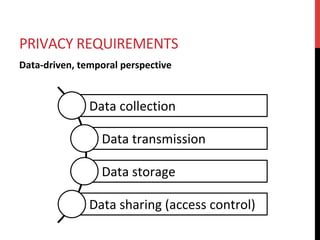
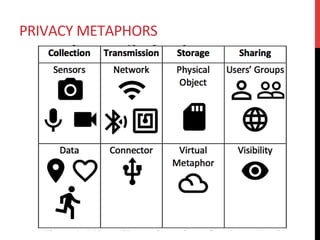
PRIVACY	REQUIREMENTS	
Data-driven,	temporal	perspective		
Data	collection	
Data	transmission	
Data	storage	
Data	sharing	(access	control)
PRIVACY	METAPHORS
OPEN	QUESTIONS	
How	to	train	users	so	that	they	become	more	aware?	
How	to	support	designers	and	developers?	
What	are	the	necessary	tools,	guidelines,	principles,	etc.?	
How	to	simplify	privacy	to	make	it	accessible	and	effective	
for	users	regardless	of	their	profile?	
How	to	devise	privacy	controls?	
…
FUTURE	DIRECTIONS	
•  Quantifiable	privacy	
•  Users’	concerns	and	nudging	
•  Visual	vocabulary	
•  Simplified	language	based	on	mental	models	
•  Privacy	framework	
•  Meta	definition	
•  Personalized	privacy	
•  Universal	models	vs.	individualized	needs
FINAL	REMARKS	
Privacy	is	a	multidisciplinary	concept	
•  Important	but	also	challenging	to	address	with	a	
universal	solution	
	
User-centric	approach	can	help	to	understand	users’	
mental	models	and	aid	to	create	privacy	solutions	that	are	
easier	to	use	
• By	matching	familiar	and	real-world	concepts	with	UI	
design	elements
ACKNOWLEDGMENT	
This	material	is	based	upon	work	supported	by	the	National	Science	
Foundation	 under	 Grant	 No.	 1314342.	 Any	 opinions,	 findings,	 and	
conclusions	or	recommendations	expressed	in	this	material	are	those	
of	 the	 author(s)	 and	 do	 not	 necessarily	 reflect	 the	 views	 of	 the	
National	Science	Foundation.
REFERENCES	
•  CHHETRI,	C.;	MOTTI,	V.	G.	(2019).	Eliciting	Privacy	Concerns	for	Smart	Home	
Devices	from	a	User	Centered	Perspective.	In	Proceedings	of	the	iConference	
2019.	Lecture	Notes	in	Computer	Science.	Springer-Verlag.		
•  LOWENS,	B.;	MOTTI,	V.	G.;	CAINE,	K.	(2017)	Wearable	Privacy:	Skeletons	in	The	
Data	Closet.	In	Proceedings	of	the	IEEE	International	Conference	on	Healthcare	
Informatics.	DOI	10.1109/ICHI.2017.29	[PDF]	[Slides]	
•  MOTTI,	V.	G.	&	CAINE,	K.	E.	(2016).	Towards	a	Visual	Vocabulary	for	Privacy	
Concepts.	In	Proceedings	of	the	Human	Factors	and	Ergonomics	Society	2016	
Annual	Meeting.	Washington	DC,	USA:	Human	Factors	and	Ergonomics	Society.	
September	2016		
•  MOTTI,	V.	G.;	CAINE,	K.	E.	(2015).	Users'	Privacy	Concerns	About	Wearables:	
Impact	of	Form	Factor,	Sensors	and	Type	of	Data	Collected.	In	Proceedings	of	
the	Financial	Cryptography	and	Data	Security	(1st	Workshop	on	Wearable	
Security	and	Privacy).	Lecture	Notes	in	Computer	Science.	Springer-Verlag	
Berlin	Heidelberg,	Vol	8976,	pp.	1-14.	DOI=10.1007/978-3-662-48051-9_16
Q+A	
vmotti@gmu.edu

Usable Privacy