Is the future of HFCs at stake ?
     The F-Gas Regulation 842/2006
              and its revision
                      Andrea Voigt
EPEE, The European Partnership for Energy and the Environment
                   www.epeeglobal.org

                    Milan, 30 March 2012
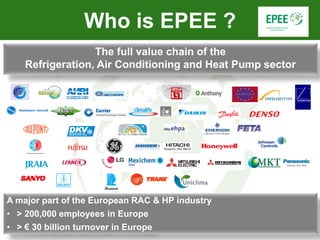
Who is EPEE ?
                  The full value chain of the
    Refrigeration, Air Conditioning and Heat Pump sector


A major part of the European RAC & HP industry
• > 200,000 employees in Europe
• > € 30 billion turnover in Europe
EPEE’s mission is to promote:

               Environmental
                Compliance


   Energy
  Efficiency                   Safety


               Affordability
EPEE’s main fields of activities
• Promote Energy Efficiency
   –   Ecodesign Directive
   –   Energy Efficiency Directive
   –   Eco Label and Energy Label
   –   Energy Performance of Buildings Directive
   –   Renewable Energies Directive …

• The F-Gas Regulation and its revision
   – Maintain and strengthen the F-Gas Regulation
   – Support a technically and economically feasible phase-down

• Raise awareness on Market Surveillance
   – Importance of properly enforcing and policing legislation

• Promote an HVACR association network at EU level
F-Gases:
 The importance of the global context


                                                                                   • By 2050, developing countries
                                                                                     will be responsible for 76% of
                                                                                     global HFC emissions

                             Quick gains on a                                      • Stationary A/C and
                            global level are key                                     Commercial refrigeration will
                                                                                     then account for approx. 60%
                                                                                     of global F-Gas emissions
Source: Projections of global emissions of fluorinated GHG in 2050, Ökorecherche
The global political context

        Montreal Protocol                        UNFCCC


 A: Global           B: No Global
Phase-down           Phase-Down


       EU 20-20-20 targets & EU 2050 low carbon roadmap


    EU                 Bans               F-Gas Reg
Phase-down
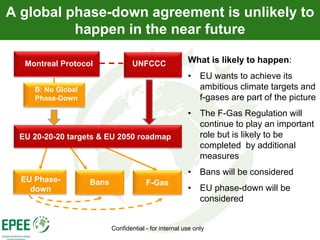
A global phase-down agreement is unlikely to
          happen in the near future

  Montreal Protocol                UNFCCC               What is likely to happen:
                                                        • EU wants to achieve its
     B: No Global                                         ambitious climate targets and
     Phase-Down                                           f-gases are part of the picture
                                                        • The F-Gas Regulation will
                                                          continue to play an important
 EU 20-20-20 targets & EU 2050 roadmap                    role but is likely to be
                                                          completed by additional
                                                          measures
                                                        • Bans will be considered
  EU Phase-         Bans                F-Gas
    down                                                • EU phase-down will be
                                                          considered


                           Confidential - for internal use only
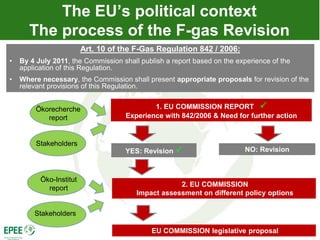
The EU’s political context
      The process of the F-gas Revision
                         Art. 10 of the F-Gas Regulation 842 / 2006:
•   By 4 July 2011, the Commission shall publish a report based on the experience of the
    application of this Regulation.
•   Where necessary, the Commission shall present appropriate proposals for revision of the
    relevant provisions of this Regulation.


         Ökorecherche                        1. EU COMMISSION REPORT 
            report                   Experience with 842/2006 & Need for further action


         Stakeholders
                                     YES: Revision                      NO: Revision


          Öko-Institut
                                                    2. EU COMMISSION
            report
                                        Impact assessment on different policy options

        Stakeholders

                                            EU COMMISSION legislative proposal
Does the F-Gas Regulation work?
YES: it reduces emissions substantially

                                             Source:
                                                          - 46%
                                     - 44%
                                                                  BAU
                          - 28%


                                                                  F-Gas
                                                                  Reg


                                           Source: Commission report Oct 2011

    If all provisions of F-Gas Regulation and MAC Directive are fully
    applied, emissions will at least stabilise at today’s levels despite
    market growth
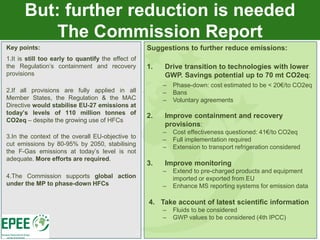
But: further reduction is needed
          The Commission Report
Key points:                                         Suggestions to further reduce emissions:
1.It is still too early to quantify the effect of
the Regulation’s containment and recovery           1.   Drive transition to technologies with lower
provisions                                               GWP. Savings potential up to 70 mt CO2eq:
                                                         –   Phase-down: cost estimated to be < 20€/to CO2eq
2.If all provisions are fully applied in all             –   Bans
Member States, the Regulation & the MAC                  –   Voluntary agreements
Directive would stabilise EU-27 emissions at
today’s levels of 110 million tonnes of
                                                    2.   Improve containment and recovery
CO2eq – despite the growing use of HFCs
                                                         provisions:
                                                         –   Cost effectiveness questioned: 41€/to CO2eq
3.In the context of the overall EU-objective to
                                                         –   Full implementation required
cut emissions by 80-95% by 2050, stabilising
                                                         –   Extension to transport refrigeration considered
the F-Gas emissions at today’s level is not
adequate. More efforts are required.
                                                    3.   Improve monitoring
                                                         –   Extend to pre-charged products and equipment
4.The Commission supports global action                      imported or exported from EU
under the MP to phase-down HFCs                          –   Enhance MS reporting systems for emission data

                                                    4. Take account of latest scientific information
                                                         –   Fluids to be considered
                                                         –   GWP values to be considered (4th IPCC)
EU Commission stakeholder meeting Feb 13:
       „There is no silver bullet“
 • COM confirms the will to revise the F-gas regulation
 • Legislative proposal expected in the autumn 2012
 • COM believes a policy mix is necessary to take into account the
   different characteristics of various sectors. Main options:
     – Voluntary agreements
     – Improve containment (scope, standards,...)
     – Progressively limiting supply of F gases (phase-down)
     – Certain use and marketing prohibitions for new equipment (bans)
 • COM recognizes that there is no silver bullet in terms of refrigerants
 • A great majority of stakeholders from industry, non-governmental
   organisations and environmental agencies support the phase-down
   principle
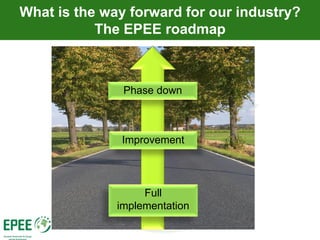
What is the way forward for our industry?
           The EPEE roadmap


               Phase down


              Improvement


                   Full
              implementation
Introduction

• The following results are based on latest scientific data of the French
  research bodies ARMINES and ERIE.
• The full study « previsions on banks and emissions from 2006 to
  2030 for the European Union » is available upon request from EPEE.
• The study develops two scenarios (F-Gas & F-Gas Plus) on how
  emissions, banks and demand could develop from 2010 until 2030.
  The F-Gas scenario is based on current market trends, the F-Gas Plus
  scenario is based on an accelerated introduction of lower GWP
  refrigerants.

        Results include “best non-available technologies” for which
        currently no feasibility studies have been carried out by
        product (OEM) manufacturers.
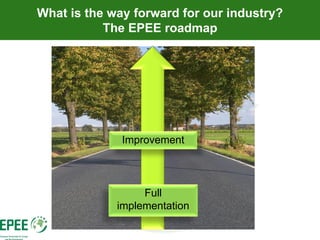
What is the way forward for our industry?
           The EPEE roadmap


                   Full
              implementation
1. Full Implementation of the F-Gas Reg.:
     At least 15% emission reduction
                                                       •   1990 – 2010: -13%
                                                           Despite more than a
                                                           doubling of the
                                                           refrigerant bank (from
         1990-2010                2010-2030
                                                           200kt to 510kt), CO2 eq
                                                           emissions decreased
                                                           by 13% (from 170 to
                                                           147million tonnes).

                                                       •   2010 – 2030: -15%
                                                           Market growth suggests
                                                           a growth of the bank by
           -13%                       -15%                 75% (from 510kt to
                                                           900kt), but CO2eq
                                                           emissions are set to
                                                           decrease further by at
                                                           least 15% (from 147 to
                                                           124 million tonnes).

    Source: ARMINES/ERIE 2011: previsions on banks and emissions in the EU, « F-Gas Scenario »
1.1 Full implementation – Key success factors:
         Incorporation of current market trends
• Introduction of new technologies
• Introduction of lower GWP refrigerants
• Retrofits and renewal of HCFC equipment
• Refrigerant choice is a key success factor

        Examples for the potential refrigerant mix in 2030
     Supermarkets                  Split A/C > 5 kW                            Warehouses


                    Source: ARMINES/ERIE 2011, « F-Gas Scenario ». *REF700 = refrigerant/blend with GWP<700
1.2 Full implementation – Key success factors:
Lower emission factors – higher recovery efficiency

        2010 vs 2030                                           2010 vs 2030


 Lower emission factors                                Higher recovery
 (average values per application)                  efficiency at end of life
                                                 (average values per application)

         Source: ARMINES/ERIE 2011: previsions on banks and emissions in the EU, « F-Gas Scenario »
What is the way forward for our industry?
           The EPEE roadmap


              Improvement


                  Full
             implementation
2. Improvements
     Potential to further increase emission reduction
General:                                            Measures targeted at member states:
 •   Broadening of the scope: Refrigerated           •   Ensure systematic controls by assigned
     transport should be included.                       market surveillance authorities in the
Measures targeted at operators:                          member states. The European Commission
                                                         should start infringement procedures if
 •   Information campaigns to make sure that
                                                         Member States are not compliant with the F-
     operators understand their obligations and
                                                         Gas rules.
     improve compliance.
Measures targeted at installers:                    Strong EU-wide standards:
                                                     •   Reduction of emission rates: EN 378…
 •   Extend liability to companies/personnel who
     interfere with or break into the refrigerant    •   Mutual recognition of training         and
     circuit.                                            certification schemes: CEN 13313

Measures targeted at sales channel                  End of life:
 •   Distributors and retailers should only be       •   Recovery, recycling and reclaim of
     allowed to sell refrigerant and/or                  refrigerants need to be improved by
     subcontract work to duly certified                  incentivizing installers and operators
     companies.
                                                     •   Reduce administrative burden related to
                                                         transportation of recovered refrigerants.
What is the way forward for our industry?
           The EPEE roadmap


              Phase down


              Improvement


                  Full
             implementation
3. Phase-Down
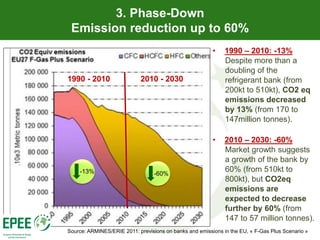
 Emission reduction up to 60%
                                                         •    1990 – 2010: -13%
                                                              Despite more than a
                                                              doubling of the
1990 - 2010                 2010 - 2030                       refrigerant bank (from
                                                              200kt to 510kt), CO2 eq
                                                              emissions decreased
                                                              by 13% (from 170 to
                                                              147million tonnes).

                                                         •    2010 – 2030: -60%
                                                              Market growth suggests
                                                              a growth of the bank by
    -13%                          -60%
                                                              60% (from 510kt to
                                                              800kt), but CO2eq
                                                              emissions are
                                                              expected to decrease
                                                              further by 60% (from
                                                              147 to 57 million tonnes).
Source: ARMINES/ERIE 2011: previsions on banks and emissions in the EU, « F-Gas Plus Scenario »
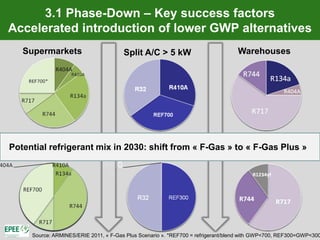
3.1 Phase-Down – Key success factors
Accelerated introduction of lower GWP alternatives
   Supermarkets                        Split A/C > 5 kW                           Warehouses


Potential refrigerant mix in 2030: shift from « F-Gas » to « F-Gas Plus »


     Source: ARMINES/ERIE 2011, « F-Gas Plus Scenario ». *REF700 = refrigerant/blend with GWP<700, REF300=GWP<300
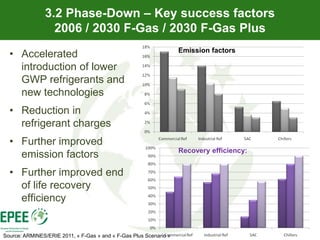
3.2 Phase-Down – Key success factors
                 2006 / 2030 F-Gas / 2030 F-Gas Plus
                                                                   Emission factors
  • Accelerated
    introduction of lower
    GWP refrigerants and
    new technologies
  • Reduction in
    refrigerant charges
  • Further improved
                                                                   Recovery efficiency:
    emission factors
  • Further improved end
    of life recovery
    efficiency


Source: ARMINES/ERIE 2011, « F-Gas » and « F-Gas Plus Scenario »
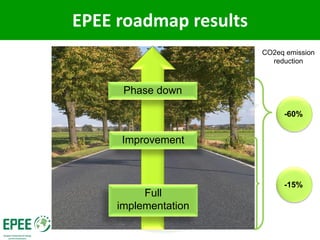
EPEE roadmap results
                       CO2eq emission
                         reduction


      Phase down

                            -60%


     Improvement


                            -15%
          Full
     implementation
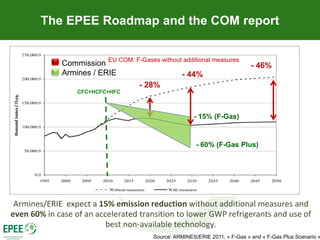
The EPEE Roadmap and the COM report


             Commission EU COM: F-Gases without additional measures          - 46%
             Armines / ERIE                    - 44%
                                    - 28%
                  CFC+HCFC+HFC


                                                       - 15% (F-Gas)


                                                        - 60% (F-Gas Plus)


 Armines/ERIE expect a 15% emission reduction without additional measures and
even 60% in case of an accelerated transition to lower GWP refrigerants and use of
                          best non-available technology.
                                        Source: ARMINES/ERIE 2011, « F-Gas » and « F-Gas Plus Scenario »
Conclusion:
           EPEE’s five main recommendations

1.   EPEE calls for a holistic approach with a focus on overall CO2
     emissions

2.   Four attributes (Safety, Environment, Economy and Energy
     Efficiency) must be taken into consideration when making decisions

3.   Energy efficiency and safety are key for industry and society

4.   A realistic and balanced phase-down provides regulatory
     certainty on CO2 equivalents => along with energy efficiency
     mandates, this ensures success for 2020 and for future targets

5.   No prescriptive bans as these may turn out to be counter
     productive for energy efficient systems

Voigt EPEE - 15th European Conference CSG

  • 1.
    Is the futureof HFCs at stake ? The F-Gas Regulation 842/2006 and its revision Andrea Voigt EPEE, The European Partnership for Energy and the Environment www.epeeglobal.org Milan, 30 March 2012
  • 2.
    Who is EPEE? The full value chain of the Refrigeration, Air Conditioning and Heat Pump sector A major part of the European RAC & HP industry • > 200,000 employees in Europe • > € 30 billion turnover in Europe
  • 3.
    EPEE’s mission isto promote: Environmental Compliance Energy Efficiency Safety Affordability
  • 4.
    EPEE’s main fieldsof activities • Promote Energy Efficiency – Ecodesign Directive – Energy Efficiency Directive – Eco Label and Energy Label – Energy Performance of Buildings Directive – Renewable Energies Directive … • The F-Gas Regulation and its revision – Maintain and strengthen the F-Gas Regulation – Support a technically and economically feasible phase-down • Raise awareness on Market Surveillance – Importance of properly enforcing and policing legislation • Promote an HVACR association network at EU level
  • 5.
    F-Gases: The importanceof the global context • By 2050, developing countries will be responsible for 76% of global HFC emissions Quick gains on a • Stationary A/C and global level are key Commercial refrigeration will then account for approx. 60% of global F-Gas emissions Source: Projections of global emissions of fluorinated GHG in 2050, Ökorecherche
  • 6.
    The global politicalcontext Montreal Protocol UNFCCC A: Global B: No Global Phase-down Phase-Down EU 20-20-20 targets & EU 2050 low carbon roadmap EU Bans F-Gas Reg Phase-down
  • 7.
    A global phase-downagreement is unlikely to happen in the near future Montreal Protocol UNFCCC What is likely to happen: • EU wants to achieve its B: No Global ambitious climate targets and Phase-Down f-gases are part of the picture • The F-Gas Regulation will continue to play an important EU 20-20-20 targets & EU 2050 roadmap role but is likely to be completed by additional measures • Bans will be considered EU Phase- Bans F-Gas down • EU phase-down will be considered Confidential - for internal use only
  • 8.
    The EU’s politicalcontext The process of the F-gas Revision Art. 10 of the F-Gas Regulation 842 / 2006: • By 4 July 2011, the Commission shall publish a report based on the experience of the application of this Regulation. • Where necessary, the Commission shall present appropriate proposals for revision of the relevant provisions of this Regulation. Ökorecherche 1. EU COMMISSION REPORT  report Experience with 842/2006 & Need for further action Stakeholders YES: Revision  NO: Revision Öko-Institut 2. EU COMMISSION report Impact assessment on different policy options Stakeholders EU COMMISSION legislative proposal
  • 9.
    Does the F-GasRegulation work? YES: it reduces emissions substantially Source: - 46% - 44% BAU - 28% F-Gas Reg Source: Commission report Oct 2011 If all provisions of F-Gas Regulation and MAC Directive are fully applied, emissions will at least stabilise at today’s levels despite market growth
  • 10.
    But: further reductionis needed The Commission Report Key points: Suggestions to further reduce emissions: 1.It is still too early to quantify the effect of the Regulation’s containment and recovery 1. Drive transition to technologies with lower provisions GWP. Savings potential up to 70 mt CO2eq: – Phase-down: cost estimated to be < 20€/to CO2eq 2.If all provisions are fully applied in all – Bans Member States, the Regulation & the MAC – Voluntary agreements Directive would stabilise EU-27 emissions at today’s levels of 110 million tonnes of 2. Improve containment and recovery CO2eq – despite the growing use of HFCs provisions: – Cost effectiveness questioned: 41€/to CO2eq 3.In the context of the overall EU-objective to – Full implementation required cut emissions by 80-95% by 2050, stabilising – Extension to transport refrigeration considered the F-Gas emissions at today’s level is not adequate. More efforts are required. 3. Improve monitoring – Extend to pre-charged products and equipment 4.The Commission supports global action imported or exported from EU under the MP to phase-down HFCs – Enhance MS reporting systems for emission data 4. Take account of latest scientific information – Fluids to be considered – GWP values to be considered (4th IPCC)
  • 11.
    EU Commission stakeholdermeeting Feb 13: „There is no silver bullet“ • COM confirms the will to revise the F-gas regulation • Legislative proposal expected in the autumn 2012 • COM believes a policy mix is necessary to take into account the different characteristics of various sectors. Main options: – Voluntary agreements – Improve containment (scope, standards,...) – Progressively limiting supply of F gases (phase-down) – Certain use and marketing prohibitions for new equipment (bans) • COM recognizes that there is no silver bullet in terms of refrigerants • A great majority of stakeholders from industry, non-governmental organisations and environmental agencies support the phase-down principle
  • 12.
    What is theway forward for our industry? The EPEE roadmap Phase down Improvement Full implementation
  • 13.
    Introduction • The followingresults are based on latest scientific data of the French research bodies ARMINES and ERIE. • The full study « previsions on banks and emissions from 2006 to 2030 for the European Union » is available upon request from EPEE. • The study develops two scenarios (F-Gas & F-Gas Plus) on how emissions, banks and demand could develop from 2010 until 2030. The F-Gas scenario is based on current market trends, the F-Gas Plus scenario is based on an accelerated introduction of lower GWP refrigerants. Results include “best non-available technologies” for which currently no feasibility studies have been carried out by product (OEM) manufacturers.
  • 14.
    What is theway forward for our industry? The EPEE roadmap Full implementation
  • 15.
    1. Full Implementationof the F-Gas Reg.: At least 15% emission reduction • 1990 – 2010: -13% Despite more than a doubling of the refrigerant bank (from 1990-2010 2010-2030 200kt to 510kt), CO2 eq emissions decreased by 13% (from 170 to 147million tonnes). • 2010 – 2030: -15% Market growth suggests a growth of the bank by -13% -15% 75% (from 510kt to 900kt), but CO2eq emissions are set to decrease further by at least 15% (from 147 to 124 million tonnes). Source: ARMINES/ERIE 2011: previsions on banks and emissions in the EU, « F-Gas Scenario »
  • 16.
    1.1 Full implementation– Key success factors: Incorporation of current market trends • Introduction of new technologies • Introduction of lower GWP refrigerants • Retrofits and renewal of HCFC equipment • Refrigerant choice is a key success factor Examples for the potential refrigerant mix in 2030 Supermarkets Split A/C > 5 kW Warehouses Source: ARMINES/ERIE 2011, « F-Gas Scenario ». *REF700 = refrigerant/blend with GWP<700
  • 17.
    1.2 Full implementation– Key success factors: Lower emission factors – higher recovery efficiency 2010 vs 2030 2010 vs 2030 Lower emission factors Higher recovery (average values per application) efficiency at end of life (average values per application) Source: ARMINES/ERIE 2011: previsions on banks and emissions in the EU, « F-Gas Scenario »
  • 18.
    What is theway forward for our industry? The EPEE roadmap Improvement Full implementation
  • 19.
    2. Improvements Potential to further increase emission reduction General: Measures targeted at member states: • Broadening of the scope: Refrigerated • Ensure systematic controls by assigned transport should be included. market surveillance authorities in the Measures targeted at operators: member states. The European Commission should start infringement procedures if • Information campaigns to make sure that Member States are not compliant with the F- operators understand their obligations and Gas rules. improve compliance. Measures targeted at installers: Strong EU-wide standards: • Reduction of emission rates: EN 378… • Extend liability to companies/personnel who interfere with or break into the refrigerant • Mutual recognition of training and circuit. certification schemes: CEN 13313 Measures targeted at sales channel End of life: • Distributors and retailers should only be • Recovery, recycling and reclaim of allowed to sell refrigerant and/or refrigerants need to be improved by subcontract work to duly certified incentivizing installers and operators companies. • Reduce administrative burden related to transportation of recovered refrigerants.
  • 20.
    What is theway forward for our industry? The EPEE roadmap Phase down Improvement Full implementation
  • 21.
    3. Phase-Down Emissionreduction up to 60% • 1990 – 2010: -13% Despite more than a doubling of the 1990 - 2010 2010 - 2030 refrigerant bank (from 200kt to 510kt), CO2 eq emissions decreased by 13% (from 170 to 147million tonnes). • 2010 – 2030: -60% Market growth suggests a growth of the bank by -13% -60% 60% (from 510kt to 800kt), but CO2eq emissions are expected to decrease further by 60% (from 147 to 57 million tonnes). Source: ARMINES/ERIE 2011: previsions on banks and emissions in the EU, « F-Gas Plus Scenario »
  • 22.
    3.1 Phase-Down –Key success factors Accelerated introduction of lower GWP alternatives Supermarkets Split A/C > 5 kW Warehouses Potential refrigerant mix in 2030: shift from « F-Gas » to « F-Gas Plus » Source: ARMINES/ERIE 2011, « F-Gas Plus Scenario ». *REF700 = refrigerant/blend with GWP<700, REF300=GWP<300
  • 23.
    3.2 Phase-Down –Key success factors 2006 / 2030 F-Gas / 2030 F-Gas Plus Emission factors • Accelerated introduction of lower GWP refrigerants and new technologies • Reduction in refrigerant charges • Further improved Recovery efficiency: emission factors • Further improved end of life recovery efficiency Source: ARMINES/ERIE 2011, « F-Gas » and « F-Gas Plus Scenario »
  • 24.
    EPEE roadmap results CO2eq emission reduction Phase down -60% Improvement -15% Full implementation
  • 25.
    The EPEE Roadmapand the COM report Commission EU COM: F-Gases without additional measures - 46% Armines / ERIE - 44% - 28% CFC+HCFC+HFC - 15% (F-Gas) - 60% (F-Gas Plus) Armines/ERIE expect a 15% emission reduction without additional measures and even 60% in case of an accelerated transition to lower GWP refrigerants and use of best non-available technology. Source: ARMINES/ERIE 2011, « F-Gas » and « F-Gas Plus Scenario »
  • 26.
    Conclusion: EPEE’s five main recommendations 1. EPEE calls for a holistic approach with a focus on overall CO2 emissions 2. Four attributes (Safety, Environment, Economy and Energy Efficiency) must be taken into consideration when making decisions 3. Energy efficiency and safety are key for industry and society 4. A realistic and balanced phase-down provides regulatory certainty on CO2 equivalents => along with energy efficiency mandates, this ensures success for 2020 and for future targets 5. No prescriptive bans as these may turn out to be counter productive for energy efficient systems