Prepared by Mario Machado
Specialties | Workplace Risk
Introduction & Background
Introduction
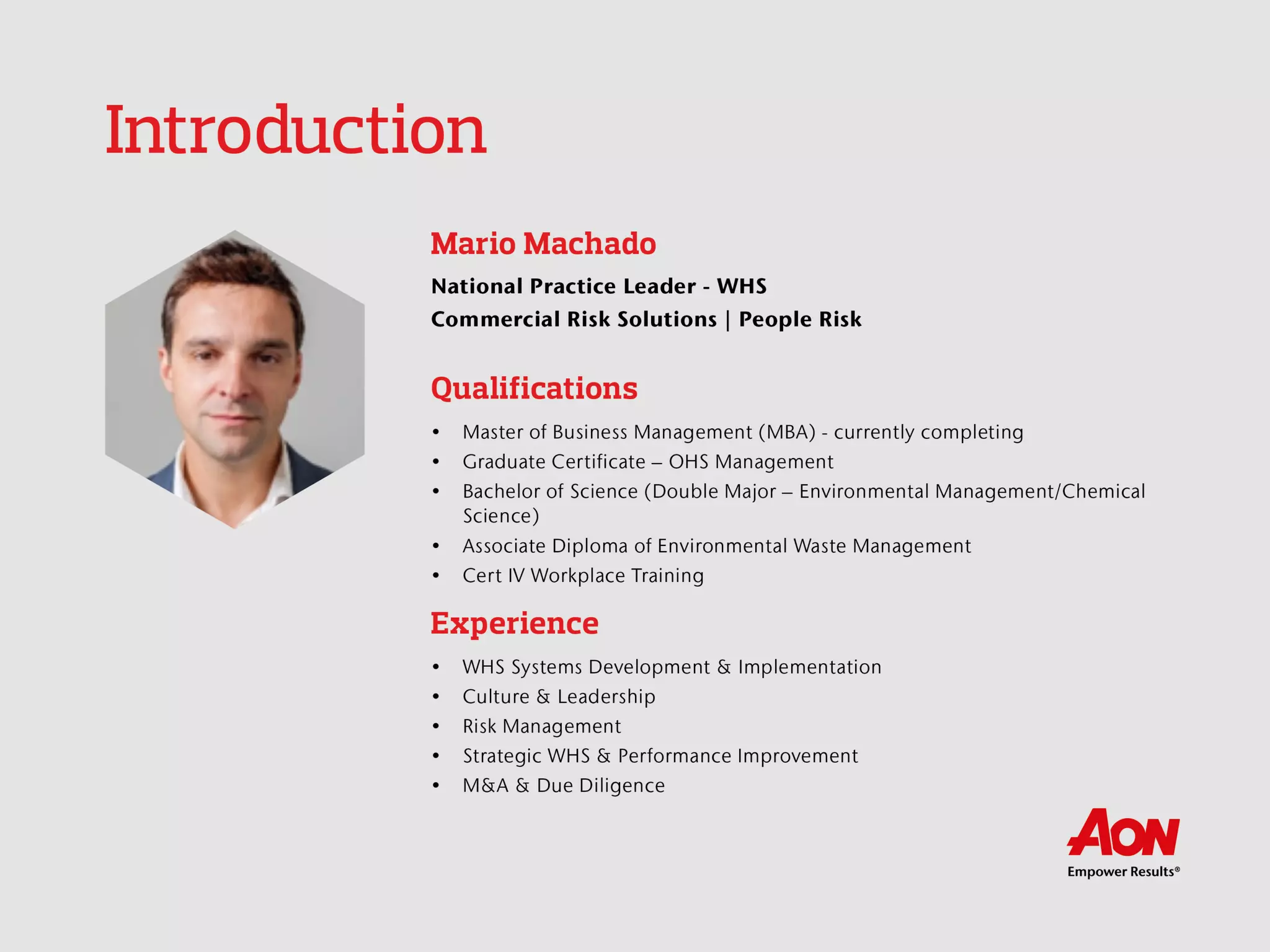
Mario Machado
National Practice Leader - WHS
Commercial Risk Solutions | People Risk
Qualifications
 Master of Business Management (MBA) - currently completing
 Graduate Certificate – OHS Management
 Bachelor of Science (Double Major – Environmental
Management/Chemical Science)
 Associate Diploma of Environmental Waste Management
 Cert IV Workplace Training
Experience
 WHS Systems Development & Implementation
 Culture & Leadership
 Risk Management
 Strategic WHS & Performance Improvement
 M&A & Due Diligence
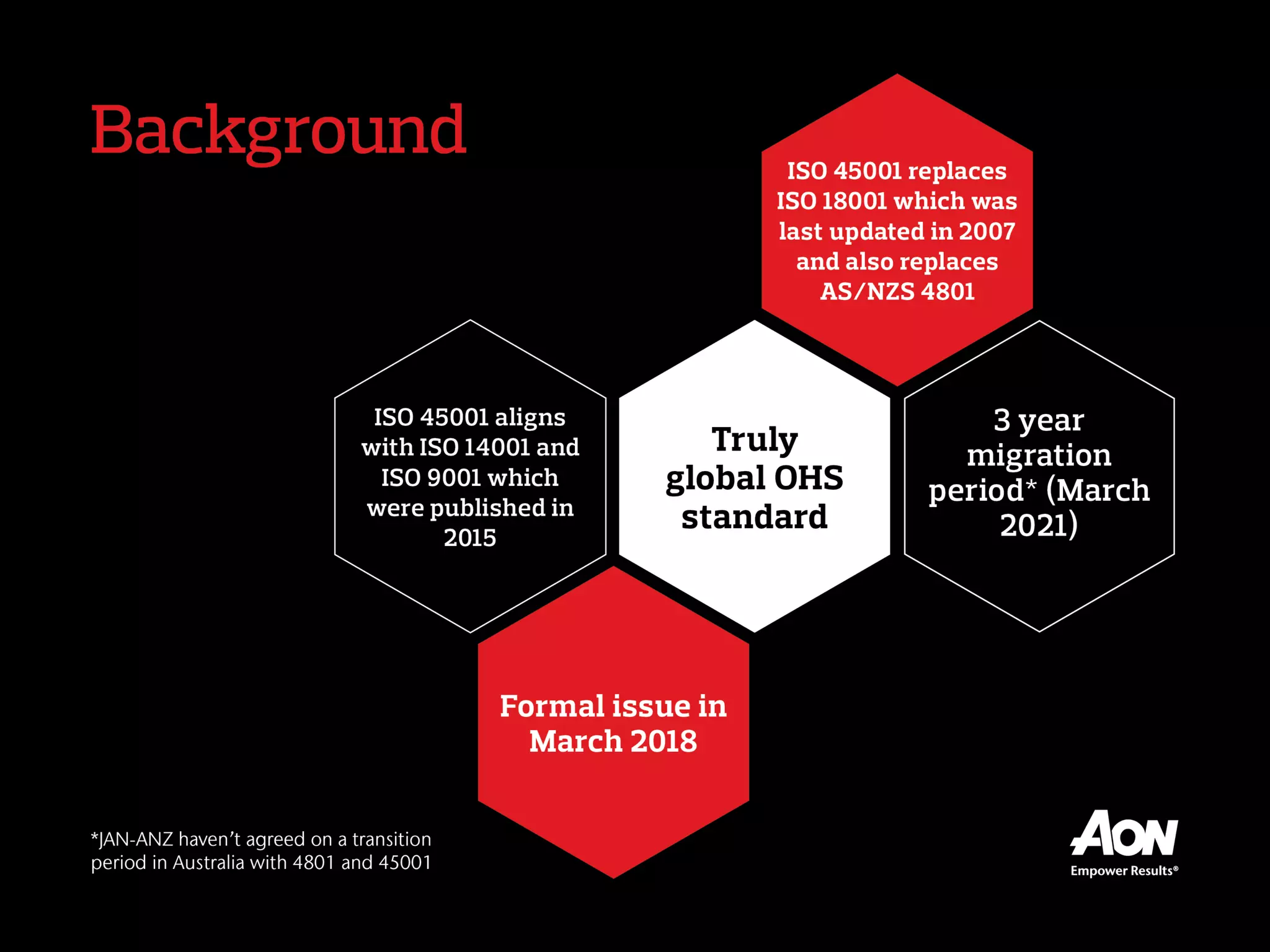
Background
 ISO 45001 replaces ISO 18001 which was last updated in 2007 and also replaces
AS/NZS 4801
 ISO 45001 aligns with ISO 14001 and ISO 9001 which were published in 2015
 Truly global OHS standard
 Formal issue in March 2018
 3 year migration period (March 2021)
The New Standard – ISO 45001
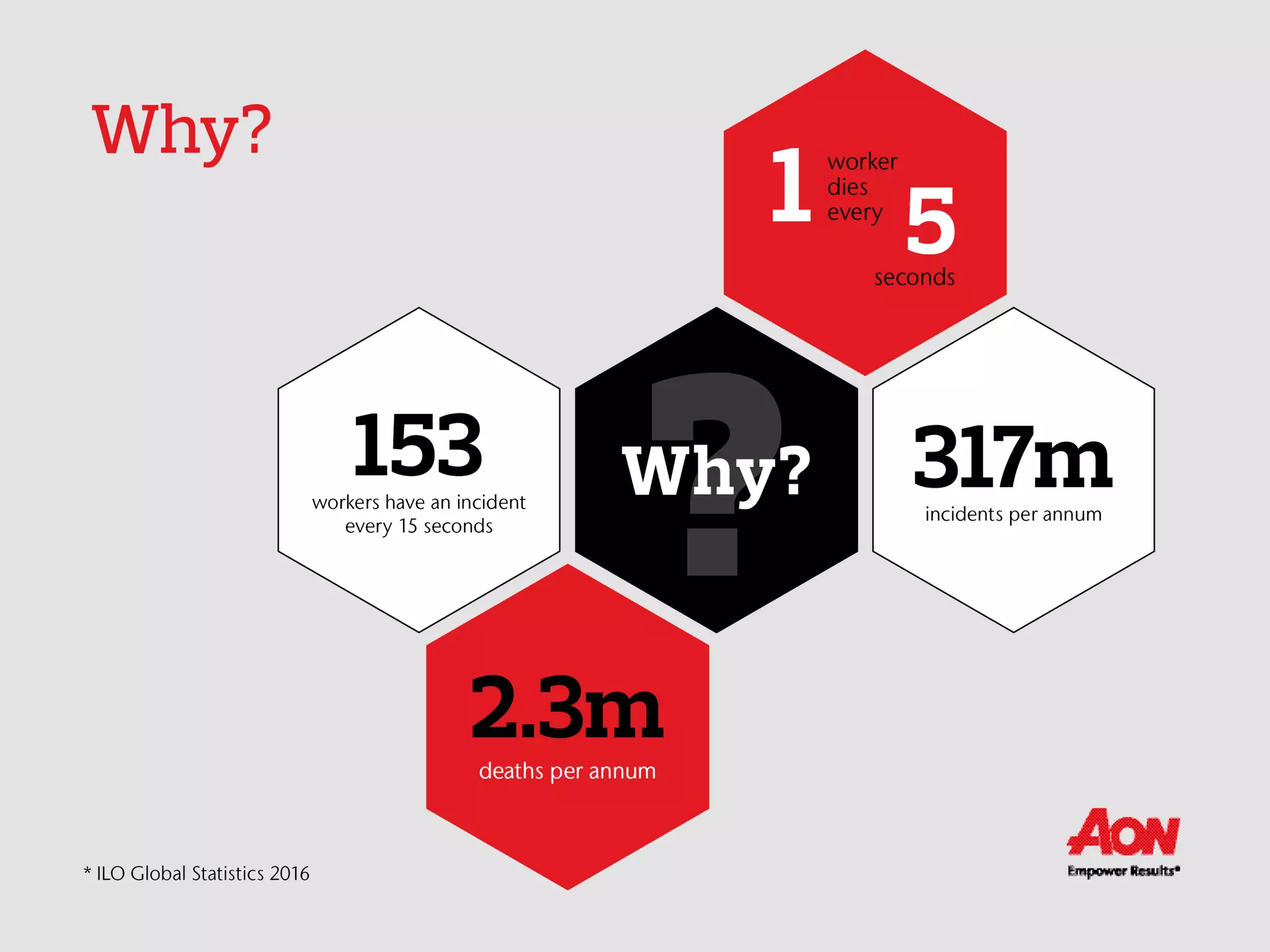
Why!
1 worker dies
every 5
seconds
153 workers
have an
incident every
15 seconds
2.3m deaths
per annum
317 accidents
per annum
* ILO Global Statistics 2016
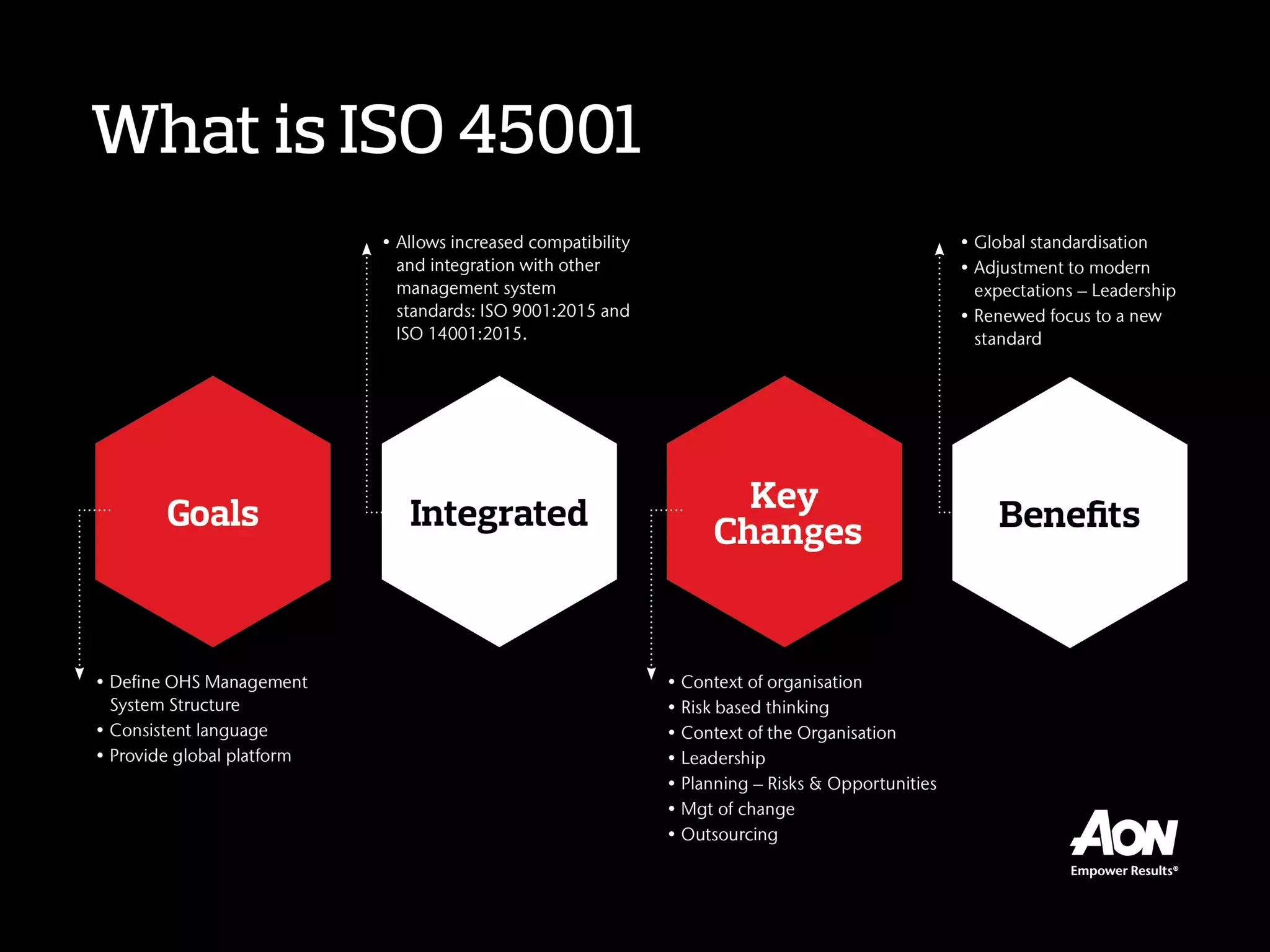
What is ISO 45001
 Allows increased
compatibility and
integration with other
management system
standards: ISO
9001:2015 and ISO
14001:2015.
Global standardisation
Adjustment to modern
expectations –
Leadership
Renewed focus to a
new standard
 Define OHS
Management System
Structure
 Consistent language
 Provide global
platform
Context of organisation
Risk based thinking
 Context of the Organisation
 Leadership
 Planning – Risks & Opportunities
 Mgt of change
 Outsourcing
BenefitsGoals Integrated Key
Changes
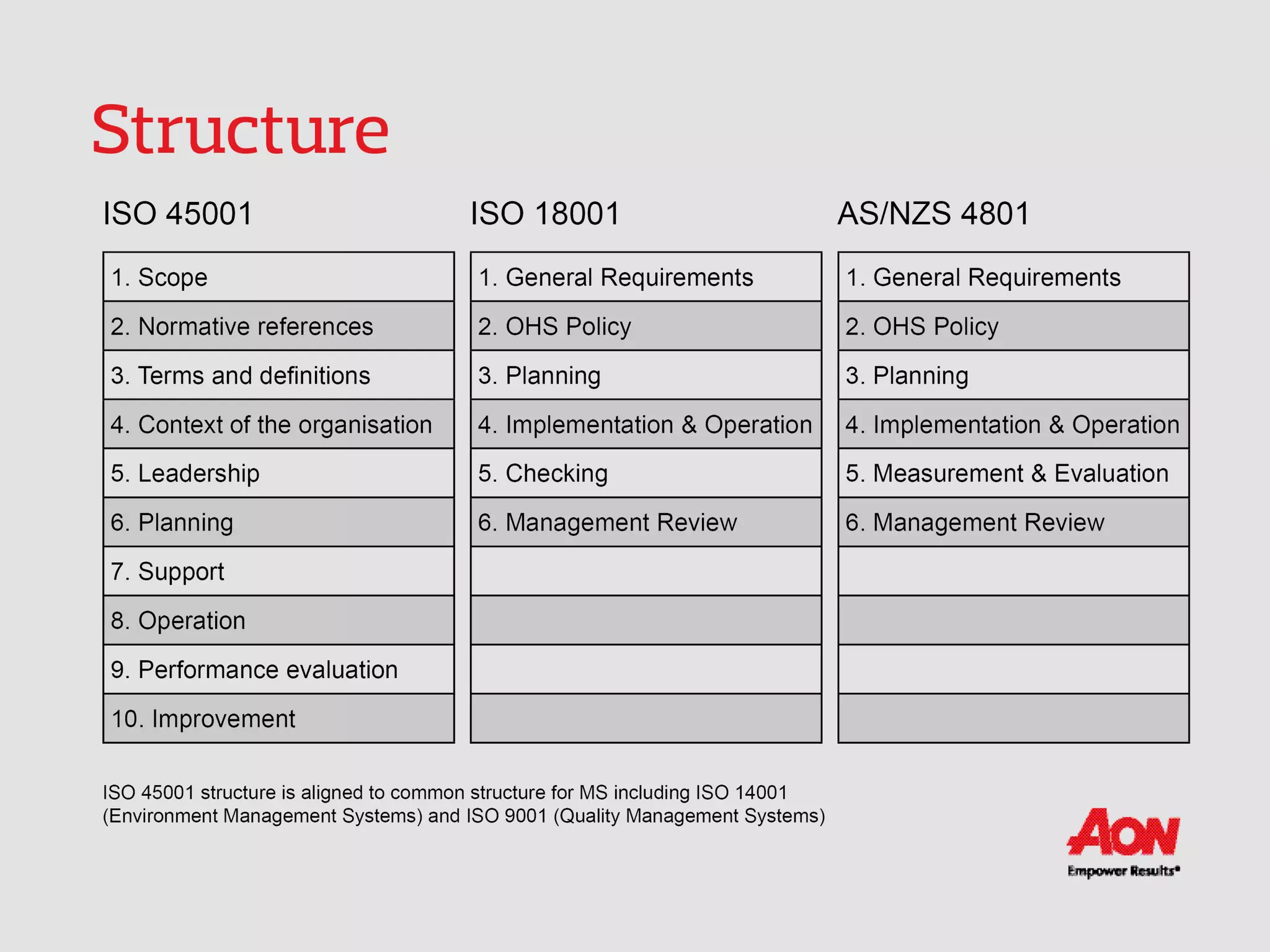
Structure
1. Scope
2. Normative references
3. Terms and definitions
4. Context of the organisation
5. Leadership
6. Planning
7. Support
8. Operation
9. Performance evaluation
10. Improvement
1. General Requirements
2. OHS Policy
3. Planning
4. Implementation & Operation
5. Checking
6. Management Review
1. General Requirements
2. OHS Policy
3. Planning
4. Implementation
5. Measurement & Evaluation
6. Management Review
ISO 45001 ISO 18001 AS/NZS 4801
ISO 45001 structure is aligned to common structure for MS including ISO 14001 (Environment
Management Systems and ISO 9001 (Quality Management Systems).
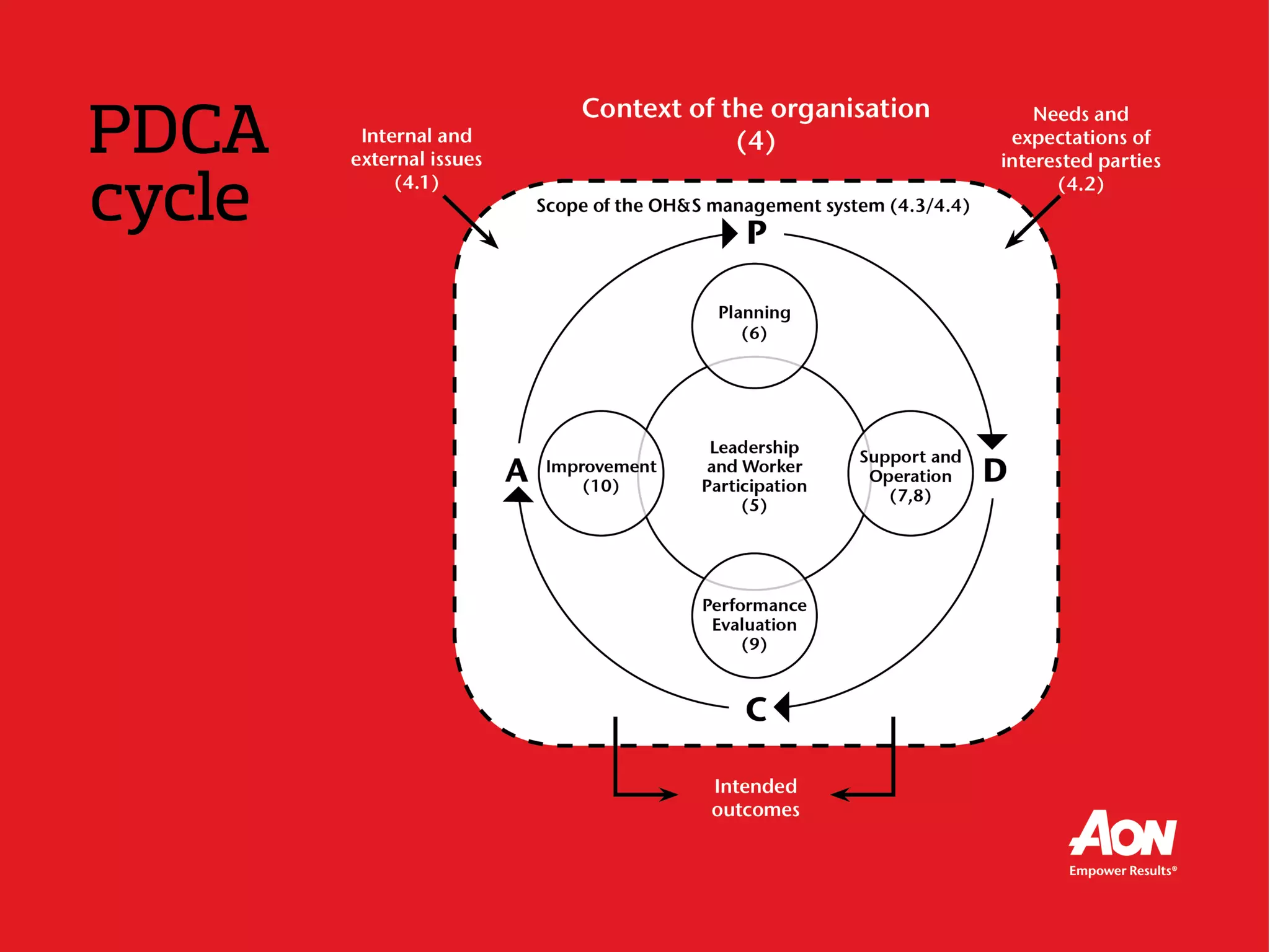
PDCA cycle
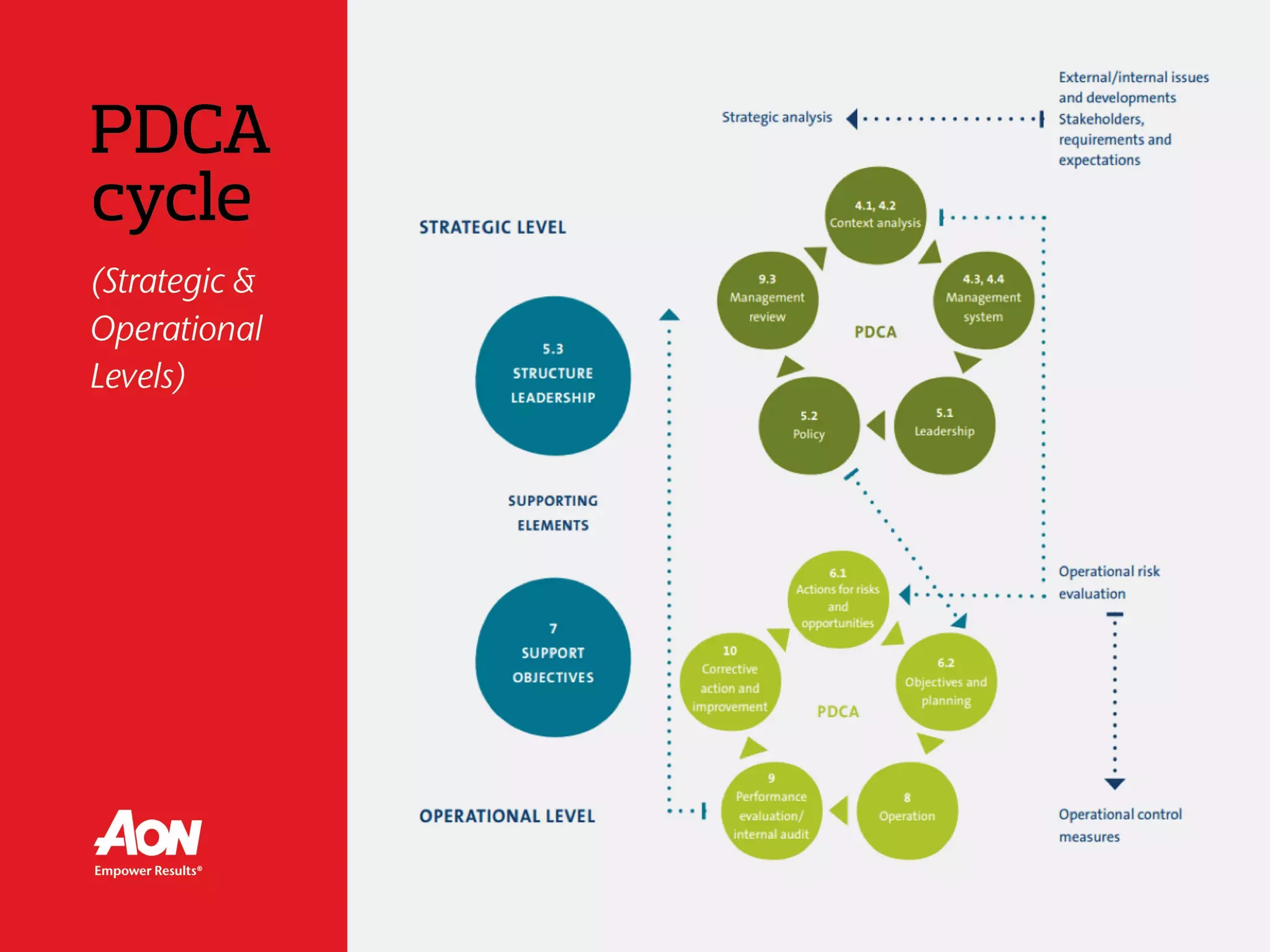
PDCA cycle (Strategic & Operational Levels)
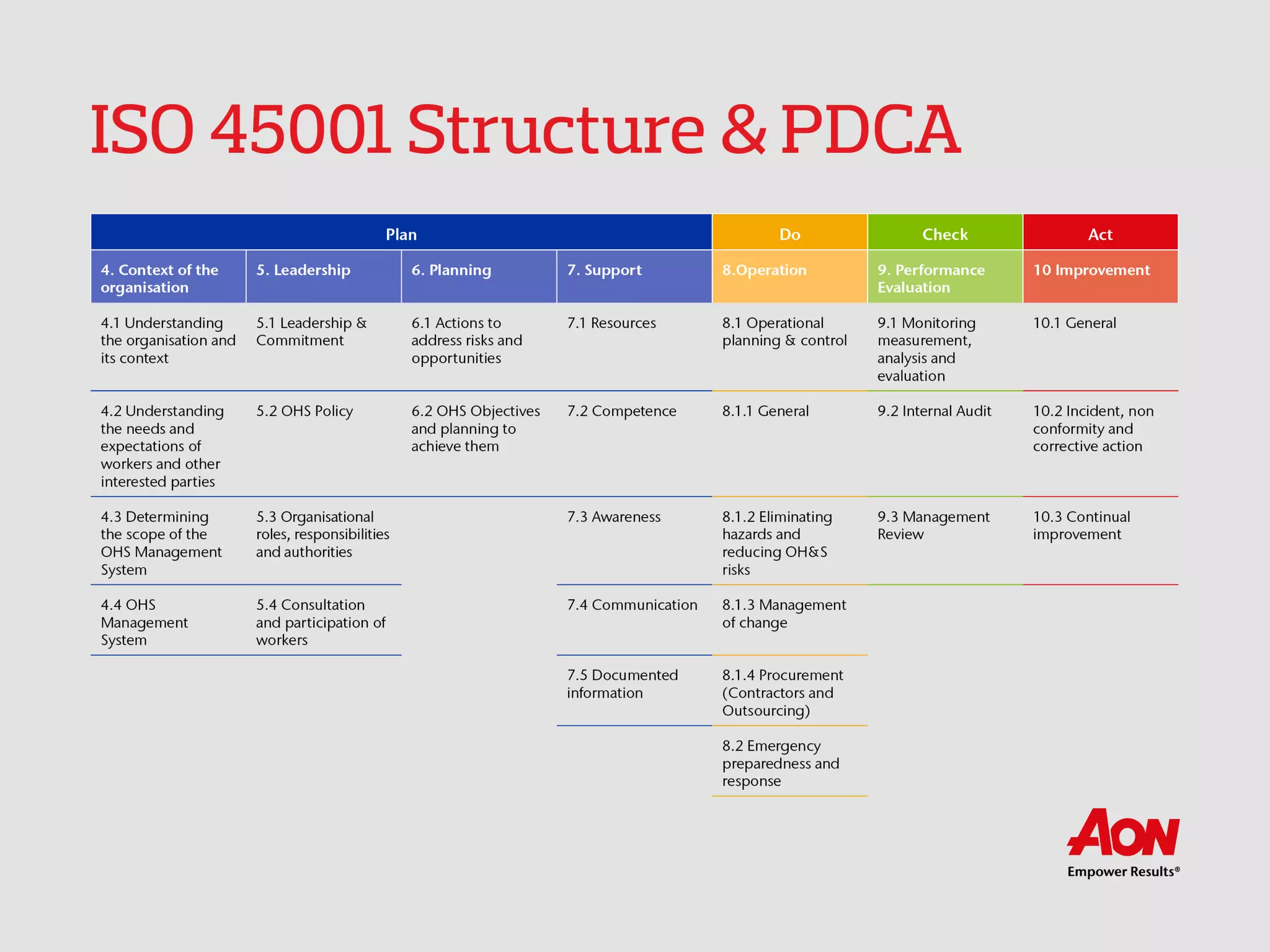
ISO 45001 Structure & PDCA
Plan Do Check Act
4. Context of the
organisation
5. Leadership 6. Planning 7. Support 8.Operation
9. Performance
Evaluation
10 Improvement
4.1 Understanding
the organisation
and its context
5.1 Leadership &
Commitment
6.1 Actions to
address risks and
opportunities
7.1 Resources 8.1 Operational
planning & control
9.1 Monitoring
measurement,
analysis and
evaluation
10.1 General
4.2 Understanding
the needs and
expectations of
workers and other
interested parties
5.2 OHS Policy 6.2 OHS Objectives
and planning to
achieve them
7.2 Competence 8.1.1 General 9.2 Internal Audit 10.2 Incident, non
conformity and
corrective action
4.3 Determining the
scope of the OHS
Management
System
5.3 Organisational
roles,
responsibilities and
authorities
7.3 Awareness 8.1.2 Eliminating
hazards and
reducing OH&S
risks
9.3 Management
Review
10.3 Continual
improvement
4.4 OHS
Management
System
5.4 Consultation
and participation of
workers
7.4 Communication 8.1.3 Management
of change
7.5 Documented
information
8.1.4 Procurement
(Contractors and
Outsourcing)
8.2 Emergency
preparedness and
response
Key changes
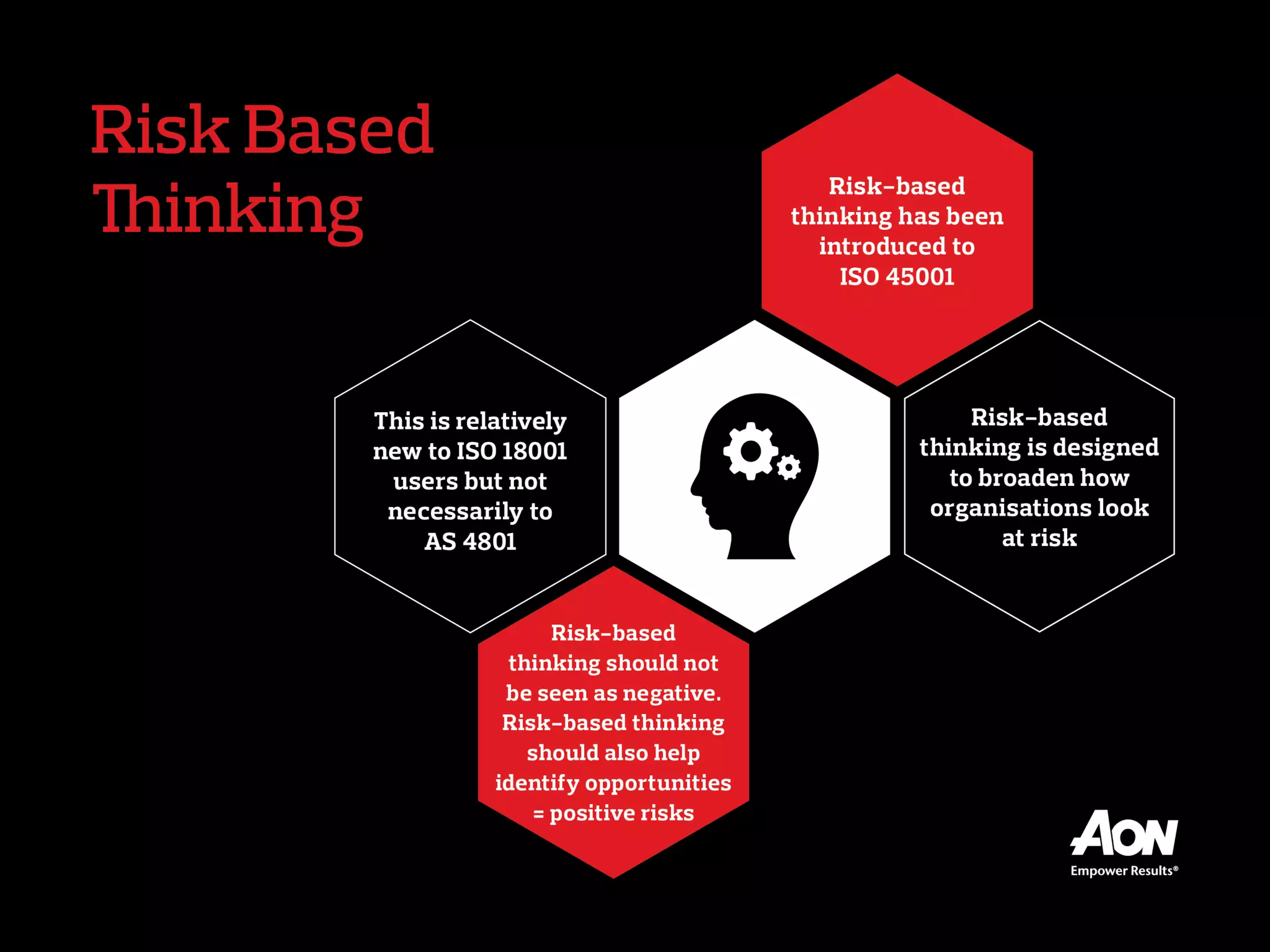
Risk Based Thinking
 Risk-based thinking has been introduced to ISO 45001
 This is relatively new to ISO 18001 users but not necessarily to AS
4801
 Risk-based thinking is designed to broaden how organisations
look at risk.
 Risk-based thinking should not be seen as negative. Risk-based
thinking should also help identify opportunities = positive risks
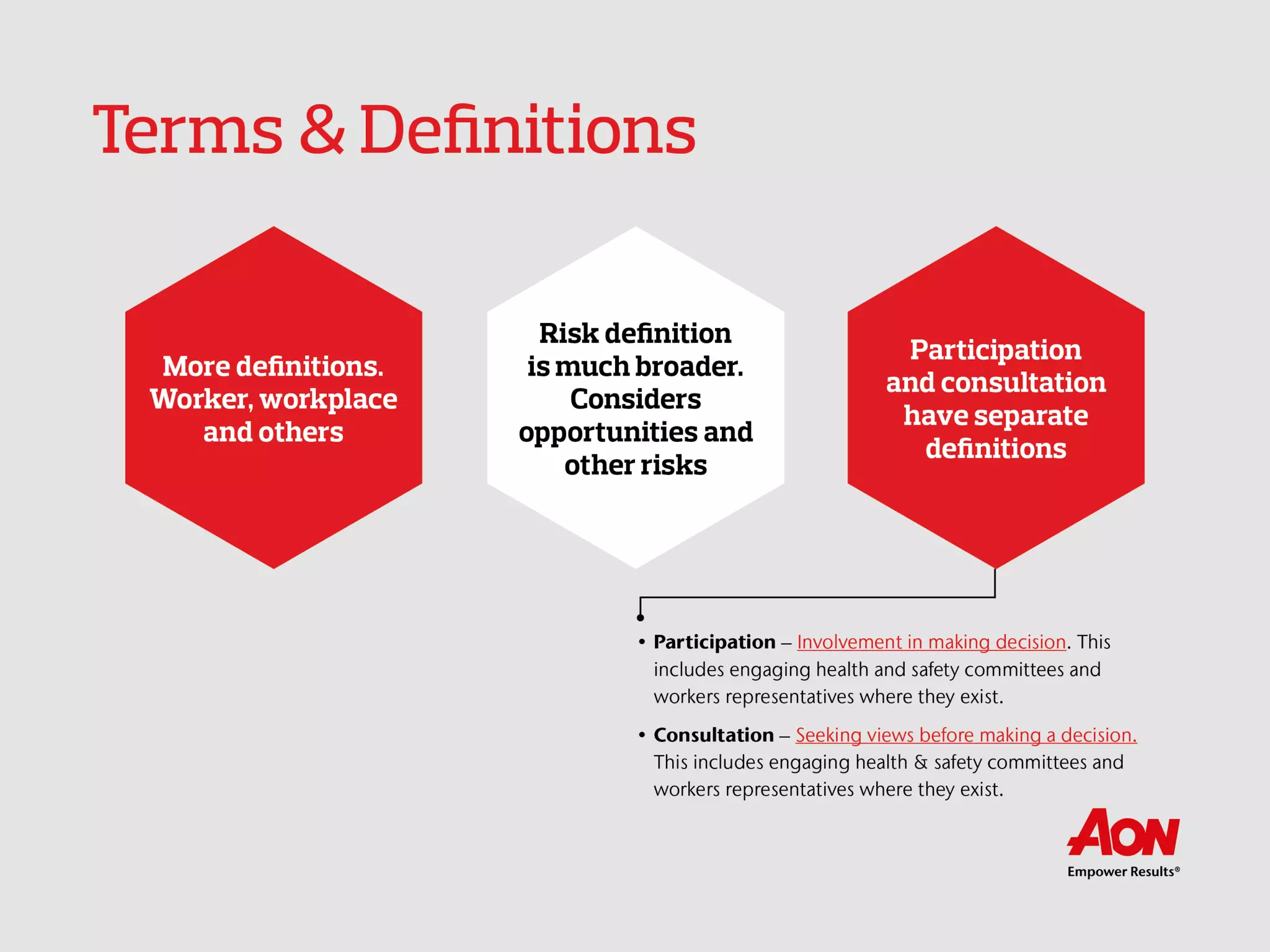
Terms & Definitions
 More definitions. Worker, workplace and others
 Risk definition is much broader. Considers opportunities and other
risks
 Participation and consultation have separate definitions
o Participation – Involvement in making decision. This includes
engaging health and safety committees and workers
representatives where they exist.
o Consultation – Seeking views before making a decision. This
includes engaging health & safety committees and workers
representatives where they exist.
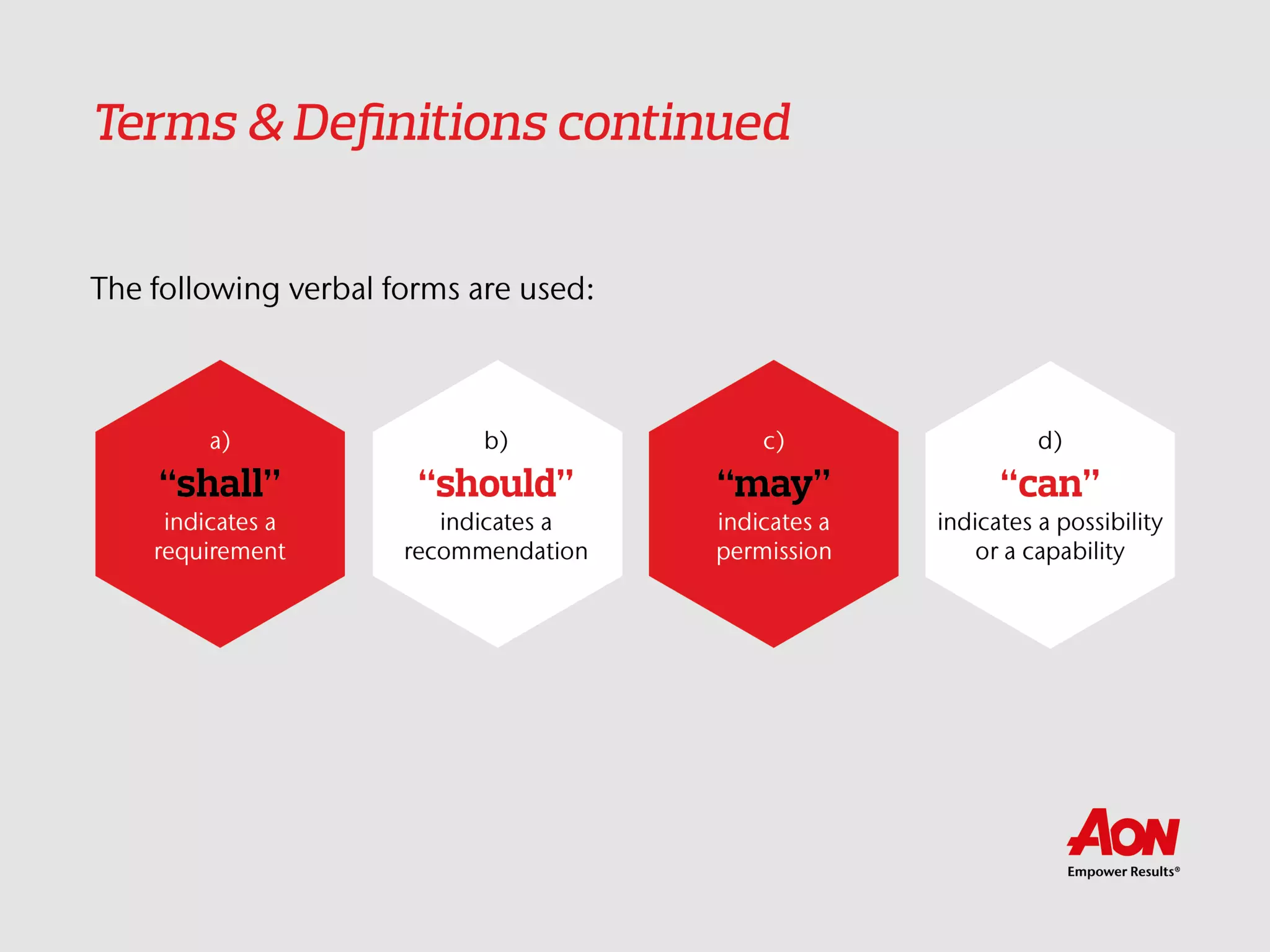
Terms & Definitions - continued
The following verbal forms are used:
a) “shall” indicates a requirement
b) “should” indicates a recommendation
c) “may” indicates a permission
d) “can” indicates a possibility or a capability
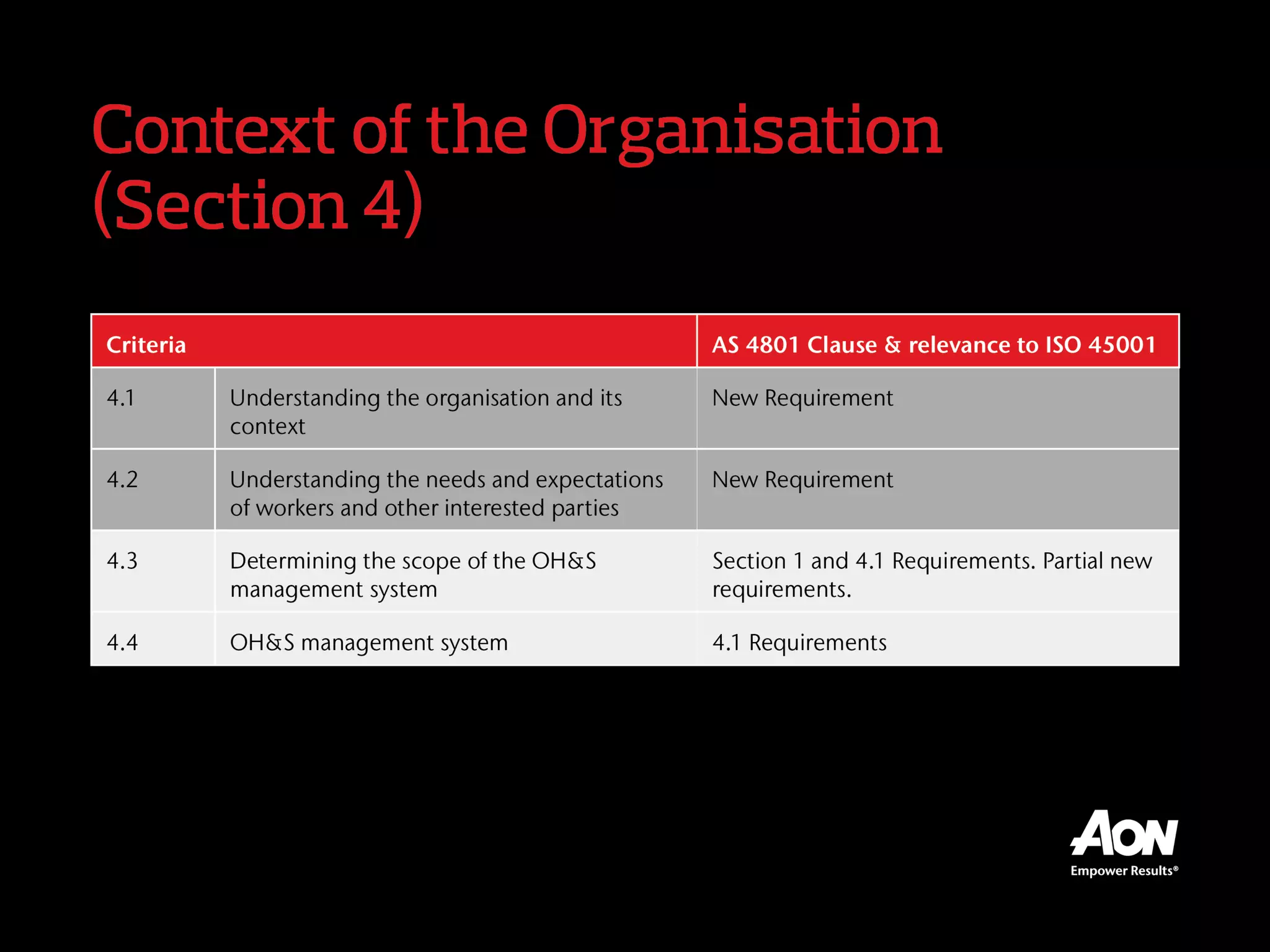
Context of the Organisation (Section 4)
Criteria AS 4801 Clause & relevance to ISO 45001
4.1
Understanding the organisation and its
context
New Requirement
4.2
Understanding the needs and
expectations of workers and other
interested parties
New Requirement
4.3
Determining the scope of the OH&S
management system
Section 1 and 4.1 Requirements. Partial new
requirements.
4.4 OH&S management system 4.1 Requirements
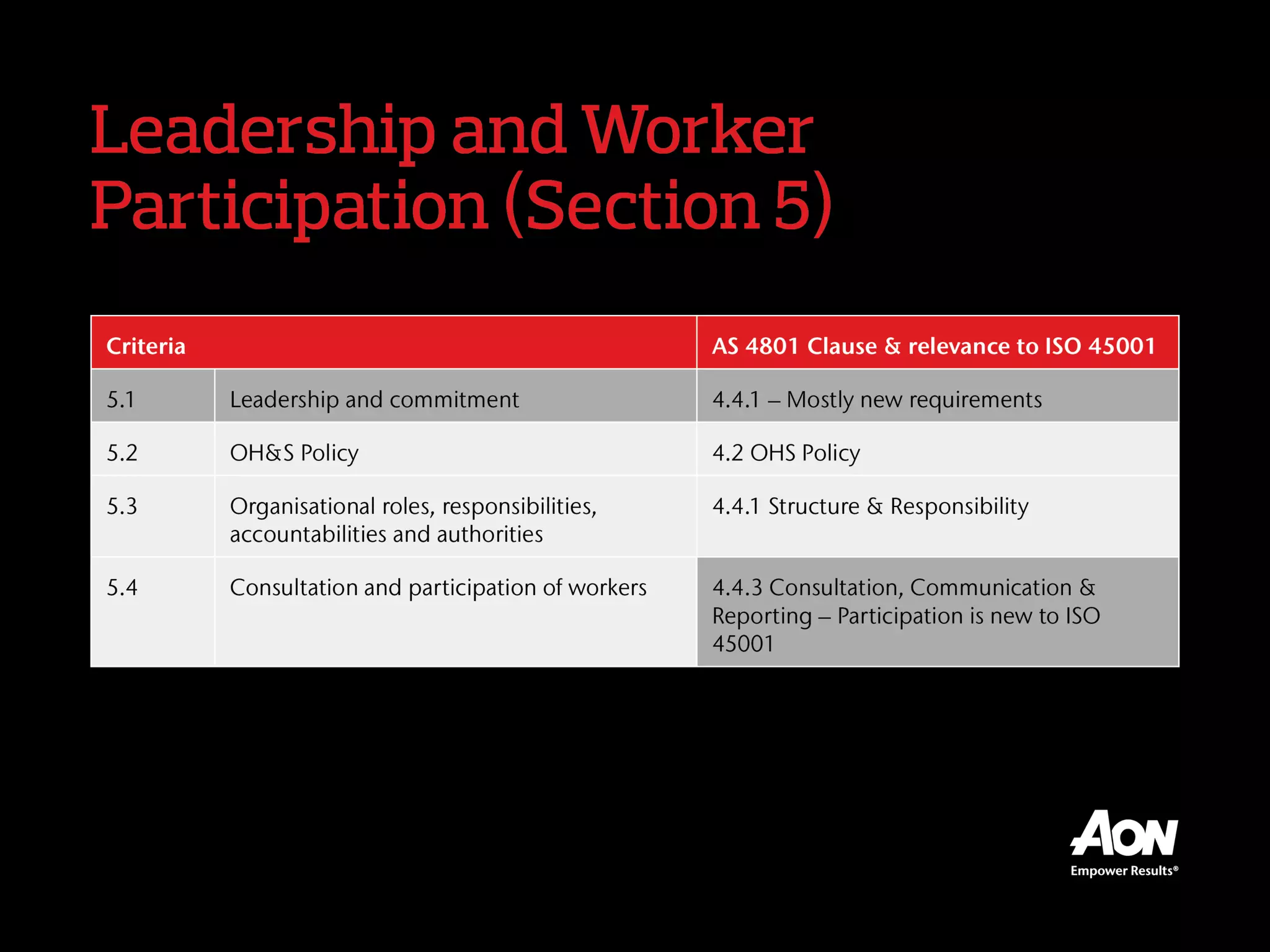
Leadership and Worker Participation (Section 5)
Criteria AS 4801 Clause & relevance to ISO 45001
5.1 Leadership and commitment 4.4.1 – Mostly new requirements
5.2 OH&S Policy 4.2 OHS Policy
5.3
Organisational roles, responsibilities,
accountabilities and authorities
4.4.1 Structure & Responsibility
5.4 Consultation and participation of workers
4.4.3 Consultation, Communication & Reporting –
Participation is new to ISO 45001
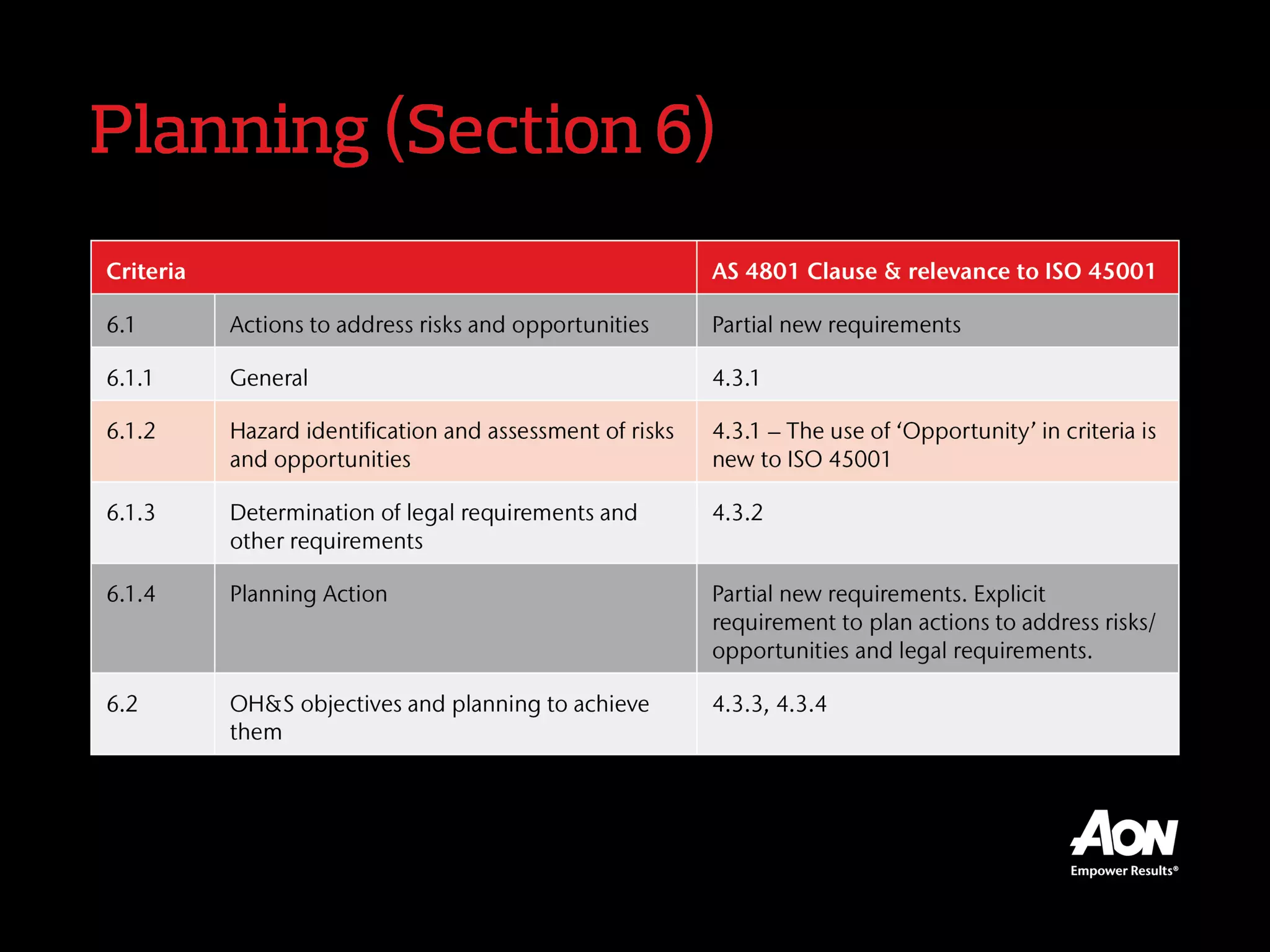
Planning (Section 6)
Criteria AS 4801 Clause & relevance to ISO 45001
6.1 Actions to address risks and opportunities Partial new requirements
6.1.1 General 4.3.1
6.1.2
Hazard identification and assessment of
risks and opportunities
4.3.1 – The use of ‘Opportunity’ in criteria is new to ISO
45001
6.1.3
Determination of legal requirements and
other requirements
4.3.2
6.1.4 Planning Action
Partial new requirements. Explicit requirement to plan
actions to address risks/opportunities and legal
requirements.
6.2
OH&S objectives and planning to achieve
them
4.3.3, 4.3.4
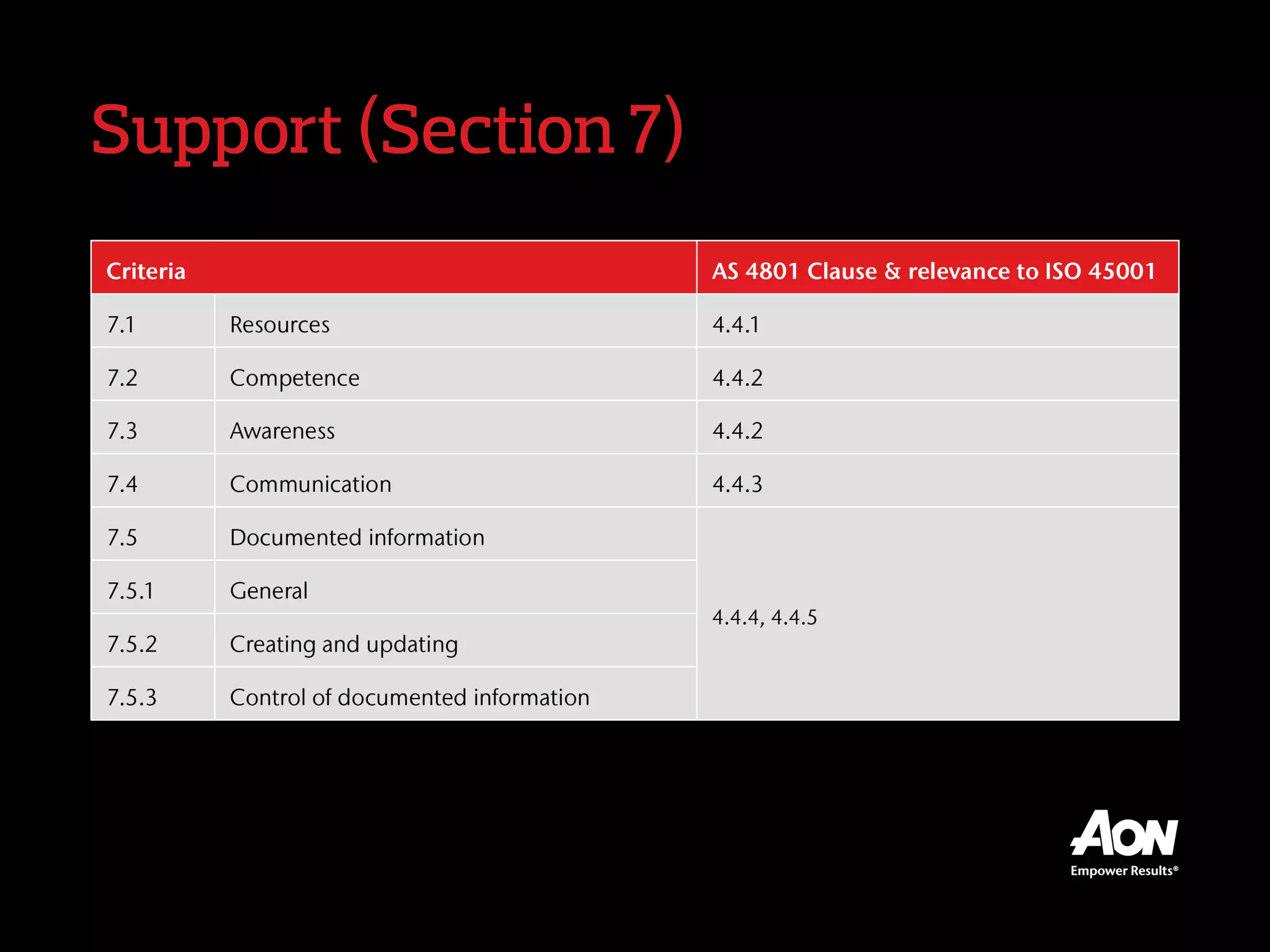
Support (Section 7)
Criteria AS 4801 Clause & relevance to ISO 45001
7.1 Resources 4.4.1
7.2 Competence 4.4.2
7.3 Awareness 4.4.2
7.4 Communication 4.4.3
7.5 Documented information
4.4.4, 4.4.5
7.5.1 General
7.5.2 Creating and updating
7.5.3 Control of documented information
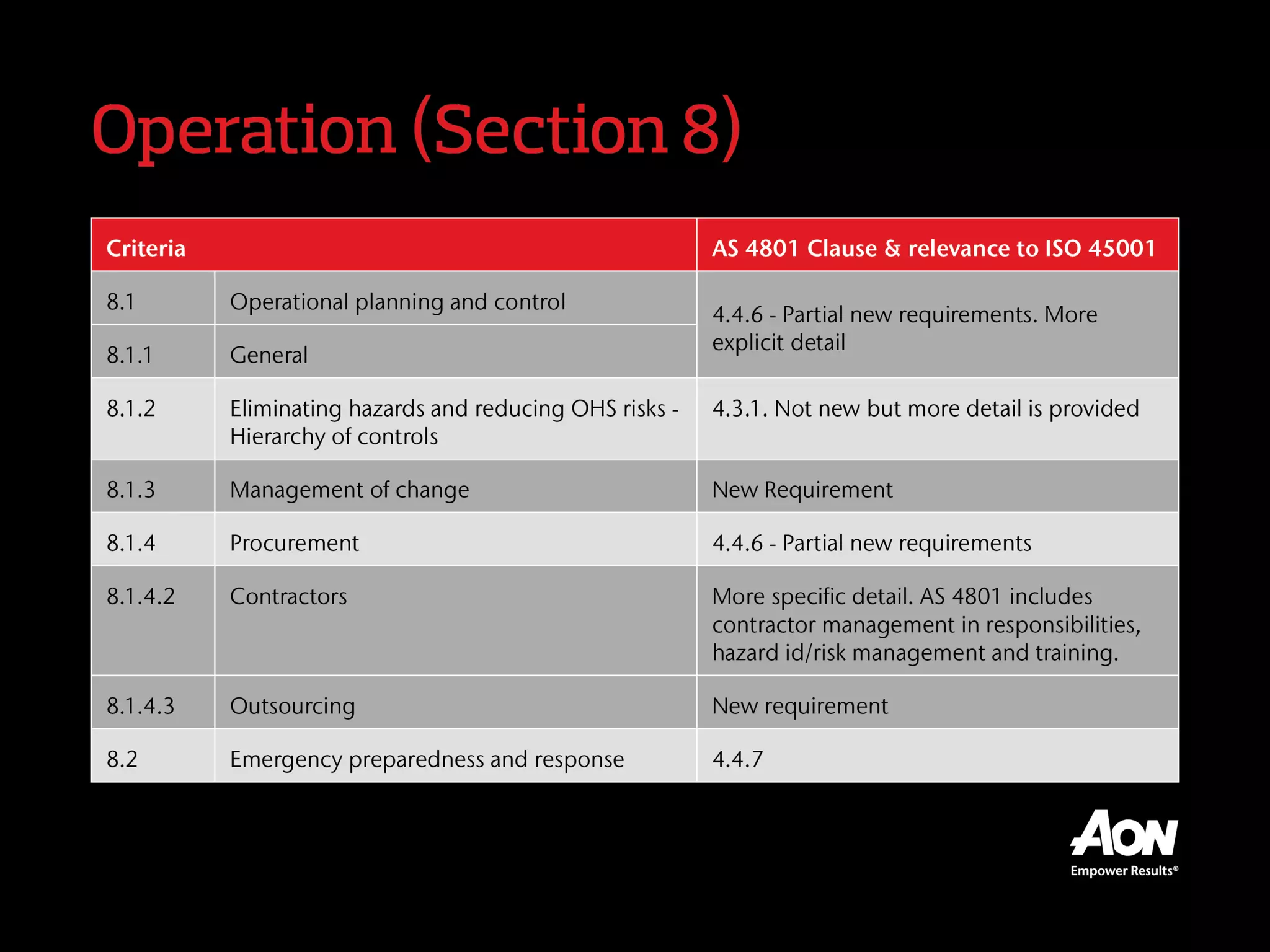
Operation (Section 8)
Criteria AS 4801 Clause & relevance to ISO 45001
8.1 Operational planning and control
4.4.6 - Partial new requirements. More explicit detail
8.1.1 General
8.1.2
Eliminating hazards and reducing OHS
risks - Hierarchy of controls
4.3.1. Not new but more detail is provided
8.1.3 Management of change New Requirement
8.1.4 Procurement 4.4.6 - Partial new requirements
8.1.4.2 Contractors
More specific detail. AS 4801 includes contractor
management in responsibilities, hazard id/risk
management and training.
8.1.4.3 Outsourcing New requirement
8.2 Emergency preparedness and response 4.4.7
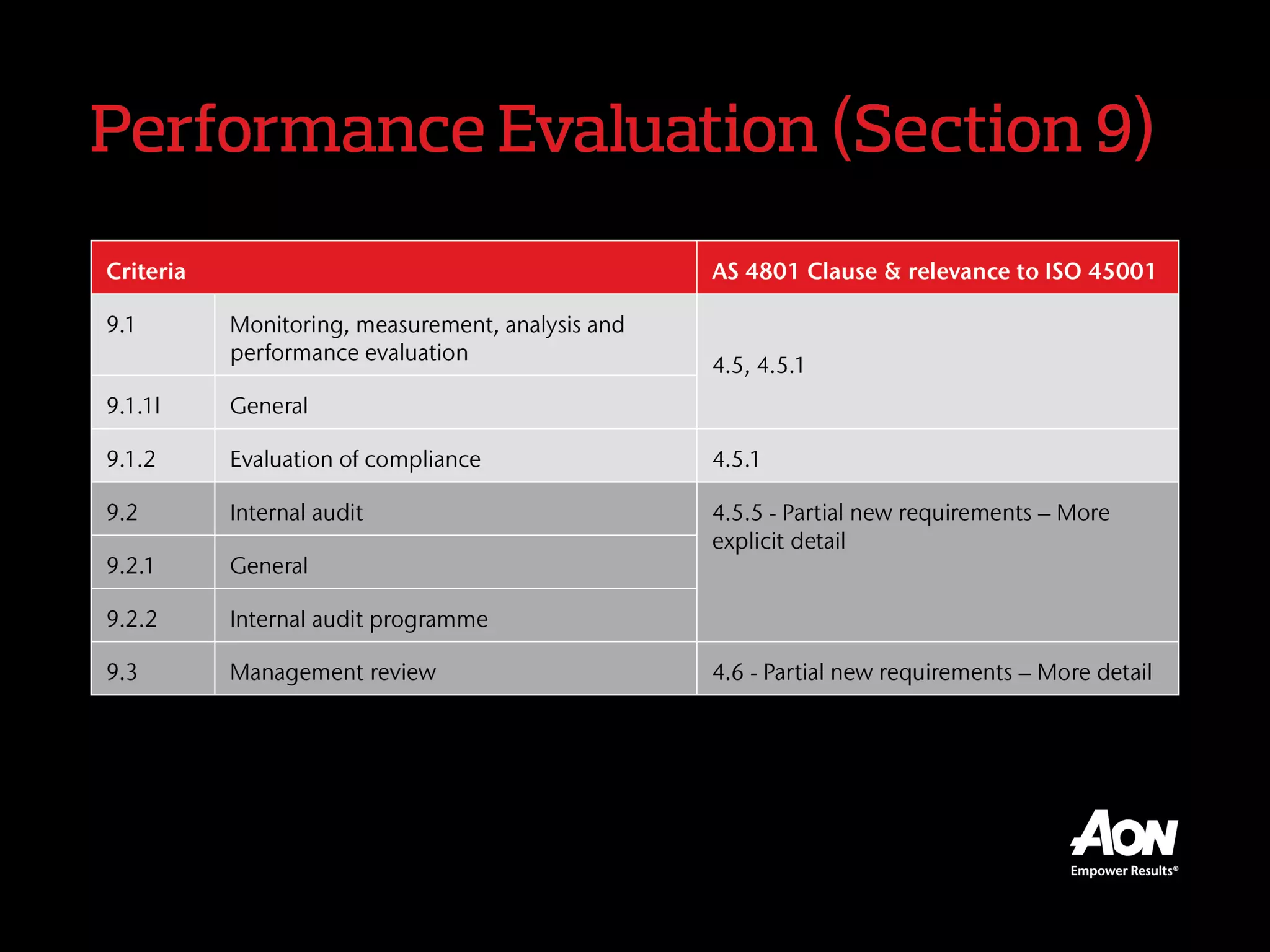
Performance Evaluation (Section 9)
Criteria AS 4801 Clause & relevance to ISO 45001
9.1
Monitoring, measurement, analysis and
performance evaluation
4.5, 4.5.1
9.1.1l General
9.1.2 Evaluation of compliance 4.5.1
9.2 Internal audit
4.5.5 - Partial new requirements – More explicit detail9.2.1 General
9.2.2 Internal audit programme
9.3 Management review 4.6 - Partial new requirements – More detail
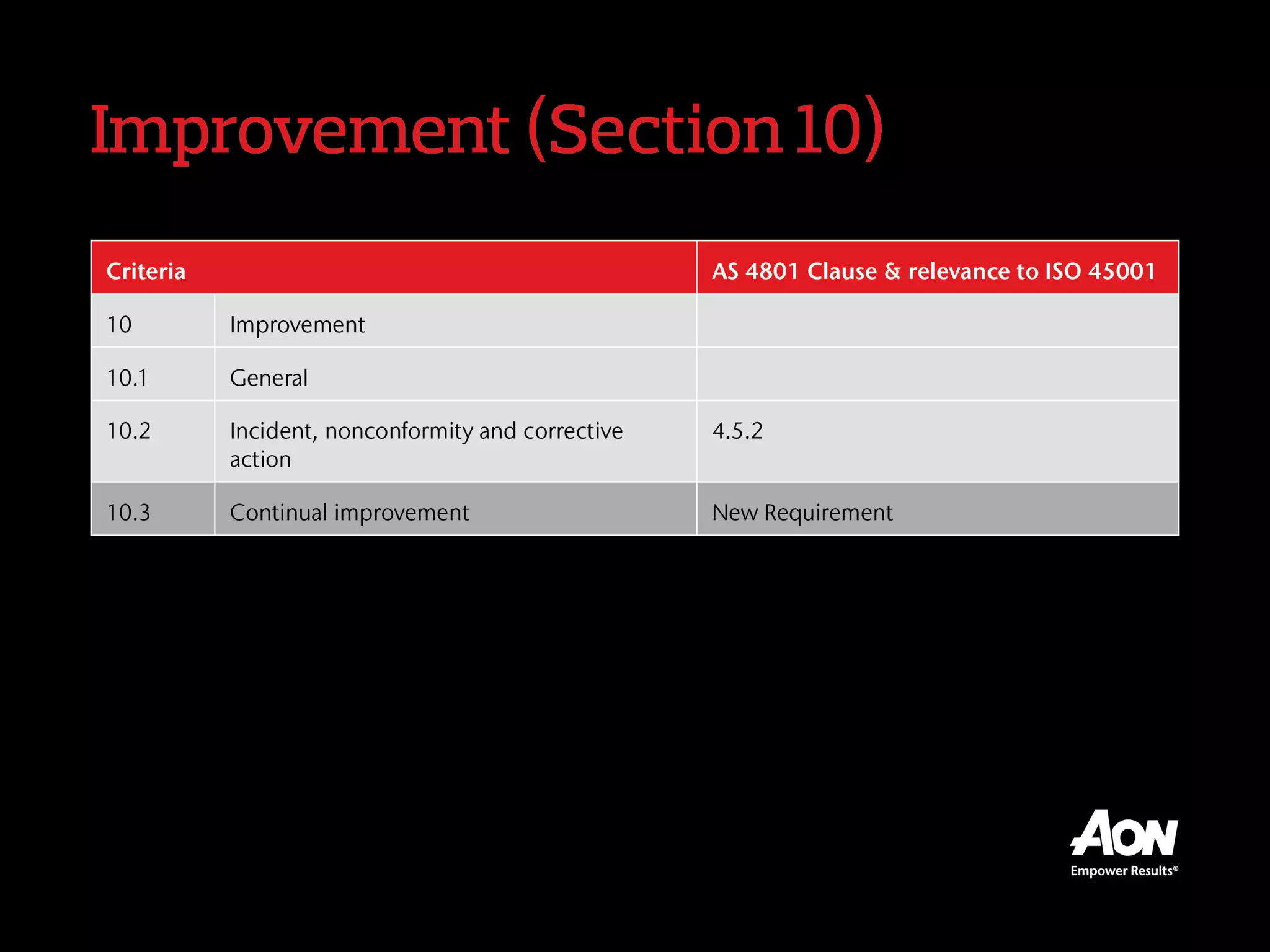
Improvement (Section 10)
Criteria AS 4801 Clause & relevance to ISO 45001
10 Improvement
10.1 General
10.2
Incident, nonconformity and corrective
action
4.5.2
10.3 Continual improvement New Requirement
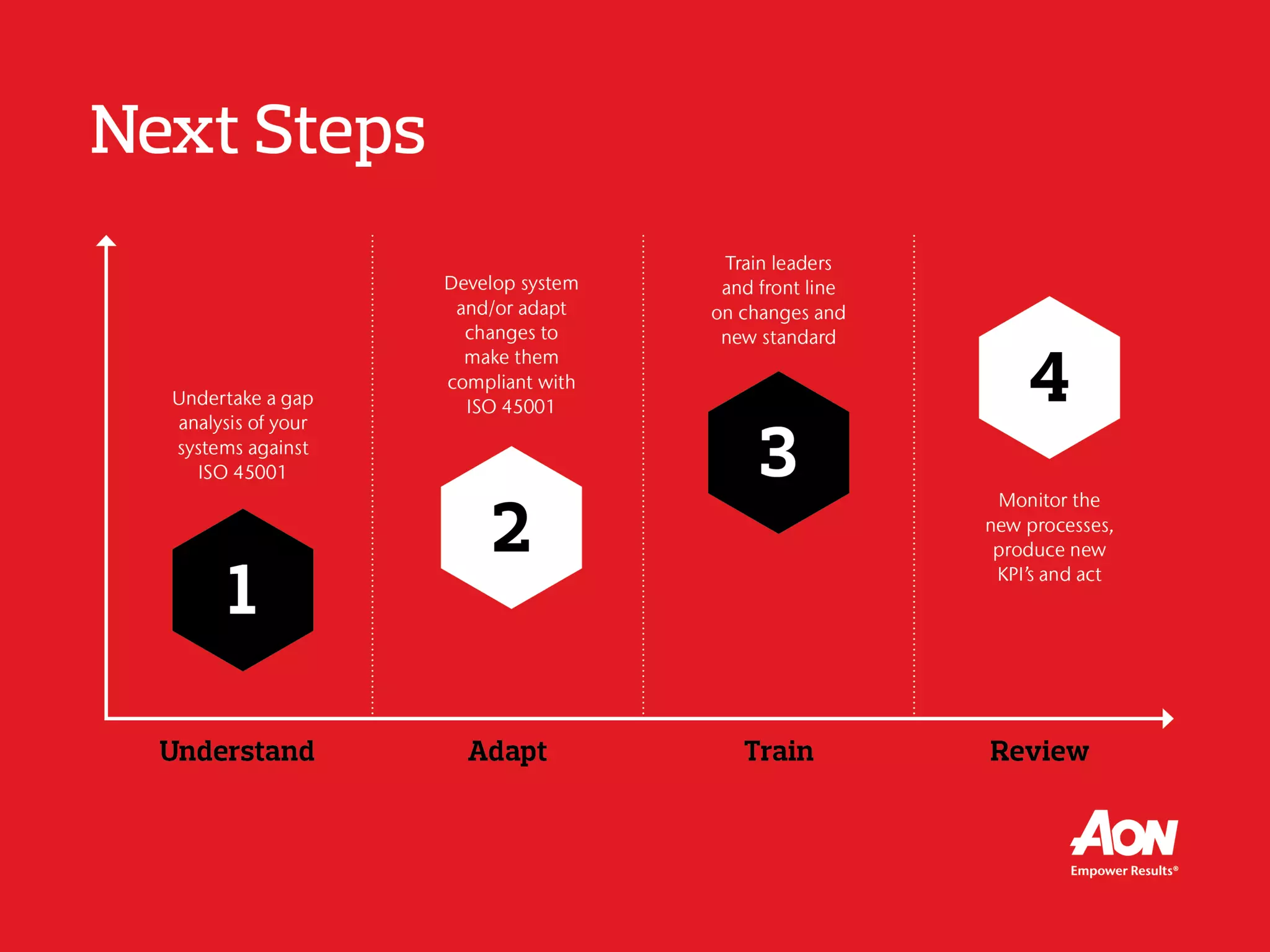
Next Steps
Next Steps
Undertake a gap
analysis of your
systems against
ISO 45001
Train leaders and
front line on
changes and
new standard
Develop system
and/or adapt
changes to
make them
compliant with
ISO 45001 Monitor the new
processes,
produce new
KPI’s and act
2
3
4
Understand Adapt Train Review
1
Thank you

Preparing for ISO 45001 - The new WHS Systems Standard

  • 1.
    Prepared by MarioMachado Specialties | Workplace Risk
  • 2.
  • 3.
    Introduction Mario Machado National PracticeLeader - WHS Commercial Risk Solutions | People Risk Qualifications  Master of Business Management (MBA) - currently completing  Graduate Certificate – OHS Management  Bachelor of Science (Double Major – Environmental Management/Chemical Science)  Associate Diploma of Environmental Waste Management  Cert IV Workplace Training Experience  WHS Systems Development & Implementation  Culture & Leadership  Risk Management  Strategic WHS & Performance Improvement  M&A & Due Diligence
  • 4.
    Background  ISO 45001replaces ISO 18001 which was last updated in 2007 and also replaces AS/NZS 4801  ISO 45001 aligns with ISO 14001 and ISO 9001 which were published in 2015  Truly global OHS standard  Formal issue in March 2018  3 year migration period (March 2021)
  • 5.
    The New Standard– ISO 45001
  • 6.
    Why! 1 worker dies every5 seconds 153 workers have an incident every 15 seconds 2.3m deaths per annum 317 accidents per annum * ILO Global Statistics 2016
  • 7.
    What is ISO45001  Allows increased compatibility and integration with other management system standards: ISO 9001:2015 and ISO 14001:2015. Global standardisation Adjustment to modern expectations – Leadership Renewed focus to a new standard  Define OHS Management System Structure  Consistent language  Provide global platform Context of organisation Risk based thinking  Context of the Organisation  Leadership  Planning – Risks & Opportunities  Mgt of change  Outsourcing BenefitsGoals Integrated Key Changes
  • 8.
    Structure 1. Scope 2. Normativereferences 3. Terms and definitions 4. Context of the organisation 5. Leadership 6. Planning 7. Support 8. Operation 9. Performance evaluation 10. Improvement 1. General Requirements 2. OHS Policy 3. Planning 4. Implementation & Operation 5. Checking 6. Management Review 1. General Requirements 2. OHS Policy 3. Planning 4. Implementation 5. Measurement & Evaluation 6. Management Review ISO 45001 ISO 18001 AS/NZS 4801 ISO 45001 structure is aligned to common structure for MS including ISO 14001 (Environment Management Systems and ISO 9001 (Quality Management Systems).
  • 9.
  • 10.
    PDCA cycle (Strategic& Operational Levels)
  • 11.
    ISO 45001 Structure& PDCA Plan Do Check Act 4. Context of the organisation 5. Leadership 6. Planning 7. Support 8.Operation 9. Performance Evaluation 10 Improvement 4.1 Understanding the organisation and its context 5.1 Leadership & Commitment 6.1 Actions to address risks and opportunities 7.1 Resources 8.1 Operational planning & control 9.1 Monitoring measurement, analysis and evaluation 10.1 General 4.2 Understanding the needs and expectations of workers and other interested parties 5.2 OHS Policy 6.2 OHS Objectives and planning to achieve them 7.2 Competence 8.1.1 General 9.2 Internal Audit 10.2 Incident, non conformity and corrective action 4.3 Determining the scope of the OHS Management System 5.3 Organisational roles, responsibilities and authorities 7.3 Awareness 8.1.2 Eliminating hazards and reducing OH&S risks 9.3 Management Review 10.3 Continual improvement 4.4 OHS Management System 5.4 Consultation and participation of workers 7.4 Communication 8.1.3 Management of change 7.5 Documented information 8.1.4 Procurement (Contractors and Outsourcing) 8.2 Emergency preparedness and response
  • 12.
  • 13.
    Risk Based Thinking Risk-based thinking has been introduced to ISO 45001  This is relatively new to ISO 18001 users but not necessarily to AS 4801  Risk-based thinking is designed to broaden how organisations look at risk.  Risk-based thinking should not be seen as negative. Risk-based thinking should also help identify opportunities = positive risks
  • 14.
    Terms & Definitions More definitions. Worker, workplace and others  Risk definition is much broader. Considers opportunities and other risks  Participation and consultation have separate definitions o Participation – Involvement in making decision. This includes engaging health and safety committees and workers representatives where they exist. o Consultation – Seeking views before making a decision. This includes engaging health & safety committees and workers representatives where they exist.
  • 15.
    Terms & Definitions- continued The following verbal forms are used: a) “shall” indicates a requirement b) “should” indicates a recommendation c) “may” indicates a permission d) “can” indicates a possibility or a capability
  • 16.
    Context of theOrganisation (Section 4) Criteria AS 4801 Clause & relevance to ISO 45001 4.1 Understanding the organisation and its context New Requirement 4.2 Understanding the needs and expectations of workers and other interested parties New Requirement 4.3 Determining the scope of the OH&S management system Section 1 and 4.1 Requirements. Partial new requirements. 4.4 OH&S management system 4.1 Requirements
  • 17.
    Leadership and WorkerParticipation (Section 5) Criteria AS 4801 Clause & relevance to ISO 45001 5.1 Leadership and commitment 4.4.1 – Mostly new requirements 5.2 OH&S Policy 4.2 OHS Policy 5.3 Organisational roles, responsibilities, accountabilities and authorities 4.4.1 Structure & Responsibility 5.4 Consultation and participation of workers 4.4.3 Consultation, Communication & Reporting – Participation is new to ISO 45001
  • 18.
    Planning (Section 6) CriteriaAS 4801 Clause & relevance to ISO 45001 6.1 Actions to address risks and opportunities Partial new requirements 6.1.1 General 4.3.1 6.1.2 Hazard identification and assessment of risks and opportunities 4.3.1 – The use of ‘Opportunity’ in criteria is new to ISO 45001 6.1.3 Determination of legal requirements and other requirements 4.3.2 6.1.4 Planning Action Partial new requirements. Explicit requirement to plan actions to address risks/opportunities and legal requirements. 6.2 OH&S objectives and planning to achieve them 4.3.3, 4.3.4
  • 19.
    Support (Section 7) CriteriaAS 4801 Clause & relevance to ISO 45001 7.1 Resources 4.4.1 7.2 Competence 4.4.2 7.3 Awareness 4.4.2 7.4 Communication 4.4.3 7.5 Documented information 4.4.4, 4.4.5 7.5.1 General 7.5.2 Creating and updating 7.5.3 Control of documented information
  • 20.
    Operation (Section 8) CriteriaAS 4801 Clause & relevance to ISO 45001 8.1 Operational planning and control 4.4.6 - Partial new requirements. More explicit detail 8.1.1 General 8.1.2 Eliminating hazards and reducing OHS risks - Hierarchy of controls 4.3.1. Not new but more detail is provided 8.1.3 Management of change New Requirement 8.1.4 Procurement 4.4.6 - Partial new requirements 8.1.4.2 Contractors More specific detail. AS 4801 includes contractor management in responsibilities, hazard id/risk management and training. 8.1.4.3 Outsourcing New requirement 8.2 Emergency preparedness and response 4.4.7
  • 21.
    Performance Evaluation (Section9) Criteria AS 4801 Clause & relevance to ISO 45001 9.1 Monitoring, measurement, analysis and performance evaluation 4.5, 4.5.1 9.1.1l General 9.1.2 Evaluation of compliance 4.5.1 9.2 Internal audit 4.5.5 - Partial new requirements – More explicit detail9.2.1 General 9.2.2 Internal audit programme 9.3 Management review 4.6 - Partial new requirements – More detail
  • 22.
    Improvement (Section 10) CriteriaAS 4801 Clause & relevance to ISO 45001 10 Improvement 10.1 General 10.2 Incident, nonconformity and corrective action 4.5.2 10.3 Continual improvement New Requirement
  • 23.
  • 24.
    Next Steps Undertake agap analysis of your systems against ISO 45001 Train leaders and front line on changes and new standard Develop system and/or adapt changes to make them compliant with ISO 45001 Monitor the new processes, produce new KPI’s and act 2 3 4 Understand Adapt Train Review 1
  • 25.