Marco Buoni
VicePresident, AREA
Air Conditioning & Refrigeration European contractors’Association (www.area-eur.be)
Secretary General Italian Association of Refrigeration Technician, ATF
(www.associazioneATF.org)
Director Centro Studi Galileo (www.centrogalileo.it)
Capacity building and training equipment for
RAC systems using alternative technologies.
Focus on Service Technicians and Training Centers
•For 40 years has been organizing training courses, seminars and
conferences in the field of refrigeration, air conditioning, 3000 technicians,
300 training sessions a year
• publishes the International Special Issue (ISI) of Industria & Formazione in
2006, 2008, 2010, 2012, 2014, 2016. The magazine is published with UNEP
and IIR, with an introduction from the UN Under-Secretary General, Achim
Steiner, and the Italian Minister of the Environment. Ddistributed at the
climate change summits in Bangkok, New Delhi, Cancun and Doha, the
summits of the Montreal protocol in Durban, Copenhagen and Geneva.
•Monthly publishes newsletters, emails and magazines
•international presence in Europe (particular in UK) and it is working with
UNEP, UNIDO, UNDP in Rwanda, Benin, Gambia, Tunisia, Arabic Countries,
Eritrea, Sri Lanka, Thailand etc….
•10 training centres in Italy – 3 in UK
•1000 technians trained in alternative refrigerants (HCs, CO2, NH3)
CENTRO STUDI GALILEO
Associazione dei Tecnici italiani del Freddo
AREA
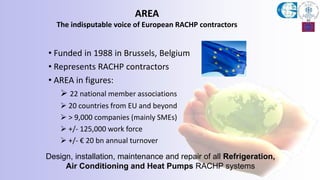
The indisputable voice of European RACHP contractors
• Funded in 1988 in Brussels, Belgium
• Represents RACHP contractors
• AREA in figures:
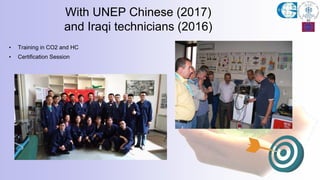
 22 national member associations
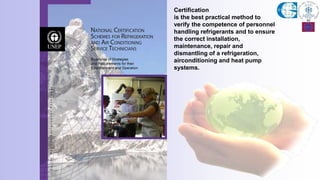
 20 countries from EU and beyond
 > 9,000 companies (mainly SMEs)
 +/- 125,000 work force
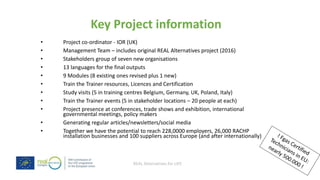
 +/- € 20 bn annual turnover
Design, installation, maintenance and repair of all Refrigeration,
Air Conditioning and Heat Pumps RACHP systems
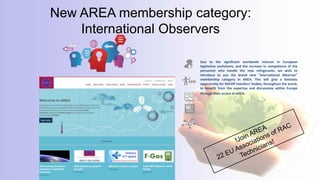
Due to the significant worldwide interest in European
legislative evolutions, and the increase in competence of the
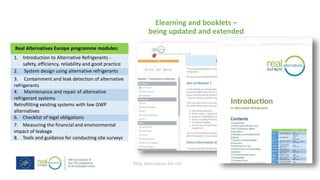
personnel who handle the new refrigerants, we wish to
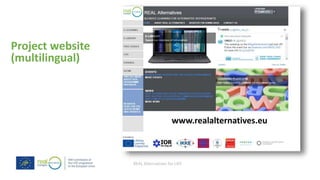
introduce to you the brand new “International Observer”
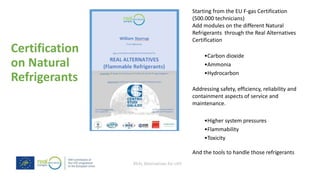
membership category in AREA. This will give a fantastic
opportunity for RACHP installers’ bodies, throughout the world,
to benefit from the expertise and discussions within Europe
through their access to AREA.
New AREA membership category:
International Observers
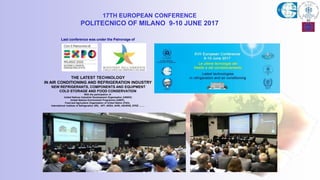
17TH EUROPEAN CONFERENCE
POLITECNICO OF MILANO 9-10 JUNE 2017
Last conference was under the Patronage of
THE LATEST TECHNOLOGY
IN AIR CONDITIONING AND REFRIGERATION INDUSTRY
NEW REFRIGERANTS, COMPONENTS AND EQUIPMENT
COLD STORAGE AND FOOD CONSERVATION
With the participation of
United Nations Industrial Development Organisation (UNIDO)
United Nations Environment Programme (UNEP),
Food and Agriculture Organisation of United Nation (FAO),
International Institute of Refrigeration (IIR), AFF, AREA, AHRI, ASHRAE, EPEE …….
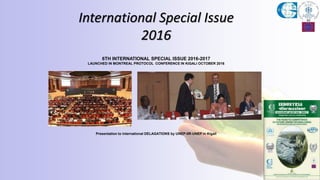
6TH INTERNATIONAL SPECIAL ISSUE 2016-2017
LAUNCHED IN MONTREAL PROTOCOL CONFERENCE IN KIGALI OCTOBER 2016
Presentation to international DELAGATIONS by UNEP-IIR-UNEP in Kigali
International Special Issue
2016
Main points of discussion
Importance of Training and Certification
• New emerging technologies and alternatives
• Motivation for RAC technicians to join the training. Regulatory and
institutional framework; linkages with certification system
• Roles of Agencies involved:
NOU/Industries/Association/Vocational Training
• Approaches for regional cooperation to achieve effective training
Strengthening national RAC associations
• Connecting contractors
• Training, Seminars and Conferences
• Information – magazine - newsletter
• Connecting with the industry
• Speak with One voice to the National, International Institutions and
Governments
• (important driver at the moment) fast moving sector in technology and in
legislation: F-gas regulations, RES directive, Refrigerants future
• Organizing training and certifications sessions
Keep the association
LIVE!
Services and Revenues:
• Members fee (in Europe starting from 63 Euro… )
• Events: trainings, conferences, summits
• Certification of persons and of companies
• Magazines
• Websites
• Sponsors (without mining Association indipendence)
Services and Budget requirements for
RAC associations
The association will give Quick and Correct
informations, vital for the sector in the next
decade. A lot of work ahead of us.
The bigger change ever.
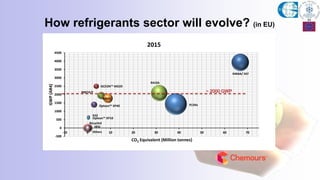
Others
HFO
R32
R404A/ 507
ISCEON™ MO29
Opteon™ XP10
R407A/F
Opteon™ XP40 R134a
R410A
R407C
Recycled
-500
0
500
1000
1500
2000
2500
3000
3500
4000
4500
-10 0 10 20 30 40 50 60 70
GWP(AR4)
CO2 Equivalent (Million tonnes)
2015
~ 2000 GWP
How refrigerants sector will evolve? (in EU)
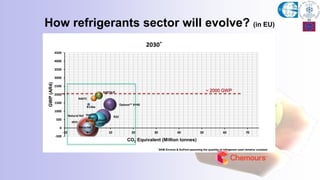
Natural Ref
HFO
R32
Opteon™
XL41
R407A/F
Opteon™ XP40
Opteon™
XP10
B250
R134a
R407C
Recycled
-500
0
500
1000
1500
2000
2500
3000
3500
4000
4500
-10 0 10 20 30 40 50 60 70
GWP(AR4)
CO2 Equivalent (Million tonnes)
2030*
~ 2000 GWP
* SKM Enviros & DuPont assuming the quantity of refrigerant used remains constant
How refrigerants sector will evolve? (in EU)
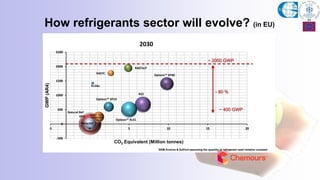
Natural Ref
HFO
R32
Opteon™ XL41
R407A/F
Opteon™ XP40
Opteon™ XP10
Opteon™ XL40 &
Opteon™ XL20
R134a
R407C
Recycled
-500
0
500
1000
1500
2000
2500
-5 0 5 10 15 20
GWP(AR4)
CO2 Equivalent (Million tonnes)
2030
- 80 %
~ 400 GWP
~ 2000 GWP
* SKM Enviros & DuPont assuming the quantity of refrigerant used remains constant
How refrigerants sector will evolve? (in EU)
Contractors’ training with low
GWP refrigerants: mind the gap!
Kigali Amendment includes measures in favour
of a decreased use of HFCs in RACHP
equipment. Such measures would, in turn, result
in an increased use of alternatives, namely low
GWP (global warming potential) refrigerants,
and in particular the so-called “natural
refrigerants” (CO2, hydrocarbons and
ammonia). Mindful of the key role played by
contractors in the safe, efficient and reliable
functioning of equipment working with natural
refrigerants, AREA sought an overview of the
availability and level of training in the EU.
Solution could be starting from the F-Gas certification
of personnel adding modules for natural refrigerants
In EU:
Report of EU commission presented at
Consultation Forum 1st December
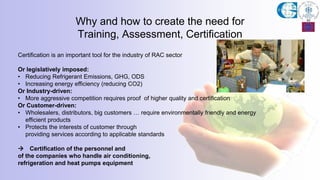
Why and how to create the need for
Training, Assessment, Certification
Certification is an important tool for the industry of RAC sector
Or legislatively imposed:
• Reducing Refrigerant Emissions, GHG, ODS
• Increasing energy efficiency (reducing CO2)
Or Industry-driven:
• More aggressive competition requires proof of higher quality and certification
Or Customer-driven:
• Wholesalers, distributors, big customers … require environmentally friendly and energy
efficient products
• Protects the interests of customer through
providing services according to applicable standards
 Certification of the personnel and
of the companies who handle air conditioning,
refrigeration and heat pumps equipment
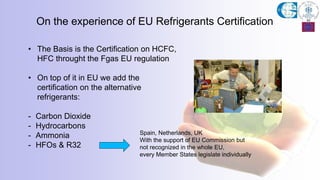
On the experience of EU Refrigerants Certification
• The Basis is the Certification on HCFC,
HFC throught the Fgas EU regulation
• On top of it in EU we add the
certification on the alternative
refrigerants:
- Carbon Dioxide
- Hydrocarbons
- Ammonia
- HFOs & R32
Spain, Netherlands, UK
With the support of EU Commission but
not recognized in the whole EU,
every Member States legislate individually
CERTIFICATIONS
A - FLAMMABLE REFRIGERANTS
Based on the European Union
Training Program
REALALTERNATIVES
• Voluntary
• Qualification Body:
CENTRO STUDI GALILEO
• Safety aspects and procedures:
EN378-1-2-3-4
EC Directive ATEX 94 – ATEX 99
• Code of practices and guide lines:
IOR – GIZ - AREA
B - REFRIGERANTS
Based on the European Regulation
EC 517/2014 (EC 842/2006)
• Mandatory (in EU)
• Qualification Body:
CENTRO STUDI GALILEO
• Certification Body: CEPAS
(Accredia) – Italy
• Legally valid in all the EU
• Recognized in all the World
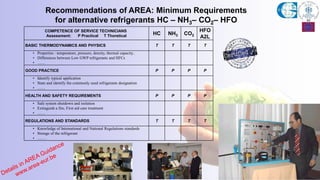
Recommendations of AREA: Minimum Requirements
for alternative refrigerants HC – NH3– CO2– HFO
COMPETENCE OF SERVICE TECHNICIANS
Assessment: P Practical T Thoretical HC NH3 CO2
HFO
A2L
BASIC THERMODYNAMICS AND PHYSICS T T T T
• Properties : temperature, pressure, density, thermal capacity..
• Differences between Low GWP refrigerants and HFCs
• ……
GOOD PRACTICE P P P P
• Identify typical application
• State and identify the commonly used refrigerants designation
• ……
HEALTH AND SAFETY REQUIREMENTS P P P P
• Safe system shutdown and isolation
• Extinguish a fire, First aid care treatment
• ……
REGULATIONS AND STANDARDS T T T T
• Knowledge of International and National Regulations standards
• Storage of the refrigerant
• …….
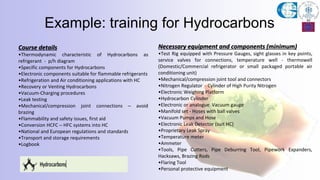
Example: training for Hydrocarbons
Course details
•Thermodynamic characteristic of Hydrocarbons as
refrigerant - p/h diagram
•Specific components for Hydrocarbons
•Electronic components suitable for flammable refrigerants
•Refrigeration and Air conditioning applications with HC
•Recovery or Venting Hydrocarbons
•Vacuum-Charging procedures
•Leak testing
•Mechanical/compression joint connections – avoid
brazing
•Flammability and safety issues, first aid
•Conversion HCFC – HFC systems into HC
•National and European regulations and standards
•Transport and storage requirements
•Logbook
Necessary equipment and components (minimum)
•Test Rig equipped with Pressure Gauges, sight glasses in key points,
service valves for connections, temperature well - thermowell
(Domestic/Commercial refrigerator or small packaged portable air
conditioning unit)
•Mechanical/compression joint tool and connectors
•Nitrogen Regulator - Cylinder of High Purity Nitrogen
•Electronic Weighing Platform
•Hydrocarbon Cylinder
•Electronic or analogue Vacuum gauge
•Manifold set - Hoses with ball valves
•Vacuum Pumps and Hose
•Electronic Leak Detector (suit HC)
•Proprietary Leak Spray
•Temperature meter
•Ammeter
•Tools, Pipe Cutters, Pipe Deburring Tool, Pipework Expanders,
Hacksaws, Brazing Rods
•Flaring Tool
•Personal protective equipment
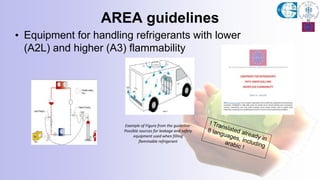
AREA guidelines
• Equipment for handling refrigerants with lower
(A2L) and higher (A3) flammability
Example of Figure from the guideline:
Possible sources for leakage and safety
equipment used when filling
flammable refrigerant
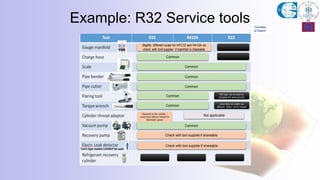
Example: R32 Service tools Courtesy
of Daikin
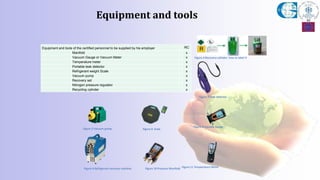
Equipment and tools of the certified personnel to be supplied by his employer RC
Manifold x
Vacuum Gauge or Vacuum Meter x
Temperature meter x
Portable leak detector x
Refrigerant weight Scale x
Vacuum pump x
Recovery set x
Nitrogen pressure regulator x
Recycling cylinder x
Figure 4 Recovery cylinder, how to label it
Figure 5 Vacuum pump
Figure 6 Refrigerant recovery machine
Figure 7 Leak detector
Figure 8 Scale
Figure 9 Vacuum Gauge
Figure 10 Pressure Manifold Figure 11 Temperature Meter
Equipment and tools
Maximum 20-25 candidates per class dependent on number of assessors
Assessor/s should be independent and not involved in the training of the candidates
Multiple answers tests, between 30 and 45 questions for 60-90 minutes duration (Sample questions in annex V)
The same test among candidates with variation of questions to prevent predictability among candidates
Closed books, only specific technical tools such as calculator and pressure-temperature comparator allowed
NO! mobile phones or cameras NO! copying or communication between candidates
YES! speaking to the assessor to ask explanation of the modalities and of the questions if not understood; many
candidates use different words and vocabulary to identify the same concept (eg. Valves)
Theoretical assessment: Pass mark above 60% correct answers
Laboratory should be properly equipped for performing
the practical test (see Annex IV of Certification Booklet)
Practical assessment: Pass if candidate proves competence
in performing main RAC service technicians activities
without or with only small hesitations (remember candidates
could be knowledgeable but be nervous!):
• Thermodynamic parameters reading through gauges and
devices, temperature, pressure, subcooling, superheating
• Parameters interpretation, troubleshooting
• Perform a leak test
• Vacuum, charge, recovery with minimum emissions
• System Logbook reading, understanding and competition
• Brazing leak tight joints
Assessment: practical
organization issues
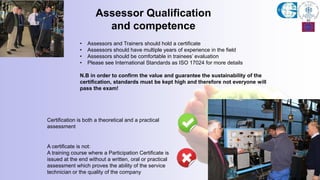
• Assessors and Trainers should hold a certificate
• Assessors should have multiple years of experience in the field
• Assessors should be comfortable in trainees’ evaluation
• Please see International Standards as ISO 17024 for more details
N.B in order to confirm the value and guarantee the sustainability of the
certification, standards must be kept high and therefore not everyone will
pass the exam!
Assessor Qualification
and competence
A certificate is not:
A training course where a Participation Certificate is
issued at the end without a written, oral or practical
assessment which proves the ability of the service
technician or the quality of the company
Certification is both a theoretical and a practical
assessment
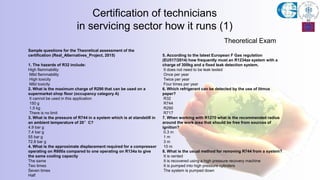
Theoretical Exam
Certification of technicians
in servicing sector how it runs (1)
Sample questions for the Theoretical assessment of the
certification (Real_Alternatives_Project, 2015)
1. The hazards of R32 include:
High flammability
Mild flammability
High toxicity
Mild toxicity
2. What is the maximum charge of R290 that can be used on a
supermarket shop floor (occupancy category A)
It cannot be used in this application
150 g
1.5 kg
There is no limit
3. What is the pressure of R744 in a system which is at standstill in
an ambient temperature of 20°C?
4.9 bar g
7.4 bar g
55 bar g
72.8 bar g
4. What is the approximate displacement required for a compressor
operating on R600a compared to one operating on R134a to give
the same cooling capacity
The same
Two times
Seven times
Half
5. According to the latest European F Gas regulation
(EU517/2014) how frequently must an R1234ze system with a
charge of 300kg and a fixed leak detection system.
It does not need to be leak tested
Once per year
Twice per year
Four times per year
6. Which refrigerant can be detected by the use of litmus
paper?
R32
R744
R290
R717
7. When working with R1270 what is the recommended radius
around the work area that should be free from sources of
ignition?
0.3 m
1 m
3 m
10 m
8. What is the usual method for removing R744 from a system?
It is vented
It is recovered using a high pressure recovery machine
It is pumped into high pressure cylinders
The system is pumped down
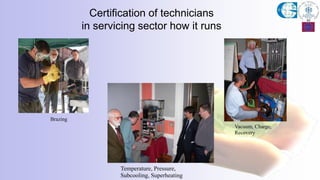
Brazing
Temperature, Pressure,
Subcooling, Superheating
Vacuum, Charge,
Recovery
Certification of technicians
in servicing sector how it runs
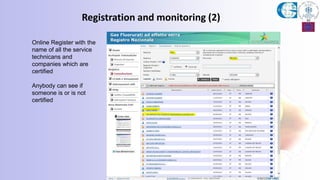
Registration and monitoring (2)
Online Register with the
name of all the service
technicans and
companies which are
certified
Anybody can see if
someone is or is not
certified
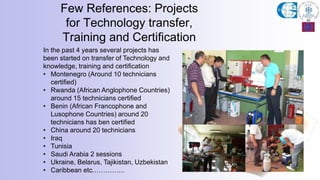
Few References: Projects
for Technology transfer,
Training and Certification
In the past 4 years several projects has
been started on transfer of Technology and
knowledge, training and certification
• Montenegro (Around 10 technicians
certified)
• Rwanda (African Anglophone Countries)
around 15 technicians certified
• Benin (African Francophone and
Lusophone Countries) around 20
technicians has ben certified
• China around 20 technicians
• Iraq
• Tunisia
• Saudi Arabia 2 sessions
• Ukraine, Belarus, Tajikistan, Uzbekistan
• Caribbean etc.…………..
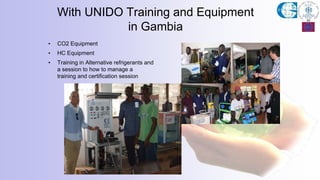
With UNIDO Training and Equipment
in Gambia
• CO2 Equipment
• HC Equipment
• Training in Alternative refrigerants and
a session to how to manage a
training and certification session
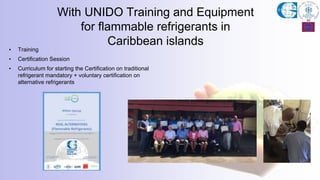
With UNIDO Training and Equipment
for flammable refrigerants in
Caribbean islands
• Training
• Certification Session
• Curriculum for starting the Certification on traditional
refrigerant mandatory + voluntary certification on
alternative refrigerants
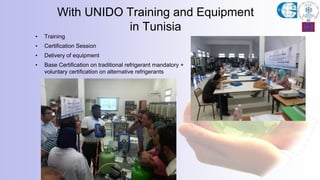
With UNIDO Training and Equipment
in Tunisia
• Training
• Certification Session
• Delivery of equipment
• Base Certification on traditional refrigerant mandatory +
voluntary certification on alternative refrigerants
With UNEP Chinese (2017)
and Iraqi technicians (2016)
• Training in CO2 and HC
• Certification Session
Certification
is the best practical method to
verify the competence of personnel
handling refrigerants and to ensure
the correct installation,
maintenance, repair and
dismantling of a refrigeration,
airconditioning and heat pump
systems.
REAL Alternatives for LIFE
Real Alternatives for LIFE
Refrigerant Emissions Alternatives and Leakage
– blended learning for natural refrigerants
Objectives
1. Increase knowledge amongst technicians in partner and stakeholder countries.
2. Address inconsistencies in skills across the whole of the EU
3. Overcome equipment operator and distributor concerns over safety, reliability,
containment, efficiency and standards restrictions
4. Support implementation of F Gas Regs and transition to alternative refrigerants
• Project start date 15th June 2017
• Project end date 14th June 2020
REAL Alternatives for LIFE
The LIFE programme is the EU’s funding instrument for the
environment and climate action.
Implementation, updating and development of EU environmental and climate
policy and legislation by co-financing projects
The European Commission (DG Environment and DG Climate Action) manages
the LIFE programme.
LIFE Climate Governance and Information projects:
• information, awareness and dissemination on climate matters
• generating public and stakeholder support of Union policy
• knowledge on sustainable development
• knowledge sharing on successful climate solutions and practice
• cooperation platforms among stakeholders and training
• promote effective compliance with climate legislation
http://ec.europa.eu/environment/life/
about/index.htm
REAL Alternatives for LIFE
Key Project information
• Project co-ordinator - IOR (UK)
• Management Team – includes original REAL Alternatives project (2016)
• Stakeholders group of seven new organisations
• 13 languages for the final outputs
• 9 Modules (8 existing ones revised plus 1 new)
• Train the Trainer resources, Licences and Certification
• Study visits (5 in training centres Belgium, Germany, UK, Poland, Italy)
• Train the Trainer events (5 in stakeholder locations – 20 people at each)
• Project presence at conferences, trade shows and exhibition, international
governmental meetings, policy makers
• Generating regular articles/newsletters/social media
• Together we have the potential to reach 228,0000 employers, 26,000 RACHP
installation businesses and 100 suppliers across Europe (and after internationally)
REAL Alternatives for LIFE
REAL Alternatives for LIFE – 1st Project Meeting – 20-21 June 2017
Project Management team
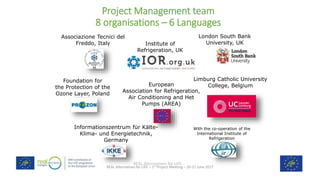
8 organisations – 6 Languages
Institute of
Refrigeration, UK
London South Bank
University, UK
European
Association for Refrigeration,
Air Conditioning and Het
Pumps (AREA)
Informationszentrum für Kälte-
Klima- und Energietechnik,
Germany
Foundation for
the Protection of the
Ozone Layer, Poland
Associazione Tecnici del
Freddo, Italy
Limburg Catholic University
College, Belgium
With the co-operation of the
International Institute of
Refrigeration
REAL Alternatives for LIFE
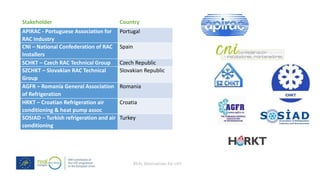
Stakeholder Country
APIRAC - Portuguese Association for
RAC Industry
Portugal
CNI – National Confederation of RAC
Installers
Spain
SCHKT – Czech RAC Technical Group Czech Republic
SZCHKT – Slovakian RAC Technical
Group
Slovakian Republic
AGFR – Romania General Association
of Refrigeration
Romania
HRKT – Croatian Refrigeration air
conditioning & heat pump assoc
Croatia
SOSIAD – Turkish refrigeration and air
conditioning
Turkey
REAL Alternatives for LIFE
Project stages
3. Review existing learning modules in line
with market needs findings – July/Sept 17
2. Prepare new material on risk and
safety for flammables – Sept 17
1. Survey on training awareness and
needs in your countries – Sept/Oct 17
4. Raise awareness of the project with
press releases, articles, talks
• Training the trainers
programme: standard lessons
plans, practical tests, trainer
training events, certification for
trainers and technicians
• Updated e-learning modules
and booklets
• Report on EU training needs
OUTCOMES
REAL Alternatives for LIFE
How will we do it?
7. Run Train the Trainer events in
stakeholder countries March/June 2019
8. Promote take up within EU through extensive
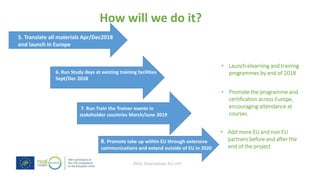
communications and extend outside of EU in 2020
• Launch elearning and training
programmes by end of 2018
• Promote the programme and
certification across Europe,
encouraging attendance at
courses
5. Translate all materials Apr/Dec2018
and launch in Europe
• Add more EU and non EU
partners before and after the
end of the project
6. Run Study days at existing training facilities
Sept/Dec 2018
REAL Alternatives for LIFE
Elearning and booklets –
being updated and extended
Real Alternatives Europe programme modules:
1. Introduction to Alternative Refrigerants -
safety, efficiency, reliability and good practice
2. System design using alternative refrigerants
3. Containment and leak detection of alternative
refrigerants
4. Maintenance and repair of alternative
refrigerant systems
Retrofitting existing systems with low GWP
alternatives
6. Checklist of legal obligations
7. Measuring the financial and environmental
impact of leakage
8. Tools and guidance for conducting site surveys
REAL Alternatives for LIFE
www.realalternatives.eu
Project website
(multilingual)
REAL Alternatives for LIFE
Certification
on Natural
Refrigerants
Starting from the EU F-gas Certification
(500.000 technicians)
Add modules on the different Natural
Refrigerants through the Real Alternatives
Certification
•Carbon dioxide
•Ammonia
•Hydrocarbon
Addressing safety, efficiency, reliability and
containment aspects of service and
maintenance.
•Higher system pressures
•Flammability
•Toxicity
And the tools to handle those refrigerants
REAL Alternatives for LIFE
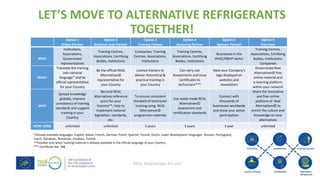
LET’S MOVE TO ALTERNATIVE REFRIGERANTS
TOGETHER!
Option 1
Global Partner
Option 2
National Lead Partner
Option 3
Training Partner
Option 4
Assessing Partner
Option 5
Sponsor Partner
Option 6
Free User
WHO
Institutions,
Associations,
Government
representatives
Training Centres,
Associations, Certifying
Bodies, Institutions
Companies, Training
Centres, Associations,
Institutions
Training Centres,
Associations, Certifying
Bodies, Institutions
Businesses in the
HVAC/R&HP sector
Training Centres,
Associations, Certifying
Bodies, Institutions,
Companies
WHAT
Translate the training
into national
language* and be
official representative
for your Country
Be the official REAL
Alternatives©
representative for
your Country
Licence trainers to
deliver theoretical &
practical training in
your Country
Can carry out
Assessments and issue
Certificates to
technicians***
Have your Company’s
logo displayed on
websites and
newsletters
Disseminate Real
Alternatives© free
online material and
e-learning platform
within your network
WHY
Spread knowledge
globally, improve
consistency of training
standards and support
training in your
Country
Become REAL
Alternatives reference
point for your
Country**, help to
implement national
legislation, standards,
etc.
To ensure consistent
standard of technician
training using REAL
Alternatives©
programme materials
Use ready-made REAL
Alternatives©
assessment and
certification standards
Connect with
thousands of
businesses worldwide
and show your active
participation
Share the innovative
and free online
platform of Real
Alternatives© to
enrich the culture and
knowledge on new
alternatives
HOW LONG unlimited unlimited 3 years 3 years 3 year unlimited
*Already available languages: English, Italian, French, German, Polish, Spanish, Finnish, Dutch; under development languages: Russian, Portuguese,
Czech, Slovakian, Romanian, Croatian, Turkish
**Possible only when training material is already available in the official language of your Country
*** Certificate fee: 30€
REAL Alternatives for LIFE
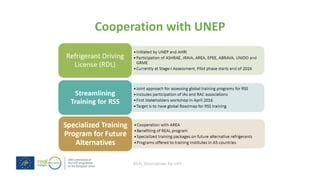
Cooperation with UNEP
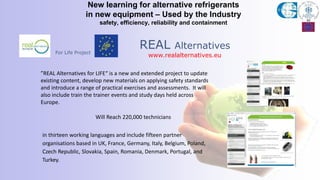
New learning for alternative refrigerants
in new equipment – Used by the Industry
safety, efficiency, reliability and containment
For Life Project
REAL Alternatives
www.realalternatives.eu
”REAL Alternatives for LIFE“ is a new and extended project to update
existing content, develop new materials on applying safety standards
and introduce a range of practical exercises and assessments. It will
also include train the trainer events and study days held across
Europe.
Will Reach 220,000 technicians
in thirteen working languages and include fifteen partner
organisations based in UK, France, Germany, Italy, Belgium, Poland,
Czech Republic, Slovakia, Spain, Romania, Denmark, Portugal, and
Turkey.
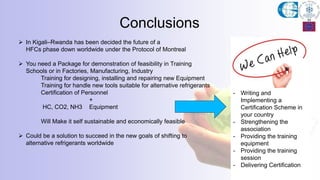
 In Kigali–Rwanda has been decided the future of a
HFCs phase down worldwide under the Protocol of Montreal
 You need a Package for demonstration of feasibility in Training
Schools or in Factories, Manufacturing, Industry
Training for designing, installing and repairing new Equipment
Training for handle new tools suitable for alternative refrigerants
Certification of Personnel
+
HC, CO2, NH3 Equipment
Will Make it self sustainable and economically feasible
 Could be a solution to succeed in the new goals of shifting to
alternative refrigerants worldwide
Conclusions
- Writing and
Implementing a
Certification Scheme in
your country
- Strengthening the
association
- Providing the training
equipment
- Providing the training
session
- Delivering Certification
THANK YOU!
Email: buoni@centrogalileo.it
Marco Buoni
VicePresident, AREA
Air Conditioning & Refrigeration European contractors’Association
(www.area-eur.be)
Secretary General Italian Association of Refrigeration Technician, ATF
(www.associazioneATF.org)
• To preserve our water,
• our climate
• our environment
 we should move to
new refrigerants but
 we should do it with
competence

About Centro Studi Galileo

  • 1.
    Marco Buoni VicePresident, AREA AirConditioning & Refrigeration European contractors’Association (www.area-eur.be) Secretary General Italian Association of Refrigeration Technician, ATF (www.associazioneATF.org) Director Centro Studi Galileo (www.centrogalileo.it) Capacity building and training equipment for RAC systems using alternative technologies. Focus on Service Technicians and Training Centers
  • 2.
    •For 40 yearshas been organizing training courses, seminars and conferences in the field of refrigeration, air conditioning, 3000 technicians, 300 training sessions a year • publishes the International Special Issue (ISI) of Industria & Formazione in 2006, 2008, 2010, 2012, 2014, 2016. The magazine is published with UNEP and IIR, with an introduction from the UN Under-Secretary General, Achim Steiner, and the Italian Minister of the Environment. Ddistributed at the climate change summits in Bangkok, New Delhi, Cancun and Doha, the summits of the Montreal protocol in Durban, Copenhagen and Geneva. •Monthly publishes newsletters, emails and magazines •international presence in Europe (particular in UK) and it is working with UNEP, UNIDO, UNDP in Rwanda, Benin, Gambia, Tunisia, Arabic Countries, Eritrea, Sri Lanka, Thailand etc…. •10 training centres in Italy – 3 in UK •1000 technians trained in alternative refrigerants (HCs, CO2, NH3) CENTRO STUDI GALILEO Associazione dei Tecnici italiani del Freddo
  • 3.
    AREA The indisputable voiceof European RACHP contractors • Funded in 1988 in Brussels, Belgium • Represents RACHP contractors • AREA in figures:  22 national member associations  20 countries from EU and beyond  > 9,000 companies (mainly SMEs)  +/- 125,000 work force  +/- € 20 bn annual turnover Design, installation, maintenance and repair of all Refrigeration, Air Conditioning and Heat Pumps RACHP systems
  • 4.
    Due to thesignificant worldwide interest in European legislative evolutions, and the increase in competence of the personnel who handle the new refrigerants, we wish to introduce to you the brand new “International Observer” membership category in AREA. This will give a fantastic opportunity for RACHP installers’ bodies, throughout the world, to benefit from the expertise and discussions within Europe through their access to AREA. New AREA membership category: International Observers
  • 5.
    17TH EUROPEAN CONFERENCE POLITECNICOOF MILANO 9-10 JUNE 2017 Last conference was under the Patronage of THE LATEST TECHNOLOGY IN AIR CONDITIONING AND REFRIGERATION INDUSTRY NEW REFRIGERANTS, COMPONENTS AND EQUIPMENT COLD STORAGE AND FOOD CONSERVATION With the participation of United Nations Industrial Development Organisation (UNIDO) United Nations Environment Programme (UNEP), Food and Agriculture Organisation of United Nation (FAO), International Institute of Refrigeration (IIR), AFF, AREA, AHRI, ASHRAE, EPEE …….
  • 6.
    6TH INTERNATIONAL SPECIALISSUE 2016-2017 LAUNCHED IN MONTREAL PROTOCOL CONFERENCE IN KIGALI OCTOBER 2016 Presentation to international DELAGATIONS by UNEP-IIR-UNEP in Kigali International Special Issue 2016
  • 7.
    Main points ofdiscussion Importance of Training and Certification • New emerging technologies and alternatives • Motivation for RAC technicians to join the training. Regulatory and institutional framework; linkages with certification system • Roles of Agencies involved: NOU/Industries/Association/Vocational Training • Approaches for regional cooperation to achieve effective training
  • 8.
    Strengthening national RACassociations • Connecting contractors • Training, Seminars and Conferences • Information – magazine - newsletter • Connecting with the industry • Speak with One voice to the National, International Institutions and Governments • (important driver at the moment) fast moving sector in technology and in legislation: F-gas regulations, RES directive, Refrigerants future • Organizing training and certifications sessions Keep the association LIVE!
  • 9.
    Services and Revenues: •Members fee (in Europe starting from 63 Euro… ) • Events: trainings, conferences, summits • Certification of persons and of companies • Magazines • Websites • Sponsors (without mining Association indipendence) Services and Budget requirements for RAC associations The association will give Quick and Correct informations, vital for the sector in the next decade. A lot of work ahead of us. The bigger change ever.
  • 10.
    Others HFO R32 R404A/ 507 ISCEON™ MO29 Opteon™XP10 R407A/F Opteon™ XP40 R134a R410A R407C Recycled -500 0 500 1000 1500 2000 2500 3000 3500 4000 4500 -10 0 10 20 30 40 50 60 70 GWP(AR4) CO2 Equivalent (Million tonnes) 2015 ~ 2000 GWP How refrigerants sector will evolve? (in EU)
  • 11.
    Natural Ref HFO R32 Opteon™ XL41 R407A/F Opteon™ XP40 Opteon™ XP10 B250 R134a R407C Recycled -500 0 500 1000 1500 2000 2500 3000 3500 4000 4500 -100 10 20 30 40 50 60 70 GWP(AR4) CO2 Equivalent (Million tonnes) 2030* ~ 2000 GWP * SKM Enviros & DuPont assuming the quantity of refrigerant used remains constant How refrigerants sector will evolve? (in EU)
  • 12.
    Natural Ref HFO R32 Opteon™ XL41 R407A/F Opteon™XP40 Opteon™ XP10 Opteon™ XL40 & Opteon™ XL20 R134a R407C Recycled -500 0 500 1000 1500 2000 2500 -5 0 5 10 15 20 GWP(AR4) CO2 Equivalent (Million tonnes) 2030 - 80 % ~ 400 GWP ~ 2000 GWP * SKM Enviros & DuPont assuming the quantity of refrigerant used remains constant How refrigerants sector will evolve? (in EU)
  • 13.
    Contractors’ training withlow GWP refrigerants: mind the gap! Kigali Amendment includes measures in favour of a decreased use of HFCs in RACHP equipment. Such measures would, in turn, result in an increased use of alternatives, namely low GWP (global warming potential) refrigerants, and in particular the so-called “natural refrigerants” (CO2, hydrocarbons and ammonia). Mindful of the key role played by contractors in the safe, efficient and reliable functioning of equipment working with natural refrigerants, AREA sought an overview of the availability and level of training in the EU. Solution could be starting from the F-Gas certification of personnel adding modules for natural refrigerants In EU: Report of EU commission presented at Consultation Forum 1st December
  • 14.
    Why and howto create the need for Training, Assessment, Certification Certification is an important tool for the industry of RAC sector Or legislatively imposed: • Reducing Refrigerant Emissions, GHG, ODS • Increasing energy efficiency (reducing CO2) Or Industry-driven: • More aggressive competition requires proof of higher quality and certification Or Customer-driven: • Wholesalers, distributors, big customers … require environmentally friendly and energy efficient products • Protects the interests of customer through providing services according to applicable standards  Certification of the personnel and of the companies who handle air conditioning, refrigeration and heat pumps equipment
  • 15.
    On the experienceof EU Refrigerants Certification • The Basis is the Certification on HCFC, HFC throught the Fgas EU regulation • On top of it in EU we add the certification on the alternative refrigerants: - Carbon Dioxide - Hydrocarbons - Ammonia - HFOs & R32 Spain, Netherlands, UK With the support of EU Commission but not recognized in the whole EU, every Member States legislate individually
  • 16.
    CERTIFICATIONS A - FLAMMABLEREFRIGERANTS Based on the European Union Training Program REALALTERNATIVES • Voluntary • Qualification Body: CENTRO STUDI GALILEO • Safety aspects and procedures: EN378-1-2-3-4 EC Directive ATEX 94 – ATEX 99 • Code of practices and guide lines: IOR – GIZ - AREA B - REFRIGERANTS Based on the European Regulation EC 517/2014 (EC 842/2006) • Mandatory (in EU) • Qualification Body: CENTRO STUDI GALILEO • Certification Body: CEPAS (Accredia) – Italy • Legally valid in all the EU • Recognized in all the World
  • 17.
    Recommendations of AREA:Minimum Requirements for alternative refrigerants HC – NH3– CO2– HFO COMPETENCE OF SERVICE TECHNICIANS Assessment: P Practical T Thoretical HC NH3 CO2 HFO A2L BASIC THERMODYNAMICS AND PHYSICS T T T T • Properties : temperature, pressure, density, thermal capacity.. • Differences between Low GWP refrigerants and HFCs • …… GOOD PRACTICE P P P P • Identify typical application • State and identify the commonly used refrigerants designation • …… HEALTH AND SAFETY REQUIREMENTS P P P P • Safe system shutdown and isolation • Extinguish a fire, First aid care treatment • …… REGULATIONS AND STANDARDS T T T T • Knowledge of International and National Regulations standards • Storage of the refrigerant • …….
  • 18.
    Example: training forHydrocarbons Course details •Thermodynamic characteristic of Hydrocarbons as refrigerant - p/h diagram •Specific components for Hydrocarbons •Electronic components suitable for flammable refrigerants •Refrigeration and Air conditioning applications with HC •Recovery or Venting Hydrocarbons •Vacuum-Charging procedures •Leak testing •Mechanical/compression joint connections – avoid brazing •Flammability and safety issues, first aid •Conversion HCFC – HFC systems into HC •National and European regulations and standards •Transport and storage requirements •Logbook Necessary equipment and components (minimum) •Test Rig equipped with Pressure Gauges, sight glasses in key points, service valves for connections, temperature well - thermowell (Domestic/Commercial refrigerator or small packaged portable air conditioning unit) •Mechanical/compression joint tool and connectors •Nitrogen Regulator - Cylinder of High Purity Nitrogen •Electronic Weighing Platform •Hydrocarbon Cylinder •Electronic or analogue Vacuum gauge •Manifold set - Hoses with ball valves •Vacuum Pumps and Hose •Electronic Leak Detector (suit HC) •Proprietary Leak Spray •Temperature meter •Ammeter •Tools, Pipe Cutters, Pipe Deburring Tool, Pipework Expanders, Hacksaws, Brazing Rods •Flaring Tool •Personal protective equipment
  • 19.
    AREA guidelines • Equipmentfor handling refrigerants with lower (A2L) and higher (A3) flammability Example of Figure from the guideline: Possible sources for leakage and safety equipment used when filling flammable refrigerant
  • 20.
    Example: R32 Servicetools Courtesy of Daikin
  • 21.
    Equipment and toolsof the certified personnel to be supplied by his employer RC Manifold x Vacuum Gauge or Vacuum Meter x Temperature meter x Portable leak detector x Refrigerant weight Scale x Vacuum pump x Recovery set x Nitrogen pressure regulator x Recycling cylinder x Figure 4 Recovery cylinder, how to label it Figure 5 Vacuum pump Figure 6 Refrigerant recovery machine Figure 7 Leak detector Figure 8 Scale Figure 9 Vacuum Gauge Figure 10 Pressure Manifold Figure 11 Temperature Meter Equipment and tools
  • 22.
    Maximum 20-25 candidatesper class dependent on number of assessors Assessor/s should be independent and not involved in the training of the candidates Multiple answers tests, between 30 and 45 questions for 60-90 minutes duration (Sample questions in annex V) The same test among candidates with variation of questions to prevent predictability among candidates Closed books, only specific technical tools such as calculator and pressure-temperature comparator allowed NO! mobile phones or cameras NO! copying or communication between candidates YES! speaking to the assessor to ask explanation of the modalities and of the questions if not understood; many candidates use different words and vocabulary to identify the same concept (eg. Valves) Theoretical assessment: Pass mark above 60% correct answers Laboratory should be properly equipped for performing the practical test (see Annex IV of Certification Booklet) Practical assessment: Pass if candidate proves competence in performing main RAC service technicians activities without or with only small hesitations (remember candidates could be knowledgeable but be nervous!): • Thermodynamic parameters reading through gauges and devices, temperature, pressure, subcooling, superheating • Parameters interpretation, troubleshooting • Perform a leak test • Vacuum, charge, recovery with minimum emissions • System Logbook reading, understanding and competition • Brazing leak tight joints Assessment: practical organization issues
  • 23.
    • Assessors andTrainers should hold a certificate • Assessors should have multiple years of experience in the field • Assessors should be comfortable in trainees’ evaluation • Please see International Standards as ISO 17024 for more details N.B in order to confirm the value and guarantee the sustainability of the certification, standards must be kept high and therefore not everyone will pass the exam! Assessor Qualification and competence A certificate is not: A training course where a Participation Certificate is issued at the end without a written, oral or practical assessment which proves the ability of the service technician or the quality of the company Certification is both a theoretical and a practical assessment
  • 24.
    Theoretical Exam Certification oftechnicians in servicing sector how it runs (1) Sample questions for the Theoretical assessment of the certification (Real_Alternatives_Project, 2015) 1. The hazards of R32 include: High flammability Mild flammability High toxicity Mild toxicity 2. What is the maximum charge of R290 that can be used on a supermarket shop floor (occupancy category A) It cannot be used in this application 150 g 1.5 kg There is no limit 3. What is the pressure of R744 in a system which is at standstill in an ambient temperature of 20°C? 4.9 bar g 7.4 bar g 55 bar g 72.8 bar g 4. What is the approximate displacement required for a compressor operating on R600a compared to one operating on R134a to give the same cooling capacity The same Two times Seven times Half 5. According to the latest European F Gas regulation (EU517/2014) how frequently must an R1234ze system with a charge of 300kg and a fixed leak detection system. It does not need to be leak tested Once per year Twice per year Four times per year 6. Which refrigerant can be detected by the use of litmus paper? R32 R744 R290 R717 7. When working with R1270 what is the recommended radius around the work area that should be free from sources of ignition? 0.3 m 1 m 3 m 10 m 8. What is the usual method for removing R744 from a system? It is vented It is recovered using a high pressure recovery machine It is pumped into high pressure cylinders The system is pumped down
  • 25.
    Brazing Temperature, Pressure, Subcooling, Superheating Vacuum,Charge, Recovery Certification of technicians in servicing sector how it runs
  • 26.
    Registration and monitoring(2) Online Register with the name of all the service technicans and companies which are certified Anybody can see if someone is or is not certified
  • 27.
    Few References: Projects forTechnology transfer, Training and Certification In the past 4 years several projects has been started on transfer of Technology and knowledge, training and certification • Montenegro (Around 10 technicians certified) • Rwanda (African Anglophone Countries) around 15 technicians certified • Benin (African Francophone and Lusophone Countries) around 20 technicians has ben certified • China around 20 technicians • Iraq • Tunisia • Saudi Arabia 2 sessions • Ukraine, Belarus, Tajikistan, Uzbekistan • Caribbean etc.…………..
  • 28.
    With UNIDO Trainingand Equipment in Gambia • CO2 Equipment • HC Equipment • Training in Alternative refrigerants and a session to how to manage a training and certification session
  • 29.
    With UNIDO Trainingand Equipment for flammable refrigerants in Caribbean islands • Training • Certification Session • Curriculum for starting the Certification on traditional refrigerant mandatory + voluntary certification on alternative refrigerants
  • 30.
    With UNIDO Trainingand Equipment in Tunisia • Training • Certification Session • Delivery of equipment • Base Certification on traditional refrigerant mandatory + voluntary certification on alternative refrigerants
  • 31.
    With UNEP Chinese(2017) and Iraqi technicians (2016) • Training in CO2 and HC • Certification Session
  • 32.
    Certification is the bestpractical method to verify the competence of personnel handling refrigerants and to ensure the correct installation, maintenance, repair and dismantling of a refrigeration, airconditioning and heat pump systems.
  • 33.
    REAL Alternatives forLIFE Real Alternatives for LIFE Refrigerant Emissions Alternatives and Leakage – blended learning for natural refrigerants Objectives 1. Increase knowledge amongst technicians in partner and stakeholder countries. 2. Address inconsistencies in skills across the whole of the EU 3. Overcome equipment operator and distributor concerns over safety, reliability, containment, efficiency and standards restrictions 4. Support implementation of F Gas Regs and transition to alternative refrigerants • Project start date 15th June 2017 • Project end date 14th June 2020
  • 34.
    REAL Alternatives forLIFE The LIFE programme is the EU’s funding instrument for the environment and climate action. Implementation, updating and development of EU environmental and climate policy and legislation by co-financing projects The European Commission (DG Environment and DG Climate Action) manages the LIFE programme. LIFE Climate Governance and Information projects: • information, awareness and dissemination on climate matters • generating public and stakeholder support of Union policy • knowledge on sustainable development • knowledge sharing on successful climate solutions and practice • cooperation platforms among stakeholders and training • promote effective compliance with climate legislation http://ec.europa.eu/environment/life/ about/index.htm
  • 35.
    REAL Alternatives forLIFE Key Project information • Project co-ordinator - IOR (UK) • Management Team – includes original REAL Alternatives project (2016) • Stakeholders group of seven new organisations • 13 languages for the final outputs • 9 Modules (8 existing ones revised plus 1 new) • Train the Trainer resources, Licences and Certification • Study visits (5 in training centres Belgium, Germany, UK, Poland, Italy) • Train the Trainer events (5 in stakeholder locations – 20 people at each) • Project presence at conferences, trade shows and exhibition, international governmental meetings, policy makers • Generating regular articles/newsletters/social media • Together we have the potential to reach 228,0000 employers, 26,000 RACHP installation businesses and 100 suppliers across Europe (and after internationally)
  • 36.
    REAL Alternatives forLIFE REAL Alternatives for LIFE – 1st Project Meeting – 20-21 June 2017 Project Management team 8 organisations – 6 Languages Institute of Refrigeration, UK London South Bank University, UK European Association for Refrigeration, Air Conditioning and Het Pumps (AREA) Informationszentrum für Kälte- Klima- und Energietechnik, Germany Foundation for the Protection of the Ozone Layer, Poland Associazione Tecnici del Freddo, Italy Limburg Catholic University College, Belgium With the co-operation of the International Institute of Refrigeration
  • 37.
    REAL Alternatives forLIFE Stakeholder Country APIRAC - Portuguese Association for RAC Industry Portugal CNI – National Confederation of RAC Installers Spain SCHKT – Czech RAC Technical Group Czech Republic SZCHKT – Slovakian RAC Technical Group Slovakian Republic AGFR – Romania General Association of Refrigeration Romania HRKT – Croatian Refrigeration air conditioning & heat pump assoc Croatia SOSIAD – Turkish refrigeration and air conditioning Turkey
  • 38.
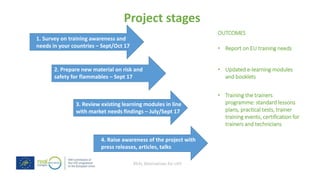
    REAL Alternatives forLIFE Project stages 3. Review existing learning modules in line with market needs findings – July/Sept 17 2. Prepare new material on risk and safety for flammables – Sept 17 1. Survey on training awareness and needs in your countries – Sept/Oct 17 4. Raise awareness of the project with press releases, articles, talks • Training the trainers programme: standard lessons plans, practical tests, trainer training events, certification for trainers and technicians • Updated e-learning modules and booklets • Report on EU training needs OUTCOMES
  • 39.
    REAL Alternatives forLIFE How will we do it? 7. Run Train the Trainer events in stakeholder countries March/June 2019 8. Promote take up within EU through extensive communications and extend outside of EU in 2020 • Launch elearning and training programmes by end of 2018 • Promote the programme and certification across Europe, encouraging attendance at courses 5. Translate all materials Apr/Dec2018 and launch in Europe • Add more EU and non EU partners before and after the end of the project 6. Run Study days at existing training facilities Sept/Dec 2018
  • 40.
    REAL Alternatives forLIFE Elearning and booklets – being updated and extended Real Alternatives Europe programme modules: 1. Introduction to Alternative Refrigerants - safety, efficiency, reliability and good practice 2. System design using alternative refrigerants 3. Containment and leak detection of alternative refrigerants 4. Maintenance and repair of alternative refrigerant systems Retrofitting existing systems with low GWP alternatives 6. Checklist of legal obligations 7. Measuring the financial and environmental impact of leakage 8. Tools and guidance for conducting site surveys
  • 41.
    REAL Alternatives forLIFE www.realalternatives.eu Project website (multilingual)
  • 42.
    REAL Alternatives forLIFE Certification on Natural Refrigerants Starting from the EU F-gas Certification (500.000 technicians) Add modules on the different Natural Refrigerants through the Real Alternatives Certification •Carbon dioxide •Ammonia •Hydrocarbon Addressing safety, efficiency, reliability and containment aspects of service and maintenance. •Higher system pressures •Flammability •Toxicity And the tools to handle those refrigerants
  • 43.
    REAL Alternatives forLIFE LET’S MOVE TO ALTERNATIVE REFRIGERANTS TOGETHER! Option 1 Global Partner Option 2 National Lead Partner Option 3 Training Partner Option 4 Assessing Partner Option 5 Sponsor Partner Option 6 Free User WHO Institutions, Associations, Government representatives Training Centres, Associations, Certifying Bodies, Institutions Companies, Training Centres, Associations, Institutions Training Centres, Associations, Certifying Bodies, Institutions Businesses in the HVAC/R&HP sector Training Centres, Associations, Certifying Bodies, Institutions, Companies WHAT Translate the training into national language* and be official representative for your Country Be the official REAL Alternatives© representative for your Country Licence trainers to deliver theoretical & practical training in your Country Can carry out Assessments and issue Certificates to technicians*** Have your Company’s logo displayed on websites and newsletters Disseminate Real Alternatives© free online material and e-learning platform within your network WHY Spread knowledge globally, improve consistency of training standards and support training in your Country Become REAL Alternatives reference point for your Country**, help to implement national legislation, standards, etc. To ensure consistent standard of technician training using REAL Alternatives© programme materials Use ready-made REAL Alternatives© assessment and certification standards Connect with thousands of businesses worldwide and show your active participation Share the innovative and free online platform of Real Alternatives© to enrich the culture and knowledge on new alternatives HOW LONG unlimited unlimited 3 years 3 years 3 year unlimited *Already available languages: English, Italian, French, German, Polish, Spanish, Finnish, Dutch; under development languages: Russian, Portuguese, Czech, Slovakian, Romanian, Croatian, Turkish **Possible only when training material is already available in the official language of your Country *** Certificate fee: 30€
  • 44.
    REAL Alternatives forLIFE Cooperation with UNEP
  • 45.
    New learning foralternative refrigerants in new equipment – Used by the Industry safety, efficiency, reliability and containment For Life Project REAL Alternatives www.realalternatives.eu ”REAL Alternatives for LIFE“ is a new and extended project to update existing content, develop new materials on applying safety standards and introduce a range of practical exercises and assessments. It will also include train the trainer events and study days held across Europe. Will Reach 220,000 technicians in thirteen working languages and include fifteen partner organisations based in UK, France, Germany, Italy, Belgium, Poland, Czech Republic, Slovakia, Spain, Romania, Denmark, Portugal, and Turkey.
  • 46.
     In Kigali–Rwandahas been decided the future of a HFCs phase down worldwide under the Protocol of Montreal  You need a Package for demonstration of feasibility in Training Schools or in Factories, Manufacturing, Industry Training for designing, installing and repairing new Equipment Training for handle new tools suitable for alternative refrigerants Certification of Personnel + HC, CO2, NH3 Equipment Will Make it self sustainable and economically feasible  Could be a solution to succeed in the new goals of shifting to alternative refrigerants worldwide Conclusions - Writing and Implementing a Certification Scheme in your country - Strengthening the association - Providing the training equipment - Providing the training session - Delivering Certification
  • 47.
    THANK YOU! Email: buoni@centrogalileo.it MarcoBuoni VicePresident, AREA Air Conditioning & Refrigeration European contractors’Association (www.area-eur.be) Secretary General Italian Association of Refrigeration Technician, ATF (www.associazioneATF.org) • To preserve our water, • our climate • our environment  we should move to new refrigerants but  we should do it with competence