INTERIOR STRUCTURE
OF
THE EARTH
Keerti Minj
Department of Geography,
St. Xavier College, Mahuadanr
INTERIOR STRUCTURE OF THE EARTH
Introduction
The exact knowledge about the interior on the
earth still remains an enigma.
Knowledge of the structure, composition, and
the process going on within it would currently
help scientists answer questions regarding
crustal motion, earth quakes, the volcanic
eruptions and the origins of the continents and
of the earth itself.
• As the earth gradually solidified, heavier
elements slowly sank towards the centre and
lighter elements slowly moved upwards to the
surface concentrating in the earth’s crust.
• Earth’s interior is arranged roughly in
concentric layers, each one distinct either in
chemical composition or temperature with
heat radiating outward from the centre by
conduction and then by physical convection in
the more plastic levels nearer the surface.
Source of information about the internal
structure:
Our knowledge of earth's internal characteristics of
these concentric layers have been acquired through
direct as well as indirect sources.
Direct Sources Indirect Sources
• Volcanic eruption •Density
• Evidences Seismology •Pressure
• Surface waves •Temperature
Seismic Waves and interior of the earth:
Earthquakes generates the following three types of
waves during its occurrence:
1. Primary waves
2. Secondary waves
3. Surface waves
Primary Waves are high frequency longitudinal
waves. These waves travel through the solid part of
the earth as well as through the liquid part of the
earth’s core. There fastest speed are recorded, while
passing through the solid part of the earth, but in
the liquid part their speed slows down.
Secondary waves (transverse or distortional
waves) They cannot pass through the liquid
geomaterials. These waves have helped to
understand the structure of the interior of the
earth.
Surface waves are very destructive and affect
the earth’s surface only. These waves travel
through the surface regions of the earth’s crust
and do not go into the interior of the earth.
They are slow and have largest oscillation.
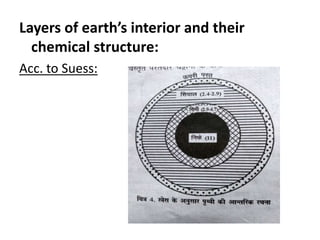
Layers of earth’s interior and their
chemical structure:
Acc. to Suess:
Acc. to Holmes:
Acc. to Gracht:
Acc. to Gutenberg:
Outline of the Earth’s Interior
1. Earth’s Crust
• Oceanic crust
• Continental crust
2. Mantle
Lower mantle and Upper mantle
3. Earth’s Core
Outer core
Inner core
Interior structure

Interior structure

  • 1.
    INTERIOR STRUCTURE OF THE EARTH KeertiMinj Department of Geography, St. Xavier College, Mahuadanr
  • 2.
    INTERIOR STRUCTURE OFTHE EARTH Introduction The exact knowledge about the interior on the earth still remains an enigma. Knowledge of the structure, composition, and the process going on within it would currently help scientists answer questions regarding crustal motion, earth quakes, the volcanic eruptions and the origins of the continents and of the earth itself.
  • 3.
    • As theearth gradually solidified, heavier elements slowly sank towards the centre and lighter elements slowly moved upwards to the surface concentrating in the earth’s crust. • Earth’s interior is arranged roughly in concentric layers, each one distinct either in chemical composition or temperature with heat radiating outward from the centre by conduction and then by physical convection in the more plastic levels nearer the surface.
  • 4.
    Source of informationabout the internal structure: Our knowledge of earth's internal characteristics of these concentric layers have been acquired through direct as well as indirect sources. Direct Sources Indirect Sources • Volcanic eruption •Density • Evidences Seismology •Pressure • Surface waves •Temperature
  • 5.
    Seismic Waves andinterior of the earth: Earthquakes generates the following three types of waves during its occurrence: 1. Primary waves 2. Secondary waves 3. Surface waves Primary Waves are high frequency longitudinal waves. These waves travel through the solid part of the earth as well as through the liquid part of the earth’s core. There fastest speed are recorded, while passing through the solid part of the earth, but in the liquid part their speed slows down.
  • 6.
    Secondary waves (transverseor distortional waves) They cannot pass through the liquid geomaterials. These waves have helped to understand the structure of the interior of the earth. Surface waves are very destructive and affect the earth’s surface only. These waves travel through the surface regions of the earth’s crust and do not go into the interior of the earth. They are slow and have largest oscillation.
  • 8.
    Layers of earth’sinterior and their chemical structure: Acc. to Suess:
  • 9.
  • 10.
  • 11.
  • 12.
    Outline of theEarth’s Interior 1. Earth’s Crust • Oceanic crust • Continental crust
  • 13.
    2. Mantle Lower mantleand Upper mantle
  • 14.
    3. Earth’s Core Outercore Inner core