The Drug Education Navigation Tool Dr Tim Legrand and Matthew Scott Tonic Consultants tonicconsultants.com
The Context Dec 07: The Children’s Plan Oct 08: Drug Education Review Sept 09: Blueprint published 5 th  Nov 09: PSHE to be made statutory 13 th  Nov 09: Drugs Guidance for Schools Consultation
Objectives DEF asked us to produce a piece of work which will help those planning and delivering drug education to be sure they are working from what the evidence suggests is effective It needs be accessible to an audience of those who actually deliver drug education in schools and other settings In short, how can we make it as easy as possible for everyone to deliver drug education in ways that have been shown to work? What follows will be a live document
What the research says: Skills based interventions are effective in equipping children and young people with the confidence to make better decisions (Faggiano  et al , 2005) …  especially when delivered via interactive lessons Parental involvement  boosts the effectiveness of drug education  … especially for children/young people with multiple risk factors Interactive lessons provide the best means of delivering information and social skills training
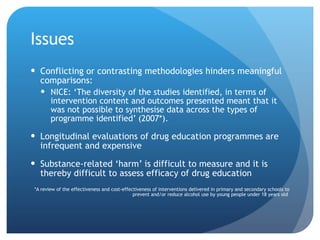
Issues  Conflicting or contrasting methodologies hinders meaningful comparisons:  NICE: ‘The diversity of the studies identified, in terms of intervention content and outcomes presented meant that it was not possible to synthesise data across the types of programme identified’ (2007*).  Longitudinal evaluations of drug education programmes are infrequent and expensive Substance-related ‘harm’ is difficult to measure and it is thereby difficult to assess efficacy of drug education *A review of the effectiveness and cost-effectiveness of interventions delivered in primary and secondary schools to prevent and/or reduce alcohol use by young people under 18 years old
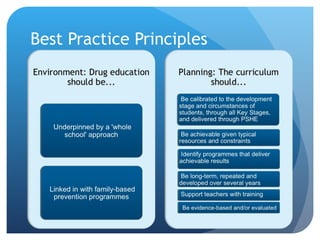
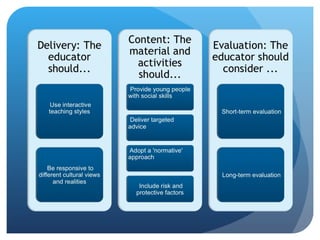
Best Practice Principles
 
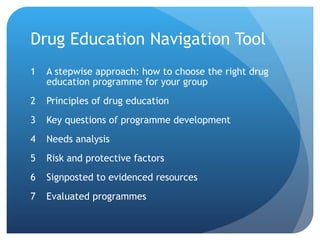
Drug Education Navigation Tool A stepwise approach: how to choose the right drug education programme for your group Principles of drug education Key questions of programme development Needs analysis Risk and protective factors Signposted to evidenced resources Evaluated programmes

The Drug Education Navigation Tool

  • 1.
    The Drug EducationNavigation Tool Dr Tim Legrand and Matthew Scott Tonic Consultants tonicconsultants.com
  • 2.
    The Context Dec07: The Children’s Plan Oct 08: Drug Education Review Sept 09: Blueprint published 5 th Nov 09: PSHE to be made statutory 13 th Nov 09: Drugs Guidance for Schools Consultation
  • 3.
    Objectives DEF askedus to produce a piece of work which will help those planning and delivering drug education to be sure they are working from what the evidence suggests is effective It needs be accessible to an audience of those who actually deliver drug education in schools and other settings In short, how can we make it as easy as possible for everyone to deliver drug education in ways that have been shown to work? What follows will be a live document
  • 4.
    What the researchsays: Skills based interventions are effective in equipping children and young people with the confidence to make better decisions (Faggiano et al , 2005) … especially when delivered via interactive lessons Parental involvement boosts the effectiveness of drug education … especially for children/young people with multiple risk factors Interactive lessons provide the best means of delivering information and social skills training
  • 5.
    Issues Conflictingor contrasting methodologies hinders meaningful comparisons: NICE: ‘The diversity of the studies identified, in terms of intervention content and outcomes presented meant that it was not possible to synthesise data across the types of programme identified’ (2007*). Longitudinal evaluations of drug education programmes are infrequent and expensive Substance-related ‘harm’ is difficult to measure and it is thereby difficult to assess efficacy of drug education *A review of the effectiveness and cost-effectiveness of interventions delivered in primary and secondary schools to prevent and/or reduce alcohol use by young people under 18 years old
  • 6.
  • 7.
  • 8.
    Drug Education NavigationTool A stepwise approach: how to choose the right drug education programme for your group Principles of drug education Key questions of programme development Needs analysis Risk and protective factors Signposted to evidenced resources Evaluated programmes