Presentation on Direct
Acyclic Graph (DAG)
Ranada Prasad Shaha University
Course Title : Compiler Design
Course code : CSE 333
Submitted by :
Rubyyat Abir
ID : 15100002
Dept : CSE
DAG :
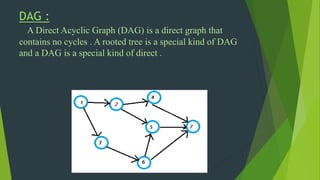
A Direct Acyclic Graph (DAG) is a direct graph that
contains no cycles . A rooted tree is a special kind of DAG
and a DAG is a special kind of direct .
Continue :
 A DAG may be used to represent common
subexpressions in an optimizing compiler.
 Example :
 expression : a*b+f(a*b)
 The common subexpression a*b need only be compiled
 Once but its value can be used twise.

A Dag can be used to represent prerequisites in a
University course , constraints on operations to be
Carried out in building construction, in fact an
arbitrary partial order ‘<’ . An edge is drawn from
a to b whenever a<b. A partial order ‘<’ satisfies :
i) transitivity, a<b and b<c implies a<c
ii) non-reflexive , not (a<a)
 These condition prevent cycles because v1<v2…<vⁿ<v1
 Would imply that v1<v1 . The word ‘partial’ indicates
 That not every pair or values are ordered. Examples of
 Partial orders are numerical less-than (also a total
order) and ‘subset-of’ ; note that {1,2} is a subset of
 {1,2,3} but that {1,2} and {2,3} are incomparable , i.e
 There is no order relationship between them .

Direct Acyclic Graph (DAG)

  • 1.
    Presentation on Direct AcyclicGraph (DAG) Ranada Prasad Shaha University Course Title : Compiler Design Course code : CSE 333 Submitted by : Rubyyat Abir ID : 15100002 Dept : CSE
  • 2.
    DAG : A DirectAcyclic Graph (DAG) is a direct graph that contains no cycles . A rooted tree is a special kind of DAG and a DAG is a special kind of direct .
  • 3.
    Continue :  ADAG may be used to represent common subexpressions in an optimizing compiler.  Example :  expression : a*b+f(a*b)  The common subexpression a*b need only be compiled  Once but its value can be used twise. 
  • 4.
    A Dag canbe used to represent prerequisites in a University course , constraints on operations to be Carried out in building construction, in fact an arbitrary partial order ‘<’ . An edge is drawn from a to b whenever a<b. A partial order ‘<’ satisfies : i) transitivity, a<b and b<c implies a<c ii) non-reflexive , not (a<a)
  • 5.
     These conditionprevent cycles because v1<v2…<vⁿ<v1  Would imply that v1<v1 . The word ‘partial’ indicates  That not every pair or values are ordered. Examples of  Partial orders are numerical less-than (also a total order) and ‘subset-of’ ; note that {1,2} is a subset of  {1,2,3} but that {1,2} and {2,3} are incomparable , i.e  There is no order relationship between them .