Intermediate Code Generation
❖ In the analysis-synthesis model of a compiler, the front end analyzes a
source program and creates an intermediate representation, from
which the back end generates target code.
❖ Details of the source language are confined to the front end, and details
of the target machine to the back end
Intermediate Code Generation
❖ A compiler for language i and machine j can then be built by
combining the front end for language i with the back end for
machine j
❖ m x n compilers can be built by writing just m front ends and
n back ends.
Intermediate Code Generation
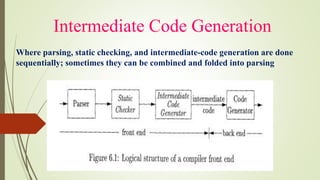
Where parsing, static checking, and intermediate-code generation are done
sequentially; sometimes they can be combined and folded into parsing
Intermediate Code Generation
Static checking includes type checking, which ensures that
operators are applied to compatible operands.
It also includes any syntactic checks that remain after parsing.
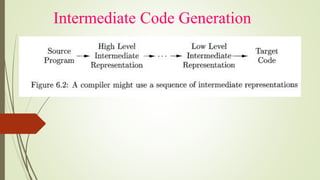
In the process of translating a program in a given source
language into code for a given target machine, a compiler may
construct a sequence of intermediate representations
Intermediate Code Generation
High-level representations are close to the source language and
low-level representations are close to the target machine.
Syntax trees are high level; they depict the natural hierarchical
structure of the source program and are well suited to tasks like
static type checking.
Intermediate Code Generation
❖ A low-level representation is suitable for machine-dependent
tasks like register allocation and instruction selection.
❖ Three-address code can range from high- to low-level, depending
on the choice of operators.
❖ The choice or design of an intermediate representation varies
from compiler to compiler.
❖ An intermediate representation may either be an actual language
or it may consist of internal data structures that are shared by
phases of the compiler
Intermediate Code Generation
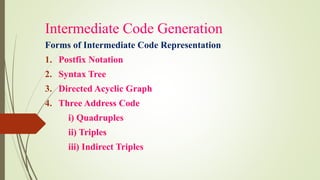
Forms of Intermediate Code Representation
1. Postfix Notation
2. Syntax Tree
3. Directed Acyclic Graph
4. Three Address Code
i) Quadruples
ii) Triples
iii) Indirect Triples
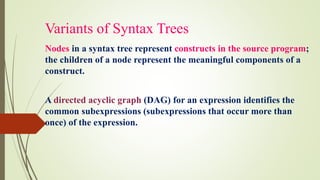
Variants of Syntax Trees
Nodes in a syntax tree represent constructs in the source program;
the children of a node represent the meaningful components of a
construct.
A directed acyclic graph (DAG) for an expression identifies the
common subexpressions (subexpressions that occur more than
once) of the expression.
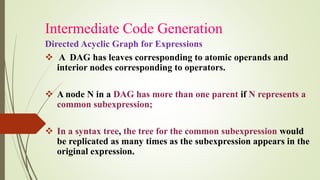
Intermediate Code Generation
Directed Acyclic Graph for Expressions
❖ A DAG has leaves corresponding to atomic operands and
interior nodes corresponding to operators.
❖ A node N in a DAG has more than one parent if N represents a
common subexpression;
❖ In a syntax tree, the tree for the common subexpression would
be replicated as many times as the subexpression appears in the
original expression.
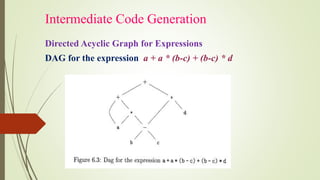
Intermediate Code Generation
Directed Acyclic Graph for Expressions
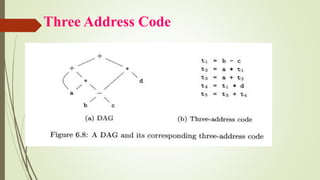
DAG for the expression a + a * (b-c) + (b-c) * d
Intermediate Code Generation
Directed Acyclic Graph for Expressions
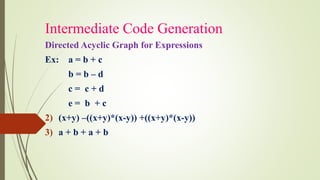
Ex: a = b + c
b = b – d
c = c + d
e = b + c
2) (x+y) –((x+y)*(x-y)) +((x+y)*(x-y))
3) a + b + a + b
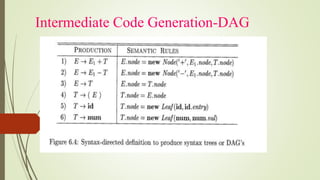
Intermediate Code Generation-DAG
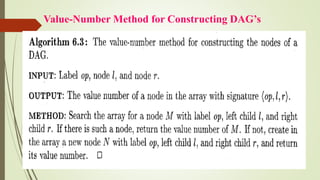
It will construct a DAG if, before creating a new node, these
functions first check whether an identical node already exists.
If a previously created identical node exists, the existing node is
returned.
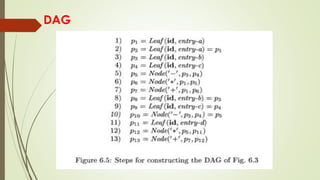
DAG
Value-Number Method for Constructing DAG’s
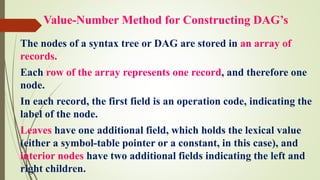
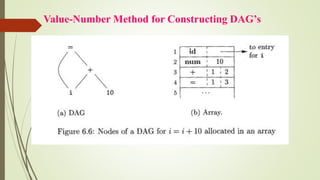
The nodes of a syntax tree or DAG are stored in an array of
records.
Each row of the array represents one record, and therefore one
node.
In each record, the first field is an operation code, indicating the
label of the node.
Leaves have one additional field, which holds the lexical value
(either a symbol-table pointer or a constant, in this case), and
interior nodes have two additional fields indicating the left and
right children.
Value-Number Method for Constructing DAG’s
Array consisting of collection of records with a node per each
record.
In this array, we refer to nodes by giving the integer index of
the record for that node within the array.
This integer has been called the value number for the node or
for the expression represented by the node.
Value-Number Method for Constructing DAG’s
A more efficient approach is to use a hash table, in which the
nodes are put into "buckets," each of which typically will have
only a few nodes.
The hash table is one of several data structures that support
dictionaries efficiently.
Hash table, performs each of these operations(insert,delete,search
an element ) in time that is constant or close to constant,
independent of the size of the set.
Value-Number Method for Constructing DAG’s
To construct a hash table for the nodes of a DAG, we need a hash
function H
H- computes the index of the bucket for a signature (op, I, r), in a
ay that distributes the signatures across buckets
Value-Number Method for Constructing DAG’s
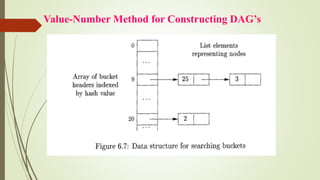
❑An array, indexed by hash value, holds the bucket headers,
each of which points to the first cell of a list.
❑Within the linked list for a bucket, each cell holds the value
number of one of the nodes that hash to that bucket.
❑That is, node (op,l,r) can be found on the list whose header is
at index h(op,l,r) of the array.
Value-Number Method for Constructing DAG’s
Three Address Code
Three Address code is a type of intermediate code which is
easy to generate and can be easily converted to machine
code.
In three-address code, there is at most one operator on the
right side of an instruction.
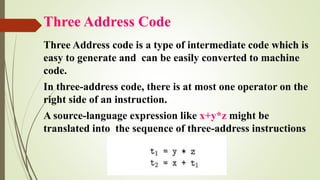
A source-language expression like x+y*z might be
translated into the sequence of three-address instructions
Three Address Code
Three Address Code
Addresses and Instructions
▪ Three-address code is built from two concepts: addresses
and instructions.
▪ Three -address code can be implemented using records
with fields for the addresses; records called quadruples
and triples
Three Address Code
An address can be one of the following—name , constant, compiler-
generated temporary
list of the common three-address instruction forms:
Assignment instructions of the form x = y op z, where op is a binary
arithmetic or logical operation, and x, y, and z are addresses.
Assignments of the form x = op y, where op is a unary operation.
Copy instructions of the form x = y, where x is assigned the value of y.
Three Address Code
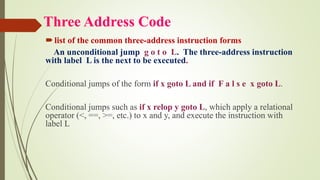
list of the common three-address instruction forms
An unconditional jump g o t o L. The three-address instruction
with label L is the next to be executed.
Conditional jumps of the form if x goto L and if F a l s e x goto L.
Conditional jumps such as if x relop y goto L, which apply a relational
operator (<, ==, >=, etc.) to x and y, and execute the instruction with
label L
Three Address Code
Consider the statement
do i = i + 1 ; while ( a [ i ] < v ) ;
Three Address Code
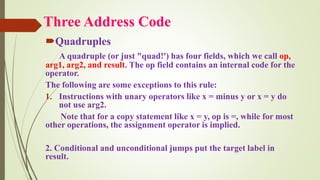
Quadruples
A quadruple (or just "quad!') has four fields, which we call op,
arg1, arg2, and result. The op field contains an internal code for the
operator.
The following are some exceptions to this rule:
1. Instructions with unary operators like x = minus y or x = y do
not use arg2.
Note that for a copy statement like x = y, op is =, while for most
other operations, the assignment operator is implied.
2. Conditional and unconditional jumps put the target label in
result.
Three Address Code
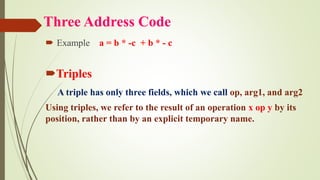
 Example a = b * -c + b * - c
Triples
A triple has only three fields, which we call op, arg1, and arg2
Using triples, we refer to the result of an operation x op y by its
position, rather than by an explicit temporary name.
Three Address Code
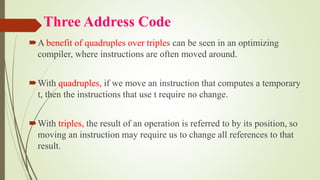
A benefit of quadruples over triples can be seen in an optimizing
compiler, where instructions are often moved around.
With quadruples, if we move an instruction that computes a temporary
t, then the instructions that use t require no change.
With triples, the result of an operation is referred to by its position, so
moving an instruction may require us to change all references to that
result.
Three Address Code
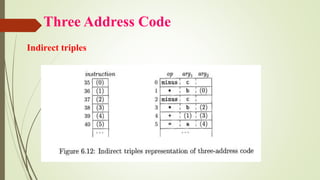
Indirect triples
Indirect triples consist of a listing of pointers to triples, rather than a
listing of triples themselves.
For example, let us use an array instruction to list pointers to
triples in the desired order
Three Address Code
Indirect triples
Types and Declarations
▪ Type Expressions
▪ Type Equivalence
▪ Declarations
▪ Storage Layout for Local Names
▪ Sequence of Declarations
▪ Fields in Records and Classes
Types and Declarations
Applications of Types can be grouped under Checking and Translation
Type Checking
uses logical rules to reason about the behaviour of a program at
run time.
Translation Applications
from the type of a name, a compiler can determine the storage
that will be needed for that name at run time.
Type information is also needed to calculate the address denoted by an
array reference , to insert explicit type conversions, choose right version
airthmetic operators
Types and Declarations
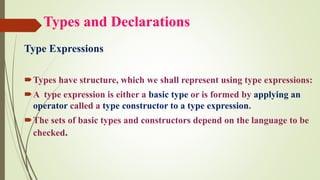
Type Expressions
Types have structure, which we shall represent using type expressions:
A type expression is either a basic type or is formed by applying an
operator called a type constructor to a type expression.
The sets of basic types and constructors depend on the language to be
checked.
Types and Declarations
Example :
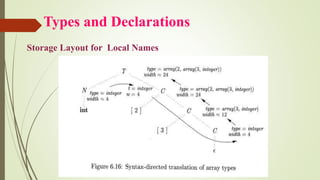
The array type i n t [2] [3] can be read as
"array of 2 arrays of 3 integers each" and
written as a type expression array(2, array(3, integer))
Types and Declarations
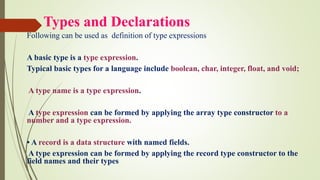
Following can be used as definition of type expressions
A basic type is a type expression.
Typical basic types for a language include boolean, char, integer, float, and void;
A type name is a type expression.
A type expression can be formed by applying the array type constructor to a
number and a type expression.
• A record is a data structure with named fields.
A type expression can be formed by applying the record type constructor to the
field names and their types
Types and Declarations
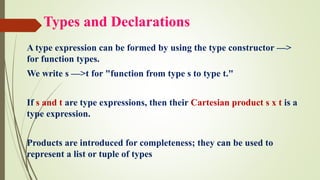
A type expression can be formed by using the type constructor —>
for function types.
We write s —>t for "function from type s to type t."
If s and t are type expressions, then their Cartesian product s x t is a
type expression.
Products are introduced for completeness; they can be used to
represent a list or tuple of types
Types and Declarations
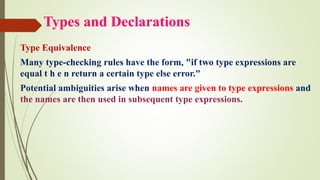
Type Equivalence
Many type-checking rules have the form, "if two type expressions are
equal t h e n return a certain type else error."
Potential ambiguities arise when names are given to type expressions and
the names are then used in subsequent type expressions.
Types and Declarations
When type expressions are represented by graphs, two types are
structurally equivalent if and only if one of the following conditions is
true:
▪ They are the same basic type.
▪ They are formed by applying the same constructor to structurally
equivalent types.
▪ One is a type name that denotes the other.
Types and Declarations
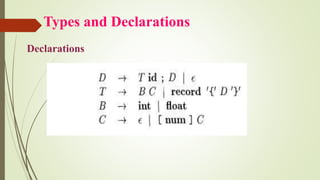
Declarations
Types and Declarations
Storage Layout for Local Names
From the type of a name, we can determine the amount of storage that
will be needed for the name at run time.
At compile time, we can use these amounts to assign each name a relative
address.
The type and relative address are saved in the symbol-table entry for the
name.
Data of varying length, such as strings, or data whose size cannot be
determined until run time, such as dynamic arrays, is handled by
reserving a known fixed amount of storage for a pointer to the data.
Types and Declarations
Storage Layout for Local Names
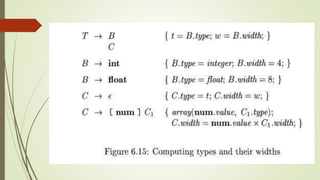
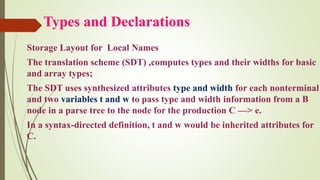
The translation scheme (SDT) ,computes types and their widths for basic
and array types;
The SDT uses synthesized attributes type and width for each nonterminal
and two variables t and w to pass type and width information from a B
node in a parse tree to the node for the production C —> e.
In a syntax-directed definition, t and w would be inherited attributes for
C.
Types and Declarations
Storage Layout for Local Names
Types and Declarations
Sequence of Declarations
▪ Languages such as C and Java allow all the declarations in a single
procedure to be processed as a group.
▪ The declarations are processed when the procedure is analyzed.
▪ A variable, say offset, is used to keep track of the next available
relative address.
Types and Declarations
Sequence of Declarations
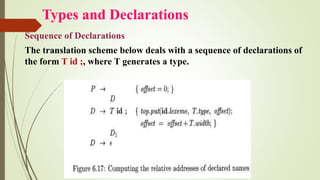
The translation scheme below deals with a sequence of declarations of
the form T id ;, where T generates a type.
Types and Declarations
Fields in Records and Classes
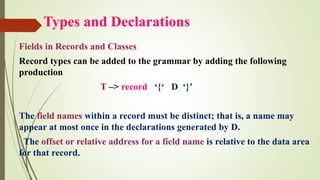
Record types can be added to the grammar by adding the following
production
T –> record ‘{‘ D ‘}’
The field names within a record must be distinct; that is, a name may
appear at most once in the declarations generated by D.
The offset or relative address for a field name is relative to the data area
for that record.
Types and Declarations
Field in Records and Classes
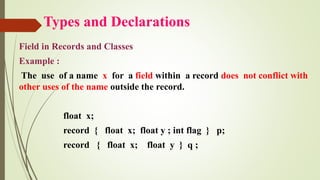
Example :
The use of a name x for a field within a record does not conflict with
other uses of the name outside the record.
float x;
record { float x; float y ; int flag } p;
record { float x; float y } q ;
Types and Declarations
Field in Records and Classes
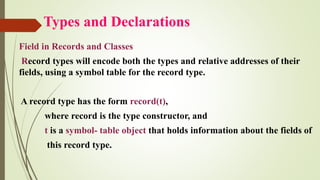
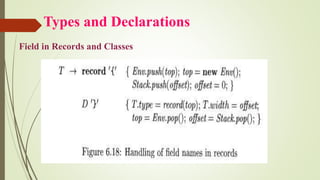
Record types will encode both the types and relative addresses of their
fields, using a symbol table for the record type.
A record type has the form record(t),
where record is the type constructor, and
t is a symbol- table object that holds information about the fields of
this record type.
Types and Declarations
Field in Records and Classes
Type Checking
To do type checking a compiler needs to assign a type expression to
each com-ponent of the source program.
The compiler must then determine that these type expressions conform
to a collection of logical rules that is called the type system for the
source language.
Type Checking
Rules for Type Checking
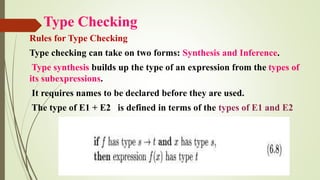
Type checking can take on two forms: Synthesis and Inference.
Type synthesis builds up the type of an expression from the types of
its subexpressions.
It requires names to be declared before they are used.
The type of E1 + E2 is defined in terms of the types of E1 and E2
Type Checking
Rules for Type Checking
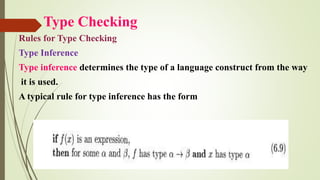
Type Inference
Type inference determines the type of a language construct from the way
it is used.
A typical rule for type inference has the form
Type Checking
Rules for Type Checking
Type inference is needed for languages like ML, which check types, but
do not require names to be declared.
Type Checking
Type Conversions
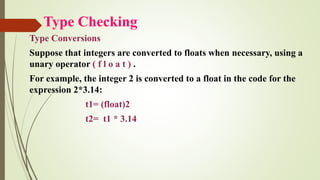
Suppose that integers are converted to floats when necessary, using a
unary operator ( f l o a t ) .
For example, the integer 2 is converted to a float in the code for the
expression 2*3.14:
t1= (float)2
t2= t1 * 3.14
Type Checking
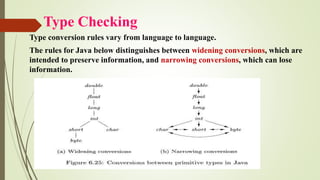
Type conversion rules vary from language to language.
The rules for Java below distinguishes between widening conversions, which are
intended to preserve information, and narrowing conversions, which can lose
information.
Type Checking
Overloading of Functions and Operators
▪ An overloaded symbol has different meanings depending on its
context.
▪ Over-loading is resolved when a unique meaning is determined for
each occurrence of a name.
▪ We consider here, overloading can be resolved by looking only at the
arguments of a function, as in Java.
Type Checking
Overloading of Functions and Operators
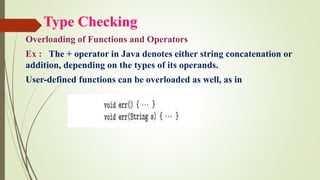
Ex : The + operator in Java denotes either string concatenation or
addition, depending on the types of its operands.
User-defined functions can be overloaded as well, as in
Type Checking
Overloading of Functions and Operators
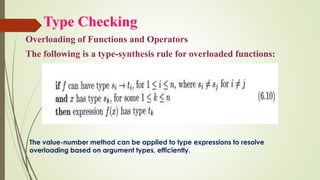
The following is a type-synthesis rule for overloaded functions:
The value-number method can be applied to type expressions to resolve
overloading based on argument types, efficiently.
Type Checking
Type Inference and Polymorphic Functions
▪ Type inference is useful for a language like ML, which is strongly
typed, but does not require names to be declared before they are
used.
▪ Type inference ensures that names are used consistently.
▪ The term "polymorphic" refers to any code fragment that can be
executed with arguments of different types.
Type Checking
Type Inference and Polymorphic Functions
The type of length can be described as, "for any type a, length maps a
list of elements of type a to an integer."
length([" sun", "mon", "tue"]) + length([10,9,8, 7])
Control Flow
The translation of statements such as if-else-statements and while-
statements is tied to the translation of boolean expressions.
In programming languages, boolean expressions are often used to
1. Alter the flow of control—Boolean expressions are used as conditional
expressions in statements that alter the flow of control.
2. Compute Logical values--Boolean expression can represent true Or false as
values. Such boolean expressions can be evaluated in analogy to arithmetic
expressions using three-address instructions with logical operators.
Control Flow
1. Boolean Expressions
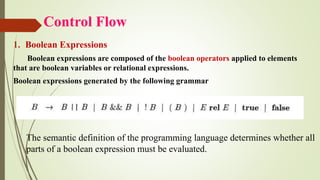
Boolean expressions are composed of the boolean operators applied to elements
that are boolean variables or relational expressions.
Boolean expressions generated by the following grammar
The semantic definition of the programming language determines whether all
parts of a boolean expression must be evaluated.
Control Flow
2. Short-Circuit Code
In short-circuit (or jumping) code, the boolean operators &&, ||,
and ! translate into jumps.
The operators themselves do not appear in the code; instead, the
value of a boolean expression is represented by a position in the
code sequence.
Control Flow
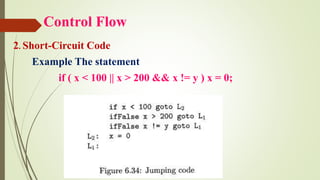
2. Short-Circuit Code
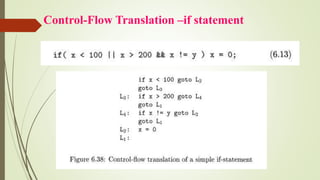
Example The statement
if ( x < 100 || x > 200 && x != y ) x = 0;
Control Flow
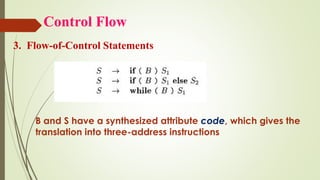
3. Flow-of-Control Statements
B and S have a synthesized attribute code, which gives the
translation into three-address instructions
Flow-of-Control Statements
Control Flow
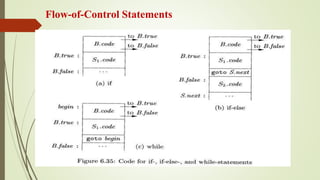
Flow-of-Control Statements
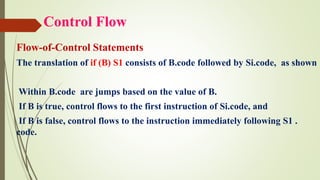
The translation of if (B) S1 consists of B.code followed by Si.code, as shown
Within B.code are jumps based on the value of B.
If B is true, control flows to the first instruction of Si.code, and
If B is false, control flows to the instruction immediately following S1 .
code.
Flow-of-Control Statements
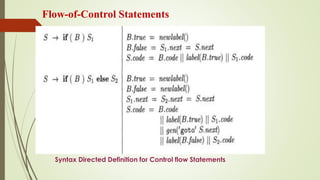
Syntax Directed Definition for Control flow Statements
Flow-of-Control Statements
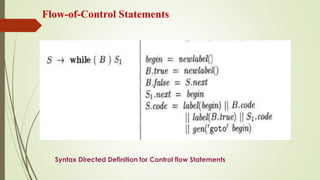
Syntax Directed Definition for Control flow Statements
Control-Flow Translation –if statement
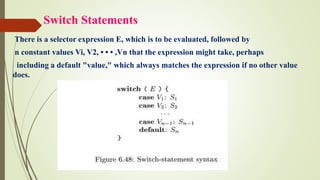
Switch Statements
There is a selector expression E, which is to be evaluated, followed by
n constant values Vi, V2, • • • ,Vn that the expression might take, perhaps
including a default "value," which always matches the expression if no other value
does.
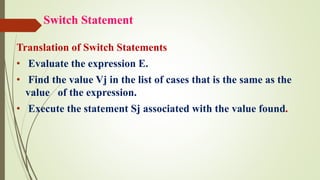
Switch Statement
Translation of Switch Statements
• Evaluate the expression E.
• Find the value Vj in the list of cases that is the same as the
value of the expression.
• Execute the statement Sj associated with the value found.
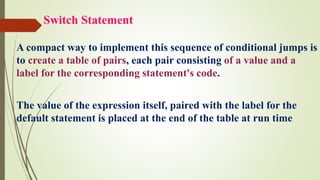
Switch Statement
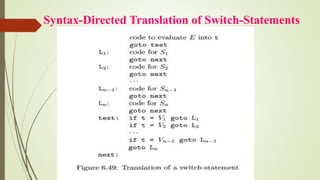
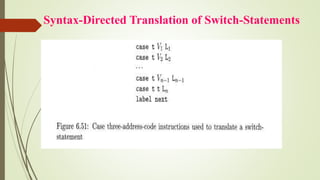
A compact way to implement this sequence of conditional jumps is
to create a table of pairs, each pair consisting of a value and a
label for the corresponding statement's code.
The value of the expression itself, paired with the label for the
default statement is placed at the end of the table at run time
Syntax-Directed Translation of Switch-Statements
Intermediate Code for Procedures
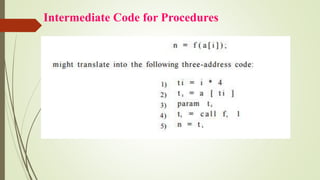
In three-address code, a function call is undone into the
evaluation of parameters in preparation for a call, followed by the
call itself.
Ex :Suppose that a is an array of integers, and that f is a function
from integers to integers. Then, the assignment
Intermediate Code for Procedures
Function definitions and function calls can be translated using
concepts
Function Types
Symbol Tables
Function Calls

INTERMEDIATE CODE GENERTION-CD UNIT-3.pdf

  • 1.
  • 2.
    Intermediate Code Generation ❖In the analysis-synthesis model of a compiler, the front end analyzes a source program and creates an intermediate representation, from which the back end generates target code. ❖ Details of the source language are confined to the front end, and details of the target machine to the back end
  • 3.
    Intermediate Code Generation ❖A compiler for language i and machine j can then be built by combining the front end for language i with the back end for machine j ❖ m x n compilers can be built by writing just m front ends and n back ends.
  • 4.
    Intermediate Code Generation Whereparsing, static checking, and intermediate-code generation are done sequentially; sometimes they can be combined and folded into parsing
  • 5.
    Intermediate Code Generation Staticchecking includes type checking, which ensures that operators are applied to compatible operands. It also includes any syntactic checks that remain after parsing. In the process of translating a program in a given source language into code for a given target machine, a compiler may construct a sequence of intermediate representations
  • 6.
    Intermediate Code Generation High-levelrepresentations are close to the source language and low-level representations are close to the target machine. Syntax trees are high level; they depict the natural hierarchical structure of the source program and are well suited to tasks like static type checking.
  • 7.
  • 8.
    Intermediate Code Generation ❖A low-level representation is suitable for machine-dependent tasks like register allocation and instruction selection. ❖ Three-address code can range from high- to low-level, depending on the choice of operators. ❖ The choice or design of an intermediate representation varies from compiler to compiler. ❖ An intermediate representation may either be an actual language or it may consist of internal data structures that are shared by phases of the compiler
  • 9.
    Intermediate Code Generation Formsof Intermediate Code Representation 1. Postfix Notation 2. Syntax Tree 3. Directed Acyclic Graph 4. Three Address Code i) Quadruples ii) Triples iii) Indirect Triples
  • 10.
    Variants of SyntaxTrees Nodes in a syntax tree represent constructs in the source program; the children of a node represent the meaningful components of a construct. A directed acyclic graph (DAG) for an expression identifies the common subexpressions (subexpressions that occur more than once) of the expression.
  • 11.
    Intermediate Code Generation DirectedAcyclic Graph for Expressions ❖ A DAG has leaves corresponding to atomic operands and interior nodes corresponding to operators. ❖ A node N in a DAG has more than one parent if N represents a common subexpression; ❖ In a syntax tree, the tree for the common subexpression would be replicated as many times as the subexpression appears in the original expression.
  • 12.
    Intermediate Code Generation DirectedAcyclic Graph for Expressions DAG for the expression a + a * (b-c) + (b-c) * d
  • 13.
    Intermediate Code Generation DirectedAcyclic Graph for Expressions Ex: a = b + c b = b – d c = c + d e = b + c 2) (x+y) –((x+y)*(x-y)) +((x+y)*(x-y)) 3) a + b + a + b
  • 14.
  • 15.
    Intermediate Code Generation-DAG Itwill construct a DAG if, before creating a new node, these functions first check whether an identical node already exists. If a previously created identical node exists, the existing node is returned.
  • 16.
  • 17.
    Value-Number Method forConstructing DAG’s The nodes of a syntax tree or DAG are stored in an array of records. Each row of the array represents one record, and therefore one node. In each record, the first field is an operation code, indicating the label of the node. Leaves have one additional field, which holds the lexical value (either a symbol-table pointer or a constant, in this case), and interior nodes have two additional fields indicating the left and right children.
  • 18.
    Value-Number Method forConstructing DAG’s
  • 19.
    Value-Number Method forConstructing DAG’s Array consisting of collection of records with a node per each record. In this array, we refer to nodes by giving the integer index of the record for that node within the array. This integer has been called the value number for the node or for the expression represented by the node.
  • 20.
    Value-Number Method forConstructing DAG’s
  • 21.
    Value-Number Method forConstructing DAG’s A more efficient approach is to use a hash table, in which the nodes are put into "buckets," each of which typically will have only a few nodes. The hash table is one of several data structures that support dictionaries efficiently. Hash table, performs each of these operations(insert,delete,search an element ) in time that is constant or close to constant, independent of the size of the set.
  • 22.
    Value-Number Method forConstructing DAG’s To construct a hash table for the nodes of a DAG, we need a hash function H H- computes the index of the bucket for a signature (op, I, r), in a ay that distributes the signatures across buckets
  • 23.
    Value-Number Method forConstructing DAG’s ❑An array, indexed by hash value, holds the bucket headers, each of which points to the first cell of a list. ❑Within the linked list for a bucket, each cell holds the value number of one of the nodes that hash to that bucket. ❑That is, node (op,l,r) can be found on the list whose header is at index h(op,l,r) of the array.
  • 24.
    Value-Number Method forConstructing DAG’s
  • 25.
    Three Address Code ThreeAddress code is a type of intermediate code which is easy to generate and can be easily converted to machine code. In three-address code, there is at most one operator on the right side of an instruction. A source-language expression like x+y*z might be translated into the sequence of three-address instructions
  • 26.
  • 27.
    Three Address Code Addressesand Instructions ▪ Three-address code is built from two concepts: addresses and instructions. ▪ Three -address code can be implemented using records with fields for the addresses; records called quadruples and triples
  • 28.
    Three Address Code Anaddress can be one of the following—name , constant, compiler- generated temporary list of the common three-address instruction forms: Assignment instructions of the form x = y op z, where op is a binary arithmetic or logical operation, and x, y, and z are addresses. Assignments of the form x = op y, where op is a unary operation. Copy instructions of the form x = y, where x is assigned the value of y.
  • 29.
    Three Address Code listof the common three-address instruction forms An unconditional jump g o t o L. The three-address instruction with label L is the next to be executed. Conditional jumps of the form if x goto L and if F a l s e x goto L. Conditional jumps such as if x relop y goto L, which apply a relational operator (<, ==, >=, etc.) to x and y, and execute the instruction with label L
  • 30.
    Three Address Code Considerthe statement do i = i + 1 ; while ( a [ i ] < v ) ;
  • 31.
    Three Address Code Quadruples Aquadruple (or just "quad!') has four fields, which we call op, arg1, arg2, and result. The op field contains an internal code for the operator. The following are some exceptions to this rule: 1. Instructions with unary operators like x = minus y or x = y do not use arg2. Note that for a copy statement like x = y, op is =, while for most other operations, the assignment operator is implied. 2. Conditional and unconditional jumps put the target label in result.
  • 32.
    Three Address Code Example a = b * -c + b * - c Triples A triple has only three fields, which we call op, arg1, and arg2 Using triples, we refer to the result of an operation x op y by its position, rather than by an explicit temporary name.
  • 33.
    Three Address Code Abenefit of quadruples over triples can be seen in an optimizing compiler, where instructions are often moved around. With quadruples, if we move an instruction that computes a temporary t, then the instructions that use t require no change. With triples, the result of an operation is referred to by its position, so moving an instruction may require us to change all references to that result.
  • 34.
    Three Address Code Indirecttriples Indirect triples consist of a listing of pointers to triples, rather than a listing of triples themselves. For example, let us use an array instruction to list pointers to triples in the desired order
  • 35.
  • 36.
    Types and Declarations ▪Type Expressions ▪ Type Equivalence ▪ Declarations ▪ Storage Layout for Local Names ▪ Sequence of Declarations ▪ Fields in Records and Classes
  • 37.
    Types and Declarations Applicationsof Types can be grouped under Checking and Translation Type Checking uses logical rules to reason about the behaviour of a program at run time. Translation Applications from the type of a name, a compiler can determine the storage that will be needed for that name at run time. Type information is also needed to calculate the address denoted by an array reference , to insert explicit type conversions, choose right version airthmetic operators
  • 38.
    Types and Declarations TypeExpressions Types have structure, which we shall represent using type expressions: A type expression is either a basic type or is formed by applying an operator called a type constructor to a type expression. The sets of basic types and constructors depend on the language to be checked.
  • 39.
    Types and Declarations Example: The array type i n t [2] [3] can be read as "array of 2 arrays of 3 integers each" and written as a type expression array(2, array(3, integer))
  • 40.
    Types and Declarations Followingcan be used as definition of type expressions A basic type is a type expression. Typical basic types for a language include boolean, char, integer, float, and void; A type name is a type expression. A type expression can be formed by applying the array type constructor to a number and a type expression. • A record is a data structure with named fields. A type expression can be formed by applying the record type constructor to the field names and their types
  • 41.
    Types and Declarations Atype expression can be formed by using the type constructor —> for function types. We write s —>t for "function from type s to type t." If s and t are type expressions, then their Cartesian product s x t is a type expression. Products are introduced for completeness; they can be used to represent a list or tuple of types
  • 42.
    Types and Declarations TypeEquivalence Many type-checking rules have the form, "if two type expressions are equal t h e n return a certain type else error." Potential ambiguities arise when names are given to type expressions and the names are then used in subsequent type expressions.
  • 43.
    Types and Declarations Whentype expressions are represented by graphs, two types are structurally equivalent if and only if one of the following conditions is true: ▪ They are the same basic type. ▪ They are formed by applying the same constructor to structurally equivalent types. ▪ One is a type name that denotes the other.
  • 44.
  • 45.
    Types and Declarations StorageLayout for Local Names From the type of a name, we can determine the amount of storage that will be needed for the name at run time. At compile time, we can use these amounts to assign each name a relative address. The type and relative address are saved in the symbol-table entry for the name. Data of varying length, such as strings, or data whose size cannot be determined until run time, such as dynamic arrays, is handled by reserving a known fixed amount of storage for a pointer to the data.
  • 47.
    Types and Declarations StorageLayout for Local Names The translation scheme (SDT) ,computes types and their widths for basic and array types; The SDT uses synthesized attributes type and width for each nonterminal and two variables t and w to pass type and width information from a B node in a parse tree to the node for the production C —> e. In a syntax-directed definition, t and w would be inherited attributes for C.
  • 48.
    Types and Declarations StorageLayout for Local Names
  • 49.
    Types and Declarations Sequenceof Declarations ▪ Languages such as C and Java allow all the declarations in a single procedure to be processed as a group. ▪ The declarations are processed when the procedure is analyzed. ▪ A variable, say offset, is used to keep track of the next available relative address.
  • 50.
    Types and Declarations Sequenceof Declarations The translation scheme below deals with a sequence of declarations of the form T id ;, where T generates a type.
  • 51.
    Types and Declarations Fieldsin Records and Classes Record types can be added to the grammar by adding the following production T –> record ‘{‘ D ‘}’ The field names within a record must be distinct; that is, a name may appear at most once in the declarations generated by D. The offset or relative address for a field name is relative to the data area for that record.
  • 52.
    Types and Declarations Fieldin Records and Classes Example : The use of a name x for a field within a record does not conflict with other uses of the name outside the record. float x; record { float x; float y ; int flag } p; record { float x; float y } q ;
  • 53.
    Types and Declarations Fieldin Records and Classes Record types will encode both the types and relative addresses of their fields, using a symbol table for the record type. A record type has the form record(t), where record is the type constructor, and t is a symbol- table object that holds information about the fields of this record type.
  • 54.
    Types and Declarations Fieldin Records and Classes
  • 55.
    Type Checking To dotype checking a compiler needs to assign a type expression to each com-ponent of the source program. The compiler must then determine that these type expressions conform to a collection of logical rules that is called the type system for the source language.
  • 56.
    Type Checking Rules forType Checking Type checking can take on two forms: Synthesis and Inference. Type synthesis builds up the type of an expression from the types of its subexpressions. It requires names to be declared before they are used. The type of E1 + E2 is defined in terms of the types of E1 and E2
  • 57.
    Type Checking Rules forType Checking Type Inference Type inference determines the type of a language construct from the way it is used. A typical rule for type inference has the form
  • 58.
    Type Checking Rules forType Checking Type inference is needed for languages like ML, which check types, but do not require names to be declared.
  • 59.
    Type Checking Type Conversions Supposethat integers are converted to floats when necessary, using a unary operator ( f l o a t ) . For example, the integer 2 is converted to a float in the code for the expression 2*3.14: t1= (float)2 t2= t1 * 3.14
  • 60.
    Type Checking Type conversionrules vary from language to language. The rules for Java below distinguishes between widening conversions, which are intended to preserve information, and narrowing conversions, which can lose information.
  • 61.
    Type Checking Overloading ofFunctions and Operators ▪ An overloaded symbol has different meanings depending on its context. ▪ Over-loading is resolved when a unique meaning is determined for each occurrence of a name. ▪ We consider here, overloading can be resolved by looking only at the arguments of a function, as in Java.
  • 62.
    Type Checking Overloading ofFunctions and Operators Ex : The + operator in Java denotes either string concatenation or addition, depending on the types of its operands. User-defined functions can be overloaded as well, as in
  • 63.
    Type Checking Overloading ofFunctions and Operators The following is a type-synthesis rule for overloaded functions: The value-number method can be applied to type expressions to resolve overloading based on argument types, efficiently.
  • 64.
    Type Checking Type Inferenceand Polymorphic Functions ▪ Type inference is useful for a language like ML, which is strongly typed, but does not require names to be declared before they are used. ▪ Type inference ensures that names are used consistently. ▪ The term "polymorphic" refers to any code fragment that can be executed with arguments of different types.
  • 65.
    Type Checking Type Inferenceand Polymorphic Functions The type of length can be described as, "for any type a, length maps a list of elements of type a to an integer." length([" sun", "mon", "tue"]) + length([10,9,8, 7])
  • 66.
    Control Flow The translationof statements such as if-else-statements and while- statements is tied to the translation of boolean expressions. In programming languages, boolean expressions are often used to 1. Alter the flow of control—Boolean expressions are used as conditional expressions in statements that alter the flow of control. 2. Compute Logical values--Boolean expression can represent true Or false as values. Such boolean expressions can be evaluated in analogy to arithmetic expressions using three-address instructions with logical operators.
  • 67.
    Control Flow 1. BooleanExpressions Boolean expressions are composed of the boolean operators applied to elements that are boolean variables or relational expressions. Boolean expressions generated by the following grammar The semantic definition of the programming language determines whether all parts of a boolean expression must be evaluated.
  • 68.
    Control Flow 2. Short-CircuitCode In short-circuit (or jumping) code, the boolean operators &&, ||, and ! translate into jumps. The operators themselves do not appear in the code; instead, the value of a boolean expression is represented by a position in the code sequence.
  • 69.
    Control Flow 2. Short-CircuitCode Example The statement if ( x < 100 || x > 200 && x != y ) x = 0;
  • 70.
    Control Flow 3. Flow-of-ControlStatements B and S have a synthesized attribute code, which gives the translation into three-address instructions
  • 71.
  • 72.
    Control Flow Flow-of-Control Statements Thetranslation of if (B) S1 consists of B.code followed by Si.code, as shown Within B.code are jumps based on the value of B. If B is true, control flows to the first instruction of Si.code, and If B is false, control flows to the instruction immediately following S1 . code.
  • 73.
    Flow-of-Control Statements Syntax DirectedDefinition for Control flow Statements
  • 74.
    Flow-of-Control Statements Syntax DirectedDefinition for Control flow Statements
  • 75.
  • 76.
    Switch Statements There isa selector expression E, which is to be evaluated, followed by n constant values Vi, V2, • • • ,Vn that the expression might take, perhaps including a default "value," which always matches the expression if no other value does.
  • 77.
    Switch Statement Translation ofSwitch Statements • Evaluate the expression E. • Find the value Vj in the list of cases that is the same as the value of the expression. • Execute the statement Sj associated with the value found.
  • 78.
    Switch Statement A compactway to implement this sequence of conditional jumps is to create a table of pairs, each pair consisting of a value and a label for the corresponding statement's code. The value of the expression itself, paired with the label for the default statement is placed at the end of the table at run time
  • 79.
  • 80.
  • 81.
    Intermediate Code forProcedures In three-address code, a function call is undone into the evaluation of parameters in preparation for a call, followed by the call itself. Ex :Suppose that a is an array of integers, and that f is a function from integers to integers. Then, the assignment
  • 82.
  • 83.
    Intermediate Code forProcedures Function definitions and function calls can be translated using concepts Function Types Symbol Tables Function Calls