
Globalization
Agenda
• Introduction

• Strategies
• 4Ps
• Challenges
• Standardization Vs Adaptation
• Conclusion
• References
Introduction
• Started in 1886 at Atlanta, Georgia
• Carbonated Soft Drinks sold in stores,
restaurants and vending machines everywhere
in the world
• Initially started as a patented drug which
could cure morphine addiction, headache and
even impotency

• Main competitor is PepsiCo.
Strategies
• Franchised Production Model
– Coco-Cola only manufactures the syrup
– Sold to bottlers throughout the World, who have one or
more geographic licenses
– Bottlers produce the final drink by mixing the syrup
with filtered water and sweeteners
– Finally they carbonate it before putting it into cans &
bottles

– Independent Bottlers can sweeten the drink according to
the local taste
Strategies
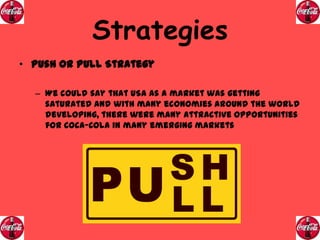
• Push or Pull Strategy
– We could say that USA as a market was getting
saturated and with many economies around the world
developing, there were many attractive opportunities
for Coca-Cola in many emerging markets
Coca-Cola in India
• Coca-Cola came to India in the early 1900’s
• Coca-Cola was India’s leading soft drink until
1977 when it left India after a new government
ordered the company to turn over its secret
formula for Coca-Cola and dilute its stake in
its Indian unit as required by FERA
Coca-Cola in India
• Entered post the opening of the markets as a
wholly owned subsidy Coco-Cola India Pvt. Ltd
• Has more than 7,000 distributors and 1.7 million
retailers
• Invested close to $2 Billion since 1992 and directly
employs over 25,000 people with employment
opportunities for more than 1,50,000 people

• Among the largest buyers of domestic agricultural
products
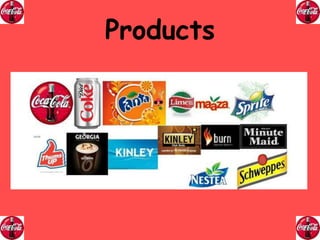
Products
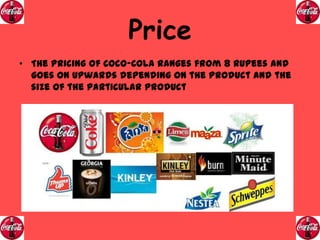
Price
• The Pricing of Coco-Cola ranges from 8 Rupees and
goes on upwards depending on the product and the
size of the particular product
Place
• The products of Coca Cola are available in all
leading retail outlets, restaurants and other
places of entertainment by keeping in line with
their Marketing Strategy which has 3 main missions
– To Refresh The World In Body, Mind & Spirit
– To Inspire Moments Of Optimism & Happiness Through Our
Brands And Our Actions
– To Create Value And Make A Difference Everywhere We
Engage
Promotion
• Some of the popular Jingles in the first year of its
existence were
– Always The Real Thing
– Pee Le Coca-Cola
– Jo Chahe Ho Jaye.. Coca-Cola Enjoy
Promotion
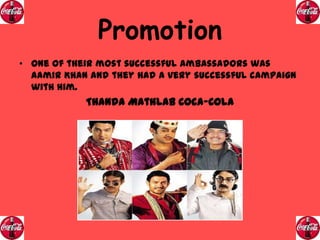
• One of their most successful ambassadors was
Aamir Khan and they had a very successful campaign
with him.

Thanda Mathlab Coca-Cola
Challenges
• The brand was under serious criticism with health
issues associated with the consumption of Coke
• Health experts blamed Coca-Cola for promoting
Child Obesity and other lifestyle diseases
• Environmentalist has shunned the manufacturing
practices of Cola giants as they claim that cola
manufacturing plants cause water depletion and
contamination
Challenges
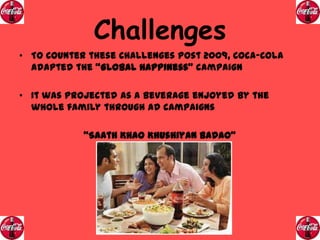
• To Counter these Challenges Post 2009, Coca-Cola
adapted the “Global Happiness” campaign
• It was projected as a beverage enjoyed by the
whole family through ad campaigns
“Saath Khao Khushiyan Badao”
Contribution to India
• Project Unnati
– Seed investment of $2 Million, the project aims at training
farmers and has established about 100 demo farms in the
pilot phase which plans to train 50,000 farmers over 5
years

• Parvatan Program
– Trains local Kirana store owners in good business practices
– Distributed water coolers to female retailers in interior
regions of UP
Standardization Vs
Adaptation
• Coke believes in Standardization as it has products
available all over the world with a customer base
which need not be specified to a geographic location
• Apart from adapting to the local laws and
standards of packaging and the price of
competitors, in terms of the product only the
Sweetness is changed according to local tastes
Conclusion
Thank You

Coca cola globalization

  • 2.
  • 3.
    Agenda • Introduction • Strategies •4Ps • Challenges • Standardization Vs Adaptation • Conclusion • References
  • 4.
    Introduction • Started in1886 at Atlanta, Georgia • Carbonated Soft Drinks sold in stores, restaurants and vending machines everywhere in the world • Initially started as a patented drug which could cure morphine addiction, headache and even impotency • Main competitor is PepsiCo.
  • 5.
    Strategies • Franchised ProductionModel – Coco-Cola only manufactures the syrup – Sold to bottlers throughout the World, who have one or more geographic licenses – Bottlers produce the final drink by mixing the syrup with filtered water and sweeteners – Finally they carbonate it before putting it into cans & bottles – Independent Bottlers can sweeten the drink according to the local taste
  • 6.
    Strategies • Push orPull Strategy – We could say that USA as a market was getting saturated and with many economies around the world developing, there were many attractive opportunities for Coca-Cola in many emerging markets
  • 7.
    Coca-Cola in India •Coca-Cola came to India in the early 1900’s • Coca-Cola was India’s leading soft drink until 1977 when it left India after a new government ordered the company to turn over its secret formula for Coca-Cola and dilute its stake in its Indian unit as required by FERA
  • 8.
    Coca-Cola in India •Entered post the opening of the markets as a wholly owned subsidy Coco-Cola India Pvt. Ltd • Has more than 7,000 distributors and 1.7 million retailers • Invested close to $2 Billion since 1992 and directly employs over 25,000 people with employment opportunities for more than 1,50,000 people • Among the largest buyers of domestic agricultural products
  • 9.
  • 10.
    Price • The Pricingof Coco-Cola ranges from 8 Rupees and goes on upwards depending on the product and the size of the particular product
  • 11.
    Place • The productsof Coca Cola are available in all leading retail outlets, restaurants and other places of entertainment by keeping in line with their Marketing Strategy which has 3 main missions – To Refresh The World In Body, Mind & Spirit – To Inspire Moments Of Optimism & Happiness Through Our Brands And Our Actions – To Create Value And Make A Difference Everywhere We Engage
  • 12.
    Promotion • Some ofthe popular Jingles in the first year of its existence were – Always The Real Thing – Pee Le Coca-Cola – Jo Chahe Ho Jaye.. Coca-Cola Enjoy
  • 13.
    Promotion • One oftheir most successful ambassadors was Aamir Khan and they had a very successful campaign with him. Thanda Mathlab Coca-Cola
  • 14.
    Challenges • The brandwas under serious criticism with health issues associated with the consumption of Coke • Health experts blamed Coca-Cola for promoting Child Obesity and other lifestyle diseases • Environmentalist has shunned the manufacturing practices of Cola giants as they claim that cola manufacturing plants cause water depletion and contamination
  • 15.
    Challenges • To Counterthese Challenges Post 2009, Coca-Cola adapted the “Global Happiness” campaign • It was projected as a beverage enjoyed by the whole family through ad campaigns “Saath Khao Khushiyan Badao”
  • 16.
    Contribution to India •Project Unnati – Seed investment of $2 Million, the project aims at training farmers and has established about 100 demo farms in the pilot phase which plans to train 50,000 farmers over 5 years • Parvatan Program – Trains local Kirana store owners in good business practices – Distributed water coolers to female retailers in interior regions of UP
  • 17.
    Standardization Vs Adaptation • Cokebelieves in Standardization as it has products available all over the world with a customer base which need not be specified to a geographic location • Apart from adapting to the local laws and standards of packaging and the price of competitors, in terms of the product only the Sweetness is changed according to local tastes
  • 18.
  • 19.

Editor's Notes