• Introduction
• SWOT Analysis
• Marketing Mix
• Existing Strategies
• Pros and Cons
• Presentation of Data
• New strategies to develop marketing mix
• The Coca-cola Company is a world’s largest beverage
company with almost 500 brands ranging from the
actual Coca Cola to products such as
Sprite,Fanta,Minute maid and many more.
• The product was originally born in Atlanta,Georgia in
1886.
• Dr.John Smith Pemberton,a local pharmacist invented
the Coca Cola which today have spreaded in more than
200 countries giving job opportunities to 139,600
people worldwide.
Do you know?
The term Coca Cola stands in the top of the most understood
terms in the world(next to the term “okay”).
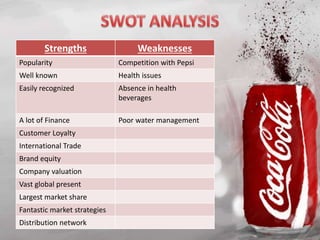
Strengths Weaknesses
Popularity Competition with Pepsi
Well known Health issues
Easily recognized Absence in health
beverages
A lot of Finance Poor water management
Customer Loyalty
International Trade
Brand equity
Company valuation
Vast global present
Largest market share
Fantastic market strategies
Distribution network
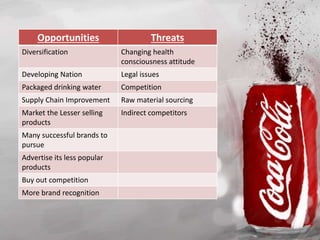
Opportunities Threats
Diversification Changing health
consciousness attitude
Developing Nation Legal issues
Packaged drinking water Competition
Supply Chain Improvement Raw material sourcing
Market the Lesser selling
products
Indirect competitors
Many successful brands to
pursue
Advertise its less popular
products
Buy out competition
More brand recognition
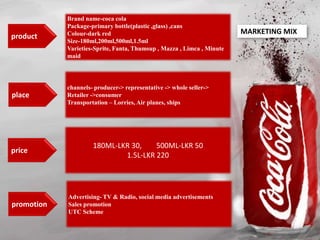
product
place
price
promotion
Brand name-coca cola
Package-primary bottle(plastic ,glass) ,cans
Colour-dark red
Size-180ml,200ml,500ml,1.5ml
Varieties-Sprite, Fanta, Thumsup , Mazza , Limca , Minute
maid
channels- producer-> representative -> whole seller->
Retailer ->consumer
Transportation – Lorries, Air planes, ships
180ML-LKR 30, 500ML-LKR 50
1.5L-LKR 220
Advertising- TV & Radio, social media advertisements
Sales promotion
UTC Scheme
MARKETING MIX
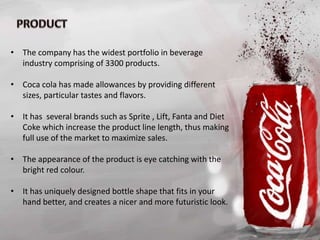
• The company has the widest portfolio in beverage
industry comprising of 3300 products.
• Coca cola has made allowances by providing different
sizes, particular tastes and flavors.
• It has several brands such as Sprite , Lift, Fanta and Diet
Coke which increase the product line length, thus making
full use of the market to maximize sales.
• The appearance of the product is eye catching with the
bright red colour.
• It has uniquely designed bottle shape that fits in your
hand better, and creates a nicer and more futuristic look.
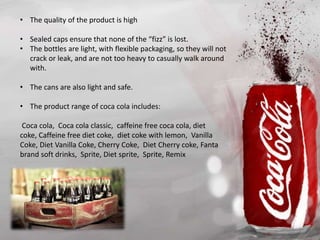
• The quality of the product is high
• Sealed caps ensure that none of the “fizz” is lost.
• The bottles are light, with flexible packaging, so they will not
crack or leak, and are not too heavy to casually walk around
with.
• The cans are also light and safe.
• The product range of coca cola includes:
Coca cola, Coca cola classic, caffeine free coca cola, diet
coke, Caffeine free diet coke, diet coke with lemon, Vanilla
Coke, Diet Vanilla Coke, Cherry Coke, Diet Cherry coke, Fanta
brand soft drinks, Sprite, Diet sprite, Sprite, Remix
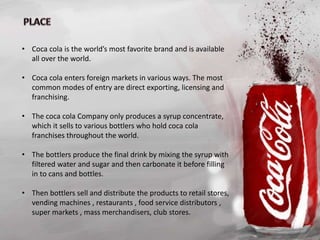
• Coca cola is the world’s most favorite brand and is available
all over the world.
• Coca cola enters foreign markets in various ways. The most
common modes of entry are direct exporting, licensing and
franchising.
• The coca cola Company only produces a syrup concentrate,
which it sells to various bottlers who hold coca cola
franchises throughout the world.
• The bottlers produce the final drink by mixing the syrup with
filtered water and sugar and then carbonate it before filling
in to cans and bottles.
• Then bottlers sell and distribute the products to retail stores,
vending machines , restaurants , food service distributors ,
super markets , mass merchandisers, club stores.
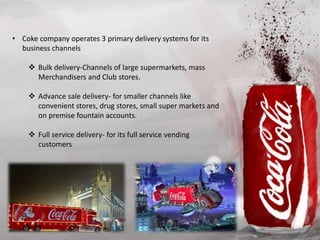
• Coke company operates 3 primary delivery systems for its
business channels
 Bulk delivery-Channels of large supermarkets, mass
Merchandisers and Club stores.
 Advance sale delivery- for smaller channels like
convenient stores, drug stores, small super markets and
on premise fountain accounts.
 Full service delivery- for its full service vending
customers
• Due to the availability of wide range products the pricing is
done according to the market and geographic segment.
• Each sub brand of coca cola has different pricing strategy.
• Their pricing strategy is based on the competitors’ pricing ,
Pepsi is the direct competitor to coke
• The long term pricing strategy of Coca cola can be best
described as Value oriented.
• Different prices in different seasons.
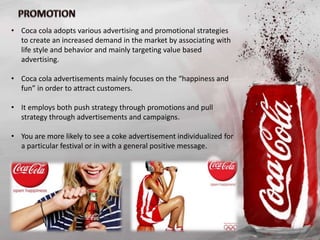
• Coca cola adopts various advertising and promotional strategies
to create an increased demand in the market by associating with
life style and behavior and mainly targeting value based
advertising.
• Coca cola advertisements mainly focuses on the “happiness and
fun” in order to attract customers.
• It employs both push strategy through promotions and pull
strategy through advertisements and campaigns.
• You are more likely to see a coke advertisement individualized for
a particular festival or in with a general positive message.
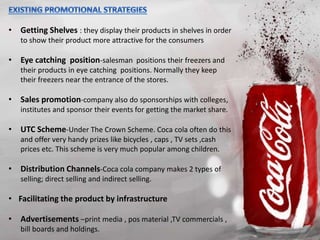
• Getting Shelves : they display their products in shelves in order
to show their product more attractive for the consumers
• Eye catching position-salesman positions their freezers and
their products in eye catching positions. Normally they keep
their freezers near the entrance of the stores.
• Sales promotion-company also do sponsorships with colleges,
institutes and sponsor their events for getting the market share.
• UTC Scheme-Under The Crown Scheme. Coca cola often do this
and offer very handy prizes like bicycles , caps , TV sets ,cash
prices etc. This scheme is very much popular among children.
• Distribution Channels-Coca cola company makes 2 types of
selling; direct selling and indirect selling.
• Facilitating the product by infrastructure
• Advertisements –print media , pos material ,TV commercials ,
bill boards and holdings.
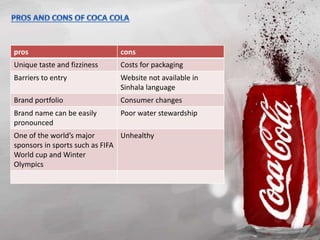
pros cons
Unique taste and fizziness Costs for packaging
Barriers to entry Website not available in
Sinhala language
Brand portfolio Consumer changes
Brand name can be easily
pronounced
Poor water stewardship
One of the world’s major
sponsors in sports such as FIFA
World cup and Winter
Olympics
Unhealthy
25%
30%
23%
22%
Age groups
16-20
21-25
26-30
31-35
89%
11%
Consumers and Non consumers of
Coca Cola
consumers non consumers
S
e
c
t
o
r
55%
8%
12%
25%
television newspapers
internet posters and cutouts
75%
25%
Taste is good brand loyalty
10%
22%
35%
13%
20%
Usage
Daily Once a week Twice a week twice a month rarely
Advertisements Medium of Coca Cola
Reasons to consume Coca Cola
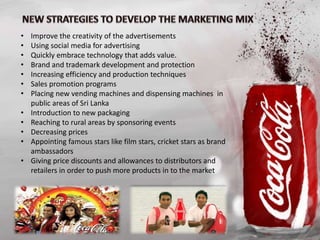
• Improve the creativity of the advertisements
• Using social media for advertising
• Quickly embrace technology that adds value.
• Brand and trademark development and protection
• Increasing efficiency and production techniques
• Sales promotion programs
• Placing new vending machines and dispensing machines in
public areas of Sri Lanka
• Introduction to new packaging
• Reaching to rural areas by sponsoring events
• Decreasing prices
• Appointing famous stars like film stars, cricket stars as brand
ambassadors
• Giving price discounts and allowances to distributors and
retailers in order to push more products in to the market
Coca cola presentation

Coca cola presentation

  • 2.
    • Introduction • SWOTAnalysis • Marketing Mix • Existing Strategies • Pros and Cons • Presentation of Data • New strategies to develop marketing mix
  • 3.
    • The Coca-colaCompany is a world’s largest beverage company with almost 500 brands ranging from the actual Coca Cola to products such as Sprite,Fanta,Minute maid and many more. • The product was originally born in Atlanta,Georgia in 1886. • Dr.John Smith Pemberton,a local pharmacist invented the Coca Cola which today have spreaded in more than 200 countries giving job opportunities to 139,600 people worldwide. Do you know? The term Coca Cola stands in the top of the most understood terms in the world(next to the term “okay”).
  • 4.
    Strengths Weaknesses Popularity Competitionwith Pepsi Well known Health issues Easily recognized Absence in health beverages A lot of Finance Poor water management Customer Loyalty International Trade Brand equity Company valuation Vast global present Largest market share Fantastic market strategies Distribution network
  • 5.
    Opportunities Threats Diversification Changinghealth consciousness attitude Developing Nation Legal issues Packaged drinking water Competition Supply Chain Improvement Raw material sourcing Market the Lesser selling products Indirect competitors Many successful brands to pursue Advertise its less popular products Buy out competition More brand recognition
  • 6.
    product place price promotion Brand name-coca cola Package-primarybottle(plastic ,glass) ,cans Colour-dark red Size-180ml,200ml,500ml,1.5ml Varieties-Sprite, Fanta, Thumsup , Mazza , Limca , Minute maid channels- producer-> representative -> whole seller-> Retailer ->consumer Transportation – Lorries, Air planes, ships 180ML-LKR 30, 500ML-LKR 50 1.5L-LKR 220 Advertising- TV & Radio, social media advertisements Sales promotion UTC Scheme MARKETING MIX
  • 7.
    • The companyhas the widest portfolio in beverage industry comprising of 3300 products. • Coca cola has made allowances by providing different sizes, particular tastes and flavors. • It has several brands such as Sprite , Lift, Fanta and Diet Coke which increase the product line length, thus making full use of the market to maximize sales. • The appearance of the product is eye catching with the bright red colour. • It has uniquely designed bottle shape that fits in your hand better, and creates a nicer and more futuristic look.
  • 8.
    • The qualityof the product is high • Sealed caps ensure that none of the “fizz” is lost. • The bottles are light, with flexible packaging, so they will not crack or leak, and are not too heavy to casually walk around with. • The cans are also light and safe. • The product range of coca cola includes: Coca cola, Coca cola classic, caffeine free coca cola, diet coke, Caffeine free diet coke, diet coke with lemon, Vanilla Coke, Diet Vanilla Coke, Cherry Coke, Diet Cherry coke, Fanta brand soft drinks, Sprite, Diet sprite, Sprite, Remix
  • 9.
    • Coca colais the world’s most favorite brand and is available all over the world. • Coca cola enters foreign markets in various ways. The most common modes of entry are direct exporting, licensing and franchising. • The coca cola Company only produces a syrup concentrate, which it sells to various bottlers who hold coca cola franchises throughout the world. • The bottlers produce the final drink by mixing the syrup with filtered water and sugar and then carbonate it before filling in to cans and bottles. • Then bottlers sell and distribute the products to retail stores, vending machines , restaurants , food service distributors , super markets , mass merchandisers, club stores.
  • 10.
    • Coke companyoperates 3 primary delivery systems for its business channels  Bulk delivery-Channels of large supermarkets, mass Merchandisers and Club stores.  Advance sale delivery- for smaller channels like convenient stores, drug stores, small super markets and on premise fountain accounts.  Full service delivery- for its full service vending customers
  • 11.
    • Due tothe availability of wide range products the pricing is done according to the market and geographic segment. • Each sub brand of coca cola has different pricing strategy. • Their pricing strategy is based on the competitors’ pricing , Pepsi is the direct competitor to coke • The long term pricing strategy of Coca cola can be best described as Value oriented. • Different prices in different seasons.
  • 12.
    • Coca colaadopts various advertising and promotional strategies to create an increased demand in the market by associating with life style and behavior and mainly targeting value based advertising. • Coca cola advertisements mainly focuses on the “happiness and fun” in order to attract customers. • It employs both push strategy through promotions and pull strategy through advertisements and campaigns. • You are more likely to see a coke advertisement individualized for a particular festival or in with a general positive message.
  • 13.
    • Getting Shelves: they display their products in shelves in order to show their product more attractive for the consumers • Eye catching position-salesman positions their freezers and their products in eye catching positions. Normally they keep their freezers near the entrance of the stores. • Sales promotion-company also do sponsorships with colleges, institutes and sponsor their events for getting the market share. • UTC Scheme-Under The Crown Scheme. Coca cola often do this and offer very handy prizes like bicycles , caps , TV sets ,cash prices etc. This scheme is very much popular among children. • Distribution Channels-Coca cola company makes 2 types of selling; direct selling and indirect selling. • Facilitating the product by infrastructure • Advertisements –print media , pos material ,TV commercials , bill boards and holdings.
  • 14.
    pros cons Unique tasteand fizziness Costs for packaging Barriers to entry Website not available in Sinhala language Brand portfolio Consumer changes Brand name can be easily pronounced Poor water stewardship One of the world’s major sponsors in sports such as FIFA World cup and Winter Olympics Unhealthy
  • 15.
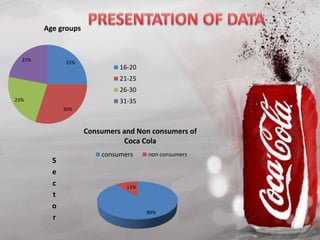
    25% 30% 23% 22% Age groups 16-20 21-25 26-30 31-35 89% 11% Consumers andNon consumers of Coca Cola consumers non consumers S e c t o r
  • 16.
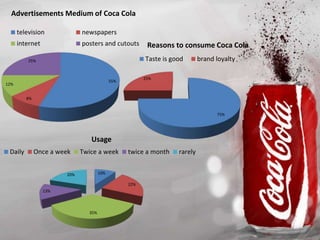
    55% 8% 12% 25% television newspapers internet postersand cutouts 75% 25% Taste is good brand loyalty 10% 22% 35% 13% 20% Usage Daily Once a week Twice a week twice a month rarely Advertisements Medium of Coca Cola Reasons to consume Coca Cola
  • 17.
    • Improve thecreativity of the advertisements • Using social media for advertising • Quickly embrace technology that adds value. • Brand and trademark development and protection • Increasing efficiency and production techniques • Sales promotion programs • Placing new vending machines and dispensing machines in public areas of Sri Lanka • Introduction to new packaging • Reaching to rural areas by sponsoring events • Decreasing prices • Appointing famous stars like film stars, cricket stars as brand ambassadors • Giving price discounts and allowances to distributors and retailers in order to push more products in to the market

Editor's Notes

  • #12 Value based pricing-When people buy Coca-Cola they are not just buying the beverage but also the image that goes with it ,therefore to have the price higher reiterates the fact that the product is of a better quality than the rest and the consumer is not cheap. This is used by many other industries in attracting consumers.