CCAFS	
  progress	
  towards	
  10-­‐year	
  targets,	
  as	
  at	
  December	
  2014	
  
10-­‐year	
  (2020)	
  targets	
  
3-­‐year	
  (2013)	
  
indicators	
  
(abbreviated)	
  	
  
Outcomes	
  towards	
  the	
  3-­‐year	
  indicators	
  and	
  10-­‐year	
  
targets	
  (always	
  achieved	
  with	
  numerous	
  partners)	
  
Progress	
  
towards	
  10-­‐
yr	
  targets	
  as	
  
at	
  Dec	
  2014	
  
Faster	
   	
  
On	
  
track	


Slower	
   	
  
1.1:	
  Agricultural	
  and	
  food	
  
security	
  strategies	
  that	
  
are	
  adapted	
  towards	
  
conditions	
  of	
  predicted	
  
climate	
  change	
  
promoted	
  by	
  the	
  key	
  
development	
  and	
  
funding	
  agencies	
  
(national	
  and	
  
international),	
  civil	
  
society	
  organizations	
  and	
  
private	
  sector	
  in	
  at	
  least	
  
20	
  countries	
  
1.1:	
  	
  1-­‐5	
  
flagship	
  
technical	
  
and/or	
  
institutional	
  
approaches	
  
identified/	
  
developed	
  
with	
  
stakeholders	
  
in	
  three	
  
regions	
  
• Major	
  flagship	
  approaches	
  developed,	
  tested	
  and	
  being	
  used	
  to	
  inform	
  practice	
  
by	
  governments,	
  farmers’	
  organisations,	
  development	
  agencies	
  and	
  private	
  
sector:	
  
o Climate-­‐Smart	
  Village	
  concept	
  developed,	
  established	
  in	
  3	
  regions	
  (SA,	
  EA,	
  
WA),	
  and	
  now	
  launched	
  in	
  2	
  new	
  regions	
  (LA	
  &	
  SEA)	
  and	
  being	
  massively	
  
scaled	
  up	
  in	
  Nepal	
  and	
  India	
  –	
  sites	
  for	
  participatory	
  testing	
  &	
  
demonstration	
  of	
  portfolios	
  of	
  climate-­‐smart	
  interventions	
  
o Farms	
  of	
  the	
  Future	
  approach,	
  using	
  the	
  analogue	
  model,	
  developed	
  and	
  
tested	
  in	
  9	
  countries	
  in	
  SA,	
  WA	
  and	
  EA	
  	
  
o AgTrials	
  database	
  with	
  >35000	
  livestock	
  &	
  Crop	
  yield	
  datasets	
  linked	
  to	
  
climate	
  data	
  	
  
o Crowdsourcing	
  used	
  to	
  broaden	
  the	
  genetic	
  base	
  of	
  crops	
  in	
  India,	
  working	
  
with	
  5000+	
  women	
  and	
  men	
  farmers	
  	
  
o Reality	
  TV	
  show	
  “Shamba	
  Shape	
  Up”	
  broadcasting	
  ideas	
  on	
  gender-­‐sensitive	
  
climate-­‐smart	
  farm	
  practices	
  to	
  more	
  than	
  9	
  million	
  viewers	
  and	
  benefiting	
  
Kenya’s	
  GDP	
  by	
  an	
  estimated	
  US$	
  24	
  million	
  
• Specific	
  approaches	
  tested	
  and	
  brought	
  to	
  scale:	
  
o Banana-­‐coffee	
  systems	
  developed	
  and	
  tested	
  with	
  farmers	
  and	
  companies	
  
in	
  EA,	
  leading	
  to	
  higher	
  &	
  more	
  stable	
  incomes	
  plus	
  mitigation	
  benefits	
  
o Adaptations	
  and	
  transitions	
  in	
  coffee	
  and	
  cocoa	
  systems	
  supported	
  in	
  EA,	
  
WA	
  and	
  LA	
  
o Alternate	
  wetting	
  and	
  drying	
  in	
  rice	
  under	
  continual	
  improvement	
  and	
  
spreading	
  widely	
  in	
  Vietnam	
  supported	
  by	
  government	
  policy	
  
o Laser	
  land	
  levelling	
  adopted	
  over	
  0.5	
  million	
  ha	
  in	
  India,	
  bringing	
  
demonstrable	
  food	
  security,	
  adaptation	
  &	
  mitigation	
  benefits	
  
o Conservation	
  agriculture	
  developed,	
  tested	
  and	
  scaled	
  out	
  in	
  SA,	
  EA,	
  
Southern	
  Africa	


1.2:	
  Strategies	
  for	
  
addressing	
  abiotic/	
  biotic	
  
stresses	
  induced	
  by	
  
future	
  climate	
  change,	
  
variability	
  and	
  extremes	
  
mainstreamed	
  among	
  >	
  
75%	
  of	
  the	
  international	
  
research	
  agencies,	
  and	
  
by	
  national	
  agencies	
  in	
  ≥	
  
12	
  countries	
  
1.2:	
  Breeding	
  
strategies	
  of	
  
regional/natio
nal	
  crop	
  
breeding	
  
institutions	
  in	
  
three	
  regions	
  
are	
  
coordinated	
  
and	
  CCAFS-­‐
informed	
  
• CCAFS-­‐climate	
  data	
  providing	
  inputs	
  for	
  projections	
  of	
  future	
  crop	
  suitability	
  
and	
  yields;	
  analyses	
  completed	
  in	
  all	
  5	
  regions	
  for	
  a	
  range	
  of	
  crops;	
  significant	
  
progress	
  has	
  been	
  made	
  in	
  modelling	
  genotypic	
  impacts,	
  and	
  using	
  these	
  to	
  
inform	
  global	
  breeding	
  strategies	
  for	
  banana,	
  cassava,	
  potato	
  and	
  beans	
  
• National	
  programs	
  for	
  maize	
  (Zimbabwe,	
  Ethiopia)	
  and	
  rice	
  (Vietnam,	
  Colombia,	
  
Brazil)	
  using	
  CCAFS	
  tools;	
  community	
  of	
  practice	
  for	
  testing	
  potato	
  varieties	
  for	
  
12	
  African	
  countries;	
  Pan-­‐Africa	
  Bean	
  Research	
  Alliance	
  (PABRA),	
  involving	
  22	
  
national	
  bean	
  programs	
  in	
  Africa,	
  using	
  CCAFS	
  research	
  
• 10-­‐year	
  US$50	
  million	
  programme	
  focused	
  on	
  crop	
  wild	
  relative	
  collection	
  and	
  
pre-­‐breeding	
  for	
  climate	
  change	
  adaptation	
  established	


1.3:	
  Integrated	
  
adaptation	
  strategies	
  for	
  
agricultural	
  and	
  food	
  
systems	
  inserted	
  into	
  
policy	
  and	
  institutional	
  
frameworks	
  at	
  regional,	
  
national	
  or	
  sub-­‐national	
  
level	
  in	
  5	
  target	
  regions.	
  
Policy	
  makers	
  and	
  key	
  
stakeholders	
  use	
  CCAFS	
  
research	
  outputs	
  –	
  
guidelines,	
  tools	
  and	
  
methods	
  –	
  to	
  support	
  the	
  
development	
  of	
  NAPAs,	
  
1.3:	
  
Integrated	
  
adaptation	
  
strategies	
  at	
  
regional,	
  
national	
  or	
  
sub-­‐national	
  
level	
  in	
  2	
  
regions	
  
informed	
  by	
  
CCAFS	
  science	
  
• CCAFS	
  science	
  and	
  scientists	
  have	
  contributed	
  directly	
  to	
  new	
  adaptation	
  
strategies	
  and	
  programs	
  in	
  several	
  countries	
  including:	
  
o National	
  Adaptation	
  Plan	
  for	
  agriculture	
  in	
  Nicaragua,	
  with	
  immediate	
  
impacts	
  through	
  new	
  investments	
  US$24	
  million	
  investment	
  to	
  climate-­‐
proof	
  the	
  coffee	
  and	
  cocoa	
  sectors.	
  
o Climate	
  Change	
  Adaptation	
  Strategy	
  in	
  Ethiopia	
  
o National	
  Climate	
  Change	
  Adaptation	
  Strategy	
  in	
  Sri	
  Lanka	
  	
  
o National	
  Agricultural	
  Resilience	
  Framework	
  in	
  Nigeria	
  
o Strategic	
  action	
  plan	
  to	
  strengthen	
  conservation	
  and	
  use	
  of	
  Mesoamerica	
  
plant	
  genetic	
  resources	
  signed	
  by	
  Agriculture	
  Ministers	
  
o Design	
  of	
  the	
  watershed	
  component	
  of	
  the	
  global	
  Pilot	
  Program	
  for	
  Climate	
  
Resilience	
  (PPCR)	
  under	
  the	
  Climate	
  Investment	
  Funds	


sector	
  specific	
  
adaptation	
  plans,	
  or	
  
germplasm	
  benefit	
  
sharing	
  policies	
  in	
  at	
  least	
  
20	
  countries	
  
2.1:	
  Systematic	
  technical	
  
and	
  policy	
  support	
  by	
  
development	
  agencies	
  
for	
  farm-­‐	
  to	
  community-­‐
level	
  agricultural	
  risk	
  
management	
  strategies	
  
and	
  actions	
  that	
  buffer	
  
against	
  climate	
  shocks	
  
and	
  enhance	
  livelihood	
  
resilience	
  in	
  at	
  least	
  20	
  
countries	
  
2.1:	
  	
  1-­‐5	
  
flagship	
  risk	
  
management	
  
interventions	
  
evaluated	
  and	
  
demonstrated	
  
by	
  
stakeholders	
  
in	
  3	
  regions	
  
• Improved	
  rainfall	
  threshold	
  in	
  index	
  insurance	
  developed	
  and	
  used	
  by	
  
Agricultural	
  Insurance	
  Company	
  of	
  India	
  with	
  56,000	
  farmers	
  
• Index-­‐based	
  livestock	
  insurance	
  developed	
  and	
  trialled	
  in	
  Kenya	
  and	
  Ethiopia	
  
• Climate-­‐specific	
  management	
  approaches	
  developed	
  and	
  trialled	
  by	
  the	
  rice,	
  
cereal	
  and	
  grain	
  producer	
  associations	
  of	
  Colombia	
  
• Mobile	
  phone	
  agro-­‐advisories	
  with	
  company	
  IKSL	
  adopted	
  widely	
  by	
  farmers	
  in	
  
Punjab	
  and	
  Haryana;	
  ICT-­‐based	
  agro-­‐advisories	
  tested	
  with	
  ESOKO	
  company	
  to	
  
benefit	
  farmers	
  in	
  Northern	
  Ghana	
  
• Mobile	
  services	
  for	
  farmers	
  related	
  to	
  irrigation	
  needs	
  and	
  flood	
  warnings	
  
established	
  in	
  Ethiopia,	
  Sudan	
  and	
  Egypt	


2.2:	
  Better	
  climate-­‐
informed	
  management	
  
by	
  key	
  international,	
  
regional	
  and	
  national	
  
agencies	
  of	
  food	
  crisis	
  
response,	
  post-­‐crisis	
  
recovery,	
  and	
  food	
  trade	
  
and	
  delivery	
  in	
  at	
  least	
  12	
  
countries	
  
2.2:	
  	
  3	
  food	
  
crisis	
  
response,	
  
post-­‐crisis	
  and	
  
food	
  trade	
  
strategies	
  
evaluated	
  
with	
  partners	
  
in	
  3	
  regions	
  
• Methodology	
  for	
  assessing	
  climate	
  risk	
  exposure	
  and	
  targeting	
  food	
  security	
  
interventions	
  used	
  to	
  inform	
  WFP,	
  Nepal	
  Government,	
  and	
  World	
  Bank	
  food	
  
security	
  programmes	
  in	
  Nepal	
  
• Integrated	
  food	
  security	
  modelling	
  in	
  Philippines	
  evaluated	
  by	
  the	
  national	
  
meteorological	
  and	
  disaster	
  risk	
  management	
  agencies	
  
• Policies	
  and	
  processes	
  for	
  responding	
  to	
  climate	
  shocks	
  reviewed	
  and	
  tested	
  in	
  
Ethiopia	
  and	
  India	
  
• Involvement	
  in	
  planning	
  of	
  WFP	
  Food	
  Security	
  Climate	
  Resilience	
  (FoodSECuRE)	
  
Facility;	
  will	
  help	
  design	
  triggers	
  for	
  >US$	
  100	
  million	
  facility	
  in	
  9	
  pilot	
  countries	
  	
  
• CCAFS	
  Regional	
  Agricultural	
  Forecasting	
  Toolbox	
  (CRAFT)	
  tested	
  for	
  use	
  by	
  WFP	
  
in	
  Nepal,	
  continues	
  to	
  be	
  developed	
  with	
  many	
  partners	


2.3:	
  Enhanced	
  uptake	
  
and	
  use	
  of	
  improved	
  
climate	
  information	
  
products	
  and	
  services,	
  
and	
  of	
  information	
  about	
  
agricultural	
  production	
  
and	
  biological	
  threats,	
  by	
  
resource-­‐poor	
  farmers,	
  
particularly	
  vulnerable	
  
groups	
  and	
  women,	
  in	
  at	
  
least	
  12	
  countries	
  
2.3:	
  National	
  
and	
  regional	
  
meteorologic
al	
  services	
  
trained	
  to	
  
produce	
  
downscaled	
  
seasonal	
  
forecast	
  
products	
  in	
  2	
  
countries	
  in	
  
each	
  of	
  3	
  
regions	
  
• National	
  Meteorological	
  Services	
  (NMS)	
  in	
  3	
  countries	
  in	
  WA	
  and	
  the	
  regional	
  
agency	
  AGRHYMET	
  producing	
  and	
  sharing	
  climate	
  information	
  at	
  relevant	
  scales	
  
• Through	
  participatory	
  research,	
  better	
  tailoring	
  of	
  climate	
  information	
  services	
  
to	
  needs	
  of	
  women	
  and	
  men	
  farmers	
  in	
  4	
  countries	
  in	
  WA;	
  WMO	
  has	
  endorsed	
  
the	
  approach	
  and	
  5	
  major	
  NGOs	
  have	
  adopted	
  
• In	
  Senegal,	
  40	
  rural	
  community	
  radio	
  stations	
  now	
  deliver	
  seasonal	
  forecasts	
  to	
  
an	
  estimated	
  2+	
  million	
  farmers	
  
• NMS	
  trained	
  by	
  global	
  experts	
  in	
  seasonal	
  forecasting	
  to	
  produce	
  seasonal	
  
forecasts	
  for	
  rural	
  communities	
  in	
  Colombia	
  and	
  Brazil	
  
• Training	
  of	
  extension	
  staff	
  in	
  climate-­‐based	
  agro-­‐advisories,	
  reaching	
  at	
  least	
  
34,000	
  farmers;	
  estimated	
  50%	
  used	
  this	
  new	
  information	
  for	
  seasonal	
  planning	


3.1:	
  Enhanced	
  
knowledge	
  about	
  
agricultural	
  development	
  
pathways	
  that	
  lead	
  to	
  
better	
  decisions	
  for	
  
climate	
  mitigation,	
  
poverty	
  alleviation,	
  food	
  
security	
  and	
  
environmental	
  heath,	
  
used	
  by	
  national	
  
agencies	
  in	
  at	
  least	
  20	
  
countries	
  
3.1:	
  	
  Findings	
  
on	
  mitigation	
  
of	
  alternative	
  
development	
  
pathways	
  
used	
  in	
  2	
  
countries	
  in	
  
each	
  of	
  3	
  
regions	
  
• Vietnam,	
  Kenya,	
  Colombia	
  and	
  Peru	
  plans	
  for	
  low	
  emissions	
  development	
  or	
  
Nationally	
  Appropriate	
  Mitigation	
  Actions	
  (NAMAs)	
  
• Alternate	
  Wetting	
  and	
  Drying	
  (AWD)	
  integrated	
  into	
  the	
  Vietnamese	
  mitigation	
  
strategy	
  20-­‐20-­‐20	
  
• Contributions	
  to	
  GHG	
  emission	
  reduction	
  commitments	
  in	
  Intended	
  Nationally	
  
Determined	
  Contributions	
  (INDCs)	
  in	
  e.g.	
  Colombia	
  
• East	
  African	
  Dairy	
  Development	
  program	
  of	
  Heifer	
  International	
  
• Local	
  governments	
  in	
  Kenya	
  and	
  Uganda	
  using	
  CCAFS-­‐Ecoagriculture	
  results	
  in	
  
management	
  of	
  carbon	
  projects	
  
• Nutrient	
  Expert	
  tool	
  used	
  by	
  extensionists	
  and	
  farmers	
  to	
  reduce	
  nitrous	
  oxide	
  
emissions	
  in	
  Haryana	


3.2:	
  Improved	
  knowledge	
  
about	
  incentives	
  and	
  
institutional	
  
arrangements	
  for	
  
mitigation	
  practices	
  by	
  
resource-­‐poor	
  
smallholders	
  used	
  by	
  
farmers,	
  (including	
  
3.2:	
  Decision-­‐
makers	
  in	
  3	
  
regions	
  
informed	
  for	
  
rewarding	
  
farmers	
  for	
  
GHG	
  
reductions	
  
• Rules	
  for	
  carbon	
  schemes	
  in	
  coffee	
  smallholder	
  contexts	
  established	
  in	
  LA	
  and	
  
now	
  piloted	
  by	
  Green	
  Mountain	
  Coffee	
  Roasters	
  	
  
• Carbon	
  project	
  partners	
  use	
  institutional	
  innovation	
  lessons	
  in	
  project	
  design	
  
and	
  development	
  in	
  East	
  Africa	
  
• New	
  agroforestry	
  policy	
  in	
  India	
  seeks	
  33%	
  tree	
  cover	
  and	
  creates	
  incentives	
  to	
  
farmers	
  
• Haryana	
  State	
  extension	
  strategies	
  informed	
  by	
  analysis	
  of	
  incentives	
  and	
  
gender	
  benefits	
  in	
  conservation	
  agriculture	


farmers’	
  organizations),	
  
project	
  developers	
  and	
  
policy	
  makers	
  in	
  at	
  least	
  
12	
  countries	
  
• Farmer-­‐led	
  low	
  emissions	
  development	
  strategies	
  (including	
  strategies	
  for	
  
gender	
  and	
  innovation,	
  biochar	
  and	
  bioslurry)	
  in	
  Cambodia	
  and	
  Honduras	
  
3.3:	
  Key	
  agencies	
  dealing	
  
with	
  climate	
  mitigation	
  in	
  
at	
  least	
  12	
  countries	
  
promoting	
  technically	
  
and	
  economically	
  
feasible	
  agricultural	
  
mitigation	
  practices	
  that	
  
have	
  co-­‐benefits	
  for	
  
resource-­‐poor	
  farmers,	
  
particularly	
  vulnerable	
  
groups	
  and	
  women	
  
3.3:	
  Project	
  
design	
  and	
  
monitoring	
  
guidelines	
  for	
  
smallholders	
  
produced	
  and	
  
contributing	
  
to	
  global	
  
standards	


• Inputs	
  to	
  global	
  standards	
  and	
  protocols	
  including:	
  
o UNFCCC	
  CDM	
  methodology	
  for	
  methane	
  emission	
  reduction	
  by	
  adjusted	
  
water	
  management	
  practice	
  in	
  rice	
  cultivation	
  
o Wetlands	
  supplement	
  to	
  IPCC	
  guidelines,	
  which	
  is	
  now	
  a	
  part	
  of	
  mandatory	
  
country	
  reporting	
  to	
  the	
  UNFCCC	
  
o Indonesian	
  Reference	
  Emission	
  Level	
  (REL)	
  for	
  REDD+	
  in	
  peatlands	
  	
  
o Global	
  Research	
  Alliance	
  Paddy	
  Rice	
  GHG	
  measurement	
  protocol	
  with	
  5	
  
countries	
  	
  
o Climate,	
  Community	
  and	
  Biodiversity	
  (CCB)	
  Standards	
  for	
  smallholders	
  in	
  
East	
  Africa	
  
o Grassland	
  methodology	
  established	
  in	
  China	
  to	
  link	
  herders	
  to	
  carbon	
  
market	
  
o Refined	
  SHAMBA	
  tool	
  for	
  assessing	
  GHGs	
  in	
  voluntary	
  carbon	
  market	
  with	
  
Plan	
  Vivo	
  in	
  Mexico,	
  Mozambique	
  and	
  Uganda	
  
• Improved	
  training	
  and	
  CSA	
  guidelines	
  for	
  scaling	
  up	
  agricultural	
  carbon	
  projects;	
  
2000	
  new	
  farmers	
  recruited	
  in	
  Kenya	
  and	
  Uganda	
  
• Adoption	
  and	
  training	
  in	
  GHG	
  measurement	
  guidelines	
  for	
  cereal	
  systems	
  in	
  
India	
  and	
  Vietnam	


4.1:	
  Appropriate	
  
adaptation	
  and	
  
mitigation	
  strategies	
  
mainstreamed	
  into	
  
national	
  policies	
  in	
  at	
  
least	
  20	
  countries,	
  in	
  the	
  
development	
  plans	
  of	
  at	
  
least	
  five	
  economic	
  areas	
  
(e.g.	
  ECOWAS,	
  EAC,	
  
South	
  Asia)	
  covering	
  
each	
  of	
  the	
  target	
  
regions,	
  and	
  in	
  the	
  key	
  
global	
  processes	
  related	
  
to	
  food	
  security	
  and	
  
climate	
  change	
  
4.1:	
  
Agriculture	
  in	
  
the	
  global	
  
climate	
  
change	
  
policies,	
  and	
  
major	
  
international	
  
food	
  
initiatives	
  
fully	
  
incorporate	
  
climate	
  
change	
  
• Agriculture	
  recognised	
  in	
  the	
  UNFCCC	
  Durban	
  Agreement	
  and	
  four	
  agriculture	
  
topics	
  placed	
  on	
  the	
  agenda	
  of	
  UNFCCC	
  SBSTA,	
  with	
  CCAFS	
  playing	
  multiple	
  
roles,	
  including:	
  
o Technical	
  and	
  Position	
  Papers	
  for	
  use	
  by	
  African	
  negotiators	
  with	
  COMESA	
  
and	
  ACPC	
  
o Formal	
  submissions	
  to	
  UNFCCC	
  
o Guidance	
  on	
  agriculture	
  in	
  the	
  negotiations,	
  commissioned	
  by	
  SACAU	
  &	
  
other	
  African	
  farmers’	
  organisations	
  	
  
o Side	
  events	
  and	
  Agriculture	
  Day	
  at	
  SBSTA	
  &	
  COP	
  
• CCAFS	
  roles	
  in	
  contributing	
  to	
  and	
  coordinating	
  several	
  major	
  global	
  reports	
  
such	
  as:	
  
o IPCC	
  AR5	
  Working	
  Groups	
  II	
  &	
  III,	
  particularly	
  meta-­‐analysis	
  of	
  crop	
  yield	
  
models	
  and	
  new	
  emissions	
  data	
  for	
  livestock	
  
o Commission	
  on	
  Sustainable	
  Agriculture	
  and	
  Climate	
  Change	
  report	
  	
  
o "Food	
  Security	
  and	
  Climate	
  Change"	
  report	
  by	
  High-­‐Level	
  Panel	
  of	
  Experts	
  of	
  
Committee	
  on	
  Food	
  Security	


o Climate	
  Smart	
  Agriculture	
  Sourcebook	
  
• FAO,	
  Oxfam,	
  UNEP	
  WCMC	
  and	
  economic	
  communities	
  investing	
  in	
  the	
  CCAFS	
  
Scenarios	
  and	
  using	
  these	
  for	
  planning	
  agricultural	
  adaptation	
  under	
  climate	
  
change	
  in	
  LA,	
  WA,	
  EA,	
  SEA	
  and	
  globally	
  
• CCAFS/CGIAR	
  play	
  significant	
  role	
  in	
  the	
  founding	
  of	
  Global	
  Alliance	
  for	
  Climate-­‐
Smart	
  Agriculture	
  (GACSA)	
  
• Background	
  papers	
  for	
  ECOWAS	
  CSA	
  strategy	
  
• Contributions	
  to	
  10-­‐year	
  ASEAN	
  strategy	
  paper	
  for	
  food,	
  agriculture	
  and	
  
forestry,	
  due	
  for	
  endorsement	
  in	
  2015	
  
• Membership	
  of	
  the	
  Technical	
  Group	
  on	
  Climate	
  Change	
  and	
  Risk	
  Management	
  
of	
  Central	
  American	
  Agricultural	
  Council	
  
• Working	
  with	
  government	
  of	
  Maharashtra	
  and	
  Panchayati	
  Raj	
  institutions	
  to	
  
scale	
  up	
  Climate	
  Smart	
  Villages	


4.2:	
  Improved	
  
frameworks,	
  databases	
  
and	
  methods	
  for	
  
planning	
  responses	
  to	
  
climate	
  change	
  used	
  by	
  
national	
  agencies	
  in	
  at	
  
least	
  20	
  countries	
  and	
  by	
  
at	
  least	
  10	
  key	
  
international	
  and	
  
4.2:	
  Global	
  
database	
  and	
  
tools	
  for	
  CSA	
  
established	
  
and	
  used	
  by	
  
key	
  
international	
  
and	
  regional	
  
agencies	
  
• CCAFS	
  Climate	
  Portal	
  widely	
  used	
  in	
  160	
  countries	
  	
  
• Global	
  cropland	
  extent	
  data	
  with	
  IIASA	
  applied	
  in	
  many	
  major	
  projects	
  
(EuroGEOSS,	
  GEOBENE,	
  CC-­‐TAME)	
  	
  
• Gender	
  and	
  Social	
  Inclusion	
  Toolbox	
  to	
  enhance	
  the	
  focus	
  on	
  these	
  issues	
  in	
  
projects	
  used	
  by	
  61	
  partners	
  
• Climate-­‐smart	
  agriculture	
  prioritization	
  tools	
  developed,	
  tested	
  and	
  applied	
  
with	
  government	
  agencies	
  in	
  LA,	
  WA,	
  EA	
  and	
  SA	
  
• AgTrials	
  data	
  used	
  to	
  analyse	
  historical	
  impacts	
  of	
  climate	
  change	
  e.g.	
  for	
  IPCC	
  
AR5	


regional	
  agencies	
  
4.3:	
  New	
  knowledge	
  on	
  
how	
  alternative	
  
policy/program	
  options	
  
impact	
  agriculture	
  and	
  
food	
  security	
  under	
  
climate	
  change	
  
incorporated	
  into	
  
strategy	
  development	
  by	
  
national	
  agencies	
  in	
  ≥	
  20	
  
countries	
  and	
  by	
  ≥	
  10	
  key	
  
international/regional	
  
agencies	
  
4.3:	
  New	
  
knowledge	
  on	
  
policy	
  impacts	
  
under	
  CC	
  used	
  
by	
  at	
  least	
  3	
  
national	
  
agencies,	
  and	
  
3	
  
international	
  
and	
  regional	
  
agencies	
  
• IMPACT	
  studies	
  and	
  associated	
  monographs	
  used	
  by	
  African	
  governments,	
  
OECD	
  and	
  regional	
  scenarios	
  processes	
  in	
  SEA,	
  EA,	
  WA	
  and	
  LA	
  
• Through	
  AgMIP,	
  significant	
  changes	
  to	
  the	
  leading	
  crop	
  modelling	
  suite	
  (DSSAT)	
  
and	
  to	
  10	
  leading	
  global	
  economic	
  models	
  used	
  by	
  OECD,	
  FAO,	
  Australia	
  &	
  USA	


Progress towards outcomes 2011-2014

  • 1.
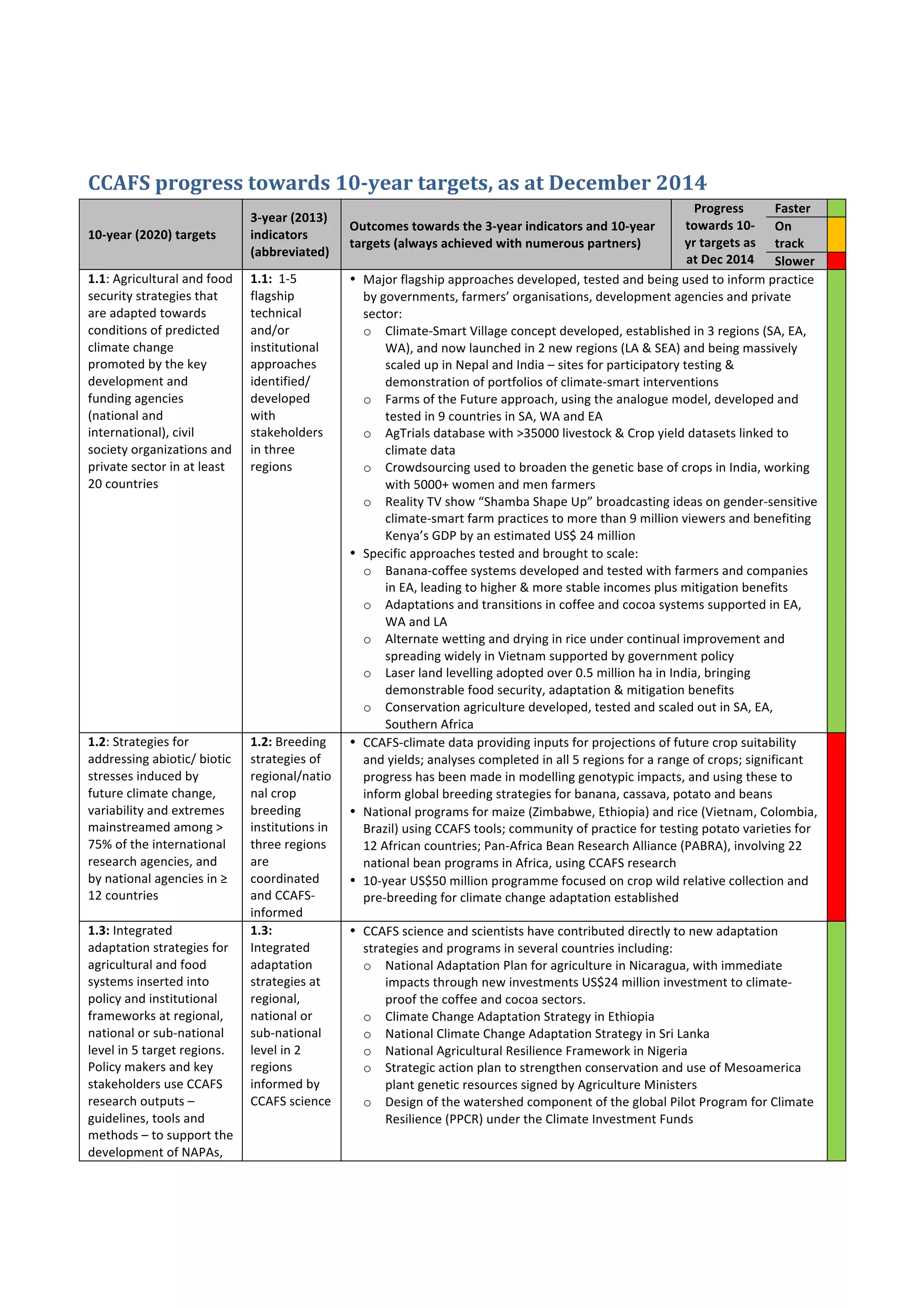
    CCAFS  progress  towards  10-­‐year  targets,  as  at  December  2014   10-­‐year  (2020)  targets   3-­‐year  (2013)   indicators   (abbreviated)     Outcomes  towards  the  3-­‐year  indicators  and  10-­‐year   targets  (always  achieved  with  numerous  partners)   Progress   towards  10-­‐ yr  targets  as   at  Dec  2014   Faster     On   track     Slower     1.1:  Agricultural  and  food   security  strategies  that   are  adapted  towards   conditions  of  predicted   climate  change   promoted  by  the  key   development  and   funding  agencies   (national  and   international),  civil   society  organizations  and   private  sector  in  at  least   20  countries   1.1:    1-­‐5   flagship   technical   and/or   institutional   approaches   identified/   developed   with   stakeholders   in  three   regions   • Major  flagship  approaches  developed,  tested  and  being  used  to  inform  practice   by  governments,  farmers’  organisations,  development  agencies  and  private   sector:   o Climate-­‐Smart  Village  concept  developed,  established  in  3  regions  (SA,  EA,   WA),  and  now  launched  in  2  new  regions  (LA  &  SEA)  and  being  massively   scaled  up  in  Nepal  and  India  –  sites  for  participatory  testing  &   demonstration  of  portfolios  of  climate-­‐smart  interventions   o Farms  of  the  Future  approach,  using  the  analogue  model,  developed  and   tested  in  9  countries  in  SA,  WA  and  EA     o AgTrials  database  with  >35000  livestock  &  Crop  yield  datasets  linked  to   climate  data     o Crowdsourcing  used  to  broaden  the  genetic  base  of  crops  in  India,  working   with  5000+  women  and  men  farmers     o Reality  TV  show  “Shamba  Shape  Up”  broadcasting  ideas  on  gender-­‐sensitive   climate-­‐smart  farm  practices  to  more  than  9  million  viewers  and  benefiting   Kenya’s  GDP  by  an  estimated  US$  24  million   • Specific  approaches  tested  and  brought  to  scale:   o Banana-­‐coffee  systems  developed  and  tested  with  farmers  and  companies   in  EA,  leading  to  higher  &  more  stable  incomes  plus  mitigation  benefits   o Adaptations  and  transitions  in  coffee  and  cocoa  systems  supported  in  EA,   WA  and  LA   o Alternate  wetting  and  drying  in  rice  under  continual  improvement  and   spreading  widely  in  Vietnam  supported  by  government  policy   o Laser  land  levelling  adopted  over  0.5  million  ha  in  India,  bringing   demonstrable  food  security,  adaptation  &  mitigation  benefits   o Conservation  agriculture  developed,  tested  and  scaled  out  in  SA,  EA,   Southern  Africa     1.2:  Strategies  for   addressing  abiotic/  biotic   stresses  induced  by   future  climate  change,   variability  and  extremes   mainstreamed  among  >   75%  of  the  international   research  agencies,  and   by  national  agencies  in  ≥   12  countries   1.2:  Breeding   strategies  of   regional/natio nal  crop   breeding   institutions  in   three  regions   are   coordinated   and  CCAFS-­‐ informed   • CCAFS-­‐climate  data  providing  inputs  for  projections  of  future  crop  suitability   and  yields;  analyses  completed  in  all  5  regions  for  a  range  of  crops;  significant   progress  has  been  made  in  modelling  genotypic  impacts,  and  using  these  to   inform  global  breeding  strategies  for  banana,  cassava,  potato  and  beans   • National  programs  for  maize  (Zimbabwe,  Ethiopia)  and  rice  (Vietnam,  Colombia,   Brazil)  using  CCAFS  tools;  community  of  practice  for  testing  potato  varieties  for   12  African  countries;  Pan-­‐Africa  Bean  Research  Alliance  (PABRA),  involving  22   national  bean  programs  in  Africa,  using  CCAFS  research   • 10-­‐year  US$50  million  programme  focused  on  crop  wild  relative  collection  and   pre-­‐breeding  for  climate  change  adaptation  established         1.3:  Integrated   adaptation  strategies  for   agricultural  and  food   systems  inserted  into   policy  and  institutional   frameworks  at  regional,   national  or  sub-­‐national   level  in  5  target  regions.   Policy  makers  and  key   stakeholders  use  CCAFS   research  outputs  –   guidelines,  tools  and   methods  –  to  support  the   development  of  NAPAs,   1.3:   Integrated   adaptation   strategies  at   regional,   national  or   sub-­‐national   level  in  2   regions   informed  by   CCAFS  science   • CCAFS  science  and  scientists  have  contributed  directly  to  new  adaptation   strategies  and  programs  in  several  countries  including:   o National  Adaptation  Plan  for  agriculture  in  Nicaragua,  with  immediate   impacts  through  new  investments  US$24  million  investment  to  climate-­‐ proof  the  coffee  and  cocoa  sectors.   o Climate  Change  Adaptation  Strategy  in  Ethiopia   o National  Climate  Change  Adaptation  Strategy  in  Sri  Lanka     o National  Agricultural  Resilience  Framework  in  Nigeria   o Strategic  action  plan  to  strengthen  conservation  and  use  of  Mesoamerica   plant  genetic  resources  signed  by  Agriculture  Ministers   o Design  of  the  watershed  component  of  the  global  Pilot  Program  for  Climate   Resilience  (PPCR)  under  the  Climate  Investment  Funds      
  • 2.
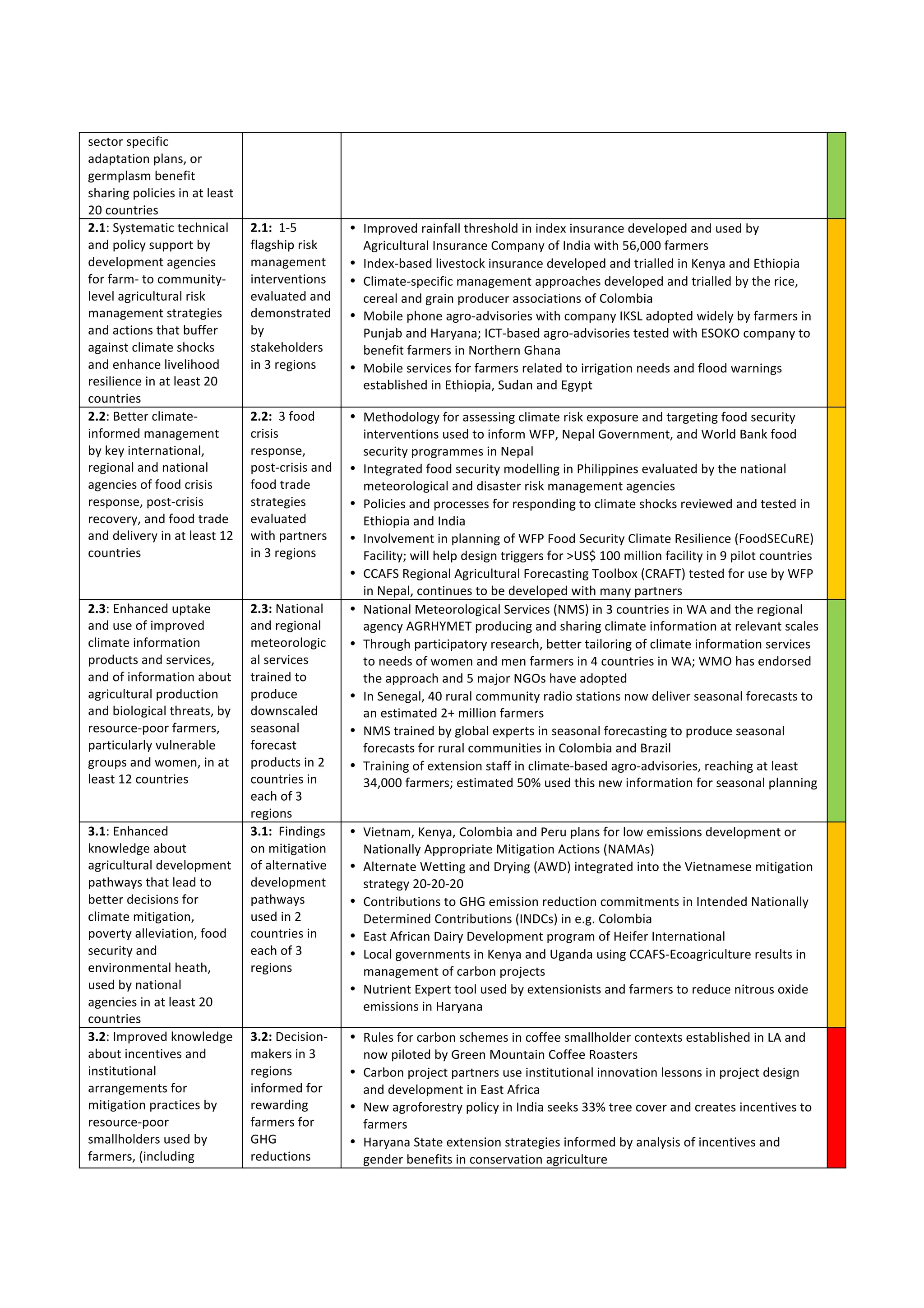
    sector  specific   adaptation  plans,  or   germplasm  benefit   sharing  policies  in  at  least   20  countries   2.1:  Systematic  technical   and  policy  support  by   development  agencies   for  farm-­‐  to  community-­‐ level  agricultural  risk   management  strategies   and  actions  that  buffer   against  climate  shocks   and  enhance  livelihood   resilience  in  at  least  20   countries   2.1:    1-­‐5   flagship  risk   management   interventions   evaluated  and   demonstrated   by   stakeholders   in  3  regions   • Improved  rainfall  threshold  in  index  insurance  developed  and  used  by   Agricultural  Insurance  Company  of  India  with  56,000  farmers   • Index-­‐based  livestock  insurance  developed  and  trialled  in  Kenya  and  Ethiopia   • Climate-­‐specific  management  approaches  developed  and  trialled  by  the  rice,   cereal  and  grain  producer  associations  of  Colombia   • Mobile  phone  agro-­‐advisories  with  company  IKSL  adopted  widely  by  farmers  in   Punjab  and  Haryana;  ICT-­‐based  agro-­‐advisories  tested  with  ESOKO  company  to   benefit  farmers  in  Northern  Ghana   • Mobile  services  for  farmers  related  to  irrigation  needs  and  flood  warnings   established  in  Ethiopia,  Sudan  and  Egypt         2.2:  Better  climate-­‐ informed  management   by  key  international,   regional  and  national   agencies  of  food  crisis   response,  post-­‐crisis   recovery,  and  food  trade   and  delivery  in  at  least  12   countries   2.2:    3  food   crisis   response,   post-­‐crisis  and   food  trade   strategies   evaluated   with  partners   in  3  regions   • Methodology  for  assessing  climate  risk  exposure  and  targeting  food  security   interventions  used  to  inform  WFP,  Nepal  Government,  and  World  Bank  food   security  programmes  in  Nepal   • Integrated  food  security  modelling  in  Philippines  evaluated  by  the  national   meteorological  and  disaster  risk  management  agencies   • Policies  and  processes  for  responding  to  climate  shocks  reviewed  and  tested  in   Ethiopia  and  India   • Involvement  in  planning  of  WFP  Food  Security  Climate  Resilience  (FoodSECuRE)   Facility;  will  help  design  triggers  for  >US$  100  million  facility  in  9  pilot  countries     • CCAFS  Regional  Agricultural  Forecasting  Toolbox  (CRAFT)  tested  for  use  by  WFP   in  Nepal,  continues  to  be  developed  with  many  partners     2.3:  Enhanced  uptake   and  use  of  improved   climate  information   products  and  services,   and  of  information  about   agricultural  production   and  biological  threats,  by   resource-­‐poor  farmers,   particularly  vulnerable   groups  and  women,  in  at   least  12  countries   2.3:  National   and  regional   meteorologic al  services   trained  to   produce   downscaled   seasonal   forecast   products  in  2   countries  in   each  of  3   regions   • National  Meteorological  Services  (NMS)  in  3  countries  in  WA  and  the  regional   agency  AGRHYMET  producing  and  sharing  climate  information  at  relevant  scales   • Through  participatory  research,  better  tailoring  of  climate  information  services   to  needs  of  women  and  men  farmers  in  4  countries  in  WA;  WMO  has  endorsed   the  approach  and  5  major  NGOs  have  adopted   • In  Senegal,  40  rural  community  radio  stations  now  deliver  seasonal  forecasts  to   an  estimated  2+  million  farmers   • NMS  trained  by  global  experts  in  seasonal  forecasting  to  produce  seasonal   forecasts  for  rural  communities  in  Colombia  and  Brazil   • Training  of  extension  staff  in  climate-­‐based  agro-­‐advisories,  reaching  at  least   34,000  farmers;  estimated  50%  used  this  new  information  for  seasonal  planning                 3.1:  Enhanced   knowledge  about   agricultural  development   pathways  that  lead  to   better  decisions  for   climate  mitigation,   poverty  alleviation,  food   security  and   environmental  heath,   used  by  national   agencies  in  at  least  20   countries   3.1:    Findings   on  mitigation   of  alternative   development   pathways   used  in  2   countries  in   each  of  3   regions   • Vietnam,  Kenya,  Colombia  and  Peru  plans  for  low  emissions  development  or   Nationally  Appropriate  Mitigation  Actions  (NAMAs)   • Alternate  Wetting  and  Drying  (AWD)  integrated  into  the  Vietnamese  mitigation   strategy  20-­‐20-­‐20   • Contributions  to  GHG  emission  reduction  commitments  in  Intended  Nationally   Determined  Contributions  (INDCs)  in  e.g.  Colombia   • East  African  Dairy  Development  program  of  Heifer  International   • Local  governments  in  Kenya  and  Uganda  using  CCAFS-­‐Ecoagriculture  results  in   management  of  carbon  projects   • Nutrient  Expert  tool  used  by  extensionists  and  farmers  to  reduce  nitrous  oxide   emissions  in  Haryana     3.2:  Improved  knowledge   about  incentives  and   institutional   arrangements  for   mitigation  practices  by   resource-­‐poor   smallholders  used  by   farmers,  (including   3.2:  Decision-­‐ makers  in  3   regions   informed  for   rewarding   farmers  for   GHG   reductions   • Rules  for  carbon  schemes  in  coffee  smallholder  contexts  established  in  LA  and   now  piloted  by  Green  Mountain  Coffee  Roasters     • Carbon  project  partners  use  institutional  innovation  lessons  in  project  design   and  development  in  East  Africa   • New  agroforestry  policy  in  India  seeks  33%  tree  cover  and  creates  incentives  to   farmers   • Haryana  State  extension  strategies  informed  by  analysis  of  incentives  and   gender  benefits  in  conservation  agriculture      
  • 3.
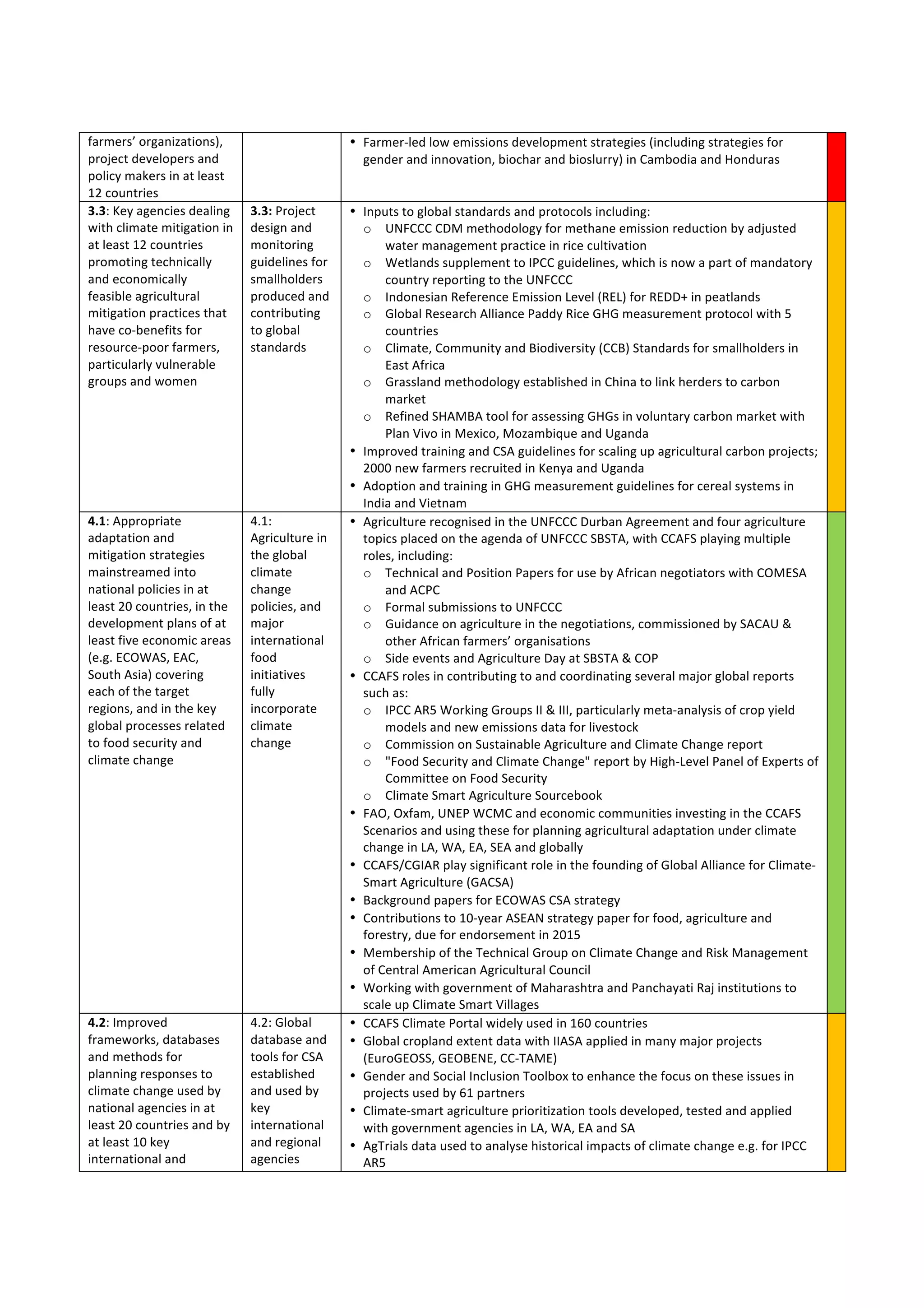
    farmers’  organizations),   project  developers  and   policy  makers  in  at  least   12  countries   • Farmer-­‐led  low  emissions  development  strategies  (including  strategies  for   gender  and  innovation,  biochar  and  bioslurry)  in  Cambodia  and  Honduras   3.3:  Key  agencies  dealing   with  climate  mitigation  in   at  least  12  countries   promoting  technically   and  economically   feasible  agricultural   mitigation  practices  that   have  co-­‐benefits  for   resource-­‐poor  farmers,   particularly  vulnerable   groups  and  women   3.3:  Project   design  and   monitoring   guidelines  for   smallholders   produced  and   contributing   to  global   standards     • Inputs  to  global  standards  and  protocols  including:   o UNFCCC  CDM  methodology  for  methane  emission  reduction  by  adjusted   water  management  practice  in  rice  cultivation   o Wetlands  supplement  to  IPCC  guidelines,  which  is  now  a  part  of  mandatory   country  reporting  to  the  UNFCCC   o Indonesian  Reference  Emission  Level  (REL)  for  REDD+  in  peatlands     o Global  Research  Alliance  Paddy  Rice  GHG  measurement  protocol  with  5   countries     o Climate,  Community  and  Biodiversity  (CCB)  Standards  for  smallholders  in   East  Africa   o Grassland  methodology  established  in  China  to  link  herders  to  carbon   market   o Refined  SHAMBA  tool  for  assessing  GHGs  in  voluntary  carbon  market  with   Plan  Vivo  in  Mexico,  Mozambique  and  Uganda   • Improved  training  and  CSA  guidelines  for  scaling  up  agricultural  carbon  projects;   2000  new  farmers  recruited  in  Kenya  and  Uganda   • Adoption  and  training  in  GHG  measurement  guidelines  for  cereal  systems  in   India  and  Vietnam       4.1:  Appropriate   adaptation  and   mitigation  strategies   mainstreamed  into   national  policies  in  at   least  20  countries,  in  the   development  plans  of  at   least  five  economic  areas   (e.g.  ECOWAS,  EAC,   South  Asia)  covering   each  of  the  target   regions,  and  in  the  key   global  processes  related   to  food  security  and   climate  change   4.1:   Agriculture  in   the  global   climate   change   policies,  and   major   international   food   initiatives   fully   incorporate   climate   change   • Agriculture  recognised  in  the  UNFCCC  Durban  Agreement  and  four  agriculture   topics  placed  on  the  agenda  of  UNFCCC  SBSTA,  with  CCAFS  playing  multiple   roles,  including:   o Technical  and  Position  Papers  for  use  by  African  negotiators  with  COMESA   and  ACPC   o Formal  submissions  to  UNFCCC   o Guidance  on  agriculture  in  the  negotiations,  commissioned  by  SACAU  &   other  African  farmers’  organisations     o Side  events  and  Agriculture  Day  at  SBSTA  &  COP   • CCAFS  roles  in  contributing  to  and  coordinating  several  major  global  reports   such  as:   o IPCC  AR5  Working  Groups  II  &  III,  particularly  meta-­‐analysis  of  crop  yield   models  and  new  emissions  data  for  livestock   o Commission  on  Sustainable  Agriculture  and  Climate  Change  report     o "Food  Security  and  Climate  Change"  report  by  High-­‐Level  Panel  of  Experts  of   Committee  on  Food  Security       o Climate  Smart  Agriculture  Sourcebook   • FAO,  Oxfam,  UNEP  WCMC  and  economic  communities  investing  in  the  CCAFS   Scenarios  and  using  these  for  planning  agricultural  adaptation  under  climate   change  in  LA,  WA,  EA,  SEA  and  globally   • CCAFS/CGIAR  play  significant  role  in  the  founding  of  Global  Alliance  for  Climate-­‐ Smart  Agriculture  (GACSA)   • Background  papers  for  ECOWAS  CSA  strategy   • Contributions  to  10-­‐year  ASEAN  strategy  paper  for  food,  agriculture  and   forestry,  due  for  endorsement  in  2015   • Membership  of  the  Technical  Group  on  Climate  Change  and  Risk  Management   of  Central  American  Agricultural  Council   • Working  with  government  of  Maharashtra  and  Panchayati  Raj  institutions  to   scale  up  Climate  Smart  Villages     4.2:  Improved   frameworks,  databases   and  methods  for   planning  responses  to   climate  change  used  by   national  agencies  in  at   least  20  countries  and  by   at  least  10  key   international  and   4.2:  Global   database  and   tools  for  CSA   established   and  used  by   key   international   and  regional   agencies   • CCAFS  Climate  Portal  widely  used  in  160  countries     • Global  cropland  extent  data  with  IIASA  applied  in  many  major  projects   (EuroGEOSS,  GEOBENE,  CC-­‐TAME)     • Gender  and  Social  Inclusion  Toolbox  to  enhance  the  focus  on  these  issues  in   projects  used  by  61  partners   • Climate-­‐smart  agriculture  prioritization  tools  developed,  tested  and  applied   with  government  agencies  in  LA,  WA,  EA  and  SA   • AgTrials  data  used  to  analyse  historical  impacts  of  climate  change  e.g.  for  IPCC   AR5    
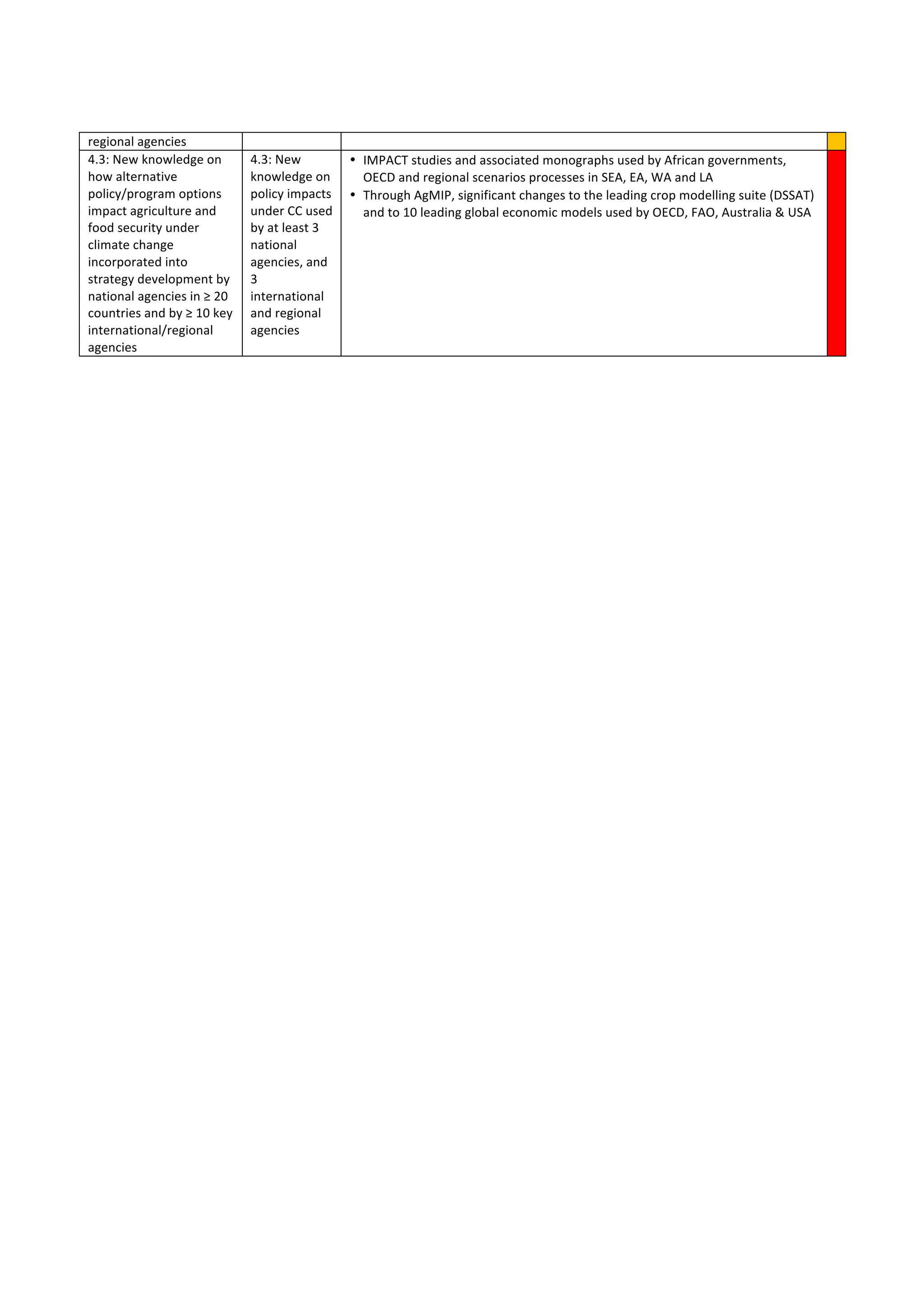
  • 4.
    regional  agencies   4.3:  New  knowledge  on   how  alternative   policy/program  options   impact  agriculture  and   food  security  under   climate  change   incorporated  into   strategy  development  by   national  agencies  in  ≥  20   countries  and  by  ≥  10  key   international/regional   agencies   4.3:  New   knowledge  on   policy  impacts   under  CC  used   by  at  least  3   national   agencies,  and   3   international   and  regional   agencies   • IMPACT  studies  and  associated  monographs  used  by  African  governments,   OECD  and  regional  scenarios  processes  in  SEA,  EA,  WA  and  LA   • Through  AgMIP,  significant  changes  to  the  leading  crop  modelling  suite  (DSSAT)   and  to  10  leading  global  economic  models  used  by  OECD,  FAO,  Australia  &  USA