Climate Smart Agriculture: Scaling examples
and learnings
Rajbir Singh
ATARI, Ludhiana
International Workshop on CSV September 3-6, 2015, Ludhiana
Agricultural Technology Application Research Institute (ATARI)
KVK Mandate: assessment, refinement and demonstration of
technologies/products to cater to the needs of farming community, extension
personnel and other stakeholders in the district.
Mandate of ATARI: Formulate, Implement, Monitor and Evaluate Programes and
activities of Krishi Vigyan Kendras (Agriculture Science Centre)
KVK Activities:
•On-farm testing to identify the location specificity of agricultural technologies
•Organizing frontline demonstrations at farmers fields
•Organizing need based training of farmers to update their knowledge and skills in
modern agricultural technologies
•Creating awareness about improved technologies to larger masses through appropriate
extension programmes.
•Work as resource and knowledge centre of agricultural technology
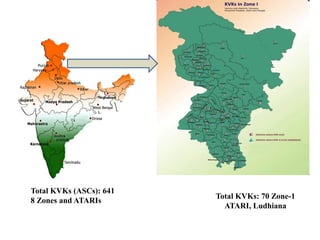
Total KVKs (ASCs): 641
8 Zones and ATARIs
Total KVKs: 70 Zone-1
ATARI, Ludhiana
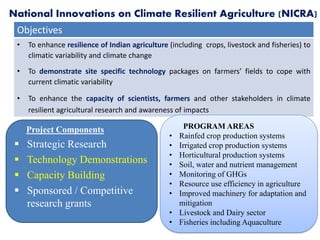
National Innovations on Climate Resilient Agriculture (NICRA)
Objectives
• To enhance resilience of Indian agriculture (including crops, livestock and fisheries) to
climatic variability and climate change
• To demonstrate site specific technology packages on farmers’ fields to cope with
current climatic variability
• To enhance the capacity of scientists, farmers and other stakeholders in climate
resilient agricultural research and awareness of impacts
Project Components
 Strategic Research
 Technology Demonstrations
 Capacity Building
 Sponsored / Competitive
research grants
PROGRAM AREAS
• Rainfed crop production systems
• Irrigated crop production systems
• Horticultural production systems
• Soil, water and nutrient management
• Monitoring of GHGs
• Resource use efficiency in agriculture
• Improved machinery for adaptation and
mitigation
• Livestock and Dairy sector
• Fisheries including Aquaculture
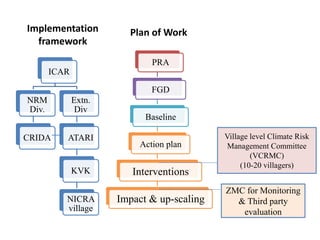
Implementation
framework
ICAR
NRM
Div.
CRIDA
Extn.
Div
ATARI
KVK
NICRA
village
Plan of Work
PRA
FGD
Baseline
Action plan
Interventions
Impact & up-scaling
Village level Climate Risk
Management Committee
(VCRMC)
(10-20 villagers)
ZMC for Monitoring
& Third party
evaluation
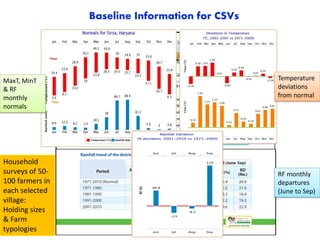
Baseline Information for CSVs
MaxT, MinT
& RF
monthly
normals
Temperature
deviations
from normal
RF monthly
departures
(June to Sep)
Household
surveys of 50-
100 farmers in
each selected
village:
Holding sizes
& Farm
typologies
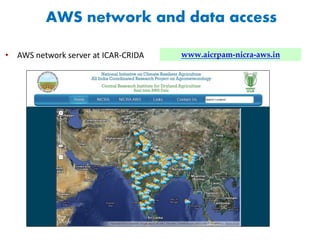
AWS network and data access
• AWS network server at ICAR-CRIDA www.aicrpam-nicra-aws.in
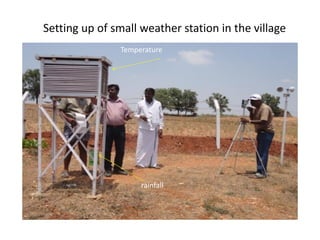
Setting up of small weather station in the village
Temperature
rainfall
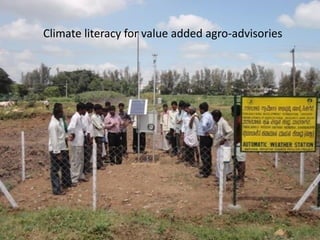
Climate literacy for value added agro-advisories
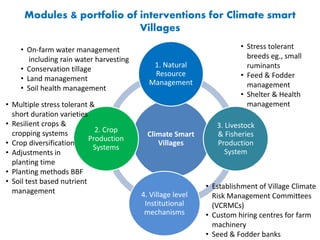
Climate Smart
Villages
1. Natural
Resource
Management
3. Livestock
& Fisheries
Production
System
4. Village level
Institutional
mechanisms
2. Crop
Production
Systems
Modules & portfolio of interventions for Climate smart
Villages
• On-farm water management
including rain water harvesting
• Conservation tillage
• Land management
• Soil health management
• Multiple stress tolerant &
short duration varieties
• Resilient crops &
cropping systems
• Crop diversification
• Adjustments in
planting time
• Planting methods BBF
• Soil test based nutrient
management
• Stress tolerant
breeds eg., small
ruminants
• Feed & Fodder
management
• Shelter & Health
management
• Establishment of Village Climate
Risk Management Committees
(VCRMCs)
• Custom hiring centres for farm
machinery
• Seed & Fodder banks
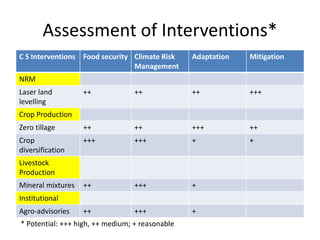
Assessment of Interventions*
C S Interventions Food security Climate Risk
Management
Adaptation Mitigation
NRM
Laser land
levelling
++ ++ ++ +++
Crop Production
Zero tillage ++ ++ +++ ++
Crop
diversification
+++ +++ + +
Livestock
Production
Mineral mixtures ++ +++ +
Institutional
Agro-advisories ++ +++ +
* Potential: +++ high, ++ medium; + reasonable
Towards climate smart villages
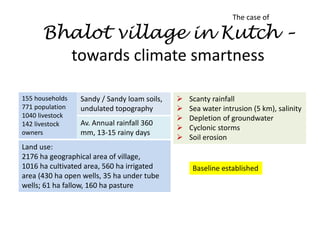
Bhalot village in Kutch –
towards climate smartness
155 households
771 population
1040 livestock
142 livestock
owners
Sandy / Sandy loam soils,
undulated topography
Av. Annual rainfall 360
mm, 13-15 rainy days
Land use:
2176 ha geographical area of village,
1016 ha cultivated area, 560 ha irrigated
area (430 ha open wells, 35 ha under tube
wells; 61 ha fallow, 160 ha pasture
 Scanty rainfall
 Sea water intrusion (5 km), salinity
 Depletion of groundwater
 Cyclonic storms
 Soil erosion
Baseline established
The case of
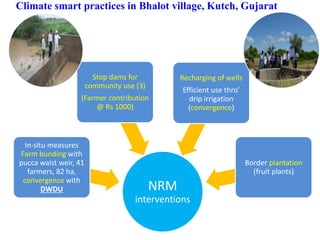
Climate smart practices in Bhalot village, Kutch, Gujarat
NRM
interventions
In-situ measures
Farm bunding with
pucca waist weir, 41
farmers, 82 ha,
convergence with
DWDU
Stop dams for
community use (3)
(Farmer contribution
@ Rs 1000)
Recharging of wells
Efficient use thro’
drip irrigation
(convergence)
Border plantation
(fruit plants)
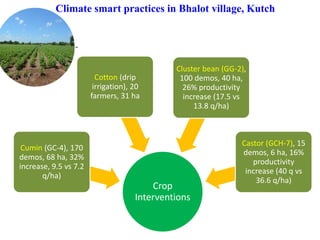
Climate smart practices in Bhalot village, Kutch
Crop
Interventions
Cumin (GC-4), 170
demos, 68 ha, 32%
increase, 9.5 vs 7.2
q/ha)
Cotton (drip
irrigation), 20
farmers, 31 ha
Cluster bean (GG-2),
100 demos, 40 ha,
26% productivity
increase (17.5 vs
13.8 q/ha)
Castor (GCH-7), 15
demos, 6 ha, 16%
productivity
increase (40 q vs
36.6 q/ha)
Climate smart practices in Bhalot village, Kutch
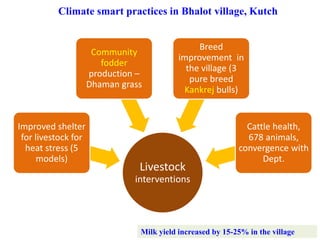
Livestock
interventions
Improved shelter
for livestock for
heat stress (5
models)
Community
fodder
production –
Dhaman grass
Breed
improvement in
the village (3
pure breed
Kankrej bulls)
Cattle health,
678 animals,
convergence with
Dept.
Milk yield increased by 15-25% in the village
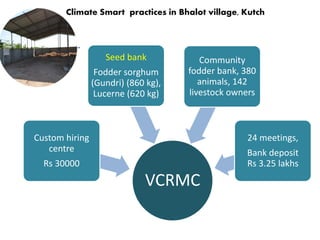
Climate Smart practices in Bhalot village, Kutch
VCRMC
Custom hiring
centre
Rs 30000
Seed bank
Fodder sorghum
(Gundri) (860 kg),
Lucerne (620 kg)
Community
fodder bank, 380
animals, 142
livestock owners
24 meetings,
Bank deposit
Rs 3.25 lakhs
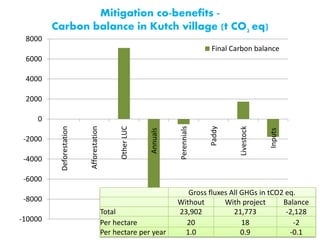
Mitigation co-benefits -
Carbon balance in Kutch village (t CO2 eq)
-10000
-8000
-6000
-4000
-2000
0
2000
4000
6000
8000
Deforestation
Afforestation
OtherLUC
Annuals
Perennials
Paddy
Livestock
Inputs
Final Carbon balance
Gross fluxes All GHGs in tCO2 eq.
Without With project Balance
Total 23,902 21,773 -2,128
Per hectare 20 18 -2
Per hectare per year 1.0 0.9 -0.1
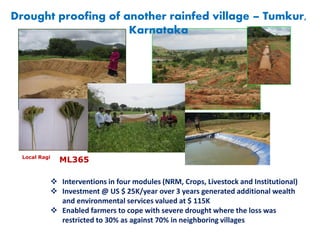
Local Ragi
ML365
Drought proofing of another rainfed village – Tumkur,
Karnataka
 Interventions in four modules (NRM, Crops, Livestock and Institutional)
 Investment @ US $ 25K/year over 3 years generated additional wealth
and environmental services valued at $ 115K
 Enabled farmers to cope with severe drought where the loss was
restricted to 30% as against 70% in neighboring villages
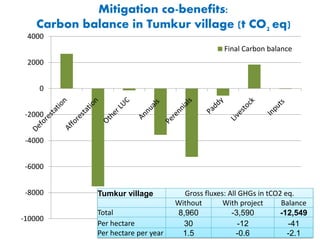
Mitigation co-benefits:
Carbon balance in Tumkur village (t CO2 eq)
-10000
-8000
-6000
-4000
-2000
0
2000
4000
Final Carbon balance
Tumkur village Gross fluxes: All GHGs in tCO2 eq.
Without With project Balance
Total 8,960 -3,590 -12,549
Per hectare 30 -12 -41
Per hectare per year 1.5 -0.6 -2.1
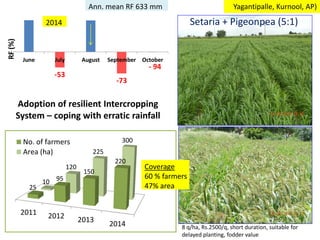
Yagantipalle, Kurnool, AP)
Setaria + Pigeonpea (5:1)
Adoption of resilient Intercropping
System – coping with erratic rainfall
-53
-73
- 94
June July August September October
RF(%)
2014
Ann. mean RF 633 mm
2011 2012 2013
2014
25
95
150
220
10
120
225
300No. of farmers
Area (ha)
Coverage
60 % farmers
47% area
8 q/ha, Rs.2500/q, short duration, suitable for
delayed planting, fodder value
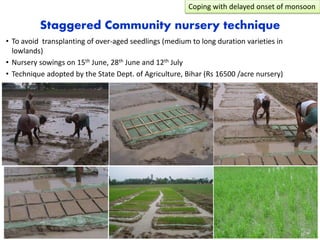
Staggered Community nursery technique
• To avoid transplanting of over-aged seedlings (medium to long duration varieties in
lowlands)
• Nursery sowings on 15th June, 28th June and 12th July
• Technique adopted by the State Dept. of Agriculture, Bihar (Rs 16500 /acre nursery)
Coping with delayed onset of monsoon
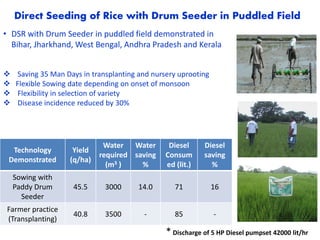
Direct Seeding of Rice with Drum Seeder in Puddled Field
Technology
Demonstrated
Yield
(q/ha)
Water
required
(m3 )
Water
saving
%
Diesel
Consum
ed (lit.)
Diesel
saving
%
Sowing with
Paddy Drum
Seeder
45.5 3000 14.0 71 16
Farmer practice
(Transplanting)
40.8 3500 - 85 -
* Discharge of 5 HP Diesel pumpset 42000 lit/hr
• DSR with Drum Seeder in puddled field demonstrated in
Bihar, Jharkhand, West Bengal, Andhra Pradesh and Kerala
 Saving 35 Man Days in transplanting and nursery uprooting
 Flexible Sowing date depending on onset of monsoon
 Flexibility in selection of variety
 Disease incidence reduced by 30%
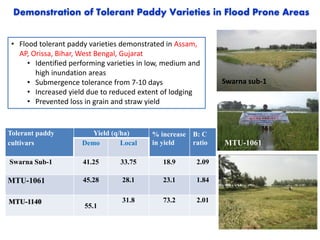
Tolerant paddy
cultivars
Yield (q/ha) % increase
in yield
B: C
ratioDemo Local
Swarna Sub-1 41.25 33.75 18.9 2.09
MTU-1061 45.28 28.1 23.1 1.84
MTU-1140
55.1
31.8 73.2 2.01
Demonstration of Tolerant Paddy Varieties in Flood Prone Areas
MTU-1061
Swarna sub-1
• Flood tolerant paddy varieties demonstrated in Assam,
AP, Orissa, Bihar, West Bengal, Gujarat
• Identified performing varieties in low, medium and
high inundation areas
• Submergence tolerance from 7-10 days
• Increased yield due to reduced extent of lodging
• Prevented loss in grain and straw yield
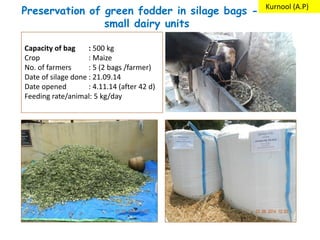
Preservation of green fodder in silage bags - –
small dairy units
Capacity of bag : 500 kg
Crop : Maize
No. of farmers : 5 (2 bags /farmer)
Date of silage done : 21.09.14
Date opened : 4.11.14 (after 42 d)
Feeding rate/animal: 5 kg/day
Kurnool (A.P)
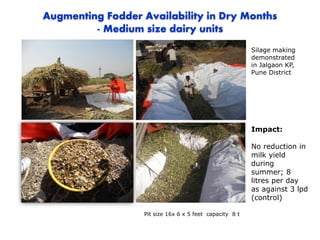
Impact:
No reduction in
milk yield
during
summer; 8
litres per day
as against 3 lpd
(control)
Pit size 16x 6 x 5 feet capacity 8 t
Augmenting Fodder Availability in Dry Months
- Medium size dairy units
Silage making
demonstrated
in Jalgaon KP,
Pune District
Enabling village level support systems
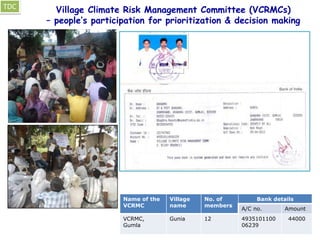
Village Climate Risk Management Committee (VCRMCs)
– people’s participation for prioritization & decision making
Name of the
VCRMC
Village
name
No. of
members
Bank details
A/C no. Amount
VCRMC,
Gumla
Gunia 12 4935101100
06239
44000
TDC
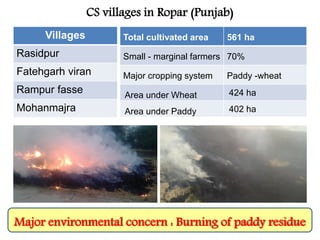
CS villages in Ropar (Punjab)
Total cultivated area 561 ha
Small - marginal farmers 70%
Major cropping system Paddy -wheat
Area under Wheat 424 ha
Area under Paddy 402 ha
Villages
Rasidpur
Fatehgarh viran
Rampur fasse
Mohanmajra
Major environmental concern : Burning of paddy residue
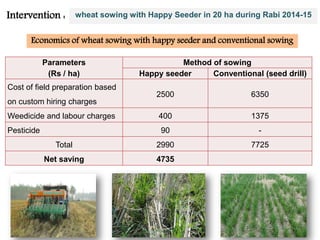
Intervention : wheat sowing with Happy Seeder in 20 ha during Rabi 2014-15
Parameters
(Rs / ha)
Method of sowing
Happy seeder Conventional (seed drill)
Cost of field preparation based
on custom hiring charges
2500 6350
Weedicide and labour charges 400 1375
Pesticide 90 -
Total 2990 7725
Net saving 4735
Economics of wheat sowing with happy seeder and conventional sowing
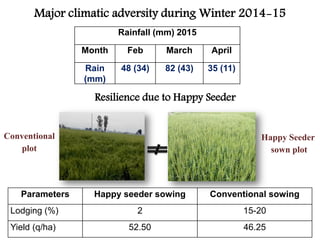
Resilience due to Happy Seeder
Parameters Happy seeder sowing Conventional sowing
Lodging (%) 2 15-20
Yield (q/ha) 52.50 46.25
Happy Seeder
sown plot
Conventional
plot
Major climatic adversity during Winter 2014-15
Rainfall (mm) 2015
Month Feb March April
Rain
(mm)
48 (34) 82 (43) 35 (11)
Summer moong Zero till wheat
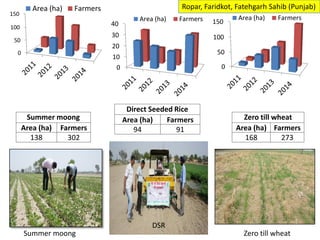
Ropar, Faridkot, Fatehgarh Sahib (Punjab)
Summer moong
Area (ha) Farmers
138 302
Direct Seeded Rice
Area (ha) Farmers
94 91
Zero till wheat
Area (ha) Farmers
168 273
0
50
100
150
Area (ha) Farmers
0
10
20
30
40
Area (ha) Farmers
0
50
100
150
Area (ha) Farmers
DSR
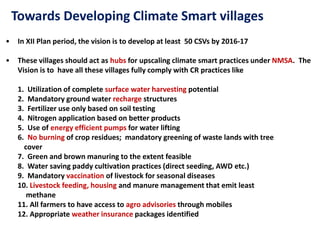
Towards Developing Climate Smart villages
• In XII Plan period, the vision is to develop at least 50 CSVs by 2016-17
• These villages should act as hubs for upscaling climate smart practices under NMSA. The
Vision is to have all these villages fully comply with CR practices like
1. Utilization of complete surface water harvesting potential
2. Mandatory ground water recharge structures
3. Fertilizer use only based on soil testing
4. Nitrogen application based on better products
5. Use of energy efficient pumps for water lifting
6. No burning of crop residues; mandatory greening of waste lands with tree
cover
7. Green and brown manuring to the extent feasible
8. Water saving paddy cultivation practices (direct seeding, AWD etc.)
9. Mandatory vaccination of livestock for seasonal diseases
10. Livestock feeding, housing and manure management that emit least
methane
11. All farmers to have access to agro advisories through mobiles
12. Appropriate weather insurance packages identified
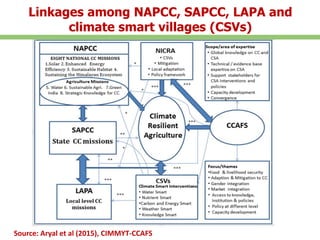
Linkages among NAPCC, SAPCC, LAPA and
climate smart villages (CSVs)
Source: Aryal et al (2015), CIMMYT-CCAFS
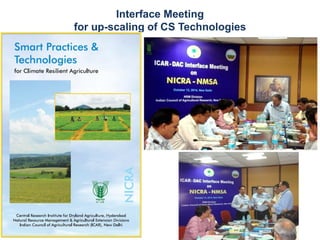
Interface Meeting
for up-scaling of CS Technologies
Summing up
 Integrated farming system approach to adaptation in CS
villages including technological interventions, management
practices, institutional and policy interventions has shown
promising results
 Case studies demonstrated evidences of productivity and
income enhancement and adaptation with mitigation co-
benefits
 Mainstreaming of these smart practices in NMSA has begun
with a Policy Dialogue with the Ministry of Agriculture for its
out scaling
 Initiative taken for follow-up of Technology Demonstrations in
cluster villages
Way Forward
 Mapping area and farming system specific climate smart
practices / products
 Develop framework and metrics for CSA
 Integrated modelling framework to develop local area
plans and out scaling
 Simple Decision Support tools for prioritisation of climate
smart practices for investment planning
 Institutional mechanisms and convergence
My Village my pride
(Launched during July 2015 by Prime Minister)
• Scheme to make scientists (NARES) adopt
villages, promote best farming practices –step
towards CSA and CSV
• 20,ooo scientists (group of 4-5) will adopt
village to guide farmers
• Overall 4000-5000 villages will be benefited
• More focussed on breezing gap and
convergence of Govt policies
Climate Smart Agriculture: Scaling examples and lessons learned

Climate Smart Agriculture: Scaling examples and lessons learned

  • 1.
    Climate Smart Agriculture:Scaling examples and learnings Rajbir Singh ATARI, Ludhiana International Workshop on CSV September 3-6, 2015, Ludhiana
  • 2.
    Agricultural Technology ApplicationResearch Institute (ATARI) KVK Mandate: assessment, refinement and demonstration of technologies/products to cater to the needs of farming community, extension personnel and other stakeholders in the district. Mandate of ATARI: Formulate, Implement, Monitor and Evaluate Programes and activities of Krishi Vigyan Kendras (Agriculture Science Centre) KVK Activities: •On-farm testing to identify the location specificity of agricultural technologies •Organizing frontline demonstrations at farmers fields •Organizing need based training of farmers to update their knowledge and skills in modern agricultural technologies •Creating awareness about improved technologies to larger masses through appropriate extension programmes. •Work as resource and knowledge centre of agricultural technology
  • 3.
    Total KVKs (ASCs):641 8 Zones and ATARIs Total KVKs: 70 Zone-1 ATARI, Ludhiana
  • 4.
    National Innovations onClimate Resilient Agriculture (NICRA) Objectives • To enhance resilience of Indian agriculture (including crops, livestock and fisheries) to climatic variability and climate change • To demonstrate site specific technology packages on farmers’ fields to cope with current climatic variability • To enhance the capacity of scientists, farmers and other stakeholders in climate resilient agricultural research and awareness of impacts Project Components  Strategic Research  Technology Demonstrations  Capacity Building  Sponsored / Competitive research grants PROGRAM AREAS • Rainfed crop production systems • Irrigated crop production systems • Horticultural production systems • Soil, water and nutrient management • Monitoring of GHGs • Resource use efficiency in agriculture • Improved machinery for adaptation and mitigation • Livestock and Dairy sector • Fisheries including Aquaculture
  • 5.
    Implementation framework ICAR NRM Div. CRIDA Extn. Div ATARI KVK NICRA village Plan of Work PRA FGD Baseline Actionplan Interventions Impact & up-scaling Village level Climate Risk Management Committee (VCRMC) (10-20 villagers) ZMC for Monitoring & Third party evaluation
  • 6.
    Baseline Information forCSVs MaxT, MinT & RF monthly normals Temperature deviations from normal RF monthly departures (June to Sep) Household surveys of 50- 100 farmers in each selected village: Holding sizes & Farm typologies
  • 7.
    AWS network anddata access • AWS network server at ICAR-CRIDA www.aicrpam-nicra-aws.in
  • 8.
    Setting up ofsmall weather station in the village Temperature rainfall
  • 9.
    Climate literacy forvalue added agro-advisories
  • 10.
    Climate Smart Villages 1. Natural Resource Management 3.Livestock & Fisheries Production System 4. Village level Institutional mechanisms 2. Crop Production Systems Modules & portfolio of interventions for Climate smart Villages • On-farm water management including rain water harvesting • Conservation tillage • Land management • Soil health management • Multiple stress tolerant & short duration varieties • Resilient crops & cropping systems • Crop diversification • Adjustments in planting time • Planting methods BBF • Soil test based nutrient management • Stress tolerant breeds eg., small ruminants • Feed & Fodder management • Shelter & Health management • Establishment of Village Climate Risk Management Committees (VCRMCs) • Custom hiring centres for farm machinery • Seed & Fodder banks
  • 11.
    Assessment of Interventions* CS Interventions Food security Climate Risk Management Adaptation Mitigation NRM Laser land levelling ++ ++ ++ +++ Crop Production Zero tillage ++ ++ +++ ++ Crop diversification +++ +++ + + Livestock Production Mineral mixtures ++ +++ + Institutional Agro-advisories ++ +++ + * Potential: +++ high, ++ medium; + reasonable
  • 12.
  • 13.
    Bhalot village inKutch – towards climate smartness 155 households 771 population 1040 livestock 142 livestock owners Sandy / Sandy loam soils, undulated topography Av. Annual rainfall 360 mm, 13-15 rainy days Land use: 2176 ha geographical area of village, 1016 ha cultivated area, 560 ha irrigated area (430 ha open wells, 35 ha under tube wells; 61 ha fallow, 160 ha pasture  Scanty rainfall  Sea water intrusion (5 km), salinity  Depletion of groundwater  Cyclonic storms  Soil erosion Baseline established The case of
  • 14.
    Climate smart practicesin Bhalot village, Kutch, Gujarat NRM interventions In-situ measures Farm bunding with pucca waist weir, 41 farmers, 82 ha, convergence with DWDU Stop dams for community use (3) (Farmer contribution @ Rs 1000) Recharging of wells Efficient use thro’ drip irrigation (convergence) Border plantation (fruit plants)
  • 15.
    Climate smart practicesin Bhalot village, Kutch Crop Interventions Cumin (GC-4), 170 demos, 68 ha, 32% increase, 9.5 vs 7.2 q/ha) Cotton (drip irrigation), 20 farmers, 31 ha Cluster bean (GG-2), 100 demos, 40 ha, 26% productivity increase (17.5 vs 13.8 q/ha) Castor (GCH-7), 15 demos, 6 ha, 16% productivity increase (40 q vs 36.6 q/ha)
  • 16.
    Climate smart practicesin Bhalot village, Kutch Livestock interventions Improved shelter for livestock for heat stress (5 models) Community fodder production – Dhaman grass Breed improvement in the village (3 pure breed Kankrej bulls) Cattle health, 678 animals, convergence with Dept. Milk yield increased by 15-25% in the village
  • 17.
    Climate Smart practicesin Bhalot village, Kutch VCRMC Custom hiring centre Rs 30000 Seed bank Fodder sorghum (Gundri) (860 kg), Lucerne (620 kg) Community fodder bank, 380 animals, 142 livestock owners 24 meetings, Bank deposit Rs 3.25 lakhs
  • 18.
    Mitigation co-benefits - Carbonbalance in Kutch village (t CO2 eq) -10000 -8000 -6000 -4000 -2000 0 2000 4000 6000 8000 Deforestation Afforestation OtherLUC Annuals Perennials Paddy Livestock Inputs Final Carbon balance Gross fluxes All GHGs in tCO2 eq. Without With project Balance Total 23,902 21,773 -2,128 Per hectare 20 18 -2 Per hectare per year 1.0 0.9 -0.1
  • 19.
    Local Ragi ML365 Drought proofingof another rainfed village – Tumkur, Karnataka  Interventions in four modules (NRM, Crops, Livestock and Institutional)  Investment @ US $ 25K/year over 3 years generated additional wealth and environmental services valued at $ 115K  Enabled farmers to cope with severe drought where the loss was restricted to 30% as against 70% in neighboring villages
  • 20.
    Mitigation co-benefits: Carbon balancein Tumkur village (t CO2 eq) -10000 -8000 -6000 -4000 -2000 0 2000 4000 Final Carbon balance Tumkur village Gross fluxes: All GHGs in tCO2 eq. Without With project Balance Total 8,960 -3,590 -12,549 Per hectare 30 -12 -41 Per hectare per year 1.5 -0.6 -2.1
  • 21.
    Yagantipalle, Kurnool, AP) Setaria+ Pigeonpea (5:1) Adoption of resilient Intercropping System – coping with erratic rainfall -53 -73 - 94 June July August September October RF(%) 2014 Ann. mean RF 633 mm 2011 2012 2013 2014 25 95 150 220 10 120 225 300No. of farmers Area (ha) Coverage 60 % farmers 47% area 8 q/ha, Rs.2500/q, short duration, suitable for delayed planting, fodder value
  • 22.
    Staggered Community nurserytechnique • To avoid transplanting of over-aged seedlings (medium to long duration varieties in lowlands) • Nursery sowings on 15th June, 28th June and 12th July • Technique adopted by the State Dept. of Agriculture, Bihar (Rs 16500 /acre nursery) Coping with delayed onset of monsoon
  • 23.
    Direct Seeding ofRice with Drum Seeder in Puddled Field Technology Demonstrated Yield (q/ha) Water required (m3 ) Water saving % Diesel Consum ed (lit.) Diesel saving % Sowing with Paddy Drum Seeder 45.5 3000 14.0 71 16 Farmer practice (Transplanting) 40.8 3500 - 85 - * Discharge of 5 HP Diesel pumpset 42000 lit/hr • DSR with Drum Seeder in puddled field demonstrated in Bihar, Jharkhand, West Bengal, Andhra Pradesh and Kerala  Saving 35 Man Days in transplanting and nursery uprooting  Flexible Sowing date depending on onset of monsoon  Flexibility in selection of variety  Disease incidence reduced by 30%
  • 24.
    Tolerant paddy cultivars Yield (q/ha)% increase in yield B: C ratioDemo Local Swarna Sub-1 41.25 33.75 18.9 2.09 MTU-1061 45.28 28.1 23.1 1.84 MTU-1140 55.1 31.8 73.2 2.01 Demonstration of Tolerant Paddy Varieties in Flood Prone Areas MTU-1061 Swarna sub-1 • Flood tolerant paddy varieties demonstrated in Assam, AP, Orissa, Bihar, West Bengal, Gujarat • Identified performing varieties in low, medium and high inundation areas • Submergence tolerance from 7-10 days • Increased yield due to reduced extent of lodging • Prevented loss in grain and straw yield
  • 25.
    Preservation of greenfodder in silage bags - – small dairy units Capacity of bag : 500 kg Crop : Maize No. of farmers : 5 (2 bags /farmer) Date of silage done : 21.09.14 Date opened : 4.11.14 (after 42 d) Feeding rate/animal: 5 kg/day Kurnool (A.P)
  • 26.
    Impact: No reduction in milkyield during summer; 8 litres per day as against 3 lpd (control) Pit size 16x 6 x 5 feet capacity 8 t Augmenting Fodder Availability in Dry Months - Medium size dairy units Silage making demonstrated in Jalgaon KP, Pune District
  • 27.
    Enabling village levelsupport systems
  • 28.
    Village Climate RiskManagement Committee (VCRMCs) – people’s participation for prioritization & decision making Name of the VCRMC Village name No. of members Bank details A/C no. Amount VCRMC, Gumla Gunia 12 4935101100 06239 44000 TDC
  • 29.
    CS villages inRopar (Punjab) Total cultivated area 561 ha Small - marginal farmers 70% Major cropping system Paddy -wheat Area under Wheat 424 ha Area under Paddy 402 ha Villages Rasidpur Fatehgarh viran Rampur fasse Mohanmajra Major environmental concern : Burning of paddy residue
  • 30.
    Intervention : wheatsowing with Happy Seeder in 20 ha during Rabi 2014-15 Parameters (Rs / ha) Method of sowing Happy seeder Conventional (seed drill) Cost of field preparation based on custom hiring charges 2500 6350 Weedicide and labour charges 400 1375 Pesticide 90 - Total 2990 7725 Net saving 4735 Economics of wheat sowing with happy seeder and conventional sowing
  • 31.
    Resilience due toHappy Seeder Parameters Happy seeder sowing Conventional sowing Lodging (%) 2 15-20 Yield (q/ha) 52.50 46.25 Happy Seeder sown plot Conventional plot Major climatic adversity during Winter 2014-15 Rainfall (mm) 2015 Month Feb March April Rain (mm) 48 (34) 82 (43) 35 (11)
  • 32.
    Summer moong Zerotill wheat Ropar, Faridkot, Fatehgarh Sahib (Punjab) Summer moong Area (ha) Farmers 138 302 Direct Seeded Rice Area (ha) Farmers 94 91 Zero till wheat Area (ha) Farmers 168 273 0 50 100 150 Area (ha) Farmers 0 10 20 30 40 Area (ha) Farmers 0 50 100 150 Area (ha) Farmers DSR
  • 33.
    Towards Developing ClimateSmart villages • In XII Plan period, the vision is to develop at least 50 CSVs by 2016-17 • These villages should act as hubs for upscaling climate smart practices under NMSA. The Vision is to have all these villages fully comply with CR practices like 1. Utilization of complete surface water harvesting potential 2. Mandatory ground water recharge structures 3. Fertilizer use only based on soil testing 4. Nitrogen application based on better products 5. Use of energy efficient pumps for water lifting 6. No burning of crop residues; mandatory greening of waste lands with tree cover 7. Green and brown manuring to the extent feasible 8. Water saving paddy cultivation practices (direct seeding, AWD etc.) 9. Mandatory vaccination of livestock for seasonal diseases 10. Livestock feeding, housing and manure management that emit least methane 11. All farmers to have access to agro advisories through mobiles 12. Appropriate weather insurance packages identified
  • 34.
    Linkages among NAPCC,SAPCC, LAPA and climate smart villages (CSVs) Source: Aryal et al (2015), CIMMYT-CCAFS
  • 35.
  • 36.
    Summing up  Integratedfarming system approach to adaptation in CS villages including technological interventions, management practices, institutional and policy interventions has shown promising results  Case studies demonstrated evidences of productivity and income enhancement and adaptation with mitigation co- benefits  Mainstreaming of these smart practices in NMSA has begun with a Policy Dialogue with the Ministry of Agriculture for its out scaling  Initiative taken for follow-up of Technology Demonstrations in cluster villages
  • 37.
    Way Forward  Mappingarea and farming system specific climate smart practices / products  Develop framework and metrics for CSA  Integrated modelling framework to develop local area plans and out scaling  Simple Decision Support tools for prioritisation of climate smart practices for investment planning  Institutional mechanisms and convergence
  • 38.
    My Village mypride (Launched during July 2015 by Prime Minister) • Scheme to make scientists (NARES) adopt villages, promote best farming practices –step towards CSA and CSV • 20,ooo scientists (group of 4-5) will adopt village to guide farmers • Overall 4000-5000 villages will be benefited • More focussed on breezing gap and convergence of Govt policies