TABLE FOR INDIVIDUAL
RECORDS
The Cell
© Copyright 2015 – All rights reserved. www.cpalms.org
SOME RANDOM CELL FACTS
•The average human being is
composed of around 100 Trillion
individual cells!!!
•It would take as many as 50 cells to
cover the area of a dot on the letter
“i”
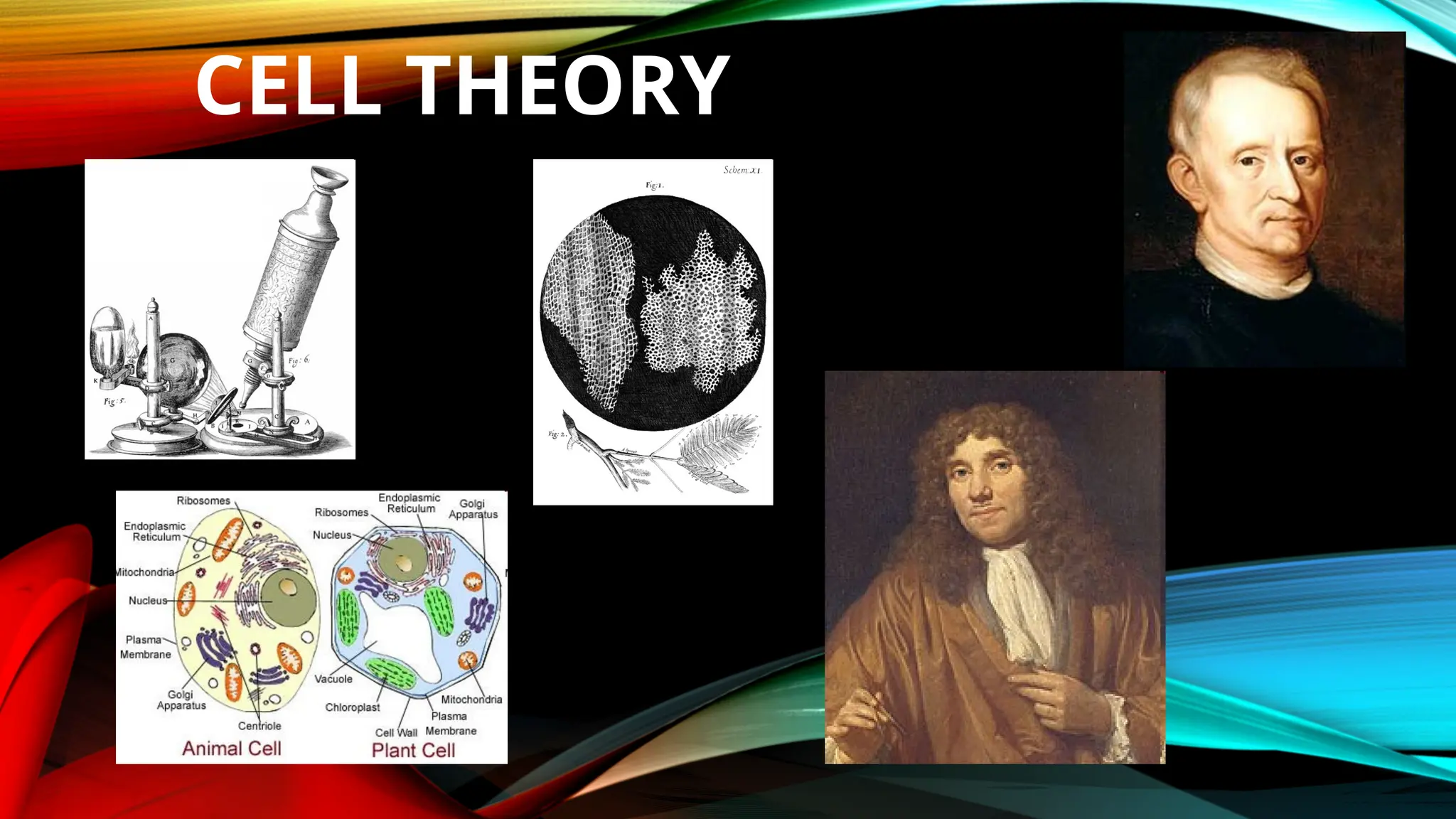
CELL THEORY
OBJECTIVES;
•explain the postulate of cell theory
•construct a 3d model of a
plant/animal/ bacterial cell using
recyclable materials
•recognize the contributions made by
Anton Van Leeuwenhoek, Hooke, et
al in the cell theory
Romans
When Romans
discovered they were
able to make glass in the
1st
century BC, things
changed for the better!
Anton Van
Leeuwenhoek
He figured how to grind
glass together and
decided to experiment.
Leeuwenhoek made his
own 270x magnification
compound microscope!
Today, microscopes
magnifications range
from 200x-10,000,000x
magnification.
What is a
Theory?
A set of principles
developed over time via
multiple investigations.
The discovery of the
CELL was made through
the invention of the
microscope between
1665-1838.
How it all started 
© Copyright 2015 – All rights reserved. www.cpalms.org
CELL THEORY
There are 3 major parts of the cell theory:
1. All organisms are made of cells.
2. All existing cells are produced by other living
cells.
3. The cell is the most basic unit of life.
© Copyright 2015 – All rights reserved. www.cpalms.org
CONTRIBUTORS
There are 5 contributors to the cell theory:
1. Robert Hooke
2. Anton van Leeuwenhoek
3. Matthias Schleiden
4. Theodor Schwann
5. Rudolf Virchow
Each of the above contributors produced evidence
through investigations and experiments that led to
today’s cell theory!
© Copyright 2015 – All rights reserved. www.cpalms.org
BELL-RINGER !
1. The cell theory is composed of how many
parts?
2. How many contributors help compile today’s
cell theory?
© Copyright 2015 – All rights reserved. www.cpalms.org
ROBERT HOOKE
English Scientist
oUsed the compound microscope to observe
cork.
oHooke observed that cork is composed of
small, hollow compartments.
oThe parts prompted Hooke to think of small
rooms (cells) in a monastery, so he gave
them the same name: CELLS.
oInvestigated cork through experimenting with
the compound microscope and came up
with the name cells!
Key Note: Hooke discovered the cell in 1665,
which started formulating the cell theory!
https://en.wikipedia.org/
wiki/Robert_Hooke
© Copyright 2015 – All rights reserved. www.cpalms.org
CORK
https://commons.wikimedia.org/wiki
/File:Cork_oak_trunk_section.jpg
© Copyright 2015 – All rights reserved. www.cpalms.org
MONASTERY
© Copyright 2015 – All rights reserved. www.cpalms.org
HOOKE’S
INVESTIGATION/EXPERIMENT
Hooke’s Observations Hooke’s Microscope
https://en.wikipedia.org/wiki/Robert_Hooke
https://en.wikipedia.org/wiki/Robert_Hooke © Copyright 2015 – All rights reserved. www.cpalms.org
ANTON VAN LEEUWENHOEK
Dutch Tradesman
o Study new approaches for creating lenses
to observe cloth.
o Leeuwenhoek’s microscope was more
powerful than Hooke’s compound
microscope.
o From investigating and experimenting with
his microscope, Leeuwenhoek became
one of the first scientists to refer to living
cells when he observed an abundant
number of single-celled organisms, which
he called animalcules (plant & animal),
swimming in a drop of pond water!
© Copyright 2015 – All rights reserved. www.cpalms.org
LEEUWENHOEK’S
INVESTIGATIONS/EXPERIMENT
Leeuwenhoek’s Observations Leeuwenhoek’s Microscope
© Copyright 2015 – All rights reserved. www.cpalms.org
MATTHIAS SCHLEIDEN
German Scientist
oFascinated with plant cells, Schleiden
used the compound microscope and
studied plant cells.
oFrom investigating and experimenting
with plants, projected plant parts are
made of cells!
oDiscussed what he observed with his
dear friend, German scientist Theodor
Schwann.
© Copyright 2015 – All rights reserved. www.cpalms.org
THEODOR SCHWANN
German Scientist
oStudied plant & animal cells, and was
intrigued by the similarities between the
two.
oFrom investigating and experimenting
with plant & animal cells, Schwann was
able to determine that all animals are
made of cells!
oSchwann published the 1st
statement of
the cell theory: all living things are made
of cells and cell products!
© Copyright 2015 – All rights reserved. www.cpalms.org
RUDOLF VIRCHOW
oBased on his investigations and
experiments, he stated that all
cells come from preexisting cells,
which is the 2nd
part of the cell
theory: all existing cells are
produced by other living cells!
Key Note: After Virchow’s completed his
work, the cell theory was finally formulated
in 1838!
© Copyright 2015 – All rights reserved. www.cpalms.org
LET’S DO THE RECAP
Cell Theory
There are 3 major parts of the
cell theory:
1. All organisms are made of
cells.
2. All existing cells are
produced by other living
cells.
3. The cell is the most basic
unit of life.
These three parts were
discovered between 1665-
1838.
Contributors
There are 5 contributors to
the cell theory:
1. Robert Hooke
2. Anton van
Leeuwenhoek
3. Matthias Schleiden
4. Theodor Schwann
5. Rudolf Virchow
Eye-
Catchers
Robert Hooke
o came up with the name cells
Anton Van Leeuwenhoek
o referred to living cells called
animalcules (plant & animal) after
observing a drop of pond water
Matthias Schleiden
o projected plant cells are made of
cells
Theodor Schwann
o determined all animals are made of
cells (1st
statement of the cell theory)
Rudolf Virchow
o stated all cells come from preexisting
cells (2nd
statement of the cell theory)
Key Note: It took over 173 years for the
cell THEORY to be formulated, wow!
© Copyright 2015 – All rights reserved. www.cpalms.org
SOME PARTING THOUGHTS
•It is amazing to think that the cells that
make up our bodies are just as alive
as we are. Humans are just an
intricately designed community of
cells, which must work together to
survive.
EXIT TICKET
1. Name the 3 major parts of the cell theory.
2. Name the 5 contributors of the cell theory.
The wacky history of cell theory - Lauren Royal-Woods (TED-Ed)
© Copyright 2015 – All rights reserved. www.cpalms.org
HOME BASED ACTIVITY
Name the Cell Structures
of plants and animals
Give the functions of each
© Copyright 2015 – All rights reserved. www.cpalms.org

1- POSTULATES OF CELL THfgshfsjgORY.pptx

  • 1.
  • 2.
    The Cell © Copyright2015 – All rights reserved. www.cpalms.org
  • 3.
    SOME RANDOM CELLFACTS •The average human being is composed of around 100 Trillion individual cells!!! •It would take as many as 50 cells to cover the area of a dot on the letter “i”
  • 4.
  • 5.
    OBJECTIVES; •explain the postulateof cell theory •construct a 3d model of a plant/animal/ bacterial cell using recyclable materials •recognize the contributions made by Anton Van Leeuwenhoek, Hooke, et al in the cell theory
  • 6.
    Romans When Romans discovered theywere able to make glass in the 1st century BC, things changed for the better! Anton Van Leeuwenhoek He figured how to grind glass together and decided to experiment. Leeuwenhoek made his own 270x magnification compound microscope! Today, microscopes magnifications range from 200x-10,000,000x magnification. What is a Theory? A set of principles developed over time via multiple investigations. The discovery of the CELL was made through the invention of the microscope between 1665-1838. How it all started  © Copyright 2015 – All rights reserved. www.cpalms.org
  • 7.
    CELL THEORY There are3 major parts of the cell theory: 1. All organisms are made of cells. 2. All existing cells are produced by other living cells. 3. The cell is the most basic unit of life. © Copyright 2015 – All rights reserved. www.cpalms.org
  • 8.
    CONTRIBUTORS There are 5contributors to the cell theory: 1. Robert Hooke 2. Anton van Leeuwenhoek 3. Matthias Schleiden 4. Theodor Schwann 5. Rudolf Virchow Each of the above contributors produced evidence through investigations and experiments that led to today’s cell theory! © Copyright 2015 – All rights reserved. www.cpalms.org
  • 9.
    BELL-RINGER ! 1. Thecell theory is composed of how many parts? 2. How many contributors help compile today’s cell theory? © Copyright 2015 – All rights reserved. www.cpalms.org
  • 10.
    ROBERT HOOKE English Scientist oUsedthe compound microscope to observe cork. oHooke observed that cork is composed of small, hollow compartments. oThe parts prompted Hooke to think of small rooms (cells) in a monastery, so he gave them the same name: CELLS. oInvestigated cork through experimenting with the compound microscope and came up with the name cells! Key Note: Hooke discovered the cell in 1665, which started formulating the cell theory! https://en.wikipedia.org/ wiki/Robert_Hooke © Copyright 2015 – All rights reserved. www.cpalms.org
  • 11.
  • 12.
    MONASTERY © Copyright 2015– All rights reserved. www.cpalms.org
  • 13.
    HOOKE’S INVESTIGATION/EXPERIMENT Hooke’s Observations Hooke’sMicroscope https://en.wikipedia.org/wiki/Robert_Hooke https://en.wikipedia.org/wiki/Robert_Hooke © Copyright 2015 – All rights reserved. www.cpalms.org
  • 14.
    ANTON VAN LEEUWENHOEK DutchTradesman o Study new approaches for creating lenses to observe cloth. o Leeuwenhoek’s microscope was more powerful than Hooke’s compound microscope. o From investigating and experimenting with his microscope, Leeuwenhoek became one of the first scientists to refer to living cells when he observed an abundant number of single-celled organisms, which he called animalcules (plant & animal), swimming in a drop of pond water! © Copyright 2015 – All rights reserved. www.cpalms.org
  • 15.
    LEEUWENHOEK’S INVESTIGATIONS/EXPERIMENT Leeuwenhoek’s Observations Leeuwenhoek’sMicroscope © Copyright 2015 – All rights reserved. www.cpalms.org
  • 16.
    MATTHIAS SCHLEIDEN German Scientist oFascinatedwith plant cells, Schleiden used the compound microscope and studied plant cells. oFrom investigating and experimenting with plants, projected plant parts are made of cells! oDiscussed what he observed with his dear friend, German scientist Theodor Schwann. © Copyright 2015 – All rights reserved. www.cpalms.org
  • 17.
    THEODOR SCHWANN German Scientist oStudiedplant & animal cells, and was intrigued by the similarities between the two. oFrom investigating and experimenting with plant & animal cells, Schwann was able to determine that all animals are made of cells! oSchwann published the 1st statement of the cell theory: all living things are made of cells and cell products! © Copyright 2015 – All rights reserved. www.cpalms.org
  • 18.
    RUDOLF VIRCHOW oBased onhis investigations and experiments, he stated that all cells come from preexisting cells, which is the 2nd part of the cell theory: all existing cells are produced by other living cells! Key Note: After Virchow’s completed his work, the cell theory was finally formulated in 1838! © Copyright 2015 – All rights reserved. www.cpalms.org
  • 19.
    LET’S DO THERECAP Cell Theory There are 3 major parts of the cell theory: 1. All organisms are made of cells. 2. All existing cells are produced by other living cells. 3. The cell is the most basic unit of life. These three parts were discovered between 1665- 1838. Contributors There are 5 contributors to the cell theory: 1. Robert Hooke 2. Anton van Leeuwenhoek 3. Matthias Schleiden 4. Theodor Schwann 5. Rudolf Virchow Eye- Catchers Robert Hooke o came up with the name cells Anton Van Leeuwenhoek o referred to living cells called animalcules (plant & animal) after observing a drop of pond water Matthias Schleiden o projected plant cells are made of cells Theodor Schwann o determined all animals are made of cells (1st statement of the cell theory) Rudolf Virchow o stated all cells come from preexisting cells (2nd statement of the cell theory) Key Note: It took over 173 years for the cell THEORY to be formulated, wow! © Copyright 2015 – All rights reserved. www.cpalms.org
  • 20.
    SOME PARTING THOUGHTS •Itis amazing to think that the cells that make up our bodies are just as alive as we are. Humans are just an intricately designed community of cells, which must work together to survive.
  • 21.
    EXIT TICKET 1. Namethe 3 major parts of the cell theory. 2. Name the 5 contributors of the cell theory. The wacky history of cell theory - Lauren Royal-Woods (TED-Ed) © Copyright 2015 – All rights reserved. www.cpalms.org
  • 22.
    HOME BASED ACTIVITY Namethe Cell Structures of plants and animals Give the functions of each © Copyright 2015 – All rights reserved. www.cpalms.org

Editor's Notes

  • #6 Emphasize to students the higher the magnification the larger something appears under a microscope.
  • #9 Answer: 3, 5
  • #10 Teacher Notes: Cork is the outer bark (outermost layer) of the cork tree. Next Slide displays a picture of cork! Monastery, a building or buildings occupied by a community of monks living under religious vows. Slide #6 displays pictures! Robert Hooke Picture https://commons.wikimedia.org/wiki/File:13_Portrait_of_Robert_Hooke.JPG, accessed September 8, 2015 (Free Art License)
  • #11 Teacher Notes: Cork is the outer bark (outermost layer) of the tree above. Refer back to the previous slide and read the 2nd bullet again, and then come back to this slide point out the small, hollow deep compartments. Cork Picture https://commons.wikimedia.org/wiki/File:Cork_oak_trunk_section.jpg, accessed September 8, 2015 (public domain image)
  • #12 Teacher Notes: Emphasize how close together the windows are in the first picture. This shows how small the rooms are! Students can see how small a monastery cell is in the second picture! Monastery building https://www.flickr.com/photos/gap089/430779781 (CC BY-SA 2.0) Accessed September 8, 2015. Monastery cell https://www.flickr.com/photos/oneeighteen/6805346317 (CC BY-NC 2.0) Accessed September 8, 2015.
  • #13 Teacher Notes: Emphasize to students picture one is what Hooke observed, and how what he observed resembles Cork and a Monastery. If need be show the previous two slides again to students. Hooke’s Observations Picture https://en.wikipedia.org/wiki/Robert_Hooke Hooke’s Microscope Picture https://en.wikipedia.org/wiki/Robert_Hooke
  • #14 Picture of Anton van Leeuwenhoek https://commons.wikimedia.org/wiki/File:Anton_van_Leeuwenhoek.png (public domain – from NIH) Accessed September 8, 2015.
  • #15 Teacher Notes: Refer students the observations Leeuwenhoek saw above in the first picture above. Emphasize how Leeuwenhoek came to name what he observed animalcules (plant & animal). Leeuwenhoek’s Observations Picture https://commons.wikimedia.org/wiki/File:Animalcules_observed_by_anton_van_leeuwenhoek_c1795_1228575.jpg (public domain – copyright expired) Accessed September 8, 2015. Leeuwenhoek’s Microscope Picture https://www.flickr.com/photos/bibliodyssey/2762756941 (CC BY 2.0) Accessed September 8, 2015.
  • #16 Matthias Schleiden Picture https://commons.wikimedia.org/wiki/File:Matthias_Jacob_Schleiden.jpg (public domain – copyright expired) Accessed September 8, 2015.
  • #17 Image credit: https://commons.wikimedia.org/wiki/File:TheodorSchwann.jpg (public domain – copyright expired) Accessed September 8, 2015.
  • #18 Rudolf Virchow Picture https://commons.wikimedia.org/wiki/File:Rudolf_Virchow_NLM10.jpg (public domain – copyright expired) Accessed September 8, 2015.
  • #19 Emphasize to students how long it takes for a theory to be formulated, you can refer back to slide #2 and #15 looking at the Key Notes I provided if need be.
  • #21 The link will take you to a video that will sum up the lesson before closing out the lesson with the interactive discussion!