The case for IPv6
IETF 97: Public Policy Program
Seoul
November 2016
IPv4 and IPv6
• IPv4 (since 1983)
– 32-bit number: 232 = ~4 billion addresses
– Example: 202.12.29.142
– Existing supply is very nearly exhausted
• IPv6 (standardised 1995, revised 1998)
– 128-bit number: 2128 = 340 billion billion billion billion addresses
– Example: FE38:DCE3:124C:C1A2:BA03:6735:EF1C:683D
– Existing supply should/must last for many decades
• Functionally the same, but they’re incompatible
– Deliberate design choice
– IPv6 was developed as an improvement over IPv4
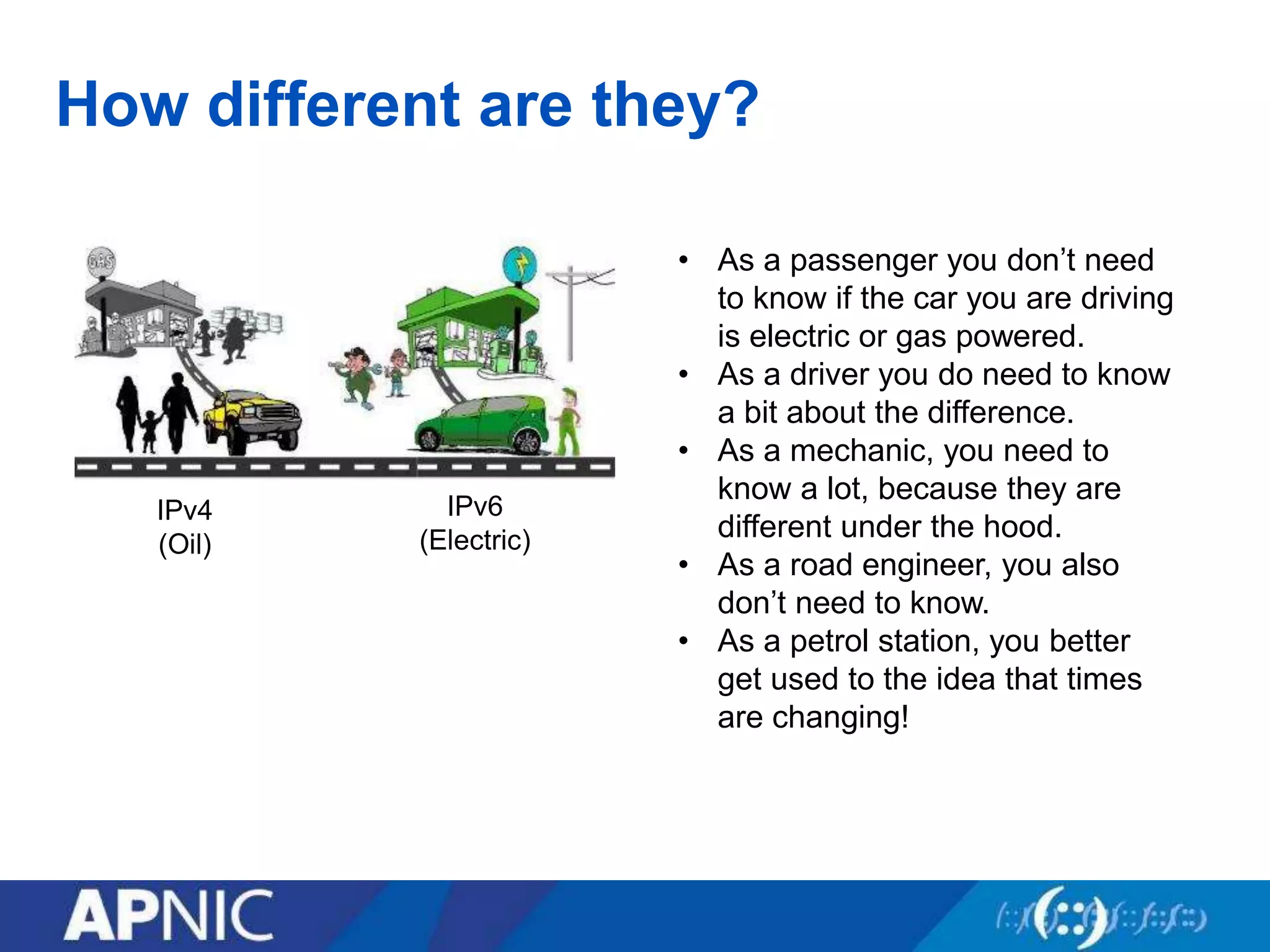
How different are they?
IPv4
(Oil)
IPv6
(Electric)
• As a passenger you don’t need
to know if the car you are driving
is electric or gas powered.
• As a driver you do need to know
a bit about the difference.
• As a mechanic, you need to
know a lot, because they are
different under the hood.
• As a road engineer, you also
don’t need to know.
• As a petrol station, you better
get used to the idea that times
are changing!
How different are they?
• Both protocols can be used at the same time on the same
network without interference
• IPv6 can be retrofitted into existing networks without
breaking or removing IPv4
• Devices can choose which protocol to use
– Depending on the capability of the other device its communicating
with
– When both available, use IPv6
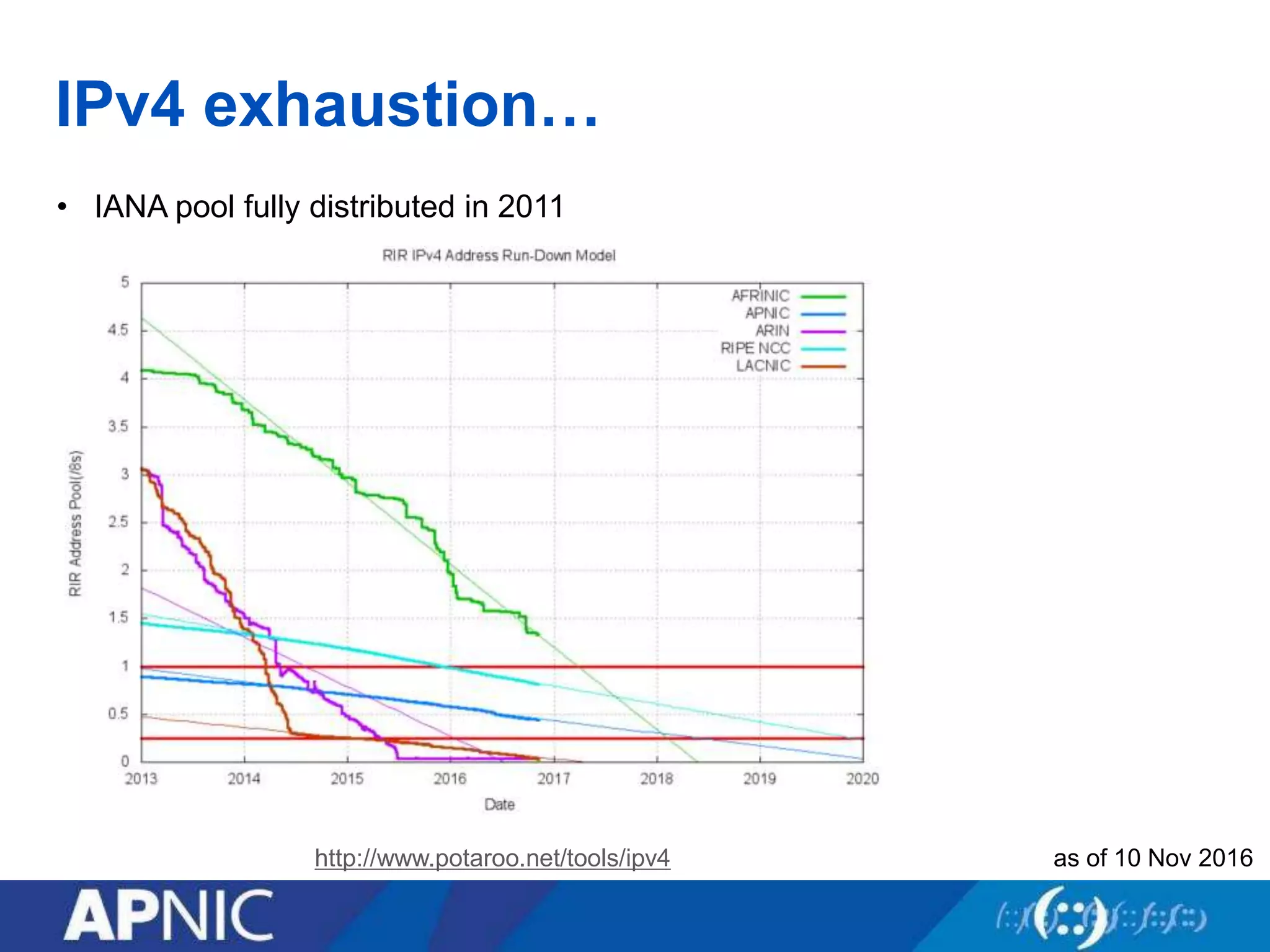
IPv4 exhaustion…
• IANA pool fully distributed in 2011
http://www.potaroo.net/tools/ipv4 as of 10 Nov 2016
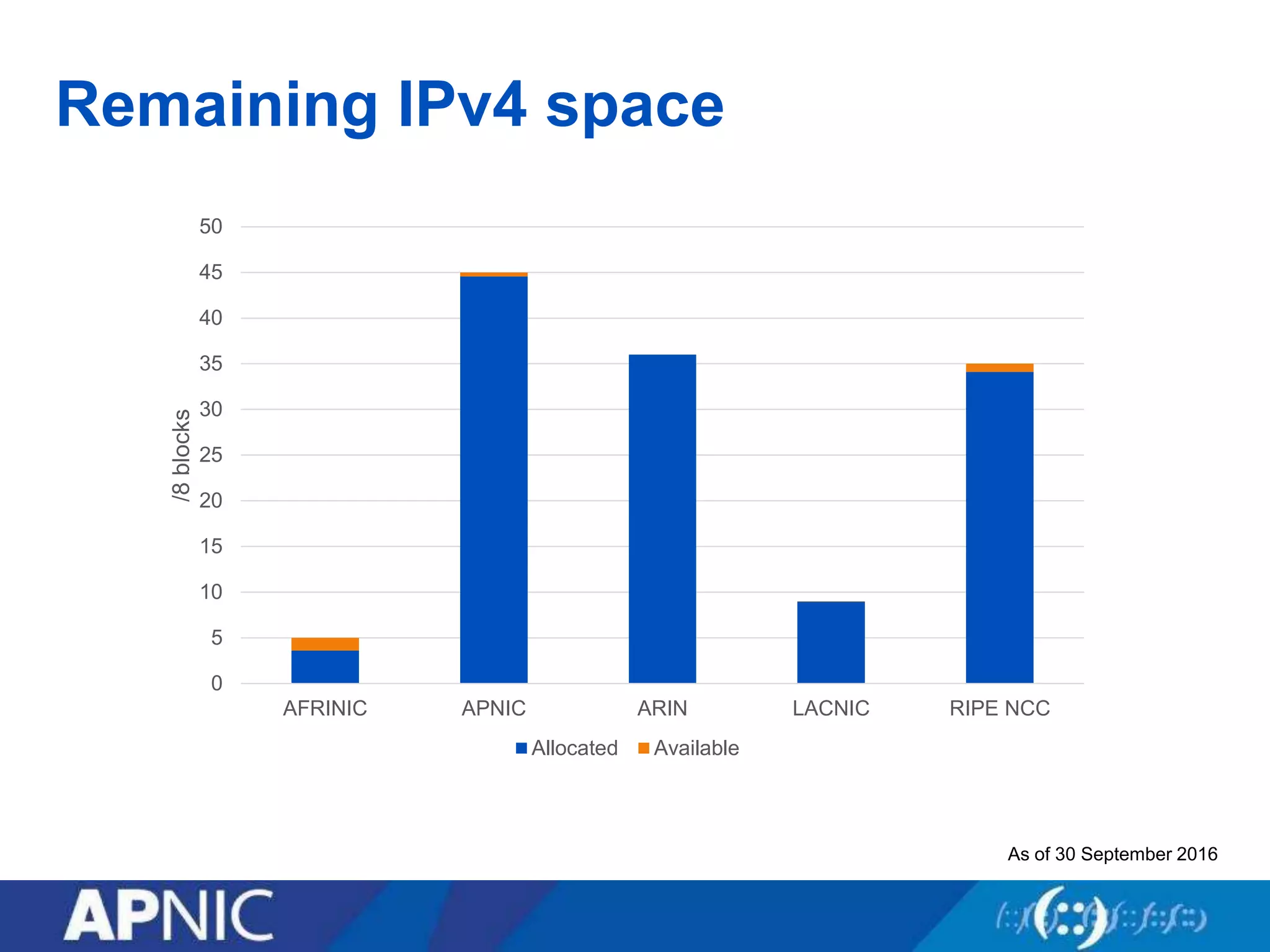
Remaining IPv4 space
0
5
10
15
20
25
30
35
40
45
50
AFRINIC APNIC ARIN LACNIC RIPE NCC
/8blocks
Allocated Available
As of 30 September 2016
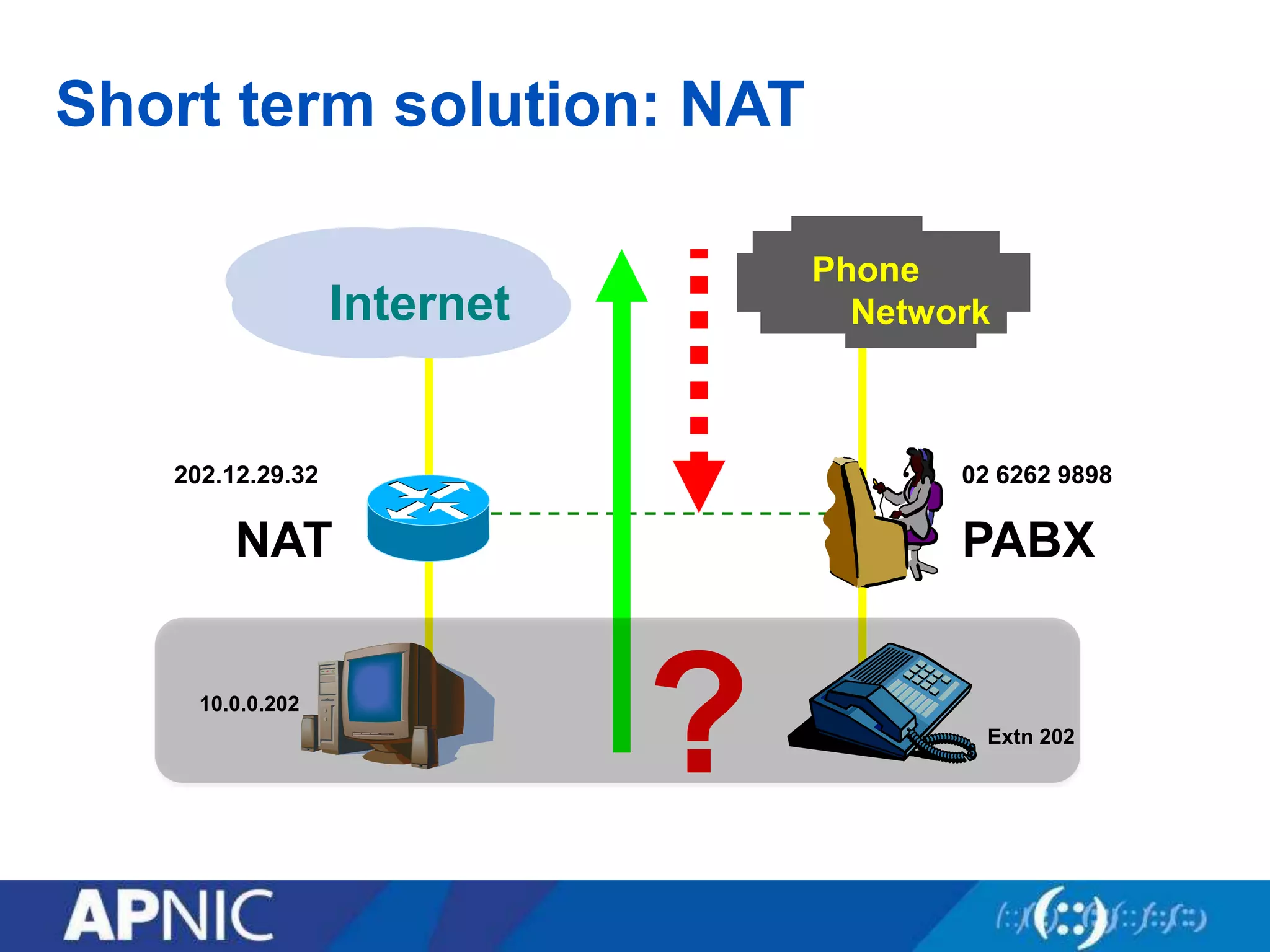
Short term solution: NAT
Internet
10.0.0.202
202.12.29.32
NAT
? Extn 202
Phone
Network
02 6262 9898
PABX
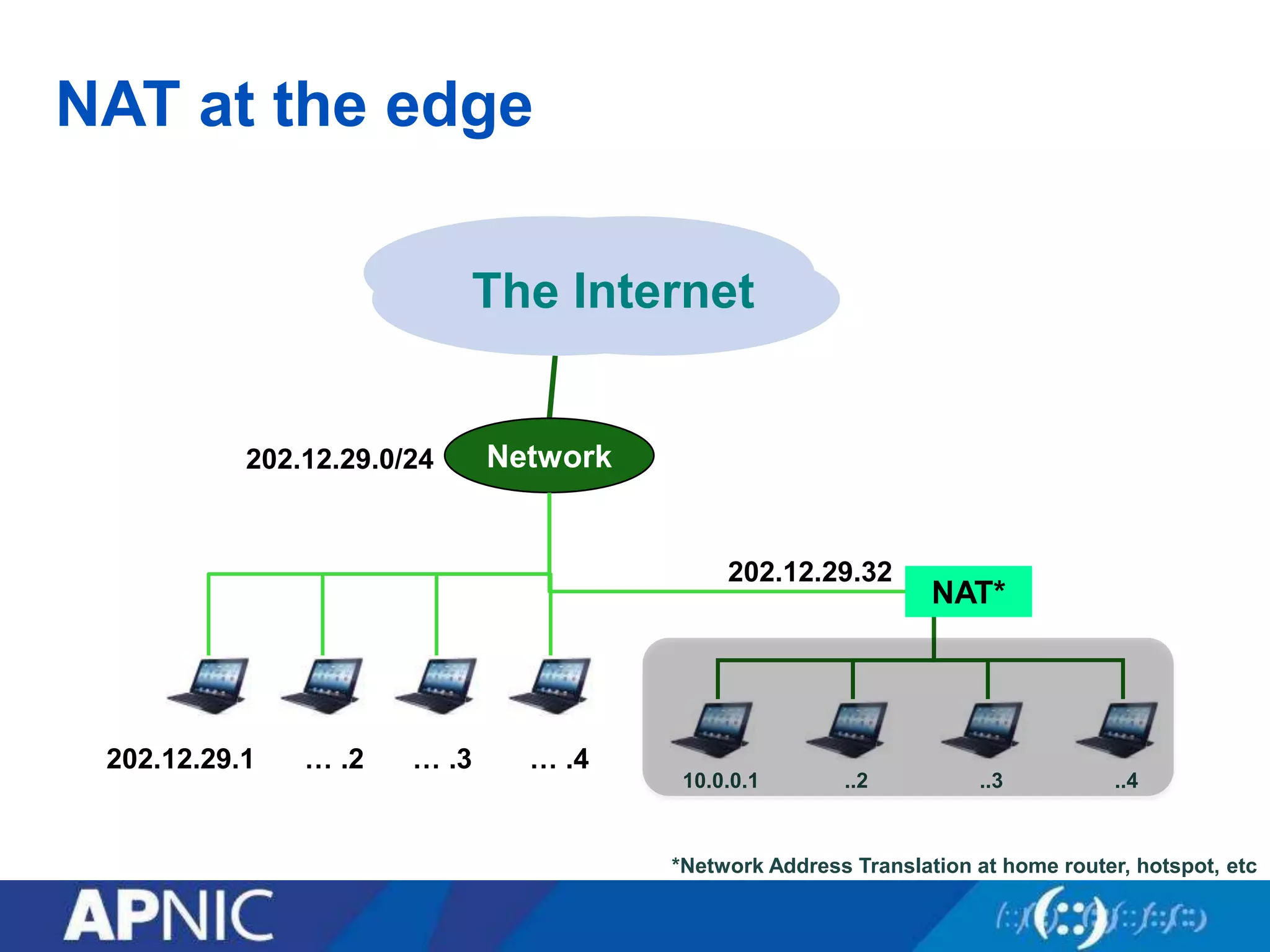
NAT at the edge
*Network Address Translation at home router, hotspot, etc
202.12.29.32
Network202.12.29.0/24
The Internet
202.12.29.1 … .2 … .3 … .4
10.0.0.1 ..2 ..3 ..4
NAT*
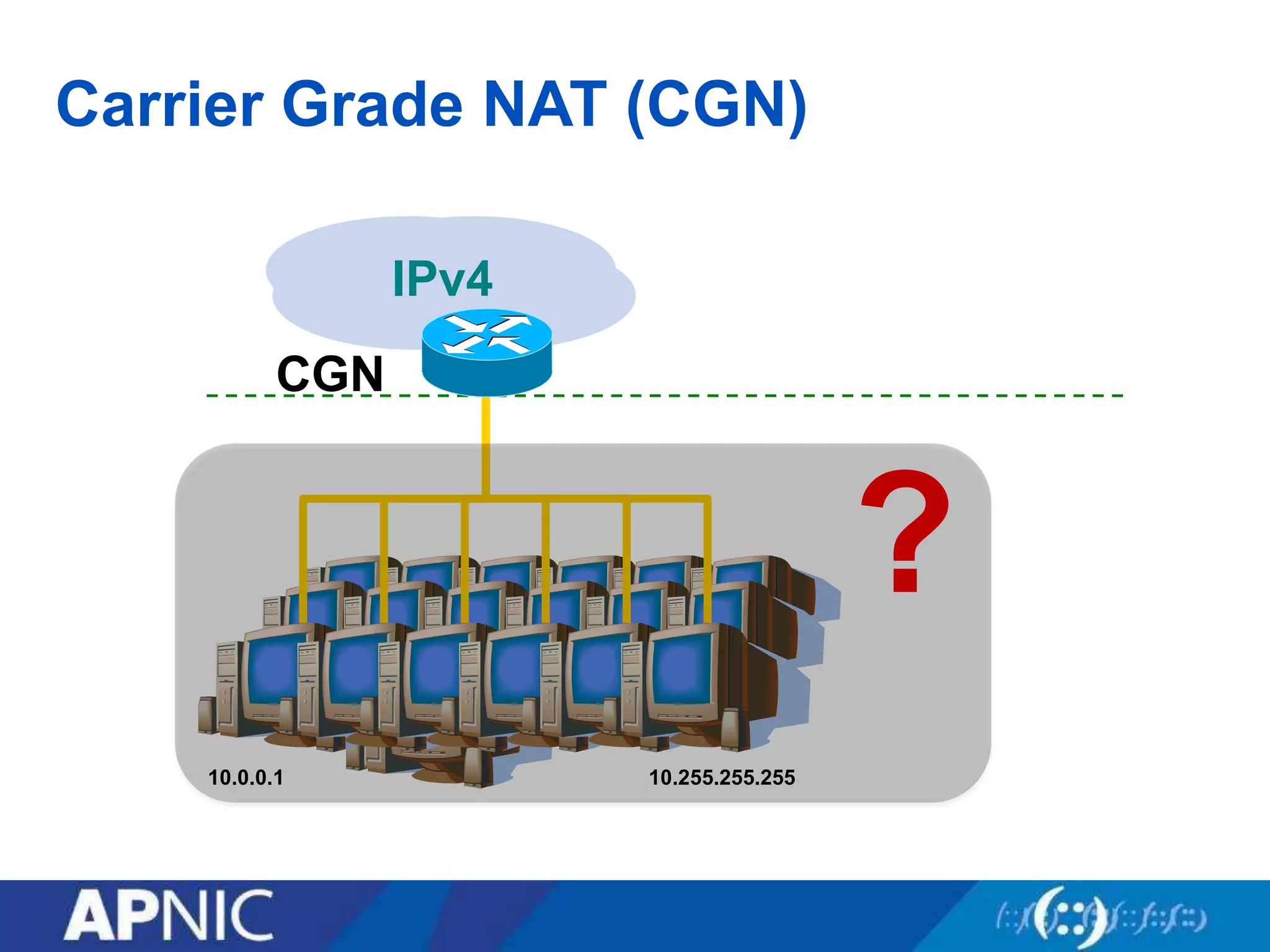
Carrier Grade NAT (CGN)
10.0.0.202
IPv4
CGN
10.255.255.25510.0.0.1
?
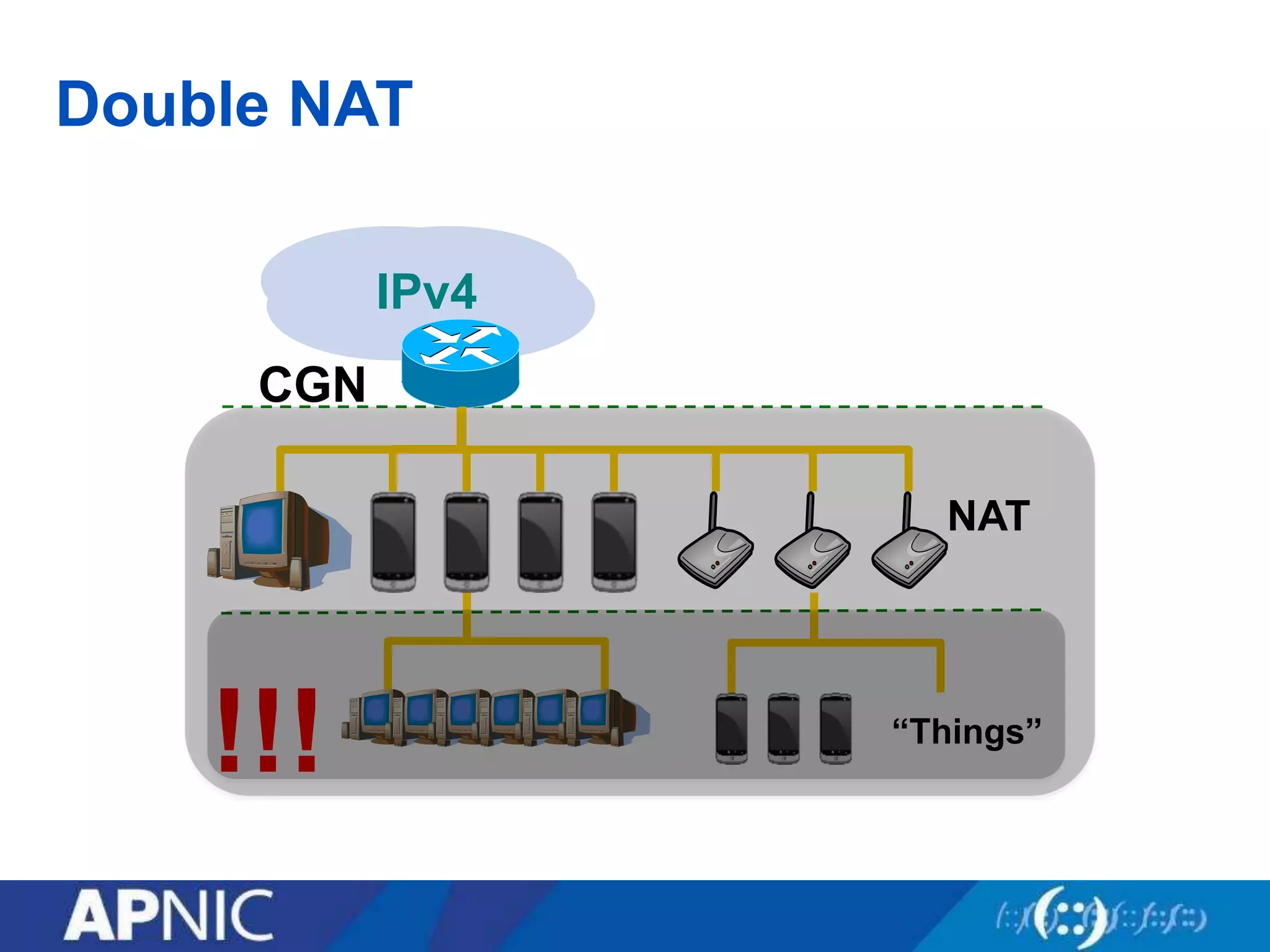
Double NAT
!!! “Things”
IPv4
CGN
NAT
The need for IPv6…
• One reason: more addresses
• The Internet is growing fast
– Broadband: Mobile and WiFi
– Internet of Things
• IPv6 is the only viable option
– Enables sustainable growth
– Maintains the openness of the Internet
Other IPv6 benefits
• IPv6 and privacy
– There are a lot of IPv6 addresses per subnet
• 2^64 (18,446,744,073,709,551,616 possible addresses)
• There’s a default address randomisation known as ‘privacy extensions’ that
prevents tracking and port scanning of devices or sessions
– Provider can still attribute the address range
• Provides feature parity to IPv4 in investigation/legal compliance
• Performance
– No network address translation processing overhead, compared to
double/triple NAT commonly seen in IPv4 networks.
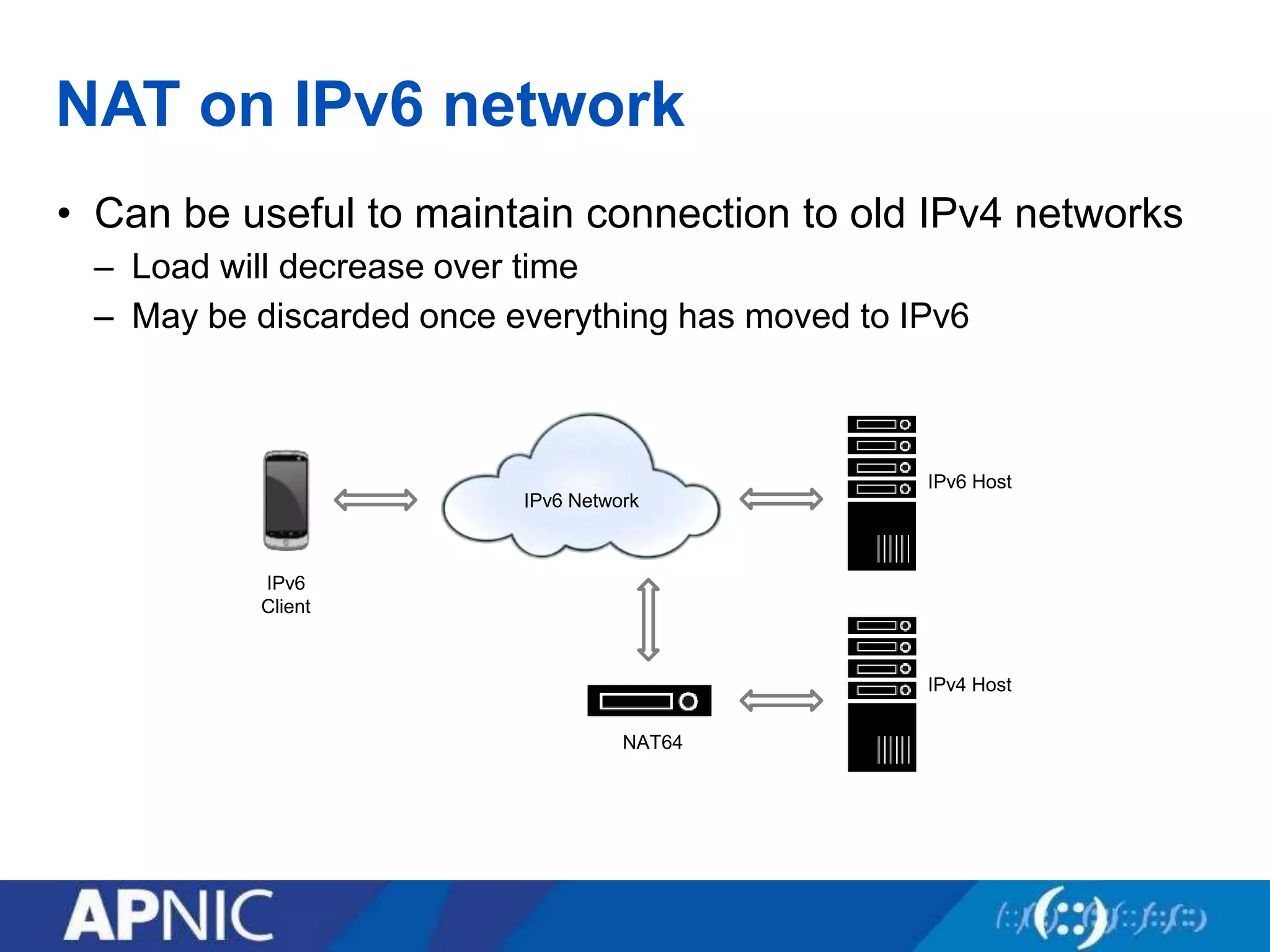
NAT on IPv6 network
• Can be useful to maintain connection to old IPv4 networks
– Load will decrease over time
– May be discarded once everything has moved to IPv6
IPv6
Client
IPv6 Network
NAT64
IPv4 Host
IPv6 Host
IPv6 deployment challenges
• 1990s
– Protocol maturity
– Vendor support (Core network devices)
• 2000s
– Implementation cost
– Vendor support (Customer premises equipment/CPEs)
• 2010s
– Application’s awareness of IPv6
– Business justification
– Technical skill
IPv6 deployment status
• Different ways to measure
– Number of IPv6 allocations by RIRs
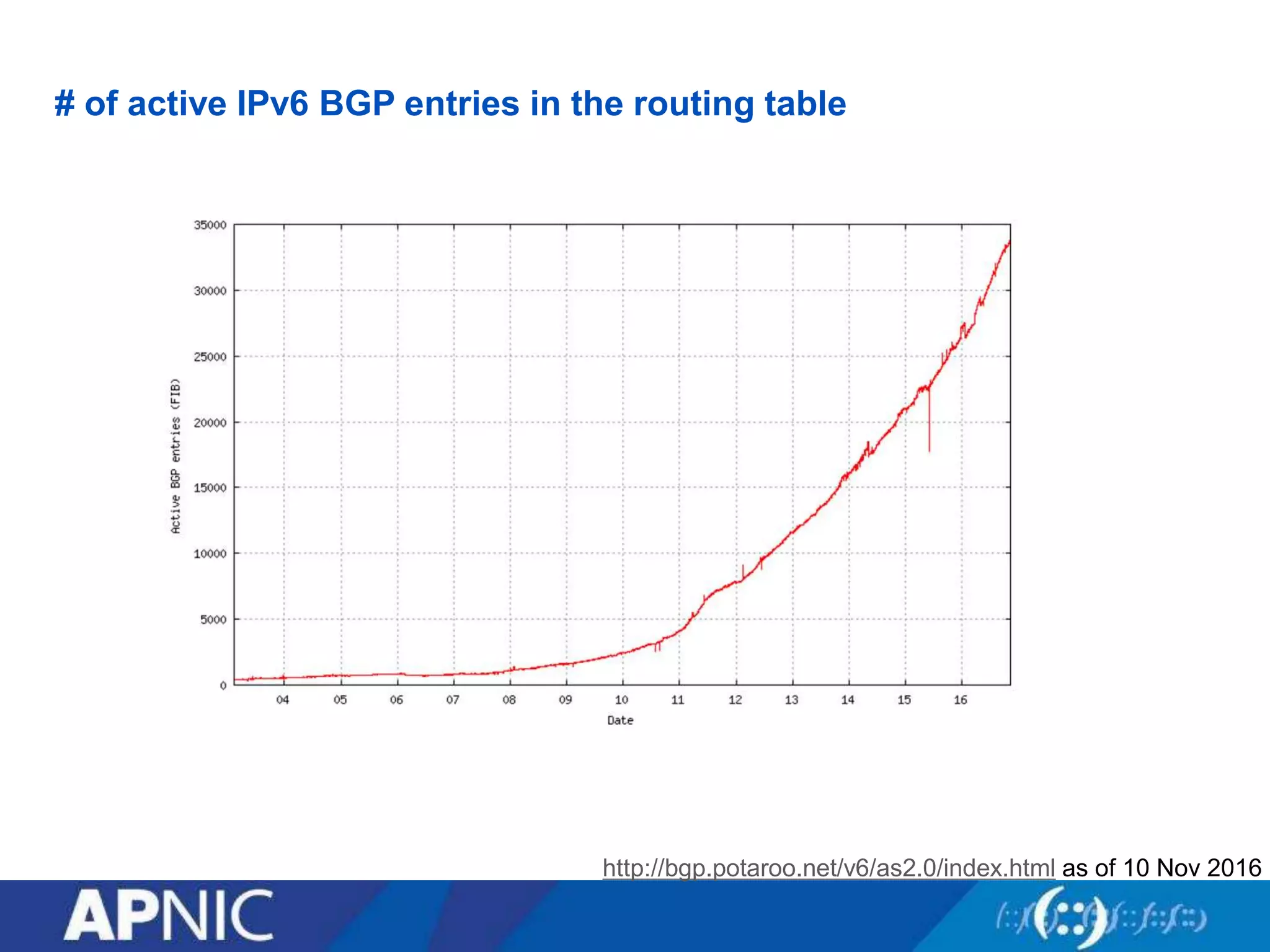
– Number of active IPv6 BGP entries (FIB) in the routing table
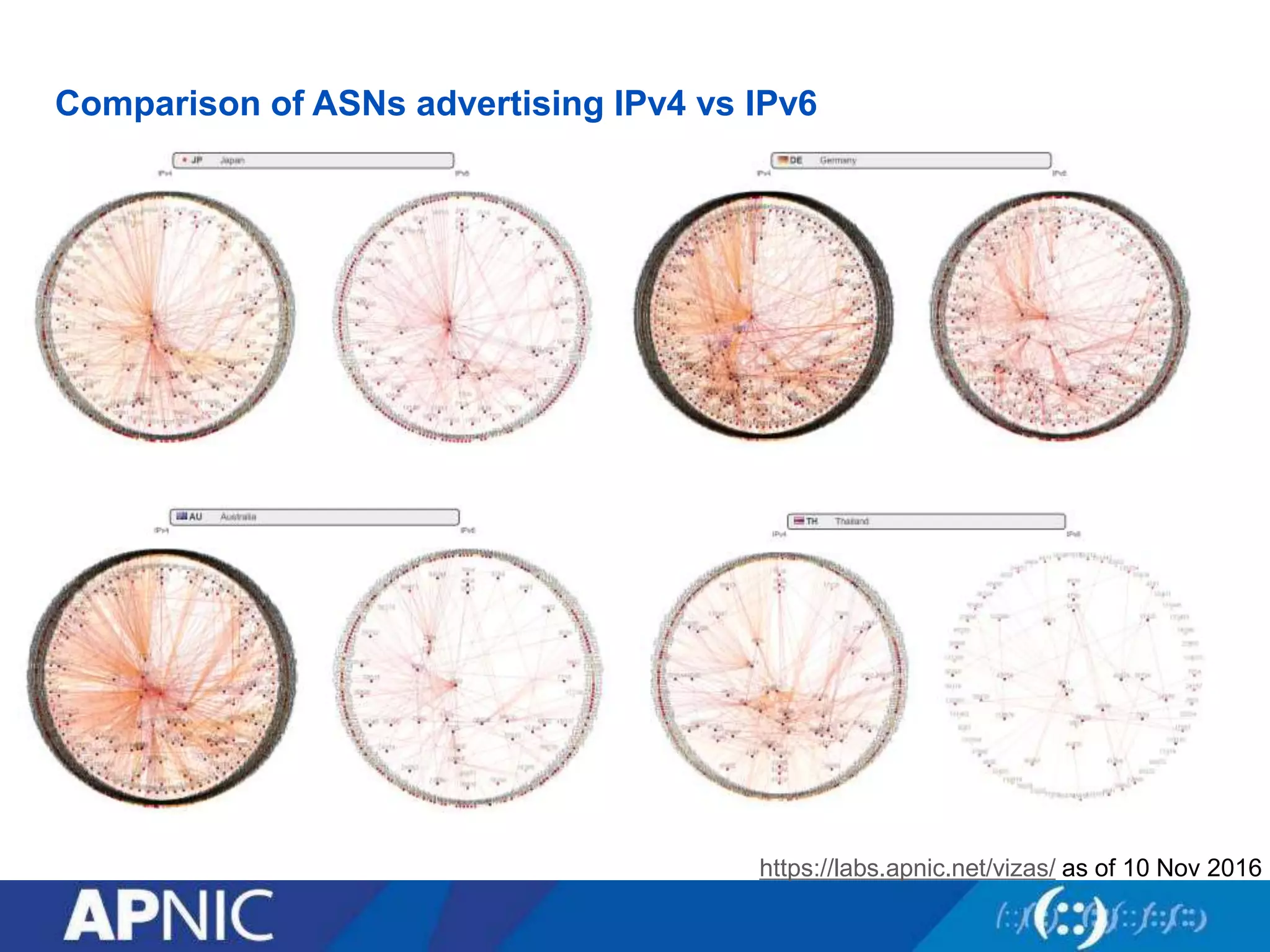
– Comparing the numbers of ASNs advertising IPv4 vs IPv6
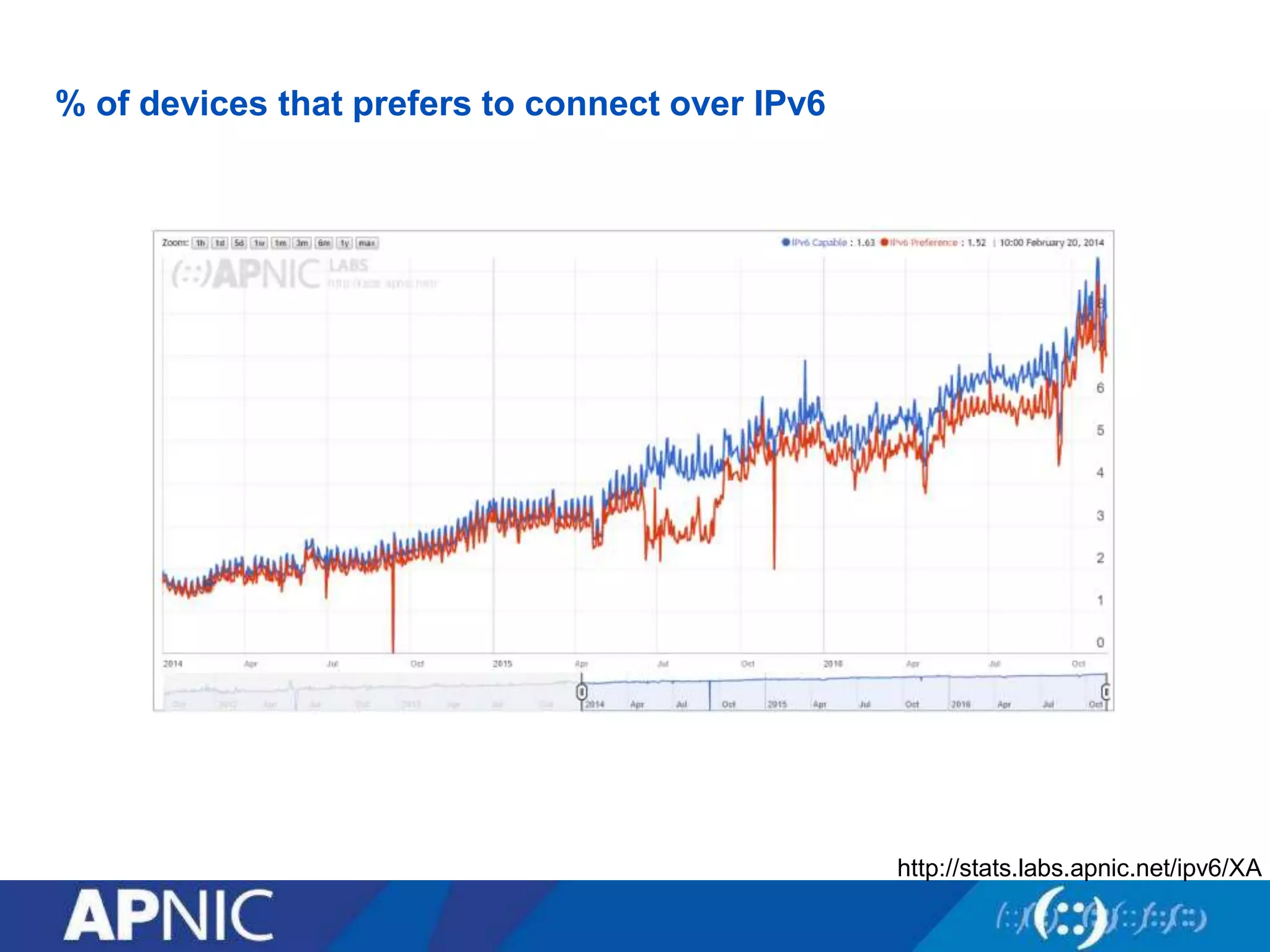
– Percentage of devices that prefers to connect over IPv6
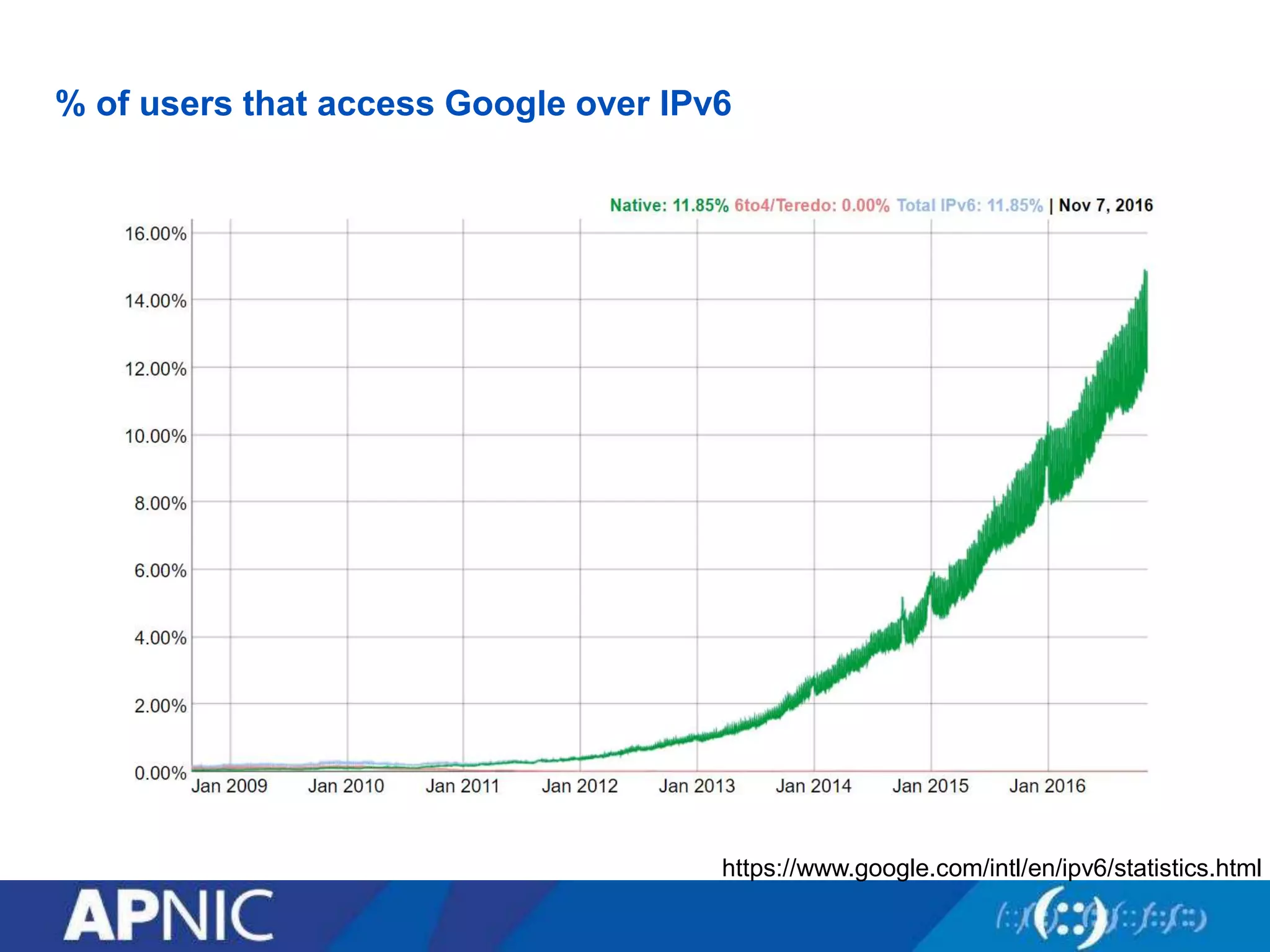
– Percentage of users that access a network over IPv6
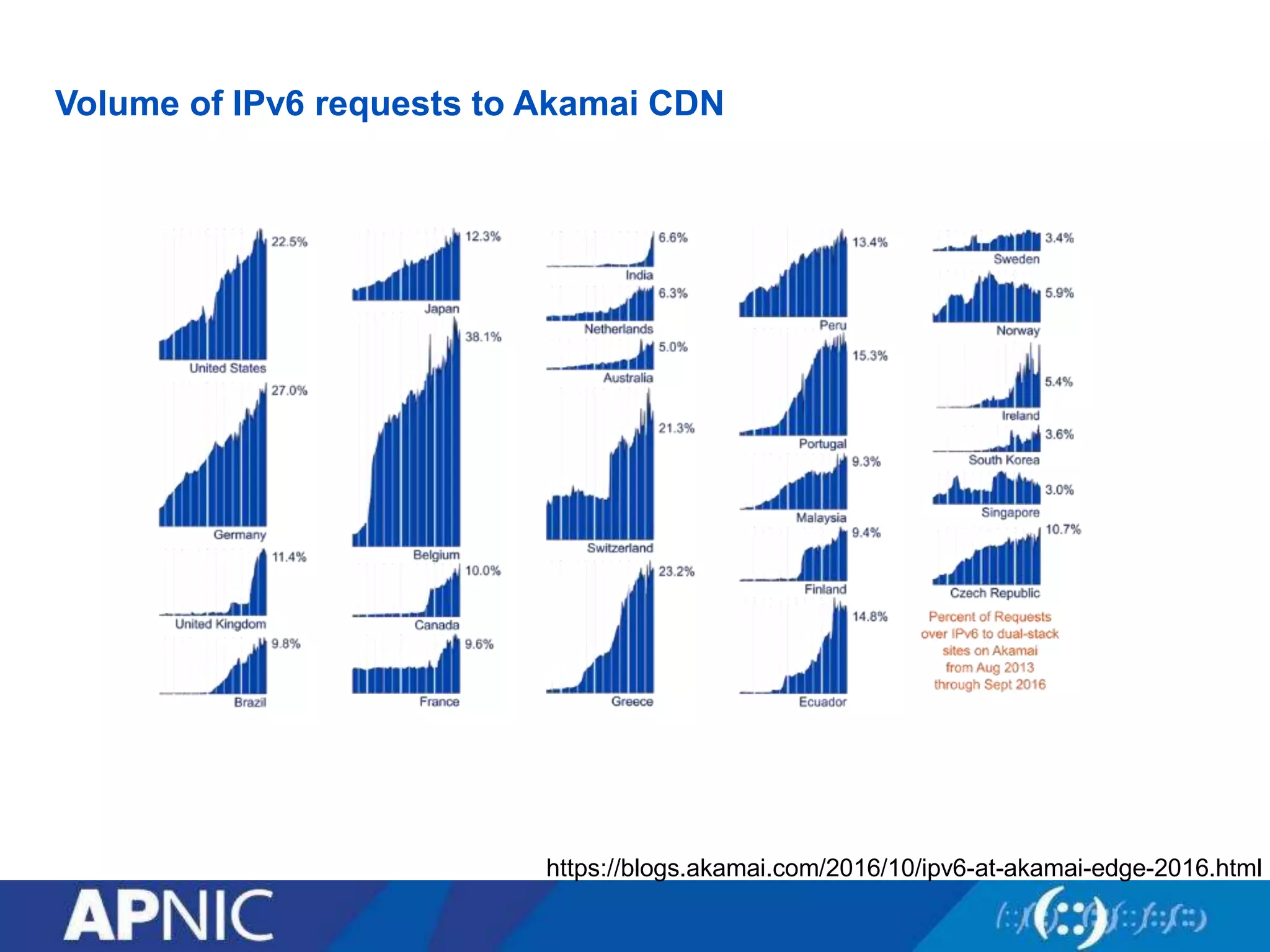
– The volume of IPv6 requests to a CDN
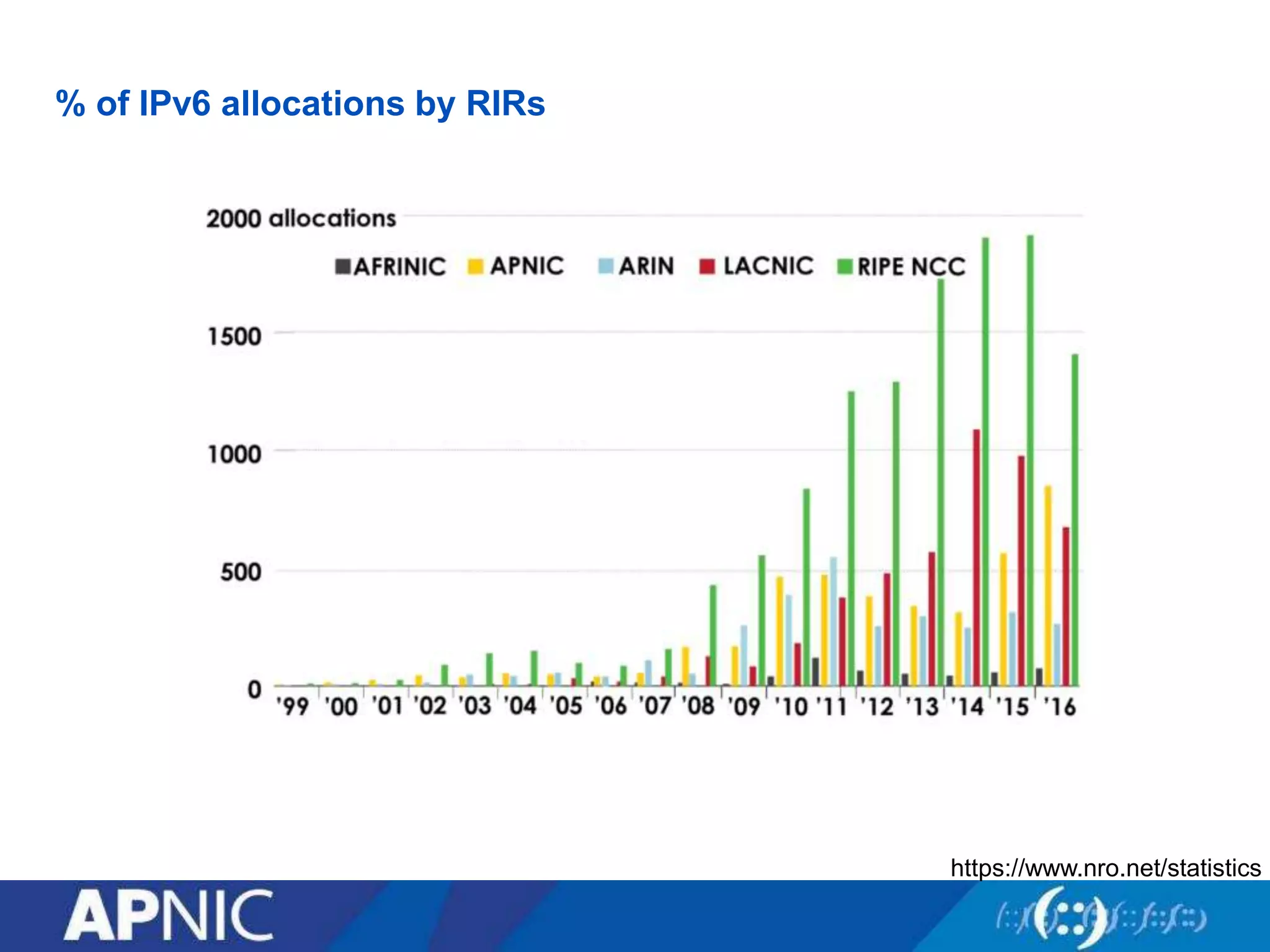
% of IPv6 allocations by RIRs
https://www.nro.net/statistics
# of active IPv6 BGP entries in the routing table
http://bgp.potaroo.net/v6/as2.0/index.html as of 10 Nov 2016
Comparison of ASNs advertising IPv4 vs IPv6
https://labs.apnic.net/vizas/ as of 10 Nov 2016
% of devices that prefers to connect over IPv6
http://stats.labs.apnic.net/ipv6/XA
% of users that access Google over IPv6
https://www.google.com/intl/en/ipv6/statistics.html
Volume of IPv6 requests to Akamai CDN
https://blogs.akamai.com/2016/10/ipv6-at-akamai-edge-2016.html
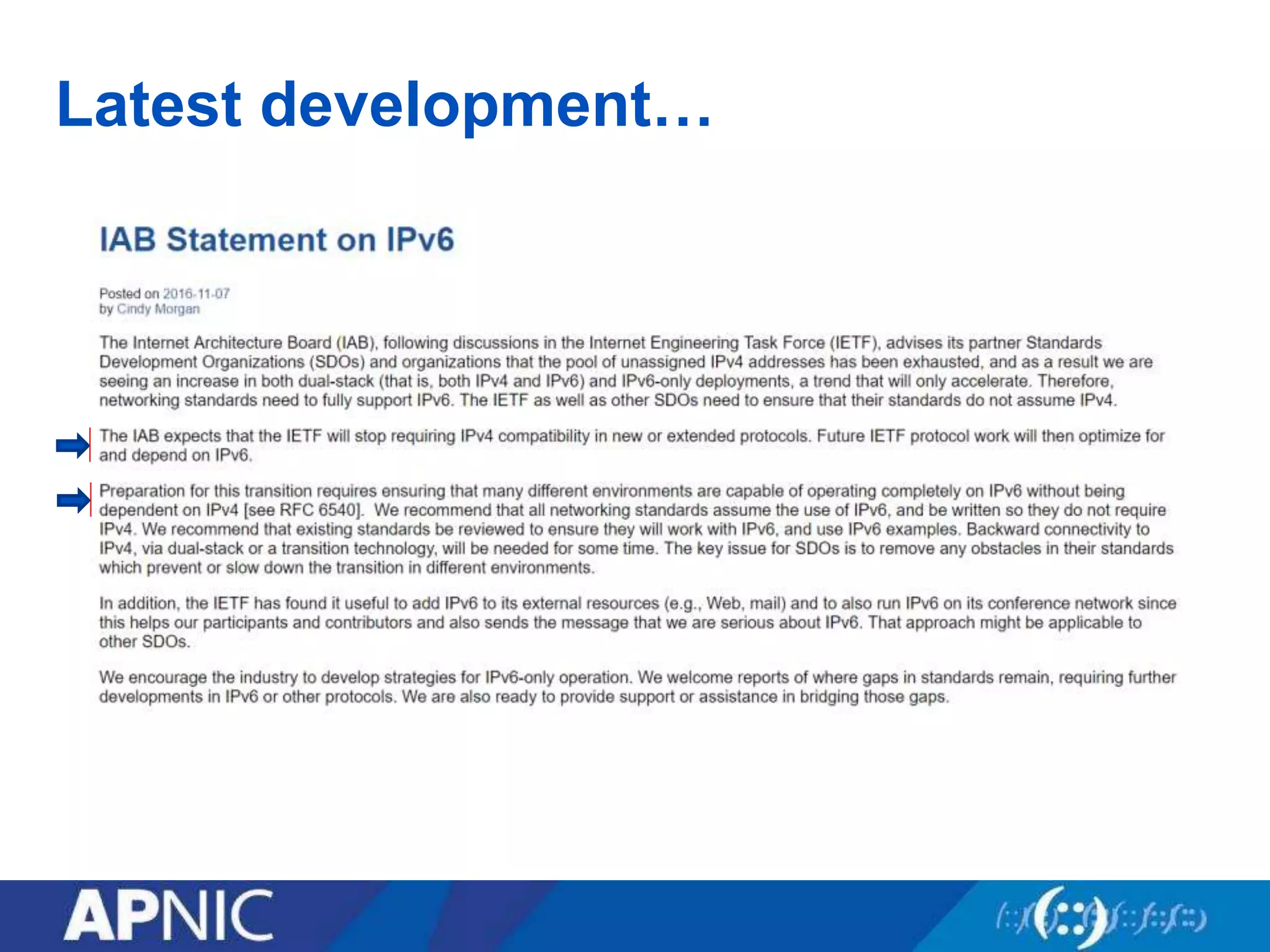
Latest development…
Conclusion
• IPv4 has served its purpose
– Time to move on
– Don’t let NAT become a long term solution
• IPv6 is here
– Deployment growth evident from different global measurements
– IETF will develop networking standards that assume the use of IPv6
and do not require IPv4
• The RIRs are committed to support IPv6 deployment in
their respective communities

The case for IPv6

  • 1.
    The case forIPv6 IETF 97: Public Policy Program Seoul November 2016
  • 2.
    IPv4 and IPv6 •IPv4 (since 1983) – 32-bit number: 232 = ~4 billion addresses – Example: 202.12.29.142 – Existing supply is very nearly exhausted • IPv6 (standardised 1995, revised 1998) – 128-bit number: 2128 = 340 billion billion billion billion addresses – Example: FE38:DCE3:124C:C1A2:BA03:6735:EF1C:683D – Existing supply should/must last for many decades • Functionally the same, but they’re incompatible – Deliberate design choice – IPv6 was developed as an improvement over IPv4
  • 3.
    How different arethey? IPv4 (Oil) IPv6 (Electric) • As a passenger you don’t need to know if the car you are driving is electric or gas powered. • As a driver you do need to know a bit about the difference. • As a mechanic, you need to know a lot, because they are different under the hood. • As a road engineer, you also don’t need to know. • As a petrol station, you better get used to the idea that times are changing!
  • 4.
    How different arethey? • Both protocols can be used at the same time on the same network without interference • IPv6 can be retrofitted into existing networks without breaking or removing IPv4 • Devices can choose which protocol to use – Depending on the capability of the other device its communicating with – When both available, use IPv6
  • 5.
    IPv4 exhaustion… • IANApool fully distributed in 2011 http://www.potaroo.net/tools/ipv4 as of 10 Nov 2016
  • 6.
    Remaining IPv4 space 0 5 10 15 20 25 30 35 40 45 50 AFRINICAPNIC ARIN LACNIC RIPE NCC /8blocks Allocated Available As of 30 September 2016
  • 7.
    Short term solution:NAT Internet 10.0.0.202 202.12.29.32 NAT ? Extn 202 Phone Network 02 6262 9898 PABX
  • 8.
    NAT at theedge *Network Address Translation at home router, hotspot, etc 202.12.29.32 Network202.12.29.0/24 The Internet 202.12.29.1 … .2 … .3 … .4 10.0.0.1 ..2 ..3 ..4 NAT*
  • 9.
    Carrier Grade NAT(CGN) 10.0.0.202 IPv4 CGN 10.255.255.25510.0.0.1 ?
  • 10.
  • 11.
    The need forIPv6… • One reason: more addresses • The Internet is growing fast – Broadband: Mobile and WiFi – Internet of Things • IPv6 is the only viable option – Enables sustainable growth – Maintains the openness of the Internet
  • 12.
    Other IPv6 benefits •IPv6 and privacy – There are a lot of IPv6 addresses per subnet • 2^64 (18,446,744,073,709,551,616 possible addresses) • There’s a default address randomisation known as ‘privacy extensions’ that prevents tracking and port scanning of devices or sessions – Provider can still attribute the address range • Provides feature parity to IPv4 in investigation/legal compliance • Performance – No network address translation processing overhead, compared to double/triple NAT commonly seen in IPv4 networks.
  • 13.
    NAT on IPv6network • Can be useful to maintain connection to old IPv4 networks – Load will decrease over time – May be discarded once everything has moved to IPv6 IPv6 Client IPv6 Network NAT64 IPv4 Host IPv6 Host
  • 14.
    IPv6 deployment challenges •1990s – Protocol maturity – Vendor support (Core network devices) • 2000s – Implementation cost – Vendor support (Customer premises equipment/CPEs) • 2010s – Application’s awareness of IPv6 – Business justification – Technical skill
  • 15.
    IPv6 deployment status •Different ways to measure – Number of IPv6 allocations by RIRs – Number of active IPv6 BGP entries (FIB) in the routing table – Comparing the numbers of ASNs advertising IPv4 vs IPv6 – Percentage of devices that prefers to connect over IPv6 – Percentage of users that access a network over IPv6 – The volume of IPv6 requests to a CDN
  • 16.
    % of IPv6allocations by RIRs https://www.nro.net/statistics
  • 17.
    # of activeIPv6 BGP entries in the routing table http://bgp.potaroo.net/v6/as2.0/index.html as of 10 Nov 2016
  • 18.
    Comparison of ASNsadvertising IPv4 vs IPv6 https://labs.apnic.net/vizas/ as of 10 Nov 2016
  • 19.
    % of devicesthat prefers to connect over IPv6 http://stats.labs.apnic.net/ipv6/XA
  • 20.
    % of usersthat access Google over IPv6 https://www.google.com/intl/en/ipv6/statistics.html
  • 21.
    Volume of IPv6requests to Akamai CDN https://blogs.akamai.com/2016/10/ipv6-at-akamai-edge-2016.html
  • 22.
  • 23.
    Conclusion • IPv4 hasserved its purpose – Time to move on – Don’t let NAT become a long term solution • IPv6 is here – Deployment growth evident from different global measurements – IETF will develop networking standards that assume the use of IPv6 and do not require IPv4 • The RIRs are committed to support IPv6 deployment in their respective communities