1
IPv6 Deployment:
Opportunities and Challenges
Lao Expo 2016
14 Dec 2016
Sheryl (Shane) Hermoso
Outline
• Global and regional IPv6 adoption
• IPv6 deployment in Laos
• IPv6 trends, challenges and opportunities
• IPv6 deployment use cases
• Training and capacity-building efforts
So what is IPv6?
• Two different Internets
• NOT interoperable
• There’s a need to upgrade/migrate/transition to IPv6
IPv6 is the new protocol standard that solves the IPv4
address limitation
IPv4 vs IPv6
IPv4 = 232 or 4.3B
IPv4 and IPv6 are represented differently
IPv6: 2128 or 3.4x1038
IPv4 = 192.168.1.100 IPv6 = 2001:DB8::ABCD
There are more IPv6 addresses than IPv4
IPv6 Adoption Status by Google
Native IPv6 adoption:
12.24%
https://www.google.com/intl/en/ipv6/statistics.html
IPv6 is already being
deployed
around the world
IPv6 Deployment Worldwide
IPv6 Preferred: 8.48
IPv6 Capable: 6.98
(as at 10 Dec 2016)
~40% increase
since start of
2016
http://stats.labs.apnic.net/ipv6/XA
IPv6 Deployment in the Region
IPv6 Preferred: 2.65
IPv6 Capable: 2.48
(as at 10 Dec 2016)
Average in the
sub-region is
lower than
worldwide
adoption
http://stats.labs.apnic.net/ipv6/XU?o=cXDw1x1r1
IPv6 Capability (South East Asia)
0
5
10
15
20
25
%IPv6Capable BN
KH
ID
LA
MY
MM
PH
SG
TH
TL
VN
IPv6 Deployment in the Region
http://stats.labs.apnic.net/ipv6/XU?o=cXDw1x1r1
IPv6 Deployment in Malaysia
IPv6 Preferred: 14.8
IPv6 Capable: 13.44
(as at 10 Dec 2016)
Highest in the
Southeast
Asia sub-
region
IPv6 Deployment in Vietnam
Huge
increase only
within the
year 2016 IPv6 Preferred: 14.8
IPv6 Capable: 13.44
(as at 10 Dec 2016)
All About Laos
6,970,272 people
996,748 users
14% penetration
19 ASes
$12.33B GDP
IPv4 12 in BGP
71,168 addresses
0.01 per head
94% visible
IPv6 2 in BGP
30,064 M addresses
4,313 per head
0% visible
0% capability
Have you adopted IPv6?
0
0.5
1
1.5
2
2.5
3
3.5
4
4.5
2010 2012 2014 2016
Number of IPv6 Delegations
9 IPv6
delegations
for LA
IPv6 Deployment in Laos
http://stats.labs.apnic.net/ipv6/LA
How to Deploy IPv6?
IPv6-only IPv4 and IPv6 Translation
Access to IPv6 only; IPv4
network is unreachable
Provides access to both
IPv4 and IPv6 networks
IPv6 internal, use
translation mechanism to
access IPv4 (or vice
versa)
Typical deployments are
for research purposes
Typically implemented in
ISP backbone
Mobile networks run
IPv6, use SP-NAT to
access IPv4
Native IPv6 Dual-stack NAT64, 464XLAT, and so
forth
IPv4 Only Network
IPv4
Internet
IPv4 host
IPv4+IPv6 host
Subscriber Network IPv4-only SP Network Internet
IPv4
Customer
Router
IPv6 host
IPv6
Internet
IPv6
Network grows as long as IPv4 addresses are available
Dual-Stack Network
IPv4
Internet
IPv4 host
IPv4+IPv6 host
Subscriber Network Dual-Stack SP Network Internet
IPv4
Customer
Router
IPv6 host
IPv6
Internet
IPv6
IPv6 available to customers
Network grows as long as IPv4 is available
Dual-Stack with SP NAT
IPv4
Internet
IPv4 host
IPv4+IPv6 host
Subscriber Network Dual-Stack SP Network using
RFC1918 addresses
Internet
IPv4
Customer
Router
IPv6 host
IPv6
Internet
IPv6
SP NAT
Sharing IPv4 address(es)
IPv6 available all the way to customer
SP NAT translates IPv6 traffic to access IPv4
IPv6 Only Network
IPv6
Internet
IPv6 host
IPv4+IPv6 host
Subscriber Network IPv4-only SP Network Internet
IPv4
Customer
Router
IPv4 host
IPv4
Internet
IPv6
Challenges to IPv6
• Extra technology cost
– Equipment purchases and upgrades with IPv6 support
• Content availability
• IPv6 performance and security concerns
IPv6 Performance
• Enough data accumulated to analyze IPv6 performance
• APNIC R&D; Geoff Huston’s recent study
– Presented @ APRICOT 2016 (Feb, 2016)
Is IPv6 as “robust” as IPv4?
Measurements: do all TCP connection attempts succeed?
Connection failure = Un-matching incoming SYN and
ACK
IPv4 connection failure sits at 0.2%
IPv6 connection failure sits at 1.8%
Came down largely since 2012 (around 5%)
Still some space to improve
http://www.potaroo.net/presentations/2016-02-10-ad-measurement.pdf
Is IPv6 as “fast” as IPv4? (use of IPv6 unicast)
Chronological comparison of RTT since 2012
RTT measurements from the SYN-ACK exchange
IPv6 as fast as IPv4
IPv6 is faster about half of the time
IPv6 Performance
http://www.potaroo.net/presentations/2016-02-10-ad-measurement.pdf
• Enough data accumulated to analyze IPv6 performance
• APNIC R&D, Geoff Huston’s recent study
– Presented @ APRICOT 2016 (Feb, 2016)
Mobility in Today’s Internet
- Geoff Huston
Mobiles are now
48% of all visible devices
https://labs.apnic.net/presentations/store/2015-11-20-mobiles.pdf
Tablet
Console
Mobile access services
represent
75% of all Access Provider
revenue
IPv6 in Mobile Networks
• Mobile devices and IPv6
– Android supports 464XLAT transition technology
– Apple iOS 9 supports IPv6 only network services (Aug 2015)
• All apps submitted to the App Store must support IPv6 starting in early 2016
• Alcatel Lucent
‘Introducing IPv6 into mobile network reduces the CG-NAT bandwidth
required by the mobile operator resulting in reduced CAPEX'
– Whitepaper published in April 2015
• 464XLAT in mobile networks: IPv6 migration strategies for mobile networks
https://developer.apple.com/news/?id=08282015a
https://www.apnic.net/community/ipv6-program/IPv6_Migration_Strategies_for_Mobile_Networks_Whitepaper.pdf
IPv6 in Mobile Networks
• Verizon Wireless (USA)
– Deployed dual stack transition technology in
2011
• T-Mobile USA (USA)
– Deployed IPv6 transition technology
(464XLAT) in Oct 2012
• Telstra Australia (Australia)
– Testing IPv6 transition technology (464XLAT)
since 2011
• Final stage of testing 464XLAT
• Started in Aug/Sept 2016
• SK Telecom (Korea)
– Deployed IPv6 transition technology
(464XLAT) in July 2014
– Why did SKT adopt IPv6 in their mobile
networks?
• CAPEX for Network Address Translator (NAT)
equipment
• Difficult to operate duplicated networks
• Korean government’s encouragement
• FPT (Vietnam)
– Began IPv6 trial for 200,000 customers in
2012
– Started transition in 2016 with aim of
providing IPv6 to 500,000 by year-end
– Complete roll-out of IPv6 connectivity to all
customers planned for 2017
T-Mobile USA
http://www.worldipv6launch.org/apps/ipv6week/measurement/images/graphs/T-MobileUSA.png
48.99% (May 2016)
Oct 2012, 464XLAT deployed
74.47% (Dec 2016)
FPT Telecom (VN)
http://www.worldipv6launch.org/apps/ipv6week/measurement/images/graphs/FPTTelecom.png
21.38 % (Dec 2016)
Observations
• IPv6 end-user readiness is increasing across the region
– Varies among region, economies, networks
• Key market players taking lead on IPv6 continues to have sizable
impact on economy-wide IPv6 readiness
• Once IPv6 is enabled in a network, end-user readiness tends to grow
rapidly
• Initial roll-out generally followed by expansion to smaller markets and
regional ISPs as well as content, cloud, cable TV, and other service
providers
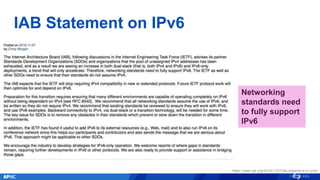
IAB Statement on IPv6
https://www.iab.org/2016/11/07/iab-statement-on-ipv6/
Networking
standards need
to fully support
IPv6
APNIC-ITU Capacity-Building Efforts
“IPv6 Transition Strategies and
Technologies” Workshop Vientiane,
Laos - August 2014
“IPv6 Infrastructure Workshop”
Phnom Penh, Cambodia – July
2016
APNIC IPv6 Capacity-Building in the
Region
• Apart from this partnership, APNIC has also conducted a
number of outreach programs
– IPv6 workshop in May 2014
– Member development in Jun 2014 – this is to coordinate more and
meet Members’ needs
– APNIC Regional Meeting – 2015
– IPv6 Address Planning & Deployment Technical Assistance (TA)
Program
Workshop on IPv6 Adoption by ASEAN
government agencies.
• APNIC and the Infocomm Development Authority of Singapore (IDA)
have conducted workshop on IPv6 adoption by ASEAN government
agencies
• Part of ASEAN Telecommunications Senior Officials Meeting
(TELSOM) and ASEAN Telecommunications Regulators’ Council
(ATRC) joint working group meeting held in Jakarta from 9 to 12 May
2016
• APNIC Presented four stage strategy to deploy IPv6 for government
IPv6 Deployment Stages
IPv6@APNIC
www.apnic.net/ipv6
Stay in Touch!
blog.apnic.net
apnic.net/social
IPv6 Deployment, Lao ICT Expo 2016

IPv6 Deployment, Lao ICT Expo 2016

  • 1.
    1 IPv6 Deployment: Opportunities andChallenges Lao Expo 2016 14 Dec 2016 Sheryl (Shane) Hermoso
  • 2.
    Outline • Global andregional IPv6 adoption • IPv6 deployment in Laos • IPv6 trends, challenges and opportunities • IPv6 deployment use cases • Training and capacity-building efforts
  • 3.
    So what isIPv6? • Two different Internets • NOT interoperable • There’s a need to upgrade/migrate/transition to IPv6 IPv6 is the new protocol standard that solves the IPv4 address limitation
  • 4.
    IPv4 vs IPv6 IPv4= 232 or 4.3B IPv4 and IPv6 are represented differently IPv6: 2128 or 3.4x1038 IPv4 = 192.168.1.100 IPv6 = 2001:DB8::ABCD There are more IPv6 addresses than IPv4
  • 5.
    IPv6 Adoption Statusby Google Native IPv6 adoption: 12.24% https://www.google.com/intl/en/ipv6/statistics.html IPv6 is already being deployed around the world
  • 6.
    IPv6 Deployment Worldwide IPv6Preferred: 8.48 IPv6 Capable: 6.98 (as at 10 Dec 2016) ~40% increase since start of 2016 http://stats.labs.apnic.net/ipv6/XA
  • 7.
  • 8.
    IPv6 Deployment inthe Region IPv6 Preferred: 2.65 IPv6 Capable: 2.48 (as at 10 Dec 2016) Average in the sub-region is lower than worldwide adoption http://stats.labs.apnic.net/ipv6/XU?o=cXDw1x1r1
  • 9.
    IPv6 Capability (SouthEast Asia) 0 5 10 15 20 25 %IPv6Capable BN KH ID LA MY MM PH SG TH TL VN
  • 10.
    IPv6 Deployment inthe Region http://stats.labs.apnic.net/ipv6/XU?o=cXDw1x1r1
  • 11.
    IPv6 Deployment inMalaysia IPv6 Preferred: 14.8 IPv6 Capable: 13.44 (as at 10 Dec 2016) Highest in the Southeast Asia sub- region
  • 12.
    IPv6 Deployment inVietnam Huge increase only within the year 2016 IPv6 Preferred: 14.8 IPv6 Capable: 13.44 (as at 10 Dec 2016)
  • 13.
    All About Laos 6,970,272people 996,748 users 14% penetration 19 ASes $12.33B GDP IPv4 12 in BGP 71,168 addresses 0.01 per head 94% visible IPv6 2 in BGP 30,064 M addresses 4,313 per head 0% visible 0% capability
  • 14.
    Have you adoptedIPv6? 0 0.5 1 1.5 2 2.5 3 3.5 4 4.5 2010 2012 2014 2016 Number of IPv6 Delegations 9 IPv6 delegations for LA
  • 15.
    IPv6 Deployment inLaos http://stats.labs.apnic.net/ipv6/LA
  • 16.
    How to DeployIPv6? IPv6-only IPv4 and IPv6 Translation Access to IPv6 only; IPv4 network is unreachable Provides access to both IPv4 and IPv6 networks IPv6 internal, use translation mechanism to access IPv4 (or vice versa) Typical deployments are for research purposes Typically implemented in ISP backbone Mobile networks run IPv6, use SP-NAT to access IPv4 Native IPv6 Dual-stack NAT64, 464XLAT, and so forth
  • 17.
    IPv4 Only Network IPv4 Internet IPv4host IPv4+IPv6 host Subscriber Network IPv4-only SP Network Internet IPv4 Customer Router IPv6 host IPv6 Internet IPv6 Network grows as long as IPv4 addresses are available
  • 18.
    Dual-Stack Network IPv4 Internet IPv4 host IPv4+IPv6host Subscriber Network Dual-Stack SP Network Internet IPv4 Customer Router IPv6 host IPv6 Internet IPv6 IPv6 available to customers Network grows as long as IPv4 is available
  • 19.
    Dual-Stack with SPNAT IPv4 Internet IPv4 host IPv4+IPv6 host Subscriber Network Dual-Stack SP Network using RFC1918 addresses Internet IPv4 Customer Router IPv6 host IPv6 Internet IPv6 SP NAT Sharing IPv4 address(es) IPv6 available all the way to customer SP NAT translates IPv6 traffic to access IPv4
  • 20.
    IPv6 Only Network IPv6 Internet IPv6host IPv4+IPv6 host Subscriber Network IPv4-only SP Network Internet IPv4 Customer Router IPv4 host IPv4 Internet IPv6
  • 21.
    Challenges to IPv6 •Extra technology cost – Equipment purchases and upgrades with IPv6 support • Content availability • IPv6 performance and security concerns
  • 22.
    IPv6 Performance • Enoughdata accumulated to analyze IPv6 performance • APNIC R&D; Geoff Huston’s recent study – Presented @ APRICOT 2016 (Feb, 2016) Is IPv6 as “robust” as IPv4? Measurements: do all TCP connection attempts succeed? Connection failure = Un-matching incoming SYN and ACK IPv4 connection failure sits at 0.2% IPv6 connection failure sits at 1.8% Came down largely since 2012 (around 5%) Still some space to improve http://www.potaroo.net/presentations/2016-02-10-ad-measurement.pdf
  • 23.
    Is IPv6 as“fast” as IPv4? (use of IPv6 unicast) Chronological comparison of RTT since 2012 RTT measurements from the SYN-ACK exchange IPv6 as fast as IPv4 IPv6 is faster about half of the time IPv6 Performance http://www.potaroo.net/presentations/2016-02-10-ad-measurement.pdf • Enough data accumulated to analyze IPv6 performance • APNIC R&D, Geoff Huston’s recent study – Presented @ APRICOT 2016 (Feb, 2016)
  • 24.
    Mobility in Today’sInternet - Geoff Huston Mobiles are now 48% of all visible devices https://labs.apnic.net/presentations/store/2015-11-20-mobiles.pdf Tablet Console Mobile access services represent 75% of all Access Provider revenue
  • 25.
    IPv6 in MobileNetworks • Mobile devices and IPv6 – Android supports 464XLAT transition technology – Apple iOS 9 supports IPv6 only network services (Aug 2015) • All apps submitted to the App Store must support IPv6 starting in early 2016 • Alcatel Lucent ‘Introducing IPv6 into mobile network reduces the CG-NAT bandwidth required by the mobile operator resulting in reduced CAPEX' – Whitepaper published in April 2015 • 464XLAT in mobile networks: IPv6 migration strategies for mobile networks https://developer.apple.com/news/?id=08282015a https://www.apnic.net/community/ipv6-program/IPv6_Migration_Strategies_for_Mobile_Networks_Whitepaper.pdf
  • 26.
    IPv6 in MobileNetworks • Verizon Wireless (USA) – Deployed dual stack transition technology in 2011 • T-Mobile USA (USA) – Deployed IPv6 transition technology (464XLAT) in Oct 2012 • Telstra Australia (Australia) – Testing IPv6 transition technology (464XLAT) since 2011 • Final stage of testing 464XLAT • Started in Aug/Sept 2016 • SK Telecom (Korea) – Deployed IPv6 transition technology (464XLAT) in July 2014 – Why did SKT adopt IPv6 in their mobile networks? • CAPEX for Network Address Translator (NAT) equipment • Difficult to operate duplicated networks • Korean government’s encouragement • FPT (Vietnam) – Began IPv6 trial for 200,000 customers in 2012 – Started transition in 2016 with aim of providing IPv6 to 500,000 by year-end – Complete roll-out of IPv6 connectivity to all customers planned for 2017
  • 27.
  • 28.
  • 29.
    Observations • IPv6 end-userreadiness is increasing across the region – Varies among region, economies, networks • Key market players taking lead on IPv6 continues to have sizable impact on economy-wide IPv6 readiness • Once IPv6 is enabled in a network, end-user readiness tends to grow rapidly • Initial roll-out generally followed by expansion to smaller markets and regional ISPs as well as content, cloud, cable TV, and other service providers
  • 30.
    IAB Statement onIPv6 https://www.iab.org/2016/11/07/iab-statement-on-ipv6/ Networking standards need to fully support IPv6
  • 31.
    APNIC-ITU Capacity-Building Efforts “IPv6Transition Strategies and Technologies” Workshop Vientiane, Laos - August 2014 “IPv6 Infrastructure Workshop” Phnom Penh, Cambodia – July 2016
  • 32.
    APNIC IPv6 Capacity-Buildingin the Region • Apart from this partnership, APNIC has also conducted a number of outreach programs – IPv6 workshop in May 2014 – Member development in Jun 2014 – this is to coordinate more and meet Members’ needs – APNIC Regional Meeting – 2015 – IPv6 Address Planning & Deployment Technical Assistance (TA) Program
  • 33.
    Workshop on IPv6Adoption by ASEAN government agencies. • APNIC and the Infocomm Development Authority of Singapore (IDA) have conducted workshop on IPv6 adoption by ASEAN government agencies • Part of ASEAN Telecommunications Senior Officials Meeting (TELSOM) and ASEAN Telecommunications Regulators’ Council (ATRC) joint working group meeting held in Jakarta from 9 to 12 May 2016 • APNIC Presented four stage strategy to deploy IPv6 for government
  • 34.
  • 35.
  • 36.