IPv4 Depletion &
  IPv6 Adoption
      John Curran
  ARIN President & CEO
                         11 May 2010
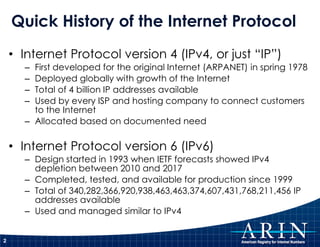
Quick History of the Internet Protocol
    • Internet Protocol version 4 (IPv4, or just “IP”)
      – First developed for the original Internet (ARPANET) in spring 1978
      – Deployed globally with growth of the Internet
      – Total of 4 billion IP addresses available
      – Used by every ISP and hosting company to connect customers
        to the Internet
      – Allocated based on documented need

    • Internet Protocol version 6 (IPv6)
      – Design started in 1993 when IETF forecasts showed IPv4
        depletion between 2010 and 2017
      – Completed, tested, and available for production since 1999
      – Total of 340,282,366,920,938,463,463,374,607,431,768,211,456 IP
        addresses available
      – Used and managed similar to IPv4


2
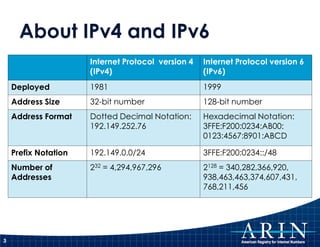
About IPv4 and IPv6
                      Internet Protocol version 4   Internet Protocol version 6
                      (IPv4)                        (IPv6)
    Deployed          1981                          1999
    Address Size      32-bit number                 128-bit number
    Address Format    Dotted Decimal Notation:      Hexadecimal Notation:
                      192.149.252.76                3FFE:F200:0234:AB00:
                                                    0123:4567:8901:ABCD

    Prefix Notation   192.149.0.0/24                3FFE:F200:0234::/48
    Number of         232 = 4,294,967,296           2128 = 340,282,366,920,
    Addresses                                       938,463,463,374,607,431,
                                                    768,211,456


3
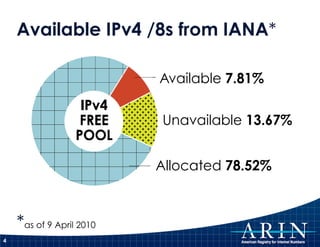
Available IPv4 /8s from IANA*


    *as of 9 April 2010
4
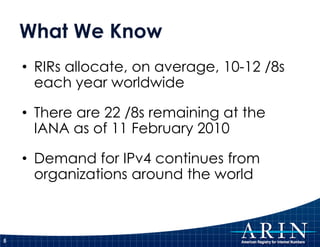
What We Know
    • RIRs allocate, on average, 10-12 /8s
      each year worldwide

    • There are 22 /8s remaining at the
      IANA as of 11 February 2010

    • Demand for IPv4 continues from
      organizations around the world


5
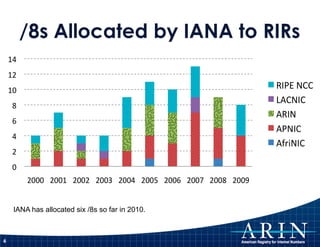
/8s Allocated by IANA to RIRs


    IANA has allocated six /8s so far in 2010.


6
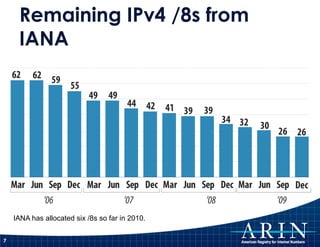
Remaining IPv4 /8s from
     IANA


    IANA has allocated six /8s so far in 2010.


7
What Will Happen
    (in no particular order)

    • IPv4 demand continues
    • IPv4 free pool depletes
    • IPv4 NAT use increases
    • IPv6 deployment


8
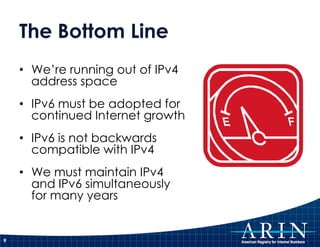
The Bottom Line
    • We’re running out of IPv4
      address space
    • IPv6 must be adopted for
      continued Internet growth
    • IPv6 is not backwards
      compatible with IPv4
    • We must maintain IPv4
      and IPv6 simultaneously
      for many years


9
RIRs have been allocating
           IPv6 address space since 1999


        Thousands of organizations have
        obtained an IPv6 allocation to date


     ARIN has IPv6 distribution policies for both
      service providers, community networks,
            and end-user organizations


10
Situation

     Today, the Internet is predominantly
     based on IPv4.
     The Internet must run two IP versions at
     the same time (IPv4 & IPv6) - this is the
     “dual-stack” approach.


11
Situation

     Today, there are organizations
     attempting to reach your mail, web,
     and application servers via IPv6.

     In the near future there will be many
     more deployments using IPv6.


12
Situation
     What requires contiguous number resources?
       • Building out major new networks
       • ISPs adding new customers

     What does this mean for:
       • Enterprise Customers?
       • Internet Service Providers?
       • Equipment Vendors?
       • Content and Hosting Firms?


13
Call to Action
     Enterprise Customers
     Mail, web, and application servers must be
     reachable via IPv6 in addition to IPv4.

     Open a dialogue with your Internet Service
     Provider about providing IPv6 services.

     Each organization must decide on timelines,
     and investment level will vary.


14
Call to Action
     Internet Service Providers
     Begin planning to connect customers via
     both IPv4 and IPv6 now.

     Communicate with your peers and vendors
     about IPv6.

     Consider IPv6 when making purchases.


15
Call to Action
     Equipment Vendors
     There was probably limited demand for IPv6 in
     the past.

     Demand for IPv6 support will become
     mandatory very, very quickly.

     Introduce IPv6 support into your product cycle
     as soon as possible.


16
Call to Action
     Content Providers
     Content clients must be reachable to
     newer Internet customers.

     Begin planning to connect hosting
     customers via both IPv4 and IPv6 now.

     Encourage customers to use IPv6 and
     test their applications over it as soon
     as possible.

17
Government Actions
     Awareness
     Coordinate with industry
     Adopt incentives
       • Regulatory
       • Economic
     Support and promote activities
     Officially adopt IPv6


18
IPv6 Adoption Needs
     IPv6 address space

     IPv6 connectivity (native or tunneled)

     Operating systems, software, and network
     management tool upgrades

     Router, firewall, and other hardware upgrades

     IT staff and customer service training


19
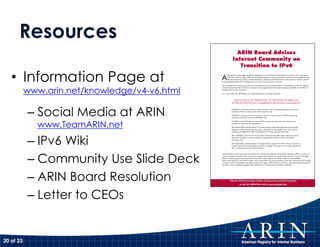
Resources

   • Information Page at
           www.arin.net/knowledge/v4-v6.html

           – Social Media at ARIN
             www.TeamARIN.net
           – IPv6 Wiki
           – Community Use Slide Deck
           – ARIN Board Resolution
           – Letter to CEOs


20 of 23
Learn More and Get Involved
     Learn more about IPv6
     www.arin.net
     www.getipv6.info
     www.TeamARIN.net

     Get Involved in ARIN
       Public Policy Mailing List
       Attend a Meeting
     http://www.arin.net/participate/

21
Thank You


22

10 fn s10

  • 1.
    IPv4 Depletion & IPv6 Adoption John Curran ARIN President & CEO 11 May 2010
  • 2.
    Quick History ofthe Internet Protocol • Internet Protocol version 4 (IPv4, or just “IP”) – First developed for the original Internet (ARPANET) in spring 1978 – Deployed globally with growth of the Internet – Total of 4 billion IP addresses available – Used by every ISP and hosting company to connect customers to the Internet – Allocated based on documented need • Internet Protocol version 6 (IPv6) – Design started in 1993 when IETF forecasts showed IPv4 depletion between 2010 and 2017 – Completed, tested, and available for production since 1999 – Total of 340,282,366,920,938,463,463,374,607,431,768,211,456 IP addresses available – Used and managed similar to IPv4 2
  • 3.
    About IPv4 andIPv6 Internet Protocol version 4 Internet Protocol version 6 (IPv4) (IPv6) Deployed 1981 1999 Address Size 32-bit number 128-bit number Address Format Dotted Decimal Notation: Hexadecimal Notation: 192.149.252.76 3FFE:F200:0234:AB00: 0123:4567:8901:ABCD Prefix Notation 192.149.0.0/24 3FFE:F200:0234::/48 Number of 232 = 4,294,967,296 2128 = 340,282,366,920, Addresses 938,463,463,374,607,431, 768,211,456 3
  • 4.
    Available IPv4 /8sfrom IANA* *as of 9 April 2010 4
  • 5.
    What We Know • RIRs allocate, on average, 10-12 /8s each year worldwide • There are 22 /8s remaining at the IANA as of 11 February 2010 • Demand for IPv4 continues from organizations around the world 5
  • 6.
    /8s Allocated byIANA to RIRs IANA has allocated six /8s so far in 2010. 6
  • 7.
    Remaining IPv4 /8sfrom IANA IANA has allocated six /8s so far in 2010. 7
  • 8.
    What Will Happen (in no particular order) • IPv4 demand continues • IPv4 free pool depletes • IPv4 NAT use increases • IPv6 deployment 8
  • 9.
    The Bottom Line • We’re running out of IPv4 address space • IPv6 must be adopted for continued Internet growth • IPv6 is not backwards compatible with IPv4 • We must maintain IPv4 and IPv6 simultaneously for many years 9
  • 10.
    RIRs have beenallocating IPv6 address space since 1999 Thousands of organizations have obtained an IPv6 allocation to date ARIN has IPv6 distribution policies for both service providers, community networks, and end-user organizations 10
  • 11.
    Situation Today, the Internet is predominantly based on IPv4. The Internet must run two IP versions at the same time (IPv4 & IPv6) - this is the “dual-stack” approach. 11
  • 12.
    Situation Today, there are organizations attempting to reach your mail, web, and application servers via IPv6. In the near future there will be many more deployments using IPv6. 12
  • 13.
    Situation What requires contiguous number resources? • Building out major new networks • ISPs adding new customers What does this mean for: • Enterprise Customers? • Internet Service Providers? • Equipment Vendors? • Content and Hosting Firms? 13
  • 14.
    Call to Action Enterprise Customers Mail, web, and application servers must be reachable via IPv6 in addition to IPv4. Open a dialogue with your Internet Service Provider about providing IPv6 services. Each organization must decide on timelines, and investment level will vary. 14
  • 15.
    Call to Action Internet Service Providers Begin planning to connect customers via both IPv4 and IPv6 now. Communicate with your peers and vendors about IPv6. Consider IPv6 when making purchases. 15
  • 16.
    Call to Action Equipment Vendors There was probably limited demand for IPv6 in the past. Demand for IPv6 support will become mandatory very, very quickly. Introduce IPv6 support into your product cycle as soon as possible. 16
  • 17.
    Call to Action Content Providers Content clients must be reachable to newer Internet customers. Begin planning to connect hosting customers via both IPv4 and IPv6 now. Encourage customers to use IPv6 and test their applications over it as soon as possible. 17
  • 18.
    Government Actions Awareness Coordinate with industry Adopt incentives • Regulatory • Economic Support and promote activities Officially adopt IPv6 18
  • 19.
    IPv6 Adoption Needs IPv6 address space IPv6 connectivity (native or tunneled) Operating systems, software, and network management tool upgrades Router, firewall, and other hardware upgrades IT staff and customer service training 19
  • 20.
    Resources • Information Page at www.arin.net/knowledge/v4-v6.html – Social Media at ARIN www.TeamARIN.net – IPv6 Wiki – Community Use Slide Deck – ARIN Board Resolution – Letter to CEOs 20 of 23
  • 21.
    Learn More andGet Involved Learn more about IPv6 www.arin.net www.getipv6.info www.TeamARIN.net Get Involved in ARIN Public Policy Mailing List Attend a Meeting http://www.arin.net/participate/ 21
  • 22.