1
IPv4 Waiting list
Elly Tawhai
AusNOG 2016 02-09-2016
Outline
• Current IPv4 delegations trends
• Introduction of IPv4 waiting list
• Odd cases
• Why IPv6
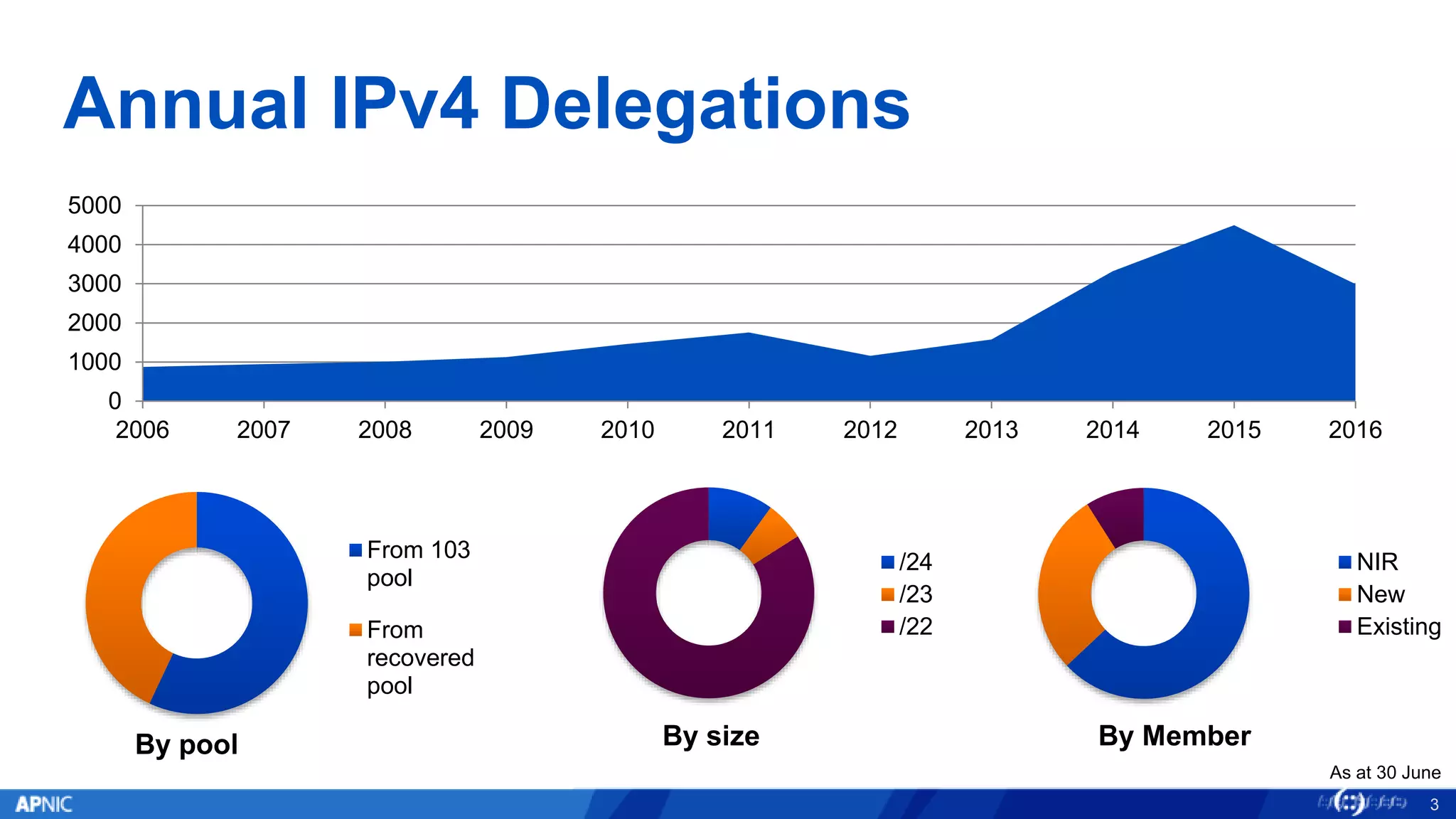
Annual IPv4 Delegations
0
1000
2000
3000
4000
5000
2006 2007 2008 2009 2010 2011 2012 2013 2014 2015 2016
3
From 103
pool
From
recovered
pool
/24
/23
/22
NIR
New
Existing
By pool By size By Member
As at 30 June
Current IPv4 Delegation Policy and
Practice
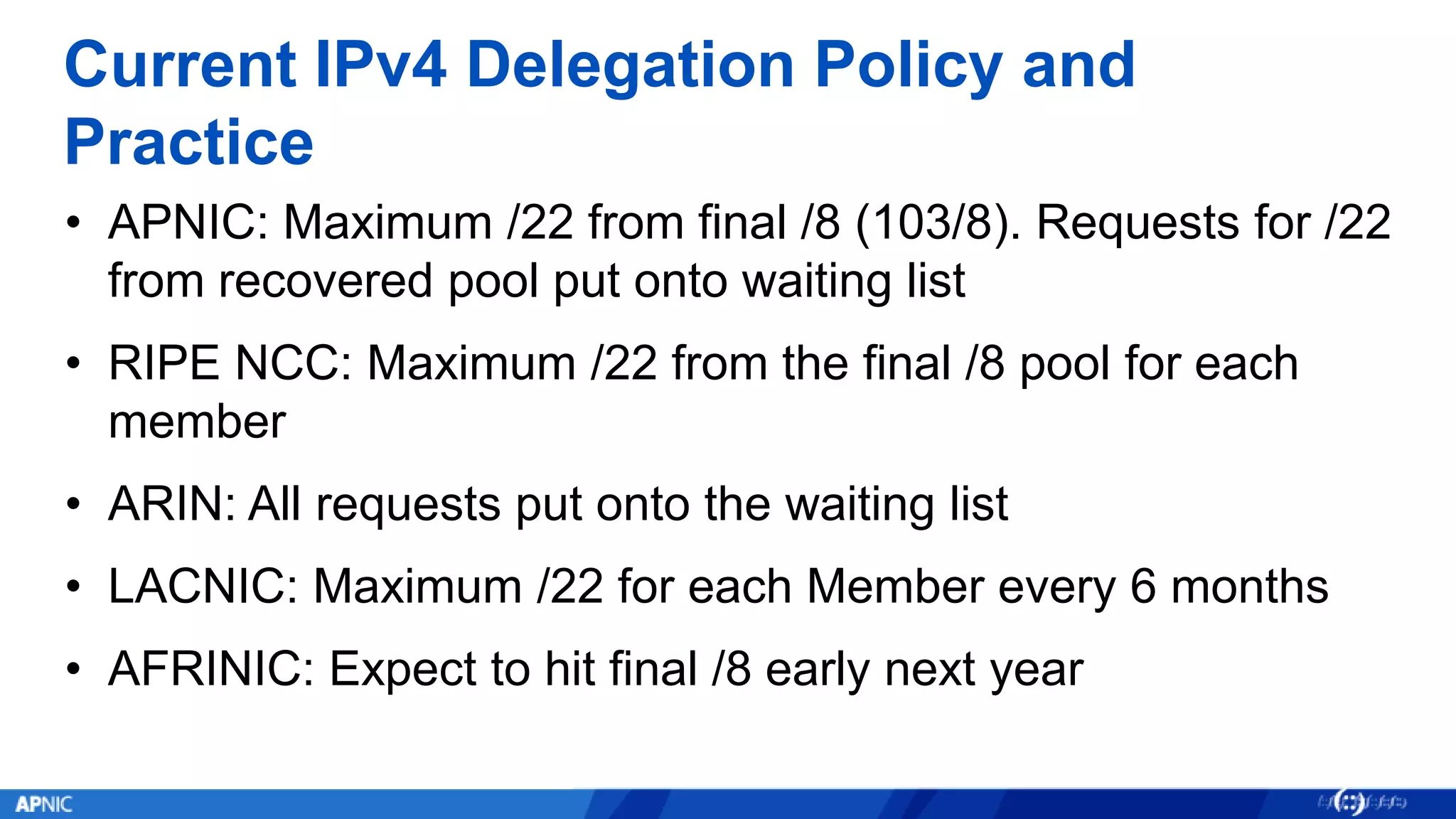
• APNIC: Maximum /22 from final /8 (103/8). Requests for /22
from recovered pool put onto waiting list
• RIPE NCC: Maximum /22 from the final /8 pool for each
member
• ARIN: All requests put onto the waiting list
• LACNIC: Maximum /22 for each Member every 6 months
• AFRINIC: Expect to hit final /8 early next year
Waiting list – What waiting list?
 9 June 2016 first approved request from recovered pool
couldn’t be processed
 Triggered activation of IPv4 Recovered Pool waiting list
How the Waiting List works?
 Any approved request from recovered pool put onto the
waiting list
 Based on request timestamp (oldest to newest)
 Option to remove request from waiting list anytime
 After 12 months request removed from waiting list unless
member reconfirms need justification
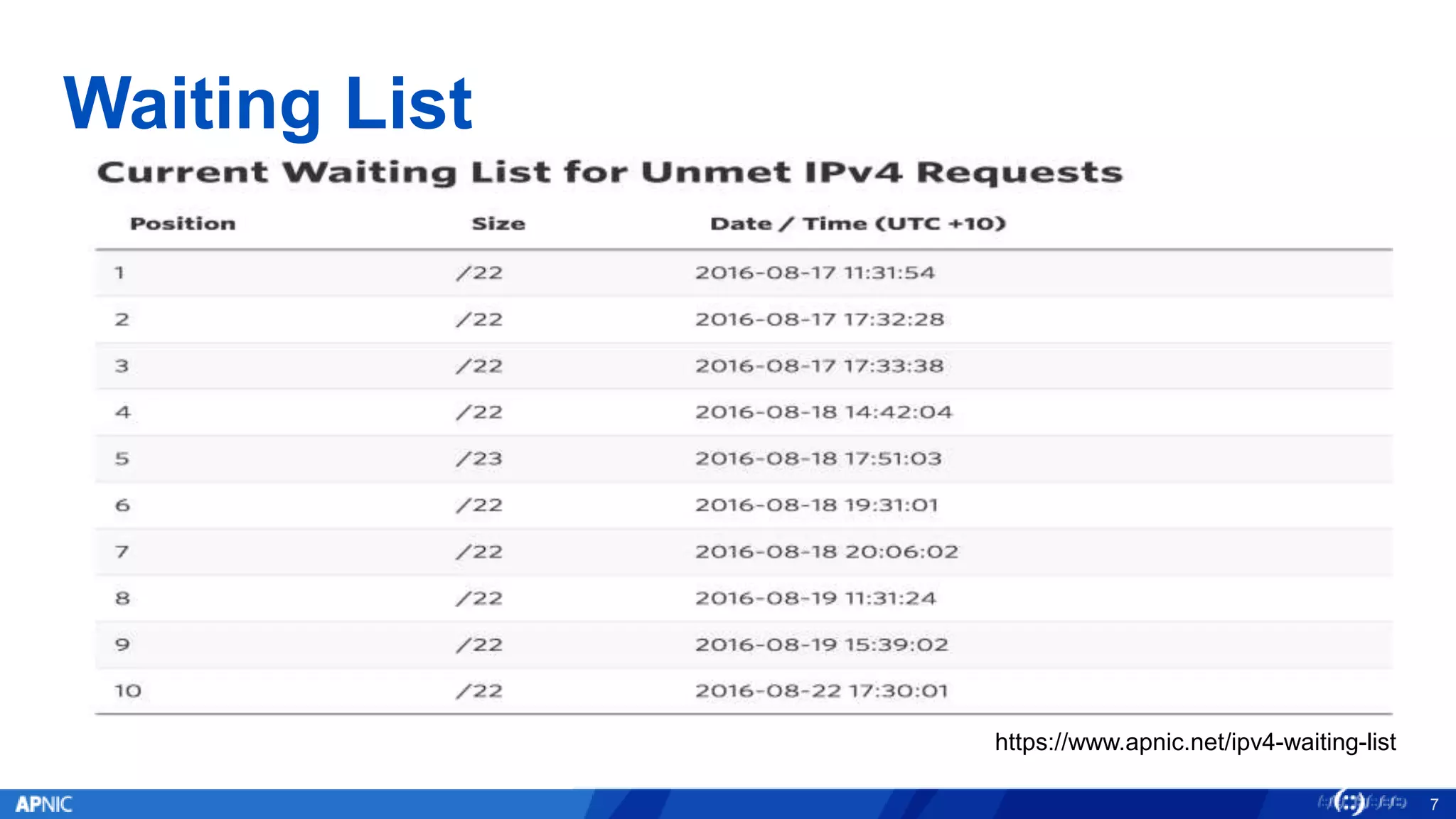
Waiting List
7
https://www.apnic.net/ipv4-waiting-list
Affects and odd requests
• Payment fraud
• NIR member applying for additional space
• No ISP license
• Not able to demonstrate utilization of requested resources
within APNIC region
• Not able to provide supporting equipment justification
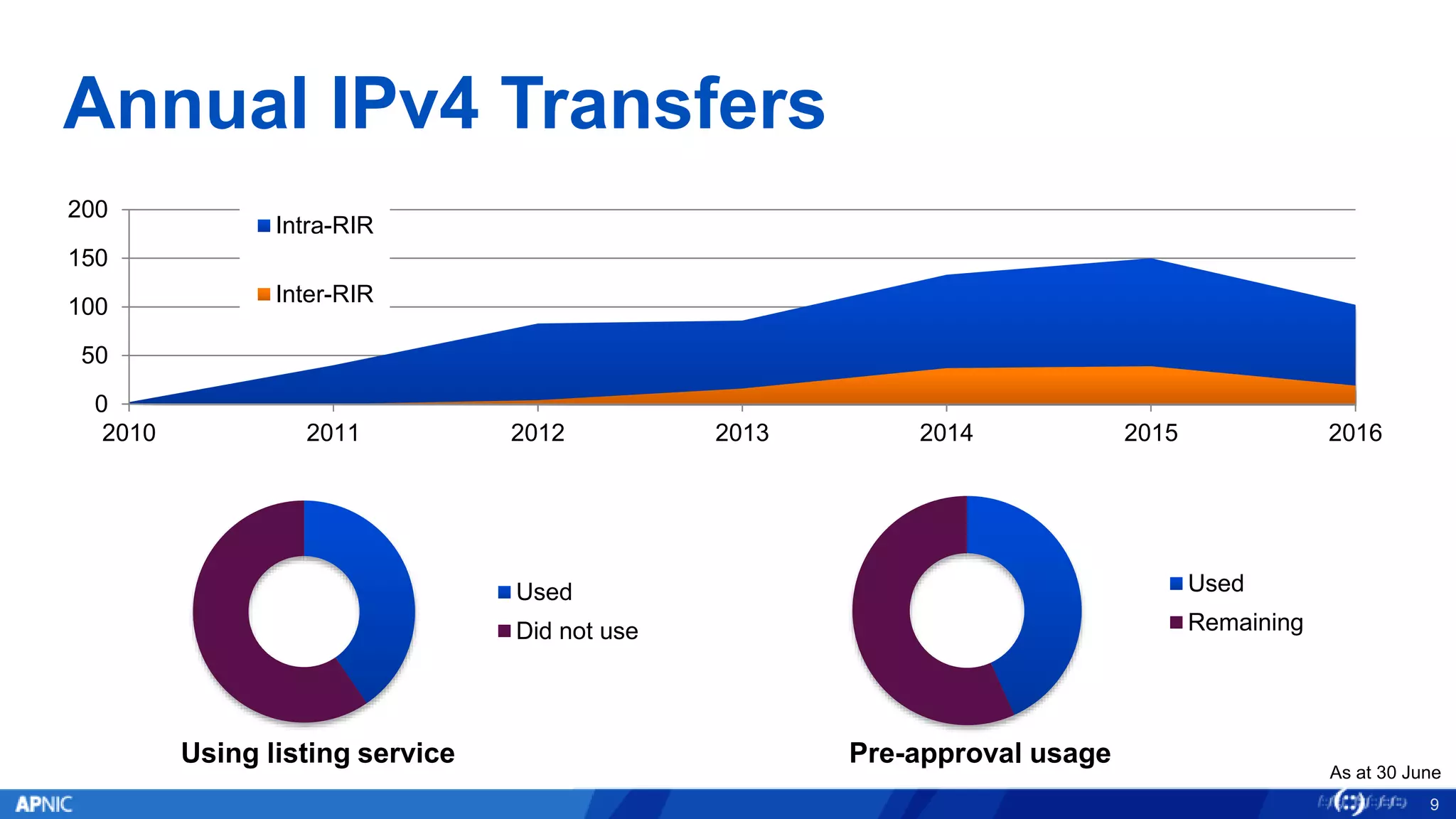
Annual IPv4 Transfers
9
Used
Did not use
Using listing service
Used
Remaining
Pre-approval usage
As at 30 June
0
50
100
150
200
2010 2011 2012 2013 2014 2015 2016
Intra-RIR
Inter-RIR
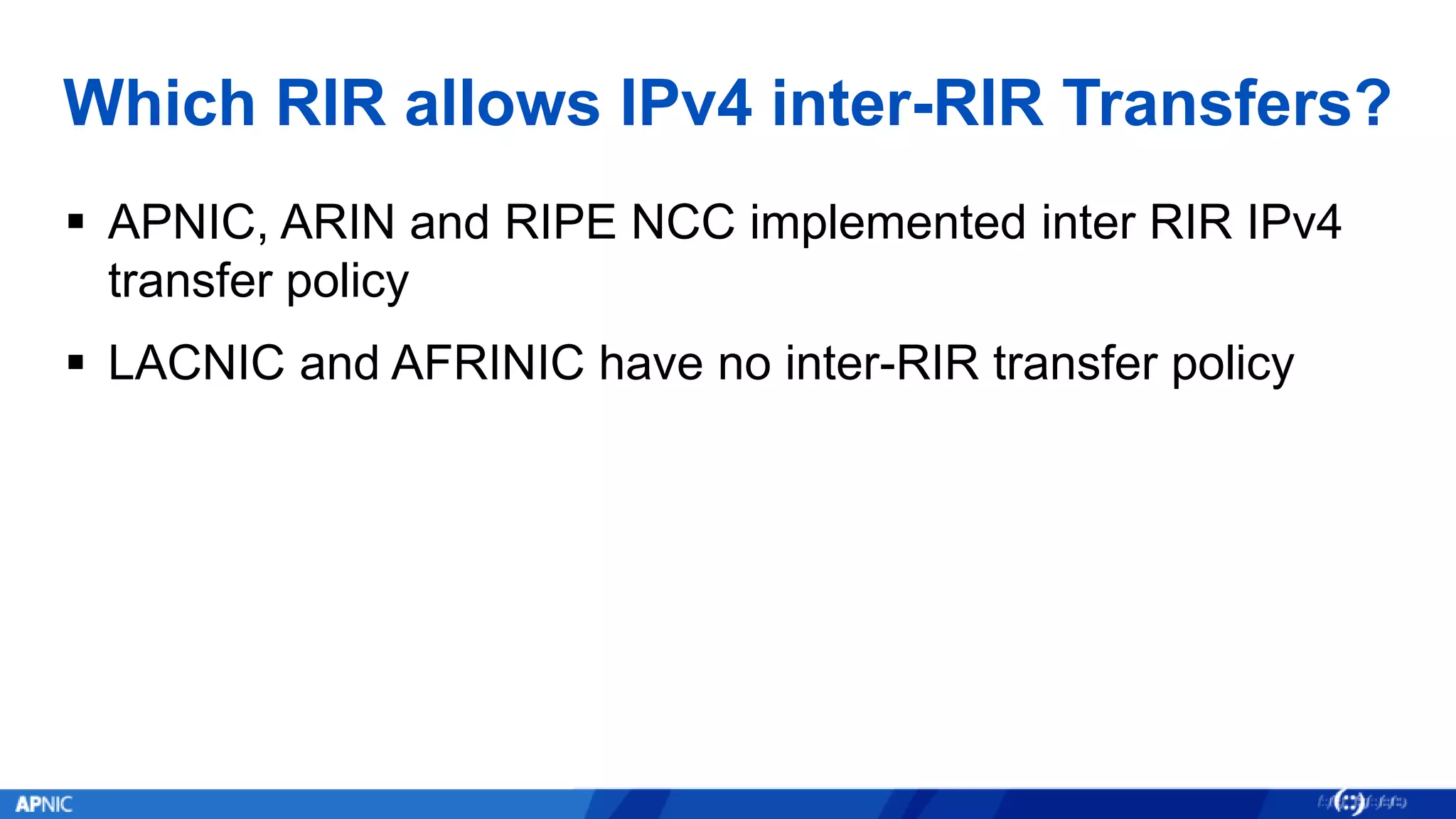
Which RIR allows IPv4 inter-RIR Transfers?
 APNIC, ARIN and RIPE NCC implemented inter RIR IPv4
transfer policy
 LACNIC and AFRINIC have no inter-RIR transfer policy
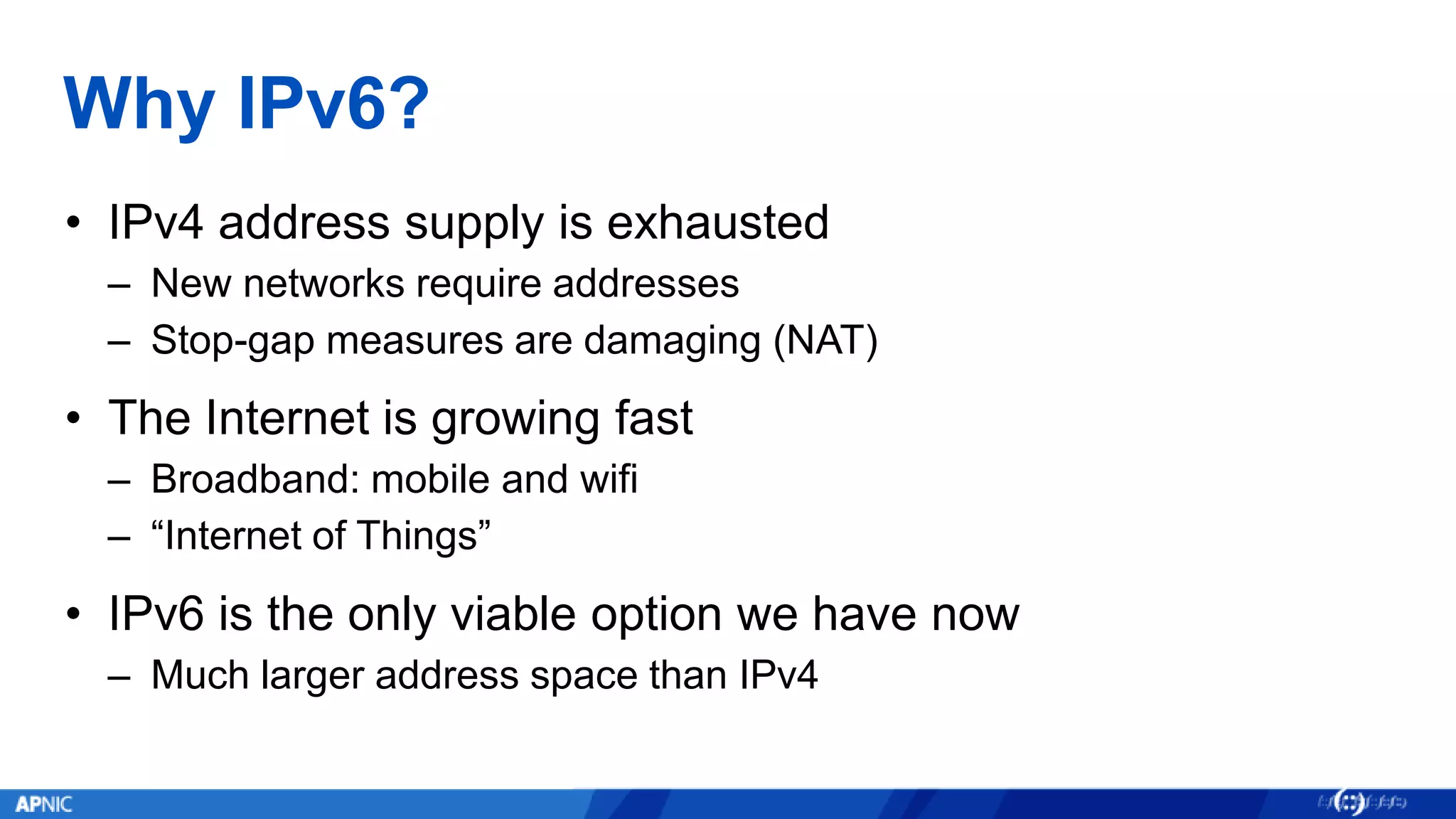
Why IPv6?
• IPv4 address supply is exhausted
– New networks require addresses
– Stop-gap measures are damaging (NAT)
• The Internet is growing fast
– Broadband: mobile and wifi
– “Internet of Things”
• IPv6 is the only viable option we have now
– Much larger address space than IPv4
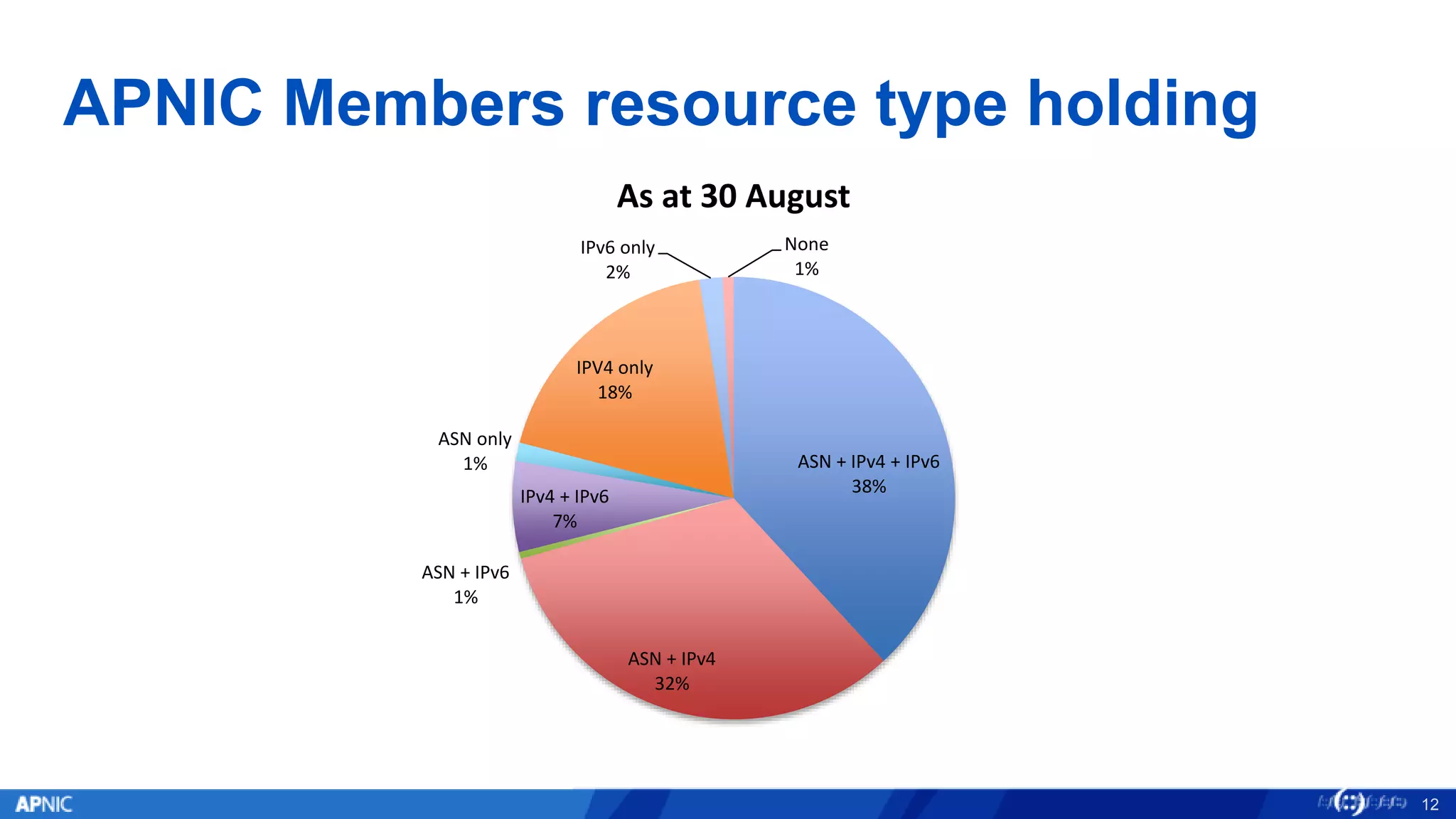
APNIC Members resource type holding
12
ASN + IPv4 + IPv6
38%
ASN + IPv4
32%
ASN + IPv6
1%
IPv4 + IPv6
7%
ASN only
1%
IPV4 only
18%
IPv6 only
2%
None
1%
As at 30 August
Annual IPv6 Delegations
13
By delegation type
>=/31
/32
/43-/47
/48
By size By request type
As at 30 June
Allocation
Assignment
One-click
Normal
0
200
400
600
800
1000
2006 2007 2008 2009 2010 2011 2012 2013 2014 2015 2016
All About Australia in INR
24,362,139 people
21,170,698 users
87% penetration
2,048 ASes
$1.62T GDP
IPv4 1257 in BGP
48,617,728 addresses
2.00 per head
87% visible
IPv6 262 in BGP
37,916,029 M addresses
1,556,350 per head
47% visible
8% capability
Significant IPv6 Capable ASNs
0
20
40
60
80
100
%IPv6Capable
AS1221 telstra
AS4739 Internode
AS133414 FoxTel
Top Australian ASN by IPv6 Capability
ASN AS Name IPv6
Capable
IPv6
Preferred
# Samples
AS58683 Rackspace.com Sydney 98.69% 97.82% 459
AS6262 CSIRO 92.80% 89.39% 264
AS15169 GOOGLE - Google Inc. 92.56% 89.43% 511
AS58686 Swinburne University of Technology 88.48% 83.25% 191
AS133414 Foxtel Management Pty Ltd 70.56% 67.43% 15715
AS56132 Monash University 25.27% 25.27% 1369
AS7477 SkyMesh Pty Ltd 20.32% 15.93% 2618
AS1221 ASN-TELSTRA Telstra Pty Ltd 15.31% 14.24% 1143259
AS20473 AS-CHOOPA - Choopa, LLC 15.09% 9.40% 1458
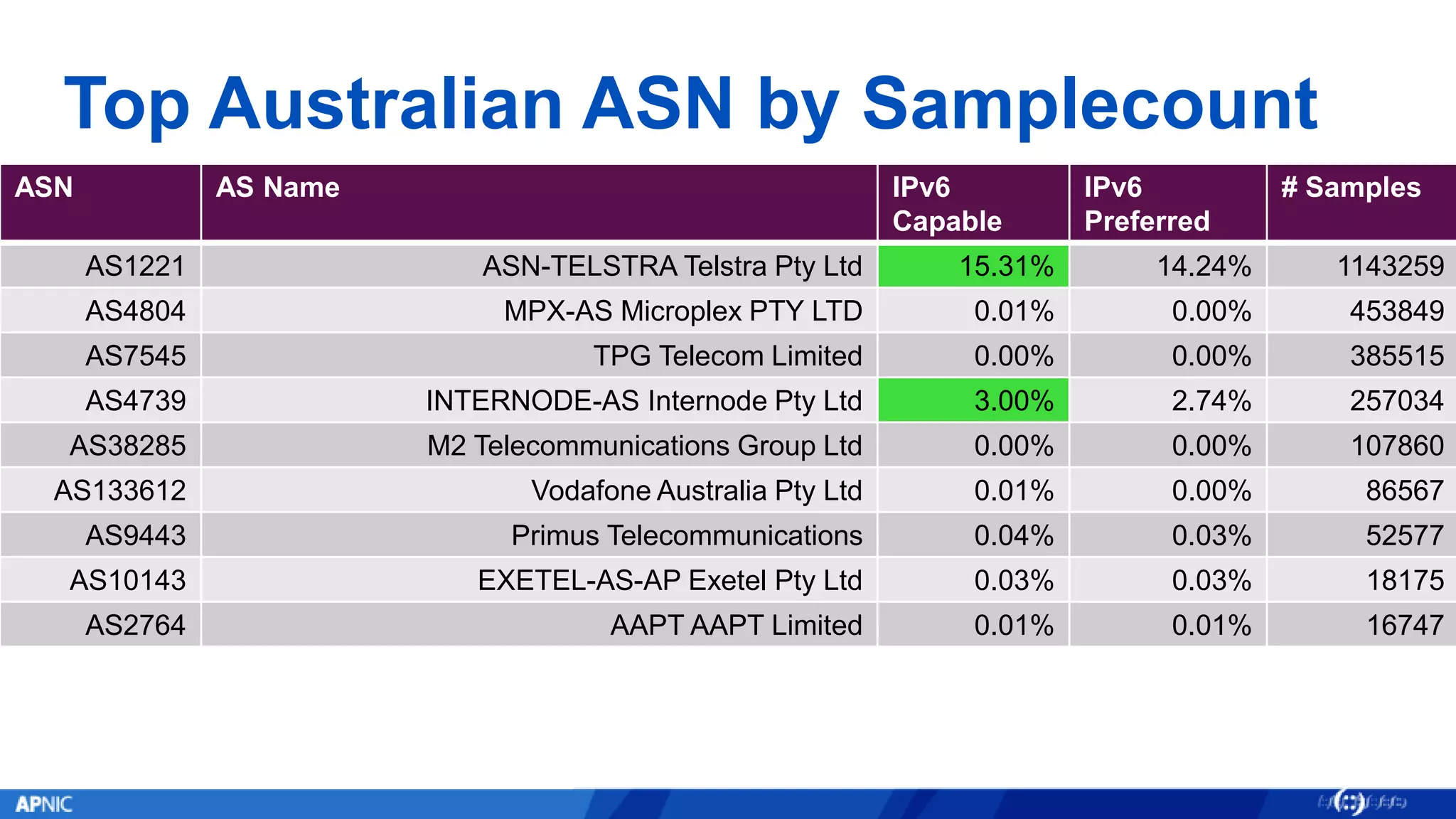
Top Australian ASN by Samplecount
ASN AS Name IPv6
Capable
IPv6
Preferred
# Samples
AS1221 ASN-TELSTRA Telstra Pty Ltd 15.31% 14.24% 1143259
AS4804 MPX-AS Microplex PTY LTD 0.01% 0.00% 453849
AS7545 TPG Telecom Limited 0.00% 0.00% 385515
AS4739 INTERNODE-AS Internode Pty Ltd 3.00% 2.74% 257034
AS38285 M2 Telecommunications Group Ltd 0.00% 0.00% 107860
AS133612 Vodafone Australia Pty Ltd 0.01% 0.00% 86567
AS9443 Primus Telecommunications 0.04% 0.03% 52577
AS10143 EXETEL-AS-AP Exetel Pty Ltd 0.03% 0.03% 18175
AS2764 AAPT AAPT Limited 0.01% 0.01% 16747
Your all invited!
18
conference.apnic.net/42
Colombo, Sri Lanka
Workshop: 28 Sep to 2 Oct
Conference: 3 to 5 Oct
19
Questions ?

APNIC IPv4 Waiting list - AusNOG 2016

  • 1.
    1 IPv4 Waiting list EllyTawhai AusNOG 2016 02-09-2016
  • 2.
    Outline • Current IPv4delegations trends • Introduction of IPv4 waiting list • Odd cases • Why IPv6
  • 3.
    Annual IPv4 Delegations 0 1000 2000 3000 4000 5000 20062007 2008 2009 2010 2011 2012 2013 2014 2015 2016 3 From 103 pool From recovered pool /24 /23 /22 NIR New Existing By pool By size By Member As at 30 June
  • 4.
    Current IPv4 DelegationPolicy and Practice • APNIC: Maximum /22 from final /8 (103/8). Requests for /22 from recovered pool put onto waiting list • RIPE NCC: Maximum /22 from the final /8 pool for each member • ARIN: All requests put onto the waiting list • LACNIC: Maximum /22 for each Member every 6 months • AFRINIC: Expect to hit final /8 early next year
  • 5.
    Waiting list –What waiting list?  9 June 2016 first approved request from recovered pool couldn’t be processed  Triggered activation of IPv4 Recovered Pool waiting list
  • 6.
    How the WaitingList works?  Any approved request from recovered pool put onto the waiting list  Based on request timestamp (oldest to newest)  Option to remove request from waiting list anytime  After 12 months request removed from waiting list unless member reconfirms need justification
  • 7.
  • 8.
    Affects and oddrequests • Payment fraud • NIR member applying for additional space • No ISP license • Not able to demonstrate utilization of requested resources within APNIC region • Not able to provide supporting equipment justification
  • 9.
    Annual IPv4 Transfers 9 Used Didnot use Using listing service Used Remaining Pre-approval usage As at 30 June 0 50 100 150 200 2010 2011 2012 2013 2014 2015 2016 Intra-RIR Inter-RIR
  • 10.
    Which RIR allowsIPv4 inter-RIR Transfers?  APNIC, ARIN and RIPE NCC implemented inter RIR IPv4 transfer policy  LACNIC and AFRINIC have no inter-RIR transfer policy
  • 11.
    Why IPv6? • IPv4address supply is exhausted – New networks require addresses – Stop-gap measures are damaging (NAT) • The Internet is growing fast – Broadband: mobile and wifi – “Internet of Things” • IPv6 is the only viable option we have now – Much larger address space than IPv4
  • 12.
    APNIC Members resourcetype holding 12 ASN + IPv4 + IPv6 38% ASN + IPv4 32% ASN + IPv6 1% IPv4 + IPv6 7% ASN only 1% IPV4 only 18% IPv6 only 2% None 1% As at 30 August
  • 13.
    Annual IPv6 Delegations 13 Bydelegation type >=/31 /32 /43-/47 /48 By size By request type As at 30 June Allocation Assignment One-click Normal 0 200 400 600 800 1000 2006 2007 2008 2009 2010 2011 2012 2013 2014 2015 2016
  • 14.
    All About Australiain INR 24,362,139 people 21,170,698 users 87% penetration 2,048 ASes $1.62T GDP IPv4 1257 in BGP 48,617,728 addresses 2.00 per head 87% visible IPv6 262 in BGP 37,916,029 M addresses 1,556,350 per head 47% visible 8% capability
  • 15.
    Significant IPv6 CapableASNs 0 20 40 60 80 100 %IPv6Capable AS1221 telstra AS4739 Internode AS133414 FoxTel
  • 16.
    Top Australian ASNby IPv6 Capability ASN AS Name IPv6 Capable IPv6 Preferred # Samples AS58683 Rackspace.com Sydney 98.69% 97.82% 459 AS6262 CSIRO 92.80% 89.39% 264 AS15169 GOOGLE - Google Inc. 92.56% 89.43% 511 AS58686 Swinburne University of Technology 88.48% 83.25% 191 AS133414 Foxtel Management Pty Ltd 70.56% 67.43% 15715 AS56132 Monash University 25.27% 25.27% 1369 AS7477 SkyMesh Pty Ltd 20.32% 15.93% 2618 AS1221 ASN-TELSTRA Telstra Pty Ltd 15.31% 14.24% 1143259 AS20473 AS-CHOOPA - Choopa, LLC 15.09% 9.40% 1458
  • 17.
    Top Australian ASNby Samplecount ASN AS Name IPv6 Capable IPv6 Preferred # Samples AS1221 ASN-TELSTRA Telstra Pty Ltd 15.31% 14.24% 1143259 AS4804 MPX-AS Microplex PTY LTD 0.01% 0.00% 453849 AS7545 TPG Telecom Limited 0.00% 0.00% 385515 AS4739 INTERNODE-AS Internode Pty Ltd 3.00% 2.74% 257034 AS38285 M2 Telecommunications Group Ltd 0.00% 0.00% 107860 AS133612 Vodafone Australia Pty Ltd 0.01% 0.00% 86567 AS9443 Primus Telecommunications 0.04% 0.03% 52577 AS10143 EXETEL-AS-AP Exetel Pty Ltd 0.03% 0.03% 18175 AS2764 AAPT AAPT Limited 0.01% 0.01% 16747
  • 18.
    Your all invited! 18 conference.apnic.net/42 Colombo,Sri Lanka Workshop: 28 Sep to 2 Oct Conference: 3 to 5 Oct
  • 19.

Editor's Notes

  • #4 There was a marked increase in IPv4 requests from 2014 as a result of the availability of address space from the recovered pool. After four months of 2016, the level of delegations is at a similar rate to 2015. 43% of requests have come from the recovered pool and 57% from the last /8 pool. Unsurprisingly, the majority of the v4 delegations are /22s, which is the maximum allowed by the policy. In 2015, APNIC has made 1958 delegations from 103/8 and 2540 delegations from the recovered pool.
  • #7 Once additional IPv4 address space is added to the recovered pool, your request for IPv4 will be made according to your position on the waiting list. An estimate of the time this will take cannot be provided.
  • #9 You may have read some of the discussion on the AusNOG mailing list in June this is some of the odd cases we have received franchise – suspected for upstream for NIR member (5) No equipment or peering contracts within AP region (7) Two different (legitimate) business registrations, but used same invoices as current account
  • #10 Another way to source address space 9 registered brokers listed on the APNIC website. (Since 2011) Total number of intra-RIR addresses transferred: 12,317,184 Total number of inter-RIR addresses transferred: 7,776,256 Time required for transfers: minimum two days
  • #11 As of 1 October 2015 transfers are now available with the RIPE NCC region.
  • #12 IPv6 is the only viable option we have now Enable sustainable growth of the Internet Support the emergence of new technologies
  • #13 Reflection of the membership that has IPv4 address space only IPv6 ratio – 46.95% IPv4 + IPv6 ratio 44.76% Total active Members 5,845
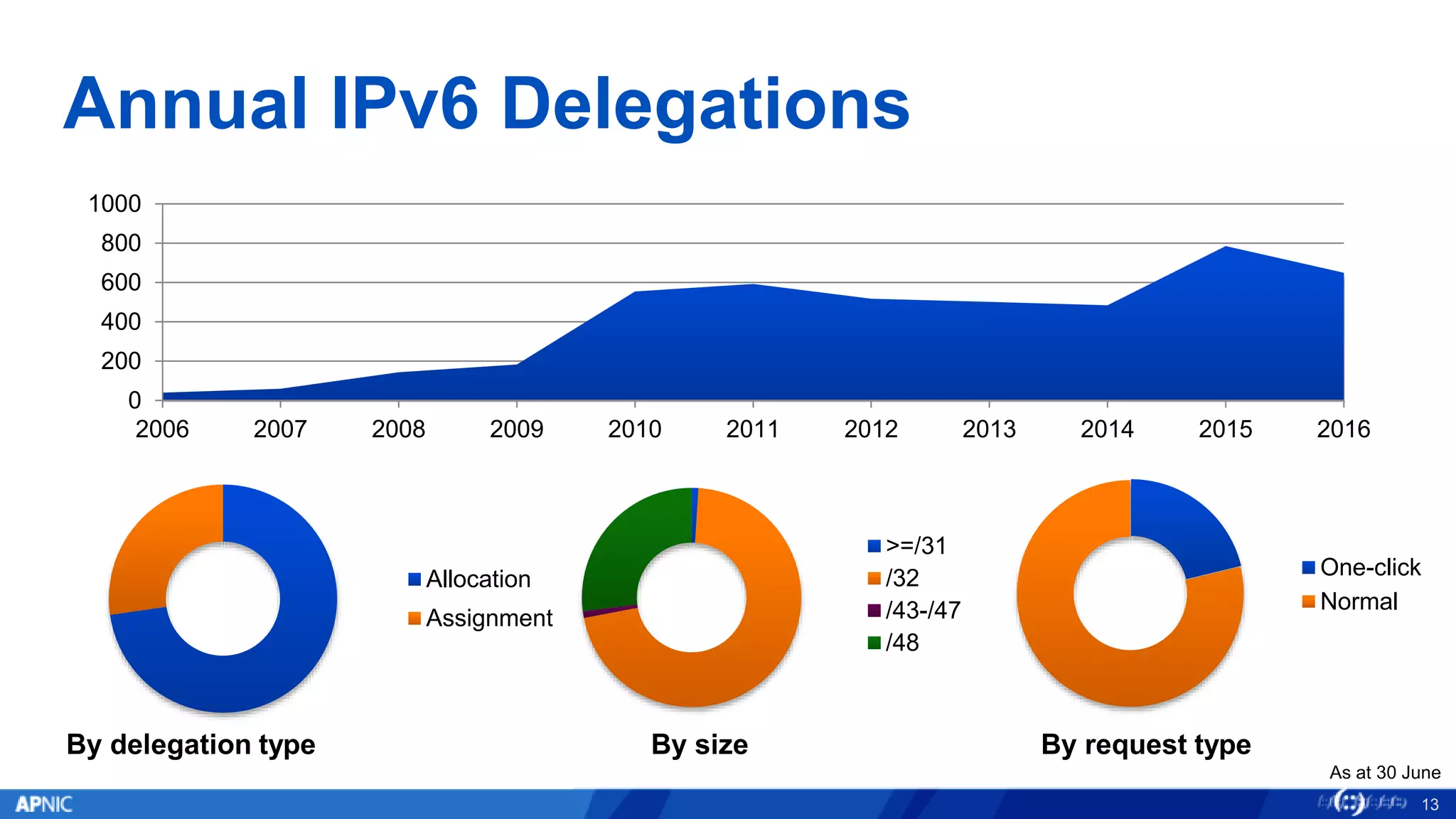
  • #14 The delegation rate for IPv6 increased in 2015 and continues to accelerate. So far in 2016, we have delegated 650 blocks of IPv6 which is a 151% increase on the same period last year (2015: 258 delegations up until end April). The majority of delegations have been a /32 (70%) which is the default allocation size for providers, followed by /48s which is the default assignment size for end-sites. Most came from normal allocations, instead of one-click.
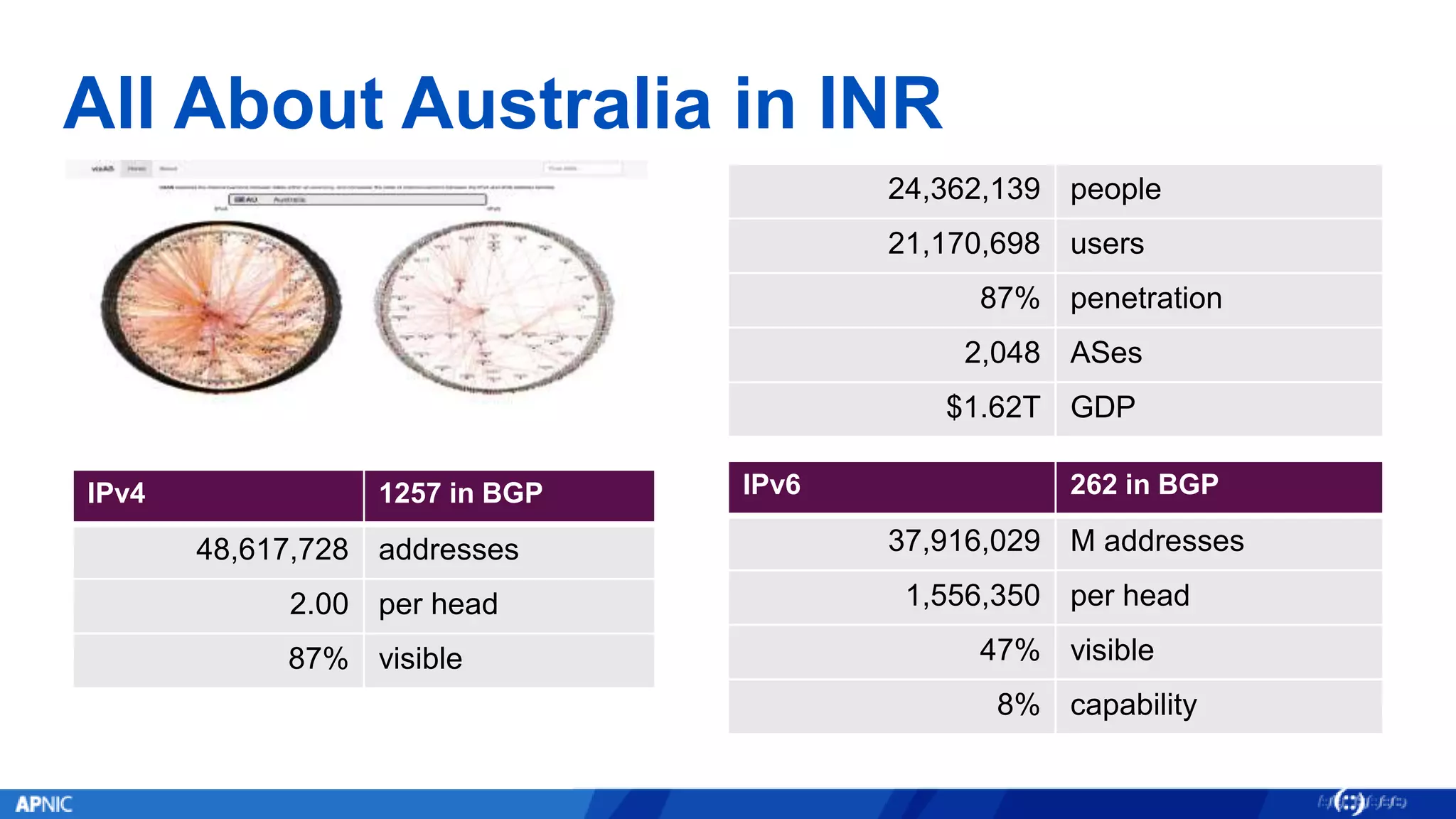
  • #15 international normalized ratio (INR) – Can see all of the data for AU such as the amount amount of routed space, number of prefixes visible. We are measuring enduser eyeballs that are able to see our advert we are measuring enduser capability (this is the blocking point). A summary has been taken of all of the measurements in lab side and put them together to show a topset of high v6 capability, then taken than the same list sorted by the number of samples whish is an approximation of eyeballs not market share but similar then taken sample set and second sorted it by v6 capability to demonstrate whom is visible. Measuring end user capalitity
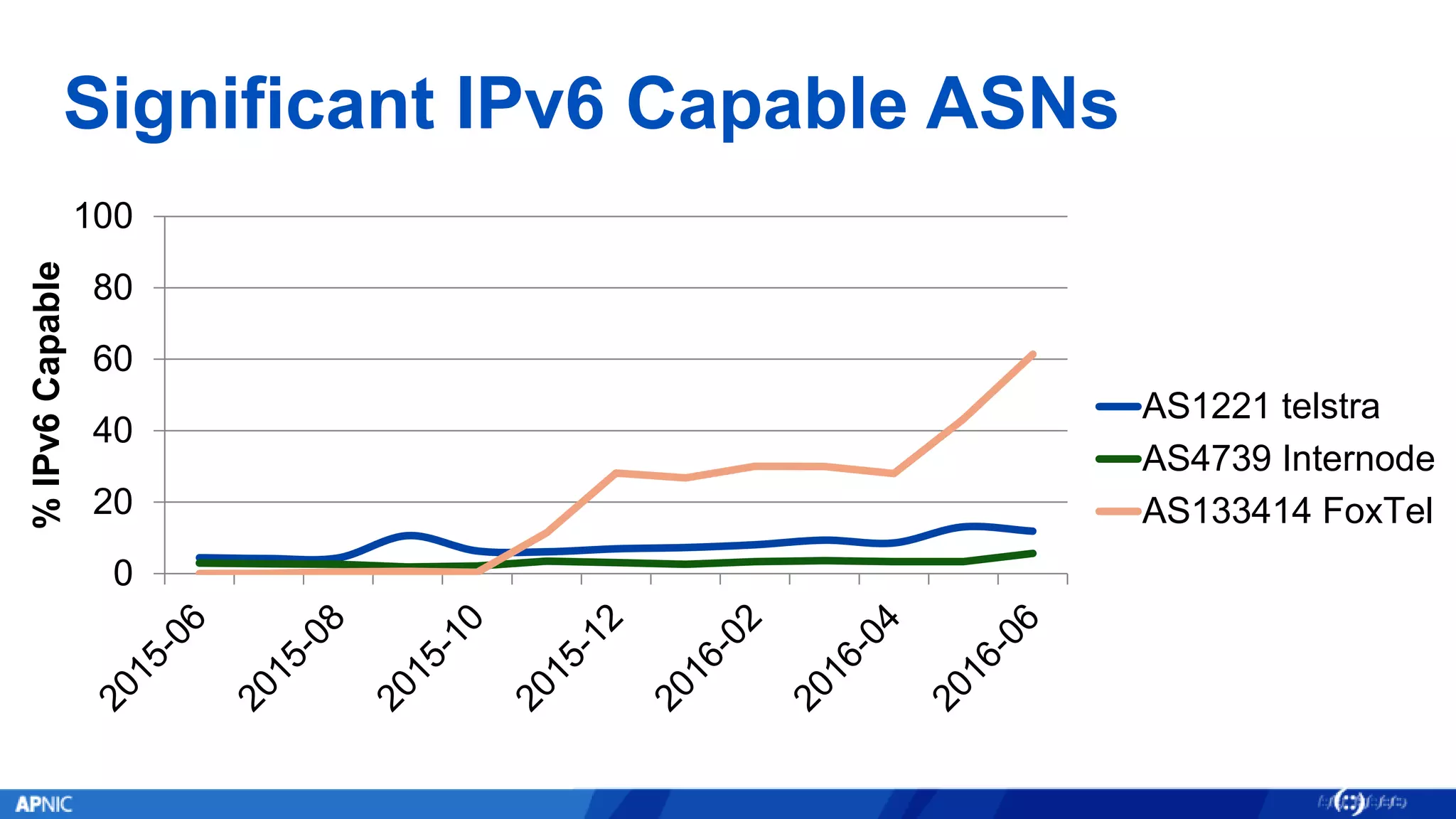
  • #16 At the 100% scaling the level of uptake within Australia
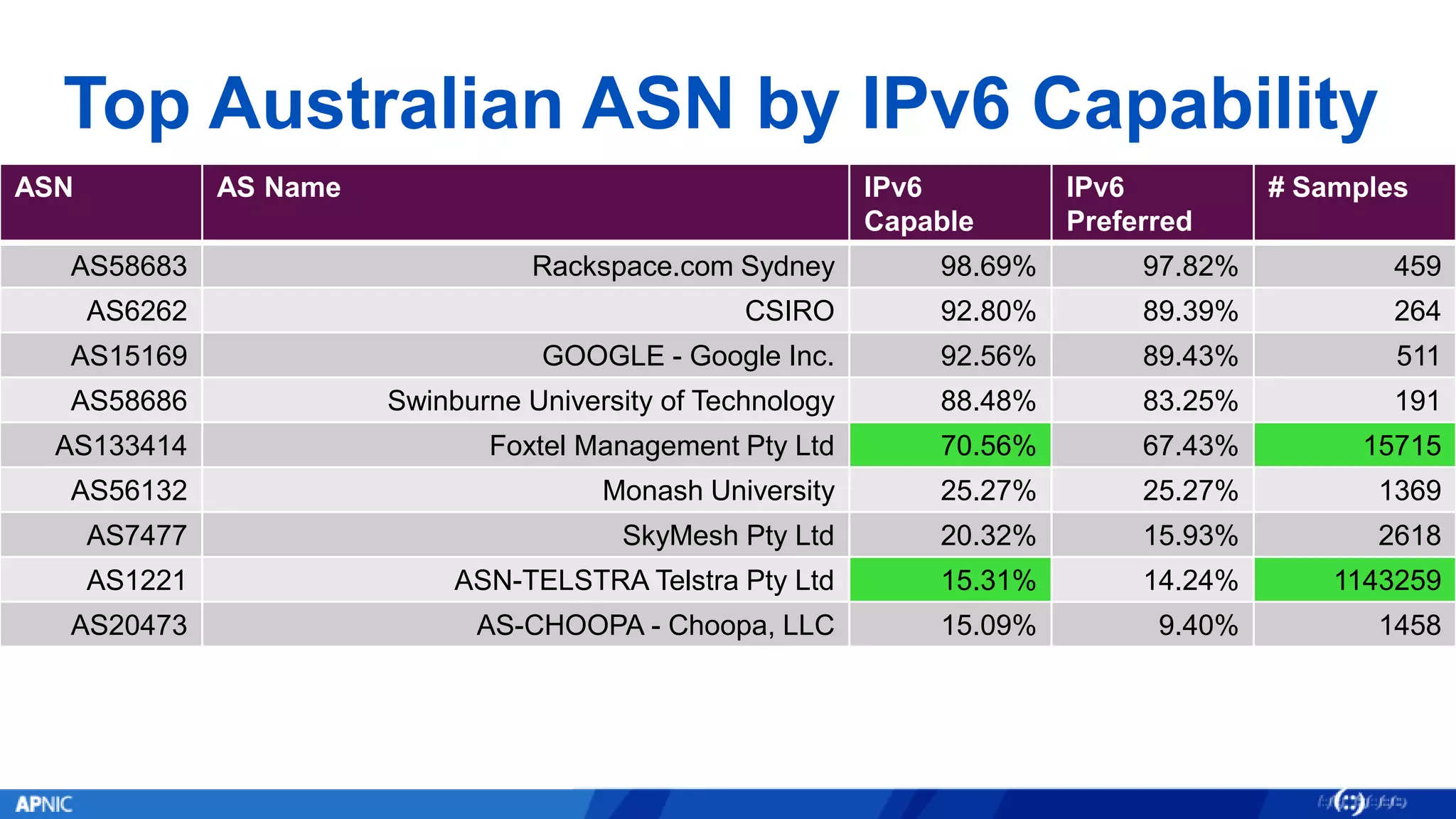
  • #17 Top Australian ASN sorted by v6 capability Highlighted are companies whom are recognised participants in customer facing services (that’s not to say the others are not) So the competency and capapility are there, but lacking economic investment that is going to make this a real activity in front of customers
  • #18 Top Australian ASN sorted, by Market share List sorted by eyeball share so list of ISPs First player is Telstra with 15.31% List of public companies with no visible activity that is going that is going to achieve v6 on their customer base So they have to arrange capital investment that is going to bring v6 into public use