THE BODY IN MOTION
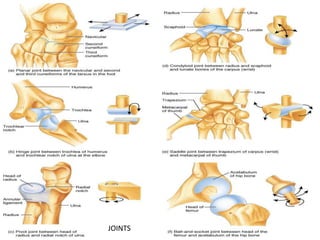
JOINTS
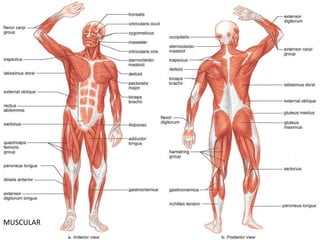
MUSCULAR
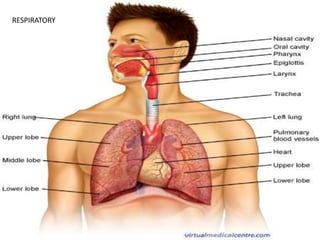
RESPIRATORY
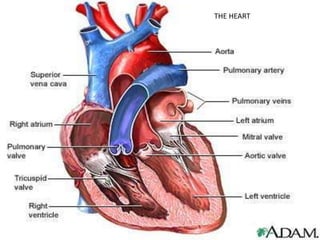
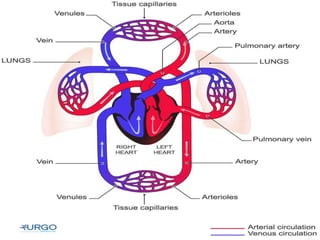
THE HEART
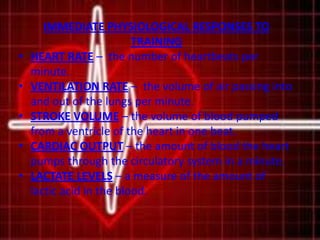
IMMEDIATE PHYSIOLOGICAL RESPONSES TO
TRAINING
• HEART RATE – the number of heartbeats per
minute.
• VENTILATION RATE – the volume of air passing into
and out of the lungs per minute.
• STROKE VOLUME – the volume of blood pumped
from a ventricle of the heart in one beat.
• CARDIAC OUTPUT – the amount of blood the heart
pumps through the circulatory system in a minute.
• LACTATE LEVELS – a measure of the amount of
lactic acid in the blood.
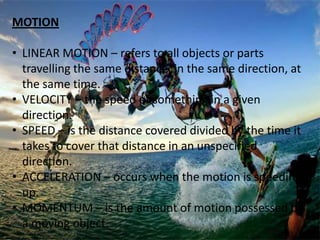
MOTION
• LINEAR MOTION – refers to all objects or parts
travelling the same distance, in the same direction, at
the same time.
• VELOCITY – the speed of something in a given
direction.
• SPEED – is the distance covered divided by the time it
takes to cover that distance in an unspecified
direction.
• ACCELERATION – occurs when the motion is speeding
up.
• MOMENTUM – is the amount of motion possessed by
a moving object.
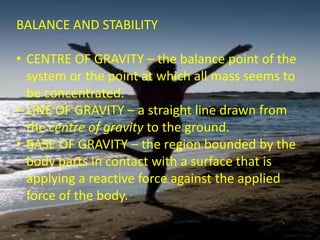
BALANCE AND STABILITY
• CENTRE OF GRAVITY – the balance point of the
system or the point at which all mass seems to
be concentrated.
• LINE OF GRAVITY – a straight line drawn from
the centre of gravity to the ground.
• BASE OF GRAVITY – the region bounded by the
body parts in contact with a surface that is
applying a reactive force against the applied
force of the body.
FLUID MECHANICS
• FLOATATION – consists of buoyant force that pushes the body
up and the weight force that pulls the body down (gravity).
• CENTRE OF BUOYANCY – the centre of gravity of the water
that the body displaces.
• FLUID RESISTANCE
• DRAG – the resistance that acts against a body as it moves
through a fluid movement.
• LIFT – occurs perpendicular to the flow of the water over
the body when swimming.
• THE MAGNUS EFFECT – occurs when a spinning object
creates a whirlpool of rotating air or liquid around it.

The body in motion ss

  • 1.
  • 3.
  • 4.
  • 5.
  • 6.
  • 11.
    IMMEDIATE PHYSIOLOGICAL RESPONSESTO TRAINING • HEART RATE – the number of heartbeats per minute. • VENTILATION RATE – the volume of air passing into and out of the lungs per minute. • STROKE VOLUME – the volume of blood pumped from a ventricle of the heart in one beat. • CARDIAC OUTPUT – the amount of blood the heart pumps through the circulatory system in a minute. • LACTATE LEVELS – a measure of the amount of lactic acid in the blood.
  • 12.
    MOTION • LINEAR MOTION– refers to all objects or parts travelling the same distance, in the same direction, at the same time. • VELOCITY – the speed of something in a given direction. • SPEED – is the distance covered divided by the time it takes to cover that distance in an unspecified direction. • ACCELERATION – occurs when the motion is speeding up. • MOMENTUM – is the amount of motion possessed by a moving object.
  • 13.
    BALANCE AND STABILITY •CENTRE OF GRAVITY – the balance point of the system or the point at which all mass seems to be concentrated. • LINE OF GRAVITY – a straight line drawn from the centre of gravity to the ground. • BASE OF GRAVITY – the region bounded by the body parts in contact with a surface that is applying a reactive force against the applied force of the body.
  • 14.
    FLUID MECHANICS • FLOATATION– consists of buoyant force that pushes the body up and the weight force that pulls the body down (gravity). • CENTRE OF BUOYANCY – the centre of gravity of the water that the body displaces. • FLUID RESISTANCE • DRAG – the resistance that acts against a body as it moves through a fluid movement. • LIFT – occurs perpendicular to the flow of the water over the body when swimming. • THE MAGNUS EFFECT – occurs when a spinning object creates a whirlpool of rotating air or liquid around it.