Standard Grade PE Mechanical Principles
Mechanical Principles The following are some of the mechanical principles that we use in our Standard Grade course :- Resistance   Balance Streamlining Centre of gravity Force/friction Transfer of weight Levers Propulsion
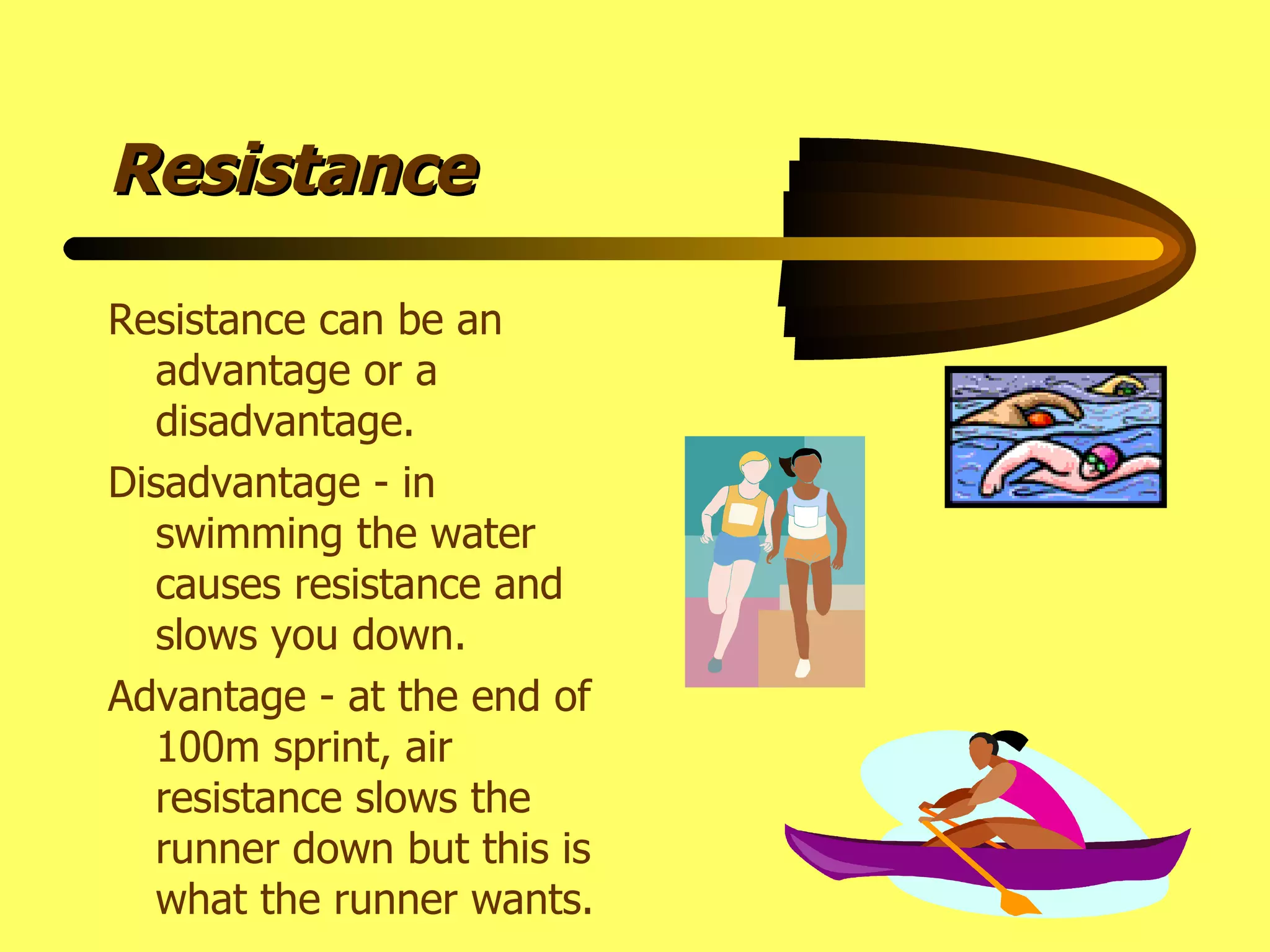
Resistance Resistance can be an advantage or a disadvantage. Disadvantage - in swimming the water causes resistance and slows you down. Advantage - at the end of 100m sprint, air resistance slows the runner down but this is what the runner wants.
Transfer of weight In everyday life, when you want to move you have to transfer your weight in the direction you want to move. If you want to move to your right, then you push off your left foot and vice versa. In different activities you transfer your weight in order to get more distance, more power etc. EG - a Badminton player steps forward after playing an  overhead clear to try and get more distance on the  shot. - a discus thrower transfers their weight continually  from one foot to the other whilst spinning across the  circle before releasing the discus.
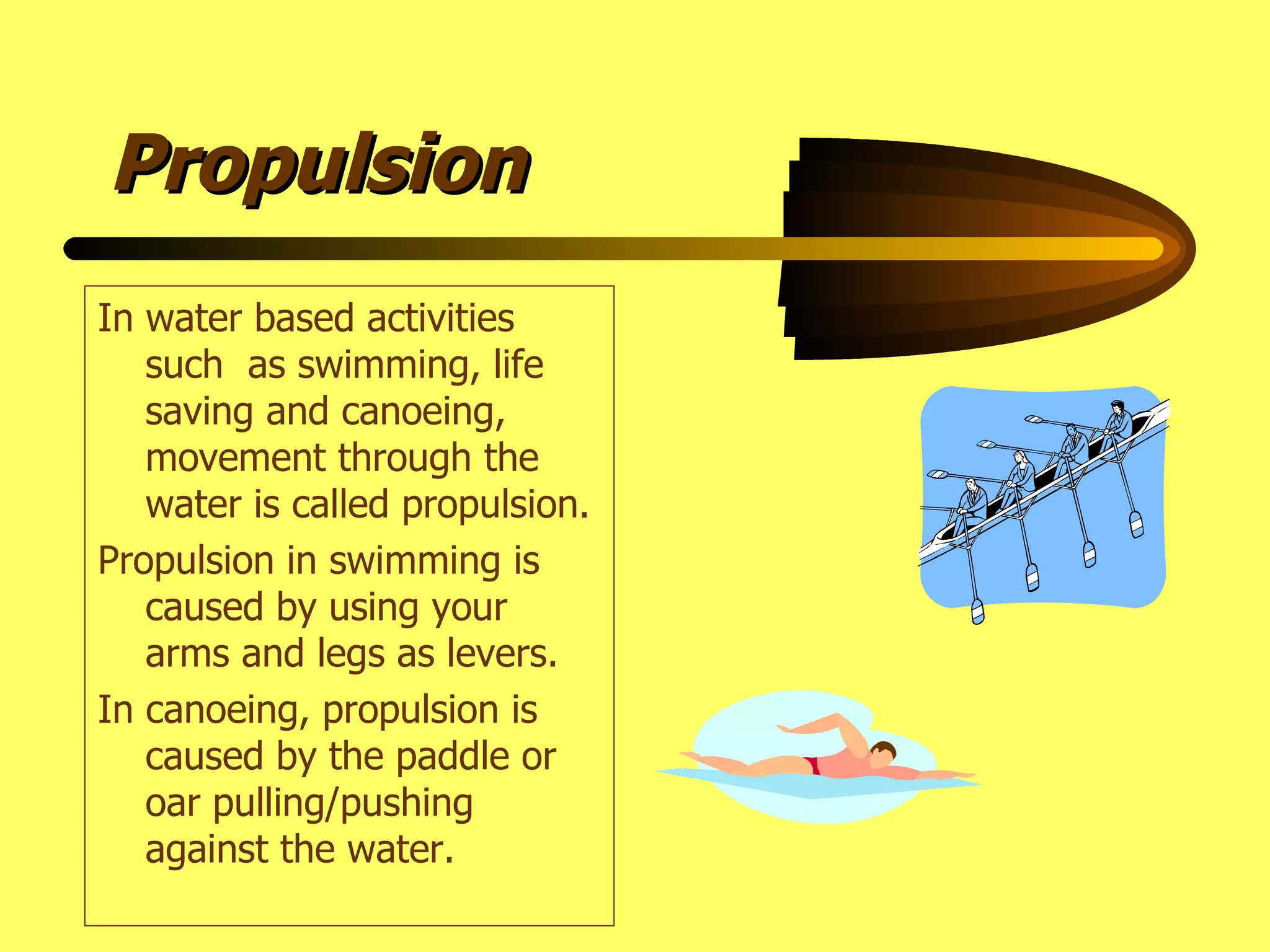
Propulsion In water based activities such  as swimming, life saving and canoeing, movement through the water is called propulsion. Propulsion in swimming is caused by using your arms and legs as levers. In canoeing, propulsion is caused by the paddle or oar pulling/pushing against the water.
Force and Friction Force Muscles provide force. When muscles contract strongly, the force causes thrust. Friction Can be an advantage Footballers wear studs on their boots to improve the friction between the boots and the ground An ice skater wants to reduce the friction between his skates and the ice – that is why the blades are thin and narrow
Centre of Gravity Where your centre of gravity is when you are performing skills determines how balanced a position you are in. When moving forwards, backwards etc, your centre of gravity constantly moves to stop us from falling over. In Gymnastics, when performing a stationary balance, your centre of gravity will be within your base and the wider the base the more stable the balance.
Levers There are many levers in our body. The muscles in our bodies move our limbs like levers. A long lever will give more speed and this in turn will make the ball, shuttle etc travel further. Examples of long levers are - a tennis player using a racket and playing with a straight arm to serve the ball fast. A gymnast  keeps her legs straight during a headspring to increase her speed of movement Short levers may be used to bring accuracy and control to various skills or techniques.
Streamlining Streamlining is when you put your body into a shape and position to reduce resistance. In swimming, the swimmer will try to keep his/her body as straight as possible in the water and part of this is by putting their face in the water instead of keeping their head up. In cycling, the cyclist wears specially designed helmets and clothes to make their body position even more streamlined.

Mechanical principles sg

  • 1.
    Standard Grade PEMechanical Principles
  • 2.
    Mechanical Principles Thefollowing are some of the mechanical principles that we use in our Standard Grade course :- Resistance Balance Streamlining Centre of gravity Force/friction Transfer of weight Levers Propulsion
  • 3.
    Resistance Resistance canbe an advantage or a disadvantage. Disadvantage - in swimming the water causes resistance and slows you down. Advantage - at the end of 100m sprint, air resistance slows the runner down but this is what the runner wants.
  • 4.
    Transfer of weightIn everyday life, when you want to move you have to transfer your weight in the direction you want to move. If you want to move to your right, then you push off your left foot and vice versa. In different activities you transfer your weight in order to get more distance, more power etc. EG - a Badminton player steps forward after playing an overhead clear to try and get more distance on the shot. - a discus thrower transfers their weight continually from one foot to the other whilst spinning across the circle before releasing the discus.
  • 5.
    Propulsion In waterbased activities such as swimming, life saving and canoeing, movement through the water is called propulsion. Propulsion in swimming is caused by using your arms and legs as levers. In canoeing, propulsion is caused by the paddle or oar pulling/pushing against the water.
  • 6.
    Force and FrictionForce Muscles provide force. When muscles contract strongly, the force causes thrust. Friction Can be an advantage Footballers wear studs on their boots to improve the friction between the boots and the ground An ice skater wants to reduce the friction between his skates and the ice – that is why the blades are thin and narrow
  • 7.
    Centre of GravityWhere your centre of gravity is when you are performing skills determines how balanced a position you are in. When moving forwards, backwards etc, your centre of gravity constantly moves to stop us from falling over. In Gymnastics, when performing a stationary balance, your centre of gravity will be within your base and the wider the base the more stable the balance.
  • 8.
    Levers There aremany levers in our body. The muscles in our bodies move our limbs like levers. A long lever will give more speed and this in turn will make the ball, shuttle etc travel further. Examples of long levers are - a tennis player using a racket and playing with a straight arm to serve the ball fast. A gymnast keeps her legs straight during a headspring to increase her speed of movement Short levers may be used to bring accuracy and control to various skills or techniques.
  • 9.
    Streamlining Streamlining iswhen you put your body into a shape and position to reduce resistance. In swimming, the swimmer will try to keep his/her body as straight as possible in the water and part of this is by putting their face in the water instead of keeping their head up. In cycling, the cyclist wears specially designed helmets and clothes to make their body position even more streamlined.