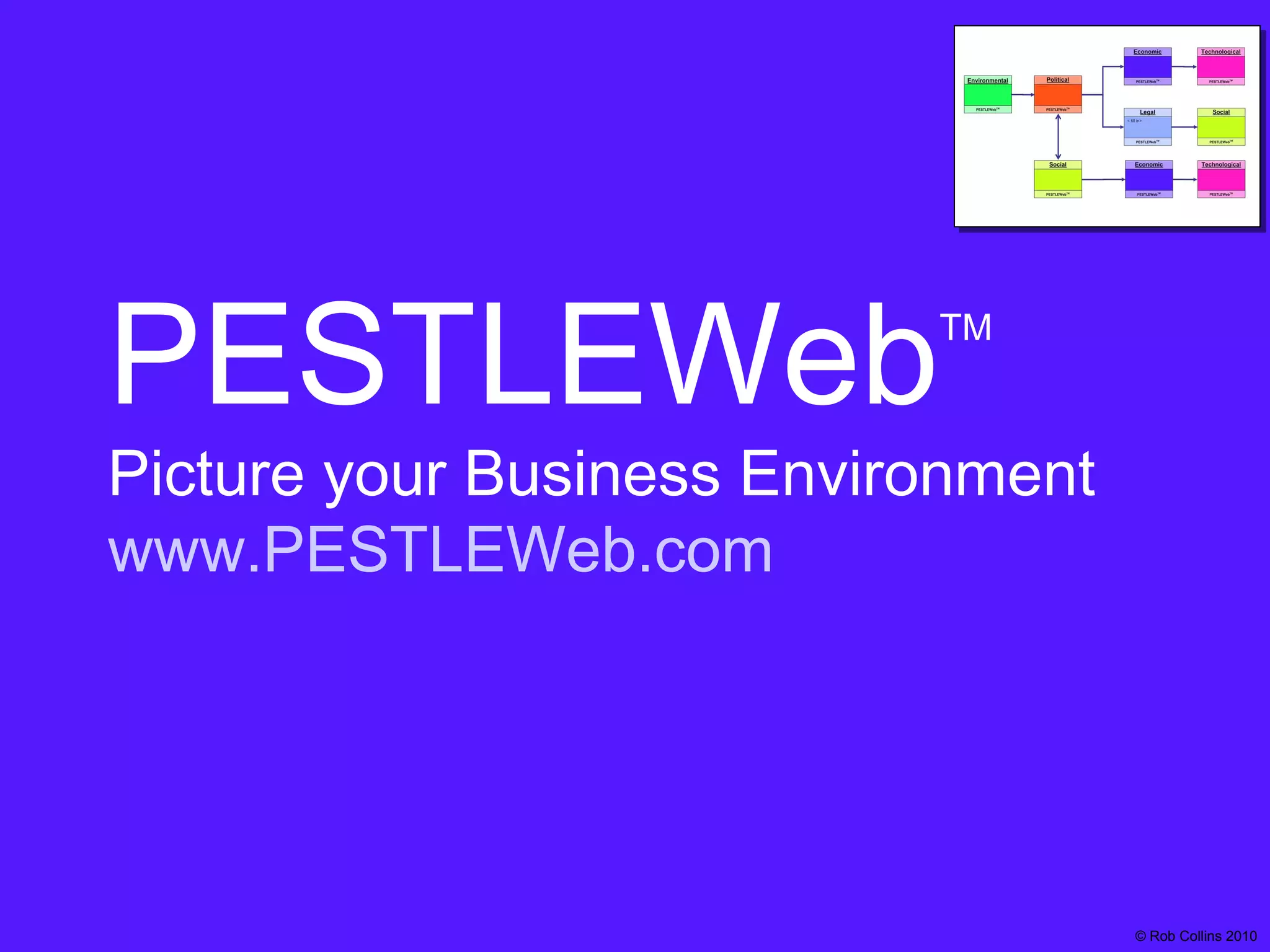
The Best way to do
PEST Analysis
A brief introduction to the PESTLEWeb method


Dr Rob Collins
www.PESTLEWeb.com

                                               © Rob Collins 2010
Setting expectations

• Don’t expect to be ‘done in 10 minutes’
• It will take time to do an analysis that is:
  • High quality
  • Information rich
  • Rigorous and Systematic
  • Valuable to your business
     • (or gets a top grade for your business strategy paper)

• Every step of the analysis increases..
  • your understanding
  • your sensitivity to your business environment
                                                         © Rob Collins 2010
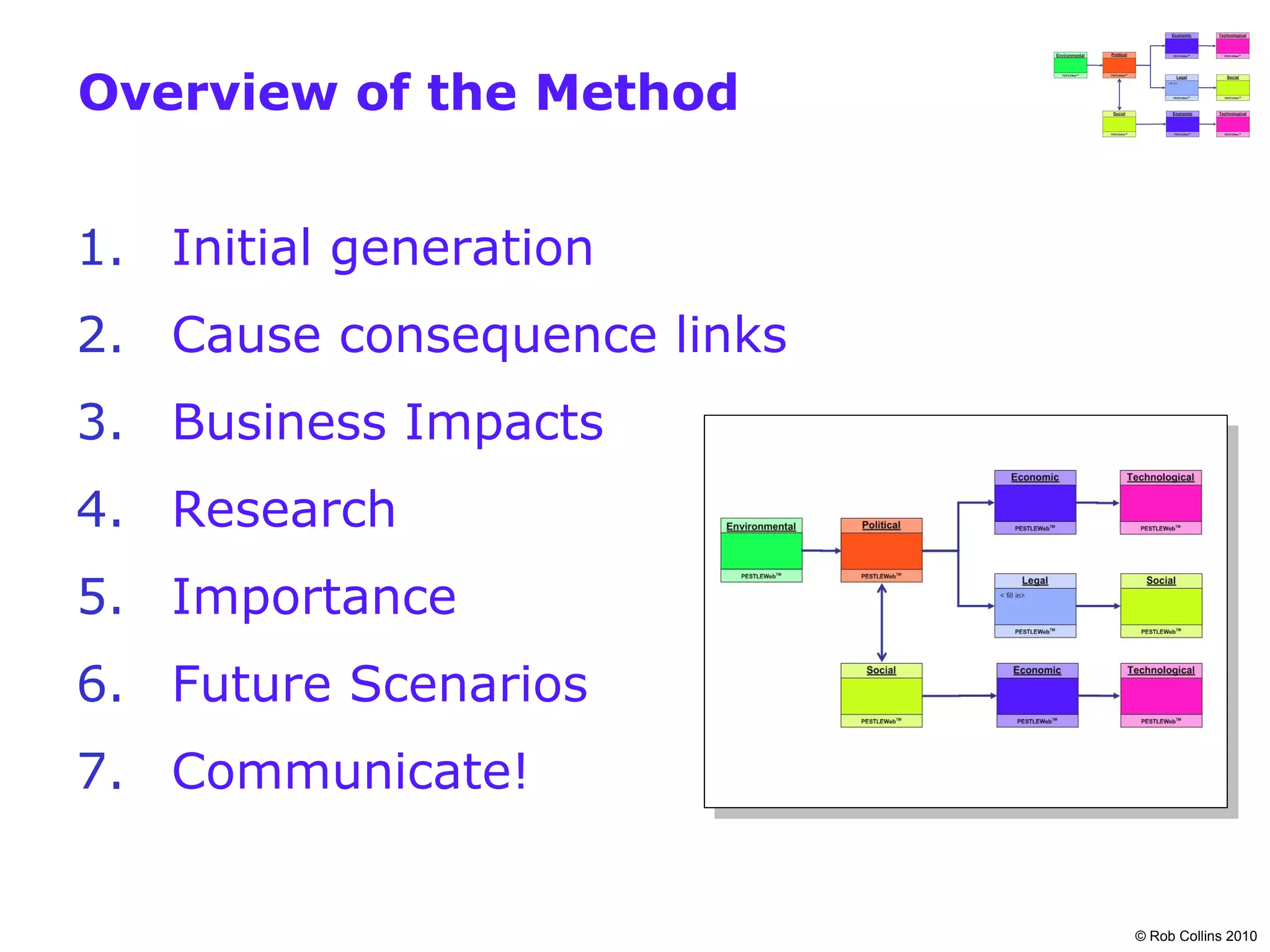
Overview of the Method


1. Initial generation
2. Cause consequence links
3. Business Impacts
4. Research
5. Importance
6. Future Scenarios
7. Communicate!


                             © Rob Collins 2010
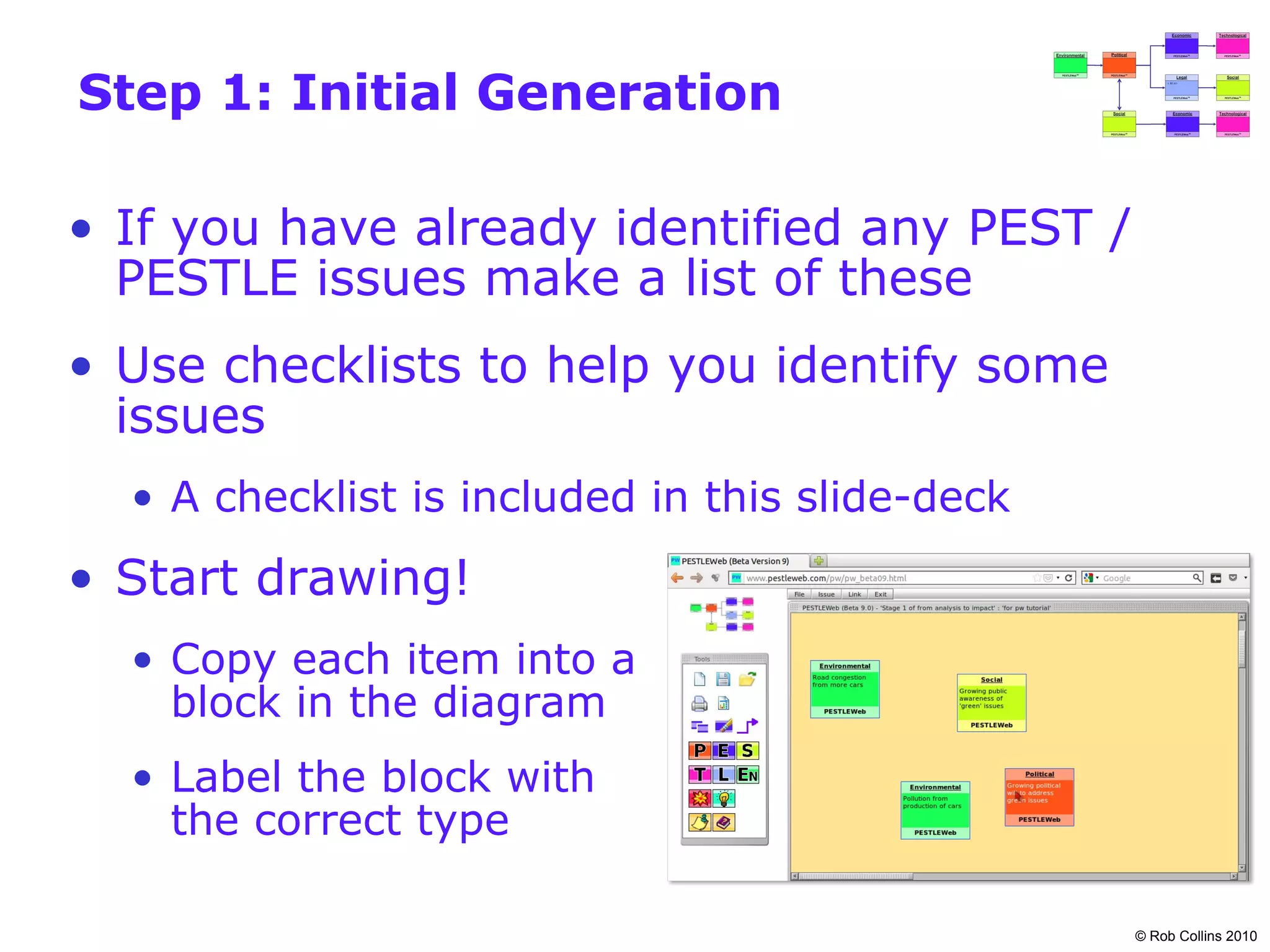
Step 1: Initial Generation

• If you have already identified any PEST /
  PESTLE issues make a list of these
• Use checklists to help you identify some
  issues
  • A checklist is included in this slide-deck
• Start drawing!
  • Copy each item into a
    block in the diagram
  • Label the block with
    the correct type

                                                 © Rob Collins 2010
Step 2: Cause/Consequence Links

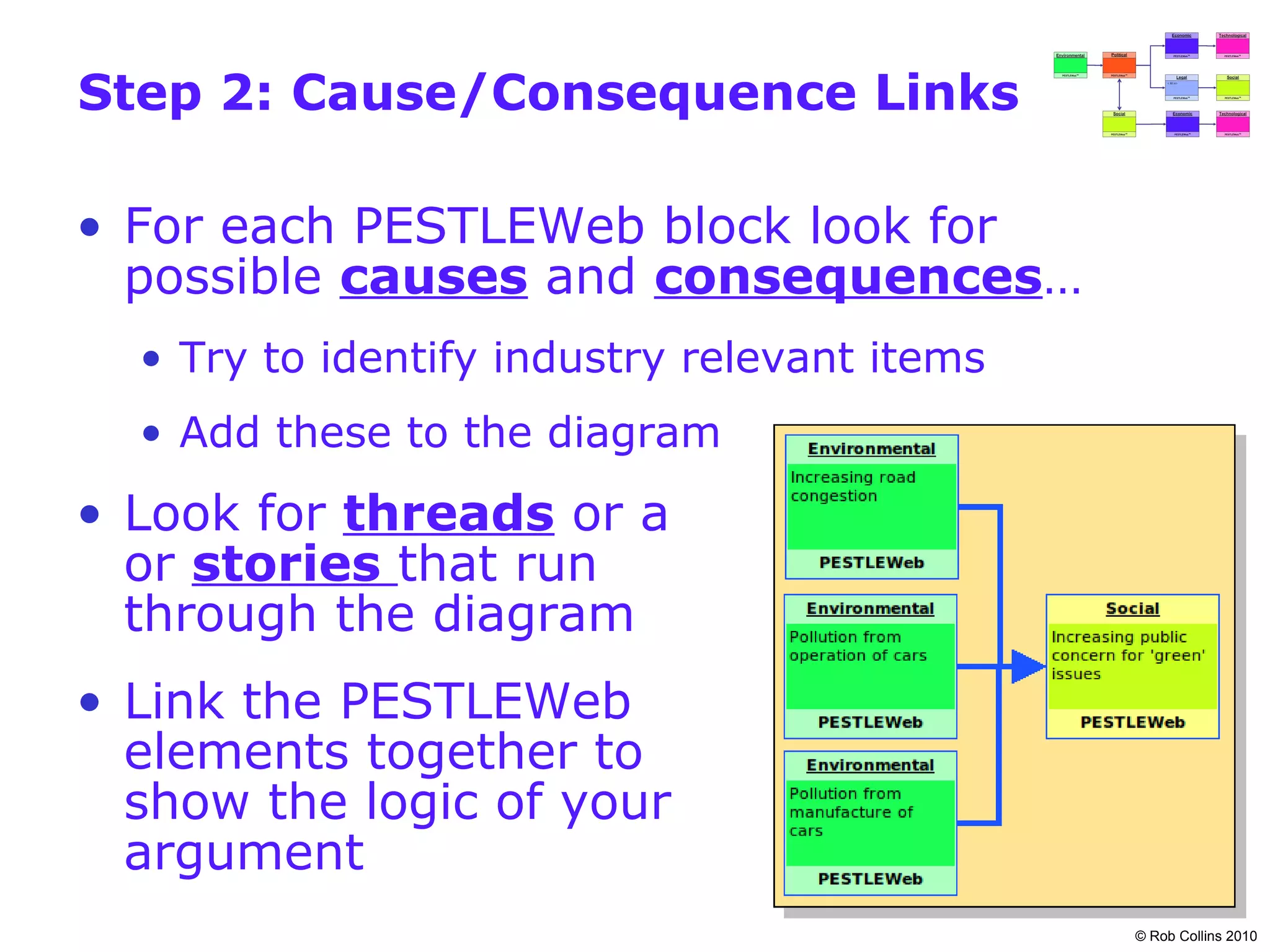
• For each PESTLEWeb block look for
  possible causes and consequences…
  • Try to identify industry relevant items
  • Add these to the diagram
• Look for threads or a
  or stories that run
  through the diagram
• Link the PESTLEWeb
  elements together to
  show the logic of your
  argument
                                              © Rob Collins 2010
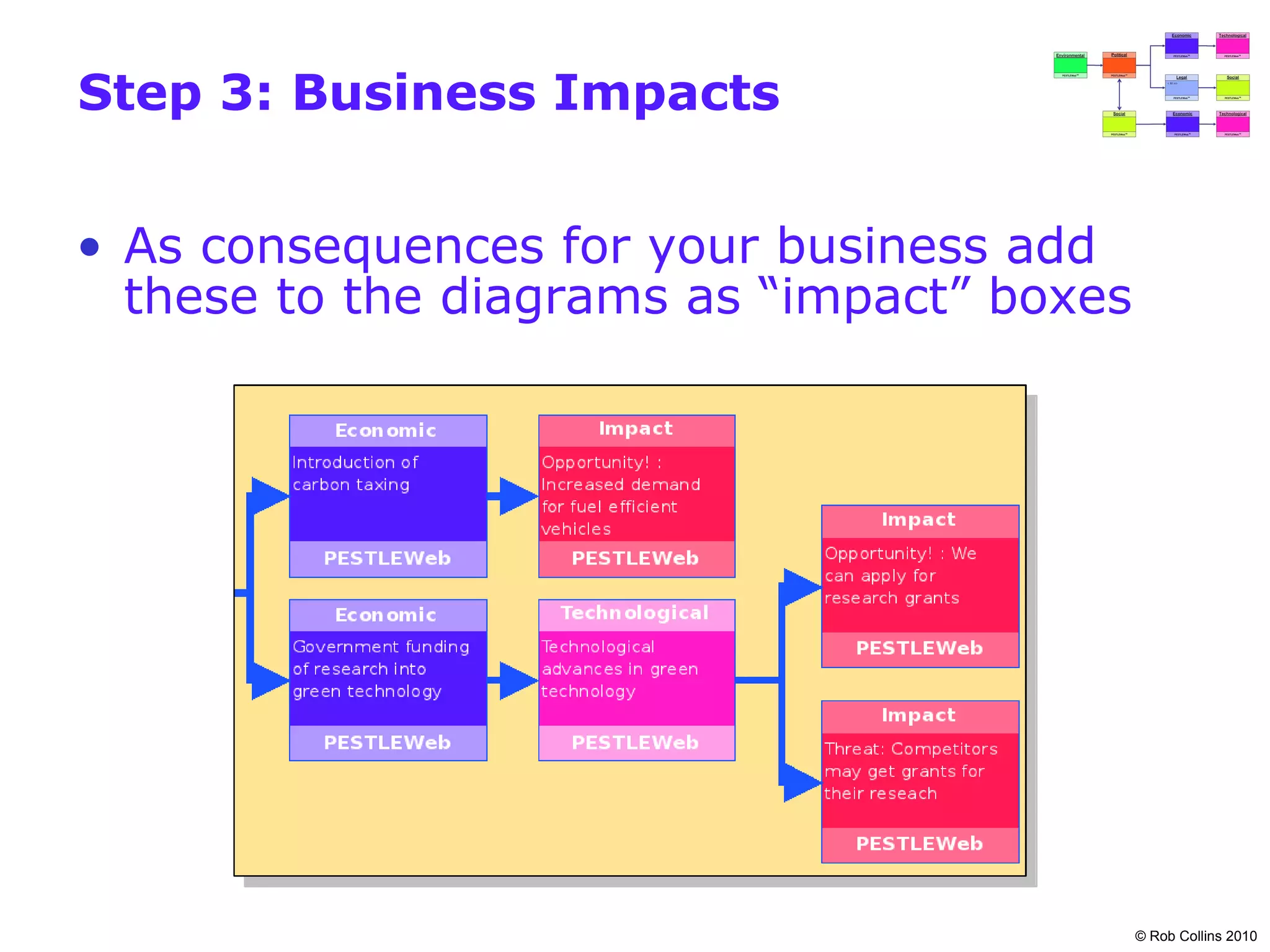
Step 3: Business Impacts


• As consequences for your business add
  these to the diagrams as “impact” boxes


                                            © Rob Collins 2010
Step 4: Research

• Don’t expect to have all of the
  knowledge already
• Use the emerging PESTLEWeb to
  guide your search
• Form hypotheses and go search for
  evidence
• Engage in conversations with people
  with knowledge in specific areas
• Ask ‘tough questions’
                                      © Rob Collins 2010
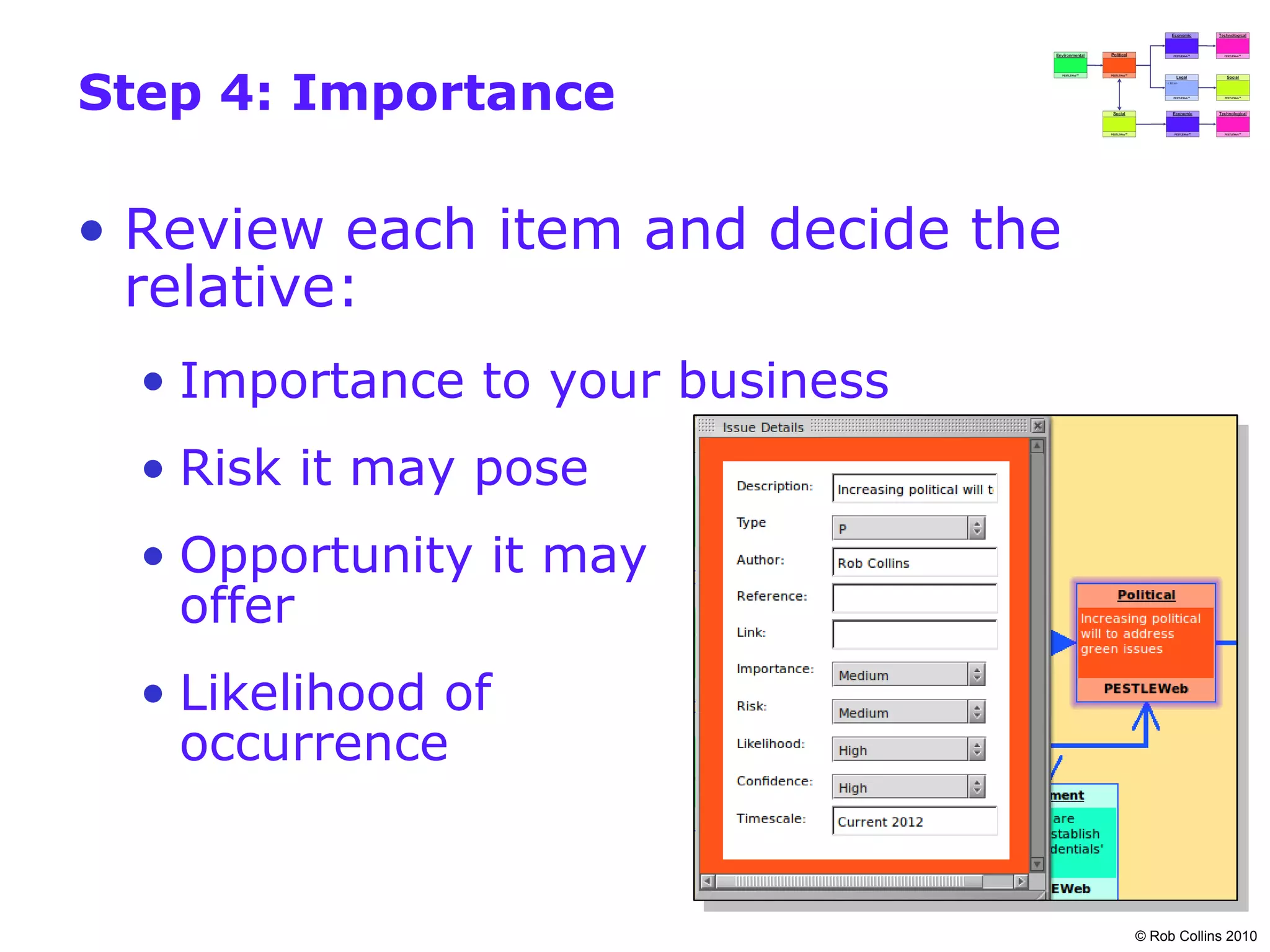
Step 4: Importance

• Review each item and decide the
  relative:
  • Importance to your business
  • Risk it may pose
  • Opportunity it may
    offer
  • Likelihood of
    occurrence


                                    © Rob Collins 2010
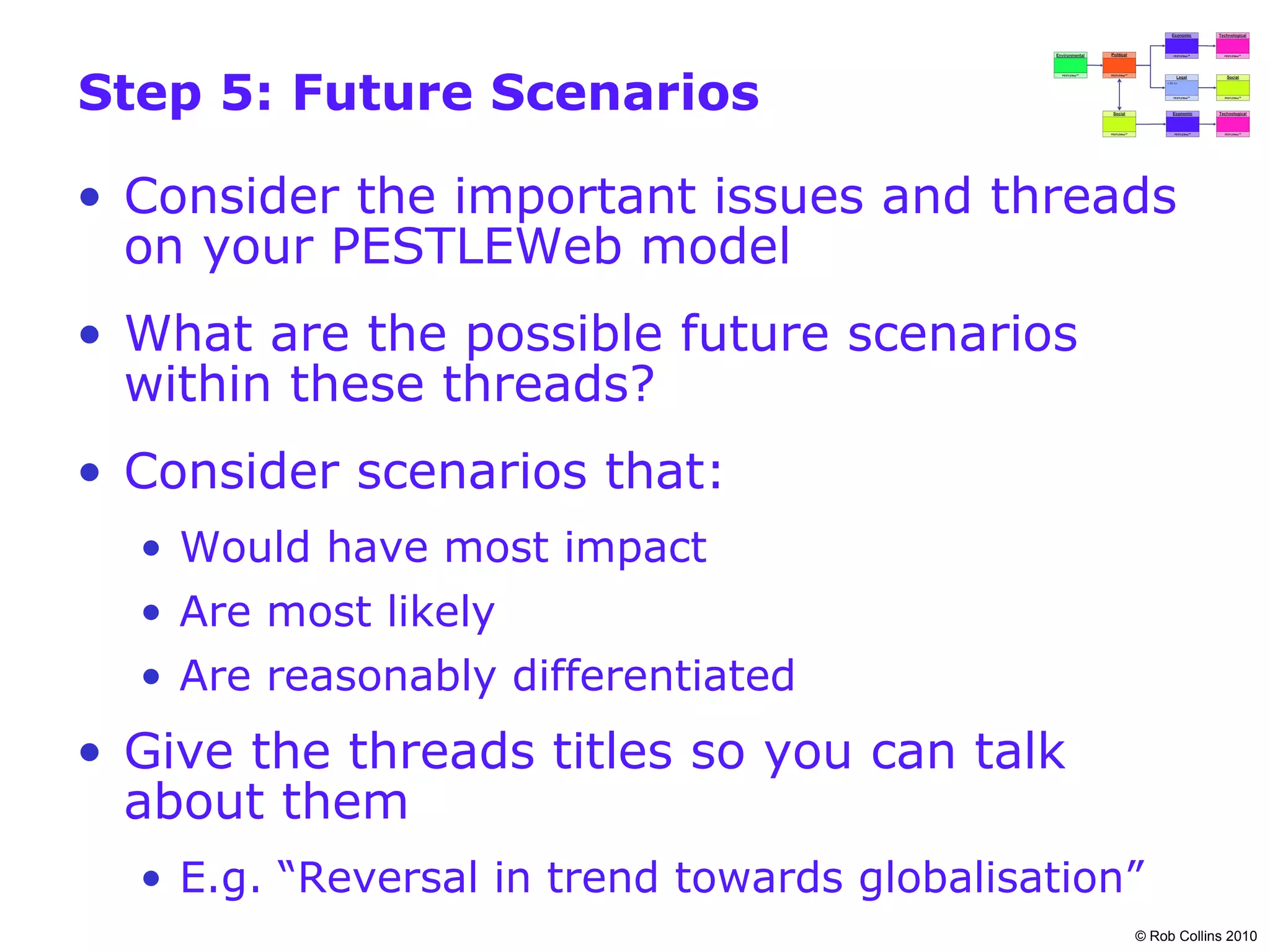
Step 5: Future Scenarios

• Consider the important issues and threads
  on your PESTLEWeb model
• What are the possible future scenarios
  within these threads?
• Consider scenarios that:
  • Would have most impact
  • Are most likely
  • Are reasonably differentiated
• Give the threads titles so you can talk
  about them
  • E.g. “Reversal in trend towards globalisation”
                                                 © Rob Collins 2010
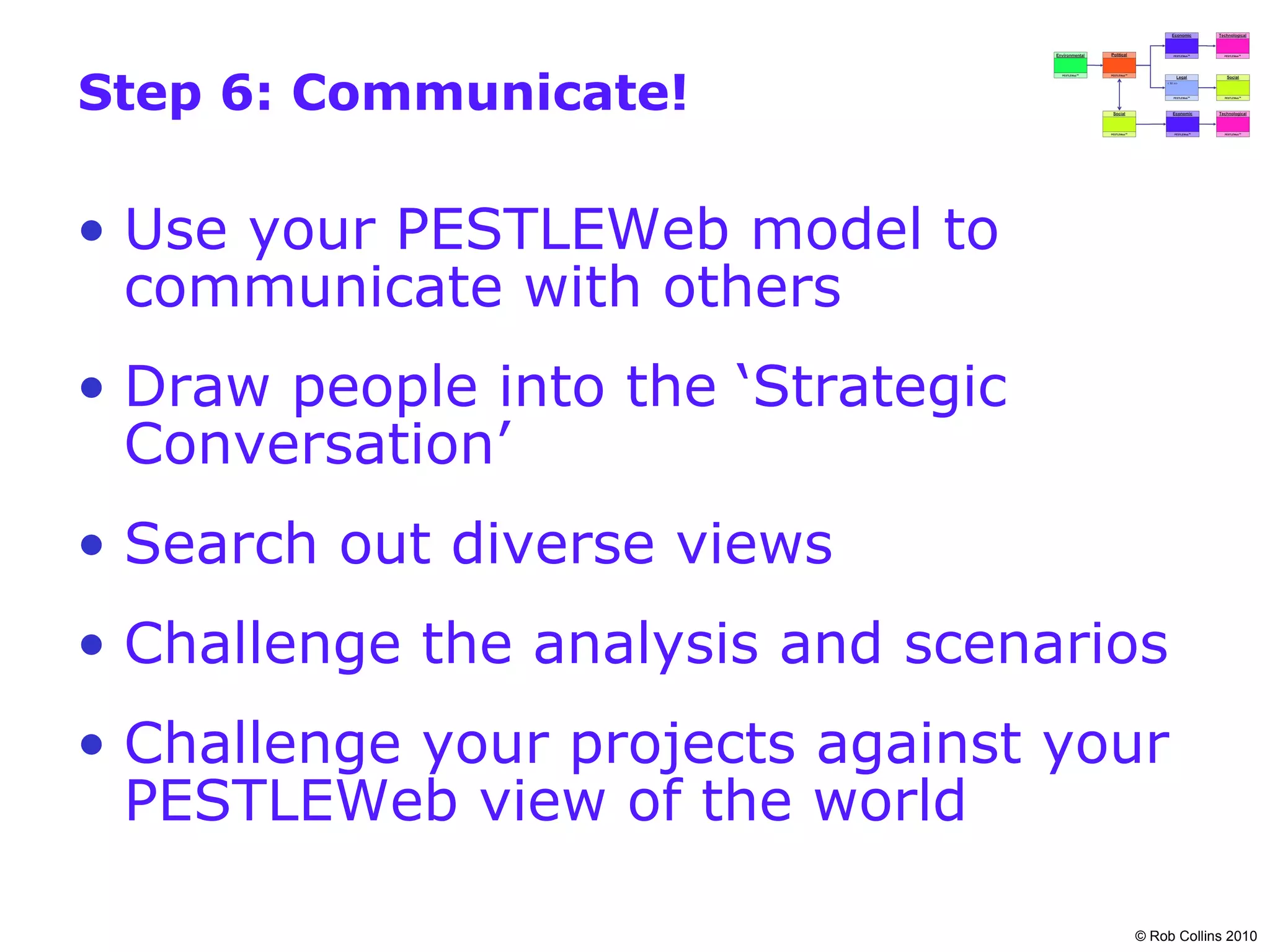
Step 6: Communicate!

• Use your PESTLEWeb model to
  communicate with others
• Draw people into the ‘Strategic
  Conversation’
• Search out diverse views
• Challenge the analysis and scenarios
• Challenge your projects against your
  PESTLEWeb view of the world

                                    © Rob Collins 2010
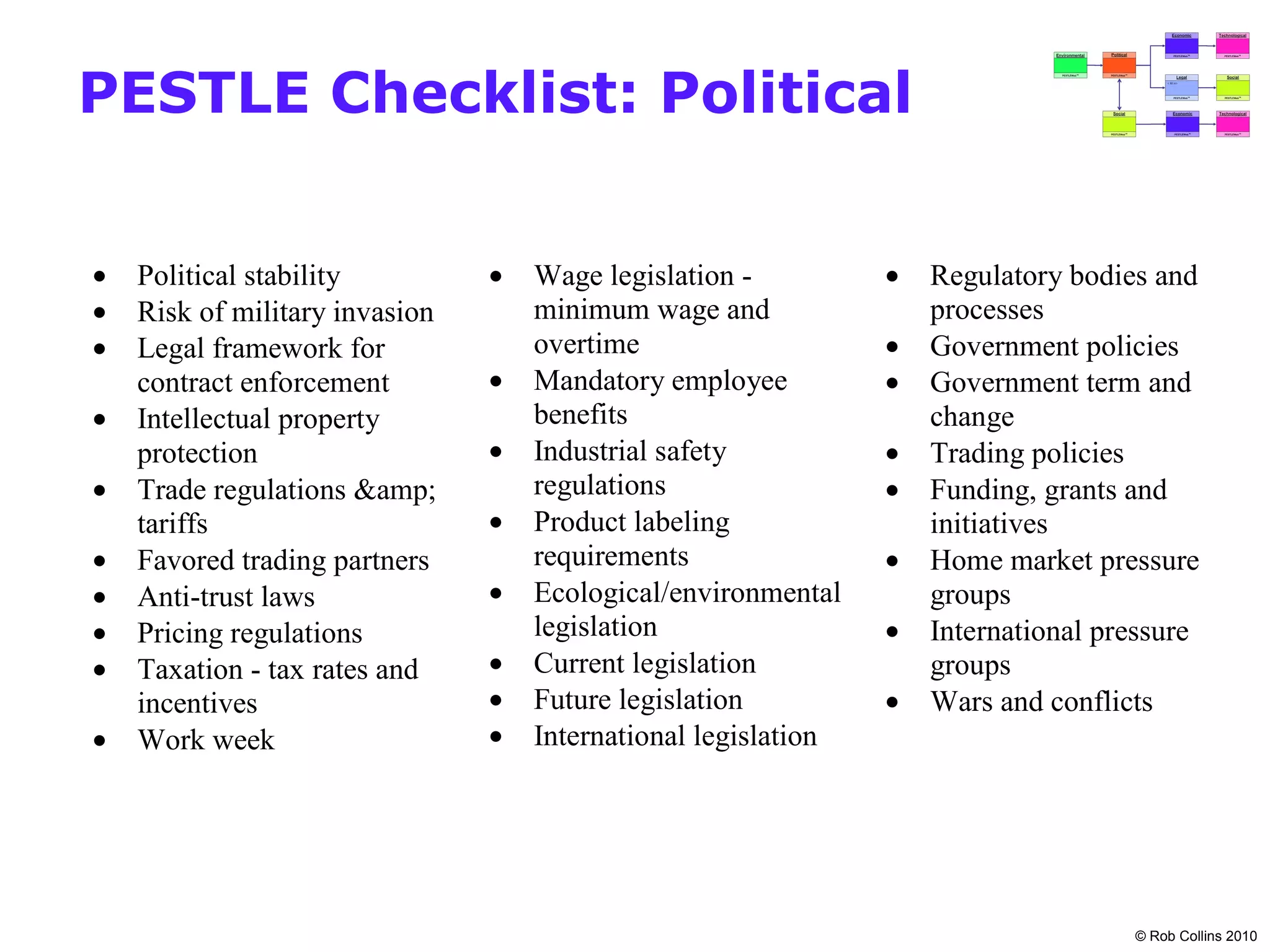
PESTLE Checklist: Political


•   Political stability         •   Wage legislation -          •   Regulatory bodies and
•   Risk of military invasion       minimum wage and                processes
•   Legal framework for             overtime                    •   Government policies
    contract enforcement        •   Mandatory employee          •   Government term and
•   Intellectual property           benefits                        change
    protection                  •   Industrial safety           •   Trading policies
•   Trade regulations &         regulations                 •   Funding, grants and
    tariffs                     •   Product labeling                initiatives
•   Favored trading partners        requirements                •   Home market pressure
•   Anti-trust laws             •   Ecological/environmental        groups
•   Pricing regulations             legislation                 •   International pressure
•   Taxation - tax rates and    •   Current legislation             groups
    incentives                  •   Future legislation          •   Wars and conflicts
•   Work week                   •   International legislation


                                                                                    © Rob Collins 2010
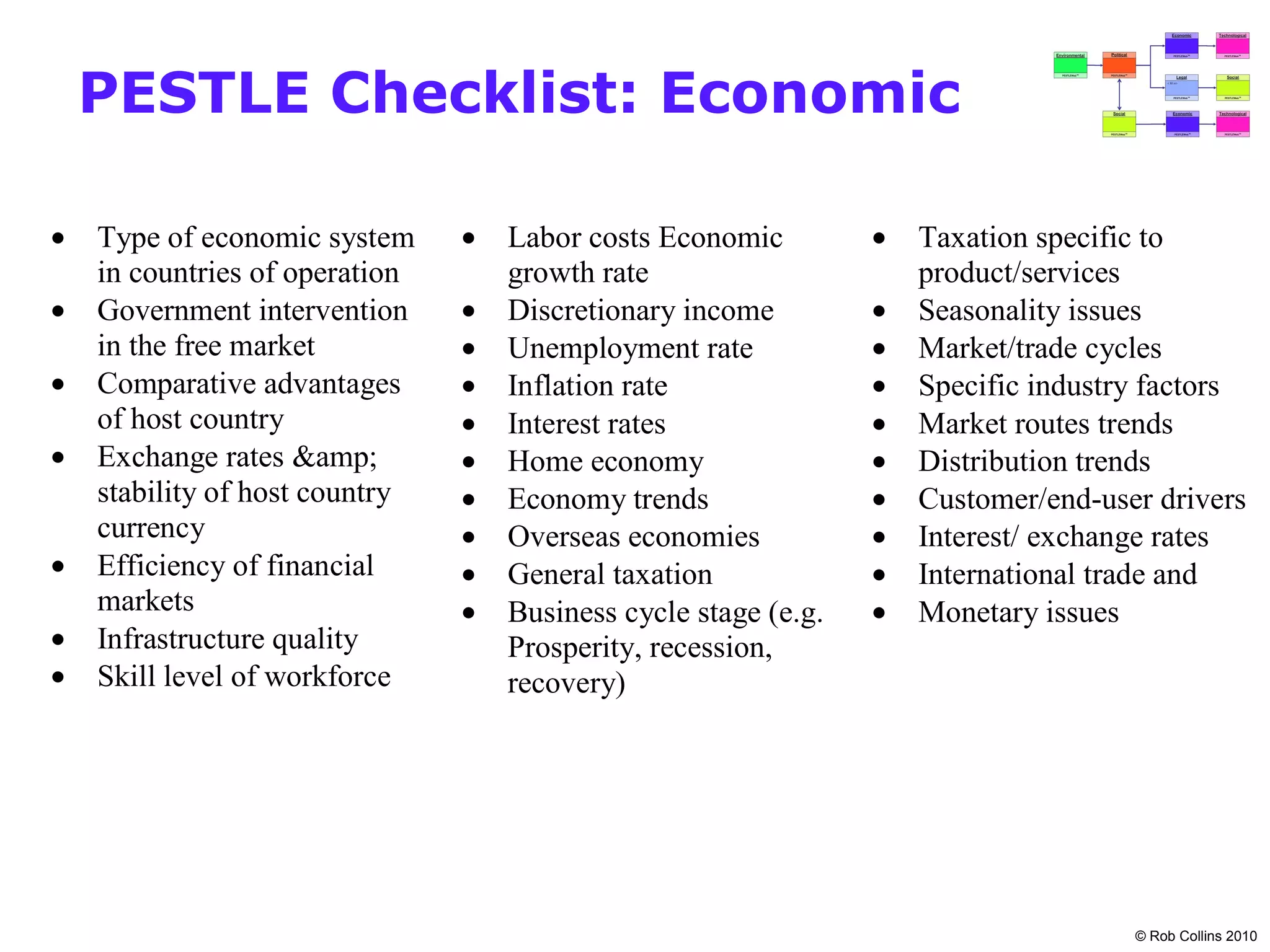
PESTLE Checklist: Economic

•   Type of economic system     •   Labor costs Economic         •   Taxation specific to
    in countries of operation       growth rate                      product/services
•   Government intervention     •   Discretionary income         •   Seasonality issues
    in the free market          •   Unemployment rate            •   Market/trade cycles
•   Comparative advantages      •   Inflation rate               •   Specific industry factors
    of host country             •   Interest rates               •   Market routes trends
•   Exchange rates &        •   Home economy                 •   Distribution trends
    stability of host country   •   Economy trends               •   Customer/end-user drivers
    currency                    •   Overseas economies           •   Interest/ exchange rates
•   Efficiency of financial     •   General taxation             •   International trade and
    markets                     •   Business cycle stage (e.g.   •   Monetary issues
•   Infrastructure quality          Prosperity, recession,
•   Skill level of workforce        recovery)


                                                                                     © Rob Collins 2010
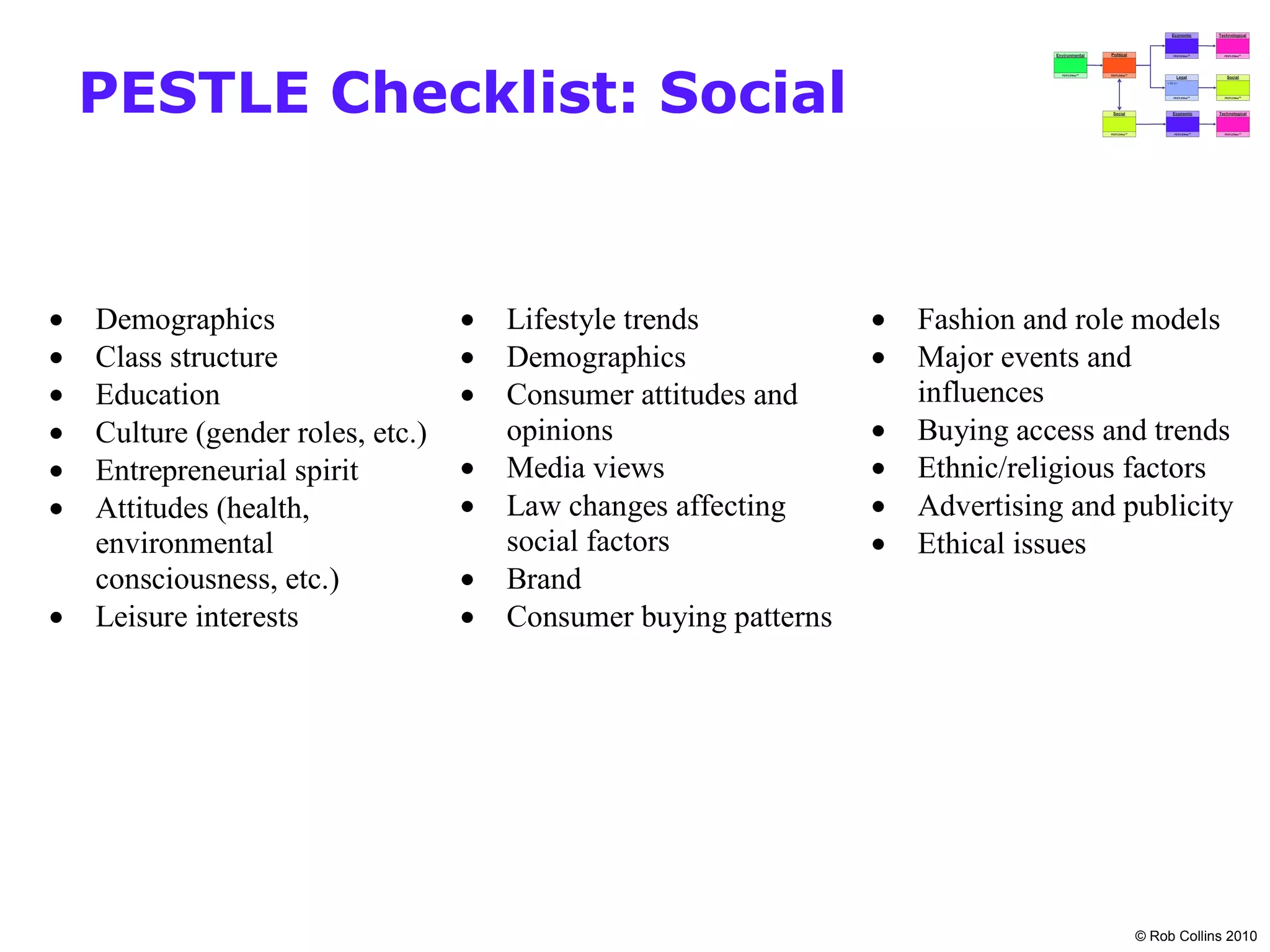
PESTLE Checklist: Social


•   Demographics                   •   Lifestyle trends           •   Fashion and role models
•   Class structure                •   Demographics               •   Major events and
•   Education                      •   Consumer attitudes and         influences
•   Culture (gender roles, etc.)       opinions                   •   Buying access and trends
•   Entrepreneurial spirit         •   Media views                •   Ethnic/religious factors
•   Attitudes (health,             •   Law changes affecting      •   Advertising and publicity
    environmental                      social factors             •   Ethical issues
    consciousness, etc.)           •   Brand
•   Leisure interests              •   Consumer buying patterns


                                                                                       © Rob Collins 2010
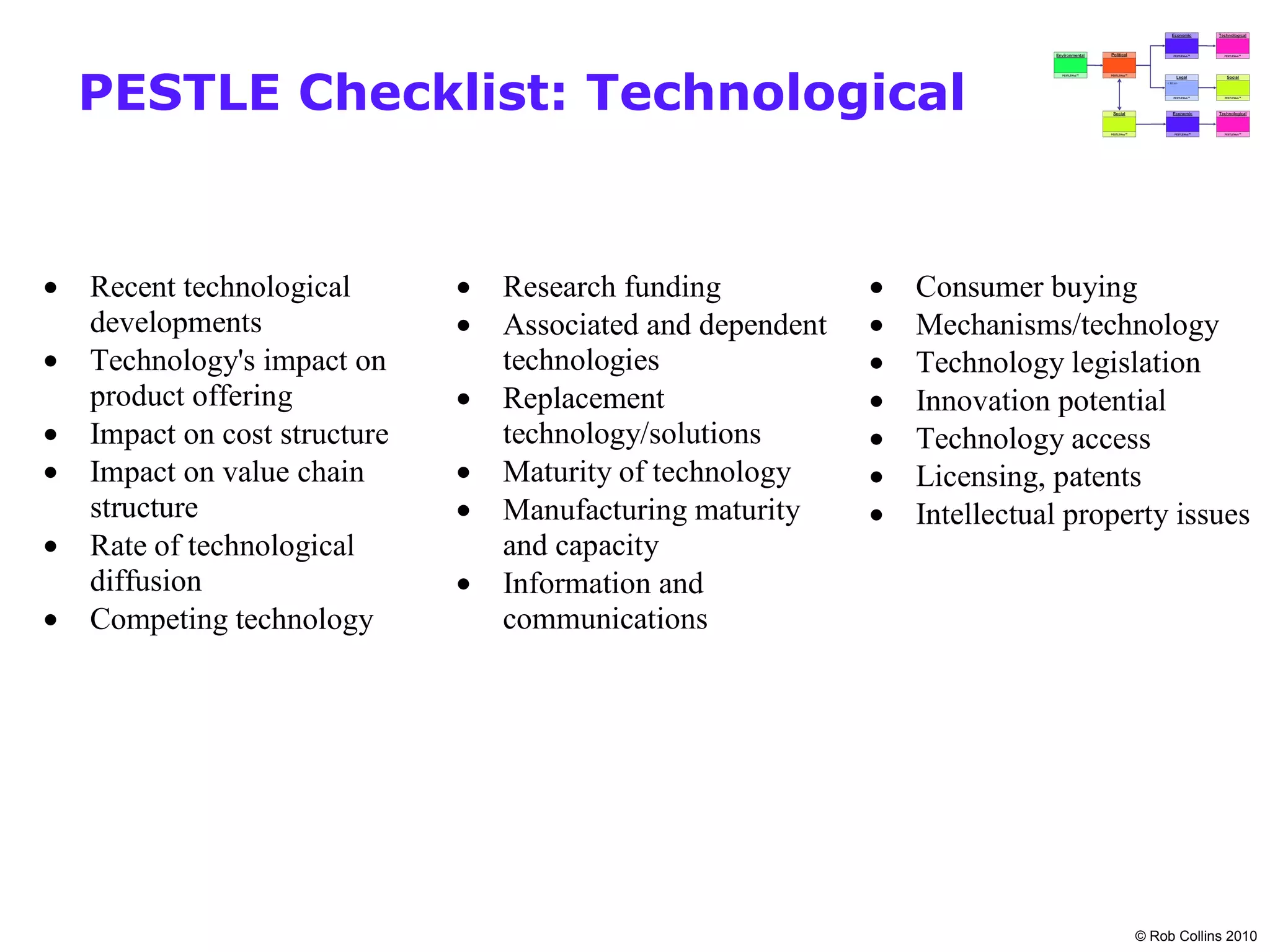
PESTLE Checklist: Technological


•   Recent technological       •   Research funding           •   Consumer buying
    developments               •   Associated and dependent   •   Mechanisms/technology
•   Technology's impact on         technologies               •   Technology legislation
    product offering           •   Replacement                •   Innovation potential
•   Impact on cost structure       technology/solutions       •   Technology access
•   Impact on value chain      •   Maturity of technology     •   Licensing, patents
    structure                  •   Manufacturing maturity     •   Intellectual property issues
•   Rate of technological          and capacity
    diffusion                  •   Information and
•   Competing technology           communications


                                                                                    © Rob Collins 2010
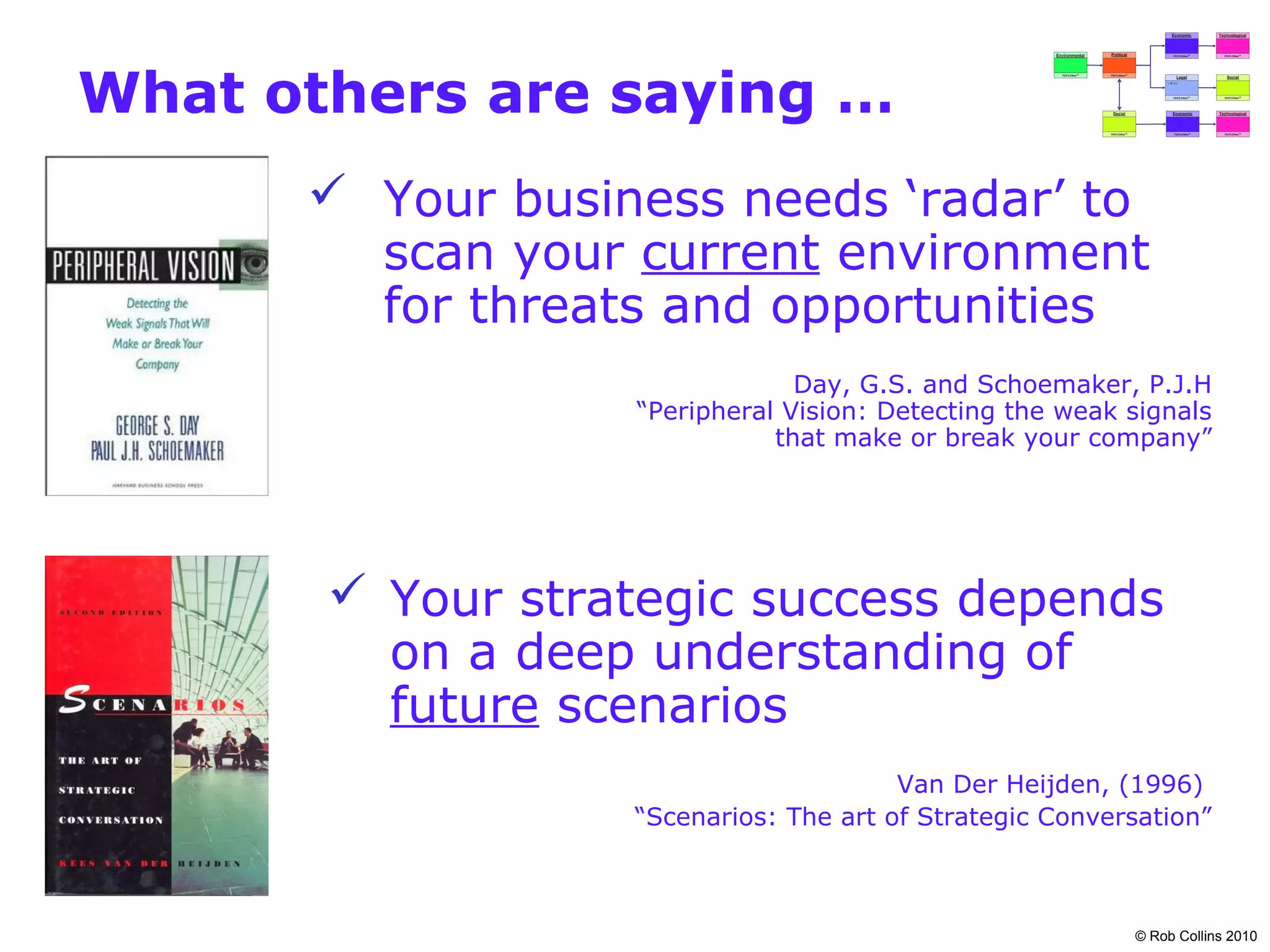
What others are saying …
       Your business needs ‘radar’ to
        scan your current environment
        for threats and opportunities
                               Day, G.S. and Schoemaker, P.J.H
                  “Peripheral Vision: Detecting the weak signals
                             that make or break your company”


        Your strategic success depends
         on a deep understanding of
         future scenarios
                                       Van Der Heijden, (1996)
                  “Scenarios: The art of Strategic Conversation”


                                                         © Rob Collins 2010
PESTLEWeb turns a list of
               TM


unrelated facts into a
   – Convincing ..
   – Relevant …
   – Well-structured ..
…argument

                            © Rob Collins 2010
PESTLEWeb                  TM


Picture your Business Environment
www.PESTLEWeb.com


                                    © Rob Collins 2010

The best way to do pest analysis

  • 1.
    The Best wayto do PEST Analysis A brief introduction to the PESTLEWeb method Dr Rob Collins www.PESTLEWeb.com © Rob Collins 2010
  • 2.
    Setting expectations • Don’texpect to be ‘done in 10 minutes’ • It will take time to do an analysis that is: • High quality • Information rich • Rigorous and Systematic • Valuable to your business • (or gets a top grade for your business strategy paper) • Every step of the analysis increases.. • your understanding • your sensitivity to your business environment © Rob Collins 2010
  • 3.
    Overview of theMethod 1. Initial generation 2. Cause consequence links 3. Business Impacts 4. Research 5. Importance 6. Future Scenarios 7. Communicate! © Rob Collins 2010
  • 4.
    Step 1: InitialGeneration • If you have already identified any PEST / PESTLE issues make a list of these • Use checklists to help you identify some issues • A checklist is included in this slide-deck • Start drawing! • Copy each item into a block in the diagram • Label the block with the correct type © Rob Collins 2010
  • 5.
    Step 2: Cause/ConsequenceLinks • For each PESTLEWeb block look for possible causes and consequences… • Try to identify industry relevant items • Add these to the diagram • Look for threads or a or stories that run through the diagram • Link the PESTLEWeb elements together to show the logic of your argument © Rob Collins 2010
  • 6.
    Step 3: BusinessImpacts • As consequences for your business add these to the diagrams as “impact” boxes © Rob Collins 2010
  • 7.
    Step 4: Research •Don’t expect to have all of the knowledge already • Use the emerging PESTLEWeb to guide your search • Form hypotheses and go search for evidence • Engage in conversations with people with knowledge in specific areas • Ask ‘tough questions’ © Rob Collins 2010
  • 8.
    Step 4: Importance •Review each item and decide the relative: • Importance to your business • Risk it may pose • Opportunity it may offer • Likelihood of occurrence © Rob Collins 2010
  • 9.
    Step 5: FutureScenarios • Consider the important issues and threads on your PESTLEWeb model • What are the possible future scenarios within these threads? • Consider scenarios that: • Would have most impact • Are most likely • Are reasonably differentiated • Give the threads titles so you can talk about them • E.g. “Reversal in trend towards globalisation” © Rob Collins 2010
  • 10.
    Step 6: Communicate! •Use your PESTLEWeb model to communicate with others • Draw people into the ‘Strategic Conversation’ • Search out diverse views • Challenge the analysis and scenarios • Challenge your projects against your PESTLEWeb view of the world © Rob Collins 2010
  • 11.
    PESTLE Checklist: Political • Political stability • Wage legislation - • Regulatory bodies and • Risk of military invasion minimum wage and processes • Legal framework for overtime • Government policies contract enforcement • Mandatory employee • Government term and • Intellectual property benefits change protection • Industrial safety • Trading policies • Trade regulations & regulations • Funding, grants and tariffs • Product labeling initiatives • Favored trading partners requirements • Home market pressure • Anti-trust laws • Ecological/environmental groups • Pricing regulations legislation • International pressure • Taxation - tax rates and • Current legislation groups incentives • Future legislation • Wars and conflicts • Work week • International legislation © Rob Collins 2010
  • 12.
    PESTLE Checklist: Economic • Type of economic system • Labor costs Economic • Taxation specific to in countries of operation growth rate product/services • Government intervention • Discretionary income • Seasonality issues in the free market • Unemployment rate • Market/trade cycles • Comparative advantages • Inflation rate • Specific industry factors of host country • Interest rates • Market routes trends • Exchange rates & • Home economy • Distribution trends stability of host country • Economy trends • Customer/end-user drivers currency • Overseas economies • Interest/ exchange rates • Efficiency of financial • General taxation • International trade and markets • Business cycle stage (e.g. • Monetary issues • Infrastructure quality Prosperity, recession, • Skill level of workforce recovery) © Rob Collins 2010
  • 13.
    PESTLE Checklist: Social • Demographics • Lifestyle trends • Fashion and role models • Class structure • Demographics • Major events and • Education • Consumer attitudes and influences • Culture (gender roles, etc.) opinions • Buying access and trends • Entrepreneurial spirit • Media views • Ethnic/religious factors • Attitudes (health, • Law changes affecting • Advertising and publicity environmental social factors • Ethical issues consciousness, etc.) • Brand • Leisure interests • Consumer buying patterns © Rob Collins 2010
  • 14.
    PESTLE Checklist: Technological • Recent technological • Research funding • Consumer buying developments • Associated and dependent • Mechanisms/technology • Technology's impact on technologies • Technology legislation product offering • Replacement • Innovation potential • Impact on cost structure technology/solutions • Technology access • Impact on value chain • Maturity of technology • Licensing, patents structure • Manufacturing maturity • Intellectual property issues • Rate of technological and capacity diffusion • Information and • Competing technology communications © Rob Collins 2010
  • 15.
    What others aresaying …  Your business needs ‘radar’ to scan your current environment for threats and opportunities Day, G.S. and Schoemaker, P.J.H “Peripheral Vision: Detecting the weak signals that make or break your company”  Your strategic success depends on a deep understanding of future scenarios Van Der Heijden, (1996) “Scenarios: The art of Strategic Conversation” © Rob Collins 2010
  • 16.
    PESTLEWeb turns alist of TM unrelated facts into a – Convincing .. – Relevant … – Well-structured .. …argument © Rob Collins 2010
  • 17.
    PESTLEWeb TM Picture your Business Environment www.PESTLEWeb.com © Rob Collins 2010

Editor's Notes

  • #2 The Best way to do PEST Analysis This slideshow provides a brief tutorial on a new diagrammatic method, developed at the world famous Henley Business School in the UK. The new method overcomes some of the major weaknesses of traditional PEST /‘PESTLE (Political, Economic, Social, Technological, Legal, Environmental) analysis. Traditional PESTLE tends to generate a random list of unrelated facts – not very useful for understanding your business, developing strategy or convincing other business leaders. We show how you can use the PESTLEWeb method to tell a clear and compelling ‘story’ that leads from key issues to business threats and opportunities. PESTLEWeb is supported by a new tool at www.PESTLEWeb.com. The new web-based tool helps you create great graphics and enables the automatic generation of outline reports and tabulated data to support your paper or presentation.
  • #16 Both of these books are great reads…and useful references for your strategy paper. They talk to the crucial need to understand the business environment – both in the present and in future scenarios.