PESTLE Analysis
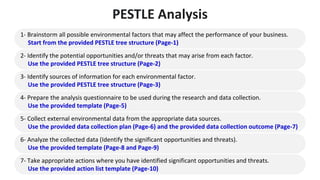
1- Brainstorm all possible environmental factors that may affect the performance of your business.
Start from the provided PESTLE tree structure (Page-1)
2- Identify the potential opportunities and/or threats that may arise from each factor.
Use the provided PESTLE tree structure (Page-2)
3- Identify sources of information for each environmental factor.
Use the provided PESTLE tree structure (Page-3)
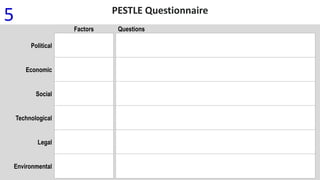
4- Prepare the analysis questionnaire to be used during the research and data collection.
Use the provided template (Page-5)
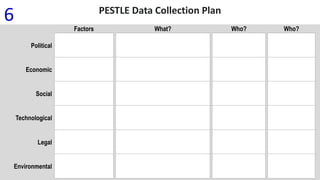
5- Collect external environmental data from the appropriate data sources.
Use the provided data collection plan (Page-6) and the provided data collection outcome (Page-7)
6- Analyze the collected data (Identify the significant opportunities and threats).
Use the provided template (Page-8 and Page-9)
7- Take appropriate actions where you have identified significant opportunities and threats.
Use the provided action list template (Page-10)
Political stability
Corruption level
Labor laws and policy
Threats of wars
Government stability
Nationalization
Trade laws and
regulations
Import & export restrictions
Corporate social
responsibility
Legislative changes
Legislations
Organized crime level
Tariffs and taxation laws
Customer protection laws
Retirement age
Customer access to credit
Seasonality issues
Interest
rates
Inflation trend
Unemployment rates
Market
conditions
Currency exchange
rates
Spending power
Economic
stability
Income levels
Wealth distribution
Spending patterns
Globalization
Education levels
Social welfare programs
Health & safety standards
Demographics
Lifestyle
trends
Values and
beliefs
Language skills
Literacy rate
Population growth rate
Health status Attitudes toward work
Health
consciousness
Gender distribution
Technological change rate
R&D productivity
Workforce competency
New technology
development
Automation
maturity
E-commerce trends
Working
remotely
Social media trends
R&D funding & spending
Protection & security
Copyright and
piracy laws
Software licensing
Access to basic
infrastructure
Government & universities
research focus
Advertising
laws
Discrimination
laws
Product safety laws
Product labeling laws
Antitrust and
bribery laws
Local
government
bylaws International
and national
standards
Attitude
towards
recycling
Environment
standards
Attitude toward
waste disposal
Attitude towards
sustainable energy
NGO
needs
Natural
resources
Attitude towards
green products
Age distribution
Climate change
Ethical Cross-cultural
Access to basic information
International
Competition
Cultural
barriers
1
Political stability
Corruption level
Labor laws and policy
Threats of wars
Government stability
Nationalization
Trade laws and
regulations
Import & export restrictions
Corporate social
responsibility
Legislative changes
Legislations
Organized crime level
Tariffs and taxation laws
Customer protection laws
Retirement age
Customer access to credit
Seasonality issues
Interest
rates
Inflation trend
Unemployment rates
Market
conditions
Currency exchange
rates
Spending power
Economic
stability
Income levels
Wealth distribution
Spending patterns
Globalization
Education levels
Social welfare programs
Health & safety standards
Demographics
Lifestyle
trends
Values and
beliefs
Language skills
Literacy rate
Population growth rate
Health status Attitudes toward work
Health
consciousness
Gender distribution
Technological change rate
R&D productivity
Workforce competency
New technology
development
Automation
maturity
E-commerce trends
Working
remotely
Social media trends
R&D funding & spending
Protection & security
Copyright and
piracy laws
Software licensing
Access to basic
infrastructure
Government & universities
research focus
Advertising
laws
Discrimination
laws
Product safety laws
Product labeling laws
Antitrust and
bribery laws
Local
government
bylaws International
and national
standards
Attitude
towards
recycling
Environment
standards
Attitude toward
waste disposal
Attitude towards
sustainable energy
NGO
needs
Natural
resources
Attitude towards
green products
Age distribution
Climate change
Ethical Cross-cultural
Access to basic information
International
Competition
Cultural
barriers
2 Potential Opportunity
Potential Threat
Political stability
Corruption level
Threats of wars
Nationalization
Trade laws and
regulations
Import & export restrictions
Corporate social
responsibility
Legislative changes
Legislations
Organized crime level
Customer protection laws
Retirement age
Customer access to credit
Seasonality issues
Interest
rates
Inflation trend
Unemployment rates
Market
conditions
Currency exchange
rates
Spending power
Economic
stability
Income levels
Wealth distribution
Spending patterns
Globalization
Education levels
Social welfare programs
Health & safety standards
Demographics
Lifestyle
trends
Values and
beliefs
Language skills
Literacy rate
Population growth rate
Health status Attitudes toward work
Health
consciousness
Gender distribution
R&D productivity
Workforce competency
New technology
development
Automation
maturity
Working
remotely
R&D funding & spending
Copyright and
piracy laws
Software licensing
Access to basic
infrastructure
Government & universities
research focus
Advertising
laws
Discrimination
laws
Product safety laws
Product labeling laws
Antitrust and
bribery laws
Local
government
bylaws International
and national
standards
Attitude
towards
recycling
Environment
standards
Attitude toward
waste disposal
Attitude towards
sustainable energy
NGO
needs
Natural
resources
Attitude towards
green products
Age distribution
Climate change
Ethical Cross-cultural
Access to basic information
International
Competition
The Internet
Commercial databases
Government databases
Journals and newspapers
Industry publications & magazines
Industry related conferences
Customers, suppliers & partners
Personal contacts
Professional colleagues
Internal databases and reports
Cultural
barriers
3
Labor laws and policy
Government stability
Tariffs and taxation laws
Technological change rate
E-commerce trends
Social media trends
Protection & security
Summary of Steps 1, 2, and 3
4
Factors Potential Opportunities / Threats
Political
Sources of Information
Economic
Social
Technological
Legal
Environmental
PESTLE Questionnaire
5
Factors Questions
Political
Economic
Social
Technological
Legal
Environmental
PESTLE Data Collection Plan
6
Factors What?
Political
Who? Who?
Economic
Social
Technological
Legal
Environmental
Research and Data Collection Outcome
7
Factors Data Collection Outcome
Political
Economic
Social
Technological
Legal
Environmental
Data Analysis Findings
8
Factors Opportunities / Threats
Political
More Information
Economic
Social
Technological
Legal
Environmental
Data Analysis Findings
Presentation
9
Political
Technological
Economic
Legal
Social
Environmental
Opportunity Risk
Listed Actions
10
Factors Actions
Political
Economic
Social
Technological
Legal
Environmental

pestle analysis instructions presentation

  • 1.
    PESTLE Analysis 1- Brainstormall possible environmental factors that may affect the performance of your business. Start from the provided PESTLE tree structure (Page-1) 2- Identify the potential opportunities and/or threats that may arise from each factor. Use the provided PESTLE tree structure (Page-2) 3- Identify sources of information for each environmental factor. Use the provided PESTLE tree structure (Page-3) 4- Prepare the analysis questionnaire to be used during the research and data collection. Use the provided template (Page-5) 5- Collect external environmental data from the appropriate data sources. Use the provided data collection plan (Page-6) and the provided data collection outcome (Page-7) 6- Analyze the collected data (Identify the significant opportunities and threats). Use the provided template (Page-8 and Page-9) 7- Take appropriate actions where you have identified significant opportunities and threats. Use the provided action list template (Page-10)
  • 2.
    Political stability Corruption level Laborlaws and policy Threats of wars Government stability Nationalization Trade laws and regulations Import & export restrictions Corporate social responsibility Legislative changes Legislations Organized crime level Tariffs and taxation laws Customer protection laws Retirement age Customer access to credit Seasonality issues Interest rates Inflation trend Unemployment rates Market conditions Currency exchange rates Spending power Economic stability Income levels Wealth distribution Spending patterns Globalization Education levels Social welfare programs Health & safety standards Demographics Lifestyle trends Values and beliefs Language skills Literacy rate Population growth rate Health status Attitudes toward work Health consciousness Gender distribution Technological change rate R&D productivity Workforce competency New technology development Automation maturity E-commerce trends Working remotely Social media trends R&D funding & spending Protection & security Copyright and piracy laws Software licensing Access to basic infrastructure Government & universities research focus Advertising laws Discrimination laws Product safety laws Product labeling laws Antitrust and bribery laws Local government bylaws International and national standards Attitude towards recycling Environment standards Attitude toward waste disposal Attitude towards sustainable energy NGO needs Natural resources Attitude towards green products Age distribution Climate change Ethical Cross-cultural Access to basic information International Competition Cultural barriers 1
  • 3.
    Political stability Corruption level Laborlaws and policy Threats of wars Government stability Nationalization Trade laws and regulations Import & export restrictions Corporate social responsibility Legislative changes Legislations Organized crime level Tariffs and taxation laws Customer protection laws Retirement age Customer access to credit Seasonality issues Interest rates Inflation trend Unemployment rates Market conditions Currency exchange rates Spending power Economic stability Income levels Wealth distribution Spending patterns Globalization Education levels Social welfare programs Health & safety standards Demographics Lifestyle trends Values and beliefs Language skills Literacy rate Population growth rate Health status Attitudes toward work Health consciousness Gender distribution Technological change rate R&D productivity Workforce competency New technology development Automation maturity E-commerce trends Working remotely Social media trends R&D funding & spending Protection & security Copyright and piracy laws Software licensing Access to basic infrastructure Government & universities research focus Advertising laws Discrimination laws Product safety laws Product labeling laws Antitrust and bribery laws Local government bylaws International and national standards Attitude towards recycling Environment standards Attitude toward waste disposal Attitude towards sustainable energy NGO needs Natural resources Attitude towards green products Age distribution Climate change Ethical Cross-cultural Access to basic information International Competition Cultural barriers 2 Potential Opportunity Potential Threat
  • 4.
    Political stability Corruption level Threatsof wars Nationalization Trade laws and regulations Import & export restrictions Corporate social responsibility Legislative changes Legislations Organized crime level Customer protection laws Retirement age Customer access to credit Seasonality issues Interest rates Inflation trend Unemployment rates Market conditions Currency exchange rates Spending power Economic stability Income levels Wealth distribution Spending patterns Globalization Education levels Social welfare programs Health & safety standards Demographics Lifestyle trends Values and beliefs Language skills Literacy rate Population growth rate Health status Attitudes toward work Health consciousness Gender distribution R&D productivity Workforce competency New technology development Automation maturity Working remotely R&D funding & spending Copyright and piracy laws Software licensing Access to basic infrastructure Government & universities research focus Advertising laws Discrimination laws Product safety laws Product labeling laws Antitrust and bribery laws Local government bylaws International and national standards Attitude towards recycling Environment standards Attitude toward waste disposal Attitude towards sustainable energy NGO needs Natural resources Attitude towards green products Age distribution Climate change Ethical Cross-cultural Access to basic information International Competition The Internet Commercial databases Government databases Journals and newspapers Industry publications & magazines Industry related conferences Customers, suppliers & partners Personal contacts Professional colleagues Internal databases and reports Cultural barriers 3 Labor laws and policy Government stability Tariffs and taxation laws Technological change rate E-commerce trends Social media trends Protection & security
  • 5.
    Summary of Steps1, 2, and 3 4 Factors Potential Opportunities / Threats Political Sources of Information Economic Social Technological Legal Environmental
  • 6.
  • 7.
    PESTLE Data CollectionPlan 6 Factors What? Political Who? Who? Economic Social Technological Legal Environmental
  • 8.
    Research and DataCollection Outcome 7 Factors Data Collection Outcome Political Economic Social Technological Legal Environmental
  • 9.
    Data Analysis Findings 8 FactorsOpportunities / Threats Political More Information Economic Social Technological Legal Environmental
  • 10.
  • 11.

Editor's Notes

  • #6 Political ========= - When is the country's next local or national election? How could this change government or regional policy? - Who are the most likely contenders for power? What are their views on business policy, and on other policies that affect your organization? - Depending on the country, how well developed are property rights and the rule of law, and how widespread are corruption and organized crime? How are these situations likely to change, and how is this likely to affect you? - Could any pending legislation or taxation changes affect your business, either positively or negatively? - How will business regulation, along with any planned changes to it, affect your business? And is there a trend towards regulation or deregulation? - How does government approach corporate policy, corporate social responsibility, environmental issues, and customer protection legislation? What impact does this have, and is it likely to change? - What is the likely timescale of proposed legislative changes? - Are there any other political factors that are likely to change? Ecomonic ======== How stable is the current economy? Is it growing, stagnating, or declining? Are key exchange rates stable, or do they tend to vary significantly? Are customers' levels of disposable income rising or falling? How is this likely to change in the next few years? What is the unemployment rate? Will it be easy to build a skilled workforce? Or will it be expensive to hire skilled labor? Do consumers and businesses have easy access to credit? If not, how will this affect your organization? How is globalization affecting the economic environment? Are there any other economic factors that you should consider? Socio-Cultural ============== What is the population's growth rate and age profile? How is this likely to change? Are generational shifts in attitude likely to affect what you're doing? What are your society's levels of health, education, and social mobility? How are these changing, and what impact does this have? What employment patterns, job market trends, and attitudes toward work can you observe? Are these different for different age groups? What social attitudes and social taboos could affect your business? Have there been recent socio-cultural changes that might affect this? How do religious beliefs and lifestyle choices affect the population? Are any other socio-cultural factors likely to drive change for your business? Technological Factors to Consider ================================= Are there any new technologies that you could be using? Are there any new technologies on the horizon that could radically affect your work or your industry? Do any of your competitors have access to new technologies that could redefine their products? In which areas do governments and educational institutions focus their research? Is there anything you can do to take advantage of this? How have infrastructure changes affected work patterns (for example, levels of remote working)? Are there existing technological hubs that you could work with or learn from? Are there any other technological factors that you should consider?
  • #7 Political ========= - When is the country's next local or national election? How could this change government or regional policy? - Who are the most likely contenders for power? What are their views on business policy, and on other policies that affect your organization? - Depending on the country, how well developed are property rights and the rule of law, and how widespread are corruption and organized crime? How are these situations likely to change, and how is this likely to affect you? - Could any pending legislation or taxation changes affect your business, either positively or negatively? - How will business regulation, along with any planned changes to it, affect your business? And is there a trend towards regulation or deregulation? - How does government approach corporate policy, corporate social responsibility, environmental issues, and customer protection legislation? What impact does this have, and is it likely to change? - What is the likely timescale of proposed legislative changes? - Are there any other political factors that are likely to change? Ecomonic ======== How stable is the current economy? Is it growing, stagnating, or declining? Are key exchange rates stable, or do they tend to vary significantly? Are customers' levels of disposable income rising or falling? How is this likely to change in the next few years? What is the unemployment rate? Will it be easy to build a skilled workforce? Or will it be expensive to hire skilled labor? Do consumers and businesses have easy access to credit? If not, how will this affect your organization? How is globalization affecting the economic environment? Are there any other economic factors that you should consider? Socio-Cultural ============== What is the population's growth rate and age profile? How is this likely to change? Are generational shifts in attitude likely to affect what you're doing? What are your society's levels of health, education, and social mobility? How are these changing, and what impact does this have? What employment patterns, job market trends, and attitudes toward work can you observe? Are these different for different age groups? What social attitudes and social taboos could affect your business? Have there been recent socio-cultural changes that might affect this? How do religious beliefs and lifestyle choices affect the population? Are any other socio-cultural factors likely to drive change for your business? Technological Factors to Consider ================================= Are there any new technologies that you could be using? Are there any new technologies on the horizon that could radically affect your work or your industry? Do any of your competitors have access to new technologies that could redefine their products? In which areas do governments and educational institutions focus their research? Is there anything you can do to take advantage of this? How have infrastructure changes affected work patterns (for example, levels of remote working)? Are there existing technological hubs that you could work with or learn from? Are there any other technological factors that you should consider?
  • #8 Political ========= - When is the country's next local or national election? How could this change government or regional policy? - Who are the most likely contenders for power? What are their views on business policy, and on other policies that affect your organization? - Depending on the country, how well developed are property rights and the rule of law, and how widespread are corruption and organized crime? How are these situations likely to change, and how is this likely to affect you? - Could any pending legislation or taxation changes affect your business, either positively or negatively? - How will business regulation, along with any planned changes to it, affect your business? And is there a trend towards regulation or deregulation? - How does government approach corporate policy, corporate social responsibility, environmental issues, and customer protection legislation? What impact does this have, and is it likely to change? - What is the likely timescale of proposed legislative changes? - Are there any other political factors that are likely to change? Ecomonic ======== How stable is the current economy? Is it growing, stagnating, or declining? Are key exchange rates stable, or do they tend to vary significantly? Are customers' levels of disposable income rising or falling? How is this likely to change in the next few years? What is the unemployment rate? Will it be easy to build a skilled workforce? Or will it be expensive to hire skilled labor? Do consumers and businesses have easy access to credit? If not, how will this affect your organization? How is globalization affecting the economic environment? Are there any other economic factors that you should consider? Socio-Cultural ============== What is the population's growth rate and age profile? How is this likely to change? Are generational shifts in attitude likely to affect what you're doing? What are your society's levels of health, education, and social mobility? How are these changing, and what impact does this have? What employment patterns, job market trends, and attitudes toward work can you observe? Are these different for different age groups? What social attitudes and social taboos could affect your business? Have there been recent socio-cultural changes that might affect this? How do religious beliefs and lifestyle choices affect the population? Are any other socio-cultural factors likely to drive change for your business? Technological Factors to Consider ================================= Are there any new technologies that you could be using? Are there any new technologies on the horizon that could radically affect your work or your industry? Do any of your competitors have access to new technologies that could redefine their products? In which areas do governments and educational institutions focus their research? Is there anything you can do to take advantage of this? How have infrastructure changes affected work patterns (for example, levels of remote working)? Are there existing technological hubs that you could work with or learn from? Are there any other technological factors that you should consider?
  • #9 Political ========= - When is the country's next local or national election? How could this change government or regional policy? - Who are the most likely contenders for power? What are their views on business policy, and on other policies that affect your organization? - Depending on the country, how well developed are property rights and the rule of law, and how widespread are corruption and organized crime? How are these situations likely to change, and how is this likely to affect you? - Could any pending legislation or taxation changes affect your business, either positively or negatively? - How will business regulation, along with any planned changes to it, affect your business? And is there a trend towards regulation or deregulation? - How does government approach corporate policy, corporate social responsibility, environmental issues, and customer protection legislation? What impact does this have, and is it likely to change? - What is the likely timescale of proposed legislative changes? - Are there any other political factors that are likely to change? Ecomonic ======== How stable is the current economy? Is it growing, stagnating, or declining? Are key exchange rates stable, or do they tend to vary significantly? Are customers' levels of disposable income rising or falling? How is this likely to change in the next few years? What is the unemployment rate? Will it be easy to build a skilled workforce? Or will it be expensive to hire skilled labor? Do consumers and businesses have easy access to credit? If not, how will this affect your organization? How is globalization affecting the economic environment? Are there any other economic factors that you should consider? Socio-Cultural ============== What is the population's growth rate and age profile? How is this likely to change? Are generational shifts in attitude likely to affect what you're doing? What are your society's levels of health, education, and social mobility? How are these changing, and what impact does this have? What employment patterns, job market trends, and attitudes toward work can you observe? Are these different for different age groups? What social attitudes and social taboos could affect your business? Have there been recent socio-cultural changes that might affect this? How do religious beliefs and lifestyle choices affect the population? Are any other socio-cultural factors likely to drive change for your business? Technological Factors to Consider ================================= Are there any new technologies that you could be using? Are there any new technologies on the horizon that could radically affect your work or your industry? Do any of your competitors have access to new technologies that could redefine their products? In which areas do governments and educational institutions focus their research? Is there anything you can do to take advantage of this? How have infrastructure changes affected work patterns (for example, levels of remote working)? Are there existing technological hubs that you could work with or learn from? Are there any other technological factors that you should consider?
  • #10 Political ========= - When is the country's next local or national election? How could this change government or regional policy? - Who are the most likely contenders for power? What are their views on business policy, and on other policies that affect your organization? - Depending on the country, how well developed are property rights and the rule of law, and how widespread are corruption and organized crime? How are these situations likely to change, and how is this likely to affect you? - Could any pending legislation or taxation changes affect your business, either positively or negatively? - How will business regulation, along with any planned changes to it, affect your business? And is there a trend towards regulation or deregulation? - How does government approach corporate policy, corporate social responsibility, environmental issues, and customer protection legislation? What impact does this have, and is it likely to change? - What is the likely timescale of proposed legislative changes? - Are there any other political factors that are likely to change? Ecomonic ======== How stable is the current economy? Is it growing, stagnating, or declining? Are key exchange rates stable, or do they tend to vary significantly? Are customers' levels of disposable income rising or falling? How is this likely to change in the next few years? What is the unemployment rate? Will it be easy to build a skilled workforce? Or will it be expensive to hire skilled labor? Do consumers and businesses have easy access to credit? If not, how will this affect your organization? How is globalization affecting the economic environment? Are there any other economic factors that you should consider? Socio-Cultural ============== What is the population's growth rate and age profile? How is this likely to change? Are generational shifts in attitude likely to affect what you're doing? What are your society's levels of health, education, and social mobility? How are these changing, and what impact does this have? What employment patterns, job market trends, and attitudes toward work can you observe? Are these different for different age groups? What social attitudes and social taboos could affect your business? Have there been recent socio-cultural changes that might affect this? How do religious beliefs and lifestyle choices affect the population? Are any other socio-cultural factors likely to drive change for your business? Technological Factors to Consider ================================= Are there any new technologies that you could be using? Are there any new technologies on the horizon that could radically affect your work or your industry? Do any of your competitors have access to new technologies that could redefine their products? In which areas do governments and educational institutions focus their research? Is there anything you can do to take advantage of this? How have infrastructure changes affected work patterns (for example, levels of remote working)? Are there existing technological hubs that you could work with or learn from? Are there any other technological factors that you should consider?
  • #11 Political ========= - When is the country's next local or national election? How could this change government or regional policy? - Who are the most likely contenders for power? What are their views on business policy, and on other policies that affect your organization? - Depending on the country, how well developed are property rights and the rule of law, and how widespread are corruption and organized crime? How are these situations likely to change, and how is this likely to affect you? - Could any pending legislation or taxation changes affect your business, either positively or negatively? - How will business regulation, along with any planned changes to it, affect your business? And is there a trend towards regulation or deregulation? - How does government approach corporate policy, corporate social responsibility, environmental issues, and customer protection legislation? What impact does this have, and is it likely to change? - What is the likely timescale of proposed legislative changes? - Are there any other political factors that are likely to change? Ecomonic ======== How stable is the current economy? Is it growing, stagnating, or declining? Are key exchange rates stable, or do they tend to vary significantly? Are customers' levels of disposable income rising or falling? How is this likely to change in the next few years? What is the unemployment rate? Will it be easy to build a skilled workforce? Or will it be expensive to hire skilled labor? Do consumers and businesses have easy access to credit? If not, how will this affect your organization? How is globalization affecting the economic environment? Are there any other economic factors that you should consider? Socio-Cultural ============== What is the population's growth rate and age profile? How is this likely to change? Are generational shifts in attitude likely to affect what you're doing? What are your society's levels of health, education, and social mobility? How are these changing, and what impact does this have? What employment patterns, job market trends, and attitudes toward work can you observe? Are these different for different age groups? What social attitudes and social taboos could affect your business? Have there been recent socio-cultural changes that might affect this? How do religious beliefs and lifestyle choices affect the population? Are any other socio-cultural factors likely to drive change for your business? Technological Factors to Consider ================================= Are there any new technologies that you could be using? Are there any new technologies on the horizon that could radically affect your work or your industry? Do any of your competitors have access to new technologies that could redefine their products? In which areas do governments and educational institutions focus their research? Is there anything you can do to take advantage of this? How have infrastructure changes affected work patterns (for example, levels of remote working)? Are there existing technological hubs that you could work with or learn from? Are there any other technological factors that you should consider?
  • #12 Political ========= - When is the country's next local or national election? How could this change government or regional policy? - Who are the most likely contenders for power? What are their views on business policy, and on other policies that affect your organization? - Depending on the country, how well developed are property rights and the rule of law, and how widespread are corruption and organized crime? How are these situations likely to change, and how is this likely to affect you? - Could any pending legislation or taxation changes affect your business, either positively or negatively? - How will business regulation, along with any planned changes to it, affect your business? And is there a trend towards regulation or deregulation? - How does government approach corporate policy, corporate social responsibility, environmental issues, and customer protection legislation? What impact does this have, and is it likely to change? - What is the likely timescale of proposed legislative changes? - Are there any other political factors that are likely to change? Ecomonic ======== How stable is the current economy? Is it growing, stagnating, or declining? Are key exchange rates stable, or do they tend to vary significantly? Are customers' levels of disposable income rising or falling? How is this likely to change in the next few years? What is the unemployment rate? Will it be easy to build a skilled workforce? Or will it be expensive to hire skilled labor? Do consumers and businesses have easy access to credit? If not, how will this affect your organization? How is globalization affecting the economic environment? Are there any other economic factors that you should consider? Socio-Cultural ============== What is the population's growth rate and age profile? How is this likely to change? Are generational shifts in attitude likely to affect what you're doing? What are your society's levels of health, education, and social mobility? How are these changing, and what impact does this have? What employment patterns, job market trends, and attitudes toward work can you observe? Are these different for different age groups? What social attitudes and social taboos could affect your business? Have there been recent socio-cultural changes that might affect this? How do religious beliefs and lifestyle choices affect the population? Are any other socio-cultural factors likely to drive change for your business? Technological Factors to Consider ================================= Are there any new technologies that you could be using? Are there any new technologies on the horizon that could radically affect your work or your industry? Do any of your competitors have access to new technologies that could redefine their products? In which areas do governments and educational institutions focus their research? Is there anything you can do to take advantage of this? How have infrastructure changes affected work patterns (for example, levels of remote working)? Are there existing technological hubs that you could work with or learn from? Are there any other technological factors that you should consider?