

International Marketing 463-441
                         Lecture 3
The Basic Tools of Marketing Redefined in the International Context
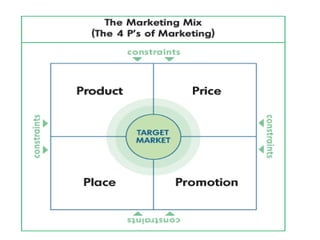
1. The Marketing Mix CRM
              2. Analytical Tools
       3. Consumer Behaviour Models
                 4. Channels
5. Consumer, B2B, Direct, Retail Marketing, etc


       A revisit to the basic tools of
    marketing in the international context
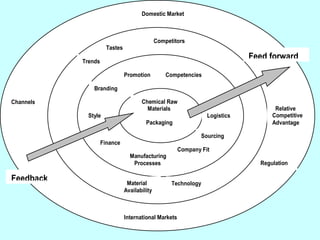
The International Marketing Toolkit
An Overall View
Domestic Market


                                              Competitors
                      Tastes

           Trends
                                                                             Feed forward
                               Promotion          Competencies

               Branding

Channels                              Chemical Raw
                                        Materials                                   Relative
             Style                                               Logistics         Competitive
                                        Packaging                                  Advantage

                                                               Sourcing
                    Finance
                                                       Company Fit
                                 Manufacturing
                                  Processes                                    Regulation

Feedback                        Material            Technology
                               Availability


                               International Markets
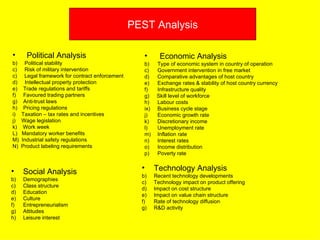
PEST Analysis

•      Political Analysis                           •       Economic Analysis
b)    Political stability                           b)     Type of economic system in country of operation
c)    Risk of military intervention                 c)     Government intervention in free market
c)    Legal framework for contract enforcement      d)     Comparative advantages of host country
d)     Intellectual property protection             e)     Exchange rates & stability of host country currency
e)    Trade regulations and tariffs                 f)     Infrastructure quality
f)    Favoured trading partners                     g)     Skill level of workforce
g)    Anti-trust laws                               h)     Labour costs
h)    Pricing regulations                           ix)    Business cycle stage
i)   Taxation – tax rates and incentives            j)     Economic growth rate
j)   Wage legislation                               k)     Discretionary income
k)    Work week                                     l)     Unemployment rate
L)   Mandatory worker benefits                      m)     Inflation rate
M)   Industrial safety regulations                  n)     Interest rates
N)   Product labeling requirements                  o)     Income distribution
                                                    p)     Poverty rate


•    Social Analysis                               •      Technology Analysis
                                                   b)     Recent technology developments
b)   Demographies
                                                   c)     Technology impact on product offering
c)   Class structure
                                                   d)     Impact on cost structure
d)   Education
                                                   e)     Impact on value chain structure
e)   Culture
                                                   f)     Rate of technology diffusion
f)   Entrepreneurialism
                                                   g)     R&D activity
g)   Attitudes
h)   Leisure interest
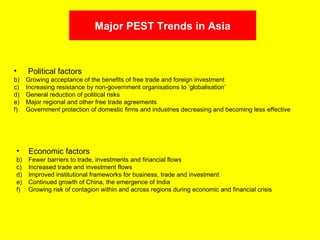
Major PEST Trends in Asia


•    Political factors
b)   Growing acceptance of the benefits of free trade and foreign investment
c)   Increasing resistance by non-government organisations to ‘globalisation’
d)   General reduction of political risks
e)   Major regional and other free trade agreements
f)   Government protection of domestic firms and industries decreasing and becoming less effective


•    Economic factors
b)   Fewer barriers to trade, investments and financial flows
c)   Increased trade and investment flows
d)   Improved institutional frameworks for business, trade and investment
e)   Continued growth of China, the emergence of India
f)   Growing risk of contagion within and across regions during economic and financial crisis
Major PEST Trends in Asia


•    Social Factors
b)   Increasingly educated, trained and competetent consumers and populations
c)   Continuing convergence in consumer needs, desires and wants
d)   Grow of disposable income in East Asia
e)   Easier and greater movement of skilled manpower within and outside Asia
f)   Emerging pressures on corporate social responsibility
g)   Long term trend of aging populations in some countries
h)   Higher proportion of female graduates than males


•    Technological Factors
b)   More rapid and disruptive changes in technology
c)   Greater ability of emerging economies to utilise and absorb technology
d)   Widespread diffusion of information and transport technology
e)   Changing ‘make or buy’ decisions and less defined firm boundaries
An Analysis of Culture and Change
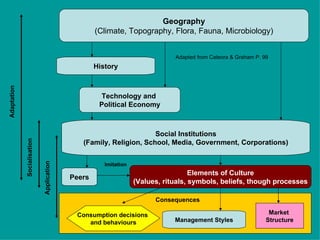
Geography
                                                   (Climate, Topography, Flora, Fauna, Microbiology)


                                                                              Adapted from Cateora & Graham P. 99
                                                   History
Adaptation


                                                     Technology and
                                                    Political Economy


                                                                    Social Institutions
             Socialisation


                                              (Family, Religion, School, Media, Government, Corporations)
                             Application


                                                      Imitation
                                                                                    Elements of Culture
                                           Peers
                                                                  (Values, rituals, symbols, beliefs, though processes

                                                                        Consequences

                                            Consumption decisions                                                Market
                                               and behaviours                 Management Styles                 Structure
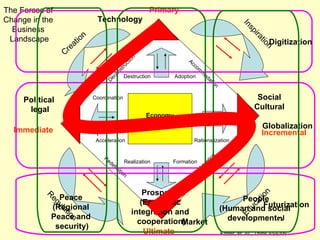
The Forces of                                                      Primary
Change in the                 Technology


                                                                                                                      In
  Business


                                                                                                                        sp
                         n


                                                                                                                          ira
 Landscape
                    a tio                                                                                                        Digitization


                                                                                                                             t io
                  re


                                                                                                                                 n
                 C


                                                             n
                                                                                   Ac


                                                         io
                                                                                     co


                                                      ct
                                                   ru
                                                                                          m


                                             st
                                                                                           m


                                       on
                                                         Destruction          Adoption      od


                                   ec
                                                                                                 at
                                                                                                      io


                                  D
                                                                                                         n


     Political               Coordination                                                                                   Social
      legal                                                                                                                Cultural
                                                                  Economy
                                                                  (Central)
                                                                                                                              Globalization
  Immediate                                                                                                                   Incremental
                              Acceleration                                              Rationalization


                                 Re


                                                                                                   n
                                                                                               tio
                                      de                 Realization      Formation


                                                                                              ap
                                           f in


                                                                                         Ad
                                                  itio
                                                         n


           R                                                     Prosperity


                                                                                                                              n
             eg Peace


                                                                                                                           tio
               ul                                               (Economic                                         People
                                                                                                                       Futurization


                                                                                                                          a
                 at
              (Regional


                                                                                                                       uc
                    io                                       integration and                                 (Human and social


                                                                                                                    Ed
             Peace andn                                                                                        development๗
                                                               cooperation) Market
               security)
                                                                 Ultimate                                    Kotler, et. Al., Think ASEAN
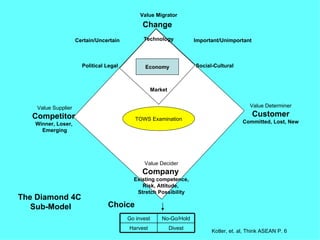
Value Migrator
                                               Change
                     Certain/Uncertain         Technology              Important/Unimportant


                       Political Legal          Economy                Social-Cultural


                                                     Market


    Value Supplier                                                                           Value Determiner

   Competitor                                                                                  Customer
                                            TOWS Examination
   Winner, Loser,                                                                         Committed, Lost, New
     Emerging


                                               Value Decider
                                              Company
                                           Existing competence,
                                              Risk, Attitude,
                                            Stretch Possibility
The Diamond 4C
   Sub-Model                     Choice
                                         Go invest       No-Go/Hold
                                         Harvest              Divest
                                                                             Kotler, et. al, Think ASEAN P. 6
Strategic Opportunity to Exploitation
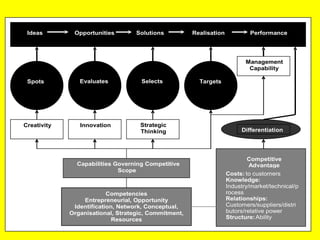
Ideas        Opportunities        Solutions          Realisation            Performance


                                                                           Management
                                                                            Capability

 Spots          Evaluates            Selects            Targets


Creativity      Innovation          Strategic
                                    Thinking                             Differentiation


                                                                            Competitive
               Capabilities Governing Competitive                            Advantage
                             Scope
                                                                    Costs: to customers
                                                                    Knowledge:
                                                                    Industry/market/technical/p
                          Competencies                              rocess
                 Entrepreneurial, Opportunity                       Relationships:
              Identification, Network, Conceptual,                  Customers/suppliers/distri
             Organisational, Strategic, Commitment,                 butors/relative power
                            Resources                               Structure: Ability
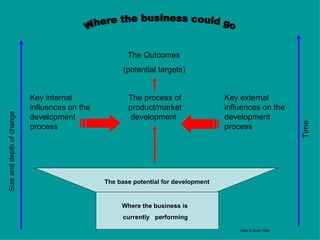
The Outcomes
                                                     (potential targets)


                           Key internal               The process of                Key external
                           influences on the          product/market                influences on the
Size and depth of change


                           development                 development                  development


                                                                                                            Time
                           process                                                  process


                                               The base potential for development


                                                    Where the business is
                                                    currently performing

                                                                                        Gibb & Scott 1988
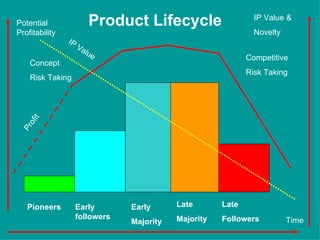
Potential                 Product Lifecycle                     IP Value &
Profitability                                                   Novelty
                IP
                     Va
                       lue
                                                              Competitive
    Concept
                                                              Risk Taking
    Risk Taking
    it
   of
 Pr


   Pioneers          Early       Early      Late       Late
                     followers              Majority   Followers          Time
                                 Majority
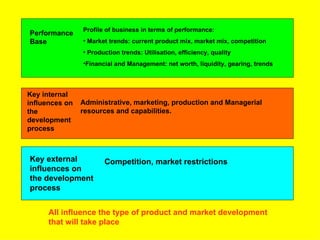
Profile of business in terms of performance:
Performance
Base            • Market trends: current product mix, market mix, competition
                • Production trends: Utilisation, efficiency, quality
                •Financial and Management: net worth, liquidity, gearing, trends


Key internal
influences on   Administrative, marketing, production and Managerial
the             resources and capabilities.
development
process


Key external           Competition, market restrictions
influences on
the development
process


      All influence the type of product and market development
      that will take place
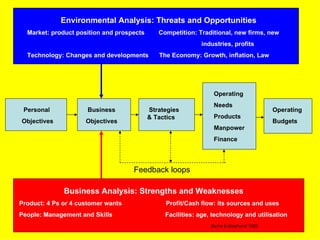
Environmental Analysis: Threats and Opportunities
  Market: product position and prospects      Competition: Traditional, new firms, new
                                                            industries, profits
  Technology: Changes and developments        The Economy: Growth, inflation, Law


                                                                 Operating
                                                                 Needs
 Personal             Business             Strategies                                   Operating
                                           & Tactics             Products
Objectives           Objectives                                                         Budgets
                                                                 Manpower
                                                                 Finance


                                    Feedback loops

              Business Analysis: Strengths and Weaknesses
Product: 4 Ps or 4 customer wants               Profit/Cash flow: its sources and uses
People: Management and Skills                   Facilities: age, technology and utilisation
                                                                Burns & Dewhurst 1993
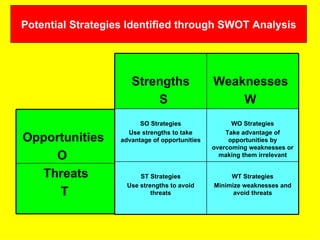
Potential Strategies Identified through SWOT Analysis


                      Strengths                 Weaknesses
                          S                         W
                         SO Strategies                WO Strategies
                     Use strengths to take          Take advantage of
Opportunities      advantage of opportunities        opportunities by
                                                overcoming weaknesses or
    O                                             making them irrelevant


  Threats                ST Strategies               WT Strategies
                     Use strengths to avoid     Minimize weaknesses and
     T                       threats                  avoid threats
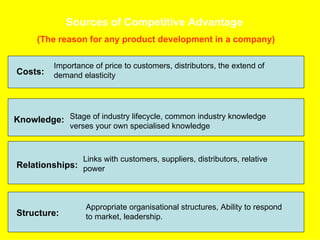
Sources of Competitive Advantage
     (The reason for any product development in a company)

          Importance of price to customers, distributors, the extend of
Costs:    demand elasticity


Knowledge: Stage of industry lifecycle, common industry knowledge
              verses your own specialised knowledge


               Links with customers, suppliers, distributors, relative
Relationships: power


                   Appropriate organisational structures, Ability to respond
Structure:         to market, leadership.
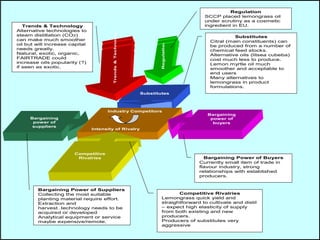
Regulation
                                                                                       SCCP placed lemongrass oil
                                                                                       under scrutiny as a cosmetic
   Trends & Technology                                                                 ingredient in EU.
Alternative technologies to


                                        Trends & Technology
steam distillation (CO2)                                                                           Substitutes
can make much smoother                                                                   Citral (main constituents) can


                                                                     Regulation
oil but will increase capital                                                            be produced from a number of
needs greatly.                                                                           chemical feed stocks.
Natural, exotic, organic,                                                                Alternative oils (litsea cubeba)
FAIRTRADE could                                                                          cost much less to produce.
increase oils popularity (?)                                                             Lemon myrtle oil much
if seen as exotic.                                                                       smoother and acceptable to
                                                                                         end users
                                                                                         Many alternatives to
                                                                                         lemongrass in product
                                                                                         formulations.
                                                              Substitutes


                                      Industry Competitors
                                                                                        Bargaining
     Bargaining                                                                          power of
      power of                                                                            buyers
      suppliers
                                Intensity of Rivalry


                        Competitive
                         Rivalries                                                     Bargaining Power of Buyers
                                                                                     Currently small item of trade in
                                                                                     flavour industry, strong
                                                                                     relationships with established
                                                                                     producers.


        Bargaining Power of Suppliers
        Collecting the most suitable                                         Competitive Rivalries
        planting material require effort.                             Lemongrass quick yield and
        Extraction and                                                straightforward to cultivate and distil
        harvest .technology needs to be                               – expect high elasticity of supply
        acquired or developed                                         from both existing and new
        Analytical equipment or service                               producers.
        maybe expensive/remote.                                       Producers of substitutes very
                                                                      aggressive
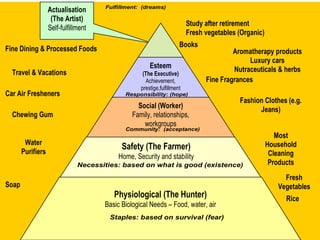
Fulfillment: (dreams)
                   Actualisation
                    (The Artist)
                                                                          Study after retirement
                   Self-fulfillment
                                                                          Fresh vegetables (Organic)
                                                                      Books
Fine Dining & Processed Foods                                                            Aromatherapy products
                                                                                              Luxury cars
                                                       Esteem                            Nutraceuticals & herbs
  Travel & Vacations                                (The Executive)
                                                      Achievement,              Fine Fragrances
                                                   prestige,fulfillment
Car Air Fresheners                           Responsibility: (hope)
                                                                                           Fashion Clothes (e.g.
                                                  Social (Worker)                                Jeans)
  Chewing Gum                                   Family, relationships,
                                                    workgroups
                                             Community: (acceptance)
                                                                                                          Most
        Water                                                                                          Household
                                            Safety (The Farmer)
       Purifiers                                                                                        Cleaning
                                          Home, Security and stability
                               Necessities: based on what is good (existence)                           Products
                                                                                                            Fresh
Soap                                                                                                      Vegetables
                                         Physiological (The Hunter)                                          Rice
                                      Basic Biological Needs – Food, water, air
                                        Staples: based on survival (fear)
http://www.brandingstrategyinsider.com/all_of_derricks_posts/index.html
Decision Framework
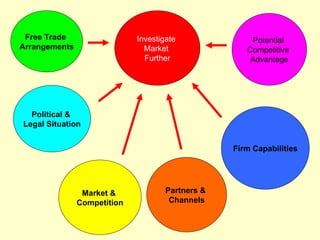
Free Trade                  Investigate              Potential
Arrangements                   Market                Competitive
                               Further                Advantage


  Political &
Legal Situation


                                                  Firm Capabilities


                Market &             Partners &
               Competition            Channels
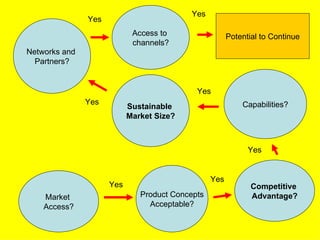
Yes
               Yes
                            Access to                  Potential to Continue
                            channels?
Networks and
  Partners?


                                            Yes
               Yes                                         Capabilities?
                           Sustainable
                           Market Size?


                                                             Yes


                                                 Yes
                     Yes                                      Competitive
    Market                    Product Concepts                Advantage?
    Access?                     Acceptable?
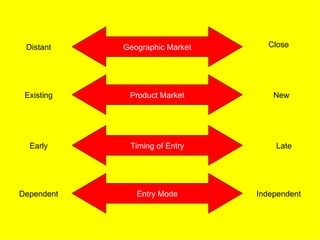
Distant    Geographic Market     Close


 Existing    Product Market         New


  Early      Timing of Entry        Late


Dependent      Entry Mode       Independent
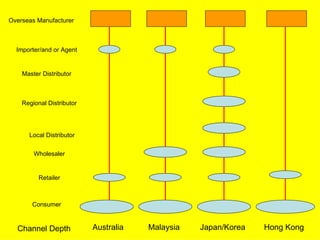
Overseas Manufacturer


  Importer/and or Agent


    Master Distributor


    Regional Distributor


      Local Distributor


        Wholesaler


          Retailer


       Consumer


  Channel Depth            Australia   Malaysia   Japan/Korea   Hong Kong
Stakeholders
Product/Channel/Market Models
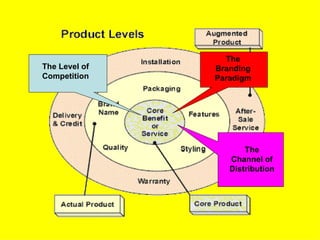
The
The Level of   Branding
Competition    Paradigm


                      The
                  Channel of
                  Distribution
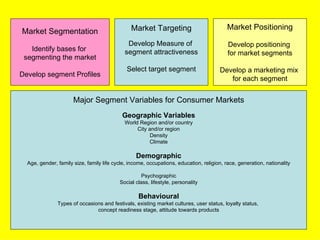
Market Targeting                           Market Positioning
Market Segmentation
                                              Develop Measure of                          Develop positioning
   Identify bases for                        segment attractiveness                       for market segments
 segmenting the market
                                             Select target segment                     Develop a marketing mix
Develop segment Profiles
                                                                                          for each segment


                      Major Segment Variables for Consumer Markets
                                           Geographic Variables
                                            World Region and/or country
                                                 City and/or region
                                                       Density
                                                      Climate

                                                  Demographic
  Age, gender, family size, family life cycle, income, occupations, education, religion, race, generation, nationality

                                                   Psychographic
                                          Social class, lifestyle, personality

                                                   Behavioural
               Types of occasions and festivals, existing market cultures, user status, loyalty status,
                               concept readiness stage, attitude towards products
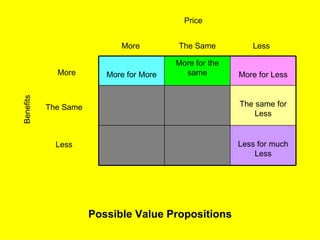
Price


                            More         The Same          Less

                                         More for the
             More        More for More     same         More for Less
Benefits


           The Same                                     The same for
                                                            Less


             Less                                       Less for much
                                                            Less


                      Possible Value Propositions

International Marketing Lecture 3

  • 1.
    International Marketing 463-441 Lecture 3 The Basic Tools of Marketing Redefined in the International Context
  • 2.
    1. The MarketingMix CRM 2. Analytical Tools 3. Consumer Behaviour Models 4. Channels 5. Consumer, B2B, Direct, Retail Marketing, etc A revisit to the basic tools of marketing in the international context
  • 3.
  • 4.
  • 5.
    Domestic Market Competitors Tastes Trends Feed forward Promotion Competencies Branding Channels Chemical Raw Materials Relative Style Logistics Competitive Packaging Advantage Sourcing Finance Company Fit Manufacturing Processes Regulation Feedback Material Technology Availability International Markets
  • 6.
    PEST Analysis • Political Analysis • Economic Analysis b) Political stability b) Type of economic system in country of operation c) Risk of military intervention c) Government intervention in free market c) Legal framework for contract enforcement d) Comparative advantages of host country d) Intellectual property protection e) Exchange rates & stability of host country currency e) Trade regulations and tariffs f) Infrastructure quality f) Favoured trading partners g) Skill level of workforce g) Anti-trust laws h) Labour costs h) Pricing regulations ix) Business cycle stage i) Taxation – tax rates and incentives j) Economic growth rate j) Wage legislation k) Discretionary income k) Work week l) Unemployment rate L) Mandatory worker benefits m) Inflation rate M) Industrial safety regulations n) Interest rates N) Product labeling requirements o) Income distribution p) Poverty rate • Social Analysis • Technology Analysis b) Recent technology developments b) Demographies c) Technology impact on product offering c) Class structure d) Impact on cost structure d) Education e) Impact on value chain structure e) Culture f) Rate of technology diffusion f) Entrepreneurialism g) R&D activity g) Attitudes h) Leisure interest
  • 7.
    Major PEST Trendsin Asia • Political factors b) Growing acceptance of the benefits of free trade and foreign investment c) Increasing resistance by non-government organisations to ‘globalisation’ d) General reduction of political risks e) Major regional and other free trade agreements f) Government protection of domestic firms and industries decreasing and becoming less effective • Economic factors b) Fewer barriers to trade, investments and financial flows c) Increased trade and investment flows d) Improved institutional frameworks for business, trade and investment e) Continued growth of China, the emergence of India f) Growing risk of contagion within and across regions during economic and financial crisis
  • 8.
    Major PEST Trendsin Asia • Social Factors b) Increasingly educated, trained and competetent consumers and populations c) Continuing convergence in consumer needs, desires and wants d) Grow of disposable income in East Asia e) Easier and greater movement of skilled manpower within and outside Asia f) Emerging pressures on corporate social responsibility g) Long term trend of aging populations in some countries h) Higher proportion of female graduates than males • Technological Factors b) More rapid and disruptive changes in technology c) Greater ability of emerging economies to utilise and absorb technology d) Widespread diffusion of information and transport technology e) Changing ‘make or buy’ decisions and less defined firm boundaries
  • 9.
    An Analysis ofCulture and Change
  • 10.
    Geography (Climate, Topography, Flora, Fauna, Microbiology) Adapted from Cateora & Graham P. 99 History Adaptation Technology and Political Economy Social Institutions Socialisation (Family, Religion, School, Media, Government, Corporations) Application Imitation Elements of Culture Peers (Values, rituals, symbols, beliefs, though processes Consequences Consumption decisions Market and behaviours Management Styles Structure
  • 11.
    The Forces of Primary Change in the Technology In Business sp n ira Landscape a tio Digitization t io re n C n Ac io co ct ru m st m on Destruction Adoption od ec at io D n Political Coordination Social legal Cultural Economy (Central) Globalization Immediate Incremental Acceleration Rationalization Re n tio de Realization Formation ap f in Ad itio n R Prosperity n eg Peace tio ul (Economic People Futurization a at (Regional uc io integration and (Human and social Ed Peace andn development๗ cooperation) Market security) Ultimate Kotler, et. Al., Think ASEAN
  • 12.
    Value Migrator Change Certain/Uncertain Technology Important/Unimportant Political Legal Economy Social-Cultural Market Value Supplier Value Determiner Competitor Customer TOWS Examination Winner, Loser, Committed, Lost, New Emerging Value Decider Company Existing competence, Risk, Attitude, Stretch Possibility The Diamond 4C Sub-Model Choice Go invest No-Go/Hold Harvest Divest Kotler, et. al, Think ASEAN P. 6
  • 13.
  • 14.
    Ideas Opportunities Solutions Realisation Performance Management Capability Spots Evaluates Selects Targets Creativity Innovation Strategic Thinking Differentiation Competitive Capabilities Governing Competitive Advantage Scope Costs: to customers Knowledge: Industry/market/technical/p Competencies rocess Entrepreneurial, Opportunity Relationships: Identification, Network, Conceptual, Customers/suppliers/distri Organisational, Strategic, Commitment, butors/relative power Resources Structure: Ability
  • 15.
    The Outcomes (potential targets) Key internal The process of Key external influences on the product/market influences on the Size and depth of change development development development Time process process The base potential for development Where the business is currently performing Gibb & Scott 1988
  • 16.
    Potential Product Lifecycle IP Value & Profitability Novelty IP Va lue Competitive Concept Risk Taking Risk Taking it of Pr Pioneers Early Early Late Late followers Majority Followers Time Majority
  • 17.
    Profile of businessin terms of performance: Performance Base • Market trends: current product mix, market mix, competition • Production trends: Utilisation, efficiency, quality •Financial and Management: net worth, liquidity, gearing, trends Key internal influences on Administrative, marketing, production and Managerial the resources and capabilities. development process Key external Competition, market restrictions influences on the development process All influence the type of product and market development that will take place
  • 18.
    Environmental Analysis: Threatsand Opportunities Market: product position and prospects Competition: Traditional, new firms, new industries, profits Technology: Changes and developments The Economy: Growth, inflation, Law Operating Needs Personal Business Strategies Operating & Tactics Products Objectives Objectives Budgets Manpower Finance Feedback loops Business Analysis: Strengths and Weaknesses Product: 4 Ps or 4 customer wants Profit/Cash flow: its sources and uses People: Management and Skills Facilities: age, technology and utilisation Burns & Dewhurst 1993
  • 19.
    Potential Strategies Identifiedthrough SWOT Analysis Strengths Weaknesses S W SO Strategies WO Strategies Use strengths to take Take advantage of Opportunities advantage of opportunities opportunities by overcoming weaknesses or O making them irrelevant Threats ST Strategies WT Strategies Use strengths to avoid Minimize weaknesses and T threats avoid threats
  • 20.
    Sources of CompetitiveAdvantage (The reason for any product development in a company) Importance of price to customers, distributors, the extend of Costs: demand elasticity Knowledge: Stage of industry lifecycle, common industry knowledge verses your own specialised knowledge Links with customers, suppliers, distributors, relative Relationships: power Appropriate organisational structures, Ability to respond Structure: to market, leadership.
  • 21.
    Regulation SCCP placed lemongrass oil under scrutiny as a cosmetic Trends & Technology ingredient in EU. Alternative technologies to Trends & Technology steam distillation (CO2) Substitutes can make much smoother Citral (main constituents) can Regulation oil but will increase capital be produced from a number of needs greatly. chemical feed stocks. Natural, exotic, organic, Alternative oils (litsea cubeba) FAIRTRADE could cost much less to produce. increase oils popularity (?) Lemon myrtle oil much if seen as exotic. smoother and acceptable to end users Many alternatives to lemongrass in product formulations. Substitutes Industry Competitors Bargaining Bargaining power of power of buyers suppliers Intensity of Rivalry Competitive Rivalries Bargaining Power of Buyers Currently small item of trade in flavour industry, strong relationships with established producers. Bargaining Power of Suppliers Collecting the most suitable Competitive Rivalries planting material require effort. Lemongrass quick yield and Extraction and straightforward to cultivate and distil harvest .technology needs to be – expect high elasticity of supply acquired or developed from both existing and new Analytical equipment or service producers. maybe expensive/remote. Producers of substitutes very aggressive
  • 22.
    Fulfillment: (dreams) Actualisation (The Artist) Study after retirement Self-fulfillment Fresh vegetables (Organic) Books Fine Dining & Processed Foods Aromatherapy products Luxury cars Esteem Nutraceuticals & herbs Travel & Vacations (The Executive) Achievement, Fine Fragrances prestige,fulfillment Car Air Fresheners Responsibility: (hope) Fashion Clothes (e.g. Social (Worker) Jeans) Chewing Gum Family, relationships, workgroups Community: (acceptance) Most Water Household Safety (The Farmer) Purifiers Cleaning Home, Security and stability Necessities: based on what is good (existence) Products Fresh Soap Vegetables Physiological (The Hunter) Rice Basic Biological Needs – Food, water, air Staples: based on survival (fear)
  • 23.
  • 24.
  • 25.
    Free Trade Investigate Potential Arrangements Market Competitive Further Advantage Political & Legal Situation Firm Capabilities Market & Partners & Competition Channels
  • 26.
    Yes Yes Access to Potential to Continue channels? Networks and Partners? Yes Yes Capabilities? Sustainable Market Size? Yes Yes Yes Competitive Market Product Concepts Advantage? Access? Acceptable?
  • 27.
    Distant Geographic Market Close Existing Product Market New Early Timing of Entry Late Dependent Entry Mode Independent
  • 28.
    Overseas Manufacturer Importer/and or Agent Master Distributor Regional Distributor Local Distributor Wholesaler Retailer Consumer Channel Depth Australia Malaysia Japan/Korea Hong Kong
  • 29.
  • 31.
  • 32.
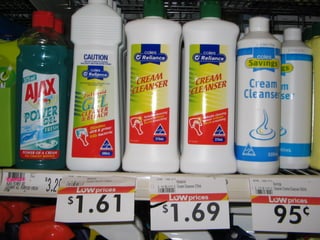
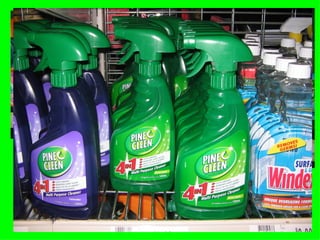
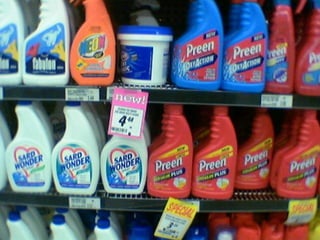
    The The Level of Branding Competition Paradigm The Channel of Distribution
  • 34.
    Market Targeting Market Positioning Market Segmentation Develop Measure of Develop positioning Identify bases for segment attractiveness for market segments segmenting the market Select target segment Develop a marketing mix Develop segment Profiles for each segment Major Segment Variables for Consumer Markets Geographic Variables World Region and/or country City and/or region Density Climate Demographic Age, gender, family size, family life cycle, income, occupations, education, religion, race, generation, nationality Psychographic Social class, lifestyle, personality Behavioural Types of occasions and festivals, existing market cultures, user status, loyalty status, concept readiness stage, attitude towards products
  • 41.
    Price More The Same Less More for the More More for More same More for Less Benefits The Same The same for Less Less Less for much Less Possible Value Propositions