Introduction
Chapter 1
Computer Networks, Fifth Edition by Andrew Tanenbaum and David Wetherall, © Pearson Education-Prentice Hall, 2011
Uses of Computer Networks
• Business Applications
• Home Applications
• Mobile Users
• Social Issues
Computer Networks, Fifth Edition by Andrew Tanenbaum and David Wetherall, © Pearson Education-Prentice Hall, 2011
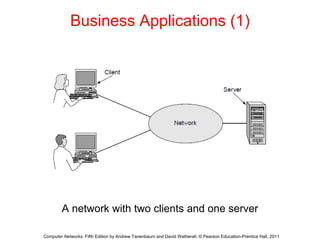
Business Applications (1)
A network with two clients and one server
Computer Networks, Fifth Edition by Andrew Tanenbaum and David Wetherall, © Pearson Education-Prentice Hall, 2011
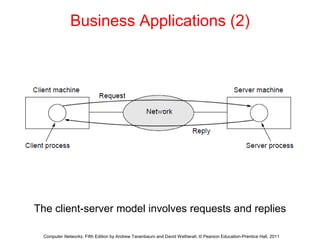
Business Applications (2)
The client-server model involves requests and replies
Computer Networks, Fifth Edition by Andrew Tanenbaum and David Wetherall, © Pearson Education-Prentice Hall, 2011
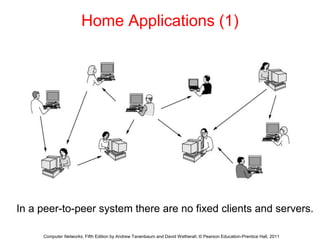
Home Applications (1)
In a peer-to-peer system there are no fixed clients and servers.
Computer Networks, Fifth Edition by Andrew Tanenbaum and David Wetherall, © Pearson Education-Prentice Hall, 2011
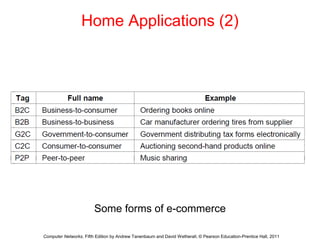
Home Applications (2)
Some forms of e-commerce
Computer Networks, Fifth Edition by Andrew Tanenbaum and David Wetherall, © Pearson Education-Prentice Hall, 2011
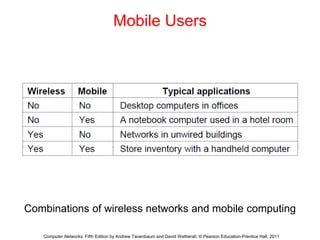
Mobile Users
Combinations of wireless networks and mobile computing
Computer Networks, Fifth Edition by Andrew Tanenbaum and David Wetherall, © Pearson Education-Prentice Hall, 2011
Social Issues
• Network neutrality
• Digital Millennium Copyright Act
• Profiling users
• Phishing
Computer Networks, Fifth Edition by Andrew Tanenbaum and David Wetherall, © Pearson Education-Prentice Hall, 2011
Network Hardware (1)
• Personal area networks
• Local area networks
• Metropolitan area networks
• Wide are networks
• The internet
Computer Networks, Fifth Edition by Andrew Tanenbaum and David Wetherall, © Pearson Education-Prentice Hall, 2011
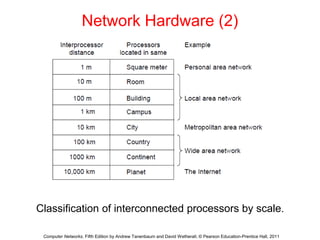
Network Hardware (2)
Classification of interconnected processors by scale.
Computer Networks, Fifth Edition by Andrew Tanenbaum and David Wetherall, © Pearson Education-Prentice Hall, 2011
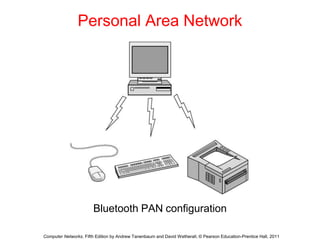
Personal Area Network
Bluetooth PAN configuration
Computer Networks, Fifth Edition by Andrew Tanenbaum and David Wetherall, © Pearson Education-Prentice Hall, 2011
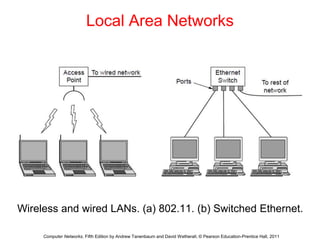
Local Area Networks
Wireless and wired LANs. (a) 802.11. (b) Switched Ethernet.
Computer Networks, Fifth Edition by Andrew Tanenbaum and David Wetherall, © Pearson Education-Prentice Hall, 2011
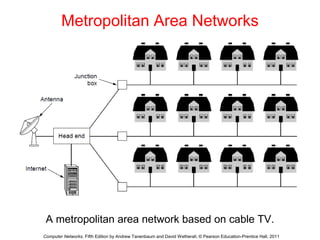
Metropolitan Area Networks
A metropolitan area network based on cable TV.
Computer Networks, Fifth Edition by Andrew Tanenbaum and David Wetherall, © Pearson Education-Prentice Hall, 2011
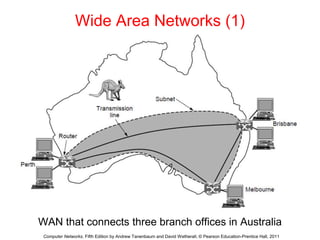
Wide Area Networks (1)
WAN that connects three branch offices in Australia
Computer Networks, Fifth Edition by Andrew Tanenbaum and David Wetherall, © Pearson Education-Prentice Hall, 2011
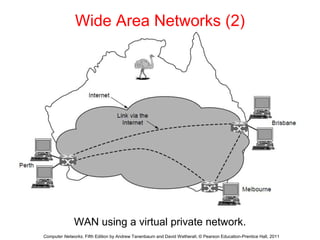
Wide Area Networks (2)
WAN using a virtual private network.
Computer Networks, Fifth Edition by Andrew Tanenbaum and David Wetherall, © Pearson Education-Prentice Hall, 2011
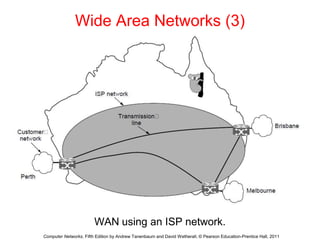
Wide Area Networks (3)
WAN using an ISP network.
Computer Networks, Fifth Edition by Andrew Tanenbaum and David Wetherall, © Pearson Education-Prentice Hall, 2011
Network Software
• Protocol hierarchies
• Design issues for the layers
• Connection-oriented versus connectionless
service
• Service primitives
• Relationship of services to protocols
Computer Networks, Fifth Edition by Andrew Tanenbaum and David Wetherall, © Pearson Education-Prentice Hall, 2011
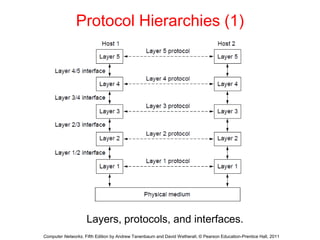
Protocol Hierarchies (1)
Layers, protocols, and interfaces.
Computer Networks, Fifth Edition by Andrew Tanenbaum and David Wetherall, © Pearson Education-Prentice Hall, 2011
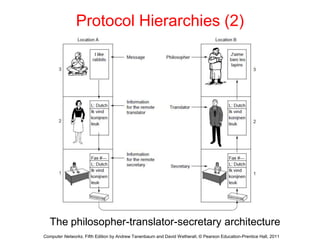
Protocol Hierarchies (2)
The philosopher-translator-secretary architecture
Computer Networks, Fifth Edition by Andrew Tanenbaum and David Wetherall, © Pearson Education-Prentice Hall, 2011
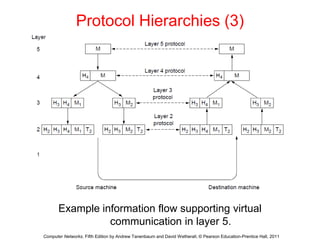
Protocol Hierarchies (3)
Example information flow supporting virtual
communication in layer 5.
Computer Networks, Fifth Edition by Andrew Tanenbaum and David Wetherall, © Pearson Education-Prentice Hall, 2011
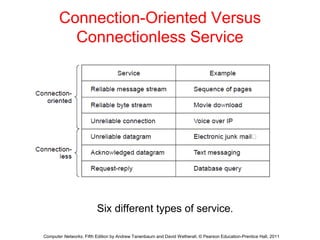
Connection-Oriented Versus
Connectionless Service
Six different types of service.
Computer Networks, Fifth Edition by Andrew Tanenbaum and David Wetherall, © Pearson Education-Prentice Hall, 2011
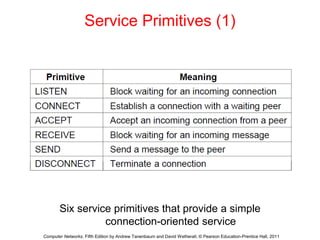
Service Primitives (1)
Six service primitives that provide a simple
connection-oriented service
Computer Networks, Fifth Edition by Andrew Tanenbaum and David Wetherall, © Pearson Education-Prentice Hall, 2011
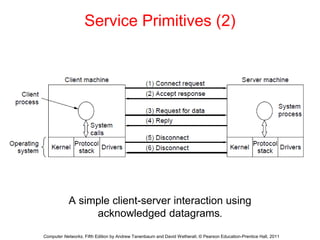
Service Primitives (2)
A simple client-server interaction using
acknowledged datagrams.
Computer Networks, Fifth Edition by Andrew Tanenbaum and David Wetherall, © Pearson Education-Prentice Hall, 2011
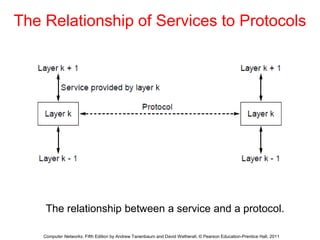
The Relationship of Services to Protocols
The relationship between a service and a protocol.
Computer Networks, Fifth Edition by Andrew Tanenbaum and David Wetherall, © Pearson Education-Prentice Hall, 2011
Reference Models
• OSI reference model
• TCP/IP reference model
• Model used for this text
• Comparison of OSI and TCP/IP
• Critique of OSI model and protocols
• Critique of TCP/IP model
Computer Networks, Fifth Edition by Andrew Tanenbaum and David Wetherall, © Pearson Education-Prentice Hall, 2011
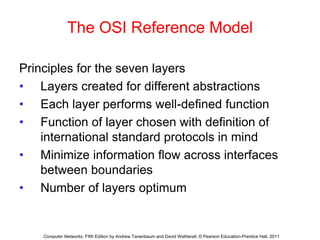
The OSI Reference Model
Principles for the seven layers
• Layers created for different abstractions
• Each layer performs well-defined function
• Function of layer chosen with definition of
international standard protocols in mind
• Minimize information flow across interfaces
between boundaries
• Number of layers optimum
Computer Networks, Fifth Edition by Andrew Tanenbaum and David Wetherall, © Pearson Education-Prentice Hall, 2011
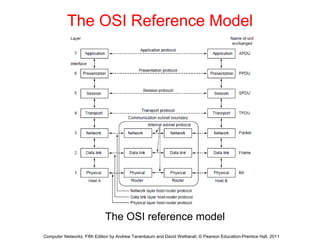
The OSI Reference Model
The OSI reference model
Computer Networks, Fifth Edition by Andrew Tanenbaum and David Wetherall, © Pearson Education-Prentice Hall, 2011
OSI Reference Model Layers
• Physical layer
• Data link layer
• Network layer
• Transport layer
• Session layer
• Presentation layer
• Application layer
Computer Networks, Fifth Edition by Andrew Tanenbaum and David Wetherall, © Pearson Education-Prentice Hall, 2011
The TCP/IP Reference Model Layers
• Link layer
• Internet layer
• Transport layer
• Application layer
Computer Networks, Fifth Edition by Andrew Tanenbaum and David Wetherall, © Pearson Education-Prentice Hall, 2011
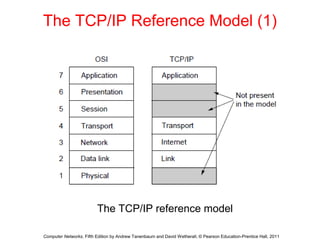
The TCP/IP Reference Model (1)
The TCP/IP reference model
Computer Networks, Fifth Edition by Andrew Tanenbaum and David Wetherall, © Pearson Education-Prentice Hall, 2011
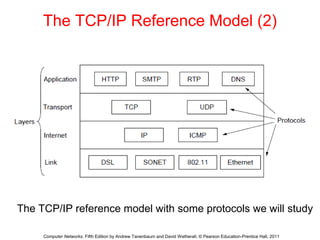
The TCP/IP Reference Model (2)
The TCP/IP reference model with some protocols we will study
Computer Networks, Fifth Edition by Andrew Tanenbaum and David Wetherall, © Pearson Education-Prentice Hall, 2011
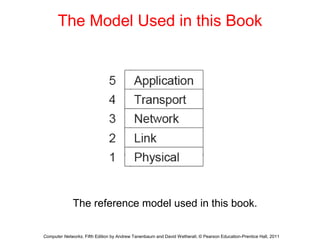
The Model Used in this Book
The reference model used in this book.
Computer Networks, Fifth Edition by Andrew Tanenbaum and David Wetherall, © Pearson Education-Prentice Hall, 2011
Comparison of the OSI and
TCP/IP Reference Models
Concepts central to OSI model
• Services
• Interfaces
• Protocols
Computer Networks, Fifth Edition by Andrew Tanenbaum and David Wetherall, © Pearson Education-Prentice Hall, 2011
Critique of the OSI Model and Protocols
• Bad timing.
• Bad technology.
• Bad implementations.
• Bad politics.
Computer Networks, Fifth Edition by Andrew Tanenbaum and David Wetherall, © Pearson Education-Prentice Hall, 2011
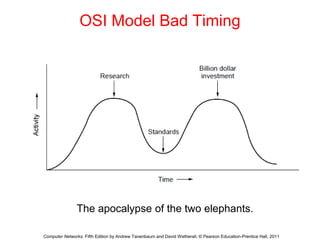
OSI Model Bad Timing
The apocalypse of the two elephants.
Computer Networks, Fifth Edition by Andrew Tanenbaum and David Wetherall, © Pearson Education-Prentice Hall, 2011
Example Networks
• Internet
• ARPANET
• NSFNET
• Third-generation mobile phone networks
• Wireless LANs: 802.11
• RFID and sensor networks
Computer Networks, Fifth Edition by Andrew Tanenbaum and David Wetherall, © Pearson Education-Prentice Hall, 2011
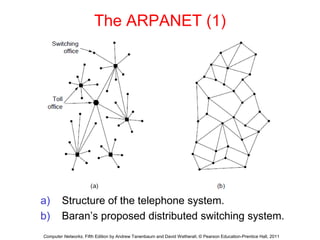
The ARPANET (1)
a) Structure of the telephone system.
b) Baran’s proposed distributed switching system.
Computer Networks, Fifth Edition by Andrew Tanenbaum and David Wetherall, © Pearson Education-Prentice Hall, 2011
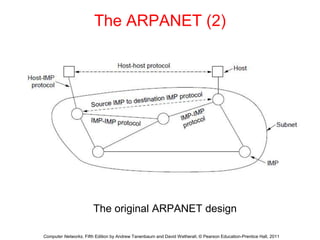
The ARPANET (2)
The original ARPANET design
Computer Networks, Fifth Edition by Andrew Tanenbaum and David Wetherall, © Pearson Education-Prentice Hall, 2011
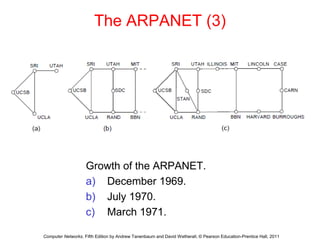
The ARPANET (3)
Growth of the ARPANET.
a) December 1969.
b) July 1970.
c) March 1971.
Computer Networks, Fifth Edition by Andrew Tanenbaum and David Wetherall, © Pearson Education-Prentice Hall, 2011
The ARPANET (4)
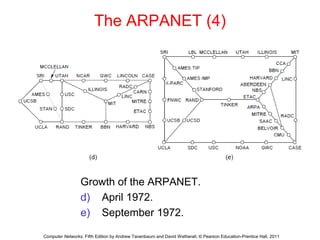
Growth of the ARPANET.
d) April 1972.
e) September 1972.
Computer Networks, Fifth Edition by Andrew Tanenbaum and David Wetherall, © Pearson Education-Prentice Hall, 2011
NSFNET
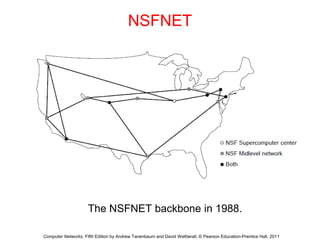
The NSFNET backbone in 1988.
Computer Networks, Fifth Edition by Andrew Tanenbaum and David Wetherall, © Pearson Education-Prentice Hall, 2011
Architecture of the Internet
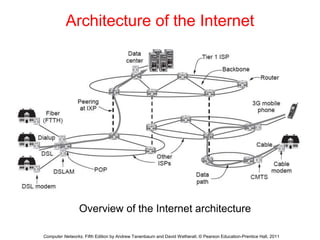
Overview of the Internet architecture
Computer Networks, Fifth Edition by Andrew Tanenbaum and David Wetherall, © Pearson Education-Prentice Hall, 2011
Third-Generation Mobile
Phone Networks (1)
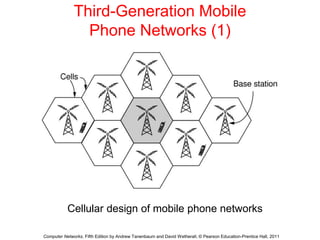
Cellular design of mobile phone networks
Computer Networks, Fifth Edition by Andrew Tanenbaum and David Wetherall, © Pearson Education-Prentice Hall, 2011
Third-Generation Mobile
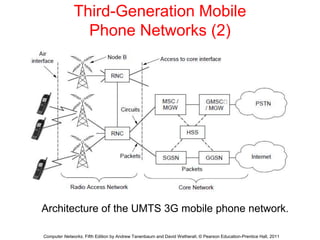
Phone Networks (2)
Architecture of the UMTS 3G mobile phone network.
Computer Networks, Fifth Edition by Andrew Tanenbaum and David Wetherall, © Pearson Education-Prentice Hall, 2011
Third-Generation Mobile
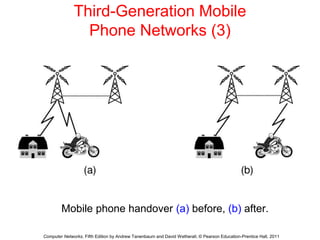
Phone Networks (3)
Mobile phone handover (a) before, (b) after.
Computer Networks, Fifth Edition by Andrew Tanenbaum and David Wetherall, © Pearson Education-Prentice Hall, 2011
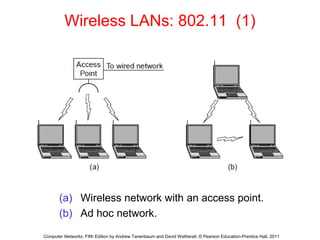
Wireless LANs: 802.11 (1)
(a) Wireless network with an access point.
(b) Ad hoc network.
Computer Networks, Fifth Edition by Andrew Tanenbaum and David Wetherall, © Pearson Education-Prentice Hall, 2011
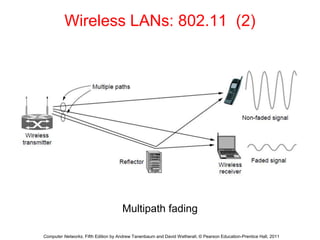
Wireless LANs: 802.11 (2)
Multipath fading
Computer Networks, Fifth Edition by Andrew Tanenbaum and David Wetherall, © Pearson Education-Prentice Hall, 2011
Wireless LANs: 802.11 (3)
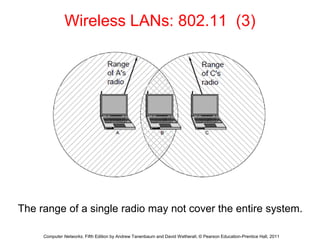
The range of a single radio may not cover the entire system.
Computer Networks, Fifth Edition by Andrew Tanenbaum and David Wetherall, © Pearson Education-Prentice Hall, 2011
RFID and Sensor Networks (1)
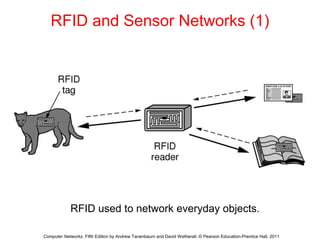
RFID used to network everyday objects.
Computer Networks, Fifth Edition by Andrew Tanenbaum and David Wetherall, © Pearson Education-Prentice Hall, 2011
RFID and Sensor Networks (2)
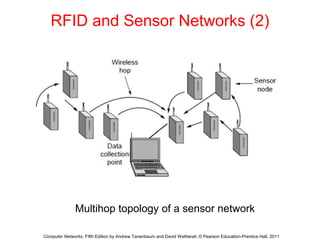
Multihop topology of a sensor network
Computer Networks, Fifth Edition by Andrew Tanenbaum and David Wetherall, © Pearson Education-Prentice Hall, 2011
Network Standardization
• Who’s Who in telecommunications
• Who’s Who in international standards
• Who’s Who in internet standards
Computer Networks, Fifth Edition by Andrew Tanenbaum and David Wetherall, © Pearson Education-Prentice Hall, 2011
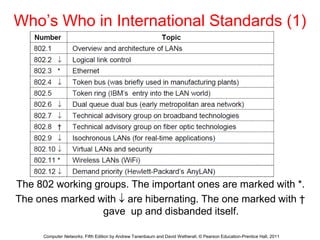
Who’s Who in International Standards (1)
The 802 working groups. The important ones are marked with *.
The ones marked with  are hibernating. The one marked with †
gave up and disbanded itself.
Computer Networks, Fifth Edition by Andrew Tanenbaum and David Wetherall, © Pearson Education-Prentice Hall, 2011
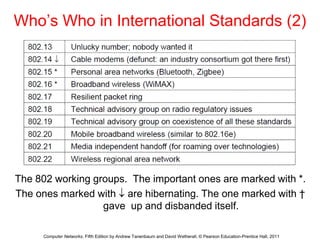
Who’s Who in International Standards (2)
The 802 working groups. The important ones are marked with *.
The ones marked with  are hibernating. The one marked with †
gave up and disbanded itself.
Computer Networks, Fifth Edition by Andrew Tanenbaum and David Wetherall, © Pearson Education-Prentice Hall, 2011
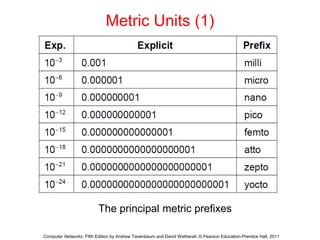
Metric Units (1)
The principal metric prefixes
Computer Networks, Fifth Edition by Andrew Tanenbaum and David Wetherall, © Pearson Education-Prentice Hall, 2011
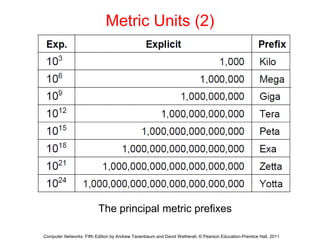
Metric Units (2)
The principal metric prefixes
Computer Networks, Fifth Edition by Andrew Tanenbaum and David Wetherall, © Pearson Education-Prentice Hall, 2011
End
Chapter 1
Computer Networks, Fifth Edition by Andrew Tanenbaum and David Wetherall, © Pearson Education-Prentice Hall, 2011

Chapter1-Introduction.ppt

  • 1.
    Introduction Chapter 1 Computer Networks,Fifth Edition by Andrew Tanenbaum and David Wetherall, © Pearson Education-Prentice Hall, 2011
  • 2.
    Uses of ComputerNetworks • Business Applications • Home Applications • Mobile Users • Social Issues Computer Networks, Fifth Edition by Andrew Tanenbaum and David Wetherall, © Pearson Education-Prentice Hall, 2011
  • 3.
    Business Applications (1) Anetwork with two clients and one server Computer Networks, Fifth Edition by Andrew Tanenbaum and David Wetherall, © Pearson Education-Prentice Hall, 2011
  • 4.
    Business Applications (2) Theclient-server model involves requests and replies Computer Networks, Fifth Edition by Andrew Tanenbaum and David Wetherall, © Pearson Education-Prentice Hall, 2011
  • 5.
    Home Applications (1) Ina peer-to-peer system there are no fixed clients and servers. Computer Networks, Fifth Edition by Andrew Tanenbaum and David Wetherall, © Pearson Education-Prentice Hall, 2011
  • 6.
    Home Applications (2) Someforms of e-commerce Computer Networks, Fifth Edition by Andrew Tanenbaum and David Wetherall, © Pearson Education-Prentice Hall, 2011
  • 7.
    Mobile Users Combinations ofwireless networks and mobile computing Computer Networks, Fifth Edition by Andrew Tanenbaum and David Wetherall, © Pearson Education-Prentice Hall, 2011
  • 8.
    Social Issues • Networkneutrality • Digital Millennium Copyright Act • Profiling users • Phishing Computer Networks, Fifth Edition by Andrew Tanenbaum and David Wetherall, © Pearson Education-Prentice Hall, 2011
  • 9.
    Network Hardware (1) •Personal area networks • Local area networks • Metropolitan area networks • Wide are networks • The internet Computer Networks, Fifth Edition by Andrew Tanenbaum and David Wetherall, © Pearson Education-Prentice Hall, 2011
  • 10.
    Network Hardware (2) Classificationof interconnected processors by scale. Computer Networks, Fifth Edition by Andrew Tanenbaum and David Wetherall, © Pearson Education-Prentice Hall, 2011
  • 11.
    Personal Area Network BluetoothPAN configuration Computer Networks, Fifth Edition by Andrew Tanenbaum and David Wetherall, © Pearson Education-Prentice Hall, 2011
  • 12.
    Local Area Networks Wirelessand wired LANs. (a) 802.11. (b) Switched Ethernet. Computer Networks, Fifth Edition by Andrew Tanenbaum and David Wetherall, © Pearson Education-Prentice Hall, 2011
  • 13.
    Metropolitan Area Networks Ametropolitan area network based on cable TV. Computer Networks, Fifth Edition by Andrew Tanenbaum and David Wetherall, © Pearson Education-Prentice Hall, 2011
  • 14.
    Wide Area Networks(1) WAN that connects three branch offices in Australia Computer Networks, Fifth Edition by Andrew Tanenbaum and David Wetherall, © Pearson Education-Prentice Hall, 2011
  • 15.
    Wide Area Networks(2) WAN using a virtual private network. Computer Networks, Fifth Edition by Andrew Tanenbaum and David Wetherall, © Pearson Education-Prentice Hall, 2011
  • 16.
    Wide Area Networks(3) WAN using an ISP network. Computer Networks, Fifth Edition by Andrew Tanenbaum and David Wetherall, © Pearson Education-Prentice Hall, 2011
  • 17.
    Network Software • Protocolhierarchies • Design issues for the layers • Connection-oriented versus connectionless service • Service primitives • Relationship of services to protocols Computer Networks, Fifth Edition by Andrew Tanenbaum and David Wetherall, © Pearson Education-Prentice Hall, 2011
  • 18.
    Protocol Hierarchies (1) Layers,protocols, and interfaces. Computer Networks, Fifth Edition by Andrew Tanenbaum and David Wetherall, © Pearson Education-Prentice Hall, 2011
  • 19.
    Protocol Hierarchies (2) Thephilosopher-translator-secretary architecture Computer Networks, Fifth Edition by Andrew Tanenbaum and David Wetherall, © Pearson Education-Prentice Hall, 2011
  • 20.
    Protocol Hierarchies (3) Exampleinformation flow supporting virtual communication in layer 5. Computer Networks, Fifth Edition by Andrew Tanenbaum and David Wetherall, © Pearson Education-Prentice Hall, 2011
  • 21.
    Connection-Oriented Versus Connectionless Service Sixdifferent types of service. Computer Networks, Fifth Edition by Andrew Tanenbaum and David Wetherall, © Pearson Education-Prentice Hall, 2011
  • 22.
    Service Primitives (1) Sixservice primitives that provide a simple connection-oriented service Computer Networks, Fifth Edition by Andrew Tanenbaum and David Wetherall, © Pearson Education-Prentice Hall, 2011
  • 23.
    Service Primitives (2) Asimple client-server interaction using acknowledged datagrams. Computer Networks, Fifth Edition by Andrew Tanenbaum and David Wetherall, © Pearson Education-Prentice Hall, 2011
  • 24.
    The Relationship ofServices to Protocols The relationship between a service and a protocol. Computer Networks, Fifth Edition by Andrew Tanenbaum and David Wetherall, © Pearson Education-Prentice Hall, 2011
  • 25.
    Reference Models • OSIreference model • TCP/IP reference model • Model used for this text • Comparison of OSI and TCP/IP • Critique of OSI model and protocols • Critique of TCP/IP model Computer Networks, Fifth Edition by Andrew Tanenbaum and David Wetherall, © Pearson Education-Prentice Hall, 2011
  • 26.
    The OSI ReferenceModel Principles for the seven layers • Layers created for different abstractions • Each layer performs well-defined function • Function of layer chosen with definition of international standard protocols in mind • Minimize information flow across interfaces between boundaries • Number of layers optimum Computer Networks, Fifth Edition by Andrew Tanenbaum and David Wetherall, © Pearson Education-Prentice Hall, 2011
  • 27.
    The OSI ReferenceModel The OSI reference model Computer Networks, Fifth Edition by Andrew Tanenbaum and David Wetherall, © Pearson Education-Prentice Hall, 2011
  • 28.
    OSI Reference ModelLayers • Physical layer • Data link layer • Network layer • Transport layer • Session layer • Presentation layer • Application layer Computer Networks, Fifth Edition by Andrew Tanenbaum and David Wetherall, © Pearson Education-Prentice Hall, 2011
  • 29.
    The TCP/IP ReferenceModel Layers • Link layer • Internet layer • Transport layer • Application layer Computer Networks, Fifth Edition by Andrew Tanenbaum and David Wetherall, © Pearson Education-Prentice Hall, 2011
  • 30.
    The TCP/IP ReferenceModel (1) The TCP/IP reference model Computer Networks, Fifth Edition by Andrew Tanenbaum and David Wetherall, © Pearson Education-Prentice Hall, 2011
  • 31.
    The TCP/IP ReferenceModel (2) The TCP/IP reference model with some protocols we will study Computer Networks, Fifth Edition by Andrew Tanenbaum and David Wetherall, © Pearson Education-Prentice Hall, 2011
  • 32.
    The Model Usedin this Book The reference model used in this book. Computer Networks, Fifth Edition by Andrew Tanenbaum and David Wetherall, © Pearson Education-Prentice Hall, 2011
  • 33.
    Comparison of theOSI and TCP/IP Reference Models Concepts central to OSI model • Services • Interfaces • Protocols Computer Networks, Fifth Edition by Andrew Tanenbaum and David Wetherall, © Pearson Education-Prentice Hall, 2011
  • 34.
    Critique of theOSI Model and Protocols • Bad timing. • Bad technology. • Bad implementations. • Bad politics. Computer Networks, Fifth Edition by Andrew Tanenbaum and David Wetherall, © Pearson Education-Prentice Hall, 2011
  • 35.
    OSI Model BadTiming The apocalypse of the two elephants. Computer Networks, Fifth Edition by Andrew Tanenbaum and David Wetherall, © Pearson Education-Prentice Hall, 2011
  • 36.
    Example Networks • Internet •ARPANET • NSFNET • Third-generation mobile phone networks • Wireless LANs: 802.11 • RFID and sensor networks Computer Networks, Fifth Edition by Andrew Tanenbaum and David Wetherall, © Pearson Education-Prentice Hall, 2011
  • 37.
    The ARPANET (1) a)Structure of the telephone system. b) Baran’s proposed distributed switching system. Computer Networks, Fifth Edition by Andrew Tanenbaum and David Wetherall, © Pearson Education-Prentice Hall, 2011
  • 38.
    The ARPANET (2) Theoriginal ARPANET design Computer Networks, Fifth Edition by Andrew Tanenbaum and David Wetherall, © Pearson Education-Prentice Hall, 2011
  • 39.
    The ARPANET (3) Growthof the ARPANET. a) December 1969. b) July 1970. c) March 1971. Computer Networks, Fifth Edition by Andrew Tanenbaum and David Wetherall, © Pearson Education-Prentice Hall, 2011
  • 40.
    The ARPANET (4) Growthof the ARPANET. d) April 1972. e) September 1972. Computer Networks, Fifth Edition by Andrew Tanenbaum and David Wetherall, © Pearson Education-Prentice Hall, 2011
  • 41.
    NSFNET The NSFNET backbonein 1988. Computer Networks, Fifth Edition by Andrew Tanenbaum and David Wetherall, © Pearson Education-Prentice Hall, 2011
  • 42.
    Architecture of theInternet Overview of the Internet architecture Computer Networks, Fifth Edition by Andrew Tanenbaum and David Wetherall, © Pearson Education-Prentice Hall, 2011
  • 43.
    Third-Generation Mobile Phone Networks(1) Cellular design of mobile phone networks Computer Networks, Fifth Edition by Andrew Tanenbaum and David Wetherall, © Pearson Education-Prentice Hall, 2011
  • 44.
    Third-Generation Mobile Phone Networks(2) Architecture of the UMTS 3G mobile phone network. Computer Networks, Fifth Edition by Andrew Tanenbaum and David Wetherall, © Pearson Education-Prentice Hall, 2011
  • 45.
    Third-Generation Mobile Phone Networks(3) Mobile phone handover (a) before, (b) after. Computer Networks, Fifth Edition by Andrew Tanenbaum and David Wetherall, © Pearson Education-Prentice Hall, 2011
  • 46.
    Wireless LANs: 802.11(1) (a) Wireless network with an access point. (b) Ad hoc network. Computer Networks, Fifth Edition by Andrew Tanenbaum and David Wetherall, © Pearson Education-Prentice Hall, 2011
  • 47.
    Wireless LANs: 802.11(2) Multipath fading Computer Networks, Fifth Edition by Andrew Tanenbaum and David Wetherall, © Pearson Education-Prentice Hall, 2011
  • 48.
    Wireless LANs: 802.11(3) The range of a single radio may not cover the entire system. Computer Networks, Fifth Edition by Andrew Tanenbaum and David Wetherall, © Pearson Education-Prentice Hall, 2011
  • 49.
    RFID and SensorNetworks (1) RFID used to network everyday objects. Computer Networks, Fifth Edition by Andrew Tanenbaum and David Wetherall, © Pearson Education-Prentice Hall, 2011
  • 50.
    RFID and SensorNetworks (2) Multihop topology of a sensor network Computer Networks, Fifth Edition by Andrew Tanenbaum and David Wetherall, © Pearson Education-Prentice Hall, 2011
  • 51.
    Network Standardization • Who’sWho in telecommunications • Who’s Who in international standards • Who’s Who in internet standards Computer Networks, Fifth Edition by Andrew Tanenbaum and David Wetherall, © Pearson Education-Prentice Hall, 2011
  • 52.
    Who’s Who inInternational Standards (1) The 802 working groups. The important ones are marked with *. The ones marked with  are hibernating. The one marked with † gave up and disbanded itself. Computer Networks, Fifth Edition by Andrew Tanenbaum and David Wetherall, © Pearson Education-Prentice Hall, 2011
  • 53.
    Who’s Who inInternational Standards (2) The 802 working groups. The important ones are marked with *. The ones marked with  are hibernating. The one marked with † gave up and disbanded itself. Computer Networks, Fifth Edition by Andrew Tanenbaum and David Wetherall, © Pearson Education-Prentice Hall, 2011
  • 54.
    Metric Units (1) Theprincipal metric prefixes Computer Networks, Fifth Edition by Andrew Tanenbaum and David Wetherall, © Pearson Education-Prentice Hall, 2011
  • 55.
    Metric Units (2) Theprincipal metric prefixes Computer Networks, Fifth Edition by Andrew Tanenbaum and David Wetherall, © Pearson Education-Prentice Hall, 2011
  • 56.
    End Chapter 1 Computer Networks,Fifth Edition by Andrew Tanenbaum and David Wetherall, © Pearson Education-Prentice Hall, 2011