BASIC
EDUCATION
CURRICULUM
Provide the general
objective of elementary,
secondary and non-formal
education.
 The objective of elementary and secondary
education serve as the “official learning
goals” of basic education as stated for a
particular population of learners; that is, the
elementary and secondary education
learners. The Bureau of Alternative Learning
System (Non-Formal Education) likewise has
a set of official learning goals for its
particular set of target learners – the out-of-
school youth and adults.
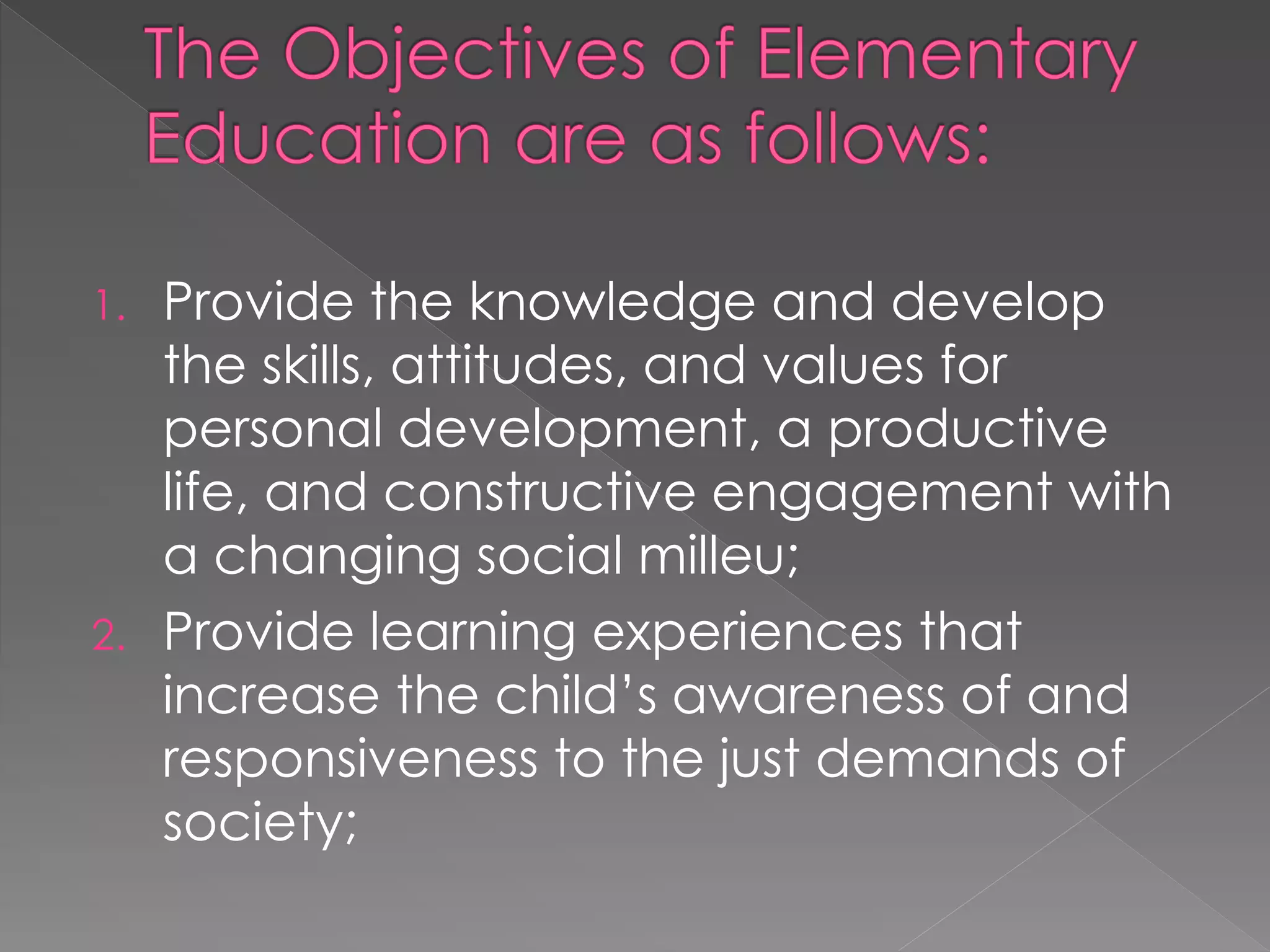
1. Provide the knowledge and develop
the skills, attitudes, and values for
personal development, a productive
life, and constructive engagement with
a changing social milleu;
2. Provide learning experiences that
increase the child’s awareness of and
responsiveness to the just demands of
society;
3. Promote and intensify awareness of
identification with, and love for our nation
and the community to which the learner
belongs; and
4. Promote experiences that develop the
learner’s orientation to the world or work
and prepare the learners to engage in
honest and gainful work.
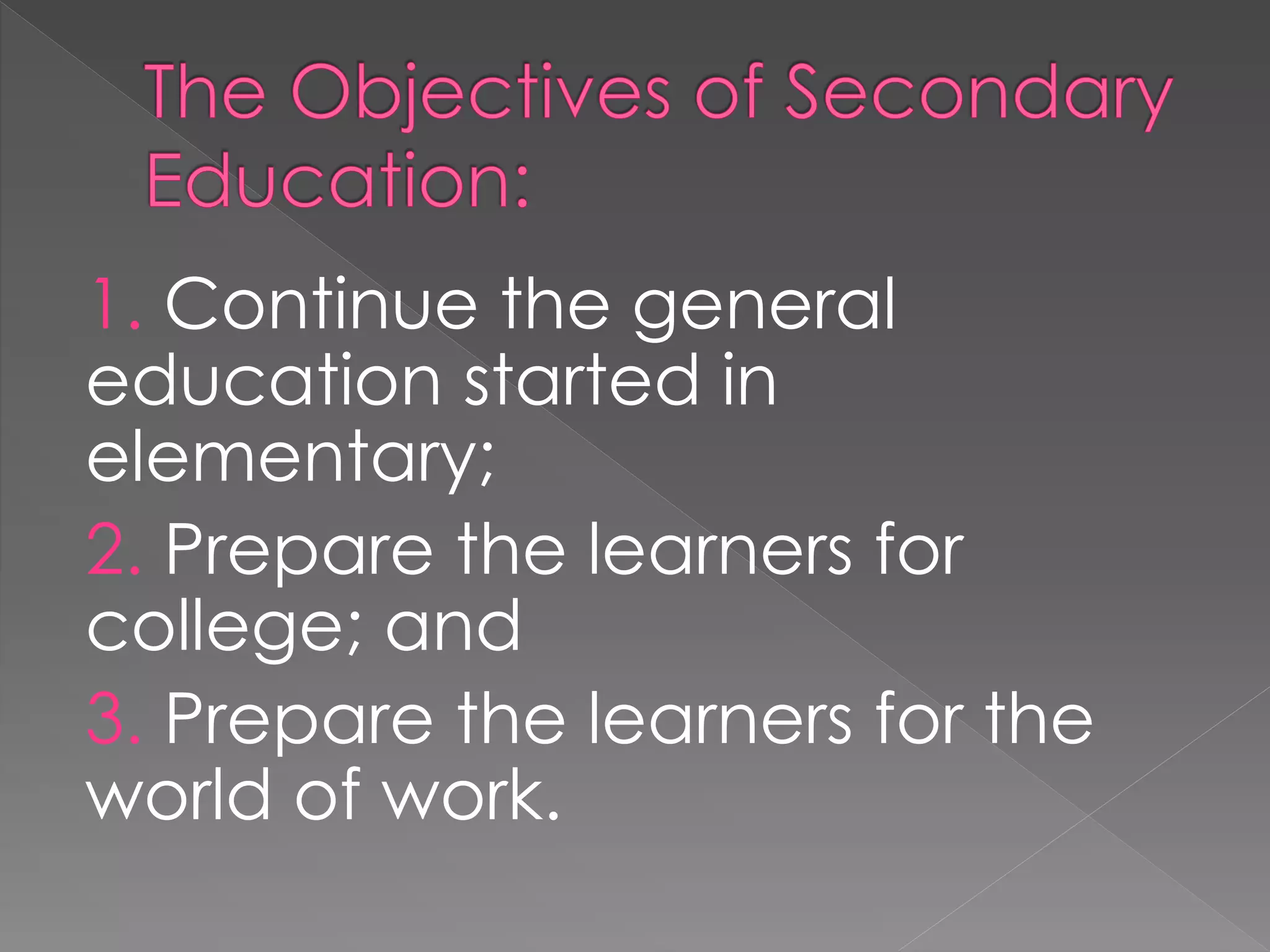
1. Continue the general
education started in
elementary;
2. Prepare the learners for
college; and
3. Prepare the learners for the
world of work.
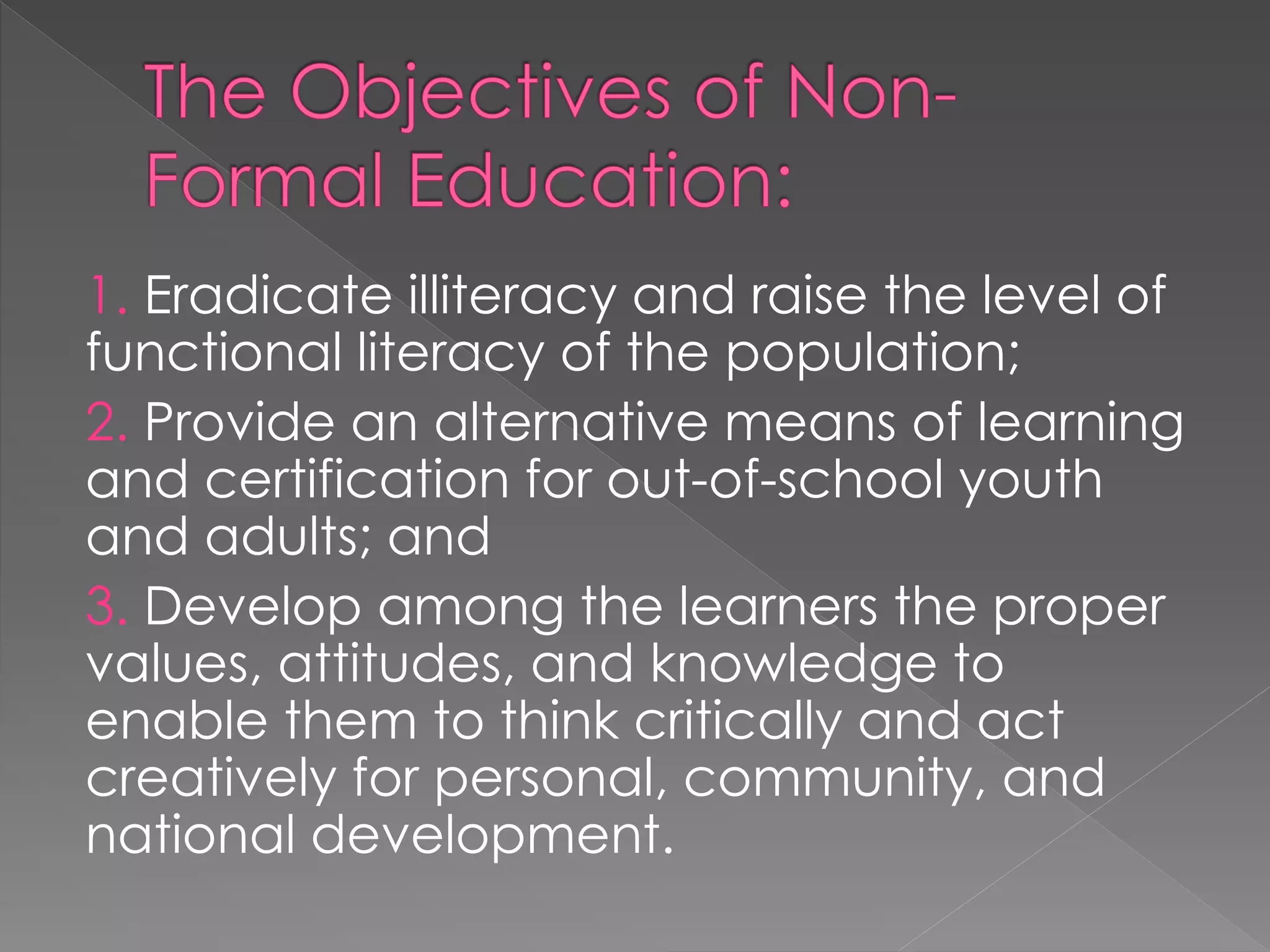
1. Eradicate illiteracy and raise the level of
functional literacy of the population;
2. Provide an alternative means of learning
and certification for out-of-school youth
and adults; and
3. Develop among the learners the proper
values, attitudes, and knowledge to
enable them to think critically and act
creatively for personal, community, and
national development.
Leveling of Pupils in the Old Curriculum
1. Greater emphasis on helping every learner
to become more successful reader.
2. Emphasis on interactive/collaborative
learning approaches.
 Between teachers and students
 Between students and self-instructional materials
 Between students (collaborative learning)
 Between students and multimedia assisted
instruction
3. Emphasis on use of integrative learning
approaches.
4. Greater focus on values formation in all
the subject areas. Every teacher is a
values education teacher.
5. Emphasis on the development of self-
reliant and patriotic citizens.
6. Emphasis on the use of effective
strategies for the development of critical
and creative thinking skills.
 The CORE SUBJECTS:
Filipino; English; Math; Science (Science
and Health for Elem.); Science and
Technology for Secondary.
 The Experiential Area:
Makabayan: Araling Panlipunan; MAPEH
(Music, Arts, PE and health); TLE; Edukasyon
sa Pagpapahalaga (“the practice
environment for holistic learning to develop
a healthy personal and national self-
identity”.
For Secondary Education:
English:
Mathematics, Science and
Technology, English, Technology and
Livelihood Education, Music, Arts, Physical
Education and Health/CAT.
Filipino:
Edukasyon sa Pagpapahalaga
(Values Education), Araling Panlipunan,
and Filipino.
 The ideal Filipino learners are empowered
learners; who are competent in learning
how to learn and have life skills so that they
become self developed persons who are
makabayan (patriotic), makatao (mindful
of humanity), Makakalikasan (respect of
nature), and Maka-Diyos (Godly).
 Functional literacy is the essential ability for
lifelong learning in our dynamically
changing world.
The ideal teacher of the
curriculum is not the
authoritarian instructor but
the trustworthy facilitator or
manager of the learning
process.
The ideal teaching learning
process is interactive.
The RBEC sought to improve the standard
of education in the country. The RBEC
would respond to the needs of Filipino
learners with the following objectives:
1. To provide knowledge and develop skills,
attitudes, and values essential to
personal development and necessary
for living in and contributing to a
developing and changing society;
2. Provide learning experiences which
increase the child awareness of and
responsiveness to the changes in society;
3. Promote and intensify knowledge,
identification with and love for the nation
and the people to which s/he belongs;
and
4. Promote work experiences which
develop orientation to the world of work
and prepare the learner to engage in
honest and gainful work (Cf. Bilbao,et.al.,
Curriculum Development. Lorimar:QC.
2008)
“The Department of Education envisions every
learner to be functionally literate, equipped
with life skills, appreciative of arts and
sports, and imbued with the desirable
values of a person who is makabayan,
makatao, makakalikasan, at maka-Diyos.”
“The Vision is in line with DepEd’s mission to
provide quality basic education that is
equitably accessible to all and lays the
foundation for lifelong learning and service
for the common good.”
Among the salient features of RBEC was its
desire to overcome an overcrowded
curriculum. The RBEC resulted in the
decongestion of the curriculum with only
five learning areas: English, Filipino,
Mathematics, Science and Makabayan,
these are “tool learning areas for an
adequate development of competencies
for learning how-to-learn”.
Makabayan “addresses primarily societal
needs. This is where the learner can apply
practical knowledge and life skills and
demonstrate deeper appreciation of
Filipino culture. Thus, it emphasizes the
development of self-reliant and patriotic
citizens as well as the development of
critical and creative thinking”
Besides “functional literacy” and “life skills”,
the DepEd envision the formation of pupils
who are makabayan, makatao,
makalikasan, at maka-Diyos – patriotic,
humane, environmentally sensitive and
God-fearing. This is the crucial foundation of
disciplines in secondary and tertiary
education that focus on the development
of human being, and not on merely
professional skills.
Consider:” Makabayan is the laboratory of life
or an experiential area which consists of
civics, culture, geography, history,
education to develop skills for the home,
education for livelihood, music, art, and
physical education.”
The desired outcome of our whole
educational reform is the development
of the patriotic human being who is
environmentally sensitive and God-
fearing - “makabayan, makatao,
makakalikasan, at maka-Diyos”.
“Teach them the difference between right
and wrong” In Makabayan, less indeed
may be more.
All the basic education teachers in the five
learning areas: English, Filipino, Mathematics,
Science and Makabayan are designated as
“values education Teachers.”
The aim is “functional literacy”-not just an ability
to read, write, calculate, and think scientifically
in themselves – but a literacy that empowers
the pupil to function appropriately in life,
interacting in healthy manner with society and
the world, equipped with life skills, appreciative
of the arts , sports and spiritual.
“Values are treated as
integral to the five learning
areas. Education in and for
values is geared towards the
learner’s self-actualization”
(2002 BEC p.16)
“After going through the restructured
curriculum from Grade 1 to Fourth Year, the
learner ought to have developed and
internalized a value system that makes
him/her a person of integrity who has the
competence and courage to face
contemporary challenges and has the firm
commitment to serve his/her country,
respect of peoples and cultures, care for
the environment, and live with gratitude to
the Creator.” (2002 BEC pg18)
Educational reform must
overcome the hazardous
of values formation in the
Revised Basic Education
Curriculum (RBEC)
Basic education curriculum

Basic education curriculum

  • 1.
  • 2.
    Provide the general objectiveof elementary, secondary and non-formal education.
  • 3.
     The objectiveof elementary and secondary education serve as the “official learning goals” of basic education as stated for a particular population of learners; that is, the elementary and secondary education learners. The Bureau of Alternative Learning System (Non-Formal Education) likewise has a set of official learning goals for its particular set of target learners – the out-of- school youth and adults.
  • 4.
    1. Provide theknowledge and develop the skills, attitudes, and values for personal development, a productive life, and constructive engagement with a changing social milleu; 2. Provide learning experiences that increase the child’s awareness of and responsiveness to the just demands of society;
  • 5.
    3. Promote andintensify awareness of identification with, and love for our nation and the community to which the learner belongs; and 4. Promote experiences that develop the learner’s orientation to the world or work and prepare the learners to engage in honest and gainful work.
  • 6.
    1. Continue thegeneral education started in elementary; 2. Prepare the learners for college; and 3. Prepare the learners for the world of work.
  • 7.
    1. Eradicate illiteracyand raise the level of functional literacy of the population; 2. Provide an alternative means of learning and certification for out-of-school youth and adults; and 3. Develop among the learners the proper values, attitudes, and knowledge to enable them to think critically and act creatively for personal, community, and national development.
  • 8.
    Leveling of Pupilsin the Old Curriculum
  • 9.
    1. Greater emphasison helping every learner to become more successful reader. 2. Emphasis on interactive/collaborative learning approaches.  Between teachers and students  Between students and self-instructional materials  Between students (collaborative learning)  Between students and multimedia assisted instruction 3. Emphasis on use of integrative learning approaches.
  • 10.
    4. Greater focuson values formation in all the subject areas. Every teacher is a values education teacher. 5. Emphasis on the development of self- reliant and patriotic citizens. 6. Emphasis on the use of effective strategies for the development of critical and creative thinking skills.
  • 11.
     The CORESUBJECTS: Filipino; English; Math; Science (Science and Health for Elem.); Science and Technology for Secondary.  The Experiential Area: Makabayan: Araling Panlipunan; MAPEH (Music, Arts, PE and health); TLE; Edukasyon sa Pagpapahalaga (“the practice environment for holistic learning to develop a healthy personal and national self- identity”.
  • 14.
    For Secondary Education: English: Mathematics,Science and Technology, English, Technology and Livelihood Education, Music, Arts, Physical Education and Health/CAT. Filipino: Edukasyon sa Pagpapahalaga (Values Education), Araling Panlipunan, and Filipino.
  • 15.
     The idealFilipino learners are empowered learners; who are competent in learning how to learn and have life skills so that they become self developed persons who are makabayan (patriotic), makatao (mindful of humanity), Makakalikasan (respect of nature), and Maka-Diyos (Godly).  Functional literacy is the essential ability for lifelong learning in our dynamically changing world.
  • 16.
    The ideal teacherof the curriculum is not the authoritarian instructor but the trustworthy facilitator or manager of the learning process. The ideal teaching learning process is interactive.
  • 18.
    The RBEC soughtto improve the standard of education in the country. The RBEC would respond to the needs of Filipino learners with the following objectives: 1. To provide knowledge and develop skills, attitudes, and values essential to personal development and necessary for living in and contributing to a developing and changing society;
  • 19.
    2. Provide learningexperiences which increase the child awareness of and responsiveness to the changes in society; 3. Promote and intensify knowledge, identification with and love for the nation and the people to which s/he belongs; and 4. Promote work experiences which develop orientation to the world of work and prepare the learner to engage in honest and gainful work (Cf. Bilbao,et.al., Curriculum Development. Lorimar:QC. 2008)
  • 20.
    “The Department ofEducation envisions every learner to be functionally literate, equipped with life skills, appreciative of arts and sports, and imbued with the desirable values of a person who is makabayan, makatao, makakalikasan, at maka-Diyos.” “The Vision is in line with DepEd’s mission to provide quality basic education that is equitably accessible to all and lays the foundation for lifelong learning and service for the common good.”
  • 21.
    Among the salientfeatures of RBEC was its desire to overcome an overcrowded curriculum. The RBEC resulted in the decongestion of the curriculum with only five learning areas: English, Filipino, Mathematics, Science and Makabayan, these are “tool learning areas for an adequate development of competencies for learning how-to-learn”. Makabayan “addresses primarily societal needs. This is where the learner can apply practical knowledge and life skills and demonstrate deeper appreciation of Filipino culture. Thus, it emphasizes the development of self-reliant and patriotic citizens as well as the development of critical and creative thinking”
  • 22.
    Besides “functional literacy”and “life skills”, the DepEd envision the formation of pupils who are makabayan, makatao, makalikasan, at maka-Diyos – patriotic, humane, environmentally sensitive and God-fearing. This is the crucial foundation of disciplines in secondary and tertiary education that focus on the development of human being, and not on merely professional skills. Consider:” Makabayan is the laboratory of life or an experiential area which consists of civics, culture, geography, history, education to develop skills for the home, education for livelihood, music, art, and physical education.”
  • 23.
    The desired outcomeof our whole educational reform is the development of the patriotic human being who is environmentally sensitive and God- fearing - “makabayan, makatao, makakalikasan, at maka-Diyos”. “Teach them the difference between right and wrong” In Makabayan, less indeed may be more.
  • 24.
    All the basiceducation teachers in the five learning areas: English, Filipino, Mathematics, Science and Makabayan are designated as “values education Teachers.” The aim is “functional literacy”-not just an ability to read, write, calculate, and think scientifically in themselves – but a literacy that empowers the pupil to function appropriately in life, interacting in healthy manner with society and the world, equipped with life skills, appreciative of the arts , sports and spiritual.
  • 25.
    “Values are treatedas integral to the five learning areas. Education in and for values is geared towards the learner’s self-actualization” (2002 BEC p.16)
  • 26.
    “After going throughthe restructured curriculum from Grade 1 to Fourth Year, the learner ought to have developed and internalized a value system that makes him/her a person of integrity who has the competence and courage to face contemporary challenges and has the firm commitment to serve his/her country, respect of peoples and cultures, care for the environment, and live with gratitude to the Creator.” (2002 BEC pg18)
  • 27.
    Educational reform must overcomethe hazardous of values formation in the Revised Basic Education Curriculum (RBEC)