1 ©2017 Acquia Inc. — Confidential and Proprietary
Dissecting Large Scale Internet Attacks
The Anatomy of a
DDoS Attack
2 ©2017 Acquia Inc. — Confidential and Proprietary2 ©2017 Acquia Inc. — Confidential and Proprietary
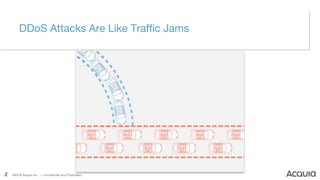
DDoS Attacks Are Like Traffic Jams
2 ©2016 Acquia Inc. — Confidential and Proprietary
3 ©2017 Acquia Inc. — Confidential and Proprietary
Elements of a DDoS Attack
– Malicious attempt to
disrupt normal traffic
– Overwhelm target with
flood
– Utilize multiple
compromised systems
– Motive can be political,
social, or financial
– Targets in every industry
Subject: ddos attack
Hi!
If you dont pay 8 bitcoin until 17.
january your network will be hardly
ddosed! Our attacks are super powerfull.
And if you dont pay until 17.
january ddos attack will start and price
to stop will double!
We are not kidding and we will do small
demo now on [XXXXXXXX] to show we are
serious.
Pay and you are safe from us forever.
OUR BITCOIN ADDRESS: [XXXXXXXX]
Dont reply, we will ignore! Pay and we
will be notify you payed and you are
safe.
Cheers!
4 ©2017 Acquia Inc. — Confidential and Proprietary
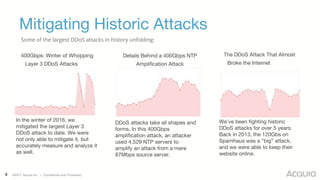
Mitigating Historic Attacks
400Gbps: Winter of Whopping
Layer 3 DDoS Attacks
Details Behind a 400Gbps NTP
Amplification Attack
The DDoS Attack That Almost
Broke the Internet
In the winter of 2016, we
mitigated the largest Layer 3
DDoS attack to date. We were
not only able to mitigate it, but
accurately measure and analyze it
as well.
We’ve been fighting historic
DDoS attacks for over 5 years.
Back in 2013, the 120Gbs on
Spamhaus was a “big” attack,
and we were able to keep their
website online.
DDoS attacks take all shapes and
forms. In this 400Gbps
amplification attack, an attacker
used 4,529 NTP servers to
amplify an attack from a mere
87Mbps source server.
Some of the largest DDoS attacks in history unfolding:
5 ©2017 Acquia Inc. — Confidential and Proprietary5 ©2017 Acquia Inc. — Confidential and Proprietary
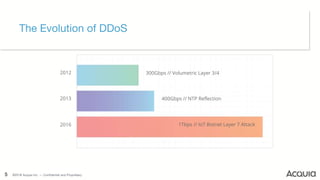
The Evolution of DDoS
5 ©2016 Acquia Inc. — Confidential and Proprietary
1Tbps // IoT Botnet Layer 7 Attack
400Gbps // NTP Reflection
300Gbps // Volumetric Layer 3/4
2016
2013
2012
6 ©2017 Acquia Inc. — Confidential and Proprietary6 ©2017 Acquia Inc. — Confidential and Proprietary
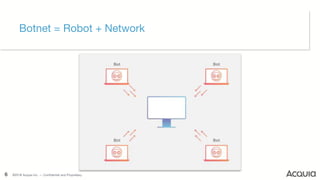
Botnet = Robot + Network
6 ©2016 Acquia Inc. — Confidential and Proprietary
7 ©2017 Acquia Inc. — Confidential and Proprietary
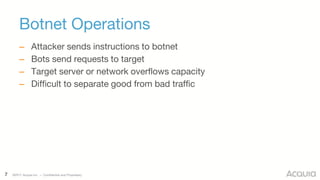
Botnet Operations
– Attacker sends instructions to botnet
– Bots send requests to target
– Target server or network overflows capacity
– Difficult to separate good from bad traffic
8 ©2017 Acquia Inc. — Confidential and Proprietary8 ©2017 Acquia Inc. — Confidential and Proprietary
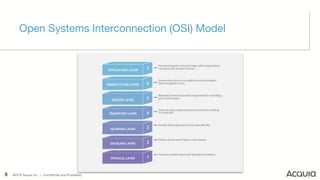
Open Systems Interconnection (OSI) Model
8 ©2016 Acquia Inc. — Confidential and Proprietary
9 ©2017 Acquia Inc. — Confidential and Proprietary
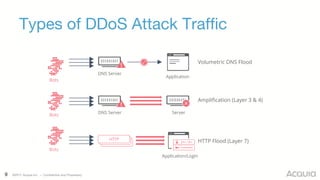
Types of DDoS Attack Traffic
Volumetric DNS Flood
Bots
DNS Server
DNS Server Server
Amplification (Layer 3 & 4)
HTTP Flood (Layer 7)
Bots
Bots
HTTP
Application
Application/Login
10 ©2017 Acquia Inc. — Confidential and Proprietary
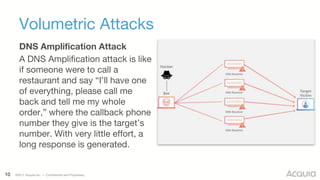
Volumetric Attacks
DNS Amplification Attack
A DNS Amplification attack is like
if someone were to call a
restaurant and say “I’ll have one
of everything, please call me
back and tell me my whole
order,” where the callback phone
number they give is the target’s
number. With very little effort, a
long response is generated.
11 ©2017 Acquia Inc. — Confidential and Proprietary
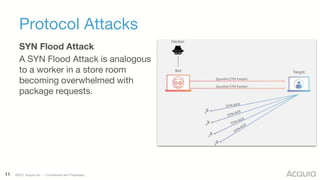
Protocol Attacks
SYN Flood Attack
A SYN Flood Attack is analogous
to a worker in a store room
becoming overwhelmed with
package requests.
12 ©2017 Acquia Inc. — Confidential and Proprietary
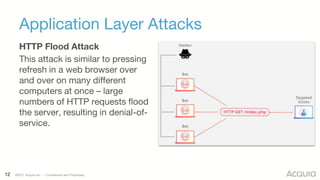
Application Layer Attacks
HTTP Flood Attack
This attack is similar to pressing
refresh in a web browser over
and over on many different
computers at once – large
numbers of HTTP requests flood
the server, resulting in denial-of-
service.
13 ©2017 Acquia Inc. — Confidential and Proprietary
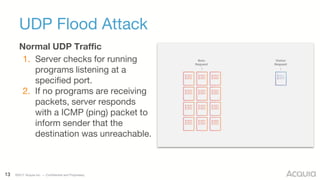
UDP Flood Attack
Normal UDP Traffic
1. Server checks for running
programs listening at a
specified port.
2. If no programs are receiving
packets, server responds
with a ICMP (ping) packet to
inform sender that the
destination was unreachable.
14 ©2017 Acquia Inc. — Confidential and Proprietary
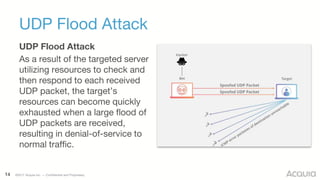
UDP Flood Attack
UDP Flood Attack
As a result of the targeted server
utilizing resources to check and
then respond to each received
UDP packet, the target’s
resources can become quickly
exhausted when a large flood of
UDP packets are received,
resulting in denial-of-service to
normal traffic.
15 ©2017 Acquia Inc. — Confidential and Proprietary
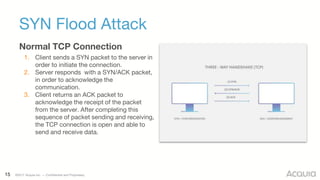
SYN Flood Attack
Normal TCP Connection
1. Client sends a SYN packet to the server in
order to initiate the connection.
2. Server responds with a SYN/ACK packet,
in order to acknowledge the
communication.
3. Client returns an ACK packet to
acknowledge the receipt of the packet
from the server. After completing this
sequence of packet sending and receiving,
the TCP connection is open and able to
send and receive data.
16 ©2017 Acquia Inc. — Confidential and Proprietary
SYN Flood Attack
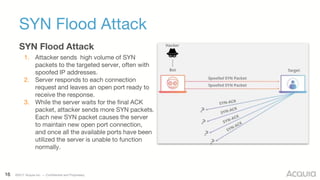
SYN Flood Attack
1. Attacker sends high volume of SYN
packets to the targeted server, often with
spoofed IP addresses.
2. Server responds to each connection
request and leaves an open port ready to
receive the response.
3. While the server waits for the final ACK
packet, attacker sends more SYN packets.
Each new SYN packet causes the server
to maintain new open port connection,
and once all the available ports have been
utilized the server is unable to function
normally.
17 ©2017 Acquia Inc. — Confidential and Proprietary
SYN Flood Attack
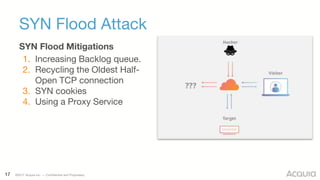
SYN Flood Mitigations
1. Increasing Backlog queue.
2. Recycling the Oldest Half-
Open TCP connection
3. SYN cookies
4. Using a Proxy Service
18 ©2017 Acquia Inc. — Confidential and Proprietary
DNS Flood Attack
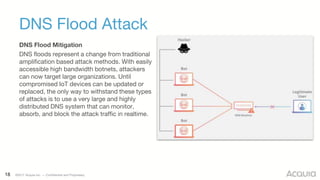
DNS Flood Mitigation
DNS floods represent a change from traditional
amplification based attack methods. With easily
accessible high bandwidth botnets, attackers
can now target large organizations. Until
compromised IoT devices can be updated or
replaced, the only way to withstand these types
of attacks is to use a very large and highly
distributed DNS system that can monitor,
absorb, and block the attack traffic in realtime.
19 ©2017 Acquia Inc. — Confidential and Proprietary
Black Hole Routing
– Drop traffic from the network
20 ©2017 Acquia Inc. — Confidential and Proprietary
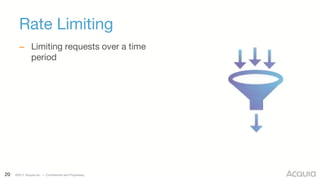
Rate Limiting
– Limiting requests over a time
period
21 ©2017 Acquia Inc. — Confidential and Proprietary
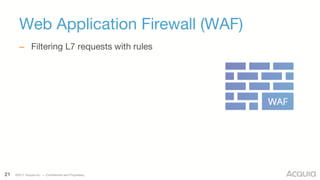
Web Application Firewall (WAF)
– Filtering L7 requests with rules
22 ©2017 Acquia Inc. — Confidential and Proprietary
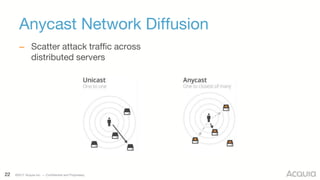
Anycast Network Diffusion
– Scatter attack traffic across
distributed servers
23 ©2017 Acquia Inc. — Confidential and Proprietary
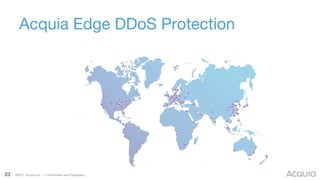
Acquia Edge DDoS Protection
24 ©2017 Acquia Inc. — Confidential and Proprietary
Thank You

The Anatomy of DDoS Attacks

  • 1.
    1 ©2017 AcquiaInc. — Confidential and Proprietary Dissecting Large Scale Internet Attacks The Anatomy of a DDoS Attack
  • 2.
    2 ©2017 AcquiaInc. — Confidential and Proprietary2 ©2017 Acquia Inc. — Confidential and Proprietary DDoS Attacks Are Like Traffic Jams 2 ©2016 Acquia Inc. — Confidential and Proprietary
  • 3.
    3 ©2017 AcquiaInc. — Confidential and Proprietary Elements of a DDoS Attack – Malicious attempt to disrupt normal traffic – Overwhelm target with flood – Utilize multiple compromised systems – Motive can be political, social, or financial – Targets in every industry Subject: ddos attack Hi! If you dont pay 8 bitcoin until 17. january your network will be hardly ddosed! Our attacks are super powerfull. And if you dont pay until 17. january ddos attack will start and price to stop will double! We are not kidding and we will do small demo now on [XXXXXXXX] to show we are serious. Pay and you are safe from us forever. OUR BITCOIN ADDRESS: [XXXXXXXX] Dont reply, we will ignore! Pay and we will be notify you payed and you are safe. Cheers!
  • 4.
    4 ©2017 AcquiaInc. — Confidential and Proprietary Mitigating Historic Attacks 400Gbps: Winter of Whopping Layer 3 DDoS Attacks Details Behind a 400Gbps NTP Amplification Attack The DDoS Attack That Almost Broke the Internet In the winter of 2016, we mitigated the largest Layer 3 DDoS attack to date. We were not only able to mitigate it, but accurately measure and analyze it as well. We’ve been fighting historic DDoS attacks for over 5 years. Back in 2013, the 120Gbs on Spamhaus was a “big” attack, and we were able to keep their website online. DDoS attacks take all shapes and forms. In this 400Gbps amplification attack, an attacker used 4,529 NTP servers to amplify an attack from a mere 87Mbps source server. Some of the largest DDoS attacks in history unfolding:
  • 5.
    5 ©2017 AcquiaInc. — Confidential and Proprietary5 ©2017 Acquia Inc. — Confidential and Proprietary The Evolution of DDoS 5 ©2016 Acquia Inc. — Confidential and Proprietary 1Tbps // IoT Botnet Layer 7 Attack 400Gbps // NTP Reflection 300Gbps // Volumetric Layer 3/4 2016 2013 2012
  • 6.
    6 ©2017 AcquiaInc. — Confidential and Proprietary6 ©2017 Acquia Inc. — Confidential and Proprietary Botnet = Robot + Network 6 ©2016 Acquia Inc. — Confidential and Proprietary
  • 7.
    7 ©2017 AcquiaInc. — Confidential and Proprietary Botnet Operations – Attacker sends instructions to botnet – Bots send requests to target – Target server or network overflows capacity – Difficult to separate good from bad traffic
  • 8.
    8 ©2017 AcquiaInc. — Confidential and Proprietary8 ©2017 Acquia Inc. — Confidential and Proprietary Open Systems Interconnection (OSI) Model 8 ©2016 Acquia Inc. — Confidential and Proprietary
  • 9.
    9 ©2017 AcquiaInc. — Confidential and Proprietary Types of DDoS Attack Traffic Volumetric DNS Flood Bots DNS Server DNS Server Server Amplification (Layer 3 & 4) HTTP Flood (Layer 7) Bots Bots HTTP Application Application/Login
  • 10.
    10 ©2017 AcquiaInc. — Confidential and Proprietary Volumetric Attacks DNS Amplification Attack A DNS Amplification attack is like if someone were to call a restaurant and say “I’ll have one of everything, please call me back and tell me my whole order,” where the callback phone number they give is the target’s number. With very little effort, a long response is generated.
  • 11.
    11 ©2017 AcquiaInc. — Confidential and Proprietary Protocol Attacks SYN Flood Attack A SYN Flood Attack is analogous to a worker in a store room becoming overwhelmed with package requests.
  • 12.
    12 ©2017 AcquiaInc. — Confidential and Proprietary Application Layer Attacks HTTP Flood Attack This attack is similar to pressing refresh in a web browser over and over on many different computers at once – large numbers of HTTP requests flood the server, resulting in denial-of- service.
  • 13.
    13 ©2017 AcquiaInc. — Confidential and Proprietary UDP Flood Attack Normal UDP Traffic 1. Server checks for running programs listening at a specified port. 2. If no programs are receiving packets, server responds with a ICMP (ping) packet to inform sender that the destination was unreachable.
  • 14.
    14 ©2017 AcquiaInc. — Confidential and Proprietary UDP Flood Attack UDP Flood Attack As a result of the targeted server utilizing resources to check and then respond to each received UDP packet, the target’s resources can become quickly exhausted when a large flood of UDP packets are received, resulting in denial-of-service to normal traffic.
  • 15.
    15 ©2017 AcquiaInc. — Confidential and Proprietary SYN Flood Attack Normal TCP Connection 1. Client sends a SYN packet to the server in order to initiate the connection. 2. Server responds with a SYN/ACK packet, in order to acknowledge the communication. 3. Client returns an ACK packet to acknowledge the receipt of the packet from the server. After completing this sequence of packet sending and receiving, the TCP connection is open and able to send and receive data.
  • 16.
    16 ©2017 AcquiaInc. — Confidential and Proprietary SYN Flood Attack SYN Flood Attack 1. Attacker sends high volume of SYN packets to the targeted server, often with spoofed IP addresses. 2. Server responds to each connection request and leaves an open port ready to receive the response. 3. While the server waits for the final ACK packet, attacker sends more SYN packets. Each new SYN packet causes the server to maintain new open port connection, and once all the available ports have been utilized the server is unable to function normally.
  • 17.
    17 ©2017 AcquiaInc. — Confidential and Proprietary SYN Flood Attack SYN Flood Mitigations 1. Increasing Backlog queue. 2. Recycling the Oldest Half- Open TCP connection 3. SYN cookies 4. Using a Proxy Service
  • 18.
    18 ©2017 AcquiaInc. — Confidential and Proprietary DNS Flood Attack DNS Flood Mitigation DNS floods represent a change from traditional amplification based attack methods. With easily accessible high bandwidth botnets, attackers can now target large organizations. Until compromised IoT devices can be updated or replaced, the only way to withstand these types of attacks is to use a very large and highly distributed DNS system that can monitor, absorb, and block the attack traffic in realtime.
  • 19.
    19 ©2017 AcquiaInc. — Confidential and Proprietary Black Hole Routing – Drop traffic from the network
  • 20.
    20 ©2017 AcquiaInc. — Confidential and Proprietary Rate Limiting – Limiting requests over a time period
  • 21.
    21 ©2017 AcquiaInc. — Confidential and Proprietary Web Application Firewall (WAF) – Filtering L7 requests with rules
  • 22.
    22 ©2017 AcquiaInc. — Confidential and Proprietary Anycast Network Diffusion – Scatter attack traffic across distributed servers
  • 23.
    23 ©2017 AcquiaInc. — Confidential and Proprietary Acquia Edge DDoS Protection
  • 24.
    24 ©2017 AcquiaInc. — Confidential and Proprietary Thank You