Mathematics
TIME
Part 1
Objectives
The Clock
The Clock
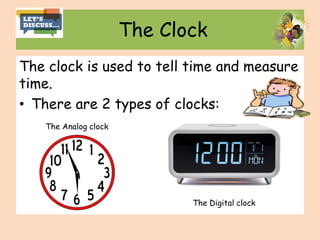
The clock is used to tell time and measure
time.
• There are 2 types of clocks:
The Digital clock
The Analog clock
The Analog Clock
• An analog clock is a tool for reading the
time of day.
• The shortest hand indicates the hour.
• The longer hand indicates the minutes.
• The longest arm indicates the seconds.
• You can go to LearnAlberta.ca for look
at the actual analog clock.
The Analog Clock
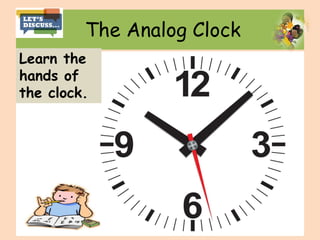
Learn the
hands of
the clock.
The Digital Clock
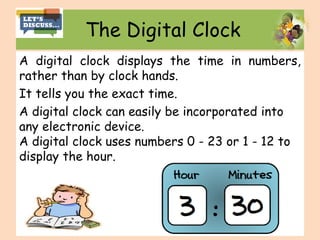
A digital clock displays the time in numbers,
rather than by clock hands.
It tells you the exact time.
A digital clock can easily be incorporated into
any electronic device.
A digital clock uses numbers 0 - 23 or 1 - 12 to
display the hour.
The Digital Clock
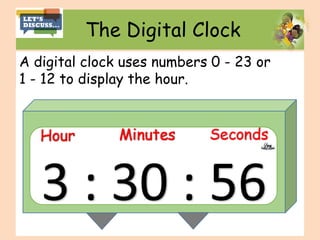
A digital clock uses numbers 0 - 23 or
1 - 12 to display the hour.
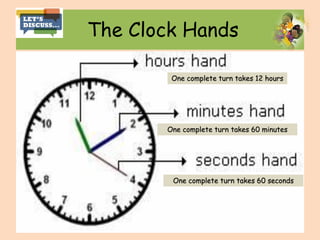
The Clock Hands
One complete turn takes 12 hours
One complete turn takes 60 minutes
One complete turn takes 60 seconds
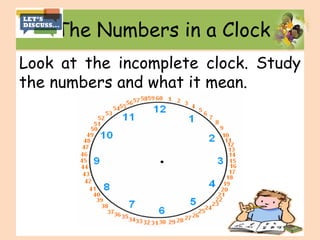
The Numbers in a Clock
Look at the incomplete clock. Study
the numbers and what it mean.
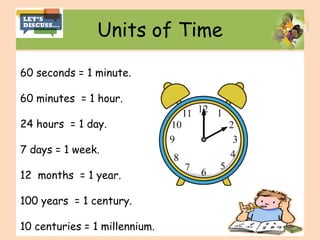
Units of Time
60 seconds = 1 minute.
60 minutes = 1 hour.
24 hours = 1 day.
7 days = 1 week.
12 months = 1 year.
100 years = 1 century.
10 centuries = 1 millennium.
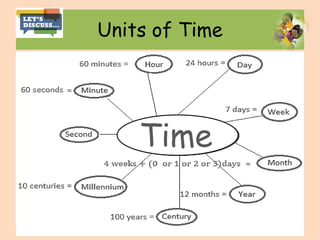
Units of Time
Time
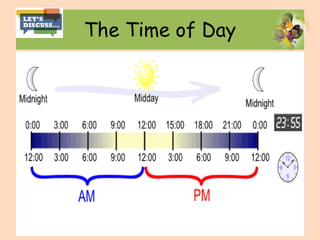
The Time of Day
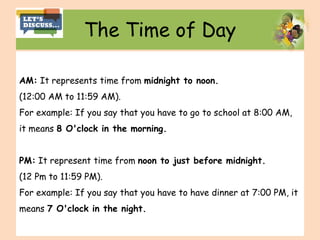
The Time of Day
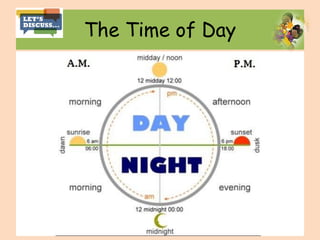
AM: It represents time from midnight to noon.
(12:00 AM to 11:59 AM).
For example: If you say that you have to go to school at 8:00 AM,
it means 8 O'clock in the morning.
PM: It represent time from noon to just before midnight.
(12 Pm to 11:59 PM).
For example: If you say that you have to have dinner at 7:00 PM, it
means 7 O'clock in the night.
The Time of Day
Minutes
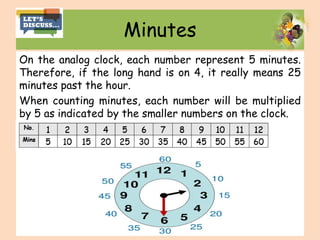
On the analog clock, each number represent 5 minutes.
Therefore, if the long hand is on 4, it really means 25
minutes past the hour.
When counting minutes, each number will be multiplied
by 5 as indicated by the smaller numbers on the clock.
The Analog & Digital Clock

The Analog & Digital Clock

  • 1.
  • 2.
    The Clock The clockis used to tell time and measure time. • There are 2 types of clocks: The Digital clock The Analog clock
  • 3.
    The Analog Clock •An analog clock is a tool for reading the time of day. • The shortest hand indicates the hour. • The longer hand indicates the minutes. • The longest arm indicates the seconds. • You can go to LearnAlberta.ca for look at the actual analog clock.
  • 4.
    The Analog Clock Learnthe hands of the clock.
  • 5.
    The Digital Clock Adigital clock displays the time in numbers, rather than by clock hands. It tells you the exact time. A digital clock can easily be incorporated into any electronic device. A digital clock uses numbers 0 - 23 or 1 - 12 to display the hour.
  • 6.
    The Digital Clock Adigital clock uses numbers 0 - 23 or 1 - 12 to display the hour.
  • 7.
    The Clock Hands Onecomplete turn takes 12 hours One complete turn takes 60 minutes One complete turn takes 60 seconds
  • 8.
    The Numbers ina Clock Look at the incomplete clock. Study the numbers and what it mean.
  • 9.
    Units of Time 60seconds = 1 minute. 60 minutes = 1 hour. 24 hours = 1 day. 7 days = 1 week. 12 months = 1 year. 100 years = 1 century. 10 centuries = 1 millennium.
  • 10.
  • 11.
  • 12.
    The Time ofDay AM: It represents time from midnight to noon. (12:00 AM to 11:59 AM). For example: If you say that you have to go to school at 8:00 AM, it means 8 O'clock in the morning. PM: It represent time from noon to just before midnight. (12 Pm to 11:59 PM). For example: If you say that you have to have dinner at 7:00 PM, it means 7 O'clock in the night.
  • 13.
  • 14.
    Minutes On the analogclock, each number represent 5 minutes. Therefore, if the long hand is on 4, it really means 25 minutes past the hour. When counting minutes, each number will be multiplied by 5 as indicated by the smaller numbers on the clock.