









The 7 Deadly Sins of SharePoint
Planning Successful Implementations and Avoiding Project Failure
LISTEN
KNOW
UNDERSTAND
CONNECT
22
Non Disclosure Agreement
For the purposes of this document, and except as otherwise expressly provided in this
document, "Confidential Information" means any information that C5 Insight, Inc. (“C5
Insight”) desires to protect against unrestricted disclosure by the receiving party
(“Recipient”).
The Recipient agrees that it will hold in confidence the Confidential Information
disclosed within this document and any documents, presentations, software, methods
or other information shared by C5 Insight in print, electronic, verbal or any other
format. The Recipient shall exercise reasonable care to protect the Confidential
Information from unauthorized disclosure, which care shall in no event be less than the
Recipient takes to protect its own Confidential Information of a like nature. The
Recipient may disclose Confidential Information only to its employees or agents who
need to know such information for purposes of this agreement, and shall inform such
employees and agents, by way of policy and agreement, that they are bound by
obligations of confidentiality.
The entire content of this statement of work is classified as Confidential Information
and by reading any further content within this document, the recipient is bound by the
terms of this non-disclosure agreement.
Don’t Be Anti-Social
@C5Curtis
@C5Insight
#C5DeadlySins
4
Curtis@C5Insight.com
Curtis Hughes
Managing Partner
C5 Insight
About Me
/in/curtishughes
@C5Curtis
Agenda
7 Deadly SinsTelling The Truth A Better Way
AIIM
WE KNOW THE REASONS WHY
Three Universal Truths We’ve Learned About SharePoint Projects
TELLING THE TRUTH
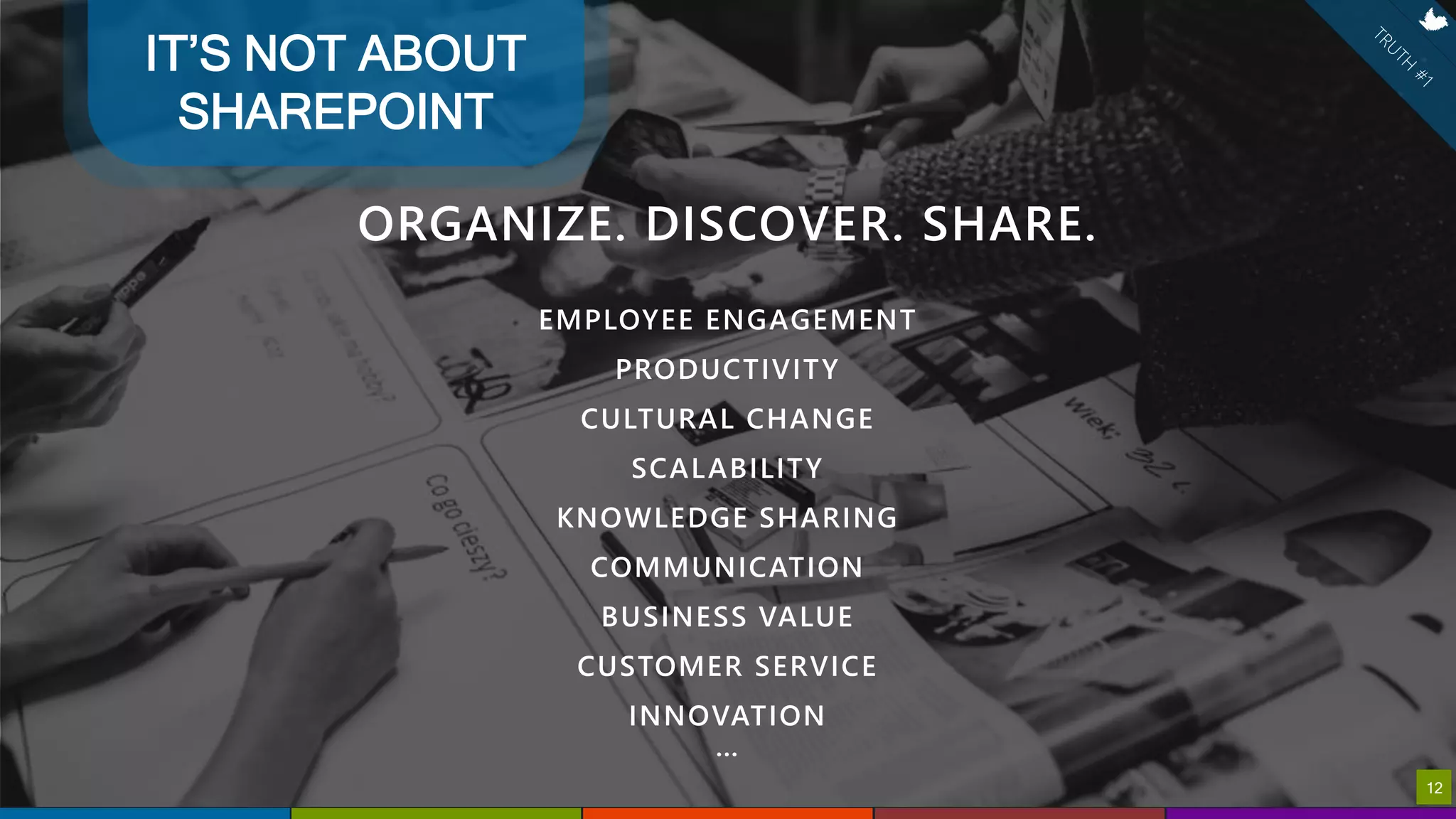
1212
IT’S NOT ABOUT
SHAREPOINT
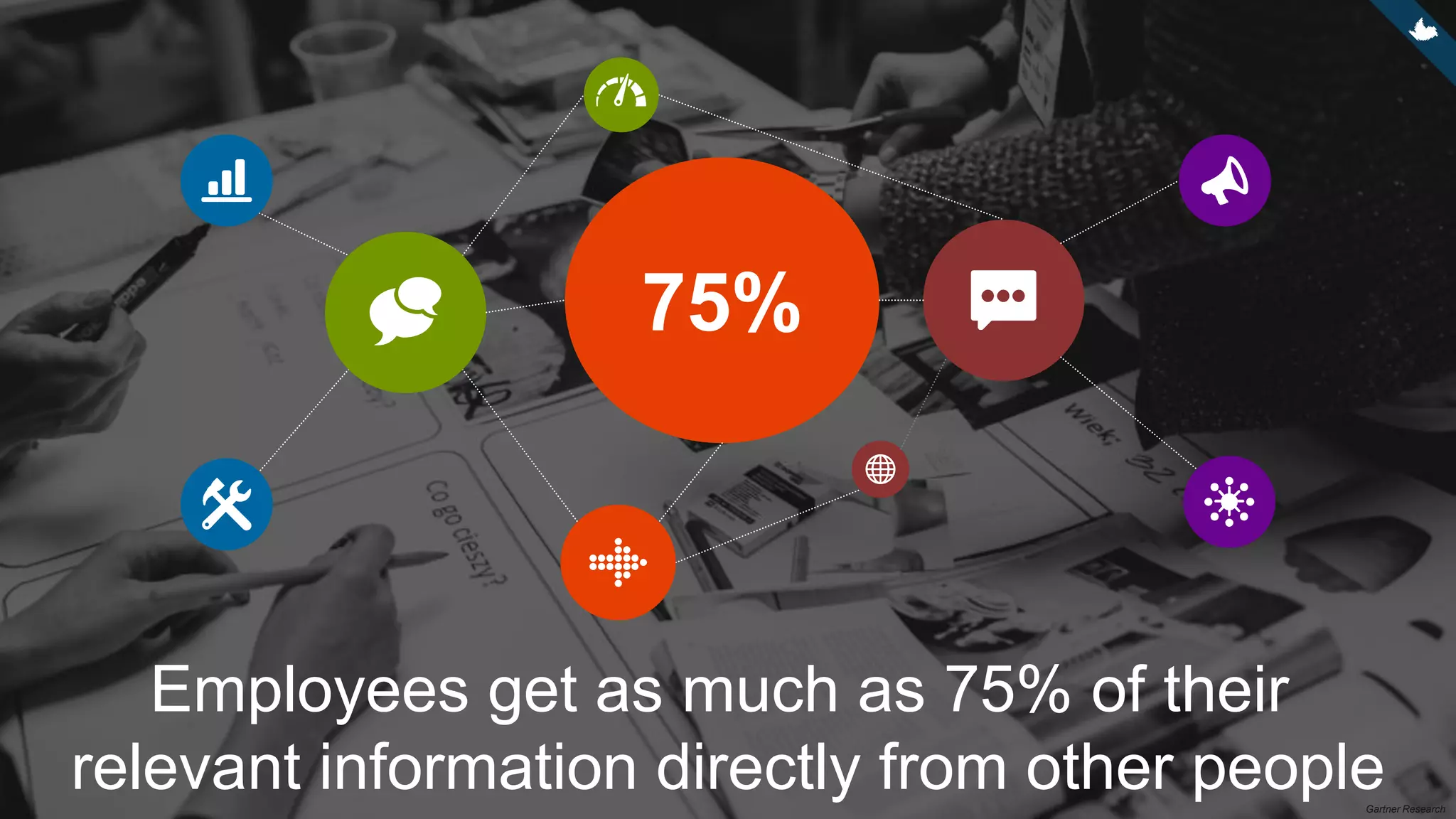
Gartner Research
Employees get as much as 75% of their
relevant information directly from other people
75%
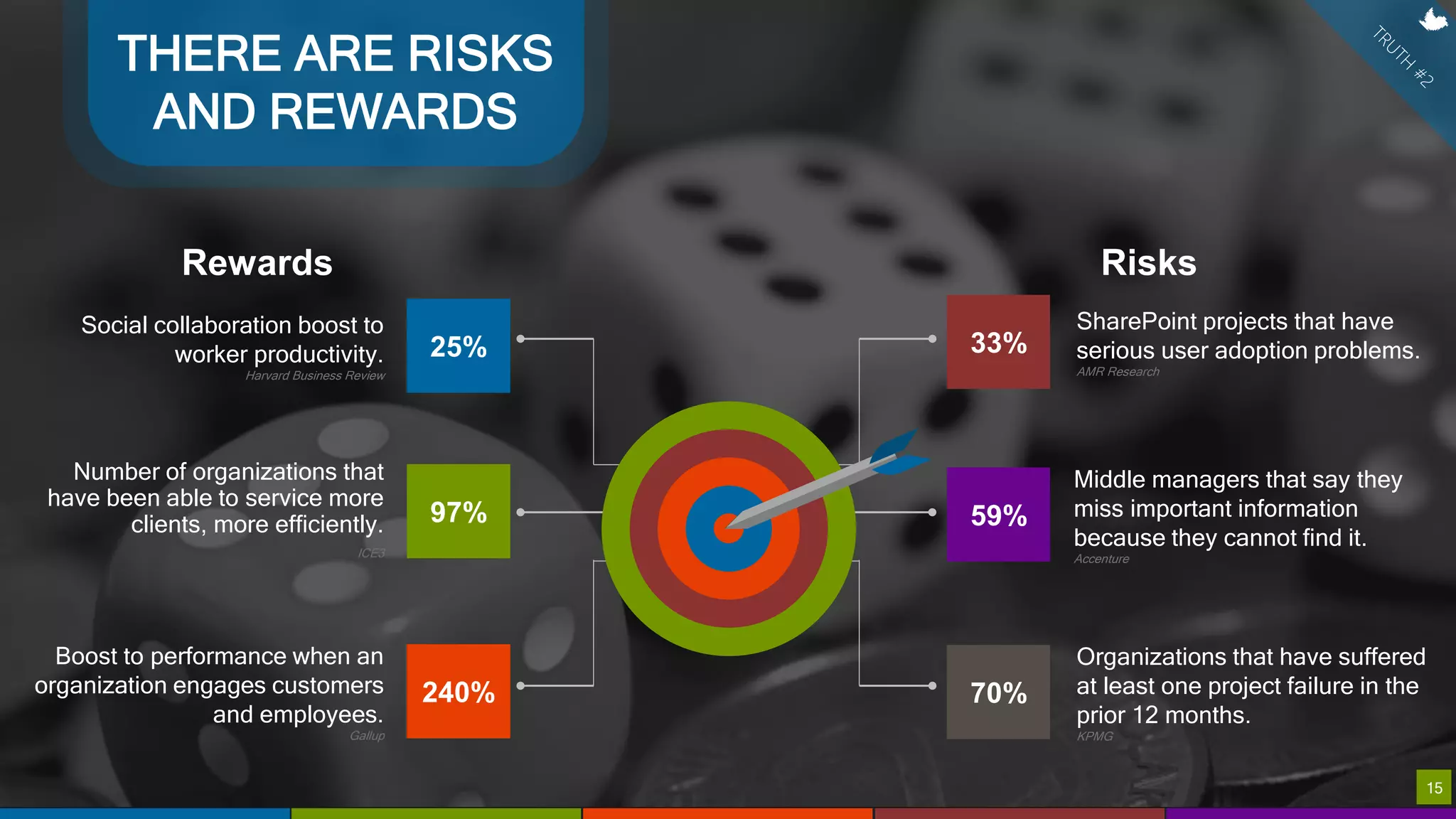
15
33%
Middle managers that say they
miss important information
because they cannot find it.
Accenture
Organizations that have suffered
at least one project failure in the
prior 12 months.
KPMG
59%
70%
25%
97%
240%
SharePoint projects that have
serious user adoption problems.
AMR Research
Social collaboration boost to
worker productivity.
Harvard Business Review
Number of organizations that
have been able to service more
clients, more efficiently.
ICE3
Boost to performance when an
organization engages customers
and employees.
Gallup
Rewards Risks
15
THERE ARE RISKS
AND REWARDS
1616
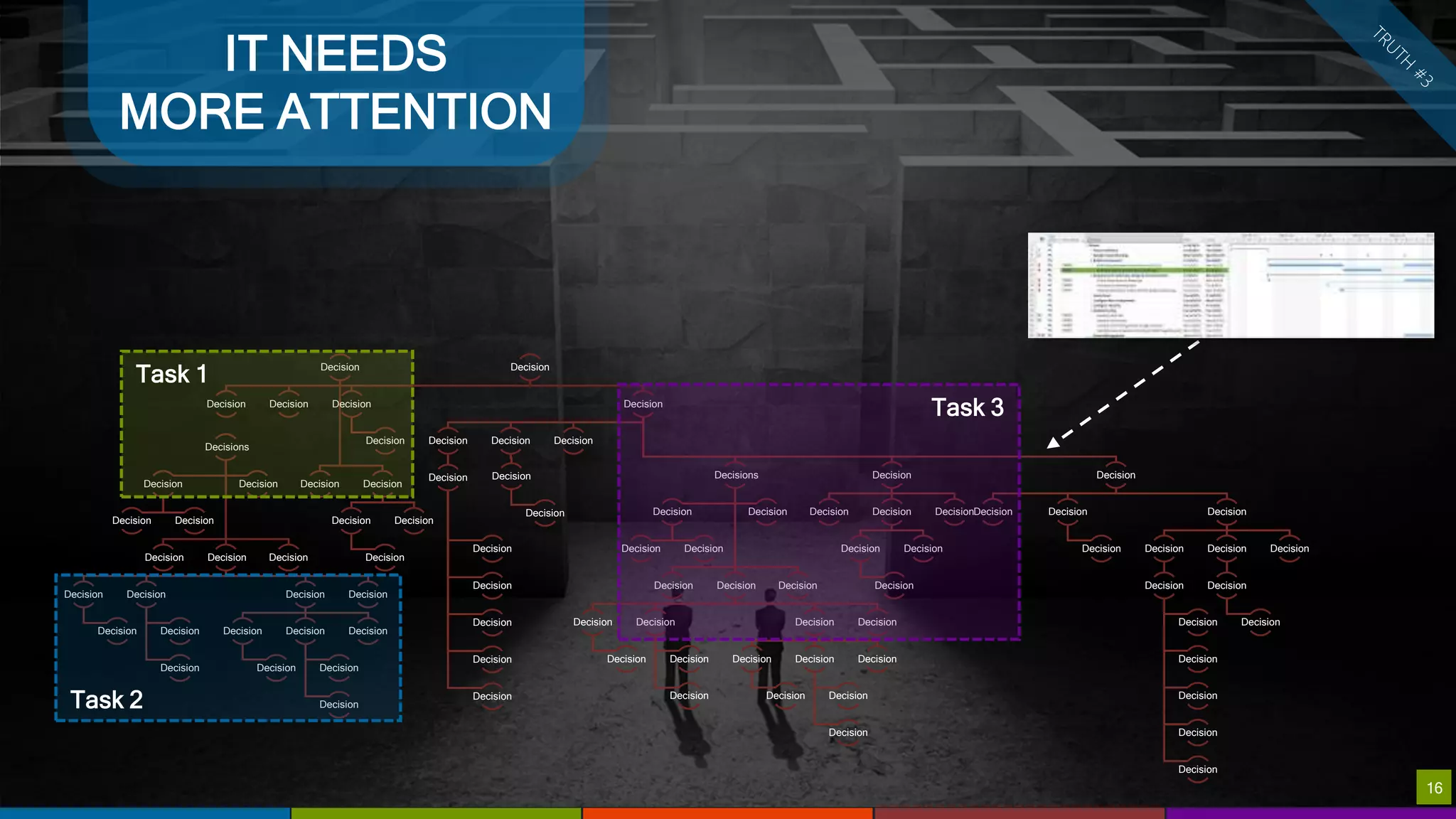
Decisions
Decision Decision
Decision
Decision
Decision
Decision
Decision
Decision
Decision
Decision
Decision
Decision
Decision
Decision
Decision
Decision
Decision
Decision Decision
Decision
Decision
Decision Decision
Decision
Decision
Decision
Decision
Decision
Decision Decision
Decision
Decision
Decision
Decision
Decision
Decision
Decision
Decision
Decision
Decision
Decision
Decision
Decision
Decisions
Decision Decision
Decision
Decision
Decision
Decision
Decision
Decision
Decision
Decision
Decision
Decision
Decision
Decision
Decision
Decision
Decision
Decision Decision
Decision
Decision
Decision Decision
Decision
Decision
Decision
Decision
Decision
Decision Decision
Decision
Decision
Decision
Decision
Decision
Decision
Decision
Decision
Decision
Decision
Decision
Decision
Decision
Task 1
Task 2
Task 3
IT NEEDS
MORE ATTENTION
1717
IT NEEDS
MORE ATTENTION
Seven Deadly Sins That Cause Companies To Miss The Mark
THE 7 DEADLY SINS
1919
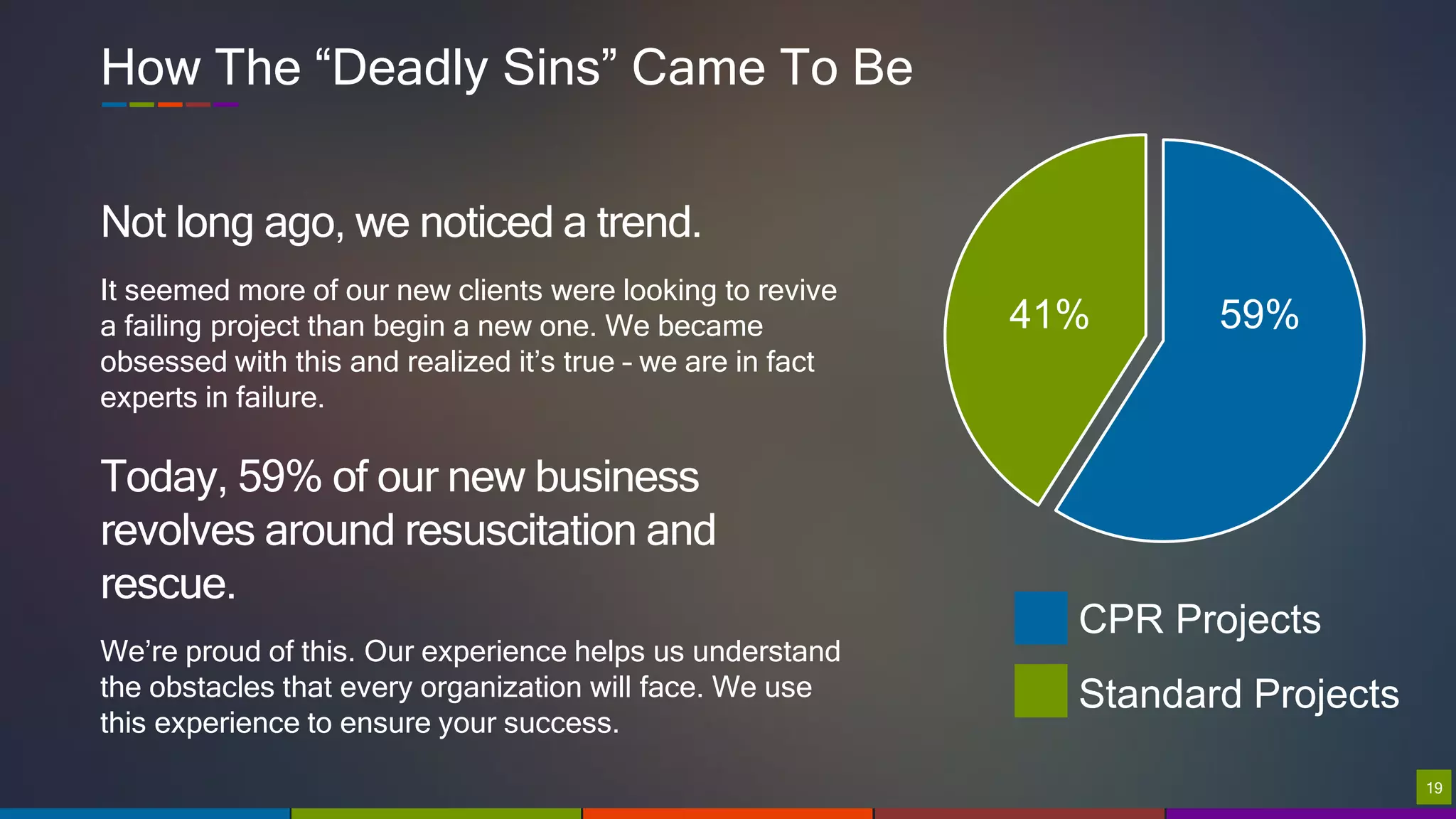
How The “Deadly Sins” Came To Be
41% 59%
CPR Projects
Standard Projects
Not long ago, we noticed a trend.
It seemed more of our new clients were looking to revive
a failing project than begin a new one. We became
obsessed with this and realized it’s true – we are in fact
experts in failure.
Today, 59% of our new business
revolves around resuscitation and
rescue.
We’re proud of this. Our experience helps us understand
the obstacles that every organization will face. We use
this experience to ensure your success.
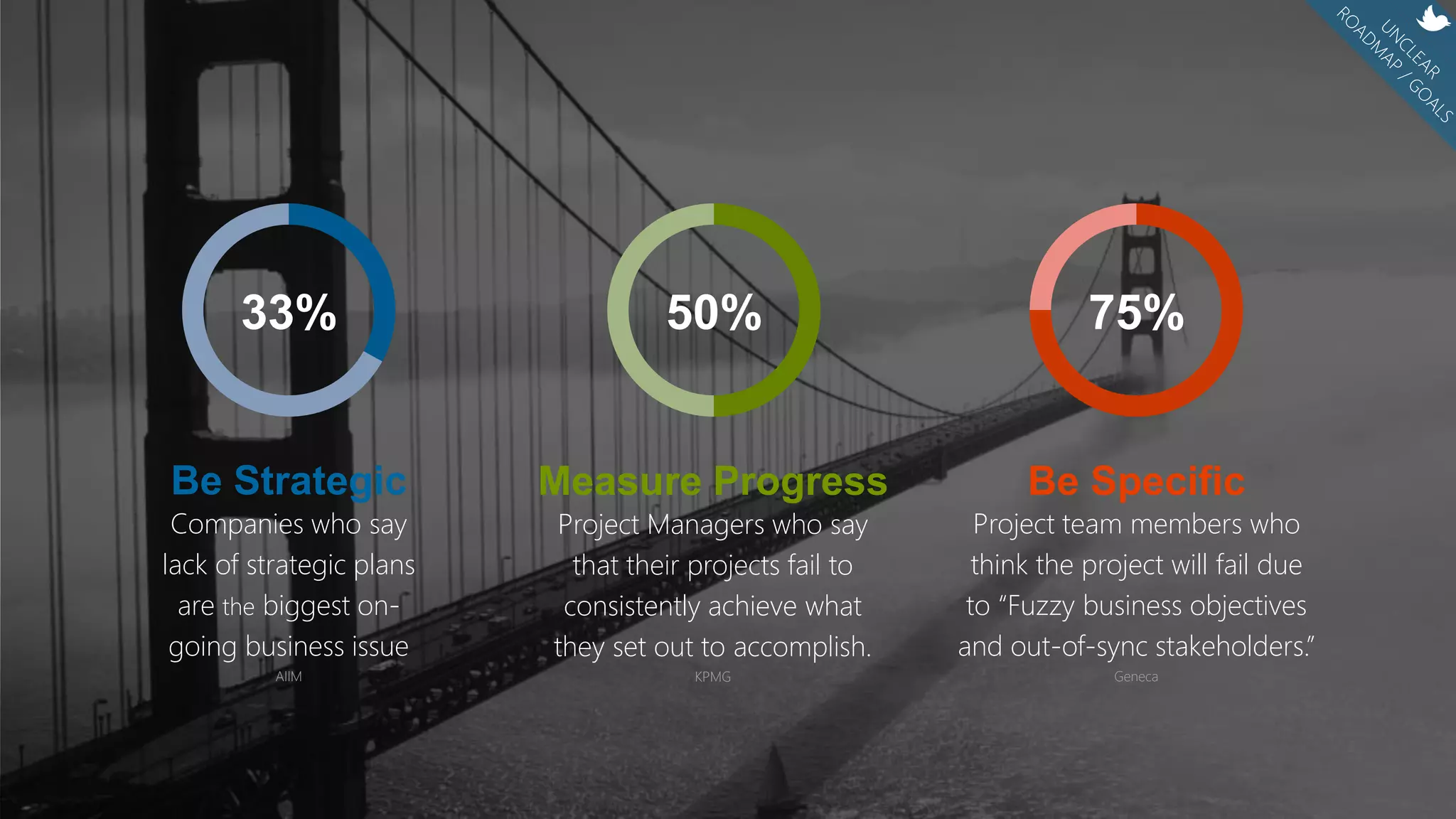
UNCLEAR
ROADMAP
OR
UNMEASURABLE
GOALS
33%
Companies who say
lack of strategic plans
are the biggest on-
going business issue
AIIM
Be Strategic
50%
Measure Progress
Project Managers who say
that their projects fail to
consistently achieve what
they set out to accomplish.
KPMG
75%
Be Specific
Project team members who
think the project will fail due
to “Fuzzy business objectives
and out-of-sync stakeholders.”
Geneca
UNREALISTIC
EXPECTATIONS
Performance
Time
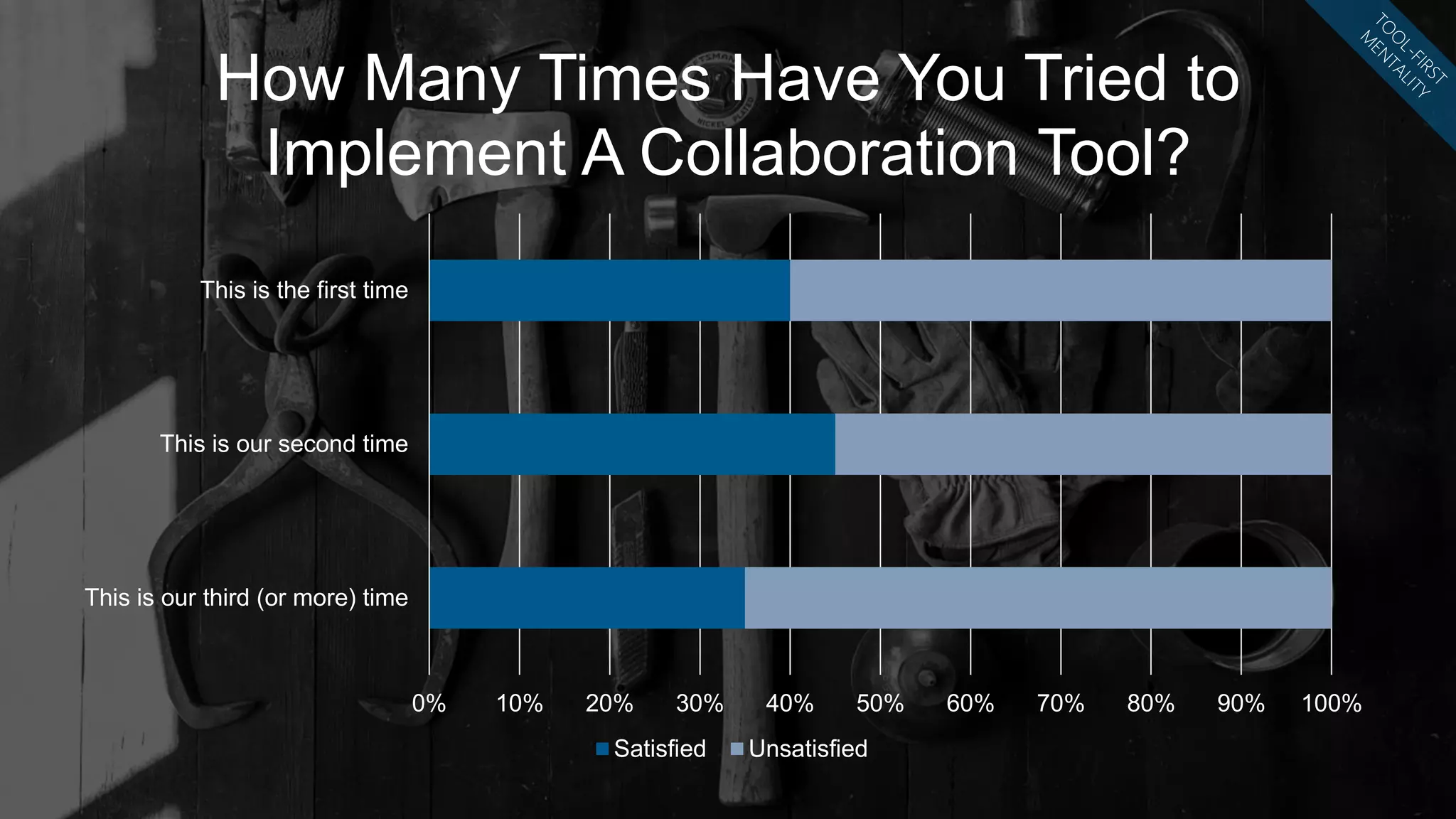
TOOL-FIRST
MENTALITY
28
0% 10% 20% 30% 40% 50% 60% 70% 80% 90% 100%
This is our third (or more) time
This is our second time
This is the first time
How Many Times Have You Tried to
Implement A Collaboration Tool?
Satisfied Unsatisfied
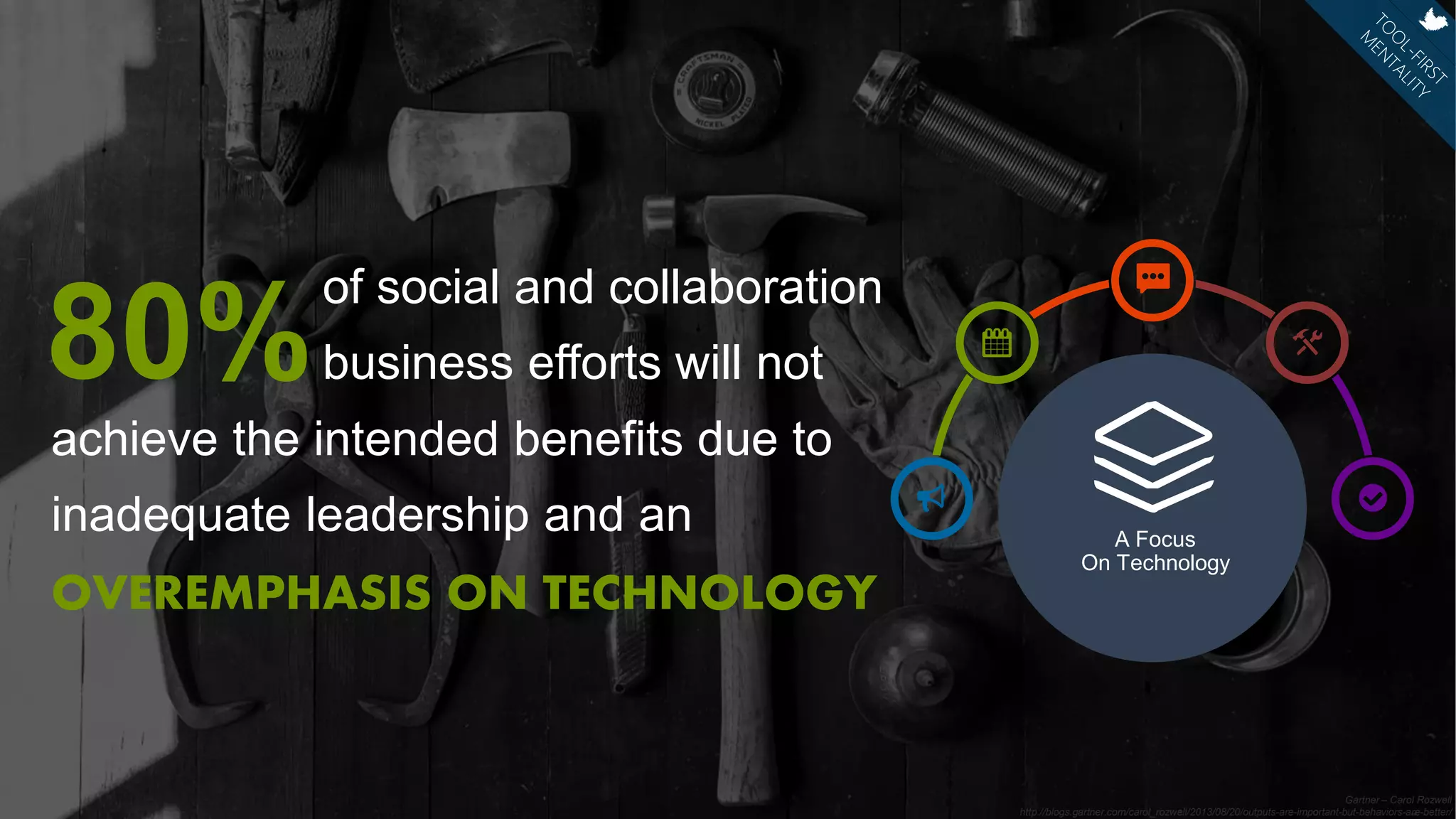
Gartner – Carol Rozwell
http://blogs.gartner.com/carol_rozwell/2013/08/20/outputs-are-important-but-behaviors-are-better/
of social and collaboration
business efforts will not
A Focus
On Technology
80%
achieve the intended benefits due to
inadequate leadership and an
OVEREMPHASIS ON TECHNOLOGY
FORGET
ABOUT
PEOPLE
31
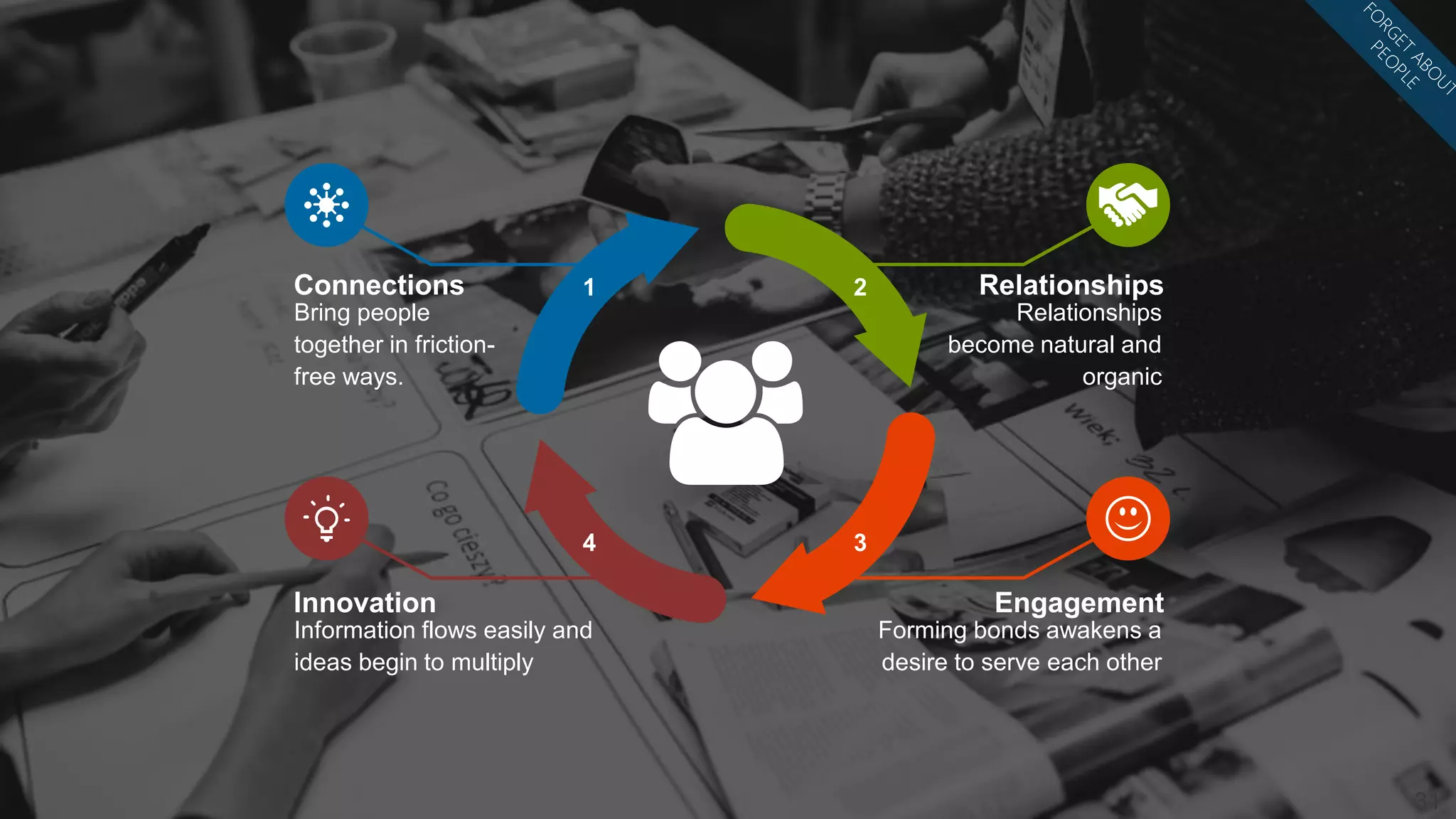
Engagement
Forming bonds awakens a
desire to serve each other
1
Information flows easily and
ideas begin to multiply
Relationships
Relationships
become natural and
organic
Connections
Bring people
together in friction-
free ways.
2
34
Innovation
TOO
MANY
RULES
Cadence Group, 2011
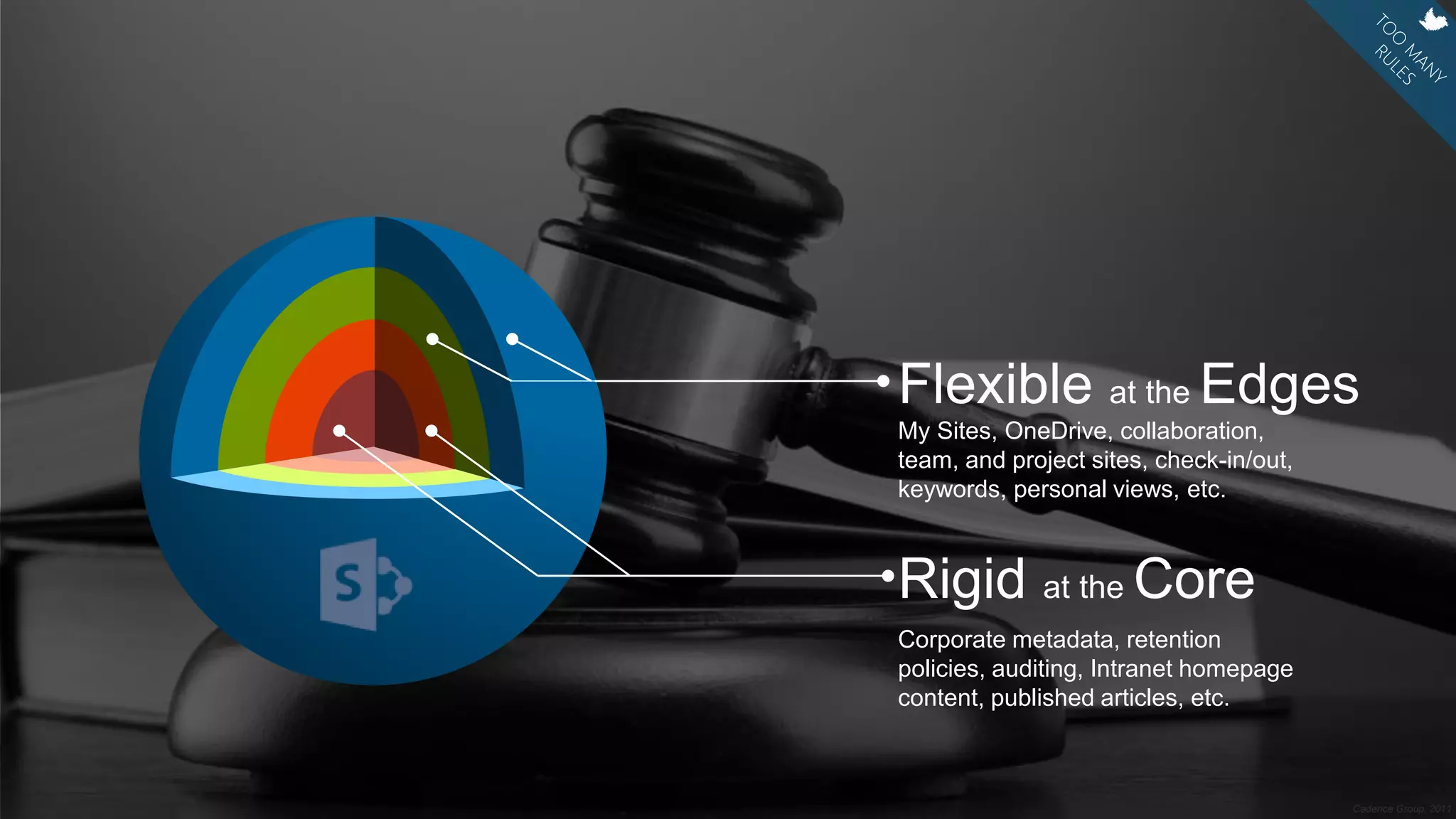
Rigid at the Core
Flexible at the Edges
Corporate metadata, retention
policies, auditing, Intranet homepage
content, published articles, etc.
My Sites, OneDrive, collaboration,
team, and project sites, check-in/out,
keywords, personal views, etc.
SET IT
AND
FORGET IT
MENTALITY
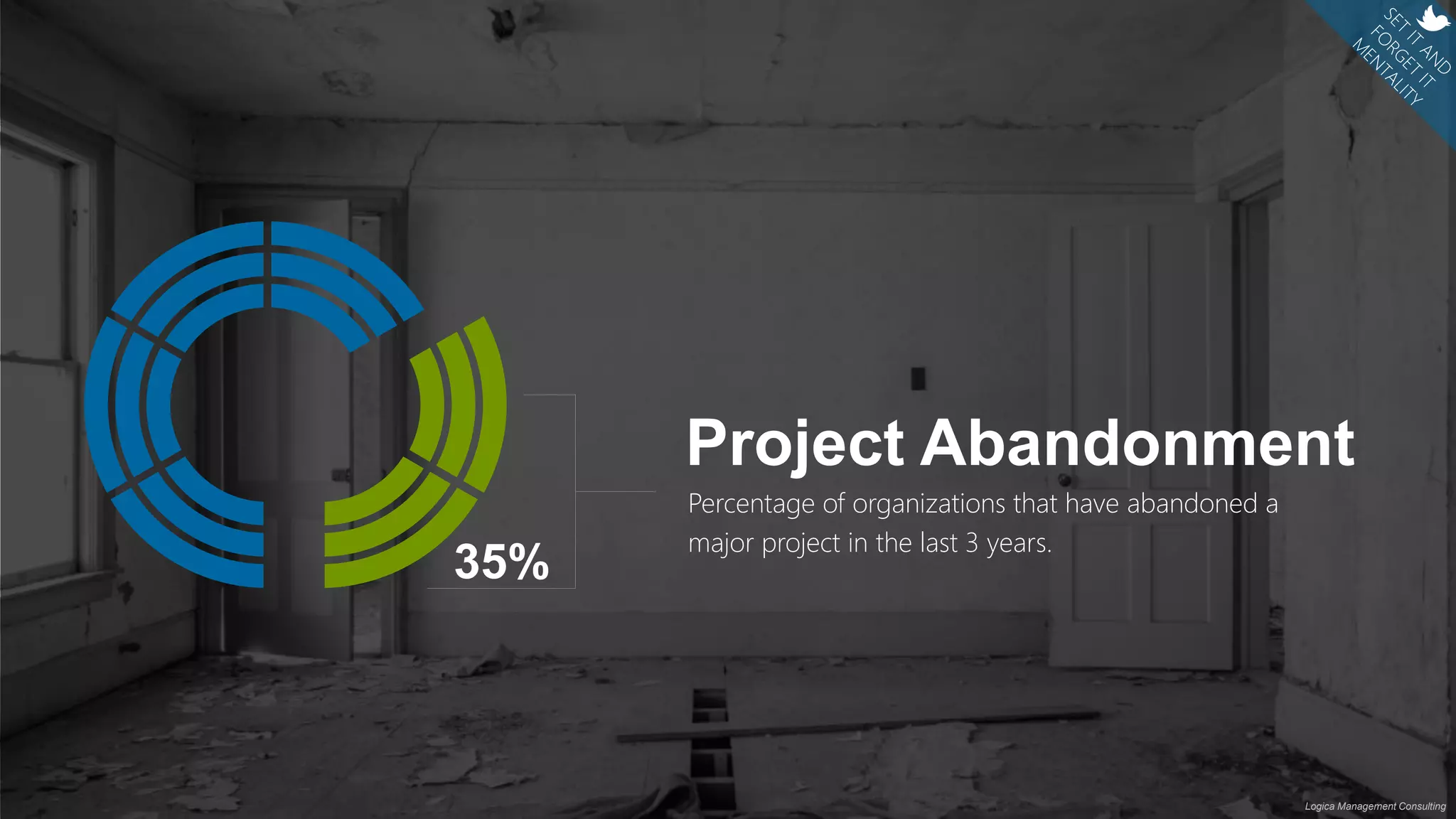
Logica Management Consulting
35%
Project Abandonment
Percentage of organizations that have abandoned a
major project in the last 3 years.
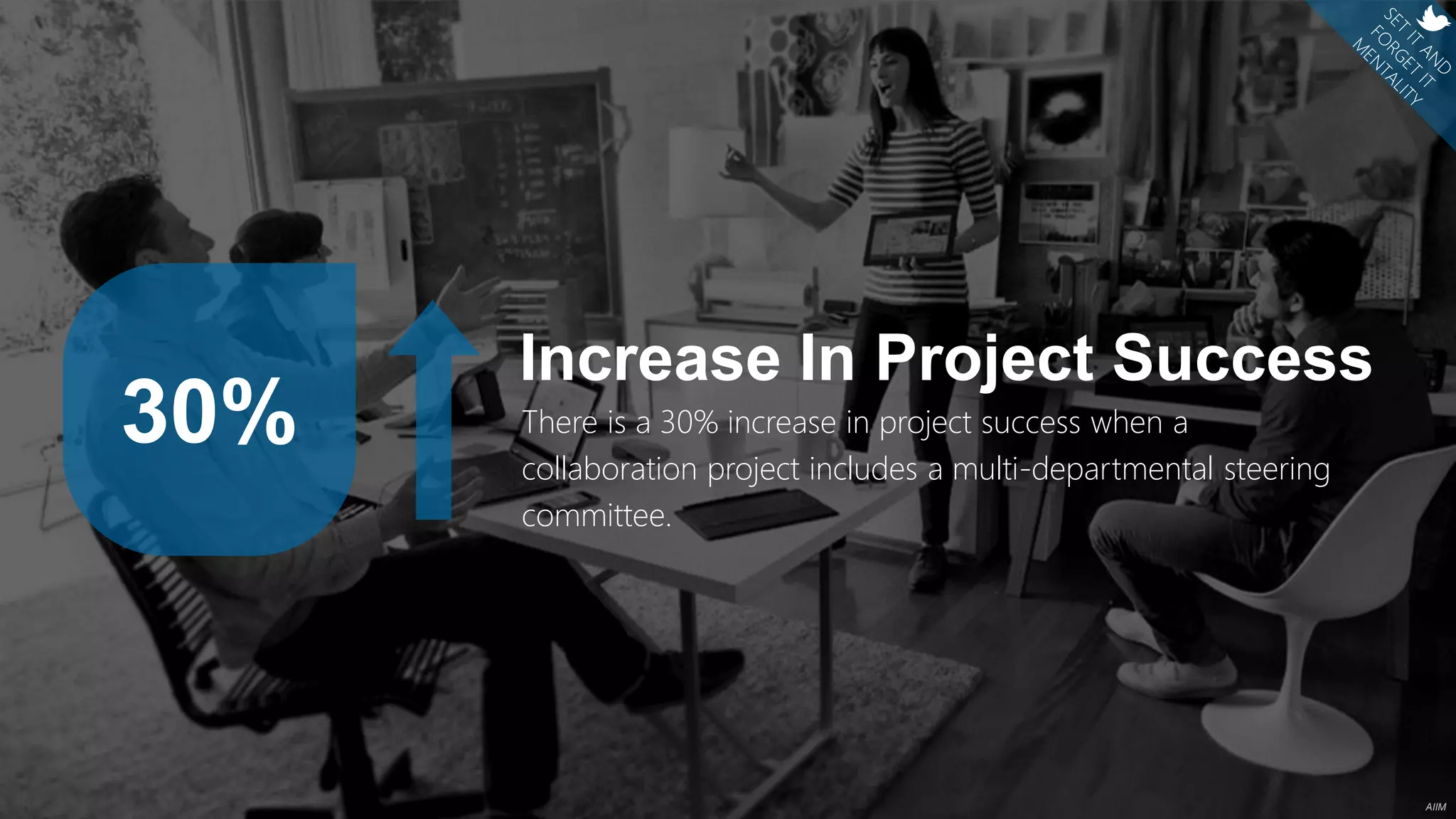
30%
Increase In Project Success
There is a 30% increase in project success when a
collaboration project includes a multi-departmental steering
committee.
AIIM
IMPROPER
TRAINING
AND
COMMUNICATION
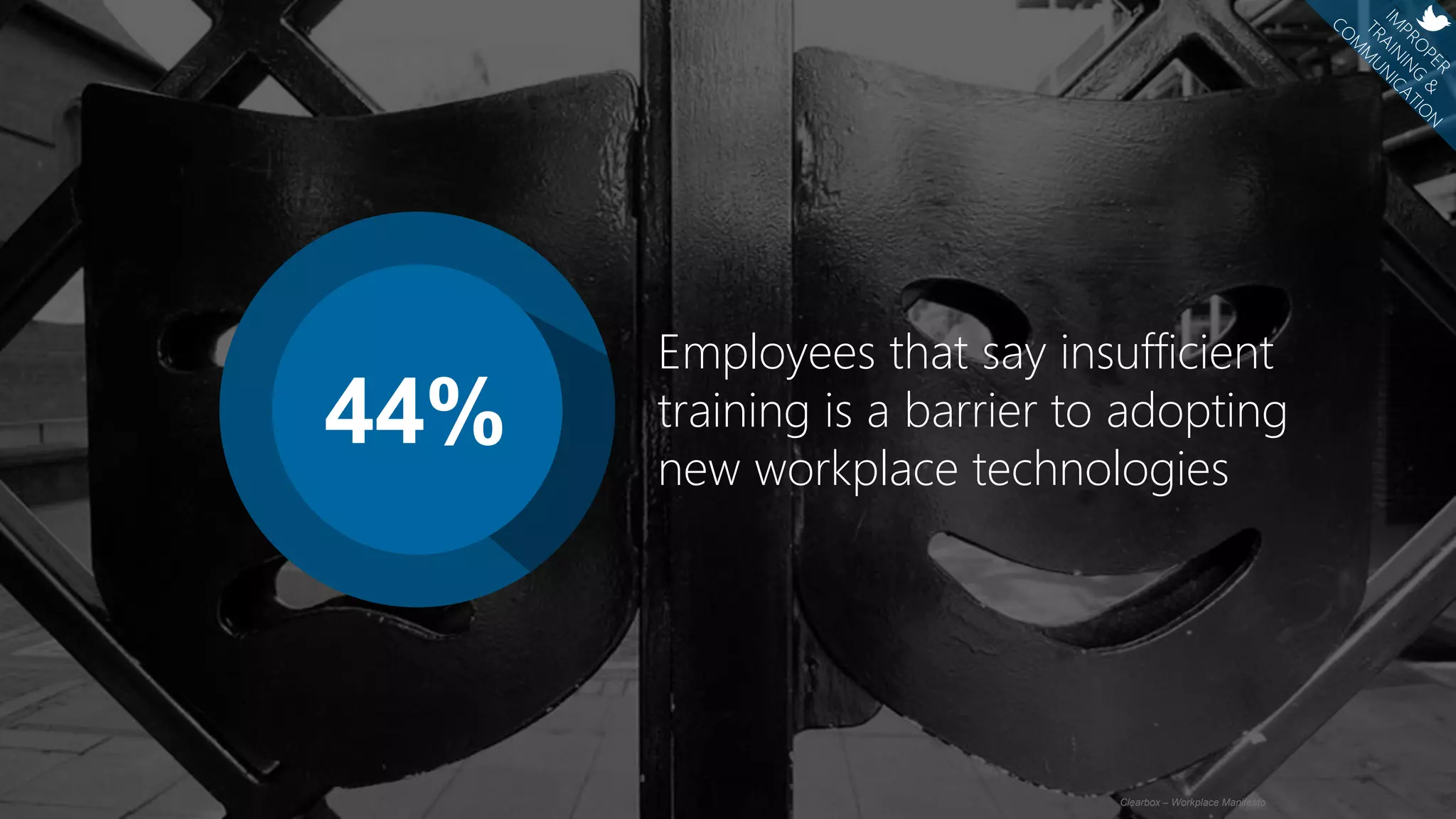
Clearbox – Workplace Manifesto
44%
Employees that say insufficient
training is a barrier to adopting
new workplace technologies
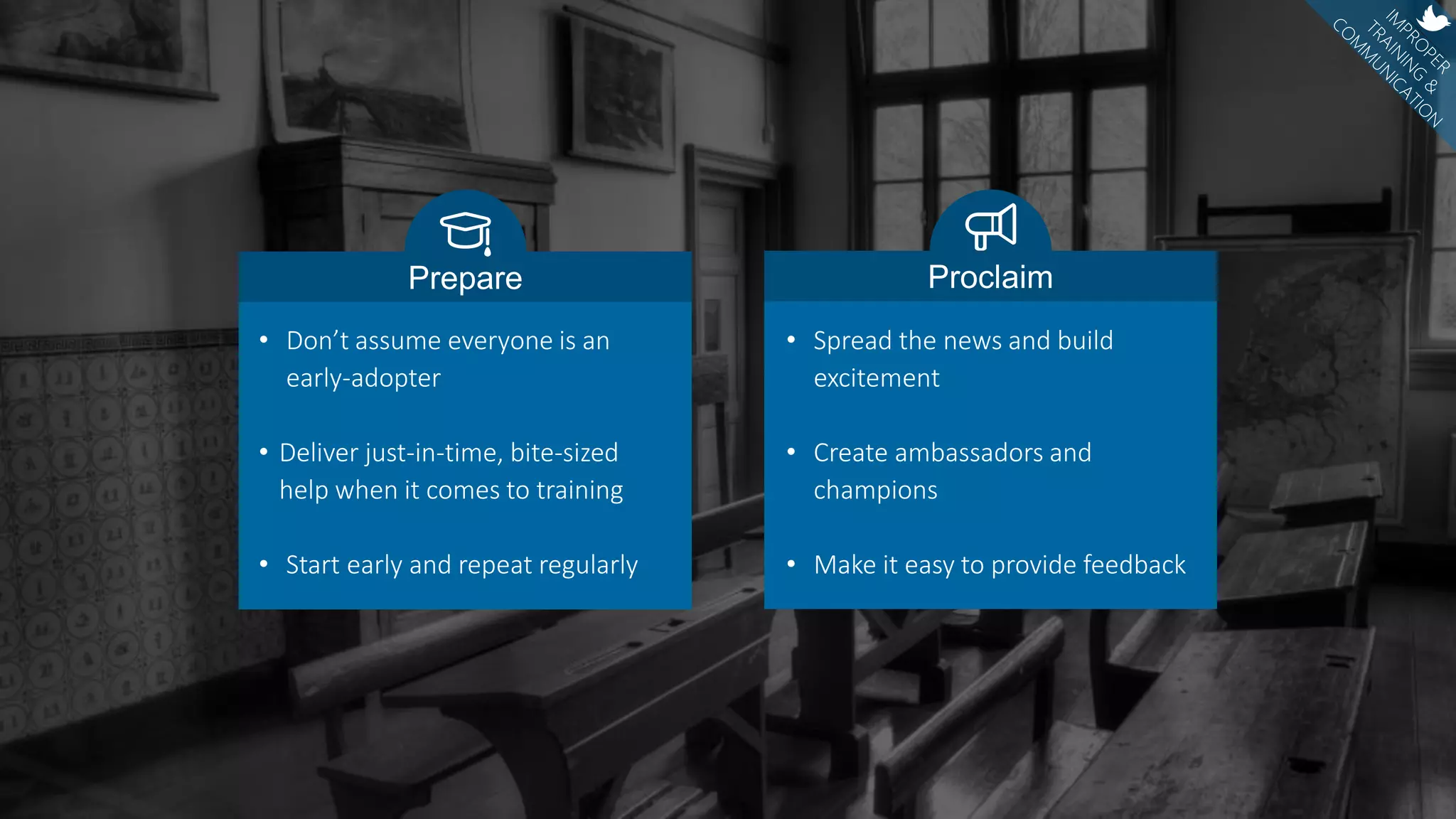
• Spread the news and build
excitement
• Create ambassadors and
champions
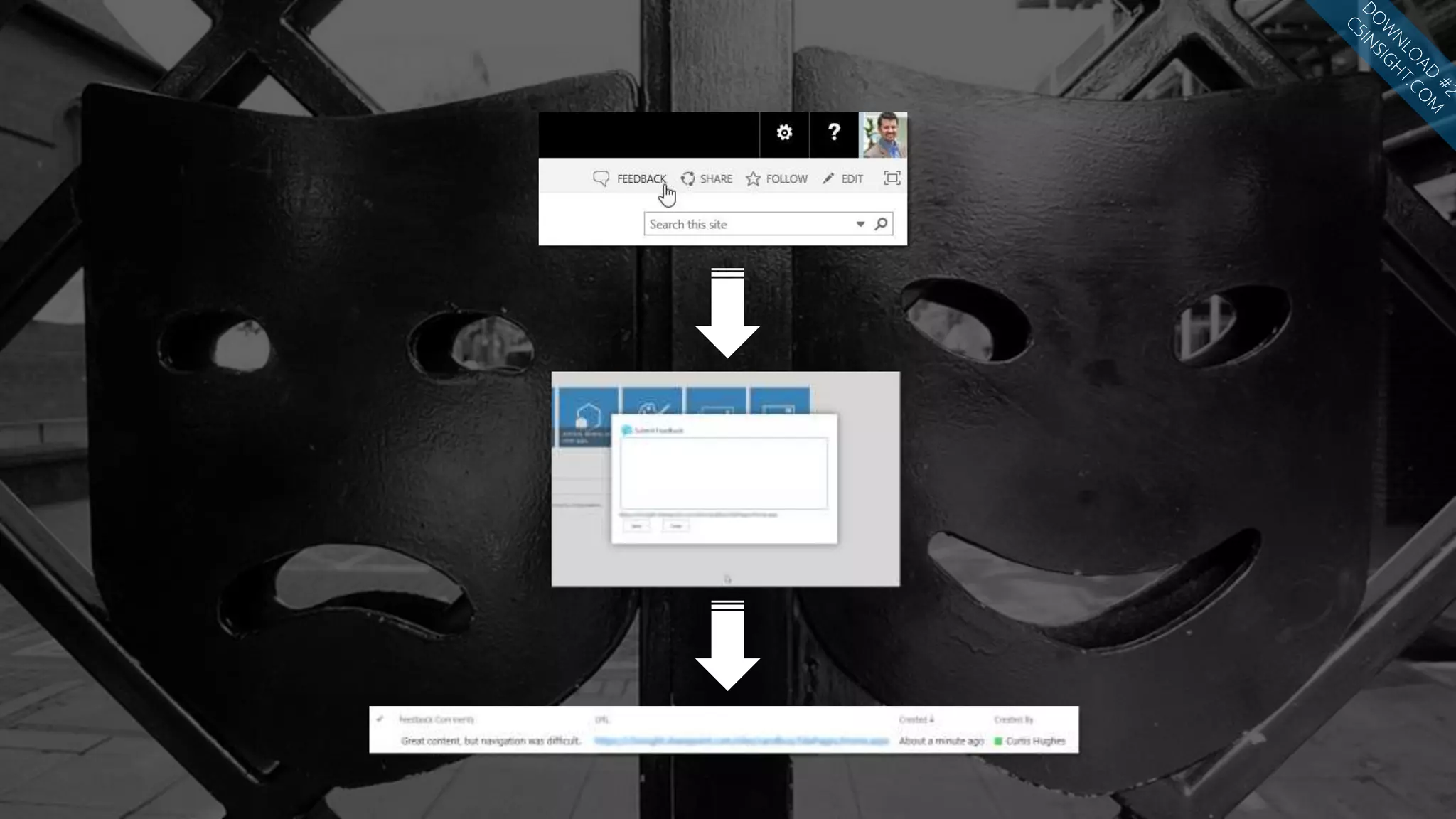
• Make it easy to provide feedback
Proclaim
• Don’t assume everyone is an
early-adopter
• Deliver just-in-time, bite-sized
help when it comes to training
• Start early and repeat regularly
Prepare
Planning Successful Implementations and Avoiding Project Failure
A BETTER WAY
50
1
2
3
4
5
6
7
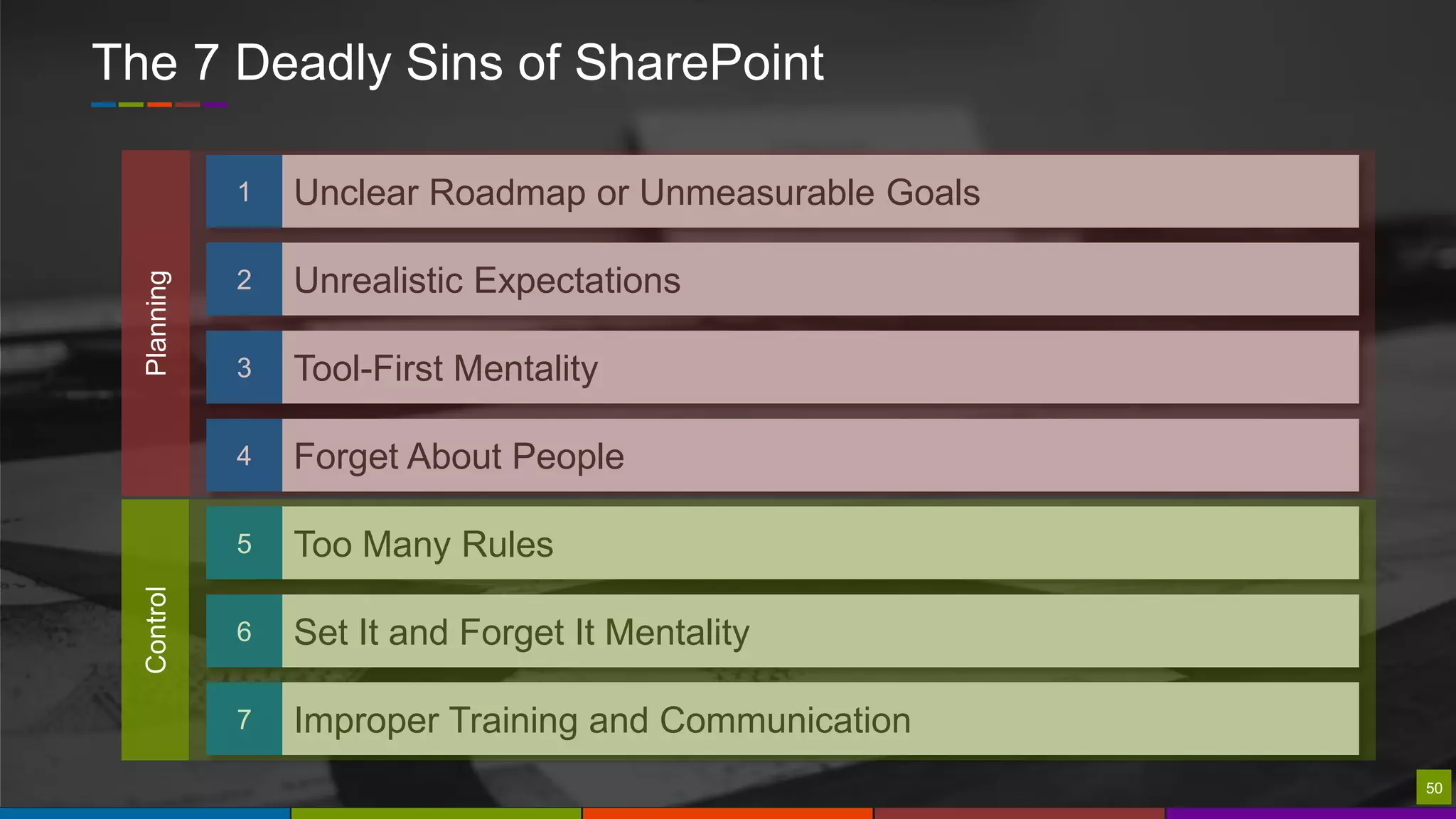
Unclear Roadmap or Unmeasurable Goals
Unrealistic Expectations
Tool-First Mentality
Forget About People
Too Many Rules
Set It and Forget It Mentality
Improper Training and Communication
ControlPlanning
The 7 Deadly Sins of SharePoint
50
51
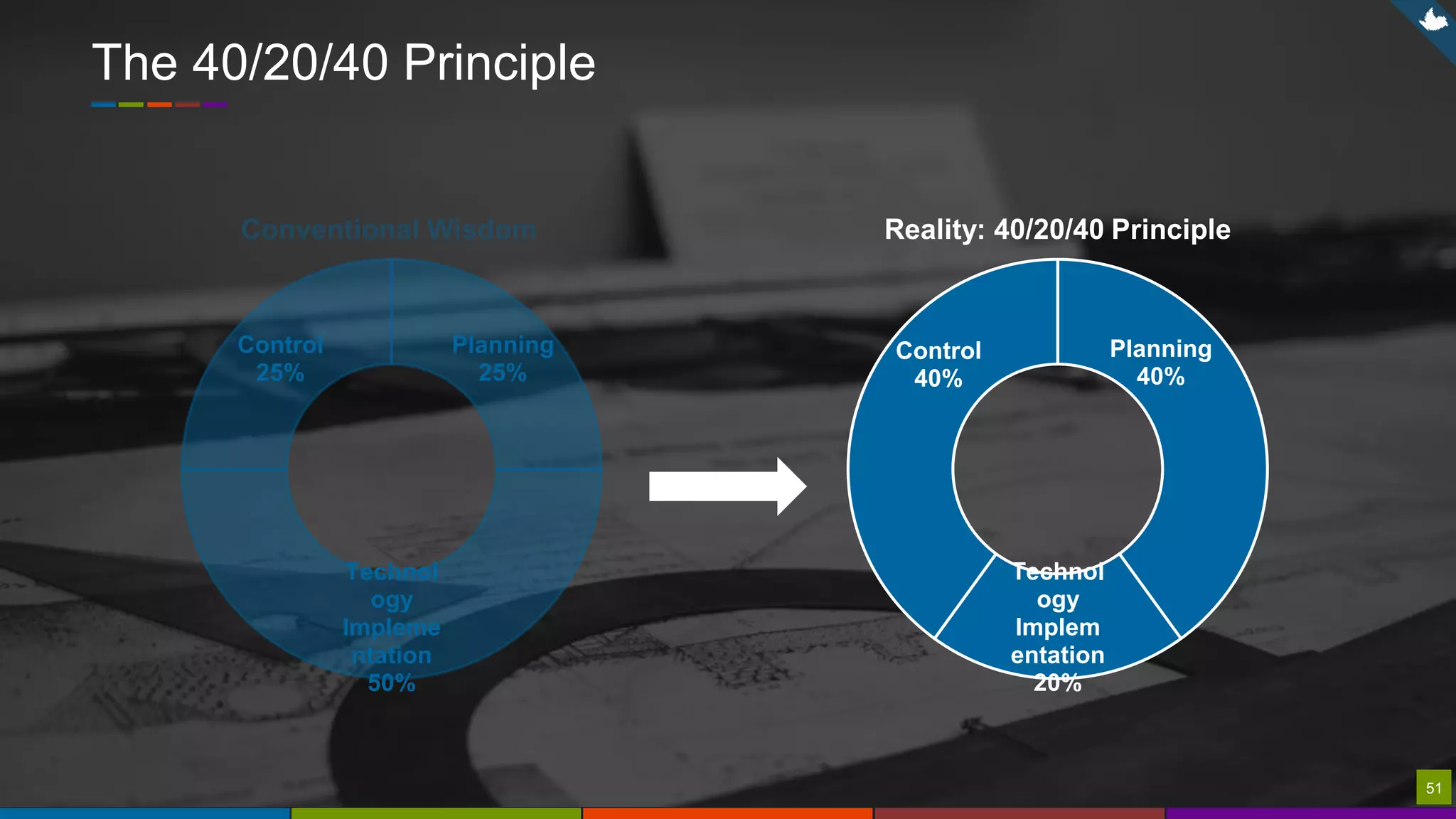
Planning
40%
Technol
ogy
Implem
entation
20%
Control
40%
Planning
25%
Technol
ogy
Impleme
ntation
50%
Control
25%
Reality: 40/20/40 Principle
The 40/20/40 Principle
51
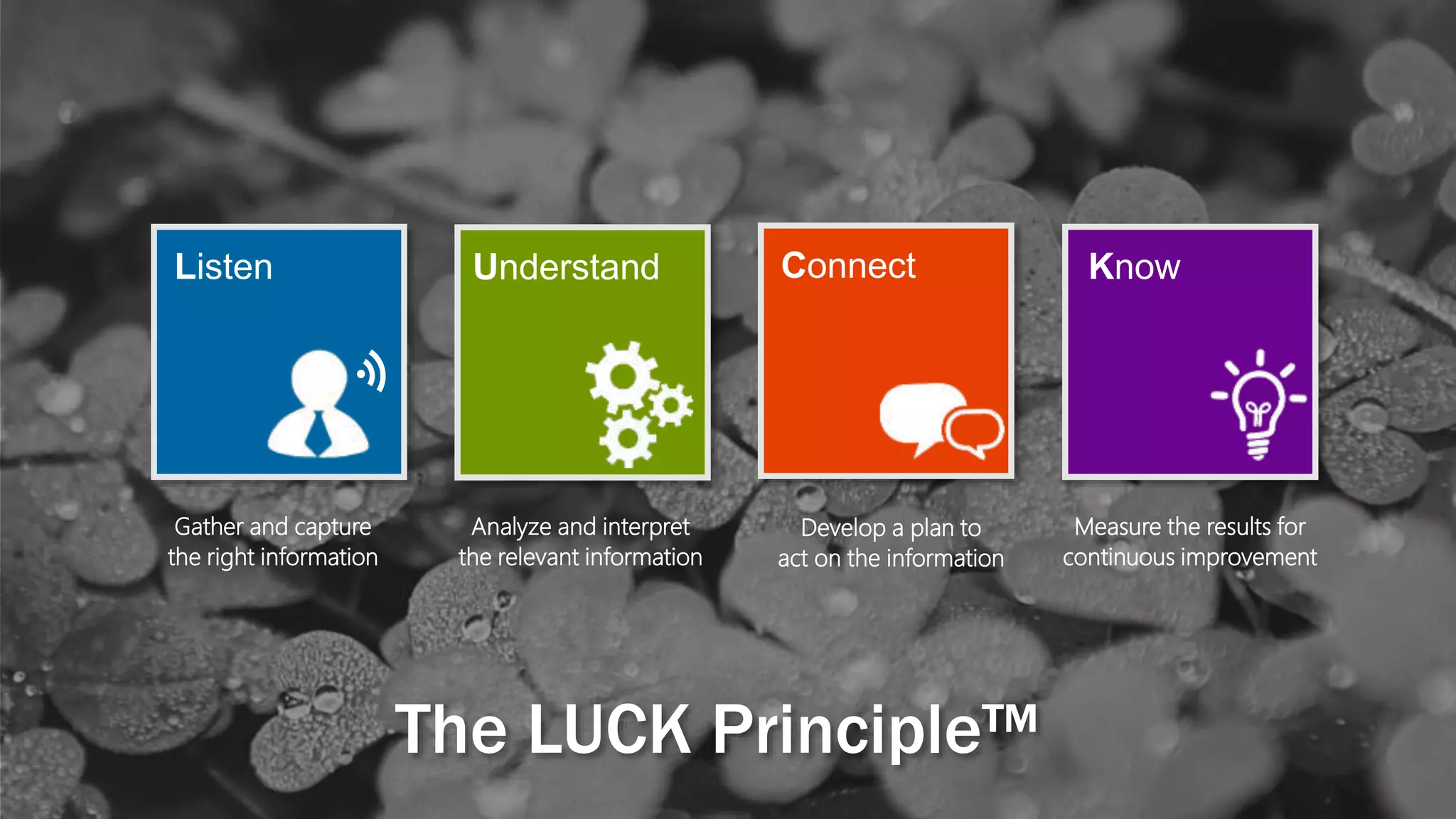
LUCK
Gather and capture
the right information
Analyze and interpret
the relevant information
Develop a plan to
act on the information
Measure the results for
continuous improvement
Listen Understand Connect Know
The LUCK Principle™
54
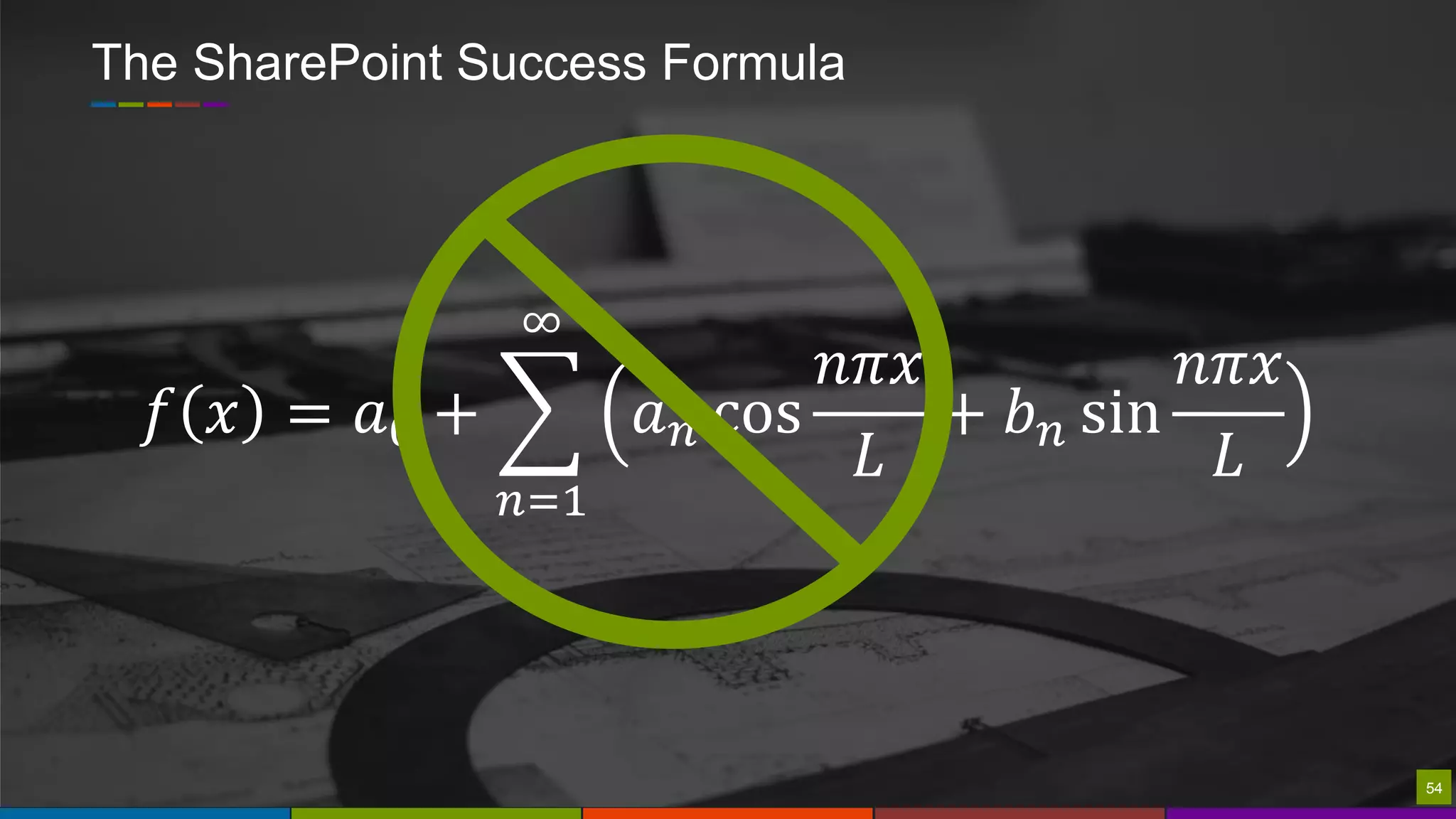
𝑓 𝑥 = 𝑎0 +
𝑛=1
∞
𝑎 𝑛 cos
𝑛𝜋𝑥
𝐿
+ 𝑏 𝑛 sin
𝑛𝜋𝑥
𝐿
The SharePoint Success Formula
54
5555
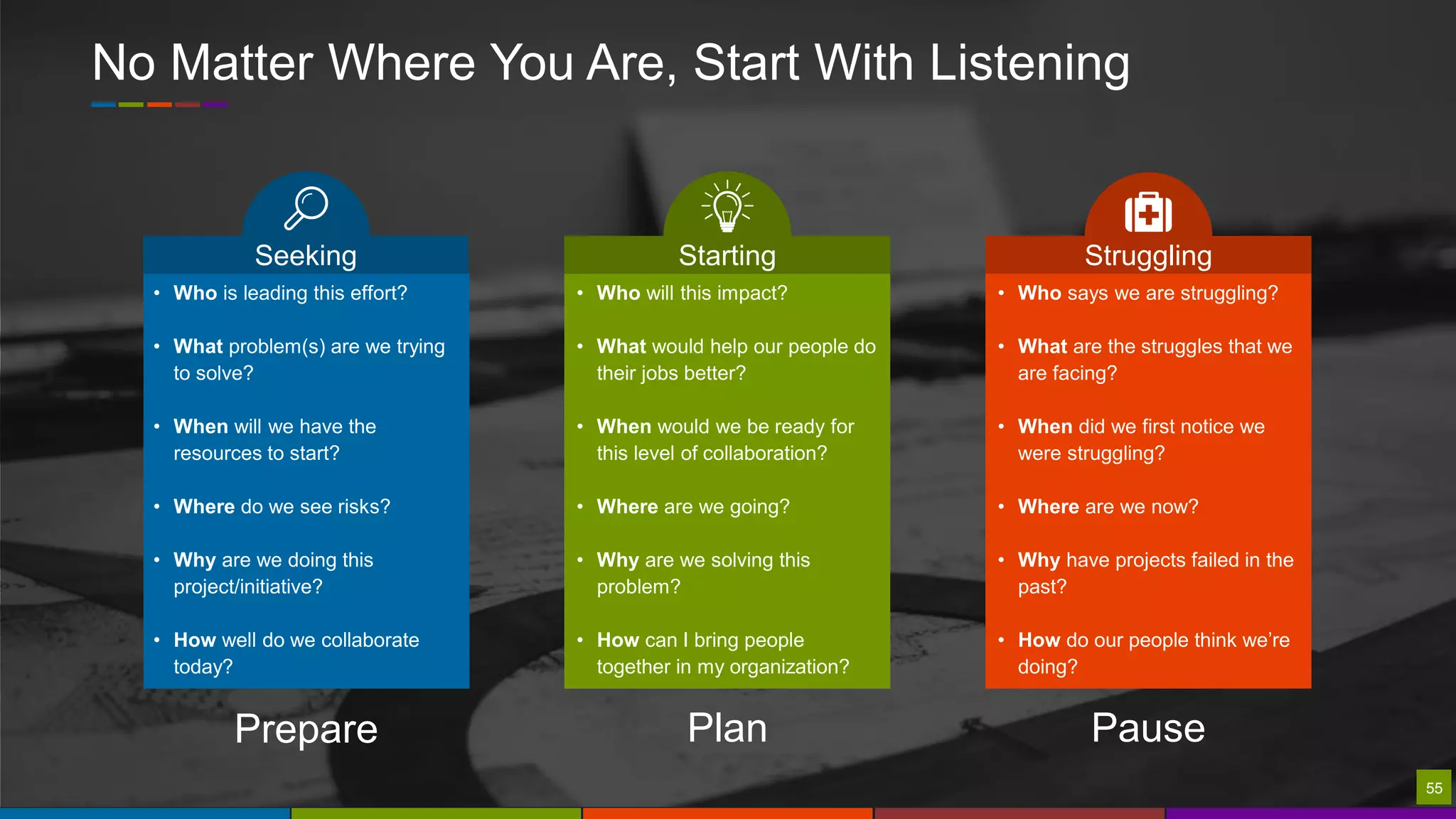
No Matter Where You Are, Start With Listening
Pause
• Who says we are struggling?
• What are the struggles that we
are facing?
• When did we first notice we
were struggling?
• Where are we now?
• Why have projects failed in the
past?
• How do our people think we’re
doing?
Struggling
Plan
• Who will this impact?
• What would help our people do
their jobs better?
• When would we be ready for
this level of collaboration?
• Where are we going?
• Why are we solving this
problem?
• How can I bring people
together in my organization?
Starting
Prepare
• Who is leading this effort?
• What problem(s) are we trying
to solve?
• When will we have the
resources to start?
• Where do we see risks?
• Why are we doing this
project/initiative?
• How well do we collaborate
today?
Seeking
56
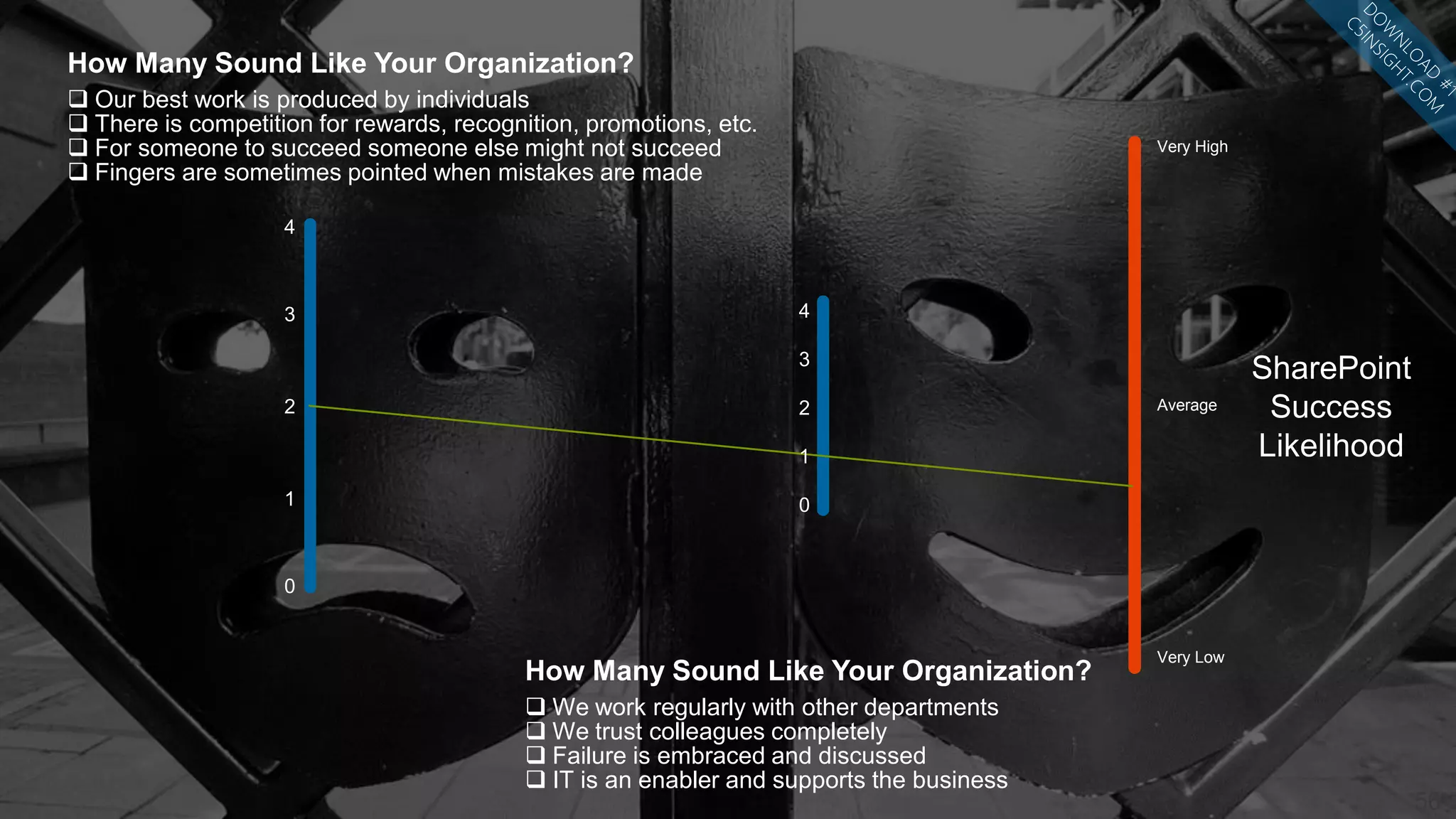
How Many Sound Like Your Organization?
 We work regularly with other departments
 We trust colleagues completely
 Failure is embraced and discussed
 IT is an enabler and supports the business
4
3
2
1
0
Very High
Average
Very Low
How Many Sound Like Your Organization?
 Our best work is produced by individuals
 There is competition for rewards, recognition, promotions, etc.
 For someone to succeed someone else might not succeed
 Fingers are sometimes pointed when mistakes are made
SharePoint
Success
Likelihood
4
3
2
1
0
We can't solve problems by using
the same kind of thinking we used
when we created them.
— Albert Einstein
“
60
luck@c5insight.com 704.895.2500 www.c5insight.com
C5 Insight
9319 Robert D. Snyder Rd.
PORTAL Building, Suite 348
Charlotte, NC 28223
REACH OUT
/C5-Insight @C5Insight /C5Insight

The 7 Deadly Sins of SharePoint: Planning Successful Implementations and Avoiding Project Failure

  • 1.
    The 7 DeadlySins of SharePoint Planning Successful Implementations and Avoiding Project Failure LISTEN KNOW UNDERSTAND CONNECT
  • 2.
    22 Non Disclosure Agreement Forthe purposes of this document, and except as otherwise expressly provided in this document, "Confidential Information" means any information that C5 Insight, Inc. (“C5 Insight”) desires to protect against unrestricted disclosure by the receiving party (“Recipient”). The Recipient agrees that it will hold in confidence the Confidential Information disclosed within this document and any documents, presentations, software, methods or other information shared by C5 Insight in print, electronic, verbal or any other format. The Recipient shall exercise reasonable care to protect the Confidential Information from unauthorized disclosure, which care shall in no event be less than the Recipient takes to protect its own Confidential Information of a like nature. The Recipient may disclose Confidential Information only to its employees or agents who need to know such information for purposes of this agreement, and shall inform such employees and agents, by way of policy and agreement, that they are bound by obligations of confidentiality. The entire content of this statement of work is classified as Confidential Information and by reading any further content within this document, the recipient is bound by the terms of this non-disclosure agreement.
  • 3.
  • 4.
    4 Curtis@C5Insight.com Curtis Hughes Managing Partner C5Insight About Me /in/curtishughes @C5Curtis
  • 5.
    Agenda 7 Deadly SinsTellingThe Truth A Better Way
  • 6.
  • 7.
    WE KNOW THEREASONS WHY
  • 9.
    Three Universal TruthsWe’ve Learned About SharePoint Projects TELLING THE TRUTH
  • 10.
  • 11.
    Gartner Research Employees getas much as 75% of their relevant information directly from other people 75%
  • 12.
    15 33% Middle managers thatsay they miss important information because they cannot find it. Accenture Organizations that have suffered at least one project failure in the prior 12 months. KPMG 59% 70% 25% 97% 240% SharePoint projects that have serious user adoption problems. AMR Research Social collaboration boost to worker productivity. Harvard Business Review Number of organizations that have been able to service more clients, more efficiently. ICE3 Boost to performance when an organization engages customers and employees. Gallup Rewards Risks 15 THERE ARE RISKS AND REWARDS
  • 13.
    1616 Decisions Decision Decision Decision Decision Decision Decision Decision Decision Decision Decision Decision Decision Decision Decision Decision Decision Decision Decision Decision Decision Decision DecisionDecision Decision Decision Decision Decision Decision Decision Decision Decision Decision Decision Decision Decision Decision Decision Decision Decision Decision Decision Decision Decision Decisions Decision Decision Decision Decision Decision Decision Decision Decision Decision Decision Decision Decision Decision Decision Decision Decision Decision Decision Decision Decision Decision Decision Decision Decision Decision Decision Decision Decision Decision Decision Decision Decision Decision Decision Decision Decision Decision Decision Decision Decision Decision Decision Decision Task 1 Task 2 Task 3 IT NEEDS MORE ATTENTION
  • 14.
  • 15.
    Seven Deadly SinsThat Cause Companies To Miss The Mark THE 7 DEADLY SINS
  • 16.
    1919 How The “DeadlySins” Came To Be 41% 59% CPR Projects Standard Projects Not long ago, we noticed a trend. It seemed more of our new clients were looking to revive a failing project than begin a new one. We became obsessed with this and realized it’s true – we are in fact experts in failure. Today, 59% of our new business revolves around resuscitation and rescue. We’re proud of this. Our experience helps us understand the obstacles that every organization will face. We use this experience to ensure your success.
  • 17.
  • 18.
    33% Companies who say lackof strategic plans are the biggest on- going business issue AIIM Be Strategic 50% Measure Progress Project Managers who say that their projects fail to consistently achieve what they set out to accomplish. KPMG 75% Be Specific Project team members who think the project will fail due to “Fuzzy business objectives and out-of-sync stakeholders.” Geneca
  • 20.
  • 22.
  • 23.
  • 24.
    28 0% 10% 20%30% 40% 50% 60% 70% 80% 90% 100% This is our third (or more) time This is our second time This is the first time How Many Times Have You Tried to Implement A Collaboration Tool? Satisfied Unsatisfied
  • 25.
    Gartner – CarolRozwell http://blogs.gartner.com/carol_rozwell/2013/08/20/outputs-are-important-but-behaviors-are-better/ of social and collaboration business efforts will not A Focus On Technology 80% achieve the intended benefits due to inadequate leadership and an OVEREMPHASIS ON TECHNOLOGY
  • 26.
  • 27.
    31 Engagement Forming bonds awakensa desire to serve each other 1 Information flows easily and ideas begin to multiply Relationships Relationships become natural and organic Connections Bring people together in friction- free ways. 2 34 Innovation
  • 29.
  • 30.
    Cadence Group, 2011 Rigidat the Core Flexible at the Edges Corporate metadata, retention policies, auditing, Intranet homepage content, published articles, etc. My Sites, OneDrive, collaboration, team, and project sites, check-in/out, keywords, personal views, etc.
  • 31.
  • 32.
    Logica Management Consulting 35% ProjectAbandonment Percentage of organizations that have abandoned a major project in the last 3 years.
  • 33.
    30% Increase In ProjectSuccess There is a 30% increase in project success when a collaboration project includes a multi-departmental steering committee. AIIM
  • 34.
  • 35.
    Clearbox – WorkplaceManifesto 44% Employees that say insufficient training is a barrier to adopting new workplace technologies
  • 36.
    • Spread thenews and build excitement • Create ambassadors and champions • Make it easy to provide feedback Proclaim • Don’t assume everyone is an early-adopter • Deliver just-in-time, bite-sized help when it comes to training • Start early and repeat regularly Prepare
  • 38.
    Planning Successful Implementationsand Avoiding Project Failure A BETTER WAY
  • 39.
    50 1 2 3 4 5 6 7 Unclear Roadmap orUnmeasurable Goals Unrealistic Expectations Tool-First Mentality Forget About People Too Many Rules Set It and Forget It Mentality Improper Training and Communication ControlPlanning The 7 Deadly Sins of SharePoint 50
  • 40.
  • 41.
  • 42.
    Gather and capture theright information Analyze and interpret the relevant information Develop a plan to act on the information Measure the results for continuous improvement Listen Understand Connect Know The LUCK Principle™
  • 43.
    54 𝑓 𝑥 =𝑎0 + 𝑛=1 ∞ 𝑎 𝑛 cos 𝑛𝜋𝑥 𝐿 + 𝑏 𝑛 sin 𝑛𝜋𝑥 𝐿 The SharePoint Success Formula 54
  • 44.
    5555 No Matter WhereYou Are, Start With Listening Pause • Who says we are struggling? • What are the struggles that we are facing? • When did we first notice we were struggling? • Where are we now? • Why have projects failed in the past? • How do our people think we’re doing? Struggling Plan • Who will this impact? • What would help our people do their jobs better? • When would we be ready for this level of collaboration? • Where are we going? • Why are we solving this problem? • How can I bring people together in my organization? Starting Prepare • Who is leading this effort? • What problem(s) are we trying to solve? • When will we have the resources to start? • Where do we see risks? • Why are we doing this project/initiative? • How well do we collaborate today? Seeking
  • 45.
    56 How Many SoundLike Your Organization?  We work regularly with other departments  We trust colleagues completely  Failure is embraced and discussed  IT is an enabler and supports the business 4 3 2 1 0 Very High Average Very Low How Many Sound Like Your Organization?  Our best work is produced by individuals  There is competition for rewards, recognition, promotions, etc.  For someone to succeed someone else might not succeed  Fingers are sometimes pointed when mistakes are made SharePoint Success Likelihood 4 3 2 1 0
  • 47.
    We can't solveproblems by using the same kind of thinking we used when we created them. — Albert Einstein “
  • 48.
    60 luck@c5insight.com 704.895.2500 www.c5insight.com C5Insight 9319 Robert D. Snyder Rd. PORTAL Building, Suite 348 Charlotte, NC 28223 REACH OUT /C5-Insight @C5Insight /C5Insight

Editor's Notes

  • #4 1 MINUTE QUESTION: How many of you have never failed…you’re perfect?
  • #5 1 MINUTE
  • #6 1 MINUTE In the next couple slides, I’m going to give you 2 overarching themes that we see a lot (there are more), and then we’ll dig-into the 7 deadly sins that are most common and most recurring across the organizations we see.
  • #7 1 MINUTE In the next couple slides, I’m going to give you 2 overarching themes that we see a lot (there are more), and then we’ll dig-into the 7 deadly sins that are most common and most recurring across the organizations we see.
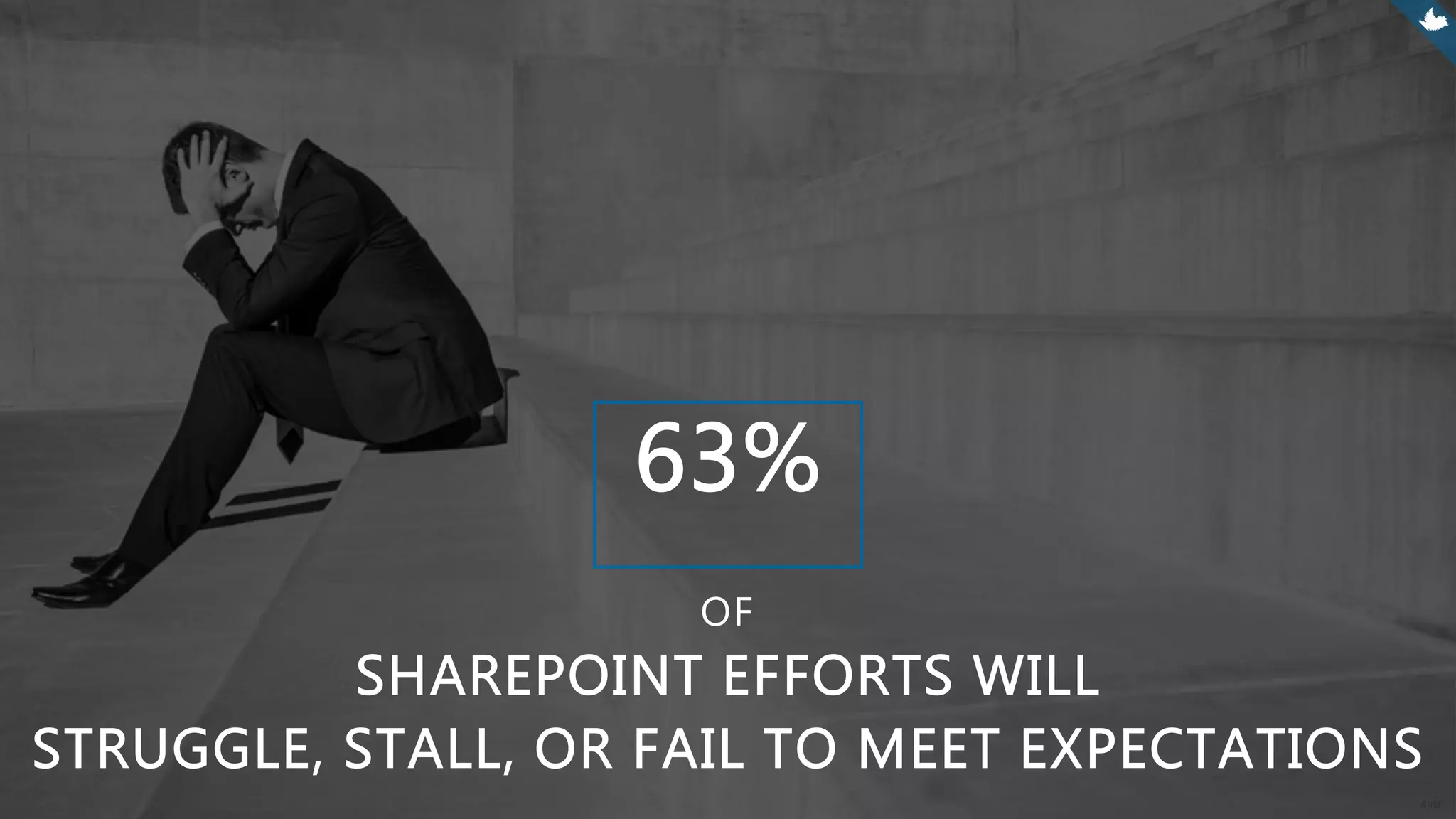
  • #8 1 MINUTE Obviously we’re going to be talking about SharePoint today, but you should know that over 60% of all SharePoint initiatives fail to meet expectations. This is an AIIM stat, not a C5 stat. In fact, Gartner even has this number as high as 80%. At least 3:5 of you will struggle with SharePoint, if you aren’t already. In 2013, this was 61% (so what’s going on)? Source: AIIM, Gartner
  • #9 1 MINUTE In the next couple slides, I’m going to give you 3 universal truths that we see (there are more), and then we’ll dig-into the 7 deadly sins that are most common and most recurring across the organizations we see.
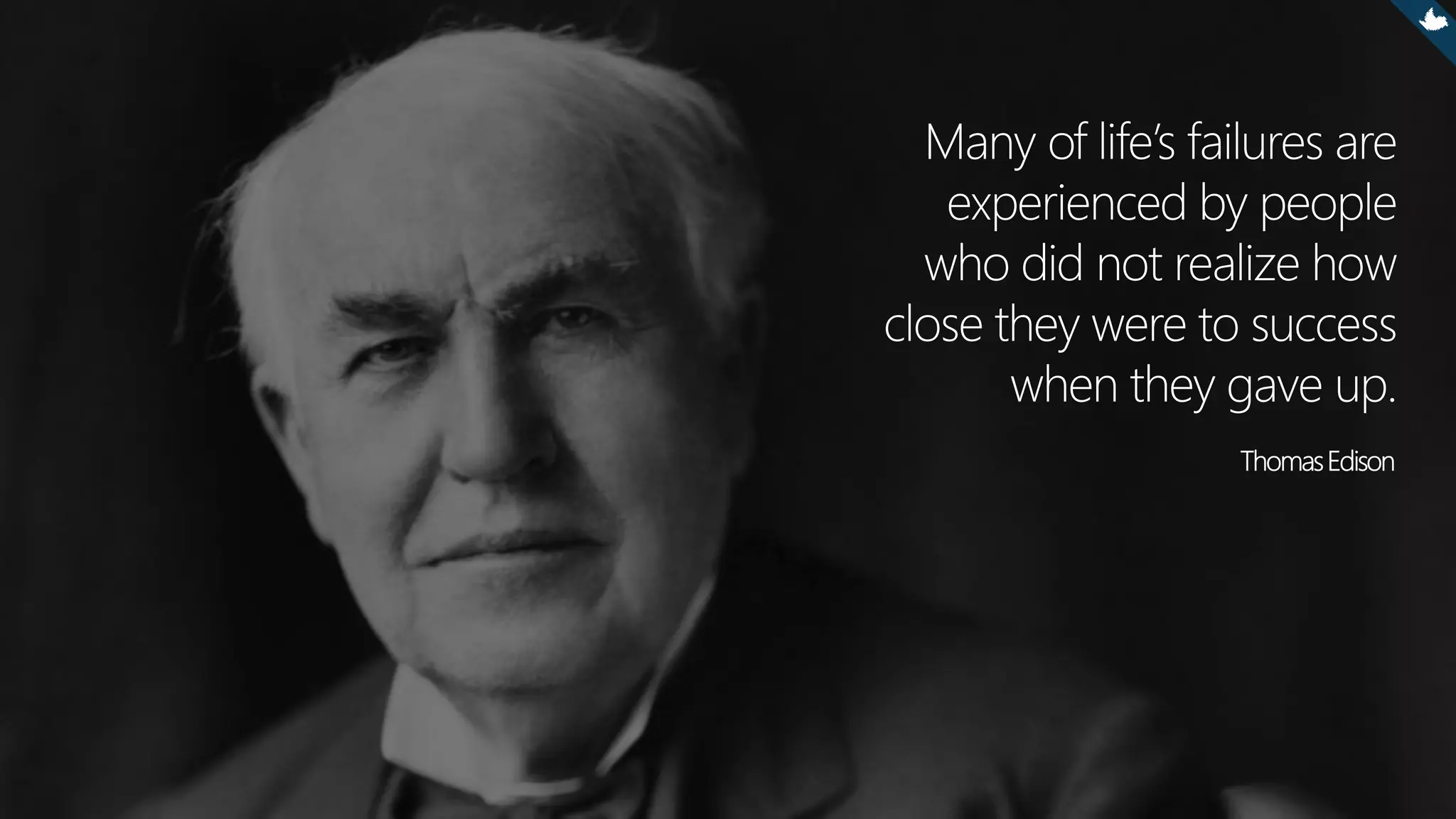
  • #10 How many of you have never failed? You’re perfect? So have many others Walt Disney Beethoven Einstein Edison And the list goes on and on….
  • #11 So have many others Walt Disney Beethoven Einstein Edison And the list goes on and on….
  • #13 2 MINUTES So, let’s just be honest, you guys aren’t really doing a SharePoint project. You know that right? It’s never been about SharePoint (or at least it shouldn’t have been). Forgot why we were doing these projects CLICK
  • #14 We get a majority of our information - our knowledge - from other people Then if this is the case, it only makes sense that we spend a little time better understanding how people – you and I – affect collaboration in our organizations. CLICK
  • #15 1 MINUTE Lastly, I want to share something else that’s going on with our people… Can you believe that 70% of employees are disengaged?! That's pretty shocking to me, not just because I’m a business owner, but because those are just staggering numbers. Hopefully, I don’t have to tell you how this would impact a company, but it’s something that successful collaboration initiatives and intranets can improve. - CLICK
  • #16 2 MINUTES Before you start doing anything, it’s always a good idea to understand both the risks and the rewards. STAT: In fact, 60% of all SharePoint and Collaboration projects are struggling or flat-out failed I won’t read all of these aloud to you, but in addition to great increases in productivity and serving clients… The two greatest priorities continue to be lack of executive support and “other bigger priorities”: 22% cite lack of executive support as the primary barrier to implementation. 18% cite “other, bigger priorities” preventing them from implementation. http://www.prescientdigital.com/downloads/2012%20Social%20Intranet%20Study_Summary_Prescient%20Digital%20Media.pdf Talk about CPR session tomorrow
  • #17 2 MINUTES When most organizations hear “planning” they think requirements, what do we need to do, etc. So they quickly move from an idea to what needs to be built, and finally develop a project plan with some tasks on it that looks like the Gantt chart here. But what we’ve found is this is not entirely true and actually contributes to the failures. ----------------------------------- On average, 2 decisions per $1,000 in LABOR costs. Of course, this is not a definitive law, and also depends on the status of the organization, structure, etc. EXAMPLE: $100,000 = 200 individual decisions So what was maybe 15-30 individual tasks is now 200+ decisions.
  • #18 2 MINUTES When most organizations hear “planning” they think requirements, what do we need to do, etc. So they quickly move from an idea to what needs to be built, and finally develop a project plan with some tasks on it that looks like the Gantt chart here. But what we’ve found is this is not entirely true and actually contributes to the failures. ----------------------------------- On average, 2 decisions per $1,000 in LABOR costs. Of course, this is not a definitive law, and also depends on the status of the organization, structure, etc. EXAMPLE: $100,000 = 200 individual decisions So what was maybe 15-30 individual tasks is now 200+ decisions.
  • #19 Over the next few minutes, I’m going to share with you 6 areas where we see this disconnect manifesting itself in today’s organizations. When companies are trying to build a collaborative intranet, what are they missing and why are they failing? CLICK
  • #21 1 MINUTE QUESTION: How many of you have ever been on a road trip? What does done look like? Are your goals actually measurable? How do you know when you’re done and have met the goals? What do you do if you had no goals and you’re trying to recover; how do you know if you are off track? If you guys were going on vacation, maybe traveling cross-country by car, wouldn't you have a map? You’d probably also have the roads you were taking, where you’d stop along the way, and probably even check the weather for the journey. So why don’t we do this with our projects? Especially SharePoint. That’s what this is about – know where you’re going, what obstacles lie in your way, how will you know when you are done, etc. Example: “We need an new Intranet” Why? What does “Intranet” mean to your organization?
  • #22 1 MINUTE Just to further illustrate this point, here are some stats on just how important it is to have proper planning and to know where you are going CLICK
  • #23 1 MINUTE
  • #24 1 MINUTE CLICK
  • #25 1 MINUTE QUESTION: Anyone ever been let down? Wrong expectations always leads to disappointments We hear things like: “This will make us so much more productive right away.” “We don’t seem to be collaborating like they are. Why is it working so well for them?” “We have smart people, very technical people, a day of training should be plenty.” (or, there's no way we'll get them for that long) “The old way was more comfortable for me.” “I developed the old way and I know how it works – I can’t get my head around this new way of doing things.” - CLICK
  • #26 2 MINUTES Most organizations grow processes over a long period of time They were made to deal with the realities of the landscape and the limitations of a small or growing company that had to get a process in place quickly But as they grew, they found that the processes didn’t scale – and they were slowing them down So they start to envision automating them so they that narrow and curvy path becomes a superhighway And they look for shortcuts. Something that they can just install and quickly configure that will solve their problem. It’s easy to get caught up in the promise of something that can do this without realizing that there’s really nothing new under the sun. The laws of successful projects change about as fast as the laws of economics. So when they try to quickly pave over those old well worn paths, CLICK they end up with something like this! The reality is that it takes a lot of careful planning to go from the footpath to the superhighway, and with the right planning approach in place, CLICK you’ll have something that looks like this for a while Just like a highway project – it’ll be important that you manage it in phases so work can still get done, but you gradually introduce the processes across everyone in the organization Possibly a good place to say… What we often see is an expectation that you’ll go from a footpath to a superhighway But instead you end up with a permanent traffic jam Another way to think of this is like building a house If you don’t know where you’re going, you may not have the right plumbing, the right foundation … and you may be enabling your workers to build on top of a foundation that will collapse under them.
  • #27 1 MINUTE QUESTION: Anyone ever been let down? Wrong expectations always leads to disappointments We hear things like: “This will make us so much more productive right away.” “We don’t seem to be collaborating like they are. Why is it working so well for them?” “We have smart people, very technical people, a day of training should be plenty.” (or, there's no way we'll get them for that long) “The old way was more comfortable for me.” “I developed the old way and I know how it works – I can’t get my head around this new way of doing things.” - CLICK
  • #28 HALFWAY 1 MINUTE I love new tools. Just want to find a use for it. One thing we have found to be certain is that focusing on technology always leads to disappointments. Throwing tools at it – most organizations are really looking for a technology “quick fix” - it just doesn’t work like that Garage analogy Silver Bullet – hammer and nail CLICK
  • #29 2 MINUTES One thing we have found to be certain is that focusing on technology always leads to disappointments. Garage analogy This includes being “owned” by IT (or the business) – it should be a collaboration between them. Focus on connecting people, bringing people together As you approach the 2nd and 3rd times, people really begin to lose faith/trust in the next solution and become more resistant Failure not only costs money, it costs satisfaction (which lowers productivity), and ultimately could cost jobs Avoid the Silver Bullet Technology is a wonderful thing, but it’s not the only thing One size never fits all Understand what it is you are building and for whom
  • #30 http://blogs.gartner.com/carol_rozwell/2013/08/20/outputs-are-important-but-behaviors-are-better/ http://www.mycustomer.com/topic/social-crm/gartner-80-social-business-efforts-will-not-succeed-through-2015/161754 http://www.gartner.com/newsroom/id/2319215 More detailed analysis is available in the report "Predicts 2013: Social and Collaboration Go Deeper and Wider." The report is available on Gartner's website at http://www.gartner.com/resId=2254316.  However, whilst adoption is set to escalate, Gartner estimates that through 2015, 80% of social business efforts will not achieve the intended benefits due to inadequate leadership and an overemphasis on technology. Carol Rozwell, VP and distinguished analyst at Gartner, explained: “Businesses need to realize that social initiatives are different from previous technology deployments. Traditional technology rollouts, such as ERP or CRM, followed a ‘push’ paradigm. Rozwell added: “There is too much focus on content and technology, and not enough focus on leadership and relationships. Leaders need to develop a social business strategy that makes sense for the organization and tackle the tough organizational change work head on and early on. Successful social business initiatives require leadership and behavioral changes. Just sponsoring a social project is not enough — managers need to demonstrate their commitment to a more open, transparent work style by their actions.”
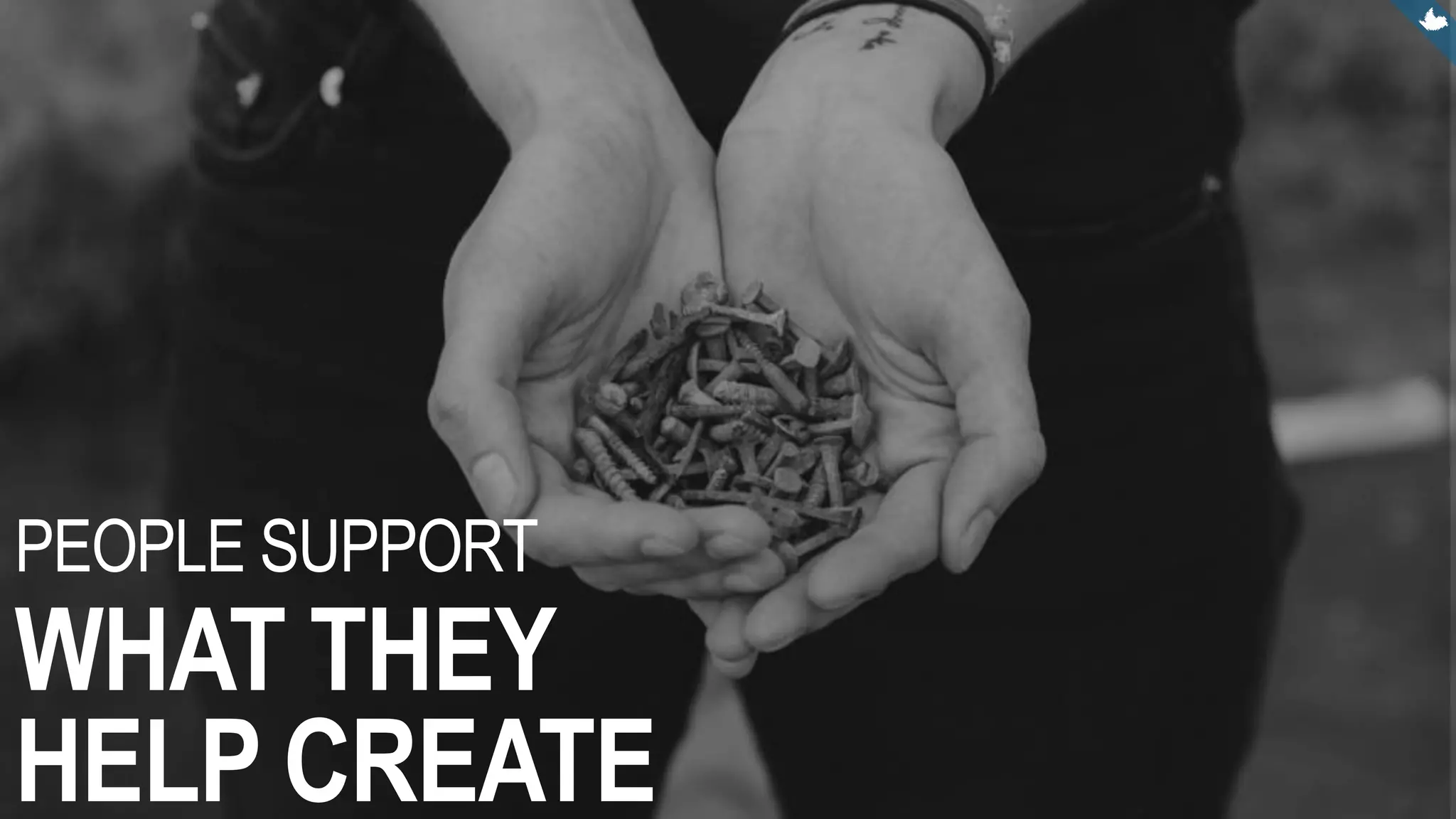
  • #31 2 MINUTES No immediate value Sometimes no value at all User-centered = User-supported Making it hard – friction, barriers Make sure that your first phase has very clear and very real value for the users/audience. One of the “easiest” things you can do to aide in user adoption is to give your users something that makes it worth their while. WIIFM – Not integrating it with the normal “workflow” of the users Get them involved in the process – People support what they help create Focus on value vs ROI – ROI comes from use, not implementation. Failure to Provide Immediate Value Make sure that your first phase has very clear and very real value for the users/audience. One of the “easiest” things you can do to aide in user adoption is to give your users something that makes it worth their while. Failure to Involve Users in the Discovery and Design How many people who have to use your SharePoint system REALLY like it? I mean TRULY like what it does for them? Why/why not? If you were architecting a house, would you expect the architect to simply go off, form a committee of architects (or other home owners) and then build your house? NO – you would be involved, as should your audience.
  • #32 2 MINUTES Since without people, none of us would have any reason to implement SharePoint and have anyone to actually implement SharePoint The culmination of all of this hard work to bring people together, form relationships, and achieve engagement, ultimately bears the fruit of innovation and ideas Or put another way: new products, better customer service, more efficient processes, more customers This is the collaboration nirvana that every organization wants, but as you can see, technology is nowhere to be found in this lifecycle. It can help – as a tool – but it’s not the core driver for this. 66% of CIOs from top-performing enterprises consider collaboration as key to driving innovation. McKinsey & Company, 2012. “The social economy: Unlocking value and productivity through social technologies.” http://www.mckinsey.com/insights/high_tech_telecoms_internet/the_social_economy CLICK
  • #33 1 MINUTE
  • #34 1 MINUTE
  • #35 1 MINUTE
  • #36 2 MINUTES I like the color blue. What if I told you, you can pick any color you want, as long as it’s blue? We’ve gone to the extreme when it comes to compliance We have to find the balance Implementing collaborative intranets with rules so restrictive people can't collaborate is a recipe for disaster. Rules of the road = yes (governance) Straight jacket = no Don’t tell your employees you want them to collaborate more, but they can only do it on Tuesday and Thursday, etc… CLICK
  • #37 1 MINUTE You don’t have to implement every one…I promise! We have to find the balance Generational changes (25 year olds and 65 year olds working together) CLICK Examples: Rigid Core: Retention of 7 years Flexible Edges: Check in/out policy CLICK
  • #38 2 MINUTES Doesn’t mean you can’t set the cruise control, automate some processes, make the trip a little better, but you still have to steer and always make sure you are pointing toward your destination. QUESTION: Run out of projects at home? SharePoint (and collab) is one initiative that should never be “finished” Planning is not enough. Projects often take wrong turns, or initial solutions prove unfounded. The project manager who does not prepare to re-plan, or has not considered and planned fall-back positions when initial plans fail, will often find that the project first stalls, and then fails. Training new employees Project management is not a straight-line process, but an iterative process that requires agile rethinking as the known environment changes before your eyes. There has to be a process for continuous improvement Changing, adapting, new employees, new generations, new ways of communicating Do you have a strategy and process for ensuring you continue to improve? This is a sophisticated platform, but it needs maintenance like everything else in life. Forget to change with the times You’re never really finished (training, adoption, improvements, leveraging new technologies/processes) CLICK
  • #39 2 MINUTES Projects typically stall before they fall Even the worst projects can start strong The key – as we saw before with the construction slide – is to quickly move through this because at his point, because should you get stalled in a construction mode, the next phase is project failure
  • #40 2 MINUTES Projects typically stall before they fall Even the worst projects can start strong The key – as we saw before with the construction slide – is to quickly move through this because at his point, because should you get stalled in a construction mode, the next phase is project failure
  • #41 1 MINUTE - One final stat I want to share is this one that speaks directly to the point of not just having a steering committee, but having one that spans multiple departments.
  • #42 2 MINUTES As a consulting firm, as you would expect, clients want to keep project costs low. Training is not an event What happens when you hire new people, people leave/join a role, etc. Lack of communication – it goes a long way Let people know what’s going on and why. People use and will support what they help create
  • #43 1 MINUTE - So it goes without saying that compliance is a hot topic today and something impacting collaboration and our Intranets
  • #44 2 MINUTES If people are at the heart of collaboration, then along with planning, it only makes sense that you spend time helping them understand the value of what you are doing One way we do this is by what we call Prepare and Proclaim Prepare Training Understanding of not only the what, and how but the WHY (adoption, change mgmt) On-going Project team (core, extended, etc) Proclaim Communication plan (banners in breakroom, email blasts, videos, contests, etc.) Get people excited Get people involved (project team) Make it easy to provide feedback (I’ll talk about that ) People support what they help create CLICK
  • #45 Top 5 change drivers:   Sense of 'Why' - purpose/connection Campaigns and communication Behavior of Colleagues Behavior of senior leaders Behavior of managers   Lowest ranked – classroom training   The Organization in the Digital Age: 10 Findings for Digital Leaders Jane McConnell This 9th annual global survey included 373 people from 26 countries representing 280 organizations. Participants responded to an in-depth online survey of 140 questions. The data was collected between October 2014 and early January 2015.
  • #46 - 3 Don’ts and 3 Dos
  • #47 5 MINUTES Who: A large manufacturer of hotel guest supplies What: A well-planned, small scope, pilot SharePoint deployment Situation Assessment: Shortly after deploying the pilot project to a single department, good news traveled fast and other departments and users began leveraging SharePoint, creating sites, customizing pages, adding users, etc. The CPR: The first step was to understand exactly who was using SharePoint throughout the organization. SharePoint web analytics and interviews/conversations with the departments helped determine this. Next, an audit was performed to determine the functionality being used by these departments. Once it was understood what users were doing with SharePoint, a Governance Committee was formed to develop and implement the “rules of the road” for this organization. Lastly, the committee members worked with each department to get their sites in alignment with the overall rules and trained each department on the rules and SharePoint functionality. How Are They Recovering: Users feel empowered and are able to be self-sufficient, but within the boundaries set by the organization – there are simply things you can and can’t do. Users also better understand how to use certain functionality, which makes them more productive and satisfied with their work.
  • #48 5 MINUTES Who: An international university with a globally dispersed alumni population What: A social alumni portal on SharePoint that would keep alumni profiles in sync with the alumnus’ primary record in CRM Situation Assessment: After two failed implementations over 2 months, and very little accomplished, the client came to C5 Insight with an extremely short timeframe remaining (6 weeks) and a project that never got off the ground. The CPR: First, we had to stop the bleeding and the pain. We knew we had to play catch-up, so we moved quickly to get a team in place to tackle this project. Next, we quickly prioritized the needs, eliminating scope and functionality that was not “mission critical” for the deployment. Lastly, we started training and testing from day 1, rather than waiting until the end of the short project phase. How Are They Recovering: Shortly after the successful launch for graduation, we conducted a three-day Scoping Assessment to recast the vision and direction for SharePoint. We were then asked to rescue another CRM project for this same client that we wrapped-up last year.
  • #49 5 MINUTES Who: A large manufacturing company What: A global SharePoint deployment, primarily used for document management Situation Assessment: Two top employees in IT have experience with SharePoint and would like to implement it within the organization. They “know” exactly what is missing at the company and how SharePoint can solve these problems. Unfortunately, after a very large deployment, users literally hate the very word “SharePoint” and think it was one of the largest failures at the company. The CPR: We first collected anonymous surveys from all users to determine their greatest challenges and pains. We formed a governance committee with various department members in addition to IT. We “turned off” functionality that was not immediately needed and created “noise” for the new users; tested the remaining functionality to ensure it fully met the needs; developed tip-sheets for the users; held a one day boot-camp on the use of the system; and re-launched to the organization. How Are They Recovering: Today, SharePoint is thriving and users see the value in the new platform and have increased productivity.
  • #50 - 3 Don’ts and 3 Dos
  • #51 50
  • #52 2 MINUTES Sounds great Curtis…So…practically speaking, how do we do it? I’m so glad you asked
  • #53 1 MINUTES Don’t believe me? What I’m going to share with you over the next few minutes will provide you with an easy way to remember how to spend 80% of your time on planning and control. Relax – it’s not that kind of LUCK CLICK In fact, we believe in this so much that we: 1) trademarked the luck principle and 2) are writing a book that will be out this year.
  • #54 1 MINUTES Don’t believe me? What I’m going to share with you over the next few minutes will provide you with an easy way to remember how to spend 80% of your time on planning and control. Relax – it’s not that kind of LUCK CLICK In fact, we believe in this so much that we: 1) trademarked the luck principle and 2) are writing a book that will be out this year.
  • #55 FOURIER SERIES The Equation – it’s not rocket science (it ain’t even algebra). It’s also not perfect, but will minimize your rick of failure and increase the likelihood of success If you are in the midst of a project that’s not going well, go into self-diagnosis mode. Check-in with the end users, review the original goals and objectives, the budget, the duration, the risks. Beginning the CPR process: Don’t assign blame, accept responsibility and look for solutions Think the Oz Principle Be honest, if someone needs to be fired, do it Create a new plan that is honest and in balance
  • #56 5 MINUTES And depending on which stage you are in, the questions to ask and the “formula” is different So it’s not THE SharePoint Success Formula – It’s YOUR SharePoint Success Formula So in other words – PREPARE – PLAN – PAUSE As I close, if I could give you guys one piece of advice for improved success, it would be to spend extra time on people LISTENING UNDERSTANDING CONNECTING KNOWING
  • #57 2 MINUTES Answering those questions is a great start, but one trend we’re starting to notice now is a mismatch between the company culture and project goals. So I came up with this quick, 60-second collaboration readiness assessment that is not scientific, but will give you a “quick and dirty” gauge of how likely you are to succeed with SharePoint. The truth is, if you don't have a culture of sharing, collaborating and working together, then no tool in and of itself is going to magically fix that. Here’s how it works: In the first section, check how many sound like your org? In the second section, check how many sound like your org? Draw a line between the 2 numbers This is a quick and dirty assessment of how likely your org is to succeed at collaboration Again – not a mention of tools…see a trend here?
  • #58 1 MINUTE At the end of the day, this Einstein quote sums it up best…. CLICK
  • #59 1 MINUTE
  • #60 1 MINUTE So as we move from disconnect and struggles to getting more out of SharePoint, I think Einstein says it best… We have to think differently – and that’s what we try to do. CLICK