











The Human Factor
Debunking The Myth That Technology Drives Collaboration
LISTEN
KNOW
UNDERSTAND
CONNECT
2
Curtis@C5Insight.com
Curtis Hughes
Managing Partner
About Me
/in/curtishughes
@C5Curtis
Get Social
@C5Curtis
@C5Insight
#TheHumanFactor
#WorkTogetherBetter
Agenda
A Better WayThe Human Factor 3 Common Myths
The Impact of People on Successful Collaboration
THE HUMAN FACTOR
66
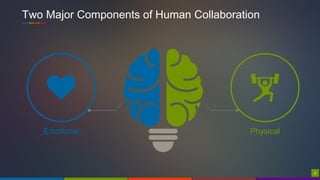
Emotional
Two Major Components of Human Collaboration
Physical
77
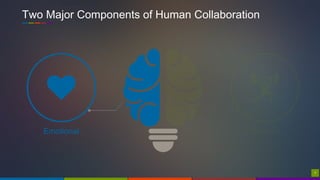
Emotional
Two Major Components of Human Collaboration
8
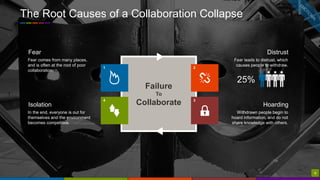
APA - Employee Distrust is Pervasive in U.S. Workforce
2
3
1
4
Failure
To
Collaborate
Fear comes from many places,
and is often at the root of poor
collaboration.
Fear
In the end, everyone is out for
themselves and the environment
becomes competitive.
Isolation
Fear leads to distrust, which
causes people to withdraw.
Distrust
Withdrawn people begin to
hoard information, and do not
share knowledge with others.
Hoarding
25%
The Root Causes of a Collaboration Collapse
8
9
Gartner Research
9
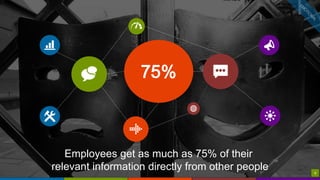
Employees get as much as 75% of their
relevant information directly from other people
75%
10
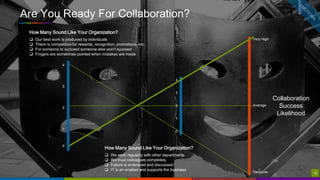
How Many Sound Like Your Organization?
๏ฑ We work regularly with other departments
๏ฑ We trust colleagues completely
๏ฑ Failure is embraced and discussed
๏ฑ IT is an enabler and supports the business
4
3
2
1
0
4
3
2
1
0
Very High
Average
Very Low
How Many Sound Like Your Organization?
๏ฑ Our best work is produced by individuals
๏ฑ There is competition for rewards, recognition, promotions, etc.
๏ฑ For someone to succeed someone else wonโ€™t succeed
๏ฑ Fingers are sometimes pointed when mistakes are made
Collaboration
Success
Likelihood
Are You Ready For Collaboration?
10
1111
Two Major Components of Human Collaboration
Physical
12
Atlasssian
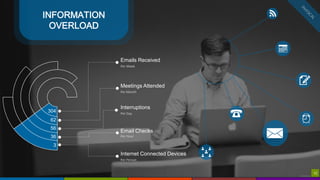
INFORMATION
OVERLOAD
Emails Received
Per Week
Meetings Attended
Per Month
Interruptions
Per Day
Email Checks
Per Hour
Internet Connected Devices
Per Person
304
62
56
36
3
12
13
Global Leadership Summit; Fast Company โ€“ Future of Work; STC Services; Ad Week โ€“ Social Media Addiction;
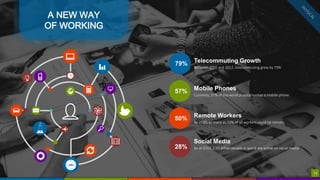
A NEW WAY
OF WORKING
Telecommuting Growth
Between 2005 and 2012, telecommuting grew by 79%
79%
Remote Workers
By 2020, as many as 50% of all workers could be remote
57% Mobile Phones
Currently, 57% of the world population has a mobile phone
50%
Social Media
As of 2014, 2.03 billion people in world are active on social media28%
13
14
Millennial Branding โ€“ The Cost of Millennial Retention Study
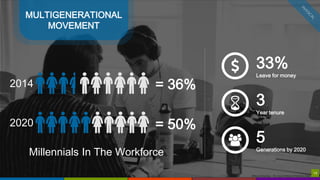
MULTIGENERATIONAL
MOVEMENT
2014
2020
= 36%
= 50%
Millennials In The Workforce
14
3
Year tenure
33%
Leave for money
5
Generations by 2020
3 COMMON MYTHS
Three Myths About Collaboration And Technology
START WITH
BEST OF BREED
TECHNOLOGY
Gartner โ€“ Carol Rozwell
http://blogs.gartner.com/carol_rozwell/2013/08/20/outputs-are-important-but-behaviors-are-better/
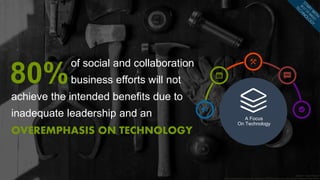
of social and collaboration
business efforts will not
A Focus
On Technology
80%
achieve the intended benefits due to
inadequate leadership and an
OVEREMPHASIS ON TECHNOLOGY
TECHNOLOGY
HAS
GREAT ROI
KEEP TRYING
IF AT FIRST YOU DONโ€™T
SUCCEED
Ideas For Tapping Into The Human Factor
A BETTER WAY
START
WITH THE
TOOLS
FORGET
ABOUT YOUR
PEOPLE
STOP
EVOLVING
26
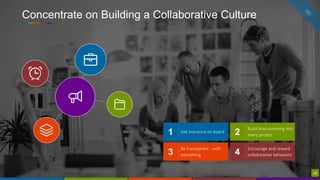
Concentrate on Building a Collaborative Culture
4
Encourage and reward
collaborative behaviors3
Be transparent - with
everything
2
Build brainstorming into
every project1 Get everyone on board
26
27
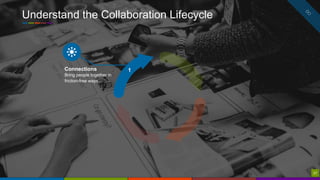
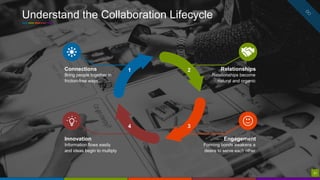
Understand the Collaboration Lifecycle
27
1Connections
Bring people together in
friction-free ways.
28
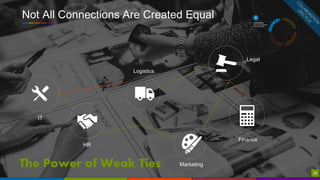
Not All Connections Are Created Equal
Marketing
IT
HR
Logistics
Legal
Finance
28
The Power of Weak Ties
29
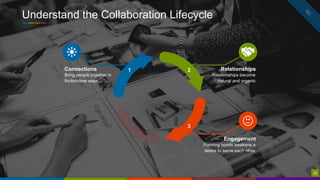
Understand the Collaboration Lifecycle
29
Engagement
Forming bonds awakens a
desire to serve each other
1 Relationships
Relationships become
natural and organic
Connections
Bring people together in
friction-free ways.
2
3
30
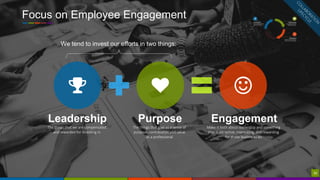
Focus on Employee Engagement
30
The things that give us a sense of
purpose, contribution and value
as a professional
Purpose
Make it both about leadership and something
that is attractive, interesting, and rewarding
for those leaders to do
Engagement
The things that we are compensated
and rewarded for investing in
Leadership
We tend to invest our efforts in two things:
31
Understand the Collaboration Lifecycle
31
Engagement
Forming bonds awakens a
desire to serve each other
1
Information flows easily
and ideas begin to multiply
Relationships
Relationships become
natural and organic
Connections
Bring people together in
friction-free ways.
2
34
Innovation
32
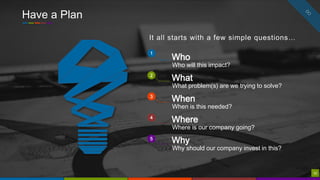
Have a Plan
32
2
What
What problem(s) are we trying to solve?
3
When
When is this needed?
1
Who
Who will this impact?
4
Where
Where is our company going?
5
Why
Why should our company invest in this?
It all starts with a few simple questionsโ€ฆ
Now youโ€™re ready to select the right tools.
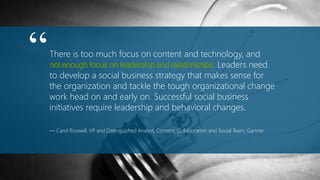
There is too much focus on content and technology, and
not enough focus on leadership and relationships. Leaders need
to develop a social business strategy that makes sense for
the organization and tackle the tough organizational change
work head on and early on. Successful social business
initiatives require leadership and behavioral changes.
โ€” Carol Rozwell, VP and Distinguished Analyst, Content, Collaboration and Social Team, Gartner
โ€œ
35
luck@c5insight.com 704.895.2500 www.c5insight.com
C5 Insight
9319 Robert D. Snyder Rd.
PORTAL Building, Suite 348
Charlotte, NC 28223
CONTACT US
/C5-Insight @C5Insight /C5Insight

The Human Factor: Debunking The Myth That Technology Drives Collaboration

  • 1.
    The Human Factor DebunkingThe Myth That Technology Drives Collaboration LISTEN KNOW UNDERSTAND CONNECT
  • 2.
  • 3.
  • 4.
    Agenda A Better WayTheHuman Factor 3 Common Myths
  • 5.
    The Impact ofPeople on Successful Collaboration THE HUMAN FACTOR
  • 6.
    66 Emotional Two Major Componentsof Human Collaboration Physical
  • 7.
    77 Emotional Two Major Componentsof Human Collaboration
  • 8.
    8 APA - EmployeeDistrust is Pervasive in U.S. Workforce 2 3 1 4 Failure To Collaborate Fear comes from many places, and is often at the root of poor collaboration. Fear In the end, everyone is out for themselves and the environment becomes competitive. Isolation Fear leads to distrust, which causes people to withdraw. Distrust Withdrawn people begin to hoard information, and do not share knowledge with others. Hoarding 25% The Root Causes of a Collaboration Collapse 8
  • 9.
    9 Gartner Research 9 Employees getas much as 75% of their relevant information directly from other people 75%
  • 10.
    10 How Many SoundLike Your Organization? ๏ฑ We work regularly with other departments ๏ฑ We trust colleagues completely ๏ฑ Failure is embraced and discussed ๏ฑ IT is an enabler and supports the business 4 3 2 1 0 4 3 2 1 0 Very High Average Very Low How Many Sound Like Your Organization? ๏ฑ Our best work is produced by individuals ๏ฑ There is competition for rewards, recognition, promotions, etc. ๏ฑ For someone to succeed someone else wonโ€™t succeed ๏ฑ Fingers are sometimes pointed when mistakes are made Collaboration Success Likelihood Are You Ready For Collaboration? 10
  • 11.
    1111 Two Major Componentsof Human Collaboration Physical
  • 12.
    12 Atlasssian INFORMATION OVERLOAD Emails Received Per Week MeetingsAttended Per Month Interruptions Per Day Email Checks Per Hour Internet Connected Devices Per Person 304 62 56 36 3 12
  • 13.
    13 Global Leadership Summit;Fast Company โ€“ Future of Work; STC Services; Ad Week โ€“ Social Media Addiction; A NEW WAY OF WORKING Telecommuting Growth Between 2005 and 2012, telecommuting grew by 79% 79% Remote Workers By 2020, as many as 50% of all workers could be remote 57% Mobile Phones Currently, 57% of the world population has a mobile phone 50% Social Media As of 2014, 2.03 billion people in world are active on social media28% 13
  • 14.
    14 Millennial Branding โ€“The Cost of Millennial Retention Study MULTIGENERATIONAL MOVEMENT 2014 2020 = 36% = 50% Millennials In The Workforce 14 3 Year tenure 33% Leave for money 5 Generations by 2020
  • 15.
    3 COMMON MYTHS ThreeMyths About Collaboration And Technology
  • 16.
    START WITH BEST OFBREED TECHNOLOGY
  • 17.
    Gartner โ€“ CarolRozwell http://blogs.gartner.com/carol_rozwell/2013/08/20/outputs-are-important-but-behaviors-are-better/ of social and collaboration business efforts will not A Focus On Technology 80% achieve the intended benefits due to inadequate leadership and an OVEREMPHASIS ON TECHNOLOGY
  • 18.
  • 20.
    KEEP TRYING IF ATFIRST YOU DONโ€™T SUCCEED
  • 21.
    Ideas For TappingInto The Human Factor A BETTER WAY
  • 22.
  • 23.
  • 24.
  • 25.
    26 Concentrate on Buildinga Collaborative Culture 4 Encourage and reward collaborative behaviors3 Be transparent - with everything 2 Build brainstorming into every project1 Get everyone on board 26
  • 26.
    27 Understand the CollaborationLifecycle 27 1Connections Bring people together in friction-free ways.
  • 27.
    28 Not All ConnectionsAre Created Equal Marketing IT HR Logistics Legal Finance 28 The Power of Weak Ties
  • 28.
    29 Understand the CollaborationLifecycle 29 Engagement Forming bonds awakens a desire to serve each other 1 Relationships Relationships become natural and organic Connections Bring people together in friction-free ways. 2 3
  • 29.
    30 Focus on EmployeeEngagement 30 The things that give us a sense of purpose, contribution and value as a professional Purpose Make it both about leadership and something that is attractive, interesting, and rewarding for those leaders to do Engagement The things that we are compensated and rewarded for investing in Leadership We tend to invest our efforts in two things:
  • 30.
    31 Understand the CollaborationLifecycle 31 Engagement Forming bonds awakens a desire to serve each other 1 Information flows easily and ideas begin to multiply Relationships Relationships become natural and organic Connections Bring people together in friction-free ways. 2 34 Innovation
  • 31.
    32 Have a Plan 32 2 What Whatproblem(s) are we trying to solve? 3 When When is this needed? 1 Who Who will this impact? 4 Where Where is our company going? 5 Why Why should our company invest in this? It all starts with a few simple questionsโ€ฆ
  • 32.
    Now youโ€™re readyto select the right tools.
  • 33.
    There is toomuch focus on content and technology, and not enough focus on leadership and relationships. Leaders need to develop a social business strategy that makes sense for the organization and tackle the tough organizational change work head on and early on. Successful social business initiatives require leadership and behavioral changes. โ€” Carol Rozwell, VP and Distinguished Analyst, Content, Collaboration and Social Team, Gartner โ€œ
  • 34.
    35 luck@c5insight.com 704.895.2500 www.c5insight.com C5Insight 9319 Robert D. Snyder Rd. PORTAL Building, Suite 348 Charlotte, NC 28223 CONTACT US /C5-Insight @C5Insight /C5Insight

Editor's Notes

  • #3ย 1 MINUTE
  • #4ย 1 MINUTE
  • #5ย 2 MINUTES GOAL: To paint a picture of how people - and not the technology you choose - are the secret sauce to successful collaboration. In fact, theyโ€™re actually more like the fuel in your carโ€ฆwithout it, you canโ€™t go anywhere. Technology is often contributing to our inability to collaborate effectively
  • #6ย 5 MINUTES TELL ELLIPTICAL STORY QUESTION: How many of you have talked to another employee today? QUESTION: How many of you have asked another employee about something work related โ€“ knowledge sharing? Since the first 2 humans worked together, we have been collaborating โ€“ so collaboration is nothing new to us. And you would think that weโ€™ve had a LOOOONG time to practice and get better at this, right? The truth is, somewhere along the way we stopped doing the things that had always worked - probably in our search for something new and shiny - that would get us there faster. In 2015, you see it all around us โ€“ this need for immediate gratification. A quick win, low hanging fruitโ€ฆ QUESTION: Who produces stuff in your organization? Animals, robots, computersโ€ฆno, people are still our producers โ€“ always have beenโ€ฆ And without people - and not just warm bodies in a chair - collaboration cannot take place. Everything else โ€“ no matter how new, shiny or great - is just a TOOL. So over the next few minutes, weโ€™re going to be talking about the original toolโ€ฆthe foundation of great collaborationโ€ฆUSโ€ฆyou and I. CLICK
  • #7ย 2 MINUTES Emotional Our thoughts and our feelings How something make us feel Our past and current experiences Our successes Our failures Our fears Physical The physical world around us The people around us Our organization Information The way we physically respond to these things CLICK
  • #8ย So first, letโ€™s take a look at the emotional side of collaboration CLICK
  • #9ย 3 MINUTES Iโ€™m going to save you the time of many years of experience and digging to understand what is almost always at the root of collaboration breakdownsโ€ฆ.FEAR And fear means different things, but when we peel back the layers of collaboration we find that individual fears are often the beginning of a process that not only affect the individual but infect the organization as well. Fears such as fear of failure, fear of making mistakes, fear of not getting credit, fear of being firedโ€ฆ As we take a look at the process we can see that FEAR ๏ƒ  DISTRUST (by the way, 25% of you donโ€™t trust your employer or boss) ๏ƒ  HOARDING (anti-collaboration) ๏ƒ  COMPETITION (Iโ€™m out for me and me alone) Slows everything down in an organization โ€“ innovation, etc. CLICK And as Iโ€™ve already mentioned, this leads to a complete failure to collaborate within an organization. We call this baggage. People have baggage, organizations are made up of people, therefore organizations have baggage too. QUESTION: Do you know how much baggage your organization has? Just a note on this โ€“ technology was not mentioned and has nothing to do with the problem OR solution hereโ€ฆ Still donโ€™t believe me or think your organization is immune? CLICK http://www.apa.org/news/press/releases/2014/04/employee-distrust.aspx
  • #10ย 1 MINUTE GARTER So if this is the case, then doesnโ€™t it make sense that we slow down, even stop, and spend a little bit of time better understanding how our organization is doing with this? I mean, you get a checkup annually, why not give your culture a checkup CLICK
  • #11ย 2 MINUTES โ€ฆAnd thatโ€™s just what you are looking at โ€“ a 60-second culture self-assessment or checkup Hereโ€™s how it works: In the first section, check how many sound like your org? In the second section, check how many sound like your org? Draw a line between the 2 numbers This is a quick and dirty assessment of how likely your org is to succeed at collaboration Again โ€“ not a mention of toolsโ€ฆsee a trend here?
  • #12ย Now letโ€™s take a minute to talk about some of the physical things round us that are affecting how we collaborate CLICK
  • #13ย 3 MINUTES QUESTION: How many of you would say, this looks like me? Heck, with this much going on, it sure seems like weโ€™re collaboratingโ€ฆbut this is not collaboratingโ€ฆthis is chaos. Today, we are INUNDATED with informationโ€ฆand the truth is, this isnโ€™t going to get any better. CLICK Now some of you might say, โ€œWait a minute, isnโ€™t this talking about technology?โ€ Itโ€™s an interesting question because tech can contributing to and relieve this problem. But truly understanding how people are responding to this information overload - and how it is actually changing us as human - is where most organizations say, huh? In fact, did you know that humans now have a shorter attention span than a goldfish? Donโ€™t believe me - look it up! Our attention span has dropped 25% in the last decade, due primarily to the nature of how we receive and contribute to this information. Frankly, Iโ€™m surprised anyone is still listening to me on this webinar! CLICK http://www.scmagazine.com/2013-mobile-device-survey/slideshow/1222/#1 http://www.informationweek.com/it-life/microsoft-says-short-attention-spans-are-fine/a/d-id/1320433 12 seconds in 2000 to 8 seconds now โ€“ 1 second less than that of a goldfish! Better at multi-tasking
  • #14ย 2 MINUTES Just as information and our reaction to it evolving, so are our teams today These arenโ€™t the organizations or teams of yesteryear (or even yesterday) They are often short-lived Very much project-based Weโ€™re seeing teams become very fluid โ€“ no longer is it 1 department or 1 group of people working on a project Weโ€™re also not coming into the office as much In fact, Global Leadership Summit in London found that nearly 50% of the workforce will be remote by 2020 This is a new age of working โ€“ Weโ€™re a part of a new generation of collaborationโ€ฆ Speaking of generationโ€ฆ CLICK http://www.fastcompany.com/3034286/the-future-of-work/will-half-of-people-be-working-remotely-by-2020 http://www.stcservices.com/blog/unified-communications/remote-workers-to-be-50-of-workforce-by-2020-is-virtual-becoming-reality/ http://www.adweek.com/socialtimes/social-media-addiction-stats/504131
  • #15ย 2 MINUTES The last thing I want to talk about in terms of physical collaboration is probably one of the largest changes in our organizations โ€“ the PEOPLE themselves. Millennials in the workforce is on the rise, and by 2020 (I think before this), they will be the majority in our organizations? Donโ€™t think this mattersโ€ฆ? Did you guys know that only 1/3 of Millennials leave for more money? And when they do choose to leave, itโ€™s only after about 3 years? And that if these 2 things werenโ€™t enough, about the time that millennials make up the majority of our workforce, weโ€™ll have yet ANOTHER generation entering the workforce โ€“ and these employees literally grew-up knowing only about the Internet, social media, etc. How will these generations work together? Think technology will automatically make a 65 year old work seamlessly with a 22 year old? Think again. Generational changes are some of the most frequent conversations weโ€™re having today with our clients CLICK
  • #16ย 1 MINUTE So now that we understand a little more about us humans and how weโ€™re impacting collaboration, letโ€™s talk about 3 myths that we see prevalent in todayโ€™s organization. CLICK
  • #17ย 2 MINUTES Now many of you may be saying, wait a minuteโ€ฆI thought best of breed was the way to go? Let me explainโ€ฆ This one goes back to something I said earlier โ€“ weโ€™re all looking for quick fixes and quick wins. We hear it all the time, especially with the amazing tools and platforms that are out there today โ€œLetโ€™s pick a great, new technology and surely weโ€™ll collaborate better.โ€ This one is not about the technology โ€“ yes, select best of breed technology โ€“ but donโ€™t START with the technology. Iโ€™ll talk more about this later. We often say that this approach is like paving potholes - itโ€™ll may work for a while, but youโ€™re not addressing the root problem. Do you want to spend time paving potholes only to fix them later, or do you want to build a superhighway? Donโ€™t take my word for itโ€ฆ CLICK
  • #18ย 1 MINUTE http://blogs.gartner.com/carol_rozwell/2013/08/20/outputs-are-important-but-behaviors-are-better/ http://www.mycustomer.com/topic/social-crm/gartner-80-social-business-efforts-will-not-succeed-through-2015/161754 http://www.gartner.com/newsroom/id/2319215 More detailed analysis is available in the report "Predicts 2013: Social and Collaboration Go Deeper and Wider." The report is available on Gartner's website at http://www.gartner.com/resId=2254316.ย  However, whilst adoption is set to escalate, Gartner estimates that through 2015, 80% of social business efforts will not achieve the intended benefits due to inadequate leadership and an overemphasis on technology. Carol Rozwell, VP and distinguished analyst at Gartner, explained: โ€œBusinesses need to realize that social initiatives are different from previous technology deployments. Traditional technology rollouts, such as ERP or CRM, followed a โ€˜pushโ€™ paradigm. Rozwell added: โ€œThere is too much focus on content and technology, and not enough focus on leadership and relationships. Leaders need to develop a social business strategy that makes sense for the organization and tackle the tough organizational change work head on and early on. Successful social business initiatives require leadership and behavioral changes. Just sponsoring a social project is not enough โ€” managers need to demonstrate their commitment to a more open, transparent work style by their actions.โ€
  • #19ย 2 MINUTES This one will probably come at a shock to you, but technology will always give you an ROI of exactly $0 Wait, what? Let me explainโ€ฆ ROI on collaboration initiatives never comes from the technology โ€“ it comes from the USE of that technology. Want to know the quickest way to get fired? Spend a lot of time and money on a big initiative and no one uses it. The truth is, organizations need start spending more time understanding how to get people to use these tools and work together, than they do on the toolsโ€ฆIโ€™ll talk more about this later. Warren Buffett puts it nicelyโ€ฆ CLICK
  • #20ย Youโ€™re paying a lot for that shiny new technology โ€“ great โ€“ but what are you getting?
  • #21ย 2 MINUTES I know I knowโ€ฆ.this is what our parents always told usโ€ฆ โ€œIf at first you donโ€™t succeed, try, try again.โ€ But hereโ€™s the catch โ€“ no one ever told us (much less taught us) to spend time understanding why we didnโ€™t succeed and that when we try again, maybe we need to try a different approach. Sure, we kinda figured it outโ€ฆever seen a child learn to walk. Stand fall โ€“ stand step fall โ€“ stand step step fall โ€“ stand step step step stepโ€ฆ We see many organizations that donโ€™t embrace failure โ€“ they think failure is something to be avoided, and sure, no one comes into work each day hoping to fail, but we sure as heck ought to learn from it, donโ€™t you think? Put into practical terms, when you struggle (or fail) with something in your organization, even if it is on another project, learn from it, understand what went wrong, and donโ€™t keep repeating the same mistakes. A few years ago I met my future mother-in-law for the first time. She was preparing a roast dinner. As she readied the lamb to go into the oven, I watched her cut off the shank and throw it in the bin. She then placed the tray in the oven. I was bewildered. I asked why she did it and the reply was โ€œwe always do that.โ€ I didnโ€™t say anything else as I didnโ€™t want to make a scene, especially as this was the first time I had met her. A year or so later, my new wife was preparing a lamb roast. Just as her mother had done previously, my wife removed the shank and disposed of it. Unable to contain myself, I asked why she had done that. โ€œWeโ€™ve always done thatโ€ she replied. โ€œBut why?โ€ I asked. โ€œI donโ€™t know. Thatโ€™s what our family have always doneโ€ was her answer. Whenever we would have a lamb roast the same thing would happen. Years later we were visiting my wifeโ€™s grandmother in her home where she had lived for nearly 50 years. She was preparing a lamb roast. I watched her remove the shank and throw it in the bin before placing the tray in the oven. Unable to contain myself I said โ€œforgive me, I donโ€™t mean to be rude, but can you tell me why you did that?โ€ โ€œOf course I canโ€œ she said. โ€œThis old house has only got a tiny oven and I canโ€™t fit the entire roast in with the shank still attached.โ€ When I see my 3 year old putting a puzzle piece in the wrong place, I donโ€™t tell him, โ€œKeep tryingโ€ฆitโ€™ll eventually fit.โ€ Thatโ€™s ludicrous! You do know thatโ€™s the definition of insanity, right? CLICK
  • #22ย 2 MINUTES One thing we have found to be certain is that focusing on technology always leads to disappointments. Garage analogy This includes being โ€œownedโ€ by IT (or the business) โ€“ it should be a collaboration between them. Focus on connecting people, bringing people together As you approach the 2nd and 3rd times, people really begin to lose faith/trust in the next solution and become more resistant Failure not only costs money, it costs satisfaction (which lowers productivity), and ultimately could cost jobs Avoid the Silver Bullet Technology is a wonderful thing, but itโ€™s not the only thing One size never fits all Understand what it is you are building and for whom
  • #23ย 1 MINUTE Ok, so letโ€™s have some good news Letโ€™s close todayโ€™s discussion talking about how we can tap-into the power of our people and make these initiatives more successful Iโ€™m going to share 3 DOs and 3 DONโ€™Ts with you CLICK
  • #24ย 2 MINUTES Let me ask you a question โ€“ when is the last time you went to your garage, grabbed a saw or hammer, and THEN went looking for ways to use it? Tech is great, but itโ€™s only a tool and without people using the tool, the initiative will fail. Iโ€™ve never woken up on a Saturday morning, only to find that the hammer had completed nearly half of my to-do list while I slept. Silver Bullet Syndrome So donโ€™t start with a focus on tools. Start with a focus on connecting people and finding ways to help people work together better CLICK
  • #25ย 2 MINUTES It should be obvious now โ€“ donโ€™t forget about your people If you donโ€™t hear anything else I say today, please hear this โ€“ Focus on value vs ROI โ€“ ROI comes from use, not implementation. People support and use what they help create CLICK
  • #26ย 2 MINUTES Last but certainly not least, we often see organizations get to the end of a very long collaboration project and then say, โ€œWhew, weโ€™re finally finished. On to the next project.โ€ This is a sure-fire way to be on a fast-track for collaboration failure. Remember how fast our people and organizations are changing? That isnโ€™t slowing down. In 2 years, 5 years, things will be different, and then what? House project analogy/question Make sure you have a process for continuous evolution and innovation. Keep going back to the drawing board. Keep getting feedback from your users, keep doing checkups, always understand what your culture of collaboration is โ€“ it can change and you not even know it. So now letโ€™s focus on 3 things you should always DO CLICK
  • #27ย 2 MINUTES Technology and tools will not change your culture. Period. These are the processes, rules and frameworks for HOW and WHY your people should work together This is the foundation โ€“ youโ€™d never build a house without first focusing on the foundation. After doing the self-assessment we saw earlier, here are 4 ways to focus on building a culture of collaboration CLICK
  • #28ย 2 MINUTES I want to take a few minutes to talk about what Iโ€™m calling the collaboration lifecycle. We talked earlier about the emotional process that causes collaboration to break-down, now letโ€™s talk about how collaboration takes shape in our organizations. Understanding this lifecycle is critical to ensuring a successful project. First, "Collaboration always requires connection" Period. It's a prerequisite to collaborating Give people a reason to work together Build bridges Knock down silos Build communities Get people talking Once you bring people together, connections are formed, but are all connections created equal? CLICK
  • #29ย 2 MINUTES The truth is, theyโ€™re not. Mark Granovetter (sociologist) in 1973 โ€“ published paper Strong Ties Your close friends, family, and in an organization, the people that sit next to you, in your dept that you work with daily, etc. They take a lot of effort to maintain Our strong ties move in the same circles that we do ๏ƒ  The information they receive overlaps with what we already know Weak Ties Acquaintances They most often know people we do not know, and allow us to receive more unknown information โ€“ new information If you have an acquaintance in the marketing department, then you have a weak tie to that person, and more importantly a weak tie to her entire network, and the network of her strong ties. Weak ties = BRIDGES to other networks โ€“ they help you cross the gap of knowledge that may exist Once you cross this gap, you have the ability to generate new ideas, opportunities, cost-cutting strategies, etc. Think LinkedIn, Twitter, Facebook. So yes, some of your connections to other people and groups are better than others and will generate more innovation value than others CLICK
  • #30ย 1 MINUTE As we continue too look at collaboration lifecycle, we see than once we form connections, we begin to form and strengthen relationships, which in turn leads to more engagement. We humans, want to serve others and we actually do want to work with other people. Itโ€™s how weโ€™re wired. Engagement is hot topic today, so letโ€™s look at this for a minute. Iโ€™ve got a pretty basic formula I want to share with you on how employee engagement works. CLICK
  • #31ย 2 MINUTES My guess is, you donโ€™t look forward to work because youโ€™ll get to use your fancy laptop or that awesome printer down the hall. Hopefully you come into work every day, because you want to work with and enjoy working with other people in your company. You get fulfillment and satisfaction from this. Hopefully you also have a sense of purpose and achievement from your work. The truth is, at work, all of us ultimately put effort into 2 areas: Leadership Purpose CLICK If any one of these is missing, then you will never see the levels of employee engagement that are needed for innovative collaboration and people working together in ways you never dreamed of. Remember, collaboration follows this path: Connections๏ƒ Relationships๏ƒ Engagement, so if engagement is broken, the collaboration cycle is broken and we donโ€™t get to the final stage, which is โ€ฆ CLICK
  • #32ย 2 MINUTES โ€ฆInnovation. This is what weโ€™re all after โ€“ call it something else if youโ€™d like. The culmination of all of this hard work to bring people together, form relationships, and achieve engagement, ultimately bears the fruit of innovation and ideas Or put another way: new products, better customer service, more efficient processes, more customers This is the collaboration nirvana that every organization wants, but as you can see, technology is nowhere to be found in this lifecycle. It can help โ€“ as a tool โ€“ but itโ€™s not the core driver for this. CLICK
  • #33ย 2 MINUTES The last thing I want you to do is to have a plan In fact, Steven Covey once said that we should stop setting goals if weโ€™re not going to have a plan to achieve them. A plan is the roadmap โ€“what getโ€™s you there. This is where we spend a lot of time of with our clients these days, because the ones that want to be successful understand that all of this is great stuff, but it means nothing if you donโ€™t have an actionable plan to achieve it. So, to oversimplify, but give you something to chew on, start by asking some basiuc questions. And if youโ€™re being honest, some of you may admit (not out loud) that you have never asked these questions. Donโ€™t worry - YOUโ€™RE NOT ALONE. CLICK
  • #34ย 1 MINUTE Ok, now that you knowโ€ฆ How people impact collaboration The myths that you hear, but are simply not true And a few dos and donโ€™ts, now, and only nowโ€ฆ CLICK โ€ฆAre you ready to select the right tools for the job.
  • #35ย 1 MINUTE If youโ€™re still scratching youโ€™re head and not sure if all of this really makes a difference, donโ€™t take it from meโ€ฆ Carol Rozwell of Gartner has this great quote from a study they did in the last couple of years regarding collaboration and technology projects.