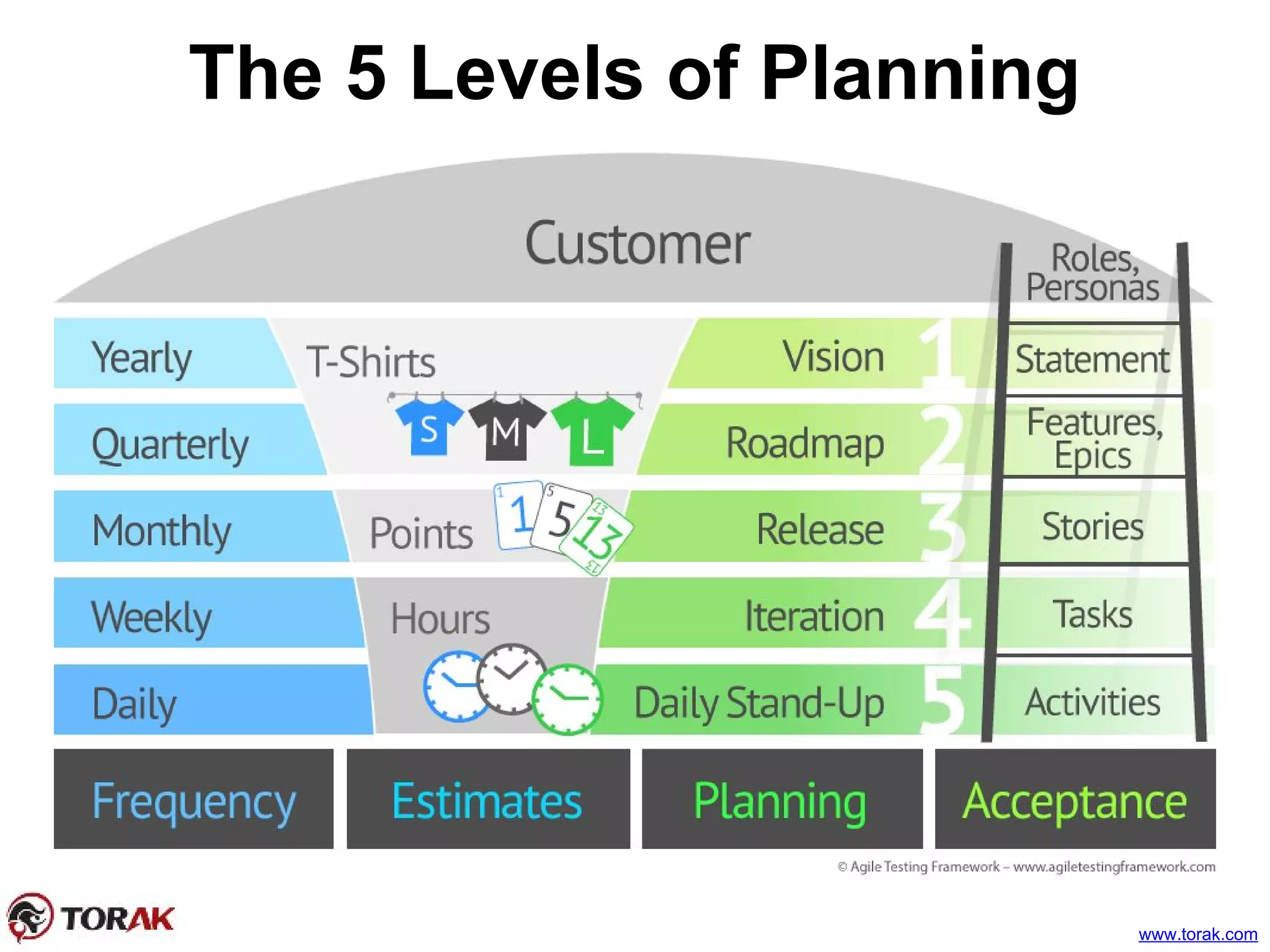
The 5 Levels of Planning
www.torak.com
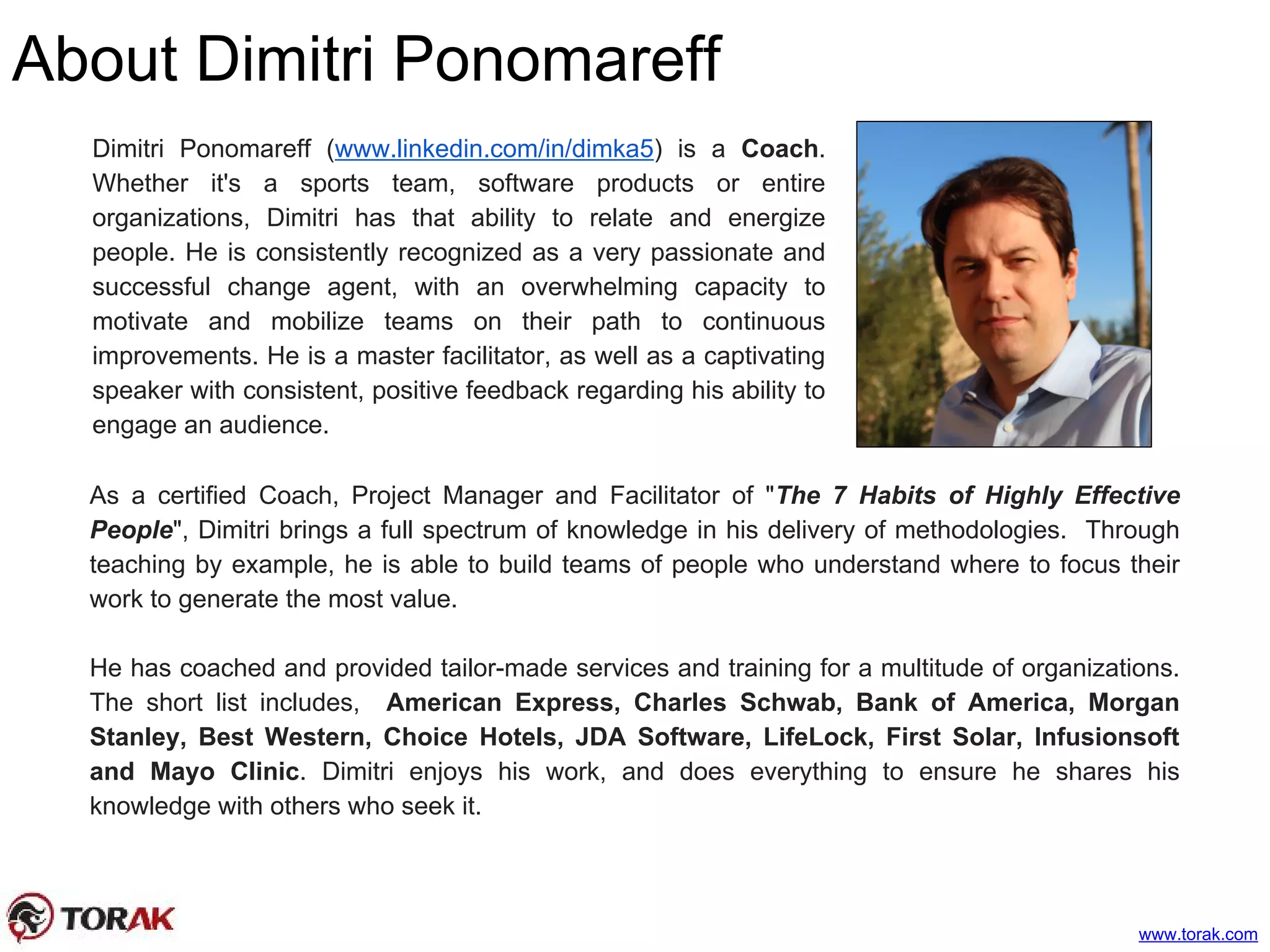
About Dimitri Ponomareff
www.torak.com
Dimitri Ponomareff (www.linkedin.com/in/dimka5) is a Coach.
Whether it's a sports team, software products or entire
organizations, Dimitri has that ability to relate and energize
people. He is consistently recognized as a very passionate and
successful change agent, with an overwhelming capacity to
motivate and mobilize teams on their path to continuous
improvements. He is a master facilitator, as well as a captivating
speaker with consistent, positive feedback regarding his ability to
engage an audience.
As a certified Coach, Project Manager and Facilitator of "The 7 Habits of Highly Effective
People", Dimitri brings a full spectrum of knowledge in his delivery of methodologies. Through
teaching by example, he is able to build teams of people who understand where to focus their
work to generate the most value.
He has coached and provided tailor-made services and training for a multitude of organizations.
The short list includes, American Express, Charles Schwab, Bank of America, Morgan
Stanley, Best Western, Choice Hotels, JDA Software, LifeLock, First Solar, Infusionsoft
and Mayo Clinic. Dimitri enjoys his work, and does everything to ensure he shares his
knowledge with others who seek it.
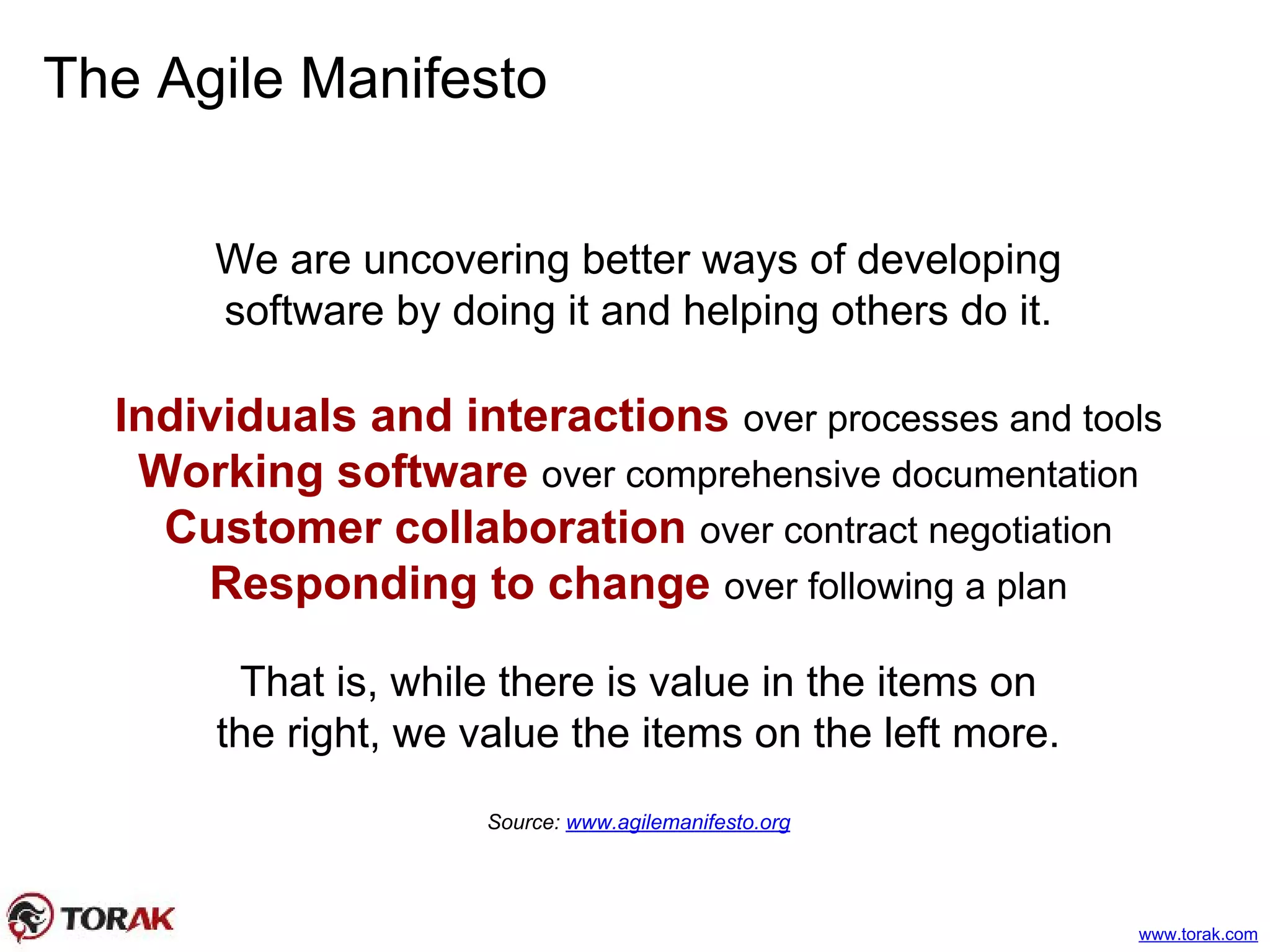
The Agile Manifesto
We are uncovering better ways of developing
software by doing it and helping others do it.
Individuals and interactions over processes and tools
Working software over comprehensive documentation
Customer collaboration over contract negotiation
Responding to change over following a plan
That is, while there is value in the items on
the right, we value the items on the left more.
Source: www.agilemanifesto.org
www.torak.com
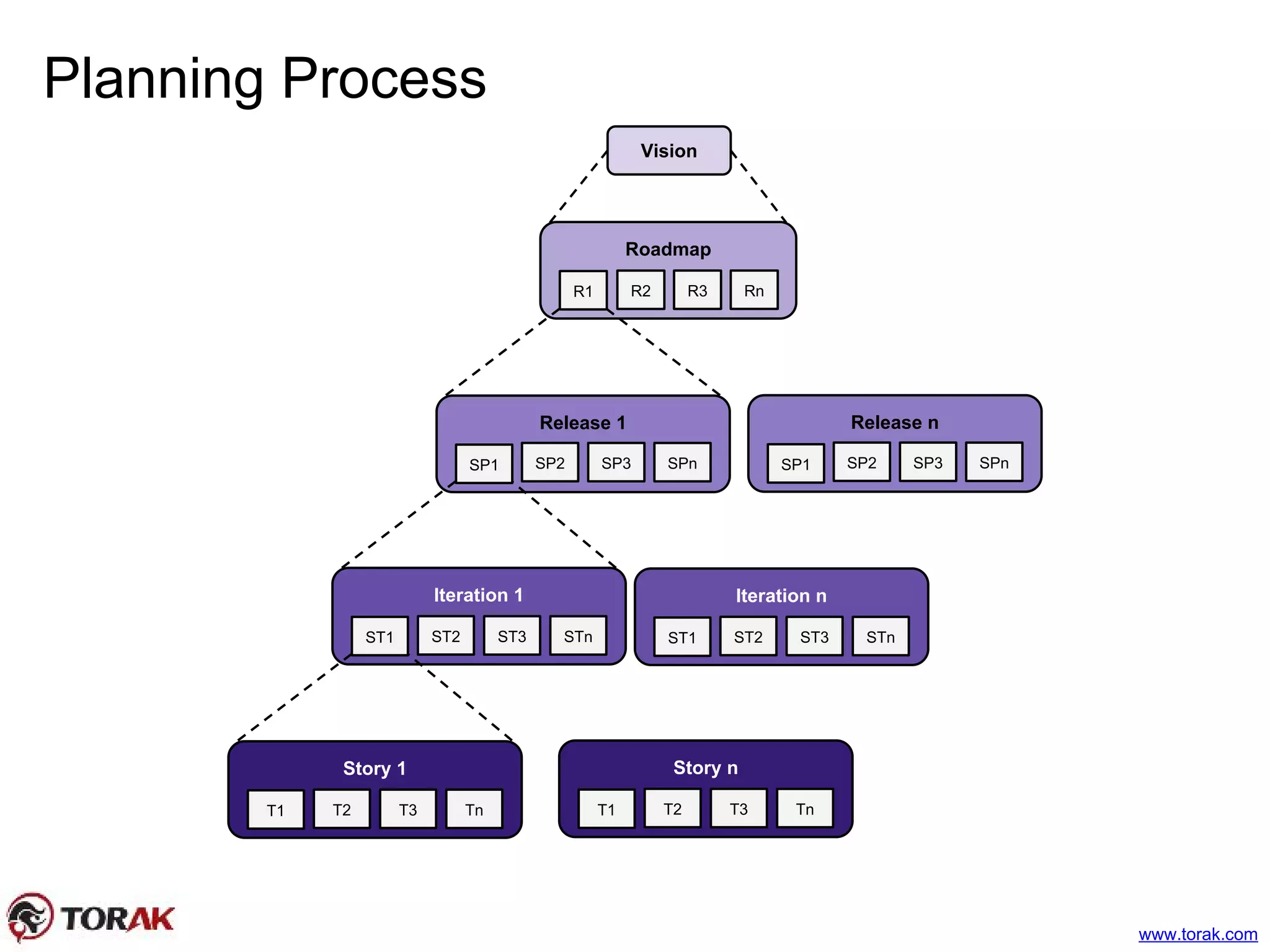
Planning Process
Vision
Roadmap
R1 R2 R3 Rn
Release 1
SP1
Iteration 1
ST1 STnST3ST2
Iteration n
ST1 STnST3ST2
Story 1
T1 TnT3T2
Story n
T1 TnT3T2
SPnSP3SP2
Release n
SP1 SPnSP3SP2
www.torak.com
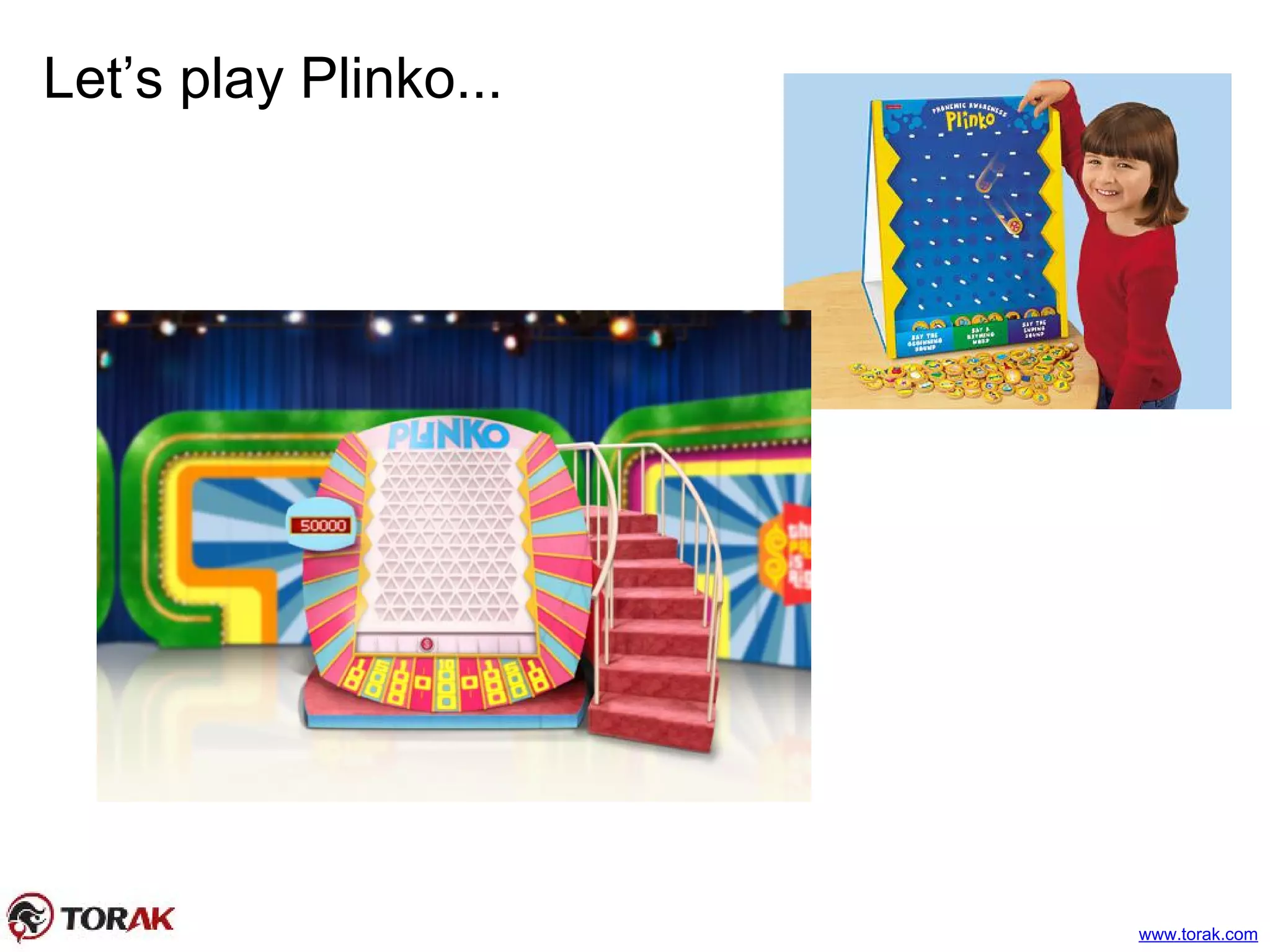
Let’s play Plinko...
www.torak.com
L1 - Vision
●Communication
●Elevator Pitch
●Voices of Why, What and How
●PDCA
www.torak.com
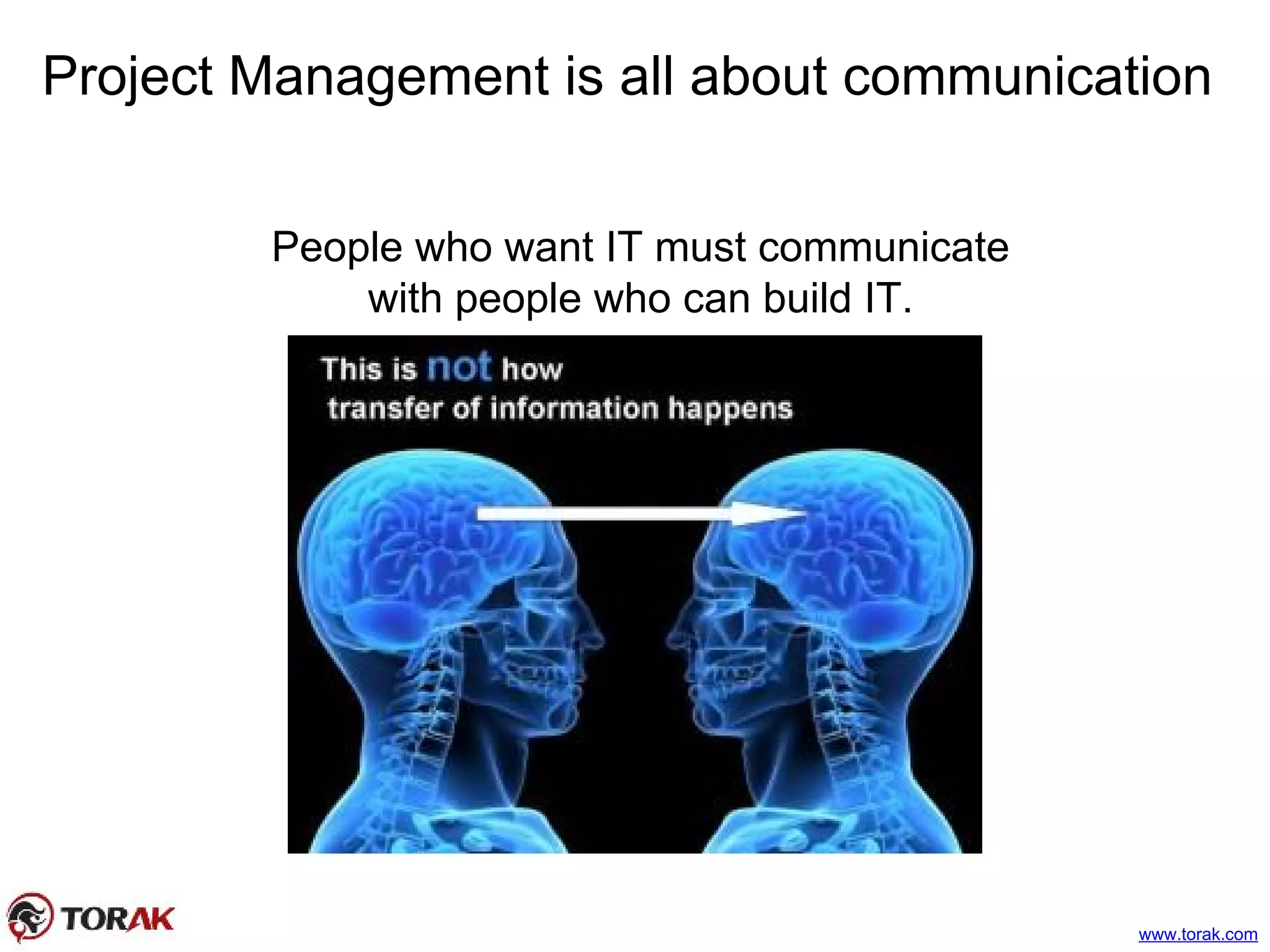
Project Management is all about communication
People who want IT must communicate
with people who can build IT.
www.torak.com
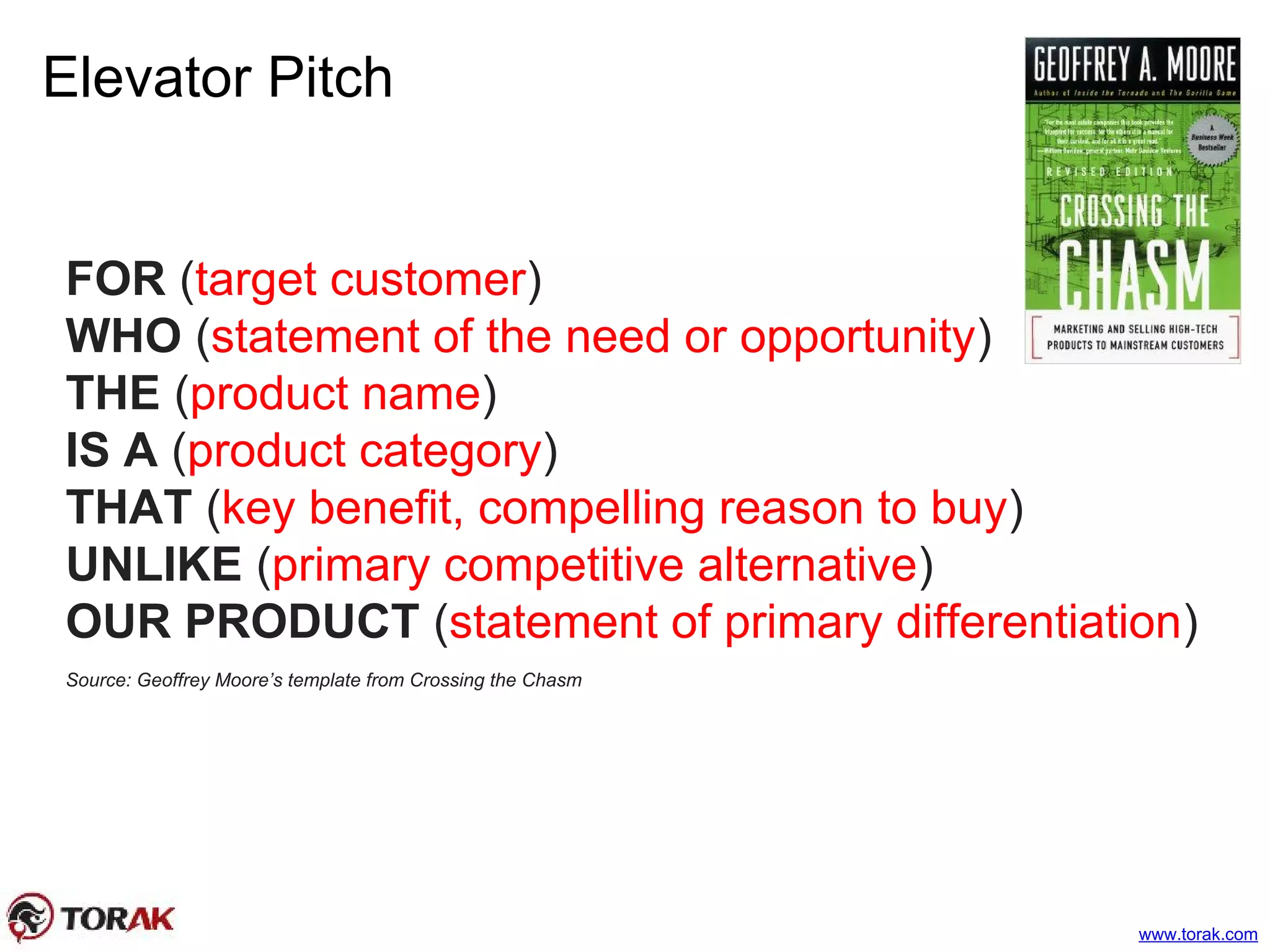
Elevator Pitch
FOR (target customer)
WHO (statement of the need or opportunity)
THE (product name)
IS A (product category)
THAT (key benefit, compelling reason to buy)
UNLIKE (primary competitive alternative)
OUR PRODUCT (statement of primary differentiation)
Source: Geoffrey Moore’s template from Crossing the Chasm
www.torak.com
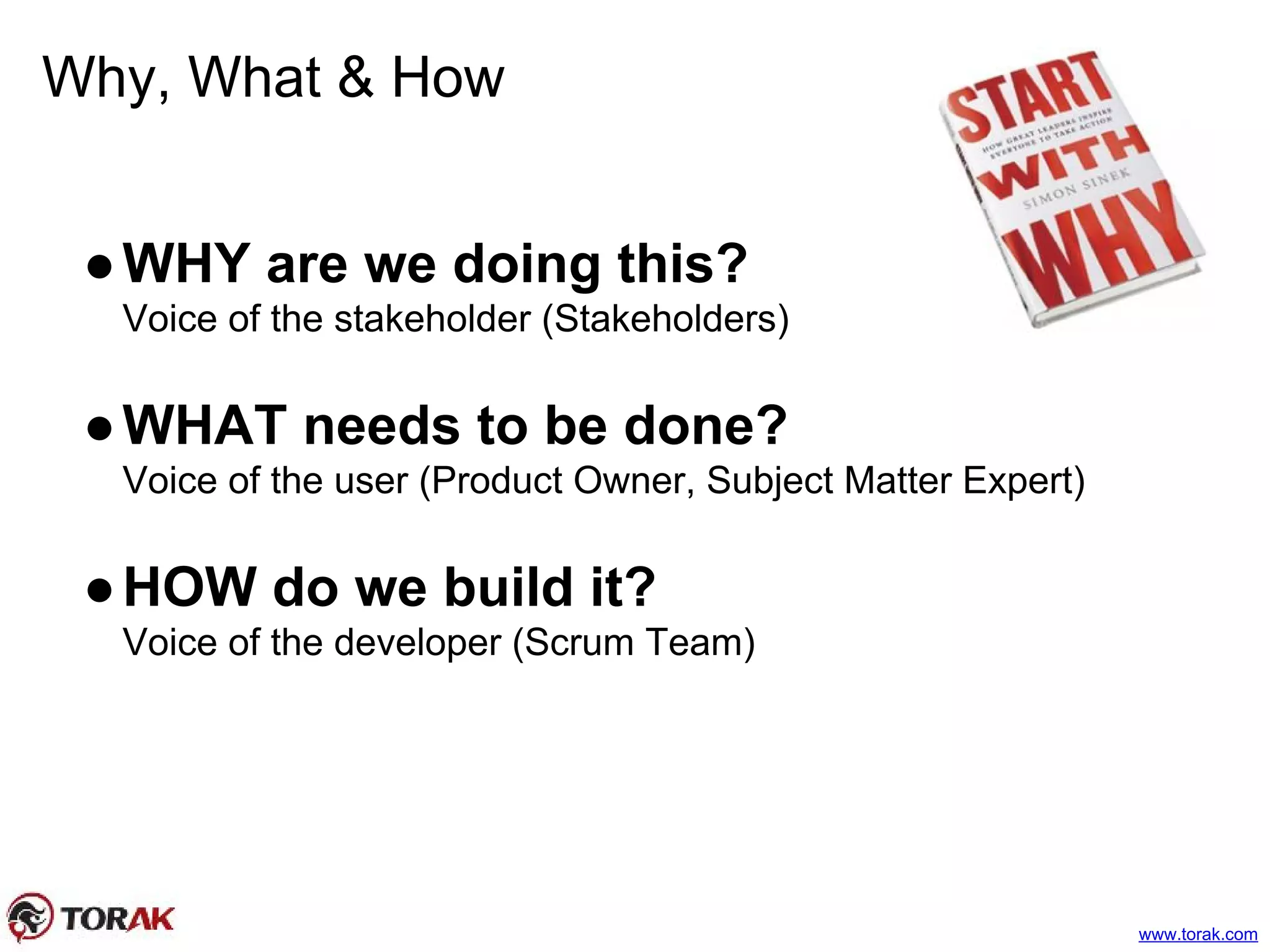
Why, What & How
●WHY are we doing this?
Voice of the stakeholder (Stakeholders)
●WHAT needs to be done?
Voice of the user (Product Owner, Subject Matter Expert)
●HOW do we build it?
Voice of the developer (Scrum Team)
www.torak.com
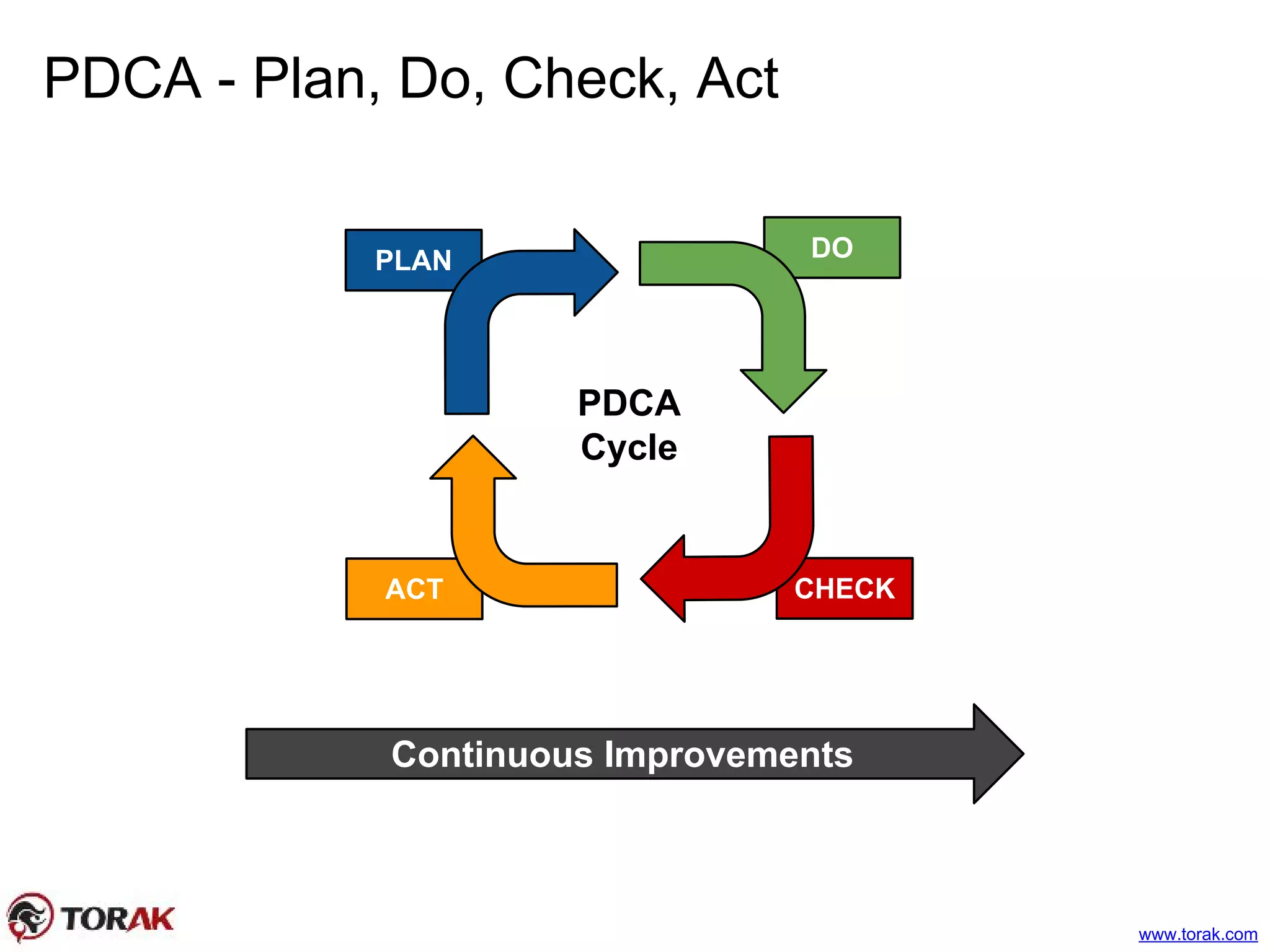
PDCA - Plan, Do, Check, Act
ACT
PLAN DO
PDCA
Cycle
CHECK
Continuous Improvements
www.torak.com
L2 - Roadmap
●What is a Roadmap
●External Facing Roadmap
www.torak.com
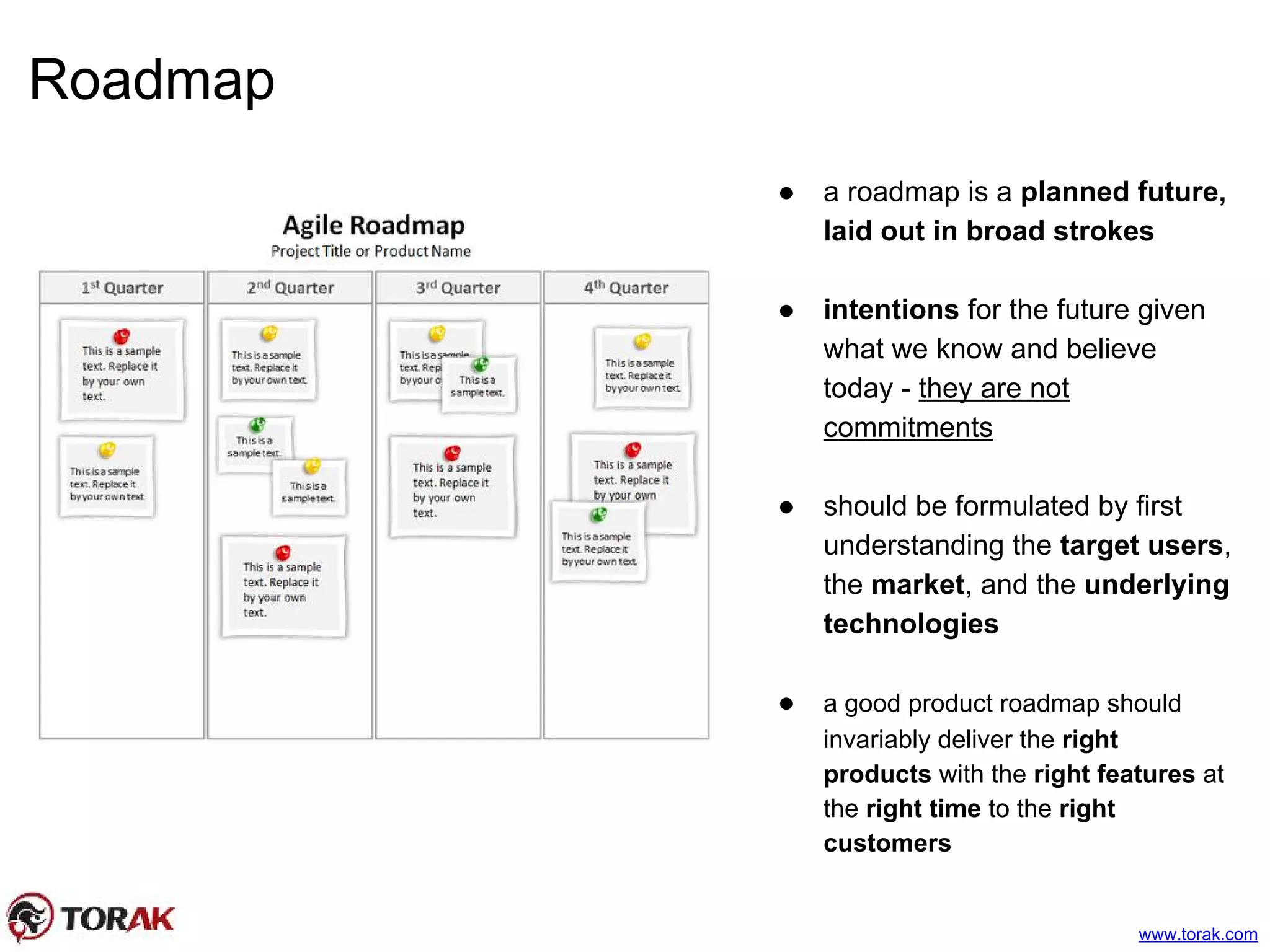
Roadmap
www.torak.com
● a roadmap is a planned future,
laid out in broad strokes
● intentions for the future given
what we know and believe
today - they are not
commitments
● should be formulated by first
understanding the target users,
the market, and the underlying
technologies
● a good product roadmap should
invariably deliver the right
products with the right features at
the right time to the right
customers
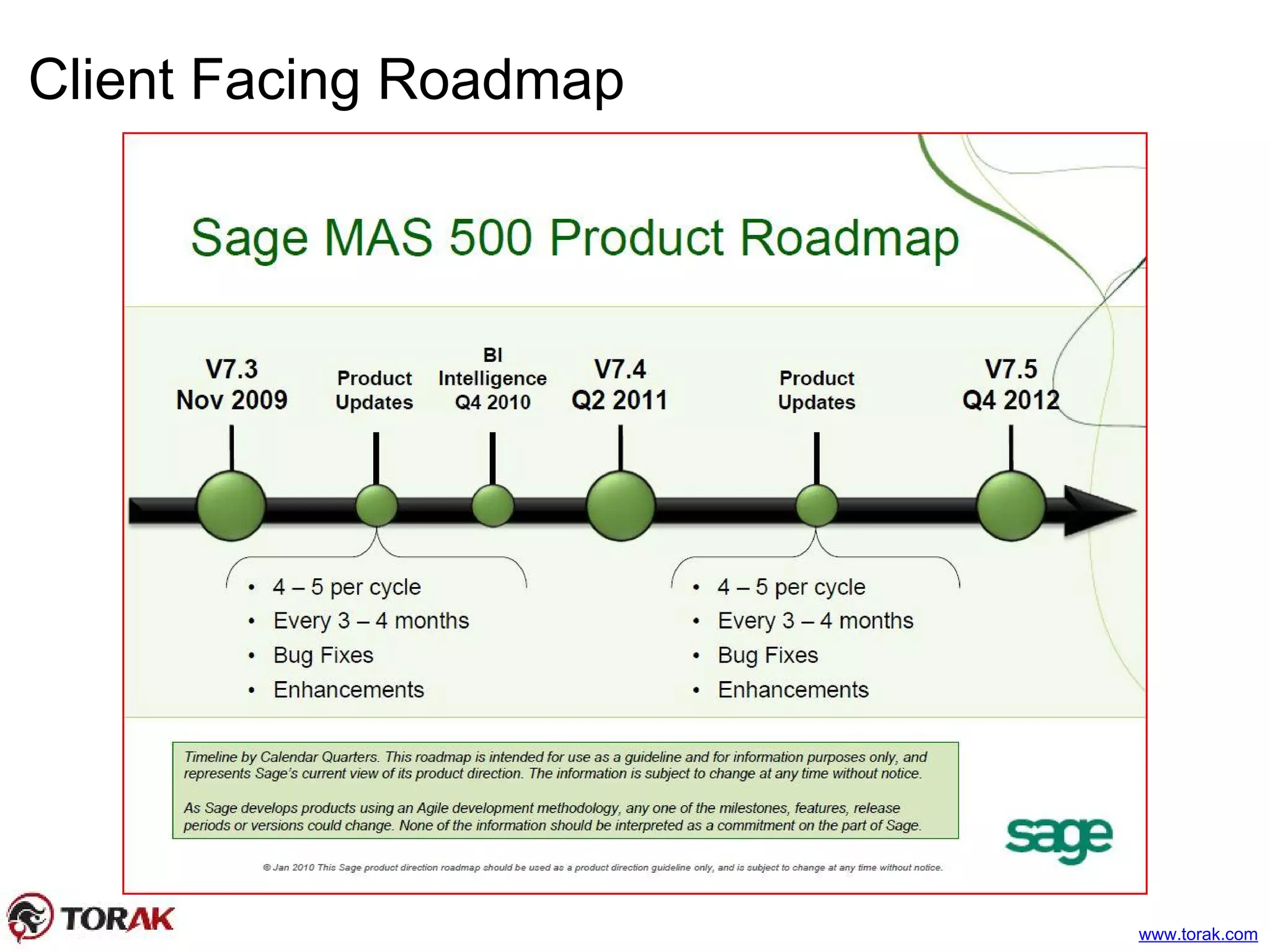
Client Facing Roadmap
www.torak.com
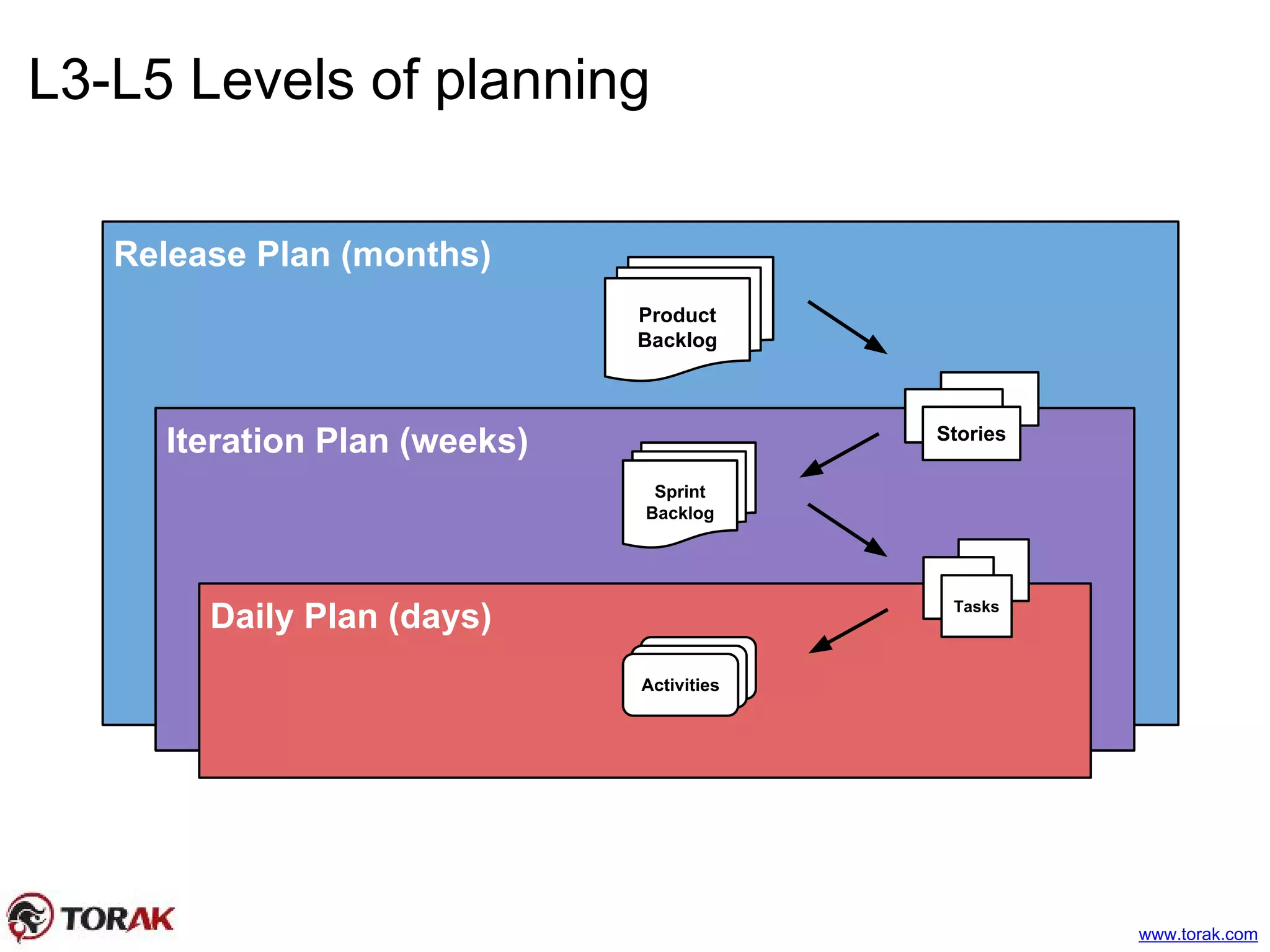
L3-L5 Levels of planning
Release Plan (months)
Iteration Plan (weeks)
Daily Plan (days)
Product
Backlog
Sprint
Backlog
Stories
Tasks
ActivitiesActivitiesActivities
www.torak.com
L3 - Release Planning
●Product, Epics & Stories
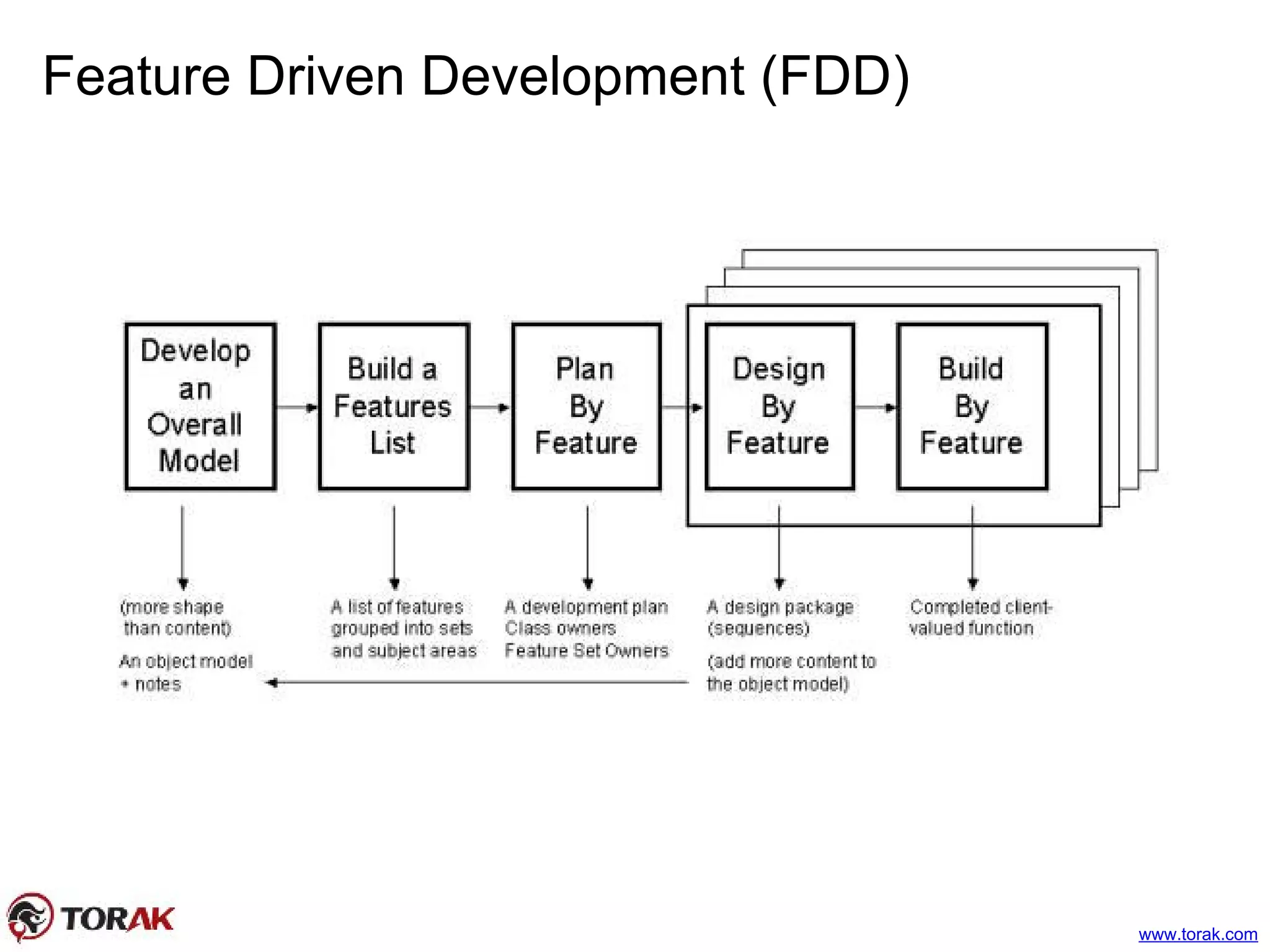
●Feature Driven Development (FDD)
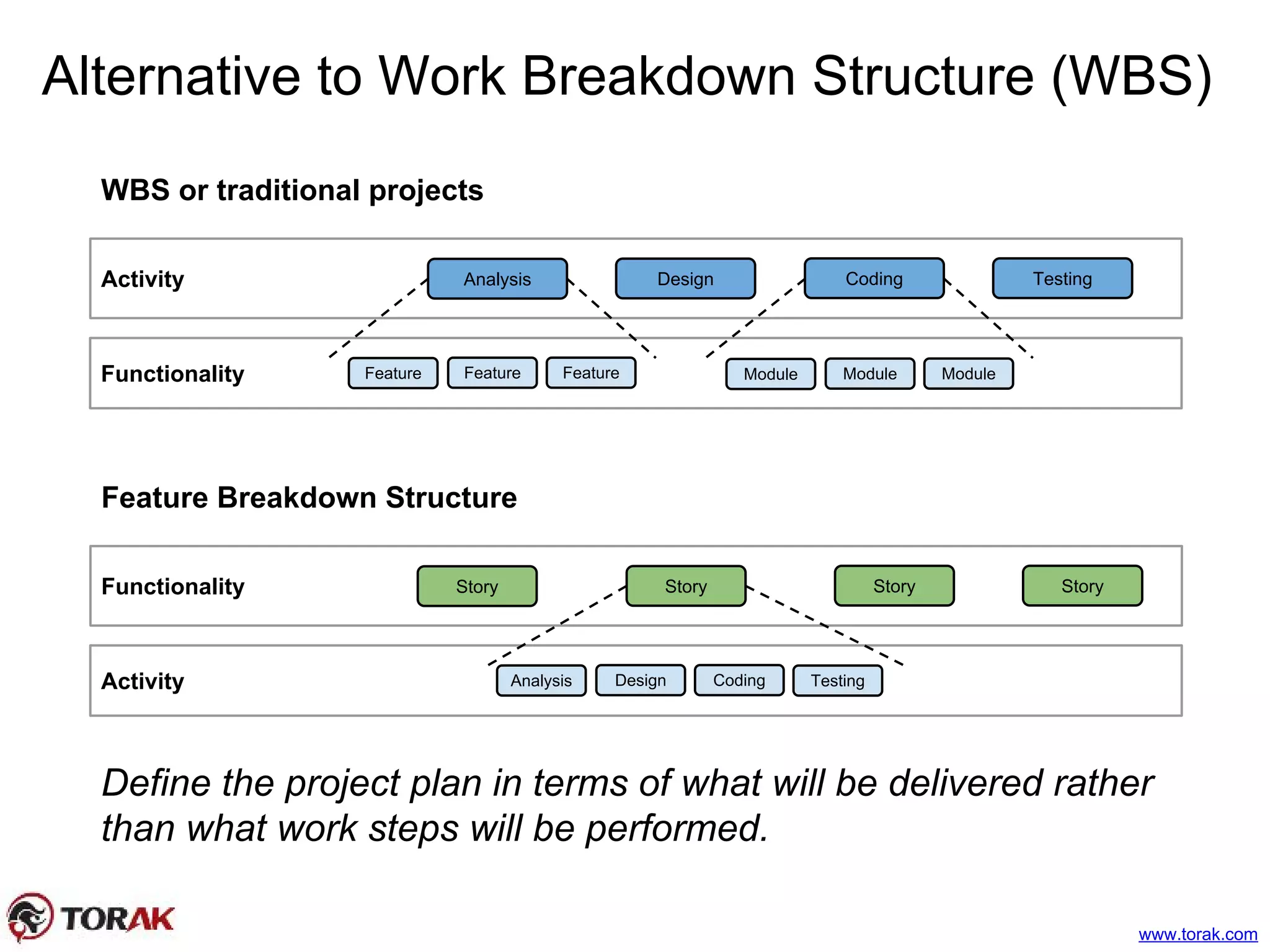
●Feature Breakdown Structure (FBS)
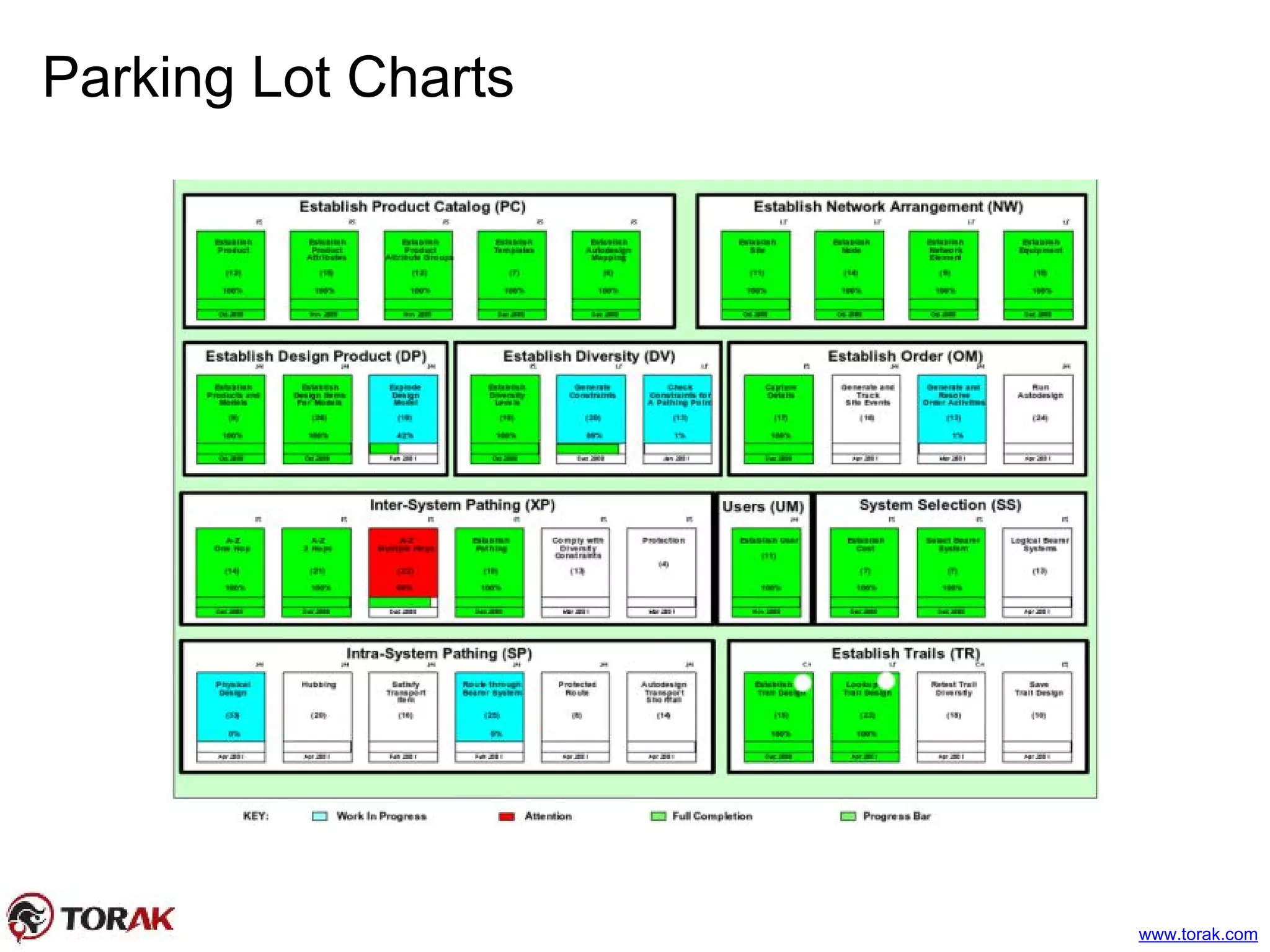
●Parking Lot Charts
●Stories and Acceptance Criteria
●Estimation
●Release Burndown
www.torak.com
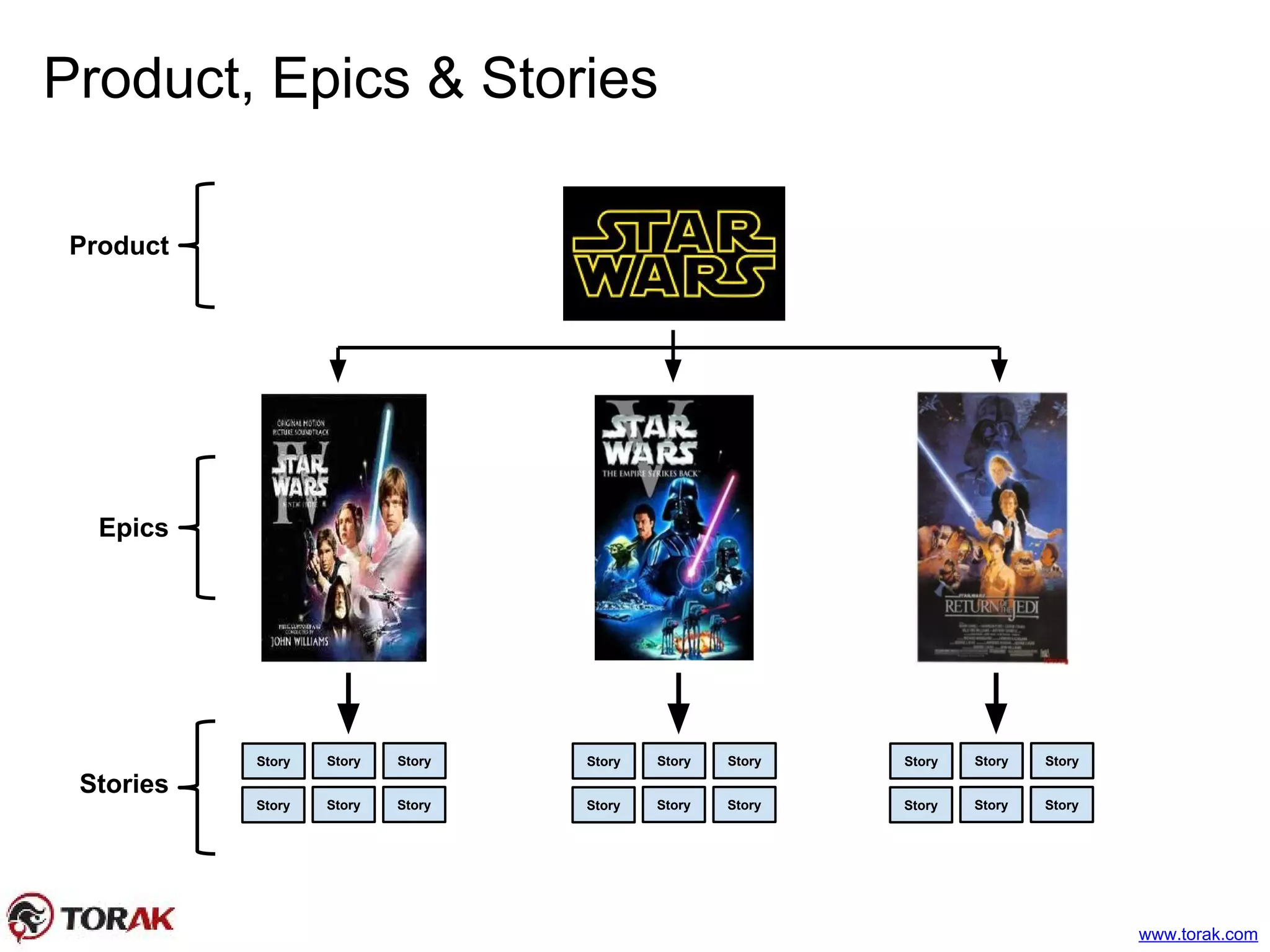
Product, Epics & Stories
Story Story Story
Story Story Story
Story Story Story
Story Story Story
Story Story Story
Story Story Story
Product
Epics
Stories
www.torak.com
Feature Driven Development (FDD)
www.torak.com
Alternative to Work Breakdown Structure (WBS)
Activity
Functionality
Analysis Design Coding Testing
Feature Feature Feature Module Module Module
WBS or traditional projects
Functionality
Activity
Story Story Story Story
Analysis Design Coding
Feature Breakdown Structure
Testing
Define the project plan in terms of what will be delivered rather
than what work steps will be performed.
www.torak.com
Parking Lot Charts
www.torak.com
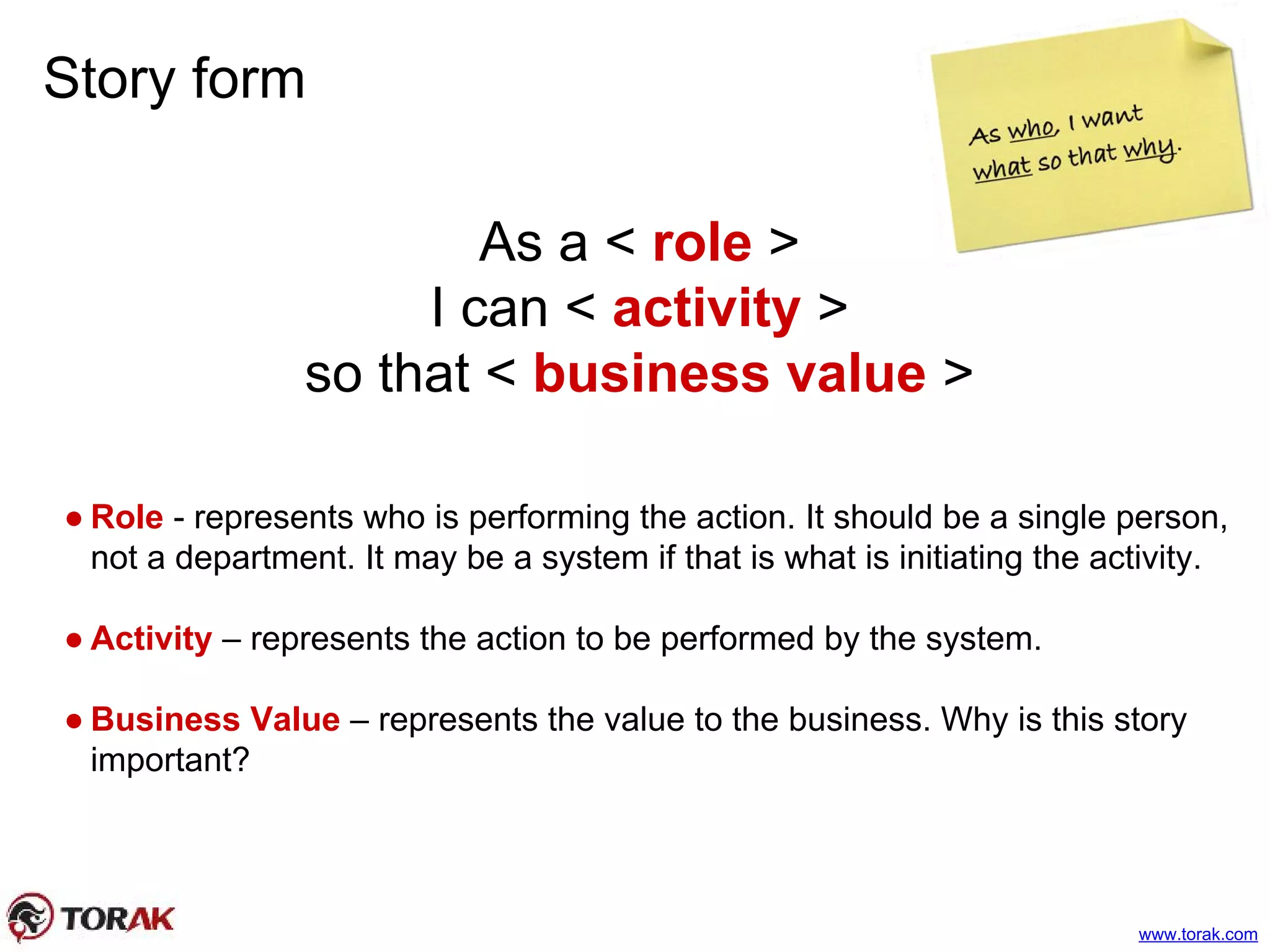
Story form
As a < role >
I can < activity >
so that < business value >
● Role - represents who is performing the action. It should be a single person,
not a department. It may be a system if that is what is initiating the activity.
● Activity – represents the action to be performed by the system.
● Business Value – represents the value to the business. Why is this story
important?
www.torak.com
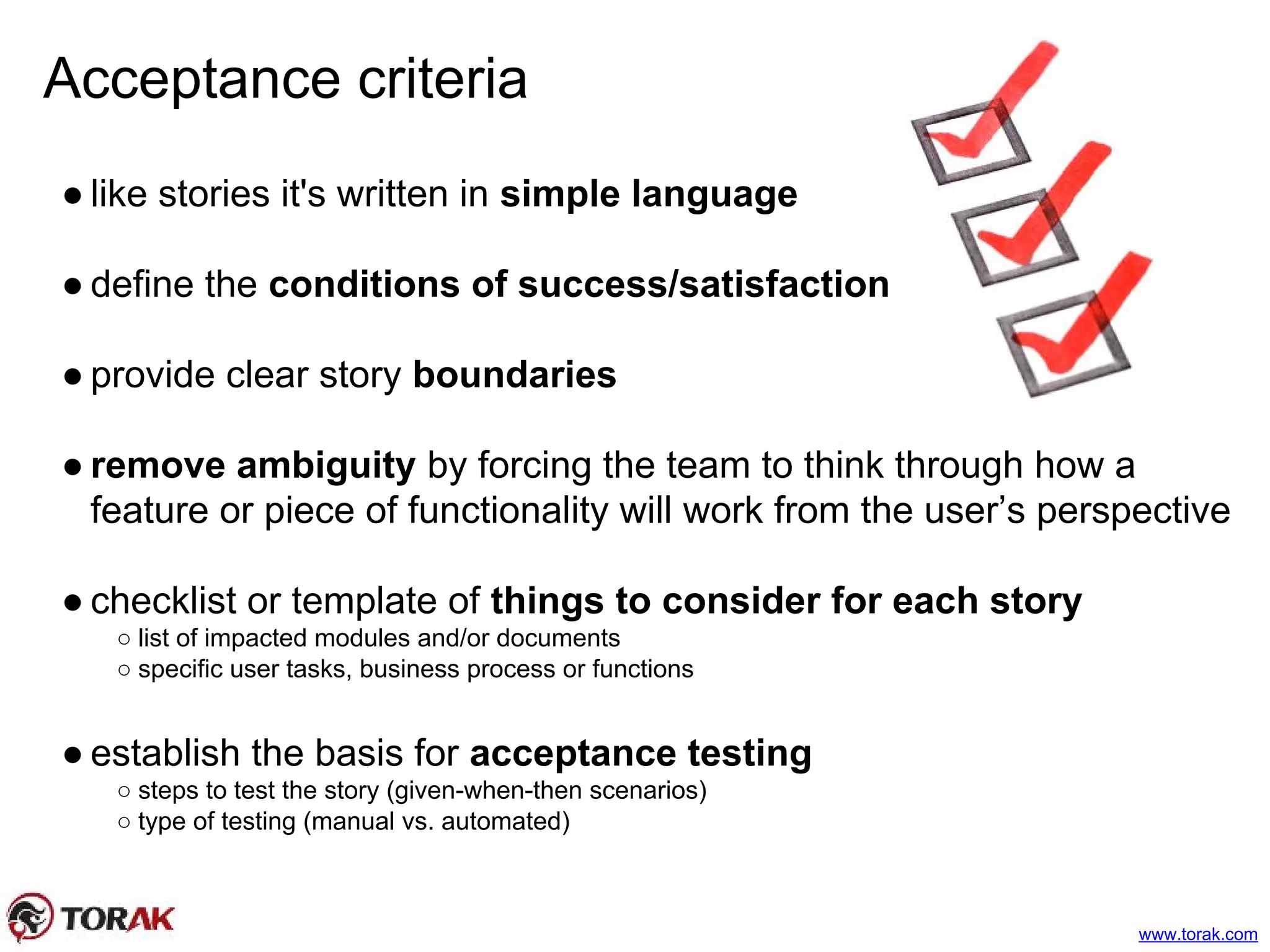
Acceptance criteria
● like stories it's written in simple language
● define the conditions of success/satisfaction
● provide clear story boundaries
● remove ambiguity by forcing the team to think through how a
feature or piece of functionality will work from the user’s perspective
● checklist or template of things to consider for each story
○ list of impacted modules and/or documents
○ specific user tasks, business process or functions
● establish the basis for acceptance testing
○ steps to test the story (given-when-then scenarios)
○ type of testing (manual vs. automated)
www.torak.com
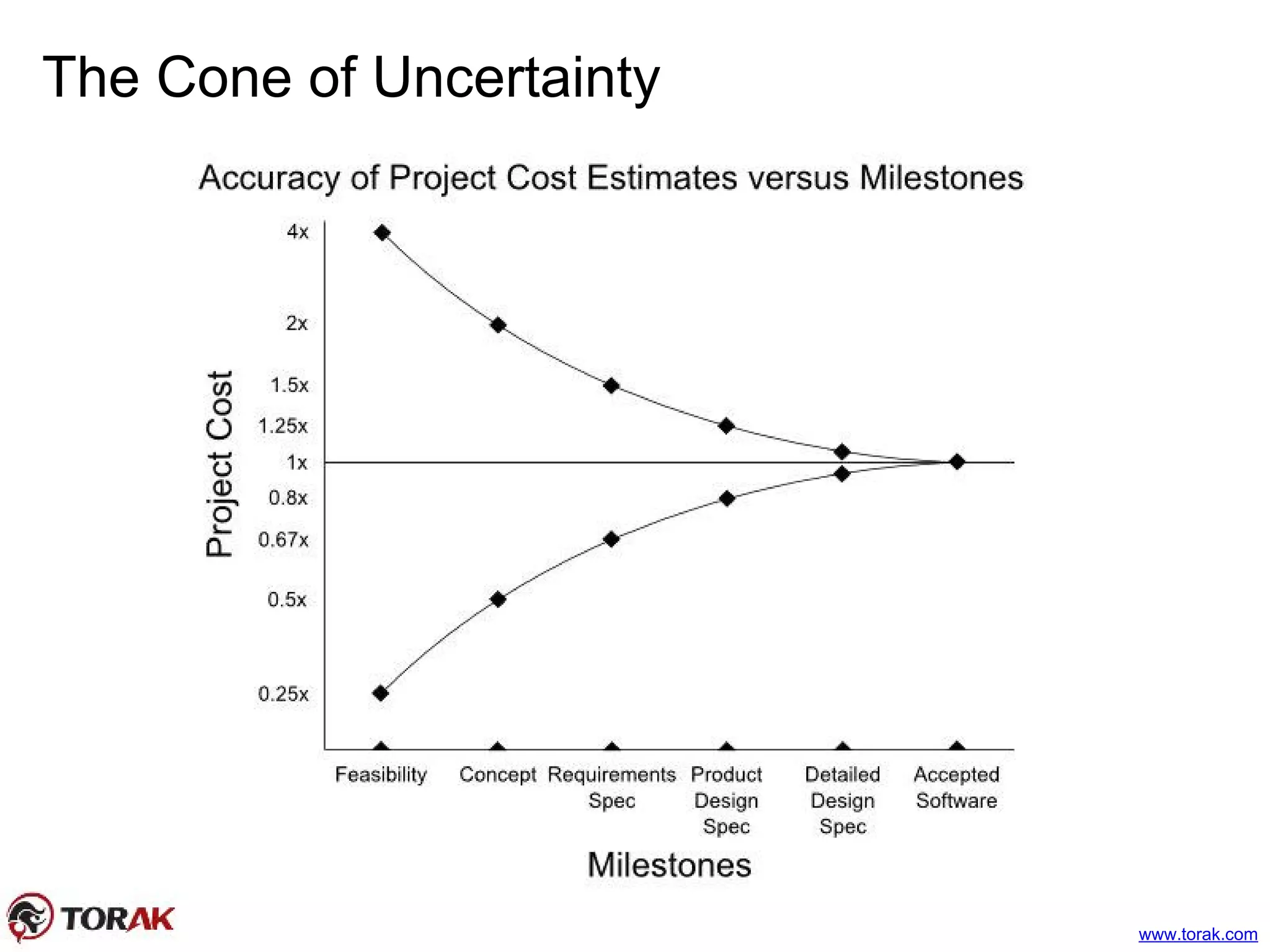
The Cone of Uncertainty
www.torak.com
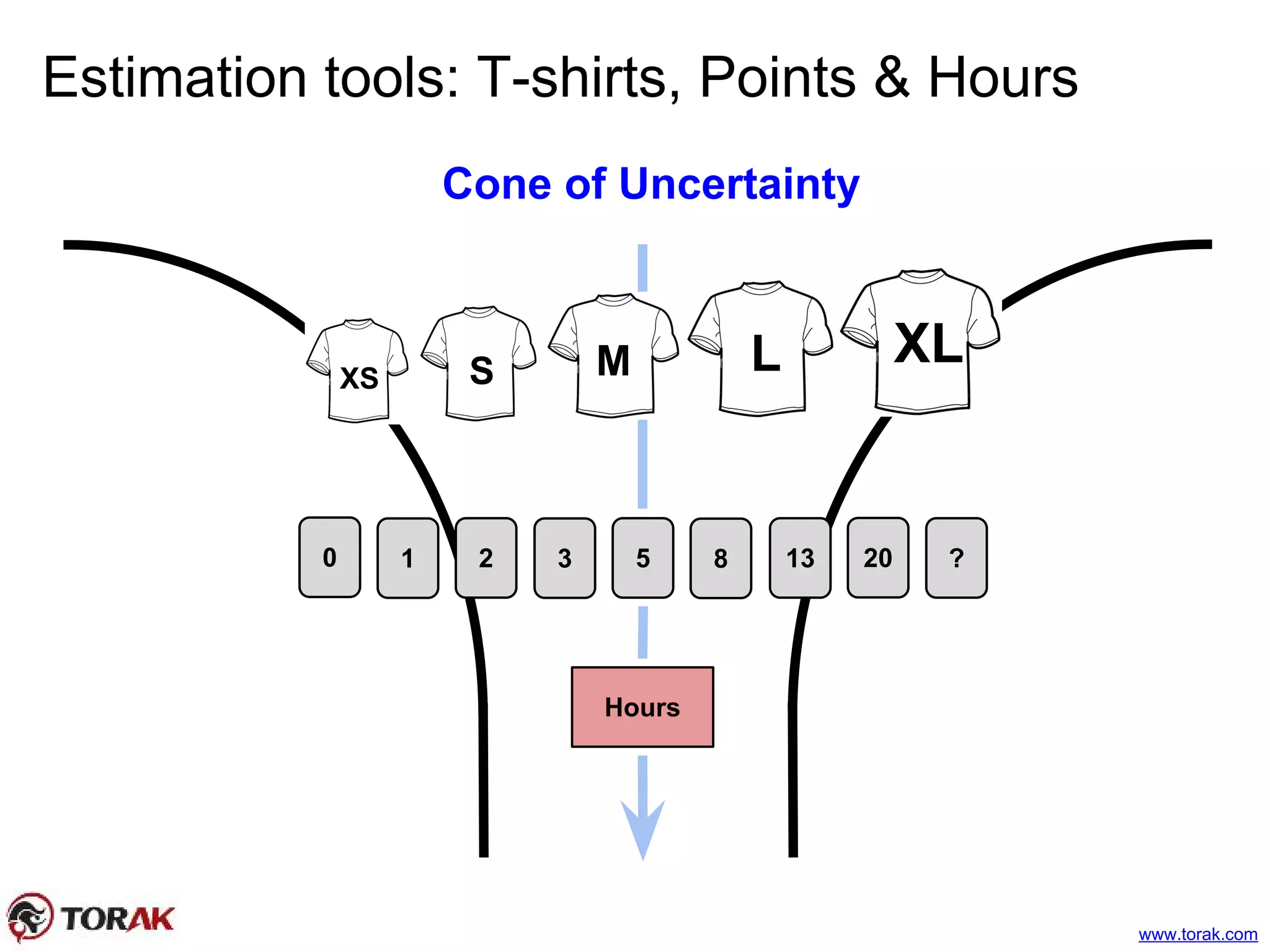
Estimation tools: T-shirts, Points & Hours
Cone of Uncertainty
13853210 20 ?
Hours
XS S
XLLM
www.torak.com
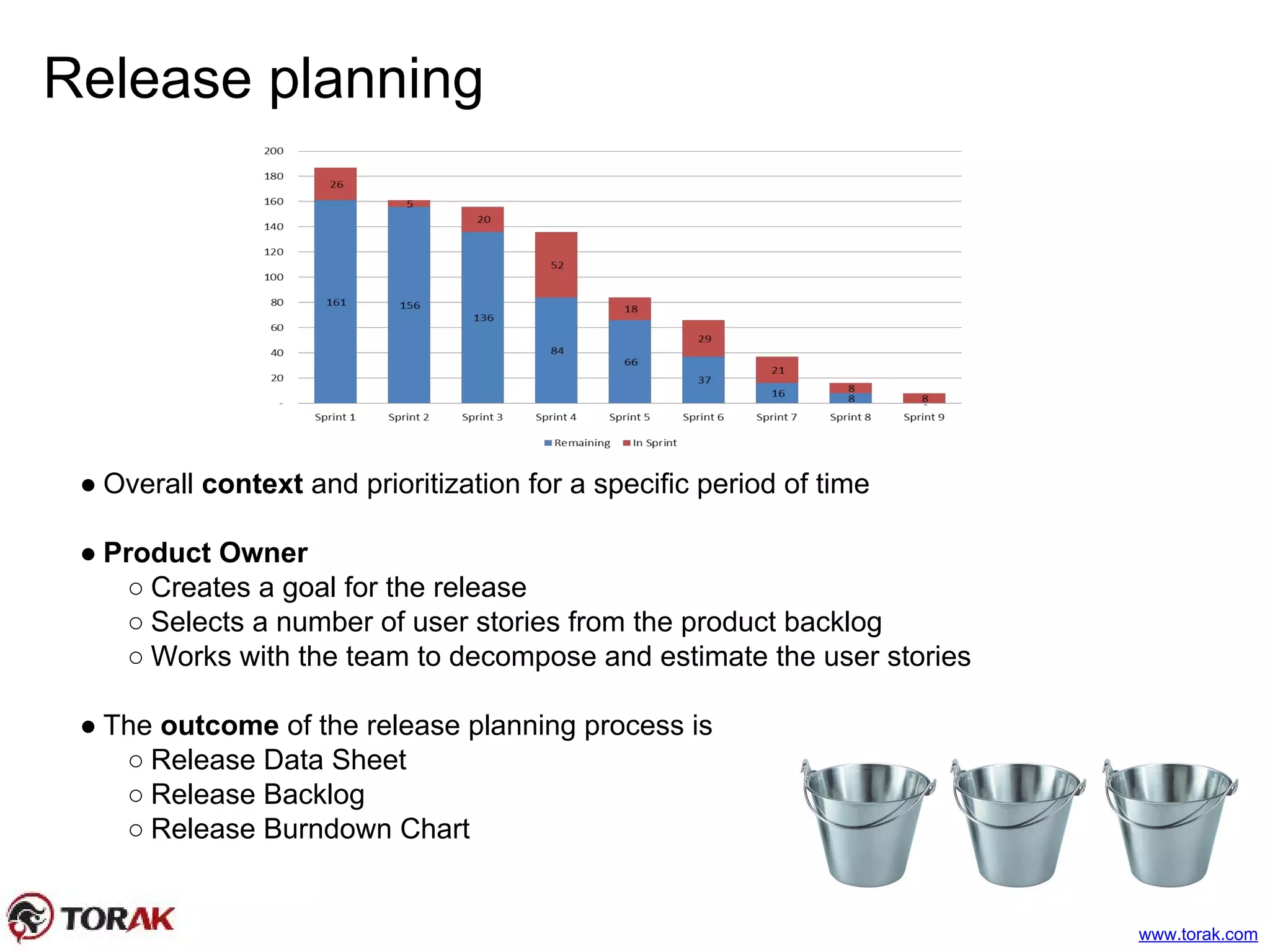
Release planning
● Overall context and prioritization for a specific period of time
● Product Owner
○ Creates a goal for the release
○ Selects a number of user stories from the product backlog
○ Works with the team to decompose and estimate the user stories
● The outcome of the release planning process is
○ Release Data Sheet
○ Release Backlog
○ Release Burndown Chart
www.torak.com
L4 - Iteration Planning
●Iteration planning ceremony
●Iteration Burndown
www.torak.com
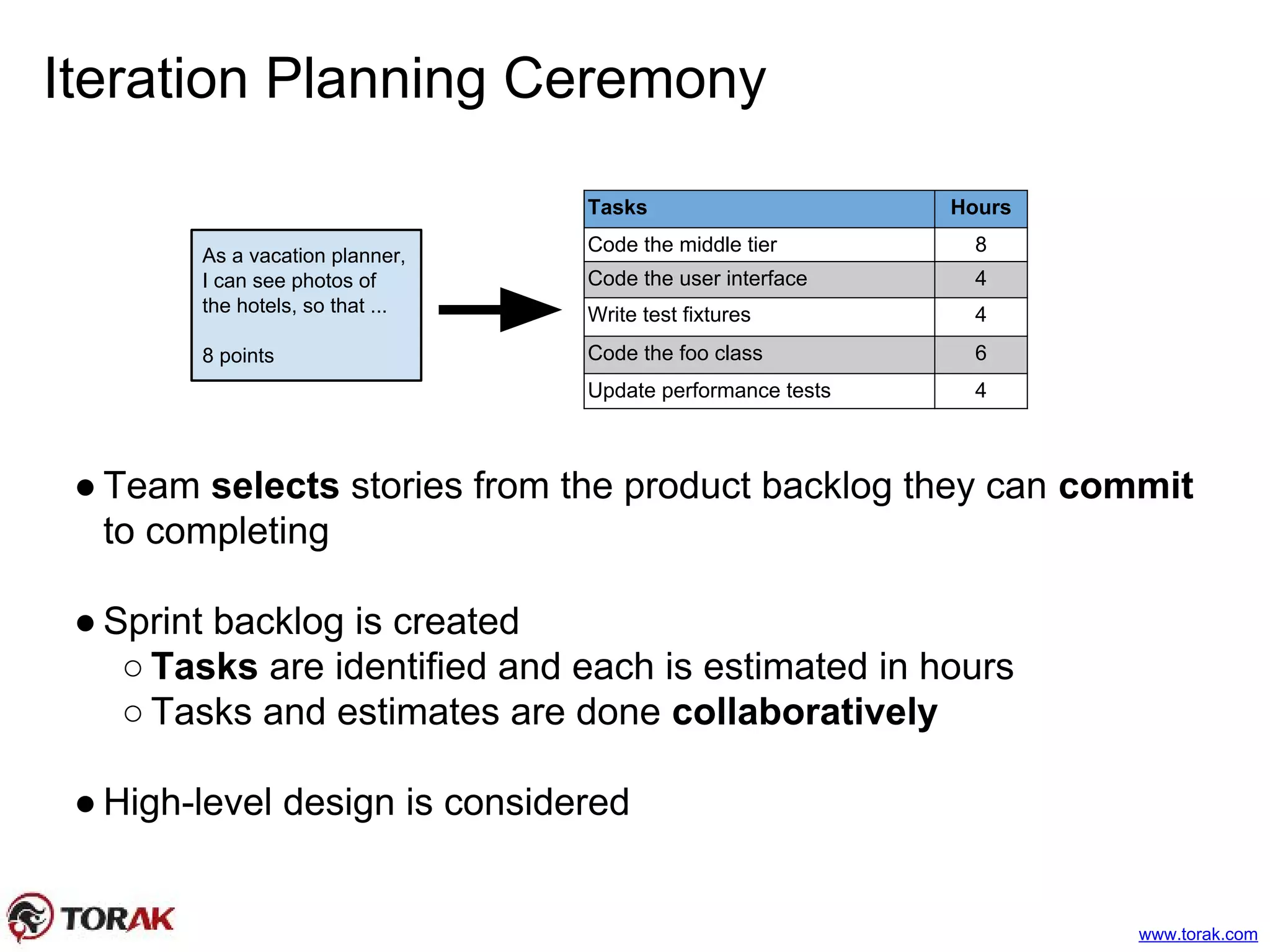
Iteration Planning Ceremony
● Team selects stories from the product backlog they can commit
to completing
● Sprint backlog is created
○ Tasks are identified and each is estimated in hours
○ Tasks and estimates are done collaboratively
● High-level design is considered
As a vacation planner,
I can see photos of
the hotels, so that ...
8 points
Tasks Hours
Code the middle tier 8
Code the user interface 4
Write test fixtures 4
Code the foo class 6
Update performance tests 4
www.torak.com
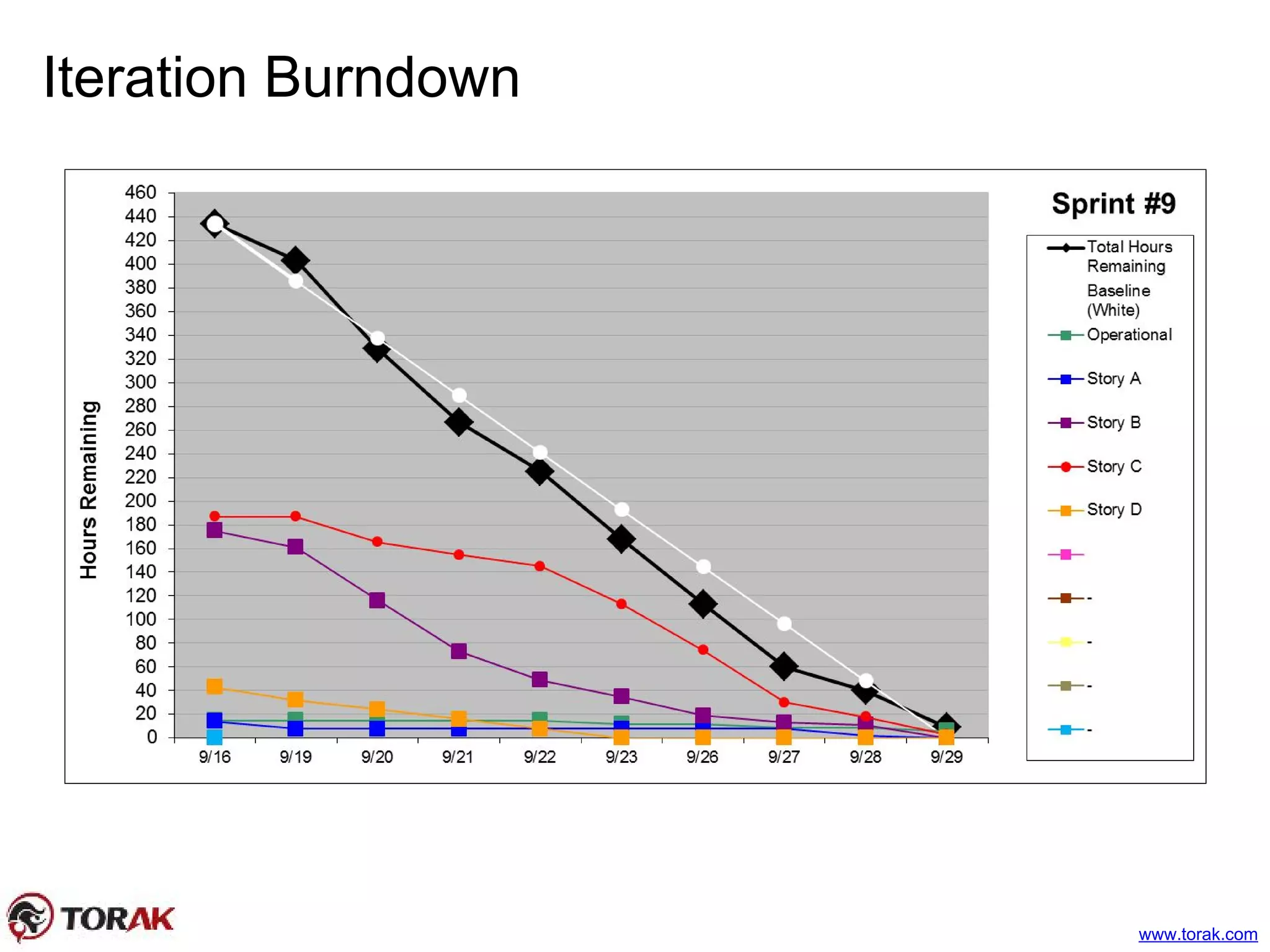
Iteration Burndown
www.torak.com
L5 - Daily Stand Up
●Plan your day...
www.torak.com
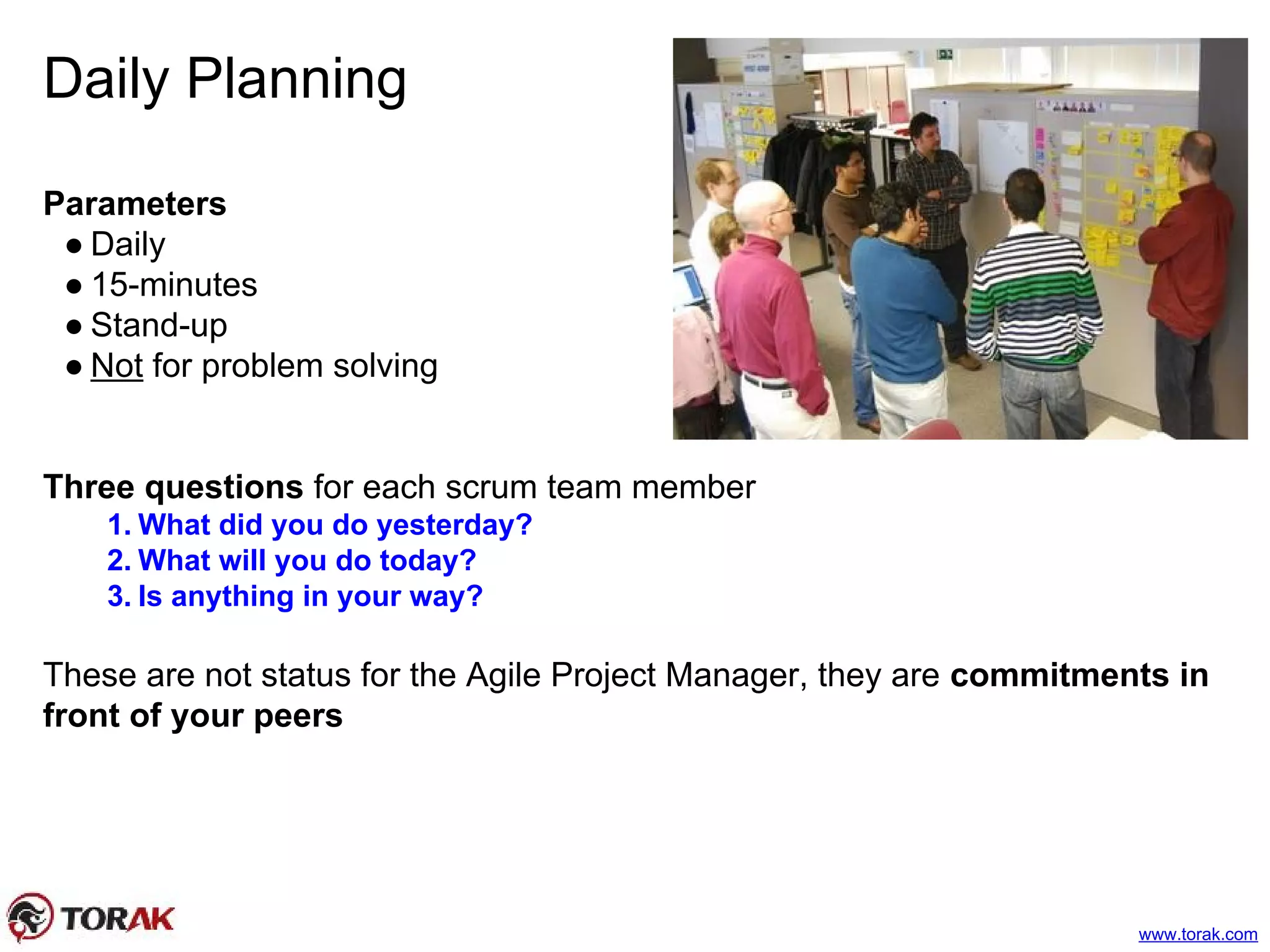
Daily Planning
Parameters
● Daily
● 15-minutes
● Stand-up
● Not for problem solving
Three questions for each scrum team member
1. What did you do yesterday?
2. What will you do today?
3. Is anything in your way?
These are not status for the Agile Project Manager, they are commitments in
front of your peers
www.torak.com
Big Picture
●Scaled Agile Framework (SAFe)
●Agile Testing Framework (ATF)
●The 5 Levels of Planning in Agile
www.torak.com
www.torak.com
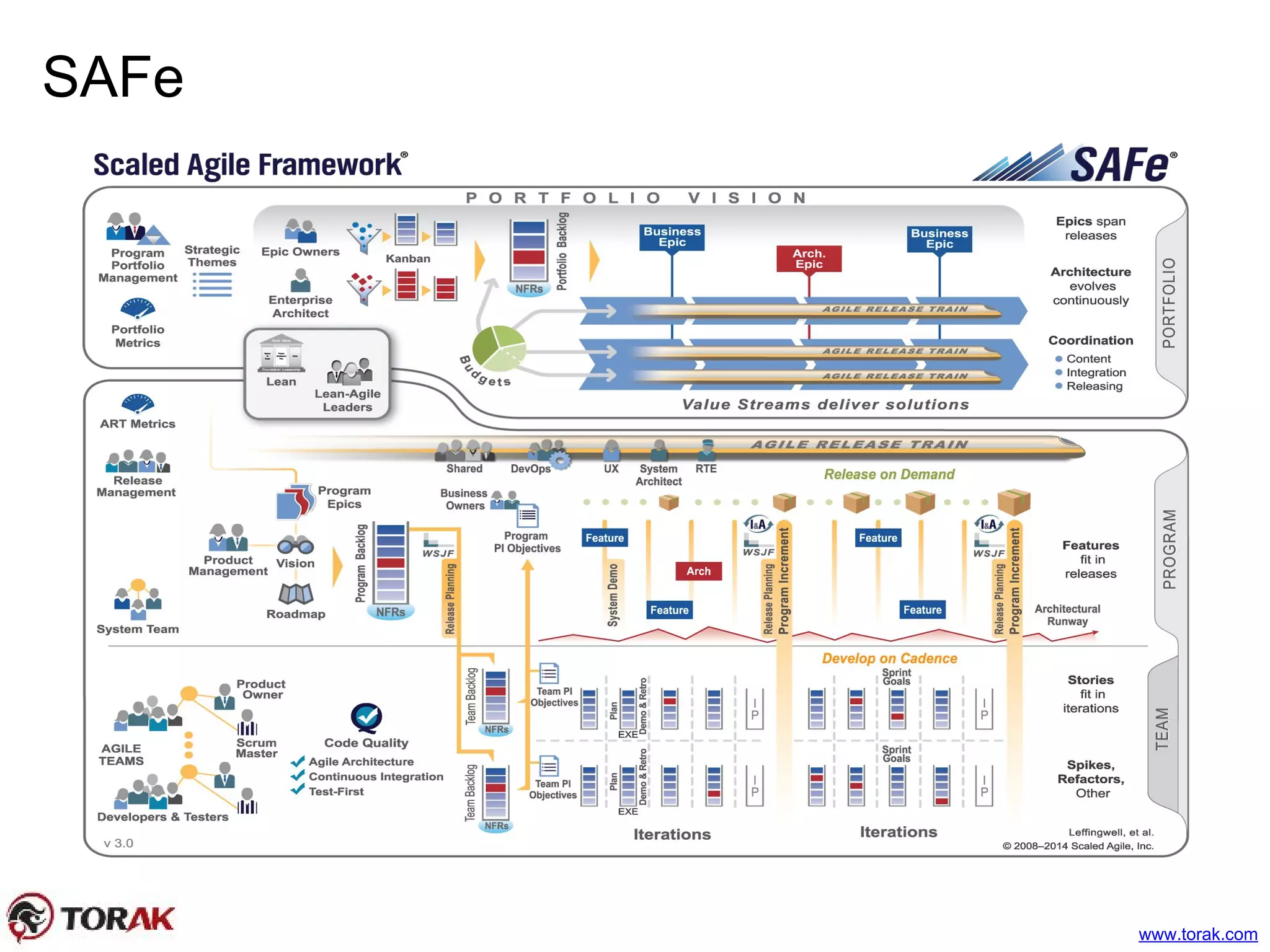
SAFe
© Torak, Inc. www.torak.com
Agile, Kanban & DevOps Coaching
Learn more at www.torak.com
Learn more at www.AgileTestingFramework.com
Learn more at www.kanbanzone.com
Thank You
www.torak.com
Resources and References
● www.scrum.org
● www.scrumalliance.org
● www.scaledagileframework.com
● www.mountaingoatsoftware.com
● www.agiletestingframework.com
● The 5 Levels of Planning: From Enterprise Product Vision to Team Stand-up
by Hubert Smits
● Agile Estimating and Planning by Mike Cohn
● Agile Project Management with Scrum by Ken Schwaber
● Agile Retrospectives by Esther Derby and Diana Larsen
● Agile Software Development Ecosystems by Jim Highsmith
● Agile Software Development with Scrum by Ken Schwaber and Mike Beedle
● Scrum and The Enterprise by Ken Schwaber
● User Stories Applied for Agile Software Development by Mike Cohn
www.torak.com
This presentation was inspired by the work of many people and we have done our very best to
attribute all authors of texts and images, and recognize any copyrights. If you think that
anything in this presentation should be changed, added or removed, please contact us.
http://creativecommons.org/licenses/by-nc-nd/3.0/
www.torak.com

The 5 Levels Planning in Agile

  • 1.
    The 5 Levelsof Planning www.torak.com
  • 2.
    About Dimitri Ponomareff www.torak.com DimitriPonomareff (www.linkedin.com/in/dimka5) is a Coach. Whether it's a sports team, software products or entire organizations, Dimitri has that ability to relate and energize people. He is consistently recognized as a very passionate and successful change agent, with an overwhelming capacity to motivate and mobilize teams on their path to continuous improvements. He is a master facilitator, as well as a captivating speaker with consistent, positive feedback regarding his ability to engage an audience. As a certified Coach, Project Manager and Facilitator of "The 7 Habits of Highly Effective People", Dimitri brings a full spectrum of knowledge in his delivery of methodologies. Through teaching by example, he is able to build teams of people who understand where to focus their work to generate the most value. He has coached and provided tailor-made services and training for a multitude of organizations. The short list includes, American Express, Charles Schwab, Bank of America, Morgan Stanley, Best Western, Choice Hotels, JDA Software, LifeLock, First Solar, Infusionsoft and Mayo Clinic. Dimitri enjoys his work, and does everything to ensure he shares his knowledge with others who seek it.
  • 3.
    The Agile Manifesto Weare uncovering better ways of developing software by doing it and helping others do it. Individuals and interactions over processes and tools Working software over comprehensive documentation Customer collaboration over contract negotiation Responding to change over following a plan That is, while there is value in the items on the right, we value the items on the left more. Source: www.agilemanifesto.org www.torak.com
  • 4.
    Planning Process Vision Roadmap R1 R2R3 Rn Release 1 SP1 Iteration 1 ST1 STnST3ST2 Iteration n ST1 STnST3ST2 Story 1 T1 TnT3T2 Story n T1 TnT3T2 SPnSP3SP2 Release n SP1 SPnSP3SP2 www.torak.com
  • 5.
  • 6.
    L1 - Vision ●Communication ●ElevatorPitch ●Voices of Why, What and How ●PDCA www.torak.com
  • 7.
    Project Management isall about communication People who want IT must communicate with people who can build IT. www.torak.com
  • 8.
    Elevator Pitch FOR (targetcustomer) WHO (statement of the need or opportunity) THE (product name) IS A (product category) THAT (key benefit, compelling reason to buy) UNLIKE (primary competitive alternative) OUR PRODUCT (statement of primary differentiation) Source: Geoffrey Moore’s template from Crossing the Chasm www.torak.com
  • 9.
    Why, What &How ●WHY are we doing this? Voice of the stakeholder (Stakeholders) ●WHAT needs to be done? Voice of the user (Product Owner, Subject Matter Expert) ●HOW do we build it? Voice of the developer (Scrum Team) www.torak.com
  • 10.
    PDCA - Plan,Do, Check, Act ACT PLAN DO PDCA Cycle CHECK Continuous Improvements www.torak.com
  • 11.
    L2 - Roadmap ●Whatis a Roadmap ●External Facing Roadmap www.torak.com
  • 12.
    Roadmap www.torak.com ● a roadmapis a planned future, laid out in broad strokes ● intentions for the future given what we know and believe today - they are not commitments ● should be formulated by first understanding the target users, the market, and the underlying technologies ● a good product roadmap should invariably deliver the right products with the right features at the right time to the right customers
  • 13.
  • 14.
    L3-L5 Levels ofplanning Release Plan (months) Iteration Plan (weeks) Daily Plan (days) Product Backlog Sprint Backlog Stories Tasks ActivitiesActivitiesActivities www.torak.com
  • 15.
    L3 - ReleasePlanning ●Product, Epics & Stories ●Feature Driven Development (FDD) ●Feature Breakdown Structure (FBS) ●Parking Lot Charts ●Stories and Acceptance Criteria ●Estimation ●Release Burndown www.torak.com
  • 16.
    Product, Epics &Stories Story Story Story Story Story Story Story Story Story Story Story Story Story Story Story Story Story Story Product Epics Stories www.torak.com
  • 17.
    Feature Driven Development(FDD) www.torak.com
  • 18.
    Alternative to WorkBreakdown Structure (WBS) Activity Functionality Analysis Design Coding Testing Feature Feature Feature Module Module Module WBS or traditional projects Functionality Activity Story Story Story Story Analysis Design Coding Feature Breakdown Structure Testing Define the project plan in terms of what will be delivered rather than what work steps will be performed. www.torak.com
  • 19.
  • 20.
    Story form As a< role > I can < activity > so that < business value > ● Role - represents who is performing the action. It should be a single person, not a department. It may be a system if that is what is initiating the activity. ● Activity – represents the action to be performed by the system. ● Business Value – represents the value to the business. Why is this story important? www.torak.com
  • 21.
    Acceptance criteria ● likestories it's written in simple language ● define the conditions of success/satisfaction ● provide clear story boundaries ● remove ambiguity by forcing the team to think through how a feature or piece of functionality will work from the user’s perspective ● checklist or template of things to consider for each story ○ list of impacted modules and/or documents ○ specific user tasks, business process or functions ● establish the basis for acceptance testing ○ steps to test the story (given-when-then scenarios) ○ type of testing (manual vs. automated) www.torak.com
  • 22.
    The Cone ofUncertainty www.torak.com
  • 23.
    Estimation tools: T-shirts,Points & Hours Cone of Uncertainty 13853210 20 ? Hours XS S XLLM www.torak.com
  • 24.
    Release planning ● Overallcontext and prioritization for a specific period of time ● Product Owner ○ Creates a goal for the release ○ Selects a number of user stories from the product backlog ○ Works with the team to decompose and estimate the user stories ● The outcome of the release planning process is ○ Release Data Sheet ○ Release Backlog ○ Release Burndown Chart www.torak.com
  • 25.
    L4 - IterationPlanning ●Iteration planning ceremony ●Iteration Burndown www.torak.com
  • 26.
    Iteration Planning Ceremony ●Team selects stories from the product backlog they can commit to completing ● Sprint backlog is created ○ Tasks are identified and each is estimated in hours ○ Tasks and estimates are done collaboratively ● High-level design is considered As a vacation planner, I can see photos of the hotels, so that ... 8 points Tasks Hours Code the middle tier 8 Code the user interface 4 Write test fixtures 4 Code the foo class 6 Update performance tests 4 www.torak.com
  • 27.
  • 28.
    L5 - DailyStand Up ●Plan your day... www.torak.com
  • 29.
    Daily Planning Parameters ● Daily ●15-minutes ● Stand-up ● Not for problem solving Three questions for each scrum team member 1. What did you do yesterday? 2. What will you do today? 3. Is anything in your way? These are not status for the Agile Project Manager, they are commitments in front of your peers www.torak.com
  • 30.
    Big Picture ●Scaled AgileFramework (SAFe) ●Agile Testing Framework (ATF) ●The 5 Levels of Planning in Agile www.torak.com
  • 31.
  • 32.
    © Torak, Inc.www.torak.com Agile, Kanban & DevOps Coaching Learn more at www.torak.com Learn more at www.AgileTestingFramework.com Learn more at www.kanbanzone.com
  • 33.
  • 34.
    Resources and References ●www.scrum.org ● www.scrumalliance.org ● www.scaledagileframework.com ● www.mountaingoatsoftware.com ● www.agiletestingframework.com ● The 5 Levels of Planning: From Enterprise Product Vision to Team Stand-up by Hubert Smits ● Agile Estimating and Planning by Mike Cohn ● Agile Project Management with Scrum by Ken Schwaber ● Agile Retrospectives by Esther Derby and Diana Larsen ● Agile Software Development Ecosystems by Jim Highsmith ● Agile Software Development with Scrum by Ken Schwaber and Mike Beedle ● Scrum and The Enterprise by Ken Schwaber ● User Stories Applied for Agile Software Development by Mike Cohn www.torak.com
  • 35.
    This presentation wasinspired by the work of many people and we have done our very best to attribute all authors of texts and images, and recognize any copyrights. If you think that anything in this presentation should be changed, added or removed, please contact us. http://creativecommons.org/licenses/by-nc-nd/3.0/ www.torak.com