
Möbius
Gabrielle Benefield
evolvebeyond.com
1
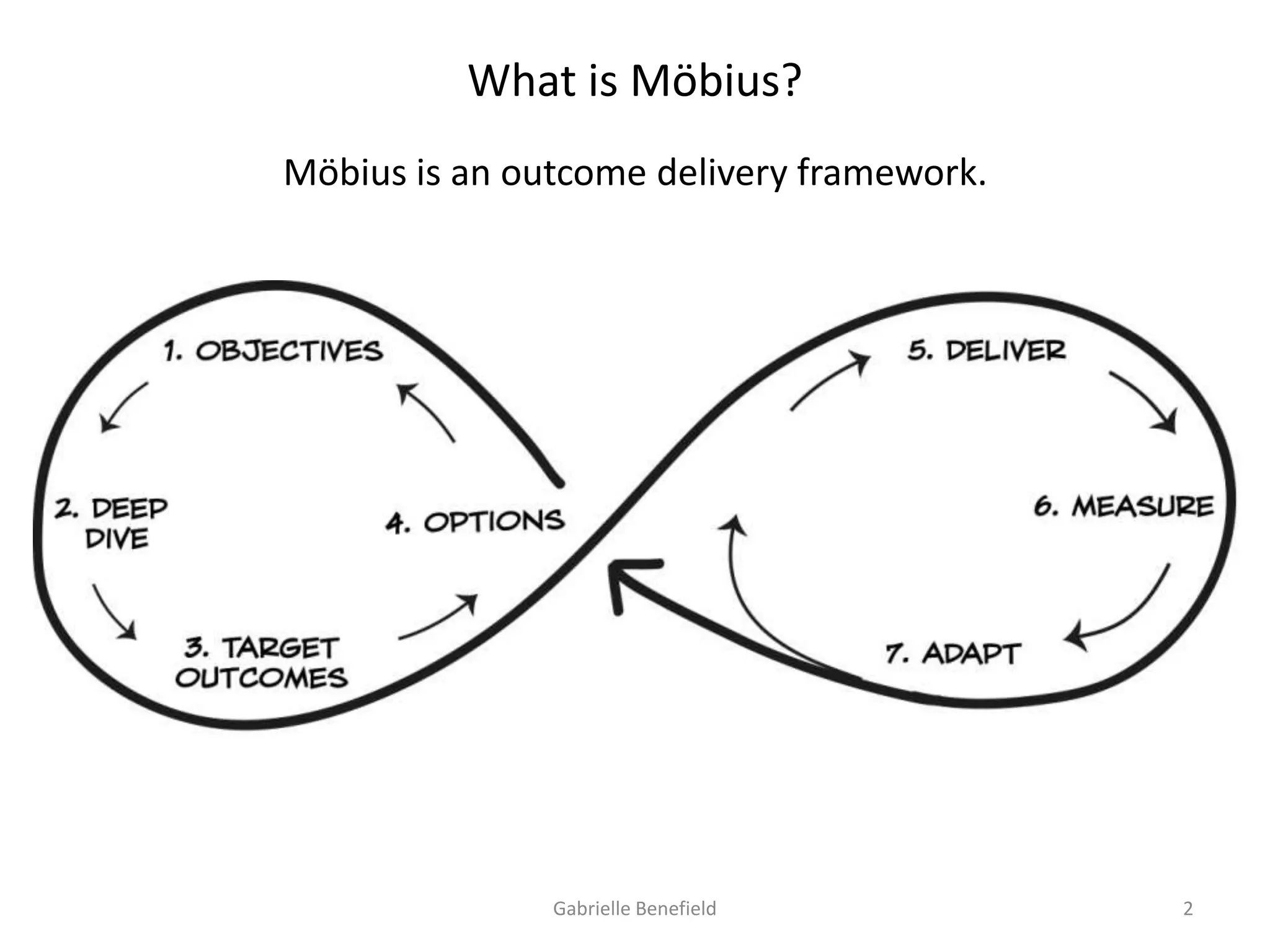
What is Möbius?
Möbius is an outcome delivery framework.

Gabrielle Benefield

2
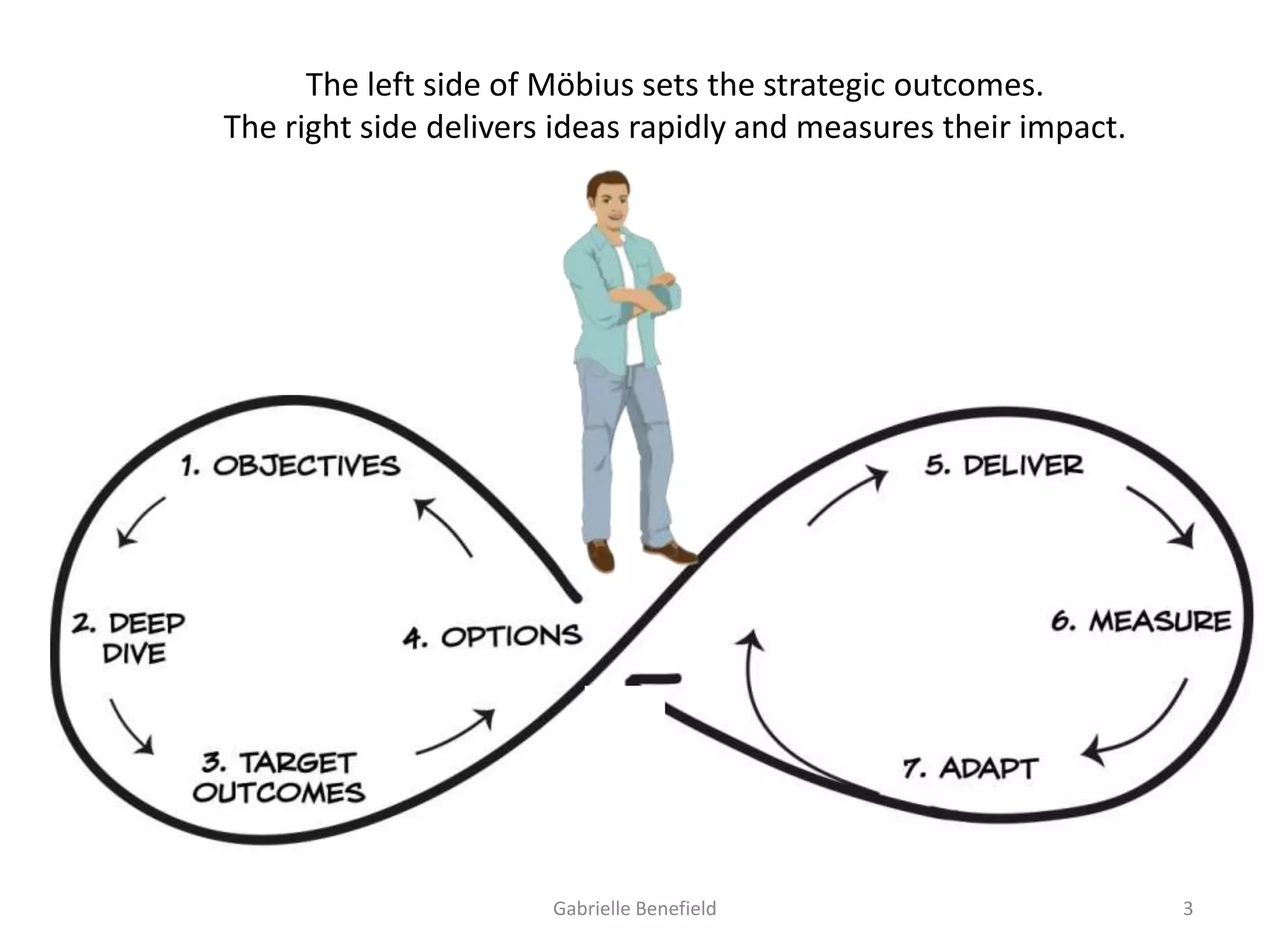
The left side of Möbius sets the strategic outcomes.
The right side delivers ideas rapidly and measures their impact.

Gabrielle Benefield

3
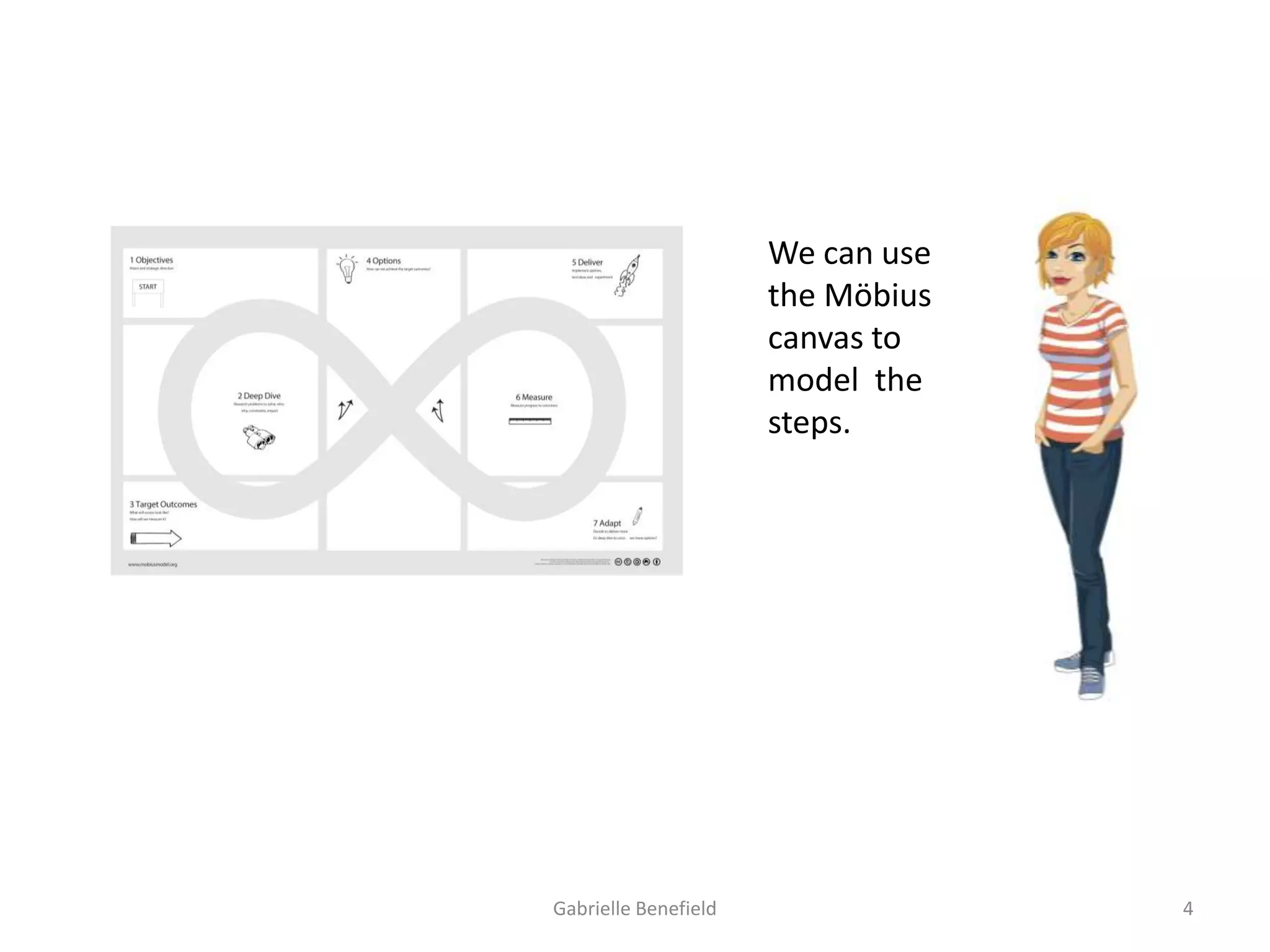
We can use
the Möbius
canvas to
model the
steps.

Gabrielle Benefield

4
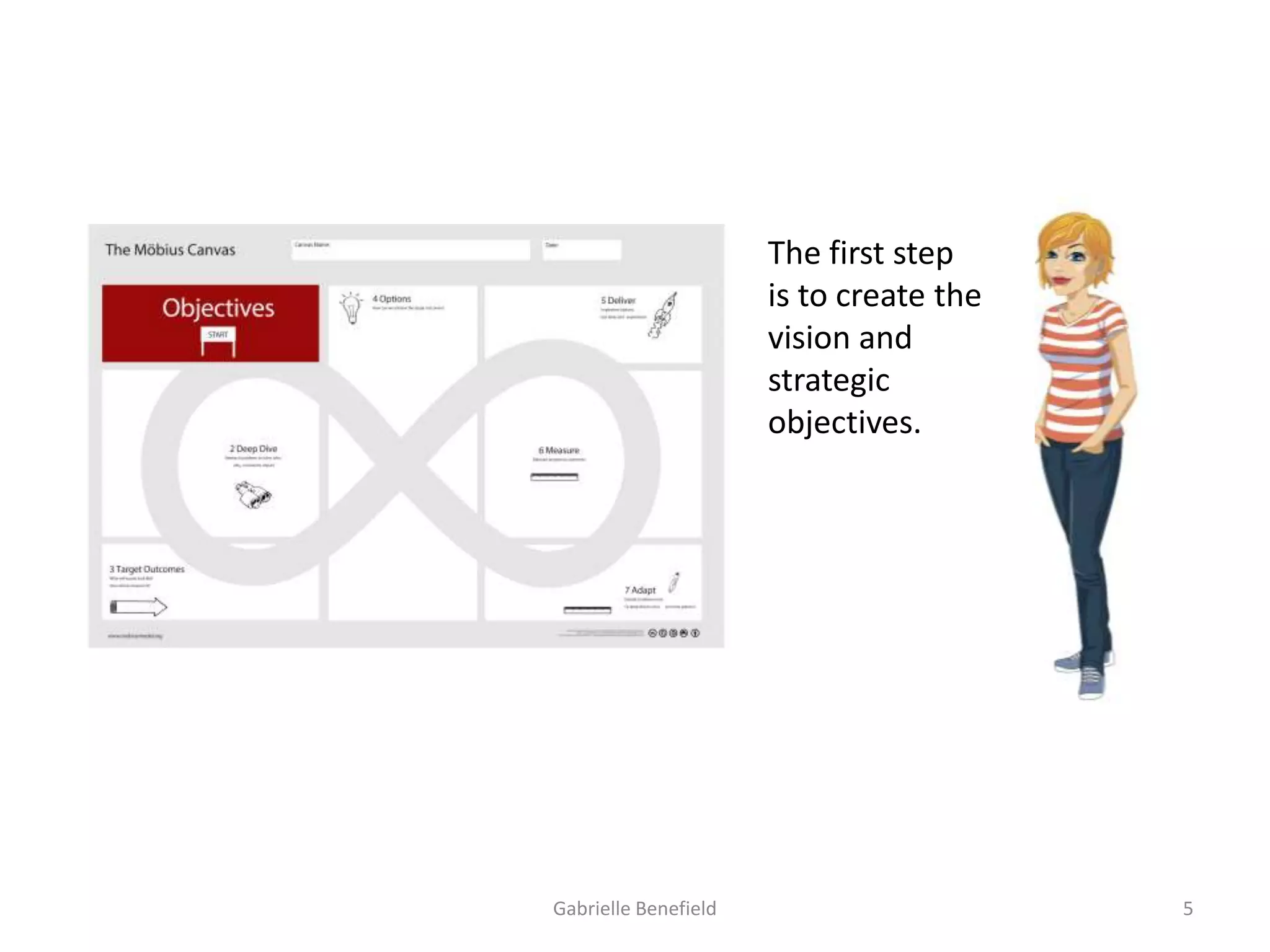
The first step
is to create the
vision and
strategic
objectives.

Gabrielle Benefield

5
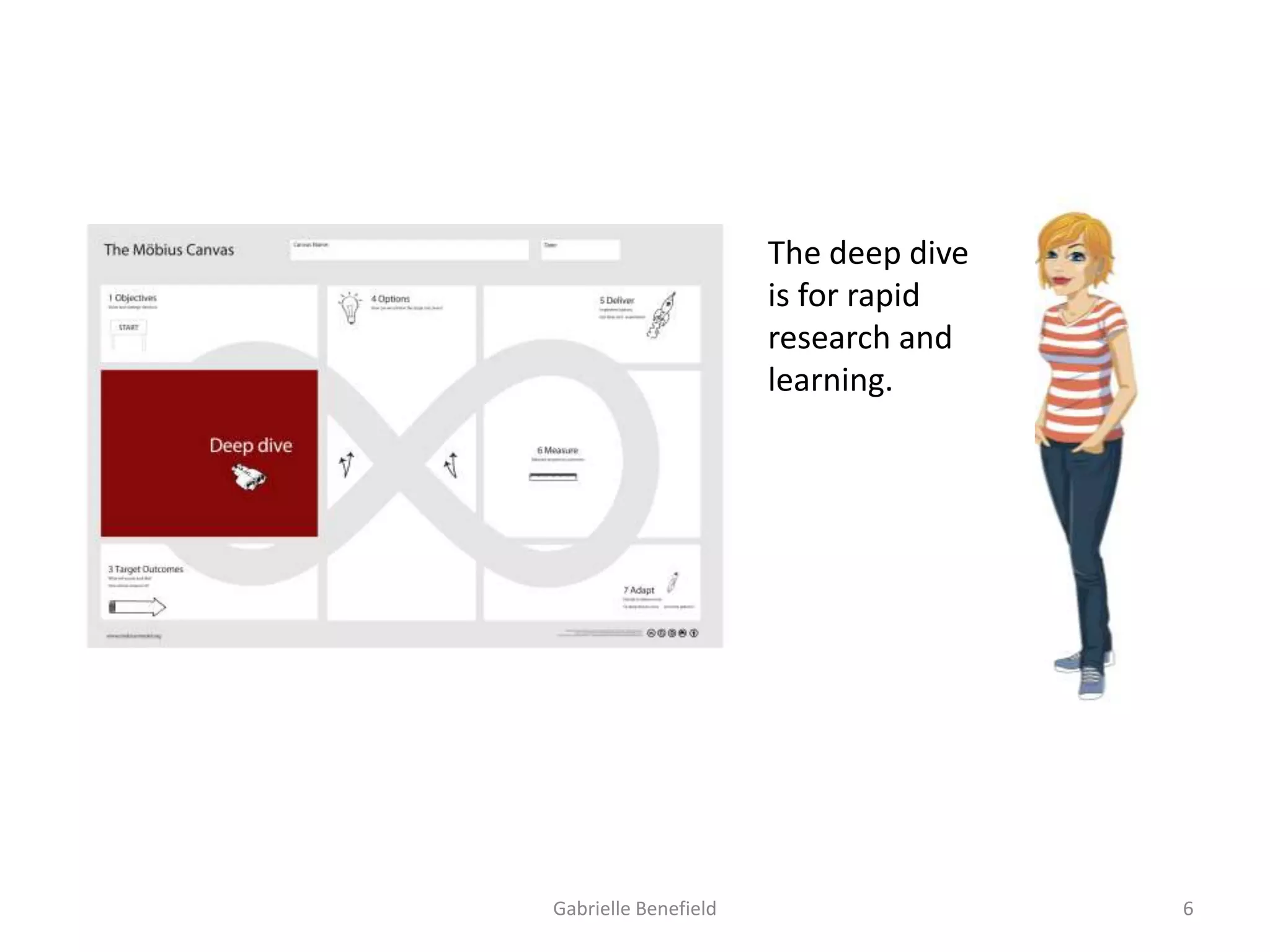
The deep dive
is for rapid
research and
learning.

Gabrielle Benefield

6
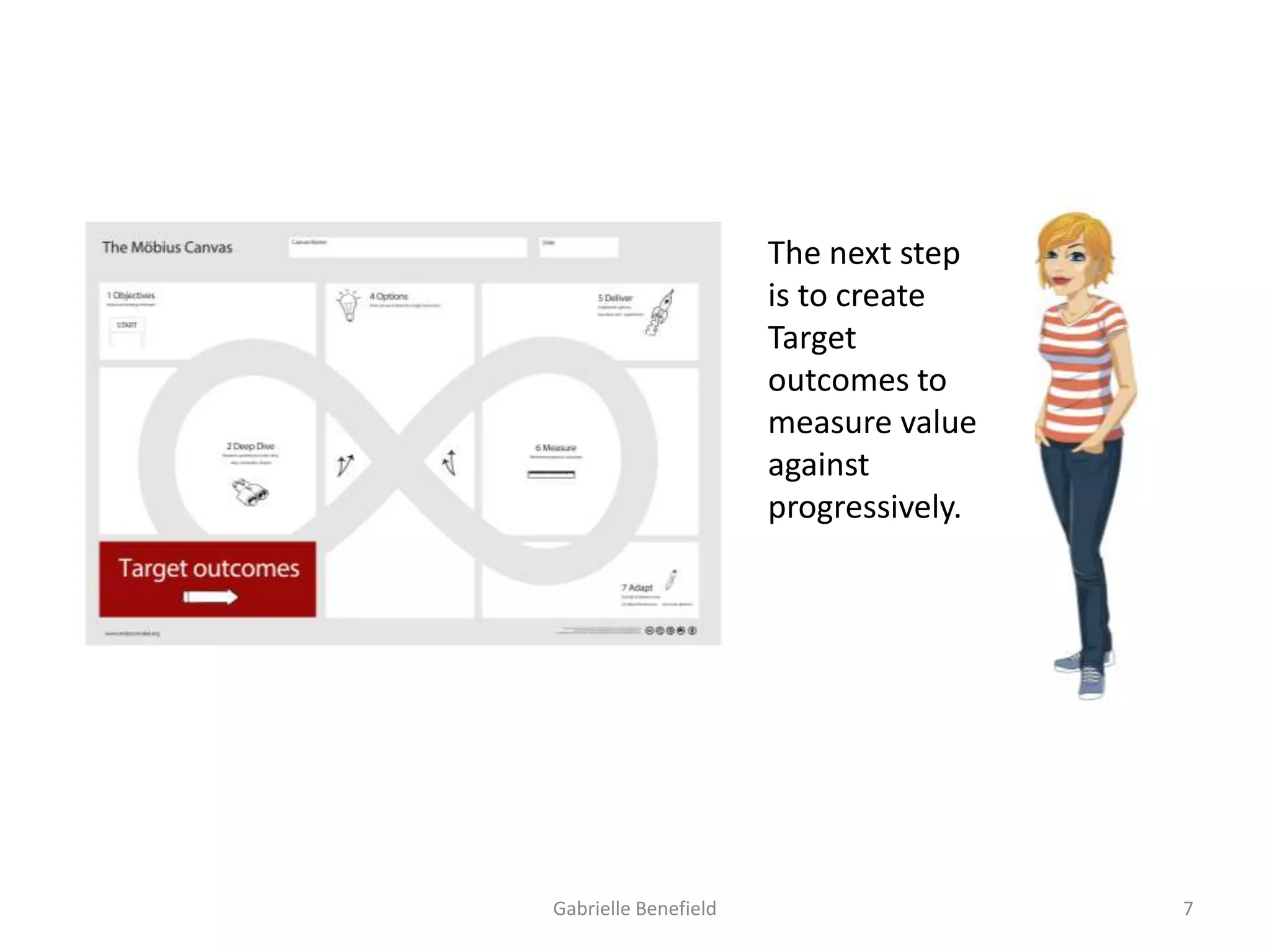
The next step
is to create
Target
outcomes to
measure value
against
progressively.

Gabrielle Benefield

7
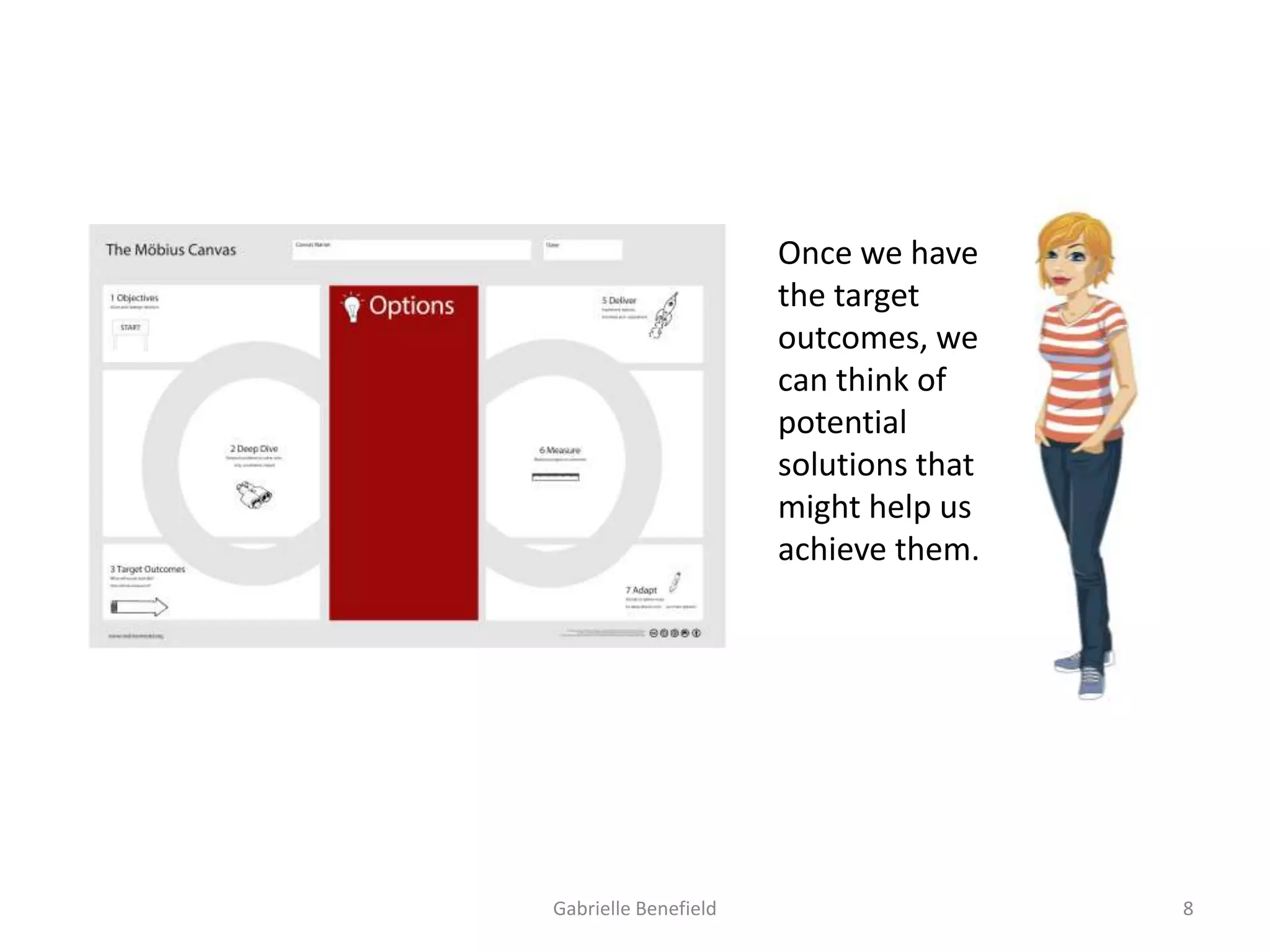
Once we have
the target
outcomes, we
can think of
potential
solutions that
might help us
achieve them.

Gabrielle Benefield

8
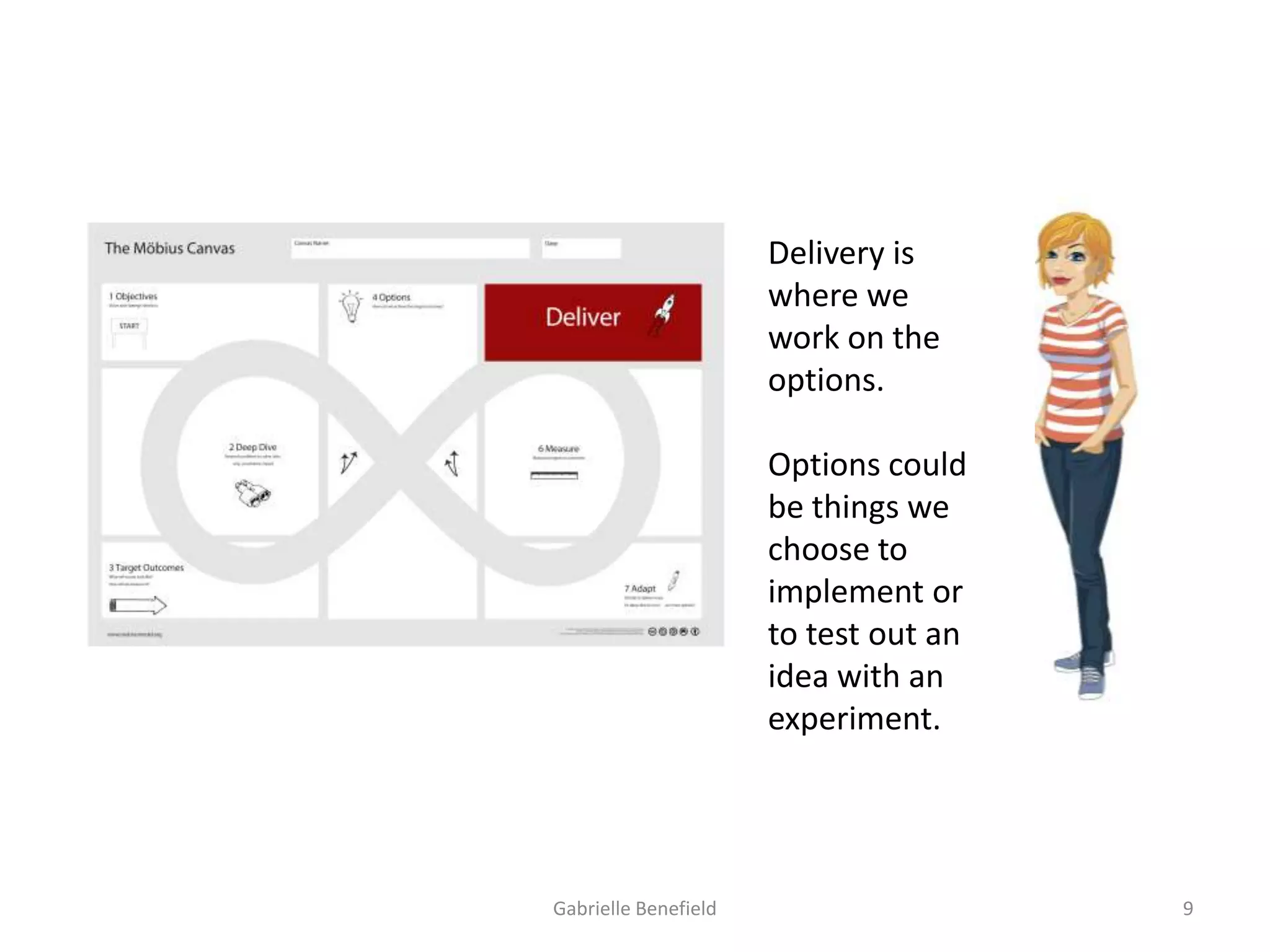
Delivery is
where we
work on the
options.
Options could
be things we
choose to
implement or
to test out an
idea with an
experiment.

Gabrielle Benefield

9
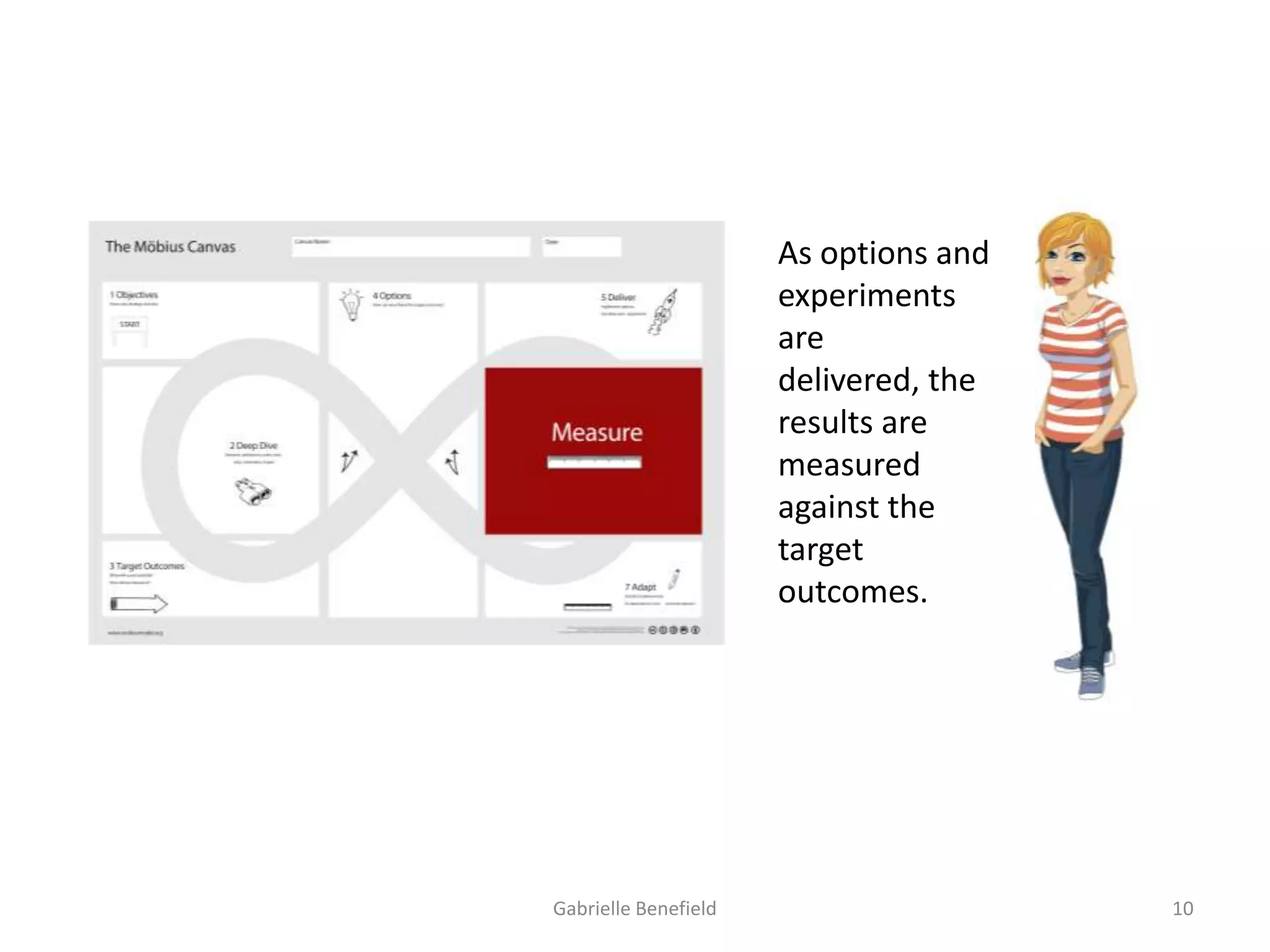
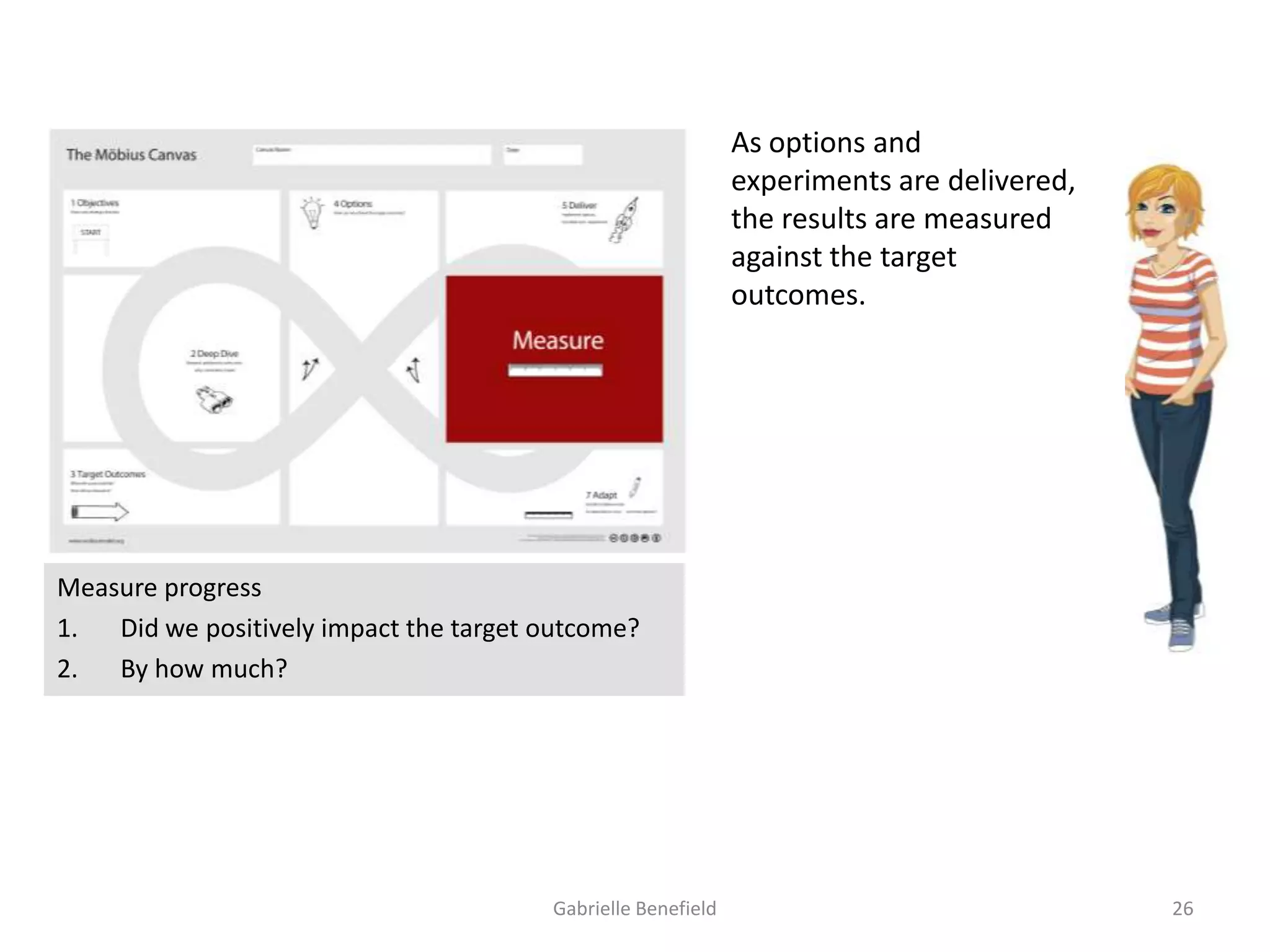
As options and
experiments
are delivered,
the results are
measured
against the
target
outcomes.

Gabrielle Benefield

10
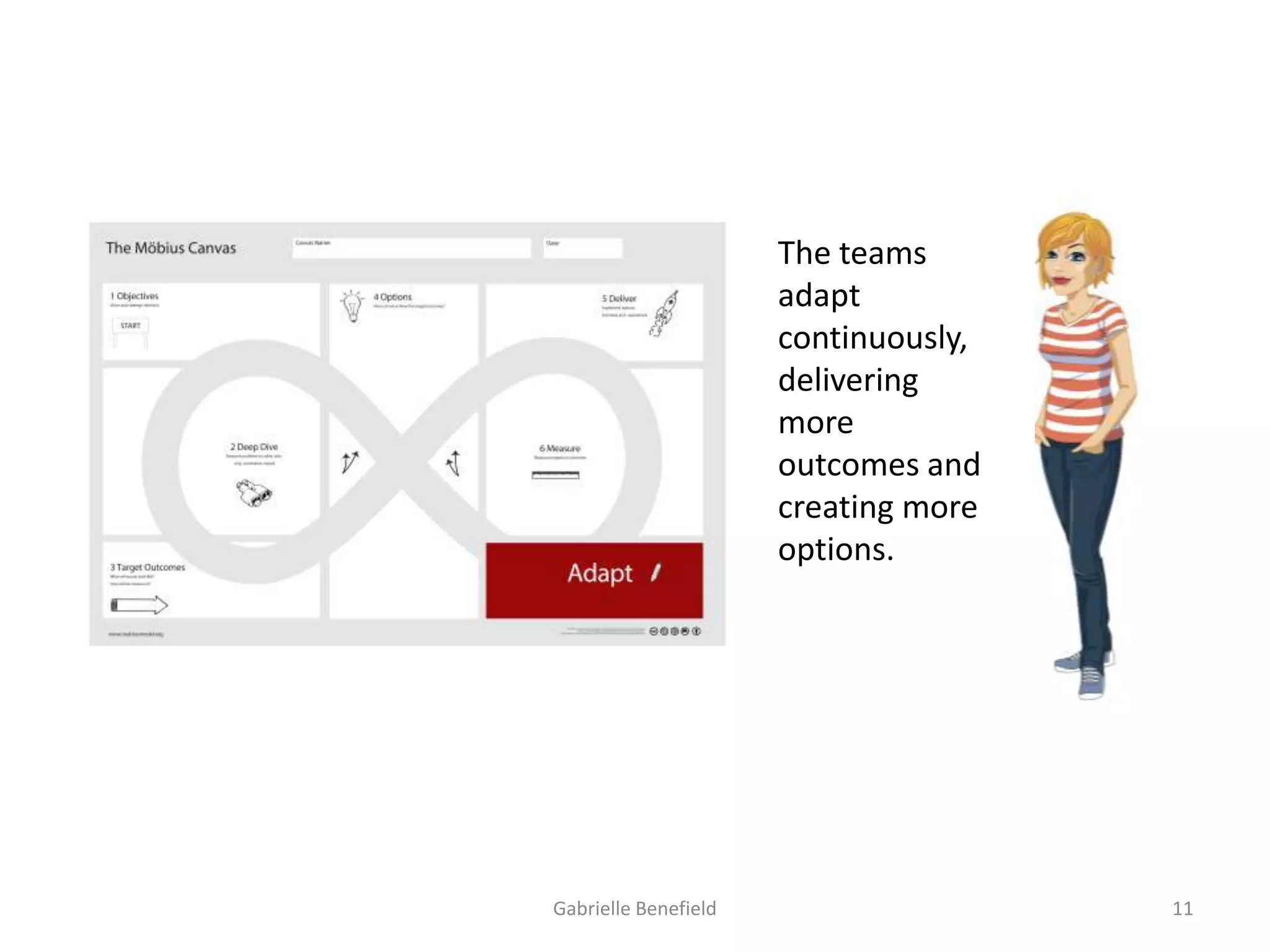
The teams
adapt
continuously,
delivering
more
outcomes and
creating more
options.

Gabrielle Benefield

11
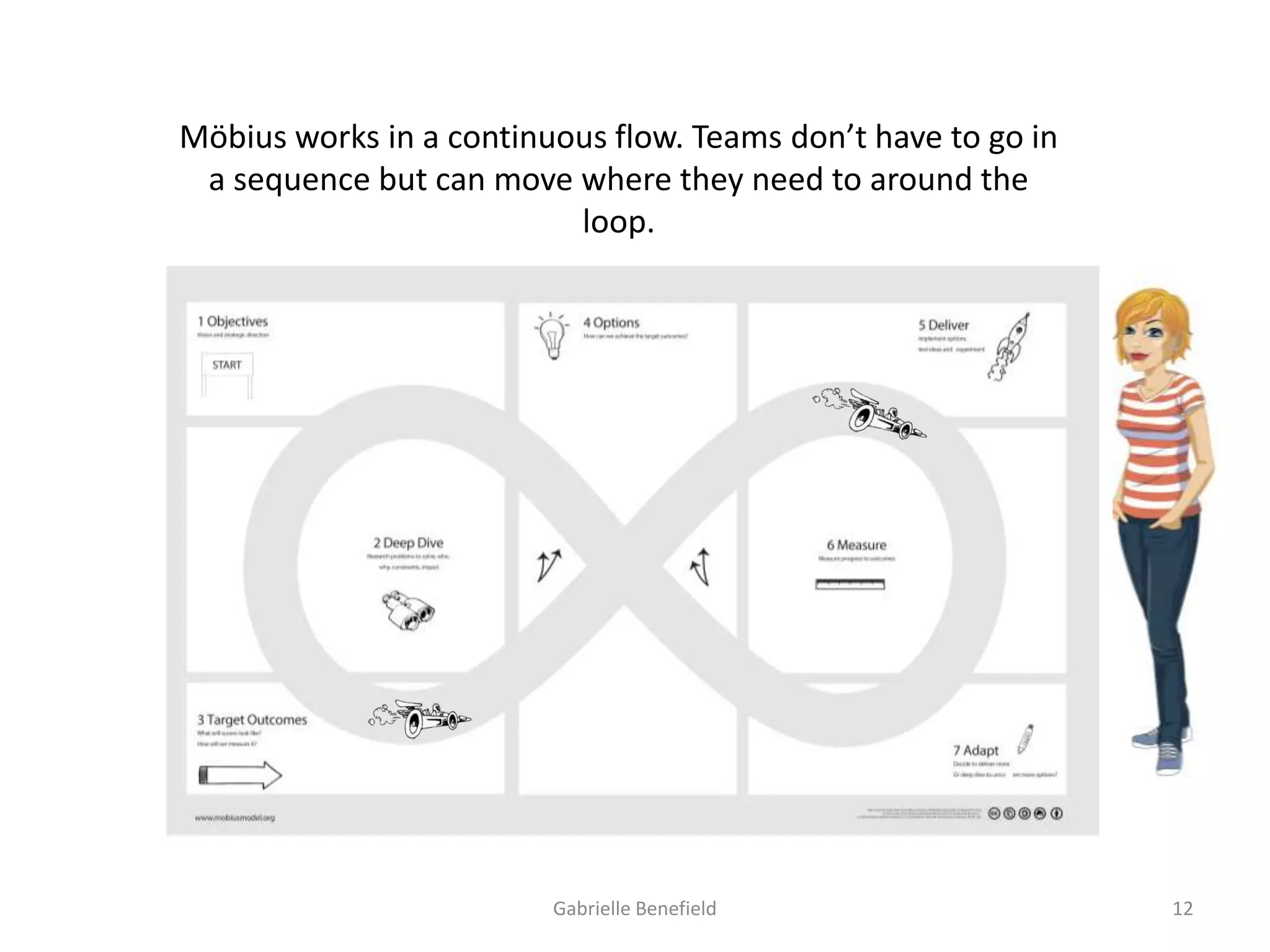
Möbius works in a continuous flow. Teams don’t have to go in
a sequence but can move where they need to around the
loop.

Gabrielle Benefield

12
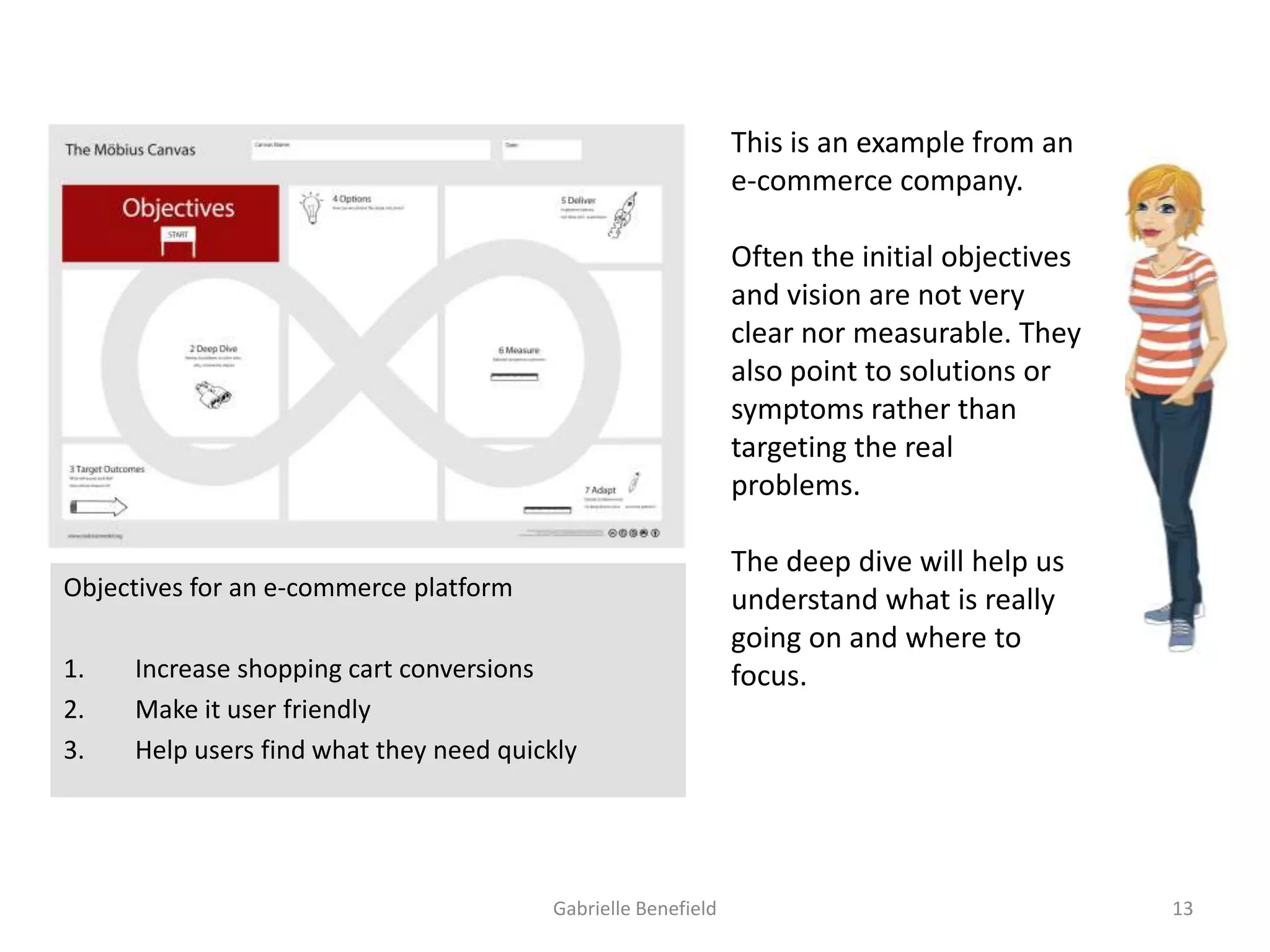
This is an example from an
e-commerce company.
Often the initial objectives
and vision are not very
clear nor measurable. They
also point to solutions or
symptoms rather than
targeting the real
problems.
Objectives for an e-commerce platform
1.
2.
3.

Increase shopping cart conversions
Make it user friendly
Help users find what they need quickly

Gabrielle Benefield

The deep dive will help us
understand what is really
going on and where to
focus.

13
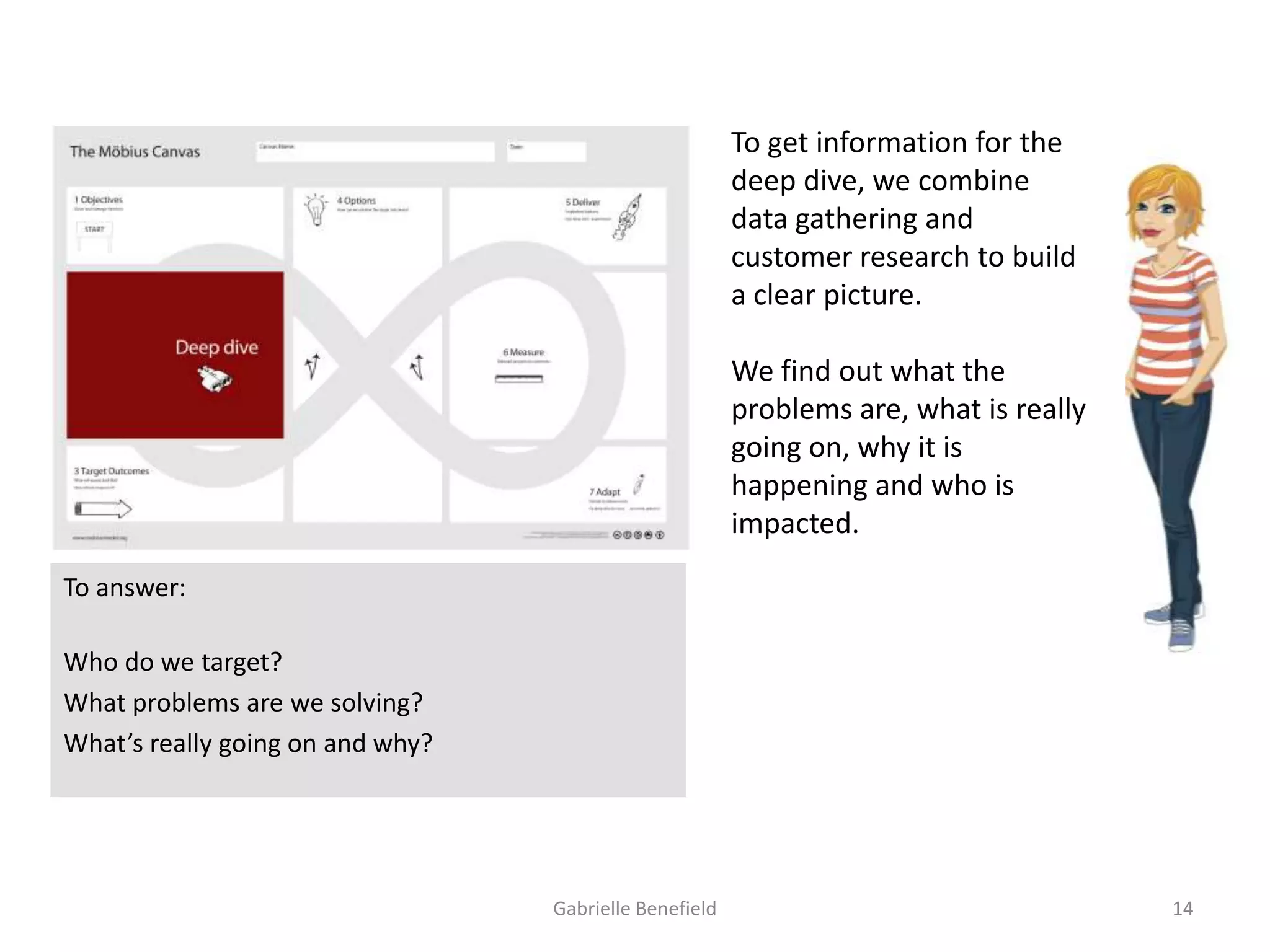
To get information for the
deep dive, we combine
data gathering and
customer research to build
a clear picture.
We find out what the
problems are, what is really
going on, why it is
happening and who is
impacted.
To answer:
Who do we target?
What problems are we solving?
What’s really going on and why?

Gabrielle Benefield

14
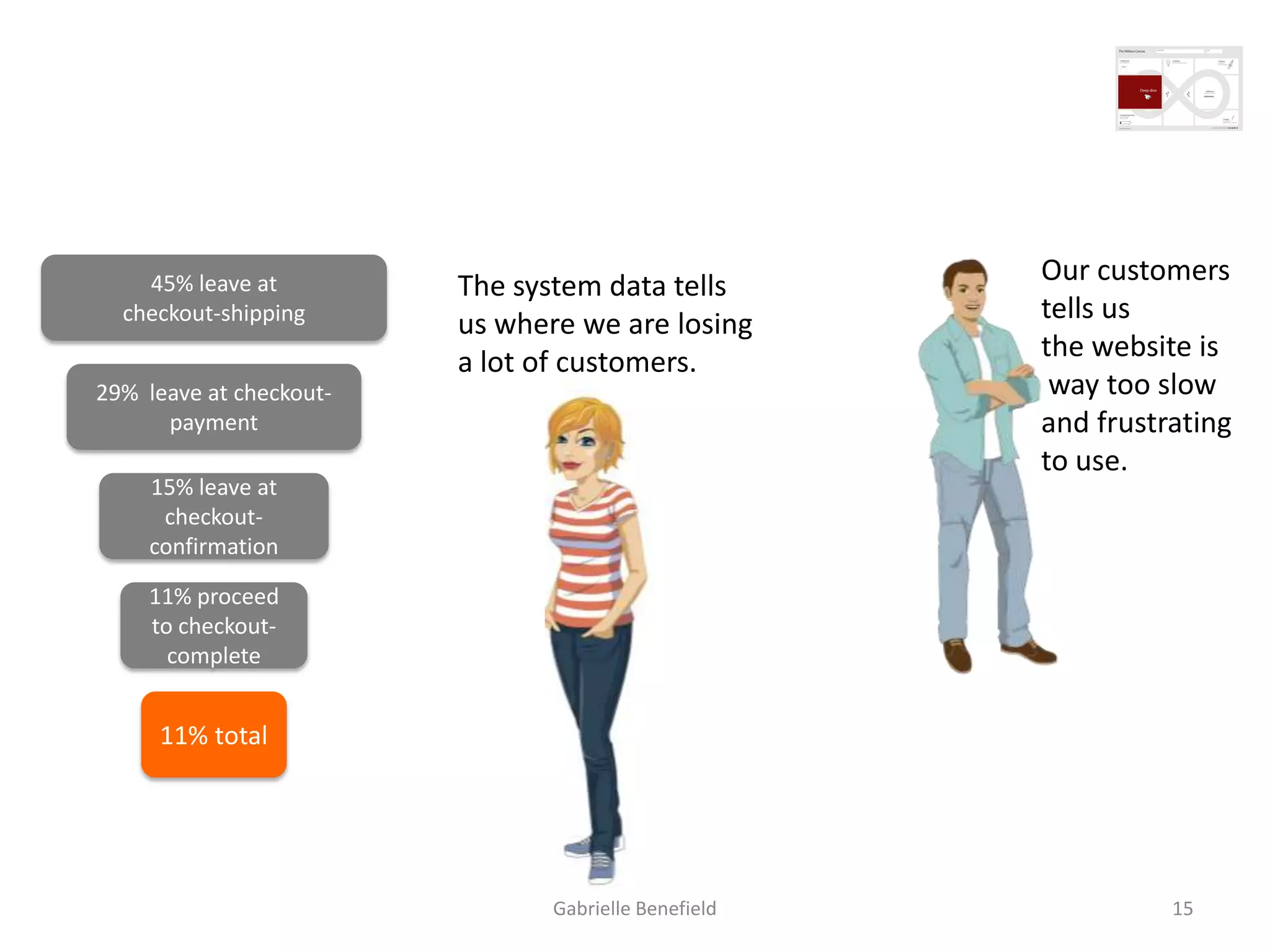
45% leave at
checkout-shipping

The system data tells
us where we are losing
a lot of customers.

29% leave at checkoutpayment
15% leave at
checkoutconfirmation

Our customers
tells us
the website is
way too slow
and frustrating
to use.

11% proceed
to checkoutcomplete

11% total

Gabrielle Benefield

15
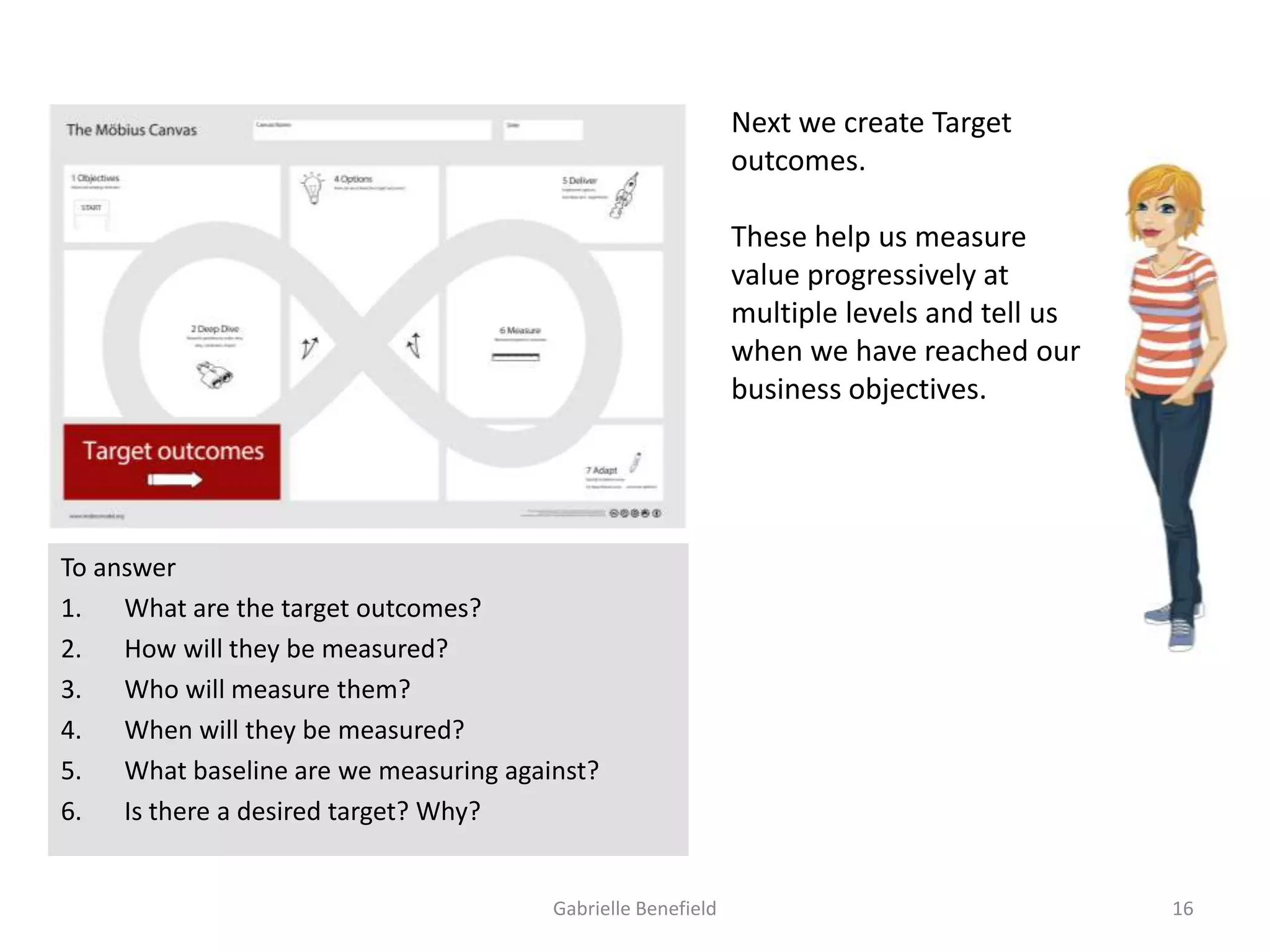
Next we create Target
outcomes.
These help us measure
value progressively at
multiple levels and tell us
when we have reached our
business objectives.

To answer
1. What are the target outcomes?
2. How will they be measured?
3. Who will measure them?
4. When will they be measured?
5. What baseline are we measuring against?
6. Is there a desired target? Why?

Gabrielle Benefield

16
Creating measurable outcomes
Outcomes are the desired results that deliver value.
Examples
• Increase revenue by 15%
• Increase checkout conversion rates by 19%
• Decrease time to create a report by 4 minutes

Gabrielle Benefield

17
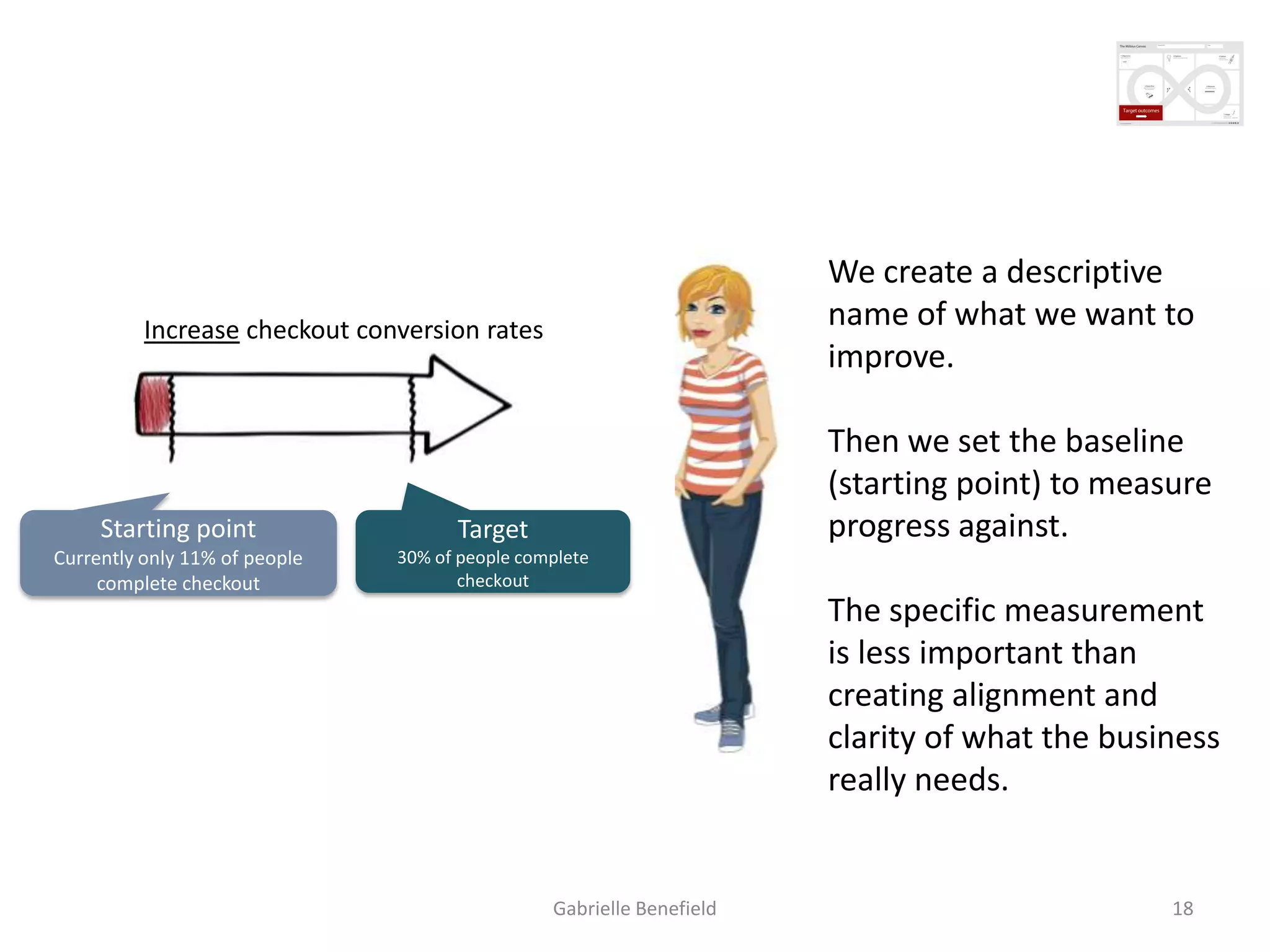
We create a descriptive
name of what we want to
improve.

Increase checkout conversion rates

Then we set the baseline
(starting point) to measure
progress against.

Starting point

Target

Currently only 11% of people
complete checkout

30% of people complete
checkout

The specific measurement
is less important than
creating alignment and
clarity of what the business
really needs.

Gabrielle Benefield

18
Creating measurable outcomes
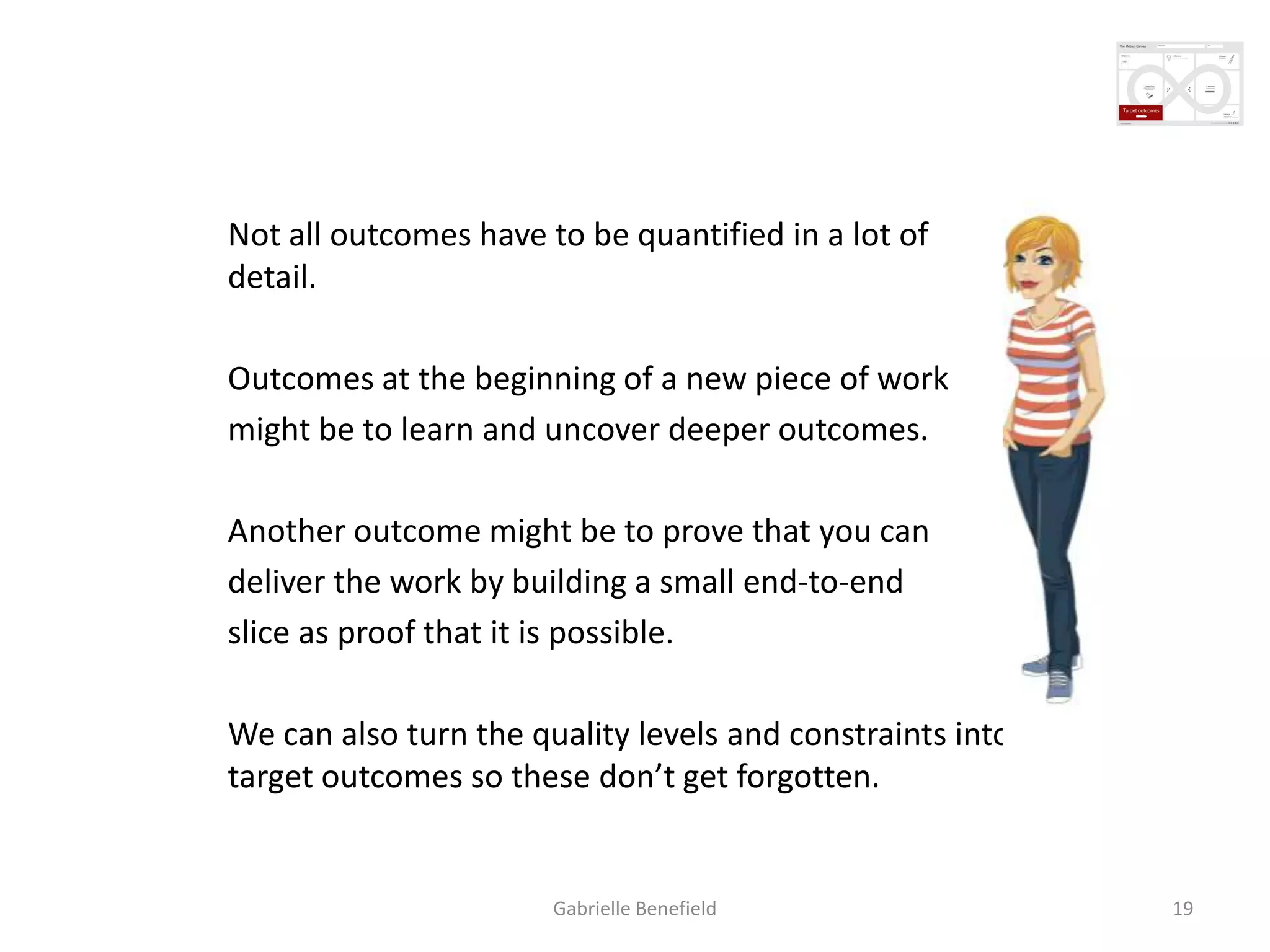
Not all outcomes have to be quantified in a lot of
detail.
Outcomes at the beginning of a new piece of work
might be to learn and uncover deeper outcomes.
Another outcome might be to prove that you can
deliver the work by building a small end-to-end
slice as proof that it is possible.
We can also turn the quality levels and constraints into
target outcomes so these don’t get forgotten.

Gabrielle Benefield

19
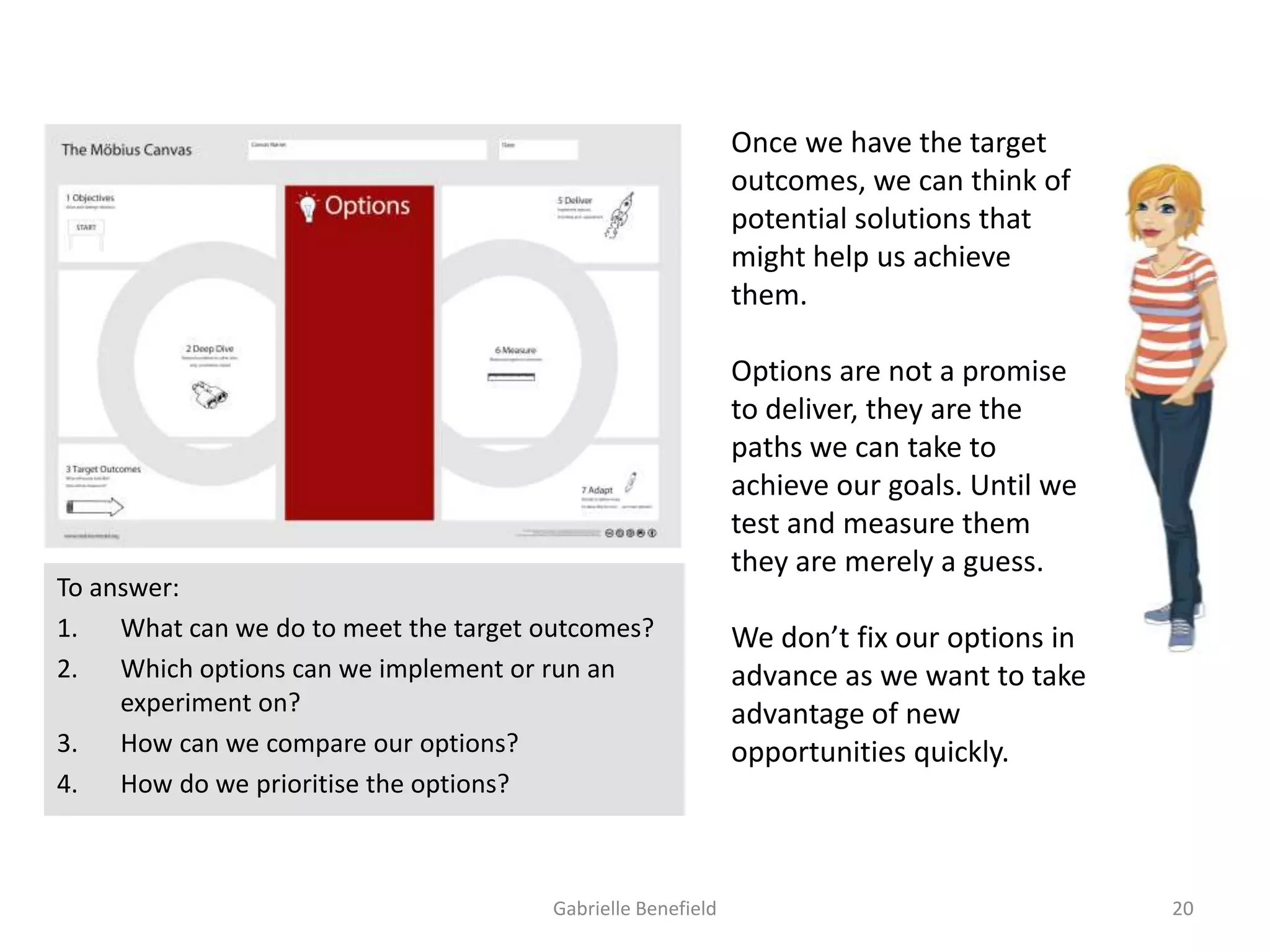
Once we have the target
outcomes, we can think of
potential solutions that
might help us achieve
them.

To answer:
1.
What can we do to meet the target outcomes?
2.
Which options can we implement or run an
experiment on?
3.
How can we compare our options?
4.
How do we prioritise the options?

Gabrielle Benefield

Options are not a promise
to deliver, they are the
paths we can take to
achieve our goals. Until we
test and measure them
they are merely a guess.
We don’t fix our options in
advance as we want to take
advantage of new
opportunities quickly.

20
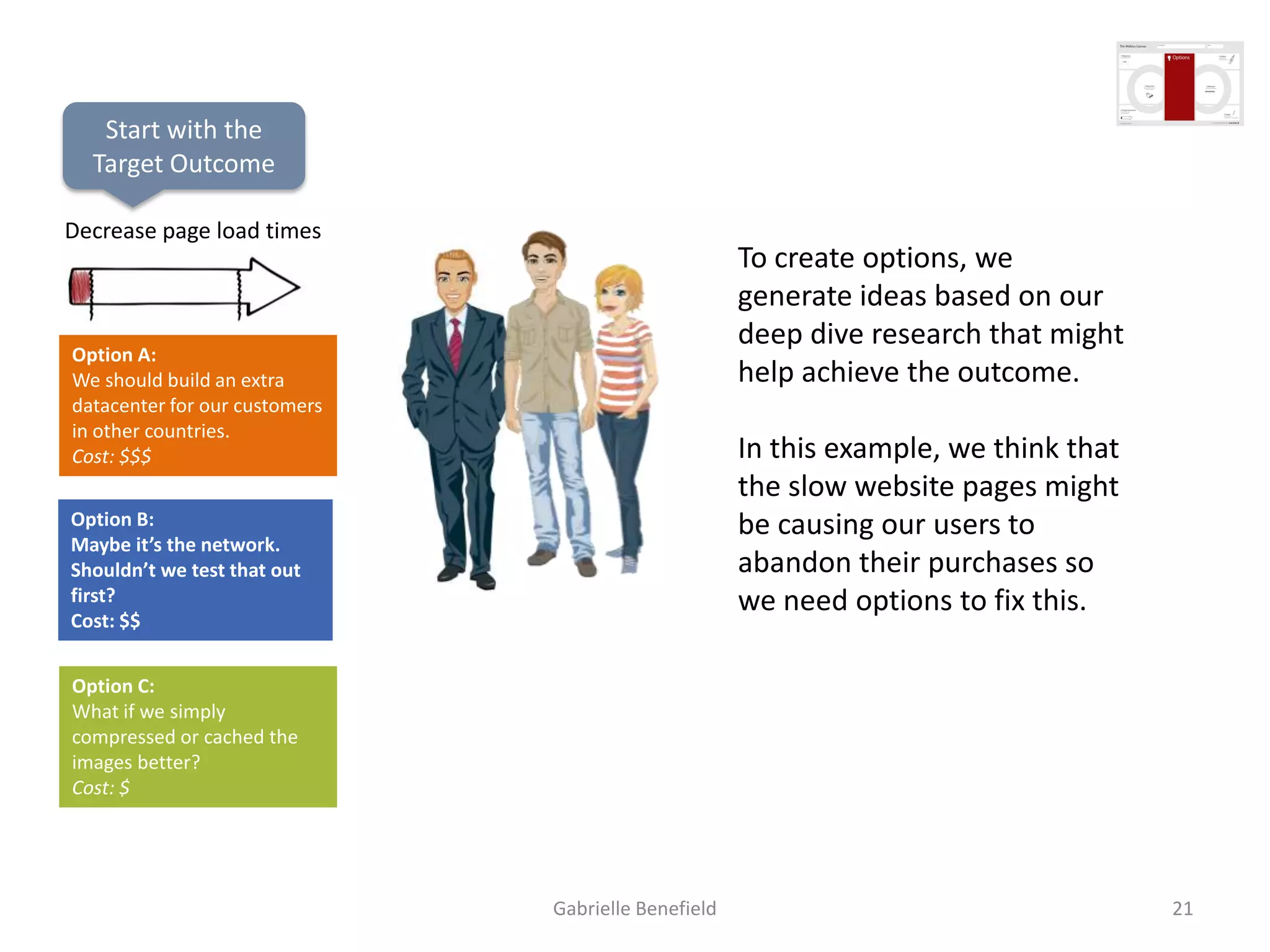
Start with the
Target Outcome
Decrease page load times

To create options, we
generate ideas based on our
deep dive research that might
help achieve the outcome.

Option A:
We should build an extra
datacenter for our customers
in other countries.
Cost: $$$

In this example, we think that
the slow website pages might
be causing our users to
abandon their purchases so
we need options to fix this.

Option B:
Maybe it’s the network.
Shouldn’t we test that out
first?
Cost: $$
Option C:
What if we simply
compressed or cached the
images better?
Cost: $

Gabrielle Benefield

21
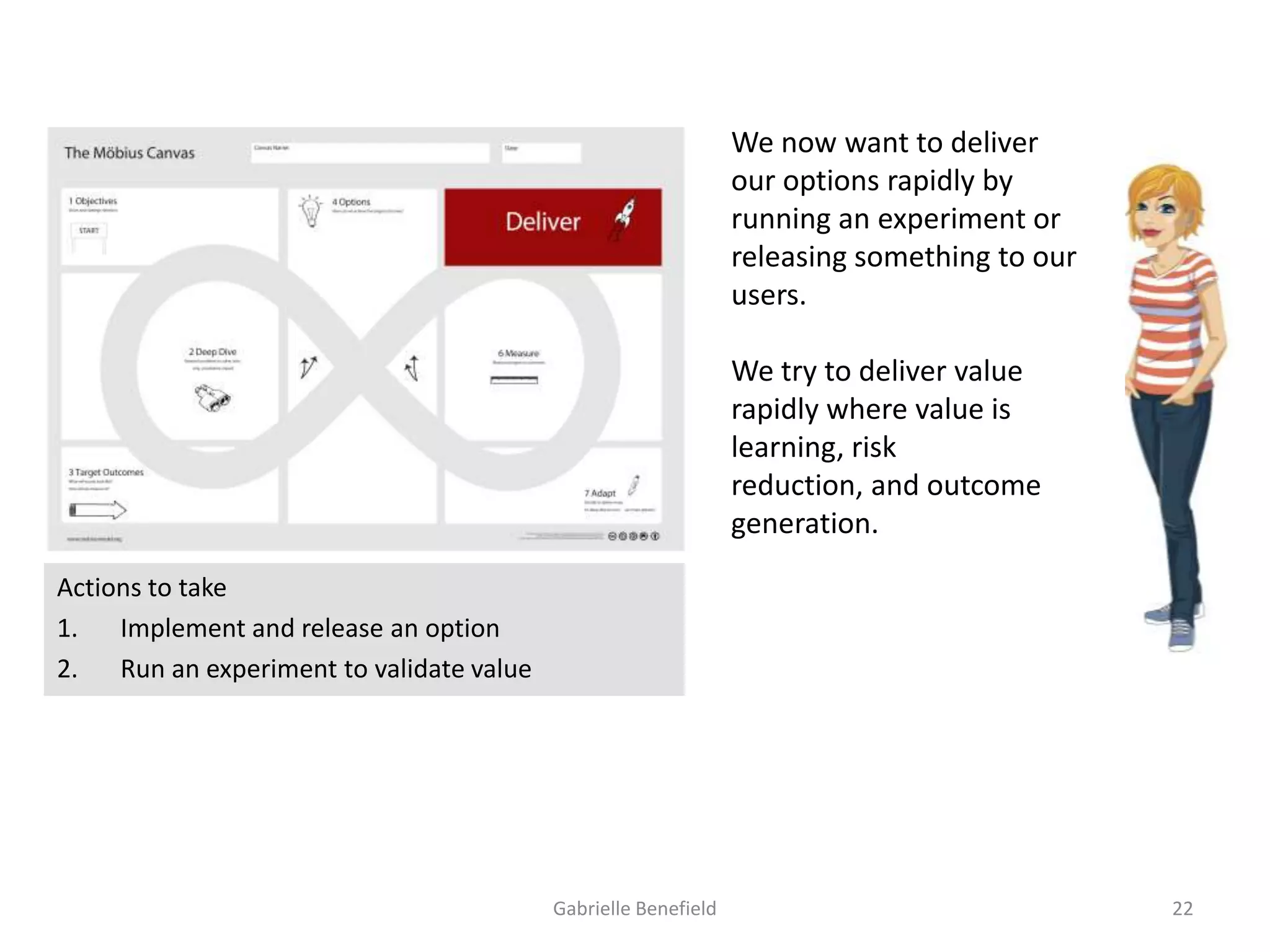
We now want to deliver
our options rapidly by
running an experiment or
releasing something to our
users.
We try to deliver value
rapidly where value is
learning, risk reduction,
and outcome generation.
Actions to take
1.
Implement and release an option
2.
Run an experiment to validate value

Gabrielle Benefield

22
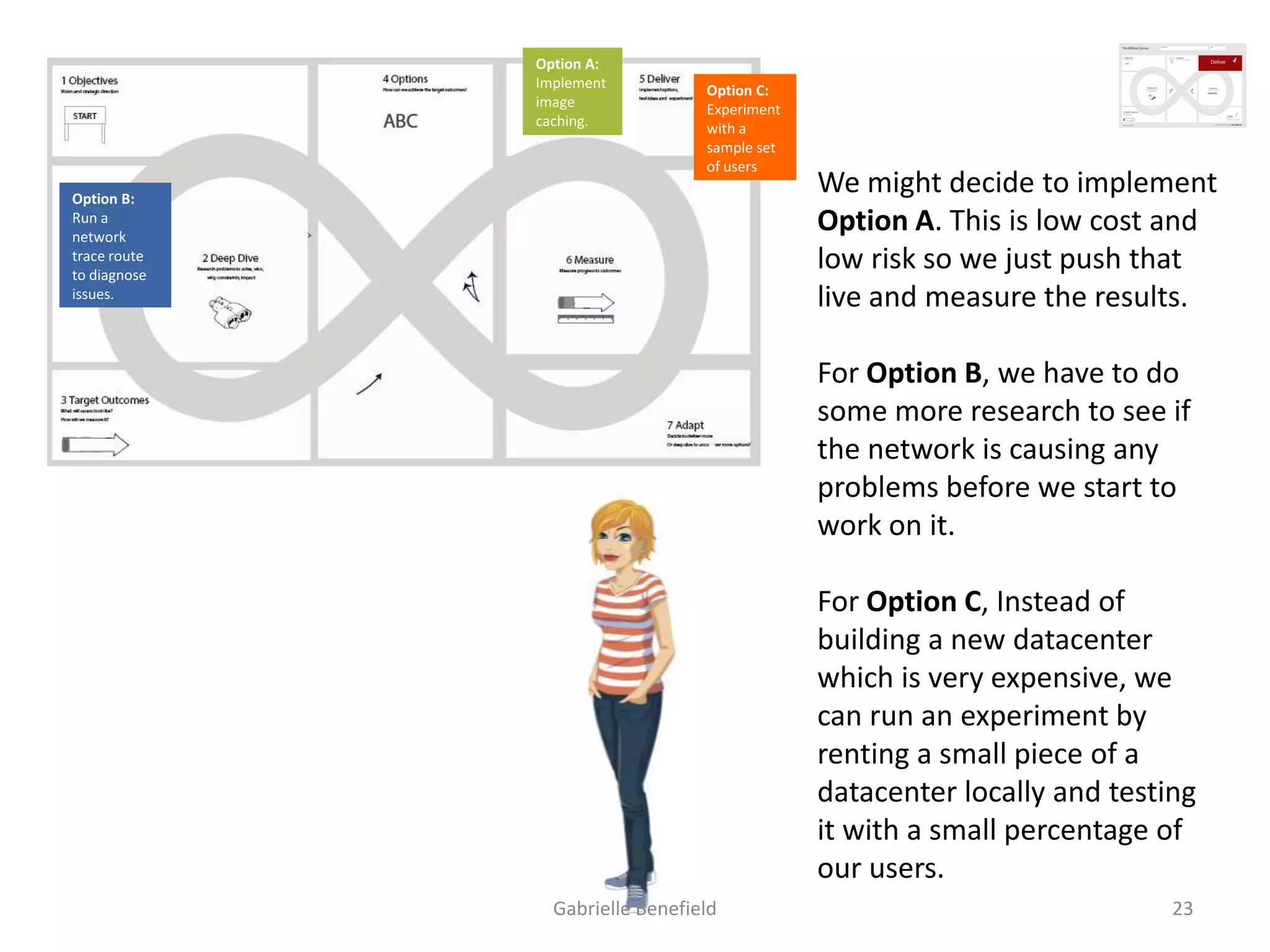
Option A:
Implement
image
caching.

Option C:
Experiment
with a
sample set
of users

Option B:
Run a
network
trace route
to diagnose
issues.

We might decide to implement
Option A. This is low cost and
low risk so we just push that
live and measure the results.
For Option B, we have to do
some more research to see if
the network is causing any
problems before we start to
work on it.
For Option C, Instead of
building a new datacenter
which is very expensive, we
can run an experiment by
renting a small piece of a
datacenter locally and testing
it with a small percentage of
our users.

Gabrielle Benefield

23
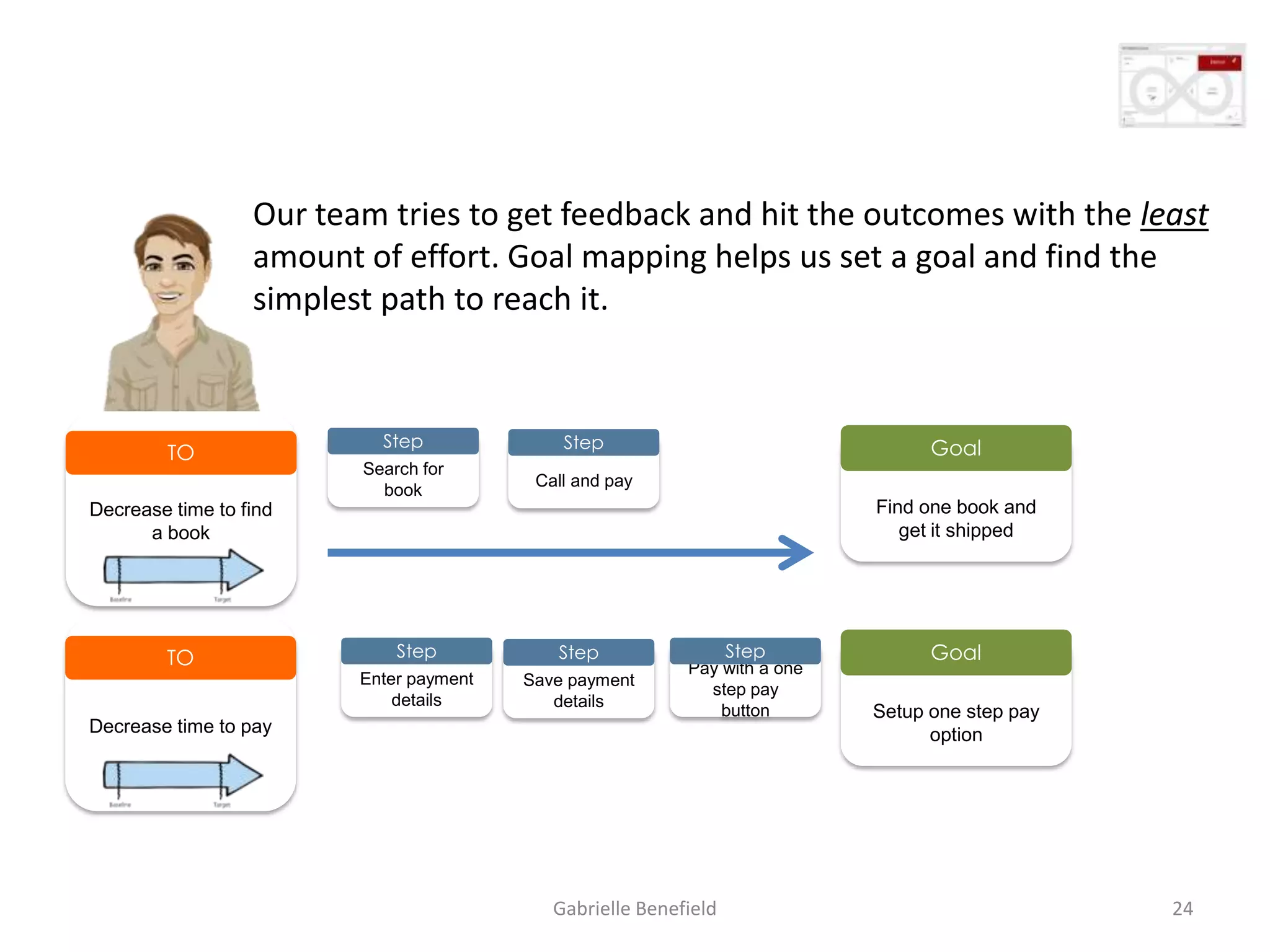
Our team tries to get feedback and hit the outcomes with the least
amount of effort. Goal mapping helps us set a goal and find the
simplest path to reach it.

TO

Step

Step

Search for
book

Call and pay

Goal
Find one book and
get it shipped

Decrease time to find
a book

TO

Step
Enter payment
details

Decrease time to pay

Step
Save payment
details

Step
Pay with a one
step pay
button

Gabrielle Benefield

Goal
Setup one step pay
option

24
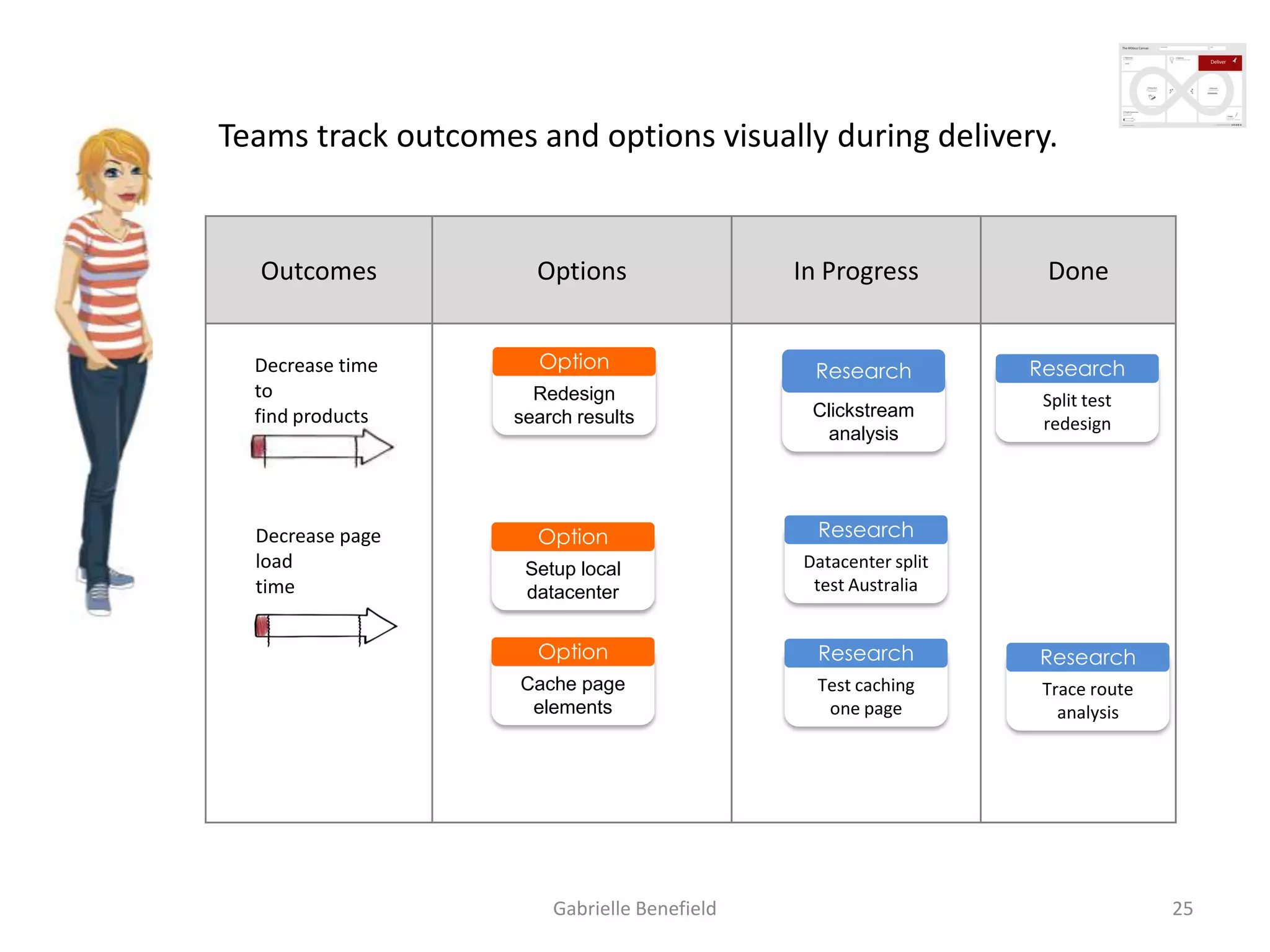
Teams track outcomes and options visually during delivery.

Outcomes

Options

Decrease time
to
find products

Option

Decrease page
load
time

Redesign
search results

In Progress

Done

Research

Research

Clickstream
analysis

Split test
redesign

Option

Research

Setup local
datacenter

Datacenter split
test Australia

Option

Research

Research

Cache page
elements

Test caching
one page

Trace route
analysis

Gabrielle Benefield

25
As options and
experiments are delivered,
the results are measured
against the target
outcomes.

Measure progress
1.
Did we positively impact the target outcome?
2.
By how much?

Gabrielle Benefield

26
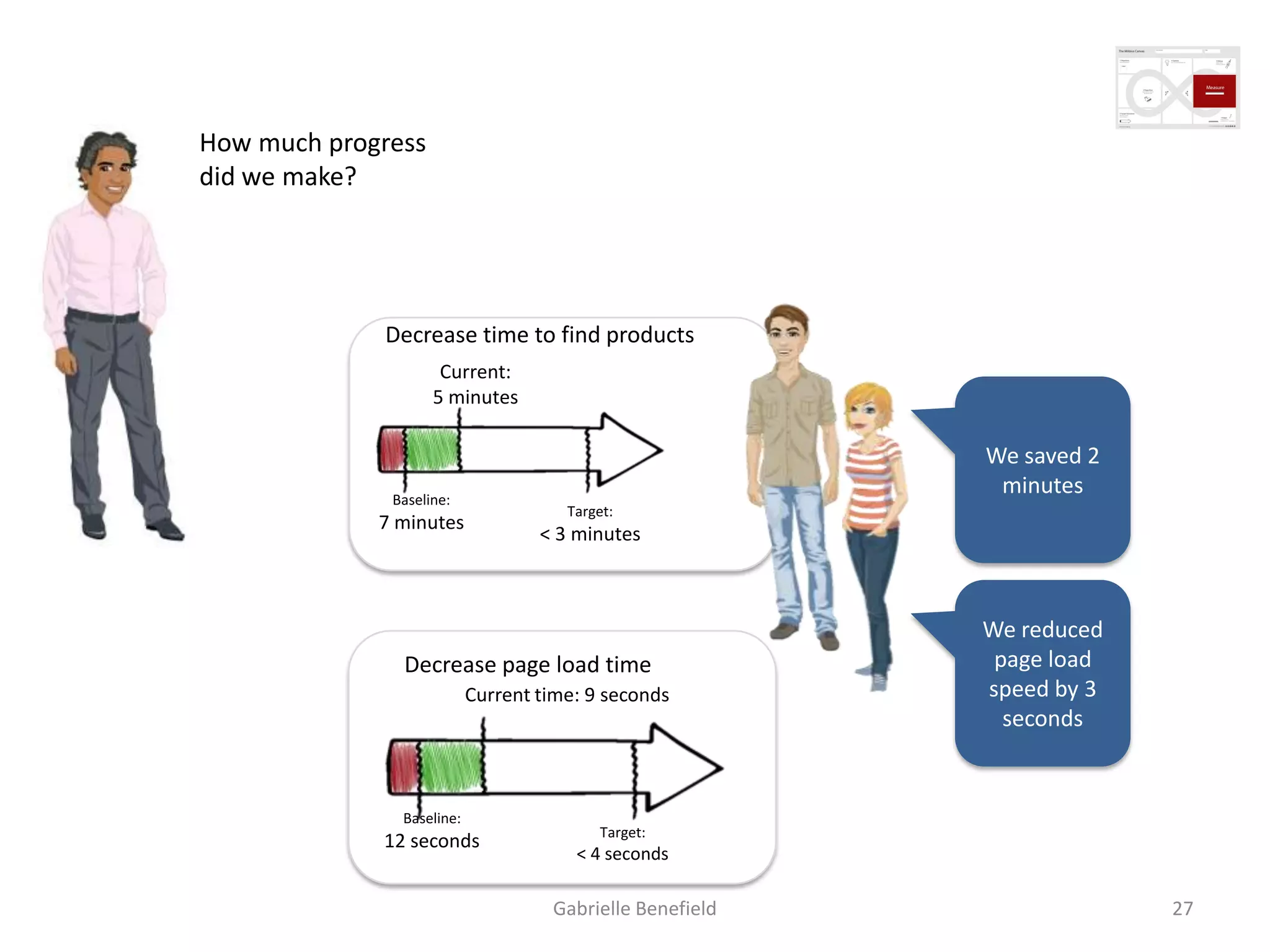
How much progress
did we make?

Decrease time to find products
Current:
5 minutes

We saved 2
minutes

Baseline:

Target:

7 minutes

< 3 minutes

Decrease page load time
Current time: 9 seconds

Baseline:

12 seconds

We reduced
page load
speed by 3
seconds

Target:

< 4 seconds

Gabrielle Benefield

27
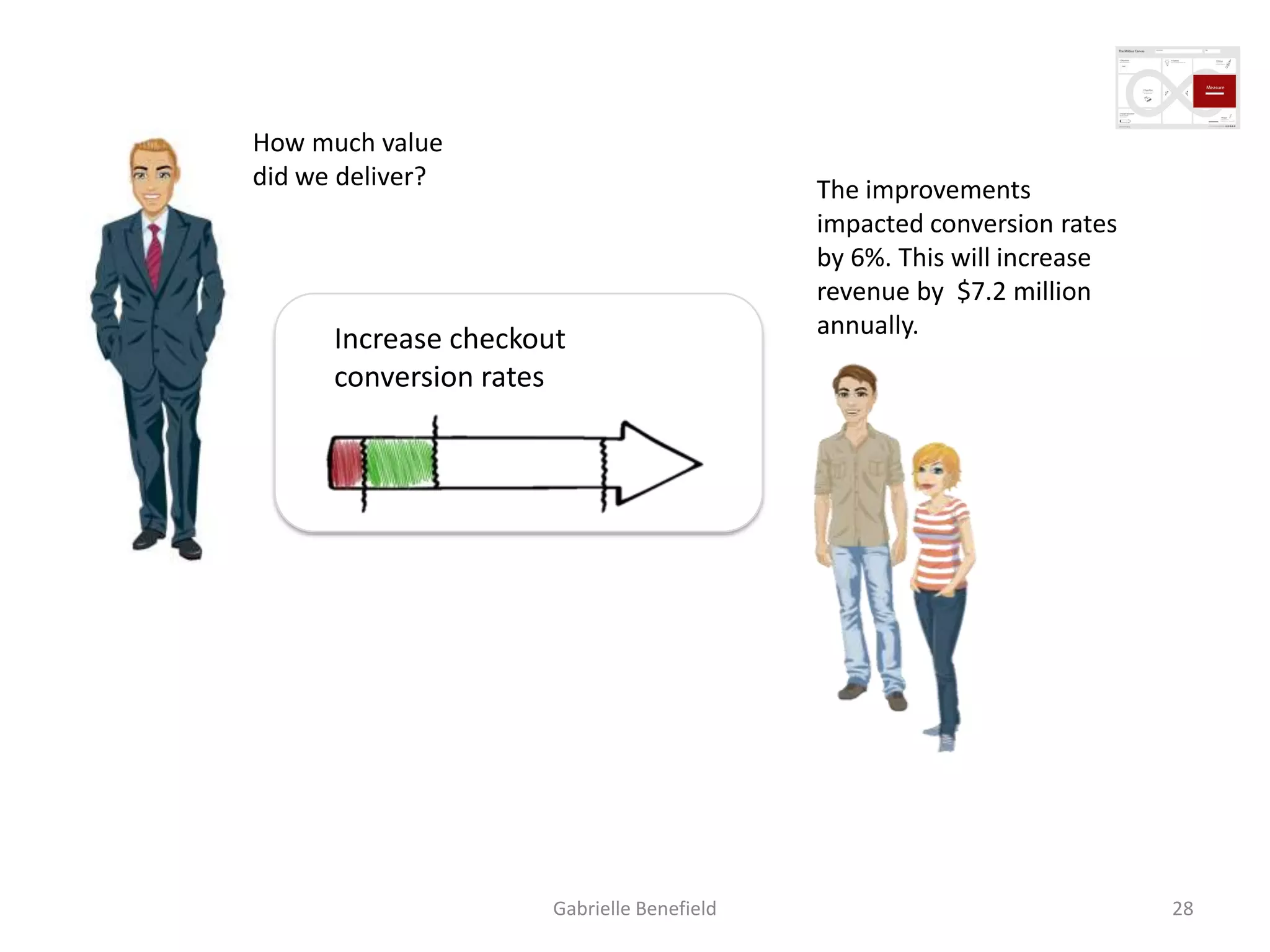
How much value
did we deliver?

Increase checkout
conversion rates

Gabrielle Benefield

The improvements
impacted conversion rates
by 6%. This will increase
revenue by $7.2 million
annually.

28
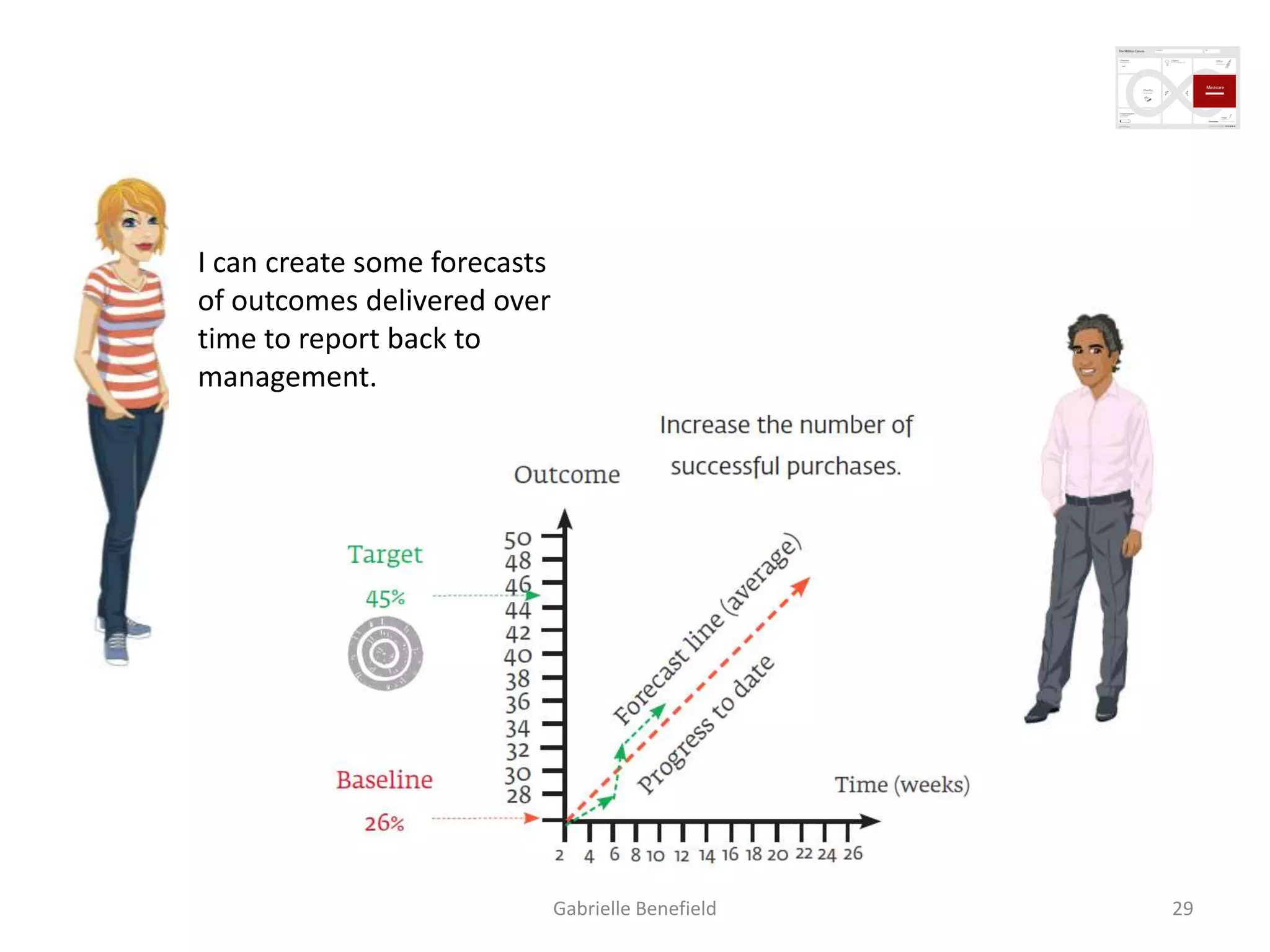
I can create some forecasts
of outcomes delivered over
time to report back to
management.

Gabrielle Benefield

29
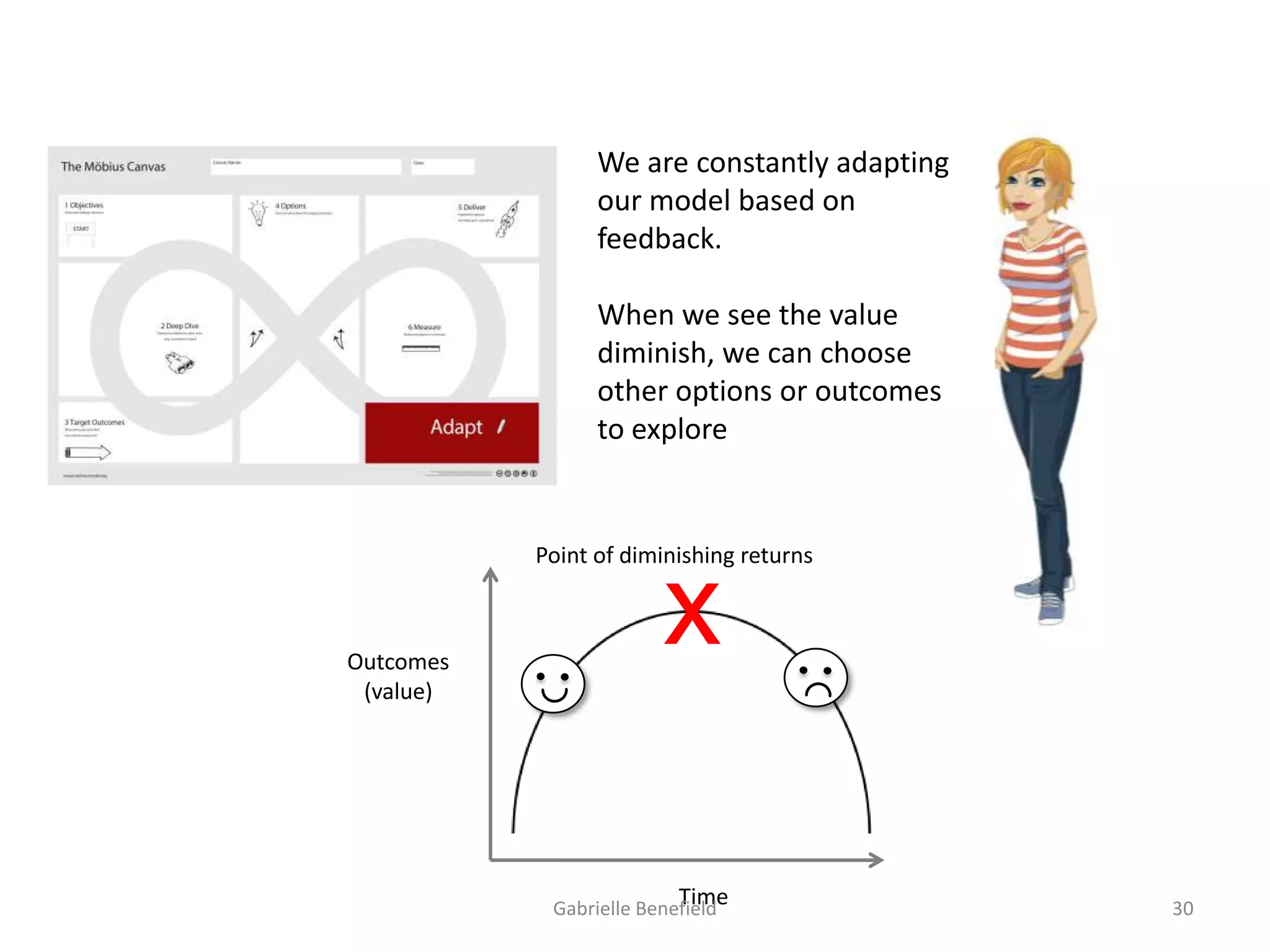
We are constantly adapting
our model based on
feedback.
When we see the value
diminish, we can choose
other options or outcomes
to explore

Point of diminishing returns

Outcomes
(value)

x

Time

Gabrielle Benefield

30
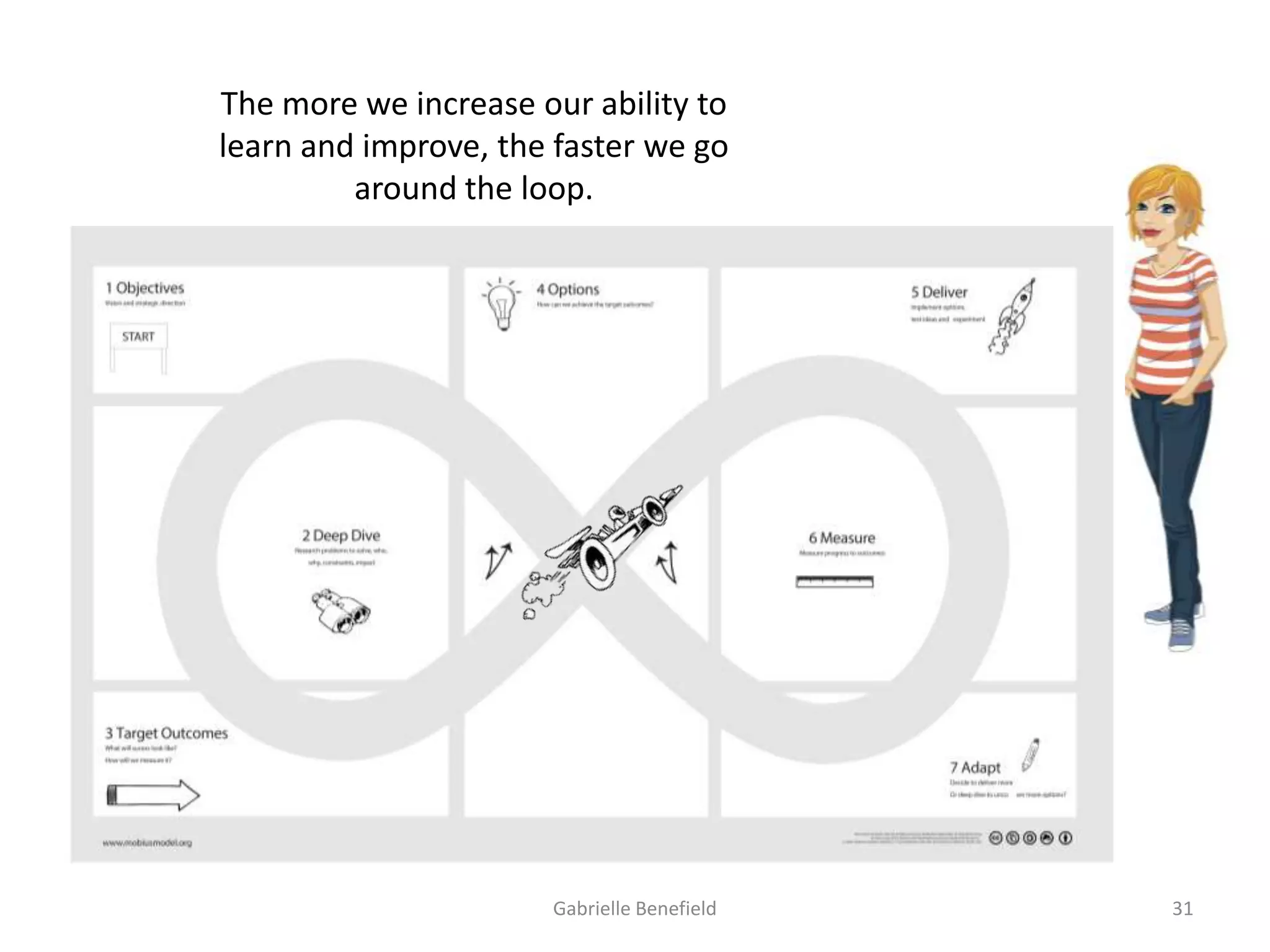
The more we increase our ability to
learn and improve, the faster we go
around the loop.

Gabrielle Benefield

31
Blog at:
http://evolvebeyond.com/blog/
Download the canvas at:
http://evolvebeyond.com/resources/
Read more about Mobius at:
http://www.mobiusmodel.org/
Gabrielle Benefield

32

Mobius slideshare - how to measure value using outcome metrics

  • 1.
  • 2.
    What is Möbius? Möbiusis an outcome delivery framework. Gabrielle Benefield 2
  • 3.
    The left sideof Möbius sets the strategic outcomes. The right side delivers ideas rapidly and measures their impact. Gabrielle Benefield 3
  • 4.
    We can use theMöbius canvas to model the steps. Gabrielle Benefield 4
  • 5.
    The first step isto create the vision and strategic objectives. Gabrielle Benefield 5
  • 6.
    The deep dive isfor rapid research and learning. Gabrielle Benefield 6
  • 7.
    The next step isto create Target outcomes to measure value against progressively. Gabrielle Benefield 7
  • 8.
    Once we have thetarget outcomes, we can think of potential solutions that might help us achieve them. Gabrielle Benefield 8
  • 9.
    Delivery is where we workon the options. Options could be things we choose to implement or to test out an idea with an experiment. Gabrielle Benefield 9
  • 10.
    As options and experiments aredelivered, the results are measured against the target outcomes. Gabrielle Benefield 10
  • 11.
  • 12.
    Möbius works ina continuous flow. Teams don’t have to go in a sequence but can move where they need to around the loop. Gabrielle Benefield 12
  • 13.
    This is anexample from an e-commerce company. Often the initial objectives and vision are not very clear nor measurable. They also point to solutions or symptoms rather than targeting the real problems. Objectives for an e-commerce platform 1. 2. 3. Increase shopping cart conversions Make it user friendly Help users find what they need quickly Gabrielle Benefield The deep dive will help us understand what is really going on and where to focus. 13
  • 14.
    To get informationfor the deep dive, we combine data gathering and customer research to build a clear picture. We find out what the problems are, what is really going on, why it is happening and who is impacted. To answer: Who do we target? What problems are we solving? What’s really going on and why? Gabrielle Benefield 14
  • 15.
    45% leave at checkout-shipping Thesystem data tells us where we are losing a lot of customers. 29% leave at checkoutpayment 15% leave at checkoutconfirmation Our customers tells us the website is way too slow and frustrating to use. 11% proceed to checkoutcomplete 11% total Gabrielle Benefield 15
  • 16.
    Next we createTarget outcomes. These help us measure value progressively at multiple levels and tell us when we have reached our business objectives. To answer 1. What are the target outcomes? 2. How will they be measured? 3. Who will measure them? 4. When will they be measured? 5. What baseline are we measuring against? 6. Is there a desired target? Why? Gabrielle Benefield 16
  • 17.
    Creating measurable outcomes Outcomesare the desired results that deliver value. Examples • Increase revenue by 15% • Increase checkout conversion rates by 19% • Decrease time to create a report by 4 minutes Gabrielle Benefield 17
  • 18.
    We create adescriptive name of what we want to improve. Increase checkout conversion rates Then we set the baseline (starting point) to measure progress against. Starting point Target Currently only 11% of people complete checkout 30% of people complete checkout The specific measurement is less important than creating alignment and clarity of what the business really needs. Gabrielle Benefield 18
  • 19.
    Creating measurable outcomes Notall outcomes have to be quantified in a lot of detail. Outcomes at the beginning of a new piece of work might be to learn and uncover deeper outcomes. Another outcome might be to prove that you can deliver the work by building a small end-to-end slice as proof that it is possible. We can also turn the quality levels and constraints into target outcomes so these don’t get forgotten. Gabrielle Benefield 19
  • 20.
    Once we havethe target outcomes, we can think of potential solutions that might help us achieve them. To answer: 1. What can we do to meet the target outcomes? 2. Which options can we implement or run an experiment on? 3. How can we compare our options? 4. How do we prioritise the options? Gabrielle Benefield Options are not a promise to deliver, they are the paths we can take to achieve our goals. Until we test and measure them they are merely a guess. We don’t fix our options in advance as we want to take advantage of new opportunities quickly. 20
  • 21.
    Start with the TargetOutcome Decrease page load times To create options, we generate ideas based on our deep dive research that might help achieve the outcome. Option A: We should build an extra datacenter for our customers in other countries. Cost: $$$ In this example, we think that the slow website pages might be causing our users to abandon their purchases so we need options to fix this. Option B: Maybe it’s the network. Shouldn’t we test that out first? Cost: $$ Option C: What if we simply compressed or cached the images better? Cost: $ Gabrielle Benefield 21
  • 22.
    We now wantto deliver our options rapidly by running an experiment or releasing something to our users. We try to deliver value rapidly where value is learning, risk reduction, and outcome generation. Actions to take 1. Implement and release an option 2. Run an experiment to validate value Gabrielle Benefield 22
  • 23.
    Option A: Implement image caching. Option C: Experiment witha sample set of users Option B: Run a network trace route to diagnose issues. We might decide to implement Option A. This is low cost and low risk so we just push that live and measure the results. For Option B, we have to do some more research to see if the network is causing any problems before we start to work on it. For Option C, Instead of building a new datacenter which is very expensive, we can run an experiment by renting a small piece of a datacenter locally and testing it with a small percentage of our users. Gabrielle Benefield 23
  • 24.
    Our team triesto get feedback and hit the outcomes with the least amount of effort. Goal mapping helps us set a goal and find the simplest path to reach it. TO Step Step Search for book Call and pay Goal Find one book and get it shipped Decrease time to find a book TO Step Enter payment details Decrease time to pay Step Save payment details Step Pay with a one step pay button Gabrielle Benefield Goal Setup one step pay option 24
  • 25.
    Teams track outcomesand options visually during delivery. Outcomes Options Decrease time to find products Option Decrease page load time Redesign search results In Progress Done Research Research Clickstream analysis Split test redesign Option Research Setup local datacenter Datacenter split test Australia Option Research Research Cache page elements Test caching one page Trace route analysis Gabrielle Benefield 25
  • 26.
    As options and experimentsare delivered, the results are measured against the target outcomes. Measure progress 1. Did we positively impact the target outcome? 2. By how much? Gabrielle Benefield 26
  • 27.
    How much progress didwe make? Decrease time to find products Current: 5 minutes We saved 2 minutes Baseline: Target: 7 minutes < 3 minutes Decrease page load time Current time: 9 seconds Baseline: 12 seconds We reduced page load speed by 3 seconds Target: < 4 seconds Gabrielle Benefield 27
  • 28.
    How much value didwe deliver? Increase checkout conversion rates Gabrielle Benefield The improvements impacted conversion rates by 6%. This will increase revenue by $7.2 million annually. 28
  • 29.
    I can createsome forecasts of outcomes delivered over time to report back to management. Gabrielle Benefield 29
  • 30.
    We are constantlyadapting our model based on feedback. When we see the value diminish, we can choose other options or outcomes to explore Point of diminishing returns Outcomes (value) x Time Gabrielle Benefield 30
  • 31.
    The more weincrease our ability to learn and improve, the faster we go around the loop. Gabrielle Benefield 31
  • 32.
    Blog at: http://evolvebeyond.com/blog/ Download thecanvas at: http://evolvebeyond.com/resources/ Read more about Mobius at: http://www.mobiusmodel.org/ Gabrielle Benefield 32