Agile Stories, Estimating
and Planning
www.torak.com
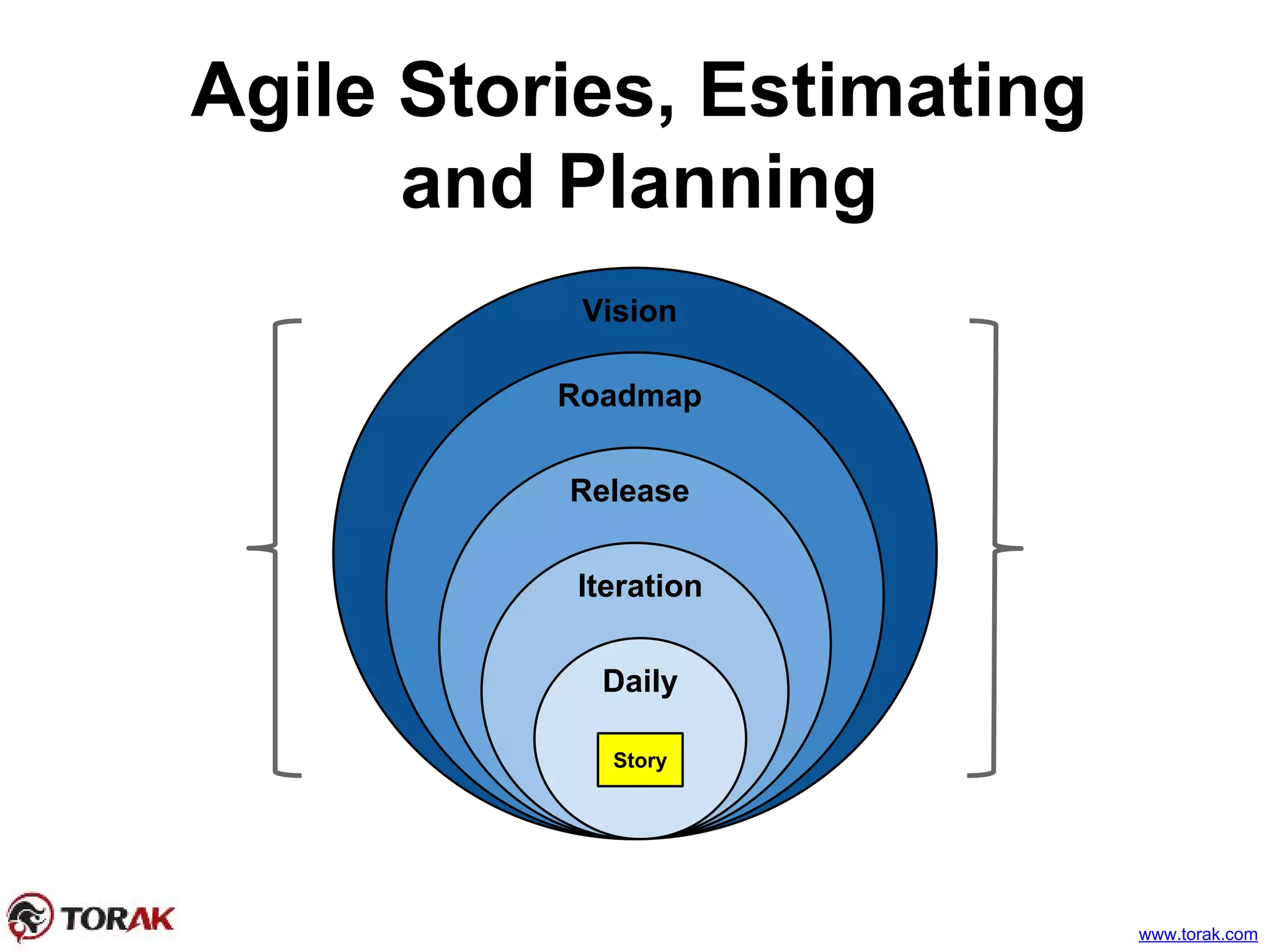
Vision
Roadmap
Release
Iteration
Daily
Story
About Dimitri Ponomareff
www.torak.com
Dimitri Ponomareff (www.linkedin.com/in/dimka5) is a Coach.
Whether it's a sports team, software products or entire
organizations, Dimitri has that ability to relate and energize
people. He is consistently recognized as a very passionate and
successful change agent, with an overwhelming capacity to
motivate and mobilize teams on their path to continuous
improvements. He is a master facilitator, as well as a captivating
speaker with consistent, positive feedback regarding his ability to
engage an audience.
As a certified Coach, Project Manager and Facilitator of "The 7 Habits of Highly Effective
People", Dimitri brings a full spectrum of knowledge in his delivery of methodologies. Through
teaching by example, he is able to build teams of people who understand where to focus their
work to generate the most value.
He has coached and provided tailor-made services and training for a multitude of organizations.
The short list includes, American Express, Charles Schwab, Bank of America, Morgan
Stanley, Best Western, Choice Hotels, JDA Software, LifeLock, First Solar, Infusionsoft
and Mayo Clinic. Dimitri enjoys his work, and does everything to ensure he shares his
knowledge with others who seek it.
Agile background for stories, estimating and
planning
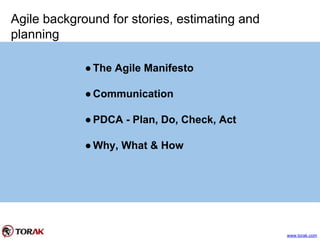
●The Agile Manifesto
●Communication
●PDCA - Plan, Do, Check, Act
●Why, What & How
www.torak.com
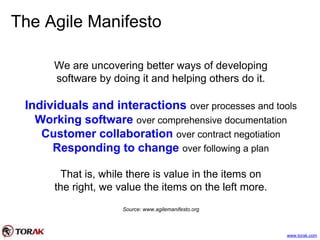
The Agile Manifesto
We are uncovering better ways of developing
software by doing it and helping others do it.
Individuals and interactions over processes and tools
Working software over comprehensive documentation
Customer collaboration over contract negotiation
Responding to change over following a plan
That is, while there is value in the items on
the right, we value the items on the left more.
Source: www.agilemanifesto.org
www.torak.com
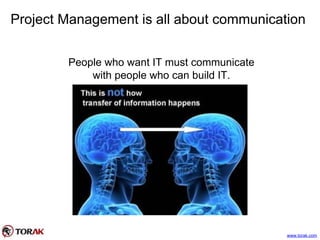
Project Management is all about communication
People who want IT must communicate
with people who can build IT.
www.torak.com
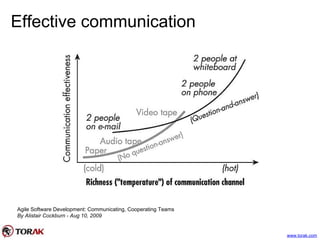
Effective communication
Agile Software Development: Communicating, Cooperating Teams
By Alistair Cockburn - Aug 10, 2009
www.torak.com
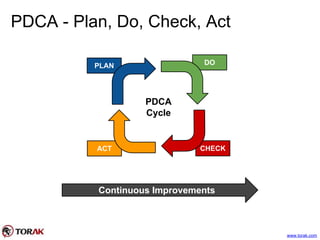
PDCA - Plan, Do, Check, Act
ACT
PLAN DO
PDCA
Cycle
CHECK
Continuous Improvements
www.torak.com
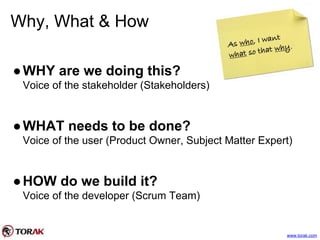
Why, What & How
●WHY are we doing this?
Voice of the stakeholder (Stakeholders)
●WHAT needs to be done?
Voice of the user (Product Owner, Subject Matter Expert)
●HOW do we build it?
Voice of the developer (Scrum Team)
www.torak.com
Agile Stories
●Work breakdown structure (WBS)
●What is a story?
○Story form
○Cards - Conversation - Confirmation
●Story writing workshops
○Epics and story breakdown
○INVEST guideline
●Stories vs. Use Cases vs. Requirements
●Product Backlog of stories
www.torak.com
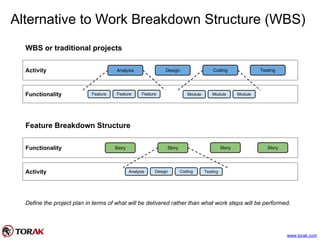
Alternative to Work Breakdown Structure (WBS)
Activity
Functionality
Analysis Design Coding Testing
Feature Feature Feature Module Module Module
WBS or traditional projects
Functionality
Activity
Story Story Story Story
Analysis Design Coding
Feature Breakdown Structure
Testing
Define the project plan in terms of what will be delivered rather than what work steps will be performed.
www.torak.com
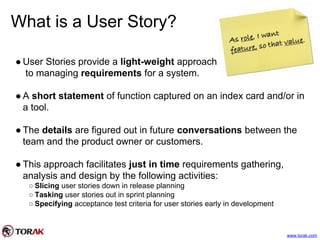
What is a User Story?
● User Stories provide a light-weight approach
to managing requirements for a system.
● A short statement of function captured on an index card and/or in
a tool.
● The details are figured out in future conversations between the
team and the product owner or customers.
● This approach facilitates just in time requirements gathering,
analysis and design by the following activities:
○ Slicing user stories down in release planning
○ Tasking user stories out in sprint planning
○ Specifying acceptance test criteria for user stories early in development
www.torak.com
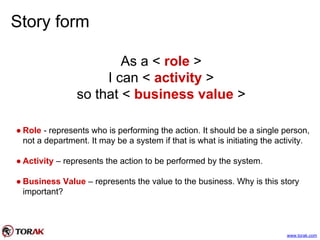
Story form
As a < role >
I can < activity >
so that < business value >
● Role - represents who is performing the action. It should be a single person,
not a department. It may be a system if that is what is initiating the activity.
● Activity – represents the action to be performed by the system.
● Business Value – represents the value to the business. Why is this story
important?
www.torak.com
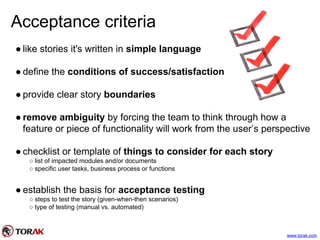
Acceptance criteria
● like stories it's written in simple language
● define the conditions of success/satisfaction
● provide clear story boundaries
● remove ambiguity by forcing the team to think through how a
feature or piece of functionality will work from the user’s perspective
● checklist or template of things to consider for each story
○ list of impacted modules and/or documents
○ specific user tasks, business process or functions
● establish the basis for acceptance testing
○ steps to test the story (given-when-then scenarios)
○ type of testing (manual vs. automated)
www.torak.com
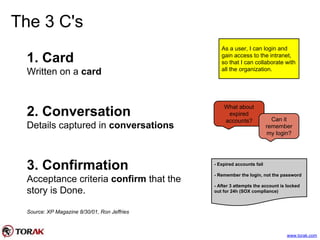
The 3 C's
1. Card
Written on a card
2. Conversation
Details captured in conversations
3. Confirmation
Acceptance criteria confirm that the
story is Done.
Source: XP Magazine 8/30/01, Ron Jeffries
As a user, I can login and
gain access to the intranet,
so that I can collaborate with
all the organization.
What about
expired
accounts? Can it
remember
my login?
- Expired accounts fail
- Remember the login, not the password
- After 3 attempts the account is locked
out for 24h (SOX compliance)
www.torak.com
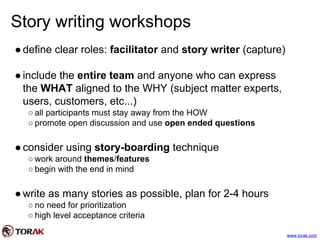
Story writing workshops
●define clear roles: facilitator and story writer (capture)
●include the entire team and anyone who can express
the WHAT aligned to the WHY (subject matter experts,
users, customers, etc...)
○ all participants must stay away from the HOW
○ promote open discussion and use open ended questions
●consider using story-boarding technique
○ work around themes/features
○ begin with the end in mind
●write as many stories as possible, plan for 2-4 hours
○ no need for prioritization
○ high level acceptance criteria
www.torak.com
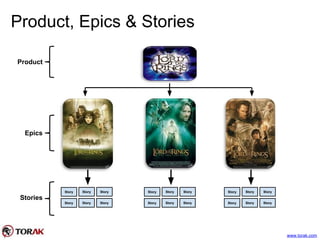
Product, Epics & Stories
Story Story Story
Story Story Story
Story Story Story
Story Story Story
Story Story Story
Story Story Story
Product
Epics
Stories
www.torak.com
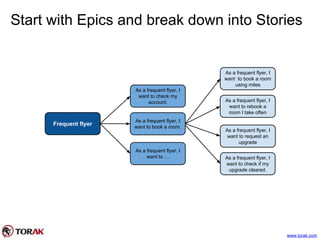
Start with Epics and break down into Stories
As a frequent flyer, I
want to rebook a
room I take often
As a frequent flyer, I
want to book a room
using miles
As a frequent flyer, I
want to request an
upgrade
As a frequent flyer, I
want to check if my
upgrade cleared.
As a frequent flyer, I
want to book a room.
As a frequent flyer, I
want to check my
account.
As a frequent flyer, I
want to …
Frequent flyer
www.torak.com
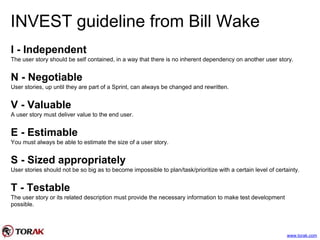
INVEST guideline from Bill Wake
I - Independent
The user story should be self contained, in a way that there is no inherent dependency on another user story.
N - Negotiable
User stories, up until they are part of a Sprint, can always be changed and rewritten.
V - Valuable
A user story must deliver value to the end user.
E - Estimable
You must always be able to estimate the size of a user story.
S - Sized appropriately
User stories should not be so big as to become impossible to plan/task/prioritize with a certain level of certainty.
T - Testable
The user story or its related description must provide the necessary information to make test development
possible.
www.torak.com
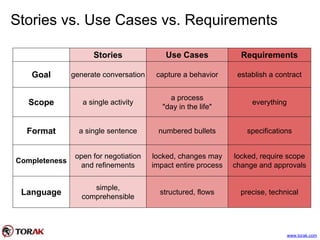
Stories vs. Use Cases vs. Requirements
Stories Use Cases Requirements
Goal generate conversation capture a behavior establish a contract
Scope a single activity
a process
"day in the life"
everything
Format a single sentence numbered bullets specifications
Completeness
open for negotiation
and refinements
locked, changes may
impact entire process
locked, require scope
change and approvals
Language
simple,
comprehensible
structured, flows precise, technical
www.torak.com
Product Backlog of stories
●a list of all desired work on the project “The requirements”
●owned, managed and prioritized by the Product Owner
●items estimated by the team
●re-prioritized at the start of each iteration
●ideally expressed such that each item has value to the users
or customers of the product
www.torak.com
Estimating
●The cone of uncertainty
●What is estimation?
●Estimation tools/techniques
●Story estimation
○Story points
○Task board
○SMART tasks
○Burn-down chart
www.torak.com
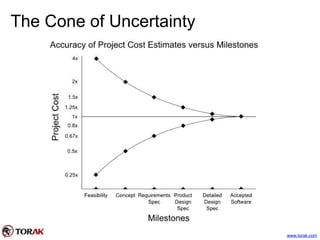
The Cone of Uncertainty
www.torak.com
What is estimation?
●Estimation
calculated approximation of a result which is usable even if
input data may be incomplete or uncertain
●Estimate
to judge tentatively or approximately the value, worth, or
significance of
●Point estimation
estimation in which a single value is assigned to a
parameter
www.torak.com
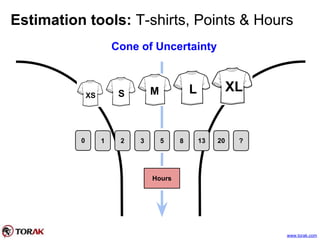
Estimation tools: T-shirts, Points & Hours
Cone of Uncertainty
13853210 20 ?
Hours
XS S
XLLM
www.torak.com
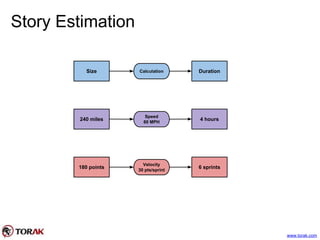
Story Estimation
Size DurationCalculation
240 miles 4 hours
Speed
60 MPH
180 points 6 sprints
Velocity
30 pts/sprint
www.torak.com
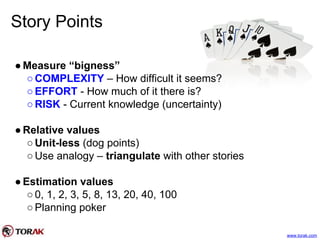
Story Points
●Measure “bigness”
○COMPLEXITY – How difficult it seems?
○EFFORT - How much of it there is?
○RISK - Current knowledge (uncertainty)
●Relative values
○Unit-less (dog points)
○Use analogy – triangulate with other stories
●Estimation values
○0, 1, 2, 3, 5, 8, 13, 20, 40, 100
○Planning poker
www.torak.com
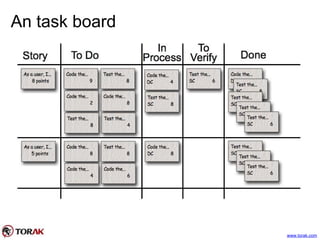
An task board
www.torak.com
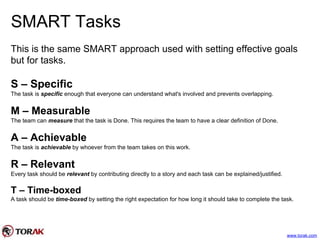
SMART Tasks
This is the same SMART approach used with setting effective goals
but for tasks.
S – Specific
The task is specific enough that everyone can understand what's involved and prevents overlapping.
M – Measurable
The team can measure that the task is Done. This requires the team to have a clear definition of Done.
A – Achievable
The task is achievable by whoever from the team takes on this work.
R – Relevant
Every task should be relevant by contributing directly to a story and each task can be explained/justified.
T – Time-boxed
A task should be time-boxed by setting the right expectation for how long it should take to complete the task.
www.torak.com
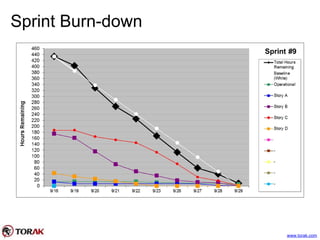
Sprint Burn-down
www.torak.com
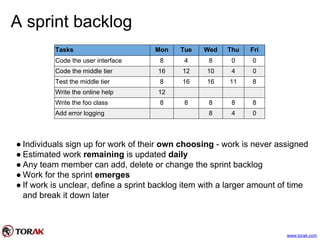
A sprint backlog
● Individuals sign up for work of their own choosing - work is never assigned
● Estimated work remaining is updated daily
● Any team member can add, delete or change the sprint backlog
● Work for the sprint emerges
● If work is unclear, define a sprint backlog item with a larger amount of time
and break it down later
Tasks Mon Tue Wed Thu Fri
Code the user interface 8 4 8 0 0
Code the middle tier 16 12 10 4 0
Test the middle tier 8 16 16 11 8
Write the online help 12
Write the foo class 8 8 8 8 8
Add error logging 8 4 0
www.torak.com
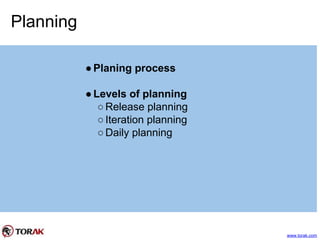
Planning
●Planing process
●Levels of planning
○Release planning
○Iteration planning
○Daily planning
www.torak.com
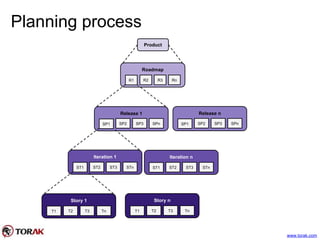
Planning process
Product
Roadmap
R1 R2 R3 Rn
Release 1
SP1
Iteration 1
ST1 STnST3ST2
Iteration n
ST1 STnST3ST2
Story 1
T1 TnT3T2
Story n
T1 TnT3T2
SPnSP3SP2
Release n
SP1 SPnSP3SP2
www.torak.com
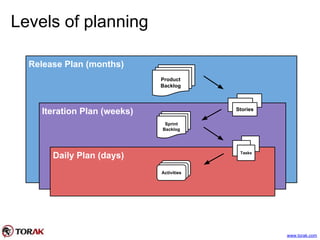
Levels of planning
Release Plan (months)
Iteration Plan (weeks)
Daily Plan (days)
Product
Backlog
Sprint
Backlog
Stories
Tasks
ActivitiesActivitiesActivities
www.torak.com
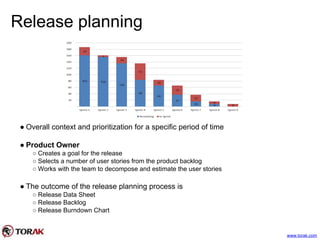
Release planning
● Overall context and prioritization for a specific period of time
● Product Owner
○ Creates a goal for the release
○ Selects a number of user stories from the product backlog
○ Works with the team to decompose and estimate the user stories
● The outcome of the release planning process is
○ Release Data Sheet
○ Release Backlog
○ Release Burndown Chart
www.torak.com
Iteration planning
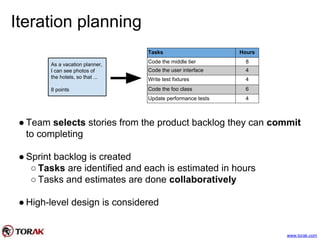
● Team selects stories from the product backlog they can commit
to completing
● Sprint backlog is created
○ Tasks are identified and each is estimated in hours
○ Tasks and estimates are done collaboratively
● High-level design is considered
As a vacation planner,
I can see photos of
the hotels, so that ...
8 points
Tasks Hours
Code the middle tier 8
Code the user interface 4
Write test fixtures 4
Code the foo class 6
Update performance tests 4
www.torak.com
Daily planning
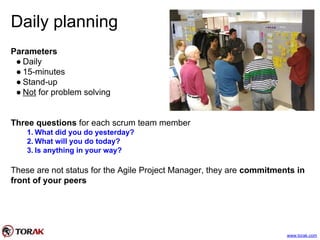
Parameters
● Daily
● 15-minutes
● Stand-up
● Not for problem solving
Three questions for each scrum team member
1. What did you do yesterday?
2. What will you do today?
3. Is anything in your way?
These are not status for the Agile Project Manager, they are commitments in
front of your peers
www.torak.com
© Torak, Inc. www.torak.com
Agile, Kanban & DevOps Coaching
Learn more at www.torak.com
Learn more at www.AgileTestingFramework.com
Learn more at www.kanbanzone.com
Thank You
www.torak.com
Resources and References
● www.scrumalliance.org
● www.mountaingoatsoftware.com/scrum
● www.controlchaos.com
● Agile and Iterative Development: A Manager’s Guide by Craig Larman
● Agile Estimating and Planning by Mike Cohn
● Agile Project Management with Scrum by Ken Schwaber
● Agile Retrospectives by Esther Derby and Diana Larsen
● Agile Software Development Ecosystems by Jim Highsmith
● Agile Software Development with Scrum by Ken Schwaber and Mike Beedle
● Scrum and The Enterprise by Ken Schwaber
● User Stories Applied for Agile Software Development by Mike Cohn
www.torak.com
This presentation was inspired by the work of many people and we have done our very best to
attribute all authors of texts and images, and recognize any copyrights. If you think that
anything in this presentation should be changed, added or removed, please contact us.
http://creativecommons.org/licenses/by-nc-nd/3.0/
www.torak.com

Agile stories, estimating and planning

  • 1.
    Agile Stories, Estimating andPlanning www.torak.com Vision Roadmap Release Iteration Daily Story
  • 2.
    About Dimitri Ponomareff www.torak.com DimitriPonomareff (www.linkedin.com/in/dimka5) is a Coach. Whether it's a sports team, software products or entire organizations, Dimitri has that ability to relate and energize people. He is consistently recognized as a very passionate and successful change agent, with an overwhelming capacity to motivate and mobilize teams on their path to continuous improvements. He is a master facilitator, as well as a captivating speaker with consistent, positive feedback regarding his ability to engage an audience. As a certified Coach, Project Manager and Facilitator of "The 7 Habits of Highly Effective People", Dimitri brings a full spectrum of knowledge in his delivery of methodologies. Through teaching by example, he is able to build teams of people who understand where to focus their work to generate the most value. He has coached and provided tailor-made services and training for a multitude of organizations. The short list includes, American Express, Charles Schwab, Bank of America, Morgan Stanley, Best Western, Choice Hotels, JDA Software, LifeLock, First Solar, Infusionsoft and Mayo Clinic. Dimitri enjoys his work, and does everything to ensure he shares his knowledge with others who seek it.
  • 3.
    Agile background forstories, estimating and planning ●The Agile Manifesto ●Communication ●PDCA - Plan, Do, Check, Act ●Why, What & How www.torak.com
  • 4.
    The Agile Manifesto Weare uncovering better ways of developing software by doing it and helping others do it. Individuals and interactions over processes and tools Working software over comprehensive documentation Customer collaboration over contract negotiation Responding to change over following a plan That is, while there is value in the items on the right, we value the items on the left more. Source: www.agilemanifesto.org www.torak.com
  • 5.
    Project Management isall about communication People who want IT must communicate with people who can build IT. www.torak.com
  • 6.
    Effective communication Agile SoftwareDevelopment: Communicating, Cooperating Teams By Alistair Cockburn - Aug 10, 2009 www.torak.com
  • 7.
    PDCA - Plan,Do, Check, Act ACT PLAN DO PDCA Cycle CHECK Continuous Improvements www.torak.com
  • 8.
    Why, What &How ●WHY are we doing this? Voice of the stakeholder (Stakeholders) ●WHAT needs to be done? Voice of the user (Product Owner, Subject Matter Expert) ●HOW do we build it? Voice of the developer (Scrum Team) www.torak.com
  • 9.
    Agile Stories ●Work breakdownstructure (WBS) ●What is a story? ○Story form ○Cards - Conversation - Confirmation ●Story writing workshops ○Epics and story breakdown ○INVEST guideline ●Stories vs. Use Cases vs. Requirements ●Product Backlog of stories www.torak.com
  • 10.
    Alternative to WorkBreakdown Structure (WBS) Activity Functionality Analysis Design Coding Testing Feature Feature Feature Module Module Module WBS or traditional projects Functionality Activity Story Story Story Story Analysis Design Coding Feature Breakdown Structure Testing Define the project plan in terms of what will be delivered rather than what work steps will be performed. www.torak.com
  • 11.
    What is aUser Story? ● User Stories provide a light-weight approach to managing requirements for a system. ● A short statement of function captured on an index card and/or in a tool. ● The details are figured out in future conversations between the team and the product owner or customers. ● This approach facilitates just in time requirements gathering, analysis and design by the following activities: ○ Slicing user stories down in release planning ○ Tasking user stories out in sprint planning ○ Specifying acceptance test criteria for user stories early in development www.torak.com
  • 12.
    Story form As a< role > I can < activity > so that < business value > ● Role - represents who is performing the action. It should be a single person, not a department. It may be a system if that is what is initiating the activity. ● Activity – represents the action to be performed by the system. ● Business Value – represents the value to the business. Why is this story important? www.torak.com
  • 13.
    Acceptance criteria ● likestories it's written in simple language ● define the conditions of success/satisfaction ● provide clear story boundaries ● remove ambiguity by forcing the team to think through how a feature or piece of functionality will work from the user’s perspective ● checklist or template of things to consider for each story ○ list of impacted modules and/or documents ○ specific user tasks, business process or functions ● establish the basis for acceptance testing ○ steps to test the story (given-when-then scenarios) ○ type of testing (manual vs. automated) www.torak.com
  • 14.
    The 3 C's 1.Card Written on a card 2. Conversation Details captured in conversations 3. Confirmation Acceptance criteria confirm that the story is Done. Source: XP Magazine 8/30/01, Ron Jeffries As a user, I can login and gain access to the intranet, so that I can collaborate with all the organization. What about expired accounts? Can it remember my login? - Expired accounts fail - Remember the login, not the password - After 3 attempts the account is locked out for 24h (SOX compliance) www.torak.com
  • 15.
    Story writing workshops ●defineclear roles: facilitator and story writer (capture) ●include the entire team and anyone who can express the WHAT aligned to the WHY (subject matter experts, users, customers, etc...) ○ all participants must stay away from the HOW ○ promote open discussion and use open ended questions ●consider using story-boarding technique ○ work around themes/features ○ begin with the end in mind ●write as many stories as possible, plan for 2-4 hours ○ no need for prioritization ○ high level acceptance criteria www.torak.com
  • 16.
    Product, Epics &Stories Story Story Story Story Story Story Story Story Story Story Story Story Story Story Story Story Story Story Product Epics Stories www.torak.com
  • 17.
    Start with Epicsand break down into Stories As a frequent flyer, I want to rebook a room I take often As a frequent flyer, I want to book a room using miles As a frequent flyer, I want to request an upgrade As a frequent flyer, I want to check if my upgrade cleared. As a frequent flyer, I want to book a room. As a frequent flyer, I want to check my account. As a frequent flyer, I want to … Frequent flyer www.torak.com
  • 18.
    INVEST guideline fromBill Wake I - Independent The user story should be self contained, in a way that there is no inherent dependency on another user story. N - Negotiable User stories, up until they are part of a Sprint, can always be changed and rewritten. V - Valuable A user story must deliver value to the end user. E - Estimable You must always be able to estimate the size of a user story. S - Sized appropriately User stories should not be so big as to become impossible to plan/task/prioritize with a certain level of certainty. T - Testable The user story or its related description must provide the necessary information to make test development possible. www.torak.com
  • 19.
    Stories vs. UseCases vs. Requirements Stories Use Cases Requirements Goal generate conversation capture a behavior establish a contract Scope a single activity a process "day in the life" everything Format a single sentence numbered bullets specifications Completeness open for negotiation and refinements locked, changes may impact entire process locked, require scope change and approvals Language simple, comprehensible structured, flows precise, technical www.torak.com
  • 20.
    Product Backlog ofstories ●a list of all desired work on the project “The requirements” ●owned, managed and prioritized by the Product Owner ●items estimated by the team ●re-prioritized at the start of each iteration ●ideally expressed such that each item has value to the users or customers of the product www.torak.com
  • 21.
    Estimating ●The cone ofuncertainty ●What is estimation? ●Estimation tools/techniques ●Story estimation ○Story points ○Task board ○SMART tasks ○Burn-down chart www.torak.com
  • 22.
    The Cone ofUncertainty www.torak.com
  • 23.
    What is estimation? ●Estimation calculatedapproximation of a result which is usable even if input data may be incomplete or uncertain ●Estimate to judge tentatively or approximately the value, worth, or significance of ●Point estimation estimation in which a single value is assigned to a parameter www.torak.com
  • 24.
    Estimation tools: T-shirts,Points & Hours Cone of Uncertainty 13853210 20 ? Hours XS S XLLM www.torak.com
  • 25.
    Story Estimation Size DurationCalculation 240miles 4 hours Speed 60 MPH 180 points 6 sprints Velocity 30 pts/sprint www.torak.com
  • 26.
    Story Points ●Measure “bigness” ○COMPLEXITY– How difficult it seems? ○EFFORT - How much of it there is? ○RISK - Current knowledge (uncertainty) ●Relative values ○Unit-less (dog points) ○Use analogy – triangulate with other stories ●Estimation values ○0, 1, 2, 3, 5, 8, 13, 20, 40, 100 ○Planning poker www.torak.com
  • 27.
  • 28.
    SMART Tasks This isthe same SMART approach used with setting effective goals but for tasks. S – Specific The task is specific enough that everyone can understand what's involved and prevents overlapping. M – Measurable The team can measure that the task is Done. This requires the team to have a clear definition of Done. A – Achievable The task is achievable by whoever from the team takes on this work. R – Relevant Every task should be relevant by contributing directly to a story and each task can be explained/justified. T – Time-boxed A task should be time-boxed by setting the right expectation for how long it should take to complete the task. www.torak.com
  • 29.
  • 30.
    A sprint backlog ●Individuals sign up for work of their own choosing - work is never assigned ● Estimated work remaining is updated daily ● Any team member can add, delete or change the sprint backlog ● Work for the sprint emerges ● If work is unclear, define a sprint backlog item with a larger amount of time and break it down later Tasks Mon Tue Wed Thu Fri Code the user interface 8 4 8 0 0 Code the middle tier 16 12 10 4 0 Test the middle tier 8 16 16 11 8 Write the online help 12 Write the foo class 8 8 8 8 8 Add error logging 8 4 0 www.torak.com
  • 31.
    Planning ●Planing process ●Levels ofplanning ○Release planning ○Iteration planning ○Daily planning www.torak.com
  • 32.
    Planning process Product Roadmap R1 R2R3 Rn Release 1 SP1 Iteration 1 ST1 STnST3ST2 Iteration n ST1 STnST3ST2 Story 1 T1 TnT3T2 Story n T1 TnT3T2 SPnSP3SP2 Release n SP1 SPnSP3SP2 www.torak.com
  • 33.
    Levels of planning ReleasePlan (months) Iteration Plan (weeks) Daily Plan (days) Product Backlog Sprint Backlog Stories Tasks ActivitiesActivitiesActivities www.torak.com
  • 34.
    Release planning ● Overallcontext and prioritization for a specific period of time ● Product Owner ○ Creates a goal for the release ○ Selects a number of user stories from the product backlog ○ Works with the team to decompose and estimate the user stories ● The outcome of the release planning process is ○ Release Data Sheet ○ Release Backlog ○ Release Burndown Chart www.torak.com
  • 35.
    Iteration planning ● Teamselects stories from the product backlog they can commit to completing ● Sprint backlog is created ○ Tasks are identified and each is estimated in hours ○ Tasks and estimates are done collaboratively ● High-level design is considered As a vacation planner, I can see photos of the hotels, so that ... 8 points Tasks Hours Code the middle tier 8 Code the user interface 4 Write test fixtures 4 Code the foo class 6 Update performance tests 4 www.torak.com
  • 36.
    Daily planning Parameters ● Daily ●15-minutes ● Stand-up ● Not for problem solving Three questions for each scrum team member 1. What did you do yesterday? 2. What will you do today? 3. Is anything in your way? These are not status for the Agile Project Manager, they are commitments in front of your peers www.torak.com
  • 37.
    © Torak, Inc.www.torak.com Agile, Kanban & DevOps Coaching Learn more at www.torak.com Learn more at www.AgileTestingFramework.com Learn more at www.kanbanzone.com
  • 38.
  • 39.
    Resources and References ●www.scrumalliance.org ● www.mountaingoatsoftware.com/scrum ● www.controlchaos.com ● Agile and Iterative Development: A Manager’s Guide by Craig Larman ● Agile Estimating and Planning by Mike Cohn ● Agile Project Management with Scrum by Ken Schwaber ● Agile Retrospectives by Esther Derby and Diana Larsen ● Agile Software Development Ecosystems by Jim Highsmith ● Agile Software Development with Scrum by Ken Schwaber and Mike Beedle ● Scrum and The Enterprise by Ken Schwaber ● User Stories Applied for Agile Software Development by Mike Cohn www.torak.com
  • 40.
    This presentation wasinspired by the work of many people and we have done our very best to attribute all authors of texts and images, and recognize any copyrights. If you think that anything in this presentation should be changed, added or removed, please contact us. http://creativecommons.org/licenses/by-nc-nd/3.0/ www.torak.com