Managing Scope, Time, Cost and Team in Agile


                  Madhu Expedith
          PMP®, CSM, CSQA, ISTQB-CTFL, ITIL v3.0
      Principal Consultant, Infosys Limited
Agenda

 Part 1:
 • Responding to change over following a plan

 • Overview of Scrum Framework

 Part 2:
 • Revisit PMBOK Process Groups and Knowledge Areas

 • Managing Scope, Time, Cost and Team in Scrum and
   alignment with PMBOK

 • Q&A Session


                                                Slide 2
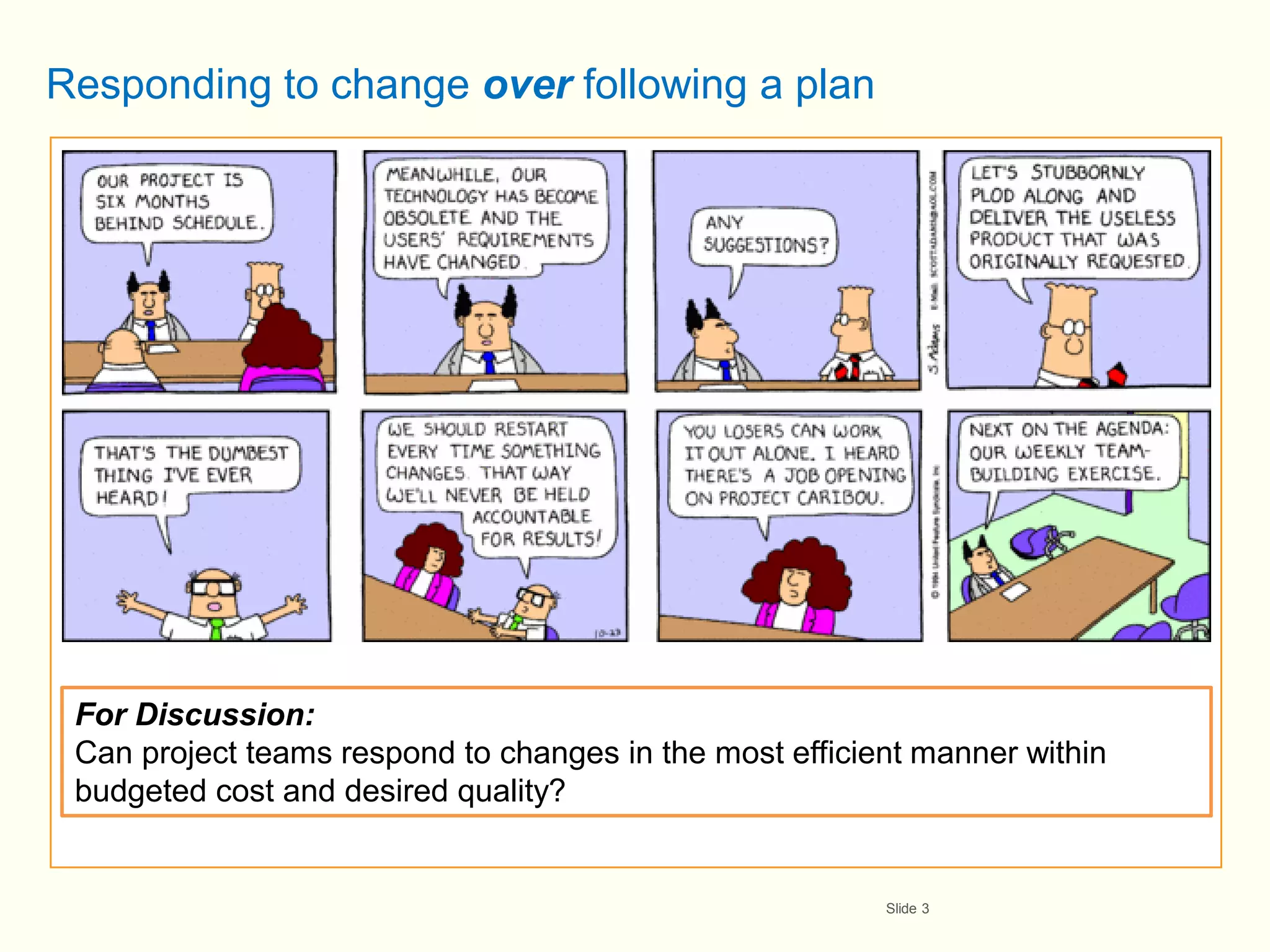
Responding to change over following a plan


 For Discussion:
 Can project teams respond to changes in the most efficient manner within
 budgeted cost and desired quality?


                                                         Slide 3
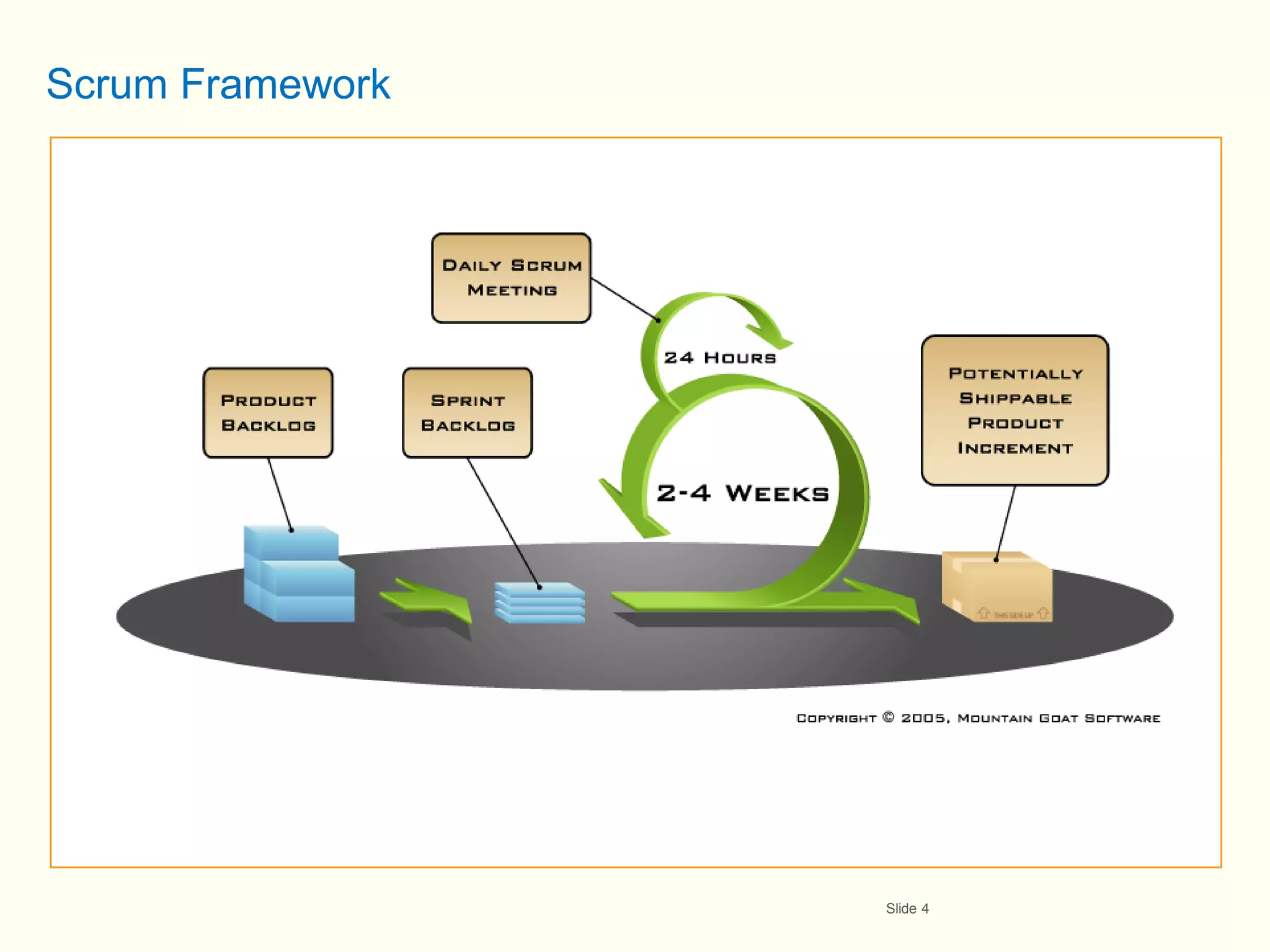
Scrum Framework


                  Slide 4
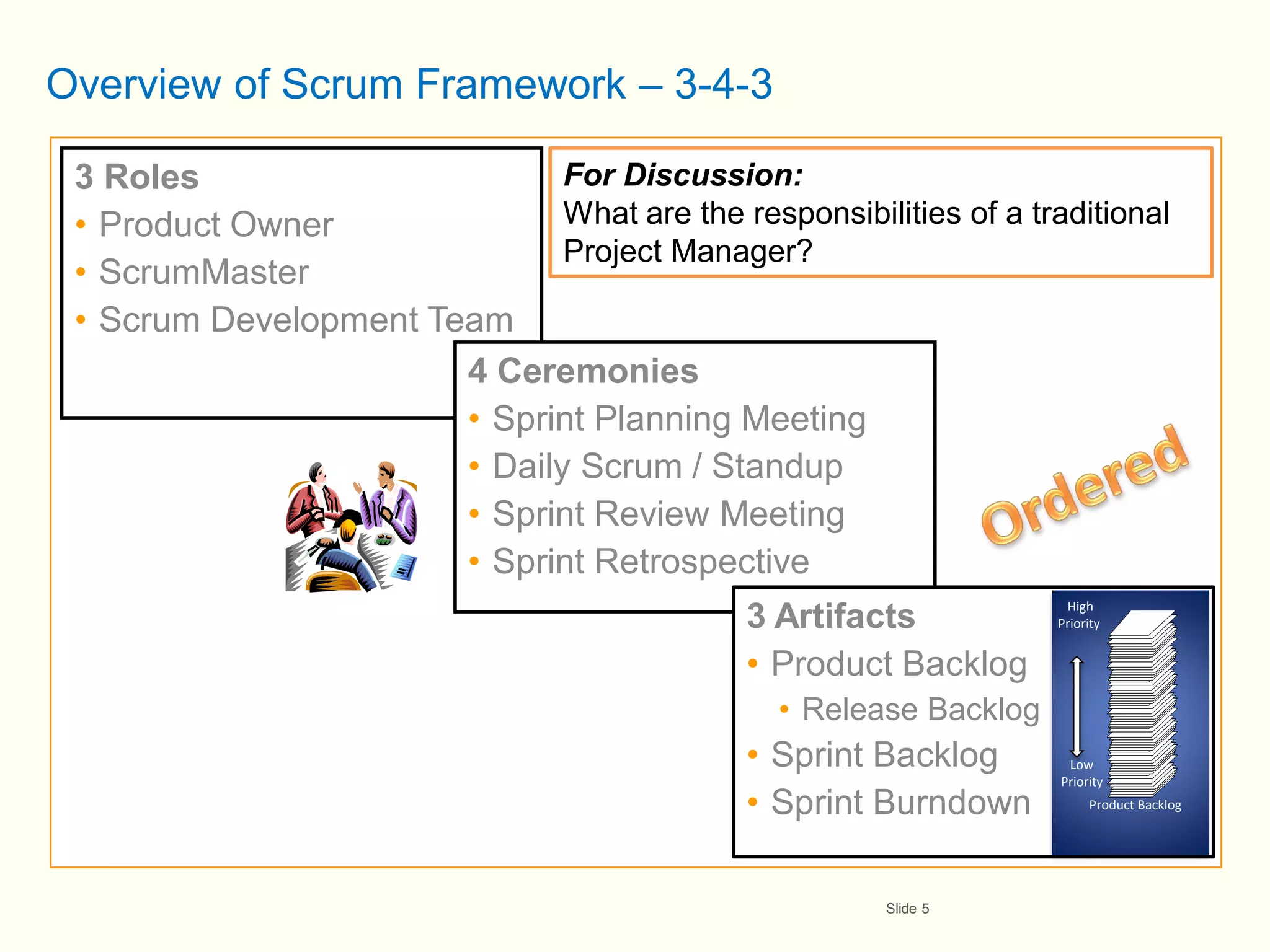
Overview of Scrum Framework – 3-4-3

 3 Roles                      For Discussion:
 • Product Owner              What are the responsibilities of a traditional
                              Project Manager?
 • ScrumMaster
 • Scrum Development Team
                       4 Ceremonies
                       • Sprint Planning Meeting
                       • Daily Scrum / Standup
                       • Sprint Review Meeting
                       • Sprint Retrospective
                                                                      High
                                               3 Artifacts           Priority


                                               • Product Backlog
                                                 • Release Backlog
                                               • Sprint Backlog       Low
                                                                     Priority
                                               • Sprint Burndown          Product Backlog


                                                        Slide 5
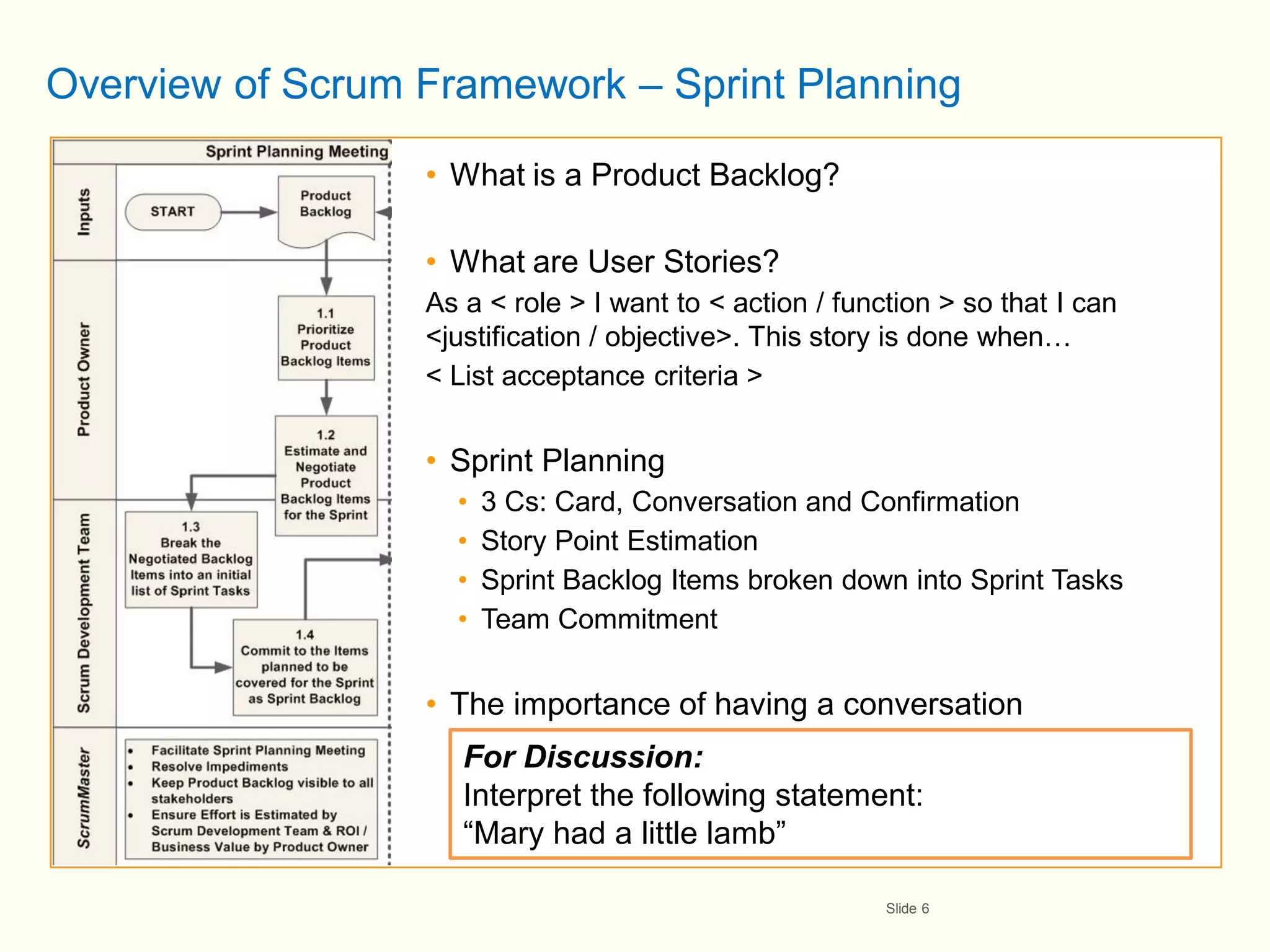
Overview of Scrum Framework – Sprint Planning

                  • What is a Product Backlog?

                  • What are User Stories?
                  As a < role > I want to < action / function > so that I can
                  <justification / objective>. This story is done when…
                  < List acceptance criteria >


                  • Sprint Planning
                    •   3 Cs: Card, Conversation and Confirmation
                    •   Story Point Estimation
                    •   Sprint Backlog Items broken down into Sprint Tasks
                    •   Team Commitment


                  • The importance of having a conversation
                     For Discussion:
                     Interpret the following statement:
                     “Mary had a little lamb”

                                                         Slide 6
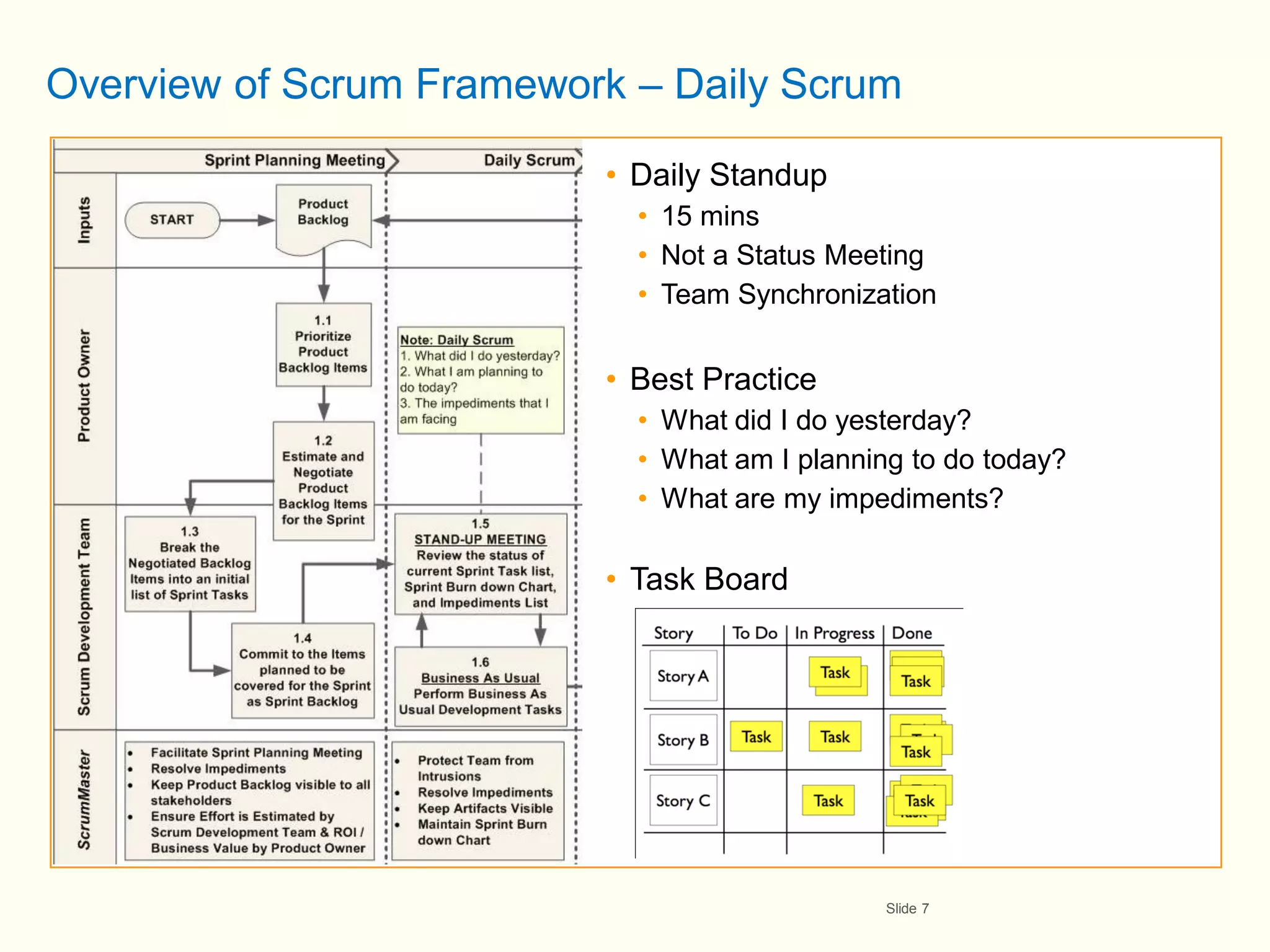
Overview of Scrum Framework – Daily Scrum

                          • Daily Standup
                            • 15 mins
                            • Not a Status Meeting
                            • Team Synchronization


                          • Best Practice
                            • What did I do yesterday?
                            • What am I planning to do today?
                            • What are my impediments?

                          • Task Board


                                               Slide 7
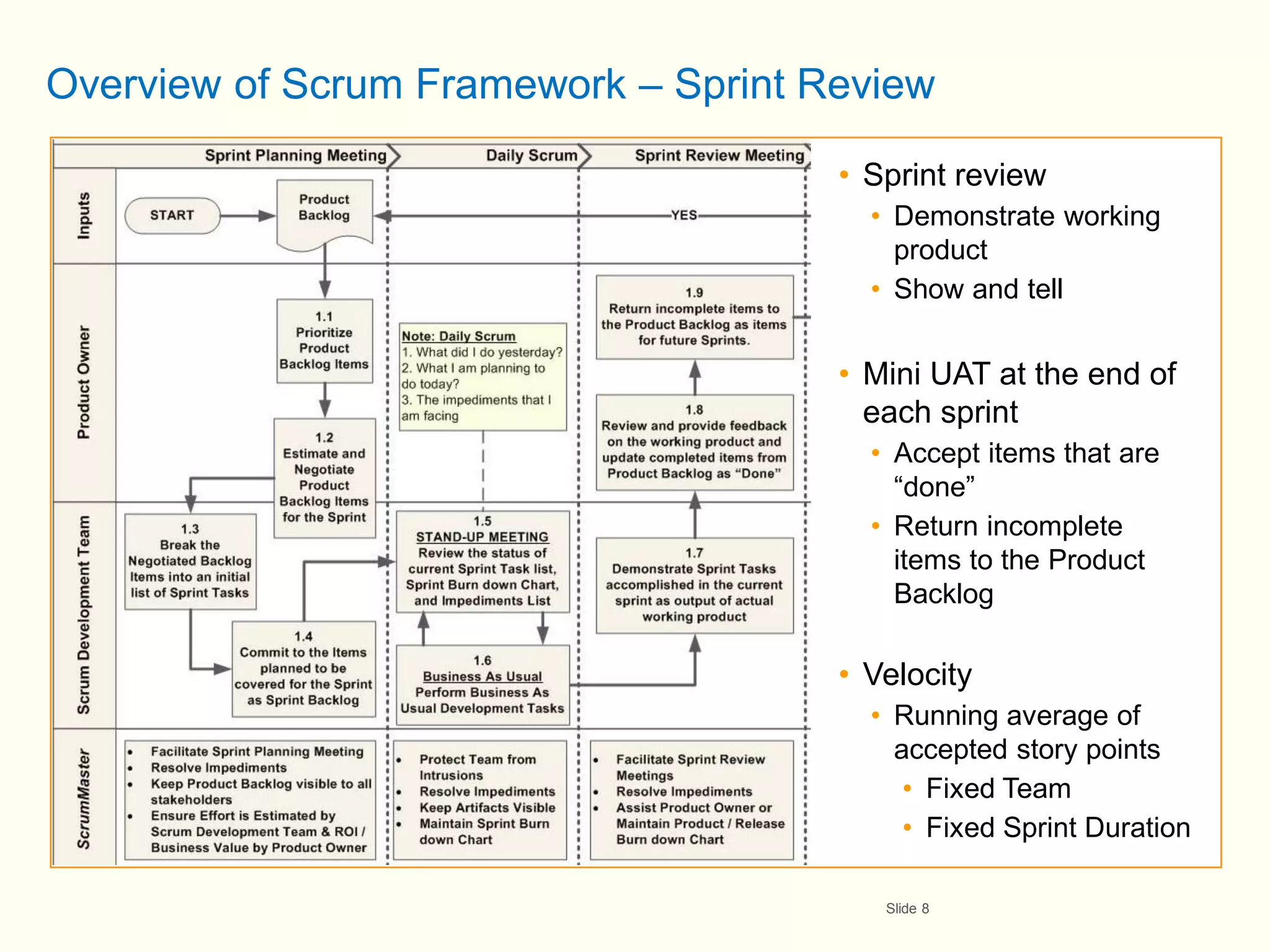
Overview of Scrum Framework – Sprint Review

                                      • Sprint review
                                        • Demonstrate working
                                          product
                                        • Show and tell


                                      • Mini UAT at the end of
                                        each sprint
                                        • Accept items that are
                                          “done”
                                        • Return incomplete
                                          items to the Product
                                          Backlog

                                      • Velocity
                                        • Running average of
                                          accepted story points
                                           • Fixed Team
                                           • Fixed Sprint Duration

                                         Slide 8
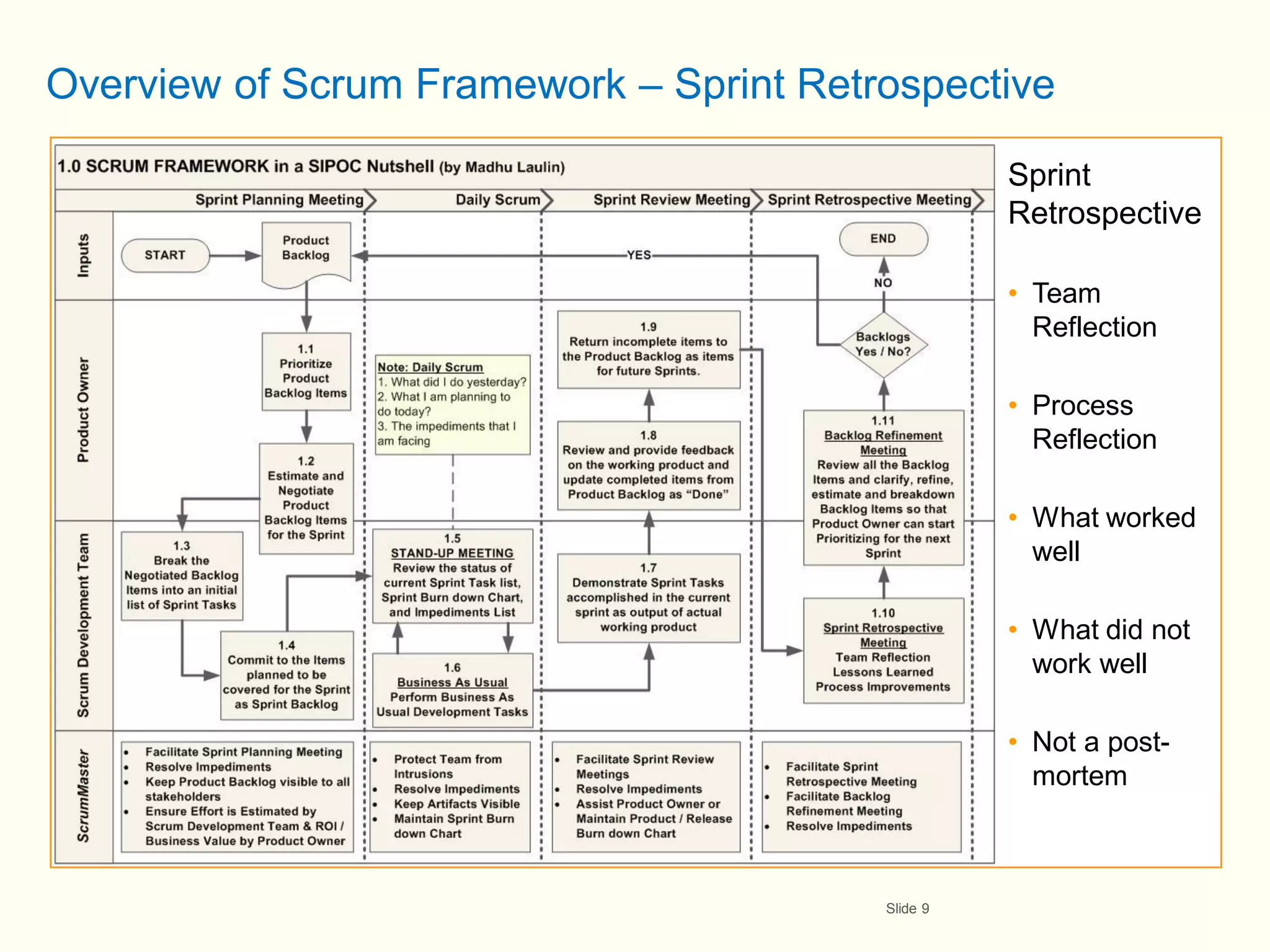
Overview of Scrum Framework – Sprint Retrospective

                                                   Sprint
                                                   Retrospective

                                                   • Team
                                                     Reflection

                                                   • Process
                                                     Reflection

                                                   • What worked
                                                     well

                                                   • What did not
                                                     work well

                                                   • Not a post-
                                                     mortem


                                         Slide 9
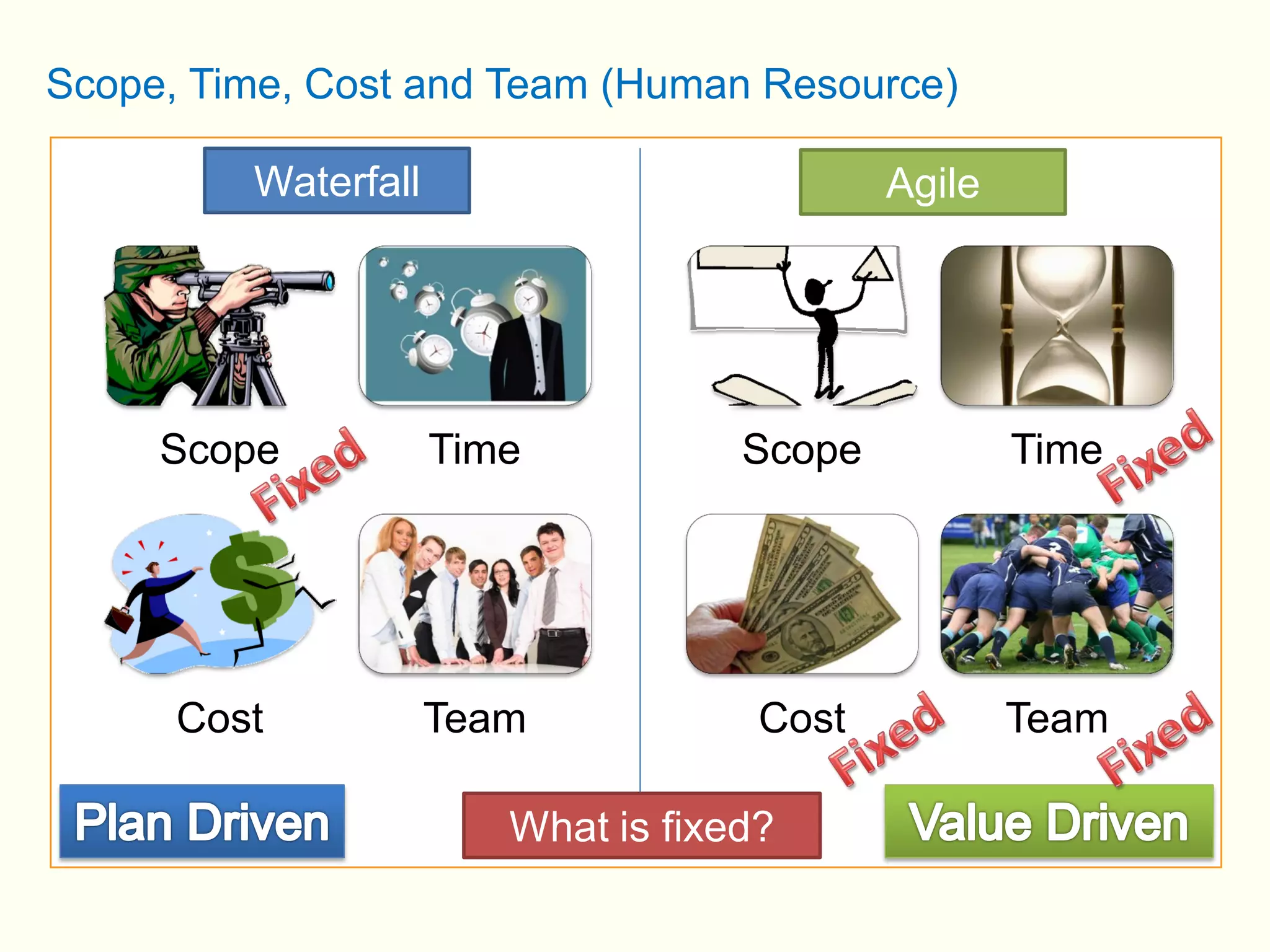
Scope, Time, Cost and Team (Human Resource)

         Waterfall                          Agile


     Scope           Time           Scope           Time


      Cost           Team            Cost           Team

                        What is fixed?
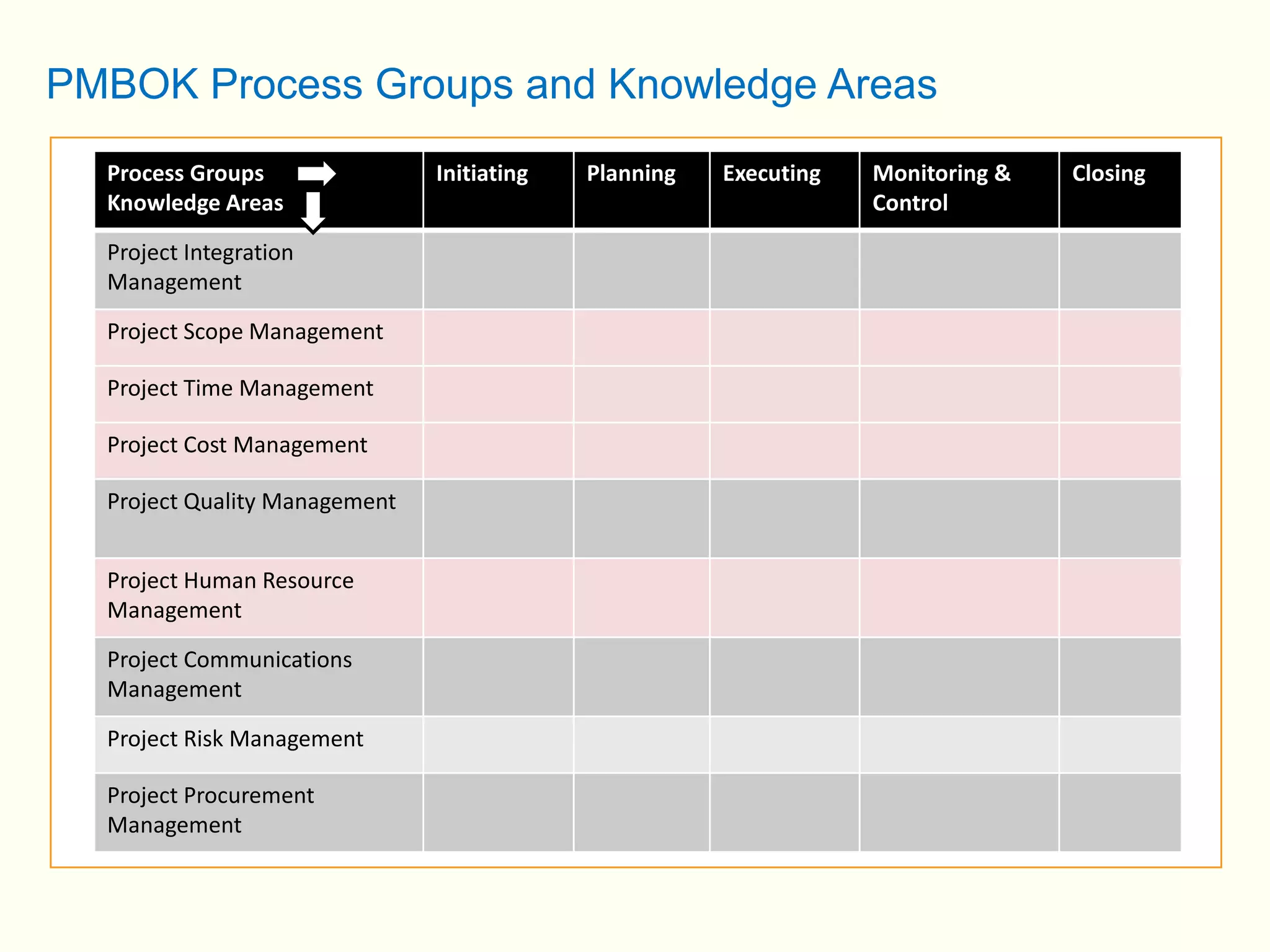
PMBOK Process Groups and Knowledge Areas
  Process Groups               Initiating   Planning   Executing   Monitoring &   Closing
  Knowledge Areas                                                  Control

  Project Integration
  Management

  Project Scope Management

  Project Time Management

  Project Cost Management

  Project Quality Management


  Project Human Resource
  Management

  Project Communications
  Management

  Project Risk Management

  Project Procurement
  Management
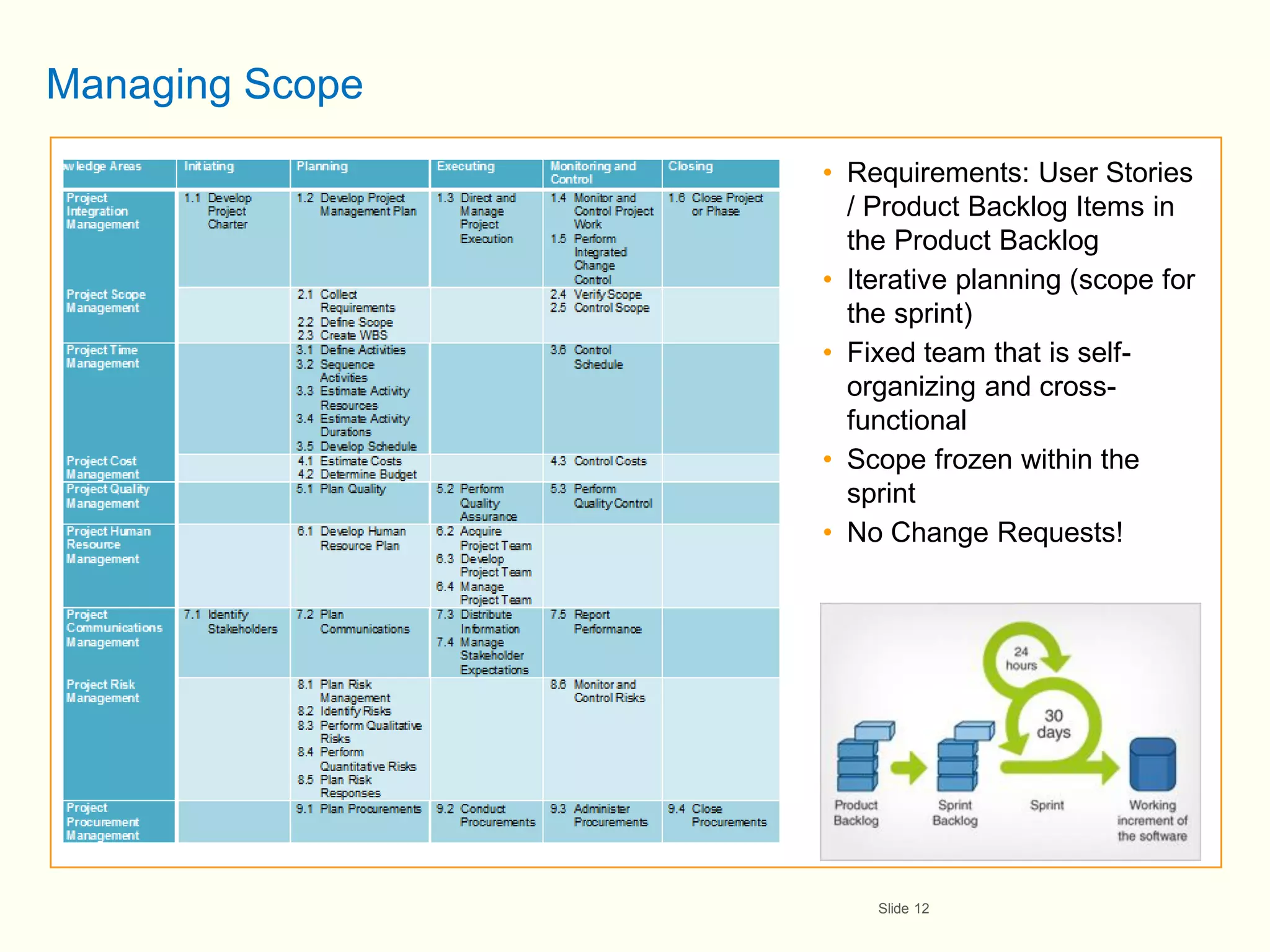
Managing Scope
                 • Requirements: User Stories
                   / Product Backlog Items in
                   the Product Backlog
                 • Iterative planning (scope for
                   the sprint)
                 • Fixed team that is self-
                   organizing and cross-
                   functional
                 • Scope frozen within the
                   sprint
                 • No Change Requests!


                     Slide 12
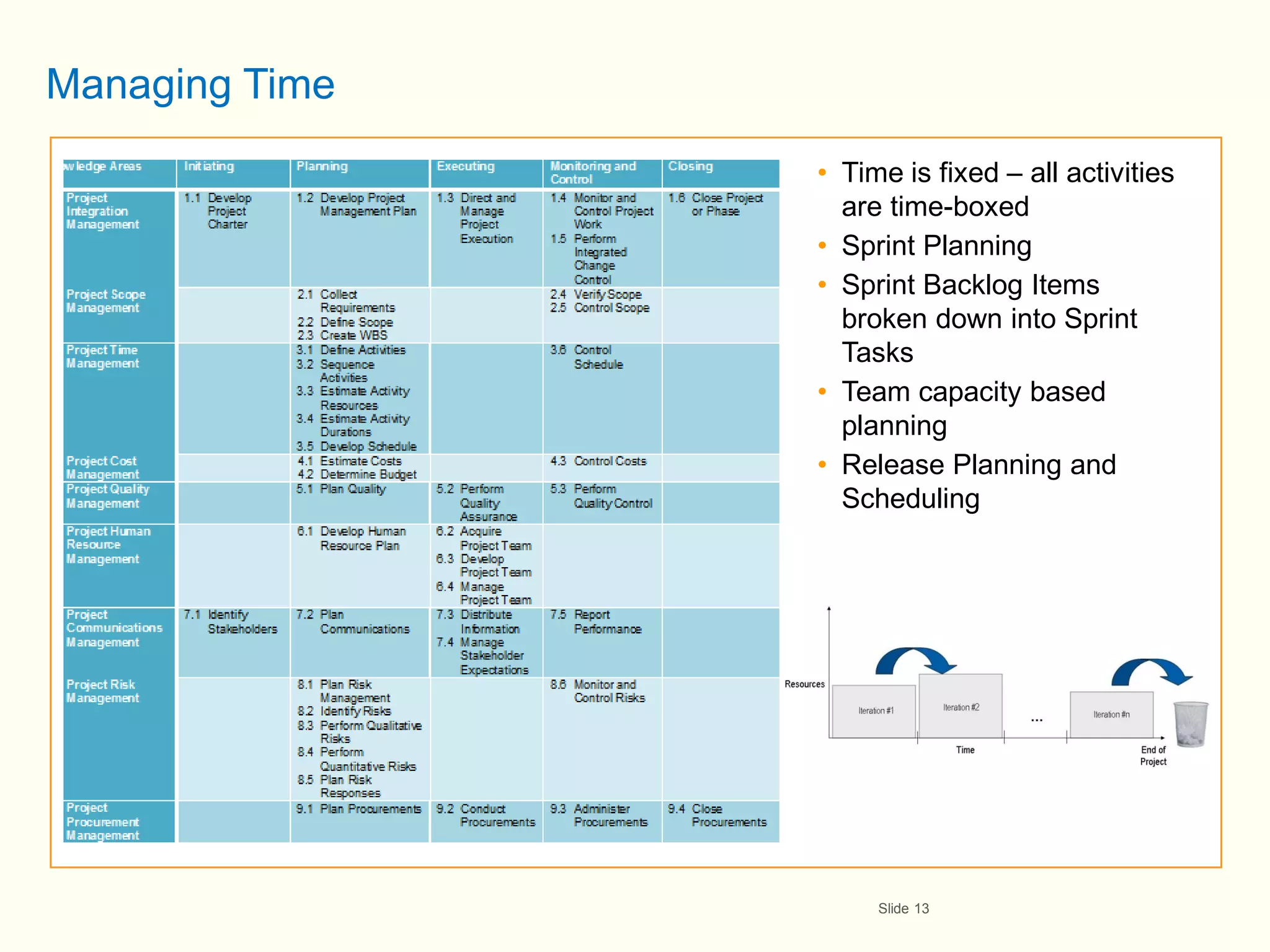
Managing Time
                • Time is fixed – all activities
                  are time-boxed
                • Sprint Planning
                • Sprint Backlog Items
                  broken down into Sprint
                  Tasks
                • Team capacity based
                  planning
                • Release Planning and
                  Scheduling


                     Slide 13
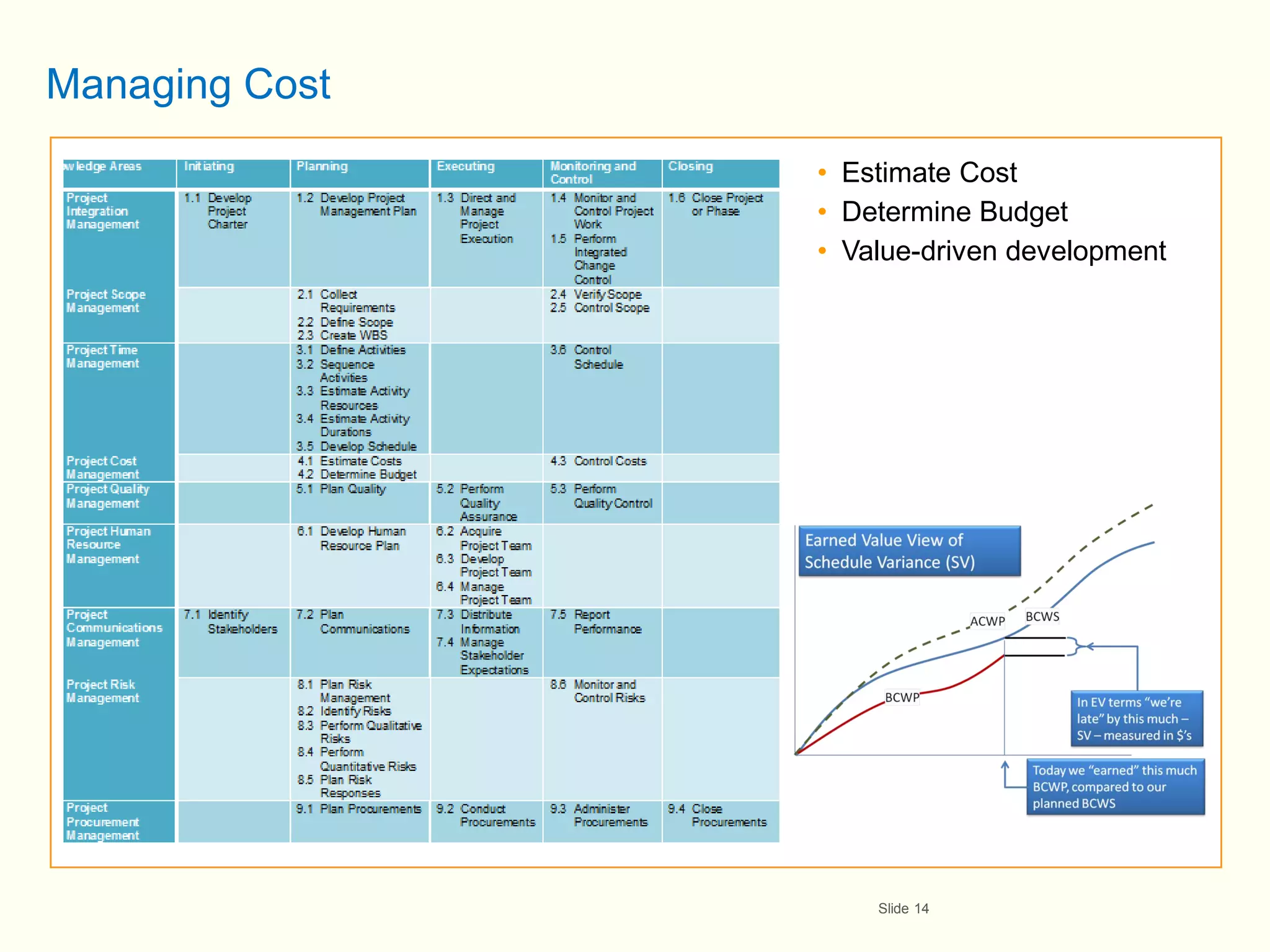
Managing Cost
                • Estimate Cost
                • Determine Budget
                • Value-driven development


                    Slide 14
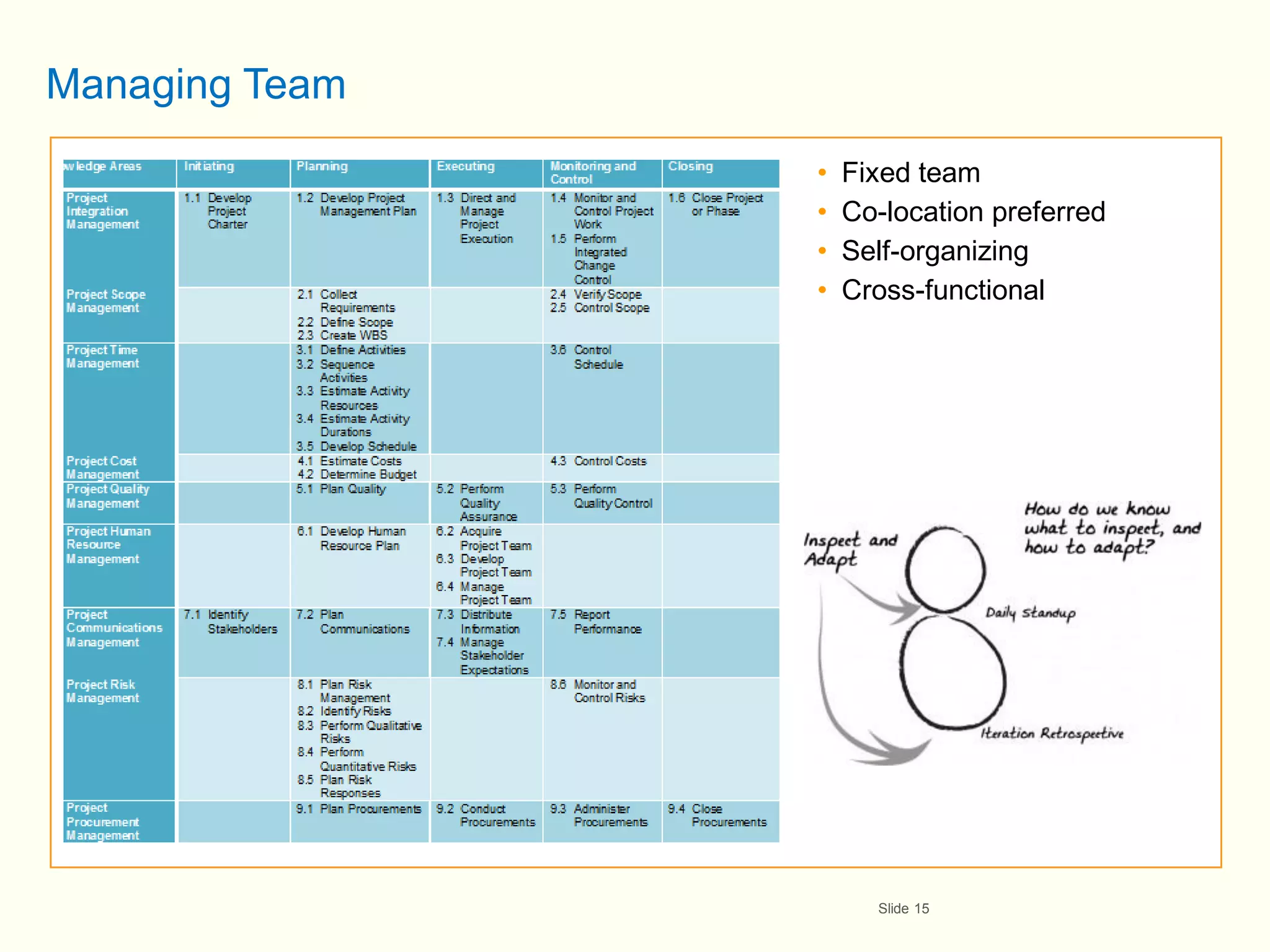
Managing Team
                •   Fixed team
                •   Co-location preferred
                •   Self-organizing
                •   Cross-functional


                      Slide 15
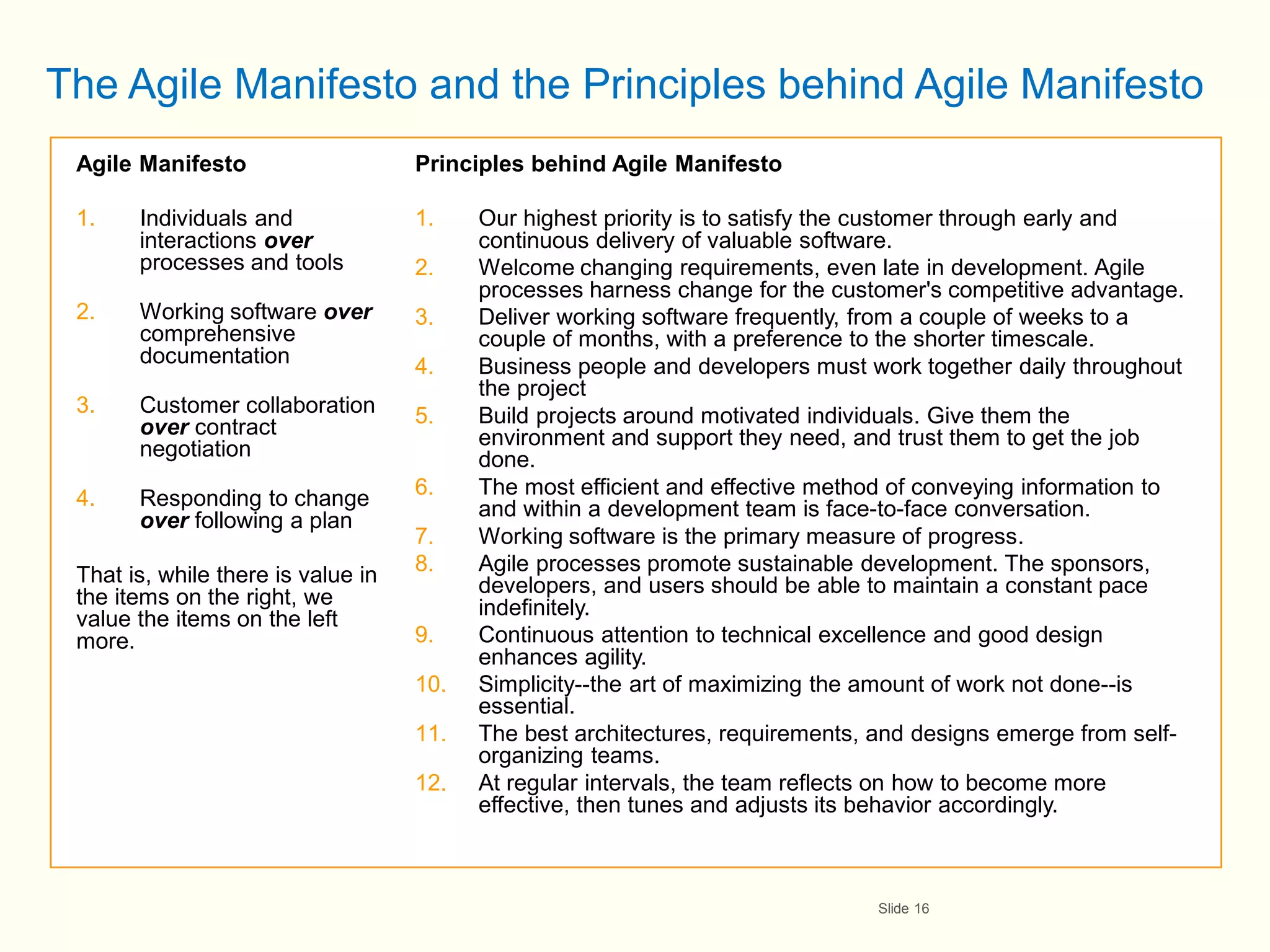
The Agile Manifesto and the Principles behind Agile Manifesto
 Agile Manifesto                    Principles behind Agile Manifesto

 1.    Individuals and              1.    Our highest priority is to satisfy the customer through early and
       interactions over                  continuous delivery of valuable software.
       processes and tools          2.    Welcome changing requirements, even late in development. Agile
                                          processes harness change for the customer's competitive advantage.
 2.    Working software over        3.    Deliver working software frequently, from a couple of weeks to a
       comprehensive                      couple of months, with a preference to the shorter timescale.
       documentation                4.    Business people and developers must work together daily throughout
                                          the project
 3.    Customer collaboration       5.    Build projects around motivated individuals. Give them the
       over contract                      environment and support they need, and trust them to get the job
       negotiation                        done.
 4.    Responding to change         6.    The most efficient and effective method of conveying information to
                                          and within a development team is face-to-face conversation.
       over following a plan
                                    7.    Working software is the primary measure of progress.
 That is, while there is value in   8.    Agile processes promote sustainable development. The sponsors,
                                          developers, and users should be able to maintain a constant pace
 the items on the right, we               indefinitely.
 value the items on the left
 more.                              9.    Continuous attention to technical excellence and good design
                                          enhances agility.
                                    10.   Simplicity--the art of maximizing the amount of work not done--is
                                          essential.
                                    11.   The best architectures, requirements, and designs emerge from self-
                                          organizing teams.
                                    12.   At regular intervals, the team reflects on how to become more
                                          effective, then tunes and adjusts its behavior accordingly.


                                                                               Slide 16
References


 • http://agilemanifesto.org/

 • http://agilemanifesto.org/principles.html

 • http://www.scrumalliance.org/pages/scrum_101

 • http://www.mountaingoatsoftware.com/scrum/overview

 • http://www.scrumalliance.org/articles/39-glossary-of-scrum-terms#1110

 • http://www.scrumalliance.org/articles/386-a-sprint-is-not-a-mini-waterfall

 • http://www.scrumalliance.org/articles/392-agile-testing-key-points-for-
   unlearning


                                                            Slide 17
The agility lies in the Agile practices, rather than in the
overarching framework itself…


Done!
                                                   Thank you…


                                            Slide 18

Managing Scope Time Cost And Team In Agile

  • 1.
    Managing Scope, Time,Cost and Team in Agile Madhu Expedith PMP®, CSM, CSQA, ISTQB-CTFL, ITIL v3.0 Principal Consultant, Infosys Limited
  • 2.
    Agenda Part 1: • Responding to change over following a plan • Overview of Scrum Framework Part 2: • Revisit PMBOK Process Groups and Knowledge Areas • Managing Scope, Time, Cost and Team in Scrum and alignment with PMBOK • Q&A Session Slide 2
  • 3.
    Responding to changeover following a plan For Discussion: Can project teams respond to changes in the most efficient manner within budgeted cost and desired quality? Slide 3
  • 4.
  • 5.
    Overview of ScrumFramework – 3-4-3 3 Roles For Discussion: • Product Owner What are the responsibilities of a traditional Project Manager? • ScrumMaster • Scrum Development Team 4 Ceremonies • Sprint Planning Meeting • Daily Scrum / Standup • Sprint Review Meeting • Sprint Retrospective High 3 Artifacts Priority • Product Backlog • Release Backlog • Sprint Backlog Low Priority • Sprint Burndown Product Backlog Slide 5
  • 6.
    Overview of ScrumFramework – Sprint Planning • What is a Product Backlog? • What are User Stories? As a < role > I want to < action / function > so that I can <justification / objective>. This story is done when… < List acceptance criteria > • Sprint Planning • 3 Cs: Card, Conversation and Confirmation • Story Point Estimation • Sprint Backlog Items broken down into Sprint Tasks • Team Commitment • The importance of having a conversation For Discussion: Interpret the following statement: “Mary had a little lamb” Slide 6
  • 7.
    Overview of ScrumFramework – Daily Scrum • Daily Standup • 15 mins • Not a Status Meeting • Team Synchronization • Best Practice • What did I do yesterday? • What am I planning to do today? • What are my impediments? • Task Board Slide 7
  • 8.
    Overview of ScrumFramework – Sprint Review • Sprint review • Demonstrate working product • Show and tell • Mini UAT at the end of each sprint • Accept items that are “done” • Return incomplete items to the Product Backlog • Velocity • Running average of accepted story points • Fixed Team • Fixed Sprint Duration Slide 8
  • 9.
    Overview of ScrumFramework – Sprint Retrospective Sprint Retrospective • Team Reflection • Process Reflection • What worked well • What did not work well • Not a post- mortem Slide 9
  • 10.
    Scope, Time, Costand Team (Human Resource) Waterfall Agile Scope Time Scope Time Cost Team Cost Team What is fixed?
  • 11.
    PMBOK Process Groupsand Knowledge Areas Process Groups Initiating Planning Executing Monitoring & Closing Knowledge Areas Control Project Integration Management Project Scope Management Project Time Management Project Cost Management Project Quality Management Project Human Resource Management Project Communications Management Project Risk Management Project Procurement Management
  • 12.
    Managing Scope • Requirements: User Stories / Product Backlog Items in the Product Backlog • Iterative planning (scope for the sprint) • Fixed team that is self- organizing and cross- functional • Scope frozen within the sprint • No Change Requests! Slide 12
  • 13.
    Managing Time • Time is fixed – all activities are time-boxed • Sprint Planning • Sprint Backlog Items broken down into Sprint Tasks • Team capacity based planning • Release Planning and Scheduling Slide 13
  • 14.
    Managing Cost • Estimate Cost • Determine Budget • Value-driven development Slide 14
  • 15.
    Managing Team • Fixed team • Co-location preferred • Self-organizing • Cross-functional Slide 15
  • 16.
    The Agile Manifestoand the Principles behind Agile Manifesto Agile Manifesto Principles behind Agile Manifesto 1. Individuals and 1. Our highest priority is to satisfy the customer through early and interactions over continuous delivery of valuable software. processes and tools 2. Welcome changing requirements, even late in development. Agile processes harness change for the customer's competitive advantage. 2. Working software over 3. Deliver working software frequently, from a couple of weeks to a comprehensive couple of months, with a preference to the shorter timescale. documentation 4. Business people and developers must work together daily throughout the project 3. Customer collaboration 5. Build projects around motivated individuals. Give them the over contract environment and support they need, and trust them to get the job negotiation done. 4. Responding to change 6. The most efficient and effective method of conveying information to and within a development team is face-to-face conversation. over following a plan 7. Working software is the primary measure of progress. That is, while there is value in 8. Agile processes promote sustainable development. The sponsors, developers, and users should be able to maintain a constant pace the items on the right, we indefinitely. value the items on the left more. 9. Continuous attention to technical excellence and good design enhances agility. 10. Simplicity--the art of maximizing the amount of work not done--is essential. 11. The best architectures, requirements, and designs emerge from self- organizing teams. 12. At regular intervals, the team reflects on how to become more effective, then tunes and adjusts its behavior accordingly. Slide 16
  • 17.
    References • http://agilemanifesto.org/ • http://agilemanifesto.org/principles.html • http://www.scrumalliance.org/pages/scrum_101 • http://www.mountaingoatsoftware.com/scrum/overview • http://www.scrumalliance.org/articles/39-glossary-of-scrum-terms#1110 • http://www.scrumalliance.org/articles/386-a-sprint-is-not-a-mini-waterfall • http://www.scrumalliance.org/articles/392-agile-testing-key-points-for- unlearning Slide 17
  • 18.
    The agility liesin the Agile practices, rather than in the overarching framework itself… Done! Thank you… Slide 18