© Torak, Inc. www.torak.com
Faster, Cheaper, Better
the Agile/Lean Way
Agile is not “the latest rage” or just a tech buzzword; Agile methodologies have
been transforming organizations all over the world since the unveiling of The Agile
Manifesto in 2001. Agile philosophies are helping companies of all sizes create
and maintain a tremendous competitive edge in today’s intense global
marketplace. Agile is the wave of right now and the wave of the future; helping
successful companies eliminate waste and forge a clear path to continuous
improvement.
© Torak, Inc. www.torak.com
About Dimitri Ponomareff
Dimitri Ponomareff (www.linkedin.com/in/dimka5) is a Coach. Whether
it's a sports team, software products or entire organizations, Dimitri has
that ability to relate and energize people. He is consistently recognized
as a very passionate and successful change agent, with an
overwhelming capacity to motivate and mobilize teams on their path to
continuous improvements. He is a master facilitator, as well as a
captivating speaker with consistent, positive feedback regarding his
ability to engage an audience.
As a certified Coach, Project Manager and Facilitator of "The 7 Habits of Highly Effective People",
Dimitri brings a full spectrum of knowledge in his delivery of methodologies. Through teaching by
example, he is able to build teams of people who understand where to focus their work to generate the
most value.
He has coached and provided tailor-made services and training for a multitude of organizations. The
short list includes, American Express, Charles Schwab, Bank of America, Morgan Stanley, Best
Western International, Choice Hotels International, JDA Software, LifeLock, First Solar, Mayo
Clinic and Phoenix Children's Hospital. Dimitri enjoys his work, and does everything to ensure he
shares his knowledge with others who seek it.
© Torak, Inc. www.torak.com
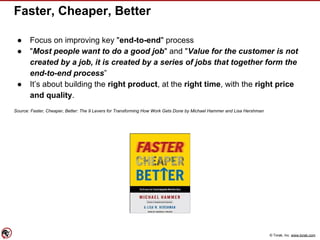
Faster, Cheaper, Better
● Focus on improving key "end-to-end" process
● "Most people want to do a good job" and "Value for the customer is not
created by a job, it is created by a series of jobs that together form the
end-to-end process”
● It’s about building the right product, at the right time, with the right price
and quality.
Source: Faster, Cheaper, Better: The 9 Levers for Transforming How Work Gets Done by Michael Hammer and Lisa Hershman
© Torak, Inc. www.torak.com
The 9 Levers for Transforming How Work Gets Done
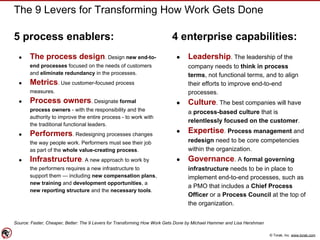
5 process enablers:
● The process design. Design new end-to-
end processes focused on the needs of customers
and eliminate redundancy in the processes.
● Metrics. Use customer-focused process
measures.
● Process owners. Designate formal
process owners - with the responsibility and the
authority to improve the entire process - to work with
the traditional functional leaders.
● Performers. Redesigning processes changes
the way people work. Performers must see their job
as part of the whole value-creating process.
● Infrastructure. A new approach to work by
the performers requires a new infrastructure to
support them — including new compensation plans,
new training and development opportunities, a
new reporting structure and the necessary tools.
4 enterprise capabilities:
● Leadership. The leadership of the
company needs to think in process
terms, not functional terms, and to align
their efforts to improve end-to-end
processes.
● Culture. The best companies will have
a process-based culture that is
relentlessly focused on the customer.
● Expertise. Process management and
redesign need to be core competencies
within the organization.
● Governance. A formal governing
infrastructure needs to be in place to
implement end-to-end processes, such as
a PMO that includes a Chief Process
Officer or a Process Council at the top of
the organization.
Source: Faster, Cheaper, Better: The 9 Levers for Transforming How Work Gets Done by Michael Hammer and Lisa Hershman
© Torak, Inc. www.torak.com
Smarter Faster Better & The Power of Habit
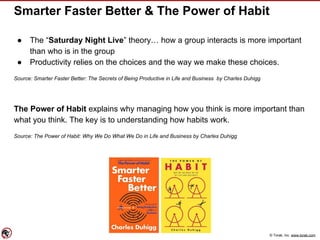
● The “Saturday Night Live” theory… how a group interacts is more important
than who is in the group
● Productivity relies on the choices and the way we make these choices.
Source: Smarter Faster Better: The Secrets of Being Productive in Life and Business by Charles Duhigg
The Power of Habit explains why managing how you think is more important than
what you think. The key is to understanding how habits work.
Source: The Power of Habit: Why We Do What We Do in Life and Business by Charles Duhigg
© Torak, Inc. www.torak.com
The Agile & Lean Mindset
● The Agile Manifesto
● The Paradigm Shift from Waterfall to Agile
● Lean Thinking
© Torak, Inc. www.torak.com
The Agile Manifesto - 4 Values
We are uncovering better ways of developing
software by doing it and helping others do it.
Individuals and interactions over processes and tools
Working software over comprehensive documentation
Customer collaboration over contract negotiation
Responding to change over following a plan
That is, while there is value in the items on
the right, we value the items on the left more.
Source: www.agilemanifesto.org
© Torak, Inc. www.torak.com
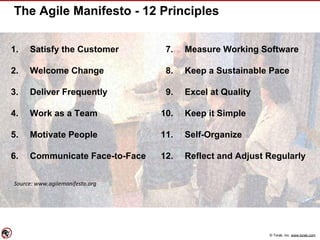
The Agile Manifesto - 12 Principles
1. Satisfy the Customer
2. Welcome Change
3. Deliver Frequently
4. Work as a Team
5. Motivate People
6. Communicate Face-to-Face
Source: www.agilemanifesto.org
7. Measure Working Software
8. Keep a Sustainable Pace
9. Excel at Quality
10. Keep it Simple
11. Self-Organize
12. Reflect and Adjust Regularly
© Torak, Inc. www.torak.com
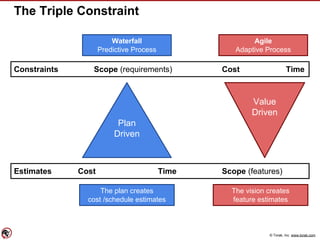
The Triple Constraint
Plan
Driven
Value
Driven
Constraints Scope (requirements) Cost Time
Estimates Cost Time Scope (features)
Waterfall
Predictive Process
Agile
Adaptive Process
The plan creates
cost /schedule estimates
The vision creates
feature estimates
© Torak, Inc. www.torak.com
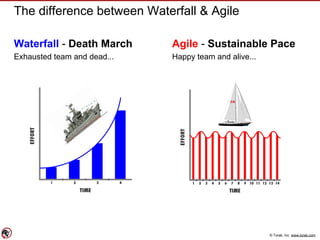
The difference between Waterfall & Agile
Waterfall - Death March
Exhausted team and dead...
Agile - Sustainable Pace
Happy team and alive...
© Torak, Inc. www.torak.com
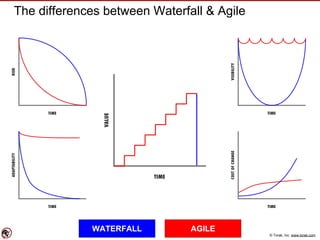
The differences between Waterfall & Agile
WATERFALL AGILE
© Torak, Inc. www.torak.com
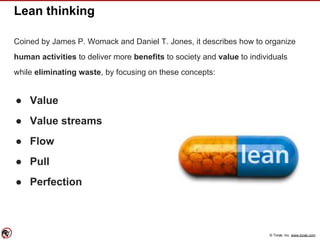
Lean thinking
Coined by James P. Womack and Daniel T. Jones, it describes how to organize
human activities to deliver more benefits to society and value to individuals
while eliminating waste, by focusing on these concepts:
● Value
● Value streams
● Flow
● Pull
● Perfection
© Torak, Inc. www.torak.com
Organizational Agility
● It’s all about communication
● Start with WHY and leave HOW to the end
● Find the best way to scale your agility
● Establish your FLOW
● Create a culture of innovation
© Torak, Inc. www.torak.com
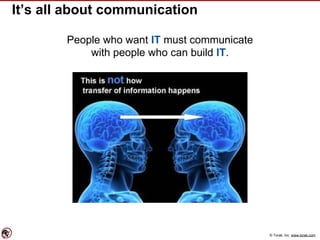
It’s all about communication
People who want IT must communicate
with people who can build IT.
© Torak, Inc. www.torak.com
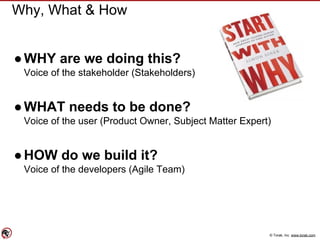
Why, What & How
●WHY are we doing this?
Voice of the stakeholder (Stakeholders)
●WHAT needs to be done?
Voice of the user (Product Owner, Subject Matter Expert)
●HOW do we build it?
Voice of the developers (Agile Team)
© Torak, Inc. www.torak.com
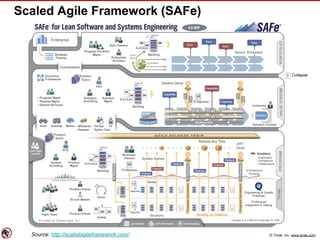
Scaled Agile Framework (SAFe)
Source: http://scaledagileframework.com/
© Torak, Inc. www.torak.com
Flow in psychology
Flow is the mental state of operation in which a person
performing an activity is fully immersed in a feeling of
energized focus, full involvement, and enjoyment in the
process of the activity.
being in the zone
© Torak, Inc. www.torak.com
Flow in the workplace
Flow has been used in the software world as being "wired in", “hack mode”, or
simply “The Zone”.
The 3 conditions to achieve Flow by Mihály Csíkszentmihályi’s
1. Goals are clear
2. Feedback is immediate
3. A balance between opportunity and capacity
Group Flow or group cohesion can be achieved through
● Creative spatial arrangements
● Playground design
● Parallel, organized working
● Target group focus
● Advancement of existing one with prototyping
● Increase in efficiency through visualization
● Using differences among participants as an
opportunity, rather than an obstacle
© Torak, Inc. www.torak.com
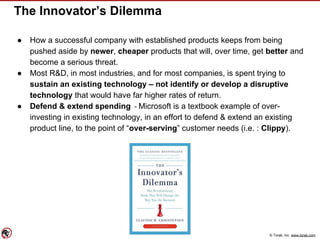
The Innovator’s Dilemma
● How a successful company with established products keeps from being
pushed aside by newer, cheaper products that will, over time, get better and
become a serious threat.
● Most R&D, in most industries, and for most companies, is spent trying to
sustain an existing technology – not identify or develop a disruptive
technology that would have far higher rates of return.
● Defend & extend spending - Microsoft is a textbook example of over-
investing in existing technology, in an effort to defend & extend an existing
product line, to the point of “over-serving” customer needs (i.e. : Clippy).
© Torak, Inc. www.torak.com
Ship it like FedEx
24 hours to innovate...
1. Work on whatever you want
2. Assemble your crew
3. You've got 24 hours... go
This approach has been coined by Atlassian. It
has now been renamed to ShipIt.
Source: www.atlassian.com/company/shipit
Other organizations conduct a
Hackathon or a Hack Day to
generate innovation.
© Torak, Inc. www.torak.com
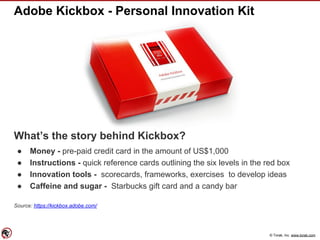
Adobe Kickbox - Personal Innovation Kit
What’s the story behind Kickbox?
● Money - pre-paid credit card in the amount of US$1,000
● Instructions - quick reference cards outlining the six levels in the red box
● Innovation tools - scorecards, frameworks, exercises to develop ideas
● Caffeine and sugar - Starbucks gift card and a candy bar
Source: https://kickbox.adobe.com/
© Torak, Inc. www.torak.com
Faster, Cheaper, Better
● FASTER
○ Time to market
○ Feedback loops
● CHEAPER
○ Eliminate waste
○ Automating your processes
● BETTER
○ Continuously improve everything you do
○ Celebrate and be happy!
© Torak, Inc. www.torak.com
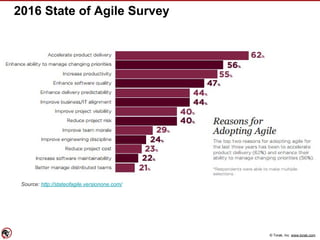
2016 State of Agile Survey
Source: http://stateofagile.versionone.com/
© Torak, Inc. www.torak.com
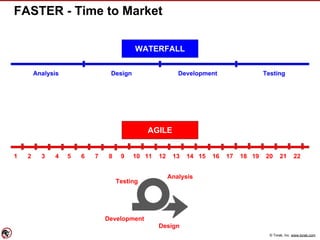
FASTER - Time to Market
DesignAnalysis TestingDevelopment
Analysis
Design
Development
Testing
1 2 3 4 5 6 7 8 9 10 11 12 13 14 15 16 17 18 19 20 21 22
WATERFALL
AGILE
© Torak, Inc. www.torak.com
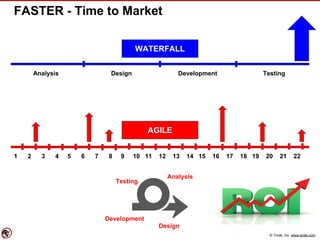
FASTER - Time to Market
DesignAnalysis TestingDevelopment
Analysis
Design
Development
Testing
1 2 3 4 5 6 7 8 9 10 11 12 13 14 15 16 17 18 19 20 21 22
WATERFALL
AGILE
© Torak, Inc. www.torak.com
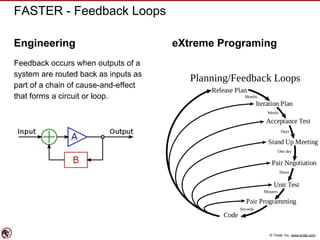
FASTER - Feedback Loops
Engineering
Feedback occurs when outputs of a
system are routed back as inputs as
part of a chain of cause-and-effect
that forms a circuit or loop.
eXtreme Programing
© Torak, Inc. www.torak.com
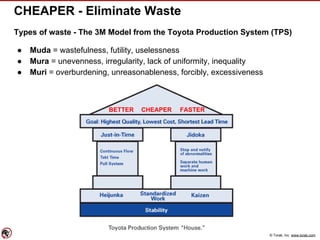
CHEAPER - Eliminate Waste
Types of waste - The 3M Model from the Toyota Production System (TPS)
● Muda = wastefulness, futility, uselessness
● Mura = unevenness, irregularity, lack of uniformity, inequality
● Muri = overburdening, unreasonableness, forcibly, excessiveness
BETTER CHEAPER FASTER
© Torak, Inc. www.torak.com
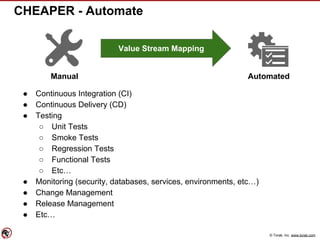
CHEAPER - Automate
● Continuous Integration (CI)
● Continuous Delivery (CD)
● Testing
○ Unit Tests
○ Smoke Tests
○ Regression Tests
○ Functional Tests
○ Etc…
● Monitoring (security, databases, services, environments, etc…)
● Change Management
● Release Management
● Etc…
Value Stream Mapping
Manual Automated
© Torak, Inc. www.torak.com
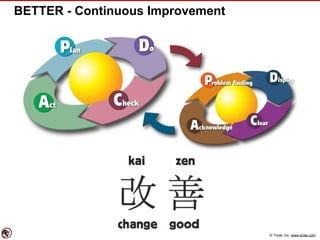
BETTER - Continuous Improvement
© Torak, Inc. www.torak.com
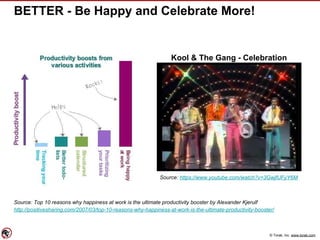
BETTER - Be Happy and Celebrate More!
Source: Top 10 reasons why happiness at work is the ultimate productivity booster by Alexander Kjerulf
http://positivesharing.com/2007/03/top-10-reasons-why-happiness-at-work-is-the-ultimate-productivity-booster/
Kool & The Gang - Celebration
Source: https://www.youtube.com/watch?v=3GwjfUFyY6M
© Torak, Inc. www.torak.com
Learn more at www.torak.com
www.torak.com/resources/presentations/
www.slideshare.net/dimka5
Learn more at www.AgileTestingFramework.com
Any questions...
© Torak, Inc. www.torak.com
This presentation was inspired by the work of many people and we have done our very best to
attribute all authors of texts and images, and recognize any copyrights. If you think that
anything in this presentation should be changed, added or removed, please contact us.
http://creativecommons.org/licenses/by-nc-nd/3.0/
www.torak.com

Faster Cheaper Better the Agile / Lean Way

  • 1.
    © Torak, Inc.www.torak.com Faster, Cheaper, Better the Agile/Lean Way Agile is not “the latest rage” or just a tech buzzword; Agile methodologies have been transforming organizations all over the world since the unveiling of The Agile Manifesto in 2001. Agile philosophies are helping companies of all sizes create and maintain a tremendous competitive edge in today’s intense global marketplace. Agile is the wave of right now and the wave of the future; helping successful companies eliminate waste and forge a clear path to continuous improvement.
  • 2.
    © Torak, Inc.www.torak.com About Dimitri Ponomareff Dimitri Ponomareff (www.linkedin.com/in/dimka5) is a Coach. Whether it's a sports team, software products or entire organizations, Dimitri has that ability to relate and energize people. He is consistently recognized as a very passionate and successful change agent, with an overwhelming capacity to motivate and mobilize teams on their path to continuous improvements. He is a master facilitator, as well as a captivating speaker with consistent, positive feedback regarding his ability to engage an audience. As a certified Coach, Project Manager and Facilitator of "The 7 Habits of Highly Effective People", Dimitri brings a full spectrum of knowledge in his delivery of methodologies. Through teaching by example, he is able to build teams of people who understand where to focus their work to generate the most value. He has coached and provided tailor-made services and training for a multitude of organizations. The short list includes, American Express, Charles Schwab, Bank of America, Morgan Stanley, Best Western International, Choice Hotels International, JDA Software, LifeLock, First Solar, Mayo Clinic and Phoenix Children's Hospital. Dimitri enjoys his work, and does everything to ensure he shares his knowledge with others who seek it.
  • 3.
    © Torak, Inc.www.torak.com Faster, Cheaper, Better ● Focus on improving key "end-to-end" process ● "Most people want to do a good job" and "Value for the customer is not created by a job, it is created by a series of jobs that together form the end-to-end process” ● It’s about building the right product, at the right time, with the right price and quality. Source: Faster, Cheaper, Better: The 9 Levers for Transforming How Work Gets Done by Michael Hammer and Lisa Hershman
  • 4.
    © Torak, Inc.www.torak.com The 9 Levers for Transforming How Work Gets Done 5 process enablers: ● The process design. Design new end-to- end processes focused on the needs of customers and eliminate redundancy in the processes. ● Metrics. Use customer-focused process measures. ● Process owners. Designate formal process owners - with the responsibility and the authority to improve the entire process - to work with the traditional functional leaders. ● Performers. Redesigning processes changes the way people work. Performers must see their job as part of the whole value-creating process. ● Infrastructure. A new approach to work by the performers requires a new infrastructure to support them — including new compensation plans, new training and development opportunities, a new reporting structure and the necessary tools. 4 enterprise capabilities: ● Leadership. The leadership of the company needs to think in process terms, not functional terms, and to align their efforts to improve end-to-end processes. ● Culture. The best companies will have a process-based culture that is relentlessly focused on the customer. ● Expertise. Process management and redesign need to be core competencies within the organization. ● Governance. A formal governing infrastructure needs to be in place to implement end-to-end processes, such as a PMO that includes a Chief Process Officer or a Process Council at the top of the organization. Source: Faster, Cheaper, Better: The 9 Levers for Transforming How Work Gets Done by Michael Hammer and Lisa Hershman
  • 5.
    © Torak, Inc.www.torak.com Smarter Faster Better & The Power of Habit ● The “Saturday Night Live” theory… how a group interacts is more important than who is in the group ● Productivity relies on the choices and the way we make these choices. Source: Smarter Faster Better: The Secrets of Being Productive in Life and Business by Charles Duhigg The Power of Habit explains why managing how you think is more important than what you think. The key is to understanding how habits work. Source: The Power of Habit: Why We Do What We Do in Life and Business by Charles Duhigg
  • 6.
    © Torak, Inc.www.torak.com The Agile & Lean Mindset ● The Agile Manifesto ● The Paradigm Shift from Waterfall to Agile ● Lean Thinking
  • 7.
    © Torak, Inc.www.torak.com The Agile Manifesto - 4 Values We are uncovering better ways of developing software by doing it and helping others do it. Individuals and interactions over processes and tools Working software over comprehensive documentation Customer collaboration over contract negotiation Responding to change over following a plan That is, while there is value in the items on the right, we value the items on the left more. Source: www.agilemanifesto.org
  • 8.
    © Torak, Inc.www.torak.com The Agile Manifesto - 12 Principles 1. Satisfy the Customer 2. Welcome Change 3. Deliver Frequently 4. Work as a Team 5. Motivate People 6. Communicate Face-to-Face Source: www.agilemanifesto.org 7. Measure Working Software 8. Keep a Sustainable Pace 9. Excel at Quality 10. Keep it Simple 11. Self-Organize 12. Reflect and Adjust Regularly
  • 9.
    © Torak, Inc.www.torak.com The Triple Constraint Plan Driven Value Driven Constraints Scope (requirements) Cost Time Estimates Cost Time Scope (features) Waterfall Predictive Process Agile Adaptive Process The plan creates cost /schedule estimates The vision creates feature estimates
  • 10.
    © Torak, Inc.www.torak.com The difference between Waterfall & Agile Waterfall - Death March Exhausted team and dead... Agile - Sustainable Pace Happy team and alive...
  • 11.
    © Torak, Inc.www.torak.com The differences between Waterfall & Agile WATERFALL AGILE
  • 12.
    © Torak, Inc.www.torak.com Lean thinking Coined by James P. Womack and Daniel T. Jones, it describes how to organize human activities to deliver more benefits to society and value to individuals while eliminating waste, by focusing on these concepts: ● Value ● Value streams ● Flow ● Pull ● Perfection
  • 13.
    © Torak, Inc.www.torak.com Organizational Agility ● It’s all about communication ● Start with WHY and leave HOW to the end ● Find the best way to scale your agility ● Establish your FLOW ● Create a culture of innovation
  • 14.
    © Torak, Inc.www.torak.com It’s all about communication People who want IT must communicate with people who can build IT.
  • 15.
    © Torak, Inc.www.torak.com Why, What & How ●WHY are we doing this? Voice of the stakeholder (Stakeholders) ●WHAT needs to be done? Voice of the user (Product Owner, Subject Matter Expert) ●HOW do we build it? Voice of the developers (Agile Team)
  • 16.
    © Torak, Inc.www.torak.com Scaled Agile Framework (SAFe) Source: http://scaledagileframework.com/
  • 17.
    © Torak, Inc.www.torak.com Flow in psychology Flow is the mental state of operation in which a person performing an activity is fully immersed in a feeling of energized focus, full involvement, and enjoyment in the process of the activity. being in the zone
  • 18.
    © Torak, Inc.www.torak.com Flow in the workplace Flow has been used in the software world as being "wired in", “hack mode”, or simply “The Zone”. The 3 conditions to achieve Flow by Mihály Csíkszentmihályi’s 1. Goals are clear 2. Feedback is immediate 3. A balance between opportunity and capacity Group Flow or group cohesion can be achieved through ● Creative spatial arrangements ● Playground design ● Parallel, organized working ● Target group focus ● Advancement of existing one with prototyping ● Increase in efficiency through visualization ● Using differences among participants as an opportunity, rather than an obstacle
  • 19.
    © Torak, Inc.www.torak.com The Innovator’s Dilemma ● How a successful company with established products keeps from being pushed aside by newer, cheaper products that will, over time, get better and become a serious threat. ● Most R&D, in most industries, and for most companies, is spent trying to sustain an existing technology – not identify or develop a disruptive technology that would have far higher rates of return. ● Defend & extend spending - Microsoft is a textbook example of over- investing in existing technology, in an effort to defend & extend an existing product line, to the point of “over-serving” customer needs (i.e. : Clippy).
  • 20.
    © Torak, Inc.www.torak.com Ship it like FedEx 24 hours to innovate... 1. Work on whatever you want 2. Assemble your crew 3. You've got 24 hours... go This approach has been coined by Atlassian. It has now been renamed to ShipIt. Source: www.atlassian.com/company/shipit Other organizations conduct a Hackathon or a Hack Day to generate innovation.
  • 21.
    © Torak, Inc.www.torak.com Adobe Kickbox - Personal Innovation Kit What’s the story behind Kickbox? ● Money - pre-paid credit card in the amount of US$1,000 ● Instructions - quick reference cards outlining the six levels in the red box ● Innovation tools - scorecards, frameworks, exercises to develop ideas ● Caffeine and sugar - Starbucks gift card and a candy bar Source: https://kickbox.adobe.com/
  • 22.
    © Torak, Inc.www.torak.com Faster, Cheaper, Better ● FASTER ○ Time to market ○ Feedback loops ● CHEAPER ○ Eliminate waste ○ Automating your processes ● BETTER ○ Continuously improve everything you do ○ Celebrate and be happy!
  • 23.
    © Torak, Inc.www.torak.com 2016 State of Agile Survey Source: http://stateofagile.versionone.com/
  • 24.
    © Torak, Inc.www.torak.com FASTER - Time to Market DesignAnalysis TestingDevelopment Analysis Design Development Testing 1 2 3 4 5 6 7 8 9 10 11 12 13 14 15 16 17 18 19 20 21 22 WATERFALL AGILE
  • 25.
    © Torak, Inc.www.torak.com FASTER - Time to Market DesignAnalysis TestingDevelopment Analysis Design Development Testing 1 2 3 4 5 6 7 8 9 10 11 12 13 14 15 16 17 18 19 20 21 22 WATERFALL AGILE
  • 26.
    © Torak, Inc.www.torak.com FASTER - Feedback Loops Engineering Feedback occurs when outputs of a system are routed back as inputs as part of a chain of cause-and-effect that forms a circuit or loop. eXtreme Programing
  • 27.
    © Torak, Inc.www.torak.com CHEAPER - Eliminate Waste Types of waste - The 3M Model from the Toyota Production System (TPS) ● Muda = wastefulness, futility, uselessness ● Mura = unevenness, irregularity, lack of uniformity, inequality ● Muri = overburdening, unreasonableness, forcibly, excessiveness BETTER CHEAPER FASTER
  • 28.
    © Torak, Inc.www.torak.com CHEAPER - Automate ● Continuous Integration (CI) ● Continuous Delivery (CD) ● Testing ○ Unit Tests ○ Smoke Tests ○ Regression Tests ○ Functional Tests ○ Etc… ● Monitoring (security, databases, services, environments, etc…) ● Change Management ● Release Management ● Etc… Value Stream Mapping Manual Automated
  • 29.
    © Torak, Inc.www.torak.com BETTER - Continuous Improvement
  • 30.
    © Torak, Inc.www.torak.com BETTER - Be Happy and Celebrate More! Source: Top 10 reasons why happiness at work is the ultimate productivity booster by Alexander Kjerulf http://positivesharing.com/2007/03/top-10-reasons-why-happiness-at-work-is-the-ultimate-productivity-booster/ Kool & The Gang - Celebration Source: https://www.youtube.com/watch?v=3GwjfUFyY6M
  • 31.
    © Torak, Inc.www.torak.com Learn more at www.torak.com www.torak.com/resources/presentations/ www.slideshare.net/dimka5 Learn more at www.AgileTestingFramework.com Any questions...
  • 32.
    © Torak, Inc.www.torak.com This presentation was inspired by the work of many people and we have done our very best to attribute all authors of texts and images, and recognize any copyrights. If you think that anything in this presentation should be changed, added or removed, please contact us. http://creativecommons.org/licenses/by-nc-nd/3.0/ www.torak.com