Joint Research Centre
the European Commission's
in-house science service
The 10
dimensions of
open education
An introduction to the
OpenEdu framework on
openness in higher
education
Andreia Inamorato dos Santos
Yves Punie
Jonatan Castaño Muñoz
@aisantos
2
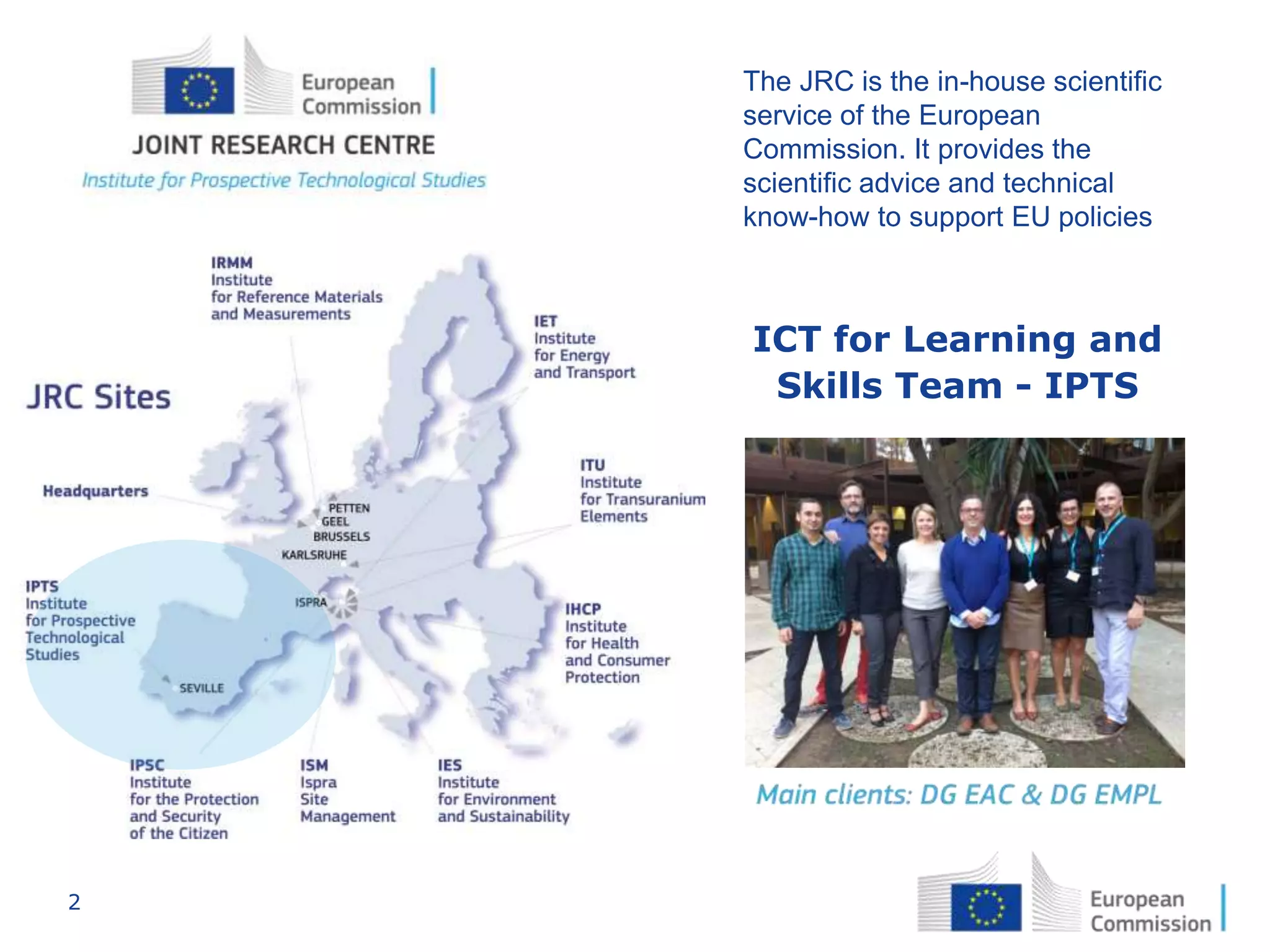
The JRC is the in-house scientific
service of the European
Commission. It provides the
scientific advice and technical
know-how to support EU policies
ICT for Learning and
Skills Team - IPTS
3
1 2
Open Education OpenEdu
Studies
OpenEdu
Framework &
Dimensions
3
4
Open Education is in Europe's Agenda
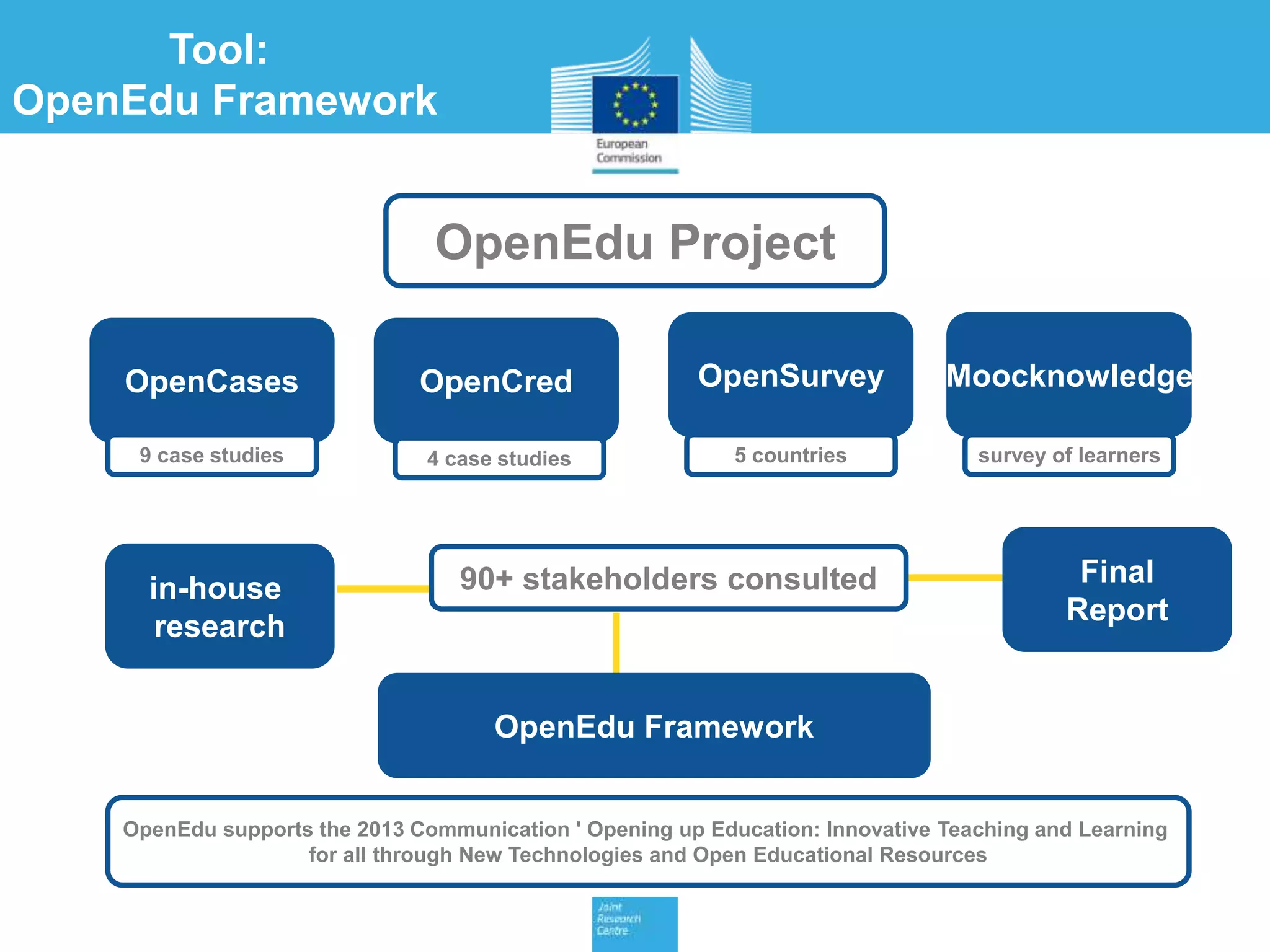
The framework was designed to support higher education
institutions in Europe to make strategic decisions on open
education. It is a hands-on tool created by the OpenEdu Project as
a response to the European Commission's Communication
'Opening up Education: Innovative teaching and learning for all
through newTechnologies andOpen Educational Resources'
OpenCases OpenCred MoocknowledgeOpenSurvey
OpenEdu Project
OpenEdu Framework
90+ stakeholders consulted
9 case studies 4 case studies 5 countries survey of learners
OpenEdu supports the 2013 Communication ' Opening up Education: Innovative Teaching and Learning
for all through New Technologies and Open Educational Resources
Tool:
OpenEdu Framework
in-house
research
Final
Report
6
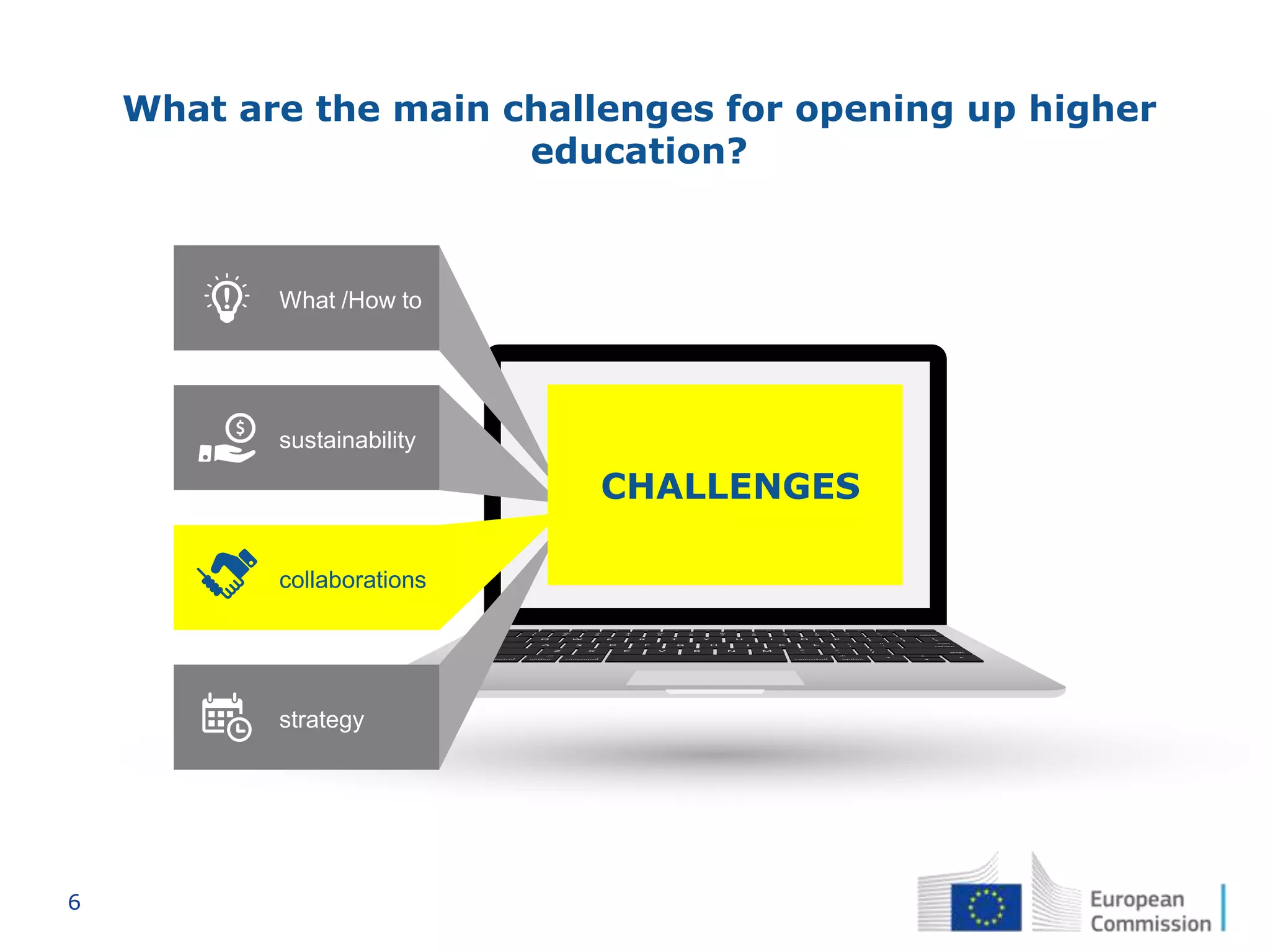
What are the main challenges for opening up higher
education?
What /How to
sustainability
collaborations
strategy
CHALLENGES
7
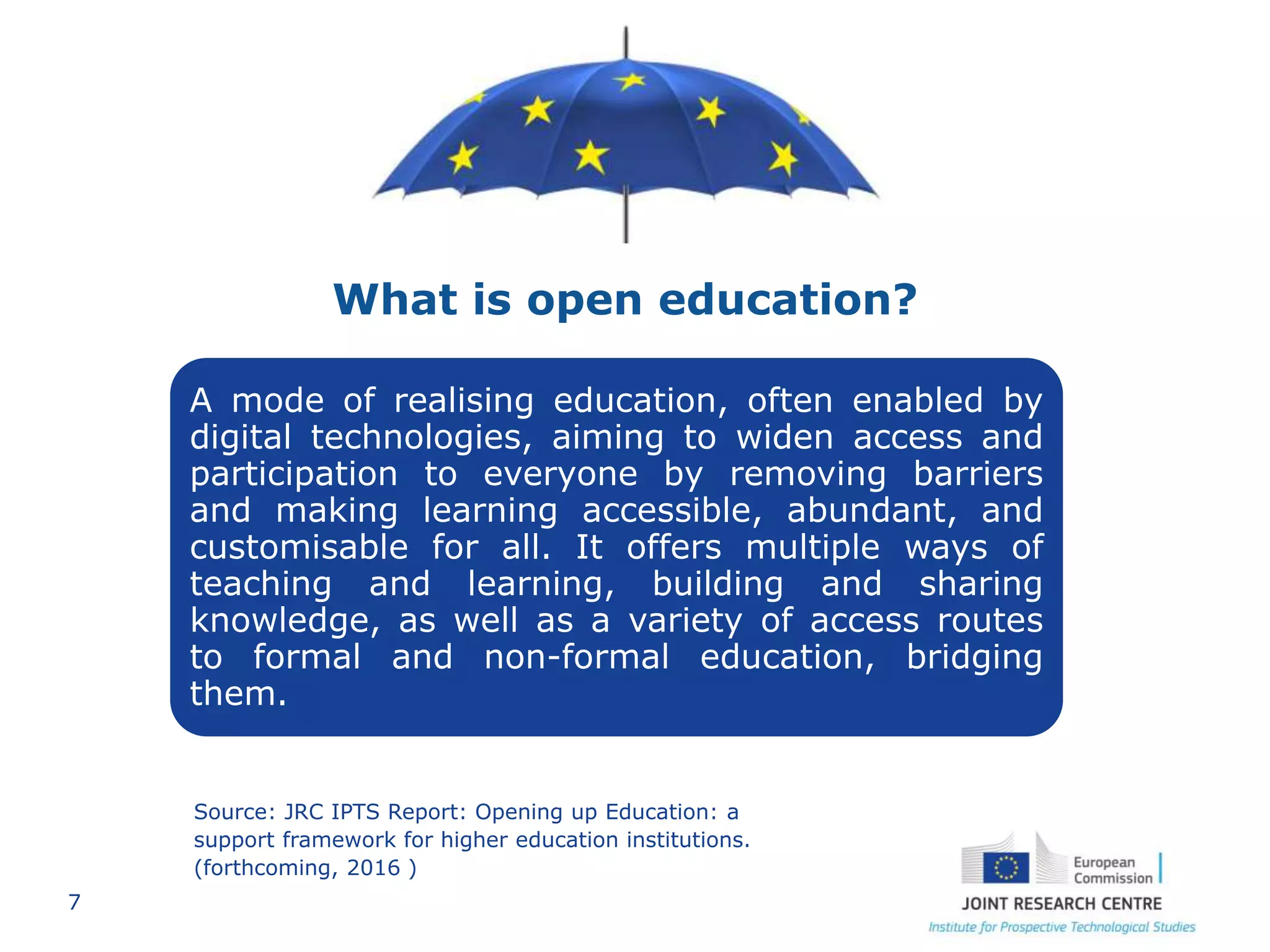
A mode of realising education, often enabled by
digital technologies, aiming to widen access and
participation to everyone by removing barriers
and making learning accessible, abundant, and
customisable for all. It offers multiple ways of
teaching and learning, building and sharing
knowledge, as well as a variety of access routes
to formal and non-formal education, bridging
them.
What is open education?
Source: JRC IPTS Report: Opening up Education: a
support framework for higher education institutions.
(forthcoming, 2016 )
8
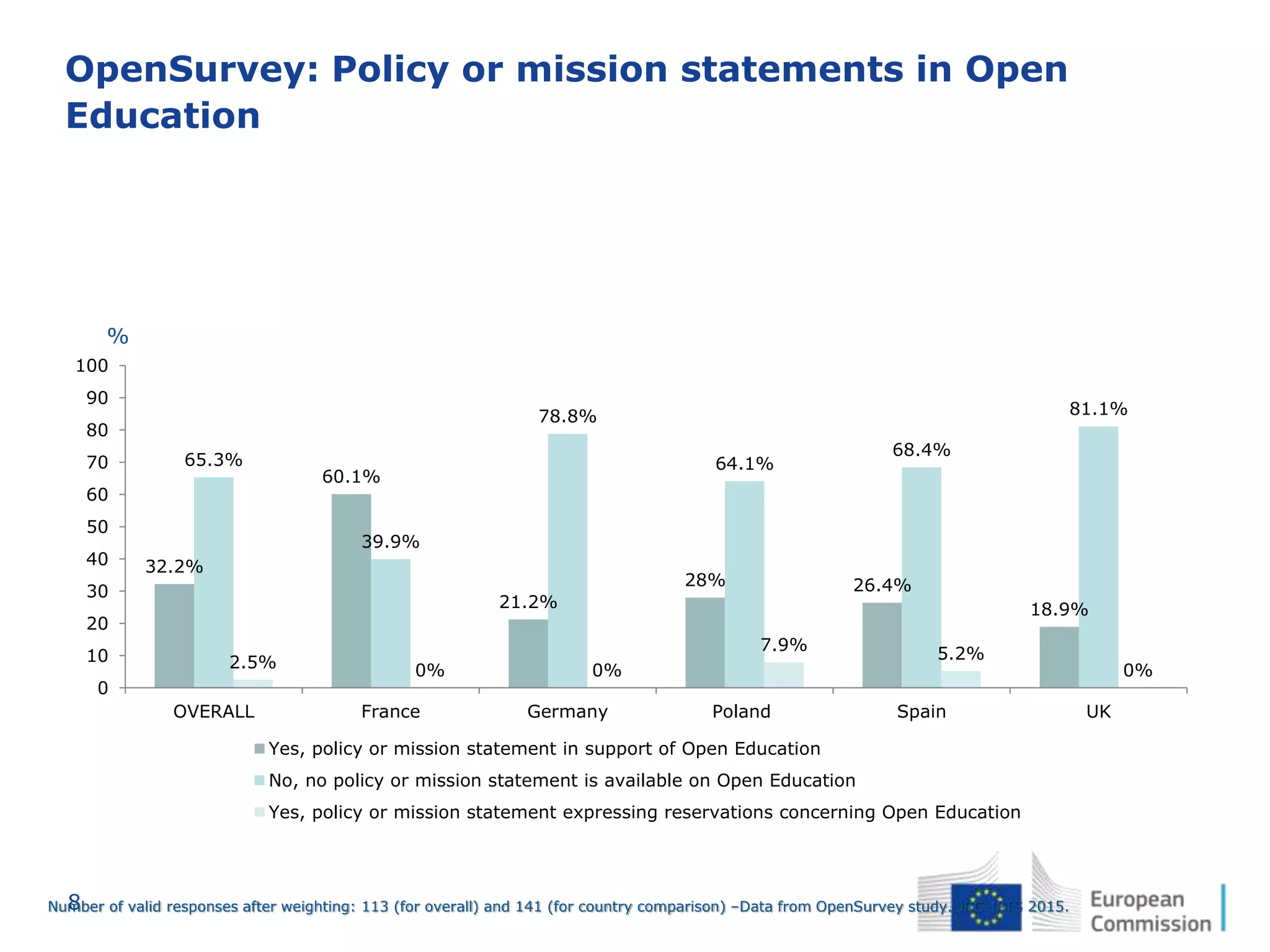
OpenSurvey: Policy or mission statements in Open
Education
32.2%
60.1%
21.2%
28% 26.4%
18.9%
65.3%
39.9%
78.8%
64.1%
68.4%
81.1%
2.5% 0% 0%
7.9% 5.2%
0%
0
10
20
30
40
50
60
70
80
90
100
OVERALL France Germany Poland Spain UK
Yes, policy or mission statement in support of Open Education
No, no policy or mission statement is available on Open Education
Yes, policy or mission statement expressing reservations concerning Open Education
%
Number of valid responses after weighting: 113 (for overall) and 141 (for country comparison) –Data from OpenSurvey study. JRC-IPTS 2015.
9
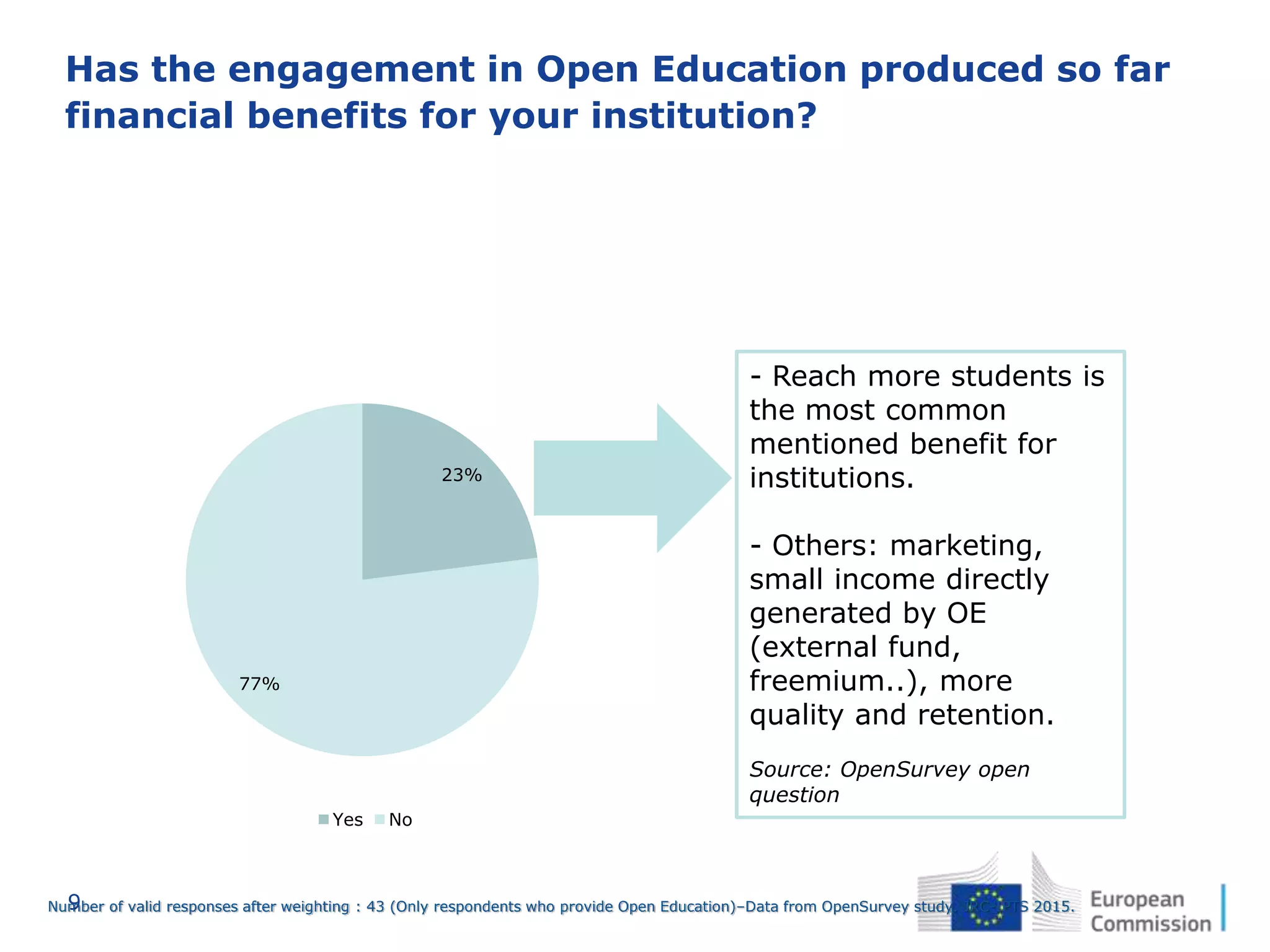
Has the engagement in Open Education produced so far
financial benefits for your institution?
23%
77%
Yes No
- Reach more students is
the most common
mentioned benefit for
institutions.
- Others: marketing,
small income directly
generated by OE
(external fund,
freemium..), more
quality and retention.
Source: OpenSurvey open
question
Number of valid responses after weighting : 43 (Only respondents who provide Open Education)–Data from OpenSurvey study. JRC-IPTS 2015.
10
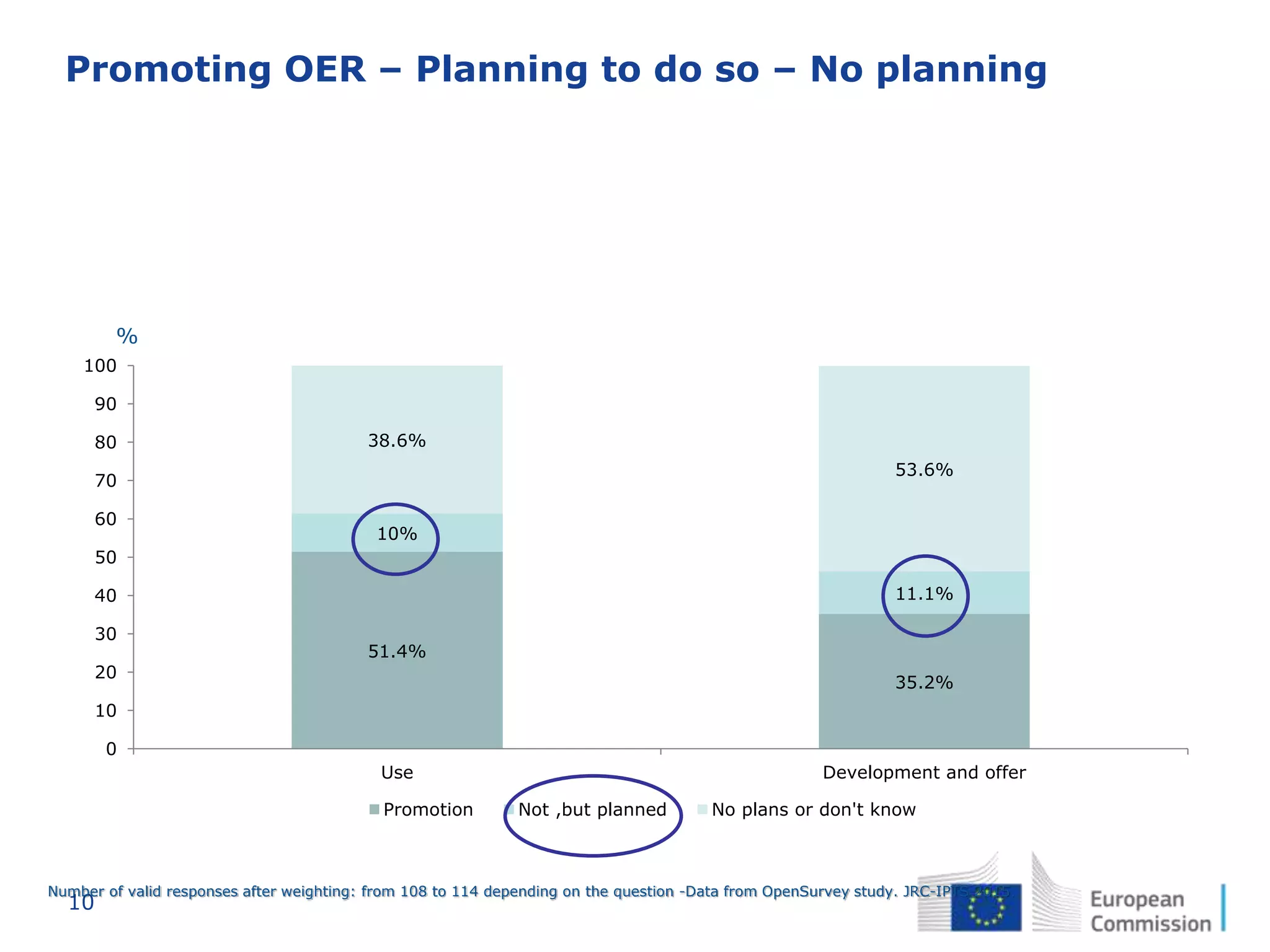
Promoting OER – Planning to do so – No planning
51.4%
35.2%
10%
11.1%
38.6%
53.6%
0
10
20
30
40
50
60
70
80
90
100
Use Development and offer
Promotion Not ,but planned No plans or don't know
%
Number of valid responses after weighting: from 108 to 114 depending on the question -Data from OpenSurvey study. JRC-IPTS 2015.
11
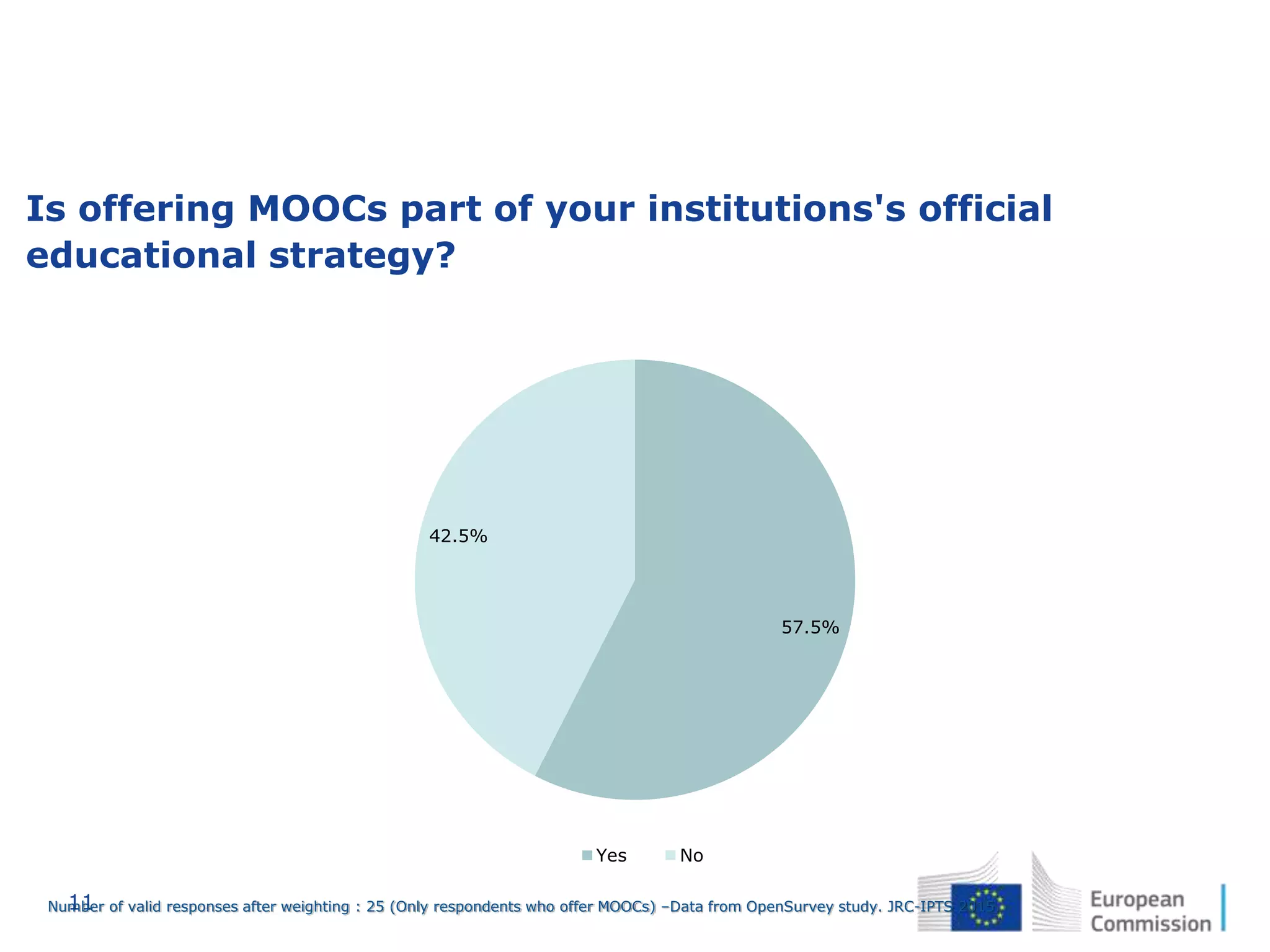
Is offering MOOCs part of your institutions's official
educational strategy?
57.5%
42.5%
Yes No
Number of valid responses after weighting : 25 (Only respondents who offer MOOCs) –Data from OpenSurvey study. JRC-IPTS 2015.
12
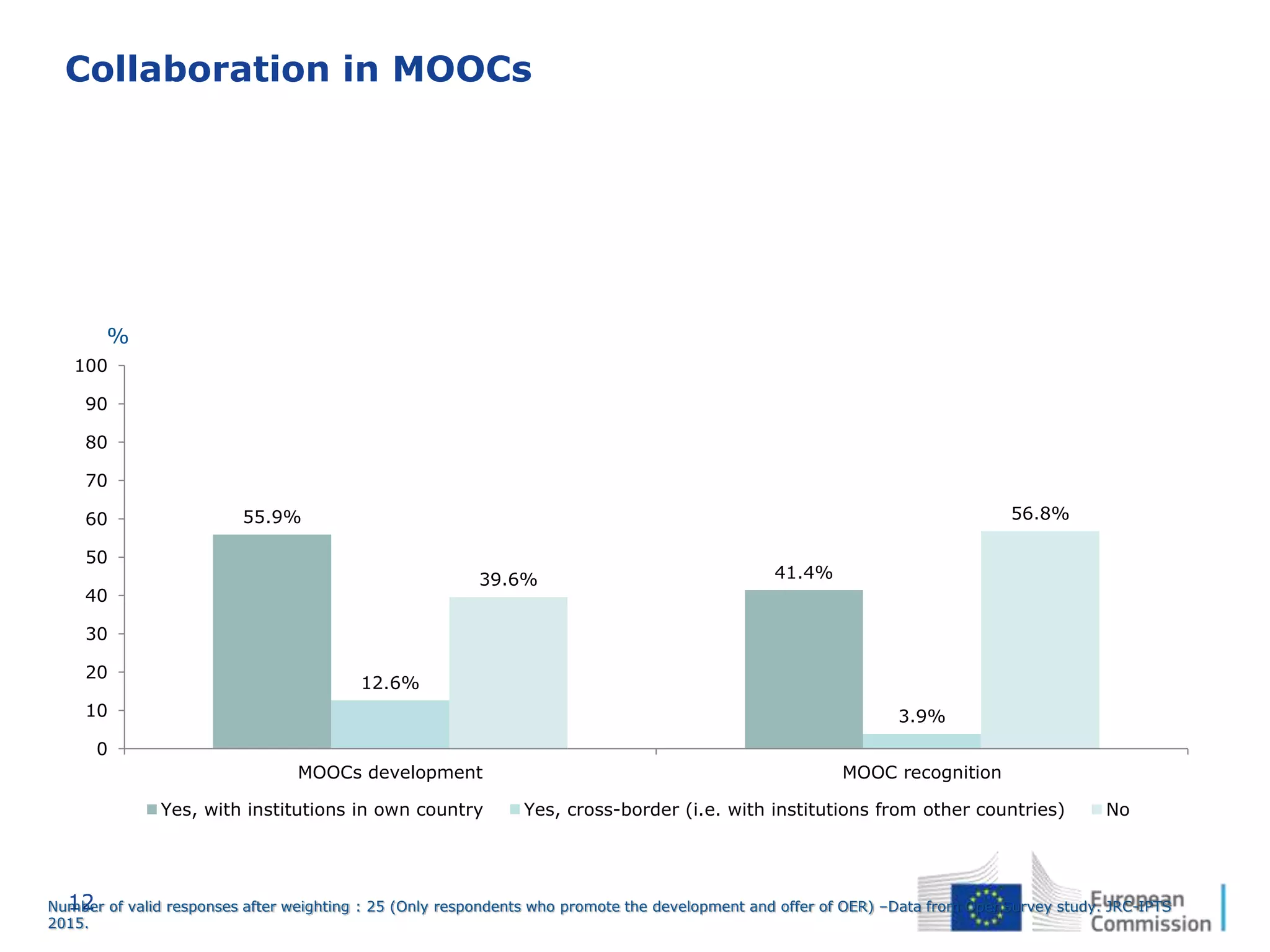
Collaboration in MOOCs
55.9%
41.4%
12.6%
3.9%
39.6%
56.8%
0
10
20
30
40
50
60
70
80
90
100
MOOCs development MOOC recognition
Yes, with institutions in own country Yes, cross-border (i.e. with institutions from other countries) No
%
Number of valid responses after weighting : 25 (Only respondents who promote the development and offer of OER) –Data from OpenSurvey study. JRC-IPTS
2015.
13
The lack of transparency and strategy
makes collaboration opportunities less
visible
14
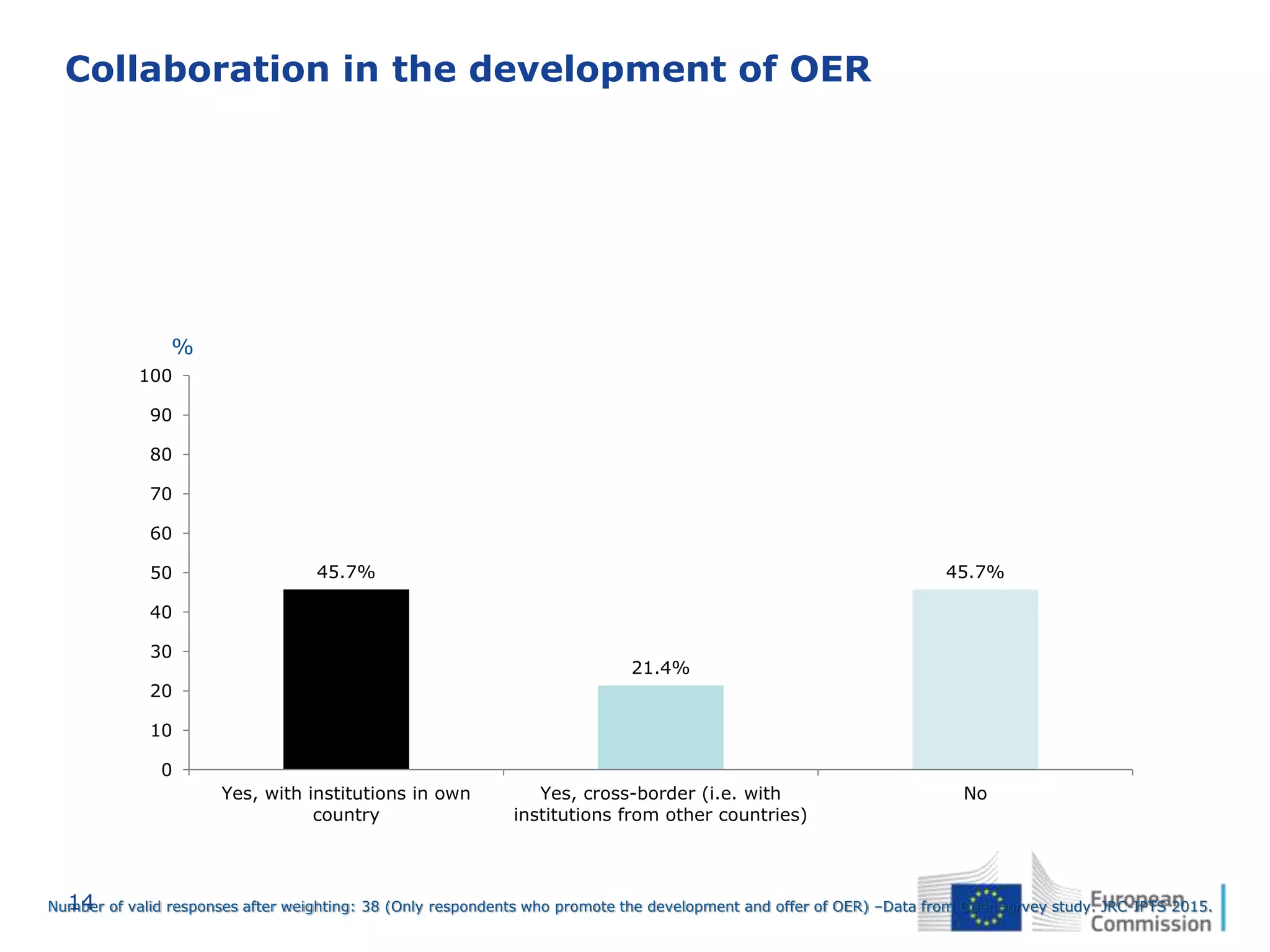
Collaboration in the development of OER
45.7%
21.4%
45.7%
0
10
20
30
40
50
60
70
80
90
100
Yes, with institutions in own
country
Yes, cross-border (i.e. with
institutions from other countries)
No
%
Number of valid responses after weighting: 38 (Only respondents who promote the development and offer of OER) –Data from OpenSurvey study. JRC-IPTS 2015.
15
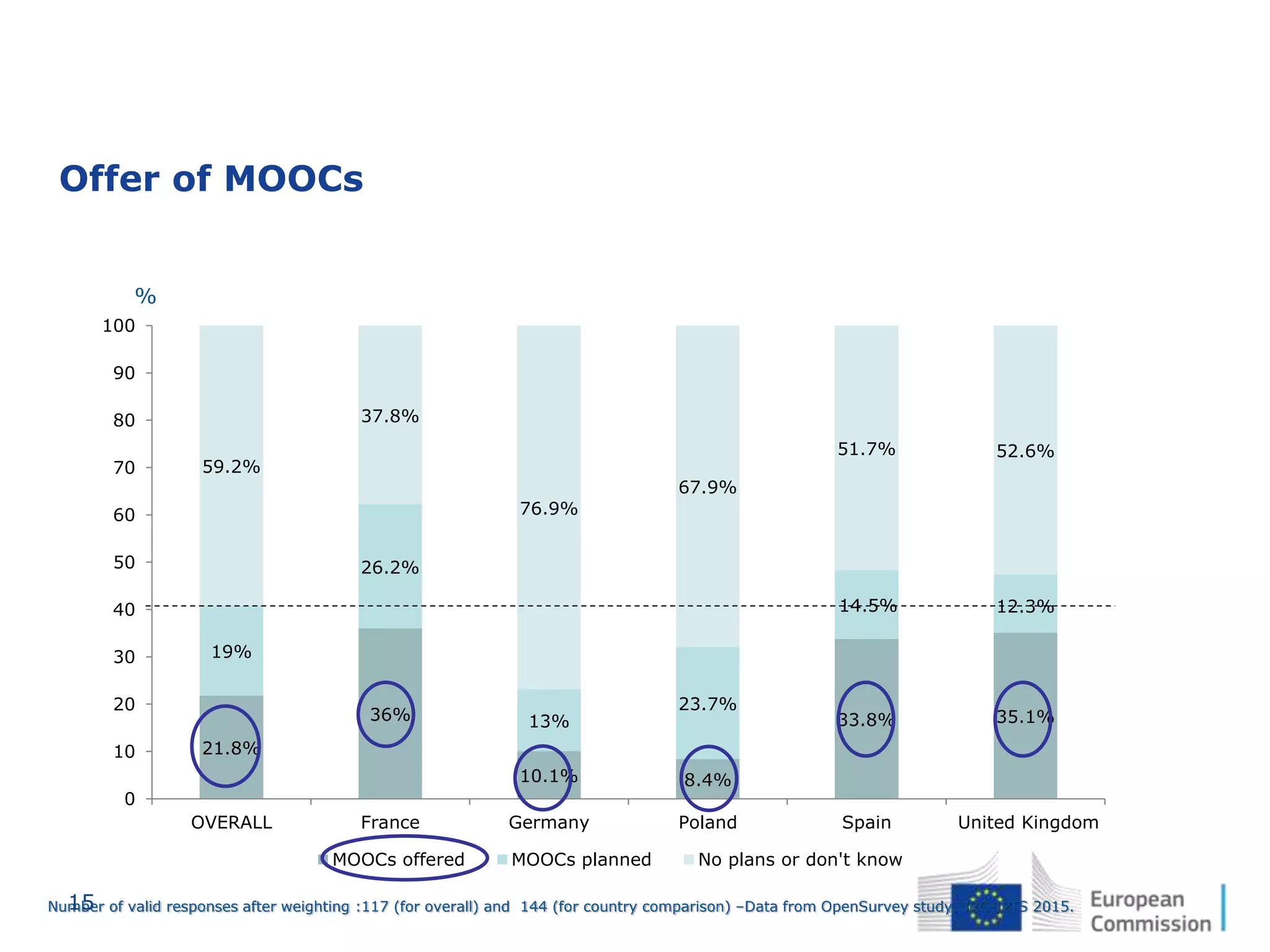
Offer of MOOCs
21.8%
36%
10.1% 8.4%
33.8% 35.1%
19%
26.2%
13%
23.7%
14.5% 12.3%
59.2%
37.8%
76.9%
67.9%
51.7% 52.6%
0
10
20
30
40
50
60
70
80
90
100
OVERALL France Germany Poland Spain United Kingdom
MOOCs offered MOOCs planned No plans or don't know
%
Number of valid responses after weighting :117 (for overall) and 144 (for country comparison) –Data from OpenSurvey study. JRC-IPTS 2015.
16
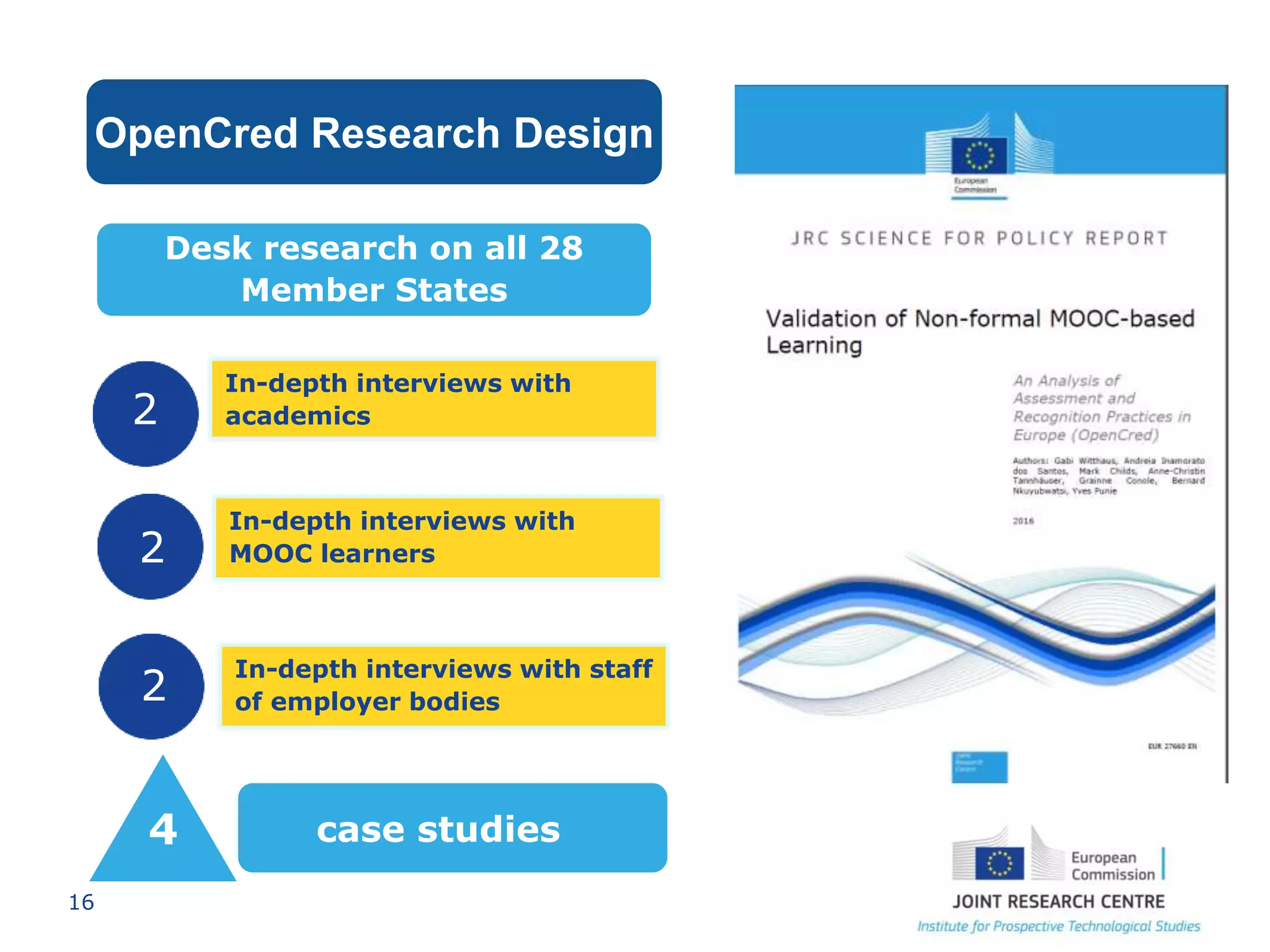
OpenCred Research Design
2
2
2
2
In-depth interviews with
academics
In-depth interviews with
MOOC learners
In-depth interviews with staff
of employer bodies
4
Desk research on all 28
Member States
case studies
17
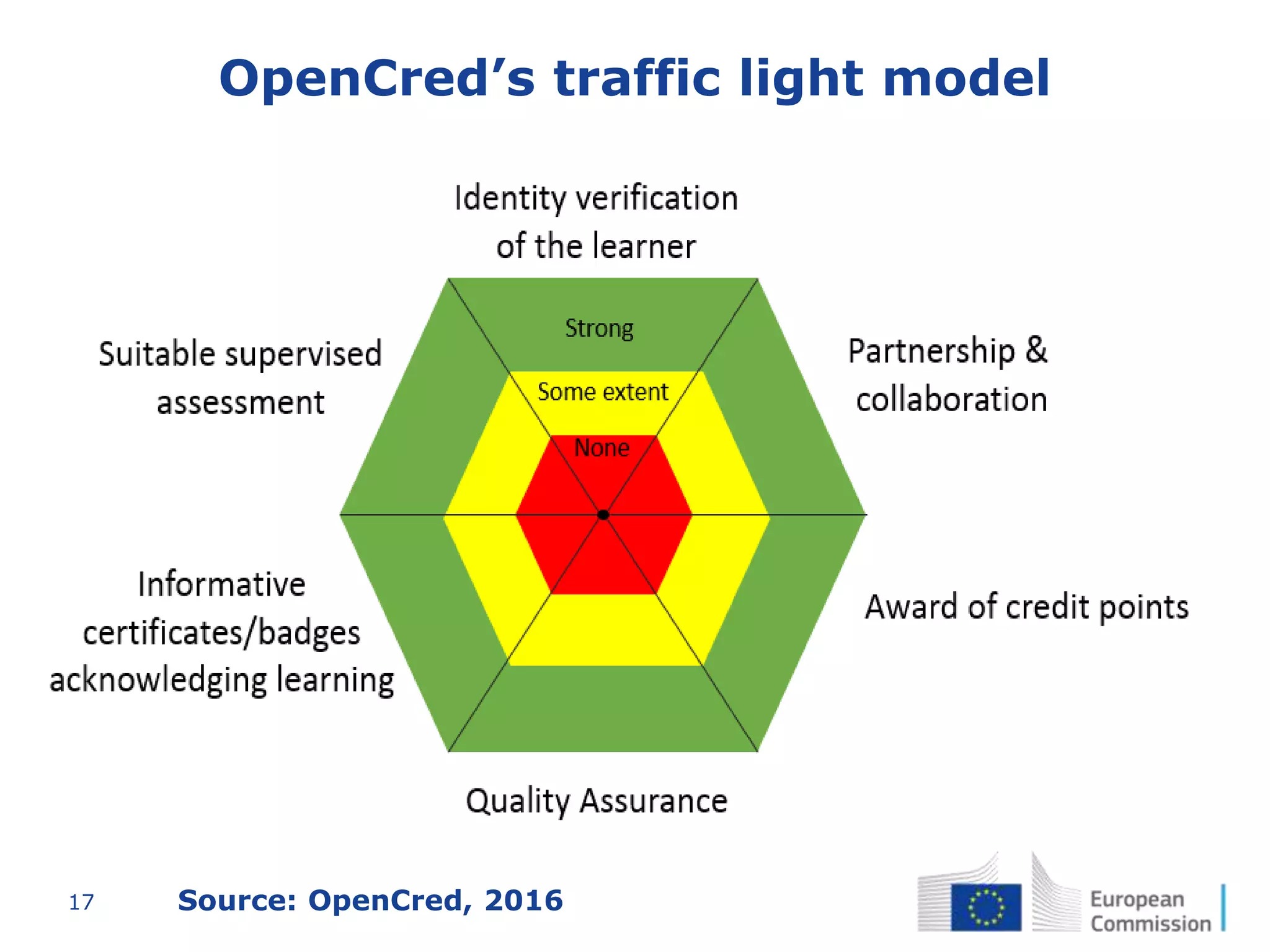
OpenCred’s traffic light model
Source: OpenCred, 2016
18
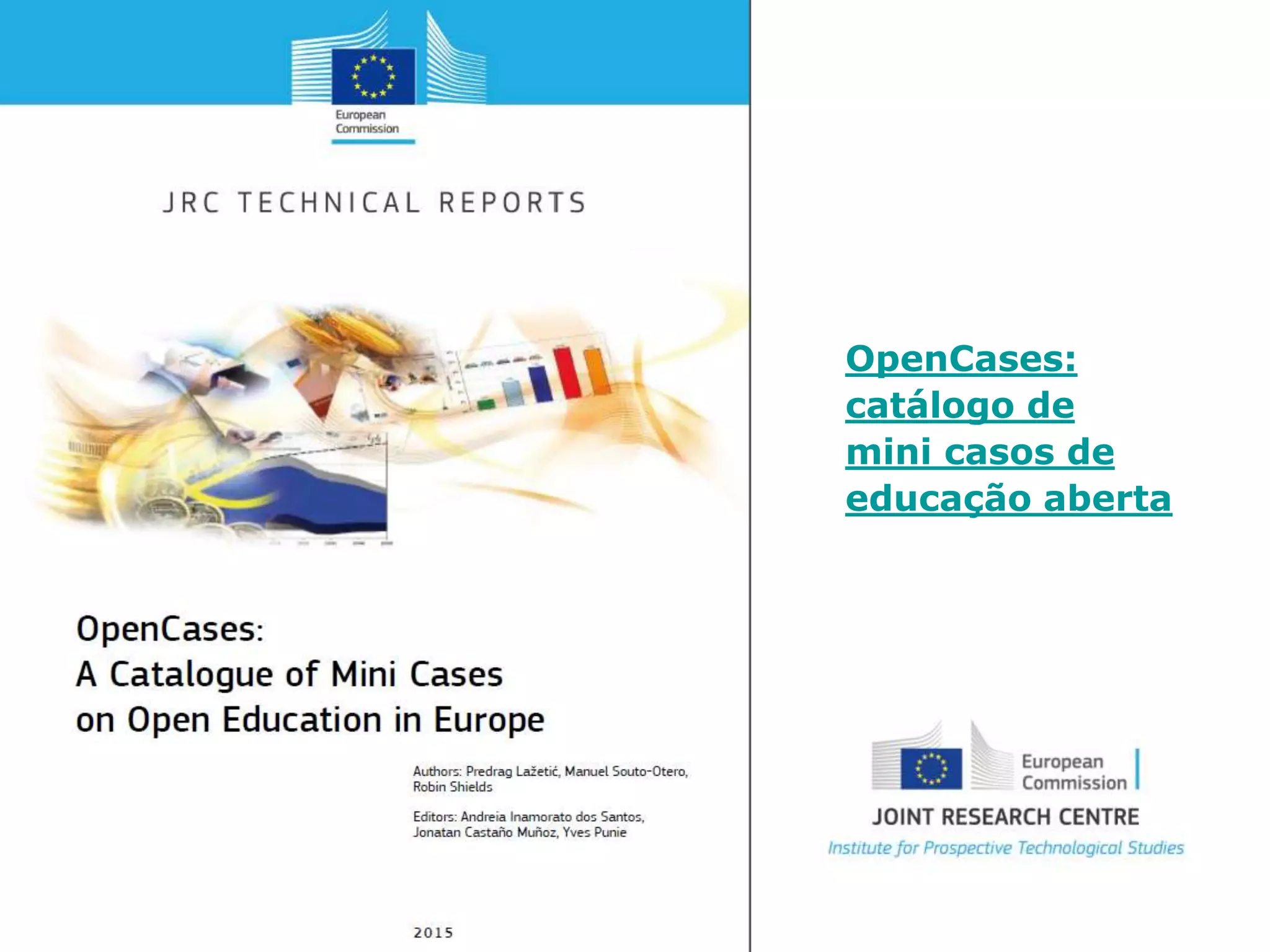
OpenCases:
catálogo de
mini casos de
educação aberta
19
JRC-IPTS OpenEdu framework on behalf
of DG EAC
The framework was designed to support higher education
institutions in Europe to make strategic decisions on open
education.
It is a hands-on tool created by the OpenEdu Project as a
response to the European Commission's Communication
'Opening up Education: Innovative teaching and learning for all
through newTechnologies andOpen Educational Resources'
20
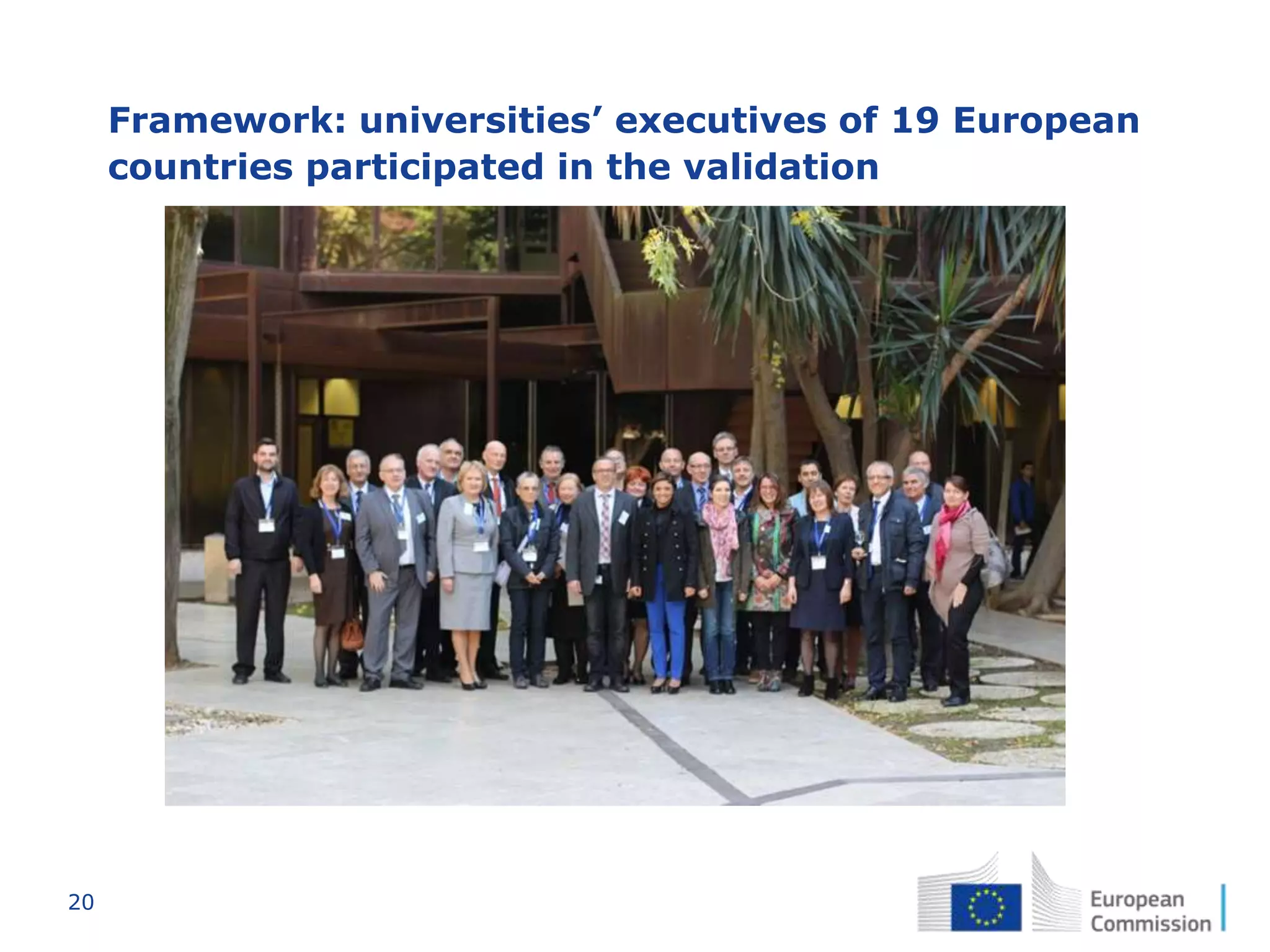
Framework: universities’ executives of 19 European
countries participated in the validation
21
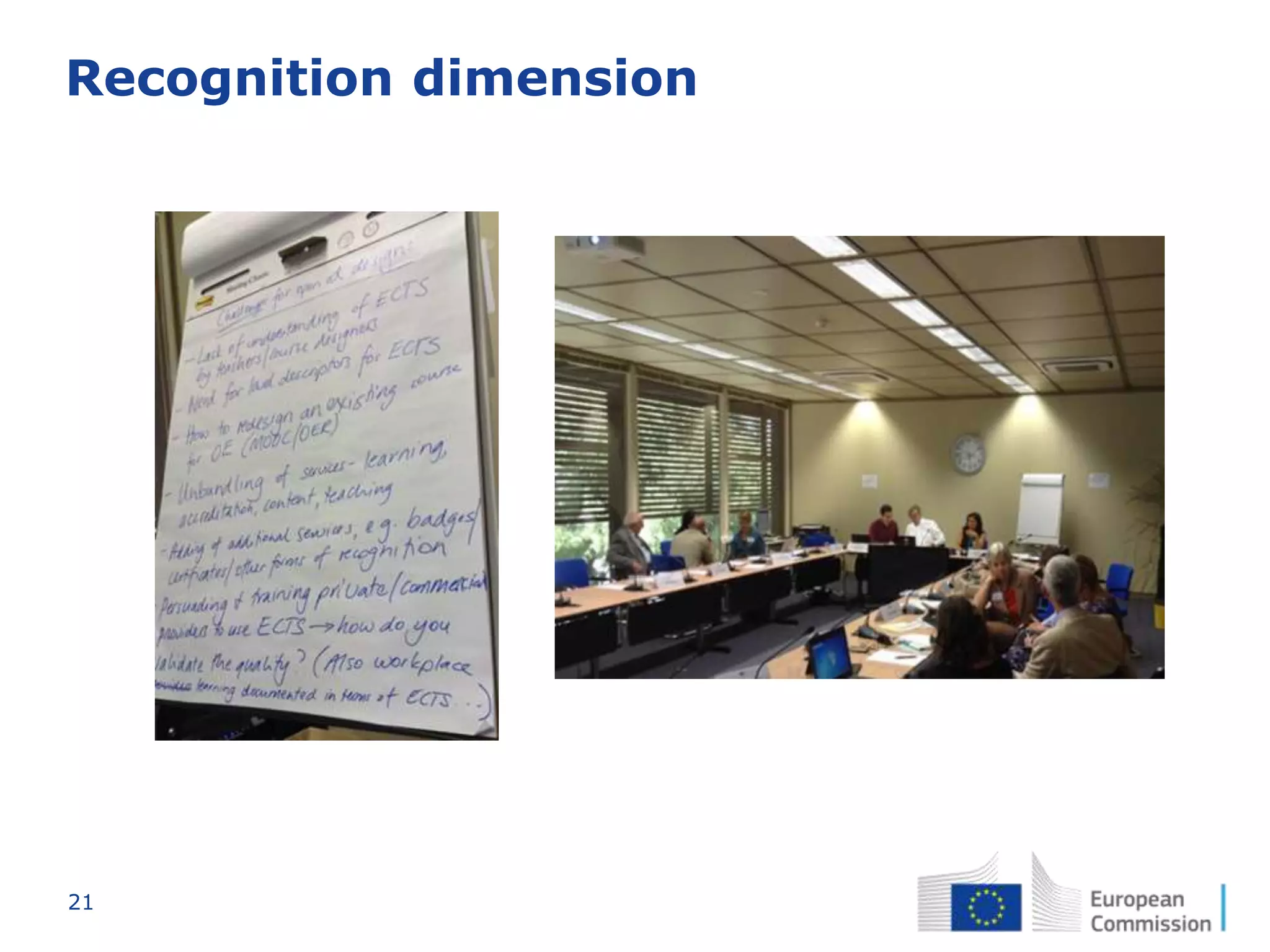
Recognition dimension
22
Why is a framework for OE important?
The framework challenges
conventional wisdom. It provides
a guide to think through critical
questions. No framework provides
definitive answers. The answers
come through the insights
generated by the process of
engaging with the framework.
23
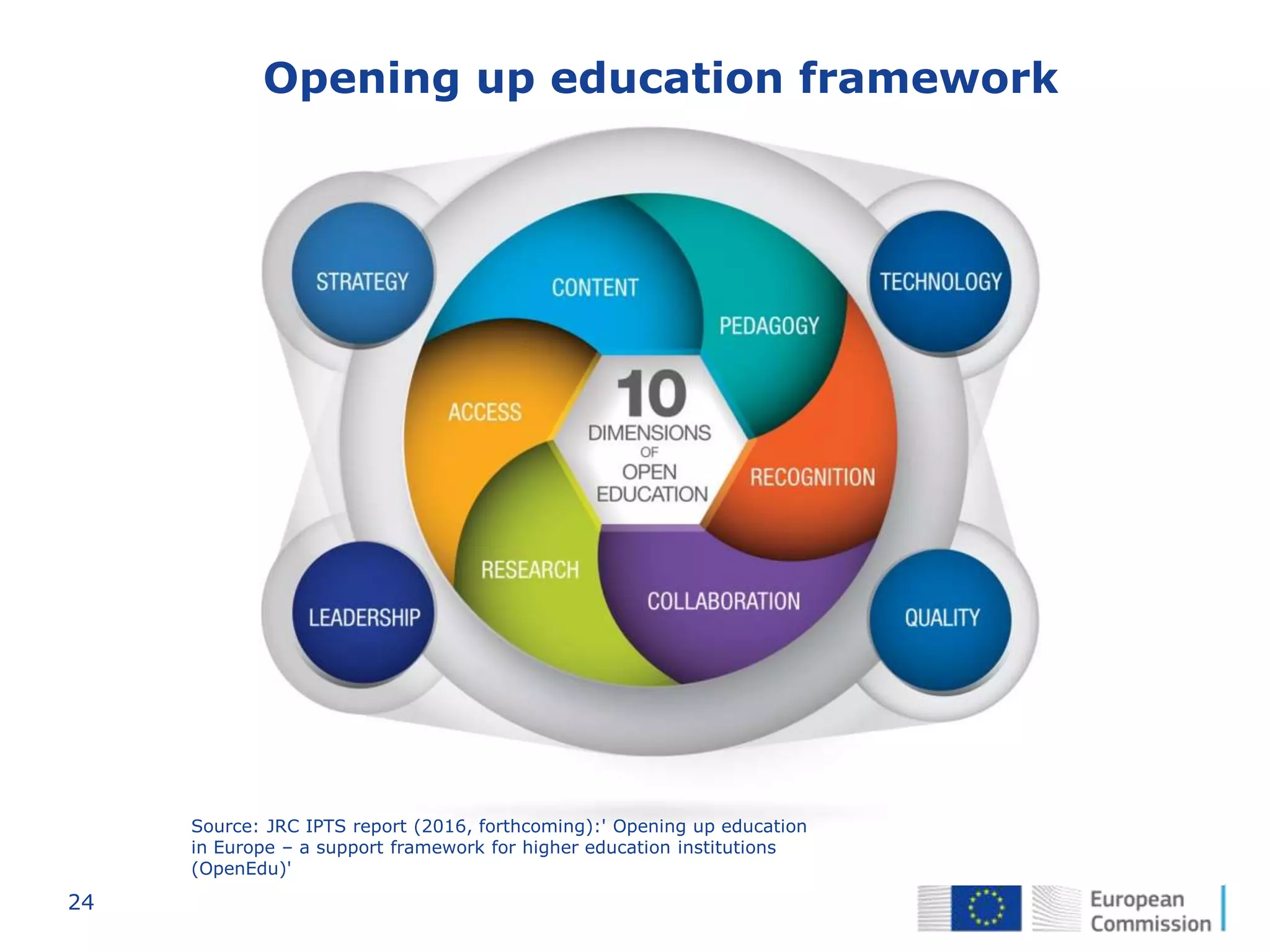
What does the framework look like?
For each dimension of open
education, the framework
brings:
√ Dimension definition
√ Rationale
√ Components
√ descriptors
• Dimensions:
• 6 core: access,
content, pedagogy,
recognition,
collaboration,
technology, research
• 4 transversal:
strategy, leadership,
technology, quality
Opening up education strategic
planning template
24
Source: JRC IPTS report (2016, forthcoming):' Opening up education
in Europe – a support framework for higher education institutions
(OpenEdu)'
Opening up education framework
25
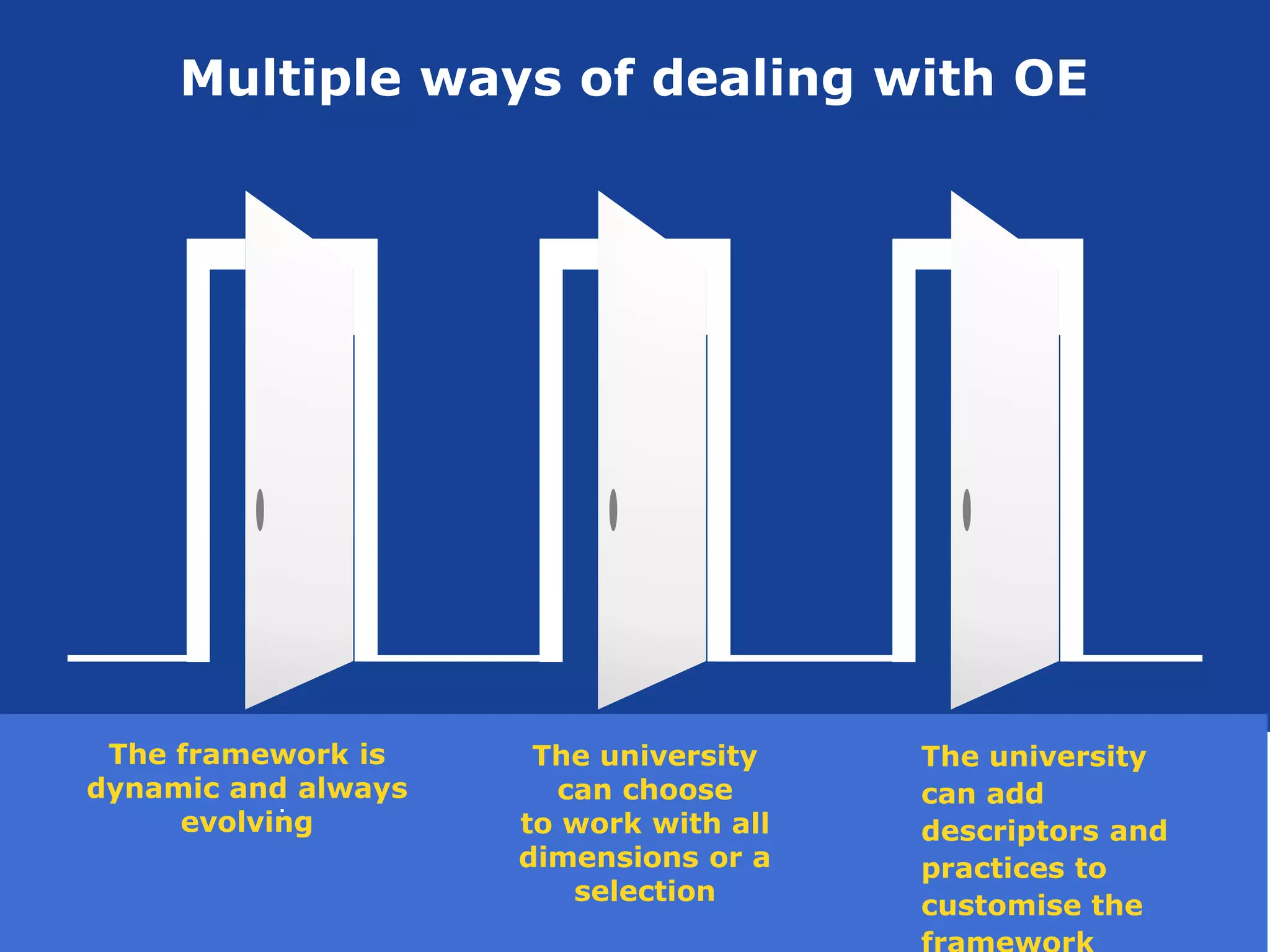
Multiple ways of dealing with OE
.
The university
can choose
to work with all
dimensions or a
selection
The framework is
dynamic and always
evolving
The university
can add
descriptors and
practices to
customise the
26
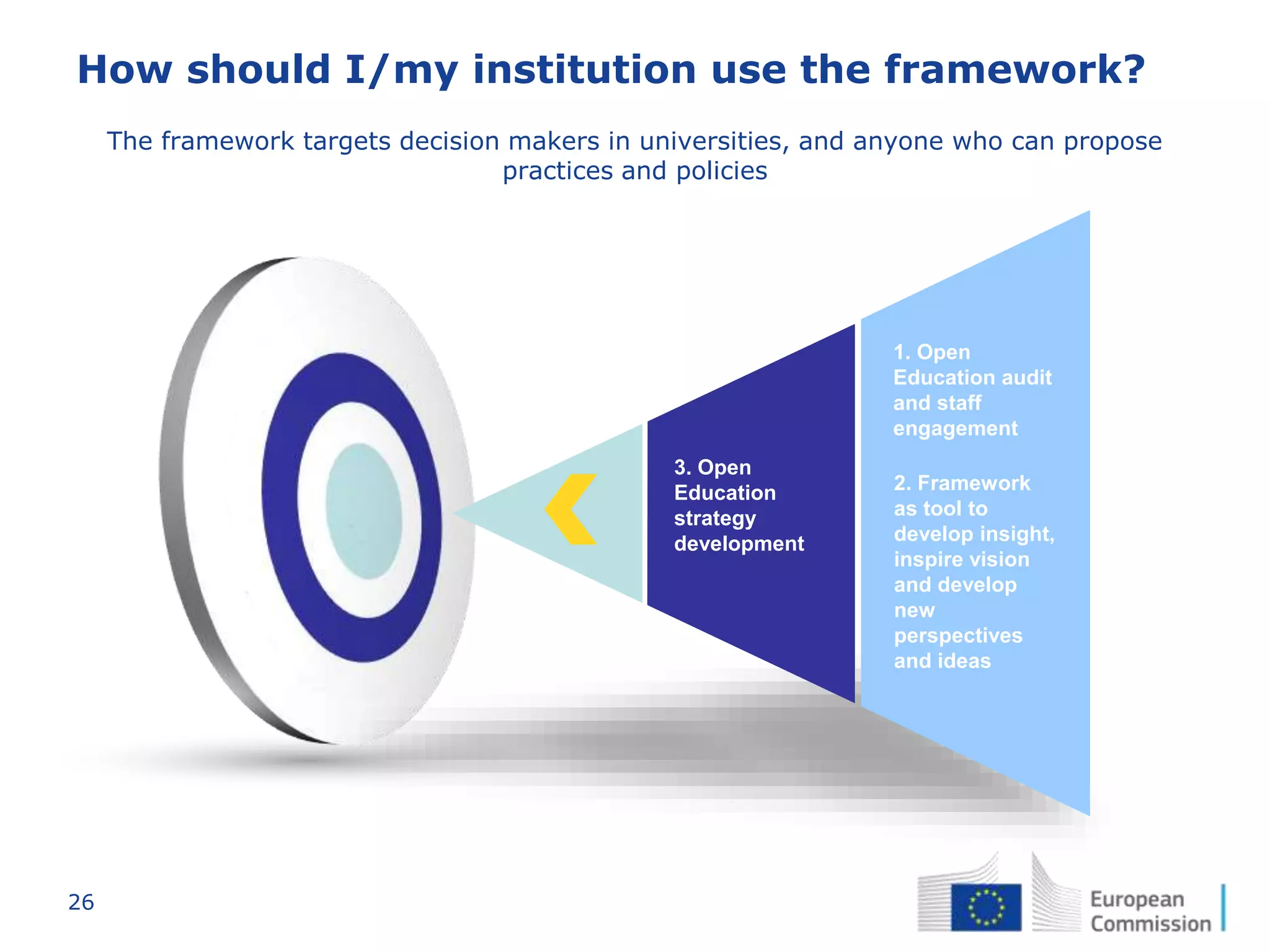
How should I/my institution use the framework?
The framework targets decision makers in universities, and anyone who can propose
practices and policies
3. Open
Education
strategy
development
1. Open
Education audit
and staff
engagement
2. Framework
as tool to
develop insight,
inspire vision
and develop
new
perspectives
and ideas
27
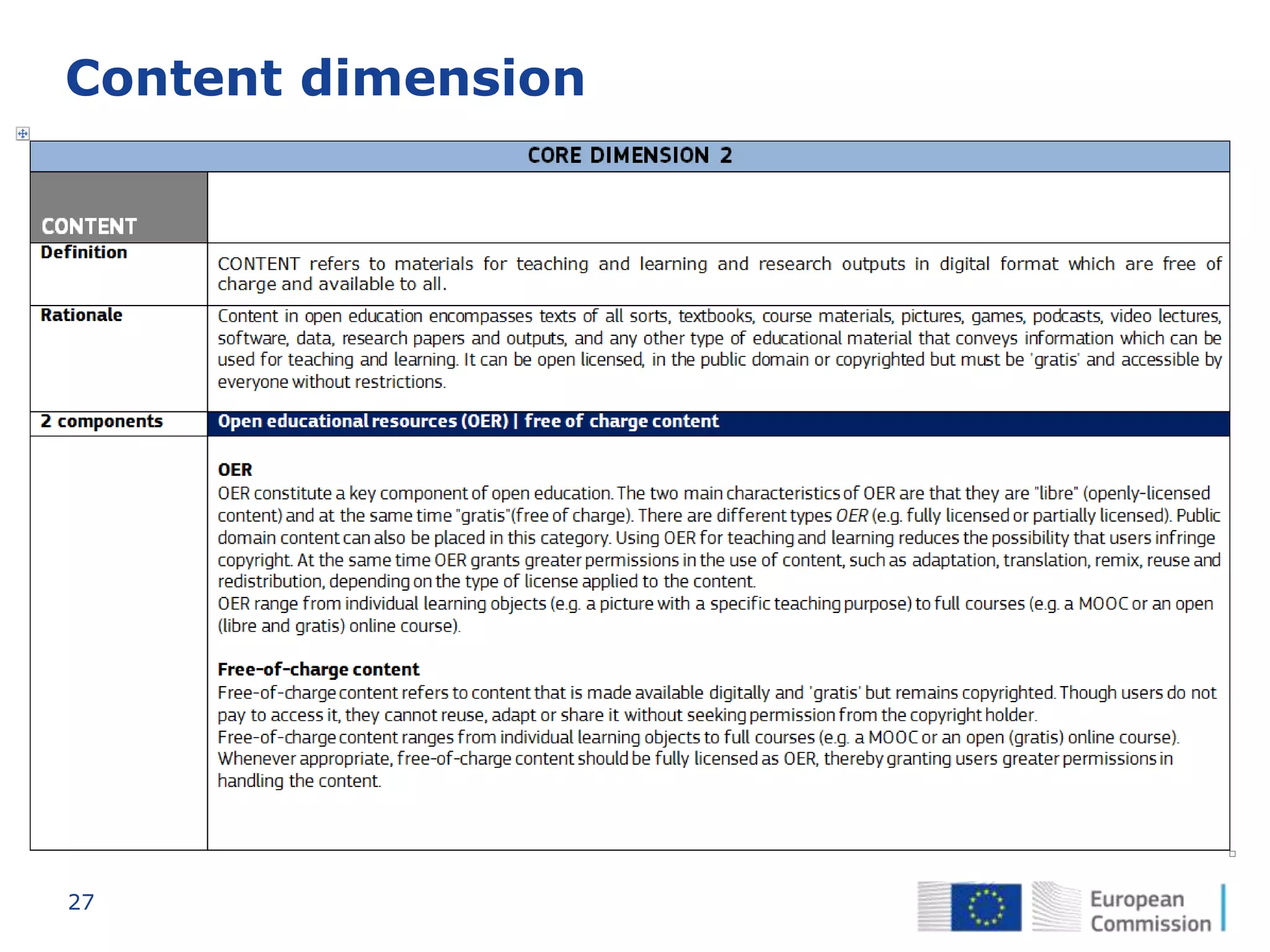
Content dimension
28
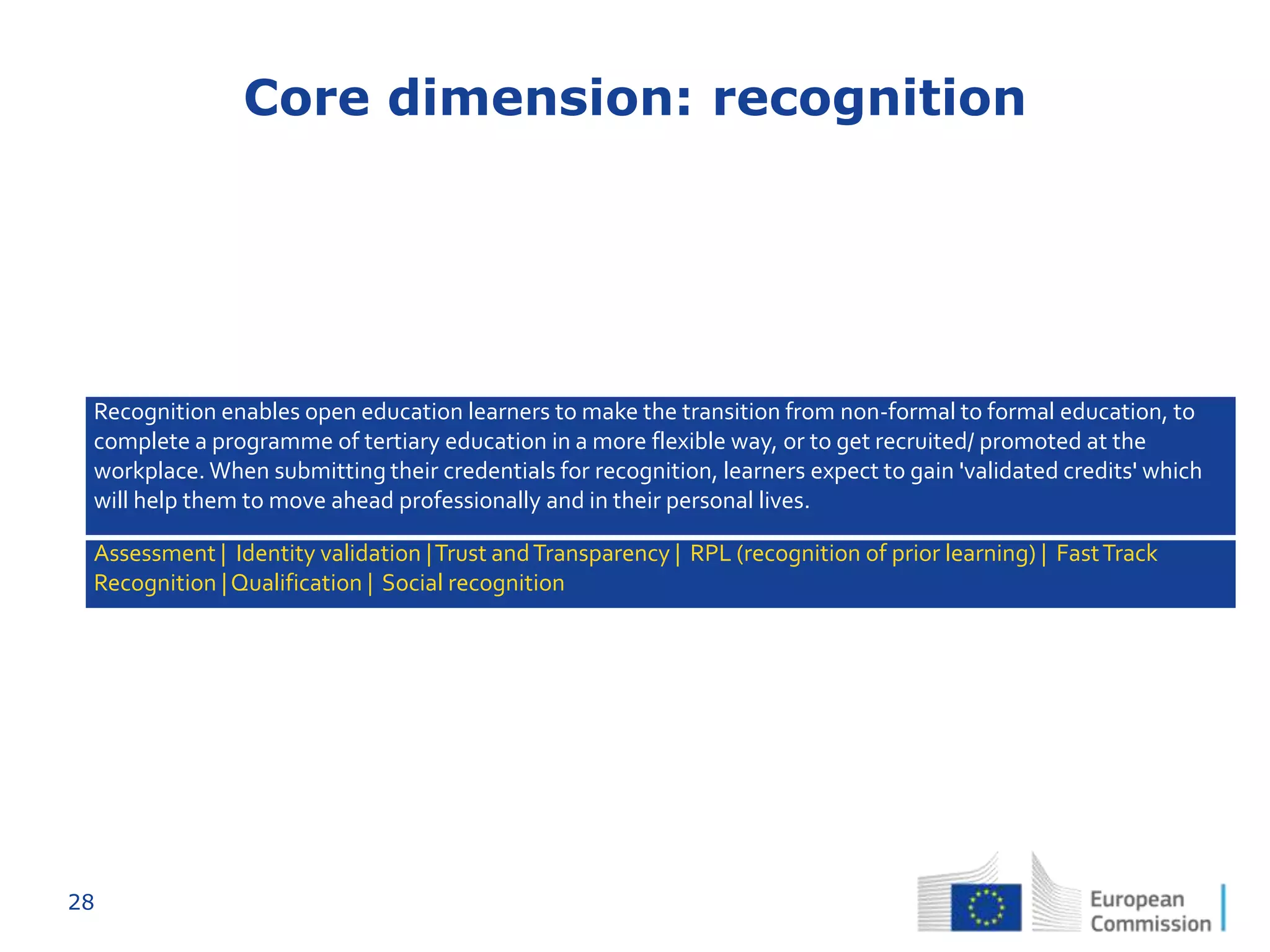
Core dimension: recognition
Recognition enables open education learners to make the transition from non-formal to formal education, to
complete a programme of tertiary education in a more flexible way, or to get recruited/ promoted at the
workplace. When submitting their credentials for recognition, learners expect to gain 'validated credits' which
will help them to move ahead professionally and in their personal lives.
Assessment | Identity validation |Trust andTransparency | RPL (recognition of prior learning) | FastTrack
Recognition |Qualification | Social recognition
29
30
Thank you
andreia-inamorato-dos.santos@ec.europa.eu

The 10 dimensions of open education

  • 1.
    Joint Research Centre theEuropean Commission's in-house science service The 10 dimensions of open education An introduction to the OpenEdu framework on openness in higher education Andreia Inamorato dos Santos Yves Punie Jonatan Castaño Muñoz @aisantos
  • 2.
    2 The JRC isthe in-house scientific service of the European Commission. It provides the scientific advice and technical know-how to support EU policies ICT for Learning and Skills Team - IPTS
  • 3.
    3 1 2 Open EducationOpenEdu Studies OpenEdu Framework & Dimensions 3
  • 4.
    4 Open Education isin Europe's Agenda The framework was designed to support higher education institutions in Europe to make strategic decisions on open education. It is a hands-on tool created by the OpenEdu Project as a response to the European Commission's Communication 'Opening up Education: Innovative teaching and learning for all through newTechnologies andOpen Educational Resources'
  • 5.
    OpenCases OpenCred MoocknowledgeOpenSurvey OpenEduProject OpenEdu Framework 90+ stakeholders consulted 9 case studies 4 case studies 5 countries survey of learners OpenEdu supports the 2013 Communication ' Opening up Education: Innovative Teaching and Learning for all through New Technologies and Open Educational Resources Tool: OpenEdu Framework in-house research Final Report
  • 6.
    6 What are themain challenges for opening up higher education? What /How to sustainability collaborations strategy CHALLENGES
  • 7.
    7 A mode ofrealising education, often enabled by digital technologies, aiming to widen access and participation to everyone by removing barriers and making learning accessible, abundant, and customisable for all. It offers multiple ways of teaching and learning, building and sharing knowledge, as well as a variety of access routes to formal and non-formal education, bridging them. What is open education? Source: JRC IPTS Report: Opening up Education: a support framework for higher education institutions. (forthcoming, 2016 )
  • 8.
    8 OpenSurvey: Policy ormission statements in Open Education 32.2% 60.1% 21.2% 28% 26.4% 18.9% 65.3% 39.9% 78.8% 64.1% 68.4% 81.1% 2.5% 0% 0% 7.9% 5.2% 0% 0 10 20 30 40 50 60 70 80 90 100 OVERALL France Germany Poland Spain UK Yes, policy or mission statement in support of Open Education No, no policy or mission statement is available on Open Education Yes, policy or mission statement expressing reservations concerning Open Education % Number of valid responses after weighting: 113 (for overall) and 141 (for country comparison) –Data from OpenSurvey study. JRC-IPTS 2015.
  • 9.
    9 Has the engagementin Open Education produced so far financial benefits for your institution? 23% 77% Yes No - Reach more students is the most common mentioned benefit for institutions. - Others: marketing, small income directly generated by OE (external fund, freemium..), more quality and retention. Source: OpenSurvey open question Number of valid responses after weighting : 43 (Only respondents who provide Open Education)–Data from OpenSurvey study. JRC-IPTS 2015.
  • 10.
    10 Promoting OER –Planning to do so – No planning 51.4% 35.2% 10% 11.1% 38.6% 53.6% 0 10 20 30 40 50 60 70 80 90 100 Use Development and offer Promotion Not ,but planned No plans or don't know % Number of valid responses after weighting: from 108 to 114 depending on the question -Data from OpenSurvey study. JRC-IPTS 2015.
  • 11.
    11 Is offering MOOCspart of your institutions's official educational strategy? 57.5% 42.5% Yes No Number of valid responses after weighting : 25 (Only respondents who offer MOOCs) –Data from OpenSurvey study. JRC-IPTS 2015.
  • 12.
    12 Collaboration in MOOCs 55.9% 41.4% 12.6% 3.9% 39.6% 56.8% 0 10 20 30 40 50 60 70 80 90 100 MOOCsdevelopment MOOC recognition Yes, with institutions in own country Yes, cross-border (i.e. with institutions from other countries) No % Number of valid responses after weighting : 25 (Only respondents who promote the development and offer of OER) –Data from OpenSurvey study. JRC-IPTS 2015.
  • 13.
    13 The lack oftransparency and strategy makes collaboration opportunities less visible
  • 14.
    14 Collaboration in thedevelopment of OER 45.7% 21.4% 45.7% 0 10 20 30 40 50 60 70 80 90 100 Yes, with institutions in own country Yes, cross-border (i.e. with institutions from other countries) No % Number of valid responses after weighting: 38 (Only respondents who promote the development and offer of OER) –Data from OpenSurvey study. JRC-IPTS 2015.
  • 15.
    15 Offer of MOOCs 21.8% 36% 10.1%8.4% 33.8% 35.1% 19% 26.2% 13% 23.7% 14.5% 12.3% 59.2% 37.8% 76.9% 67.9% 51.7% 52.6% 0 10 20 30 40 50 60 70 80 90 100 OVERALL France Germany Poland Spain United Kingdom MOOCs offered MOOCs planned No plans or don't know % Number of valid responses after weighting :117 (for overall) and 144 (for country comparison) –Data from OpenSurvey study. JRC-IPTS 2015.
  • 16.
    16 OpenCred Research Design 2 2 2 2 In-depthinterviews with academics In-depth interviews with MOOC learners In-depth interviews with staff of employer bodies 4 Desk research on all 28 Member States case studies
  • 17.
    17 OpenCred’s traffic lightmodel Source: OpenCred, 2016
  • 18.
  • 19.
    19 JRC-IPTS OpenEdu frameworkon behalf of DG EAC The framework was designed to support higher education institutions in Europe to make strategic decisions on open education. It is a hands-on tool created by the OpenEdu Project as a response to the European Commission's Communication 'Opening up Education: Innovative teaching and learning for all through newTechnologies andOpen Educational Resources'
  • 20.
    20 Framework: universities’ executivesof 19 European countries participated in the validation
  • 21.
  • 22.
    22 Why is aframework for OE important? The framework challenges conventional wisdom. It provides a guide to think through critical questions. No framework provides definitive answers. The answers come through the insights generated by the process of engaging with the framework.
  • 23.
    23 What does theframework look like? For each dimension of open education, the framework brings: √ Dimension definition √ Rationale √ Components √ descriptors • Dimensions: • 6 core: access, content, pedagogy, recognition, collaboration, technology, research • 4 transversal: strategy, leadership, technology, quality Opening up education strategic planning template
  • 24.
    24 Source: JRC IPTSreport (2016, forthcoming):' Opening up education in Europe – a support framework for higher education institutions (OpenEdu)' Opening up education framework
  • 25.
    25 Multiple ways ofdealing with OE . The university can choose to work with all dimensions or a selection The framework is dynamic and always evolving The university can add descriptors and practices to customise the
  • 26.
    26 How should I/myinstitution use the framework? The framework targets decision makers in universities, and anyone who can propose practices and policies 3. Open Education strategy development 1. Open Education audit and staff engagement 2. Framework as tool to develop insight, inspire vision and develop new perspectives and ideas
  • 27.
  • 28.
    28 Core dimension: recognition Recognitionenables open education learners to make the transition from non-formal to formal education, to complete a programme of tertiary education in a more flexible way, or to get recruited/ promoted at the workplace. When submitting their credentials for recognition, learners expect to gain 'validated credits' which will help them to move ahead professionally and in their personal lives. Assessment | Identity validation |Trust andTransparency | RPL (recognition of prior learning) | FastTrack Recognition |Qualification | Social recognition
  • 29.
  • 30.

Editor's Notes

  • #7 Opening up HE presents challenges. This is mostly because there is no consensus amongst universities on what open education is and they tend to focus on different things. It is fine, but makes collaboration opportunties less visible In order to seek collaborative efforts to achieve a goal, a common understanding and trasnparent practices are unecesserary.
  • #8 Here the goal is to present the definition building on the idea of open education as an umbrella term which accomodates many open education practices. his is why the definition is comprehensive, going beyond MOOCs and OER. It was the product of observation and research of the actual open education practices of universities, noticing that there is not a single, correct way of doing open education.
  • #23 the framework as a box is limiting. But throwing it out is also limiting. Without a framework managers tend to overlook important considerations or put greater effort in practcices that may need
  • #25 This slide provides the visual input for the framework and can be used to explain the relationship between the transversal and core dimensions. No dimension works on its own, they always interplay with one another. A university can choose to focus on one particular dimension, nevertheless the other dimensions will still be into play, even if at a lesser extent. The ultimate goal is to focus on the 6 core dimensions ( the ' what of open education' and count on the support of the 4 transversal dimensions for realisation ( the 'how to' of open education)
  • #26  This is the multiple doors metaphor.