
Game terminologies

   By Ahmed Badr
Agenda

•   RGB
•   Color cube
•   Pixel
•   Color depth
•   Resolution
•   Pixel art
•   BMP
•   Grayscale
Agenda

•   Alpha mask
•   PCX
•   JPEG/JPG
•   Alpha channels
•   Sprite
•   Polygon
•   Vertex
•   Edge
Agenda

•   Model
•   Face
•   Mesh
•   Texture
•   Tile maps
•   Texel
•   Texture Mapping
•   UV mapping
Agenda

•MinMaps
•procedural texture
•point sampling
•Bilinear interpolation
•Tri-linear filtering
•anisotropic filtering
•Render
•Frame
Agenda

•Gouraud shading
•Reflection mapping
•Specular reflection
•Diffuse reflection
•Refraction
•Bump mapping
•Normal mapping
•parallax mapping
Agenda

•   Lightmap
•   Ray tracing
•   Terrain
•   Height map
•   Pixel shader
•   Vertex shader
•   Cell shader
•   Game bots
Agenda

•   AI
•   procedural animation
•   Skeletal animation
•   Morph target animation
•   Collision
•   Game engine
•   game genre
RGB

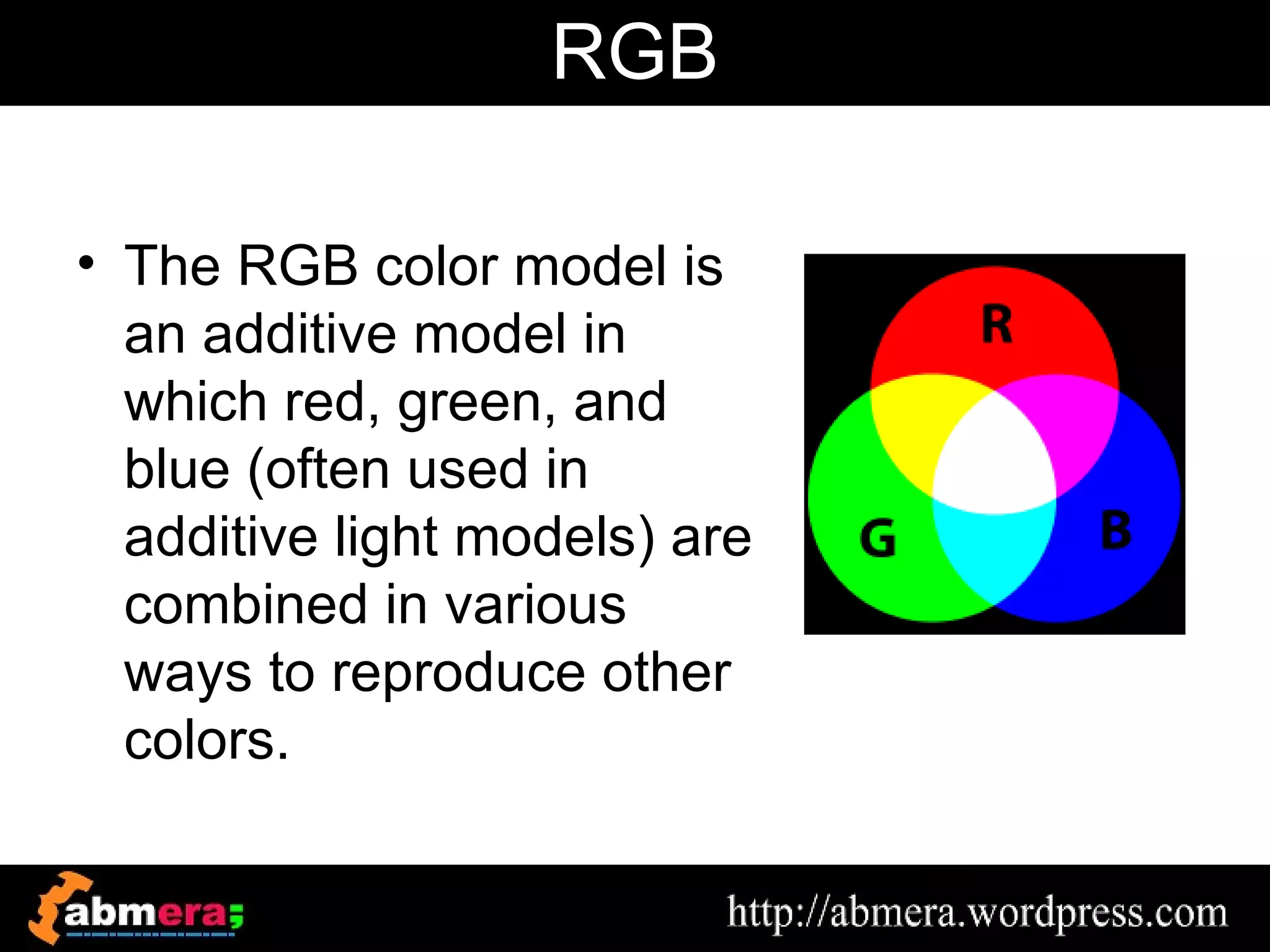
• The RGB color model is
  an additive model in
  which red, green, and
  blue (often used in
  additive light models) are
  combined in various
  ways to reproduce other
  colors.
Color cube

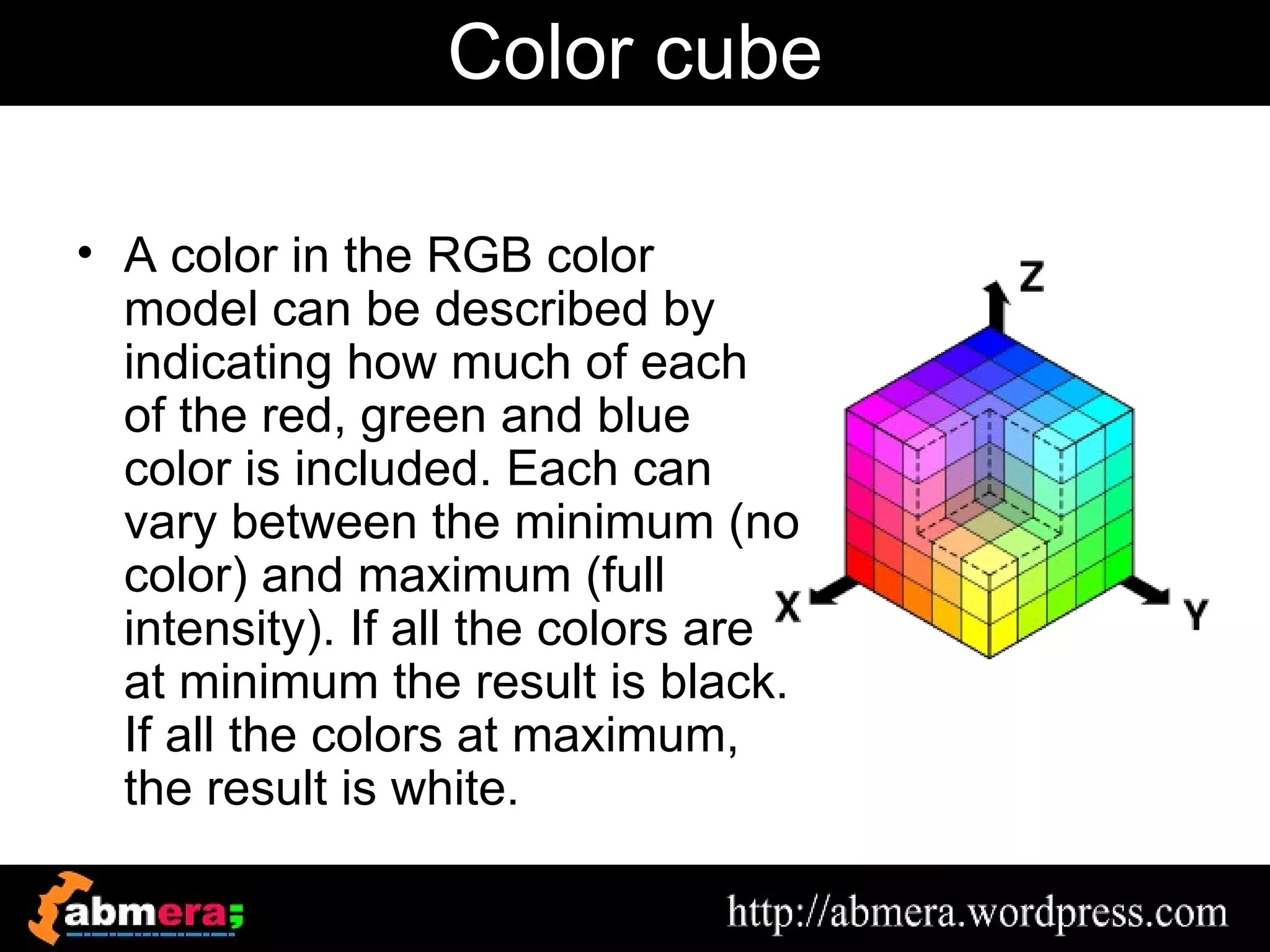
• A color in the RGB color
  model can be described by
  indicating how much of each
  of the red, green and blue
  color is included. Each can
  vary between the minimum (no
  color) and maximum (full
  intensity). If all the colors are
  at minimum the result is black.
  If all the colors at maximum,
  the result is white.
Pixel

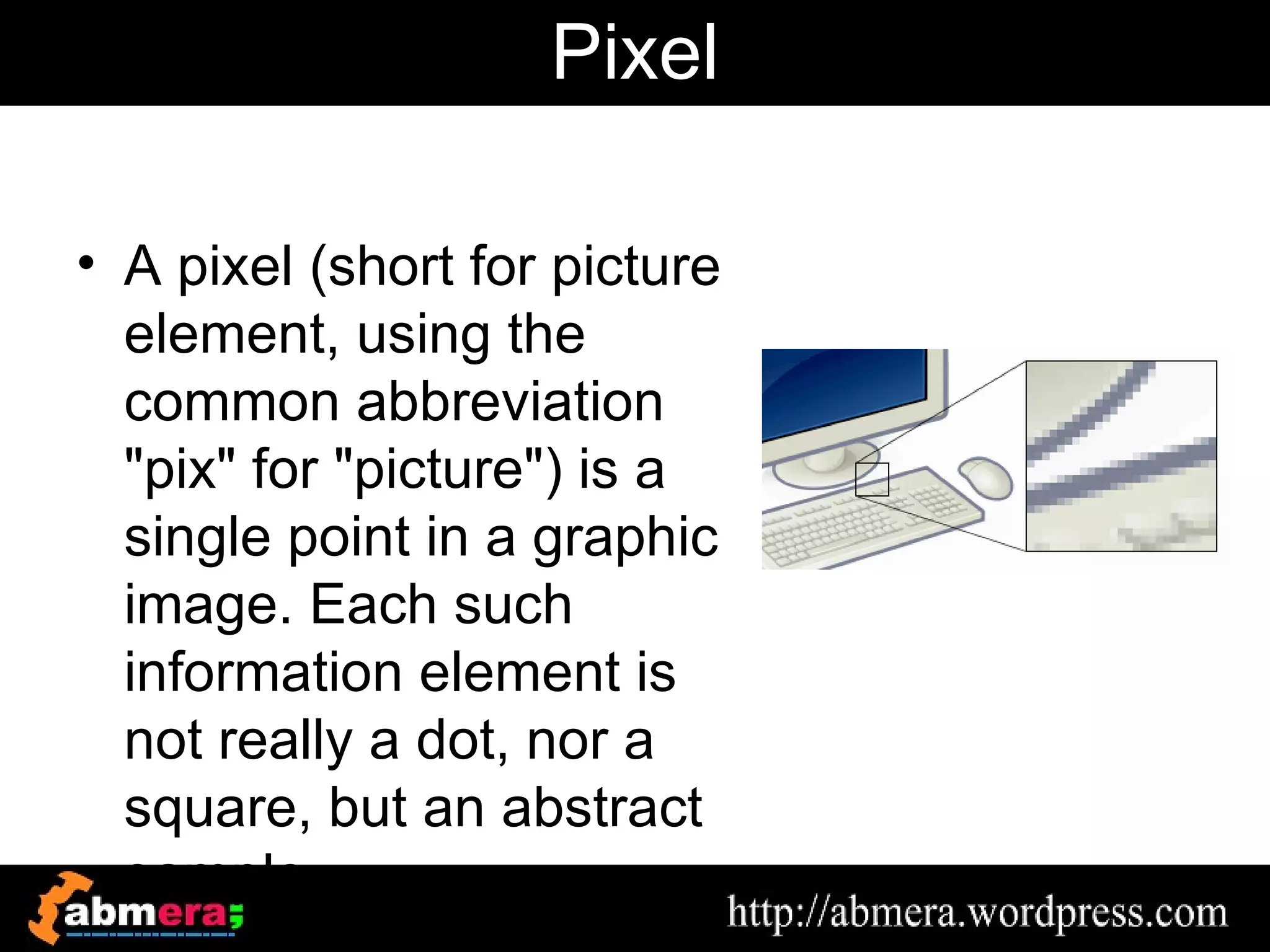
• A pixel (short for picture
  element, using the
  common abbreviation
  "pix" for "picture") is a
  single point in a graphic
  image. Each such
  information element is
  not really a dot, nor a
  square, but an abstract
  sample
Color depth

• Color depth is a computer graphics term
  describing the number of bits used to
  represent the color of a single pixel in a
  bitmapped image.

• This concept is also known as bits per
  pixel (bpp)
Resolution

• The number of pixels in an image is
  sometimes called the resolution.
• The higher the resolution the higher the
  picture quality
• In game industry the same concepts apply
  but put in mind that high resolution comes
  at the price of high memory consumption
  and processing time.
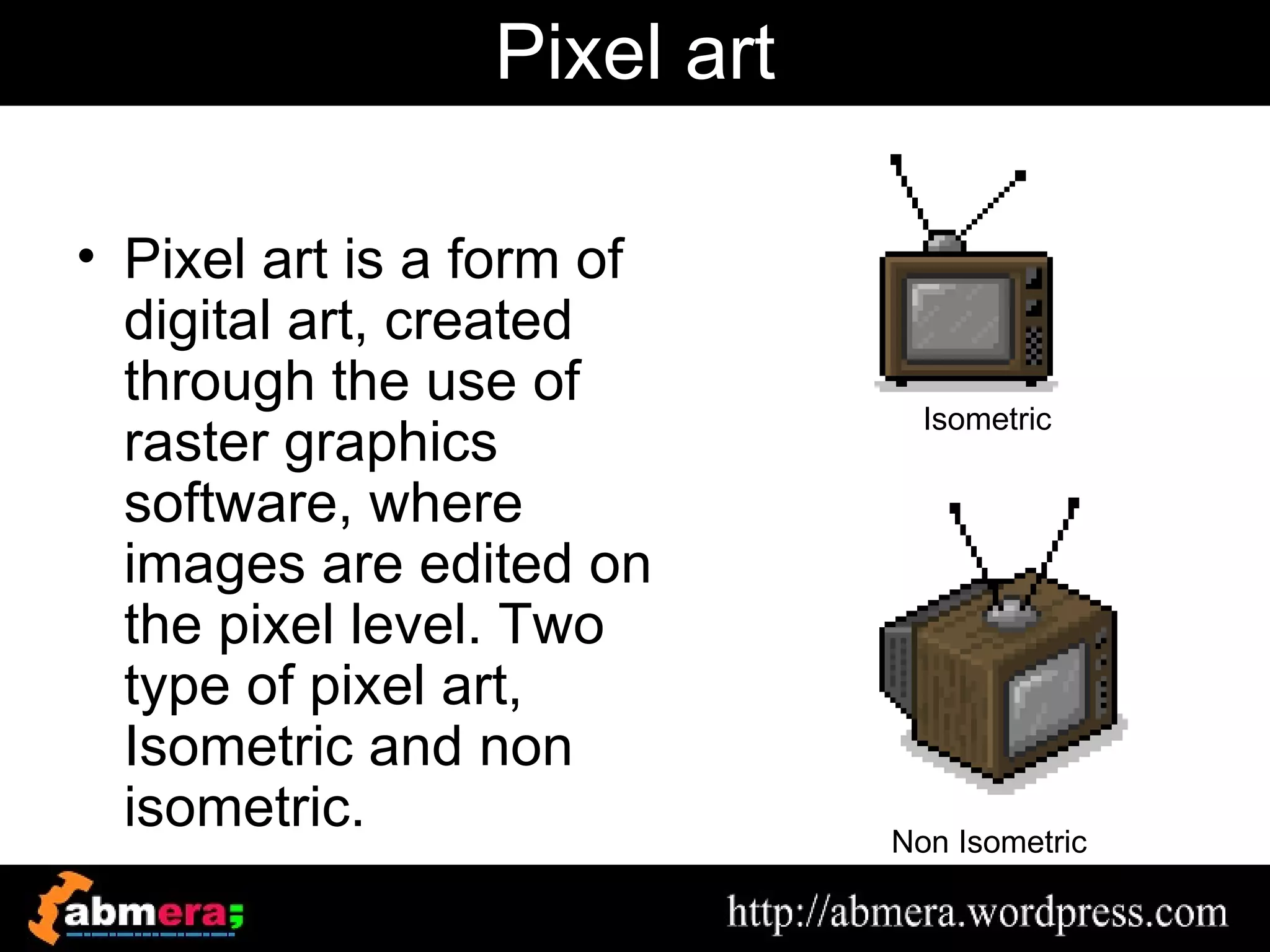
Pixel art

• Pixel art is a form of
  digital art, created
  through the use of
                               Isometric
  raster graphics
  software, where
  images are edited on
  the pixel level. Two
  type of pixel art,
  Isometric and non
  isometric.                 Non Isometric
BMP

• BMP files are usually not compressed, so
  they are typically much larger than
  compressed image file formats for the
  same image. For example, an 800×600
  24-bit image will occupy almost 1.4
  megabytes
• 800 x 600 x (24/8) = 1.4 MB
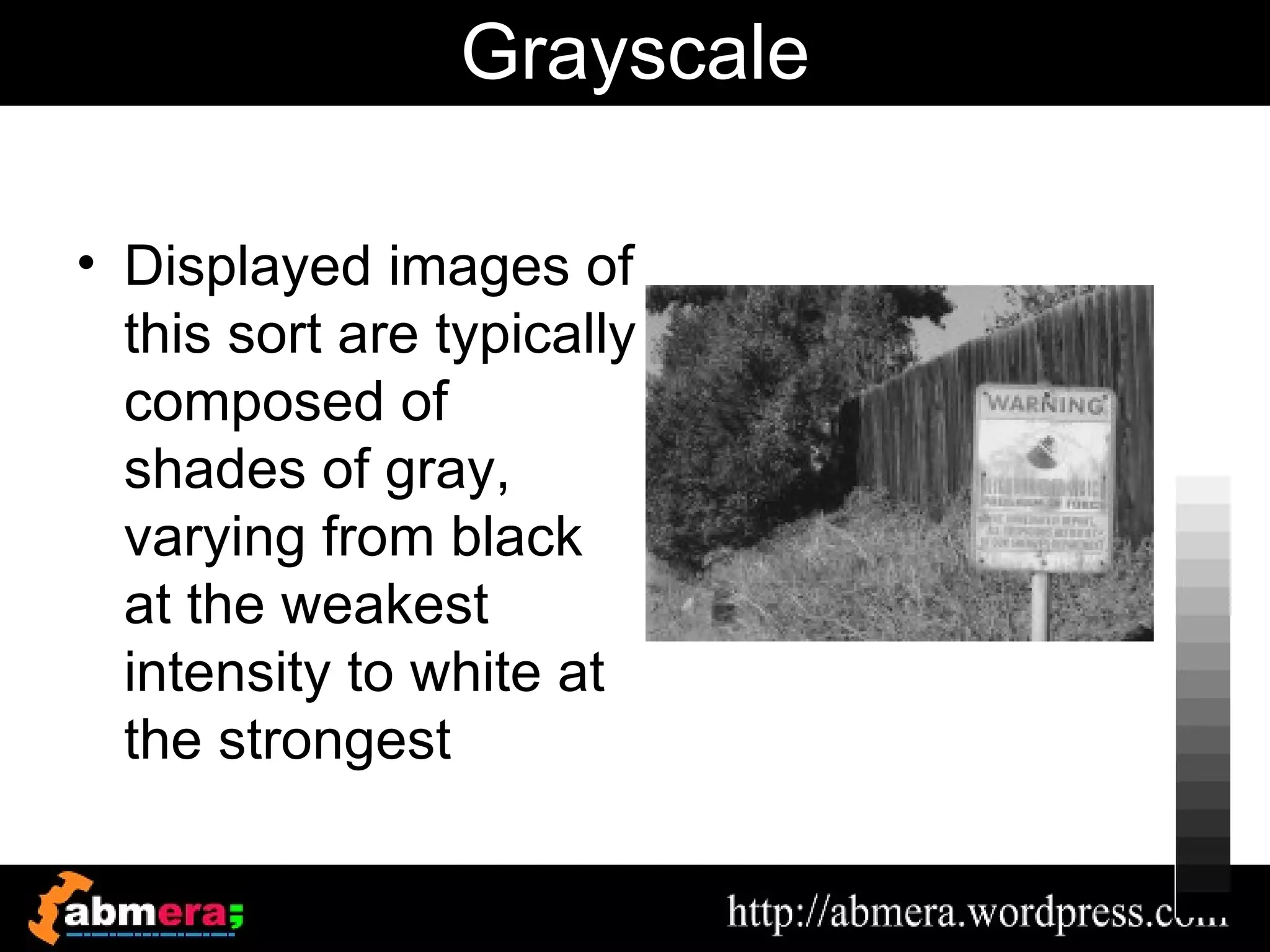
Grayscale

• Displayed images of
  this sort are typically
  composed of
  shades of gray,
  varying from black
  at the weakest
  intensity to white at
  the strongest
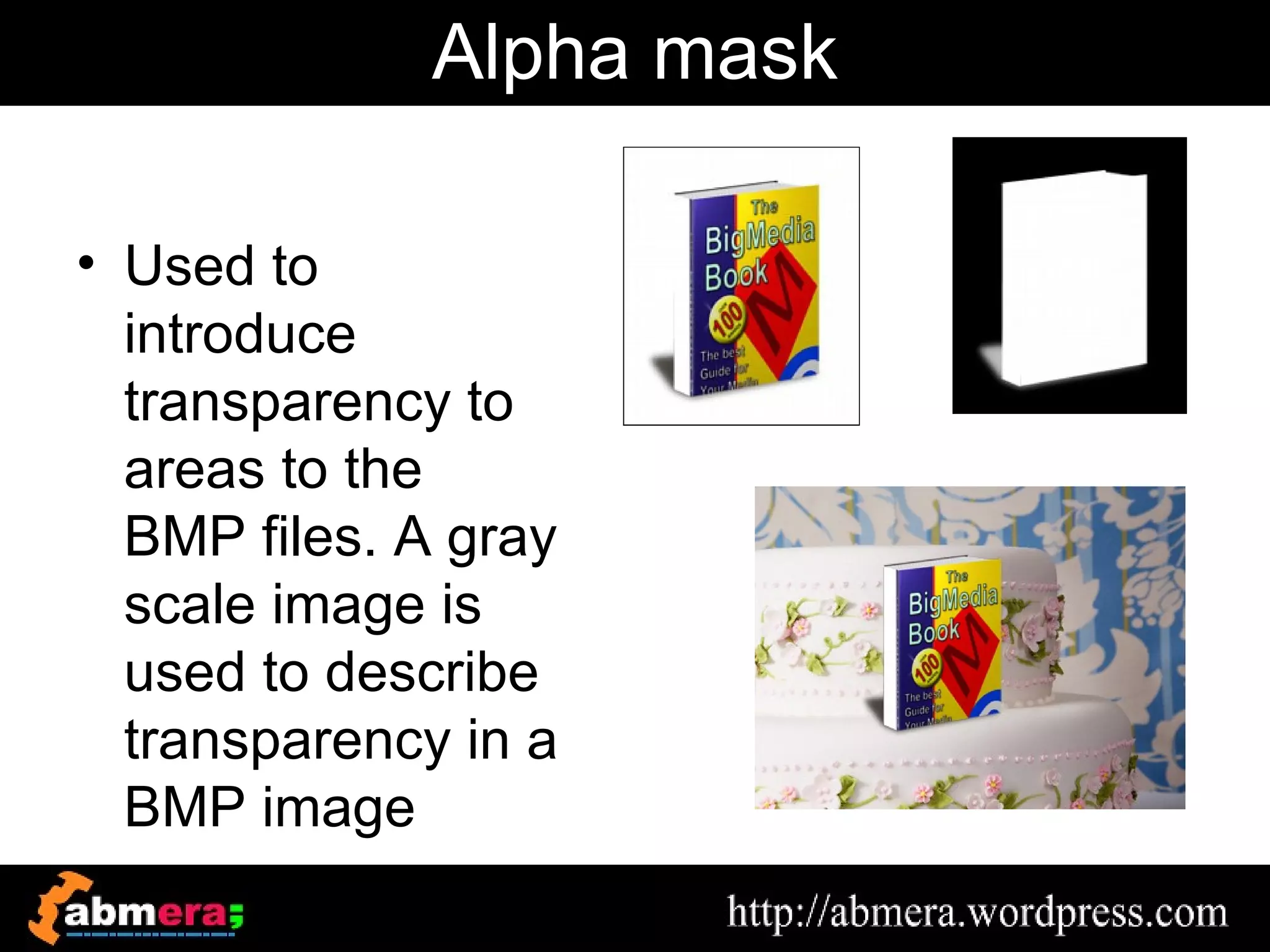
Alpha mask

• Used to
  introduce
  transparency to
  areas to the
  BMP files. A gray
  scale image is
  used to describe
  transparency in a
  BMP image
PCX

• PCX is an image file format developed by the
  ZSoft Corporation of Marietta, Georgia, USA. It
  was the native file format for PC Paintbrush and
  became one of the first widely accepted DOS
  imaging standards, although its use has since
  been succeeded by more sophisticated image
  formats such as GIF, JPEG, and PNG.
• Advantage: compression without losing quality
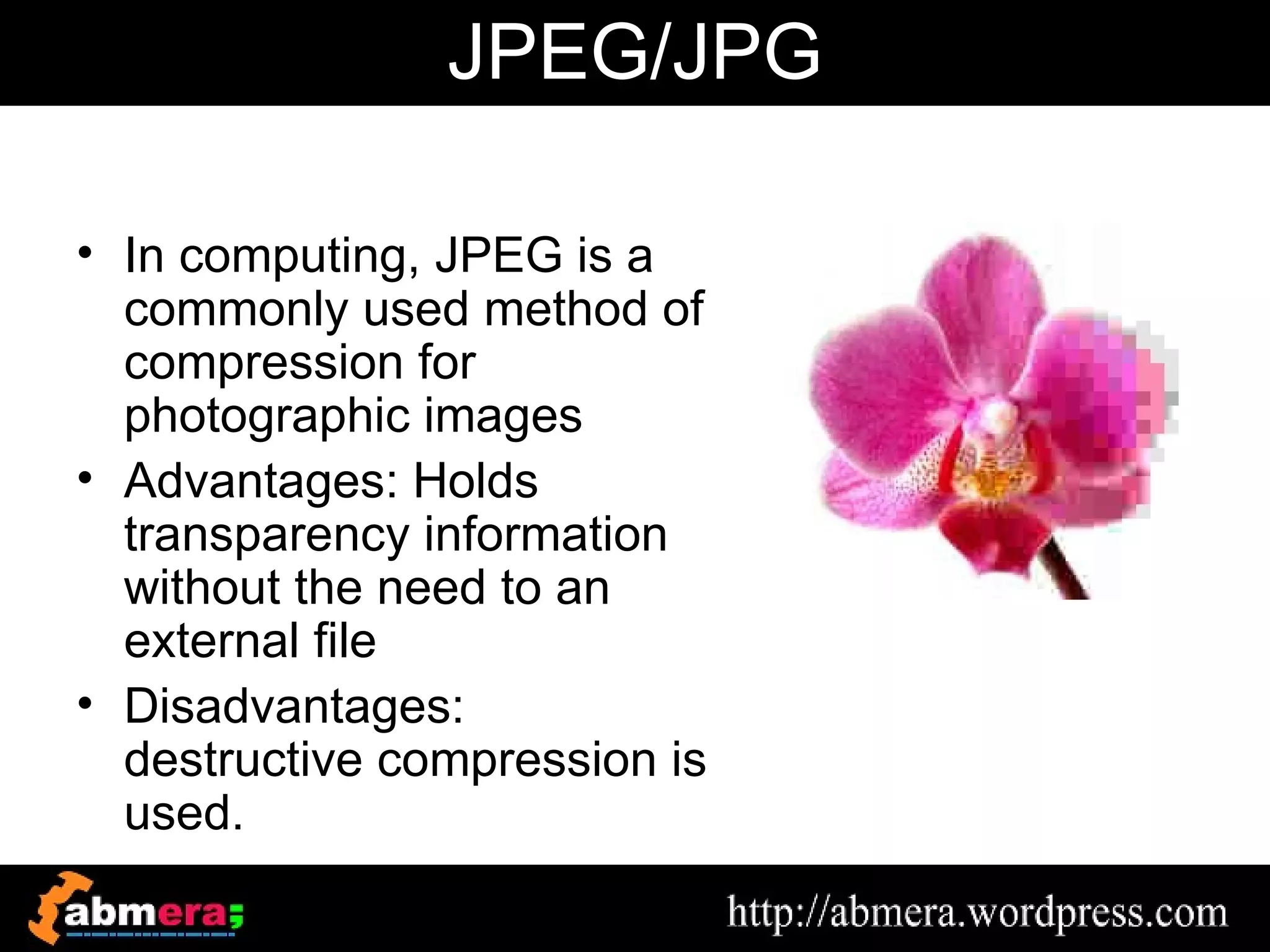
JPEG/JPG

• In computing, JPEG is a
  commonly used method of
  compression for
  photographic images
• Advantages: Holds
  transparency information
  without the need to an
  external file
• Disadvantages:
  destructive compression is
  used.
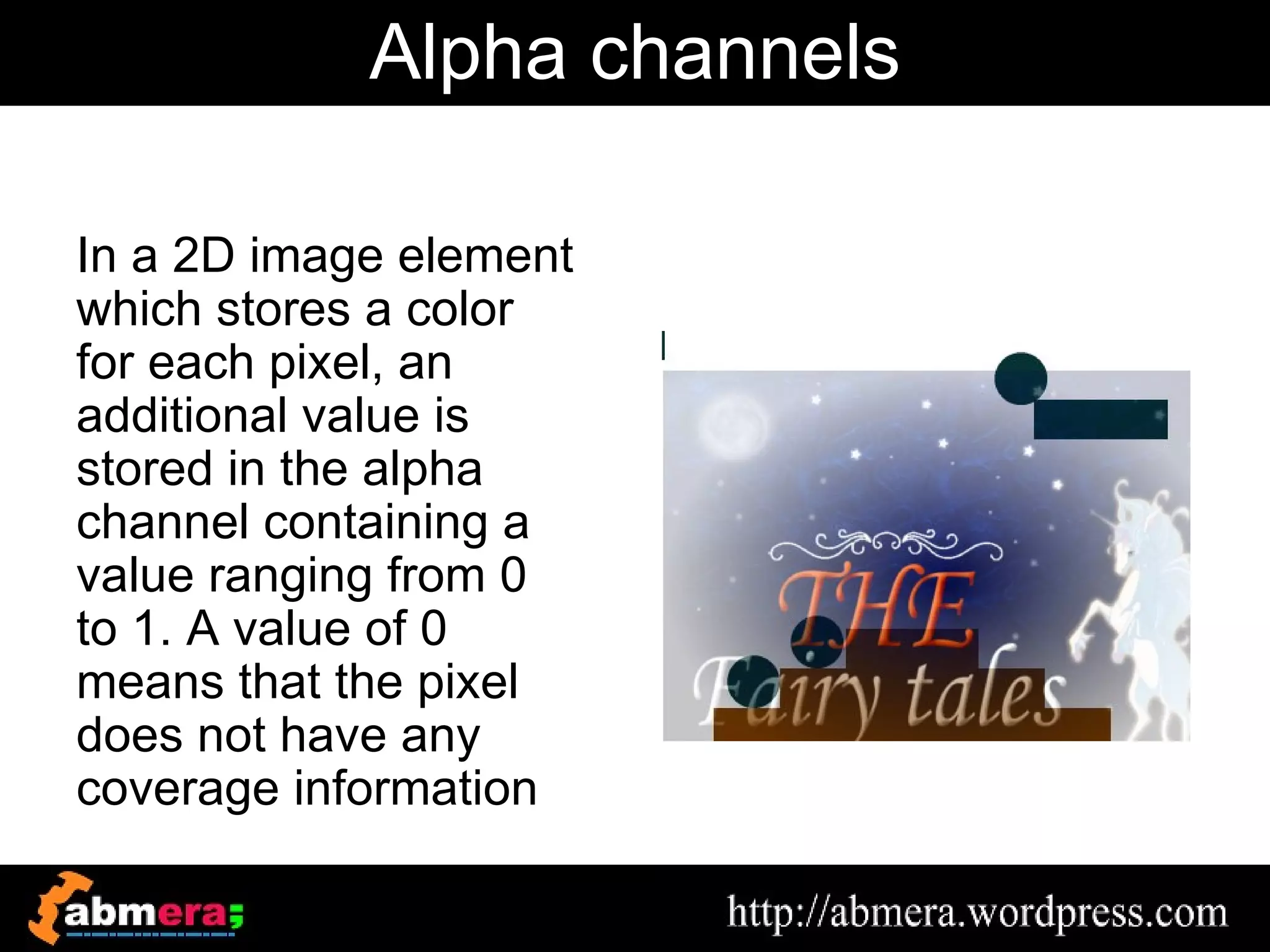
Alpha channels

In a 2D image element
which stores a color
for each pixel, an
additional value is
stored in the alpha
channel containing a
value ranging from 0
to 1. A value of 0
means that the pixel
does not have any
coverage information
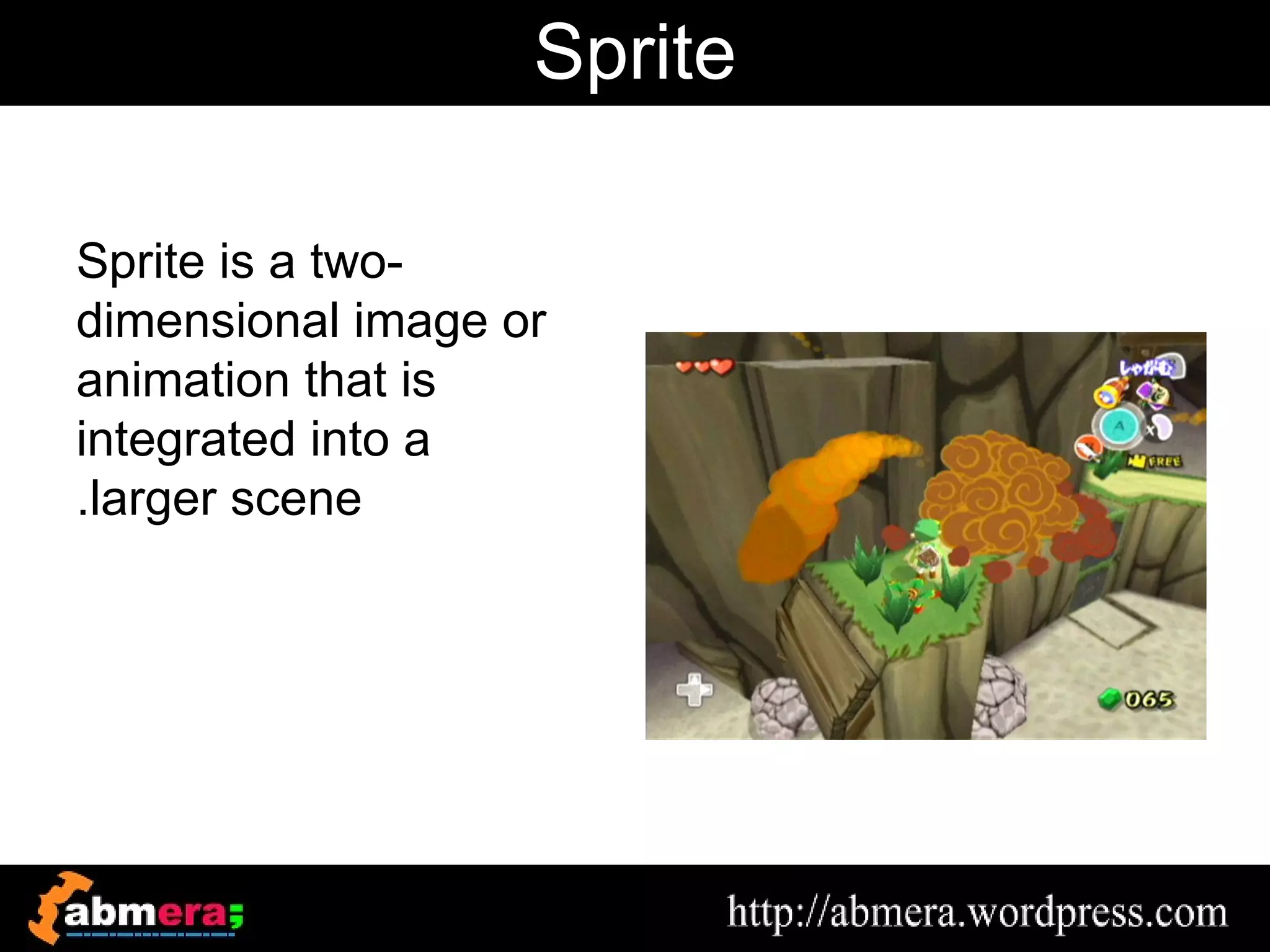
Sprite

Sprite is a two-
dimensional image or
animation that is
integrated into a
.larger scene
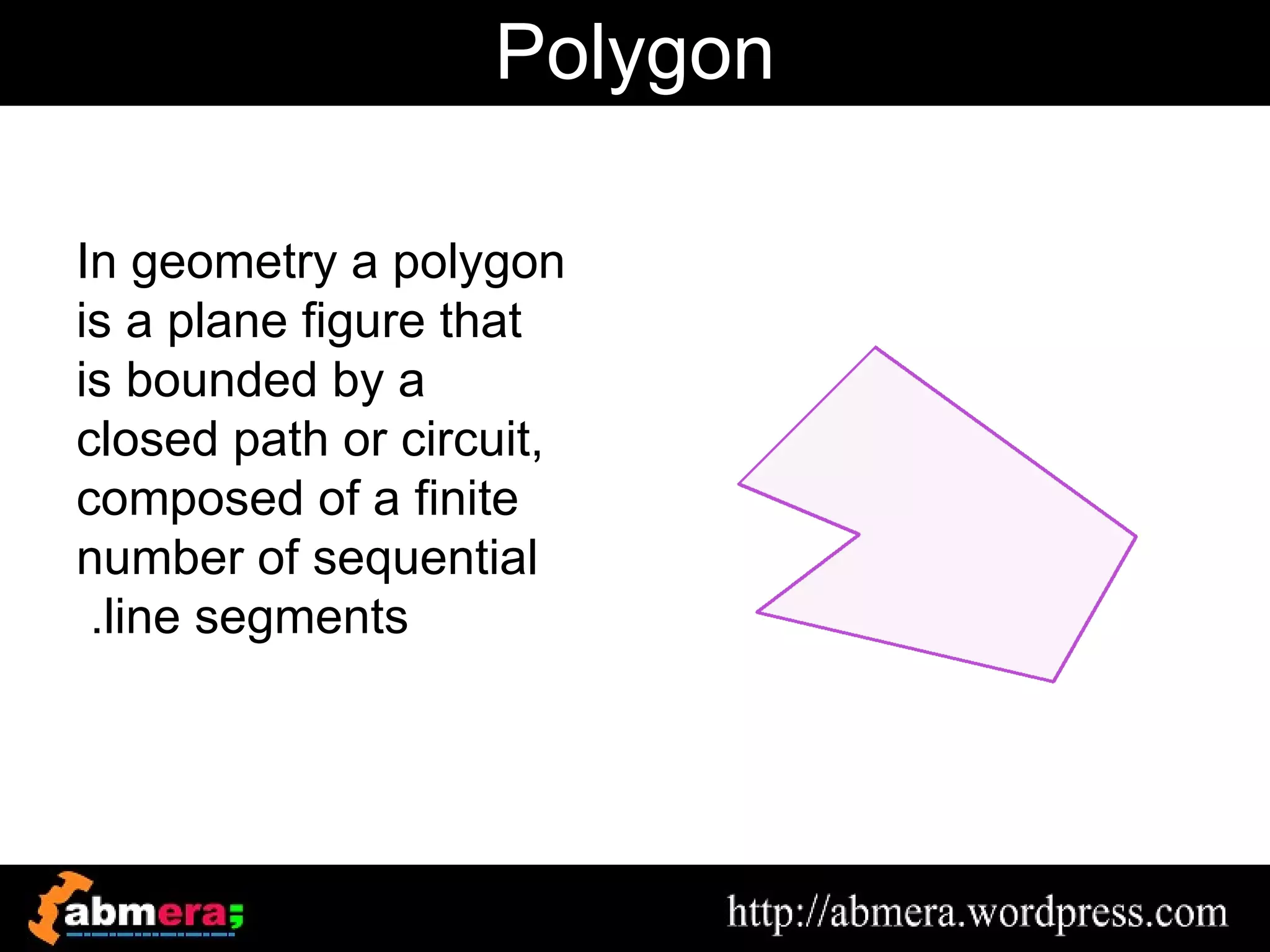
Polygon

In geometry a polygon
is a plane figure that
is bounded by a
closed path or circuit,
composed of a finite
number of sequential
 .line segments
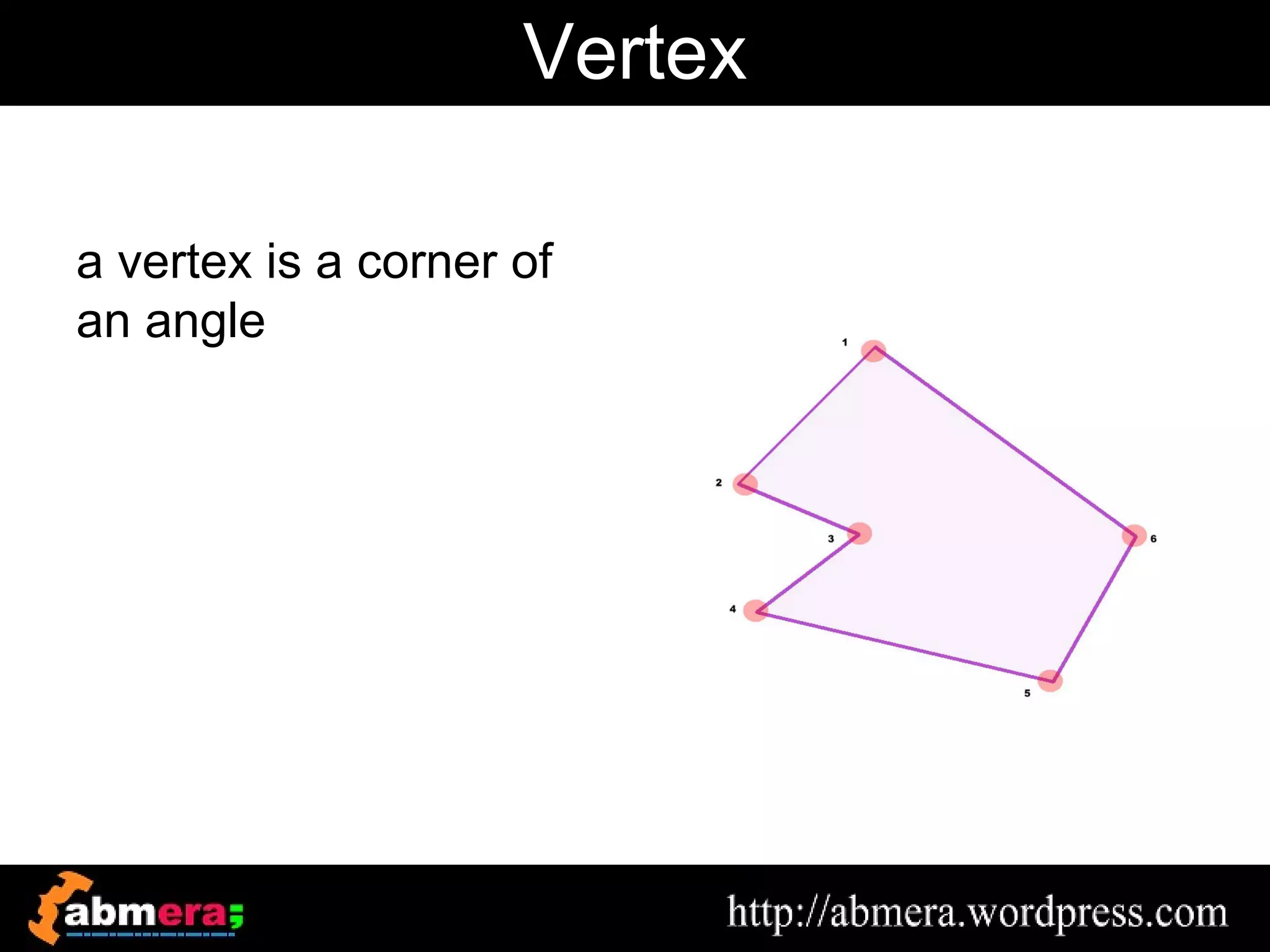
Vertex

a vertex is a corner of
an angle
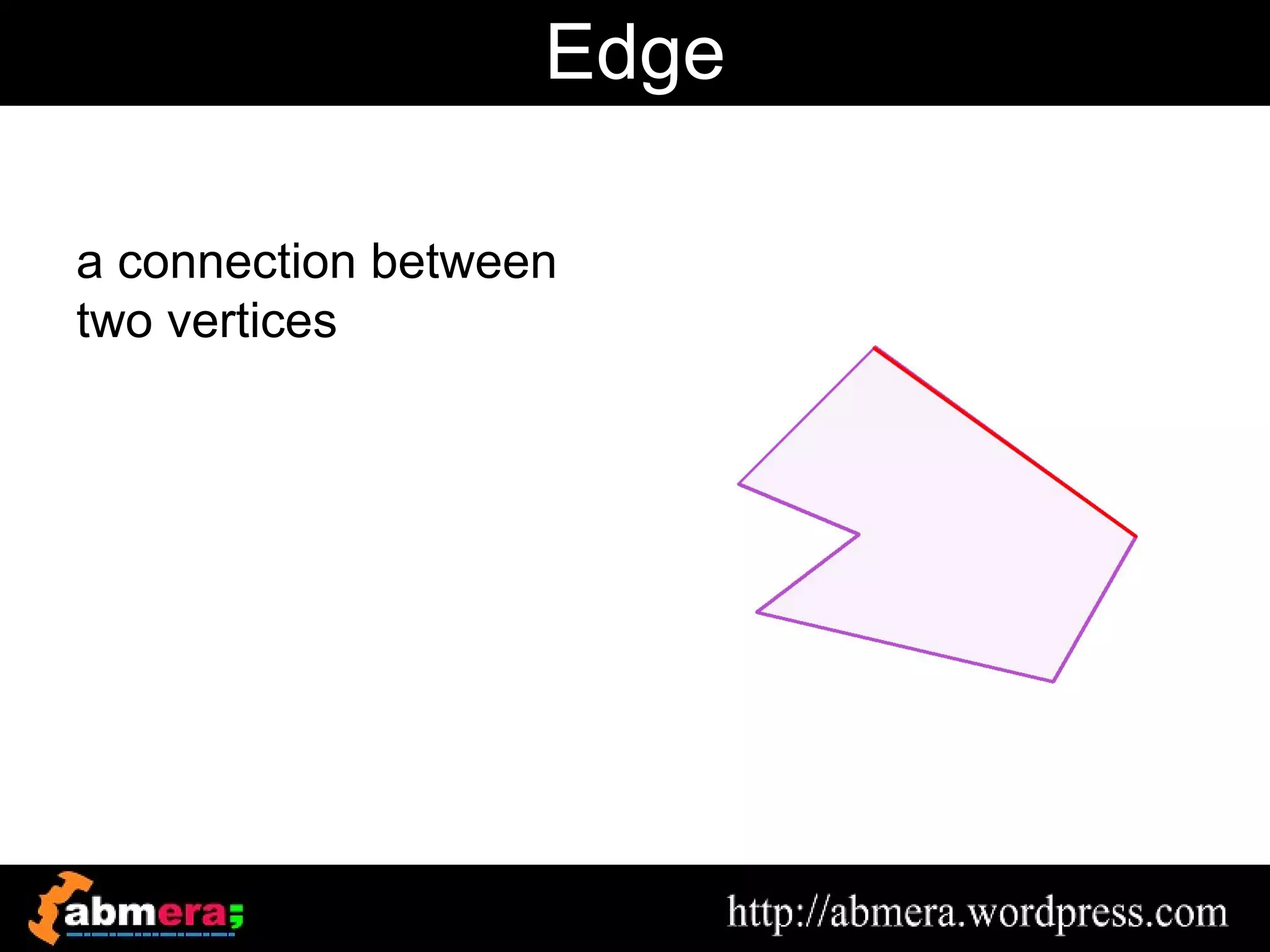
Edge

a connection between
two vertices
Model

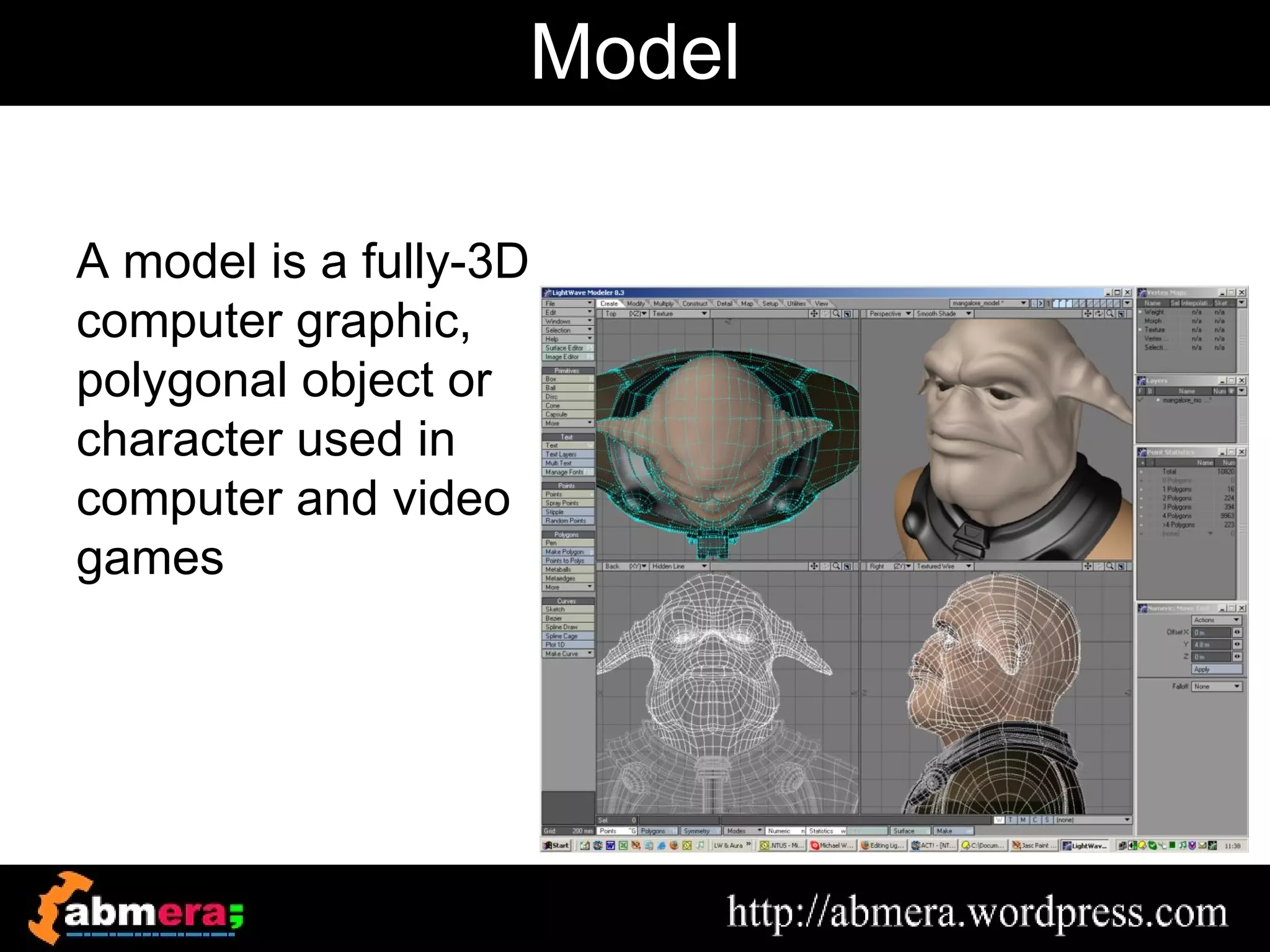
A model is a fully-3D
computer graphic,
polygonal object or
character used in
computer and video
games
Face

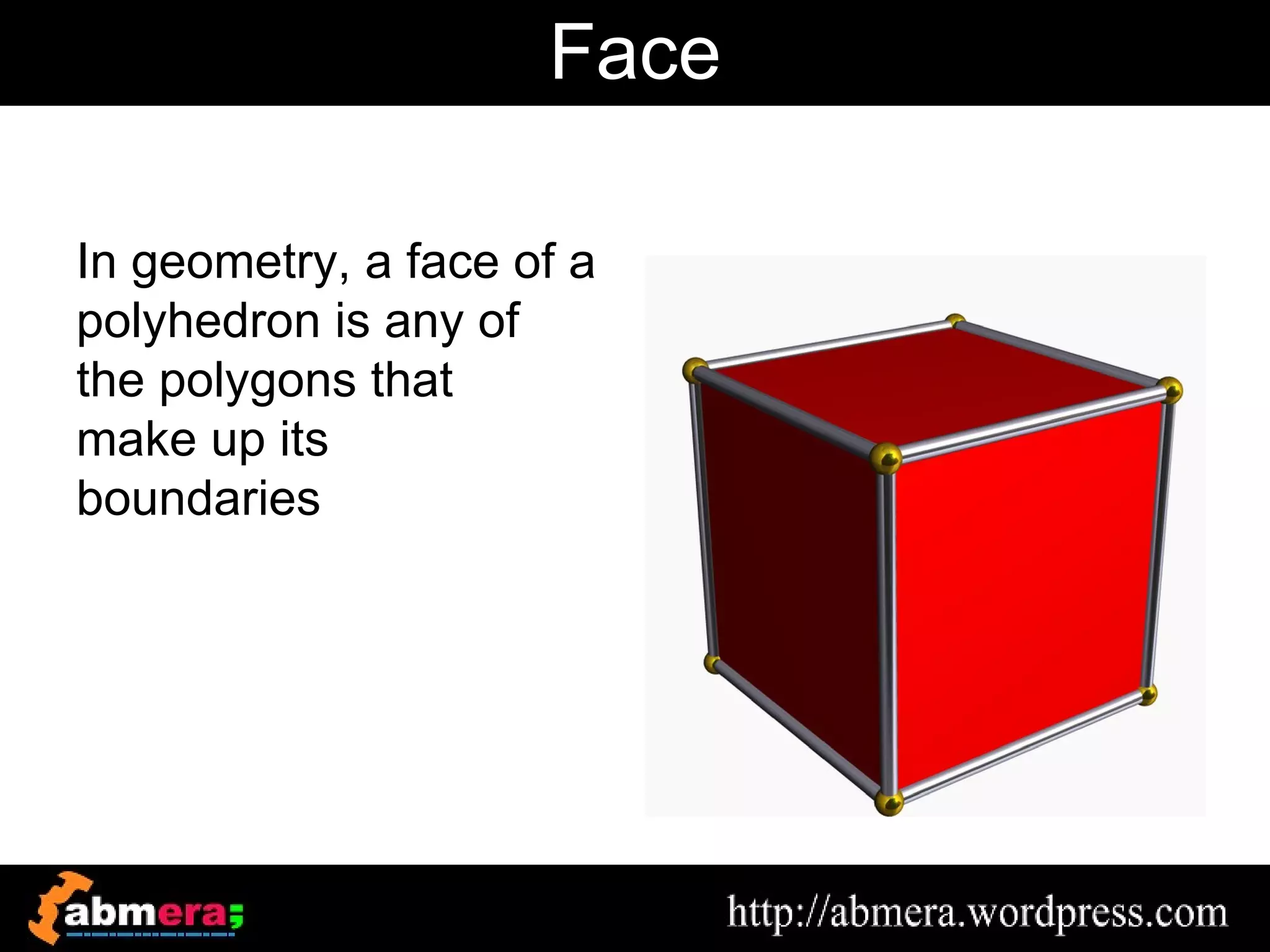
In geometry, a face of a
polyhedron is any of
the polygons that
make up its
boundaries
Mesh

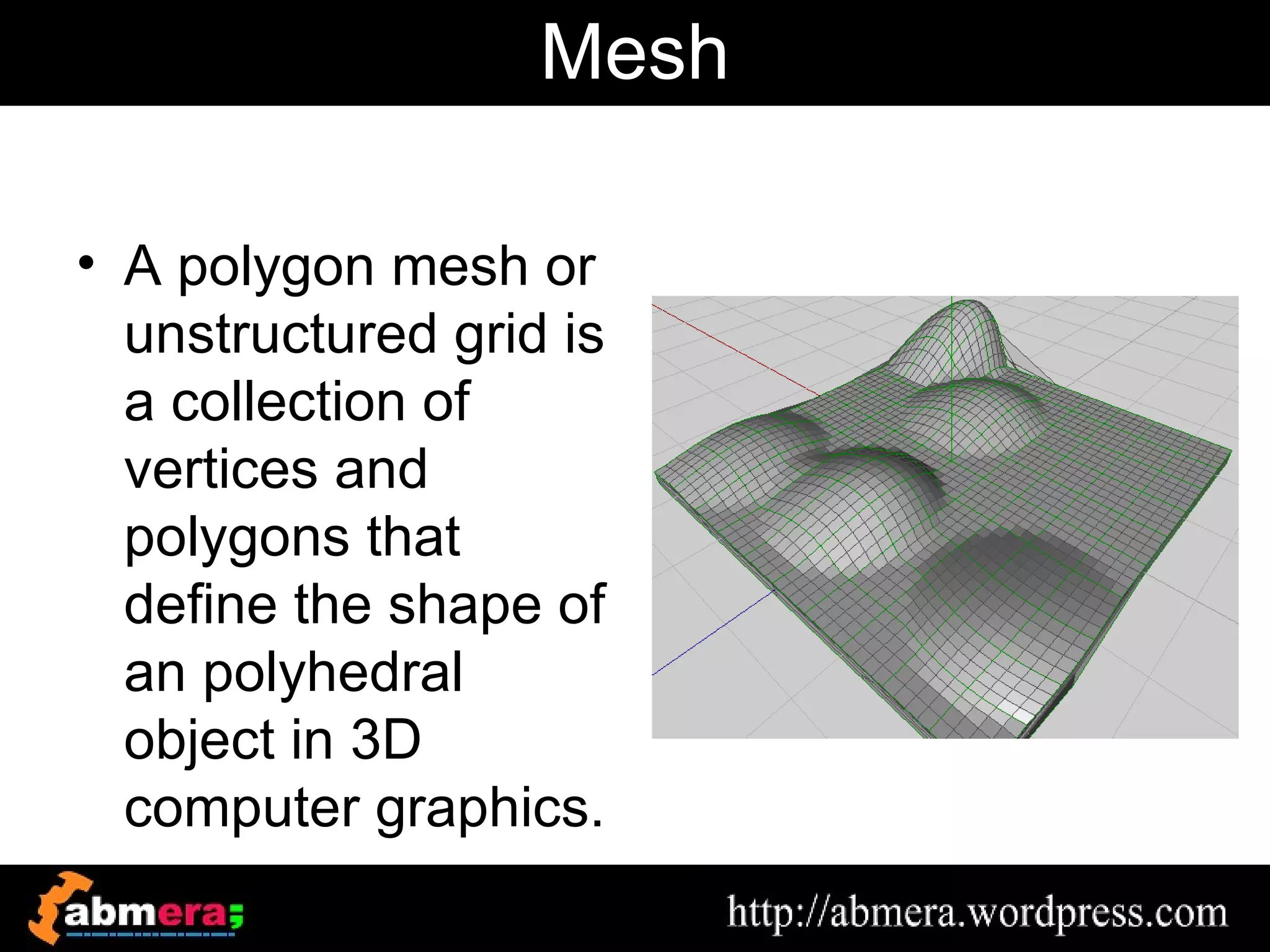
• A polygon mesh or
  unstructured grid is
  a collection of
  vertices and
  polygons that
  define the shape of
  an polyhedral
  object in 3D
  computer graphics.
Texture

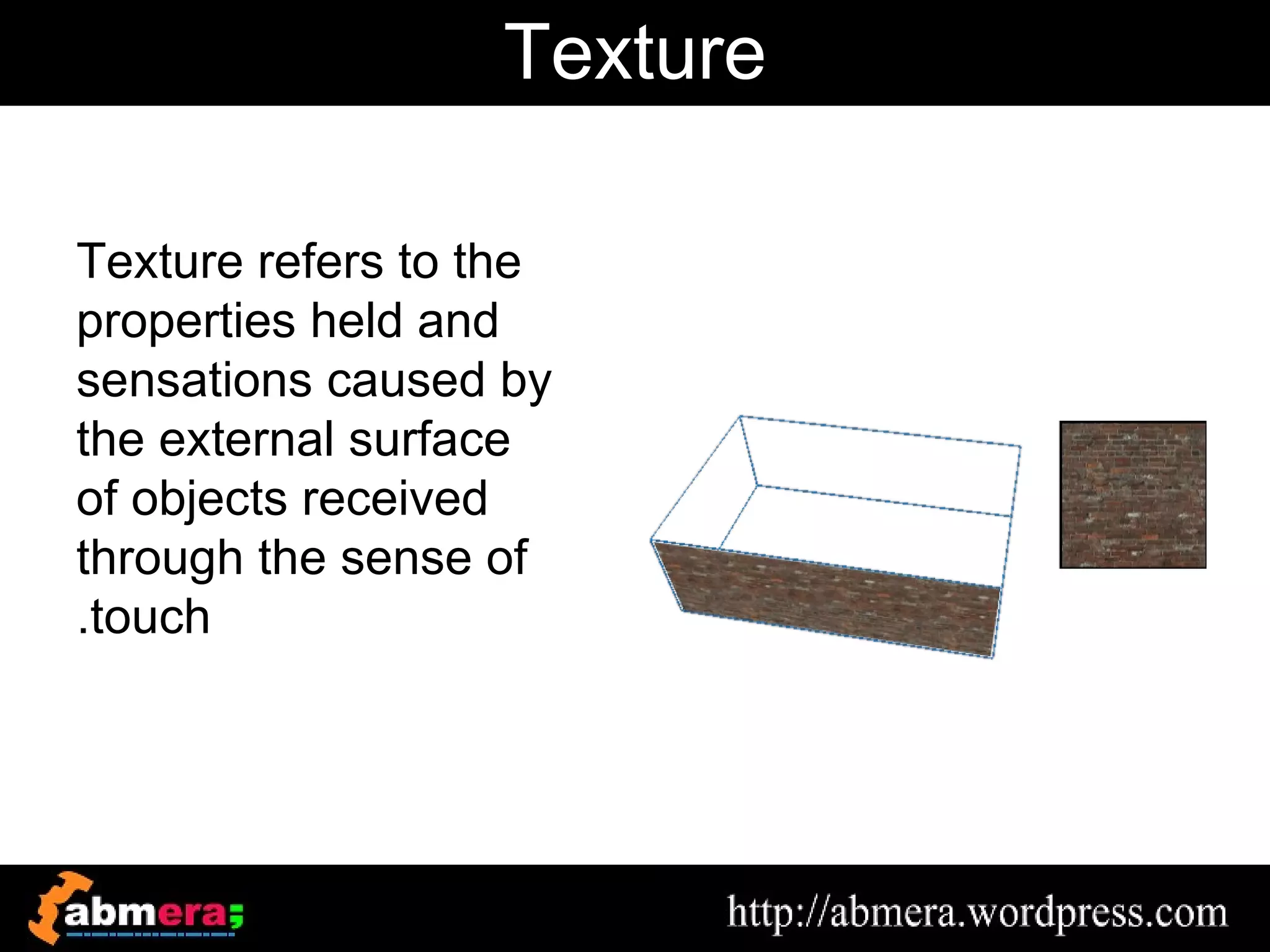
Texture refers to the
properties held and
sensations caused by
the external surface
of objects received
through the sense of
.touch
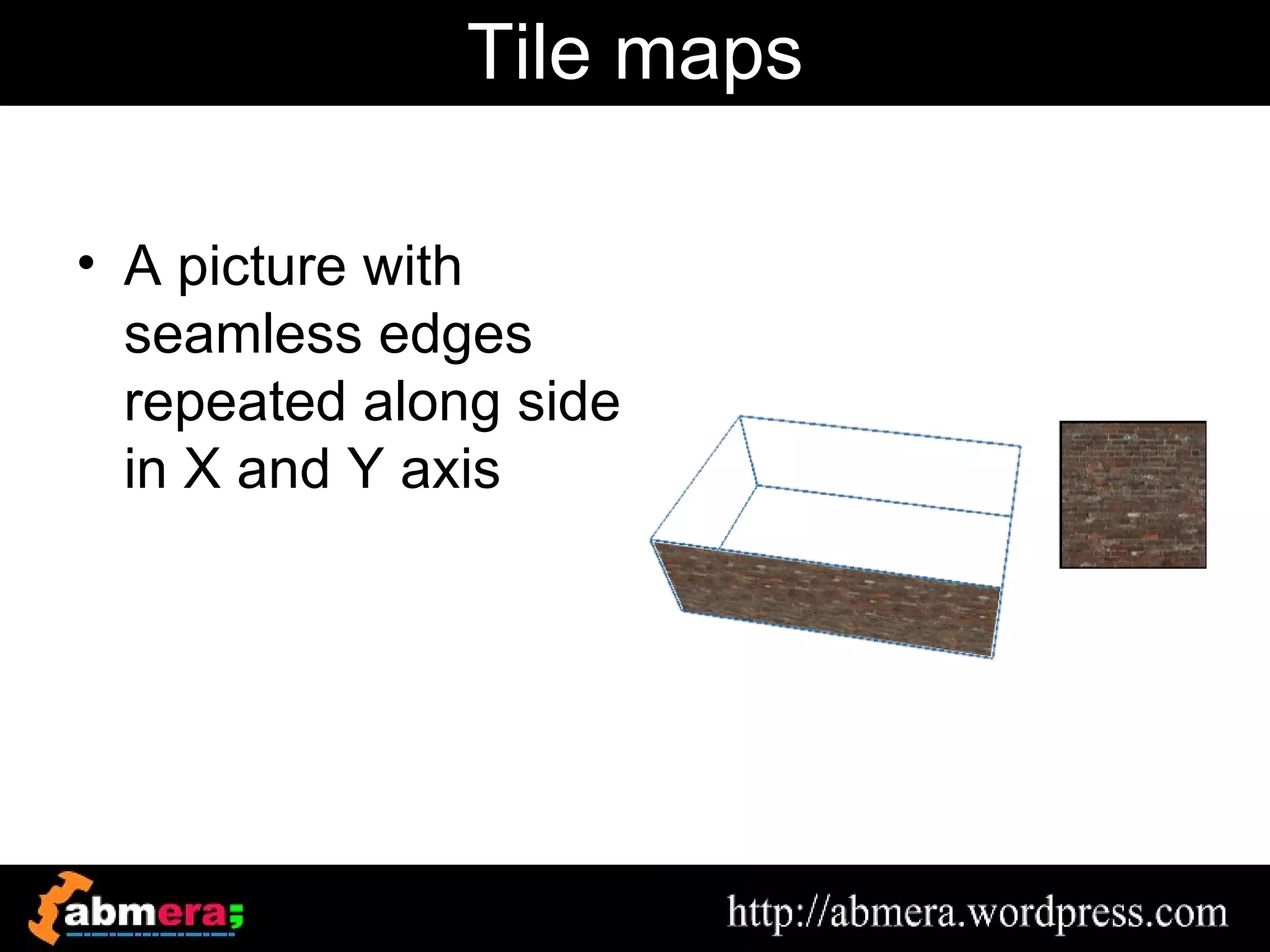
Tile maps

• A picture with
  seamless edges
  repeated along side
  in X and Y axis
Texel

texture element The smallest addressable
unit of a texture map. When objects in the
image are near, one texel is mapped to
one or more screen pixels. When objects
are distant, multiple texels are averaged
into one screen pixel
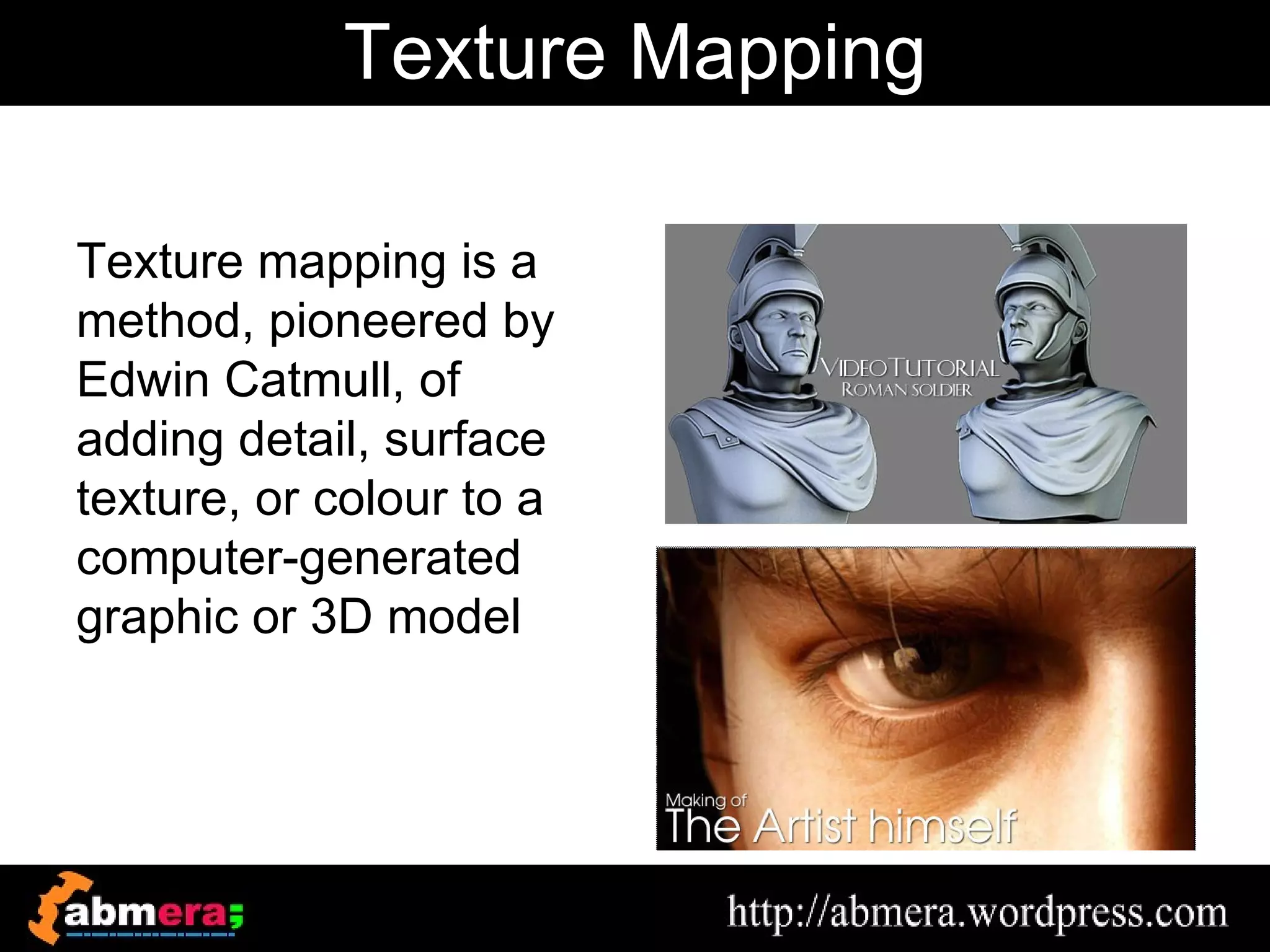
Texture Mapping

Texture mapping is a
method, pioneered by
Edwin Catmull, of
adding detail, surface
texture, or colour to a
computer-generated
graphic or 3D model
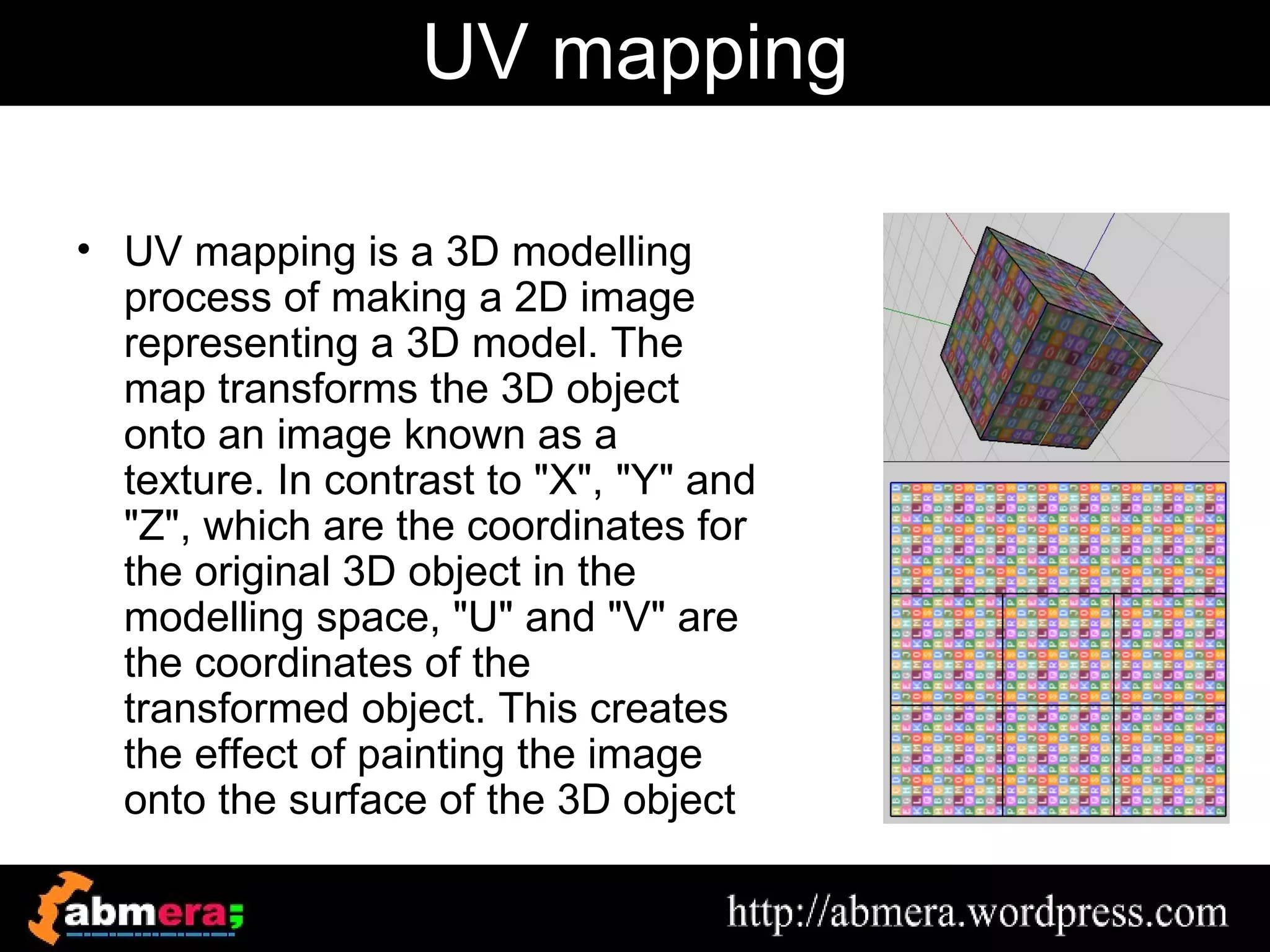
UV mapping

• UV mapping is a 3D modelling
  process of making a 2D image
  representing a 3D model. The
  map transforms the 3D object
  onto an image known as a
  texture. In contrast to "X", "Y" and
  "Z", which are the coordinates for
  the original 3D object in the
  modelling space, "U" and "V" are
  the coordinates of the
  transformed object. This creates
  the effect of painting the image
  onto the surface of the 3D object
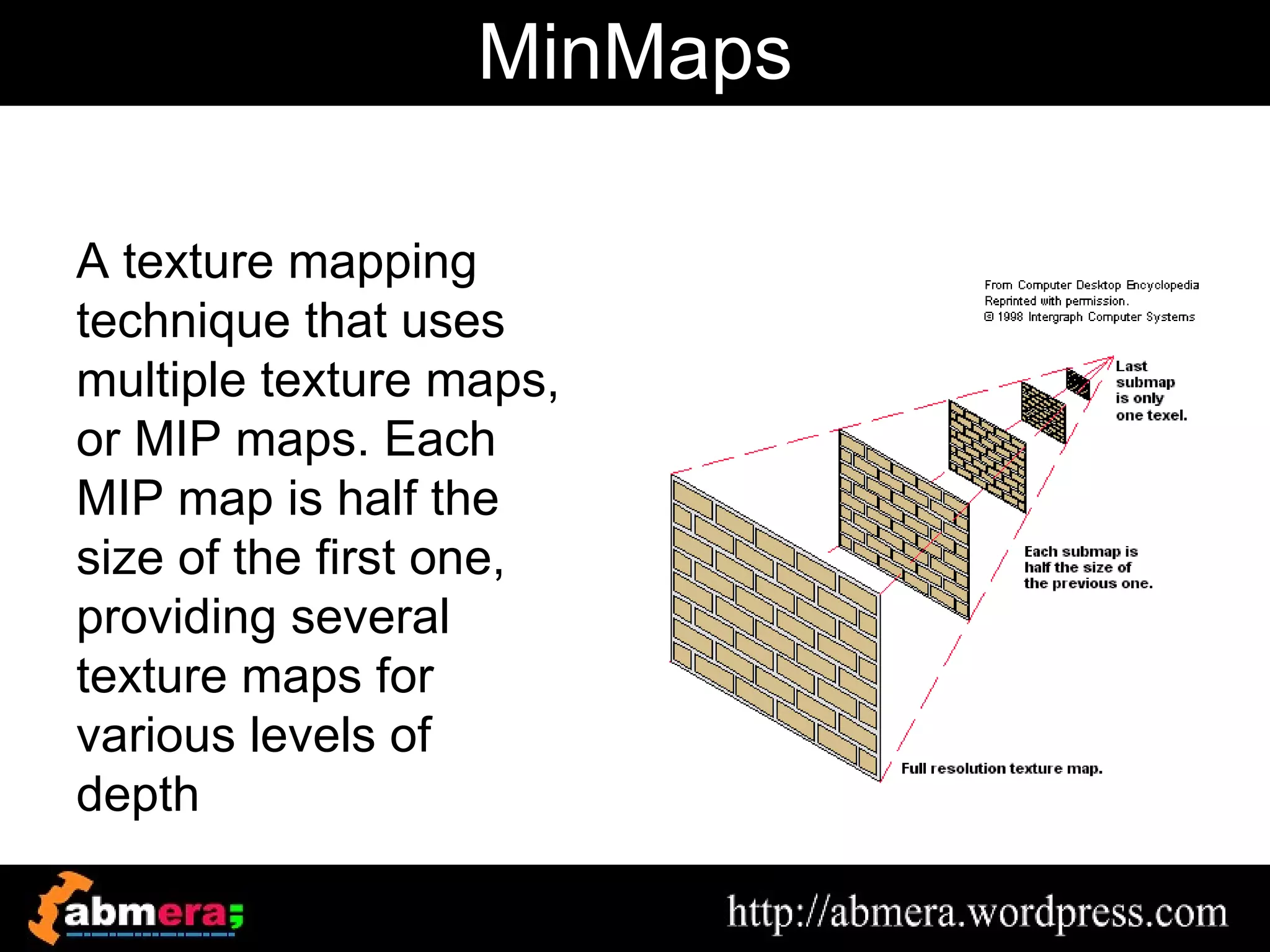
MinMaps

A texture mapping
technique that uses
multiple texture maps,
or MIP maps. Each
MIP map is half the
size of the first one,
providing several
texture maps for
various levels of
depth
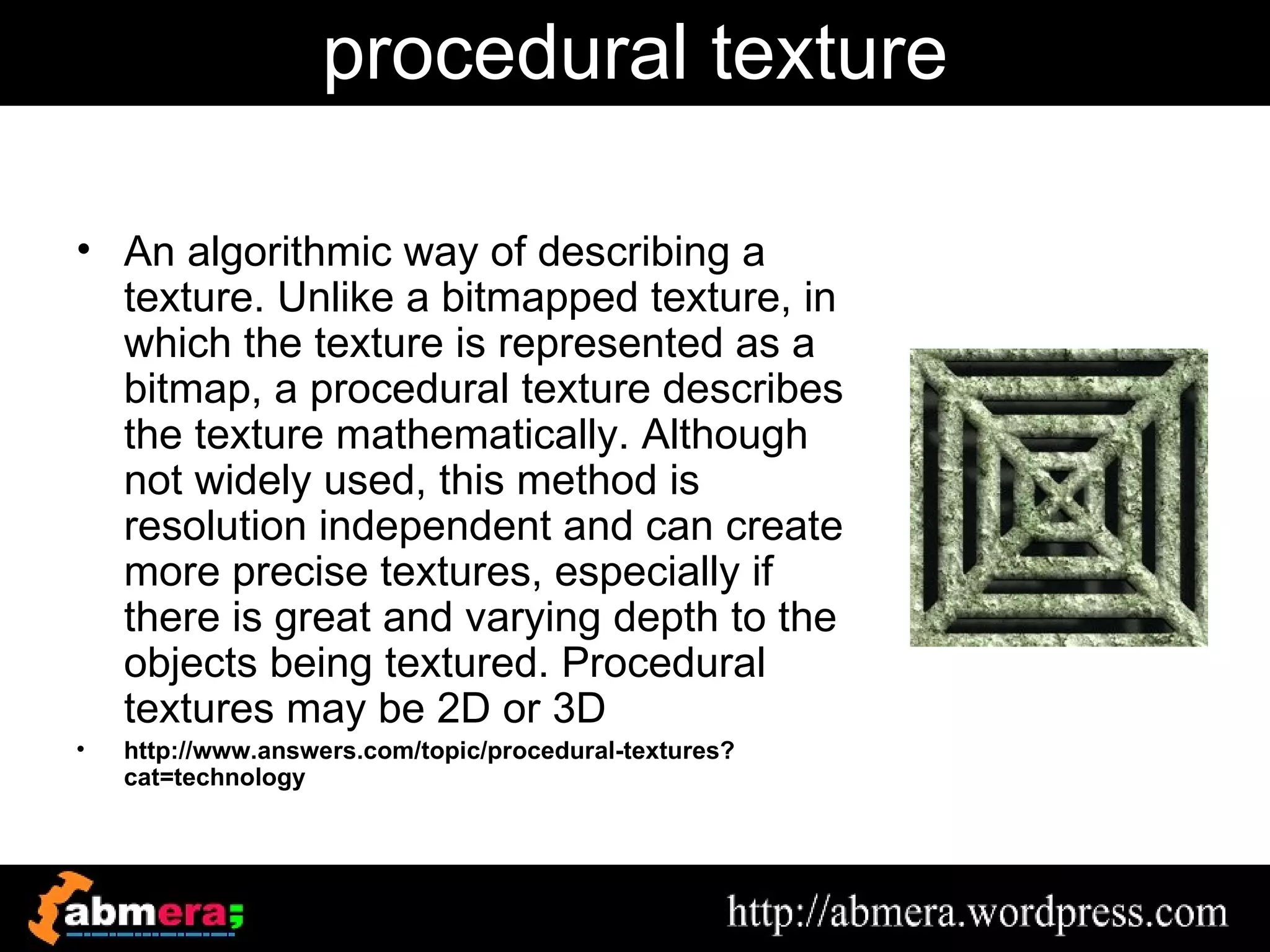
procedural texture

• An algorithmic way of describing a
  texture. Unlike a bitmapped texture, in
  which the texture is represented as a
  bitmap, a procedural texture describes
  the texture mathematically. Although
  not widely used, this method is
  resolution independent and can create
  more precise textures, especially if
  there is great and varying depth to the
  objects being textured. Procedural
  textures may be 2D or 3D
•   http://www.answers.com/topic/procedural-textures?
    cat=technology
volumetric texture

• A texture that is described in three
  dimensions. It can be created as a "stack"
  of 2D bitmapped textures or as a 3D
  procedural texture. When an object with
  volumetric texture is sliced in half, the
  texture would still be rendered accurately
  on the inside
•   http://www.answers.com/topic/volumetric-texture?cat=technology
point sampling

• Also called "nearest neighbor," it is the simplest
  form of texture mapping, which is often
  associated with low-end games and applications
  that do not demand much realism. An algorithm
  is used to map a screen pixel to the
  corresponding point on the texture map. The
  attributes (color, alpha, etc.) of the nearest texel
  are then directly applied to the screen pixel. The
  process is repeated for each pixel forming the
  object being textured
Bilinear interpolation

• A texture mapping technique that produces a
  reasonably realistic image, also known as
  "bilinear filtering" and "bilinear texture mapping."
  An algorithm is used to map a screen pixel
  location to a corresponding point on the texture
  map. A weighted average of the attributes (color,
  alpha, etc.) of the four surrounding texels is
  computed and applied to the screen pixel. This
  process is repeated for each pixel forming the
  object being textured
•   http://www.answers.com/topic/bilinear-interpolation?cat=technology
Tri-linear filtering

• Bilinear filtering has several weaknesses that
  make it an unattractive choice in many cases:
  using it on a full-detail texture when scaling to a
  very small size causes accuracy problems from
  missed texels, and compensating for this by
  using multiple mipmaps throughout the polygon
  leads to abrupt changes in blurriness, which is
  most pronounced in polygons that are steeply
  angled relative to the camera.
• trilinear filtering interpolates between the results
  of bilinear filtering on the two mipmaps nearest
  to the detail required for the polygon at the pixel
•   http://www.answers.com/Trilinear%20filtering
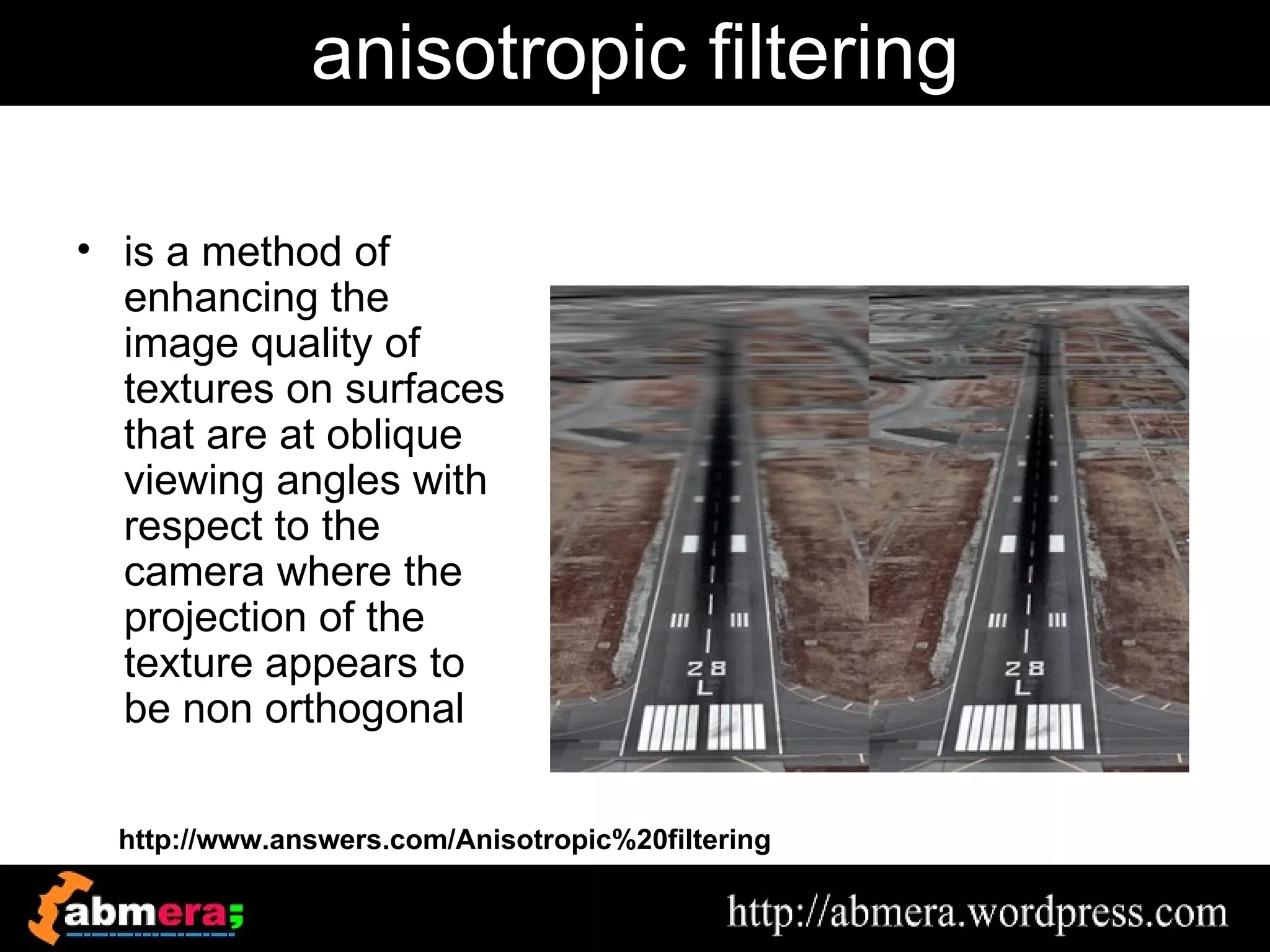
anisotropic filtering

• is a method of
  enhancing the
  image quality of
  textures on surfaces
  that are at oblique
  viewing angles with
  respect to the
  camera where the
  projection of the
  texture appears to
  be non orthogonal

  http://www.answers.com/Anisotropic%20filtering
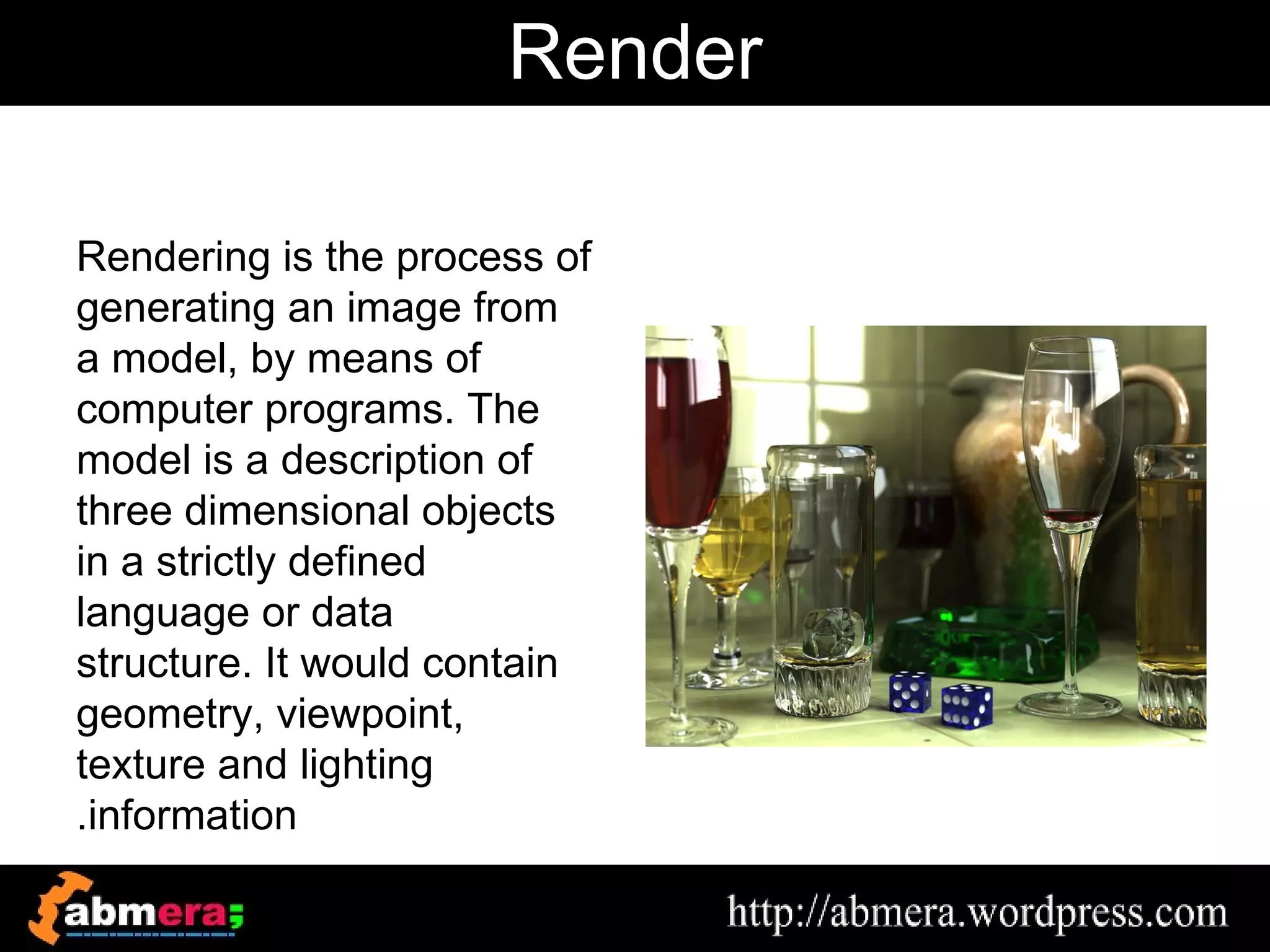
Render

Rendering is the process of
generating an image from
a model, by means of
computer programs. The
model is a description of
three dimensional objects
in a strictly defined
language or data
structure. It would contain
geometry, viewpoint,
texture and lighting
.information
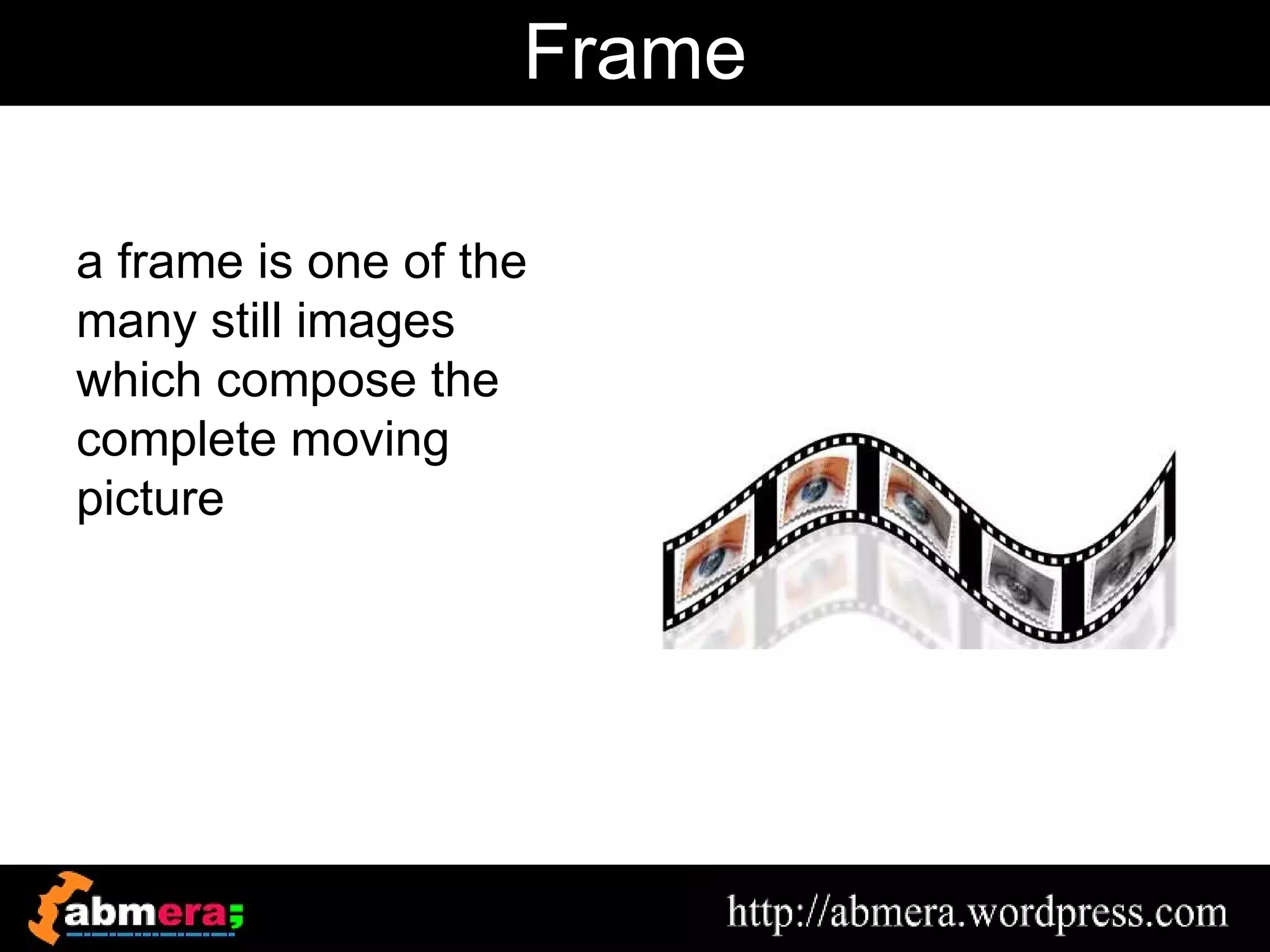
Frame

a frame is one of the
many still images
which compose the
complete moving
picture
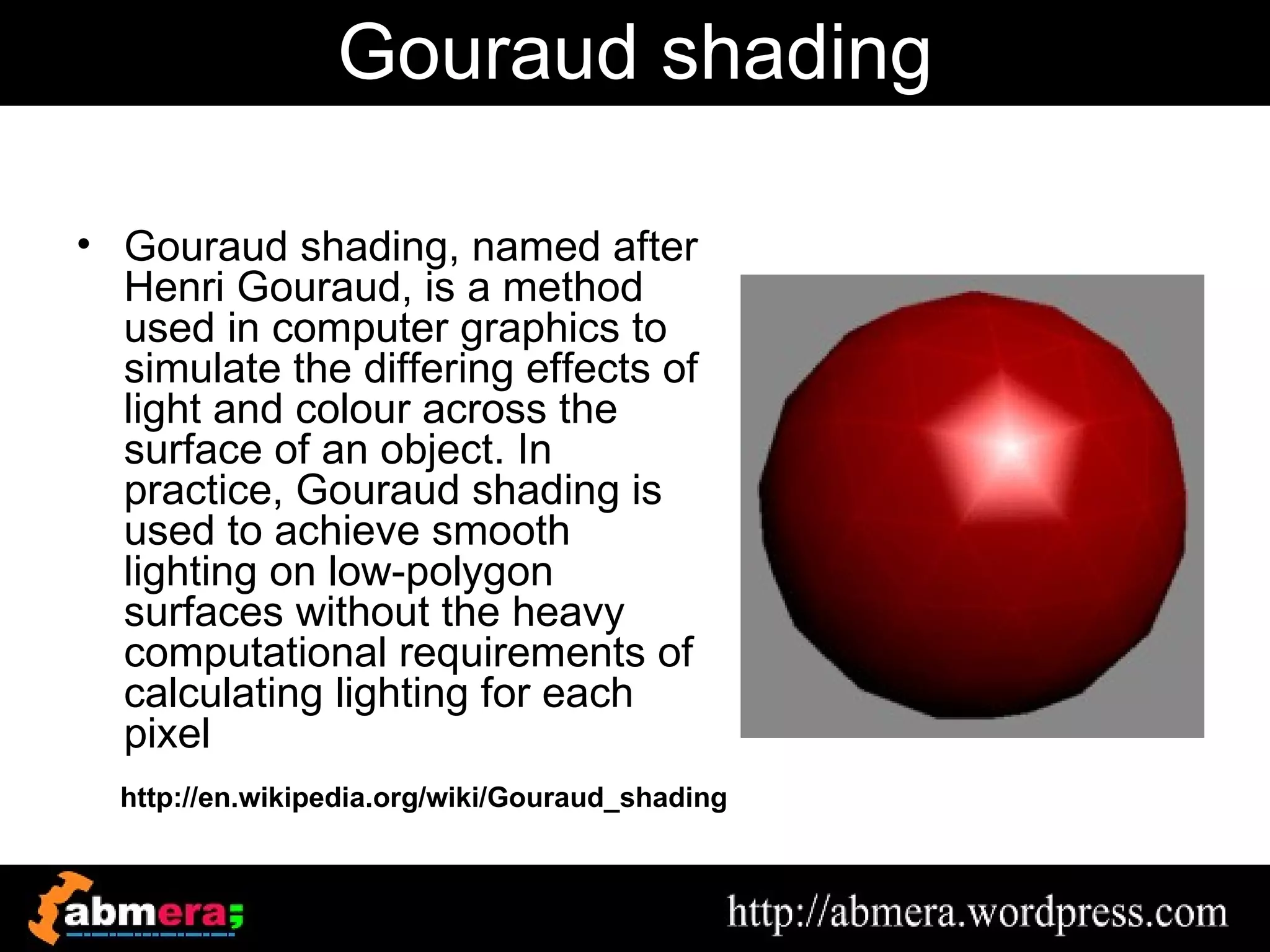
Gouraud shading

• Gouraud shading, named after
  Henri Gouraud, is a method
  used in computer graphics to
  simulate the differing effects of
  light and colour across the
  surface of an object. In
  practice, Gouraud shading is
  used to achieve smooth
  lighting on low-polygon
  surfaces without the heavy
  computational requirements of
  calculating lighting for each
  pixel
  http://en.wikipedia.org/wiki/Gouraud_shading
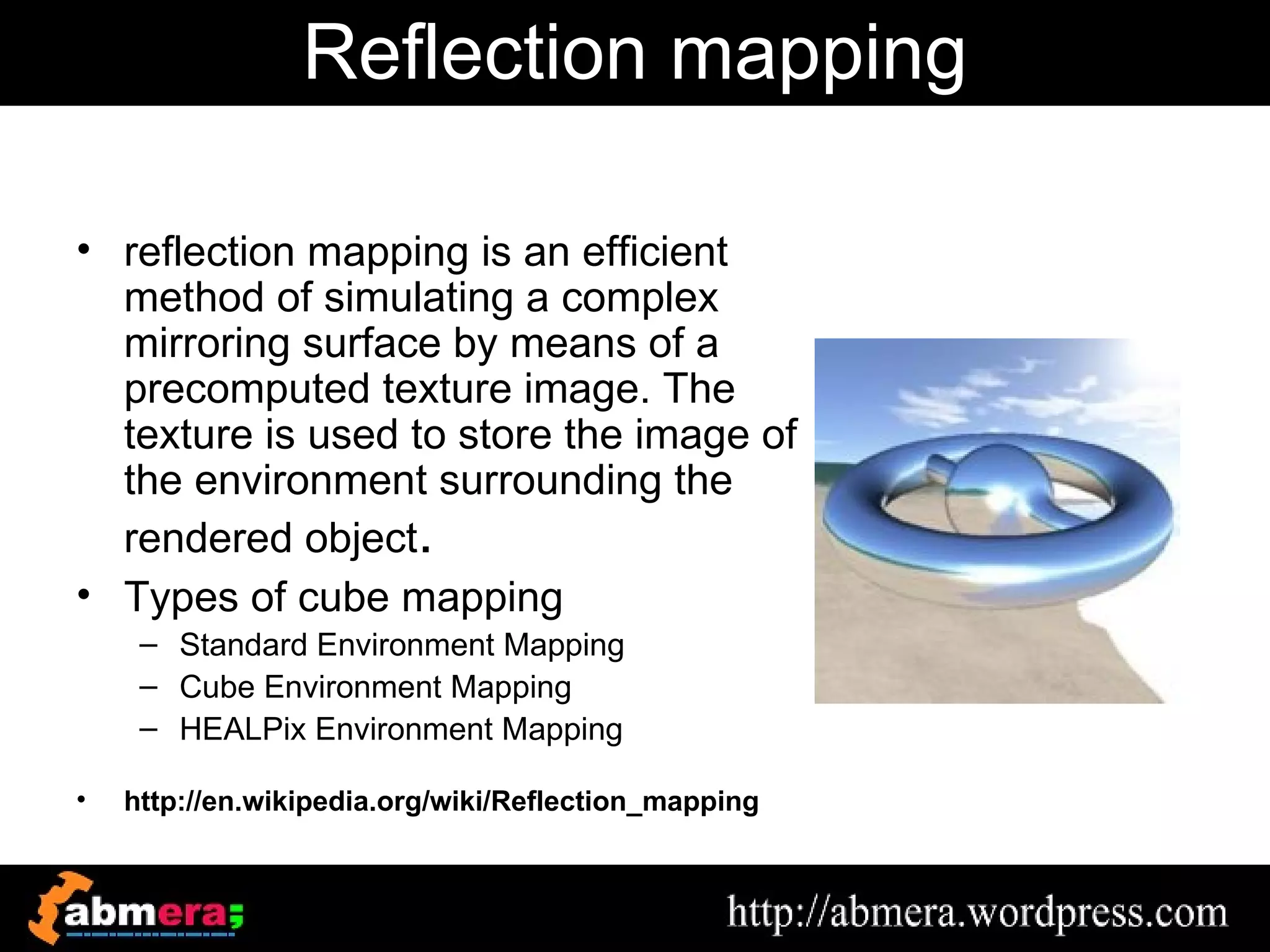
Reflection mapping

• reflection mapping is an efficient
  method of simulating a complex
  mirroring surface by means of a
  precomputed texture image. The
  texture is used to store the image of
  the environment surrounding the
  rendered object.
• Types of cube mapping
     – Standard Environment Mapping
     – Cube Environment Mapping
     – HEALPix Environment Mapping

•   http://en.wikipedia.org/wiki/Reflection_mapping
Specular reflection

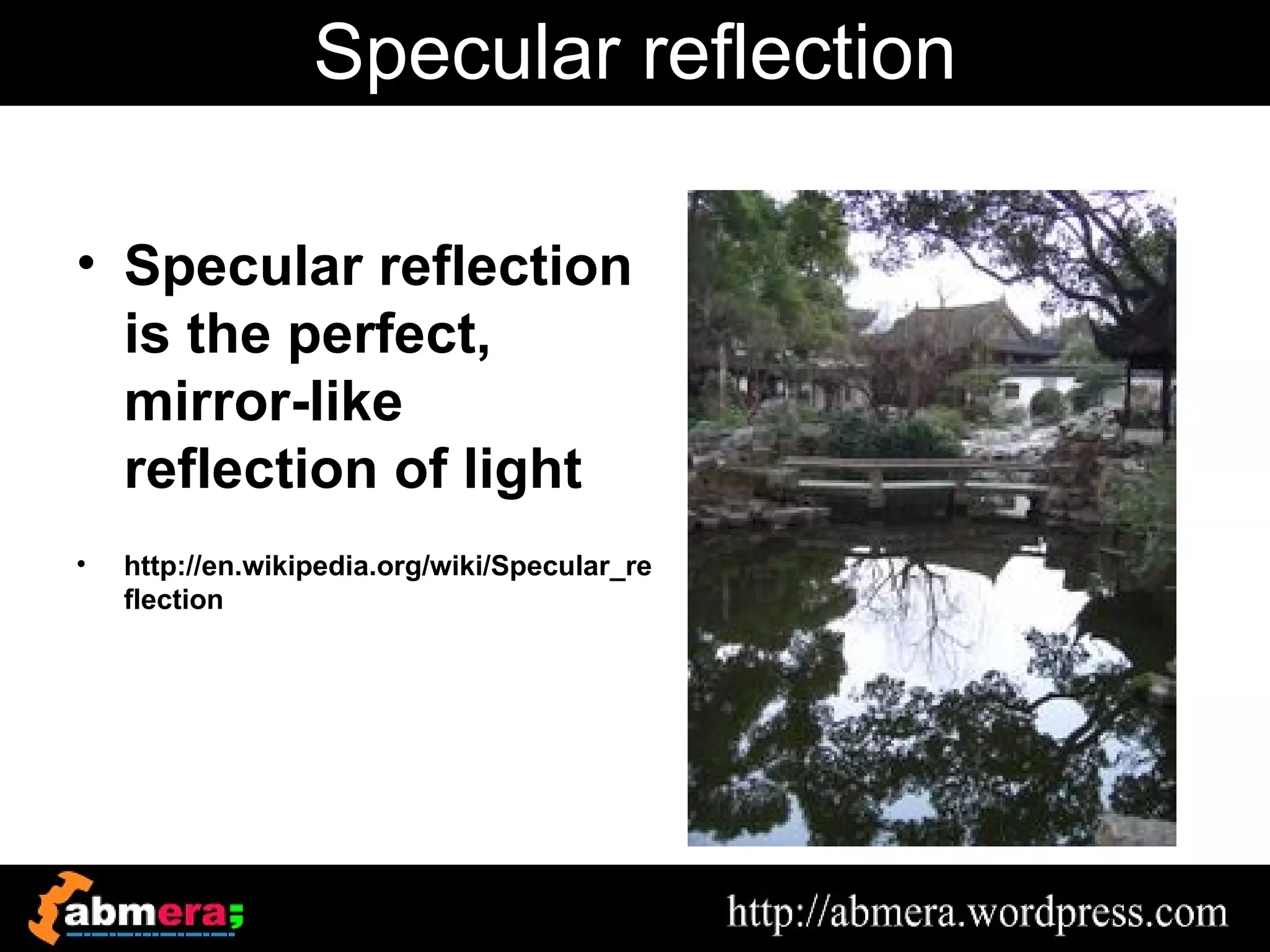
• Specular reflection
  is the perfect,
  mirror-like
  reflection of light
•   http://en.wikipedia.org/wiki/Specular_re
    flection
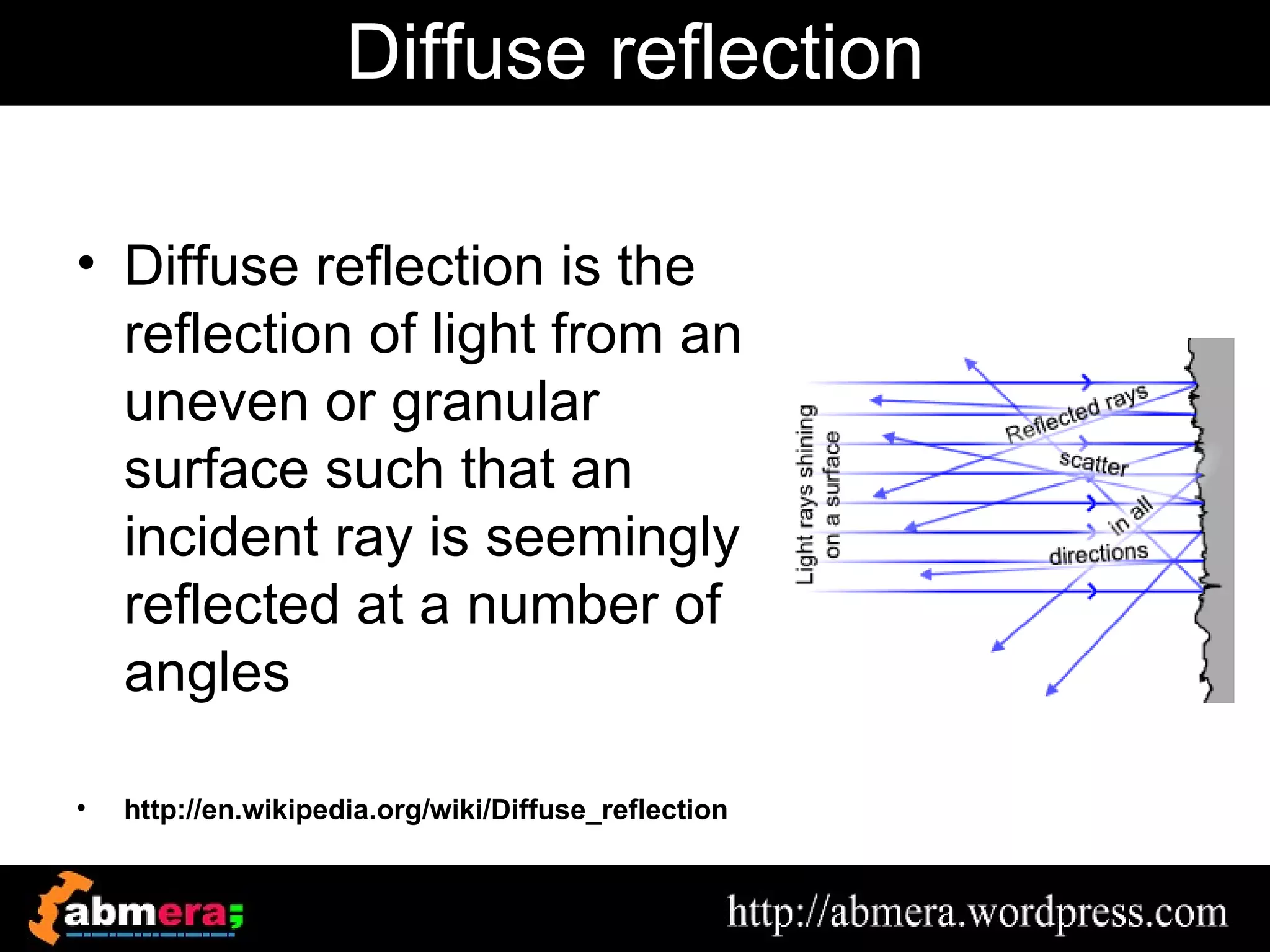
Diffuse reflection

• Diffuse reflection is the
  reflection of light from an
  uneven or granular
  surface such that an
  incident ray is seemingly
  reflected at a number of
  angles

•   http://en.wikipedia.org/wiki/Diffuse_reflection
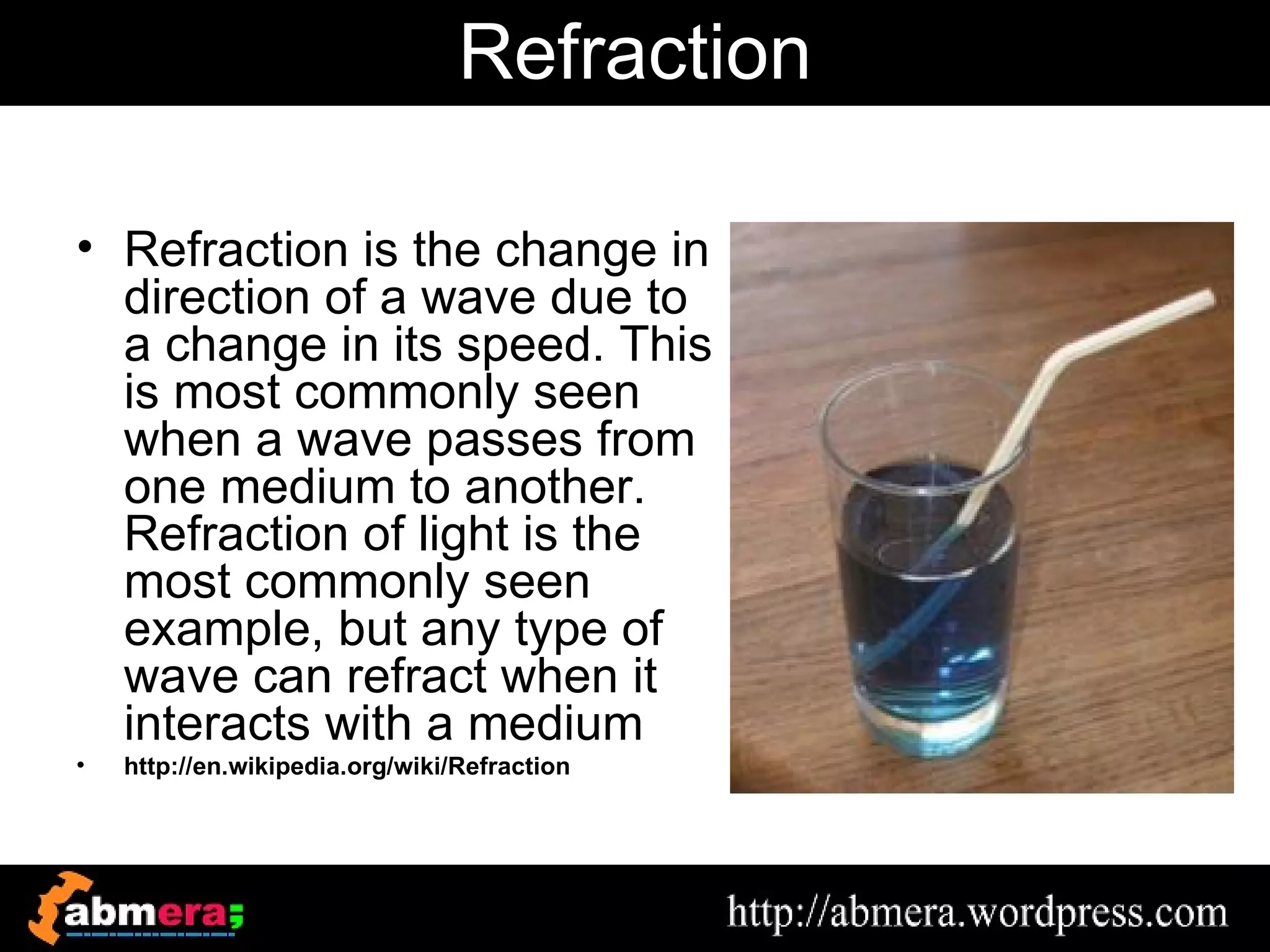
Refraction

• Refraction is the change in
  direction of a wave due to
  a change in its speed. This
  is most commonly seen
  when a wave passes from
  one medium to another.
  Refraction of light is the
  most commonly seen
  example, but any type of
  wave can refract when it
  interacts with a medium
•   http://en.wikipedia.org/wiki/Refraction
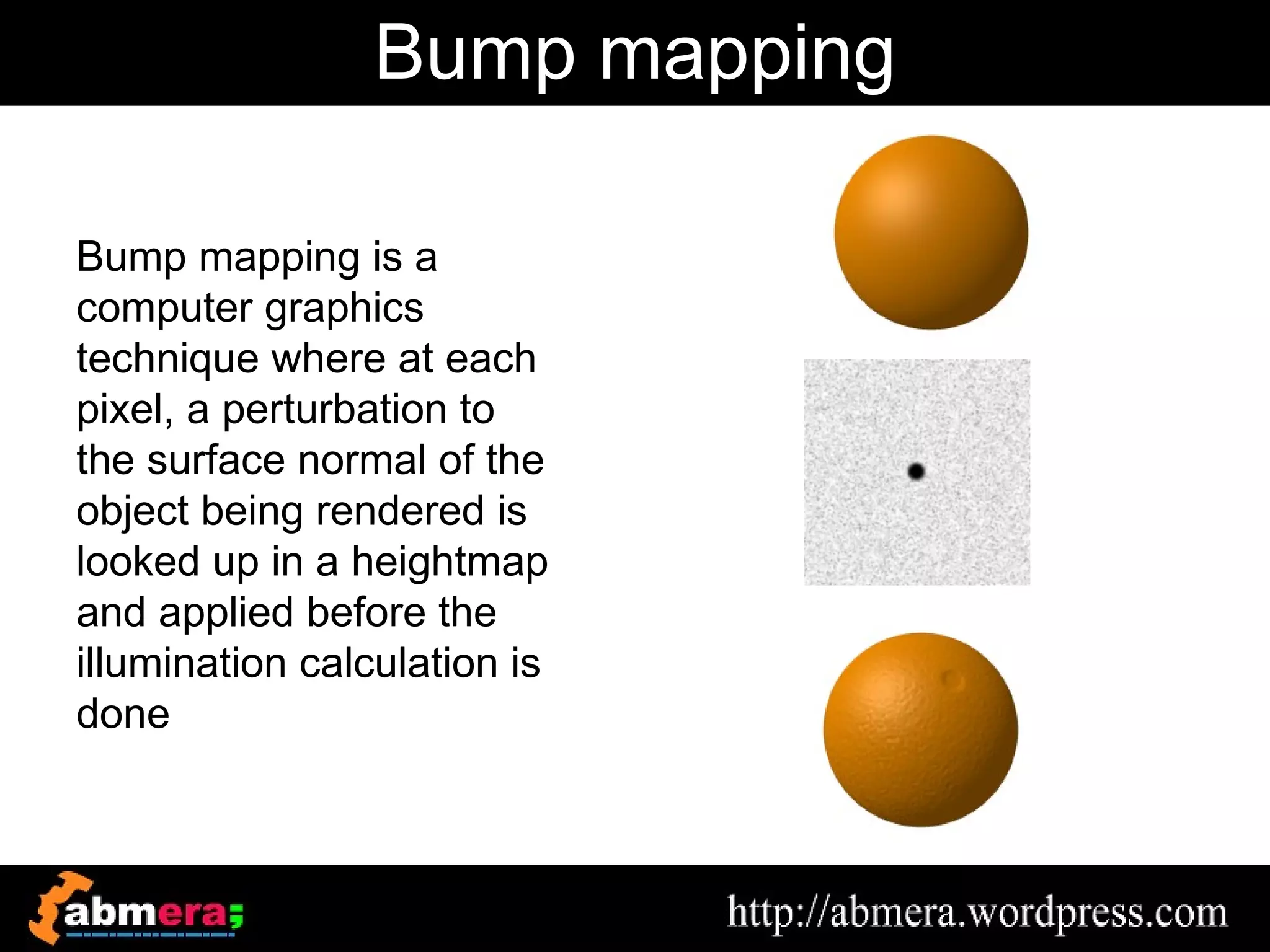
Bump mapping

Bump mapping is a
computer graphics
technique where at each
pixel, a perturbation to
the surface normal of the
object being rendered is
looked up in a heightmap
and applied before the
illumination calculation is
done
Normal mapping

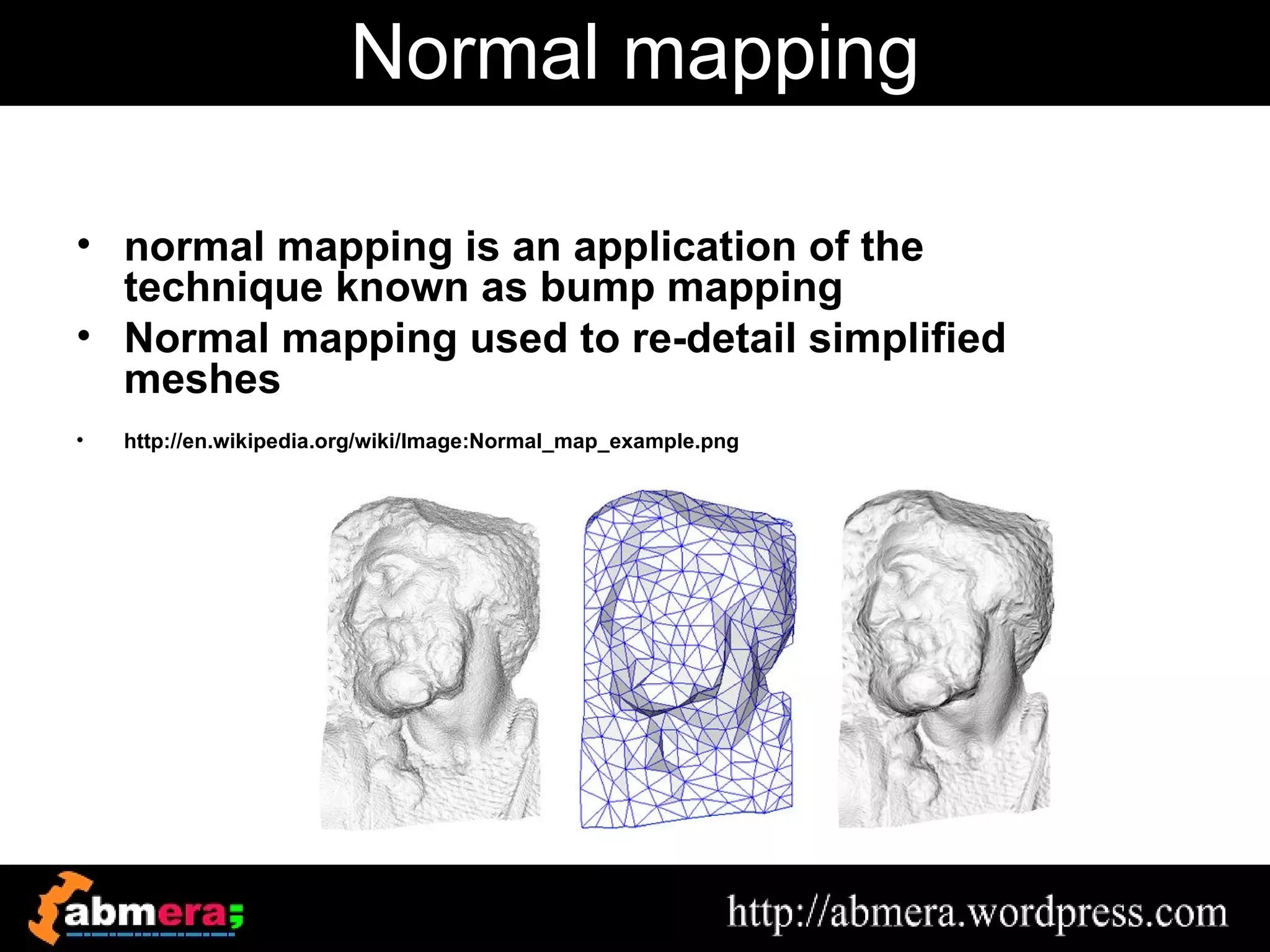
• normal mapping is an application of the
  technique known as bump mapping
• Normal mapping used to re-detail simplified
  meshes
•   http://en.wikipedia.org/wiki/Image:Normal_map_example.png
parallax mapping

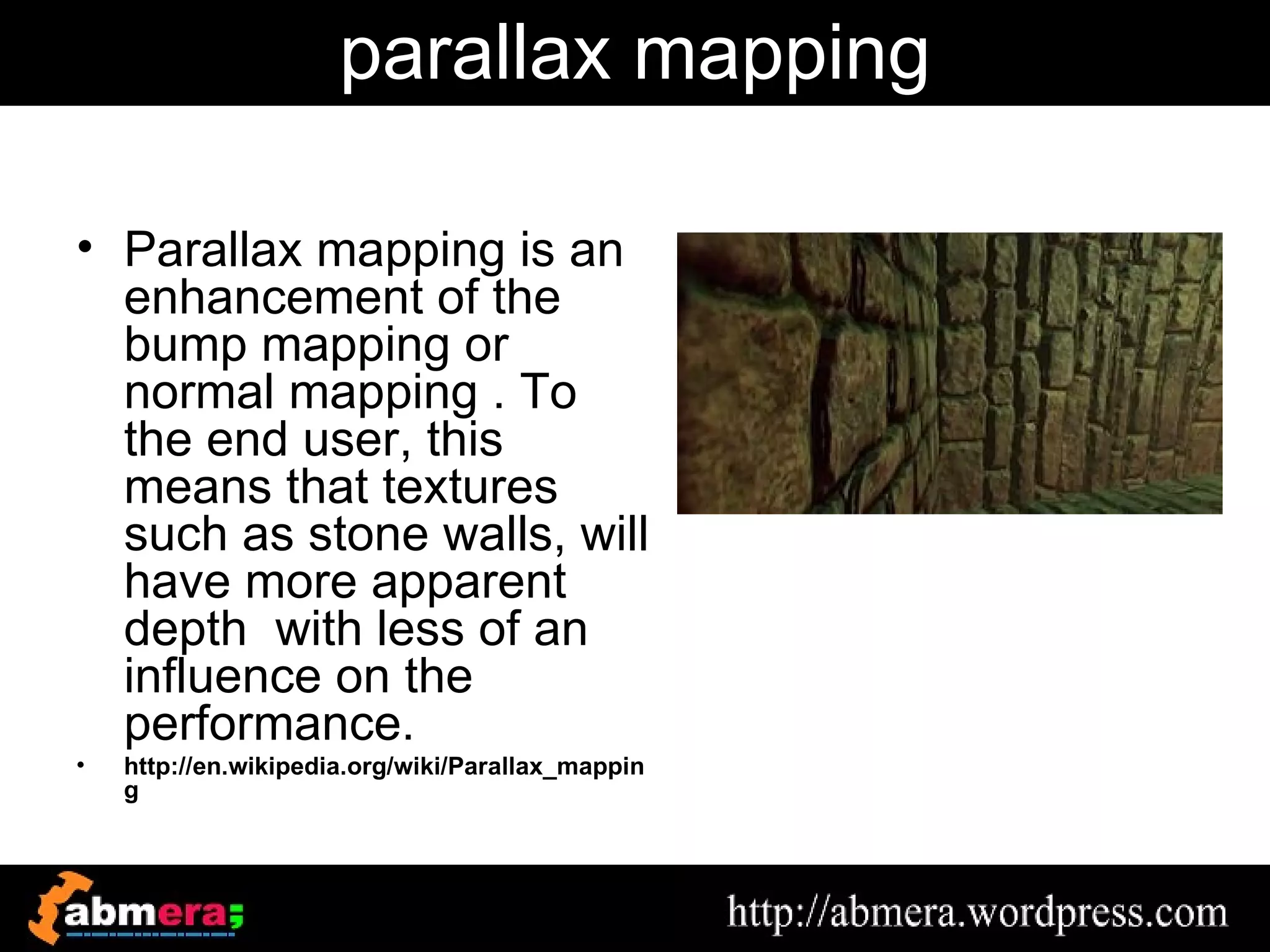
• Parallax mapping is an
  enhancement of the
  bump mapping or
  normal mapping . To
  the end user, this
  means that textures
  such as stone walls, will
  have more apparent
  depth with less of an
  influence on the
  performance.
•   http://en.wikipedia.org/wiki/Parallax_mappin
    g
Lightmap

A light map is a 3D engine light data
structure which contains the brightness of
surfaces in a video game. Light maps are
pre-computed and used for static objects
Ray tracing

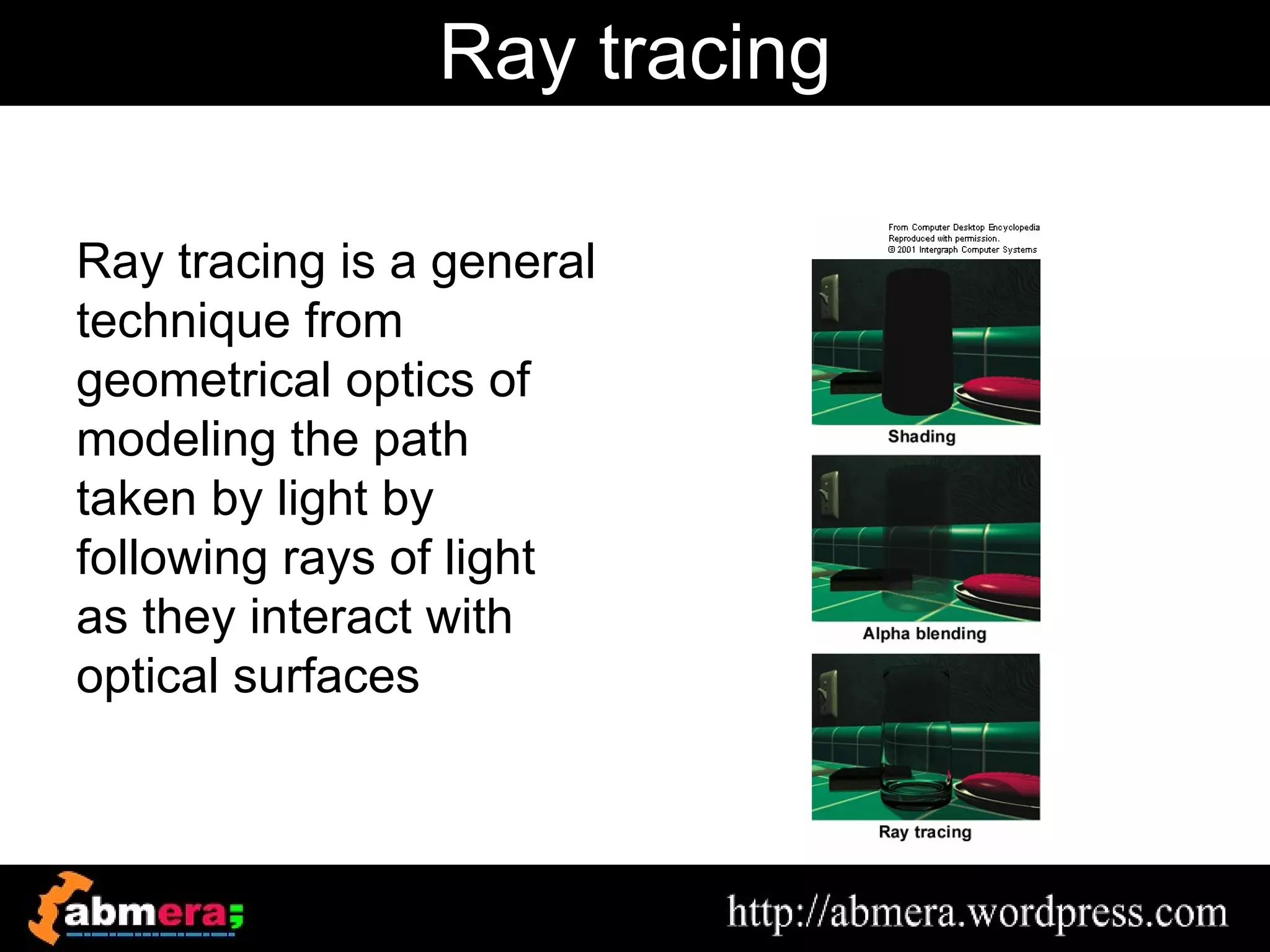
Ray tracing is a general
technique from
geometrical optics of
modeling the path
taken by light by
following rays of light
as they interact with
optical surfaces
Terrain

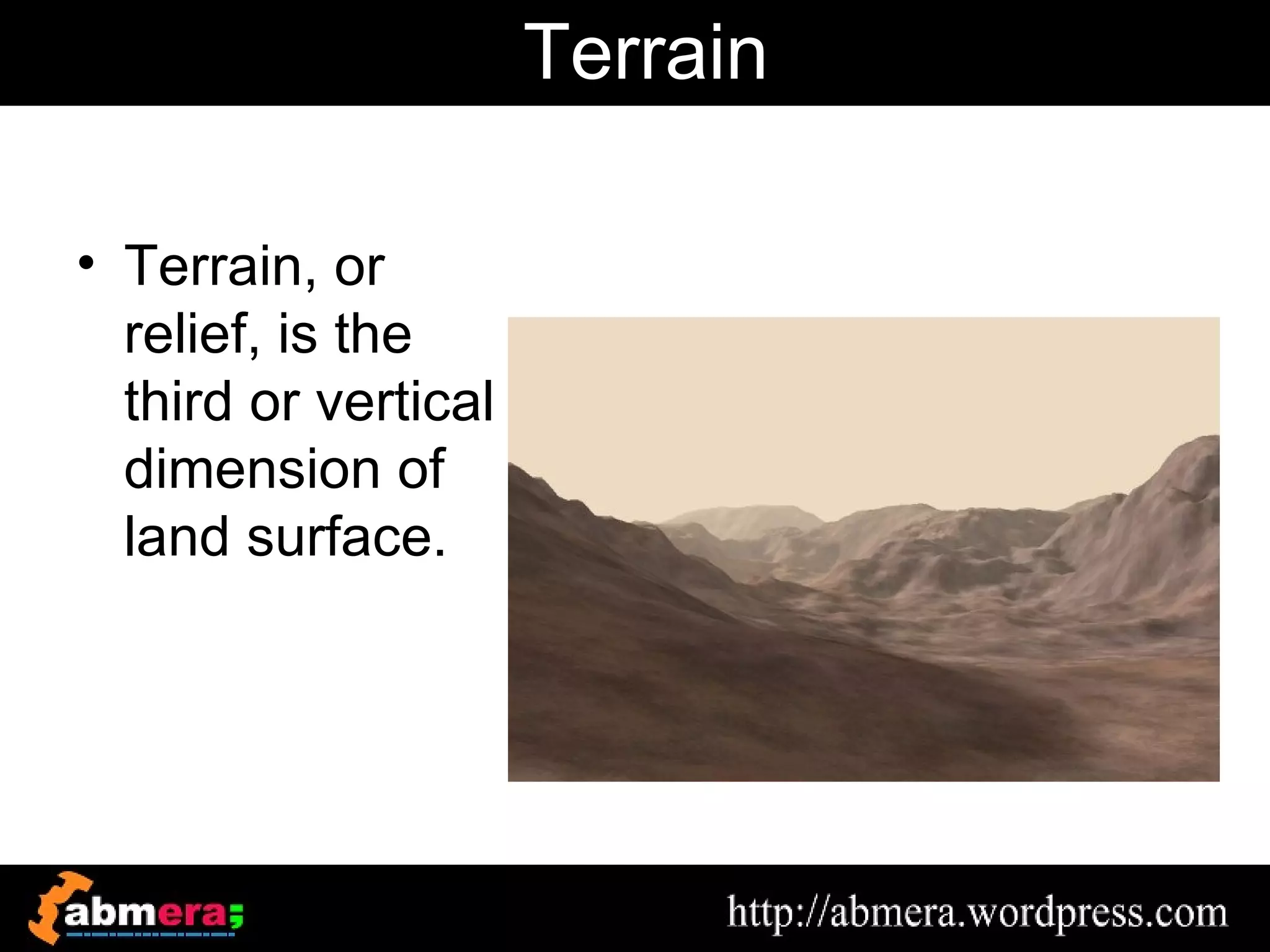
• Terrain, or
  relief, is the
  third or vertical
  dimension of
  land surface.
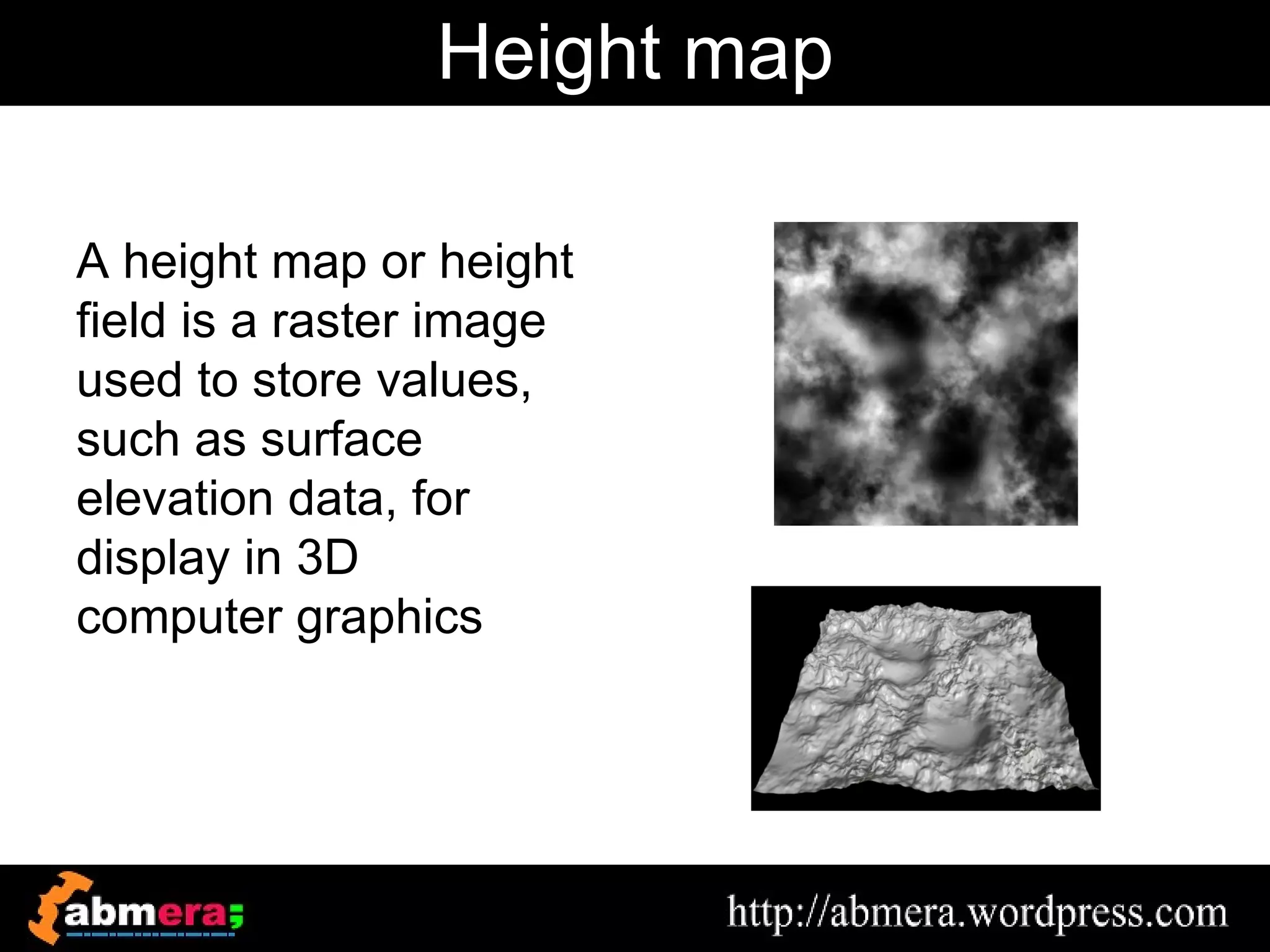
Height map

A height map or height
field is a raster image
used to store values,
such as surface
elevation data, for
display in 3D
computer graphics
Pixel shader

A pixel shader serves to manipulate a pixel,
usually to apply an effect on an image, for
example; realism, bump mapping,
.shadows, and explosion effects
Vertex shader

A Vertex-Shader serves to manipulate the
geometry of an object of a scene.
Therefore the form of the object changes
and this changes the appearance of the
object. With the help of vertex Shader
effects as vertex lighting, terrain-/Object-
deformation, waves or fish eye
perspective are possible
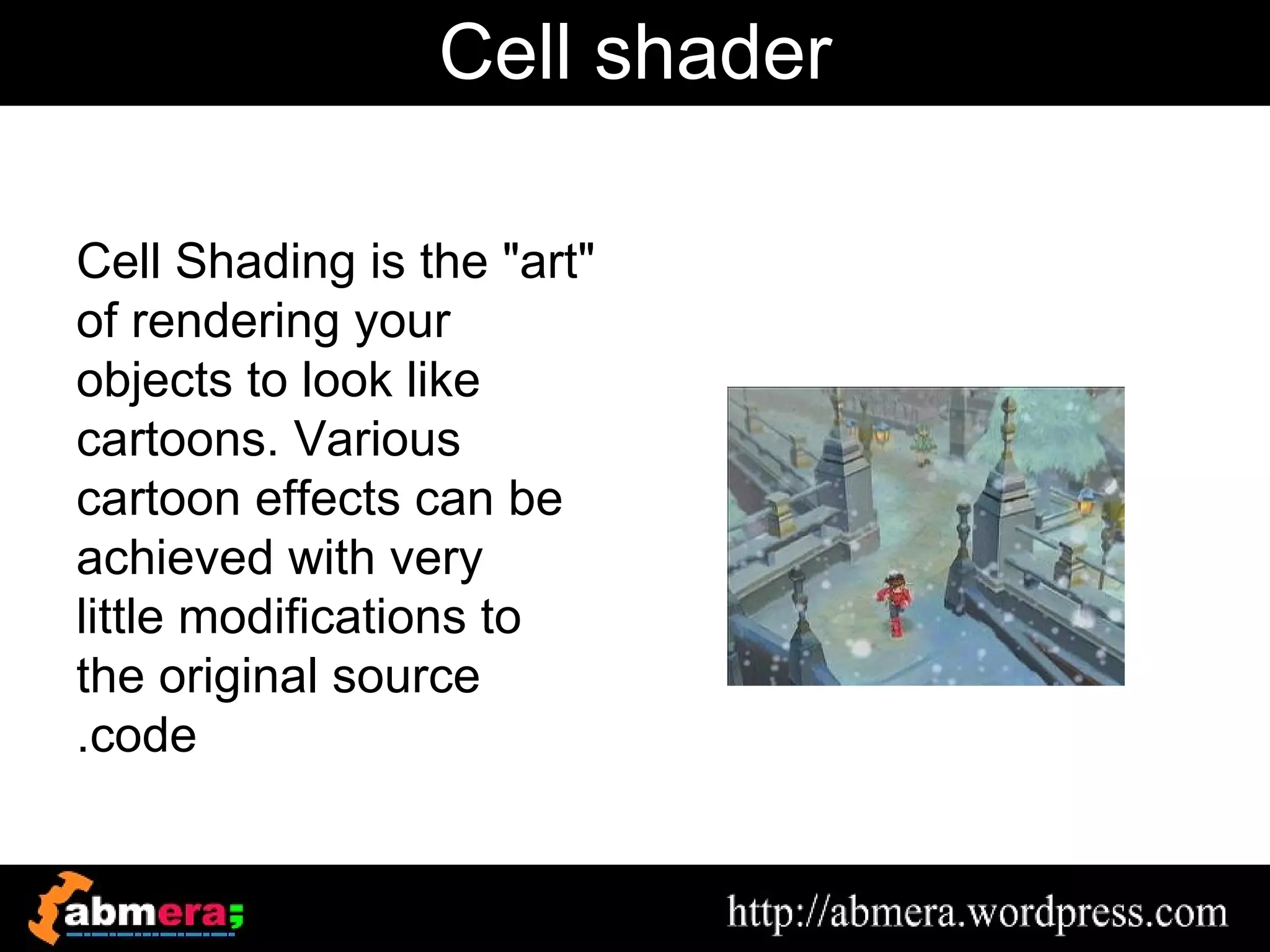
Cell shader

Cell Shading is the "art"
of rendering your
objects to look like
cartoons. Various
cartoon effects can be
achieved with very
little modifications to
the original source
.code
Game bots

is a robotic computer controlled entity that
simulates an online or LAN multiplayer
human death match opponent, team death
match opponent or a cooperative human
player. Computer game bots work via
artificial intelligence routines pre-
programmed to suit the game map, game
rules, game type and other parameters
unique to each game
AI

Game artificial intelligence refers to
techniques used in computer and video
games to produce the illusion of
intelligence in the behavior of non-player
characters (NPCs). The techniques used
typically draw upon existing methods from
the academic field of artificial intelligence
AI
procedural animation

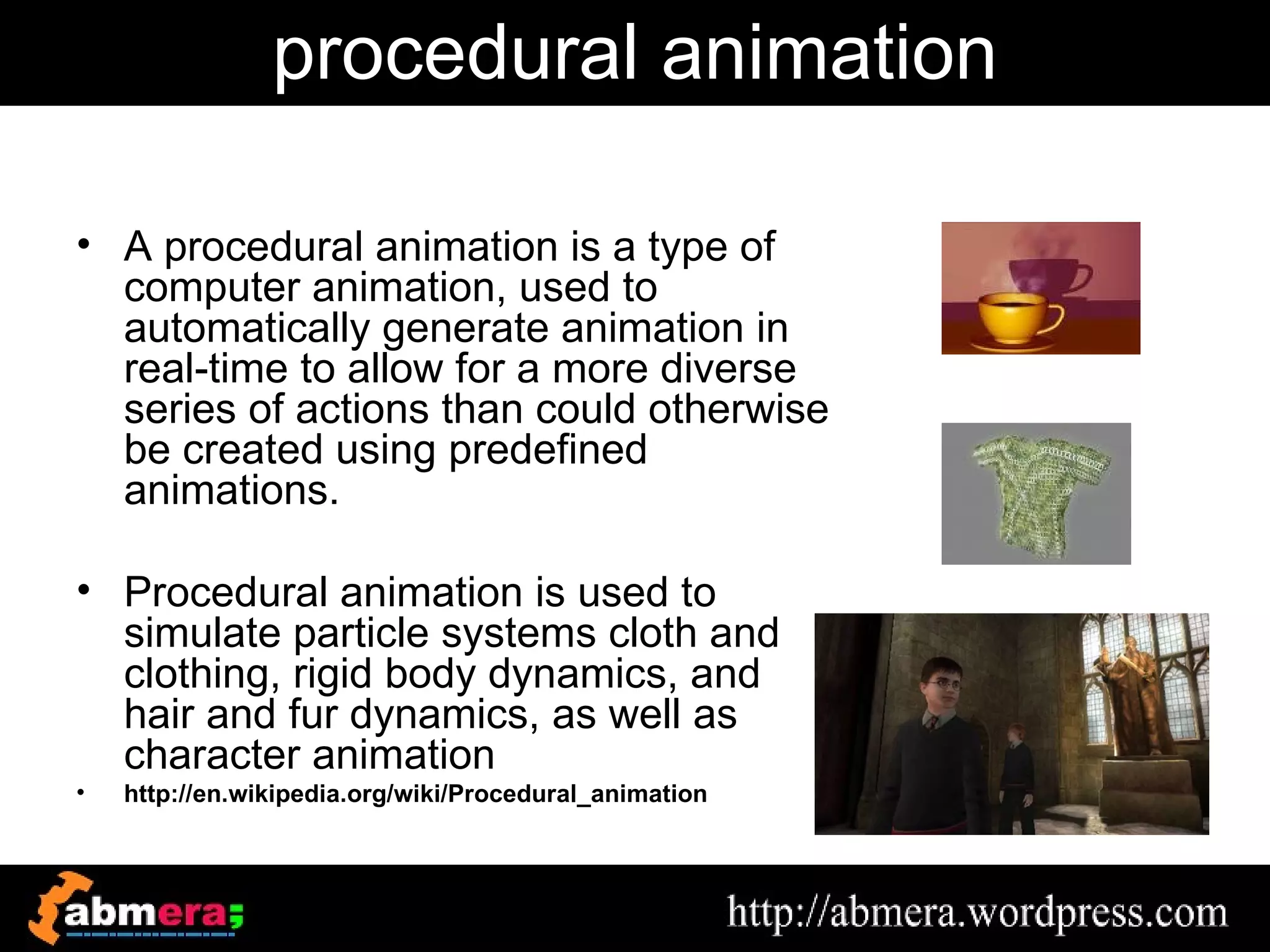
• A procedural animation is a type of
  computer animation, used to
  automatically generate animation in
  real-time to allow for a more diverse
  series of actions than could otherwise
  be created using predefined
  animations.

• Procedural animation is used to
  simulate particle systems cloth and
  clothing, rigid body dynamics, and
  hair and fur dynamics, as well as
  character animation
•   http://en.wikipedia.org/wiki/Procedural_animation
Skeltal animation

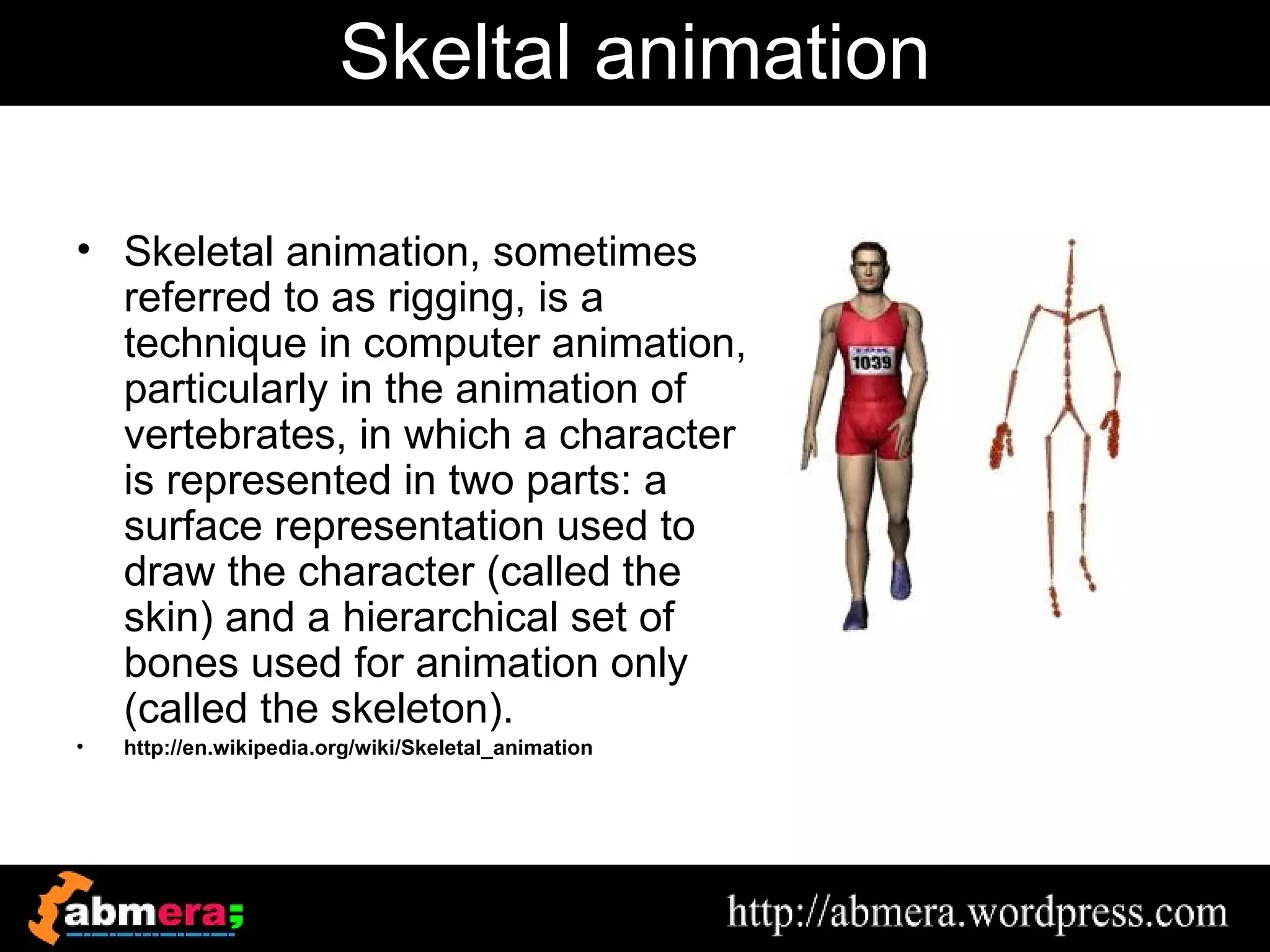
• Skeletal animation, sometimes
  referred to as rigging, is a
  technique in computer animation,
  particularly in the animation of
  vertebrates, in which a character
  is represented in two parts: a
  surface representation used to
  draw the character (called the
  skin) and a hierarchical set of
  bones used for animation only
  (called the skeleton).
•   http://en.wikipedia.org/wiki/Skeletal_animation
Morph target animation ((or per-vertex animation


• Morph target animation (or per-vertex
  animation) is a method of 3D computer
  animation that is sometimes used as an
  alternative to skeletal animation. Morph
  target animation is stored as a series of
  vertex positions. In each keyframe of the
  animation, the vertices are moved to a
  different position.
•   http://en.wikipedia.org/wiki/Morph_target_animation
Collision

collision means the action of bodies •
 striking or coming together
Game engine

• A game engine is the core software component of a
  computer video game or other interactive application
  with real-time graphics. It provides the underlying
  technologies, simplifies development, and often enables
  the game to run on multiple platforms

• The core functionality typically provided by a game
  engine includes a rendering engine (“renderer”) for 2D or
  3D graphics, a physics engine or collision detection (and
  collision response), sound, scripting, animation, artificial
  intelligence, networking, streaming, memory
  management, threading, and a scene graph
game genre

• Video games are categorized into genres
  based on their gameplay

•   http://en.wikipedia.org/wiki/Game_genre
References

• http://www.wikipedia.com
• http://www.answers.com/

Game development terminologies

  • 1.
    Game terminologies By Ahmed Badr
  • 3.
    Agenda • RGB • Color cube • Pixel • Color depth • Resolution • Pixel art • BMP • Grayscale
  • 4.
    Agenda • Alpha mask • PCX • JPEG/JPG • Alpha channels • Sprite • Polygon • Vertex • Edge
  • 5.
    Agenda • Model • Face • Mesh • Texture • Tile maps • Texel • Texture Mapping • UV mapping
  • 6.
    Agenda •MinMaps •procedural texture •point sampling •Bilinearinterpolation •Tri-linear filtering •anisotropic filtering •Render •Frame
  • 7.
    Agenda •Gouraud shading •Reflection mapping •Specularreflection •Diffuse reflection •Refraction •Bump mapping •Normal mapping •parallax mapping
  • 8.
    Agenda • Lightmap • Ray tracing • Terrain • Height map • Pixel shader • Vertex shader • Cell shader • Game bots
  • 9.
    Agenda • AI • procedural animation • Skeletal animation • Morph target animation • Collision • Game engine • game genre
  • 10.
    RGB • The RGBcolor model is an additive model in which red, green, and blue (often used in additive light models) are combined in various ways to reproduce other colors.
  • 11.
    Color cube • Acolor in the RGB color model can be described by indicating how much of each of the red, green and blue color is included. Each can vary between the minimum (no color) and maximum (full intensity). If all the colors are at minimum the result is black. If all the colors at maximum, the result is white.
  • 12.
    Pixel • A pixel(short for picture element, using the common abbreviation "pix" for "picture") is a single point in a graphic image. Each such information element is not really a dot, nor a square, but an abstract sample
  • 13.
    Color depth • Colordepth is a computer graphics term describing the number of bits used to represent the color of a single pixel in a bitmapped image. • This concept is also known as bits per pixel (bpp)
  • 14.
    Resolution • The numberof pixels in an image is sometimes called the resolution. • The higher the resolution the higher the picture quality • In game industry the same concepts apply but put in mind that high resolution comes at the price of high memory consumption and processing time.
  • 15.
    Pixel art • Pixelart is a form of digital art, created through the use of Isometric raster graphics software, where images are edited on the pixel level. Two type of pixel art, Isometric and non isometric. Non Isometric
  • 16.
    BMP • BMP filesare usually not compressed, so they are typically much larger than compressed image file formats for the same image. For example, an 800×600 24-bit image will occupy almost 1.4 megabytes • 800 x 600 x (24/8) = 1.4 MB
  • 17.
    Grayscale • Displayed imagesof this sort are typically composed of shades of gray, varying from black at the weakest intensity to white at the strongest
  • 18.
    Alpha mask • Usedto introduce transparency to areas to the BMP files. A gray scale image is used to describe transparency in a BMP image
  • 19.
    PCX • PCX isan image file format developed by the ZSoft Corporation of Marietta, Georgia, USA. It was the native file format for PC Paintbrush and became one of the first widely accepted DOS imaging standards, although its use has since been succeeded by more sophisticated image formats such as GIF, JPEG, and PNG. • Advantage: compression without losing quality
  • 20.
    JPEG/JPG • In computing,JPEG is a commonly used method of compression for photographic images • Advantages: Holds transparency information without the need to an external file • Disadvantages: destructive compression is used.
  • 21.
    Alpha channels In a2D image element which stores a color for each pixel, an additional value is stored in the alpha channel containing a value ranging from 0 to 1. A value of 0 means that the pixel does not have any coverage information
  • 22.
    Sprite Sprite is atwo- dimensional image or animation that is integrated into a .larger scene
  • 23.
    Polygon In geometry apolygon is a plane figure that is bounded by a closed path or circuit, composed of a finite number of sequential .line segments
  • 24.
    Vertex a vertex isa corner of an angle
  • 25.
  • 26.
    Model A model isa fully-3D computer graphic, polygonal object or character used in computer and video games
  • 27.
    Face In geometry, aface of a polyhedron is any of the polygons that make up its boundaries
  • 28.
    Mesh • A polygonmesh or unstructured grid is a collection of vertices and polygons that define the shape of an polyhedral object in 3D computer graphics.
  • 29.
    Texture Texture refers tothe properties held and sensations caused by the external surface of objects received through the sense of .touch
  • 30.
    Tile maps • Apicture with seamless edges repeated along side in X and Y axis
  • 31.
    Texel texture element Thesmallest addressable unit of a texture map. When objects in the image are near, one texel is mapped to one or more screen pixels. When objects are distant, multiple texels are averaged into one screen pixel
  • 32.
    Texture Mapping Texture mappingis a method, pioneered by Edwin Catmull, of adding detail, surface texture, or colour to a computer-generated graphic or 3D model
  • 33.
    UV mapping • UVmapping is a 3D modelling process of making a 2D image representing a 3D model. The map transforms the 3D object onto an image known as a texture. In contrast to "X", "Y" and "Z", which are the coordinates for the original 3D object in the modelling space, "U" and "V" are the coordinates of the transformed object. This creates the effect of painting the image onto the surface of the 3D object
  • 34.
    MinMaps A texture mapping techniquethat uses multiple texture maps, or MIP maps. Each MIP map is half the size of the first one, providing several texture maps for various levels of depth
  • 35.
    procedural texture • Analgorithmic way of describing a texture. Unlike a bitmapped texture, in which the texture is represented as a bitmap, a procedural texture describes the texture mathematically. Although not widely used, this method is resolution independent and can create more precise textures, especially if there is great and varying depth to the objects being textured. Procedural textures may be 2D or 3D • http://www.answers.com/topic/procedural-textures? cat=technology
  • 36.
    volumetric texture • Atexture that is described in three dimensions. It can be created as a "stack" of 2D bitmapped textures or as a 3D procedural texture. When an object with volumetric texture is sliced in half, the texture would still be rendered accurately on the inside • http://www.answers.com/topic/volumetric-texture?cat=technology
  • 37.
    point sampling • Alsocalled "nearest neighbor," it is the simplest form of texture mapping, which is often associated with low-end games and applications that do not demand much realism. An algorithm is used to map a screen pixel to the corresponding point on the texture map. The attributes (color, alpha, etc.) of the nearest texel are then directly applied to the screen pixel. The process is repeated for each pixel forming the object being textured
  • 38.
    Bilinear interpolation • Atexture mapping technique that produces a reasonably realistic image, also known as "bilinear filtering" and "bilinear texture mapping." An algorithm is used to map a screen pixel location to a corresponding point on the texture map. A weighted average of the attributes (color, alpha, etc.) of the four surrounding texels is computed and applied to the screen pixel. This process is repeated for each pixel forming the object being textured • http://www.answers.com/topic/bilinear-interpolation?cat=technology
  • 39.
    Tri-linear filtering • Bilinearfiltering has several weaknesses that make it an unattractive choice in many cases: using it on a full-detail texture when scaling to a very small size causes accuracy problems from missed texels, and compensating for this by using multiple mipmaps throughout the polygon leads to abrupt changes in blurriness, which is most pronounced in polygons that are steeply angled relative to the camera. • trilinear filtering interpolates between the results of bilinear filtering on the two mipmaps nearest to the detail required for the polygon at the pixel • http://www.answers.com/Trilinear%20filtering
  • 40.
    anisotropic filtering • isa method of enhancing the image quality of textures on surfaces that are at oblique viewing angles with respect to the camera where the projection of the texture appears to be non orthogonal http://www.answers.com/Anisotropic%20filtering
  • 41.
    Render Rendering is theprocess of generating an image from a model, by means of computer programs. The model is a description of three dimensional objects in a strictly defined language or data structure. It would contain geometry, viewpoint, texture and lighting .information
  • 42.
    Frame a frame isone of the many still images which compose the complete moving picture
  • 43.
    Gouraud shading • Gouraudshading, named after Henri Gouraud, is a method used in computer graphics to simulate the differing effects of light and colour across the surface of an object. In practice, Gouraud shading is used to achieve smooth lighting on low-polygon surfaces without the heavy computational requirements of calculating lighting for each pixel http://en.wikipedia.org/wiki/Gouraud_shading
  • 44.
    Reflection mapping • reflectionmapping is an efficient method of simulating a complex mirroring surface by means of a precomputed texture image. The texture is used to store the image of the environment surrounding the rendered object. • Types of cube mapping – Standard Environment Mapping – Cube Environment Mapping – HEALPix Environment Mapping • http://en.wikipedia.org/wiki/Reflection_mapping
  • 45.
    Specular reflection • Specularreflection is the perfect, mirror-like reflection of light • http://en.wikipedia.org/wiki/Specular_re flection
  • 46.
    Diffuse reflection • Diffusereflection is the reflection of light from an uneven or granular surface such that an incident ray is seemingly reflected at a number of angles • http://en.wikipedia.org/wiki/Diffuse_reflection
  • 47.
    Refraction • Refraction isthe change in direction of a wave due to a change in its speed. This is most commonly seen when a wave passes from one medium to another. Refraction of light is the most commonly seen example, but any type of wave can refract when it interacts with a medium • http://en.wikipedia.org/wiki/Refraction
  • 48.
    Bump mapping Bump mappingis a computer graphics technique where at each pixel, a perturbation to the surface normal of the object being rendered is looked up in a heightmap and applied before the illumination calculation is done
  • 49.
    Normal mapping • normalmapping is an application of the technique known as bump mapping • Normal mapping used to re-detail simplified meshes • http://en.wikipedia.org/wiki/Image:Normal_map_example.png
  • 50.
    parallax mapping • Parallaxmapping is an enhancement of the bump mapping or normal mapping . To the end user, this means that textures such as stone walls, will have more apparent depth with less of an influence on the performance. • http://en.wikipedia.org/wiki/Parallax_mappin g
  • 51.
    Lightmap A light mapis a 3D engine light data structure which contains the brightness of surfaces in a video game. Light maps are pre-computed and used for static objects
  • 52.
    Ray tracing Ray tracingis a general technique from geometrical optics of modeling the path taken by light by following rays of light as they interact with optical surfaces
  • 53.
    Terrain • Terrain, or relief, is the third or vertical dimension of land surface.
  • 54.
    Height map A heightmap or height field is a raster image used to store values, such as surface elevation data, for display in 3D computer graphics
  • 55.
    Pixel shader A pixelshader serves to manipulate a pixel, usually to apply an effect on an image, for example; realism, bump mapping, .shadows, and explosion effects
  • 56.
    Vertex shader A Vertex-Shaderserves to manipulate the geometry of an object of a scene. Therefore the form of the object changes and this changes the appearance of the object. With the help of vertex Shader effects as vertex lighting, terrain-/Object- deformation, waves or fish eye perspective are possible
  • 57.
    Cell shader Cell Shadingis the "art" of rendering your objects to look like cartoons. Various cartoon effects can be achieved with very little modifications to the original source .code
  • 58.
    Game bots is arobotic computer controlled entity that simulates an online or LAN multiplayer human death match opponent, team death match opponent or a cooperative human player. Computer game bots work via artificial intelligence routines pre- programmed to suit the game map, game rules, game type and other parameters unique to each game
  • 59.
    AI Game artificial intelligencerefers to techniques used in computer and video games to produce the illusion of intelligence in the behavior of non-player characters (NPCs). The techniques used typically draw upon existing methods from the academic field of artificial intelligence AI
  • 60.
    procedural animation • Aprocedural animation is a type of computer animation, used to automatically generate animation in real-time to allow for a more diverse series of actions than could otherwise be created using predefined animations. • Procedural animation is used to simulate particle systems cloth and clothing, rigid body dynamics, and hair and fur dynamics, as well as character animation • http://en.wikipedia.org/wiki/Procedural_animation
  • 61.
    Skeltal animation • Skeletalanimation, sometimes referred to as rigging, is a technique in computer animation, particularly in the animation of vertebrates, in which a character is represented in two parts: a surface representation used to draw the character (called the skin) and a hierarchical set of bones used for animation only (called the skeleton). • http://en.wikipedia.org/wiki/Skeletal_animation
  • 62.
    Morph target animation((or per-vertex animation • Morph target animation (or per-vertex animation) is a method of 3D computer animation that is sometimes used as an alternative to skeletal animation. Morph target animation is stored as a series of vertex positions. In each keyframe of the animation, the vertices are moved to a different position. • http://en.wikipedia.org/wiki/Morph_target_animation
  • 63.
    Collision collision means theaction of bodies • striking or coming together
  • 64.
    Game engine • Agame engine is the core software component of a computer video game or other interactive application with real-time graphics. It provides the underlying technologies, simplifies development, and often enables the game to run on multiple platforms • The core functionality typically provided by a game engine includes a rendering engine (“renderer”) for 2D or 3D graphics, a physics engine or collision detection (and collision response), sound, scripting, animation, artificial intelligence, networking, streaming, memory management, threading, and a scene graph
  • 65.
    game genre • Videogames are categorized into genres based on their gameplay • http://en.wikipedia.org/wiki/Game_genre
  • 66.