Prostitution law:
       How research should
       (or should not) affect
           our principles


            http://t0.gstatic.com/images?q=tbn:ANd9GcTUtLPiSE2Fu_aluD3QURVspGxzOn9
            JMyvZdTd9nTAYBeSatPyGleYdTAVa6A


Presentation by Raquel Avila, Jelisa Adair, Roxie Mays, Ryan
         Doherty, Lisa Walsh and Julia Berquist
Prostitution
Summary:
•Defining Prostitution
•Attitudes??             https://encrypted-tbn2.google.com/images?q=tbn:ANd9GcR4JJ_GbqaczhoXj8E0iTKiKmzjNRAZHQvKA-


 Hollywood vs. Reality
                         5D-V3IhAjoFZX8

•


•In Today's News
•Ireland's Stance
•Principle Arguments
•Research Findings
•Final Recommendation
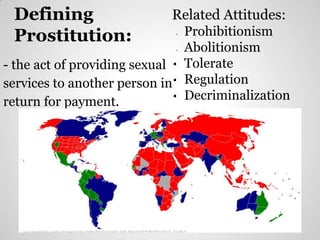
Defining                                                                                        Related Attitudes:
 Prostitution:                  Prohibitionism                                                      •


                                Abolitionism                                                        •


- the act of providing sexual • Tolerate
services to another person in • Regulation
                              • Decriminalization
return for payment.


   https://encrypted-tbn1.google.com/images?q=tbn:ANd9GcR93l3G4TLGpSiYAQ8J-3RpkCQFoWWoBlcWhYm9FonA_WJzFBC9
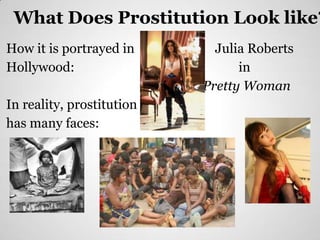
What Does Prostitution Look like?
How it is portrayed in                                                     Julia Roberts
Hollywood:                                                                     in
                                                                         Pretty Woman
In reality, prostitution
has many faces:
                           https://encrypted-
                           tbn0.google.com/images?q=tbn:ANd9GcTFHfvN_m
                           xdKcuP_VC4ZrMwnxYlcchu6z52CVL_rLQuj65DeB
                           TwAA
In Today's News
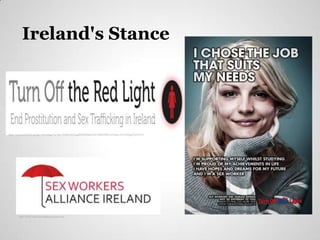
Ireland's Stance


https://encrypted-tbn2.google.com/images?q=tbn:ANd9GcRZxaqdD8SiM4akFsGUD0k6ZBtQ-3ENqyrAFrCxlZgpGJoNC41U


                                                                                                          http://www.turnoffthebluelight.ie/wp-content/gallery/posters/2.jpg
        http://www.sexworkersallianceireland.org/
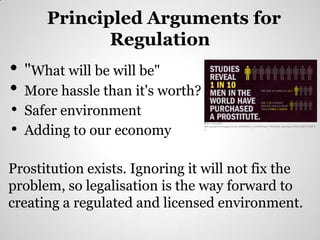
Principled Arguments for
              Regulation
•   "What will be will be"
•   More hassle than it's worth?
•   Safer environment
•   Adding to our economy
                                   https://encrypted-
                                   tbn1.google.com/images?q=tbn:ANd9GcQr_a_8Ab4tU6avz_WyP3tjsh_mSu0skeszZNJLLsRNYzH8l53
                                   n


Prostitution exists. Ignoring it will not fix the
problem, so legalisation is the way forward to
creating a regulated and licensed environment.
Principled Arguments
   Against Regulation

• Moral argument: prostitution as a sin
                                 http://images.sodahead.com/polls/002186341/1332478341_no20prostitutio
                                 n20prostitutes20sign_answer_2_xlarge.jpeg


• Legalisation will serve to legitimize
  prostitution which, as a practice is
  harmful to women
• Legalisation may allow for the expansion
  and extension of the sex industry.
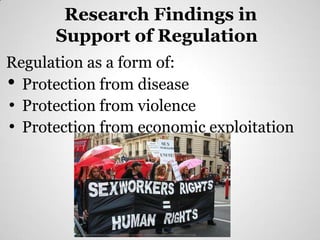
Research Findings in
      Support of Regulation
Regulation as a form of:
• Protection from disease
• Protection from violence
• Protection from economic exploitation


         http://change-production.s3.amazonaws.com/photos/wordpress_copies/criminaljustice/2008/10/sex-workers1.jpg
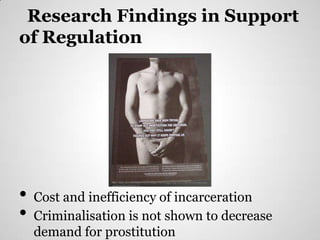
Research Findings in Support
of Regulation


•
                 http://static.thesocietypages.org/socimages/files/blogger2wp/12111098765432Anticrimin
                 alizationofprostitution.jpg


    Cost and inefficiency of incarceration
•   Criminalisation is not shown to decrease
    demand for prostitution
Strengths and Weaknesses of
    Research in Support of
    Regulation
• The research often takes into account
    the feelings and opinions of actual
    prostitutes
•   Research often looks at regulation as
    opposed to criminalization without
    considering the benefits of abolitionist
    policies
Research Findings Against
Regulation
•   Prosecutions of johns in the US have been
    successful in reducing recidivism when
    combined with educational programs.
•   In European countries like the Netherlands
    and Germany where prostitution has been
    legalised sex trafficking immigrants has
    remained a substantial problem.
•   Since legalisation the Netherlands sex
    industry has grown by roughly 25%.
Research Findings
Against Regulation
•
                                    tp:ht//images.ctv.ca/archives/CTVNews/img2/20100908/470_erotic_services_100908.jpg


    Decriminalisation increases advertising and
    the commercial aspects of the industry thus
    increasing its size. This has been shown in
    Victoria, Australia where brothels tripled in
    size.
•   Research has proved wrong notions of
    reductions in child sex trafficking that
    decriminalisation would bring. Since
    legalisation in the Netherlands child
    prostitution has quadrupled.
Strengths and Weaknesses of
Research in Opposition
•   Research against does provide statistical
    evidence that legalisation increases
    prostitution.
•   Much of the research against regulating
    prostitution fails to acknowledge its effect in
    decreasing crime.
•   Research against tends to focus more on the
    moral aspect of prostitution and ignores the
    practical implications of legislation, such as
    a reduction in sexually transmitted diseases.
Final Recommendation
•   Legalisation with regulation has several
    public health benefits but does not eliminate
    prostitution and can promote human
    trafficking.
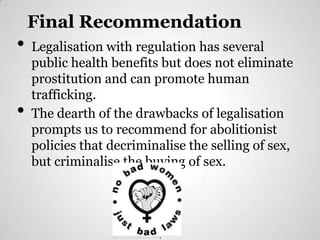
•   The dearth of the drawbacks of legalisation
    prompts us to recommend for abolitionist
    policies that decriminalise the selling of sex,
    but criminalise the buying of sex.


                  http://www.prostitutescollective.net/ecplh.jpg

Prostitution presentation

  • 1.
    Prostitution law: How research should (or should not) affect our principles http://t0.gstatic.com/images?q=tbn:ANd9GcTUtLPiSE2Fu_aluD3QURVspGxzOn9 JMyvZdTd9nTAYBeSatPyGleYdTAVa6A Presentation by Raquel Avila, Jelisa Adair, Roxie Mays, Ryan Doherty, Lisa Walsh and Julia Berquist
  • 2.
    Prostitution Summary: •Defining Prostitution •Attitudes?? https://encrypted-tbn2.google.com/images?q=tbn:ANd9GcR4JJ_GbqaczhoXj8E0iTKiKmzjNRAZHQvKA- Hollywood vs. Reality 5D-V3IhAjoFZX8 • •In Today's News •Ireland's Stance •Principle Arguments •Research Findings •Final Recommendation
  • 3.
    Defining Related Attitudes: Prostitution: Prohibitionism • Abolitionism • - the act of providing sexual • Tolerate services to another person in • Regulation • Decriminalization return for payment. https://encrypted-tbn1.google.com/images?q=tbn:ANd9GcR93l3G4TLGpSiYAQ8J-3RpkCQFoWWoBlcWhYm9FonA_WJzFBC9
  • 4.
    What Does ProstitutionLook like? How it is portrayed in Julia Roberts Hollywood: in Pretty Woman In reality, prostitution has many faces: https://encrypted- tbn0.google.com/images?q=tbn:ANd9GcTFHfvN_m xdKcuP_VC4ZrMwnxYlcchu6z52CVL_rLQuj65DeB TwAA
  • 5.
  • 6.
    Ireland's Stance https://encrypted-tbn2.google.com/images?q=tbn:ANd9GcRZxaqdD8SiM4akFsGUD0k6ZBtQ-3ENqyrAFrCxlZgpGJoNC41U http://www.turnoffthebluelight.ie/wp-content/gallery/posters/2.jpg http://www.sexworkersallianceireland.org/
  • 7.
    Principled Arguments for Regulation • "What will be will be" • More hassle than it's worth? • Safer environment • Adding to our economy https://encrypted- tbn1.google.com/images?q=tbn:ANd9GcQr_a_8Ab4tU6avz_WyP3tjsh_mSu0skeszZNJLLsRNYzH8l53 n Prostitution exists. Ignoring it will not fix the problem, so legalisation is the way forward to creating a regulated and licensed environment.
  • 8.
    Principled Arguments Against Regulation • Moral argument: prostitution as a sin http://images.sodahead.com/polls/002186341/1332478341_no20prostitutio n20prostitutes20sign_answer_2_xlarge.jpeg • Legalisation will serve to legitimize prostitution which, as a practice is harmful to women • Legalisation may allow for the expansion and extension of the sex industry.
  • 9.
    Research Findings in Support of Regulation Regulation as a form of: • Protection from disease • Protection from violence • Protection from economic exploitation http://change-production.s3.amazonaws.com/photos/wordpress_copies/criminaljustice/2008/10/sex-workers1.jpg
  • 10.
    Research Findings inSupport of Regulation • http://static.thesocietypages.org/socimages/files/blogger2wp/12111098765432Anticrimin alizationofprostitution.jpg Cost and inefficiency of incarceration • Criminalisation is not shown to decrease demand for prostitution
  • 11.
    Strengths and Weaknessesof Research in Support of Regulation • The research often takes into account the feelings and opinions of actual prostitutes • Research often looks at regulation as opposed to criminalization without considering the benefits of abolitionist policies
  • 12.
    Research Findings Against Regulation • Prosecutions of johns in the US have been successful in reducing recidivism when combined with educational programs. • In European countries like the Netherlands and Germany where prostitution has been legalised sex trafficking immigrants has remained a substantial problem. • Since legalisation the Netherlands sex industry has grown by roughly 25%.
  • 13.
    Research Findings Against Regulation • tp:ht//images.ctv.ca/archives/CTVNews/img2/20100908/470_erotic_services_100908.jpg Decriminalisation increases advertising and the commercial aspects of the industry thus increasing its size. This has been shown in Victoria, Australia where brothels tripled in size. • Research has proved wrong notions of reductions in child sex trafficking that decriminalisation would bring. Since legalisation in the Netherlands child prostitution has quadrupled.
  • 14.
    Strengths and Weaknessesof Research in Opposition • Research against does provide statistical evidence that legalisation increases prostitution. • Much of the research against regulating prostitution fails to acknowledge its effect in decreasing crime. • Research against tends to focus more on the moral aspect of prostitution and ignores the practical implications of legislation, such as a reduction in sexually transmitted diseases.
  • 15.
    Final Recommendation • Legalisation with regulation has several public health benefits but does not eliminate prostitution and can promote human trafficking. • The dearth of the drawbacks of legalisation prompts us to recommend for abolitionist policies that decriminalise the selling of sex, but criminalise the buying of sex. http://www.prostitutescollective.net/ecplh.jpg