Sexting is the act of sending sexually explicit messages or photos electronically, primarily between cell phones. sexting  (sěksting) :
 
Why? 66% of teen girls and 60% of teen boys say the most common  reason they sext is to be “fun and flirtatious”
51% of girls say they were pressured by a boy
40% of females say they have sent pictures as a joke
52% of teenage girls say they've sent pictures to their boyfriend as  a gift
Sexting Laws It is illegal for anyone to knowingly allure or advocate a minor to send a nude or semi-nude photograph of themselves. It is also illegal for anyone to have possession of photographs of minors displaying breasts, buttocks, genitals or minors engaged in sexual acts. Anything that is considered “harmful” to a minor is illegal.
Currently in Ohio, sexting is considered to be a felony. State legislators are considering legislation to minimize sexting charges from a lifetime listing on a sex-offender registry, to a first degree misdemeanor. Legislation passed by Ohio and Vermont would remove serious legal consequences for teenagers that are involved with sexting. The bill would exempt prosecution for 13-18 year olds that willingly send or receive sext messages.
-Girls are only slightly more likely than boys to send  nude photographs, but much more likely to suffer from the emotional effects if the images are spread.  -Some of the emotional effects include name calling from peers, humiliation, and verbal harassment, which can lead to depression, dropping out of school, cutting, and possibly suicide.  -In many cases, adults, parents, and school administrators  do not step in, and instead punish the student who was involved in the sexting, which can increase the emotional  effects already caused by it.  Emotional Effects
Hope Witsell, a 13 year old girl from Beth Shields Middle School in Hillsborough, Florida, hung herself after nude pictures of her were distributed. Toward the end of the school year, Hope sent a nude picture of herself to a boy that she liked and another girl found it on the boy's phone and forwarded it to other students. The picture eventually began circulating around Beth Shields Middle School and surrounding middle and high schools in the area. Hope suffered from humiliation and verbal harassment at school and began cutting herself. Her depression and embarrassment eventually led her to hang herself in her bedroom. Her suicide is the second in the nation associated with sexting.  Hope Witsell
Jesse Logan, an 18 year old girl from Cincinnati, Ohio, hung herself after she sent nude photos to her boyfriend. After they broke up, he sent them to other girls at her high school and they began circulating around the school. She suffered from humiliation and was tortured by the other students at her school, and eventually began skipping school so that she wouldn't have to deal with it. She was punished for skipping school, and her depression caused her to hang herself in her bedroom. Jesse Logan was the first case in the nation of suicide caused by sexting. Jesse Logan
What to do? Sexting is a new spin on an old problem.  The solutions offered under current laws are extreme and can have life long consequences.  Technology has amplified this age old problem with teenagers and now there is more potential to abuse than ever before.  Cell Phones and the Internet have facilitated the spreading of information. This advance has had both positive and negative affect on our lives. It has made certain facet easier but exposed us to unforeseen dangers and abuse.  The current rules and regulations do not address this age old problem among teenagers. Something must be done to stop and/or limit the harm that sexting can cause.
Final solutions
Option 1: Parents who are suspicious or certain their child is sexting could block the feature through their cell phone provider.  Cell phone providers allow you to block picture messaging without blocking text messaging.
Option 1:  Parents Restrict Feature to Protect Children   Pros  Children unable to be access to any inappropriate pictures.  Reduces cost of phone bill, smaller data plan from the majority of providers.  Cons  By removing the option the children lack the opportunity to learn to  be responsible. Instead of being able to make the right choice through  understanding the consequences of their actions  children would be denied the choice and thus the opportunity to learn.  The child could feel incompetent or inferior to their  peers with the ability to send picture messages.  Taken to an extreme, the child could feel not loved or trusted  by the parent because of the lack of this privilege. Obviously, Children would not be able to receive any pictures.  The common practice coupling of picture messaging and data  plan by cellphone providers could render the more advanced features of the  cellphone or smartphone inert.
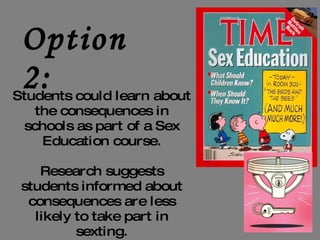
Option 2: Students could learn about the consequences in schools as part of a Sex Education course. Research suggests students informed about consequences are less likely to take part in sexting.
Option 2: Sex Education in School for Students Pros Student will understand the consequences they will  receive if caught sexting.  Sext education, like sex education, would be a casual  discussion lead by trained professionals to share information and tell reported stories of instances where sexting was dangerous. Cons Many schools may feel it is not their responsibility to  educate students about technology not permitted in the school.  Teens could use the information discussed to their advantage, making it easier to get around the laws.
Option 3: The government could pass laws making sexting  a first degree misdemeanor, also  establishing a federal standard.  This would alert children to the consequences  of their actions without having to experience lifelong consequences.
Option 3:  Sexting Delegated to 1 st  Degree Misdemeanor  Rather Than Felony  Pros  No life long consequences with a 1 st  degree misdemeanor, the offense of sexing is not significant enough to merit a felony. (the felony charge comes from it being labeled child pornography)  Offenders still have some legal consequences. 1 st  degree misdemeanor still send the message that sexting is illegal. But the majority of consequences to the individual would be the social consequences not legal ones. Offenders would not have to register as sex offenders. As the law stands, it could stop individuals from getting a job or college scholarships even years later because a felony stays on the individual's record. Cons  Provides a potential loophole for child pornography.  Some may argue a 1 st  degree misdemeanor is not strong enough a consequence to send a message to potential offenders.

Sexting

  • 1.
  • 2.
    Sexting is theact of sending sexually explicit messages or photos electronically, primarily between cell phones. sexting (sěksting) :
  • 3.
  • 4.
    Why? 66% ofteen girls and 60% of teen boys say the most common reason they sext is to be “fun and flirtatious”
  • 5.
    51% of girlssay they were pressured by a boy
  • 6.
    40% of femalessay they have sent pictures as a joke
  • 7.
    52% of teenagegirls say they've sent pictures to their boyfriend as a gift
  • 8.
    Sexting Laws Itis illegal for anyone to knowingly allure or advocate a minor to send a nude or semi-nude photograph of themselves. It is also illegal for anyone to have possession of photographs of minors displaying breasts, buttocks, genitals or minors engaged in sexual acts. Anything that is considered “harmful” to a minor is illegal.
  • 9.
    Currently in Ohio,sexting is considered to be a felony. State legislators are considering legislation to minimize sexting charges from a lifetime listing on a sex-offender registry, to a first degree misdemeanor. Legislation passed by Ohio and Vermont would remove serious legal consequences for teenagers that are involved with sexting. The bill would exempt prosecution for 13-18 year olds that willingly send or receive sext messages.
  • 10.
    -Girls are onlyslightly more likely than boys to send nude photographs, but much more likely to suffer from the emotional effects if the images are spread. -Some of the emotional effects include name calling from peers, humiliation, and verbal harassment, which can lead to depression, dropping out of school, cutting, and possibly suicide. -In many cases, adults, parents, and school administrators do not step in, and instead punish the student who was involved in the sexting, which can increase the emotional effects already caused by it. Emotional Effects
  • 11.
    Hope Witsell, a13 year old girl from Beth Shields Middle School in Hillsborough, Florida, hung herself after nude pictures of her were distributed. Toward the end of the school year, Hope sent a nude picture of herself to a boy that she liked and another girl found it on the boy's phone and forwarded it to other students. The picture eventually began circulating around Beth Shields Middle School and surrounding middle and high schools in the area. Hope suffered from humiliation and verbal harassment at school and began cutting herself. Her depression and embarrassment eventually led her to hang herself in her bedroom. Her suicide is the second in the nation associated with sexting. Hope Witsell
  • 12.
    Jesse Logan, an18 year old girl from Cincinnati, Ohio, hung herself after she sent nude photos to her boyfriend. After they broke up, he sent them to other girls at her high school and they began circulating around the school. She suffered from humiliation and was tortured by the other students at her school, and eventually began skipping school so that she wouldn't have to deal with it. She was punished for skipping school, and her depression caused her to hang herself in her bedroom. Jesse Logan was the first case in the nation of suicide caused by sexting. Jesse Logan
  • 13.
    What to do?Sexting is a new spin on an old problem. The solutions offered under current laws are extreme and can have life long consequences. Technology has amplified this age old problem with teenagers and now there is more potential to abuse than ever before. Cell Phones and the Internet have facilitated the spreading of information. This advance has had both positive and negative affect on our lives. It has made certain facet easier but exposed us to unforeseen dangers and abuse. The current rules and regulations do not address this age old problem among teenagers. Something must be done to stop and/or limit the harm that sexting can cause.
  • 14.
  • 15.
    Option 1: Parentswho are suspicious or certain their child is sexting could block the feature through their cell phone provider. Cell phone providers allow you to block picture messaging without blocking text messaging.
  • 16.
    Option 1: Parents Restrict Feature to Protect Children Pros Children unable to be access to any inappropriate pictures. Reduces cost of phone bill, smaller data plan from the majority of providers. Cons By removing the option the children lack the opportunity to learn to be responsible. Instead of being able to make the right choice through understanding the consequences of their actions children would be denied the choice and thus the opportunity to learn. The child could feel incompetent or inferior to their peers with the ability to send picture messages. Taken to an extreme, the child could feel not loved or trusted by the parent because of the lack of this privilege. Obviously, Children would not be able to receive any pictures. The common practice coupling of picture messaging and data plan by cellphone providers could render the more advanced features of the cellphone or smartphone inert.
  • 17.
    Option 2: Studentscould learn about the consequences in schools as part of a Sex Education course. Research suggests students informed about consequences are less likely to take part in sexting.
  • 18.
    Option 2: SexEducation in School for Students Pros Student will understand the consequences they will receive if caught sexting. Sext education, like sex education, would be a casual discussion lead by trained professionals to share information and tell reported stories of instances where sexting was dangerous. Cons Many schools may feel it is not their responsibility to educate students about technology not permitted in the school. Teens could use the information discussed to their advantage, making it easier to get around the laws.
  • 19.
    Option 3: Thegovernment could pass laws making sexting a first degree misdemeanor, also establishing a federal standard. This would alert children to the consequences of their actions without having to experience lifelong consequences.
  • 20.
    Option 3: Sexting Delegated to 1 st Degree Misdemeanor Rather Than Felony Pros No life long consequences with a 1 st degree misdemeanor, the offense of sexing is not significant enough to merit a felony. (the felony charge comes from it being labeled child pornography) Offenders still have some legal consequences. 1 st degree misdemeanor still send the message that sexting is illegal. But the majority of consequences to the individual would be the social consequences not legal ones. Offenders would not have to register as sex offenders. As the law stands, it could stop individuals from getting a job or college scholarships even years later because a felony stays on the individual's record. Cons Provides a potential loophole for child pornography. Some may argue a 1 st degree misdemeanor is not strong enough a consequence to send a message to potential offenders.