Hartono, S.S., M.Pd.
         College of Languages
Sultan Agung Islamic University
   Ss can understand what formal instruction
    plays in acquisition.
   Ss can understand the effects of learning and
    conscious rules in acquisition.
   Ss can understand the way to present rules
    for learning.
   Ss can understand what to do with errors.
   Grammar teaching or formal
    instruction is defined as the teaching
    of languages with the emphasis on
    focusing the learners‟ attention on
    forms in order that they become
    conscious of the rules of those forms
    and eventually acquire the language.
   Similar terms referring to the same
    meaning are: instruction (Krashen,
    1982), formal instruction (Lighbown
    and Spada, 1990), code-focused
    instruction (Doughty, 1991).
Acquisition
    vs.
 Learning
Conscious learning acts as an editor,
as a Monitor, “correcting” the errors,
or rather what the performer perceives
to be errors, in the output of the
required system.

This can happen before the sentence
is spoken or written.
   Conscious knowledge is therefore, not
    responsible for fluency, it doesn‟t
    initiate utterances.
According to Krashen, learning doesn‟t “turn
into” acquisition, based on the following
reasons:
1. We often see acquisition in cases where
   learning never occurred.
2. We also see learning that never seems to
   become acquisition.
3. The fact that even the best learners master
   only a small subset of the rules of a
   language.
Krashen uses the term „grammar‟ as a synonym
for conscious learning.

According to him, grammar has two possible
roles:
  1. As a monitor:
  2. As a subject matter or for language
     appreciation.
1.   When the monitor is used: when
     the performer has time, as in
     writing and prepared speech,
     and he / she is thinking about
     correctness or focused on forms.
2. What can be monitored: all the
 rules that students can carry
 around in their heads as mental
 baggage and actually use in
 performance.
1.   Monitor Over-user: performers who do
     attempts to think about and utilize
     conscious rules during their production.
2.   Monitor under-user: the performer who
     does all self-correction by „feel‟ and has no
     control of conscious grammar.
3.   Incompetent monitor user: the performer
     who thinks s/he knows the rules but has
     them ( or at least many of them) are wrong.
1.   Deductive – inductive issue
     Deductive: the rules are given
     directly.

     This approach is supported by
     cognitive-code teaching as
     Grammar Translation Method.
Inductive: Learners are asked to
figure out the rules themselves.

The argument for this approach is
“the best way to insure learning
was for the student to work out
the rule himself.
Acquisition:
-   Data first, rule follows
-   Rule is subconscious
-   Focus on meaning
-   Slow process
-   Requires large amount of data
 Inductive   Learning:
 - Data first, rule follows
 - Rule is conscious
 - Focus on form
 - May occur quickly
 - May occur after exposure to small amount
 of data
2.   Sequencing and Learning
     Grammatical sequencing was undesirable
     when the goal is acquisition.

     Sequencing should be based on
     - learnable
     - portable
     - not yet acquired.
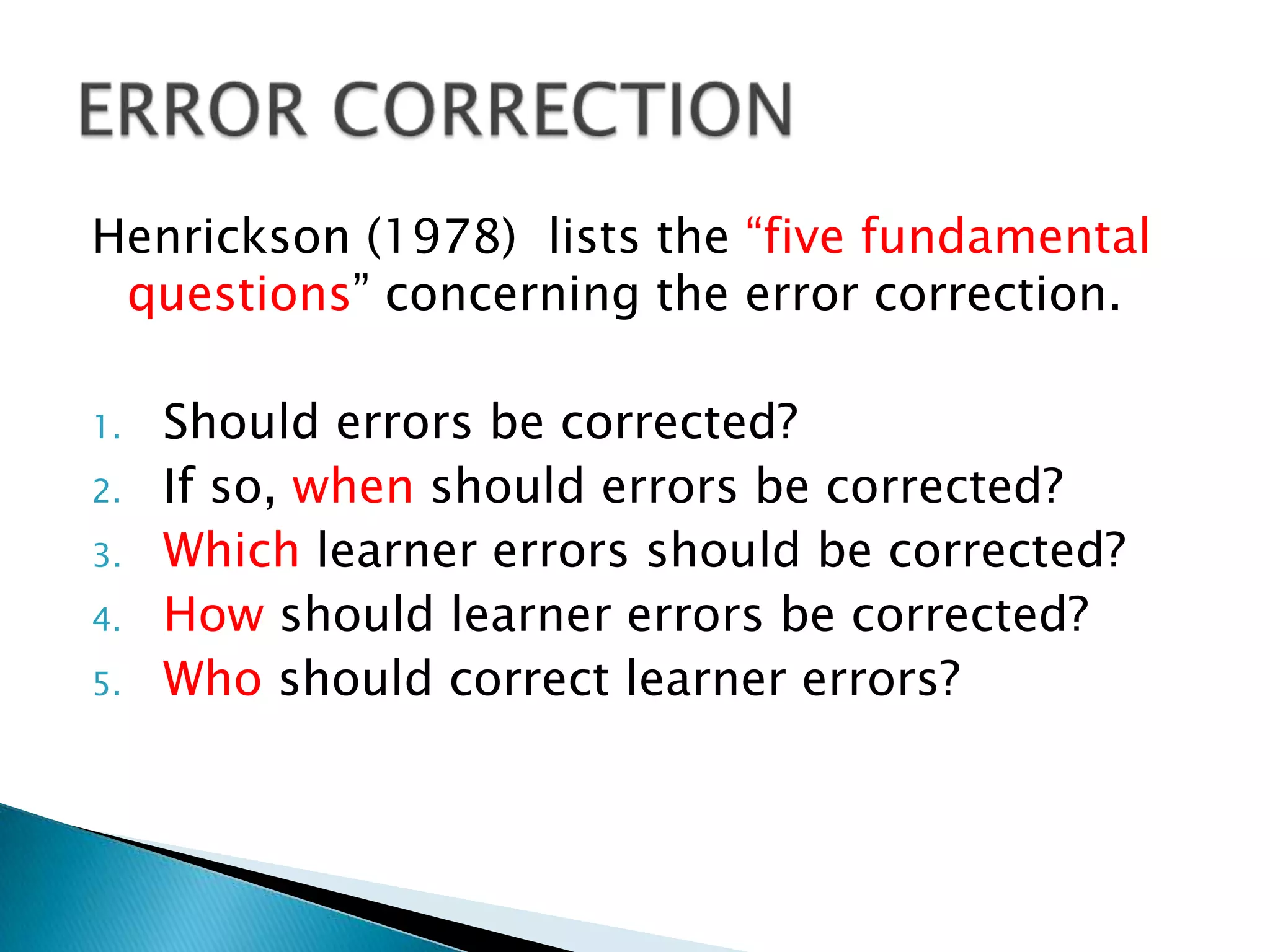
Henrickson (1978) lists the “five fundamental
 questions” concerning the error correction.

1.   Should errors be corrected?
2.   If so, when should errors be corrected?
3.   Which learner errors should be corrected?
4.   How should learner errors be corrected?
5.   Who should correct learner errors?
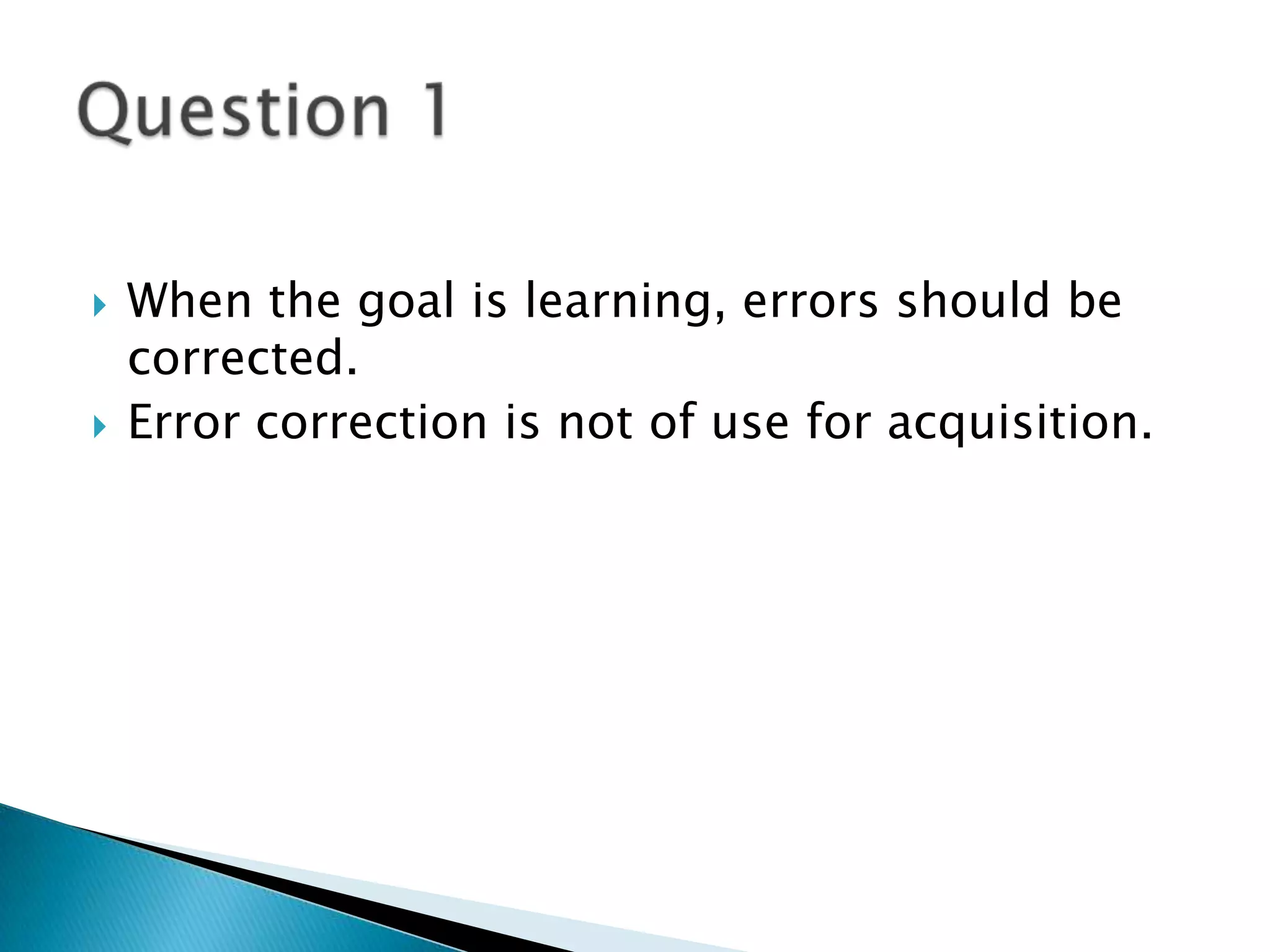
   When the goal is learning, errors should be
    corrected.
   Error correction is not of use for acquisition.
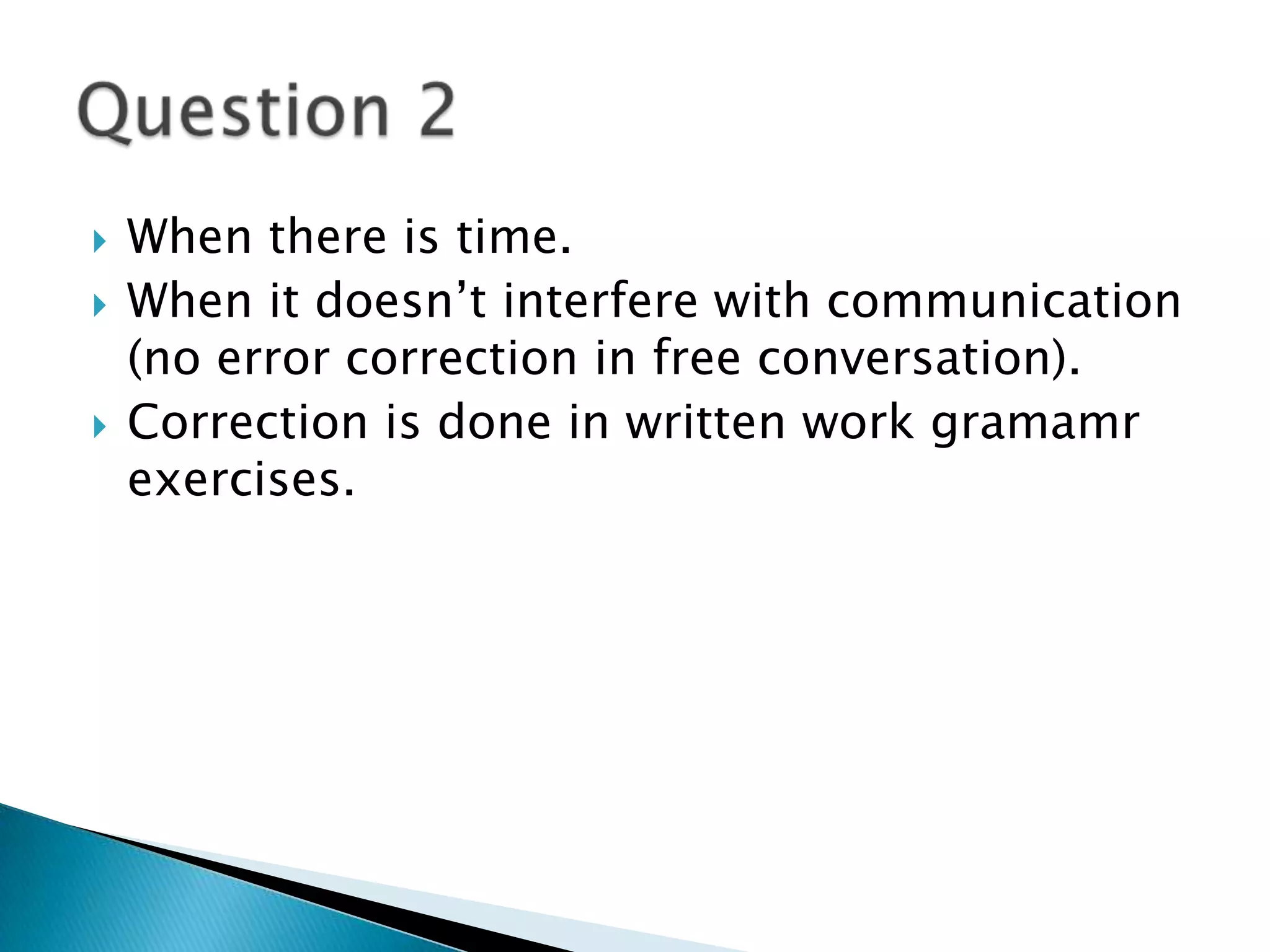
   When there is time.
   When it doesn‟t interfere with communication
    (no error correction in free conversation).
   Correction is done in written work gramamr
    exercises.
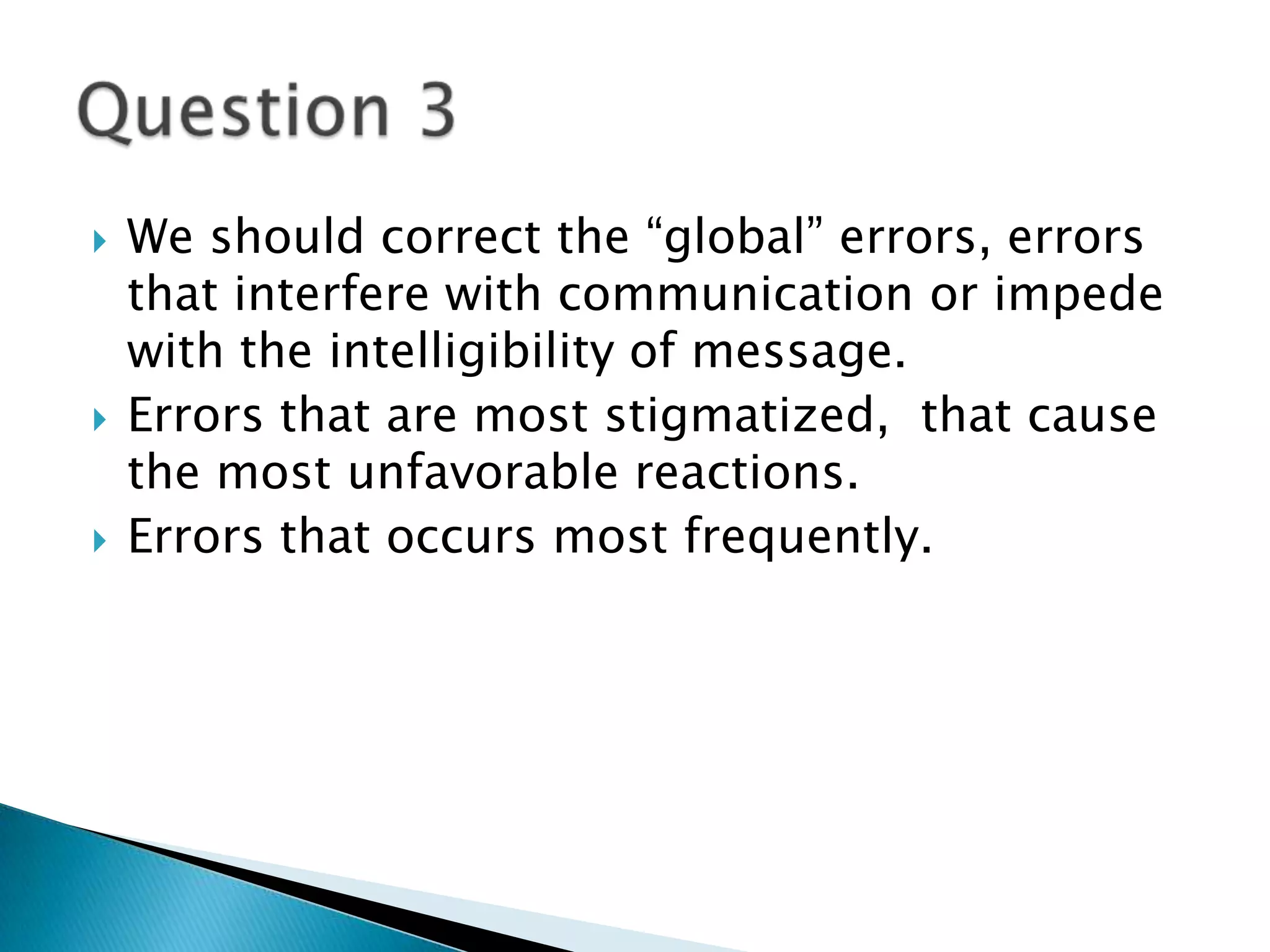
   We should correct the “global” errors, errors
    that interfere with communication or impede
    with the intelligibility of message.
   Errors that are most stigmatized, that cause
    the most unfavorable reactions.
   Errors that occurs most frequently.
   Providing the correct form / direct correction.
   The discovery / inductive approach.

Grammar teaching in sla

  • 1.
    Hartono, S.S., M.Pd. College of Languages Sultan Agung Islamic University
  • 2.
    Ss can understand what formal instruction plays in acquisition.  Ss can understand the effects of learning and conscious rules in acquisition.  Ss can understand the way to present rules for learning.  Ss can understand what to do with errors.
  • 3.
    Grammar teaching or formal instruction is defined as the teaching of languages with the emphasis on focusing the learners‟ attention on forms in order that they become conscious of the rules of those forms and eventually acquire the language.
  • 4.
    Similar terms referring to the same meaning are: instruction (Krashen, 1982), formal instruction (Lighbown and Spada, 1990), code-focused instruction (Doughty, 1991).
  • 5.
    Acquisition vs. Learning
  • 6.
    Conscious learning actsas an editor, as a Monitor, “correcting” the errors, or rather what the performer perceives to be errors, in the output of the required system. This can happen before the sentence is spoken or written.
  • 7.
    Conscious knowledge is therefore, not responsible for fluency, it doesn‟t initiate utterances.
  • 8.
    According to Krashen,learning doesn‟t “turn into” acquisition, based on the following reasons: 1. We often see acquisition in cases where learning never occurred. 2. We also see learning that never seems to become acquisition. 3. The fact that even the best learners master only a small subset of the rules of a language.
  • 9.
    Krashen uses theterm „grammar‟ as a synonym for conscious learning. According to him, grammar has two possible roles: 1. As a monitor: 2. As a subject matter or for language appreciation.
  • 10.
    1. When the monitor is used: when the performer has time, as in writing and prepared speech, and he / she is thinking about correctness or focused on forms.
  • 11.
    2. What canbe monitored: all the rules that students can carry around in their heads as mental baggage and actually use in performance.
  • 12.
    1. Monitor Over-user: performers who do attempts to think about and utilize conscious rules during their production. 2. Monitor under-user: the performer who does all self-correction by „feel‟ and has no control of conscious grammar. 3. Incompetent monitor user: the performer who thinks s/he knows the rules but has them ( or at least many of them) are wrong.
  • 13.
    1. Deductive – inductive issue Deductive: the rules are given directly. This approach is supported by cognitive-code teaching as Grammar Translation Method.
  • 14.
    Inductive: Learners areasked to figure out the rules themselves. The argument for this approach is “the best way to insure learning was for the student to work out the rule himself.
  • 15.
    Acquisition: - Data first, rule follows - Rule is subconscious - Focus on meaning - Slow process - Requires large amount of data
  • 16.
     Inductive Learning: - Data first, rule follows - Rule is conscious - Focus on form - May occur quickly - May occur after exposure to small amount of data
  • 17.
    2. Sequencing and Learning Grammatical sequencing was undesirable when the goal is acquisition. Sequencing should be based on - learnable - portable - not yet acquired.
  • 18.
    Henrickson (1978) liststhe “five fundamental questions” concerning the error correction. 1. Should errors be corrected? 2. If so, when should errors be corrected? 3. Which learner errors should be corrected? 4. How should learner errors be corrected? 5. Who should correct learner errors?
  • 19.
    When the goal is learning, errors should be corrected.  Error correction is not of use for acquisition.
  • 20.
    When there is time.  When it doesn‟t interfere with communication (no error correction in free conversation).  Correction is done in written work gramamr exercises.
  • 21.
    We should correct the “global” errors, errors that interfere with communication or impede with the intelligibility of message.  Errors that are most stigmatized, that cause the most unfavorable reactions.  Errors that occurs most frequently.
  • 22.
    Providing the correct form / direct correction.  The discovery / inductive approach.