Welcome to
Our
presentation
Presented BY
 Md.Muhib-Billah
ID:151-23-4182
Md.Kazi habibur Rahman
151-23-4231
Anfal ahammed jisan
151-23-4261
Properties of Fiber
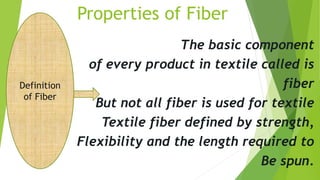
The basic component
of every product in textile called is
fiber
But not all fiber is used for textile
Textile fiber defined by strength,
Flexibility and the length required to
Be spun.
Definition
of Fiber
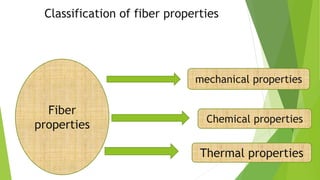
Classification of fiber properties
Fiber
properties
mechanical properties
Chemical properties
Thermal properties
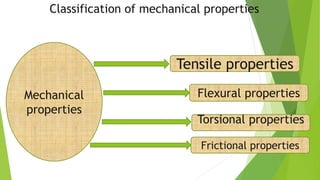
Classification of mechanical properties
Mechanical
properties
Tensile properties
Torsional properties
Frictional properties
Flexural properties
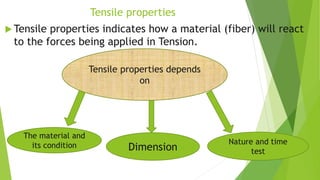
Tensile properties
 Tensile properties indicates how a material (fiber) will react
to the forces being applied in Tension.
Tensile properties depends
on
The material and
its condition Dimension
Nature and time
test
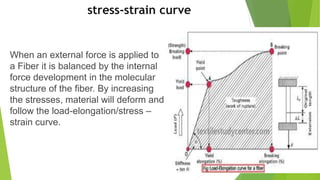
stress-strain curve
When an external force is applied to
a Fiber it is balanced by the internal
force development in the molecular
structure of the fiber. By increasing
the stresses, material will deform and
follow the load-elongation/stress –
strain curve.
Frictional properties
Friction is the force that resists the movement of a surface over
another surface during sliding. When fibres are processed in
textile industry, friction is developed between them. Due to the
friction, the properties shown by textile fibres are called as
frictional properties.
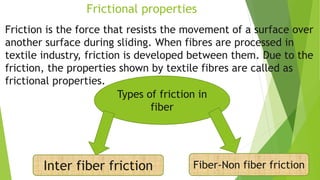
Types of friction in
fiber
Inter fiber friction Fiber-Non fiber friction
Importance of friction in textile
Friction holds the fibre in a sliver and hence material does
not break due to self weight
 Friction helps in twisting during spinning.
 Friction helps in drafting and drawing process.
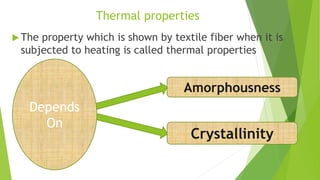
Thermal properties
 The property which is shown by textile fiber when it is
subjected to heating is called thermal properties
Amorphousness
Crystallinity
Depends
On
Continue
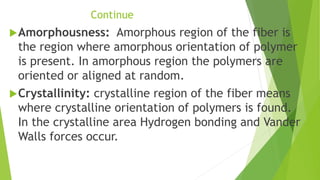
Amorphousness: Amorphous region of the fiber is
the region where amorphous orientation of polymer
is present. In amorphous region the polymers are
oriented or aligned at random.
Crystallinity: crystalline region of the fiber means
where crystalline orientation of polymers is found.
In the crystalline area Hydrogen bonding and Vander
Walls forces occur.
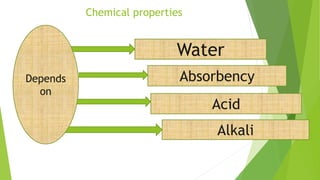
Chemical properties
Water
Absorbency
Acid
Alkali
Depends
on
Chemical properties
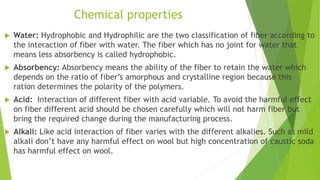
 Water: Hydrophobic and Hydrophilic are the two classification of fiber according to
the interaction of fiber with water. The fiber which has no joint for water that
means less absorbency is called hydrophobic.
 Absorbency: Absorbency means the ability of the fiber to retain the water which
depends on the ratio of fiber’s amorphous and crystalline region because this
ration determines the polarity of the polymers.
 Acid: Interaction of different fiber with acid variable. To avoid the harmful effect
on fiber different acid should be chosen carefully which will not harm fiber but
bring the required change during the manufacturing process.
 Alkali: Like acid interaction of fiber varies with the different alkalies. Such as mild
alkali don’t have any harmful effect on wool but high concentration of caustic soda
has harmful effect on wool.
Thank you

Fiber properties

  • 1.
  • 2.
    Presented BY  Md.Muhib-Billah ID:151-23-4182 Md.Kazihabibur Rahman 151-23-4231 Anfal ahammed jisan 151-23-4261
  • 3.
    Properties of Fiber Thebasic component of every product in textile called is fiber But not all fiber is used for textile Textile fiber defined by strength, Flexibility and the length required to Be spun. Definition of Fiber
  • 4.
    Classification of fiberproperties Fiber properties mechanical properties Chemical properties Thermal properties
  • 5.
    Classification of mechanicalproperties Mechanical properties Tensile properties Torsional properties Frictional properties Flexural properties
  • 6.
    Tensile properties  Tensileproperties indicates how a material (fiber) will react to the forces being applied in Tension. Tensile properties depends on The material and its condition Dimension Nature and time test
  • 7.
    stress-strain curve When anexternal force is applied to a Fiber it is balanced by the internal force development in the molecular structure of the fiber. By increasing the stresses, material will deform and follow the load-elongation/stress – strain curve.
  • 8.
    Frictional properties Friction isthe force that resists the movement of a surface over another surface during sliding. When fibres are processed in textile industry, friction is developed between them. Due to the friction, the properties shown by textile fibres are called as frictional properties. Types of friction in fiber Inter fiber friction Fiber-Non fiber friction
  • 9.
    Importance of frictionin textile Friction holds the fibre in a sliver and hence material does not break due to self weight  Friction helps in twisting during spinning.  Friction helps in drafting and drawing process.
  • 10.
    Thermal properties  Theproperty which is shown by textile fiber when it is subjected to heating is called thermal properties Amorphousness Crystallinity Depends On
  • 11.
    Continue Amorphousness: Amorphous regionof the fiber is the region where amorphous orientation of polymer is present. In amorphous region the polymers are oriented or aligned at random. Crystallinity: crystalline region of the fiber means where crystalline orientation of polymers is found. In the crystalline area Hydrogen bonding and Vander Walls forces occur.
  • 12.
  • 13.
    Chemical properties  Water:Hydrophobic and Hydrophilic are the two classification of fiber according to the interaction of fiber with water. The fiber which has no joint for water that means less absorbency is called hydrophobic.  Absorbency: Absorbency means the ability of the fiber to retain the water which depends on the ratio of fiber’s amorphous and crystalline region because this ration determines the polarity of the polymers.  Acid: Interaction of different fiber with acid variable. To avoid the harmful effect on fiber different acid should be chosen carefully which will not harm fiber but bring the required change during the manufacturing process.  Alkali: Like acid interaction of fiber varies with the different alkalies. Such as mild alkali don’t have any harmful effect on wool but high concentration of caustic soda has harmful effect on wool.
  • 14.