Text Summarization using
Clustering and Submodular
functions.
Introduction
Automatic Summarization of multiple documents into a single summary using
various clustering algorithms and submodular functions.
We use a greedy approach to generate summary.
We calculate ROGUE score for each of the generated summaries by comparing
them with human generated summaries.
Challenges
If we have n sentences then we have a set of 2n
possible candidate summaries.
We can’t follow this exponential approach and need a better approach.
For this we use a greedy approach which has a complexity of O(n2
).
Adding a sentence may increase diversity of the summary but it may decrease
the coverage and vice-versa.
Number of clusters are not defined for clustering algorithms.
Approach
We use a greedy approach and at each iteration we add a sentence to our
candidate summary which has the best score when added to the candidate
summary after previous iteration.
We use various clustering algorithms such as k-means, chinese whispers and
hierarchical clustering.
At each iteration we use submodular functions and calculate score for
coverage(L(S)) and diversity(R(S)) function for each sentence and choose the
sentence with maximum score. We use this formula for scorning : F
(S)=L(S)+λR(S)
Approach
Basic NLP tasks such as tokenization, stemming, removal of stop words are
applied for all the methods.
We calculate score for coverage and diversity functions for a candidate
summary using clusters.
For similarity between sentences we use idf(inverse document frequency) of
each token in sentences and term frequency of tokens in respective sentences.
Using these methods we generate our summary and calculate the ROGUE
score.
Advantages of this approach
Decreases the complexity by a huge amount.
Very efficient and gives a pretty decent ROGUE score.
Helpful in other tasks such as information retrieval and web search.
Dataset and Results
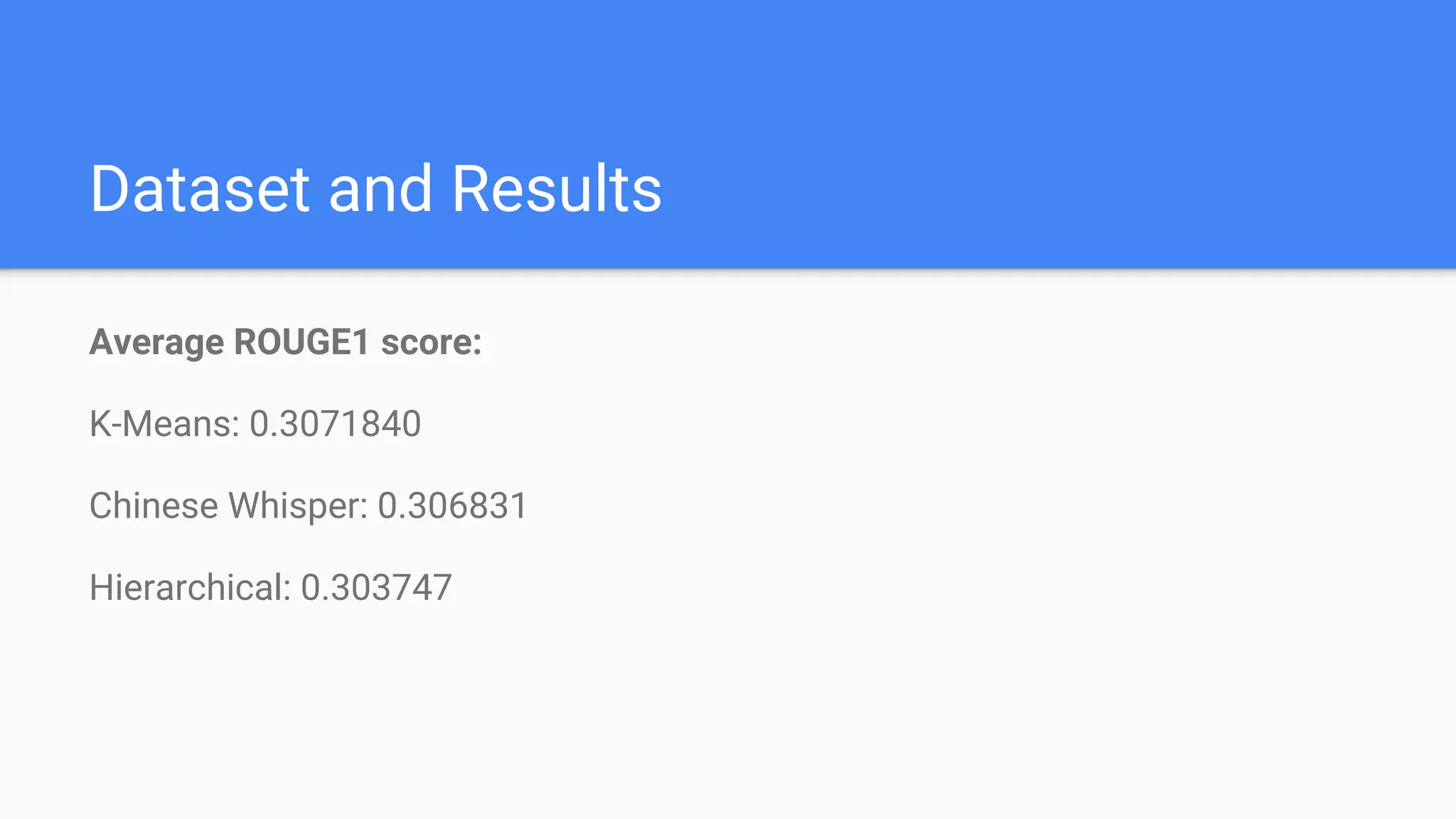
Average ROUGE1 score:
K-Means: 0.3071840
Chinese Whisper: 0.306831
Hierarchical: 0.303747
References
http://melodi.ee.washington.edu/~bilmes/mypubs/lin2011-class-submod-
sum.pdf
http://www.slideshare.net/kareemhashem/text-summarization
https://web.stanford.edu/class/cs345a/slides/12-clustering.pdf
Thanks!
Team-39
Aishwary Gupta (201302216)
B Prabhakar (201505618)
Sahil Swami (201302071)
Youtube

Text Summarization

  • 1.
    Text Summarization using Clusteringand Submodular functions.
  • 2.
    Introduction Automatic Summarization ofmultiple documents into a single summary using various clustering algorithms and submodular functions. We use a greedy approach to generate summary. We calculate ROGUE score for each of the generated summaries by comparing them with human generated summaries.
  • 3.
    Challenges If we haven sentences then we have a set of 2n possible candidate summaries. We can’t follow this exponential approach and need a better approach. For this we use a greedy approach which has a complexity of O(n2 ). Adding a sentence may increase diversity of the summary but it may decrease the coverage and vice-versa. Number of clusters are not defined for clustering algorithms.
  • 4.
    Approach We use agreedy approach and at each iteration we add a sentence to our candidate summary which has the best score when added to the candidate summary after previous iteration. We use various clustering algorithms such as k-means, chinese whispers and hierarchical clustering. At each iteration we use submodular functions and calculate score for coverage(L(S)) and diversity(R(S)) function for each sentence and choose the sentence with maximum score. We use this formula for scorning : F (S)=L(S)+λR(S)
  • 5.
    Approach Basic NLP taskssuch as tokenization, stemming, removal of stop words are applied for all the methods. We calculate score for coverage and diversity functions for a candidate summary using clusters. For similarity between sentences we use idf(inverse document frequency) of each token in sentences and term frequency of tokens in respective sentences. Using these methods we generate our summary and calculate the ROGUE score.
  • 6.
    Advantages of thisapproach Decreases the complexity by a huge amount. Very efficient and gives a pretty decent ROGUE score. Helpful in other tasks such as information retrieval and web search.
  • 7.
    Dataset and Results AverageROUGE1 score: K-Means: 0.3071840 Chinese Whisper: 0.306831 Hierarchical: 0.303747
  • 8.
  • 9.
    Thanks! Team-39 Aishwary Gupta (201302216) BPrabhakar (201505618) Sahil Swami (201302071) Youtube