Tetanus and Tetanus Toxoid Epidemiology and Prevention of Vaccine-Preventable Diseases National Immunization Program Centers for Disease Control and Prevention Revised December 2004
Note to presenters: Images of vaccine-preventable diseases are available from the Immunization Action Coalition website at  http://www.vaccineinformation.org/photos/index.asp
Tetanus First described by Hippocrates Etiology discovered in 1884 by Carle and Rattone Passive immunity used for treatment and prophylaxis during World War I Tetanus toxoid first widely used during World War II
Clostridium tetani Anaerobic gram-positive, spore-forming bacteria Spores found in soil, dust, animal feces; may persist for months to years Multiple toxins produced with growth of bacteria Tetanospasmin estimated human lethal dose = 2.5 ng/kg
Tetanus Pathogenesis Anaerobic conditions allow germination of spores and production of toxins Toxin binds in central nervous system Interferes with neurotransmitter release to block inhibitor impulses Leads to unopposed muscle contraction and spasm
Tetanus Clinical Features Incubation period; 8 days  (range, 3-21 days) Three clinical forms: Local (not common), cephalic (rare), generalized (most common) Generalized tetanus:  descending symptoms of trismus (lockjaw), difficulty swallowing, muscle rigidity, spasms Spasms continue for 3-4 weeks; complete recovery may take months
Neonatal Tetanus Generalized tetanus in newborn infant Infant born without protective passive immunity High fatality rate without therapy Estimated >215,000 deaths worldwide in 1998
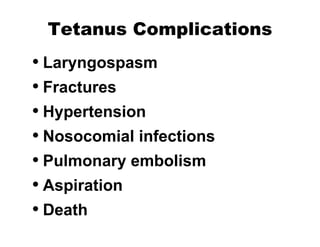
Tetanus Complications Laryngospasm Fractures Hypertension Nosocomial infections Pulmonary embolism Aspiration Death
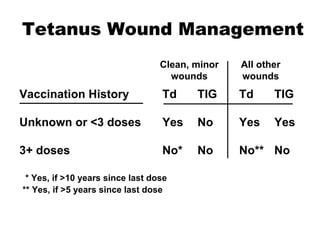
Tetanus Wound Management * Yes, if >10 years since last dose ** Yes, if >5 years since last dose Vaccination History Unknown or <3 doses 3+ doses Td TIG Yes No No* No Td TIG Yes Yes No** No Clean, minor wounds All other wounds
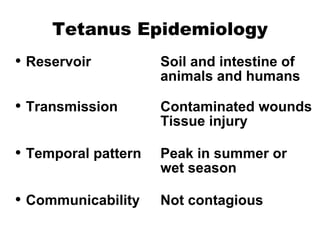
Tetanus Epidemiology Reservoir Soil and intestine of      animals and humans Transmission   Contaminated wounds   Tissue injury Temporal pattern  Peak in summer or wet season Communicability Not contagious
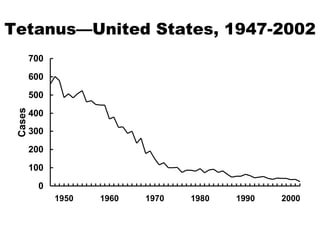
Tetanus—United States, 1947-2002
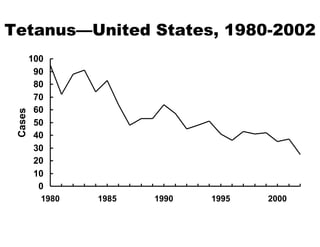
Tetanus—United States, 1980-2002
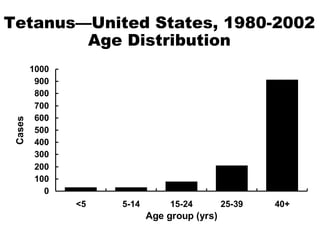
Tetanus—United States, 1980-2002 Age Distribution
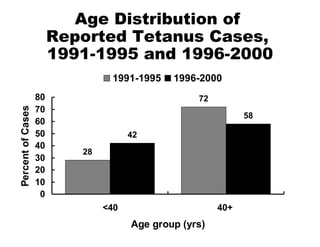
Age Distribution of  Reported Tetanus Cases,  1991-1995 and 1996-2000
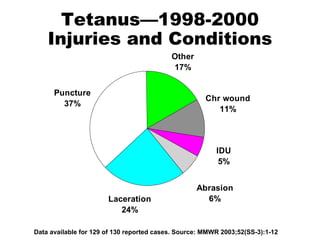
Tetanus—1998-2000 Injuries and Conditions Data available for 129 of 130 reported cases. Source: MMWR 2003;52(SS-3):1-12
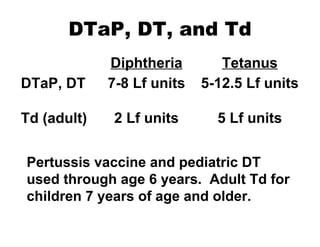
DTaP, DT, and Td DTaP, DT Td (adult) Diphtheria 7-8 Lf units 2 Lf units Tetanus 5-12.5 Lf units 5 Lf units Pertussis vaccine and pediatric DT used through age 6 years.  Adult Td for children 7 years of age and older.
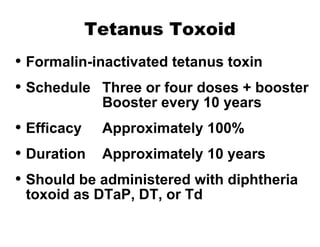
Tetanus Toxoid Formalin-inactivated tetanus toxin Schedule Three or four doses + booster Booster every 10 years Efficacy Approximately 100% Duration Approximately 10 years Should be administered with diphtheria toxoid as DTaP, DT, or Td
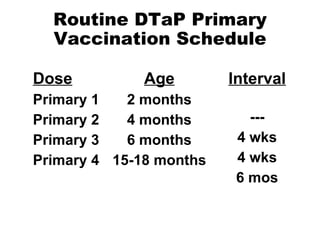
Routine DTaP Primary Vaccination Schedule Dose Primary 1 Primary 2 Primary 3 Primary 4 Age 2 months 4 months 6 months 15-18 months Interval   --- 4 wks 4 wks 6 mos
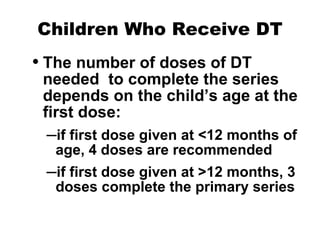
Children Who Receive DT The number of doses of DT needed  to complete the series depends on the child’s age at the first dose: if first dose given at <12 months of age, 4 doses are recommended if first dose given at >12 months, 3 doses complete the primary series
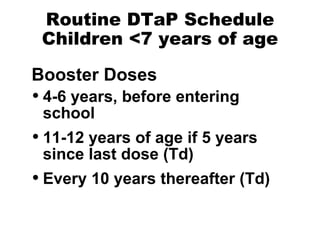
Routine DTaP Schedule Children <7 years of age 4-6 years, before entering school 11-12 years of age if 5 years since last dose (Td) Every 10 years thereafter (Td) Booster Doses
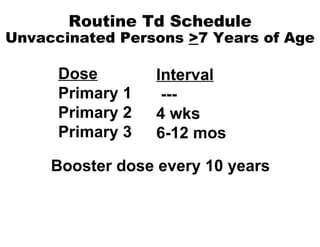
Routine Td Schedule Unvaccinated Persons  > 7 Years of Age Booster dose every 10 years Dose Primary 1 Primary 2 Primary 3 Interval --- 4 wks 6-12 mos
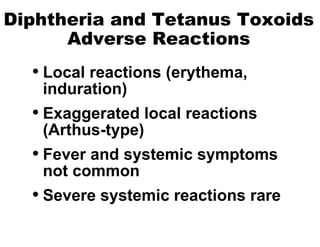
Diphtheria and Tetanus Toxoids Adverse Reactions Local reactions (erythema, induration) Exaggerated local reactions (Arthus-type) Fever and systemic symptoms not common Severe systemic reactions rare
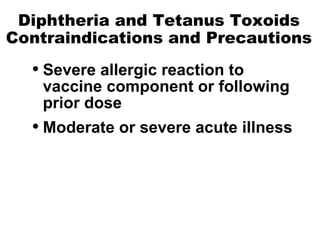
Diphtheria and Tetanus Toxoids Contraindications and Precautions Severe allergic reaction to vaccine component or following prior dose Moderate or severe acute illness
National Immunization Program Hotline 800.232.2522 Email [email_address] Website www.cdc.gov/nip

Tetanus8p

  • 1.
    Tetanus and TetanusToxoid Epidemiology and Prevention of Vaccine-Preventable Diseases National Immunization Program Centers for Disease Control and Prevention Revised December 2004
  • 2.
    Note to presenters:Images of vaccine-preventable diseases are available from the Immunization Action Coalition website at http://www.vaccineinformation.org/photos/index.asp
  • 3.
    Tetanus First describedby Hippocrates Etiology discovered in 1884 by Carle and Rattone Passive immunity used for treatment and prophylaxis during World War I Tetanus toxoid first widely used during World War II
  • 4.
    Clostridium tetani Anaerobicgram-positive, spore-forming bacteria Spores found in soil, dust, animal feces; may persist for months to years Multiple toxins produced with growth of bacteria Tetanospasmin estimated human lethal dose = 2.5 ng/kg
  • 5.
    Tetanus Pathogenesis Anaerobicconditions allow germination of spores and production of toxins Toxin binds in central nervous system Interferes with neurotransmitter release to block inhibitor impulses Leads to unopposed muscle contraction and spasm
  • 6.
    Tetanus Clinical FeaturesIncubation period; 8 days (range, 3-21 days) Three clinical forms: Local (not common), cephalic (rare), generalized (most common) Generalized tetanus: descending symptoms of trismus (lockjaw), difficulty swallowing, muscle rigidity, spasms Spasms continue for 3-4 weeks; complete recovery may take months
  • 7.
    Neonatal Tetanus Generalizedtetanus in newborn infant Infant born without protective passive immunity High fatality rate without therapy Estimated >215,000 deaths worldwide in 1998
  • 8.
    Tetanus Complications LaryngospasmFractures Hypertension Nosocomial infections Pulmonary embolism Aspiration Death
  • 9.
    Tetanus Wound Management* Yes, if >10 years since last dose ** Yes, if >5 years since last dose Vaccination History Unknown or <3 doses 3+ doses Td TIG Yes No No* No Td TIG Yes Yes No** No Clean, minor wounds All other wounds
  • 10.
    Tetanus Epidemiology ReservoirSoil and intestine of animals and humans Transmission Contaminated wounds Tissue injury Temporal pattern Peak in summer or wet season Communicability Not contagious
  • 11.
  • 12.
  • 13.
  • 14.
    Age Distribution of Reported Tetanus Cases, 1991-1995 and 1996-2000
  • 15.
    Tetanus—1998-2000 Injuries andConditions Data available for 129 of 130 reported cases. Source: MMWR 2003;52(SS-3):1-12
  • 16.
    DTaP, DT, andTd DTaP, DT Td (adult) Diphtheria 7-8 Lf units 2 Lf units Tetanus 5-12.5 Lf units 5 Lf units Pertussis vaccine and pediatric DT used through age 6 years. Adult Td for children 7 years of age and older.
  • 17.
    Tetanus Toxoid Formalin-inactivatedtetanus toxin Schedule Three or four doses + booster Booster every 10 years Efficacy Approximately 100% Duration Approximately 10 years Should be administered with diphtheria toxoid as DTaP, DT, or Td
  • 18.
    Routine DTaP PrimaryVaccination Schedule Dose Primary 1 Primary 2 Primary 3 Primary 4 Age 2 months 4 months 6 months 15-18 months Interval --- 4 wks 4 wks 6 mos
  • 19.
    Children Who ReceiveDT The number of doses of DT needed to complete the series depends on the child’s age at the first dose: if first dose given at <12 months of age, 4 doses are recommended if first dose given at >12 months, 3 doses complete the primary series
  • 20.
    Routine DTaP ScheduleChildren <7 years of age 4-6 years, before entering school 11-12 years of age if 5 years since last dose (Td) Every 10 years thereafter (Td) Booster Doses
  • 21.
    Routine Td ScheduleUnvaccinated Persons > 7 Years of Age Booster dose every 10 years Dose Primary 1 Primary 2 Primary 3 Interval --- 4 wks 6-12 mos
  • 22.
    Diphtheria and TetanusToxoids Adverse Reactions Local reactions (erythema, induration) Exaggerated local reactions (Arthus-type) Fever and systemic symptoms not common Severe systemic reactions rare
  • 23.
    Diphtheria and TetanusToxoids Contraindications and Precautions Severe allergic reaction to vaccine component or following prior dose Moderate or severe acute illness
  • 24.
    National Immunization ProgramHotline 800.232.2522 Email [email_address] Website www.cdc.gov/nip

Editor's Notes

  • #15 The age distribution of reported tetanus cases shifted to a younger age group in 1995-1997, due primarily to the contribution cases in California. Many of these cases were young Hispanic men who developed tetanus as a result of injection drug use, particularly heroin.
  • #16 1995-1997 is the most recent summary of tetanus cases reported in the U.S.
  • #20 Recommendation from the 1991 DTP ACIP statement