TETANUS
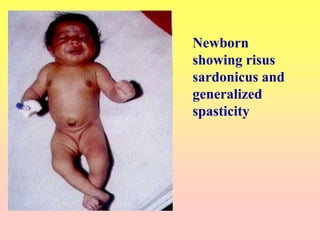
Newborn
showing risus
sardonicus and
generalized
spasticity
Tetanus is an acute,often fatal,disease caused by
an exotoxin produced by the bacterium
Clostridiumtetani. But prevented by immunization
with tetanus toxoid. It is characterized by
generalized rigidity and convulsive spasms of
skeletal muscles.The muscle stiffness usually
involves the jaw (lockjaw)and neck and then
becomes generalized.
Epidemiology
• Tetanus was first described in Egypt over 3000 years ago(Edwin
smith papyrus). It was again described by Hippocrates
•Carle and Rattone in 1884 who first noticed tetanus in animals by
injecting them with pus from a fatal human tetanus case.
•During the same year,Nicolaier produced tetanus in animals by
injecting them with samples of soil.
•In 1889,Kitasato isolated the organism from a human
victim,showed that it produced disease when injected into
animals,and reported that the toxin could be neutralized by specific
antibodies.
•Nocard demonstrated the protective effect of passively transferred
antitoxin,and passive immunization in humans
•Passive immunization and prophylaxis for tetanus during World
War I
•Tetanus Toxoid was first widely used during world war II
• Clostridiumtetani
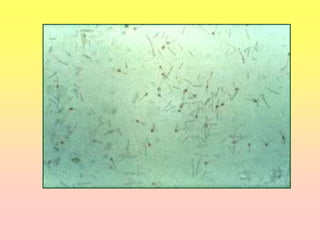
is a slender,gram-positive,anaerobic rod that may develop a
terminal spore,giving it a drumstick appearance.
The organism is sensitive to heat and cannot survive in the
presence of oxygen.The spores,in contrast,are very resistant to
heat and the usual antiseptics.
They can not survive autoclaving at 249.8 °F (121 °C)for 20
minutes.
The spores are also relatively resistant to phenol and other
chemical agents.
The spores are widely distributed in soil and in the intestines and
faeces of horses,sheep,cattle,dogs,cats,rats, guinea pigs,and
chickens.Manure-treated soil may contain large numbers of
spores.Spores may persist for months to years.
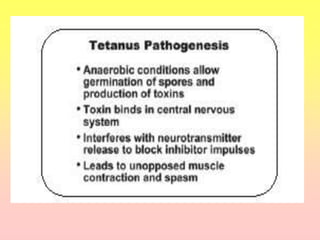
C. tetani produces two exotoxins, tetanolysin and tetanospasmin.
The function of tetanolysin is not known with certainty.
Tetanospasmin is a neurotoxin and causes the clinical
manifestations of tetanus.
Tetanospasmin estimated Human lethal dose 2.5 ng/kg
•Occurrence: Tetanus occurs worldwide but is most frequently
encountered in densely populated regions in hot,damp climates
with soil rich in organic matter.
•Reservoir:Organisms are found primarily in the soil and
intestinal tracts of animals and humans.
•Mode of Transmission:Transmission is primarily by
contaminated wounds,Tissue injury( surgery,burns,deep
puncture wounds,crush wounds,Otitis media ,dental
infection,animal bites, abortion,and pregnancy).
•Communicability
Tetanus is not contagious from person to person.It is the only
vaccine-preventable disease that is infectious but not contagious.
Temporal pattern:Peak in winter and summer season
Incubation Period: 8 DAYS ( 3-21 DAYS)
• Age : it is the disease of active age (5-40 years), New
born baby, female during delivery or abortion
• Sex : Higher incidence in males than females
• Occupation : Agricultural workers are at higher risk
• Rural –Urban difference:Incidence of tetanus is much
lower than in rural areas
• Immunity : Herd immunity does not protect the
individual
• Environmental and social factors: Unhygienic custom
habits,Unhygienic delivery practices
Diagnosis Of Tetanus
Clinically it is confirmed by noticing the
following features:
1. Risus sardonicus or fixed sneer.
2. Lock jaw.
3. Opisthotonos (extension of lower
extremities, flexion of upper extremities
and arching of the back. The examiners
hand can be passed under the back of the
patient when he lies on the bed in supine
position.)
4. Neck rigidity
Type of Tetanus
• Traumatic tetanus
• Puerperal tetanus
• Otogenic tetanus
• Idiopathic tetanus
• Tetanus Neonatorum
•Local tetanus is an uncommon form of the disease,in which
patients have persistent contraction of muscles in the same
anatomic area as the injury. Local tetanus may precede the
onset of generalized tetanus but is generally milder.Only
about 1%of cases are fatal.
•Cephalic tetanus is a rare form of the
disease,occasionally occurring with otitis media (ear
infections)in which C.tetani is present in the flora of the
middle ear,or following injuries to the head.There is
involvement of the cranial nerves,especially in the facial
area.
•The most common type (about 80%)of reported tetanus
is generalized tetanus .The disease usually presents
with a descending pattern.
Three Objectives of Management
of Tetanus
• (1)To provide supportive care until
the tetanospasmin that is fixed in
tissue has been metabolized
• (2)To neutralize circulating toxin
• (3)To remove the source of
tetanospasmin.
The rating scale for the severity and the prognosis of tetanus is described below.
•Score 1 point for each of the following:
•Incubation period less than 7 days
•Period of onset less than 48 hours
•Acquired from burns, surgical wounds, compound fractures, or septic abortion
•Narcotic addiction
•Generalized tetanus
•Temperature greater than 104°F (40°C)
•Tachycardia greater than 120 beats per minute (>150 beats per min in neonates)
•Total score indicates the severity and the prognosis as follows:
•Score of 0-1 indicates mild severity with less than a 10% mortality rate.
•Score of 2-3 indicates moderate severity with a 10-20% mortality rate.
•Score of 4 indicates severe tetanus with a 20-40% mortality rate.
•Score of 5-6 indicates very severe tetanus with greater than a 50% mortality
rate.
PREVENTION
Spores are extremely stable,although
immersion in boiling water for 15 minutes
kills most spores. Exposure to saturated
steam of pressure for 15-20 minutes at
121°c is highly effective against spores .
Sterilization by dry heat is slower than by
moist heat (1 -3 hrs at 160 °C),but it is also
effective against spores. Ethylene oxide
sterilization is also sporocidal.
Fumigation
• Sterilization of operation theatre
• 500 ml of formaline, 200gms of
Pot.permanganate/30 cu.meters of space
• All windows and doors are closed except one
• Fissures between the panels of the doors and
windows are closed with adhesive tape
• After 12 hours the doors and windows are opened
and the theatre is aired for 24 hours before
decommissioning it
TREATMENT AND
PREVENTION
IMMUNIZATIONS
• Active immunization
• Passive Immunization
• Active and passive Immunization
• Antibiotics
• Tetanus toxoid was developed by Descombey in 1924,
• Tetanus toxoid immunizations were used extensively in
the armed services during World War II.
• Tetanus toxoid consists of a formaldehyde-treated toxin.
• There are two types of toxoid available —adsorbed
(aluminum salt precipitated)toxoid and fluid toxoid.
• Although the rates of seroconversion are about
equal,the adsorbed toxoid is preferred because the
antitoxin response reaches higher titers and is longer
lasting than that following the fluid toxoid.
TETANUS TOXOID
Tetanus Toxoid Adsorbed USP,for intramuscular use,is a sterile
suspension of alum-precipitated (aluminum potassium sulfate)toxoid
in an isotonic sodium chloride solution containing sodium phosphate
buffer to control pH.The vaccine,after shaking,is a turbid
liquid,whitish-gray in color.
Clostridium tetani culture is grown in a peptone-based medium and
detoxified with formaldehyde.The detoxified material is then purified
by serial ammonium sulfate fractionation,followed by sterile
filtration,and the toxoid is adsorbed to aluminum potassium sulfate
(alum).The adsorbed toxoid is diluted with physiological saline
solution (0.85%)and thimerosal (a mercury derivative)is added to a
final concentration of 1:10,000.
Each 0.5 mL dose is formulated to contain 5 Lf (flocculation units)of
tetanus toxoid and not more than 0.25 mg of aluminum.
The residual formaldehyde content,by assay,is less than 0.02%.The
tetanus toxoid induces at least 2 units of antitoxin per mL in the guinea
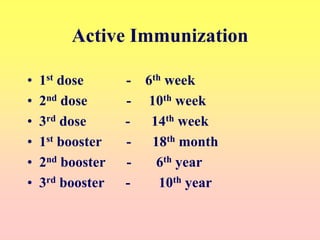
Active Immunization
• 1st dose - 6th week
• 2nd dose - 10th week
• 3rd dose - 14th week
• 1st booster - 18th month
• 2nd booster - 6th year
• 3rd booster - 10th year
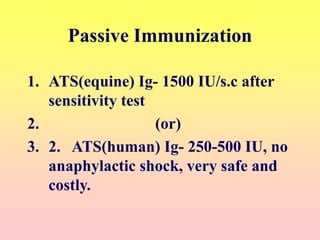
Passive Immunization
1. ATS(equine) Ig- 1500 IU/s.c after
sensitivity test
2. (or)
3. 2. ATS(human) Ig- 250-500 IU, no
anaphylactic shock, very safe and
costly.
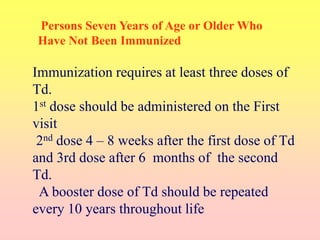
Immunization requires at least three doses of
Td.
1st dose should be administered on the First
visit
2nd dose 4 – 8 weeks after the first dose of Td
and 3rd dose after 6 months of the second
Td.
A booster dose of Td should be repeated
every 10 years throughout life
Persons Seven Years of Age or Older Who
Have Not Been Immunized
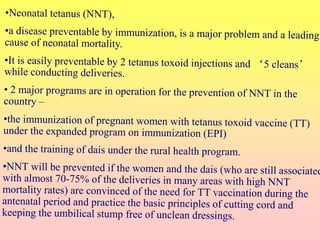
PREVENTION OF NEONATAL
TETANUS
• 2 doses of T.T to all pregnant women between 16
to 36 weeks of pregnancy with an interval of 1 to
2 months between the two doses.
• The first dose as early as possible & the second
dose a month later preferably 3 weeks before
delivery.
• If the pregnant woman is previously immunized, a
booster dose is sufficient.
• If the pregnant woman is not immunized, then the
new born should be protected against tetanus by
giving tetanus human immunoglobulin 750 IU
with in 6 hours of birth.
REFERENCE
• http://www.medindia.net/health_statistics/diseases/tetanusTeta
nus J J Farrara b, L M Yenc, T Cookd, N Fairweathere, N Binhc,
J Parrya b, C M Parrya b
• http://www.who.int/immunization_monitoring/diseases/Tetan
us_map_cases.jpg
• Txt book of preventive and social medicine 18 th edition by
K.PARK
• Text book of community medicine by T. Bhaskar Rao
• Management and Prevention of Tetanus
• Richard F.Edlich,MD PhD,?Lisa G..Hill,?Chandra A..Mahler,
툺ary Jude Cox,MD,?Daniel G..Becker MD,?Jed
H..Horowitz,MD 4 Larry S.Nichter MD MS,4 Marcus
L.Martin,MD 5 &William C.Lineweaver MD6
. www.rxlist.com/cgi/generic/tettoxpi.htm - 22k
. Manson’s Tropical diseases 21 st edition
THANK YOU

24031.ppt

  • 1.
  • 4.
  • 5.
    Tetanus is anacute,often fatal,disease caused by an exotoxin produced by the bacterium Clostridiumtetani. But prevented by immunization with tetanus toxoid. It is characterized by generalized rigidity and convulsive spasms of skeletal muscles.The muscle stiffness usually involves the jaw (lockjaw)and neck and then becomes generalized.
  • 6.
  • 7.
    • Tetanus wasfirst described in Egypt over 3000 years ago(Edwin smith papyrus). It was again described by Hippocrates •Carle and Rattone in 1884 who first noticed tetanus in animals by injecting them with pus from a fatal human tetanus case. •During the same year,Nicolaier produced tetanus in animals by injecting them with samples of soil. •In 1889,Kitasato isolated the organism from a human victim,showed that it produced disease when injected into animals,and reported that the toxin could be neutralized by specific antibodies. •Nocard demonstrated the protective effect of passively transferred antitoxin,and passive immunization in humans •Passive immunization and prophylaxis for tetanus during World War I •Tetanus Toxoid was first widely used during world war II
  • 9.
    • Clostridiumtetani is aslender,gram-positive,anaerobic rod that may develop a terminal spore,giving it a drumstick appearance. The organism is sensitive to heat and cannot survive in the presence of oxygen.The spores,in contrast,are very resistant to heat and the usual antiseptics. They can not survive autoclaving at 249.8 °F (121 °C)for 20 minutes. The spores are also relatively resistant to phenol and other chemical agents. The spores are widely distributed in soil and in the intestines and faeces of horses,sheep,cattle,dogs,cats,rats, guinea pigs,and chickens.Manure-treated soil may contain large numbers of spores.Spores may persist for months to years. C. tetani produces two exotoxins, tetanolysin and tetanospasmin. The function of tetanolysin is not known with certainty. Tetanospasmin is a neurotoxin and causes the clinical manifestations of tetanus. Tetanospasmin estimated Human lethal dose 2.5 ng/kg
  • 10.
    •Occurrence: Tetanus occursworldwide but is most frequently encountered in densely populated regions in hot,damp climates with soil rich in organic matter. •Reservoir:Organisms are found primarily in the soil and intestinal tracts of animals and humans. •Mode of Transmission:Transmission is primarily by contaminated wounds,Tissue injury( surgery,burns,deep puncture wounds,crush wounds,Otitis media ,dental infection,animal bites, abortion,and pregnancy). •Communicability Tetanus is not contagious from person to person.It is the only vaccine-preventable disease that is infectious but not contagious. Temporal pattern:Peak in winter and summer season Incubation Period: 8 DAYS ( 3-21 DAYS)
  • 11.
    • Age :it is the disease of active age (5-40 years), New born baby, female during delivery or abortion • Sex : Higher incidence in males than females • Occupation : Agricultural workers are at higher risk • Rural –Urban difference:Incidence of tetanus is much lower than in rural areas • Immunity : Herd immunity does not protect the individual • Environmental and social factors: Unhygienic custom habits,Unhygienic delivery practices
  • 13.
    Diagnosis Of Tetanus Clinicallyit is confirmed by noticing the following features: 1. Risus sardonicus or fixed sneer. 2. Lock jaw. 3. Opisthotonos (extension of lower extremities, flexion of upper extremities and arching of the back. The examiners hand can be passed under the back of the patient when he lies on the bed in supine position.) 4. Neck rigidity
  • 14.
    Type of Tetanus •Traumatic tetanus • Puerperal tetanus • Otogenic tetanus • Idiopathic tetanus • Tetanus Neonatorum
  • 15.
    •Local tetanus isan uncommon form of the disease,in which patients have persistent contraction of muscles in the same anatomic area as the injury. Local tetanus may precede the onset of generalized tetanus but is generally milder.Only about 1%of cases are fatal. •Cephalic tetanus is a rare form of the disease,occasionally occurring with otitis media (ear infections)in which C.tetani is present in the flora of the middle ear,or following injuries to the head.There is involvement of the cranial nerves,especially in the facial area. •The most common type (about 80%)of reported tetanus is generalized tetanus .The disease usually presents with a descending pattern.
  • 16.
    Three Objectives ofManagement of Tetanus • (1)To provide supportive care until the tetanospasmin that is fixed in tissue has been metabolized • (2)To neutralize circulating toxin • (3)To remove the source of tetanospasmin.
  • 17.
    The rating scalefor the severity and the prognosis of tetanus is described below. •Score 1 point for each of the following: •Incubation period less than 7 days •Period of onset less than 48 hours •Acquired from burns, surgical wounds, compound fractures, or septic abortion •Narcotic addiction •Generalized tetanus •Temperature greater than 104°F (40°C) •Tachycardia greater than 120 beats per minute (>150 beats per min in neonates) •Total score indicates the severity and the prognosis as follows: •Score of 0-1 indicates mild severity with less than a 10% mortality rate. •Score of 2-3 indicates moderate severity with a 10-20% mortality rate. •Score of 4 indicates severe tetanus with a 20-40% mortality rate. •Score of 5-6 indicates very severe tetanus with greater than a 50% mortality rate.
  • 18.
  • 19.
    Spores are extremelystable,although immersion in boiling water for 15 minutes kills most spores. Exposure to saturated steam of pressure for 15-20 minutes at 121°c is highly effective against spores . Sterilization by dry heat is slower than by moist heat (1 -3 hrs at 160 °C),but it is also effective against spores. Ethylene oxide sterilization is also sporocidal.
  • 20.
    Fumigation • Sterilization ofoperation theatre • 500 ml of formaline, 200gms of Pot.permanganate/30 cu.meters of space • All windows and doors are closed except one • Fissures between the panels of the doors and windows are closed with adhesive tape • After 12 hours the doors and windows are opened and the theatre is aired for 24 hours before decommissioning it
  • 21.
  • 22.
    IMMUNIZATIONS • Active immunization •Passive Immunization • Active and passive Immunization • Antibiotics
  • 23.
    • Tetanus toxoidwas developed by Descombey in 1924, • Tetanus toxoid immunizations were used extensively in the armed services during World War II. • Tetanus toxoid consists of a formaldehyde-treated toxin. • There are two types of toxoid available —adsorbed (aluminum salt precipitated)toxoid and fluid toxoid. • Although the rates of seroconversion are about equal,the adsorbed toxoid is preferred because the antitoxin response reaches higher titers and is longer lasting than that following the fluid toxoid. TETANUS TOXOID
  • 24.
    Tetanus Toxoid AdsorbedUSP,for intramuscular use,is a sterile suspension of alum-precipitated (aluminum potassium sulfate)toxoid in an isotonic sodium chloride solution containing sodium phosphate buffer to control pH.The vaccine,after shaking,is a turbid liquid,whitish-gray in color. Clostridium tetani culture is grown in a peptone-based medium and detoxified with formaldehyde.The detoxified material is then purified by serial ammonium sulfate fractionation,followed by sterile filtration,and the toxoid is adsorbed to aluminum potassium sulfate (alum).The adsorbed toxoid is diluted with physiological saline solution (0.85%)and thimerosal (a mercury derivative)is added to a final concentration of 1:10,000. Each 0.5 mL dose is formulated to contain 5 Lf (flocculation units)of tetanus toxoid and not more than 0.25 mg of aluminum. The residual formaldehyde content,by assay,is less than 0.02%.The tetanus toxoid induces at least 2 units of antitoxin per mL in the guinea
  • 25.
    Active Immunization • 1stdose - 6th week • 2nd dose - 10th week • 3rd dose - 14th week • 1st booster - 18th month • 2nd booster - 6th year • 3rd booster - 10th year
  • 26.
    Passive Immunization 1. ATS(equine)Ig- 1500 IU/s.c after sensitivity test 2. (or) 3. 2. ATS(human) Ig- 250-500 IU, no anaphylactic shock, very safe and costly.
  • 27.
    Immunization requires atleast three doses of Td. 1st dose should be administered on the First visit 2nd dose 4 – 8 weeks after the first dose of Td and 3rd dose after 6 months of the second Td. A booster dose of Td should be repeated every 10 years throughout life Persons Seven Years of Age or Older Who Have Not Been Immunized
  • 31.
    PREVENTION OF NEONATAL TETANUS •2 doses of T.T to all pregnant women between 16 to 36 weeks of pregnancy with an interval of 1 to 2 months between the two doses. • The first dose as early as possible & the second dose a month later preferably 3 weeks before delivery. • If the pregnant woman is previously immunized, a booster dose is sufficient. • If the pregnant woman is not immunized, then the new born should be protected against tetanus by giving tetanus human immunoglobulin 750 IU with in 6 hours of birth.
  • 32.
    REFERENCE • http://www.medindia.net/health_statistics/diseases/tetanusTeta nus JJ Farrara b, L M Yenc, T Cookd, N Fairweathere, N Binhc, J Parrya b, C M Parrya b • http://www.who.int/immunization_monitoring/diseases/Tetan us_map_cases.jpg • Txt book of preventive and social medicine 18 th edition by K.PARK • Text book of community medicine by T. Bhaskar Rao • Management and Prevention of Tetanus • Richard F.Edlich,MD PhD,?Lisa G..Hill,?Chandra A..Mahler, 툺ary Jude Cox,MD,?Daniel G..Becker MD,?Jed H..Horowitz,MD 4 Larry S.Nichter MD MS,4 Marcus L.Martin,MD 5 &William C.Lineweaver MD6 . www.rxlist.com/cgi/generic/tettoxpi.htm - 22k . Manson’s Tropical diseases 21 st edition
  • 33.