TESTING
&
ASSESMENT
BY M A R C I A C H O C
I N T R U D U C T I O N
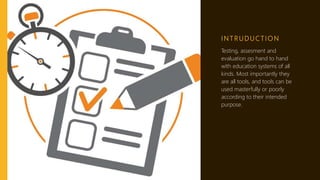
Testing, assesment and
evaluation go hand to hand
with education systems of all
kinds. Most importantly they
are all tools, and tools can be
used masterfully or poorly
according to their intended
purpose.
KEY WORDS
• Testing is a general term that refers to any activity or document used to measure
something in a educational setting.
• Assesment refers to the measuring of student abilities formal or informal. It provides
feedback on how effectivily students are learning and may offer insight on how to
improve learning process
• Evaluation is used to judge students abilities, often at the end of a course or program.
The primary purpose is to assign a score or grade to students work.
COMMON TEST FOR
PRIMARY STUDENTS
P L A C E M E N T, D I A G N O S T I C A N D P R O G R E S S
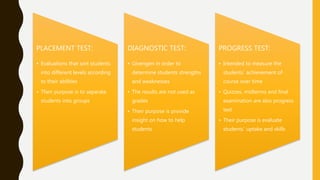
PLACEMENT TEST:
• Evaluations that sort students
into different levels according
to their abilities
• Their purpose is to separate
students into groups
DIAGNOSTIC TEST:
• Givengen in order to
determine students strengths
and weaknesses
• The results are not used as
grades
• Their purpose is provide
insight on how to help
students
PROGRESS TEST:
• Intended to measure the
students´ achievement of
course over time
• Quizzes, midterms and final
examination are also progress
test
• Their purpose is evaluate
students´ uptake and skills
CHARACTERISTICS
OF A GOOD TEST
C O N S T R U C T VA L I D I T Y, FA C E VA L I D I T Y
R E L I A B I L I T Y A N D P R A C T I C A L I T Y
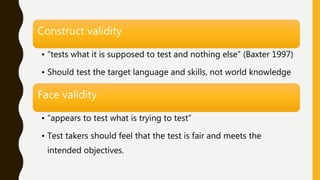
Construct validity
• “tests what it is supposed to test and nothing else” (Baxter 1997)
• Should test the target language and skills, not world knowledge
Face validity
• “appears to test what is trying to test”
• Test takers should feel that the test is fair and meets the
intended objectives.
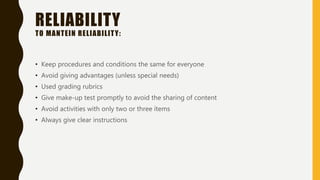
RELIABILITY
TO MANTEIN RELIABILITY:
• Keep procedures and conditions the same for everyone
• Avoid giving advantages (unless special needs)
• Used grading rubrics
• Give make-up test promptly to avoid the sharing of content
• Avoid activities with only two or three ítems
• Always give clear instructions
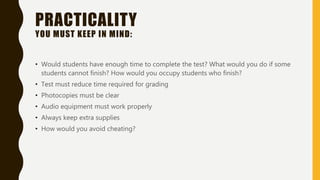
PRACTICALITY
YOU MUST KEEP IN MIND:
• Would students have enough time to complete the test? What would you do if some
students cannot finish? How would you occupy students who finish?
• Test must reduce time required for grading
• Photocopies must be clear
• Audio equipment must work properly
• Always keep extra supplies
• How would you avoid cheating?
EXAMPLES OF
TESTS
- - - - - - - - - - - - - - - - - - - - - - - - - - - - - - - - - - - - - - - - - -
- - - - - - -
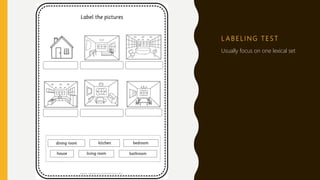
L A B E L I N G T E S T
Usually focus on one lexical set
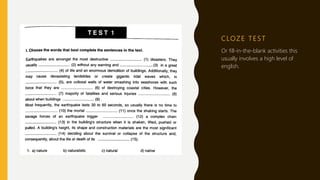
C LOZ E T E S T
Or fill-in-the-blank activities this
usually involves a high level of
english.
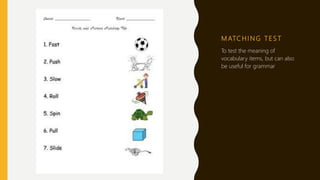
M ATC H I N G T E S T
To test the meaning of
vocabulary items, but can also
be useful for grammar
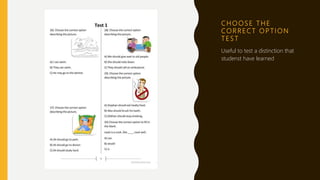
C H O O S E T H E
CO R R E C T O P T I O N
T E S T
Useful to test a distinction that
studenst have learned
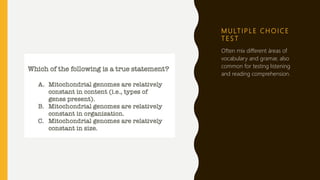
M U LT I P L E C H O I C E
T E S T
Often mix different áreas of
vocabulary and gramar, also
common for testing listening
and reading comprehension.
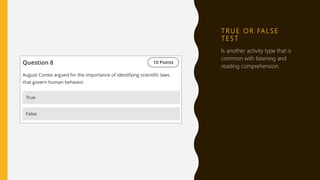
T R U E O R FA L S E
T E S T
Is another activity type that is
common with listening and
reading comprehension.
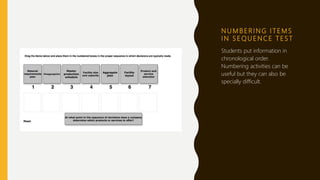
N U M B E R I N G I T E M S
I N S E Q U E N C E T E S T
Students put information in
chronological order.
Numbering activities can be
useful but they can also be
specially difficult.
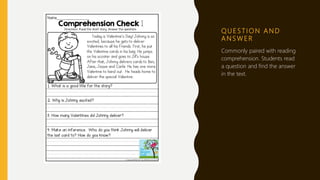
Q U E S T I O N A N D
A N S W E R
Commonly paired with reading
comprehension. Students read
a question and find the answer
in the text.
S E N T E N C E W R I T I N G
/ CO M P L E T I O N
They can describe a picture
using a specific structure or
build a sentece based on the
subject and the base form of
the verb.
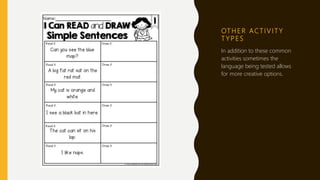
OT H E R AC T I V I T Y
T Y P E S
In addition to these common
activities sometimes the
language being tested allows
for more creative options.

Testing and assesment

  • 1.
  • 2.
    I N TR U D U C T I O N Testing, assesment and evaluation go hand to hand with education systems of all kinds. Most importantly they are all tools, and tools can be used masterfully or poorly according to their intended purpose.
  • 3.
    KEY WORDS • Testingis a general term that refers to any activity or document used to measure something in a educational setting. • Assesment refers to the measuring of student abilities formal or informal. It provides feedback on how effectivily students are learning and may offer insight on how to improve learning process • Evaluation is used to judge students abilities, often at the end of a course or program. The primary purpose is to assign a score or grade to students work.
  • 4.
    COMMON TEST FOR PRIMARYSTUDENTS P L A C E M E N T, D I A G N O S T I C A N D P R O G R E S S
  • 5.
    PLACEMENT TEST: • Evaluationsthat sort students into different levels according to their abilities • Their purpose is to separate students into groups DIAGNOSTIC TEST: • Givengen in order to determine students strengths and weaknesses • The results are not used as grades • Their purpose is provide insight on how to help students PROGRESS TEST: • Intended to measure the students´ achievement of course over time • Quizzes, midterms and final examination are also progress test • Their purpose is evaluate students´ uptake and skills
  • 6.
    CHARACTERISTICS OF A GOODTEST C O N S T R U C T VA L I D I T Y, FA C E VA L I D I T Y R E L I A B I L I T Y A N D P R A C T I C A L I T Y
  • 7.
    Construct validity • “testswhat it is supposed to test and nothing else” (Baxter 1997) • Should test the target language and skills, not world knowledge Face validity • “appears to test what is trying to test” • Test takers should feel that the test is fair and meets the intended objectives.
  • 8.
    RELIABILITY TO MANTEIN RELIABILITY: •Keep procedures and conditions the same for everyone • Avoid giving advantages (unless special needs) • Used grading rubrics • Give make-up test promptly to avoid the sharing of content • Avoid activities with only two or three ítems • Always give clear instructions
  • 9.
    PRACTICALITY YOU MUST KEEPIN MIND: • Would students have enough time to complete the test? What would you do if some students cannot finish? How would you occupy students who finish? • Test must reduce time required for grading • Photocopies must be clear • Audio equipment must work properly • Always keep extra supplies • How would you avoid cheating?
  • 10.
    EXAMPLES OF TESTS - -- - - - - - - - - - - - - - - - - - - - - - - - - - - - - - - - - - - - - - - - - - - - - - -
  • 11.
    L A BE L I N G T E S T Usually focus on one lexical set
  • 12.
    C LOZ ET E S T Or fill-in-the-blank activities this usually involves a high level of english.
  • 13.
    M ATC HI N G T E S T To test the meaning of vocabulary items, but can also be useful for grammar
  • 14.
    C H OO S E T H E CO R R E C T O P T I O N T E S T Useful to test a distinction that studenst have learned
  • 15.
    M U LTI P L E C H O I C E T E S T Often mix different áreas of vocabulary and gramar, also common for testing listening and reading comprehension.
  • 16.
    T R UE O R FA L S E T E S T Is another activity type that is common with listening and reading comprehension.
  • 17.
    N U MB E R I N G I T E M S I N S E Q U E N C E T E S T Students put information in chronological order. Numbering activities can be useful but they can also be specially difficult.
  • 18.
    Q U ES T I O N A N D A N S W E R Commonly paired with reading comprehension. Students read a question and find the answer in the text.
  • 19.
    S E NT E N C E W R I T I N G / CO M P L E T I O N They can describe a picture using a specific structure or build a sentece based on the subject and the base form of the verb.
  • 20.
    OT H ER AC T I V I T Y T Y P E S In addition to these common activities sometimes the language being tested allows for more creative options.