Principles of Language Assessment:
Test Usefulness
Course: Testing
Bachman &
Palmer, Ch. 2
The most important quality of a test is its usefu
But,
-What makes a test useful ?
- How do we know a test will be useful before we
- Or it has been useful after we have used it ?
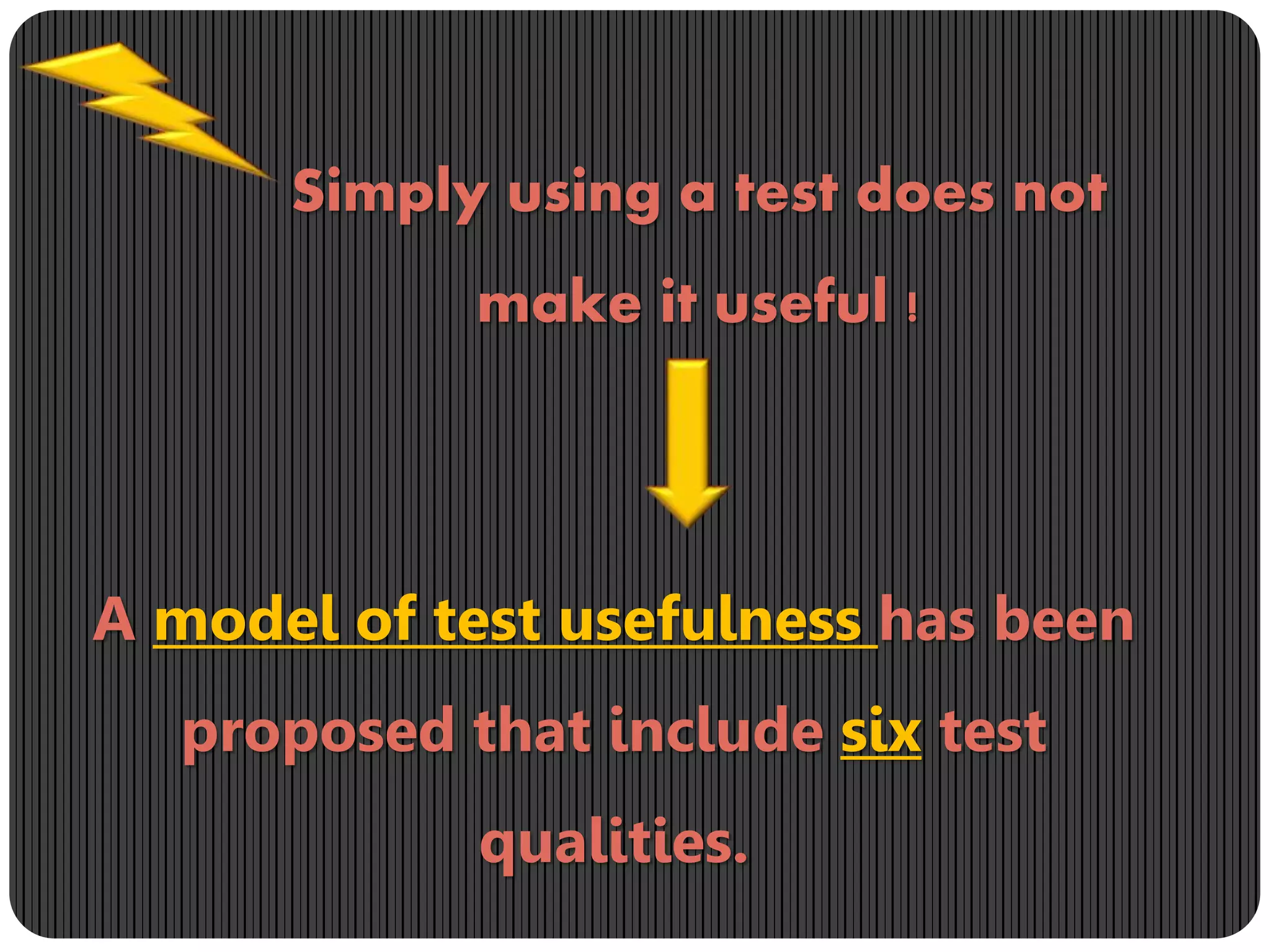
Simply using a test does not
make it useful !
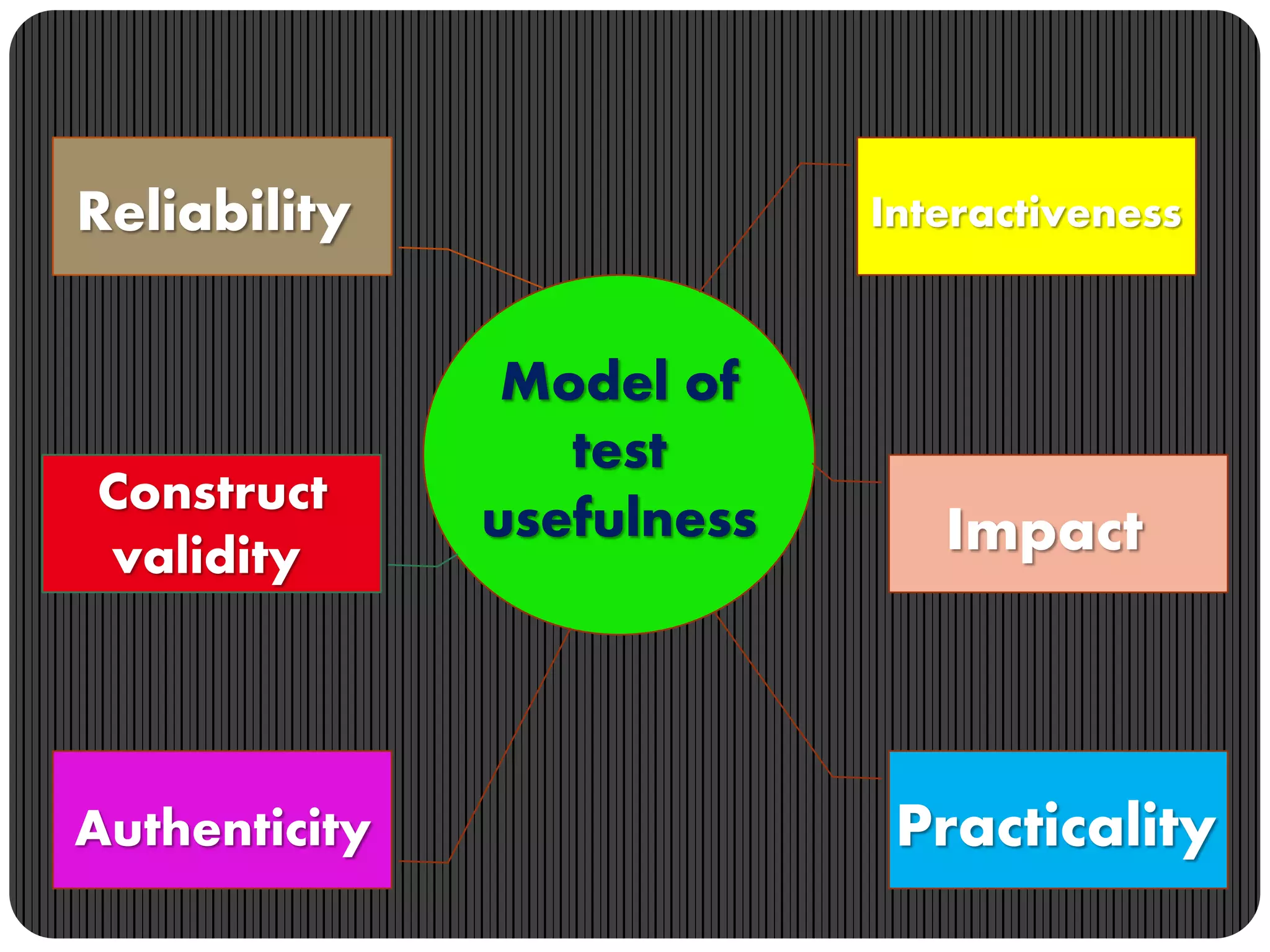
A model of test usefulness has been
proposed that include six test
qualities.
Model of
test
usefulness
Reliability
Construct
validity
Authenticity
Interactiveness
Impact
Practicality
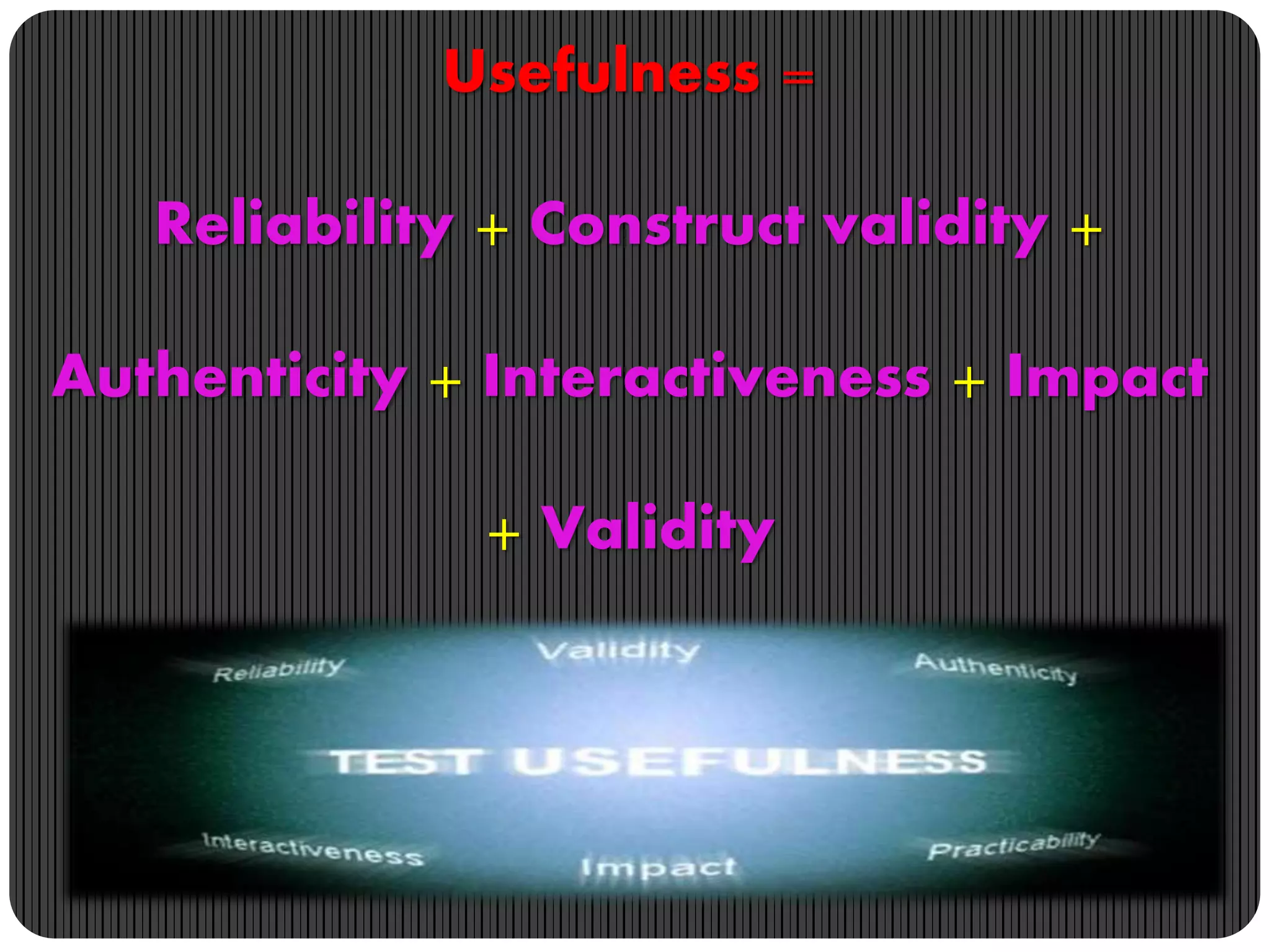
Usefulness =
Reliability + Construct validity +
Authenticity + Interactiveness + Impact
+ Validity
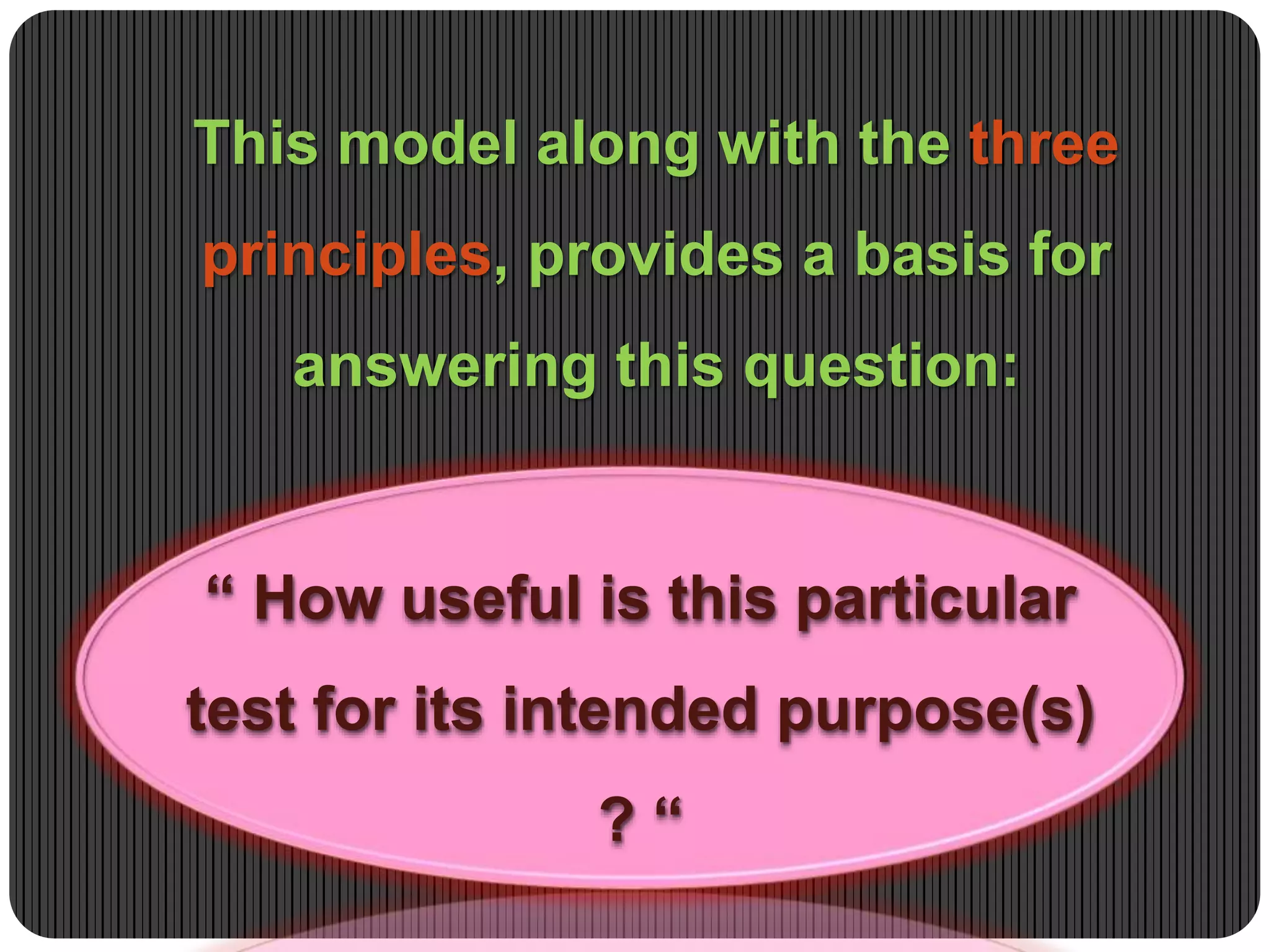
This model along with the three
principles, provides a basis for
answering this question:
“ How useful is this particular
test for its intended purpose(s)
? “
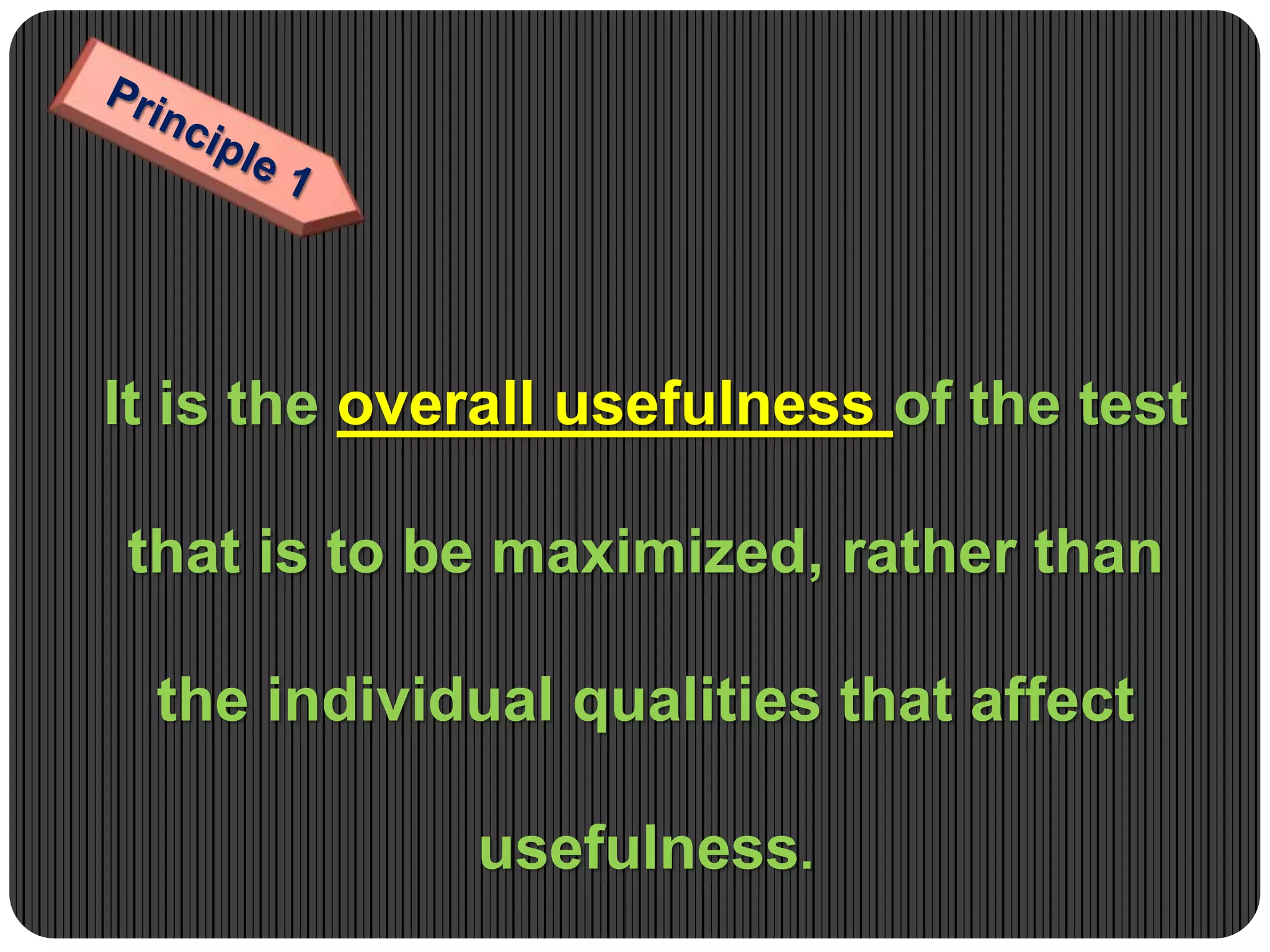
It is the overall usefulness of the test
that is to be maximized, rather than
the individual qualities that affect
usefulness.
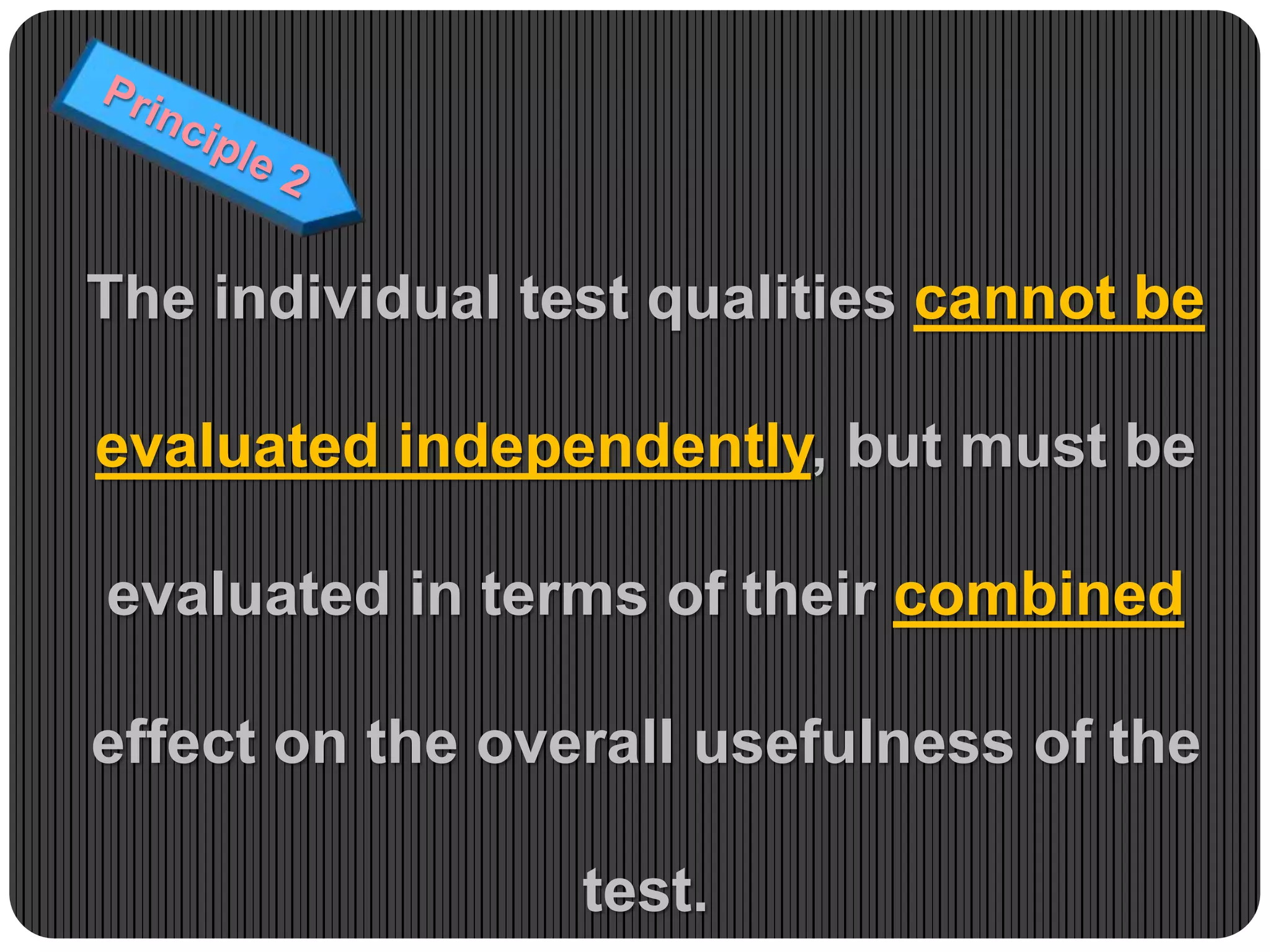
The individual test qualities cannot be
evaluated independently, but must be
evaluated in terms of their combined
effect on the overall usefulness of the
test.
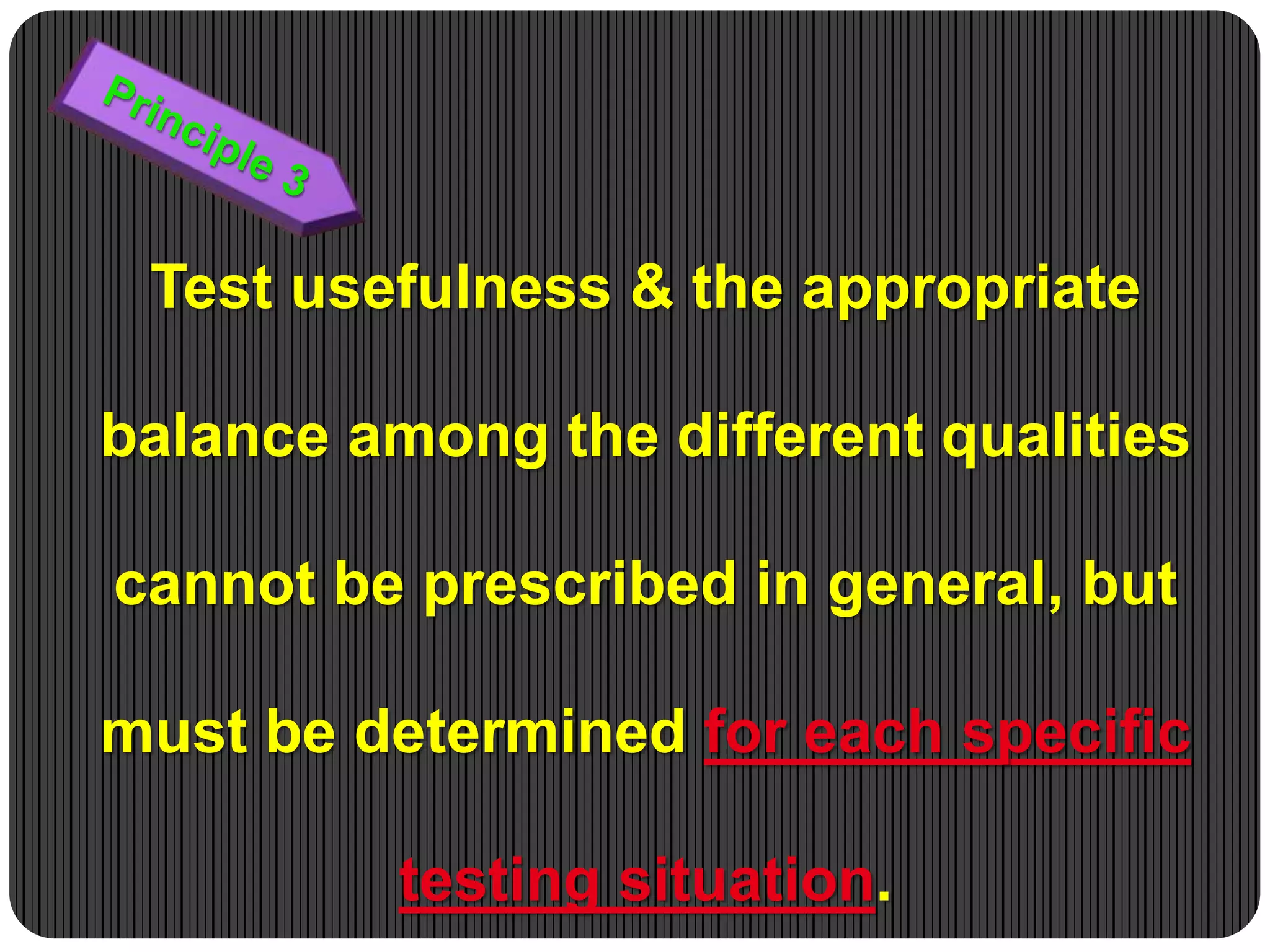
Test usefulness & the appropriate
balance among the different qualities
cannot be prescribed in general, but
must be determined for each specific
testing situation.
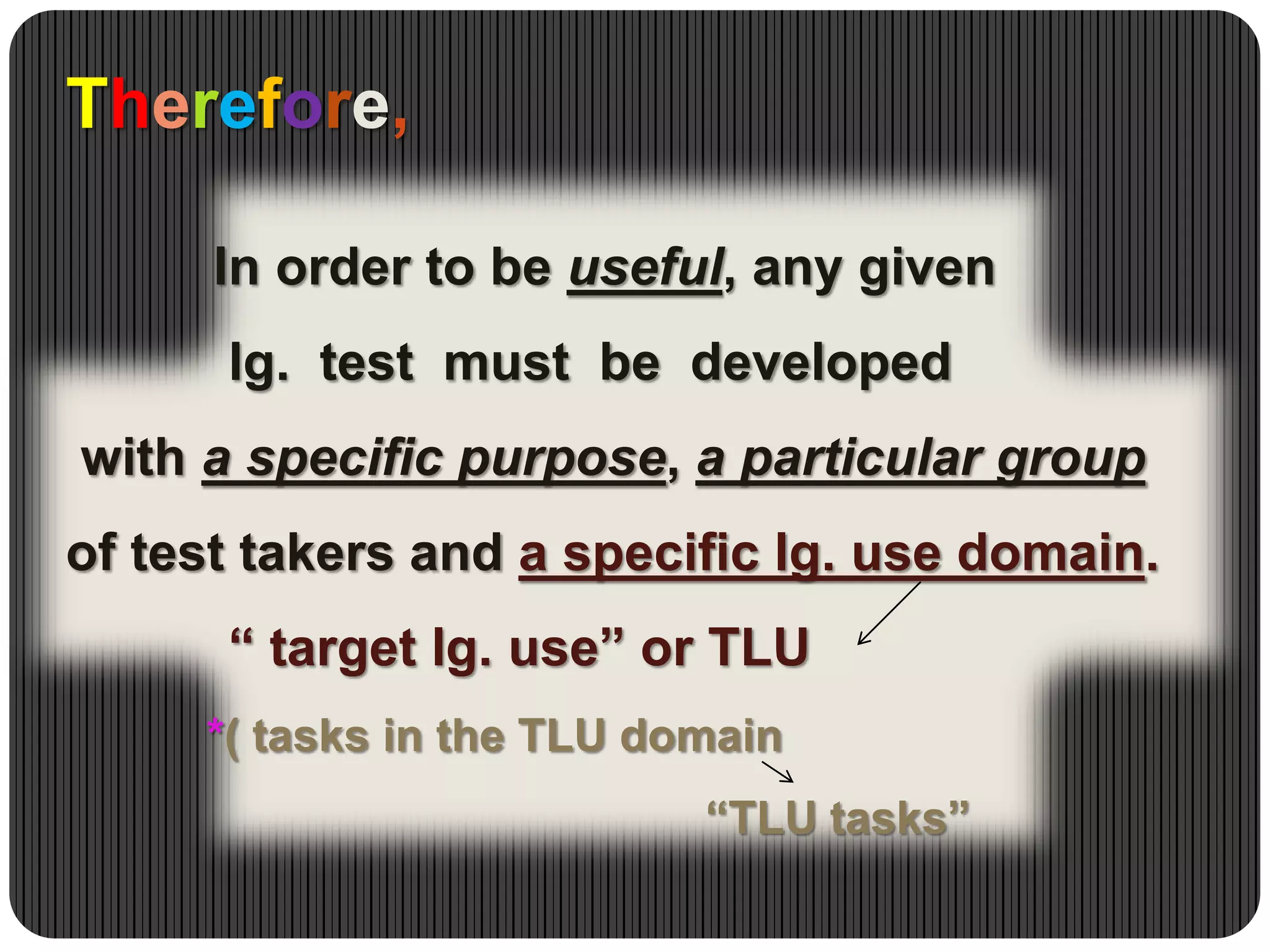
Therefore,
In order to be useful, any given
lg. test must be developed
with a specific purpose, a particular group
of test takers and a specific lg. use domain.
“ target lg. use” or TLU
*( tasks in the TLU domain
“TLU tasks”
1
R
E
L
I
A
B
I
L
I
T
Y
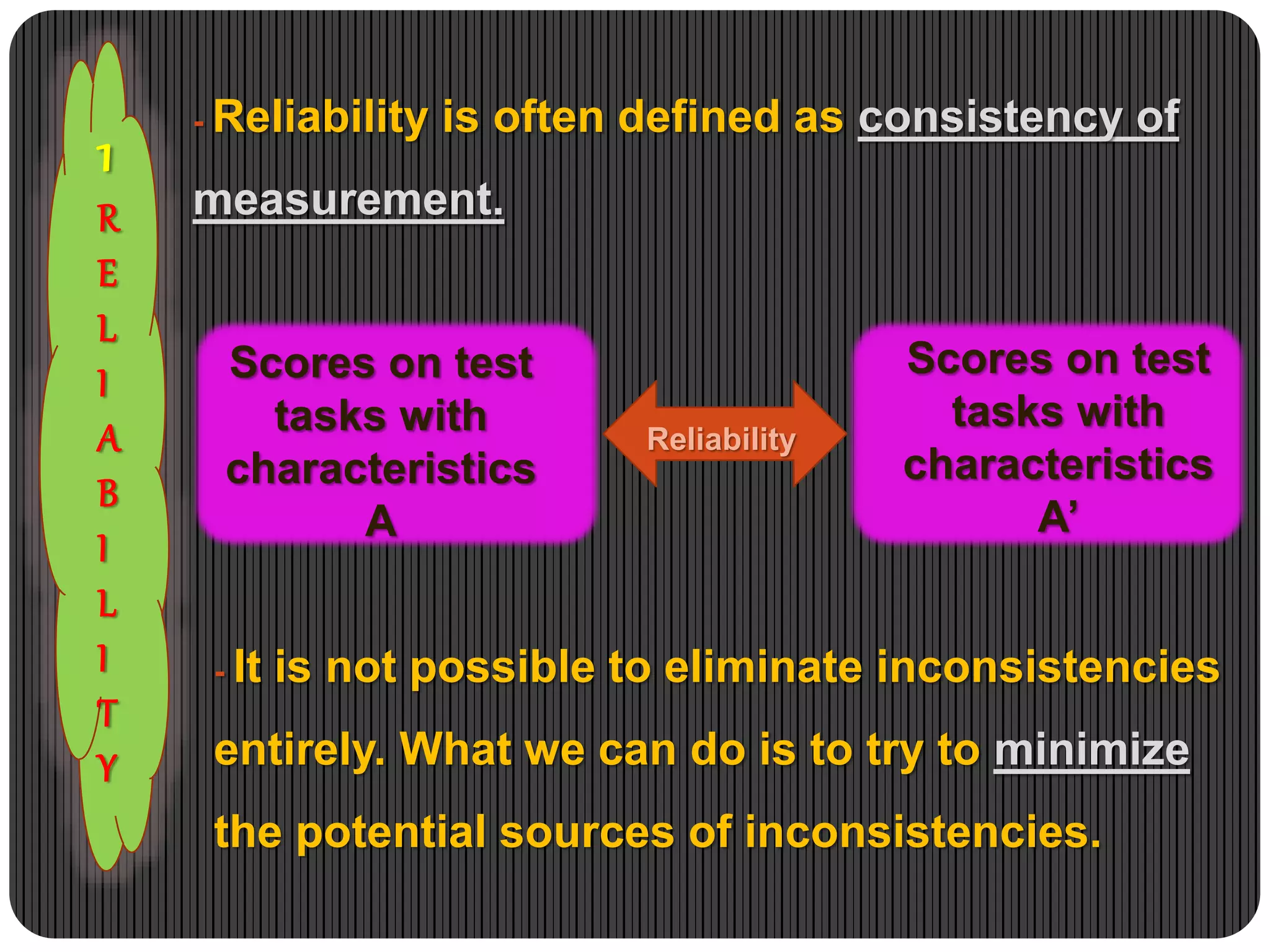
- Reliability is often defined as consistency of
measurement.
Scores on test
tasks with
characteristics
A
Scores on test
tasks with
characteristics
A’
Reliability
- It is not possible to eliminate inconsistencies
entirely. What we can do is to try to minimize
the potential sources of inconsistencies.
2
C
o
n
s
t
r
u
c
t
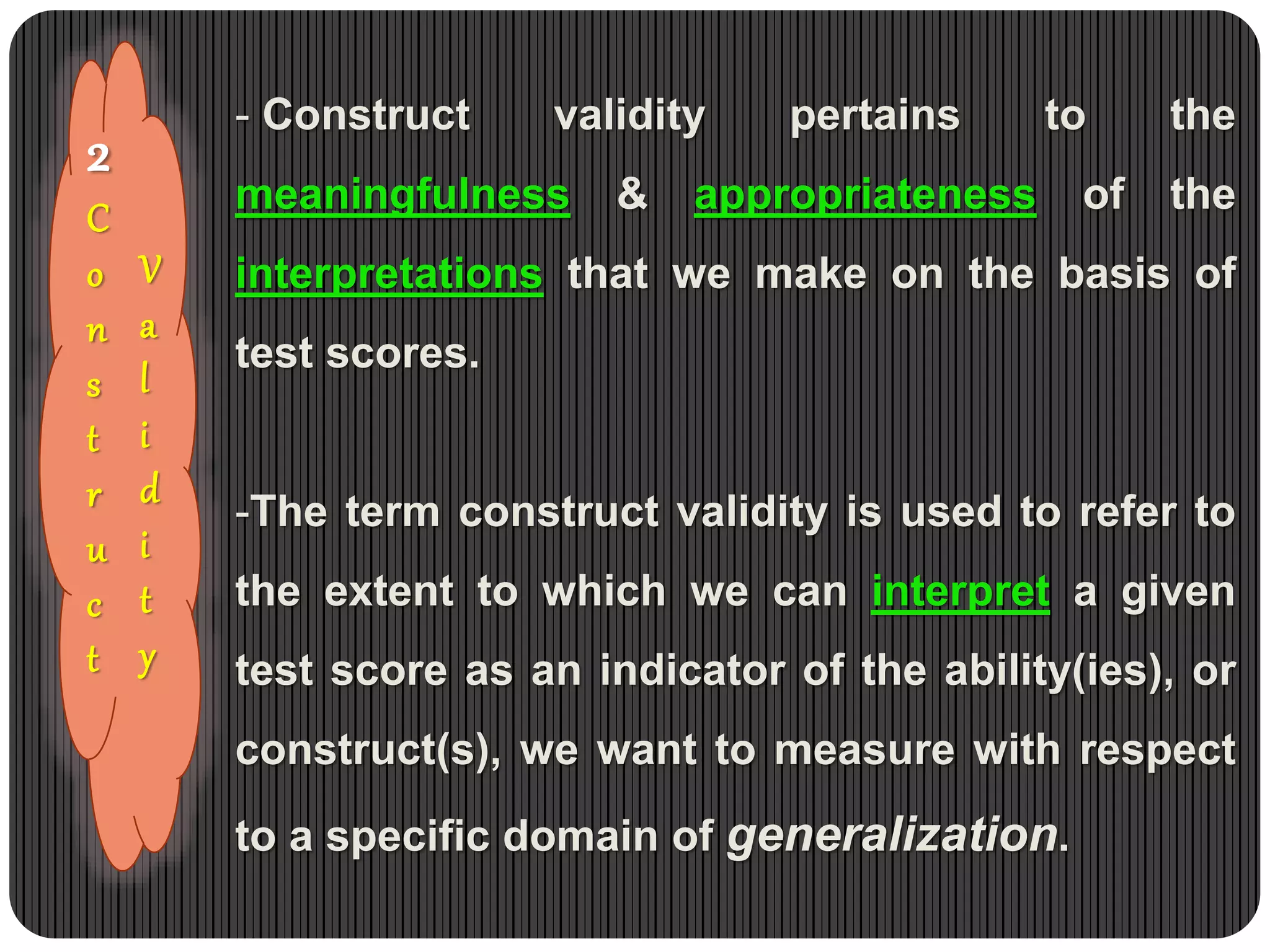
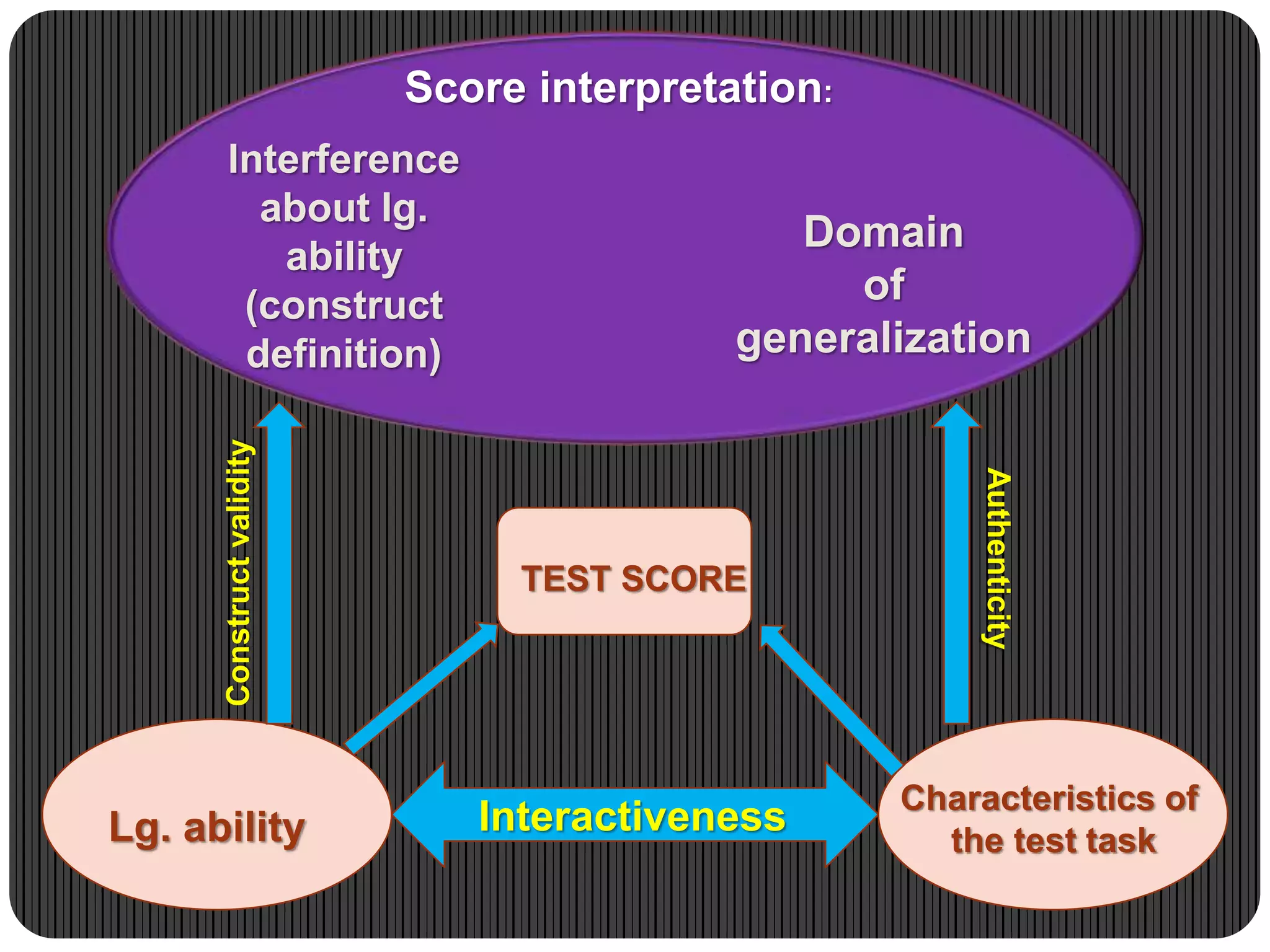
- Construct validity pertains to the
meaningfulness & appropriateness of the
interpretations that we make on the basis of
test scores.
-The term construct validity is used to refer to
the extent to which we can interpret a given
test score as an indicator of the ability(ies), or
construct(s), we want to measure with respect
to a specific domain of generalization.
V
a
l
i
d
i
t
y
Score interpretation:
Interference
about lg.
ability
(construct
definition)
Domain
of
generalization
TEST SCORE
Lg. ability
Characteristics of
the test task
Interactiveness
Constructvalidity
Authenticity
3
A
U
T
H
E
N
T
I
C
I
T
Y
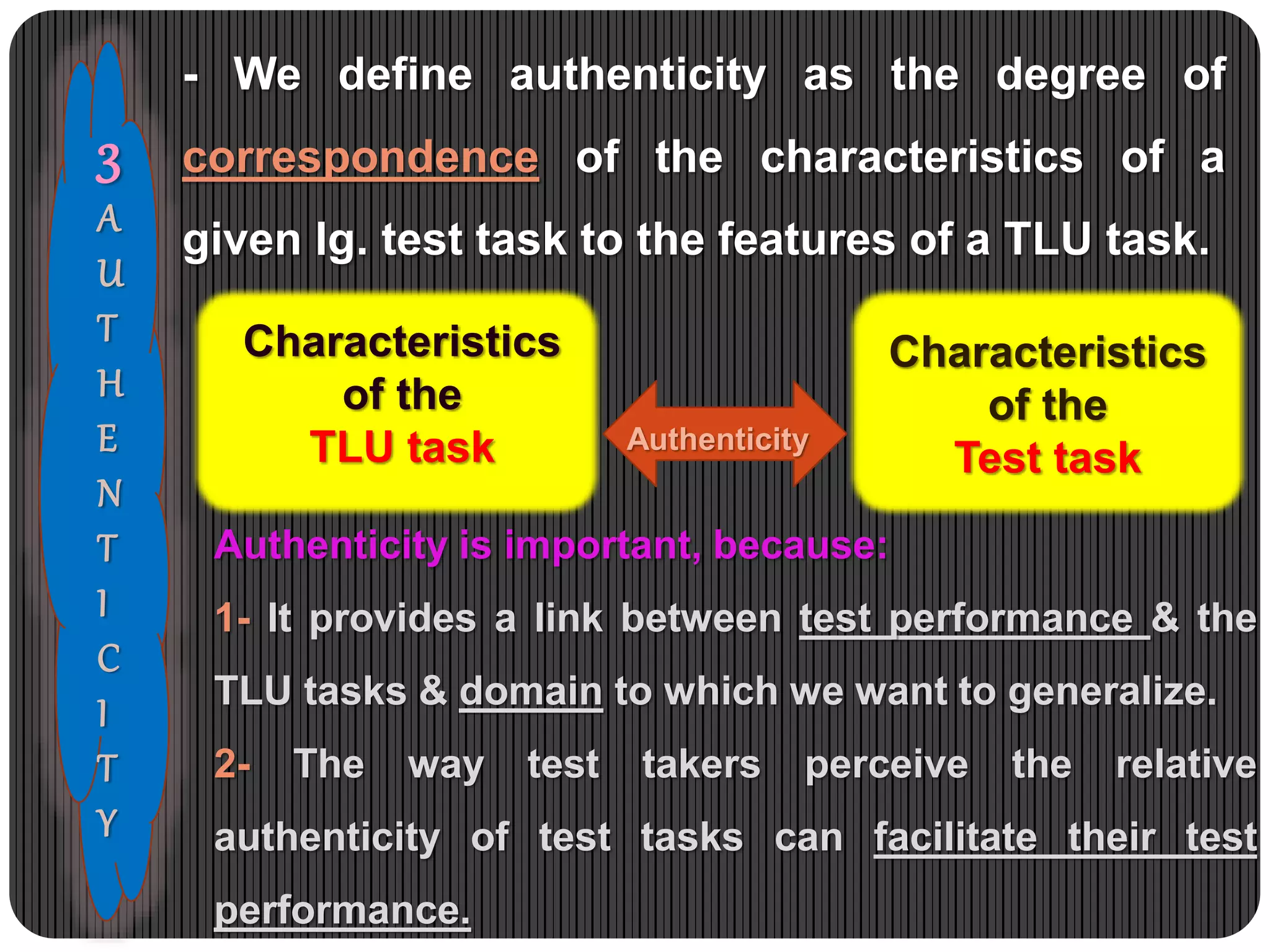
Characteristics
of the
TLU task
Characteristics
of the
Test task
Authenticity
- We define authenticity as the degree of
correspondence of the characteristics of a
given lg. test task to the features of a TLU task.
Authenticity is important, because:
1- It provides a link between test performance & the
TLU tasks & domain to which we want to generalize.
2- The way test takers perceive the relative
authenticity of test tasks can facilitate their test
performance.
4
I
N
T
E
R
A
C
T
I
Ven
ess
-We define interactiveness as the extent & the
type of involvement of the test taker’s
individual characteristics in accomplishing a
test task.
- Unlike authenticity, interactiveness resides in
the interaction between the individual ( test
taker or lg. user) & the task (test or TLU).
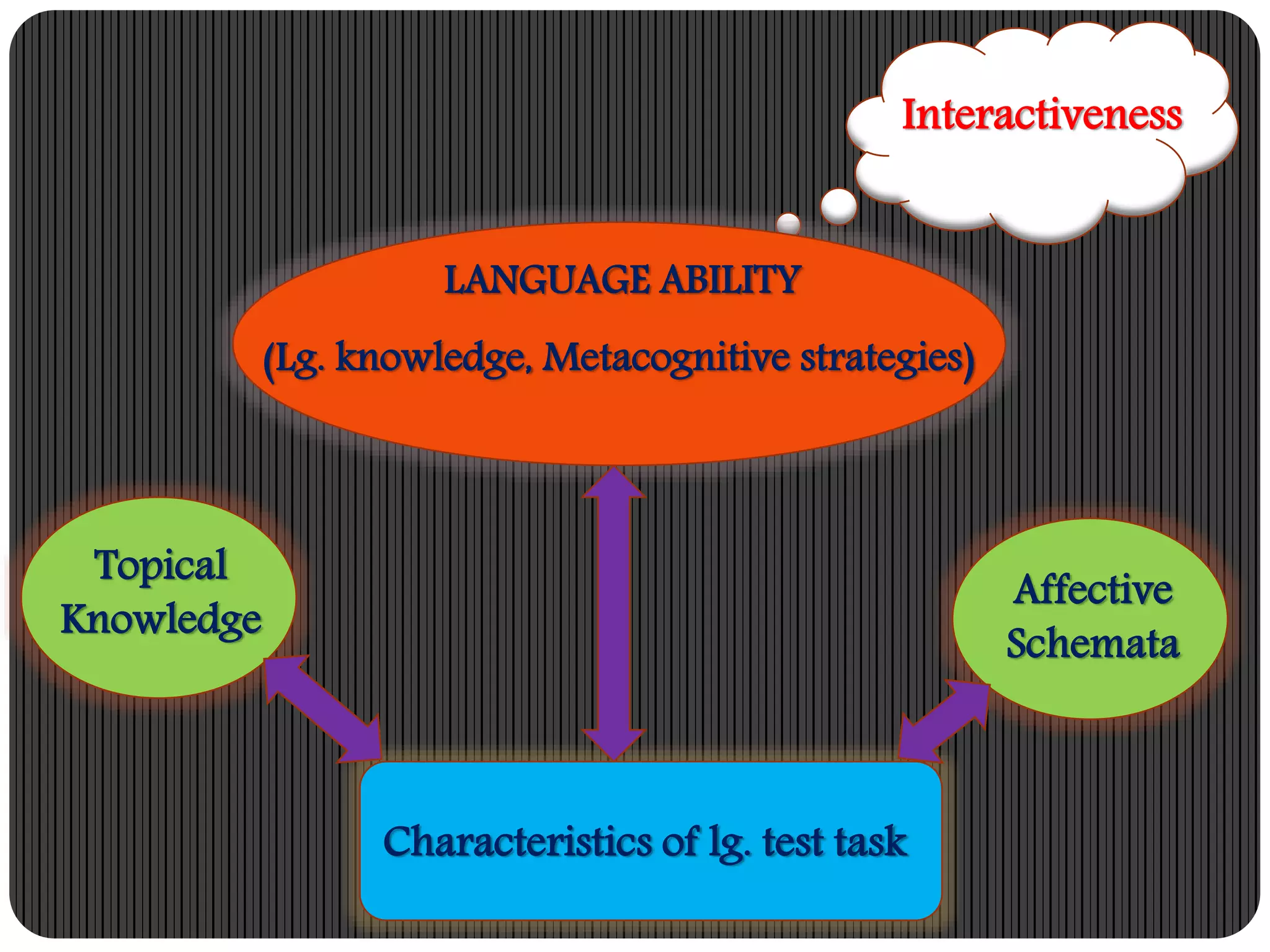
Interactiveness
LANGUAGE ABILITY
(Lg. knowledge, Metacognitive strategies)
Characteristics of lg. test task
Topical
Knowledge
Affective
Schemata
Example 1
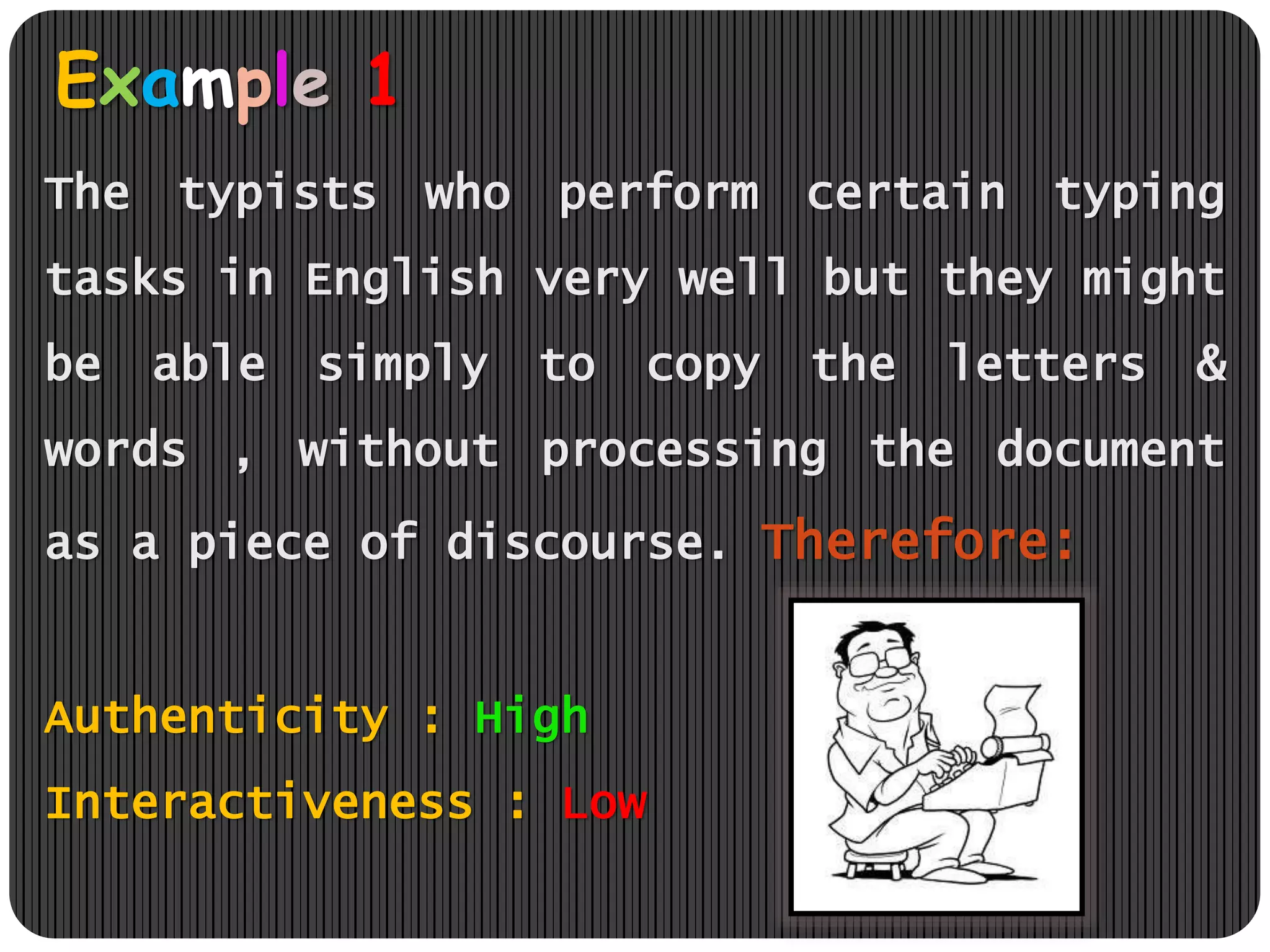
The typists who perform certain typing
tasks in English very well but they might
be able simply to copy the letters &
words , without processing the document
as a piece of discourse. Therefore:
Authenticity : High
Interactiveness : Low
Example 2
The typists who are capable of carrying on
“ small talk” about food, clothing, etc.
Authenticity : Low (Lack of relevance of
the test task to the TLU task.)
Interactiveness : High (Test takers have
reasonable amount of control in selecting
topics & influencing the structure of the
interaction.)
Example 3
International students entering an
American university were given a test of
English vocabulary, to match the words in
one column to the meanings in another one.
Authenticity : Low (few domains involve
this kind of task)
Interactiveness : Low (Highly restricted
involvement of lg. knowledge)
Example 4
To conduct a face-to-face role play; a
salesperson and a customer.
Authenticity : High (Correspondence
between the characteristics of the TLU
domain and the ones of test task.)
Interactiveness : High (High level of
involvement of all the areas of lg. &
test taker’s topical knowledge.)
POINTS TO REMEMBER
1- Both authenticity & interactiveness are relative.
2- Three types of characteristics must be considered:
those of test takers, TLU task & test task.
3- Certain test tasks may be relatively useful, even
though they are low in authenticity or interactiveness.
4- In designing or analyzing tests, our estimates of
authenticity & interactiveness are only guesses.
5- The minimum acceptable levels that we specify for
authenticity & interactiveness will depend on the
specific testing situation.
5
I
M
P
A
C
T
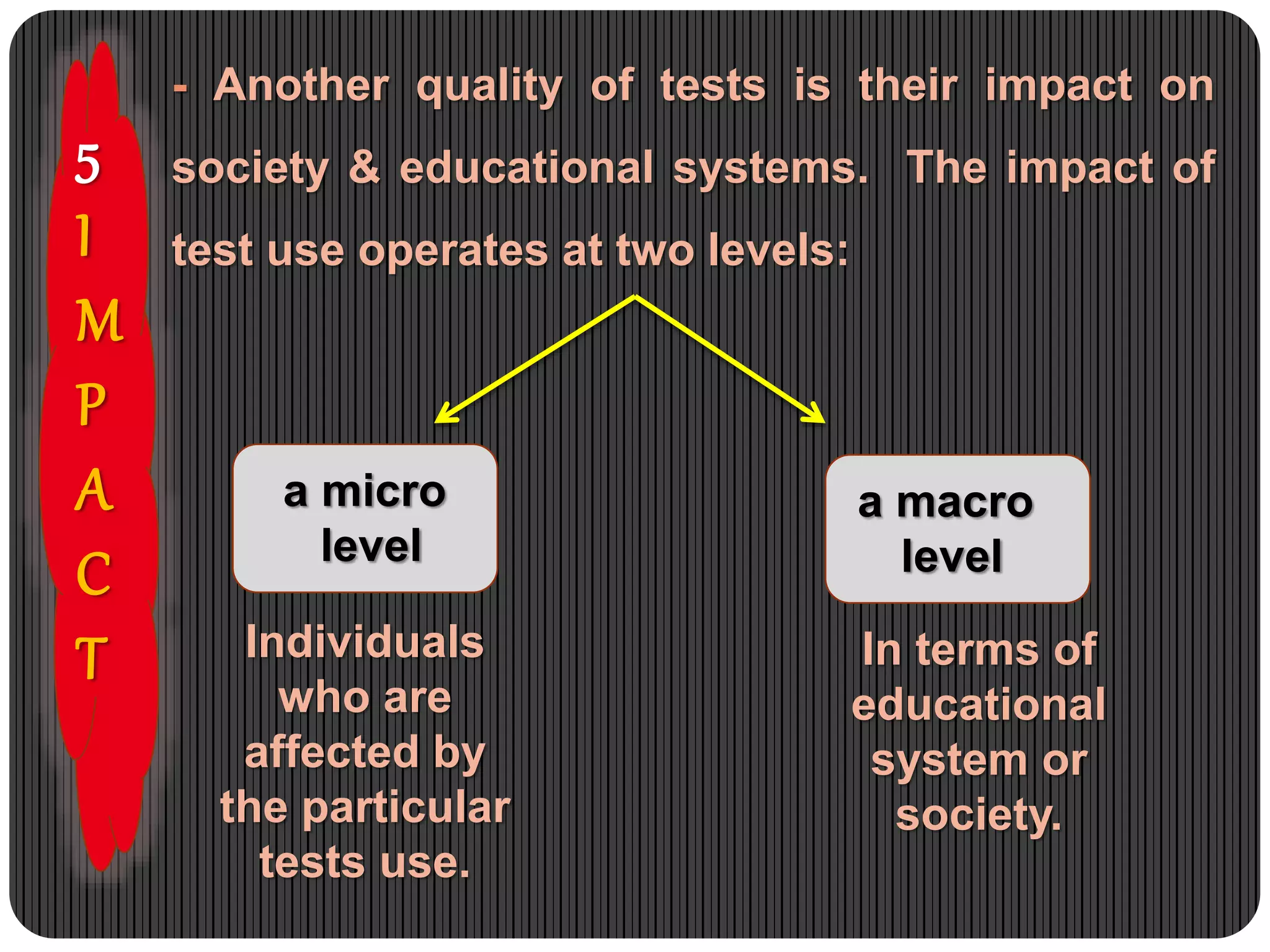
- Another quality of tests is their impact on
society & educational systems. The impact of
test use operates at two levels:
a micro
level
a macro
level
Individuals
who are
affected by
the particular
tests use.
In terms of
educational
system or
society.
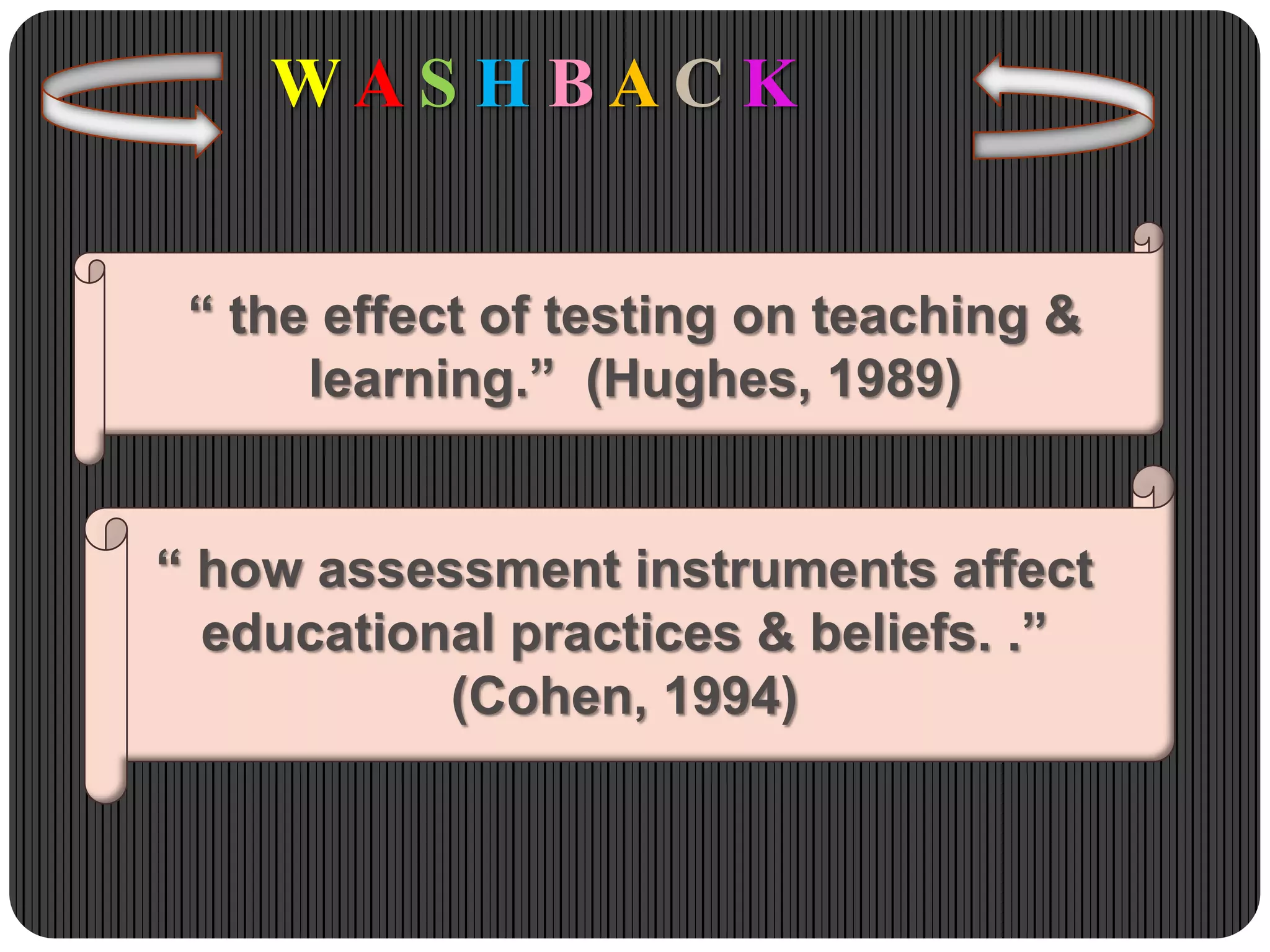
W A S H B A C K
“ the effect of testing on teaching &
learning.” (Hughes, 1989)
“ how assessment instruments affect
educational practices & beliefs. .”
(Cohen, 1994)
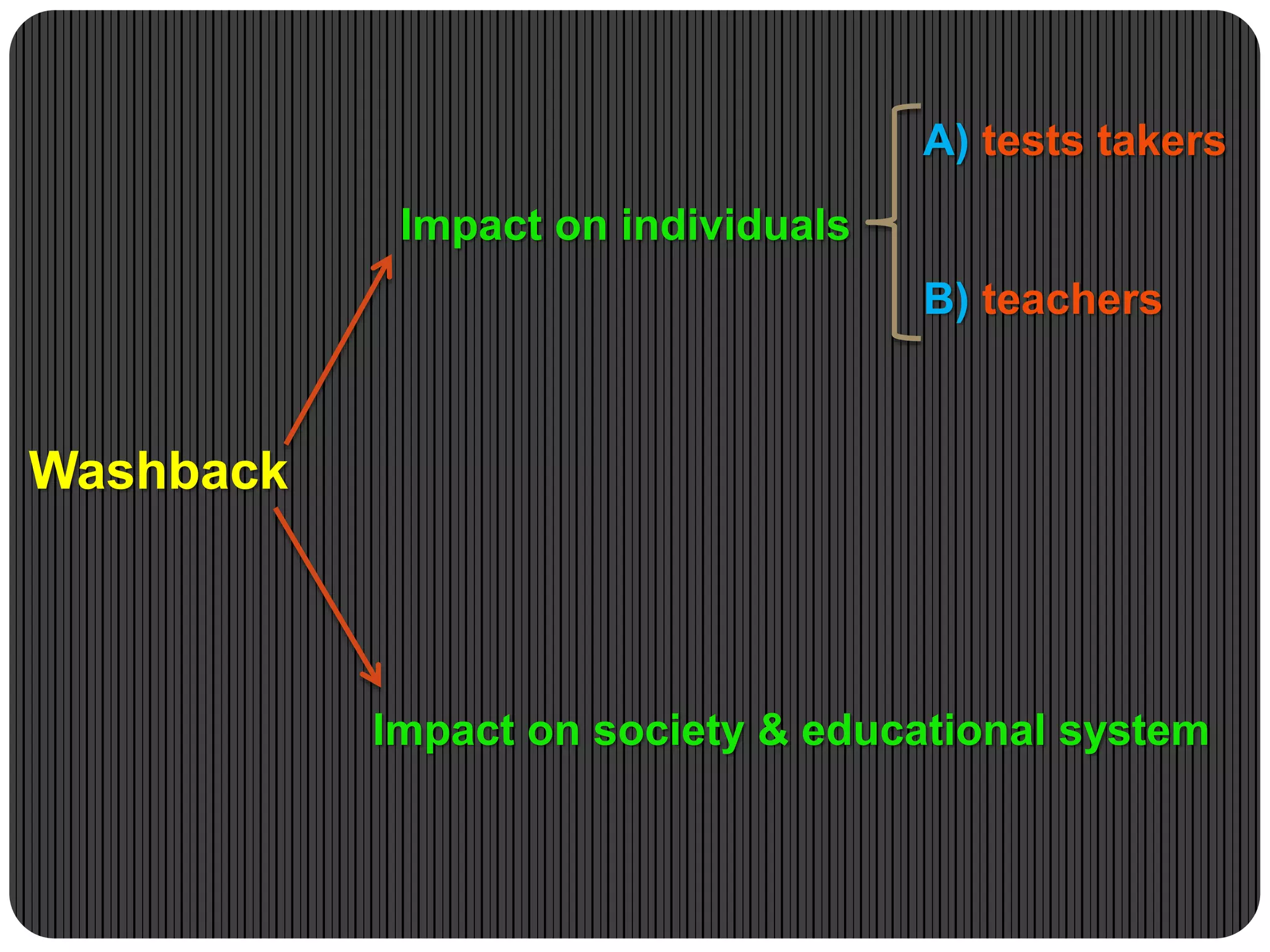
Washback
Impact on individuals
Impact on society & educational system
A) tests takers
B) teachers
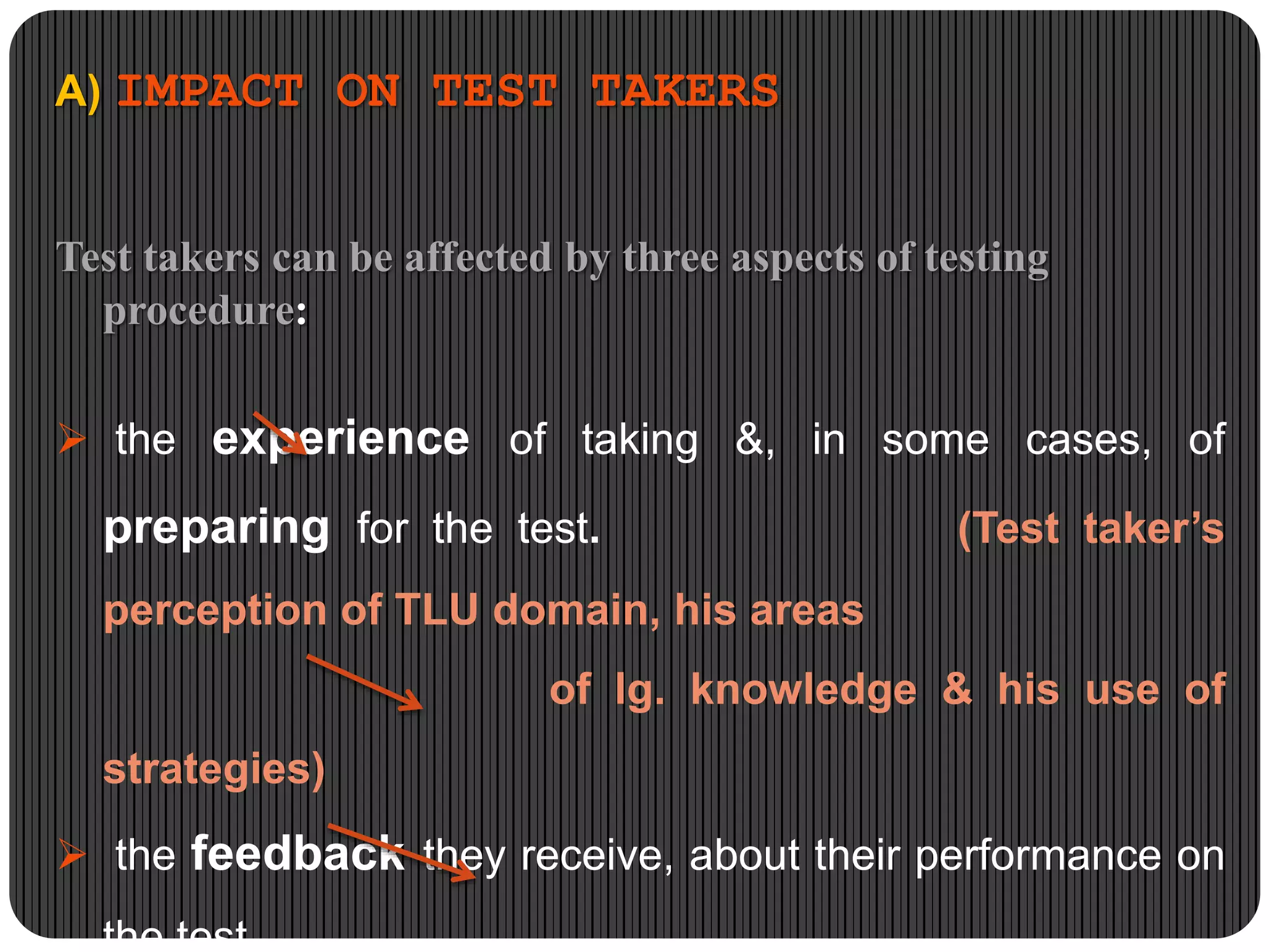
A) IMPACT ON TEST TAKERS
Test takers can be affected by three aspects of testing
procedure:
 the experience of taking &, in some cases, of
preparing for the test. (Test taker’s
perception of TLU domain, his areas
of lg. knowledge & his use of
strategies)
 the feedback they receive, about their performance on
the test,
B) IMPACT ON TEACHERS
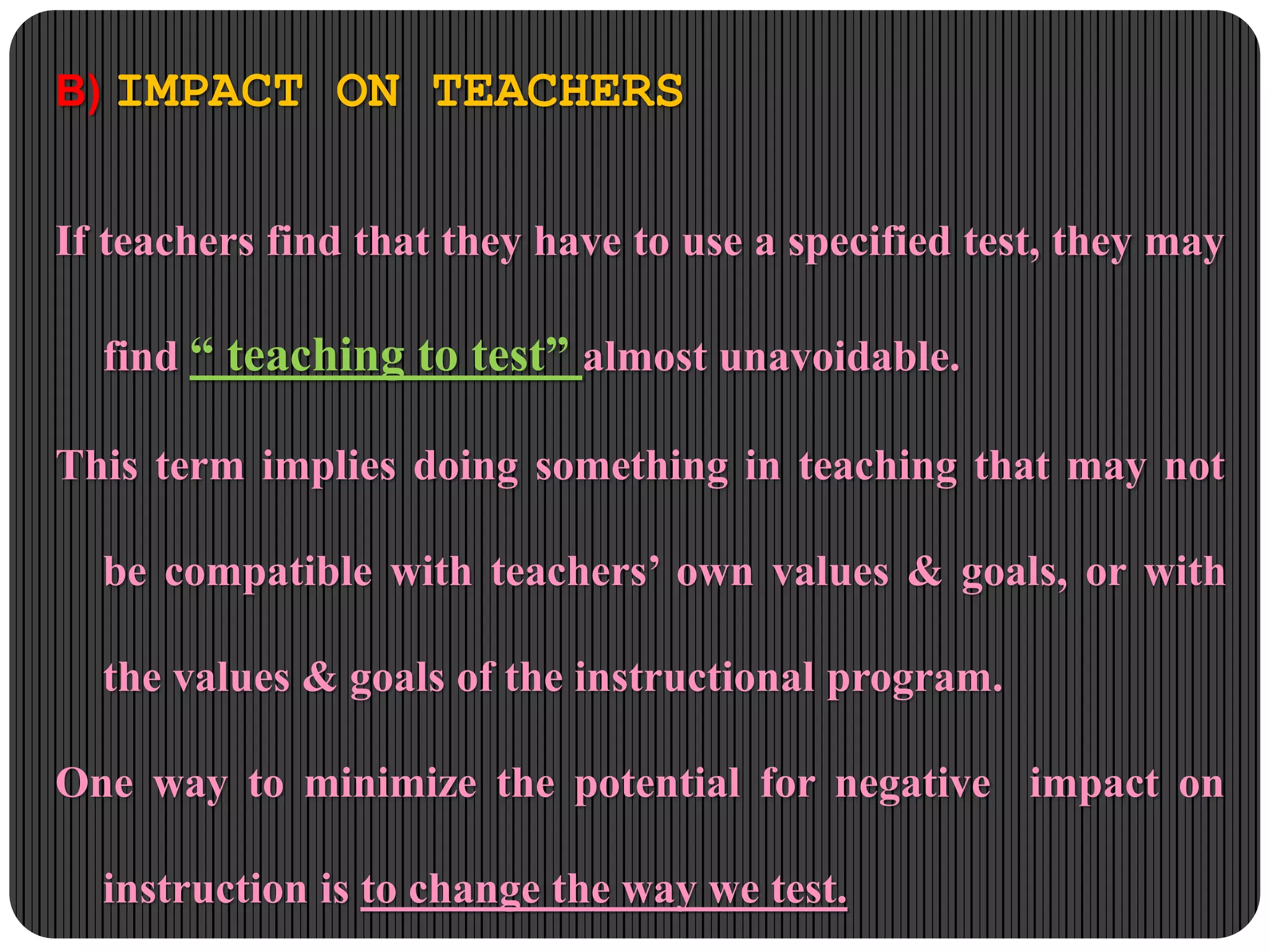
If teachers find that they have to use a specified test, they may
find “ teaching to test” almost unavoidable.
This term implies doing something in teaching that may not
be compatible with teachers’ own values & goals, or with
the values & goals of the instructional program.
One way to minimize the potential for negative impact on
instruction is to change the way we test.
6
P
R
A
C
T
I
C
A
L
I
T
Y
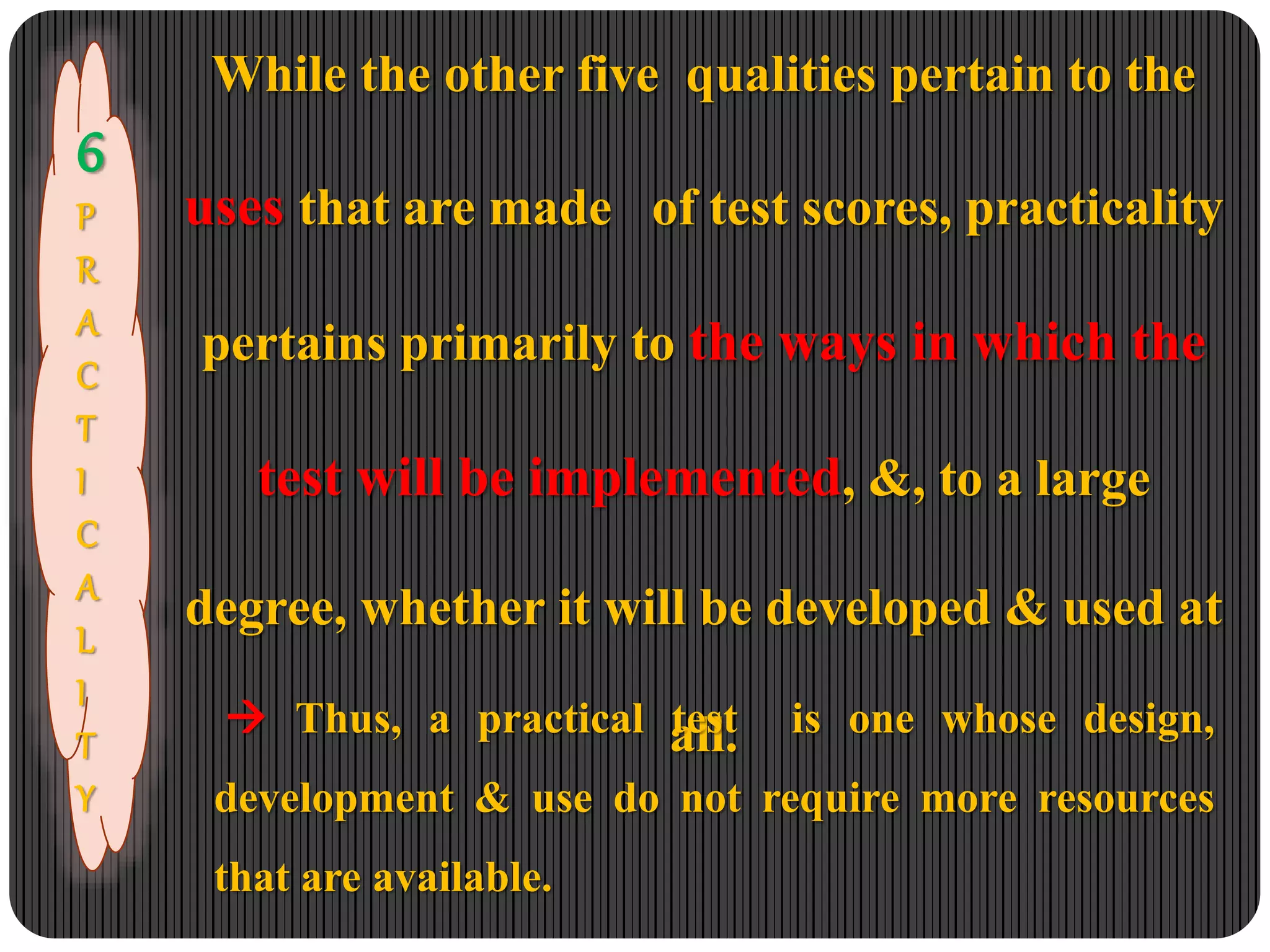
While the other five qualities pertain to the
uses that are made of test scores, practicality
pertains primarily to the ways in which the
test will be implemented, &, to a large
degree, whether it will be developed & used at
all. Thus, a practical test is one whose design,
development & use do not require more resources
that are available.
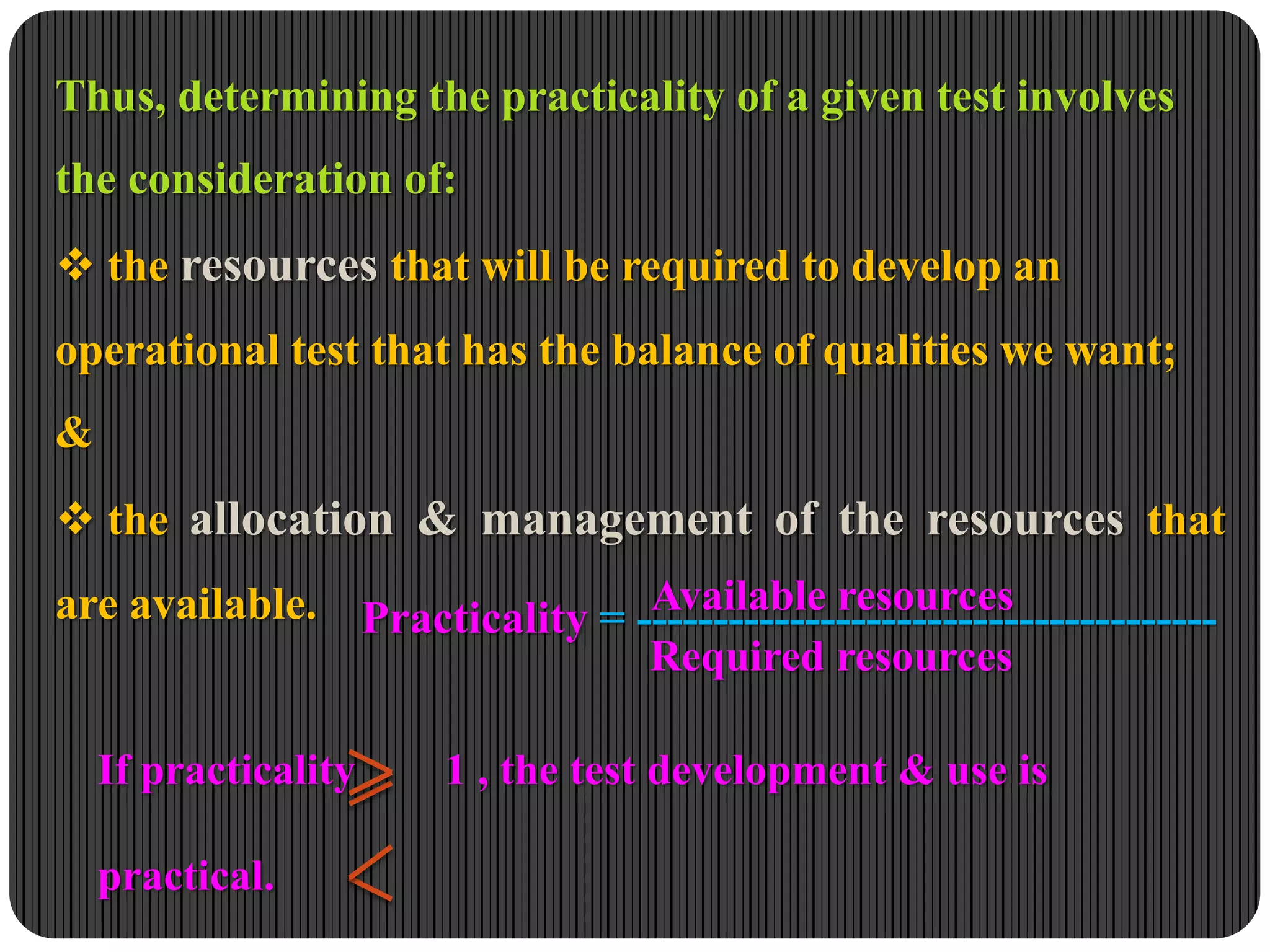
Thus, determining the practicality of a given test involves
the consideration of:
 the resources that will be required to develop an
operational test that has the balance of qualities we want;
&
 the allocation & management of the resources that
are available. Practicality = --------------------------------------
Available resources
Required resources
If practicality 1 , the test development & use is
practical.
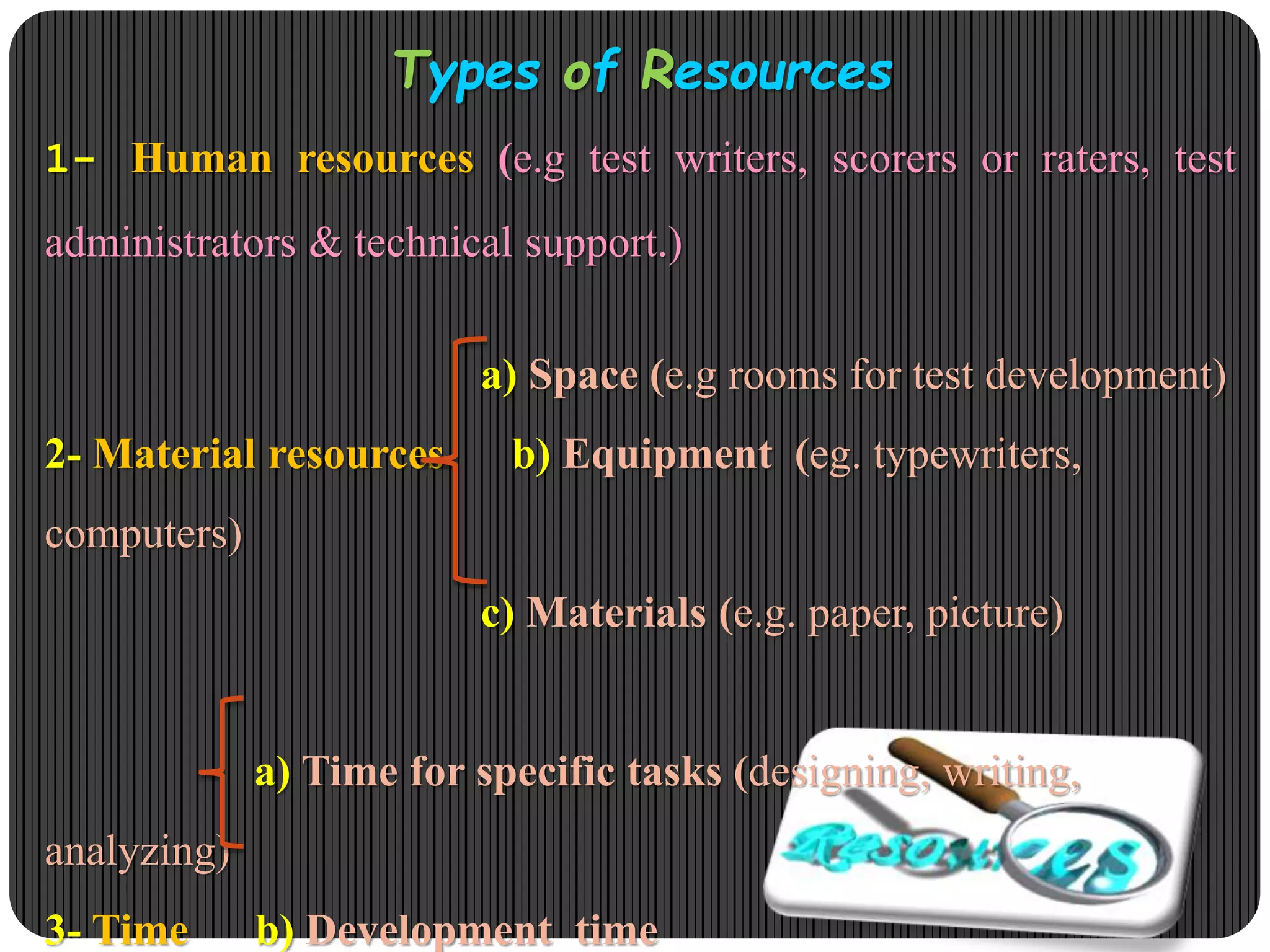
Types of Resources
1- Human resources (e.g test writers, scorers or raters, test
administrators & technical support.)
a) Space (e.g rooms for test development)
2- Material resources b) Equipment (eg. typewriters,
computers)
c) Materials (e.g. paper, picture)
a) Time for specific tasks (designing, writing,
analyzing)
3- Time b) Development time
Test Usefulness

Test Usefulness

  • 1.
    Principles of LanguageAssessment: Test Usefulness Course: Testing Bachman & Palmer, Ch. 2
  • 2.
    The most importantquality of a test is its usefu But, -What makes a test useful ? - How do we know a test will be useful before we - Or it has been useful after we have used it ?
  • 3.
    Simply using atest does not make it useful ! A model of test usefulness has been proposed that include six test qualities.
  • 4.
  • 5.
    Usefulness = Reliability +Construct validity + Authenticity + Interactiveness + Impact + Validity
  • 6.
    This model alongwith the three principles, provides a basis for answering this question: “ How useful is this particular test for its intended purpose(s) ? “
  • 7.
    It is theoverall usefulness of the test that is to be maximized, rather than the individual qualities that affect usefulness.
  • 8.
    The individual testqualities cannot be evaluated independently, but must be evaluated in terms of their combined effect on the overall usefulness of the test.
  • 9.
    Test usefulness &the appropriate balance among the different qualities cannot be prescribed in general, but must be determined for each specific testing situation.
  • 10.
    Therefore, In order tobe useful, any given lg. test must be developed with a specific purpose, a particular group of test takers and a specific lg. use domain. “ target lg. use” or TLU *( tasks in the TLU domain “TLU tasks”
  • 11.
    1 R E L I A B I L I T Y - Reliability isoften defined as consistency of measurement. Scores on test tasks with characteristics A Scores on test tasks with characteristics A’ Reliability - It is not possible to eliminate inconsistencies entirely. What we can do is to try to minimize the potential sources of inconsistencies.
  • 12.
    2 C o n s t r u c t - Construct validitypertains to the meaningfulness & appropriateness of the interpretations that we make on the basis of test scores. -The term construct validity is used to refer to the extent to which we can interpret a given test score as an indicator of the ability(ies), or construct(s), we want to measure with respect to a specific domain of generalization. V a l i d i t y
  • 13.
    Score interpretation: Interference about lg. ability (construct definition) Domain of generalization TESTSCORE Lg. ability Characteristics of the test task Interactiveness Constructvalidity Authenticity
  • 14.
    3 A U T H E N T I C I T Y Characteristics of the TLU task Characteristics ofthe Test task Authenticity - We define authenticity as the degree of correspondence of the characteristics of a given lg. test task to the features of a TLU task. Authenticity is important, because: 1- It provides a link between test performance & the TLU tasks & domain to which we want to generalize. 2- The way test takers perceive the relative authenticity of test tasks can facilitate their test performance.
  • 15.
    4 I N T E R A C T I Ven ess -We define interactivenessas the extent & the type of involvement of the test taker’s individual characteristics in accomplishing a test task. - Unlike authenticity, interactiveness resides in the interaction between the individual ( test taker or lg. user) & the task (test or TLU).
  • 16.
    Interactiveness LANGUAGE ABILITY (Lg. knowledge,Metacognitive strategies) Characteristics of lg. test task Topical Knowledge Affective Schemata
  • 17.
    Example 1 The typistswho perform certain typing tasks in English very well but they might be able simply to copy the letters & words , without processing the document as a piece of discourse. Therefore: Authenticity : High Interactiveness : Low
  • 18.
    Example 2 The typistswho are capable of carrying on “ small talk” about food, clothing, etc. Authenticity : Low (Lack of relevance of the test task to the TLU task.) Interactiveness : High (Test takers have reasonable amount of control in selecting topics & influencing the structure of the interaction.)
  • 19.
    Example 3 International studentsentering an American university were given a test of English vocabulary, to match the words in one column to the meanings in another one. Authenticity : Low (few domains involve this kind of task) Interactiveness : Low (Highly restricted involvement of lg. knowledge)
  • 20.
    Example 4 To conducta face-to-face role play; a salesperson and a customer. Authenticity : High (Correspondence between the characteristics of the TLU domain and the ones of test task.) Interactiveness : High (High level of involvement of all the areas of lg. & test taker’s topical knowledge.)
  • 21.
    POINTS TO REMEMBER 1-Both authenticity & interactiveness are relative. 2- Three types of characteristics must be considered: those of test takers, TLU task & test task. 3- Certain test tasks may be relatively useful, even though they are low in authenticity or interactiveness. 4- In designing or analyzing tests, our estimates of authenticity & interactiveness are only guesses. 5- The minimum acceptable levels that we specify for authenticity & interactiveness will depend on the specific testing situation.
  • 22.
    5 I M P A C T - Another qualityof tests is their impact on society & educational systems. The impact of test use operates at two levels: a micro level a macro level Individuals who are affected by the particular tests use. In terms of educational system or society.
  • 23.
    W A SH B A C K “ the effect of testing on teaching & learning.” (Hughes, 1989) “ how assessment instruments affect educational practices & beliefs. .” (Cohen, 1994)
  • 24.
    Washback Impact on individuals Impacton society & educational system A) tests takers B) teachers
  • 25.
    A) IMPACT ONTEST TAKERS Test takers can be affected by three aspects of testing procedure:  the experience of taking &, in some cases, of preparing for the test. (Test taker’s perception of TLU domain, his areas of lg. knowledge & his use of strategies)  the feedback they receive, about their performance on the test,
  • 26.
    B) IMPACT ONTEACHERS If teachers find that they have to use a specified test, they may find “ teaching to test” almost unavoidable. This term implies doing something in teaching that may not be compatible with teachers’ own values & goals, or with the values & goals of the instructional program. One way to minimize the potential for negative impact on instruction is to change the way we test.
  • 27.
    6 P R A C T I C A L I T Y While the otherfive qualities pertain to the uses that are made of test scores, practicality pertains primarily to the ways in which the test will be implemented, &, to a large degree, whether it will be developed & used at all. Thus, a practical test is one whose design, development & use do not require more resources that are available.
  • 28.
    Thus, determining thepracticality of a given test involves the consideration of:  the resources that will be required to develop an operational test that has the balance of qualities we want; &  the allocation & management of the resources that are available. Practicality = -------------------------------------- Available resources Required resources If practicality 1 , the test development & use is practical.
  • 29.
    Types of Resources 1-Human resources (e.g test writers, scorers or raters, test administrators & technical support.) a) Space (e.g rooms for test development) 2- Material resources b) Equipment (eg. typewriters, computers) c) Materials (e.g. paper, picture) a) Time for specific tasks (designing, writing, analyzing) 3- Time b) Development time