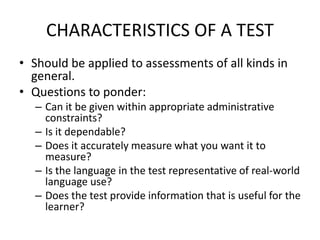
The document discusses several key principles of language assessment:
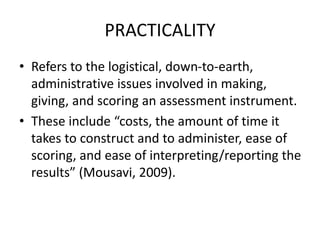
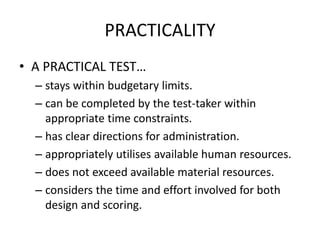
1) Practicality refers to the logistical issues of administering an assessment, such as time, costs, and ease of scoring. A practical test stays within budget, can be completed in the allotted time, and has clear administration directions.
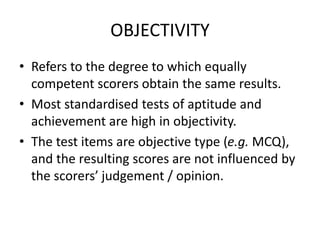
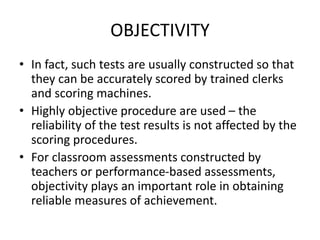
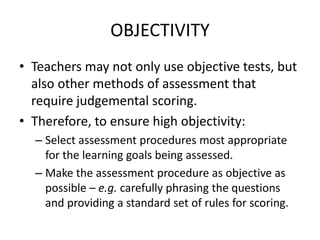
2) Objectivity means different scorers will obtain the same results. Objective tests like multiple choice aim for this.
3) Washback effect refers to how a test influences teaching and learning. A test with beneficial washback positively impacts both and provides useful feedback.
4) Authenticity is the correspondence between a test task and real-world language use. An authentic test uses natural language and simulates realistic