TESLA ANALYSIS
Mohamed Ibrahim 21125215 Shaimaa Tamer 21125579
Hossam Elgonimy 21125497
Amr Mansour 21126657
Eslam Hassan 21126340
Moataz Farouk 21126338
GROUP 1
PART 1 INTRO
Eslam Hassan 21126340
3
INTRODUCTION
• Clean energy based
About Tesla
 American Electric vehicle and clean energy company
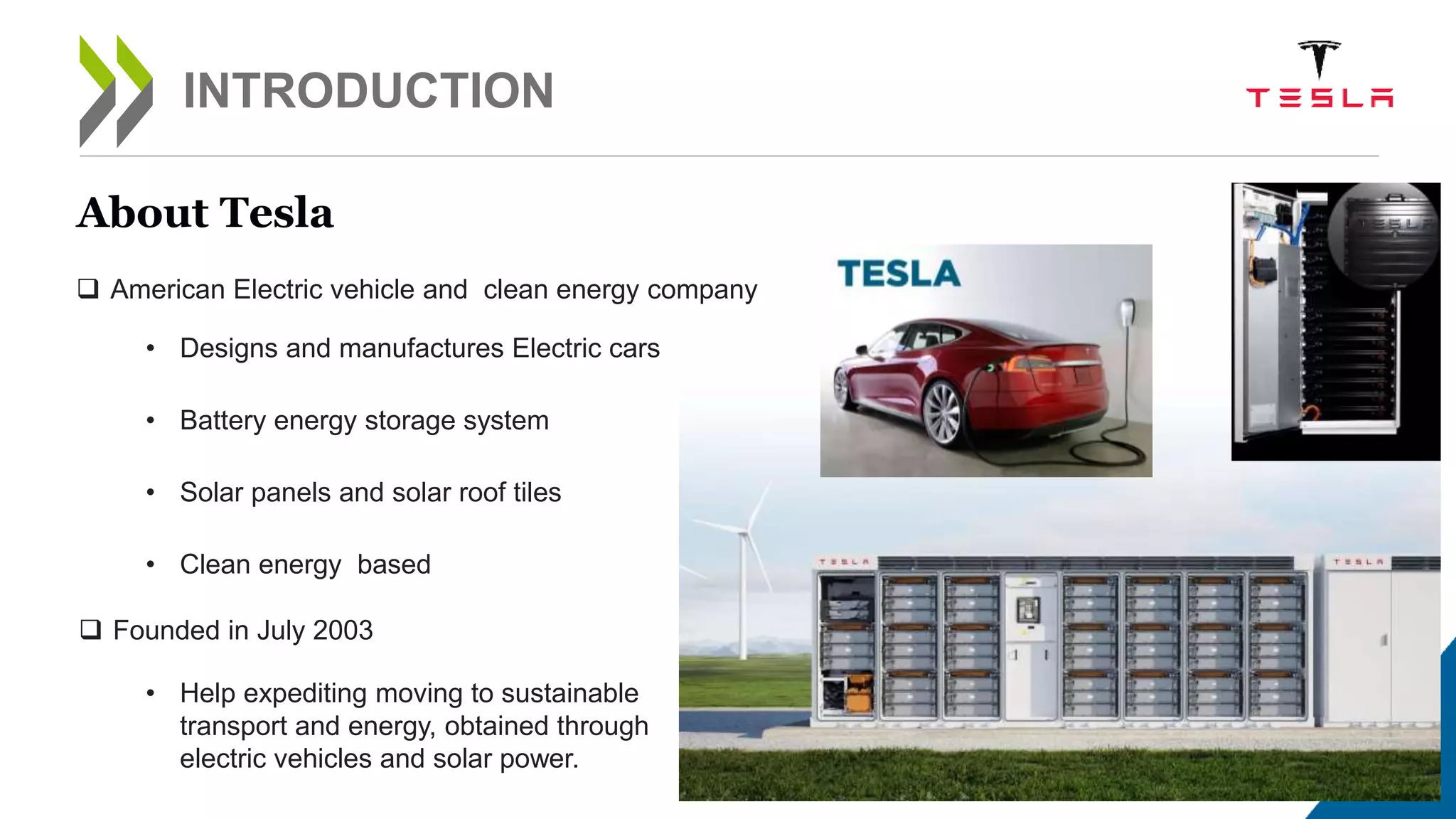
• Battery energy storage system
• Solar panels and solar roof tiles
• Designs and manufactures Electric cars
 Founded in July 2003
• Help expediting moving to sustainable
transport and energy, obtained through
electric vehicles and solar power.
4
INTRODUCTION
• Clean energy based
About Tesla
 American Electric vehicle and clean energy company
• Battery energy storage system
• Solar panels and solar roof tiles
• Designs and manufactures Electric cars
 Founded in July 2003
• Help expediting moving to sustainable
transport and energy, obtained through
electric vehicles and solar power.
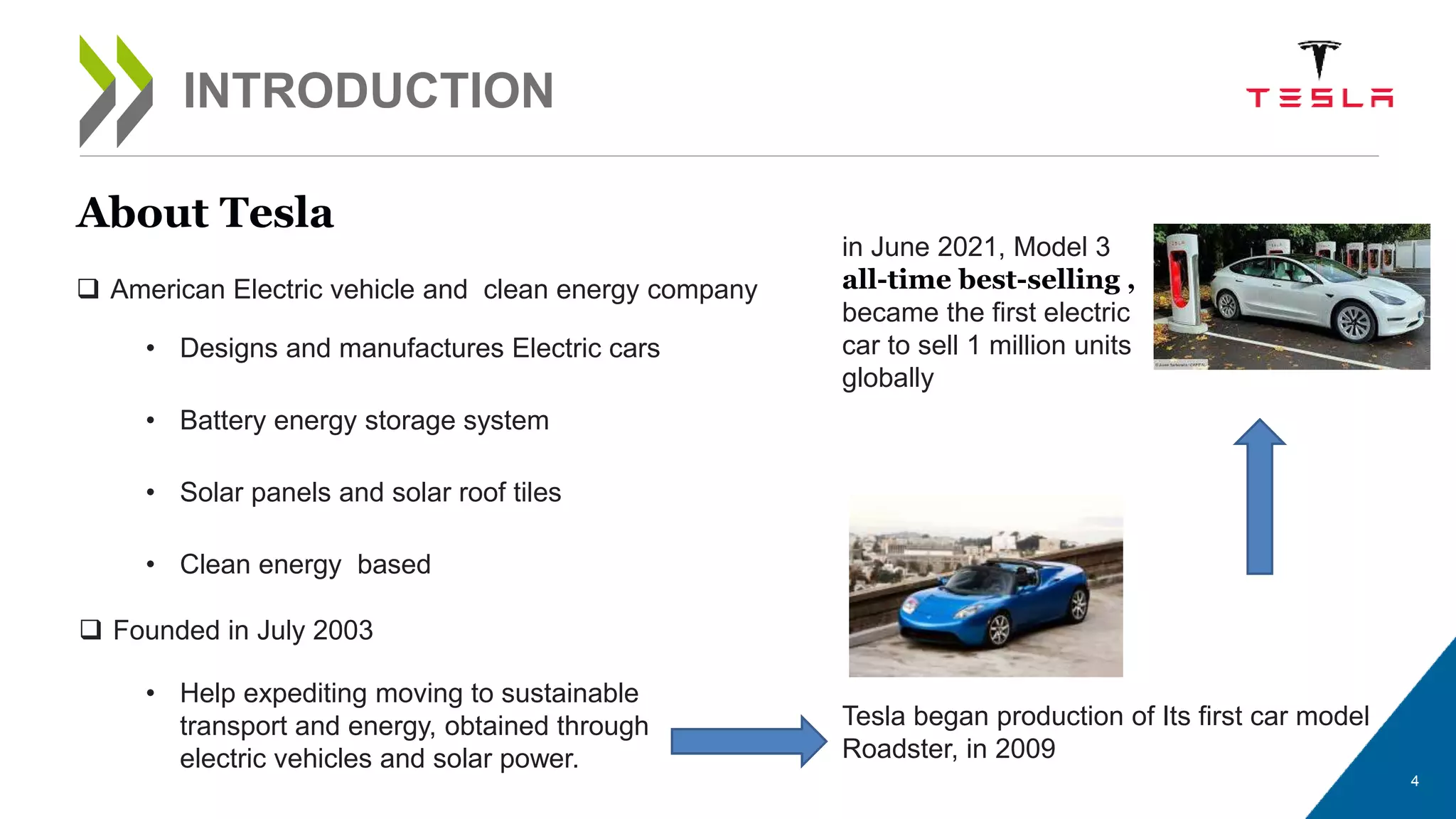
Tesla began production of Its first car model
Roadster, in 2009
in June 2021, Model 3
all-time best-selling ,
became the first electric
car to sell 1 million units
globally
5
INTRODUCTION
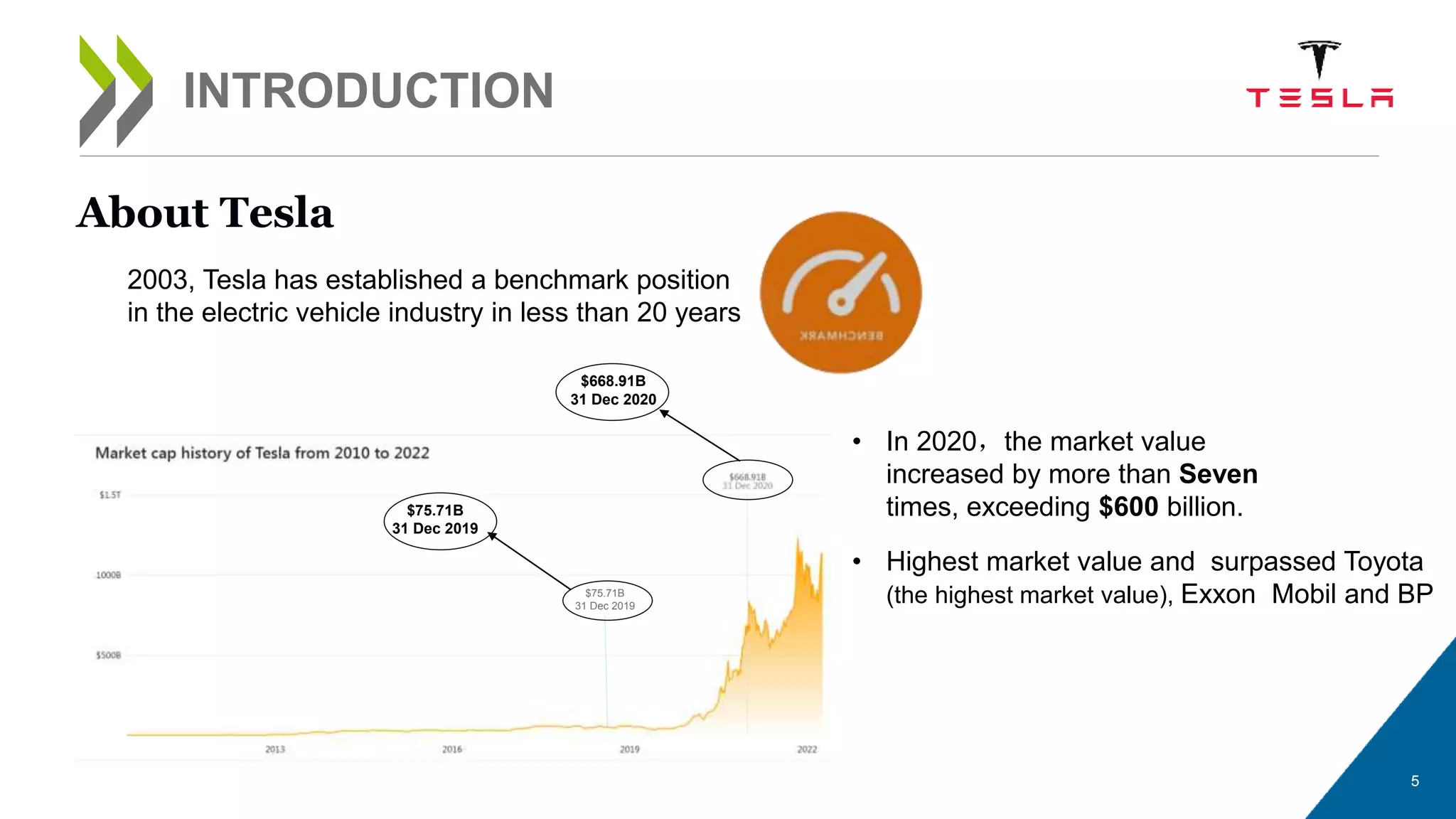
2003, Tesla has established a benchmark position
in the electric vehicle industry in less than 20 years
About Tesla
• In 2020,the market value
increased by more than Seven
times, exceeding $600 billion.
• Highest market value and surpassed Toyota
(the highest market value), Exxon Mobil and BP
$668.91B
31 Dec 2020
$75.71B
31 Dec 2019
$75.71B
31 Dec 2019
6
INTRODUCTION
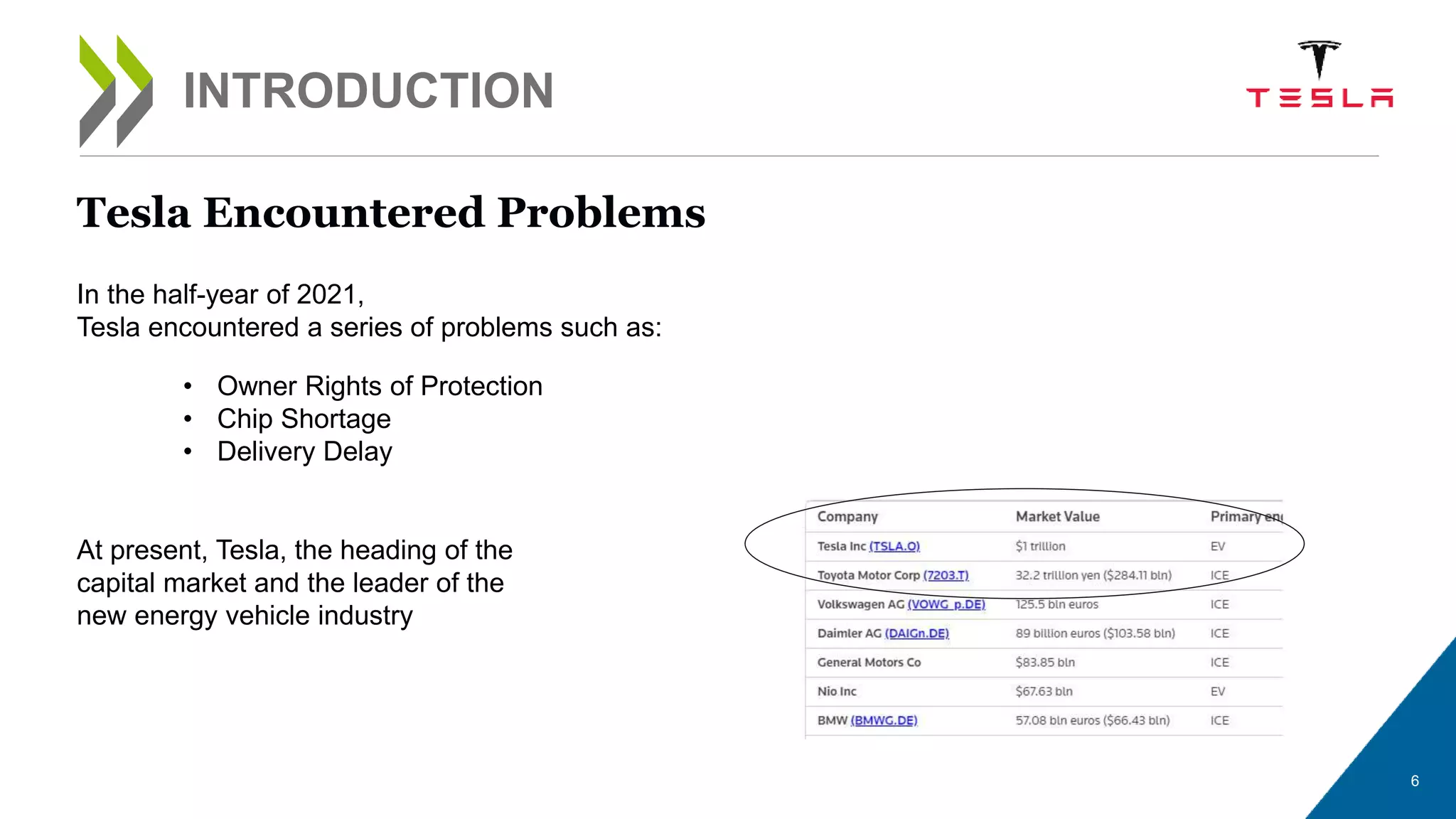
In the half-year of 2021,
Tesla encountered a series of problems such as:
Tesla Encountered Problems
• Owner Rights of Protection
• Chip Shortage
• Delivery Delay
At present, Tesla, the heading of the
capital market and the leader of the
new energy vehicle industry
7
INTRODUCTION
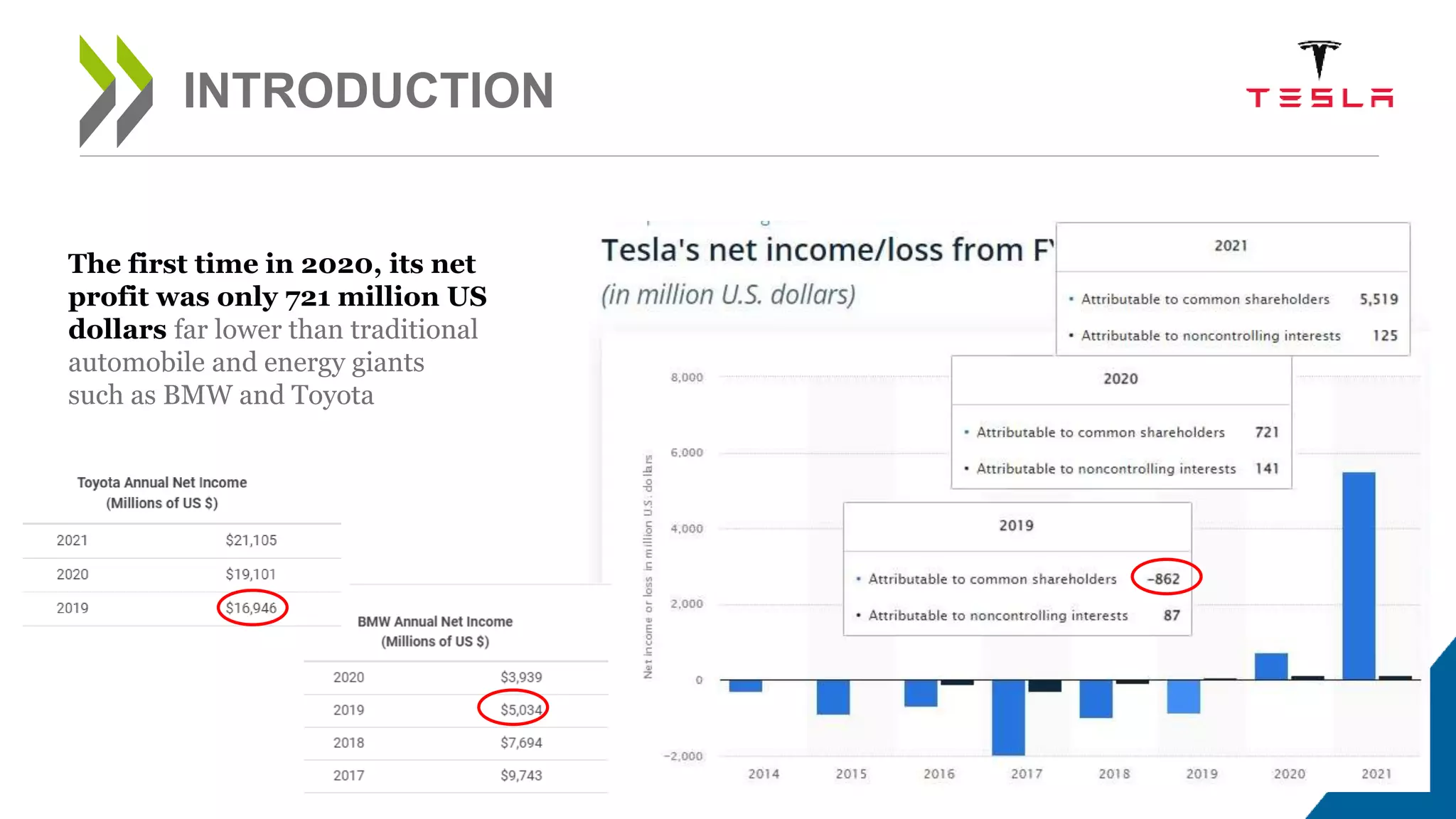
The first time in 2020, its net
profit was only 721 million US
dollars far lower than traditional
automobile and energy giants
such as BMW and Toyota
8
INTRODUCTION
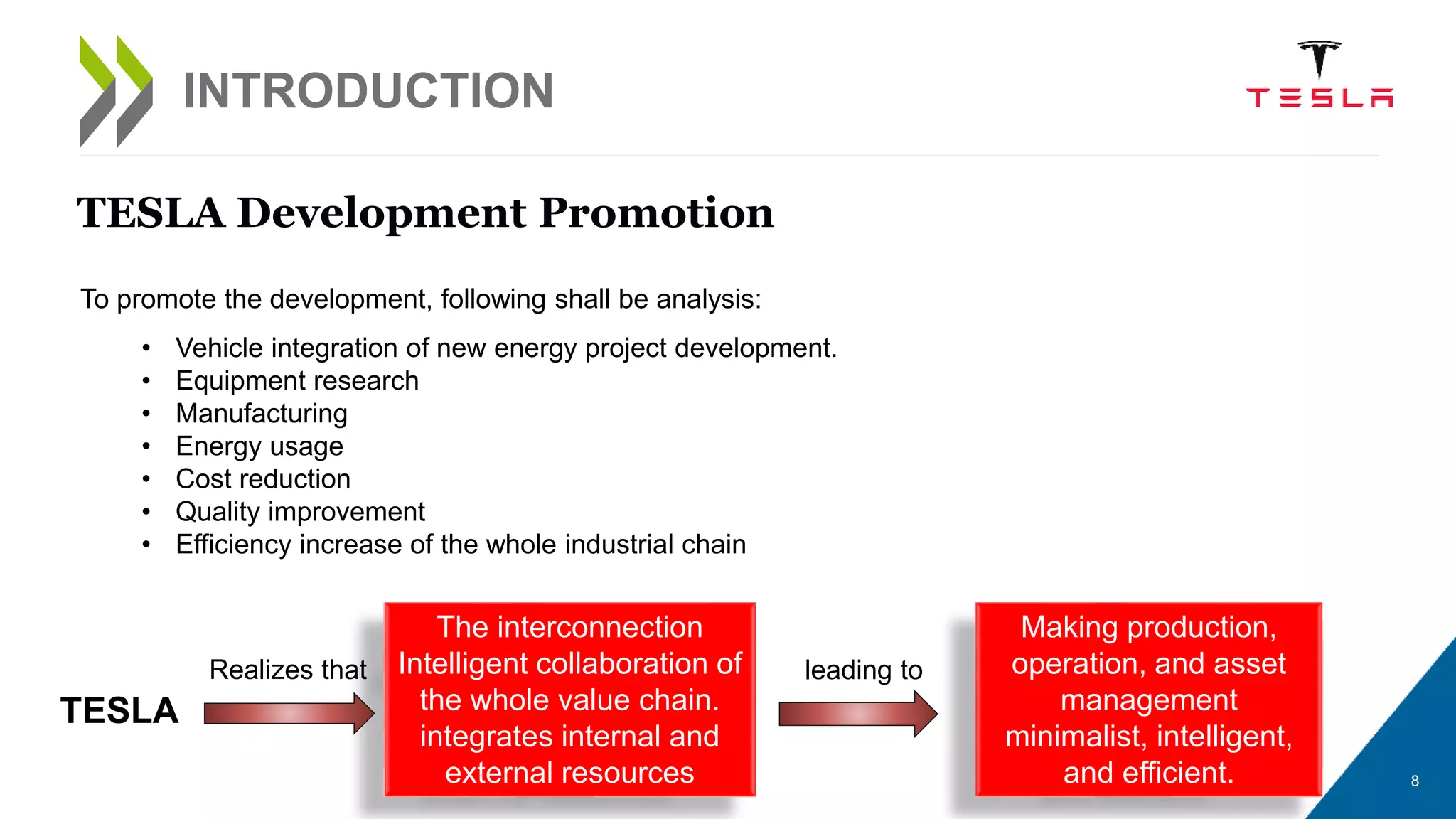
To promote the development, following shall be analysis:
TESLA Development Promotion
• Vehicle integration of new energy project development.
• Equipment research
• Manufacturing
• Energy usage
• Cost reduction
• Quality improvement
• Efficiency increase of the whole industrial chain
TESLA
The interconnection
Intelligent collaboration of
the whole value chain.
integrates internal and
external resources
leading to
Realizes that
Making production,
operation, and asset
management
minimalist, intelligent,
and efficient.
9
INTRODUCTION
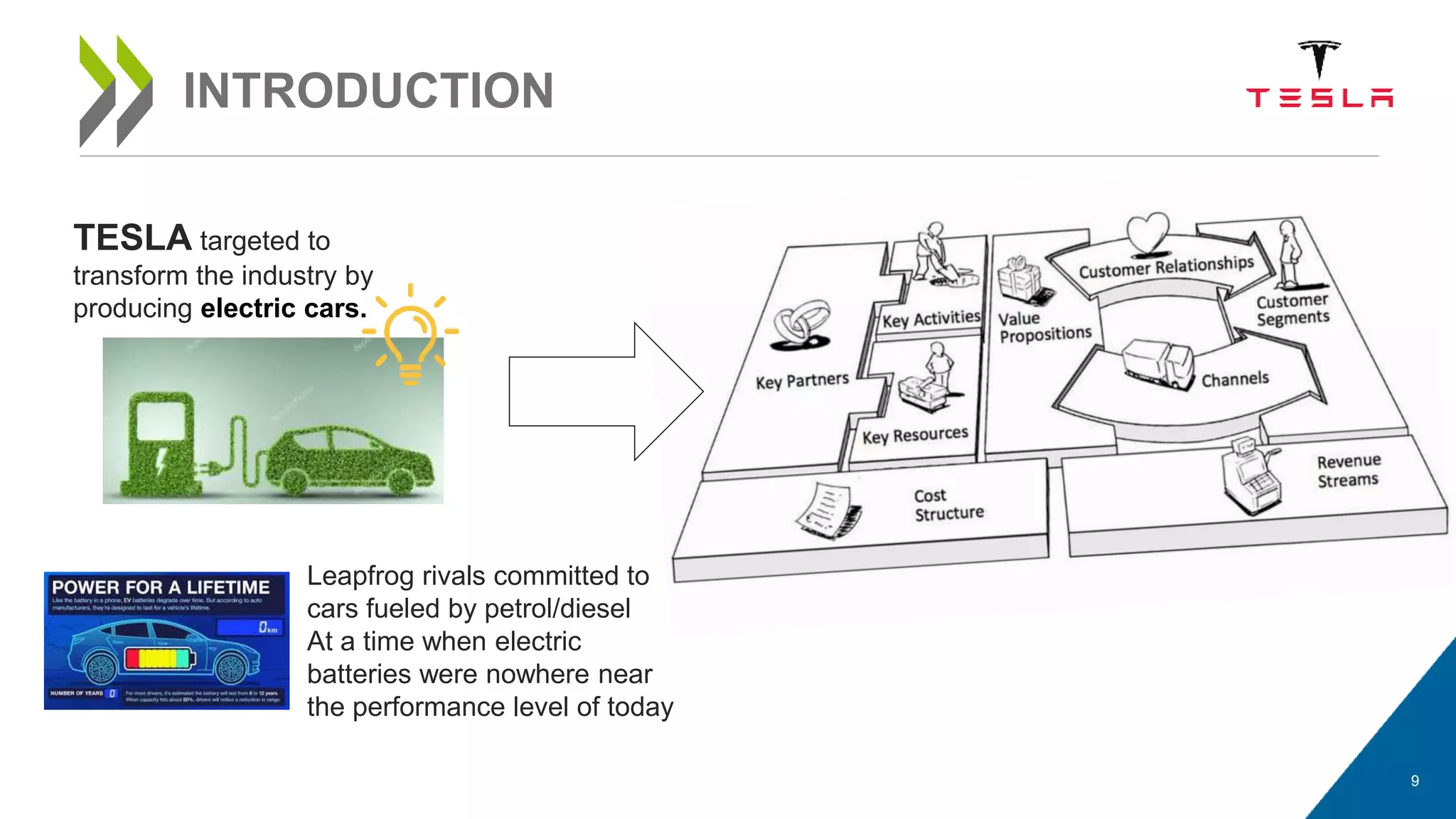
TESLA targeted to
transform the industry by
producing electric cars.
Leapfrog rivals committed to
cars fueled by petrol/diesel
At a time when electric
batteries were nowhere near
the performance level of today
PART 2
TESLA BUSINESS
MODEL ANALYSIS
Moataz Farouk 21126338
• Company’s message from day one was not that
an electric car could be good but that it could
be better
• Tesla started out as a transformative company
rather than one that has recently transformed
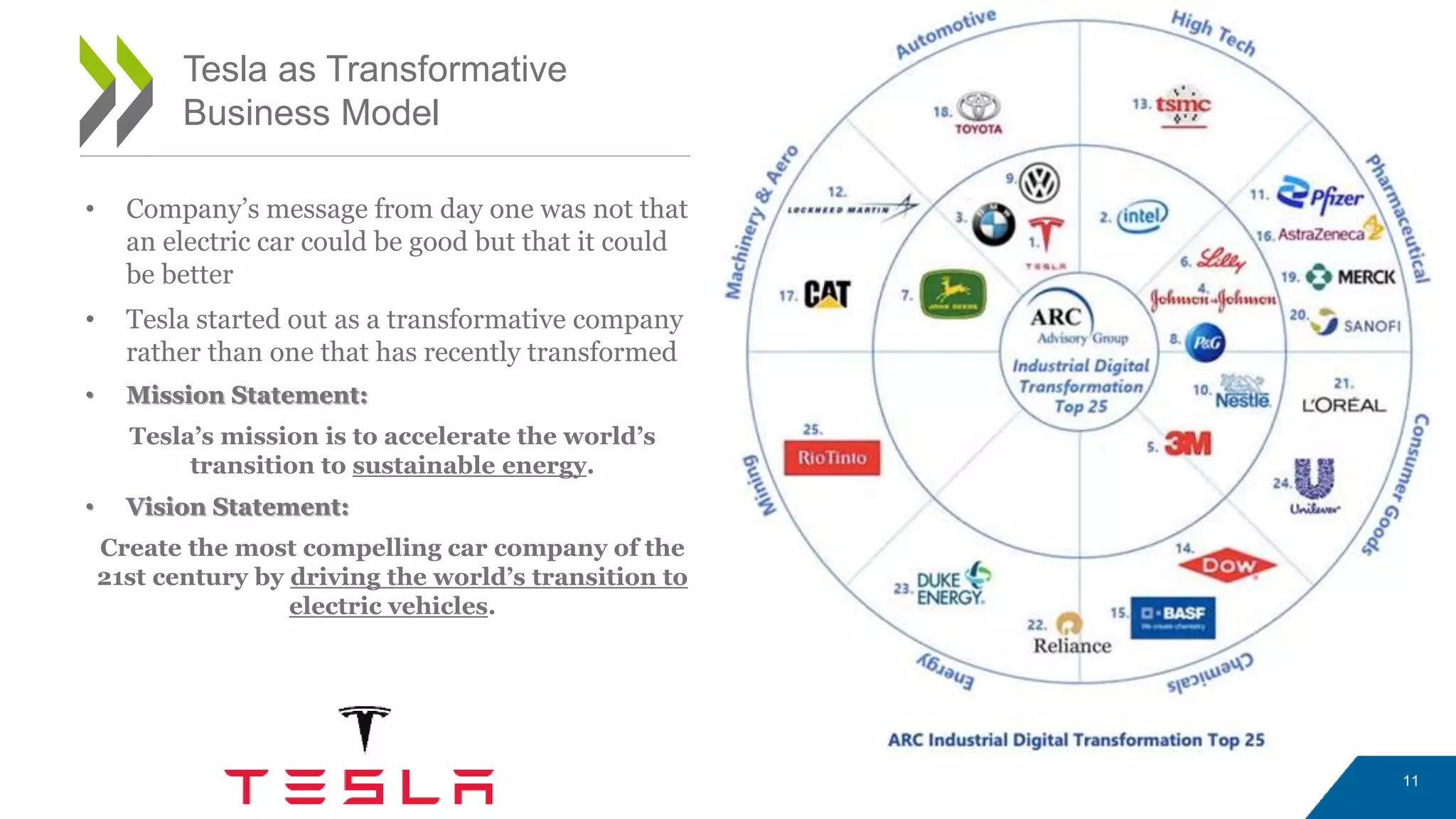
• Mission Statement:
Tesla’s mission is to accelerate the world’s
transition to sustainable energy.
• Vision Statement:
Create the most compelling car company of the
21st century by driving the world’s transition to
electric vehicles.
11
Tesla as Transformative
Business Model
12
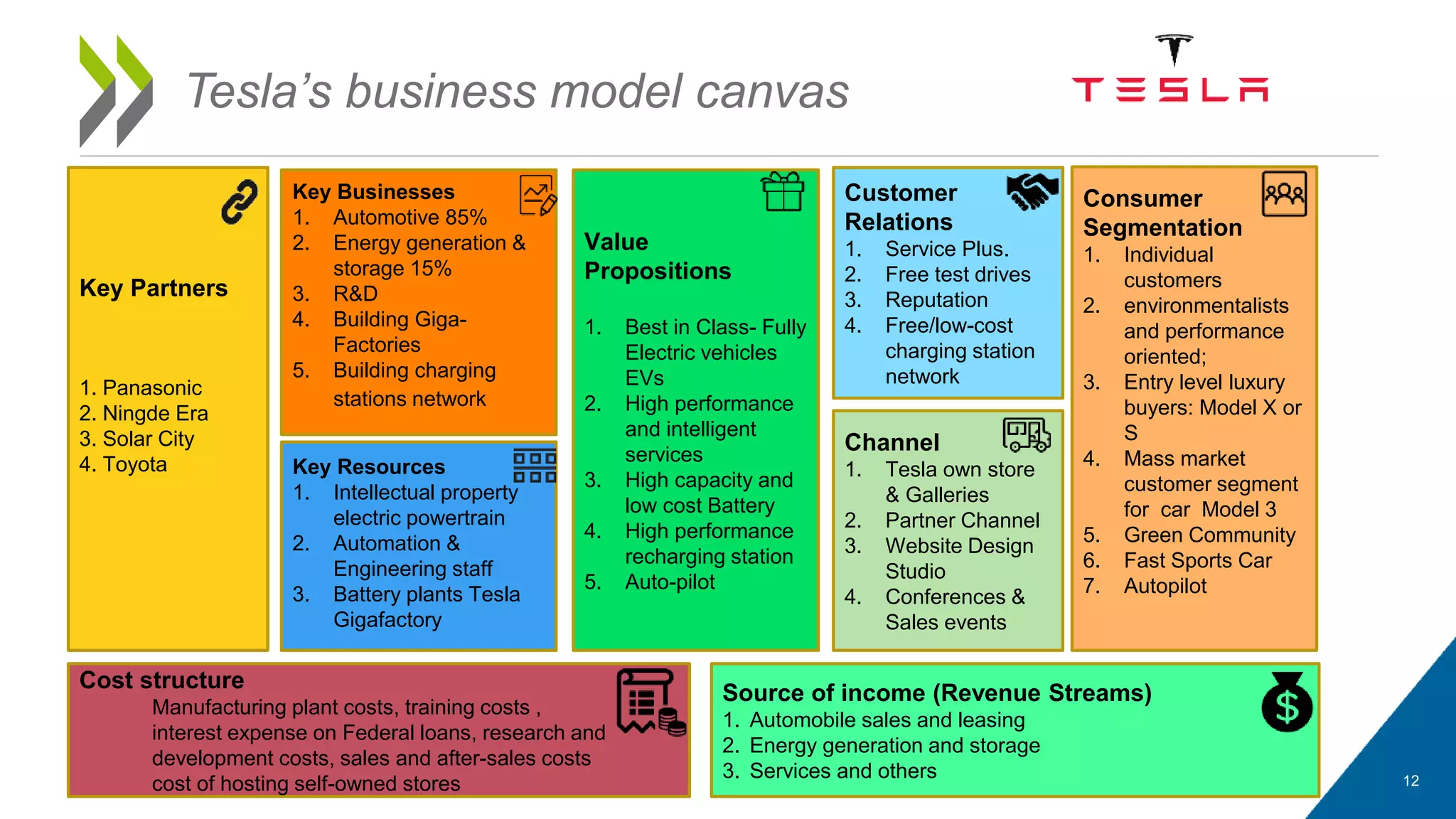
Tesla’s business model canvas
Key Partners
1. Panasonic
2. Ningde Era
3. Solar City
4. Toyota
Key Businesses
1. Automotive 85%
2. Energy generation &
storage 15%
3. R&D
4. Building Giga-
Factories
5. Building charging
stations network
Value
Propositions
1. Best in Class- Fully
Electric vehicles
EVs
2. High performance
and intelligent
services
3. High capacity and
low cost Battery
4. High performance
recharging station
5. Auto-pilot
Consumer
Segmentation
1. Individual
customers
2. environmentalists
and performance
oriented;
3. Entry level luxury
buyers: Model X or
S
4. Mass market
customer segment
for car Model 3
5. Green Community
6. Fast Sports Car
7. Autopilot
Source of income (Revenue Streams)
1. Automobile sales and leasing
2. Energy generation and storage
3. Services and others
Key Resources
1. Intellectual property
electric powertrain
2. Automation &
Engineering staff
3. Battery plants Tesla
Gigafactory
Channel
1. Tesla own store
& Galleries
2. Partner Channel
3. Website Design
Studio
4. Conferences &
Sales events
Customer
Relations
1. Service Plus.
2. Free test drives
3. Reputation
4. Free/low-cost
charging station
network
Cost structure
Manufacturing plant costs, training costs ,
interest expense on Federal loans, research and
development costs, sales and after-sales costs
cost of hosting self-owned stores
Key Partners
• More cars will be electric-only if the battery life is strong enough.
• Panasonic
– One of the key battery supply partners of Tesla.
– Battery performance is also very strong.
• Ningde Era (China)
– Is also one of Tesla's key battery partners.
– At the end of 2019, Ningde Era mode less battery pack with the new CTP
technology,
– Tesla's Model 3 series has The CTP battery of Ningde Era.
• Solar City
– Solar City specializes in solar cells. Tesla completed its acquisition in 2016
– Tesla aims to build an integrated, sustainable energy company with Solar
City
– Cover everything from energy creation and storage to energy
transportation and consumption
13
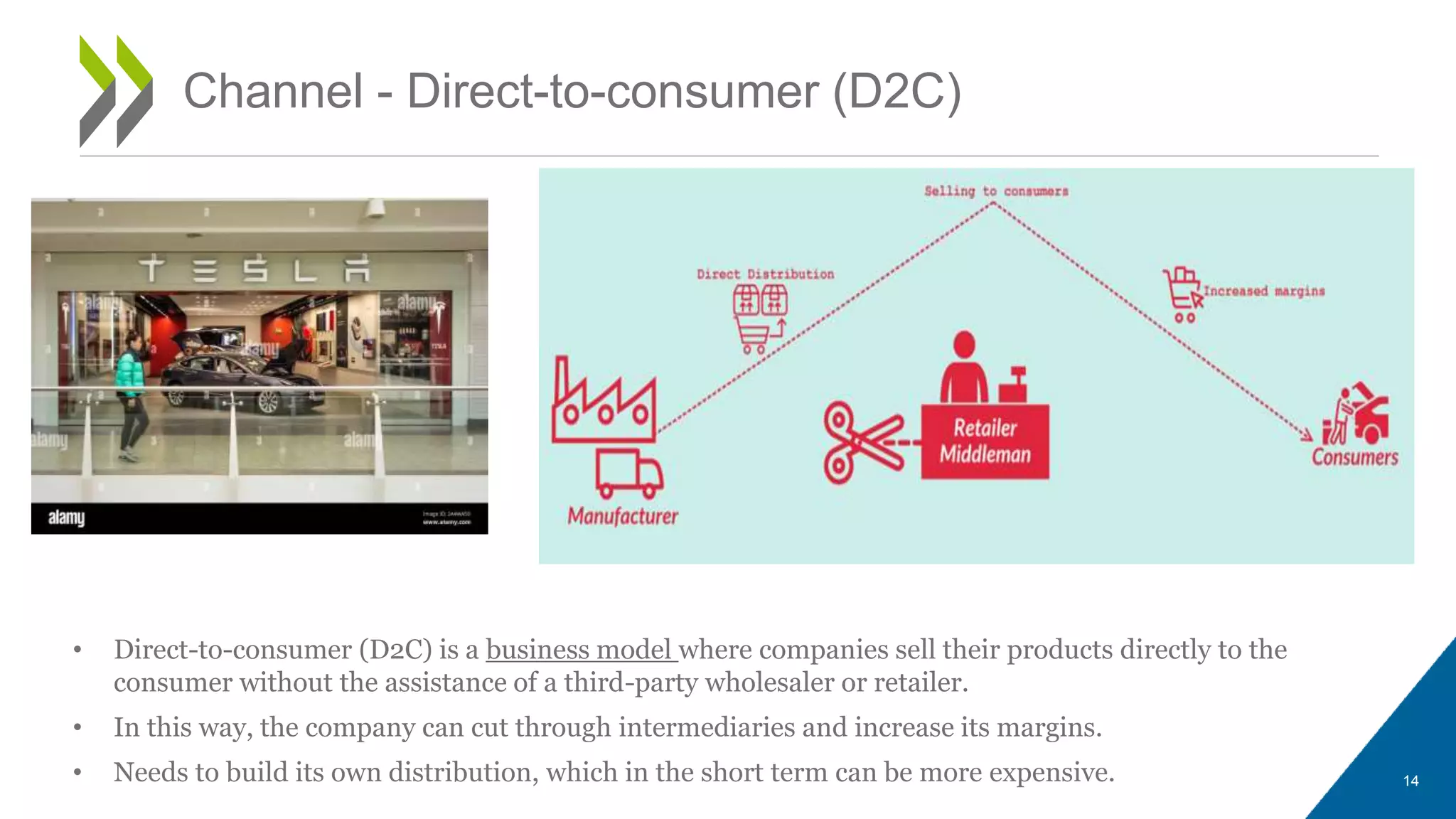
• Direct-to-consumer (D2C) is a business model where companies sell their products directly to the
consumer without the assistance of a third-party wholesaler or retailer.
• In this way, the company can cut through intermediaries and increase its margins.
• Needs to build its own distribution, which in the short term can be more expensive. 14
Channel - Direct-to-consumer (D2C)
Customer Segmentation
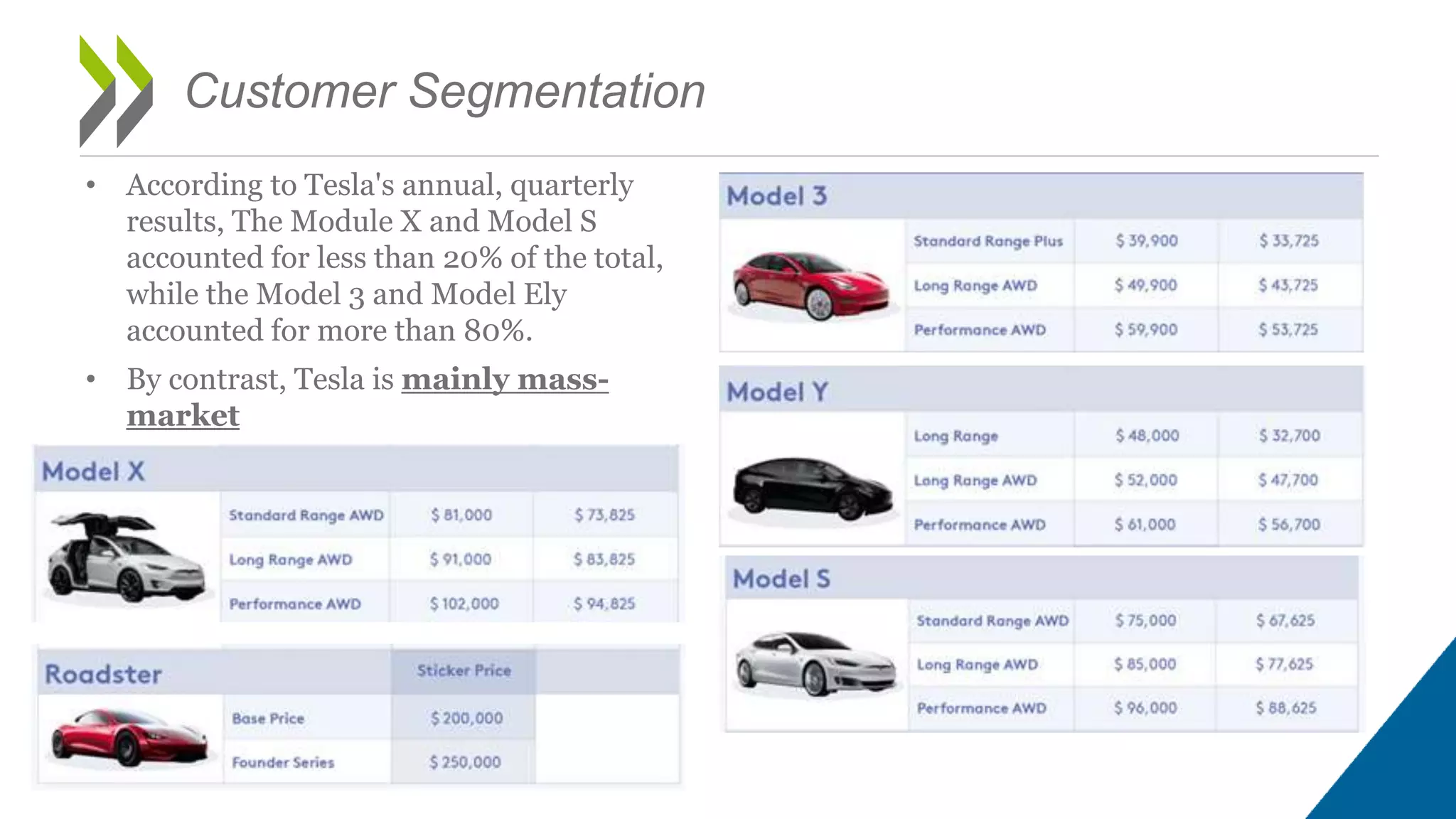
• According to Tesla's annual, quarterly
results, The Module X and Model S
accounted for less than 20% of the total,
while the Model 3 and Model Ely
accounted for more than 80%.
• By contrast, Tesla is mainly mass-
market
15
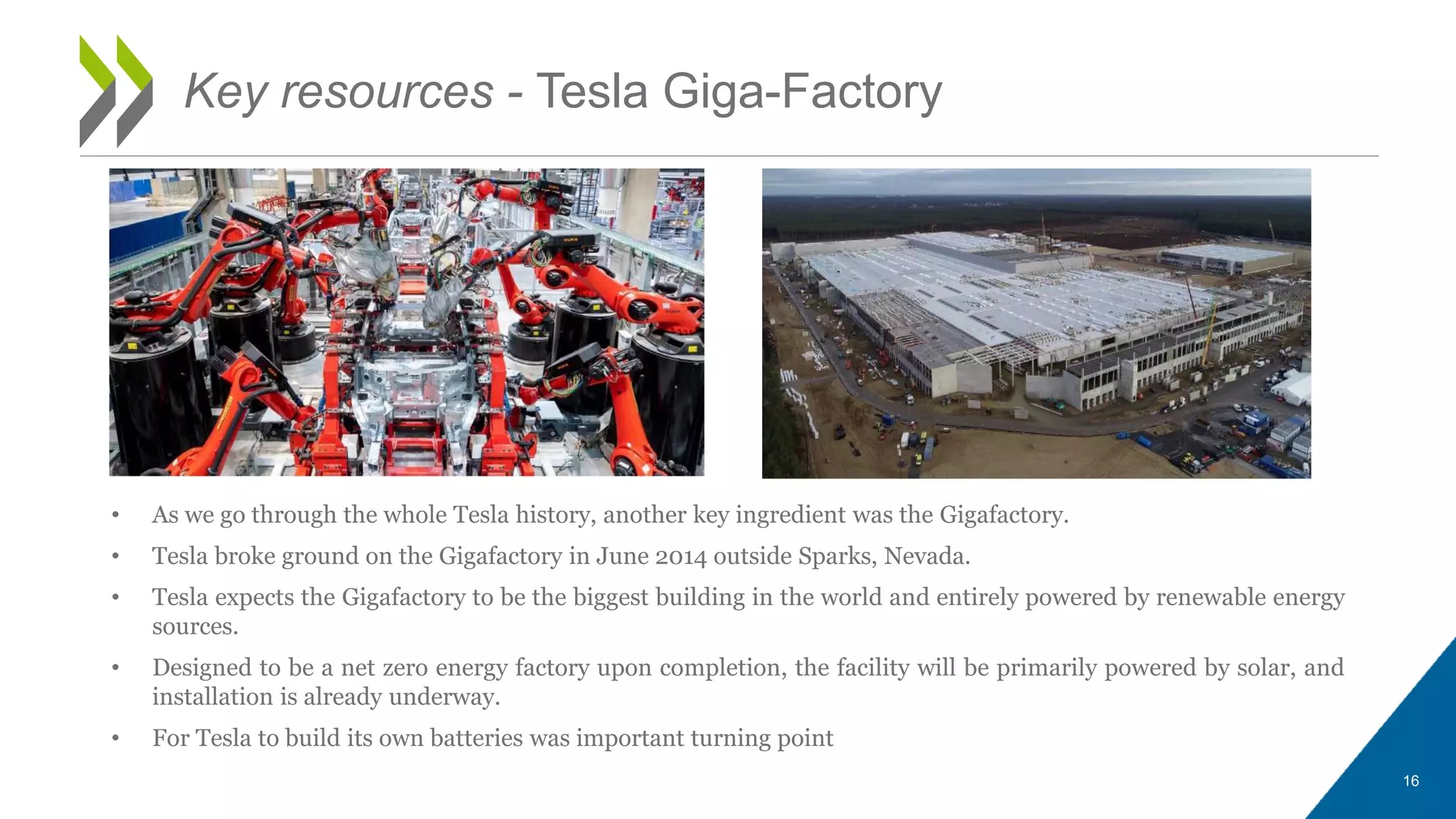
• As we go through the whole Tesla history, another key ingredient was the Gigafactory.
• Tesla broke ground on the Gigafactory in June 2014 outside Sparks, Nevada.
• Tesla expects the Gigafactory to be the biggest building in the world and entirely powered by renewable energy
sources.
• Designed to be a net zero energy factory upon completion, the facility will be primarily powered by solar, and
installation is already underway.
• For Tesla to build its own batteries was important turning point
16
Key resources - Tesla Giga-Factory
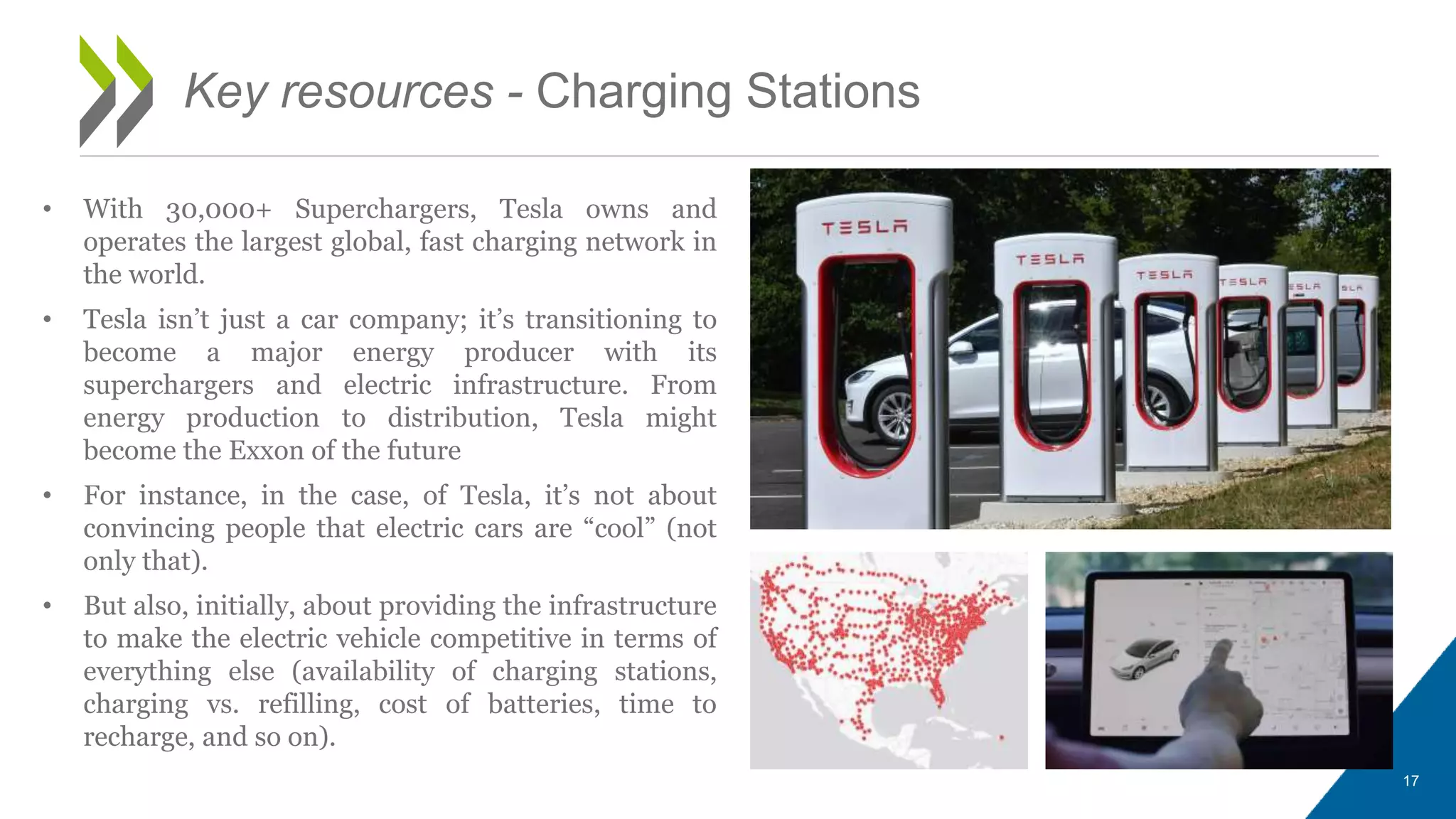
• With 30,000+ Superchargers, Tesla owns and
operates the largest global, fast charging network in
the world.
• Tesla isn’t just a car company; it’s transitioning to
become a major energy producer with its
superchargers and electric infrastructure. From
energy production to distribution, Tesla might
become the Exxon of the future
• For instance, in the case, of Tesla, it’s not about
convincing people that electric cars are “cool” (not
only that).
• But also, initially, about providing the infrastructure
to make the electric vehicle competitive in terms of
everything else (availability of charging stations,
charging vs. refilling, cost of batteries, time to
recharge, and so on).
17
Key resources - Charging Stations
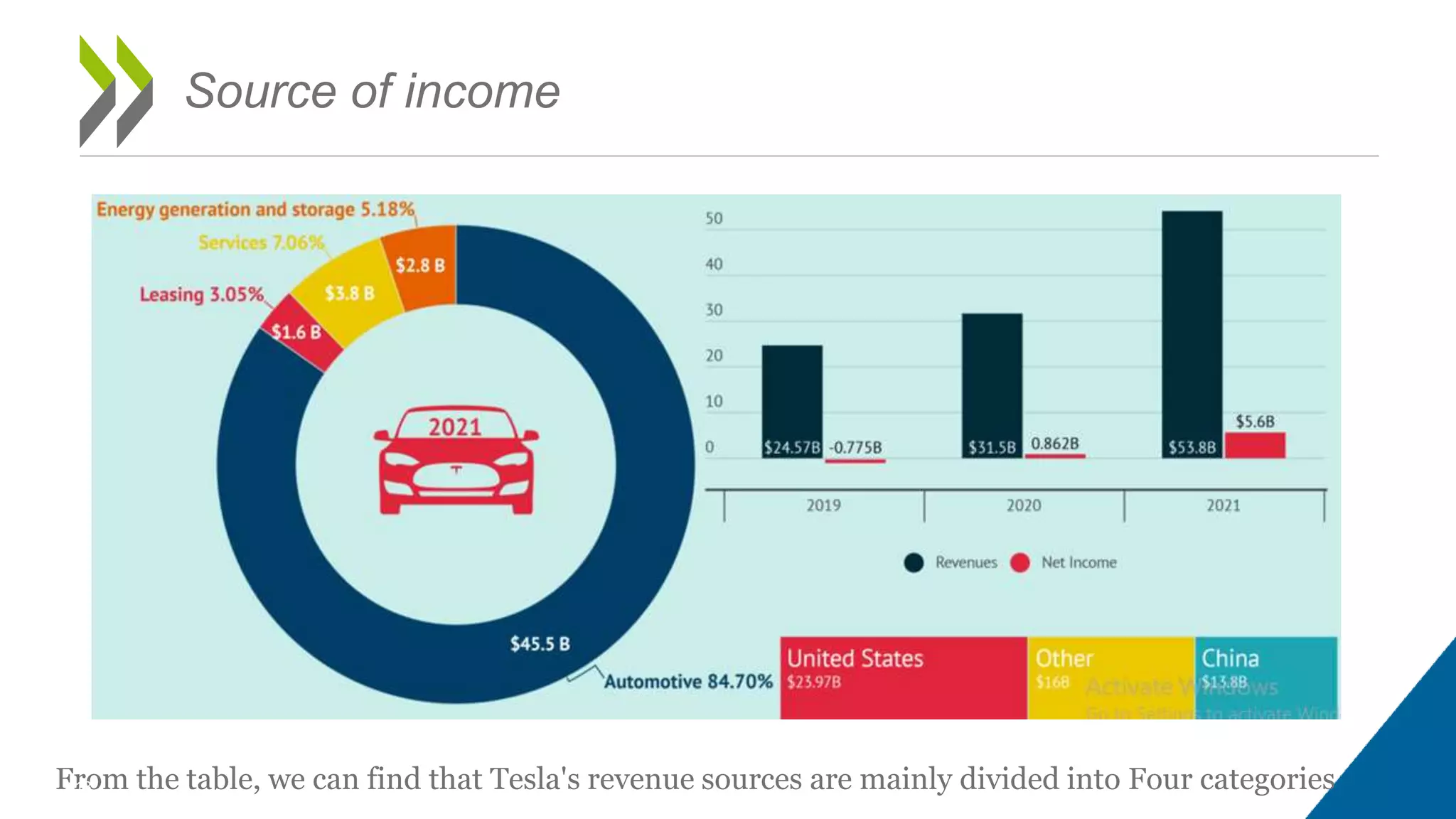
Source of income
From the table, we can find that Tesla's revenue sources are mainly divided into Four categories
18
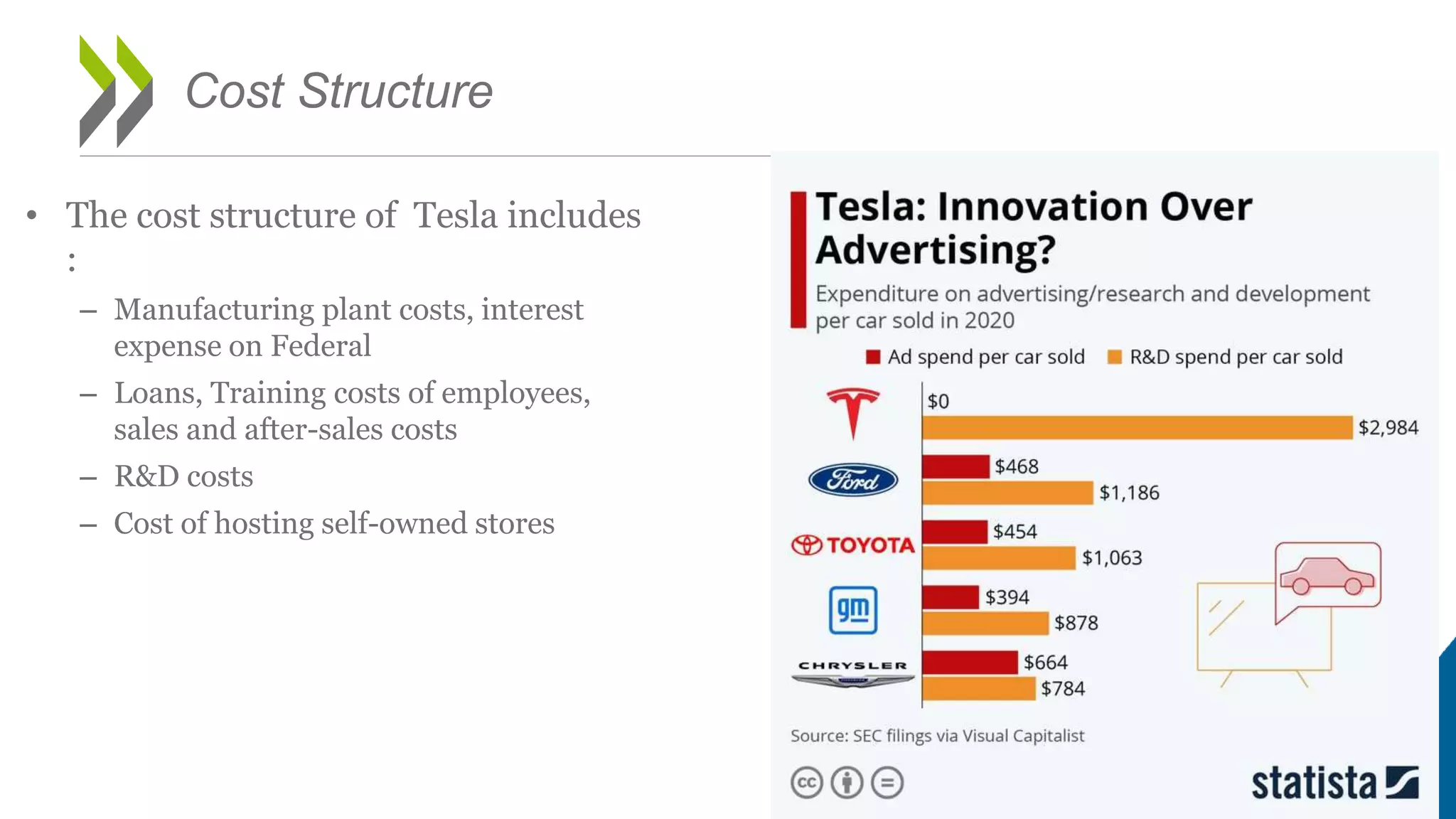
Cost Structure
• The cost structure of Tesla includes
:
– Manufacturing plant costs, interest
expense on Federal
– Loans, Training costs of employees,
sales and after-sales costs
– R&D costs
– Cost of hosting self-owned stores
19
20
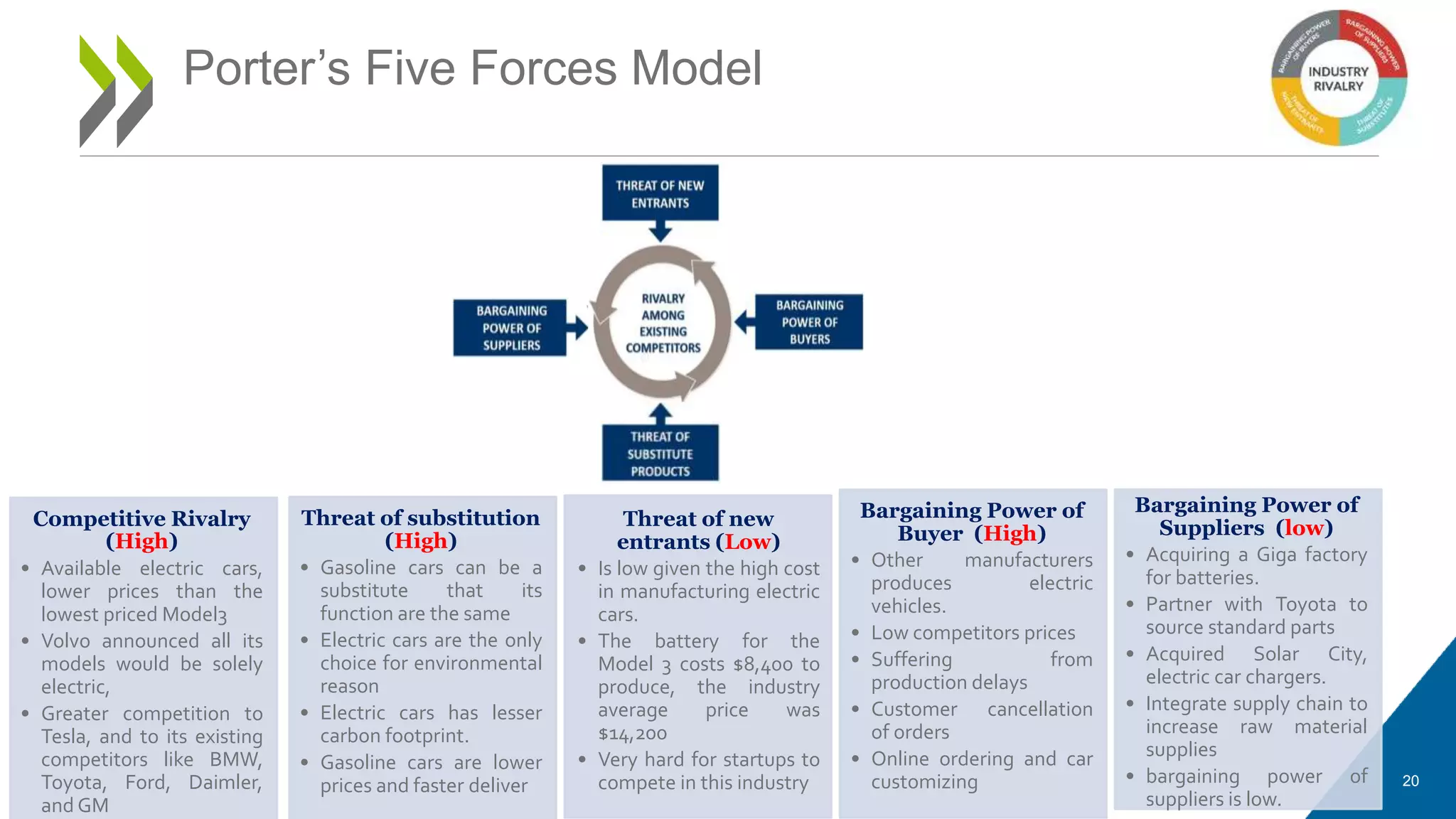
Porter’s Five Forces Model
Bargaining Power of
Buyer (High)
• Other manufacturers
produces electric
vehicles.
• Low competitors prices
• Suffering from
production delays
• Customer cancellation
of orders
• Online ordering and car
customizing
Bargaining Power of
Suppliers (low)
• Acquiring a Giga factory
for batteries.
• Partner with Toyota to
source standard parts
• Acquired Solar City,
electric car chargers.
• Integrate supply chain to
increase raw material
supplies
• bargaining power of
suppliers is low.
Competitive Rivalry
(High)
• Available electric cars,
lower prices than the
lowest priced Model3
• Volvo announced all its
models would be solely
electric,
• Greater competition to
Tesla, and to its existing
competitors like BMW,
Toyota, Ford, Daimler,
and GM
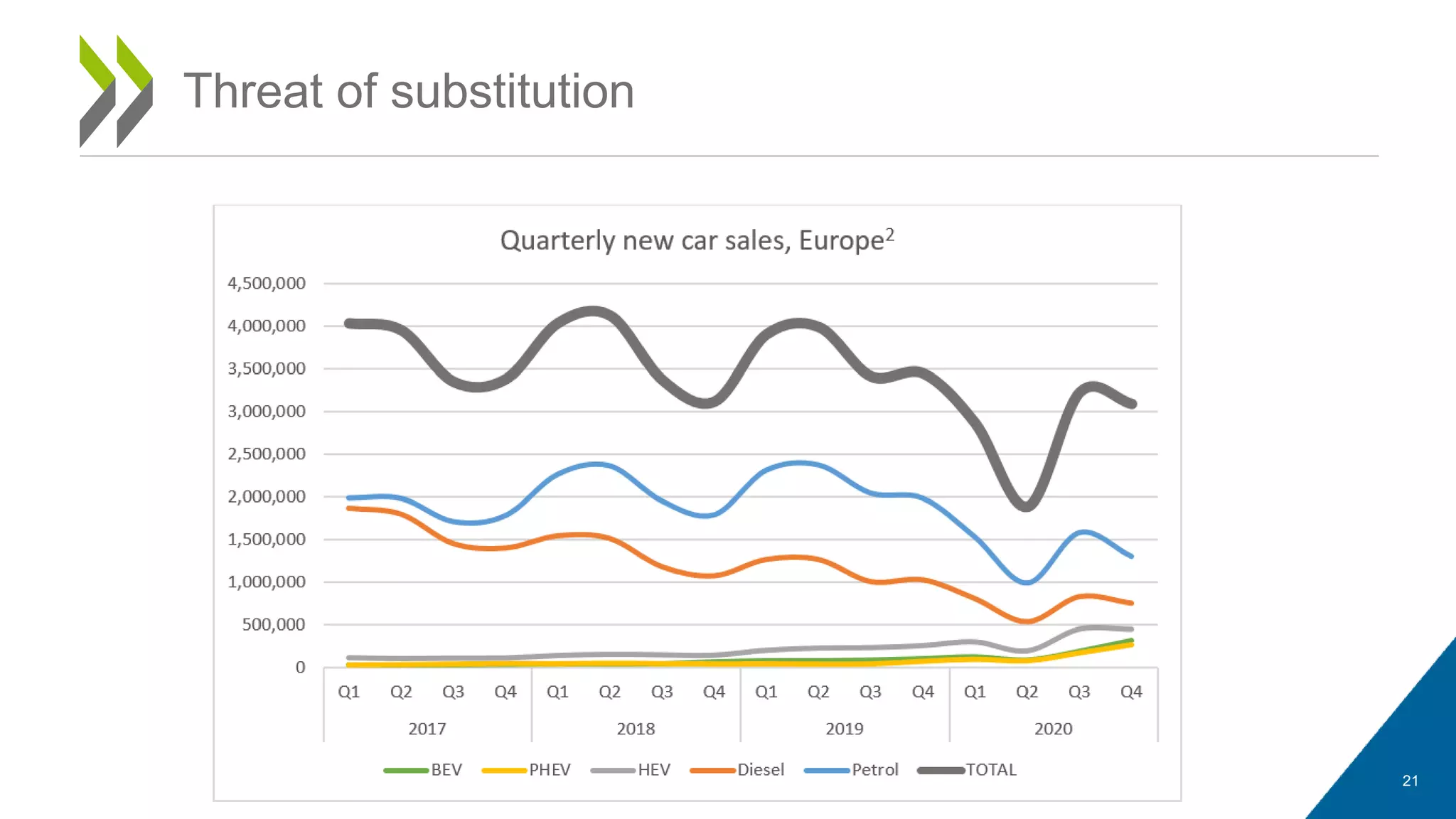
Threat of substitution
(High)
• Gasoline cars can be a
substitute that its
function are the same
• Electric cars are the only
choice for environmental
reason
• Electric cars has lesser
carbon footprint.
• Gasoline cars are lower
prices and faster deliver
Threat of new
entrants (Low)
• Is low given the high cost
in manufacturing electric
cars.
• The battery for the
Model 3 costs $8,400 to
produce, the industry
average price was
$14,200
• Very hard for startups to
compete in this industry
21
Threat of substitution
22
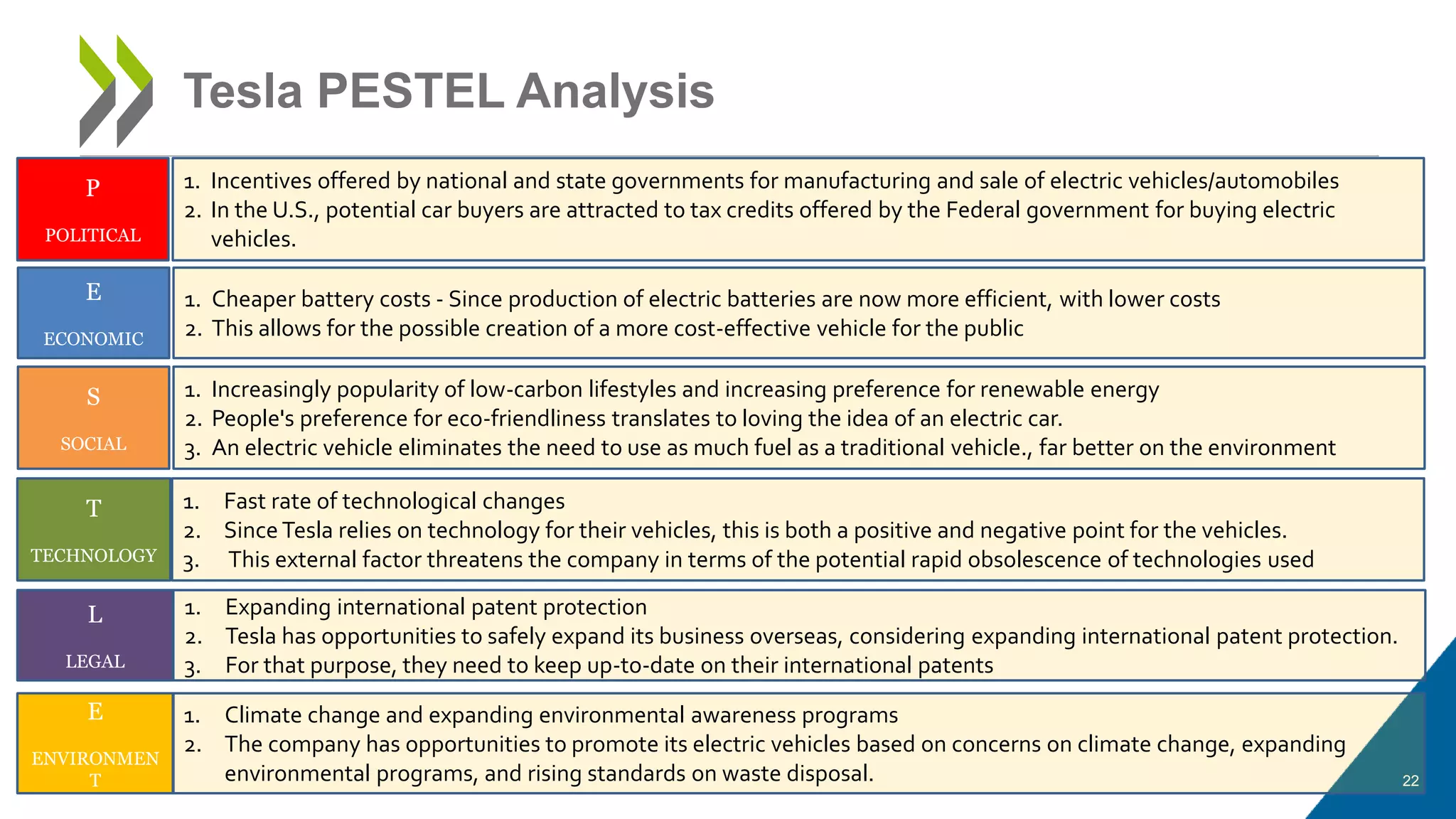
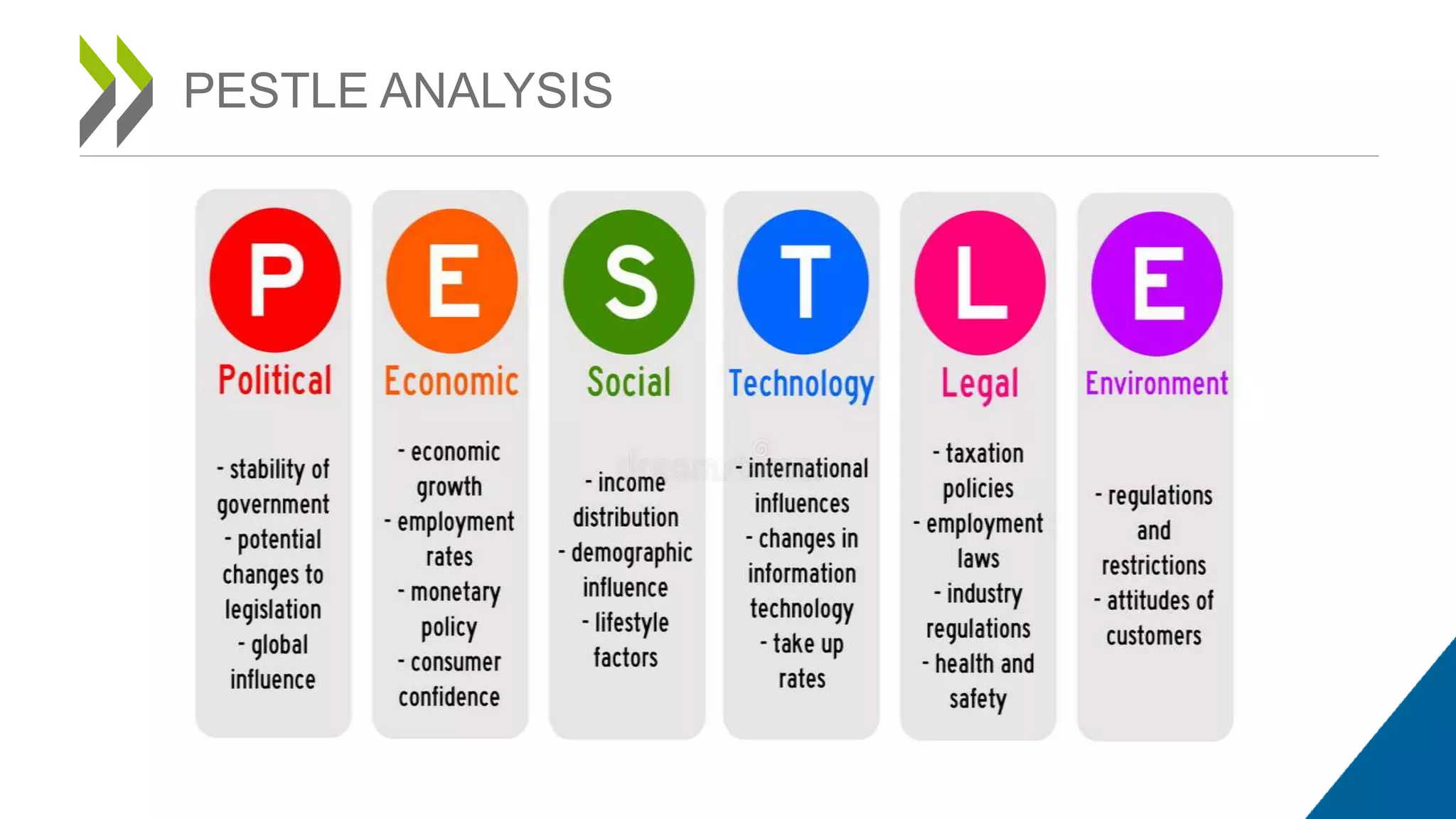
Tesla PESTEL Analysis
P
POLITICAL
E
ECONOMIC
S
SOCIAL
T
TECHNOLOGY
L
LEGAL
E
ENVIRONMEN
T
1. Incentives offered by national and state governments for manufacturing and sale of electric vehicles/automobiles
2. In the U.S., potential car buyers are attracted to tax credits offered by the Federal government for buying electric
vehicles.
1. Cheaper battery costs - Since production of electric batteries are now more efficient, with lower costs
2. This allows for the possible creation of a more cost-effective vehicle for the public
1. Increasingly popularity of low-carbon lifestyles and increasing preference for renewable energy
2. People's preference for eco-friendliness translates to loving the idea of an electric car.
3. An electric vehicle eliminates the need to use as much fuel as a traditional vehicle., far better on the environment
1. Fast rate of technological changes
2. Since Tesla relies on technology for their vehicles, this is both a positive and negative point for the vehicles.
3. This external factor threatens the company in terms of the potential rapid obsolescence of technologies used
1. Expanding international patent protection
2. Tesla has opportunities to safely expand its business overseas, considering expanding international patent protection.
3. For that purpose, they need to keep up-to-date on their international patents
1. Climate change and expanding environmental awareness programs
2. The company has opportunities to promote its electric vehicles based on concerns on climate change, expanding
environmental programs, and rising standards on waste disposal.
23
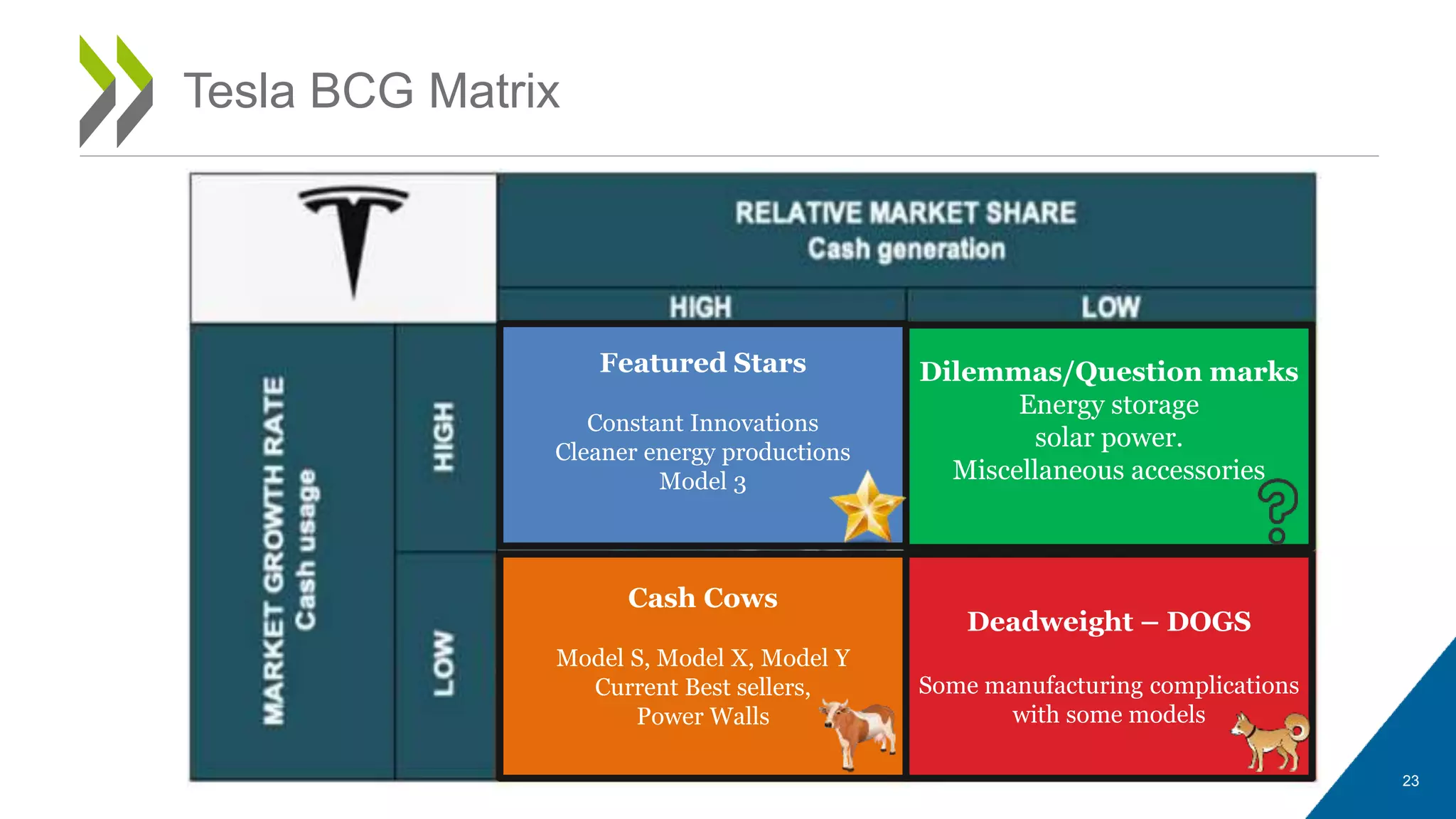
Tesla BCG Matrix
Dilemmas/Question marks
Energy storage
solar power.
Miscellaneous accessories
Cash Cows
Model S, Model X, Model Y
Current Best sellers,
Power Walls
Deadweight – DOGS
Some manufacturing complications
with some models
Featured Stars
Constant Innovations
Cleaner energy productions
Model 3
24
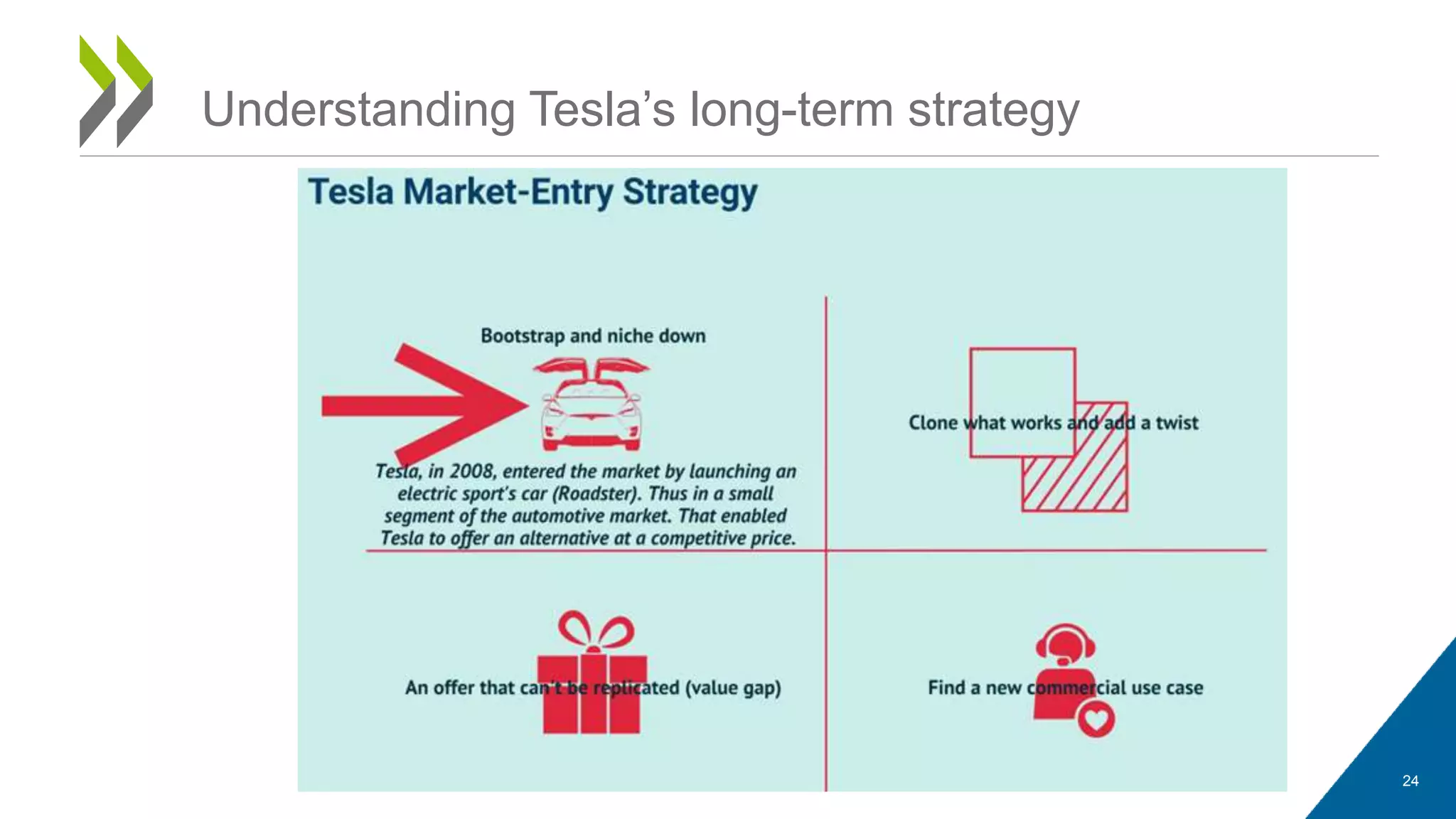
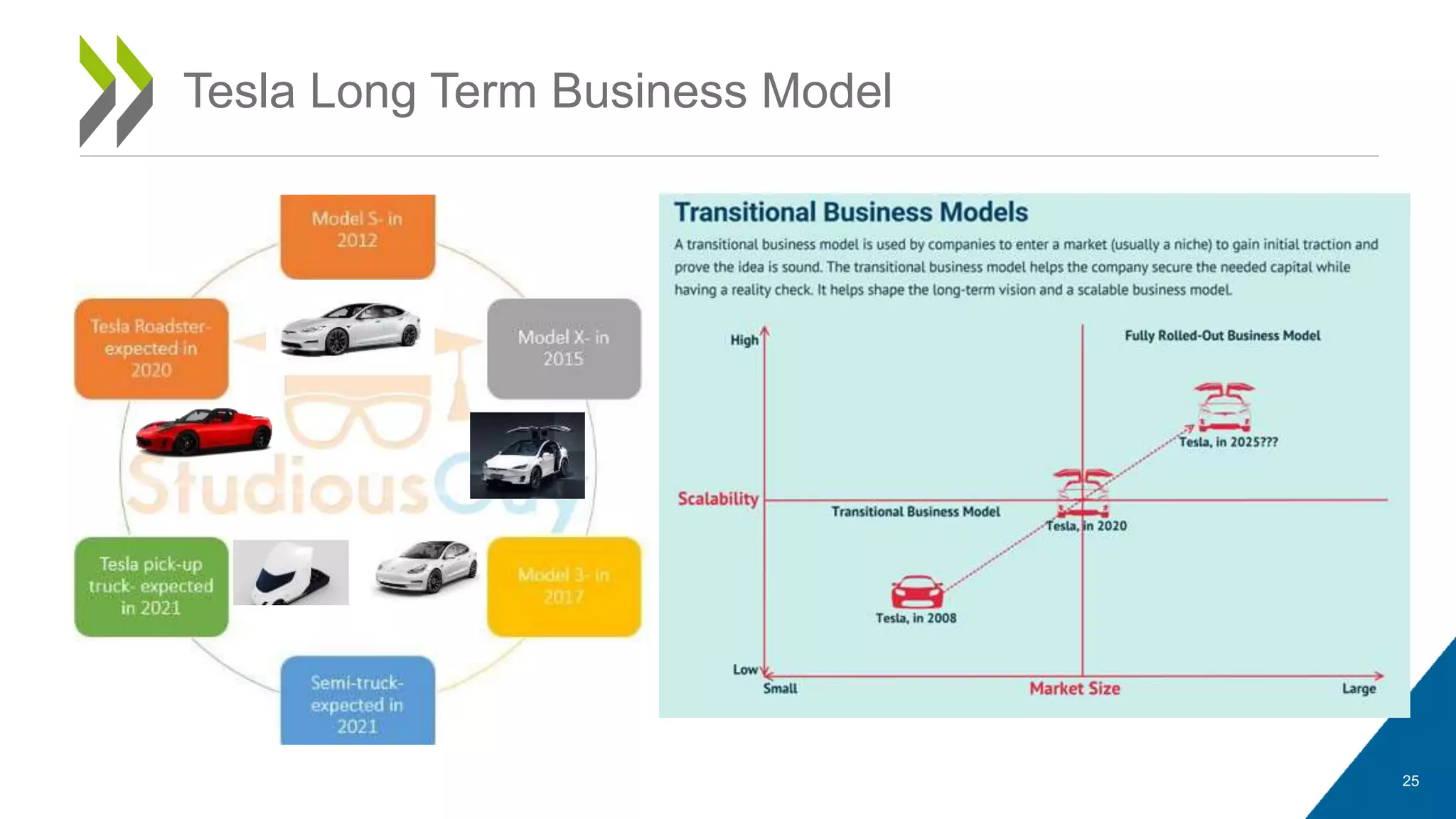
Understanding Tesla’s long-term strategy
25
Tesla Long Term Business Model
PART 3
TOYOTA BUSINESS
MODEL ANALYSIS
Mohamed Ibrahim 21125215
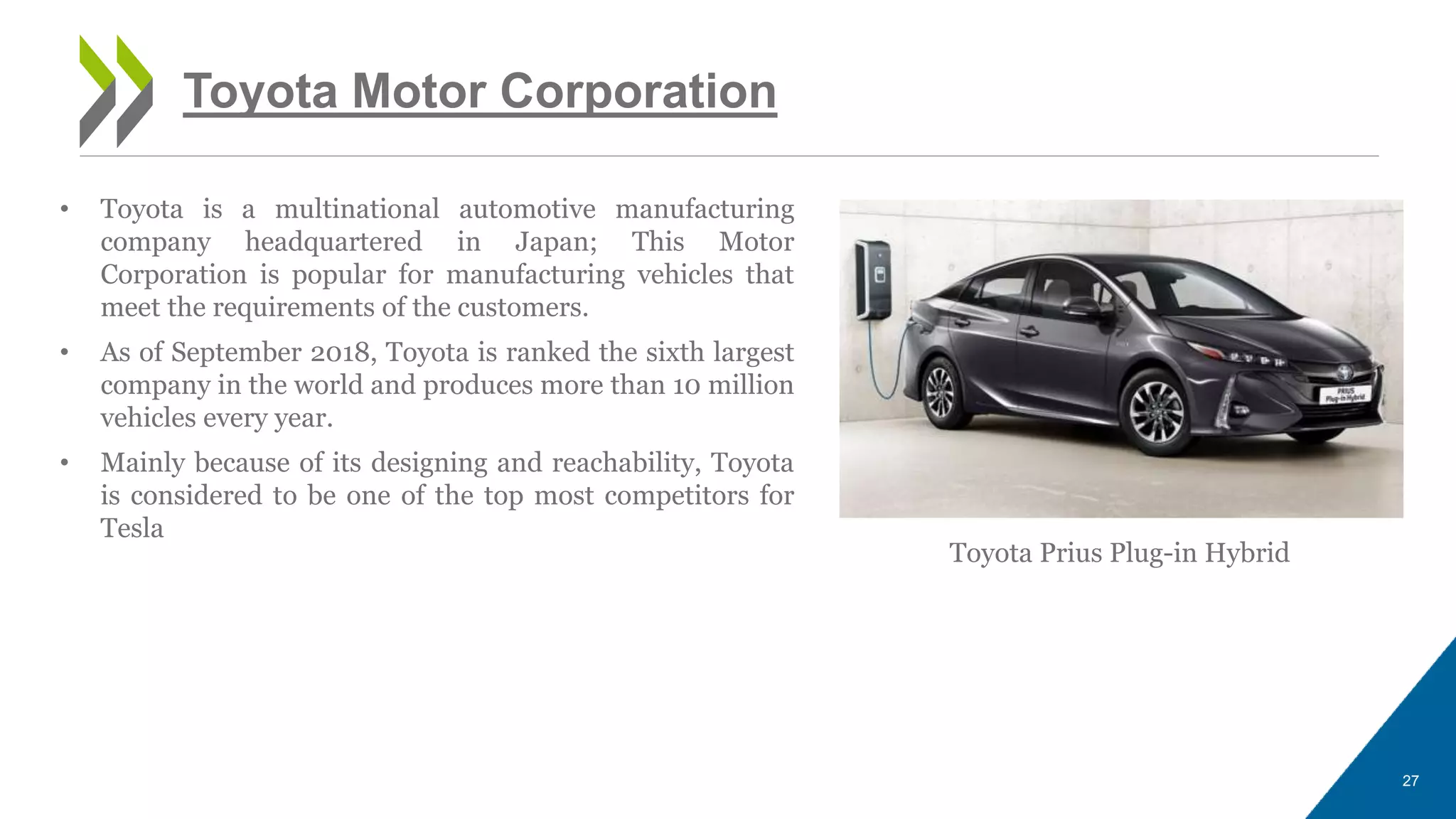
• Toyota is a multinational automotive manufacturing
company headquartered in Japan; This Motor
Corporation is popular for manufacturing vehicles that
meet the requirements of the customers.
• As of September 2018, Toyota is ranked the sixth largest
company in the world and produces more than 10 million
vehicles every year.
• Mainly because of its designing and reachability, Toyota
is considered to be one of the top most competitors for
Tesla
27
Toyota Motor Corporation
Toyota Prius Plug-in Hybrid
28
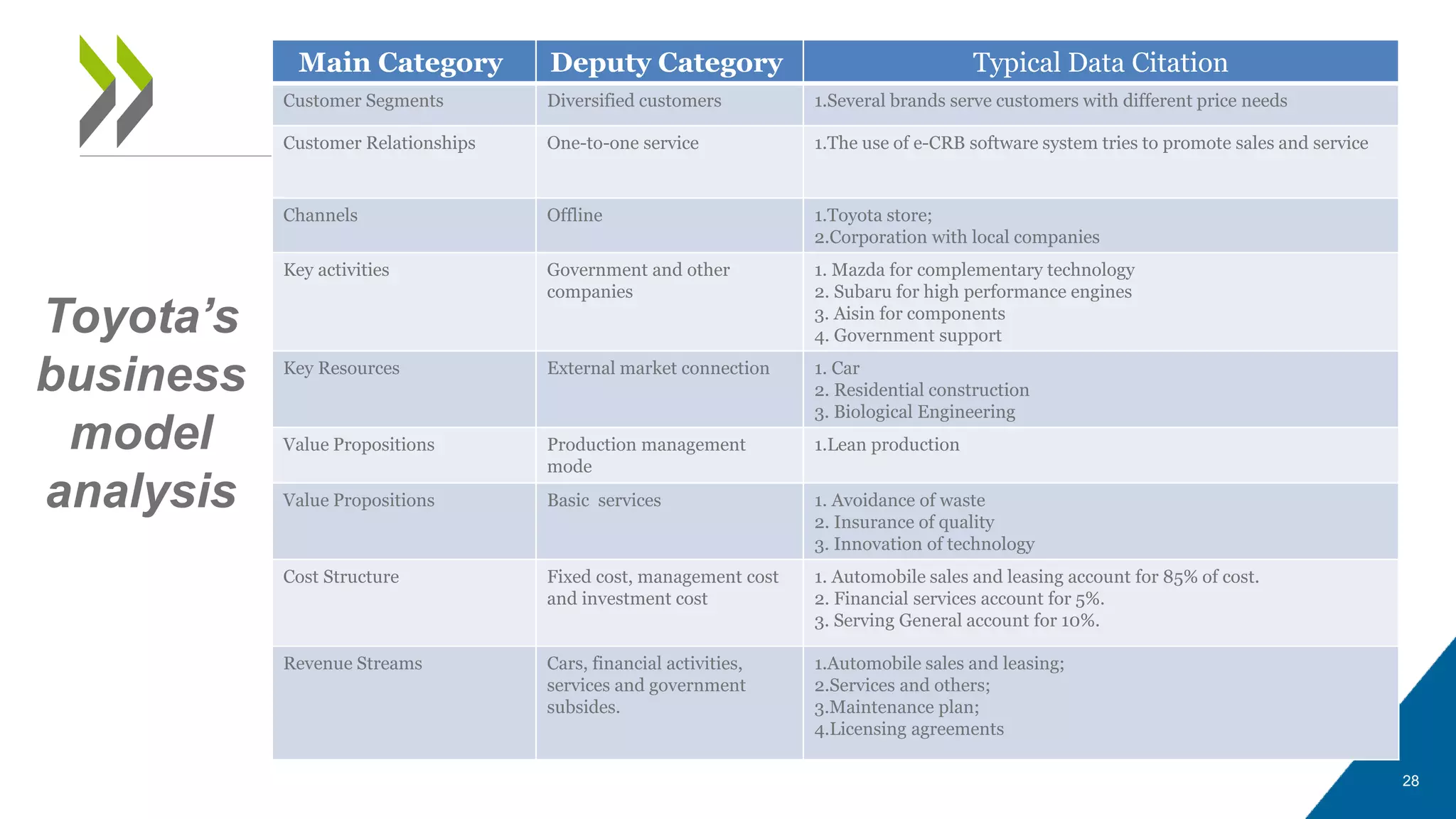
Toyota’s
business
model
analysis
Typical Data Citation
Deputy Category
Main Category
1.Several brands serve customers with different price needs
Diversified customers
Customer Segments
1.The use of e-CRB software system tries to promote sales and service
One-to-one service
Customer Relationships
1.Toyota store;
2.Corporation with local companies
Offline
Channels
1. Mazda for complementary technology
2. Subaru for high performance engines
3. Aisin for components
4. Government support
Government and other
companies
Key activities
1. Car
2. Residential construction
3. Biological Engineering
External market connection
Key Resources
1.Lean production
Production management
mode
Value Propositions
1. Avoidance of waste
2. Insurance of quality
3. Innovation of technology
Basic services
Value Propositions
1. Automobile sales and leasing account for 85% of cost.
2. Financial services account for 5%.
3. Serving General account for 10%.
Fixed cost, management cost
and investment cost
Cost Structure
1.Automobile sales and leasing;
2.Services and others;
3.Maintenance plan;
4.Licensing agreements
Cars, financial activities,
services and government
subsides.
Revenue Streams
• Toyota focuses on the customer and tries to a minimum the cost and time of production.
When applying the Toyota Production Method, the manufacturing process must first be
viewed from the customer's perspective, both internal at the later stages of the production
line and external to the final product.
• In the Toyota way, the first question to think about is, "What does the customer want out of
the process? "The thinking on this question is going to define value. From the customer's
point of view, you can look at a process and distinguish between activities and steps that
create value and activities and steps that don't.
• Toyota applies this approach to any process, be it manufacturing, information, or service.
What Toyota does is pay attention to the operation time between receiving the customer's
order and collecting the customer's account to eliminate the waste that cannot create value
and shorten the operation time.
29
Toyota’s business model analysis
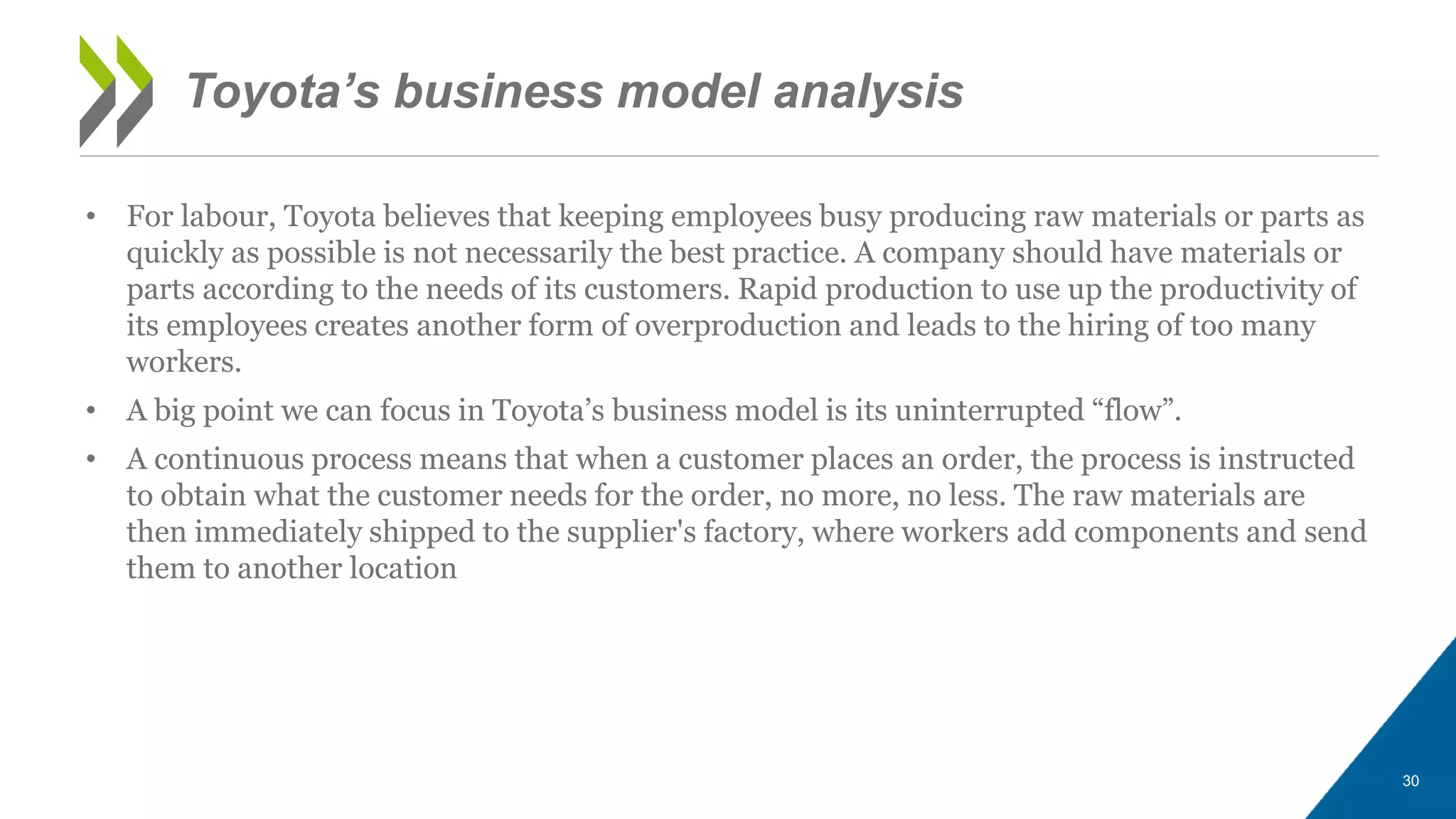
• For labour, Toyota believes that keeping employees busy producing raw materials or parts as
quickly as possible is not necessarily the best practice. A company should have materials or
parts according to the needs of its customers. Rapid production to use up the productivity of
its employees creates another form of overproduction and leads to the hiring of too many
workers.
• A big point we can focus in Toyota’s business model is its uninterrupted “flow”.
• A continuous process means that when a customer places an order, the process is instructed
to obtain what the customer needs for the order, no more, no less. The raw materials are
then immediately shipped to the supplier's factory, where workers add components and send
them to another location
30
Toyota’s business model analysis
• The factory, which is assembled by workers immediately, completes the products required by the customer's order
and finally delivers them directly to the customer. The whole process will take hours or days, not weeks or months.
One example of this is that Toyota takes less than a year, on average, to launch a car in Japan, compared with two
years for its competitors, because its engineering operations are conducted in a non-stop flow model.
• From the beginning to the end of the automotive design process, the engineering work, design decisions,
prototyping, and tool building all form a seamless flow and "communication." In this kind of process, nothing is
produced upstream unless the person or step downstream of the process asks for it.
• Of course, the ideal of "one flow" is not an overnight reality, and Toyota is a fact-facing company. It will not simply
tie the machine and the supplier together in an inappropriate place to force the implementation of "one flow". While
it is not possible to do this today, the ideal of non-interrupted processes provides a clear direction.
31
Toyota’s business model analysis
• At Toyota, this means using smaller batches, bringing all the processes closer to each other,
and allowing materials to move between them without interruption, rather than mass
production that results in piles of waiting for inventory.
• Toyota's managers and engineers do not need to perform a detailed cost-benefit analysis
every time they want to perform a task to improve the process. Cost is, of course, a major
consideration, but their philosophy is that wherever you can build a continuous process, go
ahead and keep improving it to make it work better.
• Even where "one flow" is not possible and Toyota must strategically build up inventory as a
buffer, it still tries to reduce inventory to improve processes
32
Toyota’s business model analysis
PART 4
BMW
BM,PESTLE AND
PORTER ANALYSIS
Amr Mansour 21126657
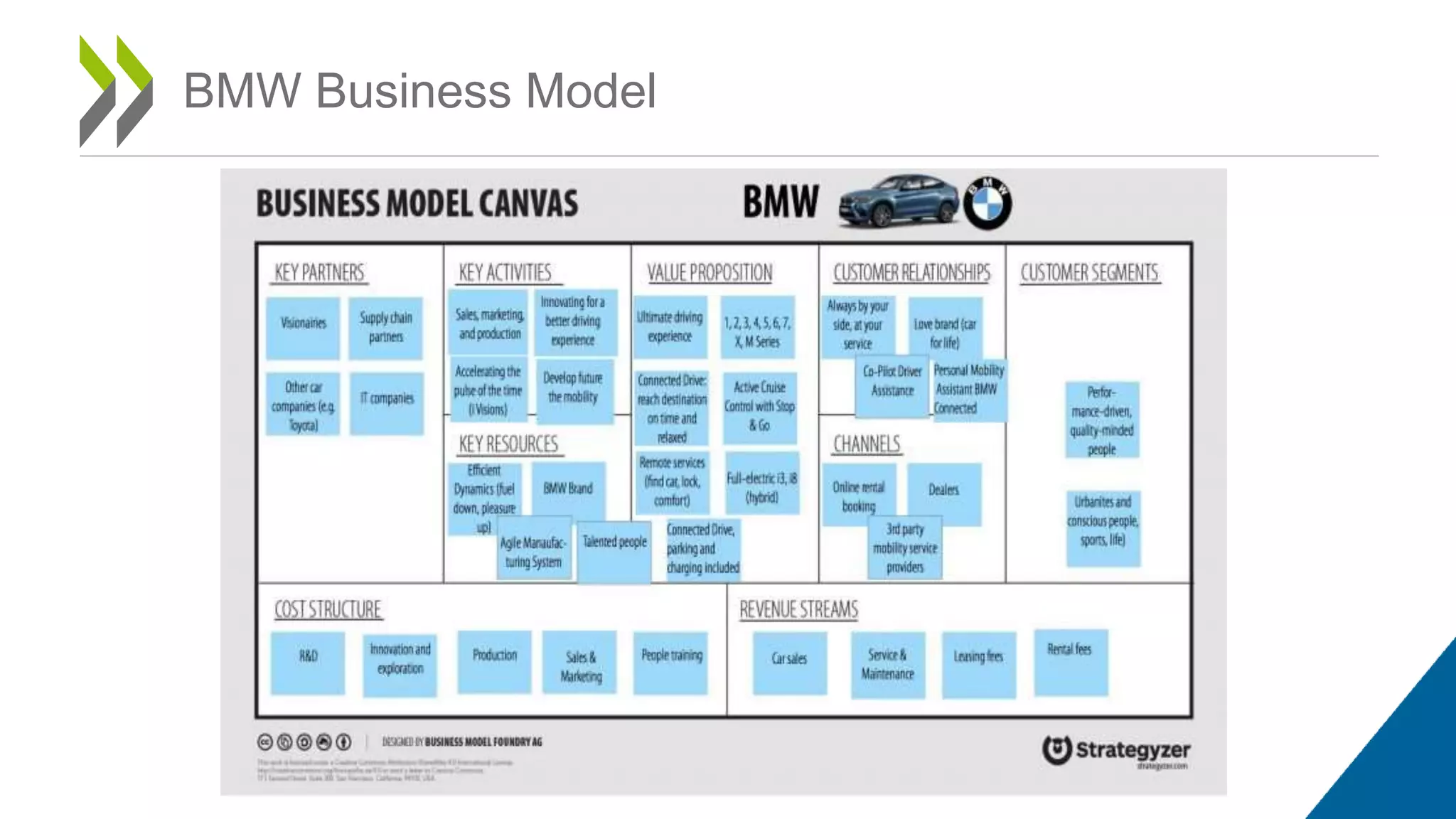
BMW Business Model
PESTLE ANALYSIS
PESTLE ANALYSIS
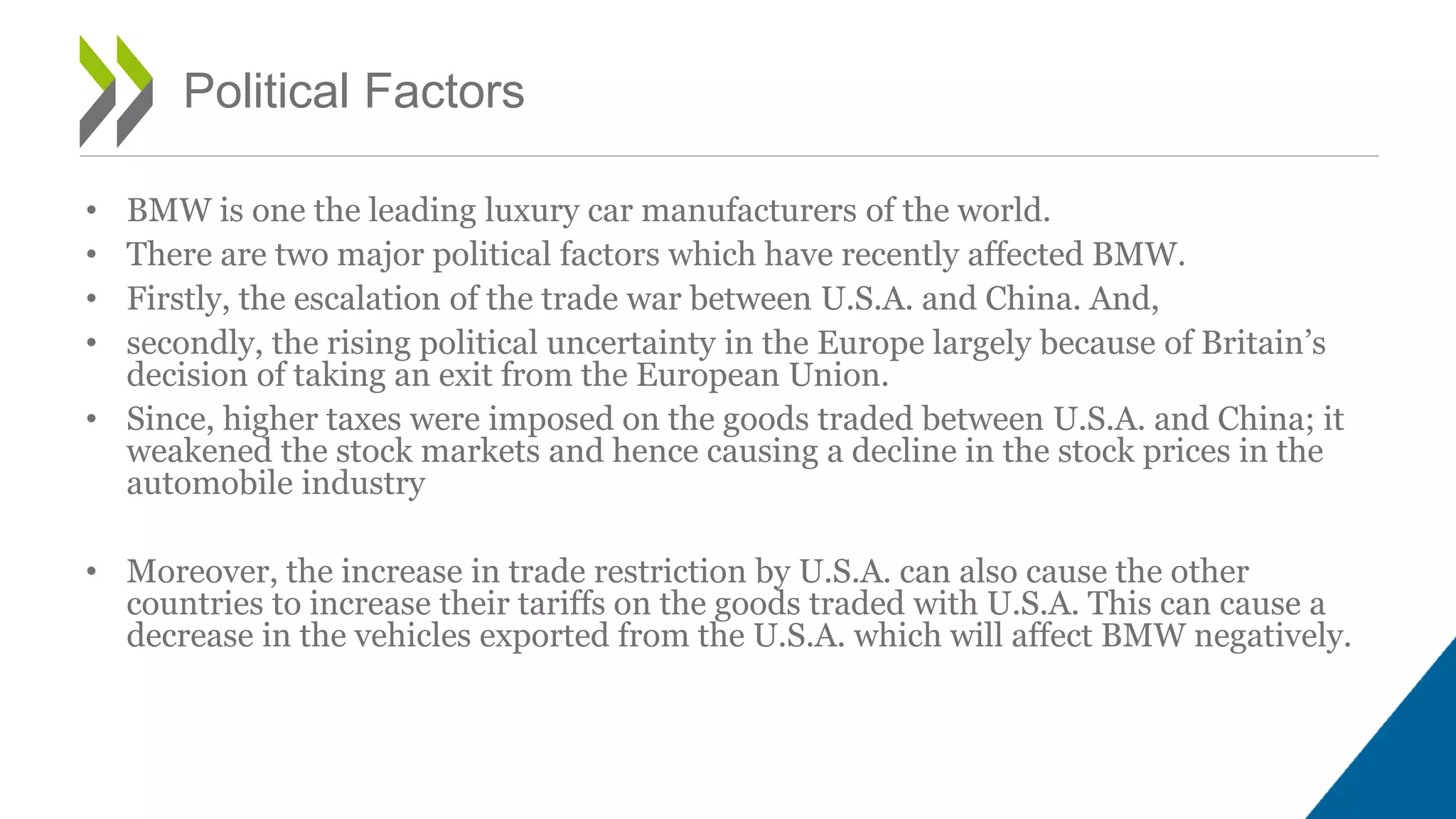
• BMW is one the leading luxury car manufacturers of the world.
• There are two major political factors which have recently affected BMW.
• Firstly, the escalation of the trade war between U.S.A. and China. And,
• secondly, the rising political uncertainty in the Europe largely because of Britain’s
decision of taking an exit from the European Union.
• Since, higher taxes were imposed on the goods traded between U.S.A. and China; it
weakened the stock markets and hence causing a decline in the stock prices in the
automobile industry
• Moreover, the increase in trade restriction by U.S.A. can also cause the other
countries to increase their tariffs on the goods traded with U.S.A. This can cause a
decrease in the vehicles exported from the U.S.A. which will affect BMW negatively.
Political Factors
• Apart from the European Union, a major chunk BMW’s
revenue comes from China and The United States of Nation.
• So, any uncertainty prevailing in these countries can
adversely affect BMW.
• The increased investment done by BMW for the electrification
of their drivetrain systems (which is responsible for providing
power to the wheels) can increase its costs significantly.
• Also, the company aims to expand its production centers. Due
to these factors, the company expects a significant reduction
in its profits before taxes from
Economic Factors
• The BMW Group has a presence in more than 140 nations.
• The BMW group has 3 divisions i.e. the automotive segment,
the motorcycles and the financial services.
• A major chunk of BMW’s revenues come from its automotive
segment with all its brands catering to the premium segment.
• BMW is focused on increasing its customer satisfaction. Apart
from increasing customer satisfaction from its vehicles itself,
BMW aims to provide extra services to improve their
experience.
Social Factors
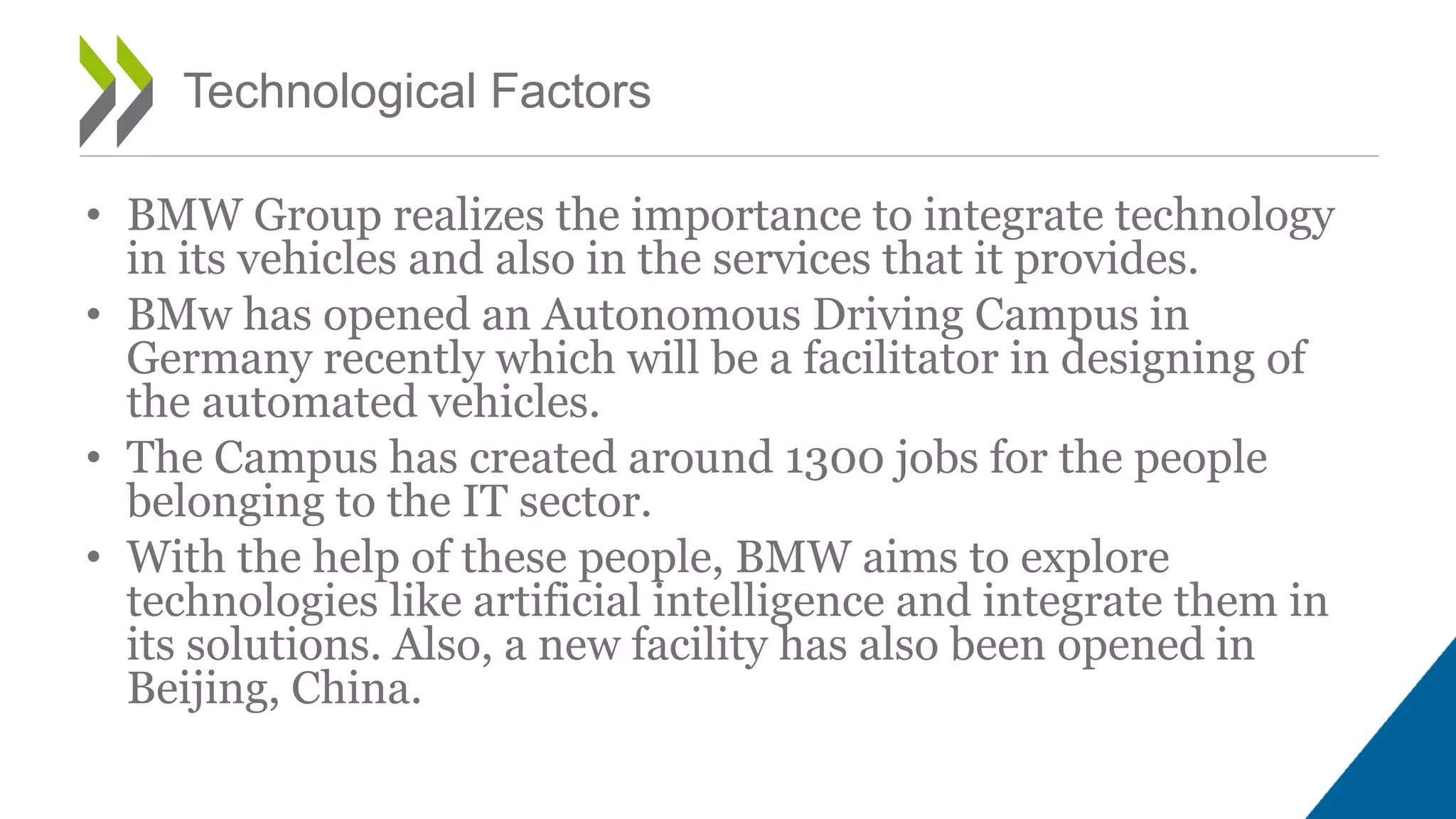
• BMW Group realizes the importance to integrate technology
in its vehicles and also in the services that it provides.
• BMw has opened an Autonomous Driving Campus in
Germany recently which will be a facilitator in designing of
the automated vehicles.
• The Campus has created around 1300 jobs for the people
belonging to the IT sector.
• With the help of these people, BMW aims to explore
technologies like artificial intelligence and integrate them in
its solutions. Also, a new facility has also been opened in
Beijing, China.
Technological Factors
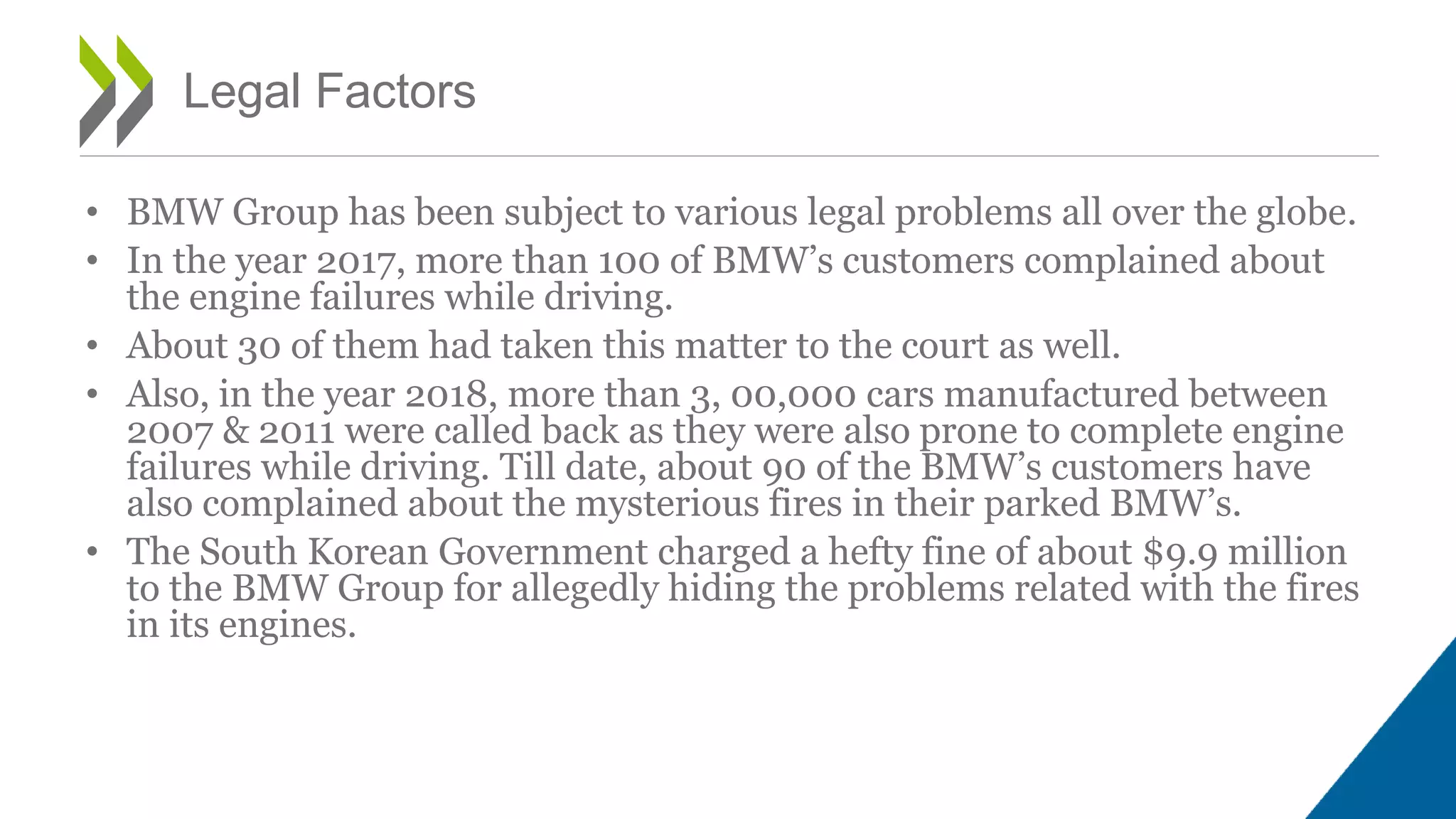
• BMW Group has been subject to various legal problems all over the globe.
• In the year 2017, more than 100 of BMW’s customers complained about
the engine failures while driving.
• About 30 of them had taken this matter to the court as well.
• Also, in the year 2018, more than 3, 00,000 cars manufactured between
2007 & 2011 were called back as they were also prone to complete engine
failures while driving. Till date, about 90 of the BMW’s customers have
also complained about the mysterious fires in their parked BMW’s.
• The South Korean Government charged a hefty fine of about $9.9 million
to the BMW Group for allegedly hiding the problems related with the fires
in its engines.
Legal Factors
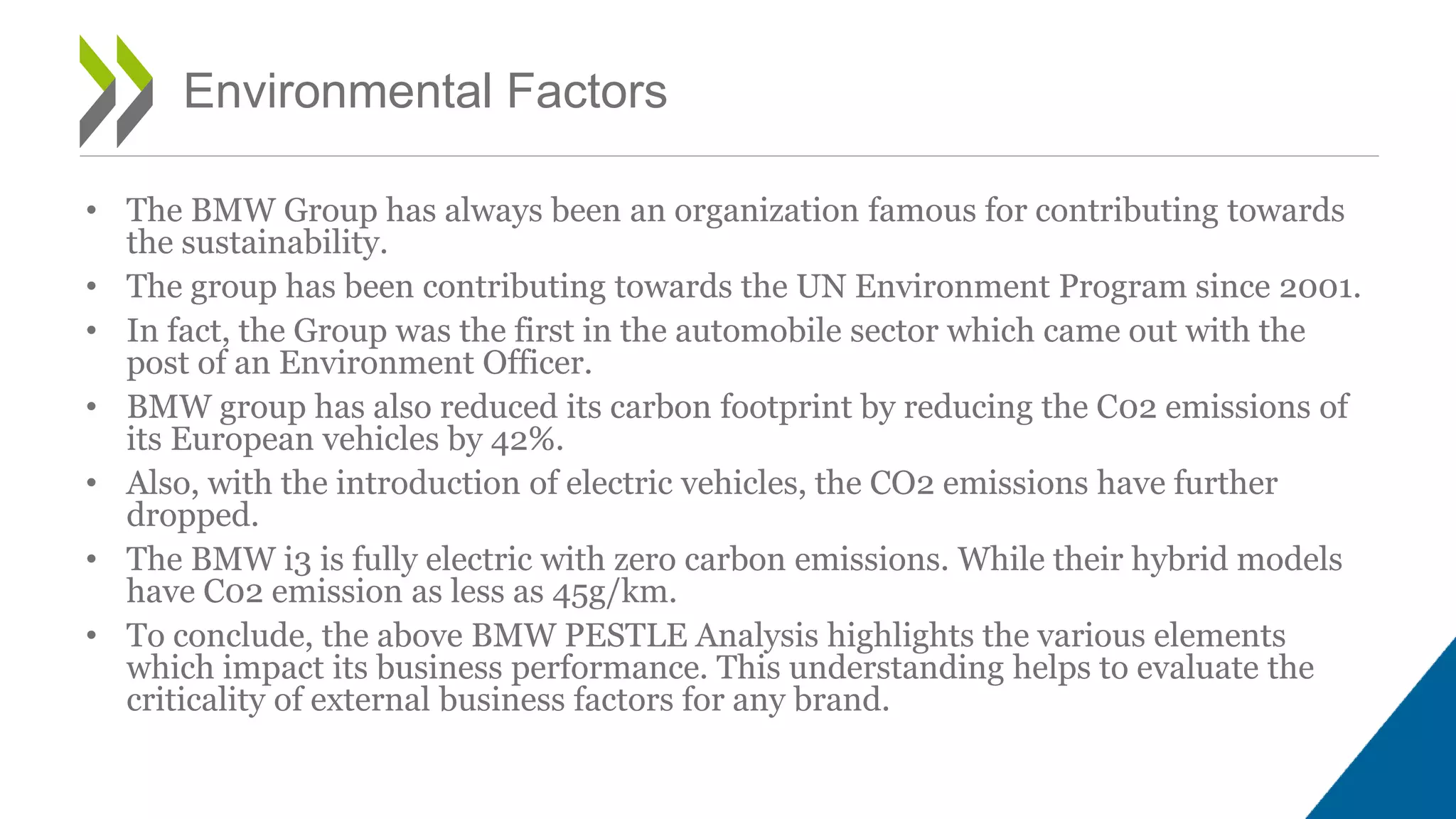
• The BMW Group has always been an organization famous for contributing towards
the sustainability.
• The group has been contributing towards the UN Environment Program since 2001.
• In fact, the Group was the first in the automobile sector which came out with the
post of an Environment Officer.
• BMW group has also reduced its carbon footprint by reducing the C02 emissions of
its European vehicles by 42%.
• Also, with the introduction of electric vehicles, the CO2 emissions have further
dropped.
• The BMW i3 is fully electric with zero carbon emissions. While their hybrid models
have C02 emission as less as 45g/km.
• To conclude, the above BMW PESTLE Analysis highlights the various elements
which impact its business performance. This understanding helps to evaluate the
criticality of external business factors for any brand.
Environmental Factors
PORTER ANALYSIS
PORTER ANALYSIS
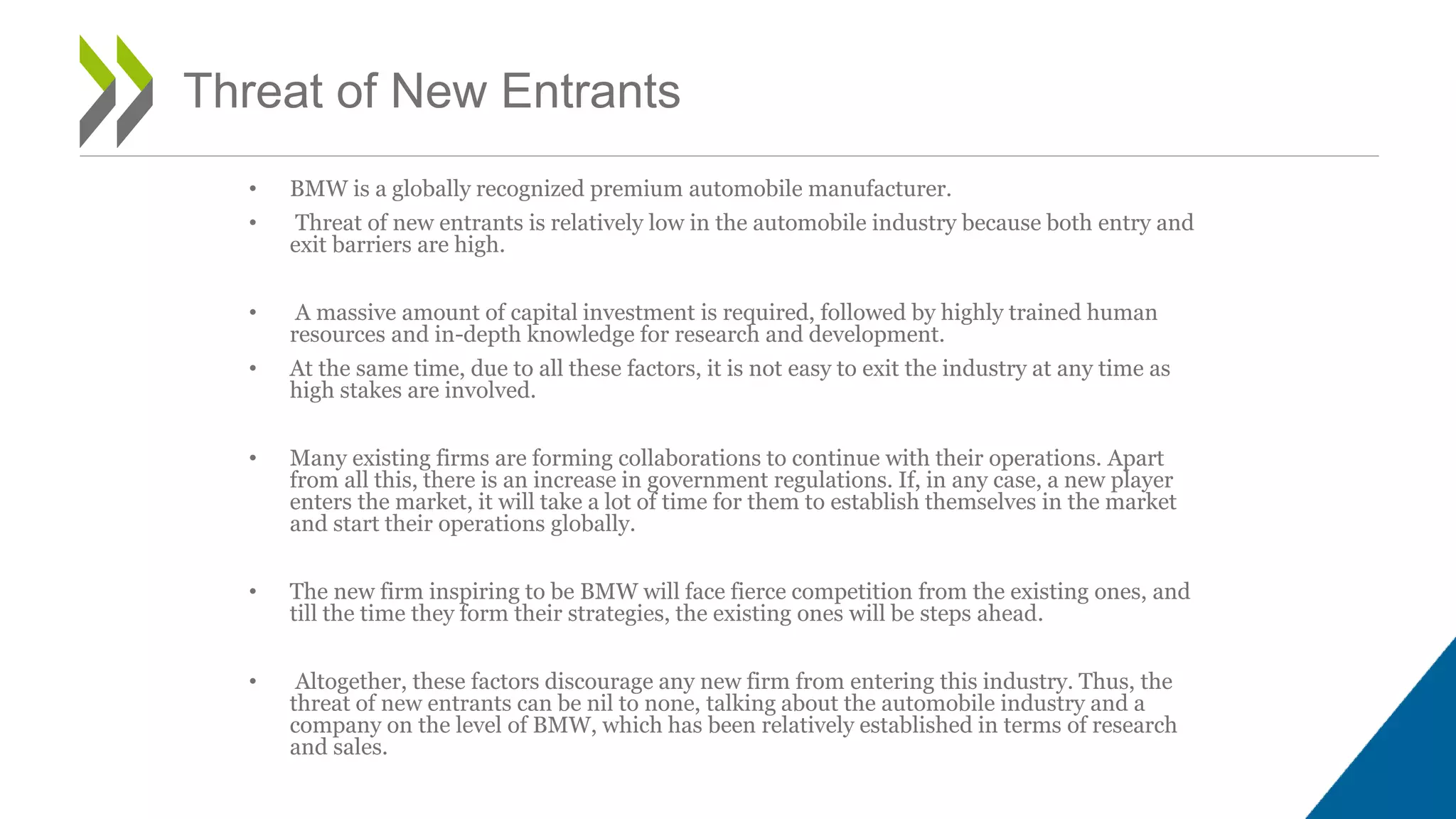
• BMW is a globally recognized premium automobile manufacturer.
• Threat of new entrants is relatively low in the automobile industry because both entry and
exit barriers are high.
• A massive amount of capital investment is required, followed by highly trained human
resources and in-depth knowledge for research and development.
• At the same time, due to all these factors, it is not easy to exit the industry at any time as
high stakes are involved.
• Many existing firms are forming collaborations to continue with their operations. Apart
from all this, there is an increase in government regulations. If, in any case, a new player
enters the market, it will take a lot of time for them to establish themselves in the market
and start their operations globally.
• The new firm inspiring to be BMW will face fierce competition from the existing ones, and
till the time they form their strategies, the existing ones will be steps ahead.
• Altogether, these factors discourage any new firm from entering this industry. Thus, the
threat of new entrants can be nil to none, talking about the automobile industry and a
company on the level of BMW, which has been relatively established in terms of research
and sales.
Threat of New Entrants
• BMW deals in the luxury segment and is not a must-have.
• Most of the people who shop in this segment do so to maintain a status symbol and class in
society.
• They want to improve the quality of their living, and this product is not seen as a must-have
but more as an experience.
• It is more to complete their satisfaction. Thus, other means of transportation buses, scooters,
public transport, etc., are its indirect substitutes.
• However, luxury motorbikes, sports cars, and bikes might substitute BMW luxury cars.
• Due to the rising awareness for environmental protection, people are shifting towards
electric vehicles, but that segment will take time to gain recognition.
• Despite these few hurdles, BMW attracts a niche crowd who have brand loyalty and has the
advantage of being decently popular against other luxury car companies. With the loyalty
and high popularity, we can say that the threat of substitutes is moderate for the company.
Threat of Substitutes
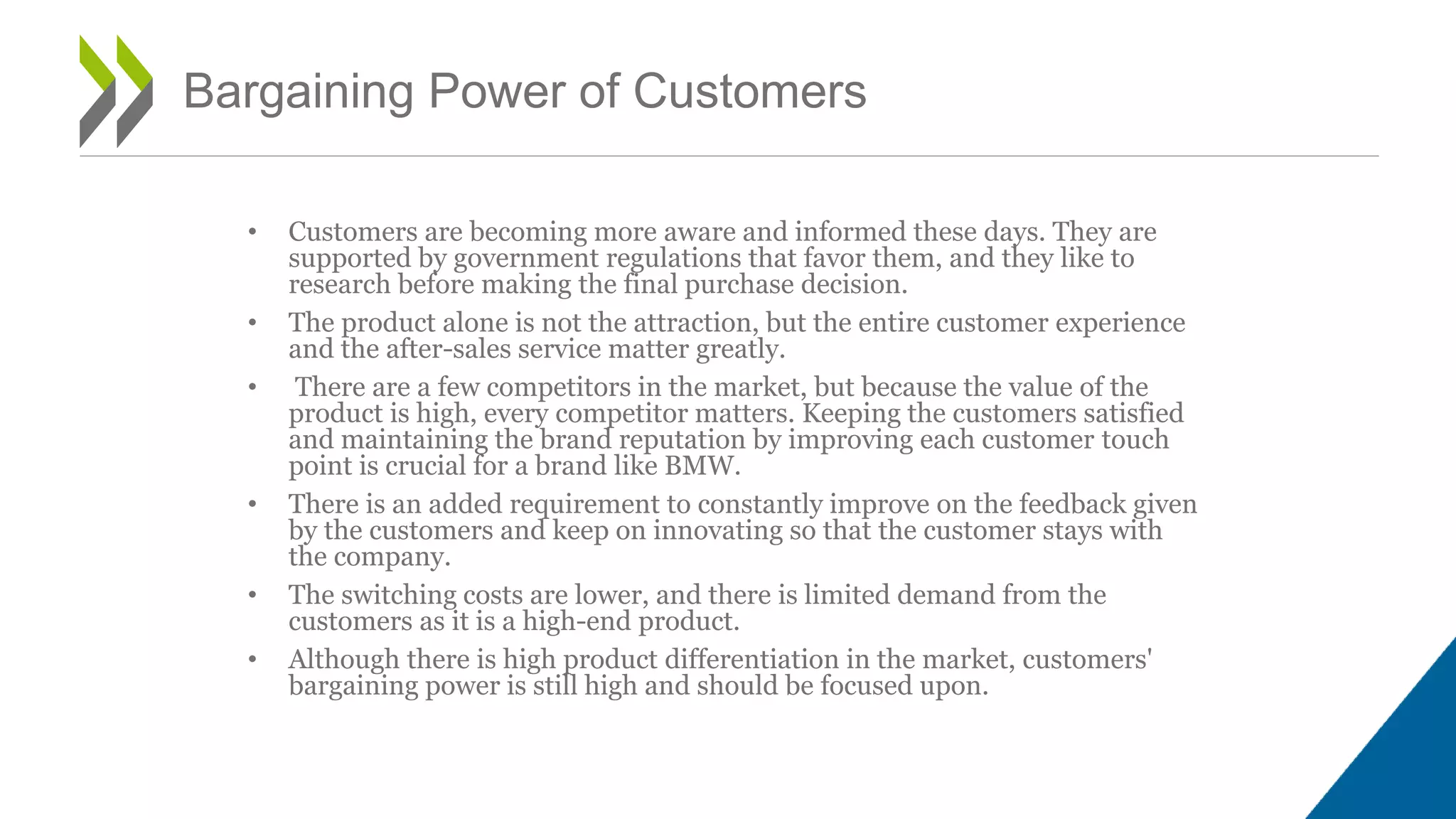
• Customers are becoming more aware and informed these days. They are
supported by government regulations that favor them, and they like to
research before making the final purchase decision.
• The product alone is not the attraction, but the entire customer experience
and the after-sales service matter greatly.
• There are a few competitors in the market, but because the value of the
product is high, every competitor matters. Keeping the customers satisfied
and maintaining the brand reputation by improving each customer touch
point is crucial for a brand like BMW.
• There is an added requirement to constantly improve on the feedback given
by the customers and keep on innovating so that the customer stays with
the company.
• The switching costs are lower, and there is limited demand from the
customers as it is a high-end product.
• Although there is high product differentiation in the market, customers'
bargaining power is still high and should be focused upon.
Bargaining Power of Customers
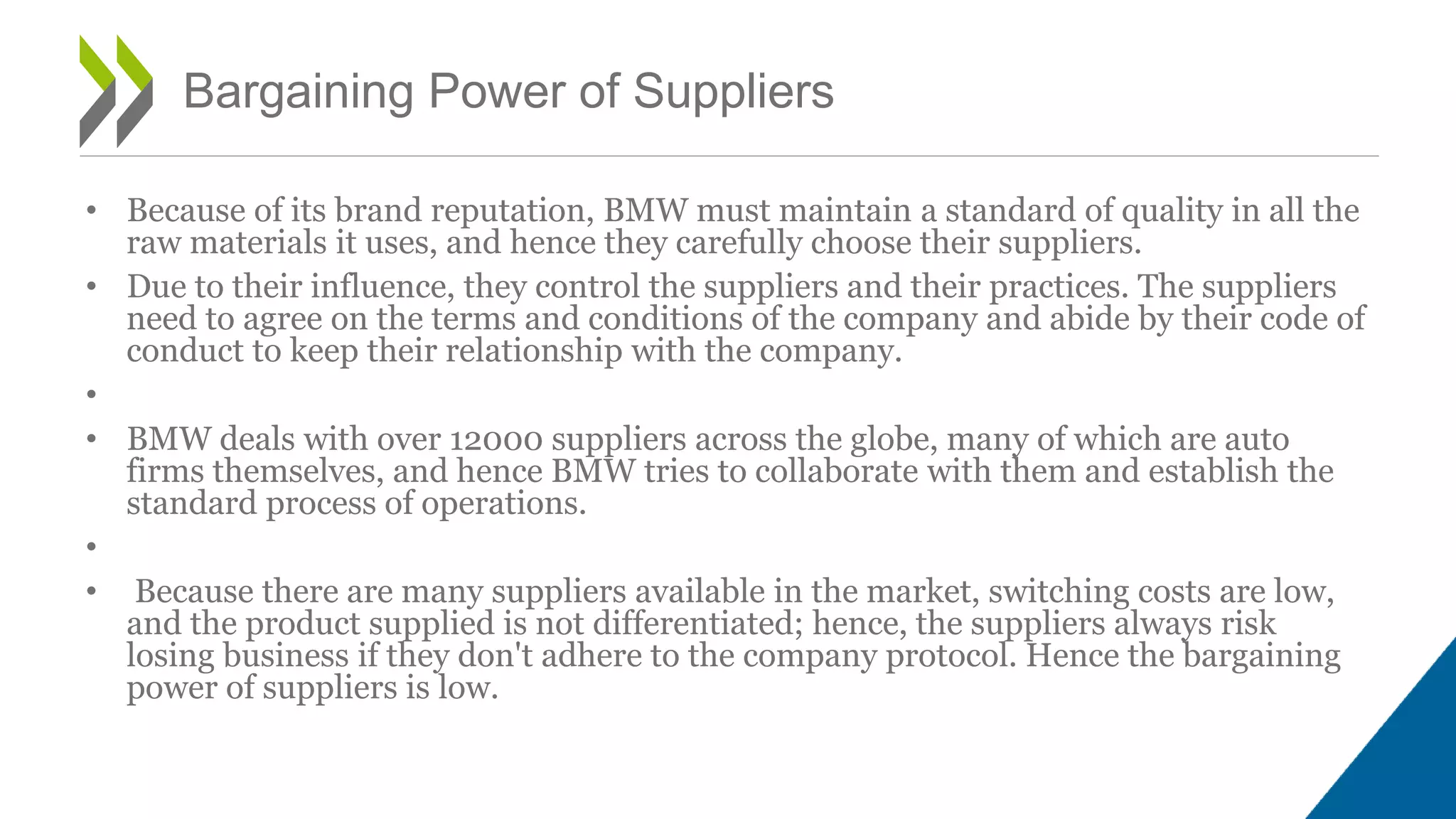
• Because of its brand reputation, BMW must maintain a standard of quality in all the
raw materials it uses, and hence they carefully choose their suppliers.
• Due to their influence, they control the suppliers and their practices. The suppliers
need to agree on the terms and conditions of the company and abide by their code of
conduct to keep their relationship with the company.
•
• BMW deals with over 12000 suppliers across the globe, many of which are auto
firms themselves, and hence BMW tries to collaborate with them and establish the
standard process of operations.
•
• Because there are many suppliers available in the market, switching costs are low,
and the product supplied is not differentiated; hence, the suppliers always risk
losing business if they don't adhere to the company protocol. Hence the bargaining
power of suppliers is low.
Bargaining Power of Suppliers
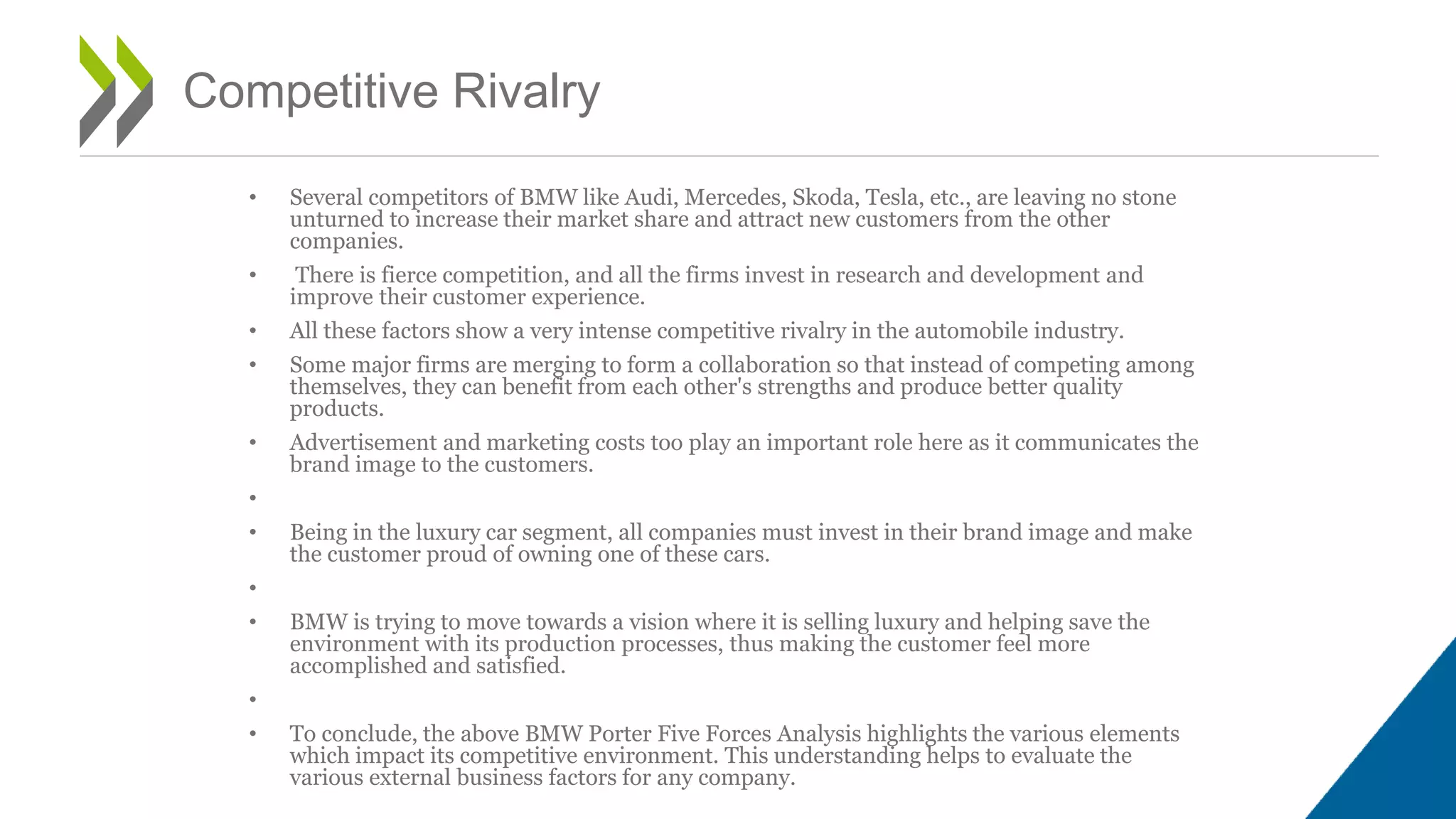
• Several competitors of BMW like Audi, Mercedes, Skoda, Tesla, etc., are leaving no stone
unturned to increase their market share and attract new customers from the other
companies.
• There is fierce competition, and all the firms invest in research and development and
improve their customer experience.
• All these factors show a very intense competitive rivalry in the automobile industry.
• Some major firms are merging to form a collaboration so that instead of competing among
themselves, they can benefit from each other's strengths and produce better quality
products.
• Advertisement and marketing costs too play an important role here as it communicates the
brand image to the customers.
•
• Being in the luxury car segment, all companies must invest in their brand image and make
the customer proud of owning one of these cars.
•
• BMW is trying to move towards a vision where it is selling luxury and helping save the
environment with its production processes, thus making the customer feel more
accomplished and satisfied.
•
• To conclude, the above BMW Porter Five Forces Analysis highlights the various elements
which impact its competitive environment. This understanding helps to evaluate the
various external business factors for any company.
Competitive Rivalry
PART 5
ROE FOR TESLA,
TOYOTA AND BMW
Hossam Elgonimy 21125497
51
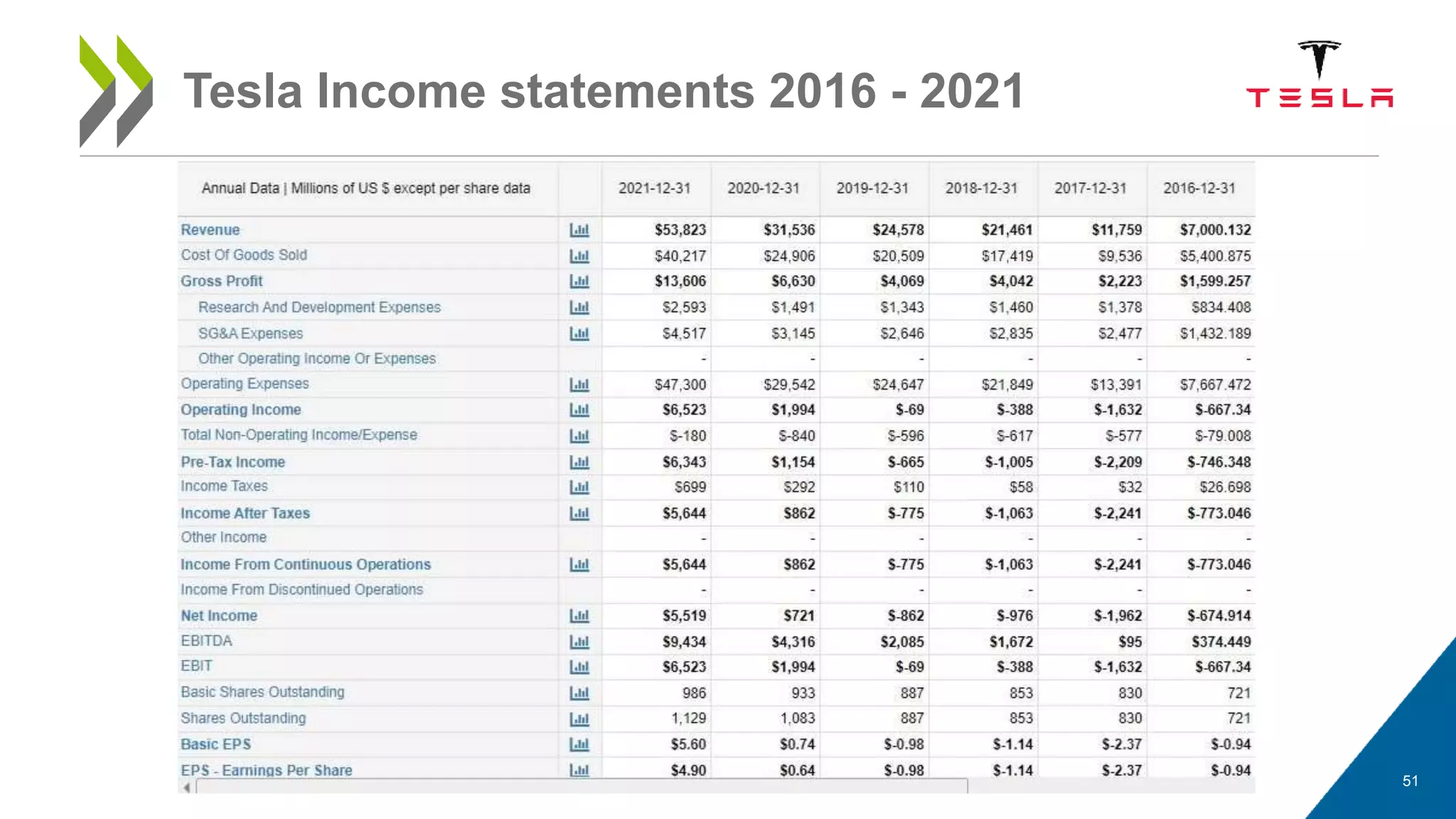
Tesla Income statements 2016 - 2021
52
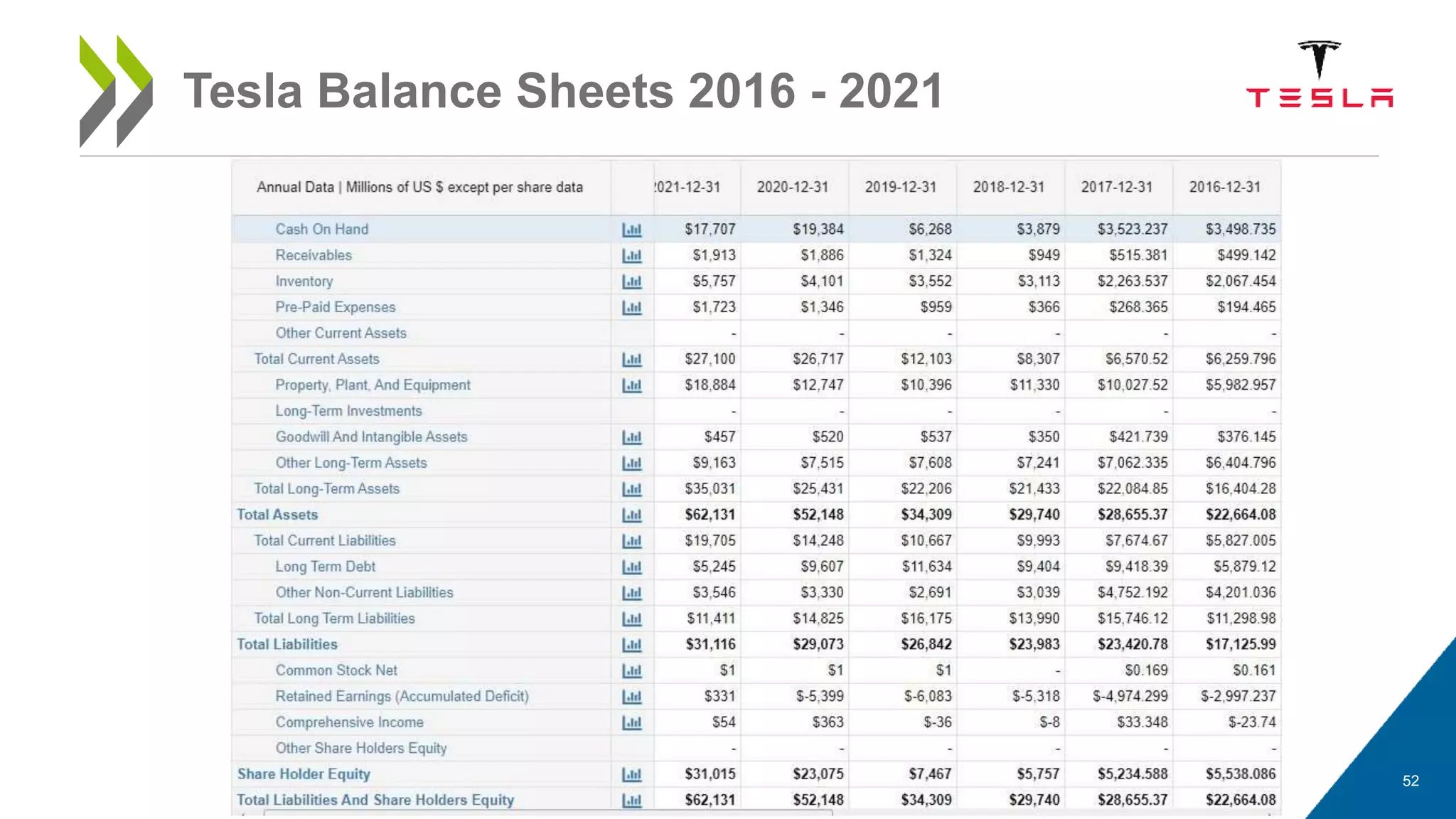
Tesla Balance Sheets 2016 - 2021
53
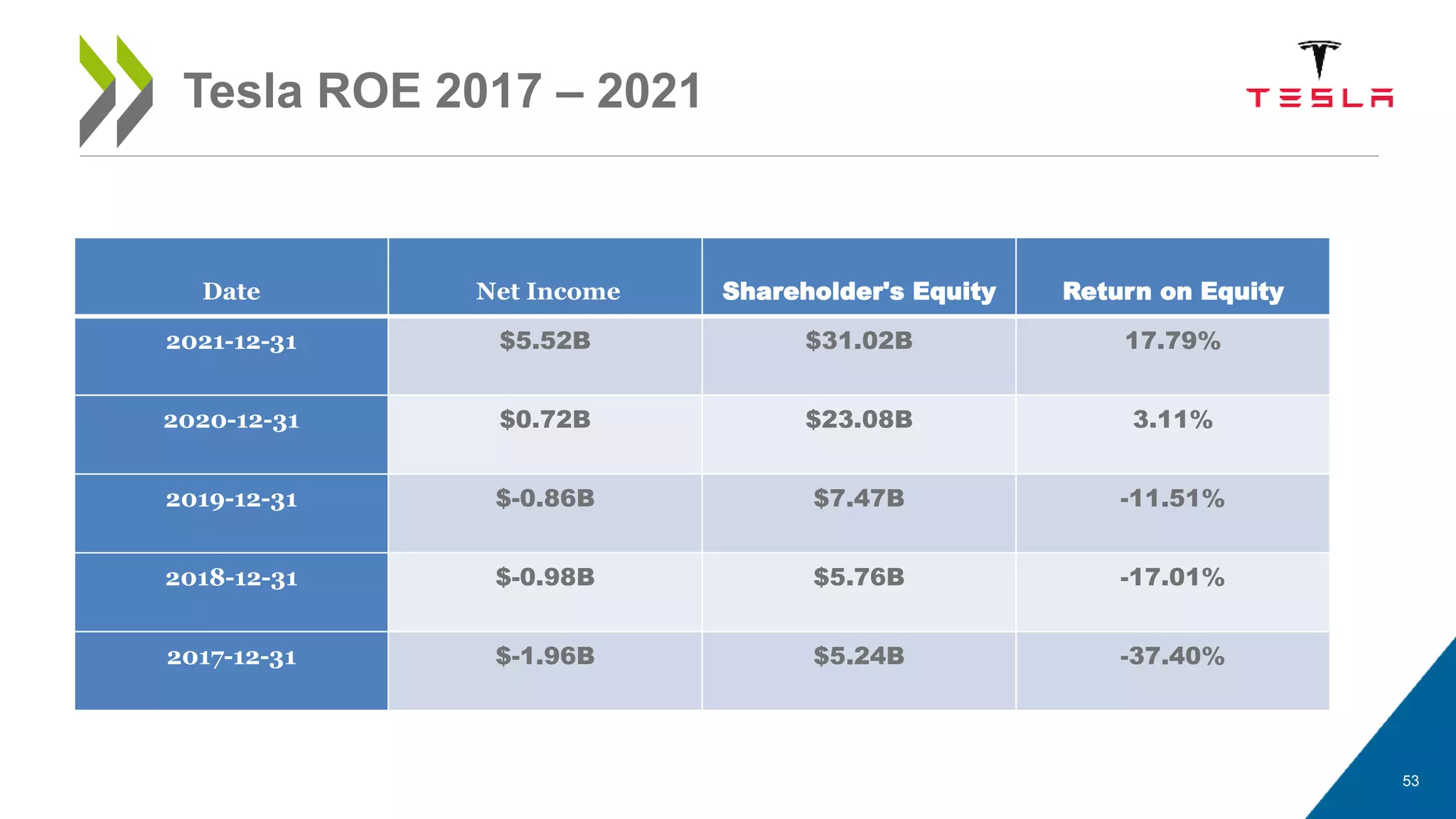
Tesla ROE 2017 – 2021
Date Net Income Shareholder's Equity Return on Equity
2021-12-31 $5.52B $31.02B 17.79%
2020-12-31 $0.72B $23.08B 3.11%
2019-12-31 $-0.86B $7.47B -11.51%
2018-12-31 $-0.98B $5.76B -17.01%
2017-12-31 $-1.96B $5.24B -37.40%
54
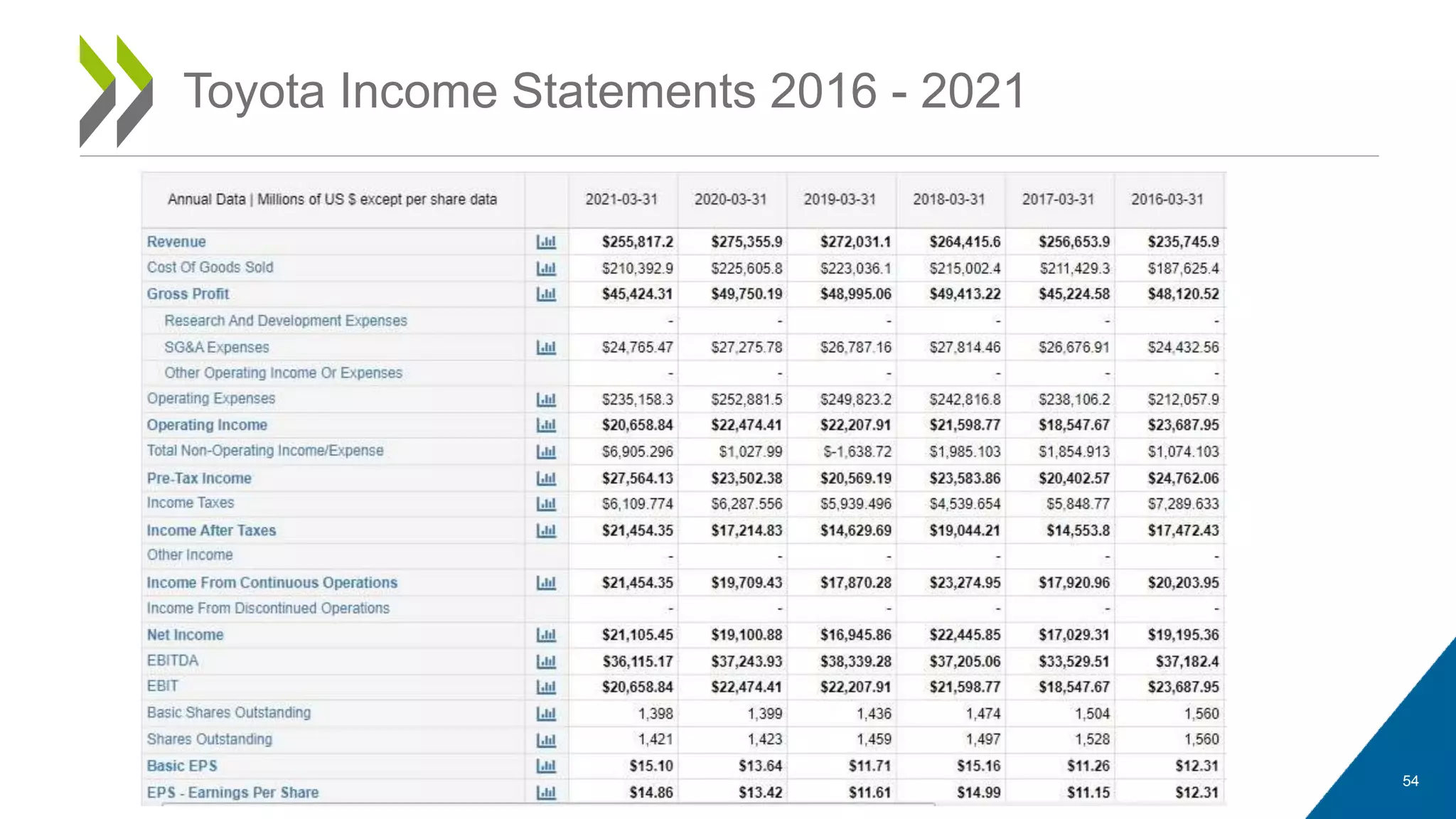
Toyota Income Statements 2016 - 2021
55
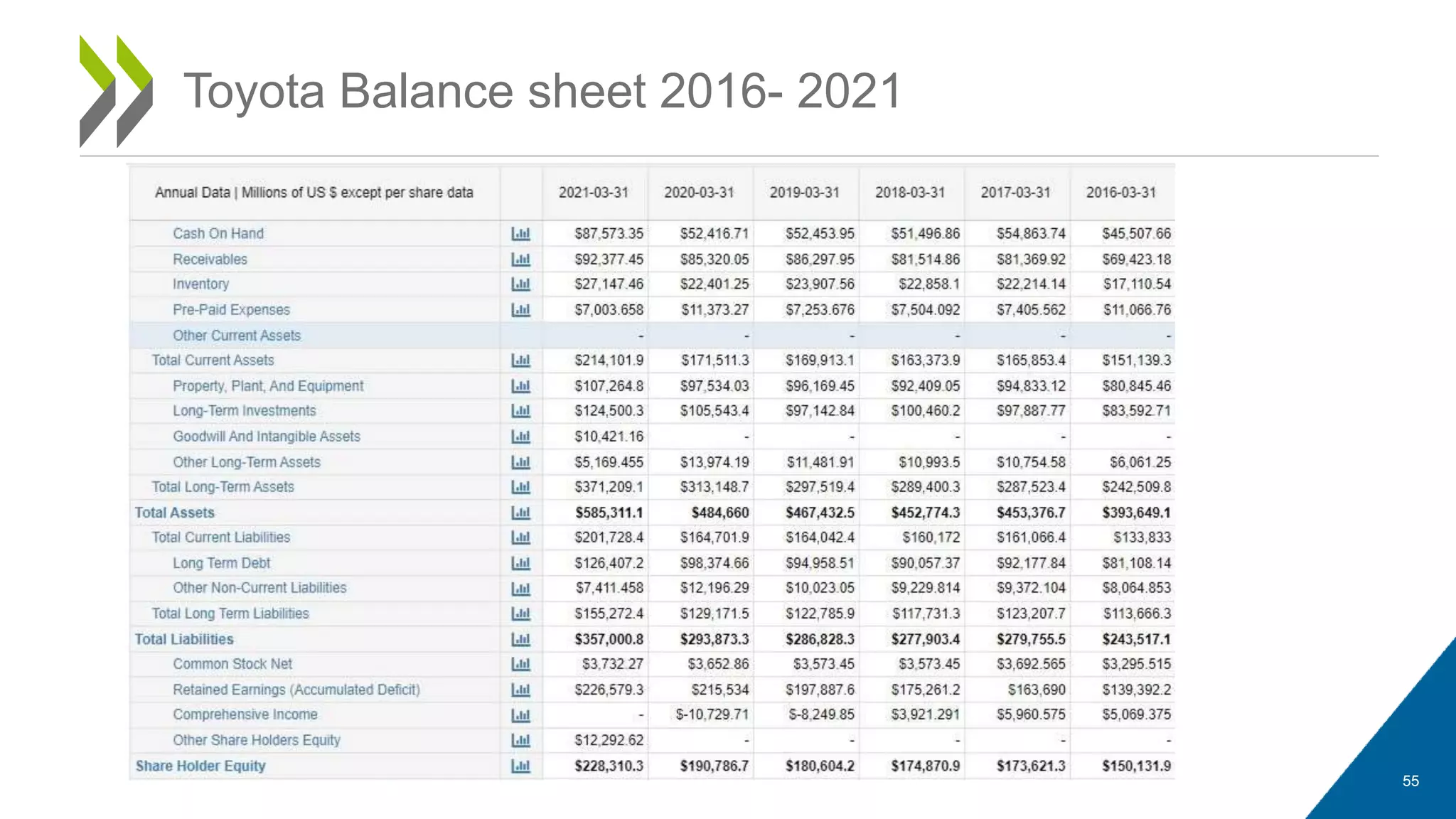
Toyota Balance sheet 2016- 2021
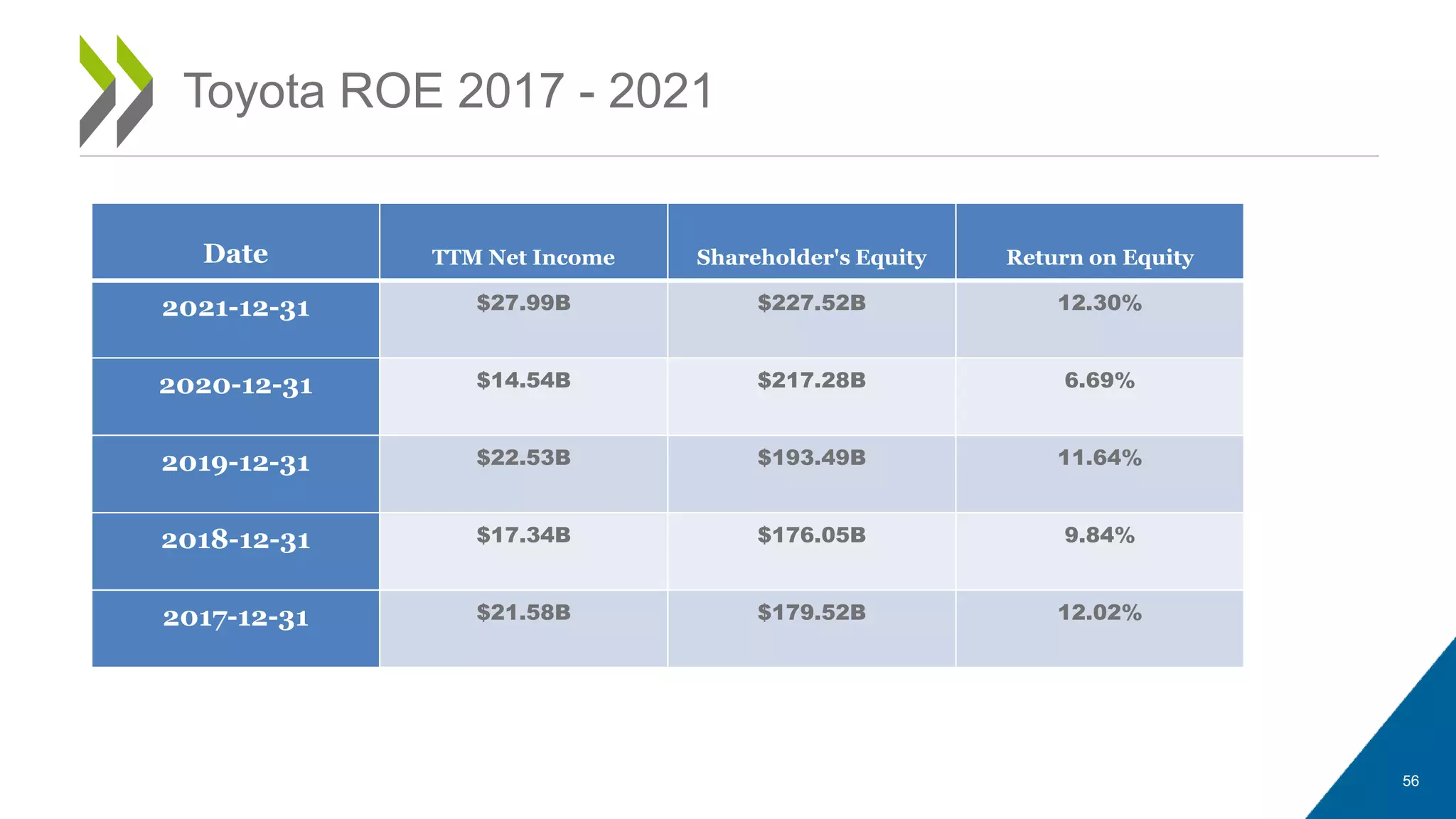
Date TTM Net Income Shareholder's Equity Return on Equity
2021-12-31 $27.99B $227.52B 12.30%
2020-12-31 $14.54B $217.28B 6.69%
2019-12-31 $22.53B $193.49B 11.64%
2018-12-31 $17.34B $176.05B 9.84%
2017-12-31 $21.58B $179.52B 12.02%
56
Toyota ROE 2017 - 2021
57
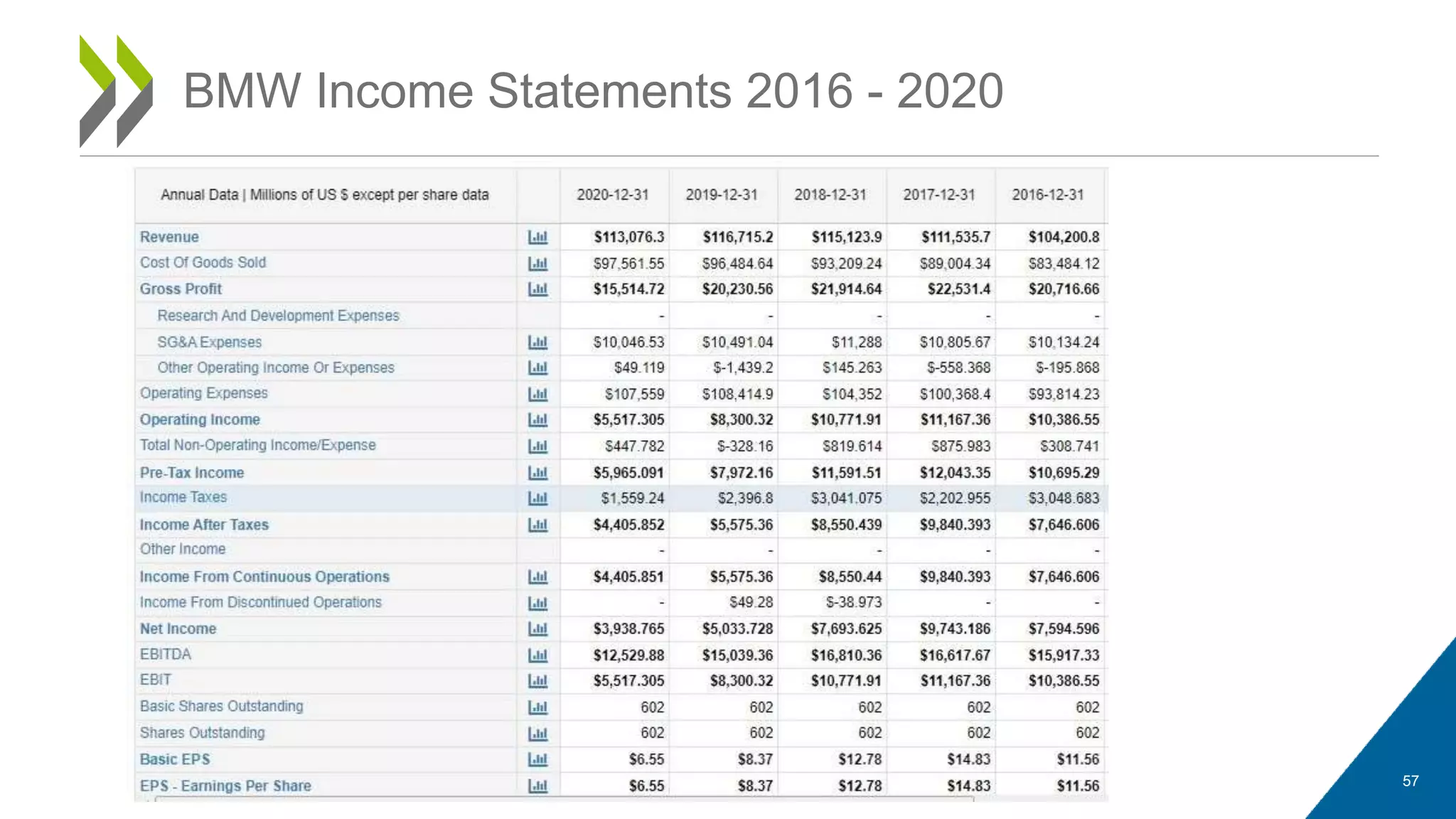
BMW Income Statements 2016 - 2020
58
BMW Balance Sheets 2016- 2020
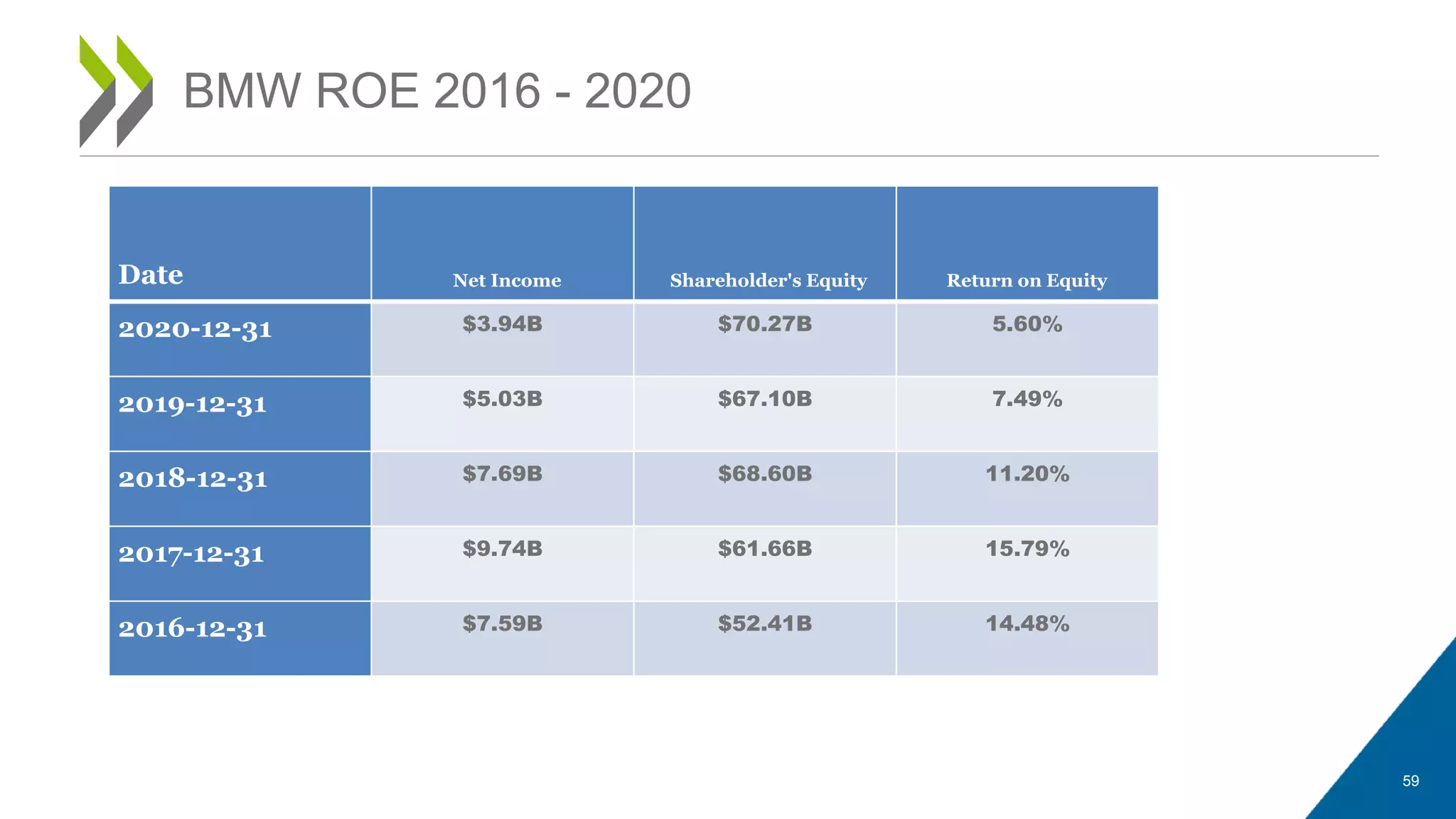
Date Net Income Shareholder's Equity Return on Equity
2020-12-31 $3.94B $70.27B 5.60%
2019-12-31 $5.03B $67.10B 7.49%
2018-12-31 $7.69B $68.60B 11.20%
2017-12-31 $9.74B $61.66B 15.79%
2016-12-31 $7.59B $52.41B 14.48%
59
BMW ROE 2016 - 2020
PART 6
MARKET CAPITAL
FOR TESLA,
TOYOTA, BMW
Shaimaa Tamer 21125579
61
Tesla Market Share
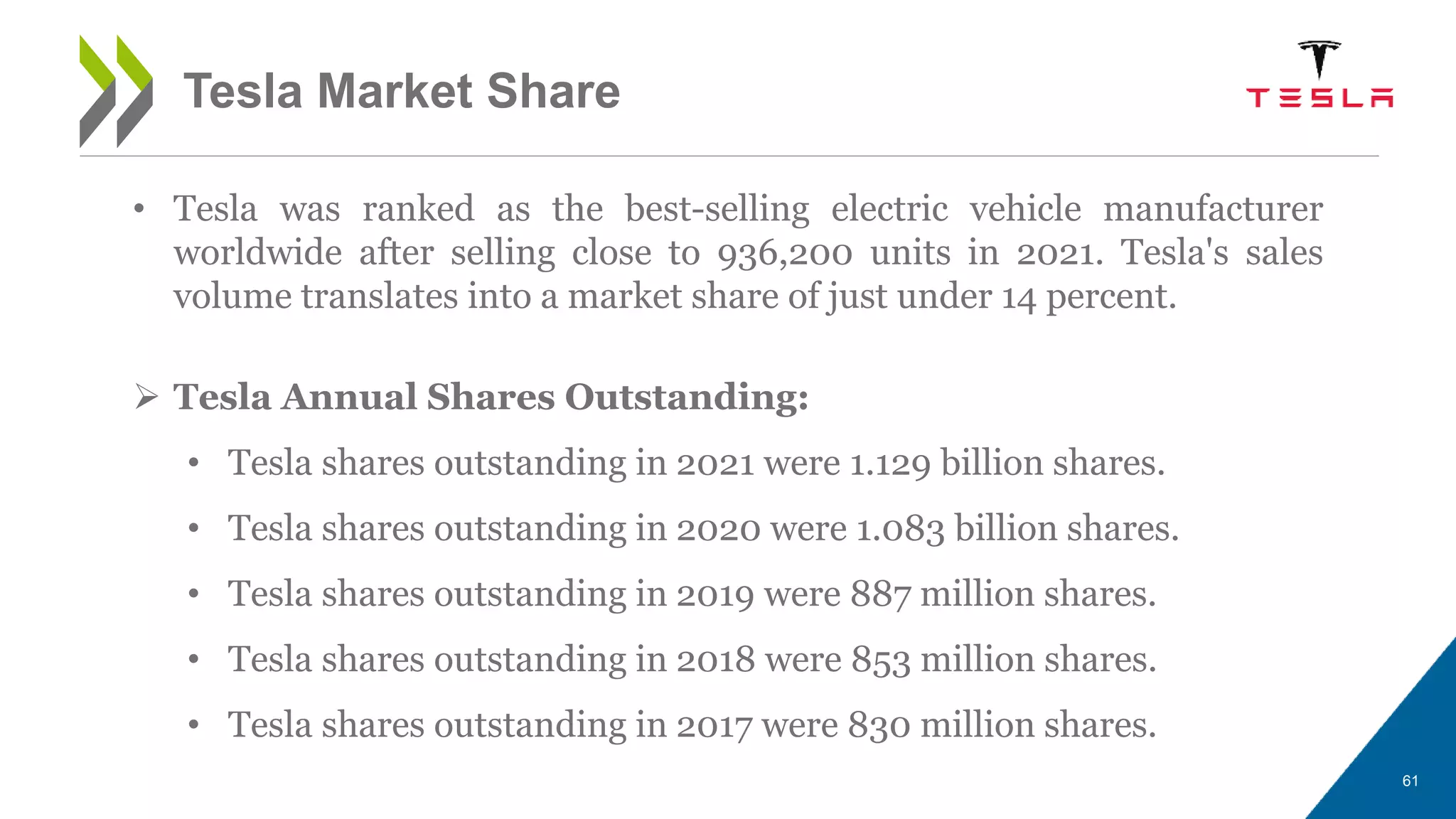
• Tesla was ranked as the best-selling electric vehicle manufacturer
worldwide after selling close to 936,200 units in 2021. Tesla's sales
volume translates into a market share of just under 14 percent.
 Tesla Annual Shares Outstanding:
• Tesla shares outstanding in 2021 were 1.129 billion shares.
• Tesla shares outstanding in 2020 were 1.083 billion shares.
• Tesla shares outstanding in 2019 were 887 million shares.
• Tesla shares outstanding in 2018 were 853 million shares.
• Tesla shares outstanding in 2017 were 830 million shares.
62
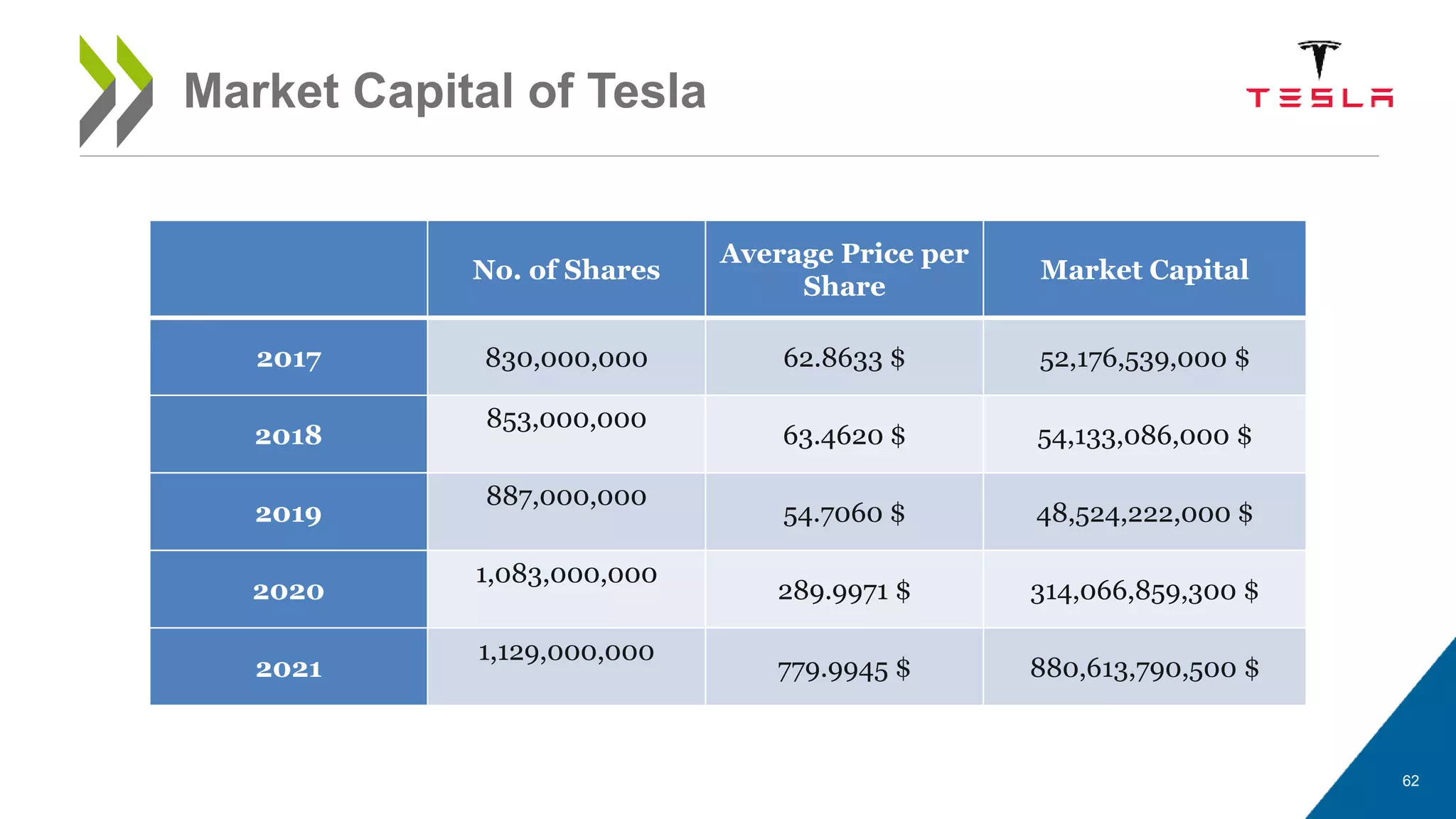
Market Capital of Tesla
No. of Shares
Average Price per
Share
Market Capital
2017 830,000,000 62.8633 $ 52,176,539,000 $
2018
853,000,000
63.4620 $ 54,133,086,000 $
2019
887,000,000
54.7060 $ 48,524,222,000 $
2020
1,083,000,000
289.9971 $ 314,066,859,300 $
2021
1,129,000,000
779.9945 $ 880,613,790,500 $
• BMW possesses 6 percent market share of the electric vehicle market.
 BMW Annual Shares Outstanding:
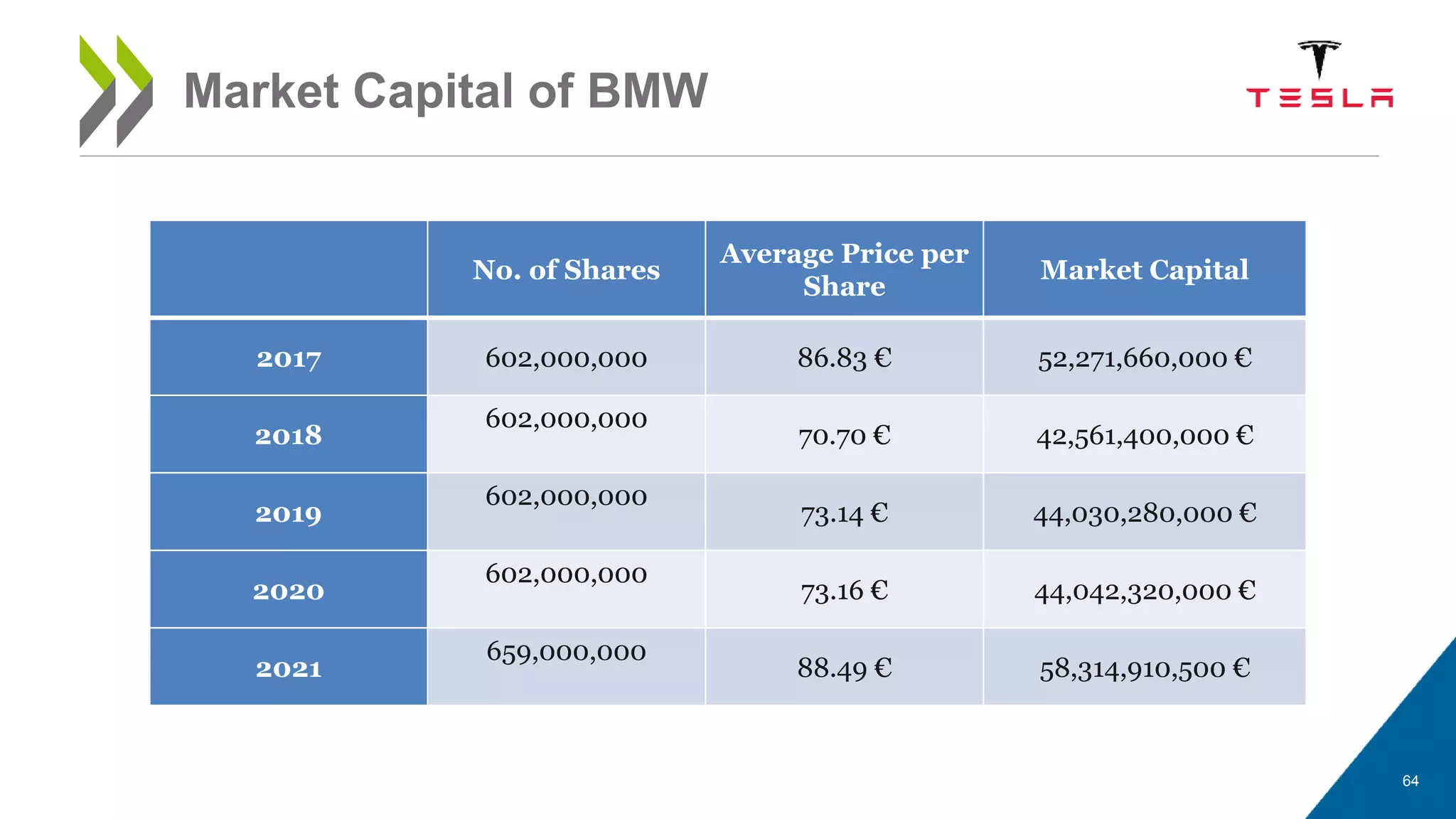
• BMW shares outstanding in 2021 were 659 million shares.
• BMW shares outstanding in 2020 were 602 million shares.
• BMW shares outstanding in 2019 were 602 million shares.
• BMW shares outstanding in 2018 were 602 million shares.
• BMW shares outstanding in 2017 were 602 million shares.
63
BMW
64
Market Capital of BMW
No. of Shares
Average Price per
Share
Market Capital
2017 602,000,000 86.83 € 52,271,660,000 €
2018
602,000,000
70.70 € 42,561,400,000 €
2019
602,000,000
73.14 € 44,030,280,000 €
2020
602,000,000
73.16 € 44,042,320,000 €
2021
659,000,000
88.49 € 58,314,910,500 €
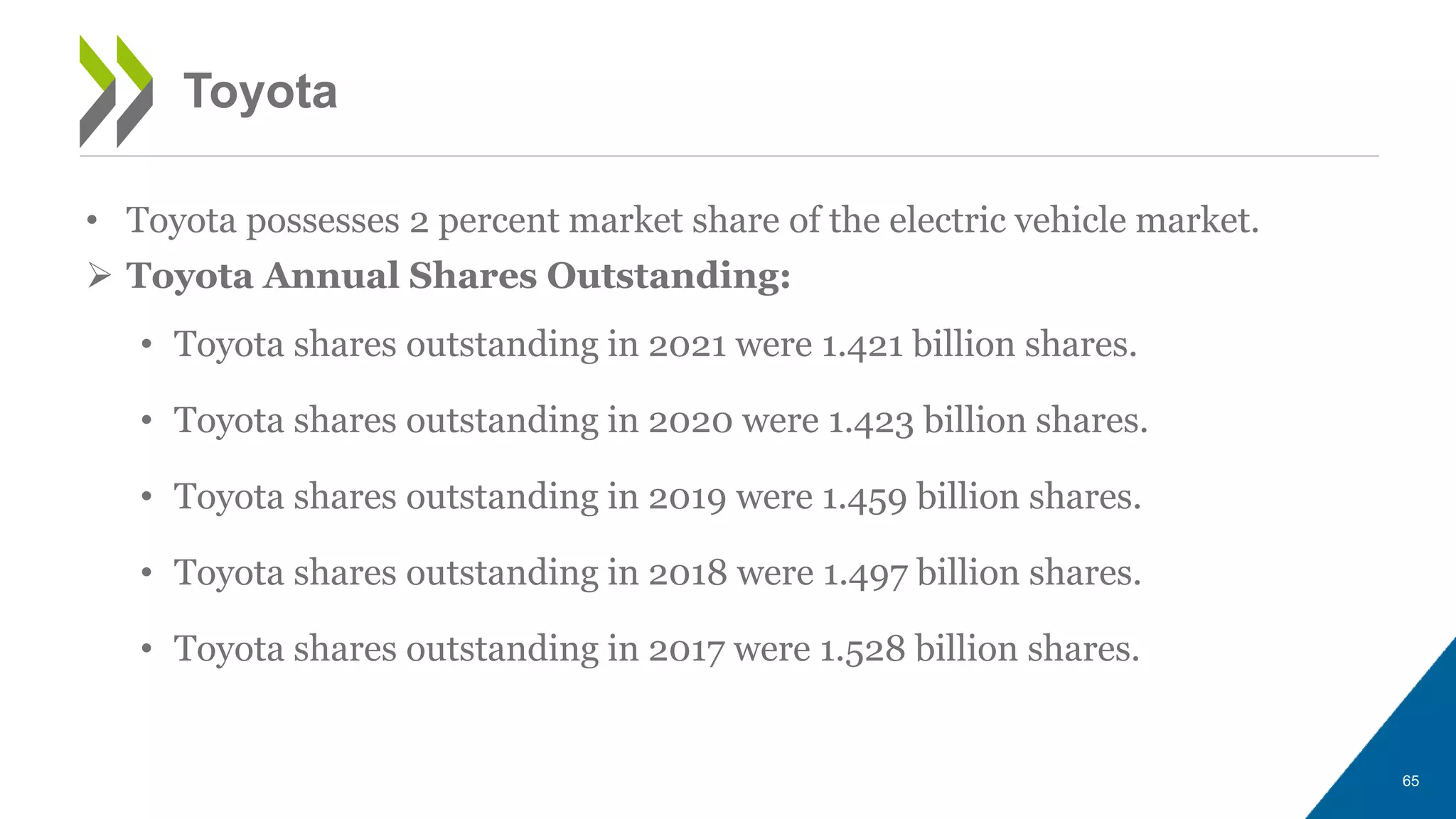
• Toyota possesses 2 percent market share of the electric vehicle market.
 Toyota Annual Shares Outstanding:
• Toyota shares outstanding in 2021 were 1.421 billion shares.
• Toyota shares outstanding in 2020 were 1.423 billion shares.
• Toyota shares outstanding in 2019 were 1.459 billion shares.
• Toyota shares outstanding in 2018 were 1.497 billion shares.
• Toyota shares outstanding in 2017 were 1.528 billion shares.
65
Toyota
66
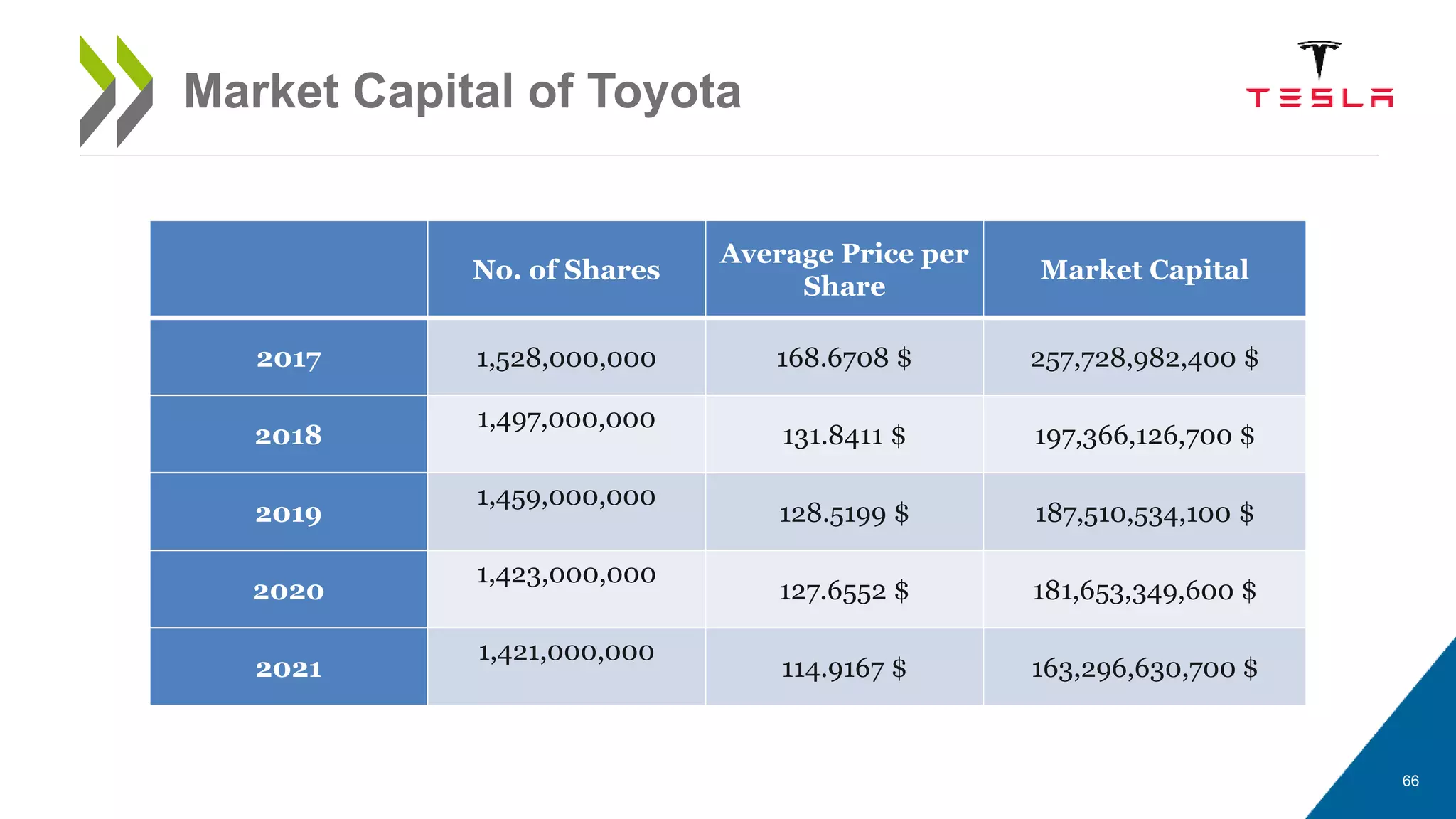
Market Capital of Toyota
No. of Shares
Average Price per
Share
Market Capital
2017 1,528,000,000 168.6708 $ 257,728,982,400 $
2018
1,497,000,000
131.8411 $ 197,366,126,700 $
2019
1,459,000,000
128.5199 $ 187,510,534,100 $
2020
1,423,000,000
127.6552 $ 181,653,349,600 $
2021
1,421,000,000
114.9167 $ 163,296,630,700 $
THANK YOU
Group 1

Tesla Case Analysis

  • 1.
    TESLA ANALYSIS Mohamed Ibrahim21125215 Shaimaa Tamer 21125579 Hossam Elgonimy 21125497 Amr Mansour 21126657 Eslam Hassan 21126340 Moataz Farouk 21126338 GROUP 1
  • 2.
    PART 1 INTRO EslamHassan 21126340
  • 3.
    3 INTRODUCTION • Clean energybased About Tesla  American Electric vehicle and clean energy company • Battery energy storage system • Solar panels and solar roof tiles • Designs and manufactures Electric cars  Founded in July 2003 • Help expediting moving to sustainable transport and energy, obtained through electric vehicles and solar power.
  • 4.
    4 INTRODUCTION • Clean energybased About Tesla  American Electric vehicle and clean energy company • Battery energy storage system • Solar panels and solar roof tiles • Designs and manufactures Electric cars  Founded in July 2003 • Help expediting moving to sustainable transport and energy, obtained through electric vehicles and solar power. Tesla began production of Its first car model Roadster, in 2009 in June 2021, Model 3 all-time best-selling , became the first electric car to sell 1 million units globally
  • 5.
    5 INTRODUCTION 2003, Tesla hasestablished a benchmark position in the electric vehicle industry in less than 20 years About Tesla • In 2020,the market value increased by more than Seven times, exceeding $600 billion. • Highest market value and surpassed Toyota (the highest market value), Exxon Mobil and BP $668.91B 31 Dec 2020 $75.71B 31 Dec 2019 $75.71B 31 Dec 2019
  • 6.
    6 INTRODUCTION In the half-yearof 2021, Tesla encountered a series of problems such as: Tesla Encountered Problems • Owner Rights of Protection • Chip Shortage • Delivery Delay At present, Tesla, the heading of the capital market and the leader of the new energy vehicle industry
  • 7.
    7 INTRODUCTION The first timein 2020, its net profit was only 721 million US dollars far lower than traditional automobile and energy giants such as BMW and Toyota
  • 8.
    8 INTRODUCTION To promote thedevelopment, following shall be analysis: TESLA Development Promotion • Vehicle integration of new energy project development. • Equipment research • Manufacturing • Energy usage • Cost reduction • Quality improvement • Efficiency increase of the whole industrial chain TESLA The interconnection Intelligent collaboration of the whole value chain. integrates internal and external resources leading to Realizes that Making production, operation, and asset management minimalist, intelligent, and efficient.
  • 9.
    9 INTRODUCTION TESLA targeted to transformthe industry by producing electric cars. Leapfrog rivals committed to cars fueled by petrol/diesel At a time when electric batteries were nowhere near the performance level of today
  • 10.
    PART 2 TESLA BUSINESS MODELANALYSIS Moataz Farouk 21126338
  • 11.
    • Company’s messagefrom day one was not that an electric car could be good but that it could be better • Tesla started out as a transformative company rather than one that has recently transformed • Mission Statement: Tesla’s mission is to accelerate the world’s transition to sustainable energy. • Vision Statement: Create the most compelling car company of the 21st century by driving the world’s transition to electric vehicles. 11 Tesla as Transformative Business Model
  • 12.
    12 Tesla’s business modelcanvas Key Partners 1. Panasonic 2. Ningde Era 3. Solar City 4. Toyota Key Businesses 1. Automotive 85% 2. Energy generation & storage 15% 3. R&D 4. Building Giga- Factories 5. Building charging stations network Value Propositions 1. Best in Class- Fully Electric vehicles EVs 2. High performance and intelligent services 3. High capacity and low cost Battery 4. High performance recharging station 5. Auto-pilot Consumer Segmentation 1. Individual customers 2. environmentalists and performance oriented; 3. Entry level luxury buyers: Model X or S 4. Mass market customer segment for car Model 3 5. Green Community 6. Fast Sports Car 7. Autopilot Source of income (Revenue Streams) 1. Automobile sales and leasing 2. Energy generation and storage 3. Services and others Key Resources 1. Intellectual property electric powertrain 2. Automation & Engineering staff 3. Battery plants Tesla Gigafactory Channel 1. Tesla own store & Galleries 2. Partner Channel 3. Website Design Studio 4. Conferences & Sales events Customer Relations 1. Service Plus. 2. Free test drives 3. Reputation 4. Free/low-cost charging station network Cost structure Manufacturing plant costs, training costs , interest expense on Federal loans, research and development costs, sales and after-sales costs cost of hosting self-owned stores
  • 13.
    Key Partners • Morecars will be electric-only if the battery life is strong enough. • Panasonic – One of the key battery supply partners of Tesla. – Battery performance is also very strong. • Ningde Era (China) – Is also one of Tesla's key battery partners. – At the end of 2019, Ningde Era mode less battery pack with the new CTP technology, – Tesla's Model 3 series has The CTP battery of Ningde Era. • Solar City – Solar City specializes in solar cells. Tesla completed its acquisition in 2016 – Tesla aims to build an integrated, sustainable energy company with Solar City – Cover everything from energy creation and storage to energy transportation and consumption 13
  • 14.
    • Direct-to-consumer (D2C)is a business model where companies sell their products directly to the consumer without the assistance of a third-party wholesaler or retailer. • In this way, the company can cut through intermediaries and increase its margins. • Needs to build its own distribution, which in the short term can be more expensive. 14 Channel - Direct-to-consumer (D2C)
  • 15.
    Customer Segmentation • Accordingto Tesla's annual, quarterly results, The Module X and Model S accounted for less than 20% of the total, while the Model 3 and Model Ely accounted for more than 80%. • By contrast, Tesla is mainly mass- market 15
  • 16.
    • As wego through the whole Tesla history, another key ingredient was the Gigafactory. • Tesla broke ground on the Gigafactory in June 2014 outside Sparks, Nevada. • Tesla expects the Gigafactory to be the biggest building in the world and entirely powered by renewable energy sources. • Designed to be a net zero energy factory upon completion, the facility will be primarily powered by solar, and installation is already underway. • For Tesla to build its own batteries was important turning point 16 Key resources - Tesla Giga-Factory
  • 17.
    • With 30,000+Superchargers, Tesla owns and operates the largest global, fast charging network in the world. • Tesla isn’t just a car company; it’s transitioning to become a major energy producer with its superchargers and electric infrastructure. From energy production to distribution, Tesla might become the Exxon of the future • For instance, in the case, of Tesla, it’s not about convincing people that electric cars are “cool” (not only that). • But also, initially, about providing the infrastructure to make the electric vehicle competitive in terms of everything else (availability of charging stations, charging vs. refilling, cost of batteries, time to recharge, and so on). 17 Key resources - Charging Stations
  • 18.
    Source of income Fromthe table, we can find that Tesla's revenue sources are mainly divided into Four categories 18
  • 19.
    Cost Structure • Thecost structure of Tesla includes : – Manufacturing plant costs, interest expense on Federal – Loans, Training costs of employees, sales and after-sales costs – R&D costs – Cost of hosting self-owned stores 19
  • 20.
    20 Porter’s Five ForcesModel Bargaining Power of Buyer (High) • Other manufacturers produces electric vehicles. • Low competitors prices • Suffering from production delays • Customer cancellation of orders • Online ordering and car customizing Bargaining Power of Suppliers (low) • Acquiring a Giga factory for batteries. • Partner with Toyota to source standard parts • Acquired Solar City, electric car chargers. • Integrate supply chain to increase raw material supplies • bargaining power of suppliers is low. Competitive Rivalry (High) • Available electric cars, lower prices than the lowest priced Model3 • Volvo announced all its models would be solely electric, • Greater competition to Tesla, and to its existing competitors like BMW, Toyota, Ford, Daimler, and GM Threat of substitution (High) • Gasoline cars can be a substitute that its function are the same • Electric cars are the only choice for environmental reason • Electric cars has lesser carbon footprint. • Gasoline cars are lower prices and faster deliver Threat of new entrants (Low) • Is low given the high cost in manufacturing electric cars. • The battery for the Model 3 costs $8,400 to produce, the industry average price was $14,200 • Very hard for startups to compete in this industry
  • 21.
  • 22.
    22 Tesla PESTEL Analysis P POLITICAL E ECONOMIC S SOCIAL T TECHNOLOGY L LEGAL E ENVIRONMEN T 1.Incentives offered by national and state governments for manufacturing and sale of electric vehicles/automobiles 2. In the U.S., potential car buyers are attracted to tax credits offered by the Federal government for buying electric vehicles. 1. Cheaper battery costs - Since production of electric batteries are now more efficient, with lower costs 2. This allows for the possible creation of a more cost-effective vehicle for the public 1. Increasingly popularity of low-carbon lifestyles and increasing preference for renewable energy 2. People's preference for eco-friendliness translates to loving the idea of an electric car. 3. An electric vehicle eliminates the need to use as much fuel as a traditional vehicle., far better on the environment 1. Fast rate of technological changes 2. Since Tesla relies on technology for their vehicles, this is both a positive and negative point for the vehicles. 3. This external factor threatens the company in terms of the potential rapid obsolescence of technologies used 1. Expanding international patent protection 2. Tesla has opportunities to safely expand its business overseas, considering expanding international patent protection. 3. For that purpose, they need to keep up-to-date on their international patents 1. Climate change and expanding environmental awareness programs 2. The company has opportunities to promote its electric vehicles based on concerns on climate change, expanding environmental programs, and rising standards on waste disposal.
  • 23.
    23 Tesla BCG Matrix Dilemmas/Questionmarks Energy storage solar power. Miscellaneous accessories Cash Cows Model S, Model X, Model Y Current Best sellers, Power Walls Deadweight – DOGS Some manufacturing complications with some models Featured Stars Constant Innovations Cleaner energy productions Model 3
  • 24.
  • 25.
    25 Tesla Long TermBusiness Model
  • 26.
    PART 3 TOYOTA BUSINESS MODELANALYSIS Mohamed Ibrahim 21125215
  • 27.
    • Toyota isa multinational automotive manufacturing company headquartered in Japan; This Motor Corporation is popular for manufacturing vehicles that meet the requirements of the customers. • As of September 2018, Toyota is ranked the sixth largest company in the world and produces more than 10 million vehicles every year. • Mainly because of its designing and reachability, Toyota is considered to be one of the top most competitors for Tesla 27 Toyota Motor Corporation Toyota Prius Plug-in Hybrid
  • 28.
    28 Toyota’s business model analysis Typical Data Citation DeputyCategory Main Category 1.Several brands serve customers with different price needs Diversified customers Customer Segments 1.The use of e-CRB software system tries to promote sales and service One-to-one service Customer Relationships 1.Toyota store; 2.Corporation with local companies Offline Channels 1. Mazda for complementary technology 2. Subaru for high performance engines 3. Aisin for components 4. Government support Government and other companies Key activities 1. Car 2. Residential construction 3. Biological Engineering External market connection Key Resources 1.Lean production Production management mode Value Propositions 1. Avoidance of waste 2. Insurance of quality 3. Innovation of technology Basic services Value Propositions 1. Automobile sales and leasing account for 85% of cost. 2. Financial services account for 5%. 3. Serving General account for 10%. Fixed cost, management cost and investment cost Cost Structure 1.Automobile sales and leasing; 2.Services and others; 3.Maintenance plan; 4.Licensing agreements Cars, financial activities, services and government subsides. Revenue Streams
  • 29.
    • Toyota focuseson the customer and tries to a minimum the cost and time of production. When applying the Toyota Production Method, the manufacturing process must first be viewed from the customer's perspective, both internal at the later stages of the production line and external to the final product. • In the Toyota way, the first question to think about is, "What does the customer want out of the process? "The thinking on this question is going to define value. From the customer's point of view, you can look at a process and distinguish between activities and steps that create value and activities and steps that don't. • Toyota applies this approach to any process, be it manufacturing, information, or service. What Toyota does is pay attention to the operation time between receiving the customer's order and collecting the customer's account to eliminate the waste that cannot create value and shorten the operation time. 29 Toyota’s business model analysis
  • 30.
    • For labour,Toyota believes that keeping employees busy producing raw materials or parts as quickly as possible is not necessarily the best practice. A company should have materials or parts according to the needs of its customers. Rapid production to use up the productivity of its employees creates another form of overproduction and leads to the hiring of too many workers. • A big point we can focus in Toyota’s business model is its uninterrupted “flow”. • A continuous process means that when a customer places an order, the process is instructed to obtain what the customer needs for the order, no more, no less. The raw materials are then immediately shipped to the supplier's factory, where workers add components and send them to another location 30 Toyota’s business model analysis
  • 31.
    • The factory,which is assembled by workers immediately, completes the products required by the customer's order and finally delivers them directly to the customer. The whole process will take hours or days, not weeks or months. One example of this is that Toyota takes less than a year, on average, to launch a car in Japan, compared with two years for its competitors, because its engineering operations are conducted in a non-stop flow model. • From the beginning to the end of the automotive design process, the engineering work, design decisions, prototyping, and tool building all form a seamless flow and "communication." In this kind of process, nothing is produced upstream unless the person or step downstream of the process asks for it. • Of course, the ideal of "one flow" is not an overnight reality, and Toyota is a fact-facing company. It will not simply tie the machine and the supplier together in an inappropriate place to force the implementation of "one flow". While it is not possible to do this today, the ideal of non-interrupted processes provides a clear direction. 31 Toyota’s business model analysis
  • 32.
    • At Toyota,this means using smaller batches, bringing all the processes closer to each other, and allowing materials to move between them without interruption, rather than mass production that results in piles of waiting for inventory. • Toyota's managers and engineers do not need to perform a detailed cost-benefit analysis every time they want to perform a task to improve the process. Cost is, of course, a major consideration, but their philosophy is that wherever you can build a continuous process, go ahead and keep improving it to make it work better. • Even where "one flow" is not possible and Toyota must strategically build up inventory as a buffer, it still tries to reduce inventory to improve processes 32 Toyota’s business model analysis
  • 33.
    PART 4 BMW BM,PESTLE AND PORTERANALYSIS Amr Mansour 21126657
  • 34.
  • 35.
  • 36.
  • 37.
    • BMW isone the leading luxury car manufacturers of the world. • There are two major political factors which have recently affected BMW. • Firstly, the escalation of the trade war between U.S.A. and China. And, • secondly, the rising political uncertainty in the Europe largely because of Britain’s decision of taking an exit from the European Union. • Since, higher taxes were imposed on the goods traded between U.S.A. and China; it weakened the stock markets and hence causing a decline in the stock prices in the automobile industry • Moreover, the increase in trade restriction by U.S.A. can also cause the other countries to increase their tariffs on the goods traded with U.S.A. This can cause a decrease in the vehicles exported from the U.S.A. which will affect BMW negatively. Political Factors
  • 38.
    • Apart fromthe European Union, a major chunk BMW’s revenue comes from China and The United States of Nation. • So, any uncertainty prevailing in these countries can adversely affect BMW. • The increased investment done by BMW for the electrification of their drivetrain systems (which is responsible for providing power to the wheels) can increase its costs significantly. • Also, the company aims to expand its production centers. Due to these factors, the company expects a significant reduction in its profits before taxes from Economic Factors
  • 39.
    • The BMWGroup has a presence in more than 140 nations. • The BMW group has 3 divisions i.e. the automotive segment, the motorcycles and the financial services. • A major chunk of BMW’s revenues come from its automotive segment with all its brands catering to the premium segment. • BMW is focused on increasing its customer satisfaction. Apart from increasing customer satisfaction from its vehicles itself, BMW aims to provide extra services to improve their experience. Social Factors
  • 40.
    • BMW Grouprealizes the importance to integrate technology in its vehicles and also in the services that it provides. • BMw has opened an Autonomous Driving Campus in Germany recently which will be a facilitator in designing of the automated vehicles. • The Campus has created around 1300 jobs for the people belonging to the IT sector. • With the help of these people, BMW aims to explore technologies like artificial intelligence and integrate them in its solutions. Also, a new facility has also been opened in Beijing, China. Technological Factors
  • 41.
    • BMW Grouphas been subject to various legal problems all over the globe. • In the year 2017, more than 100 of BMW’s customers complained about the engine failures while driving. • About 30 of them had taken this matter to the court as well. • Also, in the year 2018, more than 3, 00,000 cars manufactured between 2007 & 2011 were called back as they were also prone to complete engine failures while driving. Till date, about 90 of the BMW’s customers have also complained about the mysterious fires in their parked BMW’s. • The South Korean Government charged a hefty fine of about $9.9 million to the BMW Group for allegedly hiding the problems related with the fires in its engines. Legal Factors
  • 42.
    • The BMWGroup has always been an organization famous for contributing towards the sustainability. • The group has been contributing towards the UN Environment Program since 2001. • In fact, the Group was the first in the automobile sector which came out with the post of an Environment Officer. • BMW group has also reduced its carbon footprint by reducing the C02 emissions of its European vehicles by 42%. • Also, with the introduction of electric vehicles, the CO2 emissions have further dropped. • The BMW i3 is fully electric with zero carbon emissions. While their hybrid models have C02 emission as less as 45g/km. • To conclude, the above BMW PESTLE Analysis highlights the various elements which impact its business performance. This understanding helps to evaluate the criticality of external business factors for any brand. Environmental Factors
  • 43.
  • 44.
  • 45.
    • BMW isa globally recognized premium automobile manufacturer. • Threat of new entrants is relatively low in the automobile industry because both entry and exit barriers are high. • A massive amount of capital investment is required, followed by highly trained human resources and in-depth knowledge for research and development. • At the same time, due to all these factors, it is not easy to exit the industry at any time as high stakes are involved. • Many existing firms are forming collaborations to continue with their operations. Apart from all this, there is an increase in government regulations. If, in any case, a new player enters the market, it will take a lot of time for them to establish themselves in the market and start their operations globally. • The new firm inspiring to be BMW will face fierce competition from the existing ones, and till the time they form their strategies, the existing ones will be steps ahead. • Altogether, these factors discourage any new firm from entering this industry. Thus, the threat of new entrants can be nil to none, talking about the automobile industry and a company on the level of BMW, which has been relatively established in terms of research and sales. Threat of New Entrants
  • 46.
    • BMW dealsin the luxury segment and is not a must-have. • Most of the people who shop in this segment do so to maintain a status symbol and class in society. • They want to improve the quality of their living, and this product is not seen as a must-have but more as an experience. • It is more to complete their satisfaction. Thus, other means of transportation buses, scooters, public transport, etc., are its indirect substitutes. • However, luxury motorbikes, sports cars, and bikes might substitute BMW luxury cars. • Due to the rising awareness for environmental protection, people are shifting towards electric vehicles, but that segment will take time to gain recognition. • Despite these few hurdles, BMW attracts a niche crowd who have brand loyalty and has the advantage of being decently popular against other luxury car companies. With the loyalty and high popularity, we can say that the threat of substitutes is moderate for the company. Threat of Substitutes
  • 47.
    • Customers arebecoming more aware and informed these days. They are supported by government regulations that favor them, and they like to research before making the final purchase decision. • The product alone is not the attraction, but the entire customer experience and the after-sales service matter greatly. • There are a few competitors in the market, but because the value of the product is high, every competitor matters. Keeping the customers satisfied and maintaining the brand reputation by improving each customer touch point is crucial for a brand like BMW. • There is an added requirement to constantly improve on the feedback given by the customers and keep on innovating so that the customer stays with the company. • The switching costs are lower, and there is limited demand from the customers as it is a high-end product. • Although there is high product differentiation in the market, customers' bargaining power is still high and should be focused upon. Bargaining Power of Customers
  • 48.
    • Because ofits brand reputation, BMW must maintain a standard of quality in all the raw materials it uses, and hence they carefully choose their suppliers. • Due to their influence, they control the suppliers and their practices. The suppliers need to agree on the terms and conditions of the company and abide by their code of conduct to keep their relationship with the company. • • BMW deals with over 12000 suppliers across the globe, many of which are auto firms themselves, and hence BMW tries to collaborate with them and establish the standard process of operations. • • Because there are many suppliers available in the market, switching costs are low, and the product supplied is not differentiated; hence, the suppliers always risk losing business if they don't adhere to the company protocol. Hence the bargaining power of suppliers is low. Bargaining Power of Suppliers
  • 49.
    • Several competitorsof BMW like Audi, Mercedes, Skoda, Tesla, etc., are leaving no stone unturned to increase their market share and attract new customers from the other companies. • There is fierce competition, and all the firms invest in research and development and improve their customer experience. • All these factors show a very intense competitive rivalry in the automobile industry. • Some major firms are merging to form a collaboration so that instead of competing among themselves, they can benefit from each other's strengths and produce better quality products. • Advertisement and marketing costs too play an important role here as it communicates the brand image to the customers. • • Being in the luxury car segment, all companies must invest in their brand image and make the customer proud of owning one of these cars. • • BMW is trying to move towards a vision where it is selling luxury and helping save the environment with its production processes, thus making the customer feel more accomplished and satisfied. • • To conclude, the above BMW Porter Five Forces Analysis highlights the various elements which impact its competitive environment. This understanding helps to evaluate the various external business factors for any company. Competitive Rivalry
  • 50.
    PART 5 ROE FORTESLA, TOYOTA AND BMW Hossam Elgonimy 21125497
  • 51.
  • 52.
  • 53.
    53 Tesla ROE 2017– 2021 Date Net Income Shareholder's Equity Return on Equity 2021-12-31 $5.52B $31.02B 17.79% 2020-12-31 $0.72B $23.08B 3.11% 2019-12-31 $-0.86B $7.47B -11.51% 2018-12-31 $-0.98B $5.76B -17.01% 2017-12-31 $-1.96B $5.24B -37.40%
  • 54.
  • 55.
  • 56.
    Date TTM NetIncome Shareholder's Equity Return on Equity 2021-12-31 $27.99B $227.52B 12.30% 2020-12-31 $14.54B $217.28B 6.69% 2019-12-31 $22.53B $193.49B 11.64% 2018-12-31 $17.34B $176.05B 9.84% 2017-12-31 $21.58B $179.52B 12.02% 56 Toyota ROE 2017 - 2021
  • 57.
  • 58.
  • 59.
    Date Net IncomeShareholder's Equity Return on Equity 2020-12-31 $3.94B $70.27B 5.60% 2019-12-31 $5.03B $67.10B 7.49% 2018-12-31 $7.69B $68.60B 11.20% 2017-12-31 $9.74B $61.66B 15.79% 2016-12-31 $7.59B $52.41B 14.48% 59 BMW ROE 2016 - 2020
  • 60.
    PART 6 MARKET CAPITAL FORTESLA, TOYOTA, BMW Shaimaa Tamer 21125579
  • 61.
    61 Tesla Market Share •Tesla was ranked as the best-selling electric vehicle manufacturer worldwide after selling close to 936,200 units in 2021. Tesla's sales volume translates into a market share of just under 14 percent.  Tesla Annual Shares Outstanding: • Tesla shares outstanding in 2021 were 1.129 billion shares. • Tesla shares outstanding in 2020 were 1.083 billion shares. • Tesla shares outstanding in 2019 were 887 million shares. • Tesla shares outstanding in 2018 were 853 million shares. • Tesla shares outstanding in 2017 were 830 million shares.
  • 62.
    62 Market Capital ofTesla No. of Shares Average Price per Share Market Capital 2017 830,000,000 62.8633 $ 52,176,539,000 $ 2018 853,000,000 63.4620 $ 54,133,086,000 $ 2019 887,000,000 54.7060 $ 48,524,222,000 $ 2020 1,083,000,000 289.9971 $ 314,066,859,300 $ 2021 1,129,000,000 779.9945 $ 880,613,790,500 $
  • 63.
    • BMW possesses6 percent market share of the electric vehicle market.  BMW Annual Shares Outstanding: • BMW shares outstanding in 2021 were 659 million shares. • BMW shares outstanding in 2020 were 602 million shares. • BMW shares outstanding in 2019 were 602 million shares. • BMW shares outstanding in 2018 were 602 million shares. • BMW shares outstanding in 2017 were 602 million shares. 63 BMW
  • 64.
    64 Market Capital ofBMW No. of Shares Average Price per Share Market Capital 2017 602,000,000 86.83 € 52,271,660,000 € 2018 602,000,000 70.70 € 42,561,400,000 € 2019 602,000,000 73.14 € 44,030,280,000 € 2020 602,000,000 73.16 € 44,042,320,000 € 2021 659,000,000 88.49 € 58,314,910,500 €
  • 65.
    • Toyota possesses2 percent market share of the electric vehicle market.  Toyota Annual Shares Outstanding: • Toyota shares outstanding in 2021 were 1.421 billion shares. • Toyota shares outstanding in 2020 were 1.423 billion shares. • Toyota shares outstanding in 2019 were 1.459 billion shares. • Toyota shares outstanding in 2018 were 1.497 billion shares. • Toyota shares outstanding in 2017 were 1.528 billion shares. 65 Toyota
  • 66.
    66 Market Capital ofToyota No. of Shares Average Price per Share Market Capital 2017 1,528,000,000 168.6708 $ 257,728,982,400 $ 2018 1,497,000,000 131.8411 $ 197,366,126,700 $ 2019 1,459,000,000 128.5199 $ 187,510,534,100 $ 2020 1,423,000,000 127.6552 $ 181,653,349,600 $ 2021 1,421,000,000 114.9167 $ 163,296,630,700 $
  • 67.