DRESSMAKING NC-II
DRAFT AND CUT
PATTERNS OF CASUAL
APPAREL
Prepared by:
Analeen S. Nolasco
Competency-Based
Training
Competency-Based
Training (CBT)
•CBT is a training delivery
approach that focuses
on the competency
development of the
learner as a result of the
training
1. emphasizes most on what the learner can
actually do;
2. focuses on outcomes rather than the learning
process within specified time;
3. is concerned with the attainment and
application of knowledge, skills and attitude to
a specific level of competency.
Competency-Based Training . . .
What
Is
Competency?
The ability to do
something well or
effectively.
A possession and application
of Skills, Knowledge and Right
Attitudes to perform work
activities to the standard
expected in the workplace
Education and training must
keep pace with technology
and customer requirements
Why the Competency-Based Approach?
10
Principles of CBT
Principle One
The training is based on curriculum
developed from the competency standards
Learning is based on the
competency – based
curriculum
Principle Two
Unit of Competency
Module
1
Module
2
Module
3
Learning is competency-based
or modular in structure
Principle Three
Learning is done by the
learner at own pace
Training delivery is
individualized
and self-paced
Principle Four
Training delivery is individualized
and self-paced
Learning is based on the
actual industry practice
Principle Five
Training materials are directly
related to the competency
standards and the curriculum
CS to CBC to LMs
[CS-Competency Standards/
CBC-Competency-Based Curriculum/
LMs-Learning Materials]
Principle Six
Assessment of learners is based in the
collection of evidences of work
performance based on industry or
organizational required standards
Students are judged
againts each other
(norm referenced
Assessment)
Each student is
assessed against
the evidences
based on required
standard
Students are not judged against each other
Principle Seven
Better learning with industry and
school partnership
Training is based both on and
off the job components
Principle Eight
Workers and Students can have prior
skills recognized
The system allows Recognition of
Prior Learning (RPL)
Principle Nine
There is flexibility for entry
and exit from programs
The system allows for learners to enter and
exit programs at different times and levels
and to receive an award for competencies
attained at any point.
Principle Ten
Training programs are registered
within UTPRAS
Approved training programs are
nationally accredited
Roles of a Trainer
 Serve as a team member to determined what is to be learned.
 Stimulates trainees motivation.
 Manages learning: a consultation rather than a provider of information;
a facilitator of the learning
 Diagnose and solve learning problems
 Evaluates student achievement
 Assist learners to obtain individualized rewards
 Assist each trainee in designing a personalized plan of study
 Installs confidence in the learner by providing experience where
learner may succeed
 Serves as a model for desirable work habits, attitudes and tasks
performance in the occupational field
 Spend more time interacting with student on 1:1 or small group basis
 Help those who really need help
 Accepts responsibility along with the student for the tasks learned or
not learned.
Roles of a Trainee
 Trainee learn at their own rate within program guidelines. They
may speed up, slow down, stop or even repeat the task
 Trainees may request to receive credits Trainees may select
what they want to learn and when they want to learn it, within
reason.
 or that they already know this done either through pre-testing or
though a review of a task list completed at another site.
 Trainee may choose how they want to learn-individualized, on a
one-to one basis, in a small group, in large group or with audio-
visual
 Trainee are responsible for that they learn and when they learn it.
 Trainee decide when they are ready to perform each task or
demonstrate mastery of learning to a job-like level of proficiency
before receiving credit for the task.
 Trainee help develop personalized prescription for learning
worked out cooperatively and based upon what the student
already knows his preference for learning, learning style and
other needs.
 Trainees compete against pres job standards and not against
other student and are graded on achievement of standard or
criteria of each task
 Trainees know “up front”, before instruction begins what they
are expected to know and do to complete the program.
 Trainees evaluate their own progress to see how well they are
doing.
 Trainee move freely in the workshop, laboratory and or training
center
 Trainees know they will be rated mainly on performance, while
papers and pencil tests will be used mainly to check their
knowledge of the task.
 Trainees learn according to their interest, needs and abilities-not
 According to teacher timelines and expediency.
CBT Process Flow
Have enough
Competency/ies
been
achieved?
YES
YES
Trainee exits
program
Trainer
observes
performance
Trainee
practices task
Trainee
Rates own
performance
Trainer
Rates
performance
Trainee enters
program
• Administer RPL
• Orientation
• Role of trainer/trainee
Trainee selects
competency
and receive
instructions
• Administer Learning Contract
• Organize learning strategy
• Provide materials
• Introduce CBLM materials
• Introduce the Use of
Achievement Progress
Report
Review learning
package
View multimedia
materials
Use manuals
Observe
demonstration
Practice skills in
workshop
Receive
assistance and
advise
YES
Trainee exits
program
Have completed
all the
competencies?
Satisfactorily
Performed
Competency?
Undergo Nat’l
Assessment
NO
NO
NO
Competency-based
learning Material
(CBLM)
CBLM defined…
Instructional Media that facilitates
individualized training.
Package used by the
trainer/instructor and
trainee/student in competency
learning.
Further defined by its part.
Parts of CBLM
1.Front page
2.List of competency
3.Module content
4.Learning outcome summary
5.Learning experience
6.Information sheet
7.Self check
8.Self check/answer key
9.Operation/Task/Job Sheet
10.Performance Criteria checklist
11.Reference/further reading
Characteristics of CBT
( 9 Components )
This are the structure/arrangement provide for
learning purposes.
1. Practical Work Area- the trainee acquired the skills
& knowledge of the competencies.
2. Learning Resource Area- this area provide the
trainee with the knowledge requirements in the
various modules responding to the competencies.
(CBLMs)
3. Institutional Assessment area- This is were
recognition of prior learning is done by the
trainees.
4. Contextual learning laboratory- this facility that
the underpinning knowledge, science, ,
mathematics & communication mathematics &
6. Trainers resource area- this area houses the
learning materials, the training regulation &
curriculum examples.
7. Distance learning area- this are component-
based work shop component that enable
learning provision outside the training
institution.
8. Computer laboratory- The used of information
technology. The trainee provided to learned
and gain appropriate IT competencies that
may include word and excel.
9. Support service area
Basic Competencies
Participate in Workplace
Communication
Work in Team Environment
Practice career professionalism
Practice occupational health and
safety procedures
Common
Competencies
Carry out measurements and
calculation
Set – up and operate
machine/s
Perform basic maintenance
Apply quality standards
Core Competencies in
Dressmaking
 Draft and cut pattern of casual apparel
 Prepare and cut materials of casual
apparel
 Sew casual apparel
 Apply finishing touches of casual apparel
TEAM WORK
Has the incredible power to
increase productivity, job
satisfaction and even each
person’s individual
performance
QUALITY
cost is more important
than quality, but quality is
the best way to reduce
cost, and the best
business plan
Draft and cut
pattern of
casual apparel
What is pattern?
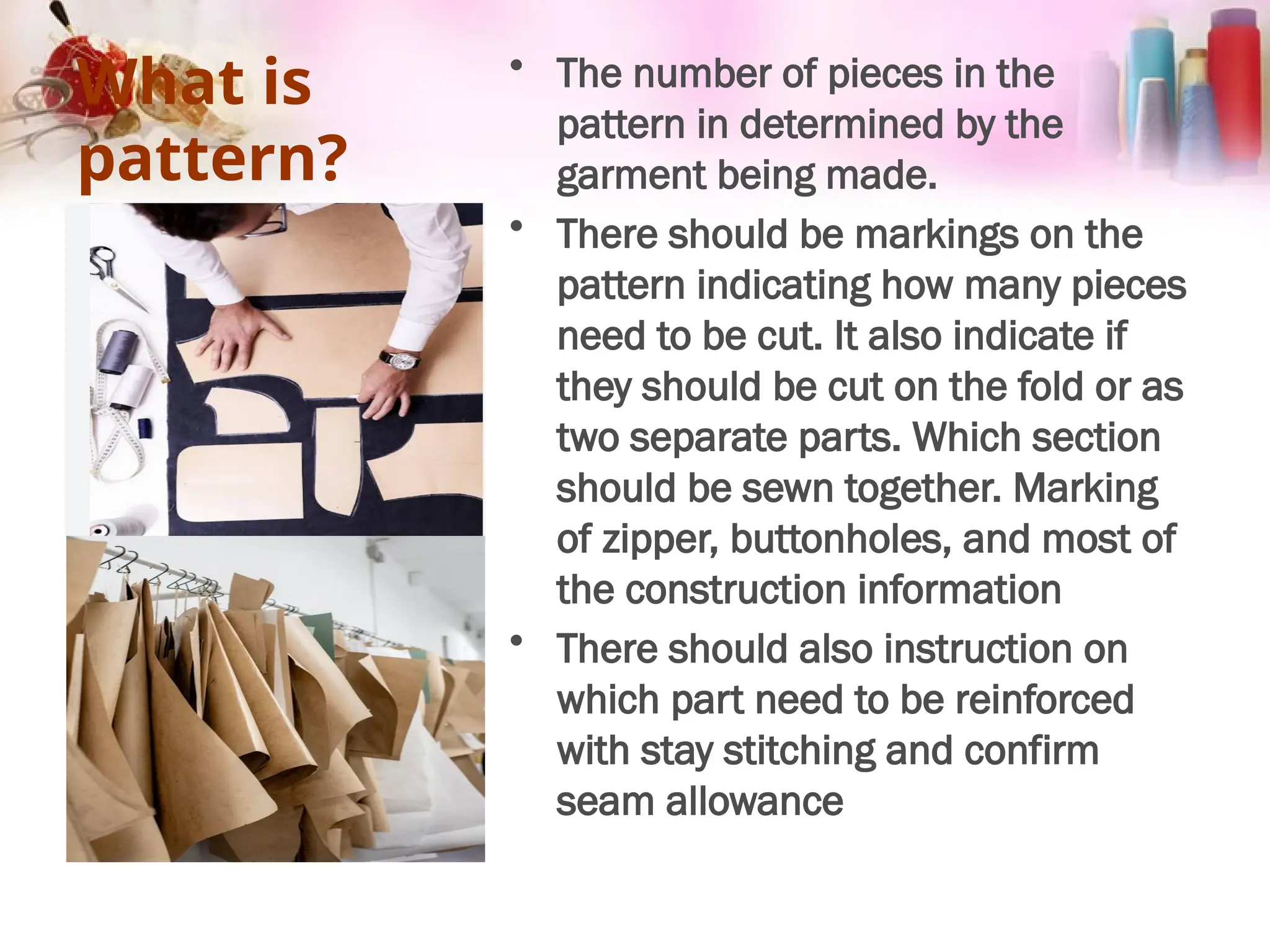
 A pattern is a template to sew a garment in
particular shape and size. Usually made out of
paper.
 made up of several pieces like a jigsaw puzzle
 Comes with clues in the shape of markings to let
you know which part goes where.
What is
pattern?
• The number of pieces in the
pattern in determined by the
garment being made.
• There should be markings on the
pattern indicating how many pieces
need to be cut. It also indicate if
they should be cut on the fold or as
two separate parts. Which section
should be sewn together. Marking
of zipper, buttonholes, and most of
the construction information
• There should also instruction on
which part need to be reinforced
with stay stitching and confirm
seam allowance
What is Pattern Drafting?
 It is the craft of making a paper plan or template
for a garment. It is the first step in the design
process.
 It is created from the body measurements.
Either for industry or commercial standards or
for individual measurements for self – drafted
patterns
 The blueprint of which the final garment is
based
Two types of pattern
1. Commercial Patterns – available in the market.
They are mass-produced
Advantages
 Pattern are tested to ensure accuracy
 Comes in multi – sized options
 Compliment current fashion trends
 Available online
Disadvantage
 Sizes can be limited
 Only for average body
 Can be expensive
 Comes with complicated instruction.
2. Self – drafted Patterns – the you drafted yourself.
 Advantages
 You can design a garment to your own taste
 It will ensure better fit
 Not restricted to the current fashion trends.
 You can choose your own embellishments
 Cheaper than buying a pattern
 Disadvantages
 Buying correct tools could increase the cost
 No marking or written instructions
 Takes time to design
 Need to learn how to draft a pattern
 You have to test the pattern yourself.
HOW TO DRAFT THE
PATTERN
1. PREPARE THE MATERIALS
Measuring Tools
 Measuring tape/Tape measure – this is the most
important tools for dressmakers. You need to
keep this flexible tape handy for measuring
around contoured curves of the body. Also great
for measuring fabrics and drafting patterns
 French Curve – usually made of metal wood or
plastic. These rulers are use for blending and
connecting points when drafting a patterns. It is
used for contoured areas like collars and
armholes and necklines.
 Hip Curve – a tool for making adjustments at the
hip line. It is also good for making adjustments
whenever there is a slight curve such as sides
seams.
 L – Square – used to create scaled patterns, with
perfect right angle corner. It is ore accurate than
ruler and convenient for measuring skirts lengths
or straight lines of material before starting to
pattern layout
 Meter Stick – it is usually made of plastic, wood or
metal. It is used to measure fabrics and draw a
straight lines onto the paper or fabric
Marking Tools
 Tailors Chalk – used for temporary markings to
indicate where it needs to be cut of left out,
shortened or lengthened, or where the pleats
need to be made.
 Markers /Pencil/ Pen – it is best to use to make
an outline on drafting a pattern.
 Pattern Paper – this paper is designed for pattern
adjustments and drafting a pattern. It is of a
similar weight to Kraft paper, but a little more
transparent. It is often with dots or markings to
assists with pattern making.
Cutting Tools
 Scissors – use for making multiple cuts on fabrics
or textiles. They are used to cut patterns, sewing
allowances or to perfect the garments
Steps in Drafting
a Pattern
Get the
measurements
• Take the proper
measurements
• Make a layout styles annd
design
TESDA DRESSMAKING PRESENTATION (TM).pptx

TESDA DRESSMAKING PRESENTATION (TM).pptx

  • 1.
    DRESSMAKING NC-II DRAFT ANDCUT PATTERNS OF CASUAL APPAREL Prepared by: Analeen S. Nolasco
  • 2.
  • 3.
    Competency-Based Training (CBT) •CBT isa training delivery approach that focuses on the competency development of the learner as a result of the training
  • 4.
    1. emphasizes moston what the learner can actually do; 2. focuses on outcomes rather than the learning process within specified time; 3. is concerned with the attainment and application of knowledge, skills and attitude to a specific level of competency. Competency-Based Training . . .
  • 5.
  • 6.
    The ability todo something well or effectively.
  • 7.
    A possession andapplication of Skills, Knowledge and Right Attitudes to perform work activities to the standard expected in the workplace
  • 8.
    Education and trainingmust keep pace with technology and customer requirements Why the Competency-Based Approach?
  • 9.
  • 10.
    Principle One The trainingis based on curriculum developed from the competency standards Learning is based on the competency – based curriculum
  • 11.
    Principle Two Unit ofCompetency Module 1 Module 2 Module 3 Learning is competency-based or modular in structure
  • 12.
    Principle Three Learning isdone by the learner at own pace Training delivery is individualized and self-paced
  • 13.
    Principle Four Training deliveryis individualized and self-paced Learning is based on the actual industry practice
  • 14.
    Principle Five Training materialsare directly related to the competency standards and the curriculum CS to CBC to LMs [CS-Competency Standards/ CBC-Competency-Based Curriculum/ LMs-Learning Materials]
  • 15.
    Principle Six Assessment oflearners is based in the collection of evidences of work performance based on industry or organizational required standards Students are judged againts each other (norm referenced Assessment) Each student is assessed against the evidences based on required standard Students are not judged against each other
  • 16.
    Principle Seven Better learningwith industry and school partnership Training is based both on and off the job components
  • 17.
    Principle Eight Workers andStudents can have prior skills recognized The system allows Recognition of Prior Learning (RPL)
  • 18.
    Principle Nine There isflexibility for entry and exit from programs The system allows for learners to enter and exit programs at different times and levels and to receive an award for competencies attained at any point.
  • 19.
    Principle Ten Training programsare registered within UTPRAS Approved training programs are nationally accredited
  • 20.
    Roles of aTrainer  Serve as a team member to determined what is to be learned.  Stimulates trainees motivation.  Manages learning: a consultation rather than a provider of information; a facilitator of the learning  Diagnose and solve learning problems  Evaluates student achievement  Assist learners to obtain individualized rewards  Assist each trainee in designing a personalized plan of study  Installs confidence in the learner by providing experience where learner may succeed  Serves as a model for desirable work habits, attitudes and tasks performance in the occupational field  Spend more time interacting with student on 1:1 or small group basis  Help those who really need help  Accepts responsibility along with the student for the tasks learned or not learned.
  • 21.
    Roles of aTrainee  Trainee learn at their own rate within program guidelines. They may speed up, slow down, stop or even repeat the task  Trainees may request to receive credits Trainees may select what they want to learn and when they want to learn it, within reason.  or that they already know this done either through pre-testing or though a review of a task list completed at another site.  Trainee may choose how they want to learn-individualized, on a one-to one basis, in a small group, in large group or with audio- visual  Trainee are responsible for that they learn and when they learn it.  Trainee decide when they are ready to perform each task or demonstrate mastery of learning to a job-like level of proficiency before receiving credit for the task.
  • 22.
     Trainee helpdevelop personalized prescription for learning worked out cooperatively and based upon what the student already knows his preference for learning, learning style and other needs.  Trainees compete against pres job standards and not against other student and are graded on achievement of standard or criteria of each task  Trainees know “up front”, before instruction begins what they are expected to know and do to complete the program.  Trainees evaluate their own progress to see how well they are doing.  Trainee move freely in the workshop, laboratory and or training center  Trainees know they will be rated mainly on performance, while papers and pencil tests will be used mainly to check their knowledge of the task.  Trainees learn according to their interest, needs and abilities-not  According to teacher timelines and expediency.
  • 23.
    CBT Process Flow Haveenough Competency/ies been achieved? YES YES Trainee exits program Trainer observes performance Trainee practices task Trainee Rates own performance Trainer Rates performance Trainee enters program • Administer RPL • Orientation • Role of trainer/trainee Trainee selects competency and receive instructions • Administer Learning Contract • Organize learning strategy • Provide materials • Introduce CBLM materials • Introduce the Use of Achievement Progress Report Review learning package View multimedia materials Use manuals Observe demonstration Practice skills in workshop Receive assistance and advise YES Trainee exits program Have completed all the competencies? Satisfactorily Performed Competency? Undergo Nat’l Assessment NO NO NO
  • 24.
  • 25.
    CBLM defined… Instructional Mediathat facilitates individualized training. Package used by the trainer/instructor and trainee/student in competency learning. Further defined by its part.
  • 26.
    Parts of CBLM 1.Frontpage 2.List of competency 3.Module content 4.Learning outcome summary 5.Learning experience 6.Information sheet 7.Self check 8.Self check/answer key 9.Operation/Task/Job Sheet 10.Performance Criteria checklist 11.Reference/further reading
  • 27.
    Characteristics of CBT (9 Components ) This are the structure/arrangement provide for learning purposes. 1. Practical Work Area- the trainee acquired the skills & knowledge of the competencies. 2. Learning Resource Area- this area provide the trainee with the knowledge requirements in the various modules responding to the competencies. (CBLMs) 3. Institutional Assessment area- This is were recognition of prior learning is done by the trainees. 4. Contextual learning laboratory- this facility that the underpinning knowledge, science, , mathematics & communication mathematics &
  • 28.
    6. Trainers resourcearea- this area houses the learning materials, the training regulation & curriculum examples. 7. Distance learning area- this are component- based work shop component that enable learning provision outside the training institution. 8. Computer laboratory- The used of information technology. The trainee provided to learned and gain appropriate IT competencies that may include word and excel. 9. Support service area
  • 30.
    Basic Competencies Participate inWorkplace Communication Work in Team Environment Practice career professionalism Practice occupational health and safety procedures
  • 31.
    Common Competencies Carry out measurementsand calculation Set – up and operate machine/s Perform basic maintenance Apply quality standards
  • 32.
    Core Competencies in Dressmaking Draft and cut pattern of casual apparel  Prepare and cut materials of casual apparel  Sew casual apparel  Apply finishing touches of casual apparel
  • 33.
    TEAM WORK Has theincredible power to increase productivity, job satisfaction and even each person’s individual performance
  • 34.
    QUALITY cost is moreimportant than quality, but quality is the best way to reduce cost, and the best business plan
  • 35.
    Draft and cut patternof casual apparel
  • 36.
    What is pattern? A pattern is a template to sew a garment in particular shape and size. Usually made out of paper.  made up of several pieces like a jigsaw puzzle  Comes with clues in the shape of markings to let you know which part goes where.
  • 37.
    What is pattern? • Thenumber of pieces in the pattern in determined by the garment being made. • There should be markings on the pattern indicating how many pieces need to be cut. It also indicate if they should be cut on the fold or as two separate parts. Which section should be sewn together. Marking of zipper, buttonholes, and most of the construction information • There should also instruction on which part need to be reinforced with stay stitching and confirm seam allowance
  • 38.
    What is PatternDrafting?  It is the craft of making a paper plan or template for a garment. It is the first step in the design process.  It is created from the body measurements. Either for industry or commercial standards or for individual measurements for self – drafted patterns  The blueprint of which the final garment is based
  • 39.
    Two types ofpattern 1. Commercial Patterns – available in the market. They are mass-produced Advantages  Pattern are tested to ensure accuracy  Comes in multi – sized options  Compliment current fashion trends  Available online Disadvantage  Sizes can be limited  Only for average body  Can be expensive  Comes with complicated instruction.
  • 40.
    2. Self –drafted Patterns – the you drafted yourself.  Advantages  You can design a garment to your own taste  It will ensure better fit  Not restricted to the current fashion trends.  You can choose your own embellishments  Cheaper than buying a pattern  Disadvantages  Buying correct tools could increase the cost  No marking or written instructions  Takes time to design  Need to learn how to draft a pattern  You have to test the pattern yourself.
  • 41.
    HOW TO DRAFTTHE PATTERN 1. PREPARE THE MATERIALS Measuring Tools  Measuring tape/Tape measure – this is the most important tools for dressmakers. You need to keep this flexible tape handy for measuring around contoured curves of the body. Also great for measuring fabrics and drafting patterns
  • 42.
     French Curve– usually made of metal wood or plastic. These rulers are use for blending and connecting points when drafting a patterns. It is used for contoured areas like collars and armholes and necklines.
  • 43.
     Hip Curve– a tool for making adjustments at the hip line. It is also good for making adjustments whenever there is a slight curve such as sides seams.
  • 44.
     L –Square – used to create scaled patterns, with perfect right angle corner. It is ore accurate than ruler and convenient for measuring skirts lengths or straight lines of material before starting to pattern layout
  • 45.
     Meter Stick– it is usually made of plastic, wood or metal. It is used to measure fabrics and draw a straight lines onto the paper or fabric
  • 46.
    Marking Tools  TailorsChalk – used for temporary markings to indicate where it needs to be cut of left out, shortened or lengthened, or where the pleats need to be made.
  • 47.
     Markers /Pencil/Pen – it is best to use to make an outline on drafting a pattern.
  • 48.
     Pattern Paper– this paper is designed for pattern adjustments and drafting a pattern. It is of a similar weight to Kraft paper, but a little more transparent. It is often with dots or markings to assists with pattern making.
  • 49.
    Cutting Tools  Scissors– use for making multiple cuts on fabrics or textiles. They are used to cut patterns, sewing allowances or to perfect the garments
  • 50.
  • 51.
    Get the measurements • Takethe proper measurements
  • 52.
    • Make alayout styles annd design