TERMINAL ILLNESS AND DEATH
INTRODUCTION
Developmental psychologists and
thanatologists have suggested that death
education be part of everyone's schooling
since all are affected.
Death education includes programs that
teach about death dying and grief, and are
designed to help all people successfully
deal with death and dying. Crisis
intervention education is one type of
death education program.
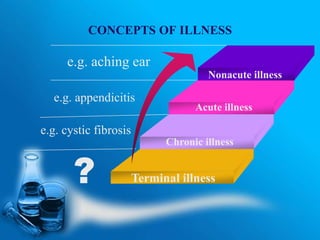
CONCEPTS OF ILLNESS
e.g. appendicitis
Nonacute illness
Acute illness
e.g. aching ear
Chronic illness
e.g. cystic fibrosis
Terminal illness
MEANING OF TERMINALLY ILL CHILD
A disease that cannot be cured and that
is reasonably expected to result in
the death of the child within a short period
of time is termed as terminal illness.
This term is more commonly used for
progressive diseases such as cancer or
advanced heart disease than for trauma. It
indicates a disease which will eventually
end the life of the sufferer.
DECISION MAKING
• Physician – health care
team
• progression of disease
• the availability of
treatment options
• the impact of
treatment
• child’s overall
prognosis
• child’s age
• premorbid cognitive
condition
• functional status
• pain or discomfort
• probability of survival
• quality of life
• E.g. DNR
PARENTAL DECISION MAKING
• When the death is unexpected, the confusion of
emergency services and possibly an intensive care
setting presents challenges to the parents as they are
asked to make difficult choices.
• If the child has experienced a life threatening illness
that has now reached its terminal phase, parents are
often unprepared for the reality of their child’s
impending death.
Nurses should ensure the families that there are
options. The nurse’s first responsibility is to explore the
family’s wishes.
THE DYING CHILD
• Honest information about their illness, treatment and prognosis.
• An open conversation early in the course of illness
• Providing appropriate literature
• Decisions regarding involving child in care during their dying process
and death, is an individual matter.
• The child’s age or developmental stage is considered.
• A shared decision making is important to the child’s and family’s
emotional health.
• Parents require professional support and guidance in this.
• Adolescents have autonomy in decision making with regard to care
and treatment.
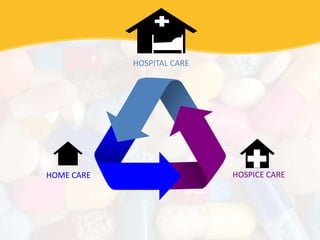
HOME CARE HOSPICE CARE
HOSPITAL CARE
HOSPITAL
• Families may choose to remain in the hospital to
provide care in his unstable condition and home
care is not an option.
-Then the setting should me made homelike as
possible.
-Familiar items of child are encouraged to bring
-There should be a consistent, coordinated care
plan for the family’s comfort.
HOME CARE
• Some families prefer to take child home
and receive service from home care
agency.
-Periodic visits of nurses to administer
medication, equipment or supplies are
provided.
-The health care team promote this in
the belief of providing hospice care to
the child.
HOSPICE CARE
• Hospice is a community health care
organisation that specializes in the care of
dying patients by combining the hospice
philosophy with principles of palliative care.
• Management of physical, psychological,
social and spiritual needs of child and family.
• Care is provided by a multidisciplinary group
of professionals in the patient’s home. It is
based on certain concepts.
Concepts of hospice care
1.Family members are the principle care givers and
are supported by team of professional and volunteer
staff.
2.The priority of care is comfort. The child’s needs are
considered. Pain and symptom control are primary
concerns and no extra ordinary efforts are taken to
prolong life.
3.Family’s needs are considered to be as important as
child’s needs.
4.It is considered with the family’s post death
adjustment and care may continue for one year or
more.
PERCEPTIONS OF DEATH
(according to developmental stage of child)
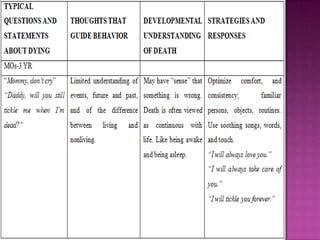
 INFANTS
-Death has least significance to them especially
< 6 months of age.
 TODDLER
-Instead of understanding death they will be
more affected by the change in life style.
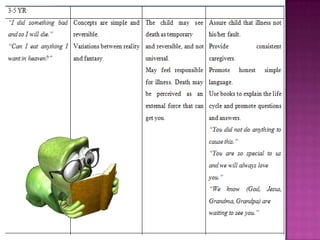
 PRESCHOOLER
-They believe their thoughts are sufficient to
cause death; the consequence is the burden of
guilt, shame and punishment.
-They seen death as departure, a kind of sleep.
-They may recognise the fact of physical death
but do not separate it from living abilities.
-They have no understanding of inevitability of
death
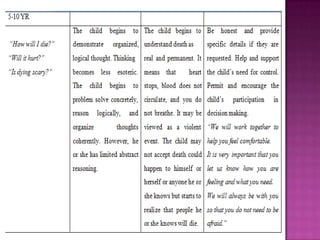
 SCHOOLER
-They associate misdeeds or bad thoughts
with causing death and feel intense guilt
and responsibility for the event.
-They respond well to the logical
explanations about death.
-They have a deeper understanding about
death.
-They personify death as devil, monster
etc.
-By age of 9 – 10 they have an adult
concept of death, realising it is inevitable,
universal and irreversible.
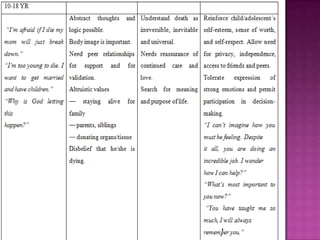
ADOLESCENTS
-They have a mature understanding of
death
-They are still influenced by the
remnants of magical thinking and are
subject to guilt and shame.
-They are likely to see deviations from
accepted behaviour as reasons for their
illness.
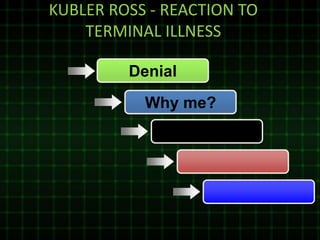
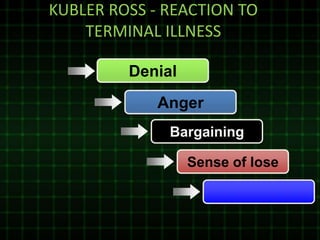
KUBLER ROSS - REACTION TO
TERMINAL ILLNESS
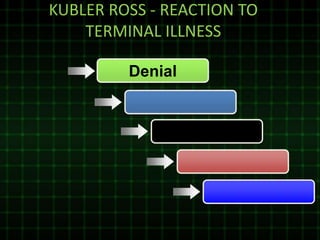
KUBLER ROSS - REACTION TO
TERMINAL ILLNESS
Denial
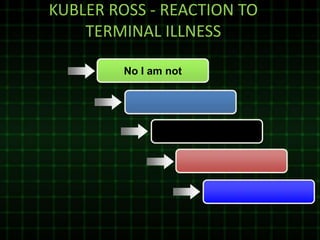
KUBLER ROSS - REACTION TO
TERMINAL ILLNESS
No I am not
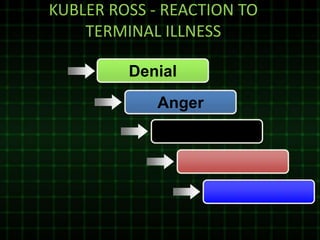
KUBLER ROSS - REACTION TO
TERMINAL ILLNESS
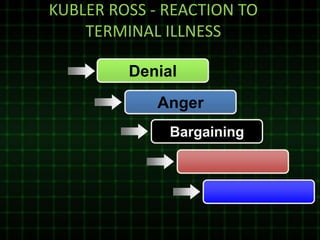
Denial
Anger
KUBLER ROSS - REACTION TO
TERMINAL ILLNESS
Denial
Why me?
KUBLER ROSS - REACTION TO
TERMINAL ILLNESS
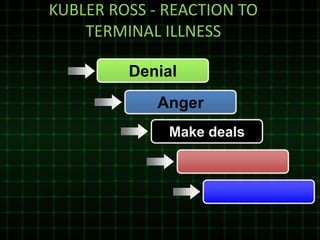
Denial
Anger
Bargaining
KUBLER ROSS - REACTION TO
TERMINAL ILLNESS
Denial
Anger
Make deals
KUBLER ROSS - REACTION TO
TERMINAL ILLNESS
Denial
Anger
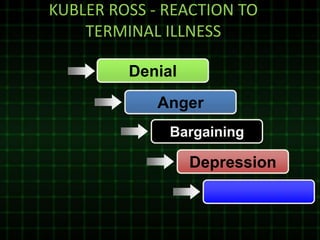
Bargaining
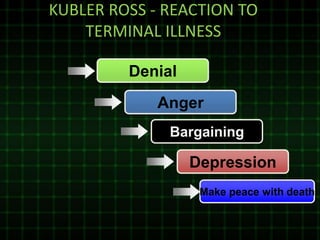
Depression
KUBLER ROSS - REACTION TO
TERMINAL ILLNESS
Denial
Anger
Bargaining
Sense of lose
KUBLER ROSS - REACTION TO
TERMINAL ILLNESS
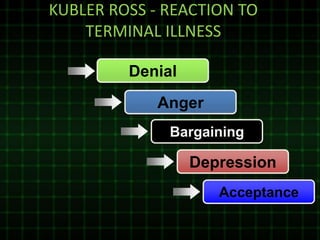
Denial
Anger
Bargaining
Depression
Acceptance
KUBLER ROSS - REACTION TO
TERMINAL ILLNESS
Denial
Anger
Bargaining
Depression
Make peace with death
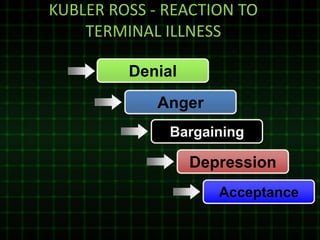
KUBLER ROSS - REACTION TO
TERMINAL ILLNESS
Denial
Anger
Bargaining
Depression
Acceptance
PALLIATIVE CARE
WHO defines - “active total
care of patients whose
disease is not responsive to
curative treatment. Control of
pain, of other symptoms and
of psychological, social and
spiritual problems is
paramount. The goal of
palliative care is to achieve
the best possible quality of
life for patients and their
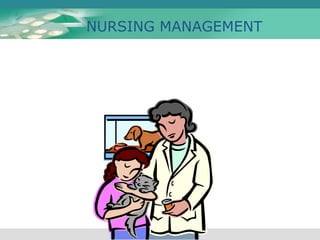
NURSING MANAGEMENT
1.Fear of pain and
suffering
2.Pain and symptom
management
3.Fear of dying alone
4.Fear of actual death
Home
1. FEAR OF PAIN AND SUFFERING
The presence of unrelieved pain in a terminally
ill child can have effects on the quality of life of
child and family.
Parents feel as unendurable, results in feelings
of helplessness, a sense that they must be
present and vigilant to get the necessary pain
medications.
Nurses can alleviate the fear of pain and
suffering by providing interventions aimed at
treating the pain and symptoms associated with
the terminal process in children.
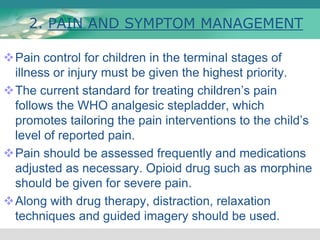
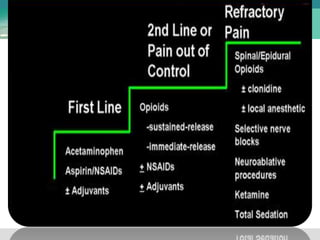
2. PAIN AND SYMPTOM MANAGEMENT
Pain control for children in the terminal stages of
illness or injury must be given the highest priority.
The current standard for treating children’s pain
follows the WHO analgesic stepladder, which
promotes tailoring the pain interventions to the child’s
level of reported pain.
Pain should be assessed frequently and medications
adjusted as necessary. Opioid drug such as morphine
should be given for severe pain.
Along with drug therapy, distraction, relaxation
techniques and guided imagery should be used.
Symptoms during their terminal course as a result
of their disease process or as side effect of
medication.
The symptoms include fatigue, nausea and
vomiting, constipation, anorexia, dyspnoea,
congestion, seizures, anxiety, depression,
restlessness, agitation and confusion.
The symptoms should be managed with
appropriate medications or treatments and with
interventions such as repositioning, relaxation,
massage and other measures to maintain comfort
and quality of life.
3. FEAR OF DYING ALONE
 When child is being treated at home, the burden of care on
parents and family members can be great.
 Nurse can assist the family helping them arrange shifts so
that friends or other family members to be present with child
and they could rest.
 If the family is with limited resource, church or hospice could
provide volunteers to sit with children.
 When the child is dying in the hospital, parents should be
given full access to the child at all times.
 If the parents need to leave they should be provided with a
means of immediate communication and alerted if staff
noted any change in the child’s condition that may indicate
imminent death.
4. FEAR OF ACTUAL DEATH
Home deaths:
 The majority of children receive hospice care die at home,
often in their own room with family, pets and other loved
possessions around them.
 The change in respiratory pattern is the most distressing
change for parents to observe. Families should be
reassured that it is not distressing to child but is normal
processing of death.
 The use of opioids can slow the respirations to make child
breath more easily. Over hydration also result in noisy
respiration.
 Families have the option of admitting the child in hospital if
they feel unable to deal with death.
Hospital deaths:
There is an increased presence of nurses and health
team to provide comfort.
A child in ICU often requires active withdrawal of life
supporting intervention such as bypass machine or
ventilator. But this situation raises ethical issues.
After death, parents should be allowed to remain
with body or rock the body if they wish.
A sibling needs preparation for post death services.
They should be permitted to stay as long as they
wish and also give private time to say good bye.
Parents should prepare the sibling.
FEW NURSING INTERVENTIONS
Pain –
• limit unnecessary painful procedures
• sedation and giving pre-emptive analgesia prior
to a procedure (e.g., including sucrose for
procedures in neonates)
• Address coincident depression, anxiety, sense of
fear or lack of control.
• Consider guided imagery, relaxation, hypnosis,
art/pet/play therapy, acupuncture/acupressure,
biofeedback, massage, heat/cold, yoga,
transcutaneous electric nerve stimulation,
Dyspnoea or air hunger-
• Suction secretions if present
• positioning, comfortable loose clothing, fan to
provide cool, blowing air.
• Limit volume of IV fluids, consider diuretics if
fluid overload/ pulmonary oedema present.
• Behavioural strategies including breathing
exercises, guided imagery, relaxation, music
Fatigue –
• Sleep hygiene
• Gentle exercise
• Address potentially contributing factors (e.g.,
anaemia, depression, side effects of
medications)
Nausea/vomiting –
• Consider dietary modifications (bland, soft,
adjust timing/ volume of foods or
• feeds) Aromatherapy: peppermint, lavender;
acupuncture/
• Constipation - Increase fibres in diet,
encourage fluids
Oral lesions/dysphagia –
• Oral hygiene and appropriate liquid, solid and
oral medication formulation
• (texture, taste, fluidity). Treat infections,
complications (mucositis, pharyngitis, dental
abscess, esophagitis).Orophayngeal motility
study and speech (feeding team) consultation
Anorexia–
• Manage treatable lesions causing oral pain,
dysphagia, and anorexia.
• Support caloric intake during phase of illness
when anorexia is reversible.
• Acknowledge that anorexia is intrinsic to the
dying process and may not be reversible.
Prevent/treat coexisting constipation
Pruritus –
• Moisturize skin, Trim child’s nails to prevent
excoriation, Try specialized anti-itch lotions,
• Apply cold packs, Counter stimulation,
distraction, and relaxation.
Diarrhoea –
• Evaluate/treat if obstipation, Assess and treat
infection, Dietary modification.
Depression –
• Psychotherapy, behavioural techniques
Anxiety –
• Psychotherapy (individual and family),
behavioural techniques
Agitation/terminal restlessness –
• Evaluate for organic or drug causes, Educate
family, Orient and reassure child; provide
calm.
NURSING CARE
•Answering the question
•Helping the parents
•Helping the dying child
• Benefit another human being
• irreversible cessation of neurologic function of
the brain
• discuss the topic with family
• Healthy child who dies unexpectedly, children
with cancer, chronic disease etc should be
considered for organ donation
ORGAN DONATION
GRIEF AND BEREAVEMENT
•Grief is the emotional response to
that loss.
•Bereavement is the
acknowledgment of the objective
fact that one has experienced a
death.
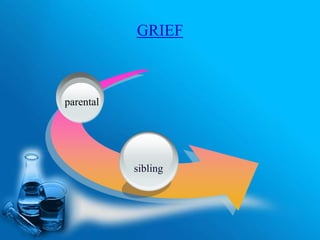
GRIEF
sibling
parental
BEREAVEMENT
The word 'bereavement' comes from the
ancient German for 'seize by violence'.
Today the word 'bereavement' is used to
describe the period of grief and mourning we
go through after someone close to us dies.
Bereavement is about trying to accept what
happened, learning to adjust to life without that
person
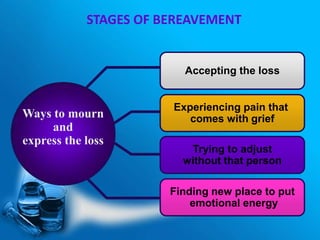
Ways to mourn
and
express the loss
Accepting the loss
Experiencing pain that
comes with grief
Trying to adjust
without that person
Finding new place to put
emotional energy
STAGES OF BEREAVEMENT
The importance of mourning
Mourning allows to say goodbye.
Seeing the body, watching the burial, or
scattering the ashes is a way of affirming
what has happened.
Sometimes we need to see evidence that a
person really has died before we can truly
enter into the grieving process.
COUNSELLING
DEFINITION
Counselling is a definitively structured
permissive relationship which allows the
client to gain an understanding of himself
to a degree which enables him to take new
positive steps in the light of his new
orientation.
- ROGES
Characteristics
2 individual
Self realization
Realistic goals
Attitude & action
Bereavement counselling
-to help people cope more effectively with the
death of their child or a loved one.
Specifically, bereavement counselling can:
offer an understanding of the mourning
process
explore areas that could potentially prevent
you from moving on
help resolve areas of conflict still remaining
help you to adjust to a new sense of self
address possible issues of depression or
suicidal thoughts
CONCLUSION
Knowledge about hospitalization,
terminally ill child and the nursing
management help nurses to provide the
adequate and quality care, to support the
family and child and to help her by self
satisfaction. Even though time heals the
wound, an adequate support accelerates
the process.
THANK YOU

terminal illness and death

  • 1.
  • 2.
    INTRODUCTION Developmental psychologists and thanatologistshave suggested that death education be part of everyone's schooling since all are affected. Death education includes programs that teach about death dying and grief, and are designed to help all people successfully deal with death and dying. Crisis intervention education is one type of death education program.
  • 3.
    CONCEPTS OF ILLNESS e.g.appendicitis Nonacute illness Acute illness e.g. aching ear Chronic illness e.g. cystic fibrosis Terminal illness
  • 4.
    MEANING OF TERMINALLYILL CHILD A disease that cannot be cured and that is reasonably expected to result in the death of the child within a short period of time is termed as terminal illness. This term is more commonly used for progressive diseases such as cancer or advanced heart disease than for trauma. It indicates a disease which will eventually end the life of the sufferer.
  • 5.
    DECISION MAKING • Physician– health care team • progression of disease • the availability of treatment options • the impact of treatment • child’s overall prognosis • child’s age • premorbid cognitive condition • functional status • pain or discomfort • probability of survival • quality of life • E.g. DNR
  • 6.
    PARENTAL DECISION MAKING •When the death is unexpected, the confusion of emergency services and possibly an intensive care setting presents challenges to the parents as they are asked to make difficult choices. • If the child has experienced a life threatening illness that has now reached its terminal phase, parents are often unprepared for the reality of their child’s impending death. Nurses should ensure the families that there are options. The nurse’s first responsibility is to explore the family’s wishes.
  • 7.
    THE DYING CHILD •Honest information about their illness, treatment and prognosis. • An open conversation early in the course of illness • Providing appropriate literature • Decisions regarding involving child in care during their dying process and death, is an individual matter. • The child’s age or developmental stage is considered. • A shared decision making is important to the child’s and family’s emotional health. • Parents require professional support and guidance in this. • Adolescents have autonomy in decision making with regard to care and treatment.
  • 9.
    HOME CARE HOSPICECARE HOSPITAL CARE
  • 10.
    HOSPITAL • Families maychoose to remain in the hospital to provide care in his unstable condition and home care is not an option. -Then the setting should me made homelike as possible. -Familiar items of child are encouraged to bring -There should be a consistent, coordinated care plan for the family’s comfort.
  • 11.
    HOME CARE • Somefamilies prefer to take child home and receive service from home care agency. -Periodic visits of nurses to administer medication, equipment or supplies are provided. -The health care team promote this in the belief of providing hospice care to the child.
  • 12.
    HOSPICE CARE • Hospiceis a community health care organisation that specializes in the care of dying patients by combining the hospice philosophy with principles of palliative care. • Management of physical, psychological, social and spiritual needs of child and family. • Care is provided by a multidisciplinary group of professionals in the patient’s home. It is based on certain concepts.
  • 13.
    Concepts of hospicecare 1.Family members are the principle care givers and are supported by team of professional and volunteer staff. 2.The priority of care is comfort. The child’s needs are considered. Pain and symptom control are primary concerns and no extra ordinary efforts are taken to prolong life. 3.Family’s needs are considered to be as important as child’s needs. 4.It is considered with the family’s post death adjustment and care may continue for one year or more.
  • 14.
    PERCEPTIONS OF DEATH (accordingto developmental stage of child)
  • 15.
     INFANTS -Death hasleast significance to them especially < 6 months of age.  TODDLER -Instead of understanding death they will be more affected by the change in life style.  PRESCHOOLER -They believe their thoughts are sufficient to cause death; the consequence is the burden of guilt, shame and punishment. -They seen death as departure, a kind of sleep. -They may recognise the fact of physical death but do not separate it from living abilities. -They have no understanding of inevitability of death
  • 16.
     SCHOOLER -They associatemisdeeds or bad thoughts with causing death and feel intense guilt and responsibility for the event. -They respond well to the logical explanations about death. -They have a deeper understanding about death. -They personify death as devil, monster etc. -By age of 9 – 10 they have an adult concept of death, realising it is inevitable, universal and irreversible.
  • 17.
    ADOLESCENTS -They have amature understanding of death -They are still influenced by the remnants of magical thinking and are subject to guilt and shame. -They are likely to see deviations from accepted behaviour as reasons for their illness.
  • 22.
    KUBLER ROSS -REACTION TO TERMINAL ILLNESS
  • 23.
    KUBLER ROSS -REACTION TO TERMINAL ILLNESS Denial
  • 24.
    KUBLER ROSS -REACTION TO TERMINAL ILLNESS No I am not
  • 25.
    KUBLER ROSS -REACTION TO TERMINAL ILLNESS Denial Anger
  • 26.
    KUBLER ROSS -REACTION TO TERMINAL ILLNESS Denial Why me?
  • 27.
    KUBLER ROSS -REACTION TO TERMINAL ILLNESS Denial Anger Bargaining
  • 28.
    KUBLER ROSS -REACTION TO TERMINAL ILLNESS Denial Anger Make deals
  • 29.
    KUBLER ROSS -REACTION TO TERMINAL ILLNESS Denial Anger Bargaining Depression
  • 30.
    KUBLER ROSS -REACTION TO TERMINAL ILLNESS Denial Anger Bargaining Sense of lose
  • 31.
    KUBLER ROSS -REACTION TO TERMINAL ILLNESS Denial Anger Bargaining Depression Acceptance
  • 32.
    KUBLER ROSS -REACTION TO TERMINAL ILLNESS Denial Anger Bargaining Depression Make peace with death
  • 33.
    KUBLER ROSS -REACTION TO TERMINAL ILLNESS Denial Anger Bargaining Depression Acceptance
  • 34.
    PALLIATIVE CARE WHO defines- “active total care of patients whose disease is not responsive to curative treatment. Control of pain, of other symptoms and of psychological, social and spiritual problems is paramount. The goal of palliative care is to achieve the best possible quality of life for patients and their
  • 35.
  • 36.
    1.Fear of painand suffering 2.Pain and symptom management 3.Fear of dying alone 4.Fear of actual death Home
  • 37.
    1. FEAR OFPAIN AND SUFFERING The presence of unrelieved pain in a terminally ill child can have effects on the quality of life of child and family. Parents feel as unendurable, results in feelings of helplessness, a sense that they must be present and vigilant to get the necessary pain medications. Nurses can alleviate the fear of pain and suffering by providing interventions aimed at treating the pain and symptoms associated with the terminal process in children.
  • 38.
    2. PAIN ANDSYMPTOM MANAGEMENT Pain control for children in the terminal stages of illness or injury must be given the highest priority. The current standard for treating children’s pain follows the WHO analgesic stepladder, which promotes tailoring the pain interventions to the child’s level of reported pain. Pain should be assessed frequently and medications adjusted as necessary. Opioid drug such as morphine should be given for severe pain. Along with drug therapy, distraction, relaxation techniques and guided imagery should be used.
  • 40.
    Symptoms during theirterminal course as a result of their disease process or as side effect of medication. The symptoms include fatigue, nausea and vomiting, constipation, anorexia, dyspnoea, congestion, seizures, anxiety, depression, restlessness, agitation and confusion. The symptoms should be managed with appropriate medications or treatments and with interventions such as repositioning, relaxation, massage and other measures to maintain comfort and quality of life.
  • 41.
    3. FEAR OFDYING ALONE  When child is being treated at home, the burden of care on parents and family members can be great.  Nurse can assist the family helping them arrange shifts so that friends or other family members to be present with child and they could rest.  If the family is with limited resource, church or hospice could provide volunteers to sit with children.  When the child is dying in the hospital, parents should be given full access to the child at all times.  If the parents need to leave they should be provided with a means of immediate communication and alerted if staff noted any change in the child’s condition that may indicate imminent death.
  • 42.
    4. FEAR OFACTUAL DEATH Home deaths:  The majority of children receive hospice care die at home, often in their own room with family, pets and other loved possessions around them.  The change in respiratory pattern is the most distressing change for parents to observe. Families should be reassured that it is not distressing to child but is normal processing of death.  The use of opioids can slow the respirations to make child breath more easily. Over hydration also result in noisy respiration.  Families have the option of admitting the child in hospital if they feel unable to deal with death.
  • 43.
    Hospital deaths: There isan increased presence of nurses and health team to provide comfort. A child in ICU often requires active withdrawal of life supporting intervention such as bypass machine or ventilator. But this situation raises ethical issues. After death, parents should be allowed to remain with body or rock the body if they wish. A sibling needs preparation for post death services. They should be permitted to stay as long as they wish and also give private time to say good bye. Parents should prepare the sibling.
  • 44.
    FEW NURSING INTERVENTIONS Pain– • limit unnecessary painful procedures • sedation and giving pre-emptive analgesia prior to a procedure (e.g., including sucrose for procedures in neonates) • Address coincident depression, anxiety, sense of fear or lack of control. • Consider guided imagery, relaxation, hypnosis, art/pet/play therapy, acupuncture/acupressure, biofeedback, massage, heat/cold, yoga, transcutaneous electric nerve stimulation,
  • 45.
    Dyspnoea or airhunger- • Suction secretions if present • positioning, comfortable loose clothing, fan to provide cool, blowing air. • Limit volume of IV fluids, consider diuretics if fluid overload/ pulmonary oedema present. • Behavioural strategies including breathing exercises, guided imagery, relaxation, music
  • 46.
    Fatigue – • Sleephygiene • Gentle exercise • Address potentially contributing factors (e.g., anaemia, depression, side effects of medications)
  • 47.
    Nausea/vomiting – • Considerdietary modifications (bland, soft, adjust timing/ volume of foods or • feeds) Aromatherapy: peppermint, lavender; acupuncture/ • Constipation - Increase fibres in diet, encourage fluids
  • 48.
    Oral lesions/dysphagia – •Oral hygiene and appropriate liquid, solid and oral medication formulation • (texture, taste, fluidity). Treat infections, complications (mucositis, pharyngitis, dental abscess, esophagitis).Orophayngeal motility study and speech (feeding team) consultation
  • 49.
    Anorexia– • Manage treatablelesions causing oral pain, dysphagia, and anorexia. • Support caloric intake during phase of illness when anorexia is reversible. • Acknowledge that anorexia is intrinsic to the dying process and may not be reversible. Prevent/treat coexisting constipation
  • 50.
    Pruritus – • Moisturizeskin, Trim child’s nails to prevent excoriation, Try specialized anti-itch lotions, • Apply cold packs, Counter stimulation, distraction, and relaxation.
  • 51.
    Diarrhoea – • Evaluate/treatif obstipation, Assess and treat infection, Dietary modification. Depression – • Psychotherapy, behavioural techniques
  • 52.
    Anxiety – • Psychotherapy(individual and family), behavioural techniques Agitation/terminal restlessness – • Evaluate for organic or drug causes, Educate family, Orient and reassure child; provide calm.
  • 53.
    NURSING CARE •Answering thequestion •Helping the parents •Helping the dying child
  • 54.
    • Benefit anotherhuman being • irreversible cessation of neurologic function of the brain • discuss the topic with family • Healthy child who dies unexpectedly, children with cancer, chronic disease etc should be considered for organ donation ORGAN DONATION
  • 55.
    GRIEF AND BEREAVEMENT •Griefis the emotional response to that loss. •Bereavement is the acknowledgment of the objective fact that one has experienced a death.
  • 56.
  • 57.
    BEREAVEMENT The word 'bereavement'comes from the ancient German for 'seize by violence'. Today the word 'bereavement' is used to describe the period of grief and mourning we go through after someone close to us dies. Bereavement is about trying to accept what happened, learning to adjust to life without that person
  • 58.
    Ways to mourn and expressthe loss Accepting the loss Experiencing pain that comes with grief Trying to adjust without that person Finding new place to put emotional energy STAGES OF BEREAVEMENT
  • 59.
    The importance ofmourning Mourning allows to say goodbye. Seeing the body, watching the burial, or scattering the ashes is a way of affirming what has happened. Sometimes we need to see evidence that a person really has died before we can truly enter into the grieving process.
  • 60.
    COUNSELLING DEFINITION Counselling is adefinitively structured permissive relationship which allows the client to gain an understanding of himself to a degree which enables him to take new positive steps in the light of his new orientation. - ROGES
  • 61.
  • 62.
    Bereavement counselling -to helppeople cope more effectively with the death of their child or a loved one. Specifically, bereavement counselling can: offer an understanding of the mourning process explore areas that could potentially prevent you from moving on help resolve areas of conflict still remaining help you to adjust to a new sense of self address possible issues of depression or suicidal thoughts
  • 63.
    CONCLUSION Knowledge about hospitalization, terminallyill child and the nursing management help nurses to provide the adequate and quality care, to support the family and child and to help her by self satisfaction. Even though time heals the wound, an adequate support accelerates the process.
  • 64.