CARE OF DYING
CHILD
BY
SHIKHA.S.A
INFANTS AND TODDLERS
 Infants and toddlers view death in relation to the loss of
a caretaker and the subsequent emptiness in their lives.
 Children of this age react to the dying process based
upon the sadness, anger and anxiety conveyed by their
parents.
 Reactions will be expressed through crying, attachment
to primary caregiver, and separation anxiety.
CHILD’S CONCEPT
OF DEATH
 Preschoolers view death as a separation or departure
and believe it to be only temporary.
 Death is also seen as reversible.
 Magical thinking and egocentricity at this age often
leads to guilt and shame because children may believe
that their thoughts or actions caused the death.
 Preschooler facing an impending death frequently
views their condition as punishment for behaviours or
thoughts.
PRESCHOOLERS-
 By the school age years, death begins to be
understood as a sad and irreversible event, yet it still
may be considered inevitable only for adults.
 By the age of 10 yrs or so, children begin to
understand that they too can die.
 They may continue to believe that thoughts or actions
can cause death or that death serves as a punishment
for wrong doing.
 School age children may wonder why they are ill and
must die so young.
 They may also fear being without their parents love and
support, which they have always known.
SCHOOL-AGE
CHILDREN
Most adolescents have a fully developed
understanding of death as inevitable and
irreversible.
As a result of their illness, adolescents may
become isolated from their peers.
The terminal illness or disability of a peer forces
adolescents to face and question their own
mortality and wholeness abruptly and unwillingly.
ADOLESCENTS
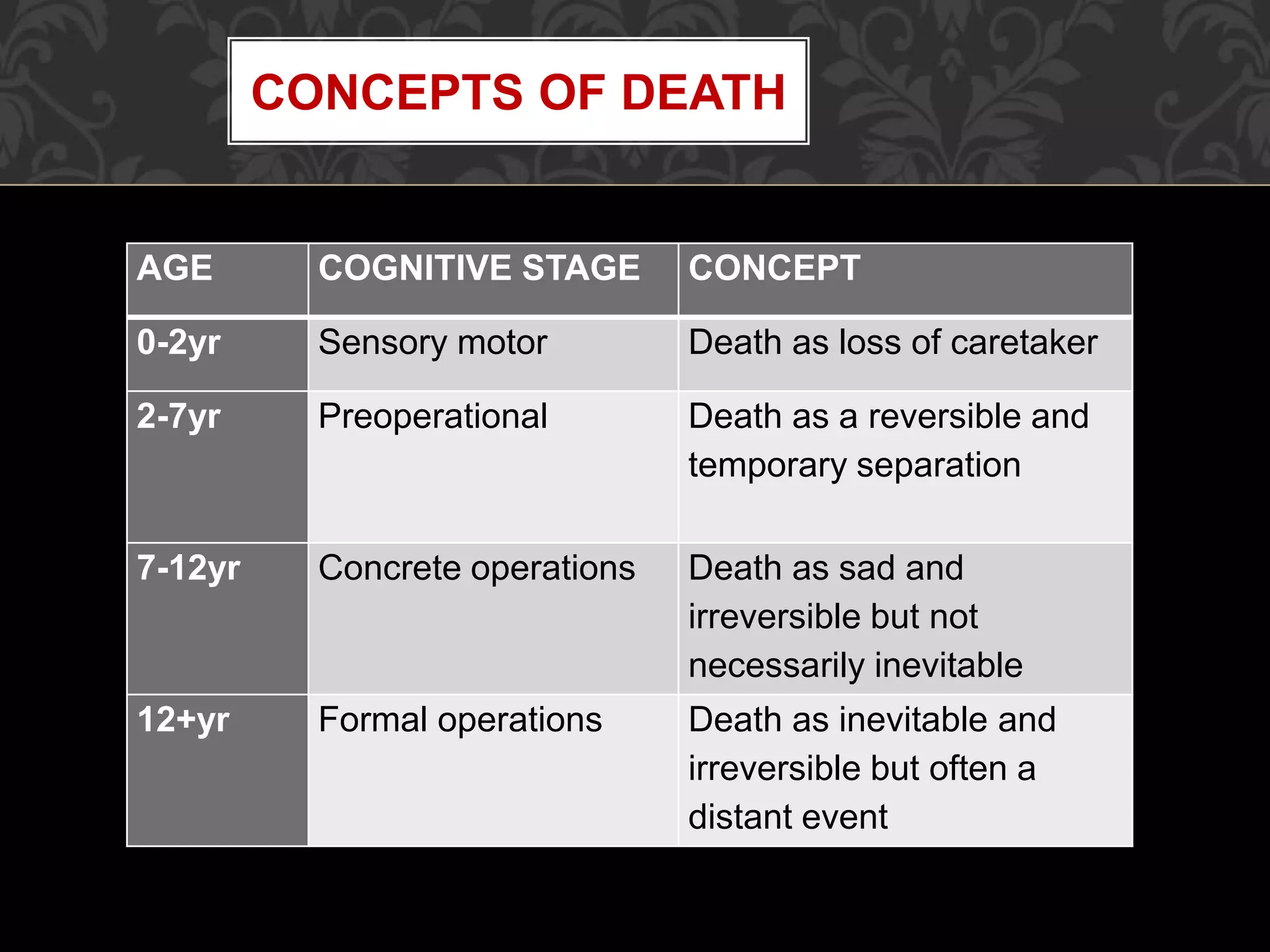
AGE COGNITIVE STAGE CONCEPT
0-2yr Sensory motor Death as loss of caretaker
2-7yr Preoperational Death as a reversible and
temporary separation
7-12yr Concrete operations Death as sad and
irreversible but not
necessarily inevitable
12+yr Formal operations Death as inevitable and
irreversible but often a
distant event
CONCEPTS OF DEATH
 IN INFANTS-: Congenital anomalies, respiratory distress
syndrome, disorders related to short gestation and low
birth weight, and sudden infant death syndrome.
 IN 5-9yrs CHILDREN-: Accidental injuries, malignant
neoplasm, congenital anomalies, homicide and heart
disease.
 IN 10-14yrs CHILDREN-: Suicide, accidental injury,
malignant neoplasm
 IN 15-19yrs CHILDREN-: Homicide, suicide, malignant
neoplasm, accidents, heart diseases.
CAUSES FOR DEATH IN CHILDREN
CHILD’S RESPONSE-
 A child who is dying wants to feel safe and does not want
to be alone or in pain.
 The frequently traumatising experiences of a chronic
condition and its treatment tend to make children more
mature and wise beyond their years.
 Children with a terminal illness see treatment as worse
than death.
 Children may speak of seeing or even interacting with
angels or the higher being recognized by their specific
faith.
RESPONSE TO DEATH
AND DYING
 They may also speak of going to heaven to be with
angels or other spiritual beings.
 In addition children may speak of going to play or be
with another child or relative who has already died. This
type of conversation may take place anywhere from
several weeks to days or hours before death. Such
behaviours are commonly referred to as nearing death
awareness.
 A child’s death may not occur as smoothly until parents
tell the child it is all right to die.
CONT……
Every parent faces and begins to cope with the
possibility of the child’s death.
Some parents may find it difficult or
unacceptable to discontinue treatment.
They may choose to continue treatment of a
curative rather than a palliative nature.
PARENT’S RESPONSE
 Siblings may experience emotions same as those
experienced by their parents.
 In relation to their level of cognition and development,
they may not be as equipped to understand, cope, and
work their way through the grieving process as
smoothly and successfully.
 Unresolved grief may contribute to many problems in
adult life.
 They often need assistance to complete the process.
SIBLING’S RESPONSE
HOSPITAL
 Family may choose to remain in the hospital to
receive care if the child’s illness or condition is
unstable and homecare is not an option or the
family is uncomfortable with providing care at home.
 The setting should be made as homelike as
possible.
 Families should be encouraged to bring familiar
items from the home.
TREATMENT OPTION FOR TERMINALLY ILL
CHILDREN
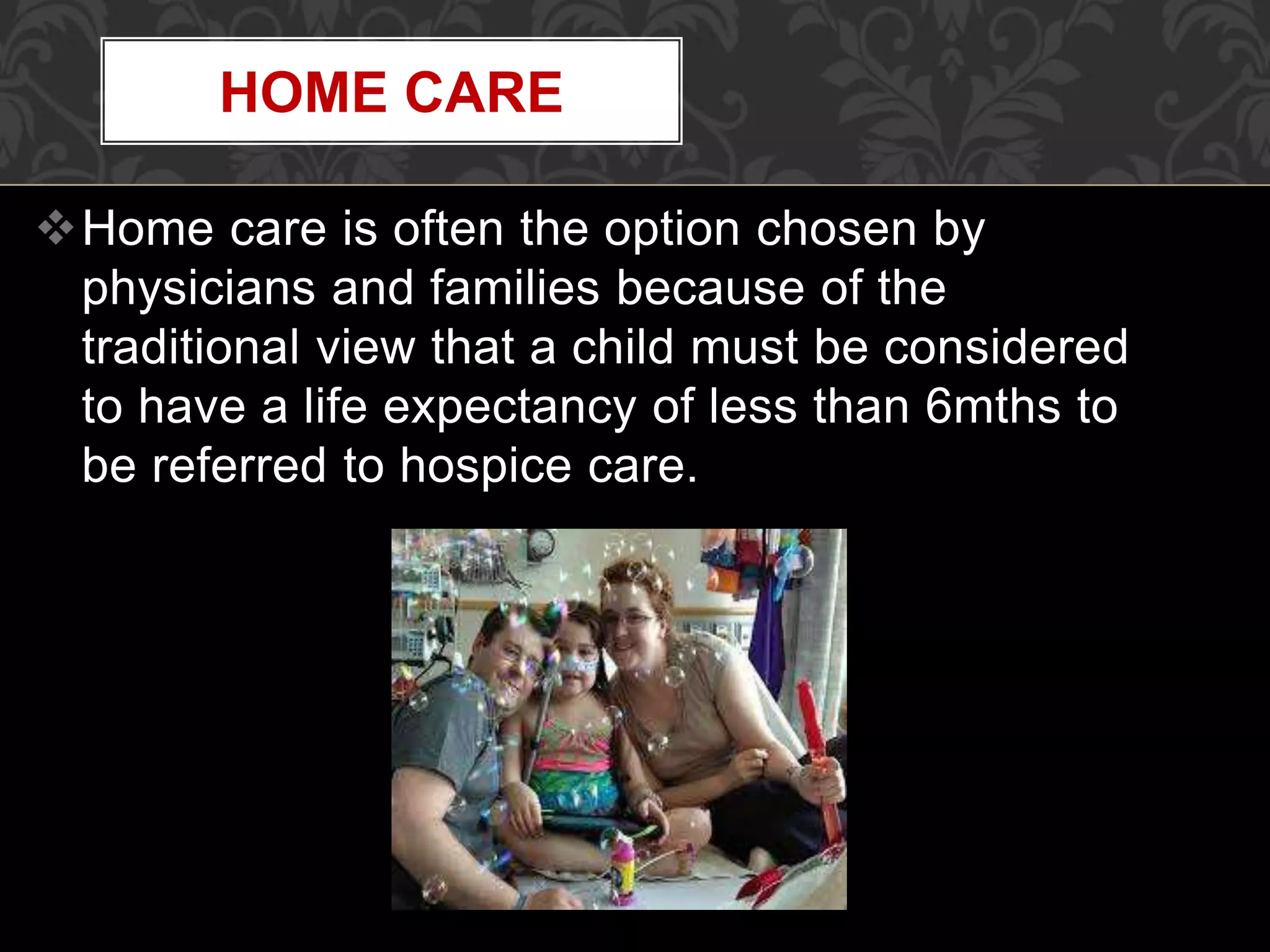
Home care is often the option chosen by
physicians and families because of the
traditional view that a child must be considered
to have a life expectancy of less than 6mths to
be referred to hospice care.
HOME CARE
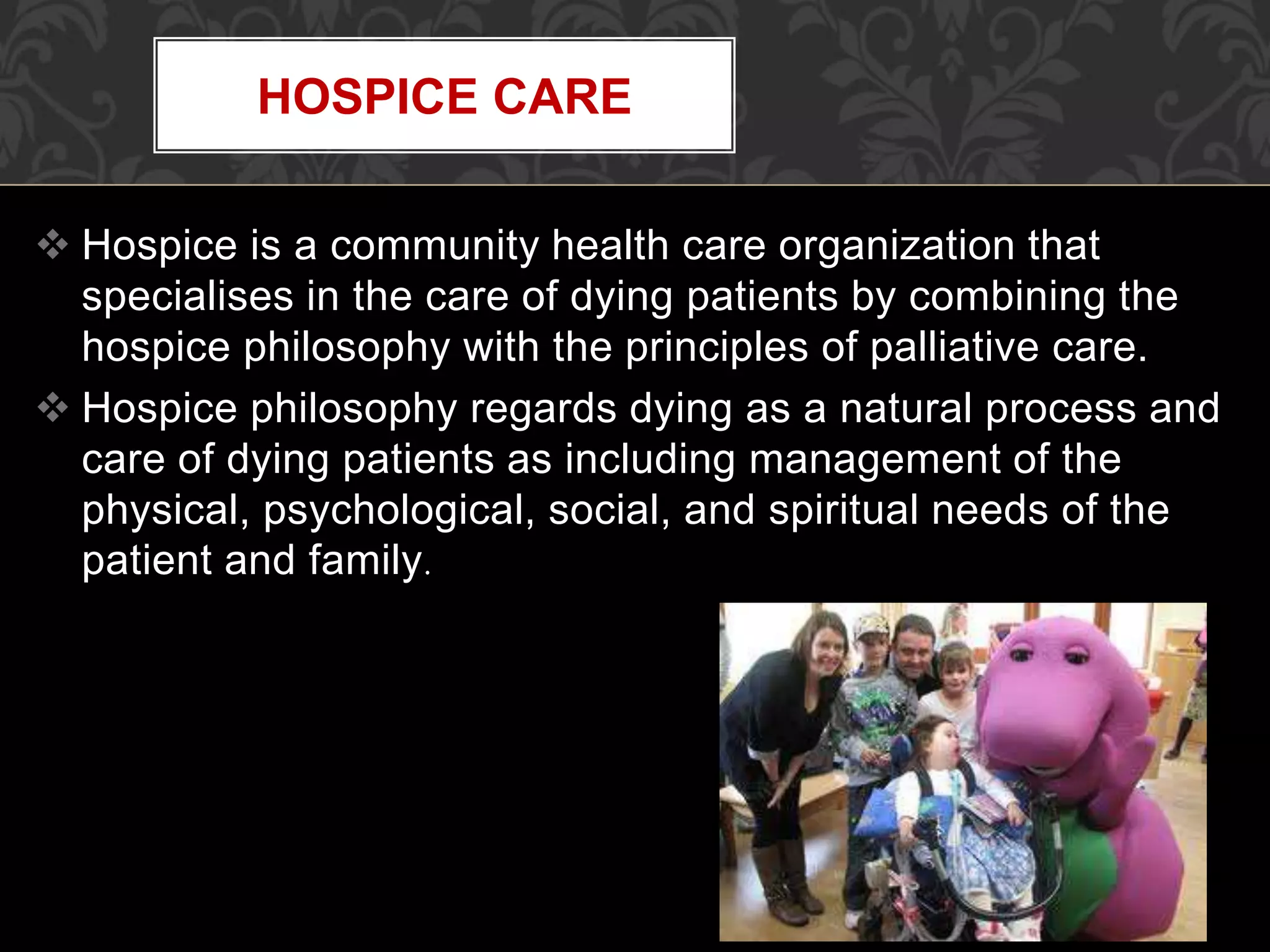
 Hospice is a community health care organization that
specialises in the care of dying patients by combining the
hospice philosophy with the principles of palliative care.
 Hospice philosophy regards dying as a natural process and
care of dying patients as including management of the
physical, psychological, social, and spiritual needs of the
patient and family.
HOSPICE CARE
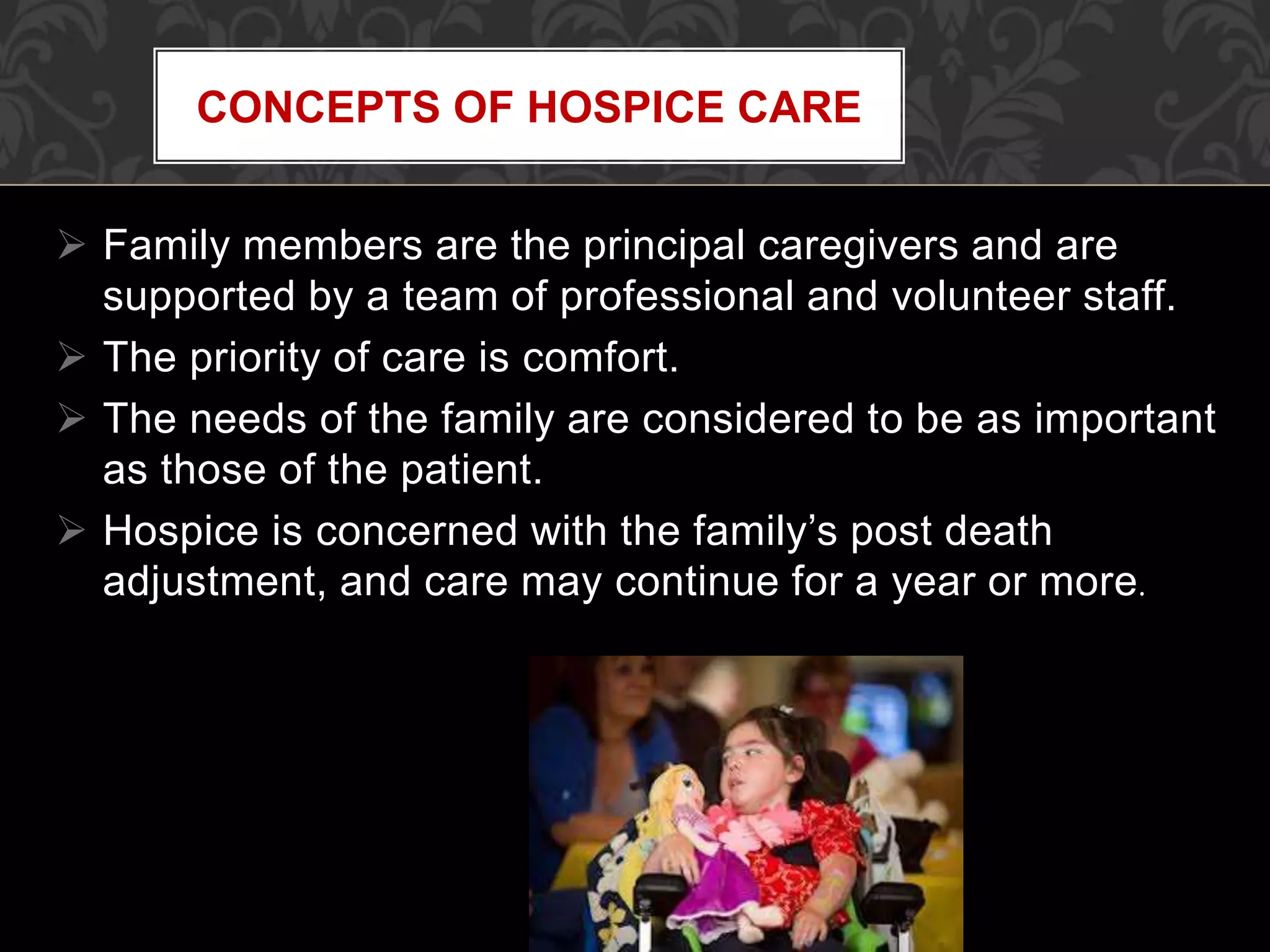
 Family members are the principal caregivers and are
supported by a team of professional and volunteer staff.
 The priority of care is comfort.
 The needs of the family are considered to be as important
as those of the patient.
 Hospice is concerned with the family’s post death
adjustment, and care may continue for a year or more.
CONCEPTS OF HOSPICE CARE
 The goal of hospice care is for children to live
life to the fullest without pain, with choices and
dignity, in the familiar environment of their
home, and with the support of their family.
CONT…..
ETHICAL CONSIDERATIONS IN “end of life”
DECISION MAKING
 The American Nurses Association code for nurses
(2004) does not support the active intent on the part
of a nurse to end a person’s life.
 It does permit the nurse to provide interventions to
relieve symptoms in the dying child even when the
interventions involve substantial risk of hastening
death.
DECISION MAKING AT THE END OF LIFE
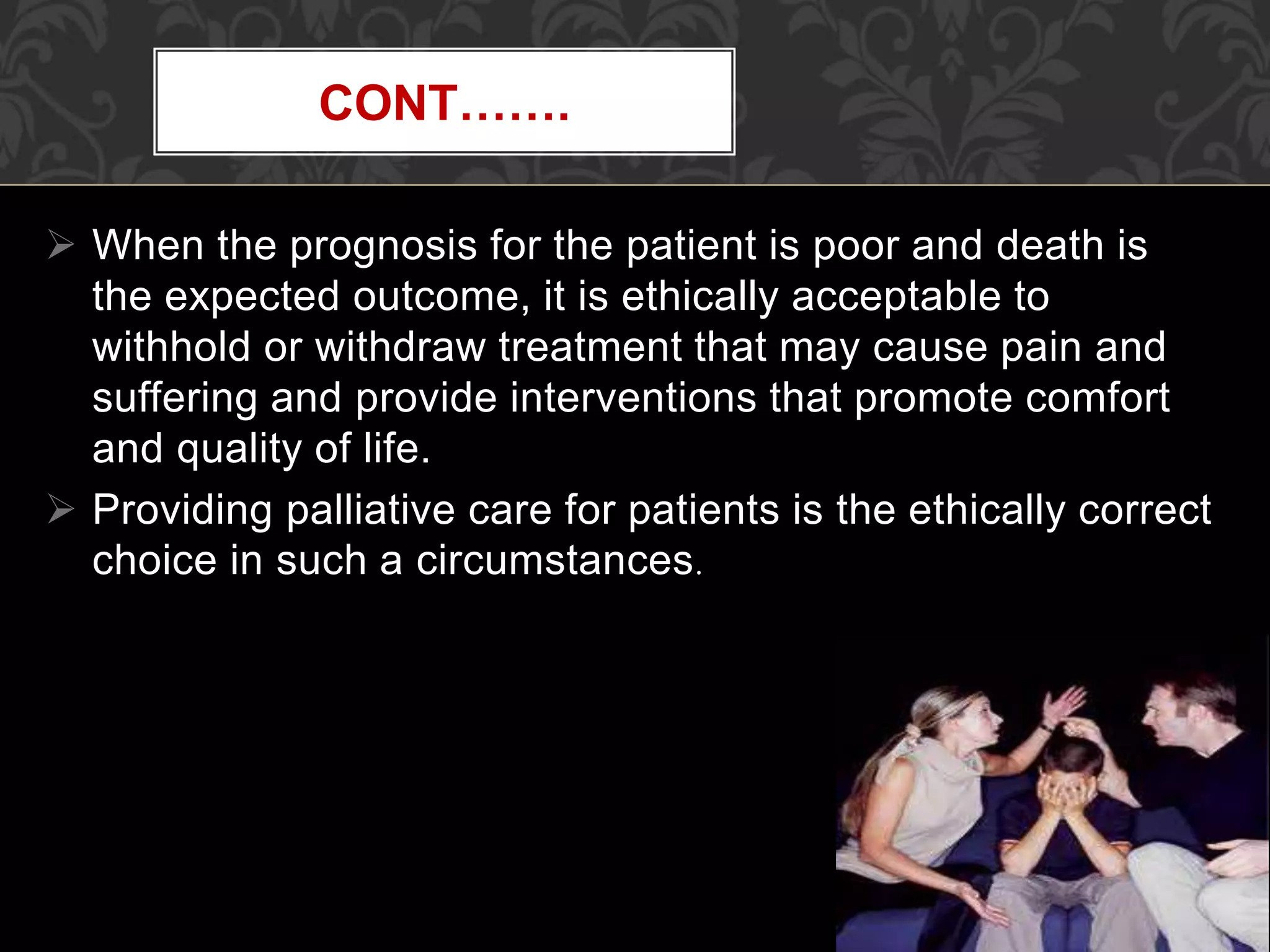
 When the prognosis for the patient is poor and death is
the expected outcome, it is ethically acceptable to
withhold or withdraw treatment that may cause pain and
suffering and provide interventions that promote comfort
and quality of life.
 Providing palliative care for patients is the ethically correct
choice in such a circumstances.
CONT…….
 Decisions by physicians regarding care are often made on
the basis of the progression of the disease or amount of
trauma, the availability of treatment options that would
 provide cure from disease or restoration of health
 the impact of such treatment on child
 the child’s overall prognosis.
PHYSICIAN/HEALTH CARE TEAM
DECISION MAKING
 If the child has experienced either a life threatening illness
or lived with a chronic illness that has now reached its
terminal phase, parents are often unprepared for the reality
of their child’s impending death.
 When the death is unexpected, as in case of accidents or
trauma, the confusion of emergency services made
challenges to parents as they are asked to make difficult
choices.
PARENTAL DECISION MAKING
 Focus on quality of life
 There can be joy and hope amidst the sadness and grief
 Good symptom control
 Whole-person approach: consider the dying person’s life
experience and current situation
 Consider also the other people who matter to that person
 Support autonomy and choice
 Emphasize open and sensitive communication with patients,
family, colleagues
 Managing pain: the WHO analgesic ladder for pain relief
PALLIATIVE CARE
FEAR OF PAIN AND SUFFERING
 The presence of unrelieved pain in a terminally ill child can
have very detrimental effects on the quality of life
experienced by the child and family
 Nurses can alleviate the fear of pain and suffering by
providing interventions aimed at treating the pain and
symptoms associated with the terminal process in
children.
NURSING CARE OF THE CHILD AND
FAMILY AT THE END OF LIFE
 The current standard of treating pain management in
children’s pain is according to the WHO’s analgesic
stepladder
 This approach promotes tailoring the pain interventions to
the child’s level of reported pain.
 Children’s pain should be assessed frequently, and
medications adjusted as necessary.
PAIN/SYMPTOM MANAGEMENT
 When a child is being cared for at home, the burden of
care experienced by parents and family members can be
great.
 When a child is dying in the hospital, parents should be
given full access to the child at all times.
 Nurses should advocate for parent’s presence in intensive
care and emergency departments and attend to the
parent’s need for food , drinks, comfortable chairs, blankets
and pillows.
FEAR OF DYING ALONE
Home death
 The child has slowly become less alert in the days before
the actual death.
 The nurses can assist the family by providing them with
information about what changes will occur as the child
progresses through the dying process.
 Nursing visits often become more frequent and longer in
duration to provide the family with additional support as the
death nears.
FEAR OF ACTUAL DEATH
Hospital death
 Increased nursing presence and attendance to the child
and family’s needs provides comfort and support for many
families.
 Nurses can assist these parents by providing detailed
information about what will happen as supportive
equipment is withdrawn, ensuring that appropriate pain
medications are administered to prevent pain during the
dying process.
CONT……
 Nurse attempt to control the environment around the
family at this time by providing privacy, asking if they
would like to play music, softening lights and monitor
noises, and arranging for any religious or cultural
rituals that the family may want performed.
CONT……
General
 Stay with the family; sit quietly if they prefer not to
talk .
 Accept the family’s grief reactions; avoid
judgemental statements.
 Avoid offering rationalization for child’s death.
 Avoid artificial consolation
 Focus on feelings by using a feeling word in the
statement.
SUPPORTING GRIEVING FAMILY
At the time of death –
 Reassure the family that everything possible is being done for
the child, if they want lifesaving interventions
 Do everything possible to ensure the child’s comfort, especially
relieving pain.
 Express personal feelings of loss or frustrations.
 Provide information that the family requests and be honest .
 Respect the emotional needs of the family members
 Make every effort to arrange for family members if they want to
be present.
 Allow the family to stay with dead child for as long as they wish.
 Arrange for spiritual support
CONT……
After death
 Attend the funeral or visitation if there was a special
closeness with the family.
 Initiate and maintain contact
 Discuss shared memories with the family.
 Discourage the use of drugs or alcohol as a method of
escaping grief.
 Encourage family members to communicate their feelings.
CONT…….
Dying child

Dying child

  • 1.
  • 2.
    INFANTS AND TODDLERS Infants and toddlers view death in relation to the loss of a caretaker and the subsequent emptiness in their lives.  Children of this age react to the dying process based upon the sadness, anger and anxiety conveyed by their parents.  Reactions will be expressed through crying, attachment to primary caregiver, and separation anxiety. CHILD’S CONCEPT OF DEATH
  • 3.
     Preschoolers viewdeath as a separation or departure and believe it to be only temporary.  Death is also seen as reversible.  Magical thinking and egocentricity at this age often leads to guilt and shame because children may believe that their thoughts or actions caused the death.  Preschooler facing an impending death frequently views their condition as punishment for behaviours or thoughts. PRESCHOOLERS-
  • 4.
     By theschool age years, death begins to be understood as a sad and irreversible event, yet it still may be considered inevitable only for adults.  By the age of 10 yrs or so, children begin to understand that they too can die.  They may continue to believe that thoughts or actions can cause death or that death serves as a punishment for wrong doing.  School age children may wonder why they are ill and must die so young.  They may also fear being without their parents love and support, which they have always known. SCHOOL-AGE CHILDREN
  • 5.
    Most adolescents havea fully developed understanding of death as inevitable and irreversible. As a result of their illness, adolescents may become isolated from their peers. The terminal illness or disability of a peer forces adolescents to face and question their own mortality and wholeness abruptly and unwillingly. ADOLESCENTS
  • 6.
    AGE COGNITIVE STAGECONCEPT 0-2yr Sensory motor Death as loss of caretaker 2-7yr Preoperational Death as a reversible and temporary separation 7-12yr Concrete operations Death as sad and irreversible but not necessarily inevitable 12+yr Formal operations Death as inevitable and irreversible but often a distant event CONCEPTS OF DEATH
  • 7.
     IN INFANTS-:Congenital anomalies, respiratory distress syndrome, disorders related to short gestation and low birth weight, and sudden infant death syndrome.  IN 5-9yrs CHILDREN-: Accidental injuries, malignant neoplasm, congenital anomalies, homicide and heart disease.  IN 10-14yrs CHILDREN-: Suicide, accidental injury, malignant neoplasm  IN 15-19yrs CHILDREN-: Homicide, suicide, malignant neoplasm, accidents, heart diseases. CAUSES FOR DEATH IN CHILDREN
  • 8.
    CHILD’S RESPONSE-  Achild who is dying wants to feel safe and does not want to be alone or in pain.  The frequently traumatising experiences of a chronic condition and its treatment tend to make children more mature and wise beyond their years.  Children with a terminal illness see treatment as worse than death.  Children may speak of seeing or even interacting with angels or the higher being recognized by their specific faith. RESPONSE TO DEATH AND DYING
  • 9.
     They mayalso speak of going to heaven to be with angels or other spiritual beings.  In addition children may speak of going to play or be with another child or relative who has already died. This type of conversation may take place anywhere from several weeks to days or hours before death. Such behaviours are commonly referred to as nearing death awareness.  A child’s death may not occur as smoothly until parents tell the child it is all right to die. CONT……
  • 10.
    Every parent facesand begins to cope with the possibility of the child’s death. Some parents may find it difficult or unacceptable to discontinue treatment. They may choose to continue treatment of a curative rather than a palliative nature. PARENT’S RESPONSE
  • 11.
     Siblings mayexperience emotions same as those experienced by their parents.  In relation to their level of cognition and development, they may not be as equipped to understand, cope, and work their way through the grieving process as smoothly and successfully.  Unresolved grief may contribute to many problems in adult life.  They often need assistance to complete the process. SIBLING’S RESPONSE
  • 12.
    HOSPITAL  Family maychoose to remain in the hospital to receive care if the child’s illness or condition is unstable and homecare is not an option or the family is uncomfortable with providing care at home.  The setting should be made as homelike as possible.  Families should be encouraged to bring familiar items from the home. TREATMENT OPTION FOR TERMINALLY ILL CHILDREN
  • 13.
    Home care isoften the option chosen by physicians and families because of the traditional view that a child must be considered to have a life expectancy of less than 6mths to be referred to hospice care. HOME CARE
  • 14.
     Hospice isa community health care organization that specialises in the care of dying patients by combining the hospice philosophy with the principles of palliative care.  Hospice philosophy regards dying as a natural process and care of dying patients as including management of the physical, psychological, social, and spiritual needs of the patient and family. HOSPICE CARE
  • 15.
     Family membersare the principal caregivers and are supported by a team of professional and volunteer staff.  The priority of care is comfort.  The needs of the family are considered to be as important as those of the patient.  Hospice is concerned with the family’s post death adjustment, and care may continue for a year or more. CONCEPTS OF HOSPICE CARE
  • 16.
     The goalof hospice care is for children to live life to the fullest without pain, with choices and dignity, in the familiar environment of their home, and with the support of their family. CONT…..
  • 17.
    ETHICAL CONSIDERATIONS IN“end of life” DECISION MAKING  The American Nurses Association code for nurses (2004) does not support the active intent on the part of a nurse to end a person’s life.  It does permit the nurse to provide interventions to relieve symptoms in the dying child even when the interventions involve substantial risk of hastening death. DECISION MAKING AT THE END OF LIFE
  • 18.
     When theprognosis for the patient is poor and death is the expected outcome, it is ethically acceptable to withhold or withdraw treatment that may cause pain and suffering and provide interventions that promote comfort and quality of life.  Providing palliative care for patients is the ethically correct choice in such a circumstances. CONT…….
  • 19.
     Decisions byphysicians regarding care are often made on the basis of the progression of the disease or amount of trauma, the availability of treatment options that would  provide cure from disease or restoration of health  the impact of such treatment on child  the child’s overall prognosis. PHYSICIAN/HEALTH CARE TEAM DECISION MAKING
  • 20.
     If thechild has experienced either a life threatening illness or lived with a chronic illness that has now reached its terminal phase, parents are often unprepared for the reality of their child’s impending death.  When the death is unexpected, as in case of accidents or trauma, the confusion of emergency services made challenges to parents as they are asked to make difficult choices. PARENTAL DECISION MAKING
  • 21.
     Focus onquality of life  There can be joy and hope amidst the sadness and grief  Good symptom control  Whole-person approach: consider the dying person’s life experience and current situation  Consider also the other people who matter to that person  Support autonomy and choice  Emphasize open and sensitive communication with patients, family, colleagues  Managing pain: the WHO analgesic ladder for pain relief PALLIATIVE CARE
  • 22.
    FEAR OF PAINAND SUFFERING  The presence of unrelieved pain in a terminally ill child can have very detrimental effects on the quality of life experienced by the child and family  Nurses can alleviate the fear of pain and suffering by providing interventions aimed at treating the pain and symptoms associated with the terminal process in children. NURSING CARE OF THE CHILD AND FAMILY AT THE END OF LIFE
  • 23.
     The currentstandard of treating pain management in children’s pain is according to the WHO’s analgesic stepladder  This approach promotes tailoring the pain interventions to the child’s level of reported pain.  Children’s pain should be assessed frequently, and medications adjusted as necessary. PAIN/SYMPTOM MANAGEMENT
  • 24.
     When achild is being cared for at home, the burden of care experienced by parents and family members can be great.  When a child is dying in the hospital, parents should be given full access to the child at all times.  Nurses should advocate for parent’s presence in intensive care and emergency departments and attend to the parent’s need for food , drinks, comfortable chairs, blankets and pillows. FEAR OF DYING ALONE
  • 25.
    Home death  Thechild has slowly become less alert in the days before the actual death.  The nurses can assist the family by providing them with information about what changes will occur as the child progresses through the dying process.  Nursing visits often become more frequent and longer in duration to provide the family with additional support as the death nears. FEAR OF ACTUAL DEATH
  • 26.
    Hospital death  Increasednursing presence and attendance to the child and family’s needs provides comfort and support for many families.  Nurses can assist these parents by providing detailed information about what will happen as supportive equipment is withdrawn, ensuring that appropriate pain medications are administered to prevent pain during the dying process. CONT……
  • 27.
     Nurse attemptto control the environment around the family at this time by providing privacy, asking if they would like to play music, softening lights and monitor noises, and arranging for any religious or cultural rituals that the family may want performed. CONT……
  • 28.
    General  Stay withthe family; sit quietly if they prefer not to talk .  Accept the family’s grief reactions; avoid judgemental statements.  Avoid offering rationalization for child’s death.  Avoid artificial consolation  Focus on feelings by using a feeling word in the statement. SUPPORTING GRIEVING FAMILY
  • 29.
    At the timeof death –  Reassure the family that everything possible is being done for the child, if they want lifesaving interventions  Do everything possible to ensure the child’s comfort, especially relieving pain.  Express personal feelings of loss or frustrations.  Provide information that the family requests and be honest .  Respect the emotional needs of the family members  Make every effort to arrange for family members if they want to be present.  Allow the family to stay with dead child for as long as they wish.  Arrange for spiritual support CONT……
  • 30.
    After death  Attendthe funeral or visitation if there was a special closeness with the family.  Initiate and maintain contact  Discuss shared memories with the family.  Discourage the use of drugs or alcohol as a method of escaping grief.  Encourage family members to communicate their feelings. CONT…….